<?xml version="1.0" encoding="ISO-8859-1"?><article xmlns:mml="http://www.w3.org/1998/Math/MathML" xmlns:xlink="http://www.w3.org/1999/xlink" xmlns:xsi="http://www.w3.org/2001/XMLSchema-instance">
<front>
<journal-meta>
<journal-id>0871-018X</journal-id>
<journal-title><![CDATA[Revista de Ciências Agrárias]]></journal-title>
<abbrev-journal-title><![CDATA[Rev. de Ciências Agrárias]]></abbrev-journal-title>
<issn>0871-018X</issn>
<publisher>
<publisher-name><![CDATA[Sociedade de Ciências Agrárias de Portugal]]></publisher-name>
</publisher>
</journal-meta>
<article-meta>
<article-id>S0871-018X2019000200018</article-id>
<article-id pub-id-type="doi">10.19084/rca.17471</article-id>
<title-group>
<article-title xml:lang="en"><![CDATA[The in vitro control of Fusarium proliferatum by propolis ethanolic extracts]]></article-title>
<article-title xml:lang="pt"><![CDATA[Extratos etanolicos de própolis no controle in vitro de Fusarium proliferatum]]></article-title>
</title-group>
<contrib-group>
<contrib contrib-type="author">
<name>
<surname><![CDATA[Gregolin]]></surname>
<given-names><![CDATA[Fernanda S.]]></given-names>
</name>
<xref ref-type="aff" rid="A1"/>
</contrib>
<contrib contrib-type="author">
<name>
<surname><![CDATA[Bonaldo]]></surname>
<given-names><![CDATA[Solange M.]]></given-names>
</name>
<xref ref-type="aff" rid="A1"/>
</contrib>
<contrib contrib-type="author">
<name>
<surname><![CDATA[Sinhorin]]></surname>
<given-names><![CDATA[Adilson P.]]></given-names>
</name>
<xref ref-type="aff" rid="A2"/>
</contrib>
<contrib contrib-type="author">
<name>
<surname><![CDATA[Banderó]]></surname>
<given-names><![CDATA[Jéfferson L.]]></given-names>
</name>
<xref ref-type="aff" rid="A3"/>
</contrib>
<contrib contrib-type="author">
<name>
<surname><![CDATA[Wobeto]]></surname>
<given-names><![CDATA[Carmen]]></given-names>
</name>
<xref ref-type="aff" rid="A2"/>
</contrib>
</contrib-group>
<aff id="AA1">
<institution><![CDATA[,Universidade Federal de Mato Grosso Instituto de Ciências Agrárias e Ambientais ]]></institution>
<addr-line><![CDATA[Sinop MT]]></addr-line>
<country>Brasil</country>
</aff>
<aff id="AA2">
<institution><![CDATA[,Universidade Federal de Mato Grosso Instituto de Ciências Naturais, Humanas e Sociais ]]></institution>
<addr-line><![CDATA[Sinop MT]]></addr-line>
<country>Brasil</country>
</aff>
<aff id="AA3">
<institution><![CDATA[,Instituto de Defesa Agropecuária do Estado de Mato Grosso  ]]></institution>
<addr-line><![CDATA[Sinop MT]]></addr-line>
<country>Brasil</country>
</aff>
<pub-date pub-type="pub">
<day>00</day>
<month>06</month>
<year>2019</year>
</pub-date>
<pub-date pub-type="epub">
<day>00</day>
<month>06</month>
<year>2019</year>
</pub-date>
<volume>42</volume>
<numero>2</numero>
<fpage>171</fpage>
<lpage>180</lpage>
<copyright-statement/>
<copyright-year/>
<self-uri xlink:href="http://scielo.pt/scielo.php?script=sci_arttext&amp;pid=S0871-018X2019000200018&amp;lng=en&amp;nrm=iso"></self-uri><self-uri xlink:href="http://scielo.pt/scielo.php?script=sci_abstract&amp;pid=S0871-018X2019000200018&amp;lng=en&amp;nrm=iso"></self-uri><self-uri xlink:href="http://scielo.pt/scielo.php?script=sci_pdf&amp;pid=S0871-018X2019000200018&amp;lng=en&amp;nrm=iso"></self-uri><abstract abstract-type="short" xml:lang="en"><p><![CDATA[In this study, we investigated the in vitro activity against Fusarium proliferatum, chemical characteristics, and antioxidant potential of eight propolis ethanolic extracts (PEE) from Brazil-six from the northern region of the state of Mato Grosso (PEE-1 to PEE-4, PEE-6, and PEE-7), one from the state of Bahia (PEE-5), and the green propolis from Minas Gerais state (PEE-8). The percentage of mycelial growth inhibition (PMGI), and macroconidia and microconidia sporulation of Fusarium proliferatum of these PEEs were evaluated and compared with that of the control (ethanol 70%). The 2% concentrations of PEE-4 to PEE-8 showed significant PMGI in relation to the control. PEE-8 at 2% stood out with the highest PMGI of Fusarium proliferatum and highest antioxidant potential. Among the PEEs that exhibited a significant antifungal action, PEE-8 and PEE-4 presented the highest total flavonoid content and PEE-6 stood out with the highest total phenolic content. Except PEE-1, all the extracts tested showed a reduction of more than 70% in the sporulation of macroconidia PEE-4 and PEE-8 presented predominance of quercetin and kaempferol flavonoids and PEE-6 of caffeic acid. Therefore, the presence of these antioxidant compounds may have contributed to the antifungal activity of these extracts.]]></p></abstract>
<abstract abstract-type="short" xml:lang="pt"><p><![CDATA[Neste estudo foi investigada a atividade no controle in vitro de Fusarium proliferatum, a composição química e a atividade antioxidante de oito extratos etanólicos de própolis (EEP) produzidos no Brasil, seis da região norte do estado de Mato Grosso, (EEP-1 até EEP-4, EEP-6 e EEP-7); um do estado da Bahia, Brasil (EEP-5) e a própolis verde do estado de Minas Gerais, Brasil (EEP-8). Foi avaliado o efeito dos EEP na percentagem de inibição do crescimento micelial (PIC) e na esporulação de macroconídios e microconídios de Fusarium proliferatum e comparado com o controle (etanol 70%). Os extratos EEP-4 até EEP-8 a 2% apresentaram PIC significativos em relação ao controle. O EEP-8 a 2% se destacou com o mais alto PIC de Fusarium proliferatum e o maior potencial antioxidante. De entre os EEP que apresentaram ação antifúngica significativa os EEP-8 e EEP-4 apresentaram os maiores teores de flavonoides totais e o EEP-6 destacou-se com os teores superiores de fenólicos totais. Todos os EEP investigados, exceto o EEP1, provocaram redução de mais de 70% na esporulação de macroconídios. Os EEP-4 e EEP-8 apresentaram predominância dos flavonóides quercitina e campferol e o EEP-6 do ácido cafeico. Estes compostos antioxidantes podem ter contribuído para a atividade antifúngica dos extratos.]]></p></abstract>
<kwd-group>
<kwd lng="en"><![CDATA[antifungal]]></kwd>
<kwd lng="en"><![CDATA[alternative control]]></kwd>
<kwd lng="en"><![CDATA[phenolics]]></kwd>
<kwd lng="en"><![CDATA[antioxidant potential]]></kwd>
<kwd lng="pt"><![CDATA[antifúngico]]></kwd>
<kwd lng="pt"><![CDATA[controle alternativo]]></kwd>
<kwd lng="pt"><![CDATA[fenólicos]]></kwd>
<kwd lng="pt"><![CDATA[potencial antioxidante]]></kwd>
</kwd-group>
</article-meta>
</front><body><![CDATA[ <p align = "right"><font face = "Verdana" size = "2"><b>ARTIGO</b></font></p>      <p><font face = "Verdana" size = "4"><b>The <i>in vitro</i> control of <i>Fusarium proliferatum </i>by propolis ethanolic extracts</b></font></p>       <p><font face = "Verdana" size = "3"><b>Extratos etanolicos de prÃ³polis no controle <i>in vitro </i>de <i>Fusarium proliferatum</i></b></font></p>      <p><font face = "Verdana" size = "2"><b>Fernanda S. Gregolin</b><sup>1</sup>, <b>Solange M. Bonaldo</b><sup>1</sup>, <b>Adilson P. Sinhorin</b><sup>2</sup>, <b>JÃ©fferson L. BanderÃ³</b><sup>3</sup> and <b>Carmen Wobeto</b><sup>2,*</sup></font></p>       <p><font face = "Verdana" size = "2"><i><sup>1</sup> Universidade Federal de Mato Grosso, Instituto de CiÃªncias AgrÃ¡rias e Ambientais, Sinop-MT, Brasil, CEP: 78550-728.</i></font></p>       <p><font face = "Verdana" size = "2"><i><sup>2</sup> Universidade Federal de Mato Grosso, Instituto de CiÃªncias Naturais, Humanas e Sociais, Sinop-MT, Brasil, CEP: 78550-728</i></font></p>       <p><font face = "Verdana" size = "2"><i><sup>3</sup> Insituto de Defesa AgropecuÃ¡ria do Estado de Mato Grosso, Sinop-MT, Brasil ,CEP: 78550-360. </i></font></p>      <p><font face = "Verdana" size = "2"><i>(*E-mail: <a href = "mailto:carmenwobeto2014@gmail.com">carmenwobeto2014@gmail.com</a>)</i></font></p>   <hr noshade size = 1>      <p><font face = "Verdana" size = "3"><b>ABSTRACT</b></font></p>       <p><font face = "Verdana" size = "2">In this study, we investigated the <i>in vitro</i> activity against <i>Fusarium proliferatum, </i>chemical characteristics, and antioxidant potential of eight propolis ethanolic extracts (PEE) from Brazil-six from the northern region of the state of Mato Grosso (PEE-1 to PEE-4, PEE-6, and PEE-7), one from the state of Bahia (PEE-5), and the green propolis from Minas Gerais state (PEE-8). The percentage of mycelial growth inhibition (PMGI), and macroconidia and microconidia sporulation of <i>Fusarium proliferatum</i> of these PEEs were evaluated and compared with that of the control (ethanol 70%). The 2% concentrations of PEE-4 to PEE-8 showed significant PMGI in relation to the control. PEE-8 at 2% stood out with the highest PMGI of <i>Fusarium proliferatum</i> and highest antioxidant potential. Among the PEEs that exhibited a significant antifungal action, PEE-8 and PEE-4 presented the highest total flavonoid content and PEE-6 stood out with the highest total phenolic content. Except PEE-1, all the extracts tested showed a reduction of more than 70% in the sporulation of macroconidia PEE-4 and PEE-8 presented predominance of quercetin and kaempferol flavonoids and PEE-6 of caffeic acid. Therefore, the presence of these antioxidant compounds may have contributed to the antifungal activity of these extracts.</font></p>       ]]></body>
<body><![CDATA[<p><font face = "Verdana" size = "2"><b>Keywords</b>: antifungal, alternative control, phenolics, antioxidant potential.</font></p>   <hr noshade size = 1>      <p><font face = "Verdana" size = "3"><b>RESUMO</b></font></p>      <p><font face = "Verdana" size = "2">Neste estudo foi investigada a atividade no controle <i>in vitro</i> de <i>Fusarium proliferatum</i>, a composiÃ§Ã£o quÃ­mica e a atividade antioxidante de oito extratos etanÃ³licos de prÃ³polis (EEP) produzidos no Brasil, seis da regiÃ£o norte do estado de Mato Grosso, (EEP-1 atÃ© EEP-4, EEP-6 e EEP-7); um do estado da Bahia, Brasil (EEP-5) e a prÃ³polis verde do estado de Minas Gerais, Brasil (EEP-8). Foi avaliado o efeito dos EEP na percentagem de inibiÃ§Ã£o do crescimento micelial (PIC) e na esporulaÃ§Ã£o de macroconÃ­dios e microconÃ­dios de <i>Fusarium proliferatum </i>e comparado com o controle (etanol 70%). Os extratos EEP-4 atÃ© EEP-8 a 2% apresentaram PIC significativos em relaÃ§Ã£o ao controle. O EEP-8 a 2% se destacou com o mais alto PIC de <i>Fusarium proliferatum</i> e o maior potencial antioxidante. De entre os EEP que apresentaram aÃ§Ã£o antifÃºngica significativa os EEP-8 e EEP-4 apresentaram os maiores teores de flavonoides totais e o EEP-6 destacou-se com os teores superiores de fenÃ³licos totais. Todos os EEP investigados, exceto o EEP1, provocaram reduÃ§Ã£o de mais de 70% na esporulaÃ§Ã£o de macroconÃ­dios. Os EEP-4 e EEP-8 apresentaram predominÃ¢ncia dos flavonÃ³ides quercitina e campferol e o EEP-6 do Ã¡cido cafeico. Estes compostos antioxidantes podem ter contribuÃ­do para a atividade antifÃºngica dos extratos.</font></p>       <p><font face = "Verdana" size = "2"><b>Palavras-chave</b>: antifÃºngico, controle alternativo, fenÃ³licos, potencial antioxidante.</font></p>   <hr noshade size = 1>      <p><font face = "Verdana" size = "3"><b>INTRODUCTION</b></font></p>      <p><font face = "Verdana" size = "2">Propolis is a gummy product produced by <i>Apis mellifera</i> bees during plant resin harvesting and is a form of beehive protection, used to seal cracks or in embalming invaders. The chemical composition of propolis is complex and varies according to botanical origin, seasonality, and geographic region. Therefore, it is studied in different regions of Brazil and also in other countries (Park <i>et al</i>., 2002; Sousa <i>et al</i>., 2007; Dezmirean <i>et al</i>., 2017; Martini <i>et al</i>., 2017; Regueira Neto <i>et al</i>., 2017).</font></p>      <p><font face = "Verdana" size = "2">There are a few studies on propolis from the northern region of Mato Grosso. Soares and Galbiati (2011) evaluated the chemical and sensory composition of propolis from two cities of these regions, ColÃ­der and Nova Santa Helena, but they did not evaluate the quantitative and qualitative composition of flavonoids, the main bioactive compounds of the product.</font></p>      <p><font face = "Verdana" size = "2">Studies on the antibiotic properties of different types of propolis have been receiving prominence in Agrarian Sciences. According to Marini <i>et al.</i> (2012), phytopathogenic bacteria such as <i>Agrobacterium tumefaciens</i>, <i>Xanthomonas axonopodis</i> pv. <i>phaseoli,</i> and <i>Erwinia chrysanthemi</i> are sensitive to the antibiotic activity of propolis.</font></p>       <p><font face = "Verdana" size = "2">However, in relation to the antifungal activity on phytopathogens, the studies do not cover all genera of fungi and there are no studies on the effect of propolis against <i>Fusarium proliferatum </i>(Tripathi and Dubey, 2004; Quiroga <i>et al</i>., 2006; Herrera <i>et al</i>., 2010; Pineda <i>et al</i>. 2010; Curifuta <i>et al</i>., 2012; Pereira <i>et al</i>., 2017).</font></p>       <p><font face = "Verdana" size = "2">The fungi of the <i>Fusarium</i> genus are causal agents of diseases in several plant species causing damage to seedlings, roots, fruits, stem, spike, and even grains, where they are responsible for the production of mycotoxins. In scientific reports, nine <i>Fusarium</i> species associated with fruit rot in banana were described: <i>F. proliferatum</i>, <i>F. oxysporum</i>, <i>F. verticillioides</i>, <i>F. sacchari</i>, <i>F. semitectum</i>, <i>F. equiseti</i>, <i>F. concentricum</i>, <i>F. camptoceras, F. solani</i> (John <i>et al</i>., 1996; Anthony <i>et al</i>., 2004; Indrakeerthi and Adikaram, 2011; EwanÃ© <i>et al</i>., 2012; Zeng <i>et al</i>., 2013). In addition, the occurrence of <i>Fusarium oxysporum</i> f. sp. <i>cubense</i>, the causal agent of Panama disease, was also reported (Pereira <i>et al</i>., 2005).</font></p>      ]]></body>
<body><![CDATA[<p><font face = "Verdana" size = "2">Crown rot disease in banana is caused by <i>Lasiodiplodia theobromae</i>, <i>Fusarium proliferatum,</i> and <i>Colletotrichum musae </i>(Anthony <i>et al</i>., 2004; Indrakeerthi and Adikaram, 2011). This disease results in reduction in shelf life and quantity and quality of the fruit produced, affecting both domestic market and exports (Anthony <i>et al</i>., 2004). In the case of <i>F. proliferatum,</i> this phytopathogen interferes in fruit quality for industrial use and produces mycotoxins, which are harmful to human and animal health; therefore, it is necessary to control this fungus for food safety (Li <i>et al</i>., 2017).</font></p>      <p><font face = "Verdana" size = "2">In this study, we investigated the chemical composition of propolis of the northern region of Mato Grosso, the green propolis of Minas Gerais, and a sample of brown propolis from Bahia and the <i>in vitro </i>effect of its ethanolic extracts (PEE) on the control of <i>Fusarium proliferatum </i>isolated from symptomatic fruits of banana.</font></p>      <p><font face = "Verdana" size = "3"><b>MATERIAL AND METHODS</b></font></p>      <p><font face = "Verdana" size = "2"><i>Sample collection and extract preparation</i></font></p>      <p><font face = "Verdana" size = "2">In August 2017, eight samples of propolis (P) were collected from Porto dos GaÃºchos city, Mato Grosso state (P1, P2, and P3); Sorriso city, Mato Grosso state (P4); Bahia state (P5); QuerÃªncia city, Mato Grosso state (P6); Sinop city, Mato Grosso state (P7); and green propolis from the state of Minas Gerais (P8).</font></p>       <p><font face = "Verdana" size = "2">The methodology described by Woisky and Salatino (1998), with some modifications, was employed for preparation of propolis ethanolic extracts (PEE): 20% propolis in 70% ethanol was used under 15 days of maceration, with three daily manual shaking. The extracts were filtered using qualitative filter paper, identified as PEE-1 to PEE-8 and kept under refrigeration in an amber bottle until the biological tests and chemical analyses were carried out.</font></p>       <p><font face = "Verdana" size = "2"><i>Assay of propolis effect on Fusarium proliferatum control</i></font></p>       <p><font face = "Verdana" size = "2">The <i>in vitro</i> assays were performed at the Laboratory of Microbiology/Phytopathology of the Federal University of Mato Grosso, Campus of Sinop, with <i>Fusarium proliferatum</i> isolated from banana.</font></p>       <p><font face = "Verdana" size = "2">The tests were performed in five replicates using PEE at two concentrations (1,6 and 2,0%) and 70% ethanol (ET 70%) as control. The PEEs were filtered for sterilization on Millipore membranes (0,45 Âµm) under reduced pressure.</font></p>      <p><font face = "Verdana" size = "2">For mycelial growth tests, culture medium potato dextrose agar (PDA, Neogen Co.; Lansing, MI, USA) was employed. The medium was placed on Petri dishes and 0.10 mL of PEE (1,6 and 2,0%) were distributed on the surface of the culture medium. Thereafter, a 7-mm-diameter disc containing mycelium of 20-day-old <i>F. proliferatum</i> was placed in the center of each dish. The dishes were covered with plastic film and incubated at 25Â° C for 7 days in the dark. Diameter measurement of the colonies was performed every 24 hours until one of the treatments reached the total diameter of the Petri dish. The mycelial growth rate index (MGI) and percentage of mycelial growth inhibition (PMGI) were calculated (Franzener<i> et al</i>., 2006).</font></p>      ]]></body>
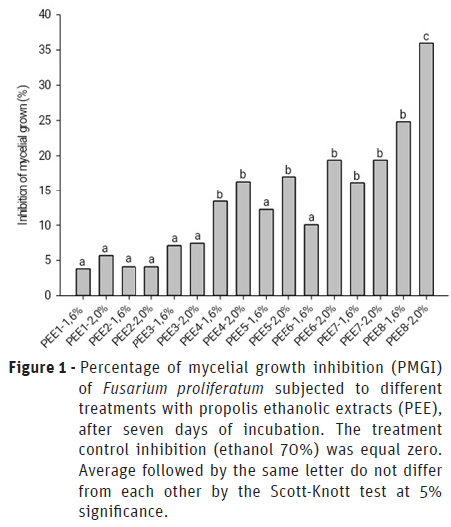
<body><![CDATA[<p><font face = "Verdana" size = "2">From each colony used during the mycelial growth bioassay, spore suspensions were prepared by the addition of 10 mL of distilled water on the dishes, scraping, and gauze filtration, followed by the counting of <i>F. proliferatum</i> macro and microconidia using a Neubauer chamber under an optical microscope (magnification of 400 times).</font></p>      <p><font face = "Verdana" size = "2"><i>Physicochemical analysis</i></font></p>       <p><font face = "Verdana" size = "2">The chemical analyses were carried out at the Food Technology Laboratory of the Federal University of Mato Grosso (UFMT)/Sinop Campus, whereas chromatographic analyses were carried out at the Integrated Chemistry Research Laboratory (LIPEQ)/ UFMT / Sinop Campus.</font></p>      <p><font face = "Verdana" size = "2">The content of ash and soluble solids in methanol in crude propolis was determined by gravimetric methods (Instituto Adolfo Lutz, 2008). Phenolic compounds and total flavonoids in extracts were determined by spectrophotometric methods using Folin-Ciocalteau and aluminum chloride as reagents and gallic acid and quercetin as standard, respectively (Woisky and Salatino, 1998).</font></p>      <p><font face = "Verdana" size = "2">Antioxidant activity was determined by sequestration of the 2,2-Diphenyl-1-picrylhydrazyl (DPPH) radical with a reading at 517 nm, using butylated hydroxytoluene butyl-hydroxy-toluene (BHT) as a sequester control and employing the following formula to calculate the antioxidant activity: Antioxidant Activity (%) = 100 - {[(Control Absorbance - Sample Absorbance Ã— 100)] / Control Absorbance} (Carpes <i>et al.</i>, 2009).</font></p>       <p><font face = "Verdana" size = "2">The PEE that showed the highest antifungal effect and antioxidant potential were investigated for phenolic acid and flavonoid content by high performance liquid chromatography (HPLC), according to the methodology described by Barbari&#8216;c <i>et al.</i> (2011), with modifications. Varian Modular Analytical HPLC Systems, equipped with a UV spectrophotometric detector at 290 nm, was employed. C18 reverse phase chromatography column (Agela, 4,6 mm Ã— 250 mm and 5 Î¼m particle diameter) was used with two mobile phases (A and B): water / methanol / acetic acid (93:5:2) (A) and water / methanol / acetic acid (3:95:2) (B). Elution was performed at a flow rate of 1 mL min<sup>-1</sup>, using the following gradient expressed in time (min) by percentage of B (t /min, % B): (0, 20), (20, 40) (30, 52), (50, 60), (70, 80), (80, 20). The PEE were rotated and solubilized in HPLC grade methanol (10 mg/mL) and a 20 Î¼L aliquot was injected into the chromatographic system. For the identification and quantification of phenolic acids and flavonoids, standard curves were constructed using the following reference substances: gallic acid, caffeic acid, Ï-cumaric acid, ferric acid, quercetin, apigenin, and kaempferol.</font></p>      <p><font face = "Verdana" size = "2"><i>Statistical analysis</i></font></p>      <p><font face = "Verdana" size = "2">The experiment was performed in a completely randomized design (CRD), with three replicates for the chemical analyses and five replicates for the bioassays. The averages were compared by the Scott Knott test (p &lt; 0,05) using Sisvar 5.8 software (Ferreira, 2011).</font></p>      <p><font face = "Verdana" size = "3"><b>RESULTS AND DISCUSSION</b></font></p>      <p><font face = "Verdana" size = "2">The green propolis extract (PEE-8) at 2% stood out due to the highest PMGI of <i>Fusarium proliferatum</i> (<a href = "#f1">Figure 1</a>) and the most pronounced antioxidant potential (<a href = "/img/revistas/rca/v42n2/v42n2a18t1.jpg" target = "_blank">Table 1</a>). The extracts at 2% of PEE-4 to PEE-7 presented lower values of PMGI than PEE-8, and differed from the control (ethanol 70%), whereas those of PEE-1 to PEE-3 did not differ from the control (<a href = "#f1">Figure 1</a>).</font></p>      
]]></body>
<body><![CDATA[<p>&nbsp;</p>  <a name = "f1"><img src = "/img/revistas/rca/v42n2/v42n2a18f1.jpg"></a>      
<p>&nbsp;</p>      <p><font face = "Verdana" size = "2">Among the PEE that presented significant antifungal action (<a href = "#f1">Figure 1</a>), PEE-8 and PEE-4 presented the highest levels of total flavonoids and PEE-6 presented significantly higher total phenolic content (<a href = "/img/revistas/rca/v42n2/v42n2a18t1.jpg" target = "_blank">Table 1</a>). These observations suggest a correlation between the antifungal effect and the levels of these compounds (Chaillou and Nazareno, 2009; Yang <i>et al</i>., 2011; Curifuta <i>et al</i>., 2012; Waller <i>et al</i>., 2017).</font></p>      
<p><font face = "Verdana" size = "2">Martini <i>et al.</i> (2017) also verified the antifungal effect of the green propolis against <i>Lasiodiplodia theobromae</i> <i>in vitro</i>. The propolis collected in the summer and in the winter showed high antifungal potential and high content of total phenolics and total flavonoids, which varied from 0,1 to 12,8 g 100 g<sup>-1</sup> and from 0,2 to 7,6 g 100 g<sup>-1</sup>, respectively.</font></p>      <p><font face = "Verdana" size = "2">However, there was no correlation between phenolic levels and antifungal activity in PEE-5 and PEE-7, but the ash levels of both did not differ from that of PEE-8, which stood out by the higher levels of this parameter (<a href = "/img/revistas/rca/v42n2/v42n2a18t1.jpg" target = "_blank">Table 1</a>). In addition, the solid content of PEE-7 in methanol was inferior only to PEE-8, which suggests that the antifungal effect can be related to other chemical compounds apart from phenolics or to the synergistic effect among these, since propolis is a complex balsamic mixture that presents more than 300 different substances (Sforcin and Bankova, 2011). Buchta <i>et al</i>. (2011) reported a partial correlation only between the levels of flavonoids in propolis and their antifungal action <i>in vitro</i>.</font></p>      
<p><font face = "Verdana" size = "2">The extracts PEE-4, PEE-6, and PEE-8 at 1,6 and 2,0% caused a reduction of 71% and 76%, respectively, in the sporulation of <i>F. proliferatum</i> macroconidia and a mean reduction of 32% in the sporulation of microconidia for both the concentrations tested (<a href = "/img/revistas/rca/v42n2/v42n2a18f2.jpg" target = "_blank">Figure 2</a>). Marini <i>et al.</i> (2012) observed a reduction of 47% in the germination of <i>Phakopsora euvitis</i> spores employing PEE at 0,5%. The differences observed may be due to different botanical origins of propolis and behavior variation of the fungi investigated (Park <i>et al</i>., 2002; Castro <i>et al</i>., 2007; Baribari&#8217;c <i>et al</i>., 2011; Curifuta <i>et al</i>., 2012).</font></p>      
<p><font face = "Verdana" size = "2">PEE-4, PEE-6, and PEE-8 were selected for the investigation of phenolic acids and flavonoids by HPLC due to their outstanding effects on the control of <i>Fusarium proliferatum </i>and high antioxidant potential. The levels of the phenolic acids and flavonoids investigated in the mentioned extracts are shown in <a href = "/img/revistas/rca/v42n2/v42n2a18t2.jpg" target = "_blank">Table 2</a>.</font></p>      
<p><font face = "Verdana" size = "2">PEE-4 and PEE-8 presented considerable levels of flavonoids (<a href = "/img/revistas/rca/v42n2/v42n2a18t1.jpg" target = "_blank">Tables 1</a> and <a href = "/img/revistas/rca/v42n2/v42n2a18t2.jpg" target = "_blank">2</a>), with predominance of quercitin and kaempferol. In PEE-6, the highest phenolic acid content was observed, with caffeic acid being predominant. These antioxidant compounds possibly contributed to the antifungal activity of extracts (Yang <i>et al.</i>, 2011; Regueira Neto <i>et al., </i>2017).</font></p>      
<p><font face = "Verdana" size = "2">The quercitin and kaempferol levels observed in this study corroborate those reported by Chailou and Nazareno (2009), who evaluated propolis from 30 different locations in Santiago del Estero, Argentina, where they found a wide range of levels from 0,8 to 47,2 mg g<sup>-1</sup> and from 0,02 to 20,3 mg g<sup>-1</sup>, for quercin and kaempferol, respectively.</font></p>      <p><font face = "Verdana" size = "2">The antifungal effect of propolis may be due to certain flavonoids or the synergistic effect of these compounds. Further, their action can be differentiated on each pathosystem. Quiroga <i>et al. </i>(2006) reported a higher percentage inhibition of <i>Fusarium oxysporum</i> growth by the use of solutions (1,16 mg ml<sup>-1</sup>) of the flavonoids pinocembrin (63,9%) and galangin (75,5%) than that of the extract of partially purified propolis (55,6%).</font></p>      ]]></body>
<body><![CDATA[<p><font face = "Verdana" size = "3"><b>CONCLUSIONS</b></font></p>      <p><font face = "Verdana" size = "2">The green propolis has a strong fungitoxic action against <i>Fusarium proliferatum.</i> Among the propolis of the northern region of Mato Grosso in two were observed high phenolics levels and action against the same fungus. Therefore, this regional beekeeping chain has potential for propolis production for use in agriculture.</font></p>      <p>&nbsp;</p>      <p><font face = "Verdana" size = "3"><b>REFERENCES</b></font></p>      <!-- ref --><p><font face = "Verdana" size = "2">Anthony, S.; Abeywickrama, K.; Dayananda R.; Wijeratman, S.W. & Arambewela, L. (2004) - Fungal pathogens associated with banana fruit in Sri-Lanka, and their treatment with essential oils. <i>Mycopathologia</i>, vol. 157, n. 1, p. 91â€“97. <a href = "https://doi.org/10.1023/B:MYCO.0000012226.95628.99" target = "_blank">https://doi.org/10.1023/B:MYCO.0000012226.95628.99</a></font>&nbsp;&nbsp;&nbsp;&nbsp;&nbsp;&nbsp;&nbsp;&nbsp;[&#160;<a href="javascript:void(0);" onclick="javascript: window.open('/scielo.php?script=sci_nlinks&ref=698919&pid=S0871-018X201900020001800001&lng=','','width=640,height=500,resizable=yes,scrollbars=1,menubar=yes,');">Links</a>&#160;]<!-- end-ref --><p><font face = "Verdana" size = "2">Barbari&#8217;c, M.; MikovÃ­c, K.; BojÃ­c, M.; Loncar, M.B.; SmolcÃ­c-Bubalo, A.; Debeljaka, Z. & MedÃ­c-SarÃ­c, M. (2011) - Chemical composition of the ethanolic propolis extracts and its effect on HeLa cells. <i>Journal of Ethnopharmacology</i>, vol. 135, n. 3, p. 772-778. <a href = "http://dx.doi.org/10.1016/j.jep.2011.04.015" target = "_blank">http://dx.doi.org/10.1016/j.jep.2011.04.015</a></font></p>      <!-- ref --><p><font face = "Verdana" size = "2">Buchta, V.; ÄŒernÃ½, J. & OpletalovÃ¡, V. (2011) - In vitro antifungal activity of propolis samples of Czech and Slovak origin. <i>Central European Journal of Biology</i>, vol. 6, n. 2, p. 160-166. <a href = "http://dx.doi.org/10.2478/s11535-010-0112-3" target = "_blank">http://dx.doi.org/10.2478/s11535-010-0112-3</a></font>&nbsp;&nbsp;&nbsp;&nbsp;&nbsp;&nbsp;&nbsp;&nbsp;[&#160;<a href="javascript:void(0);" onclick="javascript: window.open('/scielo.php?script=sci_nlinks&ref=698921&pid=S0871-018X201900020001800003&lng=','','width=640,height=500,resizable=yes,scrollbars=1,menubar=yes,');">Links</a>&#160;]<!-- end-ref --><!-- ref --><p><font face = "Verdana" size = "2">Carpes, S.T.; MourÃ£o, G.B.; Alencar, S.M de & Masson, M.L. (2009) - Chemical composition and free radical scavenging activity of Apis mellifera bee pollen from Southern Brazil. <i>Brazilian Journal of Food Technology</i>, vol. 12, n. 3, p. 220-229. <a href = "http://dx.doi.org/10.4260/BJFT2009800900016" target = "_blank">http://dx.doi.org/10.4260/BJFT2009800900016</a></font>&nbsp;&nbsp;&nbsp;&nbsp;&nbsp;&nbsp;&nbsp;&nbsp;[&#160;<a href="javascript:void(0);" onclick="javascript: window.open('/scielo.php?script=sci_nlinks&ref=698922&pid=S0871-018X201900020001800004&lng=','','width=640,height=500,resizable=yes,scrollbars=1,menubar=yes,');">Links</a>&#160;]<!-- end-ref --><!-- ref --><p><font face = "Verdana" size = "2">Castro, M.L.; Cury, J.A.; Rosalen, P.L.; Alencar, S.M.; Ikegaki, M.; Duarte, S. & Koo, H. (2007) - PrÃ³polis do sudeste e nordeste do Brasil: influÃªncia da sazonalidade na atividade antibacteriana e composiÃ§Ã£o fenÃ³lica. <i>QuÃ­mica Nova</i>, vol. 30, n. 7, p. 151-1516. <a href = "http://dx.doi.org/10.1590/S0100-40422007000700003" target = "_blank">http://dx.doi.org/10.1590/S0100-40422007000700003</a></font>&nbsp;&nbsp;&nbsp;&nbsp;&nbsp;&nbsp;&nbsp;&nbsp;[&#160;<a href="javascript:void(0);" onclick="javascript: window.open('/scielo.php?script=sci_nlinks&ref=698923&pid=S0871-018X201900020001800005&lng=','','width=640,height=500,resizable=yes,scrollbars=1,menubar=yes,');">Links</a>&#160;]<!-- end-ref --><!-- ref --><p><font face = "Verdana" size = "2">Chaillou, L.L. & Nazareno, M.A. (2009) - Bioactivity of propolis from Santiago del Estero, Argentina, related to their chemical composition. <i>LWT - Food Science and Technology</i>, vol. 42, n. 8, p. 1422-1427. <a href = "https://doi.org/10.1016/j.lwt.2009.03.002" target = "_blank">https://doi.org/10.1016/j.lwt.2009.03.002</a></font>&nbsp;&nbsp;&nbsp;&nbsp;&nbsp;&nbsp;&nbsp;&nbsp;[&#160;<a href="javascript:void(0);" onclick="javascript: window.open('/scielo.php?script=sci_nlinks&ref=698924&pid=S0871-018X201900020001800006&lng=','','width=640,height=500,resizable=yes,scrollbars=1,menubar=yes,');">Links</a>&#160;]<!-- end-ref --><!-- ref --><p><font face = "Verdana" size = "2">Curifuta, M.; Vidal, J; SÃ¡nchez-Venegas, J.; Contreras, A.; Salazar, L.A. & Alvear, M. (2012) - The in vitro antifungal evaluation of a commercial extract of Chilean propolis against six fungi of agricultural importance <i>Ciencia e InvestigaciÃ³n Agraria</i>, vol. 39, n. 2, p. 347-359. <a href = "http://dx.doi.org/10.4067/S0718-16202012000200011" target = "_blank">http://dx.doi.org/10.4067/S0718-16202012000200011</a></font>&nbsp;&nbsp;&nbsp;&nbsp;&nbsp;&nbsp;&nbsp;&nbsp;[&#160;<a href="javascript:void(0);" onclick="javascript: window.open('/scielo.php?script=sci_nlinks&ref=698925&pid=S0871-018X201900020001800007&lng=','','width=640,height=500,resizable=yes,scrollbars=1,menubar=yes,');">Links</a>&#160;]<!-- end-ref --><!-- ref --><p><font face = "Verdana" size = "2">Dezmirean, D.S.; Marghitas, L.A.; Chirila, F.; Copaciu, F.; Simonca, V.; Bobis, O. & Erlen, S. (2017) - Influence of geographic origin, plant source and polyphenolic substances on antimicrobial properties of propolis against human and honey bee pathogens. <i>Journal of Apicultural Research</i>, vol. 56, n. 5, p. 588-597. <a href = "https://doi.org/10.1080/00218839.2017.1356205" target = "_blank">https://doi.org/10.1080/00218839.2017.1356205</a></font>&nbsp;&nbsp;&nbsp;&nbsp;&nbsp;&nbsp;&nbsp;&nbsp;[&#160;<a href="javascript:void(0);" onclick="javascript: window.open('/scielo.php?script=sci_nlinks&ref=698926&pid=S0871-018X201900020001800008&lng=','','width=640,height=500,resizable=yes,scrollbars=1,menubar=yes,');">Links</a>&#160;]<!-- end-ref --><!-- ref --><p><font face = "Verdana" size = "2">EwanÃ©, C.A.; Lepoivre, P.; Bellaire, L. de L. de & Lassois L. (2012) - Involvement of phenolic compounds in the susceptibility of bananas to crown rot. A review. <i>Biotechnology, Agronomy, Society and Environment</i>, vol. 16, n. 3, p. 393-404.    &nbsp;&nbsp;&nbsp;&nbsp;&nbsp;&nbsp;&nbsp;&nbsp;[&#160;<a href="javascript:void(0);" onclick="javascript: window.open('/scielo.php?script=sci_nlinks&ref=698927&pid=S0871-018X201900020001800009&lng=','','width=640,height=500,resizable=yes,scrollbars=1,menubar=yes,');">Links</a>&#160;]<!-- end-ref --></font></p>      <!-- ref --><p><font face = "Verdana" size = "2">Ferreira, D.F. (2011) - Sisvar: a computer statistical analysis system. <i>CiÃªncia e Agrotecologia</i>, vol. 35, n. 6, p. 1039-1042. <a href = "http://dx.doi.org/10.1590/S1413-70542011000600001" target = "_blank">http://dx.doi.org/10.1590/S1413-70542011000600001</a></font>&nbsp;&nbsp;&nbsp;&nbsp;&nbsp;&nbsp;&nbsp;&nbsp;[&#160;<a href="javascript:void(0);" onclick="javascript: window.open('/scielo.php?script=sci_nlinks&ref=698929&pid=S0871-018X201900020001800010&lng=','','width=640,height=500,resizable=yes,scrollbars=1,menubar=yes,');">Links</a>&#160;]<!-- end-ref --><!-- ref --><p><font face = "Verdana" size = "2">Franzener, G.; Stangarlin, J.R.; Czepak, M.P.; Schwa-Nestrada, K.R.F. & Cruz, M.E.S. (2006) - Atividade antibacteriana, antifÃºngica e indutora de fitoalexinas de hidrolatos de plantas medicinais. <i>Semina - CiÃªncias AgrÃ¡rias</i>, vol. 28, n. 1, p. 29-38.    &nbsp;&nbsp;&nbsp;&nbsp;&nbsp;&nbsp;&nbsp;&nbsp;[&#160;<a href="javascript:void(0);" onclick="javascript: window.open('/scielo.php?script=sci_nlinks&ref=698930&pid=S0871-018X201900020001800011&lng=','','width=640,height=500,resizable=yes,scrollbars=1,menubar=yes,');">Links</a>&#160;]<!-- end-ref --></font></p>      <!-- ref --><p><font face = "Verdana" size = "2">Herrera, C.; Alvear, M.; Barrientos, L.; Montenegro, G. & Salazar, L.A. (2010) - The antifungal effect of six commercial extracts of Chilean propolis on <i>Candida</i> spp. <i>Ciencia e InvestigaciÃ³n Agraria</i>, vol. 37, n. 1, p. 75-84. <a href = "http://dx.doi.org/10.4067/S0718-16202010000100007" target = "_blank">http://dx.doi.org/10.4067/S0718-16202010000100007</a></font>&nbsp;&nbsp;&nbsp;&nbsp;&nbsp;&nbsp;&nbsp;&nbsp;[&#160;<a href="javascript:void(0);" onclick="javascript: window.open('/scielo.php?script=sci_nlinks&ref=698932&pid=S0871-018X201900020001800012&lng=','','width=640,height=500,resizable=yes,scrollbars=1,menubar=yes,');">Links</a>&#160;]<!-- end-ref --><!-- ref --><p><font face = "Verdana" size = "2">Indrakeerthi, S.R.P. & Adikaram, N.K.B. (2011) - Control of crown rot of banana using <i>Carica papaya</i> latex. <i>Journal of the National Science Foundation of Sri Lanka</i>, vol. 39, n.2, p. 155-162. <a href = "http://dx.doi.org/10.4038/jnsfsr.v39i2.3176" target = "_blank">http://dx.doi.org/10.4038/jnsfsr.v39i2.3176</a></font>&nbsp;&nbsp;&nbsp;&nbsp;&nbsp;&nbsp;&nbsp;&nbsp;[&#160;<a href="javascript:void(0);" onclick="javascript: window.open('/scielo.php?script=sci_nlinks&ref=698933&pid=S0871-018X201900020001800013&lng=','','width=640,height=500,resizable=yes,scrollbars=1,menubar=yes,');">Links</a>&#160;]<!-- end-ref --><!-- ref --><p><font face = "Verdana" size = "2">Instituto Adolfo Lutz (2008) - <i>MÃ©todos fÃ­sico-quÃ­micos para anÃ¡lise de alimentos</i>. 4Âª ed., 1a ed. digital. SÃ£o Paulo, Editora do Instituto Adolfo Lutz, 1020 p. [cit. 2017.06.12]. &lt;<a href = "http://www.ial.sp.gov.br/resources/editorinplace/ial/2016_3_19/analisedealimentosial_2008.pdf" target = "_blank">http://www.ial.sp.gov.br/resources/editorinplace/ial/2016_3_19/analisedealimentosial_2008.pdf</a>&gt;    &nbsp;&nbsp;&nbsp;&nbsp;&nbsp;&nbsp;&nbsp;&nbsp;[&#160;<a href="javascript:void(0);" onclick="javascript: window.open('/scielo.php?script=sci_nlinks&ref=698934&pid=S0871-018X201900020001800014&lng=','','width=640,height=500,resizable=yes,scrollbars=1,menubar=yes,');">Links</a>&#160;]<!-- end-ref -->.</font></p>      <!-- ref --><p><font face = "Verdana" size = "2">John C.D.; Dov, P. & Peter, J. (1996) - Fruit Diseases. <i>In</i>: Ploetz, R. (Ed.) - <i>The mango</i>. Wallingford, UK., CAB International, p. 257-280.    &nbsp;&nbsp;&nbsp;&nbsp;&nbsp;&nbsp;&nbsp;&nbsp;[&#160;<a href="javascript:void(0);" onclick="javascript: window.open('/scielo.php?script=sci_nlinks&ref=698936&pid=S0871-018X201900020001800015&lng=','','width=640,height=500,resizable=yes,scrollbars=1,menubar=yes,');">Links</a>&#160;]<!-- end-ref --></font></p>      <!-- ref --><p><font face = "Verdana" size = "2">Li T.; Wu, Q.; Wang, Y.; John, A.; Qu, H.; Gong, L.; Duan, X.; Zhu, H.; Yun, Z. & Jiang, Y. (2017) - Application of Proteomics for the Investigation of the Effect of Initial pH on Pathogenic Mechanisms of <i>Fusarium proliferatum</i> on Banana Fruit. <i>Frontiers in Microbiology</i>, vol. 8, art. 2327. <a href = "https://doi.org/10.3389/fmicb.2017.02327" target = "_blank">https://doi.org/10.3389/fmicb.2017.02327</a></font>&nbsp;&nbsp;&nbsp;&nbsp;&nbsp;&nbsp;&nbsp;&nbsp;[&#160;<a href="javascript:void(0);" onclick="javascript: window.open('/scielo.php?script=sci_nlinks&ref=698938&pid=S0871-018X201900020001800016&lng=','','width=640,height=500,resizable=yes,scrollbars=1,menubar=yes,');">Links</a>&#160;]<!-- end-ref --><!-- ref --><p><font face = "Verdana" size = "2">Marini, D.; Mensch, R.; Freiberger, M.B.; Dartora, J.; Franzener, G.; Gracia, R.C. & Stangarlin, J.R. (2012) - Efeito antifÃºngico de extratos alcoÃ³licos de prÃ³polis sobre patÃ³genos da videira. <i>Arquivos do Instituto BiolÃ³gico</i>, vol. 79, n. 2, p. 305-308. <a href = "http://dx.doi.org/10.1590/S1808-16572012000200023" target = "_blank">http://dx.doi.org/10.1590/S1808-16572012000200023</a></font>&nbsp;&nbsp;&nbsp;&nbsp;&nbsp;&nbsp;&nbsp;&nbsp;[&#160;<a href="javascript:void(0);" onclick="javascript: window.open('/scielo.php?script=sci_nlinks&ref=698939&pid=S0871-018X201900020001800017&lng=','','width=640,height=500,resizable=yes,scrollbars=1,menubar=yes,');">Links</a>&#160;]<!-- end-ref --><!-- ref --><p><font face = "Verdana" size = "2">Martini, D.; Barbosa, G.F.; Matias, R.; Marques Filho, W.C. & Garcia, N. Z. T. (2017) -Seasonality on the antifungal potential of green propolis collected in Campo Grande â€“ MS, Brazil. <i>CiÃªncia Rural</i>, vol. 47, n.3, art. e20160312. <a href = "http://dx.doi.org/10.1590/0103-8478cr20160312" target = "_blank">http://dx.doi.org/10.1590/0103-8478cr20160312</a></font>&nbsp;&nbsp;&nbsp;&nbsp;&nbsp;&nbsp;&nbsp;&nbsp;[&#160;<a href="javascript:void(0);" onclick="javascript: window.open('/scielo.php?script=sci_nlinks&ref=698940&pid=S0871-018X201900020001800018&lng=','','width=640,height=500,resizable=yes,scrollbars=1,menubar=yes,');">Links</a>&#160;]<!-- end-ref --><!-- ref --><p><font face = "Verdana" size = "2">Park, Y.K.; Alencar, S.M.; Scamparini, A.R.P. & Aguiar, C.L. (2002) - PrÃ³polis produzida no sul do Brasil, Argentina e Uruguai: evidÃªncias fitoquÃ­micas de sua origem vegetal. <i>CiÃªncia Rural</i>, vol. 32, n. 6, p. 997-1003. <a href = "http://dx.doi.org/10.1590/S0103-84782002000600013" target = "_blank">http://dx.doi.org/10.1590/S0103-84782002000600013</a></font>&nbsp;&nbsp;&nbsp;&nbsp;&nbsp;&nbsp;&nbsp;&nbsp;[&#160;<a href="javascript:void(0);" onclick="javascript: window.open('/scielo.php?script=sci_nlinks&ref=698941&pid=S0871-018X201900020001800019&lng=','','width=640,height=500,resizable=yes,scrollbars=1,menubar=yes,');">Links</a>&#160;]<!-- end-ref --><!-- ref --><p><font face = "Verdana" size = "2">Pereira, J.C.R.; Pereira, J.R.; Castro, M.E.A. & Gasparotto, L. (2005) - OcorrÃªncia do mal-do-panamÃ¡ em bananeira do subgrupo Figo, em Piau, Minas Gerais. <i>Fitopatologia Brasileira</i>, vol. 30, n. 5, p. 554. <a href = "http://dx.doi.org/10.1590/S0100-41582005000500022" target = "_blank">http://dx.doi.org/10.1590/S0100-41582005000500022</a></font>&nbsp;&nbsp;&nbsp;&nbsp;&nbsp;&nbsp;&nbsp;&nbsp;[&#160;<a href="javascript:void(0);" onclick="javascript: window.open('/scielo.php?script=sci_nlinks&ref=698942&pid=S0871-018X201900020001800020&lng=','','width=640,height=500,resizable=yes,scrollbars=1,menubar=yes,');">Links</a>&#160;]<!-- end-ref --><!-- ref --><p><font face = "Verdana" size = "2">Pereira, C.S.; Rempel, D.; Sinhorin, A.P.; Fernandes, H. & Fiorini, I.V.A. (2017) - AplicaÃ§Ã£o de extrato etanÃ³lico de prÃ³polis em doenÃ§as da cultura da soja. <i>Revista de CiÃªncias AgrÃ¡rias</i>, vol. 40, n. 4, p. 854-862. <a href = "http://dx.doi.org/10.19084/RCA17029" target = "_blank">http://dx.doi.org/10.19084/RCA17029</a></font>&nbsp;&nbsp;&nbsp;&nbsp;&nbsp;&nbsp;&nbsp;&nbsp;[&#160;<a href="javascript:void(0);" onclick="javascript: window.open('/scielo.php?script=sci_nlinks&ref=698943&pid=S0871-018X201900020001800021&lng=','','width=640,height=500,resizable=yes,scrollbars=1,menubar=yes,');">Links</a>&#160;]<!-- end-ref --><!-- ref --><p><font face = "Verdana" size = "2">Pineda, J.; Principal, J.; Barrios, C.; Milla, D.; Solano, Y. & Gil, E. (2010) - Propiedad fungistÃ¡tica <i>in vitro</i> de propÃ³leos sobre tres aislamientos de <i>Colletotrichum gloeosporioides</i>. <i>Zootecnia Tropical</i>, vol.<i> </i>28, n. 1, p. 83-91.    &nbsp;&nbsp;&nbsp;&nbsp;&nbsp;&nbsp;&nbsp;&nbsp;[&#160;<a href="javascript:void(0);" onclick="javascript: window.open('/scielo.php?script=sci_nlinks&ref=698944&pid=S0871-018X201900020001800022&lng=','','width=640,height=500,resizable=yes,scrollbars=1,menubar=yes,');">Links</a>&#160;]<!-- end-ref --> </font></p>      <!-- ref --><p><font face = "Verdana" size = "2">Quiroga, E.N.; Sampietro, D.A.; Soberon, J.R.; Sgariglia, M.A. & Vattuone, M.A. (2006) - Propolis from the northwest of Argentina as a source of antifungal principles. <i>Journal of Applied Microbiology</i>, vol. 101, n. 1, p. 103â€“110. <a href = "https://doi.org/10.1111/j.1365-2672.2006.02904.x" target = "_blank">https://doi.org/10.1111/j.1365-2672.2006.02904.x</a></font>&nbsp;&nbsp;&nbsp;&nbsp;&nbsp;&nbsp;&nbsp;&nbsp;[&#160;<a href="javascript:void(0);" onclick="javascript: window.open('/scielo.php?script=sci_nlinks&ref=698946&pid=S0871-018X201900020001800023&lng=','','width=640,height=500,resizable=yes,scrollbars=1,menubar=yes,');">Links</a>&#160;]<!-- end-ref --><!-- ref --><p><font face = "Verdana" size = "2">Regueira Neto, M.S.; Tintino, S.R.; Silva, A.R.P. da; Costa, M. do S.; Boligon, A.A.; Matias, E.F.F.; Balbino, V. de Q.; Menezes, I.R.A. & Coutinho, H.D.M. (2017) - Seasonal variation of Brazilian red propolis: Antibacterial activity, synergistic effect and phytochemical screening. <i>Food and Chemical Toxicology</i>, vol. 107, part B, p. 572-580. <a href = "https://doi.org/10.1016/j.fct.2017.03.052" target = "_blank">https://doi.org/10.1016/j.fct.2017.03.052</a></font>&nbsp;&nbsp;&nbsp;&nbsp;&nbsp;&nbsp;&nbsp;&nbsp;[&#160;<a href="javascript:void(0);" onclick="javascript: window.open('/scielo.php?script=sci_nlinks&ref=698947&pid=S0871-018X201900020001800024&lng=','','width=640,height=500,resizable=yes,scrollbars=1,menubar=yes,');">Links</a>&#160;]<!-- end-ref --><!-- ref --><p><font face = "Verdana" size = "2">Sforcin, J.M. & Bankova, V. (2011) - Propolis: Is there a potential for the development of new drugs? <i>Journal of Ethnopharmacology</i>, vol. 133, n. 2, p. 253-260. <a href = "https://doi.org/10.1016/j.jep.2010.10.032" target = "_blank">https://doi.org/10.1016/j.jep.2010.10.032</a></font>&nbsp;&nbsp;&nbsp;&nbsp;&nbsp;&nbsp;&nbsp;&nbsp;[&#160;<a href="javascript:void(0);" onclick="javascript: window.open('/scielo.php?script=sci_nlinks&ref=698948&pid=S0871-018X201900020001800025&lng=','','width=640,height=500,resizable=yes,scrollbars=1,menubar=yes,');">Links</a>&#160;]<!-- end-ref --><!-- ref --><p><font face = "Verdana" size = "2">Soares, E.M. & Galbiati, C. (2011) - CaracterizaÃ§Ã£o fÃ­sico-quÃ­mica da prÃ³polis de <i>Apis mellifera</i> (L.) em apiÃ¡rios de Colider e Nova Santa Helena, territÃ³rio do portal da AmazÃ´nia, Mato Grosso. <i>In</i>: Santos, J.E.; Galbiati, C. & Moschini, L.E. (Eds.) - <i>GestÃ£o e EducaÃ§Ã£o Ambiental: Ã¡gua, biodiversidade e cultura</i>. SÃ£o Carlos, RiMa, p. 67-81.    &nbsp;&nbsp;&nbsp;&nbsp;&nbsp;&nbsp;&nbsp;&nbsp;[&#160;<a href="javascript:void(0);" onclick="javascript: window.open('/scielo.php?script=sci_nlinks&ref=698949&pid=S0871-018X201900020001800026&lng=','','width=640,height=500,resizable=yes,scrollbars=1,menubar=yes,');">Links</a>&#160;]<!-- end-ref --></font></p>      <!-- ref --><p><font face = "Verdana" size = "2">Sousa, J.P.B.; Furtado, N.A.J.C.; Jorge, R., Soares, A.E.E. & Bastos, J.K. (2007) - Perfis fÃ­sico-quÃ­mico e cromatogrÃ¡fico de amostras de prÃ³polis produzidas nas microrregiÃµes de Franca (SP) e Passos (MG). <i>Revista Brasileira de Farmacognosia</i> vol. 17, n. 1, p. 85-93.    &nbsp;&nbsp;&nbsp;&nbsp;&nbsp;&nbsp;&nbsp;&nbsp;[&#160;<a href="javascript:void(0);" onclick="javascript: window.open('/scielo.php?script=sci_nlinks&ref=698951&pid=S0871-018X201900020001800027&lng=','','width=640,height=500,resizable=yes,scrollbars=1,menubar=yes,');">Links</a>&#160;]<!-- end-ref --></font></p>      <!-- ref --><p><font face = "Verdana" size = "2">Tripathi, P. & Dubey. N.K. (2004) - Exploitation of natural products as an alternative strategy to control postharvest fungal rotting of fruit and vegetables. <i>Postharvest Biology and Technology</i>, vol. 32, n. 3, p. 235-245. <a href = "https://doi.org/10.1016/j.postharvbio.2003.11.005" target = "_blank">https://doi.org/10.1016/j.postharvbio.2003.11.005</a></font>&nbsp;&nbsp;&nbsp;&nbsp;&nbsp;&nbsp;&nbsp;&nbsp;[&#160;<a href="javascript:void(0);" onclick="javascript: window.open('/scielo.php?script=sci_nlinks&ref=698953&pid=S0871-018X201900020001800028&lng=','','width=640,height=500,resizable=yes,scrollbars=1,menubar=yes,');">Links</a>&#160;]<!-- end-ref --><!-- ref --><p><font face = "Verdana" size = "2">Waller, S.B.; Peter, C.M.; Hoffmann, J.F.; Picoli, T.; OsÃ³rio, L. da G.; Chaves, F.; Zani, J.L.; Faria, R.O. de; Mello, J.R.B. de & Meireles, M.C.A. (2017) - Chemical and cytotoxic analyses of brown Brazilian propolis (<i>Apis melifera</i>) and in vitro activity against itraconazole-resistant <i>Sporothrix brasiliensis</i>. <i>Microbial Pathogenesis</i>, vol. 105, p. 117-121. <a href = "https://doi.org/10.1016/j.micpath.2017.02.022" target = "_blank">https://doi.org/10.1016/j.micpath.2017.02.022</a></font>&nbsp;&nbsp;&nbsp;&nbsp;&nbsp;&nbsp;&nbsp;&nbsp;[&#160;<a href="javascript:void(0);" onclick="javascript: window.open('/scielo.php?script=sci_nlinks&ref=698954&pid=S0871-018X201900020001800029&lng=','','width=640,height=500,resizable=yes,scrollbars=1,menubar=yes,');">Links</a>&#160;]<!-- end-ref --><!-- ref --><p><font face = "Verdana" size = "2">Woisky, R.G. & Salatino, A. (1998) - Analysis of propolis: some parameters and procedures of chemical quality control. <i>Journal of Apicultural Research</i>, vol. 37, n. 2, p. 99-105. <a href = "https://doi.org/10.1080/00218839.1998.11100961" target = "_blank">https://doi.org/10.1080/00218839.1998.11100961</a></font>&nbsp;&nbsp;&nbsp;&nbsp;&nbsp;&nbsp;&nbsp;&nbsp;[&#160;<a href="javascript:void(0);" onclick="javascript: window.open('/scielo.php?script=sci_nlinks&ref=698955&pid=S0871-018X201900020001800030&lng=','','width=640,height=500,resizable=yes,scrollbars=1,menubar=yes,');">Links</a>&#160;]<!-- end-ref --><!-- ref --><p><font face = "Verdana" size = "2">Yang, S.Z.; Peng, L.T.; Su, X.J.; Chen, F.; Cheng, Y.J.; Fan, G. & Pan, S.Y. (2011) - Bioassay-guided isolation and identification of antifungal components from propolis against <i>Penicillium italicum</i>. <i>Food Chemistry</i>, vol. 127, n. 1, p. 210â€“215. <a href = "https://doi.org/10.1016/j.foodchem.2010.12.011" target = "_blank">https://doi.org/10.1016/j.foodchem.2010.12.011</a></font>&nbsp;&nbsp;&nbsp;&nbsp;&nbsp;&nbsp;&nbsp;&nbsp;[&#160;<a href="javascript:void(0);" onclick="javascript: window.open('/scielo.php?script=sci_nlinks&ref=698956&pid=S0871-018X201900020001800031&lng=','','width=640,height=500,resizable=yes,scrollbars=1,menubar=yes,');">Links</a>&#160;]<!-- end-ref --><!-- ref --><p><font face = "Verdana" size = "2">Zeng, L.S.; Zhao, Z.H.; Lu, S.; Xi, Z.J.; Li, M.H. & Xi, P.G. (2013) - The <i>Fusarium</i> species isolated from banana and their phylogenetic relationships. <i>Mycosystema</i>, vol. 32, n. 4, p. 617-632.    &nbsp;&nbsp;&nbsp;&nbsp;&nbsp;&nbsp;&nbsp;&nbsp;[&#160;<a href="javascript:void(0);" onclick="javascript: window.open('/scielo.php?script=sci_nlinks&ref=698957&pid=S0871-018X201900020001800032&lng=','','width=640,height=500,resizable=yes,scrollbars=1,menubar=yes,');">Links</a>&#160;]<!-- end-ref --></font></p>      <p>&nbsp;</p>      <p><font face = "Verdana" size = "3"><b>ACKNOWLEDGMENTS</b></font></p>      <p><font face = "Verdana" size = "2">The authors thank National Council for Scientific and Technological Development (CNPq) for granting a scientific initiation grant.</font></p>      <p>&nbsp;</p>      <p><font face = "Verdana" size = "2">Received/recebido: 2018.09.07</font></p>       <p><font face = "Verdana" size = "2">Aceite/accepted: 2019.03.13</font></p>      ]]></body>
<body><![CDATA[ ]]></body><back>
<ref-list>
<ref id="B1">
<nlm-citation citation-type="journal">
<person-group person-group-type="author">
<name>
<surname><![CDATA[Anthony]]></surname>
<given-names><![CDATA[S.]]></given-names>
</name>
<name>
<surname><![CDATA[Abeywickrama]]></surname>
<given-names><![CDATA[K.]]></given-names>
</name>
<name>
<surname><![CDATA[Dayananda]]></surname>
<given-names><![CDATA[R.]]></given-names>
</name>
<name>
<surname><![CDATA[Wijeratman]]></surname>
<given-names><![CDATA[S.W.]]></given-names>
</name>
<name>
<surname><![CDATA[Arambewela]]></surname>
<given-names><![CDATA[L.]]></given-names>
</name>
</person-group>
<article-title xml:lang="en"><![CDATA[Fungal pathogens associated with banana fruit in Sri-Lanka, and their treatment with essential oils]]></article-title>
<source><![CDATA[Mycopathologia]]></source>
<year>2004</year>
<volume>157</volume>
<numero>1</numero>
<issue>1</issue>
<page-range>91-97</page-range></nlm-citation>
</ref>
<ref id="B2">
<nlm-citation citation-type="journal">
<person-group person-group-type="author">
<name>
<surname><![CDATA[Barbaríc]]></surname>
<given-names><![CDATA[M.]]></given-names>
</name>
<name>
<surname><![CDATA[Mikovíc]]></surname>
<given-names><![CDATA[K.]]></given-names>
</name>
<name>
<surname><![CDATA[Bojíc]]></surname>
<given-names><![CDATA[M.]]></given-names>
</name>
<name>
<surname><![CDATA[Loncar]]></surname>
<given-names><![CDATA[M.B.]]></given-names>
</name>
<name>
<surname><![CDATA[Smolcíc-Bubalo]]></surname>
<given-names><![CDATA[A.]]></given-names>
</name>
<name>
<surname><![CDATA[Debeljaka]]></surname>
<given-names><![CDATA[Z.]]></given-names>
</name>
<name>
<surname><![CDATA[Medíc-Saríc]]></surname>
<given-names><![CDATA[M.]]></given-names>
</name>
</person-group>
<article-title xml:lang="en"><![CDATA[Chemical composition of the ethanolic propolis extracts and its effect on HeLa cells]]></article-title>
<source><![CDATA[Journal of Ethnopharmacology]]></source>
<year>2011</year>
<volume>135</volume>
<numero>3</numero>
<issue>3</issue>
<page-range>772-778</page-range></nlm-citation>
</ref>
<ref id="B3">
<nlm-citation citation-type="journal">
<person-group person-group-type="author">
<name>
<surname><![CDATA[Buchta]]></surname>
<given-names><![CDATA[V.]]></given-names>
</name>
<name>
<surname><![CDATA[erný]]></surname>
<given-names><![CDATA[J.]]></given-names>
</name>
<name>
<surname><![CDATA[Opletalová]]></surname>
<given-names><![CDATA[V.]]></given-names>
</name>
</person-group>
<article-title xml:lang="en"><![CDATA[In vitro antifungal activity of propolis samples of Czech and Slovak origin]]></article-title>
<source><![CDATA[Central European Journal of Biology]]></source>
<year>2011</year>
<volume>6</volume>
<numero>2</numero>
<issue>2</issue>
<page-range>160-166</page-range></nlm-citation>
</ref>
<ref id="B4">
<nlm-citation citation-type="journal">
<person-group person-group-type="author">
<name>
<surname><![CDATA[Carpes]]></surname>
<given-names><![CDATA[S.T.]]></given-names>
</name>
<name>
<surname><![CDATA[Mourão]]></surname>
<given-names><![CDATA[G.B.]]></given-names>
</name>
<name>
<surname><![CDATA[Alencar]]></surname>
<given-names><![CDATA[S.M de]]></given-names>
</name>
<name>
<surname><![CDATA[Masson]]></surname>
<given-names><![CDATA[M.L.]]></given-names>
</name>
</person-group>
<article-title xml:lang="en"><![CDATA[Chemical composition and free radical scavenging activity of Apis mellifera bee pollen from Southern Brazil]]></article-title>
<source><![CDATA[Brazilian Journal of Food Technology]]></source>
<year>2009</year>
<volume>12</volume>
<numero>3</numero>
<issue>3</issue>
<page-range>220-229</page-range></nlm-citation>
</ref>
<ref id="B5">
<nlm-citation citation-type="journal">
<person-group person-group-type="author">
<name>
<surname><![CDATA[Castro]]></surname>
<given-names><![CDATA[M.L.]]></given-names>
</name>
<name>
<surname><![CDATA[Cury]]></surname>
<given-names><![CDATA[J.A.]]></given-names>
</name>
<name>
<surname><![CDATA[Rosalen]]></surname>
<given-names><![CDATA[P.L.]]></given-names>
</name>
<name>
<surname><![CDATA[Alencar]]></surname>
<given-names><![CDATA[S.M.]]></given-names>
</name>
<name>
<surname><![CDATA[Ikegaki]]></surname>
<given-names><![CDATA[M.]]></given-names>
</name>
<name>
<surname><![CDATA[Duarte]]></surname>
<given-names><![CDATA[S.]]></given-names>
</name>
<name>
<surname><![CDATA[Koo]]></surname>
<given-names><![CDATA[H.]]></given-names>
</name>
</person-group>
<article-title xml:lang="pt"><![CDATA[Própolis do sudeste e nordeste do Brasil: influência da sazonalidade na atividade antibacteriana e composição fenólica]]></article-title>
<source><![CDATA[Química Nova]]></source>
<year>2007</year>
<volume>30</volume>
<numero>7</numero>
<issue>7</issue>
<page-range>151-1516</page-range></nlm-citation>
</ref>
<ref id="B6">
<nlm-citation citation-type="journal">
<person-group person-group-type="author">
<name>
<surname><![CDATA[Chaillou]]></surname>
<given-names><![CDATA[L.L.]]></given-names>
</name>
<name>
<surname><![CDATA[Nazareno]]></surname>
<given-names><![CDATA[M.A.]]></given-names>
</name>
</person-group>
<article-title xml:lang="en"><![CDATA[Bioactivity of propolis from Santiago del Estero, Argentina, related to their chemical composition]]></article-title>
<source><![CDATA[LWT - Food Science and Technology]]></source>
<year>2009</year>
<volume>42</volume>
<numero>8</numero>
<issue>8</issue>
<page-range>1422-1427</page-range></nlm-citation>
</ref>
<ref id="B7">
<nlm-citation citation-type="journal">
<person-group person-group-type="author">
<name>
<surname><![CDATA[Curifuta]]></surname>
<given-names><![CDATA[M.]]></given-names>
</name>
<name>
<surname><![CDATA[Vidal]]></surname>
<given-names><![CDATA[J]]></given-names>
</name>
<name>
<surname><![CDATA[Sánchez-Venegas]]></surname>
<given-names><![CDATA[J.]]></given-names>
</name>
<name>
<surname><![CDATA[Contreras]]></surname>
<given-names><![CDATA[A.]]></given-names>
</name>
<name>
<surname><![CDATA[Salazar]]></surname>
<given-names><![CDATA[L.A.]]></given-names>
</name>
<name>
<surname><![CDATA[Alvear]]></surname>
<given-names><![CDATA[M.]]></given-names>
</name>
</person-group>
<article-title xml:lang="en"><![CDATA[The in vitro antifungal evaluation of a commercial extract of Chilean propolis against six fungi of agricultural importance]]></article-title>
<source><![CDATA[Ciencia e Investigación Agraria]]></source>
<year>2012</year>
<volume>39</volume>
<numero>2</numero>
<issue>2</issue>
<page-range>347-359</page-range></nlm-citation>
</ref>
<ref id="B8">
<nlm-citation citation-type="journal">
<person-group person-group-type="author">
<name>
<surname><![CDATA[Dezmirean]]></surname>
<given-names><![CDATA[D.S.]]></given-names>
</name>
<name>
<surname><![CDATA[Marghitas]]></surname>
<given-names><![CDATA[L.A.]]></given-names>
</name>
<name>
<surname><![CDATA[Chirila]]></surname>
<given-names><![CDATA[F.]]></given-names>
</name>
<name>
<surname><![CDATA[Copaciu]]></surname>
<given-names><![CDATA[F.]]></given-names>
</name>
<name>
<surname><![CDATA[Simonca]]></surname>
<given-names><![CDATA[V.]]></given-names>
</name>
<name>
<surname><![CDATA[Bobis]]></surname>
<given-names><![CDATA[O.]]></given-names>
</name>
<name>
<surname><![CDATA[Erlen]]></surname>
<given-names><![CDATA[S.]]></given-names>
</name>
</person-group>
<article-title xml:lang="en"><![CDATA[Influence of geographic origin, plant source and polyphenolic substances on antimicrobial properties of propolis against human and honey bee pathogens]]></article-title>
<source><![CDATA[Journal of Apicultural Research]]></source>
<year>2017</year>
<volume>56</volume>
<numero>5</numero>
<issue>5</issue>
<page-range>588-597</page-range></nlm-citation>
</ref>
<ref id="B9">
<nlm-citation citation-type="journal">
<person-group person-group-type="author">
<name>
<surname><![CDATA[Ewané]]></surname>
<given-names><![CDATA[C.A.]]></given-names>
</name>
<name>
<surname><![CDATA[Lepoivre]]></surname>
<given-names><![CDATA[P.]]></given-names>
</name>
<name>
<surname><![CDATA[Bellaire]]></surname>
<given-names><![CDATA[L. de L. de]]></given-names>
</name>
<name>
<surname><![CDATA[Lassois]]></surname>
<given-names><![CDATA[L.]]></given-names>
</name>
</person-group>
<article-title xml:lang="en"><![CDATA[Involvement of phenolic compounds in the susceptibility of bananas to crown rot: A review]]></article-title>
<source><![CDATA[Biotechnology, Agronomy, Society and Environment]]></source>
<year>2012</year>
<volume>16</volume>
<numero>3</numero>
<issue>3</issue>
<page-range>393-404</page-range></nlm-citation>
</ref>
<ref id="B10">
<nlm-citation citation-type="journal">
<person-group person-group-type="author">
<name>
<surname><![CDATA[Ferreira]]></surname>
<given-names><![CDATA[D.F.]]></given-names>
</name>
</person-group>
<article-title xml:lang="en"><![CDATA[Sisvar: a computer statistical analysis system]]></article-title>
<source><![CDATA[Ciência e Agrotecologia]]></source>
<year>2011</year>
<volume>35</volume>
<numero>6</numero>
<issue>6</issue>
<page-range>1039-1042</page-range></nlm-citation>
</ref>
<ref id="B11">
<nlm-citation citation-type="journal">
<person-group person-group-type="author">
<name>
<surname><![CDATA[Franzener]]></surname>
<given-names><![CDATA[G.]]></given-names>
</name>
<name>
<surname><![CDATA[Stangarlin]]></surname>
<given-names><![CDATA[J.R.]]></given-names>
</name>
<name>
<surname><![CDATA[Czepak]]></surname>
<given-names><![CDATA[M.P.]]></given-names>
</name>
<name>
<surname><![CDATA[Schwa-Nestrada]]></surname>
<given-names><![CDATA[K.R.F.]]></given-names>
</name>
<name>
<surname><![CDATA[Cruz]]></surname>
<given-names><![CDATA[M.E.S.]]></given-names>
</name>
</person-group>
<article-title xml:lang="pt"><![CDATA[Atividade antibacteriana, antifúngica e indutora de fitoalexinas de hidrolatos de plantas medicinais]]></article-title>
<source><![CDATA[Semina - Ciências Agrárias]]></source>
<year>2006</year>
<volume>28</volume>
<numero>1</numero>
<issue>1</issue>
<page-range>29-38</page-range></nlm-citation>
</ref>
<ref id="B12">
<nlm-citation citation-type="journal">
<person-group person-group-type="author">
<name>
<surname><![CDATA[Herrera]]></surname>
<given-names><![CDATA[C.]]></given-names>
</name>
<name>
<surname><![CDATA[Alvear]]></surname>
<given-names><![CDATA[M.]]></given-names>
</name>
<name>
<surname><![CDATA[Barrientos]]></surname>
<given-names><![CDATA[L.]]></given-names>
</name>
<name>
<surname><![CDATA[Montenegro]]></surname>
<given-names><![CDATA[G.]]></given-names>
</name>
<name>
<surname><![CDATA[Salazar]]></surname>
<given-names><![CDATA[L.A.]]></given-names>
</name>
</person-group>
<article-title xml:lang="en"><![CDATA[The antifungal effect of six commercial extracts of Chilean propolis on Candida spp]]></article-title>
<source><![CDATA[Ciencia e Investigación Agraria]]></source>
<year>2010</year>
<volume>37</volume>
<numero>1</numero>
<issue>1</issue>
<page-range>75-84</page-range></nlm-citation>
</ref>
<ref id="B13">
<nlm-citation citation-type="journal">
<person-group person-group-type="author">
<name>
<surname><![CDATA[Indrakeerthi]]></surname>
<given-names><![CDATA[S.R.P.]]></given-names>
</name>
<name>
<surname><![CDATA[Adikaram]]></surname>
<given-names><![CDATA[N.K.B.]]></given-names>
</name>
</person-group>
<article-title xml:lang="en"><![CDATA[Control of crown rot of banana using Carica papaya latex]]></article-title>
<source><![CDATA[Journal of the National Science Foundation of Sri Lanka]]></source>
<year>2011</year>
<volume>39</volume>
<numero>2</numero>
<issue>2</issue>
<page-range>155-162</page-range></nlm-citation>
</ref>
<ref id="B14">
<nlm-citation citation-type="book">
<collab>Instituto Adolfo Lutz</collab>
<source><![CDATA[Métodos físico-químicos para análise de alimentos]]></source>
<year>2008</year>
<edition>4ª</edition>
<publisher-loc><![CDATA[São Paulo ]]></publisher-loc>
<publisher-name><![CDATA[Editora do Instituto Adolfo Lutz]]></publisher-name>
</nlm-citation>
</ref>
<ref id="B15">
<nlm-citation citation-type="book">
<person-group person-group-type="author">
<name>
<surname><![CDATA[John]]></surname>
<given-names><![CDATA[C.D.]]></given-names>
</name>
<name>
<surname><![CDATA[Dov]]></surname>
<given-names><![CDATA[P.]]></given-names>
</name>
<name>
<surname><![CDATA[Peter]]></surname>
<given-names><![CDATA[J.]]></given-names>
</name>
</person-group>
<article-title xml:lang="en"><![CDATA[Fruit Diseases]]></article-title>
<person-group person-group-type="editor">
<name>
<surname><![CDATA[Ploetz]]></surname>
<given-names><![CDATA[R.]]></given-names>
</name>
</person-group>
<source><![CDATA[The mango]]></source>
<year>1996</year>
<page-range>257-280</page-range><publisher-loc><![CDATA[Wallingford ]]></publisher-loc>
<publisher-name><![CDATA[CAB International]]></publisher-name>
</nlm-citation>
</ref>
<ref id="B16">
<nlm-citation citation-type="journal">
<person-group person-group-type="author">
<name>
<surname><![CDATA[Li]]></surname>
<given-names><![CDATA[T.]]></given-names>
</name>
<name>
<surname><![CDATA[Wu]]></surname>
<given-names><![CDATA[Q.]]></given-names>
</name>
<name>
<surname><![CDATA[Wang]]></surname>
<given-names><![CDATA[Y.]]></given-names>
</name>
<name>
<surname><![CDATA[John]]></surname>
<given-names><![CDATA[A.]]></given-names>
</name>
<name>
<surname><![CDATA[Qu]]></surname>
<given-names><![CDATA[H.]]></given-names>
</name>
<name>
<surname><![CDATA[Gong]]></surname>
<given-names><![CDATA[L.]]></given-names>
</name>
<name>
<surname><![CDATA[Duan]]></surname>
<given-names><![CDATA[X.]]></given-names>
</name>
<name>
<surname><![CDATA[Zhu]]></surname>
<given-names><![CDATA[H.]]></given-names>
</name>
<name>
<surname><![CDATA[Yun]]></surname>
<given-names><![CDATA[Z.]]></given-names>
</name>
<name>
<surname><![CDATA[Jiang]]></surname>
<given-names><![CDATA[Y.]]></given-names>
</name>
</person-group>
<article-title xml:lang="en"><![CDATA[Application of Proteomics for the Investigation of the Effect of Initial pH on Pathogenic Mechanisms of Fusarium proliferatum on Banana Fruit]]></article-title>
<source><![CDATA[Frontiers in Microbiology]]></source>
<year>2017</year>
<volume>8</volume>
<page-range>2327</page-range></nlm-citation>
</ref>
<ref id="B17">
<nlm-citation citation-type="journal">
<person-group person-group-type="author">
<name>
<surname><![CDATA[Marini]]></surname>
<given-names><![CDATA[D.]]></given-names>
</name>
<name>
<surname><![CDATA[Mensch]]></surname>
<given-names><![CDATA[R.]]></given-names>
</name>
<name>
<surname><![CDATA[Freiberger]]></surname>
<given-names><![CDATA[M.B.]]></given-names>
</name>
<name>
<surname><![CDATA[Dartora]]></surname>
<given-names><![CDATA[J.]]></given-names>
</name>
<name>
<surname><![CDATA[Franzener]]></surname>
<given-names><![CDATA[G.]]></given-names>
</name>
<name>
<surname><![CDATA[Stangarlin]]></surname>
<given-names><![CDATA[J.R.]]></given-names>
</name>
</person-group>
<article-title xml:lang="pt"><![CDATA[Efeito antifúngico de extratos alcoólicos de própolis sobre patógenos da videira]]></article-title>
<source><![CDATA[Arquivos do Instituto Biológico]]></source>
<year>2012</year>
<volume>79</volume>
<numero>2</numero>
<issue>2</issue>
<page-range>305-308</page-range></nlm-citation>
</ref>
<ref id="B18">
<nlm-citation citation-type="journal">
<person-group person-group-type="author">
<name>
<surname><![CDATA[Martini]]></surname>
<given-names><![CDATA[D.]]></given-names>
</name>
<name>
<surname><![CDATA[Barbosa]]></surname>
<given-names><![CDATA[G.F.]]></given-names>
</name>
<name>
<surname><![CDATA[Matias]]></surname>
<given-names><![CDATA[R.]]></given-names>
</name>
<name>
<surname><![CDATA[Marques Filho]]></surname>
<given-names><![CDATA[W.C.]]></given-names>
</name>
<name>
<surname><![CDATA[Garcia]]></surname>
<given-names><![CDATA[N. Z. T.]]></given-names>
</name>
</person-group>
<article-title xml:lang="en"><![CDATA[Seasonality on the antifungal potential of green propolis collected in Campo Grande - MS, Brazil]]></article-title>
<source><![CDATA[Ciência Rural]]></source>
<year>2017</year>
<volume>47</volume>
<numero>3</numero>
<issue>3</issue>
<page-range>e20160312</page-range></nlm-citation>
</ref>
<ref id="B19">
<nlm-citation citation-type="journal">
<person-group person-group-type="author">
<name>
<surname><![CDATA[Park]]></surname>
<given-names><![CDATA[Y.K.]]></given-names>
</name>
<name>
<surname><![CDATA[Alencar]]></surname>
<given-names><![CDATA[S.M.]]></given-names>
</name>
<name>
<surname><![CDATA[Scamparini]]></surname>
<given-names><![CDATA[A.R.P.]]></given-names>
</name>
<name>
<surname><![CDATA[Aguiar]]></surname>
<given-names><![CDATA[C.L.]]></given-names>
</name>
</person-group>
<article-title xml:lang="pt"><![CDATA[Própolis produzida no sul do Brasil, Argentina e Uruguai: evidências fitoquímicas de sua origem vegetal]]></article-title>
<source><![CDATA[Ciência Rural]]></source>
<year>2002</year>
<volume>32</volume>
<numero>6</numero>
<issue>6</issue>
<page-range>997-1003</page-range></nlm-citation>
</ref>
<ref id="B20">
<nlm-citation citation-type="journal">
<person-group person-group-type="author">
<name>
<surname><![CDATA[Pereira]]></surname>
<given-names><![CDATA[J.C.R.]]></given-names>
</name>
<name>
<surname><![CDATA[Pereira]]></surname>
<given-names><![CDATA[J.R.]]></given-names>
</name>
<name>
<surname><![CDATA[Castro]]></surname>
<given-names><![CDATA[M.E.A.]]></given-names>
</name>
<name>
<surname><![CDATA[Gasparotto]]></surname>
<given-names><![CDATA[L.]]></given-names>
</name>
</person-group>
<article-title xml:lang="pt"><![CDATA[Ocorrência do mal-do-panamá em bananeira do subgrupo Figo, em Piau, Minas Gerais]]></article-title>
<source><![CDATA[Fitopatologia Brasileira]]></source>
<year>2005</year>
<volume>30</volume>
<numero>5</numero>
<issue>5</issue>
<page-range>554</page-range></nlm-citation>
</ref>
<ref id="B21">
<nlm-citation citation-type="journal">
<person-group person-group-type="author">
<name>
<surname><![CDATA[Pereira]]></surname>
<given-names><![CDATA[C.S.]]></given-names>
</name>
<name>
<surname><![CDATA[Rempel]]></surname>
<given-names><![CDATA[D.]]></given-names>
</name>
<name>
<surname><![CDATA[Sinhorin]]></surname>
<given-names><![CDATA[A.P.]]></given-names>
</name>
<name>
<surname><![CDATA[Fernandes]]></surname>
<given-names><![CDATA[H.]]></given-names>
</name>
<name>
<surname><![CDATA[Fiorini]]></surname>
<given-names><![CDATA[I.V.A.]]></given-names>
</name>
</person-group>
<article-title xml:lang="pt"><![CDATA[Aplicação de extrato etanólico de própolis em doenças da cultura da soja]]></article-title>
<source><![CDATA[Revista de Ciências Agrárias]]></source>
<year>2017</year>
<volume>40</volume>
<numero>4</numero>
<issue>4</issue>
<page-range>854-862</page-range></nlm-citation>
</ref>
<ref id="B22">
<nlm-citation citation-type="journal">
<person-group person-group-type="author">
<name>
<surname><![CDATA[Pineda]]></surname>
<given-names><![CDATA[J.]]></given-names>
</name>
<name>
<surname><![CDATA[Principal]]></surname>
<given-names><![CDATA[J.]]></given-names>
</name>
<name>
<surname><![CDATA[Barrios]]></surname>
<given-names><![CDATA[C.]]></given-names>
</name>
<name>
<surname><![CDATA[Milla]]></surname>
<given-names><![CDATA[D.]]></given-names>
</name>
<name>
<surname><![CDATA[Solano]]></surname>
<given-names><![CDATA[Y.]]></given-names>
</name>
<name>
<surname><![CDATA[Gil]]></surname>
<given-names><![CDATA[E.]]></given-names>
</name>
</person-group>
<article-title xml:lang="es"><![CDATA[Propiedad fungistática in vitro de propóleos sobre tres aislamientos de Colletotrichum gloeosporioides]]></article-title>
<source><![CDATA[Zootecnia Tropical]]></source>
<year>2010</year>
<volume>28</volume>
<numero>1</numero>
<issue>1</issue>
<page-range>83-91</page-range></nlm-citation>
</ref>
<ref id="B23">
<nlm-citation citation-type="journal">
<person-group person-group-type="author">
<name>
<surname><![CDATA[Quiroga]]></surname>
<given-names><![CDATA[E.N.]]></given-names>
</name>
<name>
<surname><![CDATA[Sampietro]]></surname>
<given-names><![CDATA[D.A.]]></given-names>
</name>
<name>
<surname><![CDATA[Soberon]]></surname>
<given-names><![CDATA[J.R.]]></given-names>
</name>
<name>
<surname><![CDATA[Sgariglia]]></surname>
<given-names><![CDATA[M.A.]]></given-names>
</name>
<name>
<surname><![CDATA[Vattuone]]></surname>
<given-names><![CDATA[M.A.]]></given-names>
</name>
</person-group>
<article-title xml:lang="en"><![CDATA[Propolis from the northwest of Argentina as a source of antifungal principles]]></article-title>
<source><![CDATA[Journal of Applied Microbiology]]></source>
<year>2006</year>
<volume>101</volume>
<numero>1</numero>
<issue>1</issue>
<page-range>103-110</page-range></nlm-citation>
</ref>
<ref id="B24">
<nlm-citation citation-type="journal">
<person-group person-group-type="author">
<name>
<surname><![CDATA[Regueira Neto]]></surname>
<given-names><![CDATA[M.S.]]></given-names>
</name>
<name>
<surname><![CDATA[Tintino]]></surname>
<given-names><![CDATA[S.R.]]></given-names>
</name>
<name>
<surname><![CDATA[Silva]]></surname>
<given-names><![CDATA[A.R.P. da]]></given-names>
</name>
<name>
<surname><![CDATA[Costa]]></surname>
<given-names><![CDATA[M. do S.]]></given-names>
</name>
<name>
<surname><![CDATA[Boligon]]></surname>
<given-names><![CDATA[A.A.]]></given-names>
</name>
<name>
<surname><![CDATA[Matias]]></surname>
<given-names><![CDATA[E.F.F.]]></given-names>
</name>
<name>
<surname><![CDATA[Balbino]]></surname>
<given-names><![CDATA[V. de Q.]]></given-names>
</name>
<name>
<surname><![CDATA[Menezes]]></surname>
<given-names><![CDATA[I.R.A.]]></given-names>
</name>
<name>
<surname><![CDATA[Coutinho]]></surname>
<given-names><![CDATA[H.D.M.]]></given-names>
</name>
</person-group>
<article-title xml:lang="en"><![CDATA[Seasonal variation of Brazilian red propolis: Antibacterial activity, synergistic effect and phytochemical screening]]></article-title>
<source><![CDATA[Food and Chemical Toxicology]]></source>
<year>2017</year>
<volume>107</volume>
<numero>B</numero>
<issue>B</issue>
<page-range>572-580</page-range></nlm-citation>
</ref>
<ref id="B25">
<nlm-citation citation-type="journal">
<person-group person-group-type="author">
<name>
<surname><![CDATA[Sforcin]]></surname>
<given-names><![CDATA[J.M.]]></given-names>
</name>
<name>
<surname><![CDATA[Bankova]]></surname>
<given-names><![CDATA[V.]]></given-names>
</name>
</person-group>
<article-title xml:lang="en"><![CDATA[Propolis: Is there a potential for the development of new drugs?]]></article-title>
<source><![CDATA[Journal of Ethnopharmacology]]></source>
<year>2011</year>
<volume>133</volume>
<numero>2</numero>
<issue>2</issue>
<page-range>253-260</page-range></nlm-citation>
</ref>
<ref id="B26">
<nlm-citation citation-type="book">
<person-group person-group-type="author">
<name>
<surname><![CDATA[Soares]]></surname>
<given-names><![CDATA[E.M.]]></given-names>
</name>
<name>
<surname><![CDATA[Galbiati]]></surname>
<given-names><![CDATA[C.]]></given-names>
</name>
</person-group>
<article-title xml:lang="pt"><![CDATA[Caracterização físico-química da própolis de Apis mellifera (L.) em apiários de Colider e Nova Santa Helena, território do portal da Amazônia, Mato Grosso]]></article-title>
<person-group person-group-type="editor">
<name>
<surname><![CDATA[Santos]]></surname>
<given-names><![CDATA[J.E.]]></given-names>
</name>
<name>
<surname><![CDATA[Galbiati]]></surname>
<given-names><![CDATA[C.]]></given-names>
</name>
<name>
<surname><![CDATA[Moschini]]></surname>
<given-names><![CDATA[L.E.]]></given-names>
</name>
</person-group>
<source><![CDATA[Gestão e Educação Ambiental: água, biodiversidade e cultura]]></source>
<year>2011</year>
<page-range>67-81</page-range><publisher-loc><![CDATA[São Carlos ]]></publisher-loc>
<publisher-name><![CDATA[RiMa]]></publisher-name>
</nlm-citation>
</ref>
<ref id="B27">
<nlm-citation citation-type="journal">
<person-group person-group-type="author">
<name>
<surname><![CDATA[Sousa]]></surname>
<given-names><![CDATA[J.P.B.]]></given-names>
</name>
<name>
<surname><![CDATA[Furtado]]></surname>
<given-names><![CDATA[N.A.J.C.]]></given-names>
</name>
<name>
<surname><![CDATA[Jorge]]></surname>
<given-names><![CDATA[R.]]></given-names>
</name>
<name>
<surname><![CDATA[Soares]]></surname>
<given-names><![CDATA[A.E.E.]]></given-names>
</name>
<name>
<surname><![CDATA[Bastos]]></surname>
<given-names><![CDATA[J.K.]]></given-names>
</name>
</person-group>
<article-title xml:lang="pt"><![CDATA[Perfis físico-químico e cromatográfico de amostras de própolis produzidas nas microrregiões de Franca (SP) e Passos (MG)]]></article-title>
<source><![CDATA[Revista Brasileira de Farmacognosia]]></source>
<year>2007</year>
<volume>17</volume>
<numero>1</numero>
<issue>1</issue>
<page-range>85-93</page-range></nlm-citation>
</ref>
<ref id="B28">
<nlm-citation citation-type="journal">
<person-group person-group-type="author">
<name>
<surname><![CDATA[Tripathi]]></surname>
<given-names><![CDATA[P.]]></given-names>
</name>
<name>
<surname><![CDATA[Dubey]]></surname>
<given-names><![CDATA[N.K.]]></given-names>
</name>
</person-group>
<article-title xml:lang="en"><![CDATA[Exploitation of natural products as an alternative strategy to control postharvest fungal rotting of fruit and vegetables]]></article-title>
<source><![CDATA[Postharvest Biology and Technology]]></source>
<year>2004</year>
<volume>32</volume>
<numero>3</numero>
<issue>3</issue>
<page-range>235-245</page-range></nlm-citation>
</ref>
<ref id="B29">
<nlm-citation citation-type="journal">
<person-group person-group-type="author">
<name>
<surname><![CDATA[Waller]]></surname>
<given-names><![CDATA[S.B.]]></given-names>
</name>
<name>
<surname><![CDATA[Peter]]></surname>
<given-names><![CDATA[C.M.]]></given-names>
</name>
<name>
<surname><![CDATA[Hoffmann]]></surname>
<given-names><![CDATA[J.F.]]></given-names>
</name>
<name>
<surname><![CDATA[Picoli]]></surname>
<given-names><![CDATA[T.]]></given-names>
</name>
<name>
<surname><![CDATA[Osório]]></surname>
<given-names><![CDATA[L. da G.]]></given-names>
</name>
<name>
<surname><![CDATA[Chaves]]></surname>
<given-names><![CDATA[F.]]></given-names>
</name>
<name>
<surname><![CDATA[Zani]]></surname>
<given-names><![CDATA[J.L.]]></given-names>
</name>
<name>
<surname><![CDATA[Faria]]></surname>
<given-names><![CDATA[R.O. de]]></given-names>
</name>
<name>
<surname><![CDATA[Mello]]></surname>
<given-names><![CDATA[J.R.B. de]]></given-names>
</name>
<name>
<surname><![CDATA[Meireles]]></surname>
<given-names><![CDATA[M.C.A.]]></given-names>
</name>
</person-group>
<article-title xml:lang="en"><![CDATA[Chemical and cytotoxic analyses of brown Brazilian propolis (Apis melifera) and in vitro activity against itraconazole-resistant Sporothrix brasiliensis]]></article-title>
<source><![CDATA[Microbial Pathogenesis]]></source>
<year>2017</year>
<volume>105</volume>
<page-range>117-121</page-range></nlm-citation>
</ref>
<ref id="B30">
<nlm-citation citation-type="journal">
<person-group person-group-type="author">
<name>
<surname><![CDATA[Woisky]]></surname>
<given-names><![CDATA[R.G.]]></given-names>
</name>
<name>
<surname><![CDATA[Salatino]]></surname>
<given-names><![CDATA[A.]]></given-names>
</name>
</person-group>
<article-title xml:lang="en"><![CDATA[Analysis of propolis: some parameters and procedures of chemical quality control]]></article-title>
<source><![CDATA[Journal of Apicultural Research]]></source>
<year>1998</year>
<volume>37</volume>
<numero>2</numero>
<issue>2</issue>
<page-range>99-105</page-range></nlm-citation>
</ref>
<ref id="B31">
<nlm-citation citation-type="journal">
<person-group person-group-type="author">
<name>
<surname><![CDATA[Yang]]></surname>
<given-names><![CDATA[S.Z.]]></given-names>
</name>
<name>
<surname><![CDATA[Peng]]></surname>
<given-names><![CDATA[L.T.]]></given-names>
</name>
<name>
<surname><![CDATA[Su]]></surname>
<given-names><![CDATA[X.J.]]></given-names>
</name>
<name>
<surname><![CDATA[Chen]]></surname>
<given-names><![CDATA[F.]]></given-names>
</name>
<name>
<surname><![CDATA[Cheng]]></surname>
<given-names><![CDATA[Y.J.]]></given-names>
</name>
<name>
<surname><![CDATA[Fan]]></surname>
<given-names><![CDATA[G.]]></given-names>
</name>
<name>
<surname><![CDATA[Pan]]></surname>
<given-names><![CDATA[S.Y.]]></given-names>
</name>
</person-group>
<article-title xml:lang="en"><![CDATA[Bioassay-guided isolation and identification of antifungal components from propolis against Penicillium italicum]]></article-title>
<source><![CDATA[Food Chemistry]]></source>
<year>2011</year>
<volume>127</volume>
<numero>1</numero>
<issue>1</issue>
<page-range>210-215</page-range></nlm-citation>
</ref>
<ref id="B32">
<nlm-citation citation-type="journal">
<person-group person-group-type="author">
<name>
<surname><![CDATA[Zeng]]></surname>
<given-names><![CDATA[L.S.]]></given-names>
</name>
<name>
<surname><![CDATA[Zhao]]></surname>
<given-names><![CDATA[Z.H.]]></given-names>
</name>
<name>
<surname><![CDATA[Lu]]></surname>
<given-names><![CDATA[S.]]></given-names>
</name>
<name>
<surname><![CDATA[Xi]]></surname>
<given-names><![CDATA[Z.J.]]></given-names>
</name>
<name>
<surname><![CDATA[Li]]></surname>
<given-names><![CDATA[M.H.]]></given-names>
</name>
<name>
<surname><![CDATA[Xi]]></surname>
<given-names><![CDATA[P.G.]]></given-names>
</name>
</person-group>
<article-title xml:lang="en"><![CDATA[The Fusarium species isolated from banana and their phylogenetic relationships]]></article-title>
<source><![CDATA[Mycosystema]]></source>
<year>2013</year>
<volume>32</volume>
<numero>4</numero>
<issue>4</issue>
<page-range>617-632</page-range></nlm-citation>
</ref>
</ref-list>
</back>
</article>
