<?xml version="1.0" encoding="ISO-8859-1"?><article xmlns:mml="http://www.w3.org/1998/Math/MathML" xmlns:xlink="http://www.w3.org/1999/xlink" xmlns:xsi="http://www.w3.org/2001/XMLSchema-instance">
<front>
<journal-meta>
<journal-id>0871-018X</journal-id>
<journal-title><![CDATA[Revista de Ciências Agrárias]]></journal-title>
<abbrev-journal-title><![CDATA[Rev. de Ciências Agrárias]]></abbrev-journal-title>
<issn>0871-018X</issn>
<publisher>
<publisher-name><![CDATA[Sociedade de Ciências Agrárias de Portugal]]></publisher-name>
</publisher>
</journal-meta>
<article-meta>
<article-id>S0871-018X2019000200029</article-id>
<article-id pub-id-type="doi">10.19084/rca.17171</article-id>
<title-group>
<article-title xml:lang="en"><![CDATA[Consumer acceptance of ‘Navelina’ navel oranges]]></article-title>
<article-title xml:lang="pt"><![CDATA[Teste de aceitação de laranjas de umbigo ‘Navelina’]]></article-title>
</title-group>
<contrib-group>
<contrib contrib-type="author">
<name>
<surname><![CDATA[Carvalho]]></surname>
<given-names><![CDATA[Deived U. de]]></given-names>
</name>
<xref ref-type="aff" rid="A1"/>
</contrib>
<contrib contrib-type="author">
<name>
<surname><![CDATA[Cruz]]></surname>
<given-names><![CDATA[Maria A. da]]></given-names>
</name>
<xref ref-type="aff" rid="A1"/>
</contrib>
<contrib contrib-type="author">
<name>
<surname><![CDATA[Chaves Jr.]]></surname>
<given-names><![CDATA[Osmar J.]]></given-names>
</name>
<xref ref-type="aff" rid="A1"/>
</contrib>
<contrib contrib-type="author">
<name>
<surname><![CDATA[Pacheco]]></surname>
<given-names><![CDATA[Camilla de A.]]></given-names>
</name>
<xref ref-type="aff" rid="A1"/>
</contrib>
<contrib contrib-type="author">
<name>
<surname><![CDATA[Colombo]]></surname>
<given-names><![CDATA[Ronan C.]]></given-names>
</name>
<xref ref-type="aff" rid="A1"/>
</contrib>
<contrib contrib-type="author">
<name>
<surname><![CDATA[Tazima]]></surname>
<given-names><![CDATA[Zuleide H.]]></given-names>
</name>
<xref ref-type="aff" rid="A2"/>
</contrib>
<contrib contrib-type="author">
<name>
<surname><![CDATA[Neves]]></surname>
<given-names><![CDATA[Carmen S. V. J.]]></given-names>
</name>
<xref ref-type="aff" rid="A1"/>
</contrib>
</contrib-group>
<aff id="AA1">
<institution><![CDATA[,Universidade Estadual de Londrina Centro de Ciências Agrárias Departamento de Agronomia]]></institution>
<addr-line><![CDATA[Londrina ]]></addr-line>
<country>Brasil</country>
</aff>
<aff id="AA2">
<institution><![CDATA[,Instituto Agronômico do Paraná Departamento de Ecofisiologia ]]></institution>
<addr-line><![CDATA[Londrina ]]></addr-line>
<country>Brasil</country>
</aff>
<pub-date pub-type="pub">
<day>00</day>
<month>06</month>
<year>2019</year>
</pub-date>
<pub-date pub-type="epub">
<day>00</day>
<month>06</month>
<year>2019</year>
</pub-date>
<volume>42</volume>
<numero>2</numero>
<fpage>281</fpage>
<lpage>290</lpage>
<copyright-statement/>
<copyright-year/>
<self-uri xlink:href="http://scielo.pt/scielo.php?script=sci_arttext&amp;pid=S0871-018X2019000200029&amp;lng=en&amp;nrm=iso"></self-uri><self-uri xlink:href="http://scielo.pt/scielo.php?script=sci_abstract&amp;pid=S0871-018X2019000200029&amp;lng=en&amp;nrm=iso"></self-uri><self-uri xlink:href="http://scielo.pt/scielo.php?script=sci_pdf&amp;pid=S0871-018X2019000200029&amp;lng=en&amp;nrm=iso"></self-uri><abstract abstract-type="short" xml:lang="en"><p><![CDATA[The introduction of citrus variety in new areas is mainly based on the edaphic and climatic adaptation linked to the physical-chemical properties of the fruits, requiring more studies about the sensory aspects to comprehend the consumer preferences. In this way, the aim of this study was to evaluate the acceptance of ‘Navelina’ [Citrus sinensis (L.) Osb.] navel oranges by consumers and the purchase intent, through sensory evaluation. To perform the harvest, the fruits were first analyzed in relation to the physical-chemical characteristics. Then, 131 untrained panelists representing the consumers were asked to evaluate samples of ‘Navelina’ through the acceptance test performed in individual booths with white light, according to the fruit attributes: appearance, firmness, aroma and taste. At the end, they were asked about the purchase intent of the fruit. The data was subjected to the Principal Component Analyses in order to describe the results and internal preference mapping. According to the results, the ‘Navelina’ fruits present excellent sensory attributes and physical-chemical characteristics associated to the seedless aspect, which are required by the consumers whose express high preference for its fruits, mainly based in the attributes of appearance and taste, attending to the standard requirements of the consumer market.]]></p></abstract>
<abstract abstract-type="short" xml:lang="pt"><p><![CDATA[A introdução de uma variedade cítrica numa nova área baseia-se principalmente na adaptação edafoclimática associada às propriedades físico-químicas dos frutos, necessitando de mais estudos sobre os aspectos sensoriais para conhecer as preferências do consumidor. Desta forma, o objetivo deste estudo foi avaliar a aceitação de laranjas ‘Navelina’ [Citrus sinensis (L.) Osb.] pelos consumidores e a intenção de compra, através da análise sensorial. Após colheita, foram analisadas as características físico-químicas dos frutos. Seguidamente, 131 julgadores, não treinados, foram questionados para avaliar as amostras da laranja ‘Navelina’, através do teste de aceitação realizado em cabines individuais com luz branca, de acordo com os atributos sensoriais do fruto: aparência, firmeza, aroma e sabor. No final, foi também questionado a intenção de compra do fruto. Os dados foram submetidos à Análise em Componentes Principais para descrever os resultados e o mapeamento das preferências interna. De acordo com os resultados, os frutos da Navelina apresentam excelentes atributos sensoriais e características físico-químicas associadas ao aspecto sem sementes, exigidas pelos consumidores que expressam alta preferência pelo seus frutos, principalmente em relação aos atributos de aparência e sabor, atendendo aos requisitos do mercado consumidor.]]></p></abstract>
<kwd-group>
<kwd lng="en"><![CDATA[Citrus sinensis]]></kwd>
<kwd lng="en"><![CDATA[sensory evaluation]]></kwd>
<kwd lng="en"><![CDATA[affective test]]></kwd>
<kwd lng="en"><![CDATA[fruit attributes]]></kwd>
<kwd lng="en"><![CDATA[fresh fruit]]></kwd>
<kwd lng="pt"><![CDATA[Citrus sinensis]]></kwd>
<kwd lng="pt"><![CDATA[análise sensorial]]></kwd>
<kwd lng="pt"><![CDATA[teste afetivo]]></kwd>
<kwd lng="pt"><![CDATA[atributos dos frutos]]></kwd>
<kwd lng="pt"><![CDATA[fruto de mesa]]></kwd>
</kwd-group>
</article-meta>
</front><body><![CDATA[ <p align = "right"><font face = "Verdana" size = "2"><b>ARTIGO</b></font></p>      <p><font face = "Verdana" size = "4"><b>Consumer acceptance of &#8216;Navelina&#8217; navel oranges</b></font></p>      <p><font face = "Verdana" size = "3"><b>Teste de aceitação de laranjas de umbigo &#8216;Navelina&#8217;</b></font></p>       <p><font face = "Verdana" size = "2"><b>Deived U. de Carvalho</b><sup>1,</sup>*, <b>Maria A. da Cruz</b><sup>1</sup>, <b>Osmar J. Chaves Jr.</b><sup> 1</sup>, <b>Camilla de A. Pacheco</b><sup>1</sup>, <b>Ronan C. Colombo</b><sup>1</sup>, <b>Zuleide H. Tazima</b><sup>2</sup> and <b>Carmen S. V. J. Neves</b><sup>1</sup></font></p>      <p><font face = "Verdana" size = "2"><sup>1</sup><i> Departamento de Agronomia, Centro de Ciências Agrárias, Universidade Estadual de Londrina, C.P. 10.011, 86.057-970, Londrina, Brasil</i></font></p>      <p><font face = "Verdana" size = "2"><sup>2</sup><i> Departamento de Ecofisiologia, Instituto Agronômico do Paraná, C.P. 301, 86.001-970, Londrina, Brasil</i></font></p>      <p><font face = "Verdana" size = "2"><i>(*E-mail: <a href = "mailto:deived10@gmail.com">deived10@gmail.com</a>)</i></font></p>   <hr noshade size = 1>      <p><font face = "Verdana" size = "3"><b>ABSTRACT</b></font></p>      <p><font face = "Verdana" size = "2">The introduction of citrus variety in new areas is mainly based on the edaphic and climatic adaptation linked to the physical-chemical properties of the fruits, requiring more studies about the sensory aspects to comprehend the consumer preferences. In this way, the aim of this study was to evaluate the acceptance of &#8216;Navelina&#8217; [<i>Citrus sinensis </i>(L.) Osb.] navel oranges by consumers and the purchase intent, through sensory evaluation. To perform the harvest, the fruits were first analyzed in relation to the physical-chemical characteristics. Then, 131 untrained panelists representing the consumers were asked to evaluate samples of &#8216;Navelina&#8217; through the acceptance test performed in individual booths with white light, according to the fruit attributes: appearance, firmness, aroma and taste. At the end, they were asked about the purchase intent of the fruit. The data was subjected to the Principal Component Analyses in order to describe the results and internal preference mapping. According to the results, the &#8216;Navelina&#8217; fruits present excellent sensory attributes and physical-chemical characteristics associated to the seedless aspect, which are required by the consumers whose express high preference for its fruits, mainly based in the attributes of appearance and taste, attending to the standard requirements of the consumer market.</font></p>       <p><font face = "Verdana" size = "2"><b>Keywords</b>: <i>Citrus sinensis</i>, sensory evaluation, affective test, fruit attributes, fresh fruit.</font></p>   <hr noshade size = 1>      ]]></body>
<body><![CDATA[<p><font face = "Verdana" size = "3"><b>RESUMO</b></font></p>      <p><font face = "Verdana" size = "2">A introdução de uma variedade cítrica numa nova área baseia-se principalmente na adaptação edafoclimática associada às propriedades físico-químicas dos frutos, necessitando de mais estudos sobre os aspectos sensoriais para conhecer as preferências do consumidor. Desta forma, o objetivo deste estudo foi avaliar a aceitação de laranjas &#8216;Navelina&#8217; [<i>Citrus sinensis </i>(L.) Osb.] pelos consumidores e a intenção de compra, através da análise sensorial. Após colheita, foram analisadas as características físico-químicas dos frutos. Seguidamente, 131 julgadores, não treinados, foram questionados para avaliar as amostras da laranja &#8216;Navelina&#8217;, através do teste de aceitação realizado em cabines individuais com luz branca, de acordo com os atributos sensoriais do fruto: aparência, firmeza, aroma e sabor. No final, foi também questionado a intenção de compra do fruto. Os dados foram submetidos à Análise em Componentes Principais para descrever os resultados e o mapeamento das preferências interna. De acordo com os resultados, os frutos da Navelina apresentam excelentes atributos sensoriais e características físico-químicas associadas ao aspecto sem sementes, exigidas pelos consumidores que expressam alta preferência pelo seus frutos, principalmente em relação aos atributos de aparência e sabor, atendendo aos requisitos do mercado consumidor.</font></p>      <p><font face = "Verdana" size = "2"><b>Palavras-chave</b>:<i> Citrus sinensis</i>, análise sensorial, teste afetivo, atributos dos frutos, fruto de mesa.</font></p>   <hr noshade size = 1>      <p><font face = "Verdana" size = "3"><b>INTRODUCTION</b></font></p>      <p><font face = "Verdana" size = "2">The citric fruits group stands out among the most consumed fruits around the world. These fruits are present in the diet of all social classes. Brazil leads the orange world production, followed by China and India, producing almost 17M tons in 2014 (FAO, 2017). However, some diseases as Citrus canker, Citrus variegated chlorosis (CVC), Citrus leprosis virus (CiLV), Citrus sudden death (CSD), Citrus tristeza virus (CTV) and recently the Huanglonnbing – HLB (ex. greening) (Castro <i>et al</i>., 2013), have discouraged the citrus growers causing severe economic damages and compromising the crop commercialization, for those fruits that are destined for fresh consumption and citrus industry.</font></p>      <p><font face = "Verdana" size = "2">The citrus canker is an important disease and its infection severity varies from cultivar to cultivar, as well as for the climate conditions (Leite Junior, 1992). Nowadays, the disease is endemic in several citrus growing countries such as China, Japan, India, Argentina, Paraguay, Uruguay and in the Brazilian southern region (Das, 2003; Oliveira <i>et al</i>., 2008; Gottwald and Graham, 2014). The development of the integrated disease management, involving the use of cultivars bearing a certain degree of resistance, windbreaks protection, and chemical control with copper sprays mainly when the leaves are young, could become possible the citrus cultivation in Paraná (Leite Junior <i>et al.</i>, 1987).</font></p>      <p><font face = "Verdana" size = "2">Among these cultivars, there is the &#8216;Navelina&#8217; navel orange [<i>Citrus sinensis</i> (L.) Osb.], which is moderately resistant to citrus canker and is indicated to grow in the southern area of Brazil (Leite Junior, 1992), producing high quality seedless fruits that are quite desirable and commercially valuable, since there is a substantial preference for seedless fruits at the consumer market. This cultivar was probably originated from a spontaneous mutation in California, being widely cultivated in the citrus growing areas for fresh fruits (Oliveira <i>et al</i>., 2008; Tazima and Leite Junior, 2008; Santos <i>et al</i>., 2010).</font></p>       <p><font face = "Verdana" size = "2">As far as the commercial release of a citrus variety in a new area is concerned, its performance as a new product presents relevant importance for the potential consumers, through awareness of the sensory aspects of the product. However, the sensory evaluation is not quite performed to verify the consumer acceptance before commercialization, which is primarily based on the edaphic-climatic conditions and physical-chemical aspects of the product that provide an incomplete profile (Castro <i>et al.</i>, 2013), requiring more studies about the sensory technique to understand the consumer behavior.</font></p>      <p><font face = "Verdana" size = "2">In this sense, the acceptance or consumer test is characterized on results from consumers that are randomly drawn from a certain group of people, whose are asked to assess their degree of liking and their purchase intent for the new product (Stone and Sidel, 2004; Naes <i>et al</i>., 2010). The consumer test plays an important role in food science and industry, being crucial to understand the relation between food properties, human liking and buying behavior (Naes <i>et al</i>., 2010). According to these authors, this test is important to develop good marketing strategies and also to understand more generally, what are the opinions and trends in various consumer segments.</font></p>      <p><font face = "Verdana" size = "2">Therefore, it is essential to conduct sensory evaluation to determine the acceptance and purchase intent of the new product, and also to estimate approaches to increase its acceptance (Stone and Sidel, 2004). Under these circumstances, the aim of this study was to evaluate the acceptance of &#8216;Navelina&#8217; oranges by consumers and the purchase intent, through sensory evaluation.</font></p>       ]]></body>
<body><![CDATA[<p><font face = "Verdana" size = "3"><b>MATERIAL AND METHODS</b></font></p>      <p><font face = "Verdana" size = "2"><i>Fruits collection</i></font></p>      <p><font face = "Verdana" size = "2">&#8216;Navelina&#8217; navel orange fruits were harvested on May 2017 from an experimental area. The orchard was 12 years old, spacing by 4.0 to 7.0 meters (357 trees per ha), and was grafted onto &#8216;Swingle&#8217; citrumelo [<i>C. paradisi</i> Macfad. cv. Duncan × <i>P. trifoliata</i> (L.) Raf.] rootstock. In order to perform the harvest, physical and chemical characteristics of the fruits were analyzed, using six samples of 10 fruits harvested randomly from those plants, in which the values for each parameter were composed by the mean between 60 fruits.</font></p>      <p><font face = "Verdana" size = "2"><i>Physical analysis</i></font></p>       <p><font face = "Verdana" size = "2">Fruit mass (gram) obtained by a Filizola<sup>®</sup> scale, with maximum capacity of 15 kilograms and sensibility of five grams; longitudinal and equatorial diameters of the fruits (millimeter), using the Mitutoyo Absolute-Coolant Proof<sup>®</sup> digital caliper; juice content, after total juice extraction by Croydon<sup>®</sup> extractor, where the juice content was calculated through the ratio of juice mass/fruit mass, and the result was expressed in percentage.</font></p>       <p><font face = "Verdana" size = "2"><i>Chemical analysis</i></font></p>      <p><font face = "Verdana" size = "2">Soluble solids (<sup>o</sup>Brix), obtained by Atago<sup>®</sup> digital refractometer; titratable acidity, determined by Tritoline Easy<sup>®</sup> using 25 milliliters of juice and 0,1 N NaOH solution, expressed in percentage of citric acid; sugars/acids <i>ratio</i>, calculated through the ratio of soluble solids/acidity; color tone obtained by the Hue angle (<i>h</i><sup>o</sup>) from the peel of each fruits samples, using the mean values for red-green (<i>a*</i>) and yellow-blue (<i>b*</i>) measured by the Minolta colorimeter (CR-400), taking three measurement points in the equatorial portion of each fruit. The Hue angle was calculated by the formula: <i>h</i><sup>o</sup> = tan<sup>-1</sup>(<i>b</i>*/<i>a</i>*), which the color angle 0° indicates red-purple color, 90° yellow, 180° bluish-green, 270° blue and 360° the black color described by McGuire (1992).</font></p>       <p><font face = "Verdana" size = "2"><i>Sensory evaluation</i></font></p>      <p><font face = "Verdana" size = "2">131 untrained panelists representing the consumers were asked to evaluate samples of &#8216;Navelina&#8217; in an acceptance test using a nine-point hedonic scale for fruit appearance, texture/firmness, aroma, and taste, which ranged from &#8216;dislike extremely (1)&#8217; to &#8216;like extremely (9)&#8217; according to Stone and Sidel (2004). The group profile was composed by 57% male and 43% female, aging from 18 to 56 years old. At the end, panelists were asked about the purchase intent of the fruit based on the preview attributes. The purchase intent was measured on a five-point scale from &#8216;definitely would not buy (1)&#8217; to &#8216;definitely would buy (5)&#8217;.</font></p>       <p><font face = "Verdana" size = "2">The acceptance test was performed in individual booths with white light, each panelist received a similar sample of the &#8216;Navelina&#8217; fruit, both the whole fruit and tree fruit slices, on a disposable plastic plate served with drinking water at room temperature for mouth cleaning before each sample. The fruit slices were obtained from longitudinal cut of the fruit after hand peeled, then sliced in four similar portions and sectioned again in three similar slices.</font></p>      ]]></body>
<body><![CDATA[<p><font face = "Verdana" size = "2"><i>Statistical analysis</i></font></p>      <p><font face = "Verdana" size = "2">The dataset from the attributes evaluated in the acceptance test were subjected to the multivariate analyze using the R software version 3.1.0 (<a href = "http://www.r-project.org" target = "_blank">http://www.r-project.org</a>) and the FactoMineR package (Husson <i>et al</i>., 2017). A Principal Component Analyses (PCA) was carried out based on the consumer responses for the sensory attributes through the Euclidean matrix and the UPGMA method (unweighted pair-group method with arithmetic mean) in order to describe the results and the internal preference mapping.</font></p>      <p><font face = "Verdana" size = "3"><b>RESULTS AND DISCUSSION</b></font></p>      <p><font face = "Verdana" size = "2">The &#8216;Navelina&#8217; navel oranges were harvested at the optimum ripeness (<a href = "/img/revistas/rca/v42n2/v42n2a29t1.jpg" target = "_blank">Table 1</a>). The fruit samples are in conformity to the quality requirements for citrus established by the standards of the OECD (2010) and CEAGESP (2011).</font></p>      
<p><font face = "Verdana" size = "2">The fruits were classified as medium size = presenting diameter between 80 and 90 mm exhibiting both external and internal expected quality attributes, presenting attractive characteristics for the external appearance according to the size = and the color of the fruits. It was observed that the fruit color was close to the pure yellow (<i>h</i><sup>o</sup> = 85), satisfying the criteria for fresh fruit commercialization and consumption as long as the peel color is considered the most attractive quality attribute by the consumers. This is one of the determinant factors in the fruit purchase, because it is associated to the fruit ripeness, freshness and taste (Pacheco <i>et al</i>., 2014).</font></p>      <p><font face = "Verdana" size = "2">The mean value for soluble solids of the fruit samples was 10° Brix, attending the minimum quality requirements of the CEAGESP (2011) as well as the juice content (48%) and ratio (16) between soluble solids and titratable acidity. These values are considered satisfactory for fresh fruit consumption once the citrus fruits are characterized as non-climacteric fruits, demanding to be harvested at an appropriated stage of ripeness in terms of sugar, acidity and juice content (Pacheco <i>et al</i>., 2017).</font></p>      <p><font face = "Verdana" size = "2">According to Santos <i>et al</i>. (2010), the fruit color and sugars/acidity ratio associated to the seedless aspect are considered the most important quality attributes for fresh fruits, because they are required by the consumers at the purchasing decision. Also, Silva <i>et al</i>. (2014) reported that the soluble solids content related to the taste are an important quality factor of the fruits. However, the fruits that are commercialized in Brazil basically do not present any physical-chemical and sensory quality control, its commercialization is exclusively based on supply and demand, pushing consumers to purchase low quality products that reflects in the customer&#8217;s dissatisfaction and frustration (Corrêa <i>et al</i>., 2014).</font></p>      <p><font face = "Verdana" size = "2">Concerning sensory evaluation, the Principal Component Analysis (PCA) shows that the first two components explain 77.2% of the variance in the dataset. This result implies that the Principal Component 1 (PC1) represented 56.5% and the Principal Component 2 (PC2) 20.8% of the total variance, noticing that the variation is large for the first component and small for the last one, about 9.4% (<a href = "/img/revistas/rca/v42n2/v42n2a29t2.jpg" target = "_blank">Table 2</a>); however, only the PC1 and PC2 were built (<a href = "/img/revistas/rca/v42n2/v42n2a29f1.jpg" target = "_blank">Figure 1</a>).</font></p>      
<p><font face = "Verdana" size = "2">The loadings values for the PC1 were close to each other for the different attributes, being around 0.5 that characterizes to be highly significant. The PC2 discriminated the attributes taste and aroma from the physical attributes, firmness and appearance. In this case, the taste and aroma were similar, as well as, the appearance and firmness because they were correlated characterizing to present similarity between the scores attributed by the consumers, agreeing to their degree of liking in the nine-point hedonic scale. The loadings values for appearance and taste attributes in the CP2 were higher, - 0.662 and 0.586, respectively (<a href = "/img/revistas/rca/v42n2/v42n2a29t2.jpg" target = "_blank">Table 2</a>) being far away from the origin (<a href = "/img/revistas/rca/v42n2/v42n2a29f1.jpg" target = "_blank">Figure 1A</a>) and loading strong influence in this component.</font></p>      
<p><font face = "Verdana" size = "2">The loadings distribution from each consumer in the PCA, according to the first two components, can be observed at the <a href = "/img/revistas/rca/v42n2/v42n2a29f1.jpg" target = "_blank">Figure 1B</a>. Consumers that lied close to each other were determined to belong to the same segment, but if there was not observed tendency of grouping they were kept separated, arranging in three different clusters.</font></p>      
]]></body>
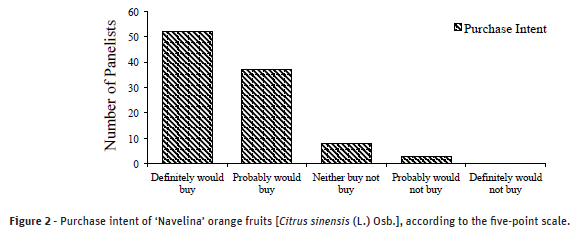
<body><![CDATA[<p><font face = "Verdana" size = "2">As a result, there was noticed that most of the consumers were grouped into the clusters 2 and 3 (35 and 56%, respectively) and stood closer to the origin point. This means that these consumers scored high values in the nine-point hedonic scale for the attributes analyzed in the sensory evaluation, contrasting to the cluster 1 that was composed by just 9% of the total consumers, in which 25% from this consumer group attributed low values for aroma and taste and 75% attributed low values for the appearance and firmness attributes. After assessing their degree of liking for the fruit attributes, the consumers were asked to estimate their purchase intent (<a href = "#f2">Figure 2</a>).</font></p>      <p>&nbsp;</p>  <a name = "f2"><img src = "/img/revistas/rca/v42n2/v42n2a29f2.jpg"></a>      
<p>&nbsp;</p>      <p><font face = "Verdana" size = "2">It was observed that almost 90% of the total consumers definitely and probably would buy the fruits of the &#8216;Navelina&#8217; cultivar corroborating Pacheco <i>et al</i>. (2014), whose found good acceptance by the consumers, about 81% of approval for the fruits of the TMxLP 290 [hybrid between &#8216;Murcott&#8217; tangor (TM) and &#8216;Pera&#8217; sweet orange (LP)]. The remaining consumers, those which neither buy or not buy and probably would not buy the fruits, assed low values in their degree of liking scale for the analyzed attributes in the acceptance test (cluster 1), arranging far away from the origin point (0) as can be seen in the factor map (<a href = "/img/revistas/rca/v42n2/v42n2a29f1.jpg" target = "_blank">Figure 1B</a>).</font></p>      
<p><font face = "Verdana" size = "2">Most of these consumers justified their assessments pointing the fruit appearance as being the least liked attribute, more precisely the fruit size =, relating to be large for them (data not shown). Despite to represent a small portion of the total consumer, this result shows how heterogeneous the group was composed and the peculiarity of this consumer portion, presenting different results according to their behavior and requirements.  </font></p>      <p><font face = "Verdana" size = "2">Therefore, these results demonstrated that the physical attributes, appearance and firmness, can interfere in the purchase intent of the fruits because the consumers are first induced to buy through visual impression, indicating the fruit appearance as the most relevant aspect at the market decision, because consumers usually associate the appearance to the fruit quality (Rombaldi <i>et al</i>., 2007; Petry <i>et al</i>., 2015). Also, Teixeira <i>et al</i>. (2006) reported that the fruit consumption is motivated through the sensory aspects, as appearance mentioned above, and not by the nutritional properties of the fruits, demanding more studies about consumer behavior to conduct politics about food education.  </font></p>      <p><font face = "Verdana" size = "2">In this way, the degree of liking from the different attributes, as well as the purchase intent corroborated Cunha <i>et al</i>. (2004), Malgarim <i>et al</i>. (2007a), Jayasena and Cameron (2008), and Benjamin <i>et al</i>. (2013), noticing consumer preference for samples that presented an appropriated sugar/acidity ratio and sugar content (soluble solids). However, Castro <i>et al</i>. (2013) observed preference for samples presenting different sugar/acidity ratio and soluble solids levels for orange juice, reporting that some perceptions are singular for some group and cannot be measured without human senses, confirming the importance of sensory evaluation.</font></p>      <p><font face = "Verdana" size = "2">In summary, the performance of the &#8216;Navelina&#8217; orange assessed in the research are consistent with those reported by Malgarim <i>et al</i>. (2007a) evaluating the same cultivar and also by other authors for different citrus cultivars, as for &#8216;Clemenules&#8217; mandarin (Malgarim <i>et al</i>., 2007b), &#8216;Valencia&#8217; orange and &#8216;Or&#8217; mandarin (Benjamin <i>et al</i>., 2013; Petry <i>et al.</i>, 2015), TC x LP 5 [hybrid between &#8216;Cravo&#8217; mandarin (TC) and &#8216;Pera&#8217; sweet orange (LP)], TM x LP 16, TM x LP 222 and TM x LP 290 hybrids [hybrids between &#8216;Murcott&#8217; tangor (TM) and &#8216;Pera&#8217; sweet orange (LP)] (Castro <i>et al</i>., 2013; Pacheco <i>et al.</i>, 2014, 2018), and &#8216;Fremont&#8217; mandarin (Pacheco <i>et al.</i>, 2017) in which consumers expressed high preference for these cultivars, according to their degree of liking.</font></p>       <p><font face = "Verdana" size = "3"><b>CONCLUSION</b></font></p>      <p><font face = "Verdana" size = "2">The &#8216;Navelina&#8217; navel orange is a potential variety for the fresh fruit market, satisfying the criteria of the OECD and the CEAGESP for commercialization and consumption. Its fruit presents excellent sensory attributes and physical-chemical characteristics associated to the seedless aspect, which are required by the consumers expressing high preference for its fruits, mainly based on appearance and taste attributes.</font></p>      ]]></body>
<body><![CDATA[<p>&nbsp;</p>      <p><font face = "Verdana" size = "3"><b>REFERENCES</b></font></p>      <!-- ref --><p><font face = "Verdana" size = "2">Benjamin, G.; Tietel, Z & Porat, R. (2013) – Effects of rootstock/scion combinations on the flavor of citrus fruit. <i>Journal of Agricultural and Food Chemistry</i>, vol. 61, n. 47, p. 11286-11294. <a href = "http://dx.doi.org/10.1021/jf402892p" target = "_blank">http://dx.doi.org/10.1021/jf402892p</a></font>&nbsp;&nbsp;&nbsp;&nbsp;&nbsp;&nbsp;&nbsp;&nbsp;[&#160;<a href="javascript:void(0);" onclick="javascript: window.open('/scielo.php?script=sci_nlinks&ref=700638&pid=S0871-018X201900020002900001&lng=','','width=640,height=500,resizable=yes,scrollbars=1,menubar=yes,');">Links</a>&#160;]<!-- end-ref --><!-- ref --><p><font face = "Verdana" size = "2">Castro, D.B.A; Mauri&#769;cio, F.N.; Crisfoni-Yaly, M.; Schinor, E.H. & Verruma-Bernardi, M.R. (2013) – Sensory analysis of new varieties of citrus as a complementary strategy to the Brazilian citriculture. <i>Journal of Agricultural Science</i>, vol. 5, n. 4, p. 161-170. <a href = "https://doi.org/10.5539/jas.v5n4p161" target = "_blank">https://doi.org/10.5539/jas.v5n4p161</a></font>&nbsp;&nbsp;&nbsp;&nbsp;&nbsp;&nbsp;&nbsp;&nbsp;[&#160;<a href="javascript:void(0);" onclick="javascript: window.open('/scielo.php?script=sci_nlinks&ref=700639&pid=S0871-018X201900020002900002&lng=','','width=640,height=500,resizable=yes,scrollbars=1,menubar=yes,');">Links</a>&#160;]<!-- end-ref --><!-- ref --><p><font face = "Verdana" size = "2">CEAGESP (2011) - <i>Programa Brasileiro para a melhoria dos padro&#771;es comerciais e embalagens de hortigranjeiros centro de qualidade em horticultura</i>. Campinas, Companhia de Entrepostos e Armazéns Gerais de São Paulo, 11 p.    &nbsp;&nbsp;&nbsp;&nbsp;&nbsp;&nbsp;&nbsp;&nbsp;[&#160;<a href="javascript:void(0);" onclick="javascript: window.open('/scielo.php?script=sci_nlinks&ref=700640&pid=S0871-018X201900020002900003&lng=','','width=640,height=500,resizable=yes,scrollbars=1,menubar=yes,');">Links</a>&#160;]<!-- end-ref --></font></p>      <!-- ref --><p><font face = "Verdana" size = "2">Corrêa, S.C.; Pinheiro, A.C.M.; Siqueira; H.E.; Carvalho, E.M.; Nunes, C.A. & Vilas Boas, E.V.B. (2014) – Prediction of the sensory acceptance of fruits by physical and physical-chemical parameters using multivariate models. <i>LWT - Food Science and Technology</i>, vol. 59, n. 2, p. 666-672. <a href = "http://dx.doi.org/10.1016/j.lwt.2014.07.042" target = "_blank">http://dx.doi.org/10.1016/j.lwt.2014.07.042</a></font>&nbsp;&nbsp;&nbsp;&nbsp;&nbsp;&nbsp;&nbsp;&nbsp;[&#160;<a href="javascript:void(0);" onclick="javascript: window.open('/scielo.php?script=sci_nlinks&ref=700642&pid=S0871-018X201900020002900004&lng=','','width=640,height=500,resizable=yes,scrollbars=1,menubar=yes,');">Links</a>&#160;]<!-- end-ref --><!-- ref --><p><font face = "Verdana" size = "2">Cunha, R.L.; Sato, A.C.K. & Sanjinez-Argandoña E.J. (2004) – Avaliac&#807;a&#771;o das propriedades fi&#769;sicas, qui&#769;micas e sensorial de prefere&#770;ncia de goiabas em calda industrializadas. <i>Ciência e Tecnologia de Alimentos</i>, vol. 24, n. 4, p. 550-555. <a href = "http://dx.doi.org/10.1590/S0101-20612004000400012" target = "_blank">http://dx.doi.org/10.1590/S0101-20612004000400012</a></font>&nbsp;&nbsp;&nbsp;&nbsp;&nbsp;&nbsp;&nbsp;&nbsp;[&#160;<a href="javascript:void(0);" onclick="javascript: window.open('/scielo.php?script=sci_nlinks&ref=700643&pid=S0871-018X201900020002900005&lng=','','width=640,height=500,resizable=yes,scrollbars=1,menubar=yes,');">Links</a>&#160;]<!-- end-ref --><!-- ref --><p><font face = "Verdana" size = "2">Das, A.K. (2003) – Citrus canker – A review. <i>Journal of Applied Horticulture</i>, vol. 5, n. 1, p. 52-60.    &nbsp;&nbsp;&nbsp;&nbsp;&nbsp;&nbsp;&nbsp;&nbsp;[&#160;<a href="javascript:void(0);" onclick="javascript: window.open('/scielo.php?script=sci_nlinks&ref=700644&pid=S0871-018X201900020002900006&lng=','','width=640,height=500,resizable=yes,scrollbars=1,menubar=yes,');">Links</a>&#160;]<!-- end-ref --></font></p>       ]]></body>
<body><![CDATA[<!-- ref --><p><font face = "Verdana" size = "2">FAO (2017) - <i>FAOSTAT</i>, Food and Agriculture Organization of the United Nations. [cit. 2017-06-08]. &lt; <a href = "http://faostat3.fao.org/browse/Q/QC/E" target = "_blank">http://faostat3.fao.org/browse/Q/QC/E</a>&gt;    &nbsp;&nbsp;&nbsp;&nbsp;&nbsp;&nbsp;&nbsp;&nbsp;[&#160;<a href="javascript:void(0);" onclick="javascript: window.open('/scielo.php?script=sci_nlinks&ref=700646&pid=S0871-018X201900020002900007&lng=','','width=640,height=500,resizable=yes,scrollbars=1,menubar=yes,');">Links</a>&#160;]<!-- end-ref -->.</font></p>       <!-- ref --><p><font face = "Verdana" size = "2">Gottwald, T.R. & Graham, J.H. (2014) – Citrus diseases with global ramifications including citrus canker and huanglongbing. <i>CAB Reviews</i>, vol. 9, n. 16, p. 1-11.    &nbsp;&nbsp;&nbsp;&nbsp;&nbsp;&nbsp;&nbsp;&nbsp;[&#160;<a href="javascript:void(0);" onclick="javascript: window.open('/scielo.php?script=sci_nlinks&ref=700648&pid=S0871-018X201900020002900008&lng=','','width=640,height=500,resizable=yes,scrollbars=1,menubar=yes,');">Links</a>&#160;]<!-- end-ref --></font></p>      <!-- ref --><p><font face = "Verdana" size = "2">Husson, F.; Josse, J.; Le, S. & Mazet, J. (2017) – <i>FactoMineR: Multivariate Exploratory Data Analysis and Data Mining.</i> R Package Version 1.36. [cit. 2017-06-04] &lt;<a href = "https://CRAN.R-project.org/package=FactoMineR" target = "_blank">https://CRAN.R-project.org/package=FactoMineR</a>&gt;    &nbsp;&nbsp;&nbsp;&nbsp;&nbsp;&nbsp;&nbsp;&nbsp;[&#160;<a href="javascript:void(0);" onclick="javascript: window.open('/scielo.php?script=sci_nlinks&ref=700650&pid=S0871-018X201900020002900009&lng=','','width=640,height=500,resizable=yes,scrollbars=1,menubar=yes,');">Links</a>&#160;]<!-- end-ref -->.</font></p>      <!-- ref --><p><font face = "Verdana" size = "2">Jayasena, V. & Cameron, I. (2008) – Brix/acid ratio as a predictor of consumer acceptability of crimson seedless table grapes. <i>Journal of Food Quality</i>, vol. 31, n. 6, p. 736-750. <a href = "http://dx.doi.org/10.1111/j.1745-4557.2008.00231.x" target = "_blank">http://dx.doi.org/10.1111/j.1745-4557.2008.00231.x</a></font>&nbsp;&nbsp;&nbsp;&nbsp;&nbsp;&nbsp;&nbsp;&nbsp;[&#160;<a href="javascript:void(0);" onclick="javascript: window.open('/scielo.php?script=sci_nlinks&ref=700652&pid=S0871-018X201900020002900010&lng=','','width=640,height=500,resizable=yes,scrollbars=1,menubar=yes,');">Links</a>&#160;]<!-- end-ref --><!-- ref --><p><font face = "Verdana" size = "2">Leite Junior, R.P.; Moham, S.K.; Pereira, A.L.G. & Campacci, C.A. (1987) – Controle integrado de cancro cítrico: efeito da resistência genética e da aplicação de bactericidas. <i>Fitopatologia Brasileira</i>, vol. 12, n. 1, p. 257-263.    &nbsp;&nbsp;&nbsp;&nbsp;&nbsp;&nbsp;&nbsp;&nbsp;[&#160;<a href="javascript:void(0);" onclick="javascript: window.open('/scielo.php?script=sci_nlinks&ref=700653&pid=S0871-018X201900020002900011&lng=','','width=640,height=500,resizable=yes,scrollbars=1,menubar=yes,');">Links</a>&#160;]<!-- end-ref -->     </font></p>      <!-- ref --><p><font face = "Verdana" size = "2">Leite Junior, R.P. (1992) – Cultivares de copa e porta-enxertos. <i>In</i>: Carvalho, S.L.C.A. (Ed.) - <i>Citricultura no Paraná</i>. Londrina, IAPAR, p. 91-116.    &nbsp;&nbsp;&nbsp;&nbsp;&nbsp;&nbsp;&nbsp;&nbsp;[&#160;<a href="javascript:void(0);" onclick="javascript: window.open('/scielo.php?script=sci_nlinks&ref=700655&pid=S0871-018X201900020002900012&lng=','','width=640,height=500,resizable=yes,scrollbars=1,menubar=yes,');">Links</a>&#160;]<!-- end-ref --></font></p>       <!-- ref --><p><font face = "Verdana" size = "2">Malgarim, M.B.; Cantillano, R.F.F. & Treptow, R.O. (2007a) – Armazenamento refrigerado de laranjas cv. Navelina em diferentes concentrac&#807;o&#771;es de cera a&#768; base de carnau&#769;ba. <i>Acta Scientiarum Agronomy</i>, vol. 29, n. 1, p. 99-105. <a href = "http://dx.doi.org/10.4025/actasciagron.v29i1.72" target = "_blank">http://dx.doi.org/10.4025/actasciagron.v29i1.72</a></font>&nbsp;&nbsp;&nbsp;&nbsp;&nbsp;&nbsp;&nbsp;&nbsp;[&#160;<a href="javascript:void(0);" onclick="javascript: window.open('/scielo.php?script=sci_nlinks&ref=700657&pid=S0871-018X201900020002900013&lng=','','width=640,height=500,resizable=yes,scrollbars=1,menubar=yes,');">Links</a>&#160;]<!-- end-ref --><!-- ref --><p><font face = "Verdana" size = "2">Malgarim, M.B.; Cantillano, R.F.F. & Treptow, R.O. (2007b) – Conservac&#807;a&#771;o de tangerina cv. Clemenules utilizando diferentes recobrimentos. <i>Acta Scientiarum Agronomy</i>, vol. 29, n. 1, p. 75-82. <a href = "http://dx.doi.org/10.4025/actasciagron.v29i1.69" target = "_blank">http://dx.doi.org/10.4025/actasciagron.v29i1.69</a></font>&nbsp;&nbsp;&nbsp;&nbsp;&nbsp;&nbsp;&nbsp;&nbsp;[&#160;<a href="javascript:void(0);" onclick="javascript: window.open('/scielo.php?script=sci_nlinks&ref=700658&pid=S0871-018X201900020002900014&lng=','','width=640,height=500,resizable=yes,scrollbars=1,menubar=yes,');">Links</a>&#160;]<!-- end-ref --><!-- ref --><p><font face = "Verdana" size = "2">McGuire, R.G. (1992) – Reporting of objective color measurements. <i>Horticulture Science</i>, vol. 27, n. 12, p. 1254-1255.    &nbsp;&nbsp;&nbsp;&nbsp;&nbsp;&nbsp;&nbsp;&nbsp;[&#160;<a href="javascript:void(0);" onclick="javascript: window.open('/scielo.php?script=sci_nlinks&ref=700659&pid=S0871-018X201900020002900015&lng=','','width=640,height=500,resizable=yes,scrollbars=1,menubar=yes,');">Links</a>&#160;]<!-- end-ref --></font></p>      <!-- ref --><p><font face = "Verdana" size = "2">Naes, T.; Brockhoff, P.B. & Tomic, O. (2010) – <i>Statistic for sensory and consumer science</i>. 1<sup>st</sup> ed. United Kingdom, Wiley, 287 p.    &nbsp;&nbsp;&nbsp;&nbsp;&nbsp;&nbsp;&nbsp;&nbsp;[&#160;<a href="javascript:void(0);" onclick="javascript: window.open('/scielo.php?script=sci_nlinks&ref=700661&pid=S0871-018X201900020002900016&lng=','','width=640,height=500,resizable=yes,scrollbars=1,menubar=yes,');">Links</a>&#160;]<!-- end-ref --></font></p>      <!-- ref --><p><font face = "Verdana" size = "2">OECD (2010) – <i>International standards for fruit and vegetables: citrus fruit</i>. Paris, Organization for Economic Co-operation and Development, 244 p.    &nbsp;&nbsp;&nbsp;&nbsp;&nbsp;&nbsp;&nbsp;&nbsp;[&#160;<a href="javascript:void(0);" onclick="javascript: window.open('/scielo.php?script=sci_nlinks&ref=700663&pid=S0871-018X201900020002900017&lng=','','width=640,height=500,resizable=yes,scrollbars=1,menubar=yes,');">Links</a>&#160;]<!-- end-ref --></font></p>      <!-- ref --><p><font face = "Verdana" size = "2">Oliveira, R.P.; Scivittaro, W.B. & Rocha, P.S.G. (2008) – <i>Cultivares de laranjeira resistentes ao cancro ci&#769;trico</i>. Pelotas, Embrapa Clima Temperado, 31 p.    &nbsp;&nbsp;&nbsp;&nbsp;&nbsp;&nbsp;&nbsp;&nbsp;[&#160;<a href="javascript:void(0);" onclick="javascript: window.open('/scielo.php?script=sci_nlinks&ref=700665&pid=S0871-018X201900020002900018&lng=','','width=640,height=500,resizable=yes,scrollbars=1,menubar=yes,');">Links</a>&#160;]<!-- end-ref --></font></p>      <!-- ref --><p><font face = "Verdana" size = "2">Pacheco, C.A.; Schinor, E.H.; Azevedo, F.A.; Bastianel, M. & Cristofani-Yaly, M. (2014) – Caracterizac&#807;a&#771;o de frutos do tangor TM x LP 290 para mercado de fruta fresca. <i>Revista Brasileira de Fruticultura</i>, vol. 36, n. 4, p. 805-812. <a href = "http://dx.doi.org/10.1590/0100-2945-219/13" target = "_blank">http://dx.doi.org/10.1590/0100-2945-219/13</a></font>&nbsp;&nbsp;&nbsp;&nbsp;&nbsp;&nbsp;&nbsp;&nbsp;[&#160;<a href="javascript:void(0);" onclick="javascript: window.open('/scielo.php?script=sci_nlinks&ref=700667&pid=S0871-018X201900020002900019&lng=','','width=640,height=500,resizable=yes,scrollbars=1,menubar=yes,');">Links</a>&#160;]<!-- end-ref --><!-- ref --><p><font face = "Verdana" size = "2">Pacheco, C.A.; Azevedo, F.A.; Barros, V.N.P., Cristofani-Yaly, M. & Verruma-Bernardi, M.R. (2017) – Fremont - IAC 543: Tangerine with potential for the Brazilian market. <i>Revista Brasileira de Fruticultura</i>, vol. 39, n.sp., p. e-436. <a href = "http://dx.doi.org/10.1590/0100-29452017436" target = "_blank">http://dx.doi.org/10.1590/0100-29452017436</a></font>&nbsp;&nbsp;&nbsp;&nbsp;&nbsp;&nbsp;&nbsp;&nbsp;[&#160;<a href="javascript:void(0);" onclick="javascript: window.open('/scielo.php?script=sci_nlinks&ref=700668&pid=S0871-018X201900020002900020&lng=','','width=640,height=500,resizable=yes,scrollbars=1,menubar=yes,');">Links</a>&#160;]<!-- end-ref --><!-- ref --><p><font face = "Verdana" size = "2">Pacheco, C.A.; Schinor, E.H.; Azevedo, F.A.; Shimizu, G.D.; Bastianel, M. & Cristofani-Yaly (2018) – Sensory acceptance and postharvest quality of a new hybrid of citrus: TMxLP 16. <i>Citrus Research & Technology</i>, vol. 39, n.sp., p. e-1031. <a href = "http://dx.doi.org/10.4322/crt.08315" target = "_blank">http://dx.doi.org/10.4322/crt.08315</a></font>&nbsp;&nbsp;&nbsp;&nbsp;&nbsp;&nbsp;&nbsp;&nbsp;[&#160;<a href="javascript:void(0);" onclick="javascript: window.open('/scielo.php?script=sci_nlinks&ref=700669&pid=S0871-018X201900020002900021&lng=','','width=640,height=500,resizable=yes,scrollbars=1,menubar=yes,');">Links</a>&#160;]<!-- end-ref --><!-- ref --><p><font face = "Verdana" size = "2">Petry, H.B.; Schneider, L.A.; Silveira Ju&#769;nior, J.C.; Crizel, T.M; Flo&#770;res, S.H. & Schwarz, S.F. (2015) – Avaliac&#807;a&#771;o fi&#769;sica e qui&#769;mica e aceitac&#807;a&#771;o pelo consumidor de laranjas &#8216;Vale&#770;ncia&#8217;, produzidas sob sistemas de cultivo orga&#770;nico e convencional. <i>Cie&#770;ncia Rural</i>, vol. 45, n. 4, p. 619-625. <a href = "http://dx.doi.org/10.1590/0103-8478cr20131546" target = "_blank">http://dx.doi.org/10.1590/0103-8478cr20131546</a></font>&nbsp;&nbsp;&nbsp;&nbsp;&nbsp;&nbsp;&nbsp;&nbsp;[&#160;<a href="javascript:void(0);" onclick="javascript: window.open('/scielo.php?script=sci_nlinks&ref=700670&pid=S0871-018X201900020002900022&lng=','','width=640,height=500,resizable=yes,scrollbars=1,menubar=yes,');">Links</a>&#160;]<!-- end-ref --><!-- ref --><p><font face = "Verdana" size = "2">Rombaldi, C.V.; Tibola, C.S.; Fachinello, J.C. & Silva, J.A. (2007) – Percepc&#807;a&#771;o de consumidores do Rio Grande do Sul em relac&#807;a&#771;o a quesitos de qualidade em frutas. <i>Revista Brasileira de Fruticultura</i>, vol. 29, n. 3, p. 681-684. <a href = "http://dx.doi.org/10.1590/S0100-29452007000300049" target = "_blank">http://dx.doi.org/10.1590/S0100-29452007000300049</a></font>&nbsp;&nbsp;&nbsp;&nbsp;&nbsp;&nbsp;&nbsp;&nbsp;[&#160;<a href="javascript:void(0);" onclick="javascript: window.open('/scielo.php?script=sci_nlinks&ref=700671&pid=S0871-018X201900020002900023&lng=','','width=640,height=500,resizable=yes,scrollbars=1,menubar=yes,');">Links</a>&#160;]<!-- end-ref --><!-- ref --><p><font face = "Verdana" size = "2">Santos, D.; Matarazzo, P.H.M.; Silva, D.F.P.; Siqueira, D.L.; Santos, D.C.M. & Lucena, C.C. (2010) – Caracterizac&#807;a&#771;o fi&#769;sico-qui&#769;mica de frutos ci&#769;tricos apire&#770;nicos produzidos em Vic&#807;osa, Minas Gerais. <i>Revista Ceres</i>, vol. 57, n. 3, p. 393-400. <a href = "http://dx.doi.org/10.1590/S0034-737X2010000300016" target = "_blank">http://dx.doi.org/10.1590/S0034-737X2010000300016</a></font>&nbsp;&nbsp;&nbsp;&nbsp;&nbsp;&nbsp;&nbsp;&nbsp;[&#160;<a href="javascript:void(0);" onclick="javascript: window.open('/scielo.php?script=sci_nlinks&ref=700672&pid=S0871-018X201900020002900024&lng=','','width=640,height=500,resizable=yes,scrollbars=1,menubar=yes,');">Links</a>&#160;]<!-- end-ref --><!-- ref --><p><font face = "Verdana" size = "2">Silva, A.P.G.; Silva, S.M.; Schunemann, A.P.P.; Dantas, A.L.; Dantas, R.L.D.; Silva, J. A. & Mendonc&#807;a, R.M.N. (2014) – I&#769;ndices de identidade e qualidade de tangerina &#8216;Ponkan&#8217; produzida no estado da Parai&#769;ba. <i>AGROTEC</i>, vol. 35, n. 1, p. 143-149. <a href = "https://doi.org/10.25066/agrotec.v35i1.20473" target = "_blank">https://doi.org/10.25066/agrotec.v35i1.20473</a></font>&nbsp;&nbsp;&nbsp;&nbsp;&nbsp;&nbsp;&nbsp;&nbsp;[&#160;<a href="javascript:void(0);" onclick="javascript: window.open('/scielo.php?script=sci_nlinks&ref=700673&pid=S0871-018X201900020002900025&lng=','','width=640,height=500,resizable=yes,scrollbars=1,menubar=yes,');">Links</a>&#160;]<!-- end-ref --><!-- ref --><p><font face = "Verdana" size = "2">Stone, H. & Sidel, J.L. (2004) – <i>Sensory evaluation practices</i>. London, Elsevier Academic Press, 408 p.    &nbsp;&nbsp;&nbsp;&nbsp;&nbsp;&nbsp;&nbsp;&nbsp;[&#160;<a href="javascript:void(0);" onclick="javascript: window.open('/scielo.php?script=sci_nlinks&ref=700674&pid=S0871-018X201900020002900026&lng=','','width=640,height=500,resizable=yes,scrollbars=1,menubar=yes,');">Links</a>&#160;]<!-- end-ref --></font></p>        ]]></body>
<body><![CDATA[<!-- ref --><p><font face = "Verdana" size = "2">Tazima, Z.H. & Leite Junior, R.P. (2008) – <i>Novas Cultivares de Citros para o Parana&#769;</i>. Londrina, IAPAR.    &nbsp;&nbsp;&nbsp;&nbsp;&nbsp;&nbsp;&nbsp;&nbsp;[&#160;<a href="javascript:void(0);" onclick="javascript: window.open('/scielo.php?script=sci_nlinks&ref=700676&pid=S0871-018X201900020002900027&lng=','','width=640,height=500,resizable=yes,scrollbars=1,menubar=yes,');">Links</a>&#160;]<!-- end-ref --></font></p>       <!-- ref --><p><font face = "Verdana" size = "2">Teixeira, L.J.Q.; Pereira, J.M.A.T.K.; Silva, N.M. and Reis, F.P. (2006) – Ha&#769;bitos de consumo de frutas entre estudantes da Universidade Federal de Vic&#807;osa. <i>Revista Ceres</i>, vol. 53, n. 3, p. 366-373.    &nbsp;&nbsp;&nbsp;&nbsp;&nbsp;&nbsp;&nbsp;&nbsp;[&#160;<a href="javascript:void(0);" onclick="javascript: window.open('/scielo.php?script=sci_nlinks&ref=700678&pid=S0871-018X201900020002900028&lng=','','width=640,height=500,resizable=yes,scrollbars=1,menubar=yes,');">Links</a>&#160;]<!-- end-ref --></font></p>      <p>&nbsp;</p>      <p><font face = "Verdana" size = "3"><b>ACKNOWLEDGMENTS</b></font></p>       <p><font face = "Verdana" size = "2">The authors would like to thank the Coordination for the Improvement of Higher Education Personnel (Coordenac&#807;a&#771;o de Aperfeic&#807;oamento de Pessoal de Ni&#769;vel Superior - CAPES) and the National Research Council (Conselho Nacional de Desenvolvimento de Ciência e Tecnologia - CNPq) for the financial support.</font></p>      <p>&nbsp;</p>      <p><font face = "Verdana" size = "2">Received/recebido: 2018.07.26</font></p>      <p><font face = "Verdana" size = "2">Accepted/aceite: 2018.10.03</font></p>      ]]></body>
<body><![CDATA[ ]]></body><back>
<ref-list>
<ref id="B1">
<nlm-citation citation-type="journal">
<person-group person-group-type="author">
<name>
<surname><![CDATA[Benjamin]]></surname>
<given-names><![CDATA[G.]]></given-names>
</name>
<name>
<surname><![CDATA[Tietel]]></surname>
<given-names><![CDATA[Z]]></given-names>
</name>
<name>
<surname><![CDATA[Porat]]></surname>
<given-names><![CDATA[R.]]></given-names>
</name>
</person-group>
<article-title xml:lang="en"><![CDATA[Effects of rootstock/scion combinations on the flavor of citrus fruit]]></article-title>
<source><![CDATA[Journal of Agricultural and Food Chemistry]]></source>
<year>2013</year>
<volume>61</volume>
<numero>47</numero>
<issue>47</issue>
<page-range>11286-11294</page-range></nlm-citation>
</ref>
<ref id="B2">
<nlm-citation citation-type="journal">
<person-group person-group-type="author">
<name>
<surname><![CDATA[Castro]]></surname>
<given-names><![CDATA[D.B.A]]></given-names>
</name>
<name>
<surname><![CDATA[Mauri&#769;cio]]></surname>
<given-names><![CDATA[F.N.]]></given-names>
</name>
<name>
<surname><![CDATA[Crisfoni-Yaly]]></surname>
<given-names><![CDATA[M.]]></given-names>
</name>
<name>
<surname><![CDATA[Schinor]]></surname>
<given-names><![CDATA[E.H.]]></given-names>
</name>
<name>
<surname><![CDATA[Verruma-Bernardi]]></surname>
<given-names><![CDATA[M.R.]]></given-names>
</name>
</person-group>
<article-title xml:lang="en"><![CDATA[Sensory analysis of new varieties of citrus as a complementary strategy to the Brazilian citriculture]]></article-title>
<source><![CDATA[Journal of Agricultural Science]]></source>
<year>2013</year>
<volume>5</volume>
<numero>4</numero>
<issue>4</issue>
<page-range>161-170</page-range></nlm-citation>
</ref>
<ref id="B3">
<nlm-citation citation-type="book">
<collab>CEAGESP</collab>
<source><![CDATA[Programa Brasileiro para a melhoria dos padro&#771;es comerciais e embalagens de hortigranjeiros centro de qualidade em horticultura]]></source>
<year>2011</year>
<publisher-loc><![CDATA[Campinas ]]></publisher-loc>
<publisher-name><![CDATA[Companhia de Entrepostos e Armazéns Gerais de São Paulo]]></publisher-name>
</nlm-citation>
</ref>
<ref id="B4">
<nlm-citation citation-type="journal">
<person-group person-group-type="author">
<name>
<surname><![CDATA[Corrêa]]></surname>
<given-names><![CDATA[S.C.]]></given-names>
</name>
<name>
<surname><![CDATA[Pinheiro]]></surname>
<given-names><![CDATA[A.C.M.]]></given-names>
</name>
<name>
<surname><![CDATA[Siqueira]]></surname>
<given-names><![CDATA[H.E.]]></given-names>
</name>
<name>
<surname><![CDATA[Carvalho]]></surname>
<given-names><![CDATA[E.M.]]></given-names>
</name>
<name>
<surname><![CDATA[Nunes]]></surname>
<given-names><![CDATA[C.A.]]></given-names>
</name>
<name>
<surname><![CDATA[Vilas Boas]]></surname>
<given-names><![CDATA[E.V.B.]]></given-names>
</name>
</person-group>
<article-title xml:lang="en"><![CDATA[Prediction of the sensory acceptance of fruits by physical and physical-chemical parameters using multivariate models]]></article-title>
<source><![CDATA[LWT - Food Science and Technology]]></source>
<year>2014</year>
<volume>59</volume>
<numero>2</numero>
<issue>2</issue>
<page-range>666-672</page-range></nlm-citation>
</ref>
<ref id="B5">
<nlm-citation citation-type="journal">
<person-group person-group-type="author">
<name>
<surname><![CDATA[Cunha]]></surname>
<given-names><![CDATA[R.L.]]></given-names>
</name>
<name>
<surname><![CDATA[Sato]]></surname>
<given-names><![CDATA[A.C.K.]]></given-names>
</name>
<name>
<surname><![CDATA[Sanjinez-Argandoña]]></surname>
<given-names><![CDATA[E.J.]]></given-names>
</name>
</person-group>
<article-title xml:lang="pt"><![CDATA[Avaliac&#807;a&#771;o das propriedades fi&#769;sicas, qui&#769;micas e sensorial de prefere&#770;ncia de goiabas em calda industrializadas]]></article-title>
<source><![CDATA[Ciência e Tecnologia de Alimentos]]></source>
<year>2004</year>
<volume>24</volume>
<numero>4</numero>
<issue>4</issue>
<page-range>550-555</page-range></nlm-citation>
</ref>
<ref id="B6">
<nlm-citation citation-type="journal">
<person-group person-group-type="author">
<name>
<surname><![CDATA[Das]]></surname>
<given-names><![CDATA[A.K.]]></given-names>
</name>
</person-group>
<article-title xml:lang="en"><![CDATA[Citrus canker - A review]]></article-title>
<source><![CDATA[Journal of Applied Horticulture]]></source>
<year>2003</year>
<volume>5</volume>
<numero>1</numero>
<issue>1</issue>
<page-range>52-60</page-range></nlm-citation>
</ref>
<ref id="B7">
<nlm-citation citation-type="book">
<collab>FAO</collab>
<source><![CDATA[FAOSTAT]]></source>
<year>2017</year>
<publisher-name><![CDATA[Food and Agriculture Organization of the United Nations]]></publisher-name>
</nlm-citation>
</ref>
<ref id="B8">
<nlm-citation citation-type="journal">
<person-group person-group-type="author">
<name>
<surname><![CDATA[Gottwald]]></surname>
<given-names><![CDATA[T.R.]]></given-names>
</name>
<name>
<surname><![CDATA[Graham]]></surname>
<given-names><![CDATA[J.H.]]></given-names>
</name>
</person-group>
<article-title xml:lang="en"><![CDATA[Citrus diseases with global ramifications including citrus canker and huanglongbing]]></article-title>
<source><![CDATA[CAB Reviews]]></source>
<year>2014</year>
<volume>9</volume>
<numero>16</numero>
<issue>16</issue>
<page-range>1-11</page-range></nlm-citation>
</ref>
<ref id="B9">
<nlm-citation citation-type="">
<person-group person-group-type="author">
<name>
<surname><![CDATA[Husson]]></surname>
<given-names><![CDATA[F.]]></given-names>
</name>
<name>
<surname><![CDATA[Josse]]></surname>
<given-names><![CDATA[J.]]></given-names>
</name>
<name>
<surname><![CDATA[Le]]></surname>
<given-names><![CDATA[S.]]></given-names>
</name>
<name>
<surname><![CDATA[Mazet]]></surname>
<given-names><![CDATA[J.]]></given-names>
</name>
</person-group>
<source><![CDATA[FactoMineR: Multivariate Exploratory Data Analysis and Data Mining]]></source>
<year>2017</year>
</nlm-citation>
</ref>
<ref id="B10">
<nlm-citation citation-type="journal">
<person-group person-group-type="author">
<name>
<surname><![CDATA[Jayasena]]></surname>
<given-names><![CDATA[V.]]></given-names>
</name>
<name>
<surname><![CDATA[Cameron]]></surname>
<given-names><![CDATA[I.]]></given-names>
</name>
</person-group>
<article-title xml:lang="en"><![CDATA[Brix/acid ratio as a predictor of consumer acceptability of crimson seedless table grapes]]></article-title>
<source><![CDATA[Journal of Food Quality]]></source>
<year>2008</year>
<volume>31</volume>
<numero>6</numero>
<issue>6</issue>
<page-range>736-750</page-range></nlm-citation>
</ref>
<ref id="B11">
<nlm-citation citation-type="journal">
<person-group person-group-type="author">
<name>
<surname><![CDATA[Leite Junior]]></surname>
<given-names><![CDATA[R.P.]]></given-names>
</name>
<name>
<surname><![CDATA[Moham]]></surname>
<given-names><![CDATA[S.K.]]></given-names>
</name>
<name>
<surname><![CDATA[Pereira]]></surname>
<given-names><![CDATA[A.L.G.]]></given-names>
</name>
<name>
<surname><![CDATA[Campacci]]></surname>
<given-names><![CDATA[C.A.]]></given-names>
</name>
</person-group>
<article-title xml:lang="pt"><![CDATA[Controle integrado de cancro cítrico: efeito da resistência genética e da aplicação de bactericidas]]></article-title>
<source><![CDATA[Fitopatologia Brasileira]]></source>
<year>1987</year>
<volume>12</volume>
<numero>1</numero>
<issue>1</issue>
<page-range>257-263</page-range></nlm-citation>
</ref>
<ref id="B12">
<nlm-citation citation-type="book">
<person-group person-group-type="author">
<name>
<surname><![CDATA[Leite Junior]]></surname>
<given-names><![CDATA[R.P.]]></given-names>
</name>
</person-group>
<article-title xml:lang="pt"><![CDATA[Cultivares de copa e porta-enxertos]]></article-title>
<person-group person-group-type="editor">
<name>
<surname><![CDATA[Carvalho]]></surname>
<given-names><![CDATA[S.L.C.A.]]></given-names>
</name>
</person-group>
<source><![CDATA[Citricultura no Paraná]]></source>
<year>1992</year>
<page-range>91-116</page-range><publisher-loc><![CDATA[Londrina ]]></publisher-loc>
<publisher-name><![CDATA[IAPAR]]></publisher-name>
</nlm-citation>
</ref>
<ref id="B13">
<nlm-citation citation-type="journal">
<person-group person-group-type="author">
<name>
<surname><![CDATA[Malgarim]]></surname>
<given-names><![CDATA[M.B.]]></given-names>
</name>
<name>
<surname><![CDATA[Cantillano]]></surname>
<given-names><![CDATA[R.F.F.]]></given-names>
</name>
<name>
<surname><![CDATA[Treptow]]></surname>
<given-names><![CDATA[R.O.]]></given-names>
</name>
</person-group>
<article-title xml:lang="pt"><![CDATA[Armazenamento refrigerado de laranjas cv. Navelina em diferentes concentrac&#807;o&#771;es de cera a&#768; base de carnau&#769;ba]]></article-title>
<source><![CDATA[Acta Scientiarum Agronomy]]></source>
<year>2007</year>
<month>a</month>
<volume>29</volume>
<numero>1</numero>
<issue>1</issue>
<page-range>99-105</page-range></nlm-citation>
</ref>
<ref id="B14">
<nlm-citation citation-type="journal">
<person-group person-group-type="author">
<name>
<surname><![CDATA[Malgarim]]></surname>
<given-names><![CDATA[M.B.]]></given-names>
</name>
<name>
<surname><![CDATA[Cantillano]]></surname>
<given-names><![CDATA[R.F.F.]]></given-names>
</name>
<name>
<surname><![CDATA[Treptow]]></surname>
<given-names><![CDATA[R.O.]]></given-names>
</name>
</person-group>
<article-title xml:lang="pt"><![CDATA[Conservac&#807;a&#771;o de tangerina cv. Clemenules utilizando diferentes recobrimentos]]></article-title>
<source><![CDATA[Acta Scientiarum Agronomy]]></source>
<year>2007</year>
<month>b</month>
<volume>29</volume>
<numero>1</numero>
<issue>1</issue>
<page-range>75-82</page-range></nlm-citation>
</ref>
<ref id="B15">
<nlm-citation citation-type="journal">
<person-group person-group-type="author">
<name>
<surname><![CDATA[McGuire]]></surname>
<given-names><![CDATA[R.G.]]></given-names>
</name>
</person-group>
<article-title xml:lang="en"><![CDATA[Reporting of objective color measurements]]></article-title>
<source><![CDATA[Horticulture Science]]></source>
<year>1992</year>
<volume>27</volume>
<numero>12</numero>
<issue>12</issue>
<page-range>1254-1255</page-range></nlm-citation>
</ref>
<ref id="B16">
<nlm-citation citation-type="book">
<person-group person-group-type="author">
<name>
<surname><![CDATA[Naes]]></surname>
<given-names><![CDATA[T.]]></given-names>
</name>
<name>
<surname><![CDATA[Brockhoff]]></surname>
<given-names><![CDATA[P.B.]]></given-names>
</name>
<name>
<surname><![CDATA[Tomic]]></surname>
<given-names><![CDATA[O.]]></given-names>
</name>
</person-group>
<source><![CDATA[Statistic for sensory and consumer science]]></source>
<year>2010</year>
<edition>1st</edition>
<publisher-name><![CDATA[Wiley]]></publisher-name>
</nlm-citation>
</ref>
<ref id="B17">
<nlm-citation citation-type="book">
<collab>OECD</collab>
<source><![CDATA[International standards for fruit and vegetables: citrus fruit]]></source>
<year>2010</year>
<publisher-loc><![CDATA[Paris ]]></publisher-loc>
<publisher-name><![CDATA[Organization for Economic Co-operation and Development]]></publisher-name>
</nlm-citation>
</ref>
<ref id="B18">
<nlm-citation citation-type="book">
<person-group person-group-type="author">
<name>
<surname><![CDATA[Oliveira]]></surname>
<given-names><![CDATA[R.P.]]></given-names>
</name>
<name>
<surname><![CDATA[Scivittaro]]></surname>
<given-names><![CDATA[W.B.]]></given-names>
</name>
<name>
<surname><![CDATA[Rocha]]></surname>
<given-names><![CDATA[P.S.G.]]></given-names>
</name>
</person-group>
<source><![CDATA[Cultivares de laranjeira resistentes ao cancro ci&#769;trico]]></source>
<year>2008</year>
<publisher-loc><![CDATA[Pelotas ]]></publisher-loc>
<publisher-name><![CDATA[Embrapa Clima Temperado]]></publisher-name>
</nlm-citation>
</ref>
<ref id="B19">
<nlm-citation citation-type="journal">
<person-group person-group-type="author">
<name>
<surname><![CDATA[Pacheco]]></surname>
<given-names><![CDATA[C.A.]]></given-names>
</name>
<name>
<surname><![CDATA[Schinor]]></surname>
<given-names><![CDATA[E.H.]]></given-names>
</name>
<name>
<surname><![CDATA[Azevedo]]></surname>
<given-names><![CDATA[F.A.]]></given-names>
</name>
<name>
<surname><![CDATA[Bastianel]]></surname>
<given-names><![CDATA[M.]]></given-names>
</name>
<name>
<surname><![CDATA[Cristofani-Yaly]]></surname>
<given-names><![CDATA[M.]]></given-names>
</name>
</person-group>
<article-title xml:lang="pt"><![CDATA[Caracterizac&#807;a&#771;o de frutos do tangor TM x LP 290 para mercado de fruta fresca]]></article-title>
<source><![CDATA[Revista Brasileira de Fruticultura]]></source>
<year>2014</year>
<volume>36</volume>
<numero>4</numero>
<issue>4</issue>
<page-range>805-812</page-range></nlm-citation>
</ref>
<ref id="B20">
<nlm-citation citation-type="journal">
<person-group person-group-type="author">
<name>
<surname><![CDATA[Pacheco]]></surname>
<given-names><![CDATA[C.A.]]></given-names>
</name>
<name>
<surname><![CDATA[Azevedo]]></surname>
<given-names><![CDATA[F.A.]]></given-names>
</name>
<name>
<surname><![CDATA[Barros]]></surname>
<given-names><![CDATA[V.N.P.]]></given-names>
</name>
<name>
<surname><![CDATA[Cristofani-Yaly]]></surname>
<given-names><![CDATA[M.]]></given-names>
</name>
<name>
<surname><![CDATA[Verruma-Bernardi]]></surname>
<given-names><![CDATA[M.R.]]></given-names>
</name>
</person-group>
<article-title xml:lang="en"><![CDATA[Fremont - IAC 543: Tangerine with potential for the Brazilian market]]></article-title>
<source><![CDATA[Revista Brasileira de Fruticultura]]></source>
<year>2017</year>
<volume>39</volume>
<numero>sp</numero>
<issue>sp</issue>
<page-range>e-436</page-range></nlm-citation>
</ref>
<ref id="B21">
<nlm-citation citation-type="journal">
<person-group person-group-type="author">
<name>
<surname><![CDATA[Pacheco]]></surname>
<given-names><![CDATA[C.A.]]></given-names>
</name>
<name>
<surname><![CDATA[Schinor]]></surname>
<given-names><![CDATA[E.H.]]></given-names>
</name>
<name>
<surname><![CDATA[Azevedo]]></surname>
<given-names><![CDATA[F.A.]]></given-names>
</name>
<name>
<surname><![CDATA[Shimizu]]></surname>
<given-names><![CDATA[G.D.]]></given-names>
</name>
<name>
<surname><![CDATA[Bastianel]]></surname>
<given-names><![CDATA[M.]]></given-names>
</name>
<name>
<given-names><![CDATA[Cristofani-Yaly]]></given-names>
</name>
</person-group>
<article-title xml:lang="en"><![CDATA[Sensory acceptance and postharvest quality of a new hybrid of citrus: TMxLP 16]]></article-title>
<source><![CDATA[Citrus Research & Technology]]></source>
<year>2018</year>
<volume>39</volume>
<numero>sp</numero>
<issue>sp</issue>
<page-range>e-1031</page-range></nlm-citation>
</ref>
<ref id="B22">
<nlm-citation citation-type="journal">
<person-group person-group-type="author">
<name>
<surname><![CDATA[Petry]]></surname>
<given-names><![CDATA[H.B.]]></given-names>
</name>
<name>
<surname><![CDATA[Schneider]]></surname>
<given-names><![CDATA[L.A.]]></given-names>
</name>
<name>
<surname><![CDATA[Silveira Ju&#769;nior]]></surname>
<given-names><![CDATA[J.C.]]></given-names>
</name>
<name>
<surname><![CDATA[Crizel]]></surname>
<given-names><![CDATA[T.M]]></given-names>
</name>
<name>
<surname><![CDATA[Flo&#770;res]]></surname>
<given-names><![CDATA[S.H.]]></given-names>
</name>
<name>
<surname><![CDATA[Schwarz]]></surname>
<given-names><![CDATA[S.F.]]></given-names>
</name>
</person-group>
<article-title xml:lang="pt"><![CDATA[Avaliac&#807;a&#771;o fi&#769;sica e qui&#769;mica e aceitac&#807;a&#771;o pelo consumidor de laranjas ‘Vale&#770;ncia’, produzidas sob sistemas de cultivo orga&#770;nico e convencional]]></article-title>
<source><![CDATA[Cie&#770;ncia Rural]]></source>
<year>2015</year>
<volume>45</volume>
<numero>4</numero>
<issue>4</issue>
<page-range>619-625</page-range></nlm-citation>
</ref>
<ref id="B23">
<nlm-citation citation-type="journal">
<person-group person-group-type="author">
<name>
<surname><![CDATA[Rombaldi]]></surname>
<given-names><![CDATA[C.V.]]></given-names>
</name>
<name>
<surname><![CDATA[Tibola]]></surname>
<given-names><![CDATA[C.S.]]></given-names>
</name>
<name>
<surname><![CDATA[Fachinello]]></surname>
<given-names><![CDATA[J.C.]]></given-names>
</name>
<name>
<surname><![CDATA[Silva]]></surname>
<given-names><![CDATA[J.A.]]></given-names>
</name>
</person-group>
<article-title xml:lang="pt"><![CDATA[Percepc&#807;a&#771;o de consumidores do Rio Grande do Sul em relac&#807;a&#771;o a quesitos de qualidade em frutas]]></article-title>
<source><![CDATA[Revista Brasileira de Fruticultura]]></source>
<year>2007</year>
<volume>29</volume>
<numero>3</numero>
<issue>3</issue>
<page-range>681-684</page-range></nlm-citation>
</ref>
<ref id="B24">
<nlm-citation citation-type="journal">
<person-group person-group-type="author">
<name>
<surname><![CDATA[Santos]]></surname>
<given-names><![CDATA[D.]]></given-names>
</name>
<name>
<surname><![CDATA[Matarazzo]]></surname>
<given-names><![CDATA[P.H.M.]]></given-names>
</name>
<name>
<surname><![CDATA[Silva]]></surname>
<given-names><![CDATA[D.F.P.]]></given-names>
</name>
<name>
<surname><![CDATA[Siqueira]]></surname>
<given-names><![CDATA[D.L.]]></given-names>
</name>
<name>
<surname><![CDATA[Santos]]></surname>
<given-names><![CDATA[D.C.M.]]></given-names>
</name>
<name>
<surname><![CDATA[Lucena]]></surname>
<given-names><![CDATA[C.C.]]></given-names>
</name>
</person-group>
<article-title xml:lang="pt"><![CDATA[Caracterizac&#807;a&#771;o fi&#769;sico-qui&#769;mica de frutos ci&#769;tricos apire&#770;nicos produzidos em Vic&#807;osa, Minas Gerais]]></article-title>
<source><![CDATA[Revista Ceres]]></source>
<year>2010</year>
<volume>57</volume>
<numero>3</numero>
<issue>3</issue>
<page-range>393-400</page-range></nlm-citation>
</ref>
<ref id="B25">
<nlm-citation citation-type="journal">
<person-group person-group-type="author">
<name>
<surname><![CDATA[Silva]]></surname>
<given-names><![CDATA[A.P.G.]]></given-names>
</name>
<name>
<surname><![CDATA[Silva]]></surname>
<given-names><![CDATA[S.M.]]></given-names>
</name>
<name>
<surname><![CDATA[Schunemann]]></surname>
<given-names><![CDATA[A.P.P.]]></given-names>
</name>
<name>
<surname><![CDATA[Dantas]]></surname>
<given-names><![CDATA[A.L.]]></given-names>
</name>
<name>
<surname><![CDATA[Dantas]]></surname>
<given-names><![CDATA[R.L.D.]]></given-names>
</name>
<name>
<surname><![CDATA[Silva]]></surname>
<given-names><![CDATA[J. A.]]></given-names>
</name>
<name>
<surname><![CDATA[Mendonc&#807;a]]></surname>
<given-names><![CDATA[R.M.N.]]></given-names>
</name>
</person-group>
<article-title xml:lang="pt"><![CDATA[I&#769;ndices de identidade e qualidade de tangerina ‘Ponkan’ produzida no estado da Parai&#769;ba]]></article-title>
<source><![CDATA[AGROTEC]]></source>
<year>2014</year>
<volume>35</volume>
<numero>1</numero>
<issue>1</issue>
<page-range>143-149</page-range></nlm-citation>
</ref>
<ref id="B26">
<nlm-citation citation-type="book">
<person-group person-group-type="author">
<name>
<surname><![CDATA[Stone]]></surname>
<given-names><![CDATA[H.]]></given-names>
</name>
<name>
<surname><![CDATA[Sidel]]></surname>
<given-names><![CDATA[J.L.]]></given-names>
</name>
</person-group>
<source><![CDATA[Sensory evaluation practices]]></source>
<year>2004</year>
<publisher-loc><![CDATA[London ]]></publisher-loc>
<publisher-name><![CDATA[Elsevier Academic Press]]></publisher-name>
</nlm-citation>
</ref>
<ref id="B27">
<nlm-citation citation-type="book">
<person-group person-group-type="author">
<name>
<surname><![CDATA[Tazima]]></surname>
<given-names><![CDATA[Z.H.]]></given-names>
</name>
<name>
<surname><![CDATA[Leite Junior]]></surname>
<given-names><![CDATA[R.P.]]></given-names>
</name>
</person-group>
<source><![CDATA[Novas Cultivares de Citros para o Parana&#769;]]></source>
<year>2008</year>
<publisher-loc><![CDATA[Londrina ]]></publisher-loc>
<publisher-name><![CDATA[IAPAR]]></publisher-name>
</nlm-citation>
</ref>
<ref id="B28">
<nlm-citation citation-type="journal">
<person-group person-group-type="author">
<name>
<surname><![CDATA[Teixeira]]></surname>
<given-names><![CDATA[L.J.Q.]]></given-names>
</name>
<name>
<surname><![CDATA[Pereira]]></surname>
<given-names><![CDATA[J.M.A.T.K.]]></given-names>
</name>
<name>
<surname><![CDATA[Silva]]></surname>
<given-names><![CDATA[N.M.]]></given-names>
</name>
<name>
<surname><![CDATA[Reis]]></surname>
<given-names><![CDATA[F.P.]]></given-names>
</name>
</person-group>
<article-title xml:lang="pt"><![CDATA[Ha&#769;bitos de consumo de frutas entre estudantes da Universidade Federal de Vic&#807;osa]]></article-title>
<source><![CDATA[Revista Ceres]]></source>
<year>2006</year>
<volume>53</volume>
<numero>3</numero>
<issue>3</issue>
<page-range>366-373</page-range></nlm-citation>
</ref>
</ref-list>
</back>
</article>
