<?xml version="1.0" encoding="ISO-8859-1"?><article xmlns:mml="http://www.w3.org/1998/Math/MathML" xmlns:xlink="http://www.w3.org/1999/xlink" xmlns:xsi="http://www.w3.org/2001/XMLSchema-instance">
<front>
<journal-meta>
<journal-id>0871-018X</journal-id>
<journal-title><![CDATA[Revista de Ciências Agrárias]]></journal-title>
<abbrev-journal-title><![CDATA[Rev. de Ciências Agrárias]]></abbrev-journal-title>
<issn>0871-018X</issn>
<publisher>
<publisher-name><![CDATA[Sociedade de Ciências Agrárias de Portugal]]></publisher-name>
</publisher>
</journal-meta>
<article-meta>
<article-id>S0871-018X2019000300012</article-id>
<article-id pub-id-type="doi">10.19084/rca.16389</article-id>
<title-group>
<article-title xml:lang="en"><![CDATA[Influence of seeds vigor in the attributes of soybean yield]]></article-title>
<article-title xml:lang="pt"><![CDATA[Influência do vigor de sementes nos atributos de produtividade da soja]]></article-title>
</title-group>
<contrib-group>
<contrib contrib-type="author">
<name>
<surname><![CDATA[Struker]]></surname>
<given-names><![CDATA[Stevan]]></given-names>
</name>
<xref ref-type="aff" rid="A1"/>
</contrib>
<contrib contrib-type="author">
<name>
<surname><![CDATA[Carvalho]]></surname>
<given-names><![CDATA[Ivan Ricardo]]></given-names>
</name>
<xref ref-type="aff" rid="A1"/>
</contrib>
<contrib contrib-type="author">
<name>
<surname><![CDATA[Szareski]]></surname>
<given-names><![CDATA[Vinícius Jardel]]></given-names>
</name>
<xref ref-type="aff" rid="A1"/>
</contrib>
<contrib contrib-type="author">
<name>
<surname><![CDATA[Barbosa]]></surname>
<given-names><![CDATA[Maurício Horbach]]></given-names>
</name>
<xref ref-type="aff" rid="A1"/>
</contrib>
<contrib contrib-type="author">
<name>
<surname><![CDATA[Souza]]></surname>
<given-names><![CDATA[Velci Queiróz de]]></given-names>
</name>
<xref ref-type="aff" rid="A1"/>
</contrib>
<contrib contrib-type="author">
<name>
<surname><![CDATA[Conte]]></surname>
<given-names><![CDATA[Giordano Gelain]]></given-names>
</name>
<xref ref-type="aff" rid="A1"/>
</contrib>
<contrib contrib-type="author">
<name>
<surname><![CDATA[Martins]]></surname>
<given-names><![CDATA[Andrea Bicca Noguez]]></given-names>
</name>
<xref ref-type="aff" rid="A1"/>
</contrib>
<contrib contrib-type="author">
<name>
<surname><![CDATA[Cavalcante]]></surname>
<given-names><![CDATA[Jerffeson Araujo]]></given-names>
</name>
<xref ref-type="aff" rid="A1"/>
</contrib>
<contrib contrib-type="author">
<name>
<surname><![CDATA[Koch]]></surname>
<given-names><![CDATA[Felipe]]></given-names>
</name>
<xref ref-type="aff" rid="A1"/>
</contrib>
<contrib contrib-type="author">
<name>
<surname><![CDATA[Schuch]]></surname>
<given-names><![CDATA[Luis Osmar Braga]]></given-names>
</name>
<xref ref-type="aff" rid="A1"/>
</contrib>
<contrib contrib-type="author">
<name>
<surname><![CDATA[Aumonde]]></surname>
<given-names><![CDATA[Tiago Zanatta]]></given-names>
</name>
<xref ref-type="aff" rid="A1"/>
</contrib>
<contrib contrib-type="author">
<name>
<surname><![CDATA[Villela]]></surname>
<given-names><![CDATA[Francisco Amaral]]></given-names>
</name>
<xref ref-type="aff" rid="A1"/>
</contrib>
<contrib contrib-type="author">
<name>
<surname><![CDATA[Pedó]]></surname>
<given-names><![CDATA[Tiago]]></given-names>
</name>
<xref ref-type="aff" rid="A1"/>
</contrib>
</contrib-group>
<aff id="AA1">
<institution><![CDATA[,Federal University of Pelotas  ]]></institution>
<addr-line><![CDATA[Pelotas RS]]></addr-line>
<country>Brazil</country>
</aff>
<pub-date pub-type="pub">
<day>00</day>
<month>09</month>
<year>2019</year>
</pub-date>
<pub-date pub-type="epub">
<day>00</day>
<month>09</month>
<year>2019</year>
</pub-date>
<volume>42</volume>
<numero>3</numero>
<fpage>111</fpage>
<lpage>120</lpage>
<copyright-statement/>
<copyright-year/>
<self-uri xlink:href="http://scielo.pt/scielo.php?script=sci_arttext&amp;pid=S0871-018X2019000300012&amp;lng=en&amp;nrm=iso"></self-uri><self-uri xlink:href="http://scielo.pt/scielo.php?script=sci_abstract&amp;pid=S0871-018X2019000300012&amp;lng=en&amp;nrm=iso"></self-uri><self-uri xlink:href="http://scielo.pt/scielo.php?script=sci_pdf&amp;pid=S0871-018X2019000300012&amp;lng=en&amp;nrm=iso"></self-uri><abstract abstract-type="short" xml:lang="en"><p><![CDATA[This study aimed to evaluate the influence of three levels of seeds vigor in the attributes of soybean yield when cultivated in the state of Rio Grande do Sul. The experiment was conducted in the crop season of 2017/2018, in the city of Condor, located in the state of Rio Grande do Sul, Brazil. The experimental design was random blocks organized in factorial scheme, being two soybean genotypes (NA 5909 RG and BMX Ativa RR) x three vigor levels (high, medium and low), and disposed in four replicates. The data was submitted to normality and homoscedasticity analysis of errors, variance analysis and interaction between soybean genotypes x seeds vigor level, linear correlation, Mahalanobis algorithm and Biplot analysis of the main compounds. The use of high vigor seeds determines the plant stand per unit of area and the grain yield of soybean. An increment of 20 % is obtained for grain yield due to the use of seeds with elevated physiologic potential independent of the soybean genotype. The soybean initial establishment, when compromised, negatively influences the yield components, also, abrupt modifications in the plants structure does not results in effects that will compensate production.]]></p></abstract>
<abstract abstract-type="short" xml:lang="pt"><p><![CDATA[Este estudo teve objetivo de avaliar a influencia de três níveis de vigor de sementes em caracteres do rendimento de grãos da soja cultivada no estado do Rio Grande do Sul, Brasil. O experimento foi conduzido na safra agrícola de 2017/2018 no município de Condor, localizado no estado do Rio Grande do Sul, Brasil. O experimento foi conduzido em delineamento de blocos casualizados, organizado em esquema fatorial com dois genótipos de soja (NA 5909 RG e BMX Ativa RR) e três níveis de vigor (alto, médio e baixo), dispostos em quatro repetições. Os dados foram submetidos aos testes homocedasticidades dos resíduos e homogeneidade das variâncias, análise de variância e interação entre genótipos de soja x níveis de vigor, correlação linear, algoritmo de Mahalanobis e análise biplot dos componentes principais. O uso de sementes com alto vigor determinou o estande de plantas por unidade de área e o rendimento de grãos da soja. Um incremento de 20% foi obtido para o rendimento de grãos devido o uso de sementes com elevado potencial fisiológico independente do genótipo de soja utilizado. A estabilidade inicial quando comprometida, influencia negativamente os componentes de rendimento, bem como, modificações abruptas na estrutura das plantas não resultaram em efeitos que compensassem a produção.]]></p></abstract>
<kwd-group>
<kwd lng="en"><![CDATA[Glycine max]]></kwd>
<kwd lng="en"><![CDATA[soybean varieties]]></kwd>
<kwd lng="en"><![CDATA[seed yield]]></kwd>
<kwd lng="en"><![CDATA[yield components]]></kwd>
<kwd lng="pt"><![CDATA[Glycine max]]></kwd>
<kwd lng="pt"><![CDATA[cultivares de soja]]></kwd>
<kwd lng="pt"><![CDATA[rendimento de sementes]]></kwd>
<kwd lng="pt"><![CDATA[components de rendimento]]></kwd>
</kwd-group>
</article-meta>
</front><body><![CDATA[ <p align = "right"><font face = "Verdana" size = "2"><b>ARTIGO</b></font></p>      <p><font face = "Verdana" size = "4"><b>Influence of seeds vigor in the attributes of soybean yield</b></font></p>       <p><font face = "Verdana" size = "3"><b>Influência do vigor de sementes nos atributos de produtividade da soja</b></font></p>      <p><font face = "Verdana" size = "2"><b>Stevan Struker</b>, <b>Ivan Ricardo Carvalho</b>*, <b>Vinícius Jardel Szareski</b>, <b>Maurício Horbach Barbosa</b>, <b>Velci Queiróz de Souza</b>, <b>Giordano Gelain Conte</b>, <b>Andrea Bicca Noguez Martins</b>, <b>Jerffeson Araujo Cavalcante</b>, <b>Felipe Koch</b>, <b>Luis Osmar Braga Schuch</b>, <b>Tiago Zanatta Aumonde</b>, <b>Francisco Amaral Villela</b> and <b>Tiago Pedó</b></font></p>      <p><font face = "Verdana" size = "2"><i>Federal University of Pelotas, Pelotas &ndash; RS, Brazil</i></font></p>       <p><font face = "Verdana" size = "2"><i>(*E-mail: <a href = "mailto:carvalho.irc@gmail.com" target = "_blank">carvalho.irc@gmail.com</a>)</i></font></p>   <hr noshade size = 1>      <p><font face = "Verdana" size = "3"><b>ABSTRACT</b></font></p>       <p><font face = "Verdana" size = "2">This study aimed to evaluate the influence of three levels of seeds vigor in the attributes of soybean yield when cultivated in the state of Rio Grande do Sul. The experiment was conducted in the crop season of 2017/2018, in the city of Condor, located in the state of Rio Grande do Sul, Brazil. The experimental design was random blocks organized in factorial scheme, being two soybean genotypes (NA 5909 RG and BMX Ativa RR) x three vigor levels (high, medium and low), and disposed in four replicates. The data was submitted to normality and homoscedasticity analysis of errors, variance analysis and interaction between soybean genotypes x seeds vigor level, linear correlation, <i>Mahalanobis</i> algorithm and Biplot analysis of the main compounds. The use of high vigor seeds determines the plant stand per unit of area and the grain yield of soybean.  An increment of 20 % is obtained for grain yield due to the use of seeds with elevated physiologic potential independent of the soybean genotype. The soybean initial establishment, when compromised, negatively influences the yield components, also, abrupt modifications in the plants structure does not results in effects that will compensate production.</font></p>       <p><font face = "Verdana" size = "2"><b>Keywords</b>: <i>Glycine max, </i>soybean varieties, seed yield, yield components</font></p>  <hr noshade size = 1>      <p><font face = "Verdana" size = "3"><b>RESUMO</b></font></p>      ]]></body>
<body><![CDATA[<p><font face = "Verdana" size = "2">Este estudo teve objetivo de avaliar a influencia de três níveis de vigor de sementes em caracteres do rendimento de grãos da soja cultivada no estado do Rio Grande do Sul, Brasil. O experimento foi conduzido na safra agrícola de 2017/2018 no município de Condor, localizado no estado do Rio Grande do Sul, Brasil. O experimento foi conduzido em delineamento de blocos casualizados, organizado em esquema fatorial com dois genótipos de soja (NA 5909 RG e  BMX Ativa RR) e três níveis de vigor (alto, médio e baixo), dispostos em quatro repetições. Os dados foram submetidos aos testes homocedasticidades dos resíduos e homogeneidade das variâncias, análise de variância e interação entre genótipos de soja x níveis de vigor, correlação linear, algoritmo de <i>Mahalanobis </i>e análise biplot dos componentes principais. O uso de sementes com alto vigor determinou o estande de plantas por unidade de área e o rendimento de grãos da soja. Um incremento de 20% foi obtido para o rendimento de grãos devido o uso de sementes com elevado potencial fisiológico independente do genótipo de soja utilizado. A estabilidade inicial quando comprometida, influencia negativamente os componentes de rendimento, bem como, modificações abruptas na estrutura das plantas não resultaram em efeitos que compensassem a produção.</font></p>      <p><font face = "Verdana" size = "2"><b>Palavras-chave</b>: <i>Glycine max, </i>cultivares de soja, rendimento de sementes, components de rendimento.</font></p>  <hr noshade size = 1>      <p><font face = "Verdana" size = "3"><b>INTRODUCTION</b></font></p>      <p><font face = "Verdana" size = "2">Brazil, the second largest country in soybean production, presented a production of 119.2 million tons in the crop season of 2017/2018, being surpassed only by United States of America. The State of Rio Grande do Sul is the third largest soybean producer in the country, where the first two are the States of Mato Grosso and Paraná. In the same growing season, the State of Rio Grande do Sul produced 17.1 million tons, with an average yield of 3013 kg ha<sup>-1</sup>, 11 % inferior to the national average (CONAB, 2018).</font></p>      <p><font face = "Verdana" size = "2">In spite of the large representation of the State in the national soybean production, the State of Rio Grande do Sul a low certified seeds usage rate, since only 35% of the total sown is performed with certified seeds, value much lower when compared to other Brazilian States (ABRASEM, 2015). This situation occurs, mainly, due to the good climatic conditions in the state to store the seed at property level, as well due to cultural conceptions. The use of high quality seeds, which should have the physical, physiological, genetic and sanitary attributes are fundamental to obtain an excellent plant stand. Consequently, farmers will increase the probability of evidencing high yields, proportionating higher profits per area (Schuch <i>et al</i>., 2009; Peske <i>et al</i>., 2012; Marcos Filho, 2015).</font></p>      <p><font face = "Verdana" size = "2">The physiologic attribute denominated vigor is defined as the seed property that determines its potential for a fast and uniform emergence, resulting in normal seedlings under broad diversity of environmental conditions (Aosa, 2009). Currently, the Brazilian legislation do not requires that certified seeds must be delivered to farmers with vigor verification, although, requires from seeds producers only a minimum of 80% of germination (Brasil, 2003). However, the benefits of vigor are well understood to the increase of soybean seeds yield (Carvalho <i>et al</i>., 2017).</font></p>      <p><font face = "Verdana" size = "2">Circumstances of the vigor effect were exemplified with different stresses by França <i>et al</i>. (2012), being exemplified with excessive sowing depth, superficial compaction or crowding in consequence of heavy rainfall after sowing, sowing under low temperature, soil fungi incidence on seeds and drought stress after sowing. In this manner, high vigor seeds present advantages in these situations in relation to a seed with low or medium vigor, since vigorous seeds secure the establishment of a regular stand of plants under adverse conditions. In this context, this study aimed to evaluate the influence of three levels of seeds vigor in the attributes of soybean yield when cultivated in the state of Rio Grande do Sul.</font></p>      <p><font face = "Verdana" size = "3"><b>MATERIAL AND METHODS</b></font></p>      <p><font face = "Verdana" size = "2">The experiment was carried out in the growing season of 2017/2018, in the city of Condor, located in the state of Rio Grande do Sul, in the coordinates 28°12&rsquo;50&rdquo; S and 53°27&rsquo;18&rdquo; W, altitude of 460 meters. The soil is characterized as dystrophic red latosol (Streck <i>et al</i>., 2008), and climate, according Köppen, is Cfa subtropical (Moreno, 1961).</font></p>      <p><font face = "Verdana" size = "2">The experimental design was random blocks organized in factorial scheme being two soybean genotypes (NA 5909 RG and BMX Ativa RR) x three vigor levels (high, medium and low), and disposed in four replicates. The different levels of seeds vigor were obtained through the accelerated aging in <i>gerbox</i>, where the seeds with high vigor were aged thru 48 hours and temperature of 41 ºC, and the seeds of low vigor were aged thru 72 hours and temperature of 41 ºC.</font></p>       ]]></body>
<body><![CDATA[<p><font face = "Verdana" size = "2">The seeding was performed in the first half of December 2017, with 250 kg per hectare being fertilized in the formulation 00-20-30, also, 150 kg of potassium chloride was broadcasted in the V3 growing stage. The seeding density was of 260 thousand seeds per hectare, for all genotypes. The experimental units were established by five lines of five meters length, spaced by 0.5 meters, where only the two central lines were used to differentiate the vigor levels, and the rest were composed by high vigor seeds. The field measurements were proceeded in 10 plants in the utile area of each experimental unit, being the two central lines with 5 meters length. The measured characters were:</font></p>      <p><font face = "Verdana" size = "2">Plant stand (PS), being measured at the 21 days after seeding, where it was accounted the number of emerged plants (plants per hectare);</font></p>       <p><font face = "Verdana" size = "2">Grain yield (GY), measuring the total grain mass of each experimental unit, the result was pondered by the number of plants per hectare at 13% humidity (kg ha<sup>-1</sup>);</font></p>      <p><font face = "Verdana" size = "2">Plants height (PH), measuring the extension between the soil to the top of the stem (cm).</font></p>      <p><font face = "Verdana" size = "2">Number of pods per plant (NLP), where it was measured the number of viable pods per plant (units).</font></p>      <p><font face = "Verdana" size = "2">Number of seeds per plant (NSP), where the pods were trashed and counted the amount of seeds per plant (units).</font></p>      <p><font face = "Verdana" size = "2">The harvest was carried out in April 2018 and followed by measurement of the characters. The data obtained was submitted to normality and homoscedasticity analysis, and later it was proceeded the variance analysis at 5% of probability, aiming to verify the interaction between soybean genotypes x seeds vigor level. The significant interactions were unraveled to the simple effect. The characters were submitted to linear correlation aiming to identify the degree and the association tendency. Then, it was used the Mahalanobis algorithm and the UPGMA grouping method in order to develop a dendogram, and applied an analysis of the Biplot main components to present the multiple tendencies of the treatments and characters effects.</font></p>      <p><font face = "Verdana" size = "3"><b>RESULTS AND DISCUSSION</b></font></p>       <p><font face = "Verdana" size = "2">The variance analysis (<a href = "/img/revistas/rca/v42n3/v42n3a12t1.jpg" target = "_blank">Table 1</a>) revealed absence of interaction between soybean genotypes x vigor levels, at 5% probability, for all the measured characters. However, the genotypes main effects were significant for PH, and for the seeds vigor effect there was significance for PS, GY, PH, NLP and NSP.</font></p>      
<p><font face = "Verdana" size = "2">It was verified, for PS, a higher number of emerged seedlings due to the seeds high vigor. It revealed a stand 33% superior face to the medium vigor seeds, and 59% superior to the low vigor seeds (<a href = "#t2">Table 2</a>). The plant stand is primordial to the obtaining of high yields, where the phenotypic plasticity of the soybean, often, are not efficient in the optimization of the physical space without the occupation of plants in the field (Carvalho <i>et al</i>., 2017). All soybean genotypes requires an adequate plant population to elevate its grain yield, moreover, it is important the population be verified after the seeding, since the usage of high vigor seeds further the field success. It is laid emphasis on the importance of the adequate establishment and quantitative response of the genotype (Cervieri, 2005; Mielezrski <i>et al</i>., 2008; França-Neto, 2013).</font></p>      ]]></body>
<body><![CDATA[<p><font face = "Verdana" size = "2">The GY was superior in plants originated from high vigor seeds, although, these responses were similar to those from medium vigor seeds (<a href = "#t2">Table 2</a>). Significant difference was obtained between seeds of high and low vigor, evidencing an amplitude of 990 kg ha<sup>-1</sup> of grains. Even though there was no statistical differences between high and medium vigor seeds, the use of seeds with high potential express a rise of 377 kg ha<sup>-1</sup> of grains. Seeds with medium and low vigor evidenced 616 kg ha<sup>-1</sup> of grains (<a href = "#t2">Table 2</a>). Abundant number of producers seek compensating effects of using seeds with low vigor, throughout increasing the plants density per unit of area. However, many times it does not turns out in yield increases, since the plants have the necessity to present high growth and development performance to obtain high grains yield (Szareski <i>et al</i>., 2018).</font></p>      <p>&nbsp;</p>      <p><a name = "t2"><img src = "/img/revistas/rca/v42n3/v42n3a12t2.jpg"></a></p>      
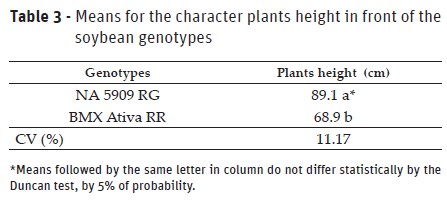
<p>&nbsp;</p>      <p><font face = "Verdana" size = "2">In percent terms, high vigor seeds proportionate a yield of 20% superior in relation to low vigor, and 7% superior to medium vigor. Studies from Scheeren <i>et al</i>. (2010), when evaluating the soybean yield in relation to different vigor levels, observed increment of 9% in the soybean grains yield for batches of high vigor when compared to low vigor. According to Kolchinski <i>et al</i>. (2005), when evaluating the combinations distribution of soybean seeds with high and low vigor within the sowing line, verified an increase of 35% in the grains yield in the comparison among the use of high and low vigor seeds.</font></p>      <p><font face = "Verdana" size = "2">The plants height was superior for plants originated from seeds of high vigor (<a href = "#t2">Table 2</a>), observations that corroborate with Kolchinski <i>et al</i>. (2005) and Scheeren <i>et al</i>. (2010). Seeds of low vigor presented low mobilization and allocation of reserves, as well, low Lea protein and HSPS enzyme accumulation since, when sowed on field, it take a large period of time to reactivate the metabolism and result in the delay of the seedlings emergence, compromising the plant stand (Aumonde <i>et al</i>., 2017). For Schuch <i>et al</i>. (2009), the soybean plants originated from seeds with high physiologic quality presented taller, larger stem diameter and 25% superior to grain yield. For Garcia <i>et al</i>. (2007), the PH must be superior to 60 cm, aiming to minimize the losses and maximize the harvesting operations.</font></p>      <p><font face = "Verdana" size = "2">The low vigor seeds originated plants with higher NLP, in relation to other vigors, which indicates that lower seeds vigor determines reduction in the plant stand, although, it boosts the formation of plants per pod (<a href = "#t2">Table 2</a>). Similar behavior was visible to NSP, probably due to the large phenotypic plasticity of soybean genotypes facing the flexibility of the magnitude of plants per unit of area, modification of the dynamic of total nodes and reproductive nodes, flowers, pods and seeds per unit of area. The ability of the soybean to compensate the plant density per unit of area was evidenced by Tourino <i>et al</i>. (2002) and EmbrapaSoja (2011). This plasticity alters the number and dimensions of branches per plant, pods, grains and diameter of ramifications and branches. In relation to the genotypes comparison (<a href = "#t3">Table 3</a>) the PH expressed superiority to the genotype NA 5909 RG, being justified by the growing habit attributed to this genotype.</font></p>      <p>&nbsp;</p>      <p><a name = "t3"><img src = "/img/revistas/rca/v42n3/v42n3a12t3.jpg"></a></p>      
<p>&nbsp;</p>      ]]></body>
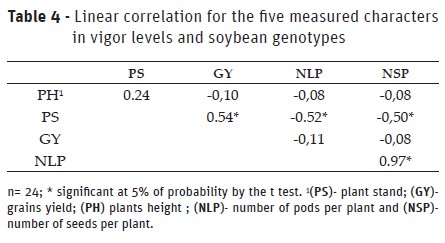
<body><![CDATA[<p><font face = "Verdana" size = "2">The linear correlation evidenced four significant correlations, being a similar fraction for both direction (<a href = "#t4">Table 4</a>). Positive associations were identified between the PS and GY, therefore, they are intimately related, where the increase of the stand by unit of area boosts the GY. Similar tendencies were expressed between the NLP and NSP, where these components are related. Negative associations were evidenced between the PS, NLP and NSP, convincing the soybean potential in modify itself phenotypically in order to acclimate to the growing environment.</font></p>      <p>&nbsp;</p>      <p><a name = "t4"><img src = "/img/revistas/rca/v42n3/v42n3a12t4.jpg"></a></p>      
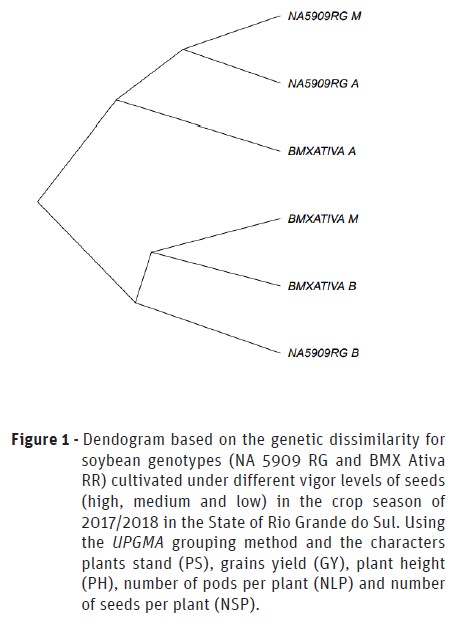
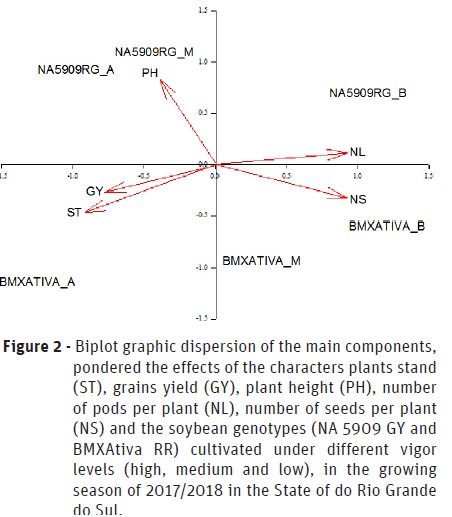
<p>&nbsp;</p>      <p><font face = "Verdana" size = "2">The genetic dissimilarity used to build the dendogram (<a href = "#f1">Figure 1</a>) revealed, based on all characters, the formation of two dissimilar groups, where the genotype NA 5909 RG of high and medium vigor and the genotype BMX Ativa of high vigor formed the first group. The second groups was composed by the genotype BMX Ativa RR through the seeds of medium and low vigor, as well as the genotype NA 5909 RG with low vigor seeds. The Biplot dispersion (<a href = "#f2">Figure 2</a>), based on the mean estimates of the characters, evidenced affinity of the PH with the genotype NA 5909 RG originated from high and medium vigor seeds. The NLP is intimately related to the genotype NA 5909 RG, based on the usage of low vigor seeds, where the NSP is exclusively attributed to the genotype BMX Ativa RR, with plants obtained with low vigor seeds.</font></p>      <p>&nbsp;</p>      <p><a name = "f1"><img src = "/img/revistas/rca/v42n3/v42n3a12f1.jpg"></a></p>      
<p>&nbsp;</p>      <p><a name = "f2"><img src = "/img/revistas/rca/v42n3/v42n3a12f2.jpg"></a></p>      
<p>&nbsp;</p>      ]]></body>
<body><![CDATA[<p><font face = "Verdana" size = "3"><b>CONCLUSION</b></font></p>      <p><font face = "Verdana" size = "2">The usage of high vigor seeds determines the plant stand per unit of area and the GY of soybean. In addition, an increment of 20% is obtained for GY due to the use of seeds with elevated physiologic potential independent of the soybean genotype. The soybean initial establishment, when compromised, negatively influences the yield compounds, and abrupt modifications in the plants structure does not results in effects that will compensate production.</font></p>      <p>&nbsp;</p>      <p><font face = "Verdana" size = "3"><b>References</b></font></p>       <!-- ref --><p><font face = "Verdana" size = "2">ABRASEM (2015) - <i>Estatística da produção e comercialização de sementes no Brasil.</i> Anuário 2015, Associação Brasileira De Sementes e Mudas.    &nbsp;&nbsp;&nbsp;&nbsp;&nbsp;&nbsp;&nbsp;&nbsp;[&#160;<a href="javascript:void(0);" onclick="javascript: window.open('/scielo.php?script=sci_nlinks&ref=702696&pid=S0871-018X201900030001200001&lng=','','width=640,height=500,resizable=yes,scrollbars=1,menubar=yes,');">Links</a>&#160;]<!-- end-ref --></font></p>      <!-- ref --><p><font face = "Verdana" size = "2">Aumonde, T.Z.; Pedo, T.; Martinazzo, E.G. & Villela, F.A. (2017) - <i>Produção de Sementes e Estresses ambientais</i>. Cópias Santa Cruz, Pelotas, 312p.    &nbsp;&nbsp;&nbsp;&nbsp;&nbsp;&nbsp;&nbsp;&nbsp;[&#160;<a href="javascript:void(0);" onclick="javascript: window.open('/scielo.php?script=sci_nlinks&ref=702698&pid=S0871-018X201900030001200002&lng=','','width=640,height=500,resizable=yes,scrollbars=1,menubar=yes,');">Links</a>&#160;]<!-- end-ref --></font></p>      <p><font face = "Verdana" size = "2">Brasil (2003) - <i>Lei nº 10.711 de 05 de agosto de 2003.  Dispõe sobre o Sistema Nacional de Sementes e Mudas e dá outras providências</i>. Diário Oficial da União, 06 de agosto de 2003.</font></p>      <!-- ref --><p><font face = "Verdana" size = "2">Carvalho, I.R.; Nardino, M. & Souza, V.Q. (2017) - <i>Melhoramento e cultivo da soja</i>, n. 1, 288 p.    &nbsp;&nbsp;&nbsp;&nbsp;&nbsp;&nbsp;&nbsp;&nbsp;[&#160;<a href="javascript:void(0);" onclick="javascript: window.open('/scielo.php?script=sci_nlinks&ref=702701&pid=S0871-018X201900030001200003&lng=','','width=640,height=500,resizable=yes,scrollbars=1,menubar=yes,');">Links</a>&#160;]<!-- end-ref --></font></p>      <!-- ref --><p><font face = "Verdana" size = "2">Cervieri, F.E. (2005) - <i>Desempenho de plantas oriundas de sementes de alto e baixo vigor dentro de uma população de soja</i>. Tese Doutorado, Faculdade de Agronomia Eliseu Maciel, UFPel, Pelotas. 42 pp.    &nbsp;&nbsp;&nbsp;&nbsp;&nbsp;&nbsp;&nbsp;&nbsp;[&#160;<a href="javascript:void(0);" onclick="javascript: window.open('/scielo.php?script=sci_nlinks&ref=702703&pid=S0871-018X201900030001200004&lng=','','width=640,height=500,resizable=yes,scrollbars=1,menubar=yes,');">Links</a>&#160;]<!-- end-ref --></font></p>      <!-- ref --><p><font face = "Verdana" size = "2">CONAB (2018) - <i>Acompanhamento da safra brasileira de grãos</i>. v. 1 Safra 2018/2019 -Primeiro levantamento, Brasília. Companhia Nacional de Abastecimento. p. 1-129.    &nbsp;&nbsp;&nbsp;&nbsp;&nbsp;&nbsp;&nbsp;&nbsp;[&#160;<a href="javascript:void(0);" onclick="javascript: window.open('/scielo.php?script=sci_nlinks&ref=702705&pid=S0871-018X201900030001200005&lng=','','width=640,height=500,resizable=yes,scrollbars=1,menubar=yes,');">Links</a>&#160;]<!-- end-ref --></font></p>      <!-- ref --><p><font face = "Verdana" size = "2">Embrapa Soja (2011) - <i>Sistemas de produção 15</i>. Tecnologias de produção de soja- região Central do Brasil 2012 e 2013. Londrina, v. 1, 261 p.    &nbsp;&nbsp;&nbsp;&nbsp;&nbsp;&nbsp;&nbsp;&nbsp;[&#160;<a href="javascript:void(0);" onclick="javascript: window.open('/scielo.php?script=sci_nlinks&ref=702707&pid=S0871-018X201900030001200006&lng=','','width=640,height=500,resizable=yes,scrollbars=1,menubar=yes,');">Links</a>&#160;]<!-- end-ref --></font></p>      <!-- ref --><p><font face = "Verdana" size = "2">França-Neto J.B (2013) - <i>A tecnologia extraordinária da Sementes.</i> A Granja, nº 777, p 21-29. [cit. 2018-10-12]. &lt;<a href = "http://www.abrasem.com.br/wp-content/uploads/2013/09/Matéria-A-granja-A-tecnologia-extraordinária-da-semente.pdf" target = "_blank">http://www.abrasem.com.br/wp-content/uploads/2013/09/Matéria-A-granja-A-tecnologia-extraordinária-da-semente.pdf</a>&gt;    &nbsp;&nbsp;&nbsp;&nbsp;&nbsp;&nbsp;&nbsp;&nbsp;[&#160;<a href="javascript:void(0);" onclick="javascript: window.open('/scielo.php?script=sci_nlinks&ref=702709&pid=S0871-018X201900030001200007&lng=','','width=640,height=500,resizable=yes,scrollbars=1,menubar=yes,');">Links</a>&#160;]<!-- end-ref --></font></p>      <p><font face = "Verdana" size = "2">Garcia, A.; Pípolo, A.E.; Lopes, I.O.N. & Portugal, F.A.F. (2007) -<i> Instalação da lavoura de soja: época, cultivares, espaçamento e população de plantas.</i> Londrina: EMBRAPA &ndash; CNPSO, 12 p. (Circular Técnica, 51).</font></p>      ]]></body>
<body><![CDATA[<!-- ref --><p><font face = "Verdana" size = "2">Kolchinski, E.M.; Schuch, L.O.B. & Peske, S.T. (2005) - Vigor de sementes e competição intra-específica em soja. <i>Ciência Rural</i>, vol. 35, n. 6, p. 1248-1256. <a href = "http://dx.doi.org/10.1590/S0103-84782005000600004" target = "_blank">http://dx.doi.org/10.1590/S0103-84782005000600004</a></font>&nbsp;&nbsp;&nbsp;&nbsp;&nbsp;&nbsp;&nbsp;&nbsp;[&#160;<a href="javascript:void(0);" onclick="javascript: window.open('/scielo.php?script=sci_nlinks&ref=702712&pid=S0871-018X201900030001200009&lng=','','width=640,height=500,resizable=yes,scrollbars=1,menubar=yes,');">Links</a>&#160;]<!-- end-ref --><p><font face = "Verdana" size = "2">Marcos Filho, J. (2015) - Seed vigor testing: an overview of the past, present and future perspective. <i>Scientia Agrícola</i>, vol. 72, n. 4, p. 363&ndash;374. <a href = "http://dx.doi.org/10.1590/0103-9016-2015-0007" target = "_blank">http://dx.doi.org/10.1590/0103-9016-2015-0007</a></font></p>       <!-- ref --><p><font face = "Verdana" size = "2">Mielezrski, F.; Schuch, L.O.B.; Peske, S.T.; Panozzo, L.E.; Peske, F.T. & Carvalho, R.R. (2008) - Desempenho individual e de populações de plantas de arroz híbrido em função da qualidade fisiológica das sementes. <i>Revista Brasileira de Sementes</i>, vol. 30, n. 3, p. 86-94. <a href = "http://dx.doi.org/10.1590/S0101-31222008000300012" target = "_blank">http://dx.doi.org/10.1590/S0101-31222008000300012</a></font>&nbsp;&nbsp;&nbsp;&nbsp;&nbsp;&nbsp;&nbsp;&nbsp;[&#160;<a href="javascript:void(0);" onclick="javascript: window.open('/scielo.php?script=sci_nlinks&ref=702714&pid=S0871-018X201900030001200011&lng=','','width=640,height=500,resizable=yes,scrollbars=1,menubar=yes,');">Links</a>&#160;]<!-- end-ref --><!-- ref --><p><font face = "Verdana" size = "2">Moreno, J.A. (1961) - <i>Clima do Rio Grande do Sul.</i> Porto Alegre, Secretaria de Agricultura, 42p.    &nbsp;&nbsp;&nbsp;&nbsp;&nbsp;&nbsp;&nbsp;&nbsp;[&#160;<a href="javascript:void(0);" onclick="javascript: window.open('/scielo.php?script=sci_nlinks&ref=702715&pid=S0871-018X201900030001200012&lng=','','width=640,height=500,resizable=yes,scrollbars=1,menubar=yes,');">Links</a>&#160;]<!-- end-ref --></font></p>      <!-- ref --><p><font face = "Verdana" size = "2">Peske, S.T; Villela, F.A. & Meneghello, G.E. (2012) - <i>Sementes: fundamentos científicos e tecnológicos</i>. 3.ed. Pelotas: Ed. Universitária, 573 p.    &nbsp;&nbsp;&nbsp;&nbsp;&nbsp;&nbsp;&nbsp;&nbsp;[&#160;<a href="javascript:void(0);" onclick="javascript: window.open('/scielo.php?script=sci_nlinks&ref=702717&pid=S0871-018X201900030001200013&lng=','','width=640,height=500,resizable=yes,scrollbars=1,menubar=yes,');">Links</a>&#160;]<!-- end-ref --></font></p>      <!-- ref --><p><font face = "Verdana" size = "2">Scheeren, B.R.; Peske, S.T.; Schuch, L.O.B. & Barros, A.C.A. (2010) - Qualidade fisiológica e produtividade de sementes de soja. <i>Revista Brasileira de Sementes</i>, vol. 32, p. 35-41.    &nbsp;&nbsp;&nbsp;&nbsp;&nbsp;&nbsp;&nbsp;&nbsp;[&#160;<a href="javascript:void(0);" onclick="javascript: window.open('/scielo.php?script=sci_nlinks&ref=702719&pid=S0871-018X201900030001200014&lng=','','width=640,height=500,resizable=yes,scrollbars=1,menubar=yes,');">Links</a>&#160;]<!-- end-ref --></font></p>       <!-- ref --><p><font face = "Verdana" size = "2">Schuch, L.O.B.; Kolchinski, E.M. & Finatto, J.A. (2009) - Qualidade fisiológica da semente e desempenho de plantas isoladas em soja. <i>Revista Brasileira de Sementes</i>, vol. 31, n. 1, p. 144-149. <a href = "http://dx.doi.org/10.1590/S0101-31222009000100016" target = "_blank">http://dx.doi.org/10.1590/S0101-31222009000100016</a></font>&nbsp;&nbsp;&nbsp;&nbsp;&nbsp;&nbsp;&nbsp;&nbsp;[&#160;<a href="javascript:void(0);" onclick="javascript: window.open('/scielo.php?script=sci_nlinks&ref=702721&pid=S0871-018X201900030001200015&lng=','','width=640,height=500,resizable=yes,scrollbars=1,menubar=yes,');">Links</a>&#160;]<!-- end-ref --><!-- ref --><p><font face = "Verdana" size = "2">Schuch, L.O.; Kolchinski, E.M. & Finatto, J.A. (2009) - Qualidade fisiológica da semente e desempenho de plantas isoladas em soja. <i>Revista Brasileira de Sementes</i>, vol. 31, n. 1, p. 144-149. <a href = "http://dx.doi.org/10.1590/S0101-31222009000100016" target = "_blank">http://dx.doi.org/10.1590/S0101-31222009000100016</a></font>&nbsp;&nbsp;&nbsp;&nbsp;&nbsp;&nbsp;&nbsp;&nbsp;[&#160;<a href="javascript:void(0);" onclick="javascript: window.open('/scielo.php?script=sci_nlinks&ref=702722&pid=S0871-018X201900030001200016&lng=','','width=640,height=500,resizable=yes,scrollbars=1,menubar=yes,');">Links</a>&#160;]<!-- end-ref --><!-- ref --><p><font face = "Verdana" size = "2">Streck, E.V.; Kämpf, N.; Dalmolin, R.S.; Klamt, E.; Nascimento, P.C.; Schneider, P.; Giasson, É. & Pinto, L.F.S. (2008) - <i>Solos do Rio Grande do Sul.</i> 2.ed. Porto Alegre, Emater, 222 p.    &nbsp;&nbsp;&nbsp;&nbsp;&nbsp;&nbsp;&nbsp;&nbsp;[&#160;<a href="javascript:void(0);" onclick="javascript: window.open('/scielo.php?script=sci_nlinks&ref=702723&pid=S0871-018X201900030001200017&lng=','','width=640,height=500,resizable=yes,scrollbars=1,menubar=yes,');">Links</a>&#160;]<!-- end-ref --></font></p>      <!-- ref --><p><font face = "Verdana" size = "2">Szareski, V.J.; Carvalho, I.R.; Kehl, K.; Levien, A.M.; Nardino, M.; Dellagostin, S.M.; Demari, G.H.; Lautenchleger, F.; Villela, F.A.; Pedo, T.; Souza, V.Q. & Aumonde, T.Z. (2018) - Evaluation of the adaptability and stability of wheat genotypes using a phenotypic index of seed vigor. <i>Pesquisa Agropecuária Brasileira</i>, vol. 53, n. 6, p. 727-73. <a href = "http://dx.doi.org/10.1590/s0100-204x2018000600009" target = "_blank">http://dx.doi.org/10.1590/s0100-204x2018000600009</a></font>&nbsp;&nbsp;&nbsp;&nbsp;&nbsp;&nbsp;&nbsp;&nbsp;[&#160;<a href="javascript:void(0);" onclick="javascript: window.open('/scielo.php?script=sci_nlinks&ref=702725&pid=S0871-018X201900030001200018&lng=','','width=640,height=500,resizable=yes,scrollbars=1,menubar=yes,');">Links</a>&#160;]<!-- end-ref --><!-- ref --><p><font face = "Verdana" size = "2">Tourino, M.C.C.; Rezende, P.M. & Salvador, N. (2002) - Espaçamento, densidade e uniformidade de semeadura na produtividade e características agronômicas da soja. <i>Pesquisa Agropecuária Brasileira</i>, Brasília, vol. 37, n. 8, p. 1071-1077. <a href = "http://dx.doi.org/10.1590/S0100-204X2002000800004" target = "_blank">http://dx.doi.org/10.1590/S0100-204X2002000800004</a></font>&nbsp;&nbsp;&nbsp;&nbsp;&nbsp;&nbsp;&nbsp;&nbsp;[&#160;<a href="javascript:void(0);" onclick="javascript: window.open('/scielo.php?script=sci_nlinks&ref=702726&pid=S0871-018X201900030001200019&lng=','','width=640,height=500,resizable=yes,scrollbars=1,menubar=yes,');">Links</a>&#160;]<!-- end-ref --><p>&nbsp;</p>      <p><font face = "Verdana" size = "2">Received/recebido: 2019.01.07</font></p>      <p><font face = "Verdana" size = "2">Accepted/aceite: 2019.02.28</font></p>       ]]></body><back>
<ref-list>
<ref id="B1">
<nlm-citation citation-type="book">
<collab>ABRASEM</collab>
<source><![CDATA[Estatística da produção e comercialização de sementes no Brasil]]></source>
<year>2015</year>
<publisher-name><![CDATA[Associação Brasileira De Sementes e Mudas]]></publisher-name>
</nlm-citation>
</ref>
<ref id="B2">
<nlm-citation citation-type="book">
<person-group person-group-type="author">
<name>
<surname><![CDATA[Aumonde]]></surname>
<given-names><![CDATA[T.Z.]]></given-names>
</name>
<name>
<surname><![CDATA[Pedo]]></surname>
<given-names><![CDATA[T.]]></given-names>
</name>
<name>
<surname><![CDATA[Martinazzo]]></surname>
<given-names><![CDATA[E.G.]]></given-names>
</name>
<name>
<surname><![CDATA[Villela]]></surname>
<given-names><![CDATA[F.A.]]></given-names>
</name>
</person-group>
<source><![CDATA[Produção de Sementes e Estresses ambientais]]></source>
<year>2017</year>
<publisher-loc><![CDATA[Pelotas ]]></publisher-loc>
<publisher-name><![CDATA[Cópias Santa Cruz]]></publisher-name>
</nlm-citation>
</ref>
<ref id="B3">
<nlm-citation citation-type="">
<person-group person-group-type="author">
<name>
<surname><![CDATA[Carvalho]]></surname>
<given-names><![CDATA[I.R.]]></given-names>
</name>
<name>
<surname><![CDATA[Nardino]]></surname>
<given-names><![CDATA[M.]]></given-names>
</name>
<name>
<surname><![CDATA[Souza]]></surname>
<given-names><![CDATA[V.Q.]]></given-names>
</name>
</person-group>
<source><![CDATA[Melhoramento e cultivo da soja]]></source>
<year>2017</year>
</nlm-citation>
</ref>
<ref id="B4">
<nlm-citation citation-type="">
<person-group person-group-type="author">
<name>
<surname><![CDATA[Cervieri]]></surname>
<given-names><![CDATA[F.E.]]></given-names>
</name>
</person-group>
<source><![CDATA[Desempenho de plantas oriundas de sementes de alto e baixo vigor dentro de uma população de soja]]></source>
<year>2005</year>
</nlm-citation>
</ref>
<ref id="B5">
<nlm-citation citation-type="book">
<collab>CONAB</collab>
<source><![CDATA[Acompanhamento da safra brasileira de grãos]]></source>
<year>2018</year>
<volume>1</volume>
<page-range>1-129</page-range><publisher-loc><![CDATA[Brasília ]]></publisher-loc>
<publisher-name><![CDATA[Companhia Nacional de Abastecimento]]></publisher-name>
</nlm-citation>
</ref>
<ref id="B6">
<nlm-citation citation-type="">
<collab>Embrapa Soja</collab>
<source><![CDATA[Sistemas de produção 15: Tecnologias de produção de soja- região Central do Brasil 2012 e 2013]]></source>
<year>2011</year>
<volume>1</volume>
<publisher-loc><![CDATA[Londrina ]]></publisher-loc>
</nlm-citation>
</ref>
<ref id="B7">
<nlm-citation citation-type="">
<person-group person-group-type="author">
<name>
<surname><![CDATA[França-Neto]]></surname>
<given-names><![CDATA[J.B]]></given-names>
</name>
</person-group>
<source><![CDATA[A tecnologia extraordinária da Sementes]]></source>
<year>2013</year>
<page-range>21-29</page-range></nlm-citation>
</ref>
<ref id="B8">
<nlm-citation citation-type="book">
<person-group person-group-type="author">
<name>
<surname><![CDATA[Garcia]]></surname>
<given-names><![CDATA[A.]]></given-names>
</name>
<name>
<surname><![CDATA[Pípolo]]></surname>
<given-names><![CDATA[A.E.]]></given-names>
</name>
<name>
<surname><![CDATA[Lopes]]></surname>
<given-names><![CDATA[I.O.N.]]></given-names>
</name>
<name>
<surname><![CDATA[Portugal]]></surname>
<given-names><![CDATA[F.A.F.]]></given-names>
</name>
</person-group>
<source><![CDATA[Instalação da lavoura de soja: época, cultivares, espaçamento e população de plantas]]></source>
<year>2007</year>
<publisher-loc><![CDATA[Londrina ]]></publisher-loc>
<publisher-name><![CDATA[EMBRAPA - CNPSO]]></publisher-name>
</nlm-citation>
</ref>
<ref id="B9">
<nlm-citation citation-type="journal">
<person-group person-group-type="author">
<name>
<surname><![CDATA[Kolchinski]]></surname>
<given-names><![CDATA[E.M.]]></given-names>
</name>
<name>
<surname><![CDATA[Schuch]]></surname>
<given-names><![CDATA[L.O.B.]]></given-names>
</name>
<name>
<surname><![CDATA[Peske]]></surname>
<given-names><![CDATA[S.T.]]></given-names>
</name>
</person-group>
<article-title xml:lang="pt"><![CDATA[Vigor de sementes e competição intra-específica em soja]]></article-title>
<source><![CDATA[Ciência Rural]]></source>
<year>2005</year>
<volume>35</volume>
<numero>6</numero>
<issue>6</issue>
<page-range>1248-1256</page-range></nlm-citation>
</ref>
<ref id="B10">
<nlm-citation citation-type="journal">
<person-group person-group-type="author">
<name>
<surname><![CDATA[Marcos Filho]]></surname>
<given-names><![CDATA[J.]]></given-names>
</name>
</person-group>
<article-title xml:lang="en"><![CDATA[Seed vigor testing: an overview of the past, present and future perspective]]></article-title>
<source><![CDATA[Scientia Agrícola]]></source>
<year>2015</year>
<volume>72</volume>
<numero>4</numero>
<issue>4</issue>
<page-range>363-374</page-range></nlm-citation>
</ref>
<ref id="B11">
<nlm-citation citation-type="journal">
<person-group person-group-type="author">
<name>
<surname><![CDATA[Mielezrski]]></surname>
<given-names><![CDATA[F.]]></given-names>
</name>
<name>
<surname><![CDATA[Schuch]]></surname>
<given-names><![CDATA[L.O.B.]]></given-names>
</name>
<name>
<surname><![CDATA[Peske]]></surname>
<given-names><![CDATA[S.T.]]></given-names>
</name>
<name>
<surname><![CDATA[Panozzo]]></surname>
<given-names><![CDATA[L.E.]]></given-names>
</name>
<name>
<surname><![CDATA[Peske]]></surname>
<given-names><![CDATA[F.T.]]></given-names>
</name>
<name>
<surname><![CDATA[Carvalho]]></surname>
<given-names><![CDATA[R.R.]]></given-names>
</name>
</person-group>
<article-title xml:lang="pt"><![CDATA[Desempenho individual e de populações de plantas de arroz híbrido em função da qualidade fisiológica das sementes]]></article-title>
<source><![CDATA[Revista Brasileira de Sementes]]></source>
<year>2008</year>
<volume>30</volume>
<numero>3</numero>
<issue>3</issue>
<page-range>86-94</page-range></nlm-citation>
</ref>
<ref id="B12">
<nlm-citation citation-type="book">
<person-group person-group-type="author">
<name>
<surname><![CDATA[Moreno]]></surname>
<given-names><![CDATA[J.A.]]></given-names>
</name>
</person-group>
<source><![CDATA[Clima do Rio Grande do Sul]]></source>
<year>1961</year>
<publisher-loc><![CDATA[Porto Alegre ]]></publisher-loc>
<publisher-name><![CDATA[Secretaria de Agricultura]]></publisher-name>
</nlm-citation>
</ref>
<ref id="B13">
<nlm-citation citation-type="book">
<person-group person-group-type="author">
<name>
<surname><![CDATA[Peske]]></surname>
<given-names><![CDATA[S.T]]></given-names>
</name>
<name>
<surname><![CDATA[Villela]]></surname>
<given-names><![CDATA[F.A.]]></given-names>
</name>
<name>
<surname><![CDATA[Meneghello]]></surname>
<given-names><![CDATA[G.E.]]></given-names>
</name>
</person-group>
<source><![CDATA[Sementes: fundamentos científicos e tecnológicos]]></source>
<year>2012</year>
<edition>3</edition>
<publisher-loc><![CDATA[Pelotas ]]></publisher-loc>
<publisher-name><![CDATA[Ed. Universitária]]></publisher-name>
</nlm-citation>
</ref>
<ref id="B14">
<nlm-citation citation-type="journal">
<person-group person-group-type="author">
<name>
<surname><![CDATA[Scheeren]]></surname>
<given-names><![CDATA[B.R.]]></given-names>
</name>
<name>
<surname><![CDATA[Peske]]></surname>
<given-names><![CDATA[S.T]]></given-names>
</name>
<name>
<surname><![CDATA[Schuch]]></surname>
<given-names><![CDATA[L.O.B.]]></given-names>
</name>
<name>
<surname><![CDATA[Barros]]></surname>
<given-names><![CDATA[A.C.A.]]></given-names>
</name>
</person-group>
<article-title xml:lang="pt"><![CDATA[Qualidade fisiológica e produtividade de sementes de soja]]></article-title>
<source><![CDATA[Revista Brasileira de Sementes]]></source>
<year>2010</year>
<volume>32</volume>
<page-range>35-41</page-range></nlm-citation>
</ref>
<ref id="B15">
<nlm-citation citation-type="journal">
<person-group person-group-type="author">
<name>
<surname><![CDATA[Schuch]]></surname>
<given-names><![CDATA[L.O.B.]]></given-names>
</name>
<name>
<surname><![CDATA[Kolchinski]]></surname>
<given-names><![CDATA[E.M.]]></given-names>
</name>
<name>
<surname><![CDATA[Finatto]]></surname>
<given-names><![CDATA[J.A.]]></given-names>
</name>
</person-group>
<article-title xml:lang="pt"><![CDATA[Qualidade fisiológica da semente e desempenho de plantas isoladas em soja]]></article-title>
<source><![CDATA[Revista Brasileira de Sementes]]></source>
<year>2009</year>
<volume>31</volume>
<numero>1</numero>
<issue>1</issue>
<page-range>144-149</page-range></nlm-citation>
</ref>
<ref id="B16">
<nlm-citation citation-type="journal">
<person-group person-group-type="author">
<name>
<surname><![CDATA[Schuch]]></surname>
<given-names><![CDATA[L.O.]]></given-names>
</name>
<name>
<surname><![CDATA[Kolchinski]]></surname>
<given-names><![CDATA[E.M.]]></given-names>
</name>
<name>
<surname><![CDATA[Finatto]]></surname>
<given-names><![CDATA[J.A.]]></given-names>
</name>
</person-group>
<article-title xml:lang="pt"><![CDATA[Qualidade fisiológica da semente e desempenho de plantas isoladas em soja]]></article-title>
<source><![CDATA[Revista Brasileira de Sementes]]></source>
<year>2009</year>
<volume>31</volume>
<numero>1</numero>
<issue>1</issue>
<page-range>144-149</page-range></nlm-citation>
</ref>
<ref id="B17">
<nlm-citation citation-type="book">
<person-group person-group-type="author">
<name>
<surname><![CDATA[Streck]]></surname>
<given-names><![CDATA[E.V.]]></given-names>
</name>
<name>
<surname><![CDATA[Kämpf]]></surname>
<given-names><![CDATA[N.]]></given-names>
</name>
<name>
<surname><![CDATA[Dalmolin]]></surname>
<given-names><![CDATA[R.S.]]></given-names>
</name>
<name>
<surname><![CDATA[Klamt]]></surname>
<given-names><![CDATA[E.]]></given-names>
</name>
<name>
<surname><![CDATA[Nascimento]]></surname>
<given-names><![CDATA[P.C.]]></given-names>
</name>
<name>
<surname><![CDATA[Schneider]]></surname>
<given-names><![CDATA[P.]]></given-names>
</name>
<name>
<surname><![CDATA[Giasson]]></surname>
<given-names><![CDATA[É.]]></given-names>
</name>
<name>
<surname><![CDATA[Pinto]]></surname>
<given-names><![CDATA[L.F.S.]]></given-names>
</name>
</person-group>
<source><![CDATA[Solos do Rio Grande do Sul]]></source>
<year>2008</year>
<edition>2</edition>
<publisher-loc><![CDATA[Porto Alegre ]]></publisher-loc>
<publisher-name><![CDATA[Emater]]></publisher-name>
</nlm-citation>
</ref>
<ref id="B18">
<nlm-citation citation-type="journal">
<person-group person-group-type="author">
<name>
<surname><![CDATA[Szareski]]></surname>
<given-names><![CDATA[V.J.]]></given-names>
</name>
<name>
<surname><![CDATA[Carvalho]]></surname>
<given-names><![CDATA[I.R.]]></given-names>
</name>
<name>
<surname><![CDATA[Kehl]]></surname>
<given-names><![CDATA[K.]]></given-names>
</name>
<name>
<surname><![CDATA[Levien]]></surname>
<given-names><![CDATA[A.M.]]></given-names>
</name>
<name>
<surname><![CDATA[Nardino]]></surname>
<given-names><![CDATA[M.]]></given-names>
</name>
<name>
<surname><![CDATA[Dellagostin]]></surname>
<given-names><![CDATA[S.M.]]></given-names>
</name>
<name>
<surname><![CDATA[Demari]]></surname>
<given-names><![CDATA[G.H.]]></given-names>
</name>
<name>
<surname><![CDATA[Lautenchleger]]></surname>
<given-names><![CDATA[F.]]></given-names>
</name>
<name>
<surname><![CDATA[Villela]]></surname>
<given-names><![CDATA[F.A.]]></given-names>
</name>
<name>
<surname><![CDATA[Pedo]]></surname>
<given-names><![CDATA[T.]]></given-names>
</name>
<name>
<surname><![CDATA[Souza]]></surname>
<given-names><![CDATA[V.Q.]]></given-names>
</name>
<name>
<surname><![CDATA[Aumonde]]></surname>
<given-names><![CDATA[T.Z.]]></given-names>
</name>
</person-group>
<article-title xml:lang="en"><![CDATA[Evaluation of the adaptability and stability of wheat genotypes using a phenotypic index of seed vigor]]></article-title>
<source><![CDATA[Pesquisa Agropecuária Brasileira]]></source>
<year>2018</year>
<volume>53</volume>
<numero>6</numero>
<issue>6</issue>
<page-range>727-73</page-range></nlm-citation>
</ref>
<ref id="B19">
<nlm-citation citation-type="journal">
<person-group person-group-type="author">
<name>
<surname><![CDATA[Tourino]]></surname>
<given-names><![CDATA[M.C.C.]]></given-names>
</name>
<name>
<surname><![CDATA[Rezende]]></surname>
<given-names><![CDATA[P.M.]]></given-names>
</name>
<name>
<surname><![CDATA[Salvador]]></surname>
<given-names><![CDATA[N.]]></given-names>
</name>
</person-group>
<article-title xml:lang="pt"><![CDATA[Espaçamento, densidade e uniformidade de semeadura na produtividade e características agronômicas da soja]]></article-title>
<source><![CDATA[Pesquisa Agropecuária Brasileira]]></source>
<year>2002</year>
<volume>37</volume>
<numero>8</numero>
<issue>8</issue>
<page-range>1071-1077</page-range><publisher-loc><![CDATA[Brasília ]]></publisher-loc>
</nlm-citation>
</ref>
</ref-list>
</back>
</article>