<?xml version="1.0" encoding="ISO-8859-1"?><article xmlns:mml="http://www.w3.org/1998/Math/MathML" xmlns:xlink="http://www.w3.org/1999/xlink" xmlns:xsi="http://www.w3.org/2001/XMLSchema-instance">
<front>
<journal-meta>
<journal-id>0871-018X</journal-id>
<journal-title><![CDATA[Revista de Ciências Agrárias]]></journal-title>
<abbrev-journal-title><![CDATA[Rev. de Ciências Agrárias]]></abbrev-journal-title>
<issn>0871-018X</issn>
<publisher>
<publisher-name><![CDATA[Sociedade de Ciências Agrárias de Portugal]]></publisher-name>
</publisher>
</journal-meta>
<article-meta>
<article-id>S0871-018X2019000300024</article-id>
<article-id pub-id-type="doi">10.19084/rca.17701</article-id>
<title-group>
<article-title xml:lang="en"><![CDATA[Nutritional and health potential of European chestnut]]></article-title>
<article-title xml:lang="pt"><![CDATA[Potencial nutricional e de saúde da castanha europeia]]></article-title>
</title-group>
<contrib-group>
<contrib contrib-type="author">
<name>
<surname><![CDATA[Choupina]]></surname>
<given-names><![CDATA[Altino]]></given-names>
</name>
<xref ref-type="aff" rid="A1"/>
</contrib>
</contrib-group>
<aff id="AA1">
<institution><![CDATA[,Polytechnic Institute of Bragança Agricultural College of Bragança Department of Biology and Biotechnology]]></institution>
<addr-line><![CDATA[Bragança ]]></addr-line>
<country>Portugal</country>
</aff>
<pub-date pub-type="pub">
<day>00</day>
<month>09</month>
<year>2019</year>
</pub-date>
<pub-date pub-type="epub">
<day>00</day>
<month>09</month>
<year>2019</year>
</pub-date>
<volume>42</volume>
<numero>3</numero>
<fpage>231</fpage>
<lpage>240</lpage>
<copyright-statement/>
<copyright-year/>
<self-uri xlink:href="http://scielo.pt/scielo.php?script=sci_arttext&amp;pid=S0871-018X2019000300024&amp;lng=en&amp;nrm=iso"></self-uri><self-uri xlink:href="http://scielo.pt/scielo.php?script=sci_abstract&amp;pid=S0871-018X2019000300024&amp;lng=en&amp;nrm=iso"></self-uri><self-uri xlink:href="http://scielo.pt/scielo.php?script=sci_pdf&amp;pid=S0871-018X2019000300024&amp;lng=en&amp;nrm=iso"></self-uri><abstract abstract-type="short" xml:lang="en"><p><![CDATA[Chestnut is a crisp, sweet soft fruit that has already played an important role in the feeding of many European regions and is still a very popular fruit. Classical analyzes were used to determine the chemical and nutritional composition of European sweet chestnut. Already, for the determination of the starch content, we use the Lintner polarimetric method. However, the amylose/amylopectin ratio of the starch was measured by gel filtration chromatography. The values for the chemical composition of sweet chestnut were found very interesting, particularly, the values of vitamin C such as the abundance of mineral salts. Were also surprising the starch value and in this the amylose/amylopectin ratio, when compared with the same ratio in most cereals. The amylose/amylopectin ratio of European sweet chestnut starch may help us to explain many of its beneficial nutritional properties and may prove to be of great importance in the industrial use of chestnut. Due to the chemical and nutritional characteristics, European sweet chestnut is a recommended food, especially for patients with high cholesterol, diabetics, and patients suffering from celiac disease, since the chestnut does not have gluten. The aim of this work is to evaluate the nutritional and health potential of sweet chestnut being a great part of the results presented the fruit of bibliographical research.]]></p></abstract>
<abstract abstract-type="short" xml:lang="pt"><p><![CDATA[O objetivo deste trabalho é avaliar o potencial nutricional e de saúde da castanha doce europeia, sendo grande parte dos resultados apresentados fruto de pesquisa bibliográfica. A castanha é um fruto suave e doce que já desempenhou um papel importante na alimentação de muitas regiões europeias continuando a ser um fruto muito popular. Análises clássicas foram usadas para determinar a composição química e nutricional da castanha europeia. Já para a determinação do teor de amido, utilizou-se o método polarimétrico de Lintner. A amilose/amilopectina do amido foram determinadas por cromatografia de filtração em gel, sendo posteriormente calculada a sua relação. Dos valores para a composição química da castanha, pesquisados na bibliografia, são de realçar os valores de vitamina C e a abundância de sais minerais. Também é importante o valor de amido e neste a razão amilose/amilopectina, quando comparado com a mesma proporção na maioria dos cereais. A relação amilose/amilopectina do amido de castanha-europeia pode ajudar-nos a explicar muitas das suas propriedades nutricionais benéficas e pode revelar-se de grande importância no uso industrial da castanha. Devido às suas características químicas e nutricionais, a castanha europeia é um alimento recomendado especialmente para pacientes com colesterol alto, diabéticos e pacientes que sofrem de doença celíaca, uma vez que a castanha não tem glúten.]]></p></abstract>
<kwd-group>
<kwd lng="en"><![CDATA[Chestnut]]></kwd>
<kwd lng="en"><![CDATA[starch]]></kwd>
<kwd lng="en"><![CDATA[amylose/amylopectin ratio]]></kwd>
<kwd lng="en"><![CDATA[nutrition]]></kwd>
<kwd lng="en"><![CDATA[health]]></kwd>
<kwd lng="pt"><![CDATA[Castanha]]></kwd>
<kwd lng="pt"><![CDATA[amido]]></kwd>
<kwd lng="pt"><![CDATA[relação amilose/amilopectina]]></kwd>
<kwd lng="pt"><![CDATA[nutrição]]></kwd>
<kwd lng="pt"><![CDATA[saúde]]></kwd>
</kwd-group>
</article-meta>
</front><body><![CDATA[ <p align = "right"><font face = "Verdana" size = "2"><b>ARTIGO</b></font></p>      <p><font face = "Verdana" size = "4"><b>Nutritional and health potential of European chestnut</b></font></p>      <p><font face = "Verdana" size = "3"><b>Potencial nutricional e de saúde da castanha europeia</b></font></p>      <p><font face = "Verdana" size = "2"><b>Altino Choupina</b>*</font></p>       <p><font face = "Verdana" size = "2"><i>CIMO-Mountain Research Center, Department of Biology and Biotechnology, Agricultural College of Bragança, Polytechnic Institute of Bragança, Campus Santa Apolónia, 5301-855, Bragança, Portugal</i></font></p>       <p><font face = "Verdana" size = "2"><i>(*E-mail: <a href = "mailto:albracho@ipb.pt" target = "_blank">albracho@ipb.pt</a>)</i></font></p>   <hr noshade size = 1>      <p><font face = "Verdana" size = "3"><b>ABSTRACT</b></font></p>      <p><font face = "Verdana" size = "2">Chestnut is a crisp, sweet soft fruit that has already played an important role in the feeding of many European regions and is still a very popular fruit. Classical analyzes were used to determine the chemical and nutritional composition of European sweet chestnut. Already, for the determination of the starch content, we use the Lintner polarimetric method. However, the amylose/amylopectin ratio of the starch was measured by gel filtration chromatography. The values for the chemical composition of sweet chestnut were found very interesting, particularly, the values of vitamin C such as the abundance of mineral salts. Were also surprising the starch value and in this the amylose/amylopectin ratio, when compared with the same ratio in most cereals. The amylose/amylopectin ratio of European sweet chestnut starch may help us to explain many of its beneficial nutritional properties and may prove to be of great importance in the industrial use of chestnut. Due to the chemical and nutritional characteristics, European sweet chestnut is a recommended food, especially for patients with high cholesterol, diabetics, and patients suffering from celiac disease, since the chestnut does not have gluten. The aim of this work is to evaluate the nutritional and health potential of sweet chestnut being a great part of the results presented the fruit of bibliographical research.</font></p>      <p><font face = "Verdana" size = "2"><b>Keywords:</b> Chestnut, starch, amylose/amylopectin ratio, nutrition, health.</font></p>  <hr noshade size = 1>      <p><font face = "Verdana" size = "3"><b>RESUMO</b></font></p>      ]]></body>
<body><![CDATA[<p><font face = "Verdana" size = "2">O objetivo deste trabalho é avaliar o potencial nutricional e de saúde da castanha doce europeia, sendo grande parte dos resultados apresentados fruto de pesquisa bibliográfica. A castanha é um fruto suave e doce que já desempenhou um papel importante na alimentação de muitas regiões europeias continuando a ser um fruto muito popular. Análises clássicas foram usadas para determinar a composição química e nutricional da castanha europeia. Já para a determinação do teor de amido, utilizou-se o método polarimétrico de Lintner. A amilose/amilopectina do amido foram determinadas por cromatografia de filtração em gel, sendo posteriormente calculada a sua relação. Dos valores para a composição química da castanha, pesquisados na bibliografia, são de realçar os valores de vitamina C e a abundância de sais minerais. Também é importante o valor de amido e neste a razão amilose/amilopectina, quando comparado com a mesma proporção na maioria dos cereais. A relação amilose/amilopectina do amido de castanha-europeia pode ajudar-nos a explicar muitas das suas propriedades nutricionais benéficas e pode revelar-se de grande importância no uso industrial da castanha. Devido às suas características químicas e nutricionais, a castanha europeia é um alimento recomendado especialmente para pacientes com colesterol alto, diabéticos e pacientes que sofrem de doença celíaca, uma vez que a castanha não tem glúten.</font></p>      <p><font face = "Verdana" size = "2"><b>Palavras-chave:</b> Castanha, amido, relação amilose/amilopectina, nutrição, saúde.</font></p>  <hr noshade size = 1>      <p><font face = "Verdana" size = "3"><b>INTRODUCTION</b></font></p>      <p><font face = "Verdana" size = "2">The chestnut is the fruit of the chestnut tree, a tree that belongs to the genus Castanea, of the Fagaceae family. The family includes species without great aptitude for fruit production and species with a good aptitude for fruit production.</font></p>       <p><font face = "Verdana" size = "2"><i>Castanea sativa</i> Mill. commonly known as European sweet chestnut belongs to the genus Castanea, it is distributed in 25 European countries, occupying about two million hectares. This species has a large distribution in Spain, France, Greece, Italy, Portugal, and Turkey. In Italy, the area planted with chestnut is the largest in Europe (Gomes-Laranjo <i>et al.,</i> 2009).</font></p>       <p><font face = "Verdana" size = "2">The chestnut fruit has always had great importance in the southern Europe countries. It was the basis of food before the emergence and expansion of potato and cereal crops (Borges <i>et al</i>., 2008). Currently, chestnuts are no longer used as the main direct food of rural populations. However, it is still a very fruit important source of income since there has been a growing demand for this fruit abroad, favoring an increase in prices.</font></p>      <p><font face = "Verdana" size = "2">In addition to domestic consumption, it is also very traditional to sell roasting chestnuts by roasters on the streets of European cities. However, it is very important to highlight its use, with growing interest, in modern confectionery and in the feeding of children with allergic problems.</font></p>      <p><font face = "Verdana" size = "2">In this perspective, chestnut can be used as an ingredient in ice cream and yogurts, and in confectionery such as sweets, pastes and &quot;marron glacé&quot;, being possible also the use of sweet chestnut flour in processes of extrusion cooking to obtain pasta and breakfast cereals (Silva <i>et al.</i> 1994).</font></p>       <p><font face = "Verdana" size = "2">Several studies over recent times have revealed that nuts are important allies of health. They contribute to cholesterol lowering, reduce the risk of cardiovascular disease and, associated with fish and vegetables, help prevent Alzheimer's disease. Dried fruits such as nuts, chestnut, almonds, macadamia nuts, hazelnuts, and others also improve cholesterol levels because of their potential to reduce the risk of coronary heart disease, as well as assist in controlling blood pressure prevent type 2 diabetes and decrease appetite and consequently obesity (Rose, 2010).</font></p>      <p><font face = "Verdana" size = "2">In a comprehensive study by Maria <i>et al</i>. (2010) is well explored the relationship between the chemical and nutritional composition of European sweet chestnut and its products, with its benefits in human and animal health.</font></p>      ]]></body>
<body><![CDATA[<p><font face = "Verdana" size = "2">As regards the nutritional composition of sweet chestnut, this can bring great benefits to the diet. It is high in starch as opposed to simple sugars (recommended for diabetes prevention), low in fat and protein, and a vitamin C content similar to citrus fruit. In addition to the nutritional advantages already mentioned, sweet chestnut is free from gluten, which gives the fruit aptitude as food for celiacs (Rostom <i>et al.</i>, 2006) Celiac disease is a food intolerance that has an immunological and genetic component being triggered by the ingestion of gluten even in small amounts. The global prevalence of celiac disease based on serologic test results is 1.4% and based on biopsy results is 0.7% (Shridhar <i>et al.</i>, 2015)</font></p>      <p><font face = "Verdana" size = "2">It is important to note that depending on the variety and region of sweet chestnut origin, its nutritional value and its organoleptic quality vary. In any case, it is true that this fruit is good food with enormous potential in various aspects of health and should, therefore, be used by the food industry and its production and consumption should be encouraged.</font></p>       <p><font face = "Verdana" size = "2">This work aims to strengthen our knowledge about the chemical and nutritional composition of European sweet chestnut and its health potential being a great part of the results presented the fruit of bibliographical research.</font></p>      <p><font face = "Verdana" size = "3"><b>MATERIAL AND METHODS</b></font></p>      <p><font face = "Verdana" size = "2">The determinations concerning the moisture content, total fat, total protein, cellulose, sugars, mineral salts, ash, and starch content, as well as the amylose/ amylopectin ratio, were determined by us, and five replicates were performed for each experiment, presenting as results the mean calculate of the five replications. The most specific determinations are a result of bibliographic research work.</font></p>      <p><font face = "Verdana" size = "3"><b>Material</b></font></p>      <p><font face = "Verdana" size = "2">The chestnuts studied were collected by us in the Northeast of Portugal, consist of a mixture of several varieties with a predominance of the variety Longal. The samples of sweet chestnut used in the analyzes were obtained after milling in an Arnelfield mill (cal. Ref. Ff2) using a sieve with 0.71 mm mesh. The flours thus obtained were then stored in sealed containers for the following analyzes.</font></p>      <p><font face = "Verdana" size = "2">All the analyses were made in triplicate. Statistical differences between samples were tested using analysis of variance (ANOVA). The level of significance was determined at P &lt; 0.05 for all experiments.</font></p>       <p><font face = "Verdana" size = "3"><b>Methods</b></font></p>       <p><font face = "Verdana" size = "2"><i>Humidity</i> - drying in a laboratory oven (100-105 ºC) until constant weight.</font></p>      ]]></body>
<body><![CDATA[<p><font face = "Verdana" size = "2"><i>Ash</i> - calcination in muffle (at 600 ºC) until constant weight.</font></p>       <p><font face = "Verdana" size = "2"><i>Total fat</i> - ethyl ether extraction (AOAC Method, 1990).</font></p>      <p><font face = "Verdana" size = "2"><i>Total Protein</i> - obtained multiplying by 6.25 of the percentage of total nitrogen obtained by the KJELDHAL method, using saturated copper as the catalyst (Kirk, 1950).</font></p>       <p><font face = "Verdana" size = "2"><i>Cellulose</i> - made by acid hydrolysis for half hour followed by alkaline hydrolysis during the same period of time (AOAC Method, 1990).</font></p>      <p><font face = "Verdana" size = "2"><i>Total Sugars</i> - the total number of reducer sugars was determined, expressed as invert sugar, after hydrolysis under the conditions described in Portuguese Standard Nº. 1420.</font></p>       <p><font face = "Verdana" size = "2"><i>Starch</i> - LINTNER polarimetric method (Method official AOAC), following the method described on the website:</font></p>      <p><font face = "Verdana" size = "2"><a href = "https://www.gafta.com/write/MediaUploads/Contracts/2014/method_23.0_2014.pdf" target = "_blank">https://www.gafta.com/write/MediaUploads/Contracts/2014/method_23.0_2014.pdf</a></font></p>       <p><font face = "Verdana" size = "2"><i>Amylose/amylopectin ratio</i> - evaluated by chromatography using the gel Sepharose CL-2B (Pharmacia Fine Chemicals, Sweden), and as eluent NaN<sub>3</sub> (sodium azide) at 0.02% (v/v) at the rate of 0.5 mL/minute.</font></p>        <p><font face = "Verdana" size = "3"><b>RESULTS AND DISCUSSION</b></font></p>      <p><font face = "Verdana" size = "2"><i>The chemical composition of sweet Chestnut</i></font></p>       ]]></body>
<body><![CDATA[<p><font face = "Verdana" size = "2">The results of the analytic determinations, done to the nutrient, used by us, are exposed in <a href = "/img/revistas/rca/v42n3/v42n3a24t1.jpg" target = "_blank">Table 1</a> and are very similar to results determined by other authors (Vasconcelos <i>et al</i>., 2010).</font></p>      
<p><font face = "Verdana" size = "2">The edible part of the chestnut is 83%. From the analysis of results, it is clear that water is the component that exists in greater quantity. The second most abundant component is starch which expressed in terms of dry matter is close to 50%. Moreover, their importance is even greater if we look at the specificity of its composition, and to its value in the organic equilibrium.</font></p>      <p><font face = "Verdana" size = "2"><i>Nutritional value of sweet chestnut</i></font></p>      <p><font face = "Verdana" size = "2"><u>Carbohydrates</u></font></p>      <p><font face = "Verdana" size = "2">Sweet chestnut is, according to several authors (Barreira <i>et al</i>., 2010) one of the nuts that have higher levels in carbohydrate, about 40 g (in 100 g edible product), the starch corresponding to about 27.5 g (slightly more than that of our determinations). In terms of carbohydrates, it is, therefore, the starch that exists, with a difference, in a greater proposition in the chestnut as we can check in <a href = "/img/revistas/rca/v42n3/v42n3a24t2.jpg" target = "_blank">Table 2</a>.</font></p>      
<p> <font face = "Verdana" size = "2">Many nuts such as walnuts are low in carbohydrates and high in fats. However, the Chestnuts have, as <a href = "/img/revistas/rca/v42n3/v42n3a24t2.jpg" target = "_blank">Table 2</a> shows, a large and significant amount of carbohydrates. Carbohydrates are important sources of energy and are also indispensable for the good functioning of the nervous system since the brain consumes glucose (Rose, 2010).</font></p>     
<p><font face = "Verdana" size = "2">Chestnuts are an excellent source of   dietary fiber, which helps prevent constipation and facilitate bowel movement control.   Also, soluble fiber, nuts, can lower blood sugar levels and contribute to lower   cholesterol (Blomhoff <i>et al</i>., 2016).</font></p>     <p><font face = "Verdana" size = "2">Chestnut because it has a high content of starch, is beneficial as a preventive factor of diabetes. This also seems to confer anti-allergic action according to some studies done in children with various types of allergies and intolerance,s (Kelly and Sabaté, 2006).</font></p>      <p><font face = "Verdana" size = "2"><u>Amylose/amylopectin ratio of sweet chestnut starch</u></font></p>      <p><font face = "Verdana" size = "2">The chromatographic profile obtained with sweet chestnut starch revealed two perfectly distinct peaks. After calculating their areas, we obtained mean values relative to 43% for the fraction of the lowest mass molecular and 57% for the higher fraction of mass molecular. We think that these fractions should mainly to amylose and amylopectin respectively, being, therefore, its ratio of 0.75. It is relationship may have some nutritional importance because it seems that carbohydrates with molecule complex such as starch of chestnut have beneficial properties as the preventive factor of diabetes and allergies. For another side, the knowledge of the amylose/amylopectin ratio may prove to be of great importance in the industrial processing of sweet chestnut in processes such as extrusion (Silva <i>et al.</i> 1994).</font></p>       ]]></body>
<body><![CDATA[<p><font face = "Verdana" size = "2"><i>Proteins and amino acids</i></font></p>        <p><font face = "Verdana" size = "2">Compared with carbohydrates the protein content of European sweet chestnuts is low (<a href = "/img/revistas/rca/v42n3/v42n3a24t3.jpg" target = "_blank">Table 3</a>).</font></p>      
<p><font face = "Verdana" size = "2">Proteins are indispensable in the diet because they perform structural and functional functions in the body. They are an ingrained part of cellular structures and build up for multiple aspects of their metabolism, and can still be used as a source of energy. Thus, proteins are critical in maintaining body tissue, including development and repair. Hair, skin, eyes, muscles, and organs are made of proteins. Enzymes are proteins that increase the rate of chemical reactions in the body. Antibodies are proteins that help prevent infections and multiple diseases. However, the European sweet chestnuts protein content represents a small percentage of the recommended daily allowance for men and women (Bittencourt, 2018).</font></p>      <p><font face = "Verdana" size = "2">The amino acid values are presented in <a href = "/img/revistas/rca/v42n3/v42n3a24t4.jpg" target = "_blank">Table 4</a>, data adapted from Borges <i>et al</i>. (2008).</font></p>      
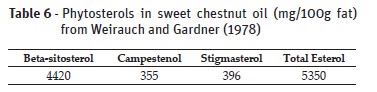
<p><font face = "Verdana" size = "2">As can be seen, protein content and amino acid percentages are low in European sweet chestnuts; however, it contains all the essential amino acids in the human diet, those who are in greater presence aspartic acid, asparagine and glutamic acid.</font></p>      <p><font face = "Verdana" size = "2"><i>Lipids</i></font></p>      <p><font face = "Verdana" size = "2">Chestnut, like other foods in its group, has a low-fat value, having an average value for both oleic acid and linoleic acid of about 35%, but the content of palmitic saturated acid is the highest in nuts being about 15%.</font></p>      <p><font face = "Verdana" size = "2">It is thought that phytosterols are of particular interest in particular beta-sitosterol which appears to have a hypocholesterolemic action and to be antagonistic to cholesterol both in the digestive system and metabolic phenomena. Beta-sitosterol is the main phytosterol present in nuts, with sweet chestnut being the highest value for other nuts, such as almonds, hazelnuts, walnuts, and peanuts (Slota and Kozlov, 1998).</font></p>     <p>&nbsp;</p> <a href = "/img/revistas/rca/v42n3/v42n3a24t5.jpg" target = "_blank">Table 5</a>      
<p>&nbsp;</p>      ]]></body>
<body><![CDATA[<p><a name = "t6"><img src = "/img/revistas/rca/v42n3/v42n3a24t6.jpg"></a></p>      
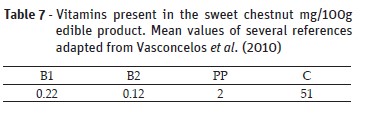
<p>&nbsp;</p>      <p><font face = "Verdana" size = "2"><i>Vitamins</i></font></p>      <p><font face = "Verdana" size = "2">As is well known, vitamins are essential in a balanced diet, for various health-related effects. An essential compound for human health, which humans can not synthesize, is vitamin C (ascorbic acid).</font></p>      <p><font face = "Verdana" size = "2">In European sweet chestnut it is very relevant the vitamin C content, is similar to many citrus fruits which, as is well known, are a large natural source of vitamin C. Vitamin C is very important in creating resistance against infections, calcium, and iron fixation, in the prevention of scurvy and eliminates cancer-causing free radicals in the body (FAO/WHO, 2001).</font></p>      <p><font face = "Verdana" size = "2">Another vitamin with a relevant presence in sweet chestnut is vitamin PP, niacin or vitamin B3. This vitamin has an important role in cellular metabolism and repair of genetic material (DNA). Other important functions are the removal of the body from toxic chemicals and help in the production of steroid hormones by the adrenal glands. Its deficiency can lead to pellagra, which is a disorder that causes diarrhea, dermatitis and nerve damage that affects the central nervous system, leading to dementia. In addition to this disease, the lack of niacin can lead to fatigue, irritability, insomnia, headache, depression, diarrhea and dermatitis (Barros <i>et al</i>., 2011).</font></p>      <p>&nbsp;</p>      <p><a name = "t7"><img src = "/img/revistas/rca/v42n3/v42n3a24t7.jpg"></a></p>      
<p>&nbsp;</p>      <p><font face = "Verdana" size = "2"><i>Minerals</i></font></p>      ]]></body>
<body><![CDATA[<p><font face = "Verdana" size = "2">The content of minerals in European sweet chestnut depends on the different varieties and with the edaphoclimatic conditions of cultivation. The minerals with a greater presence in the sweet chestnut are potassium, copper, phosphorus, magnesium and calcium, as can be seen in <a href = "/img/revistas/rca/v42n3/v42n3a24t8.jpg" target = "_blank">Table 8</a>.</font></p>      
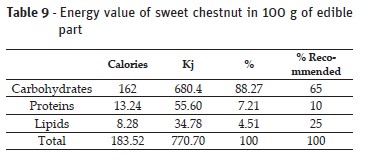
<p><font face = "Verdana" size = "2">The double sodium and potassium are essences for muscle contractions and so it helps maintain normal heart rhythm. Sodium acts on the metabolism of carbohydrates, proteins, and fats, turning these macronutrients into energy for the body. Therefore, the absence of sodium can lead to fatigue, headache, and cardiac arrhythmia. However, as we all know, sodium sources are many and diverse. Potassium has been linked to increased blood flow to the brain; heighten cognition, concentration, and neural activity (Newberry <i>et al.,</i> 2018).</font></p>      <p><font face = "Verdana" size = "2">Sweet chestnut is an important source of calcium an essential mineral for the construction and maintenance of bones and teeth, as well as being very important for muscle contraction and transmission of nerve impulses (Piste <i>et al</i>., 2013). Magnesium is a cofactor of several enzymes such as those that act on the fundamental metabolism of DNA, RNA and Protein synthesis. Manganese is also essential for many enzymes that control blood sugar, energy metabolism, and thyroid function. One cup of chestnuts possesses a whopping 84 percent of the recommended value of manganese. Deficiencies in manganese can be associated with impaired fertility, growth retardation, congenital disabilities, and general weakness. Phosphorus participates in several essential functions such as bone formation along with calcium, chemical reactions of energy release, phosphate buffer system in the intracellular fluid and renal tubules and is also part of the nucleic acids, DNA and RNA (Soetan <i>et al.</i>, 2010).</font></p>      <p><font face = "Verdana" size = "2">Micro-minerals with a significant presence in sweet chestnut are zinc and iron, important components of many enzymes. Iron is an essential component of hemoglobin that carries oxygen from the lungs to the tissues and myoglobin that supplies oxygen to the muscles. This is also necessary for growth, development, normal cellular functioning and the synthesis of some hormones and connective tissue (Soetan <i>et al.</i>, 2010).</font></p>      <p><font face = "Verdana" size = "2"><i>Energetic value</i></font></p>      <p><font face = "Verdana" size = "2">If we consider in the calculations for the energy content the coefficients of Atwater and FAO recommendations, and the values of our determinations, the sweet Chestnut is an excellent source of natural energy, provides about 183.52 Calories per 100 grams of the edible part, as can be observed in <a href = "#t9">Table 9</a>.</font></p>      <p>&nbsp;</p>      <p><a name = "t9"><img src = "/img/revistas/rca/v42n3/v42n3a24t9.jpg"></a></p>      
<p>&nbsp;</p>      <p><font face = "Verdana" size = "3"><b>CONCLUSIONS</b></font></p>      ]]></body>
<body><![CDATA[<p><font face = "Verdana" size = "2">In conclusion, we can affirm that the most significant aspect in the nutritional value of sweet chestnut is its high content of complex molecule carbohydrates such as starch, the content of vitamin C and minerals and the existence of low content of proteins and lipids.</font></p>      <p><font face = "Verdana" size = "2">In any case, sweet chestnut is good food with enormous potential in human and animal health, especially for celiac and diabetic patients, prevention of cancer, reduction of allergies and strengthening of the immune system in children. For all this, the production and processing of sweet chestnut in various products should be increased in order to enhance and increase its shelf life.</font></p>      <p>&nbsp;</p>      <p><font face = "Verdana" size = "3"><b>References</b></font></p>       <!-- ref --><p><font face = "Verdana" size = "2">Barreira, J.C..; Pereira, J.A.; Oliveira, M.B. & Ferreira, I.C. (2010) - Sugars Profiles of Different Chestnut (<i>Castanea</i><i> sativa</i> Mill.) and Almond (<i>Prunus dulcis</i>) Cultivars by HPLC-RI. <i>Plant Foods for Human Nutrition</i>, vol. 65, n. 1, p.38-43. <a href = "https://doi.org/10.1007/s11130-009-0147-7" target = "_blank">https://doi.org/10.1007/s11130-009-0147-7</a></font>&nbsp;&nbsp;&nbsp;&nbsp;&nbsp;&nbsp;&nbsp;&nbsp;[&#160;<a href="javascript:void(0);" onclick="javascript: window.open('/scielo.php?script=sci_nlinks&ref=703568&pid=S0871-018X201900030002400001&lng=','','width=640,height=500,resizable=yes,scrollbars=1,menubar=yes,');">Links</a>&#160;]<!-- end-ref --><!-- ref --><p><font face = "Verdana" size = "2">Barros, A.; Nunes, F.; Gonçalves, B.; Bennett, R. & Silva, A. (2011) - Effect of cooking on total vitamin C contents and antioxidant activity of sweet chestnuts (<i>Castanea sativa</i> Mill.). <i>Food Chemistry</i>, vol. 128, n. 1, p. 165-172. <a href = "https://doi.org/10.1016/j.foodchem.2011.03.013" target = "_blank">https://doi.org/10.1016/j.foodchem.2011.03.013</a></font>&nbsp;&nbsp;&nbsp;&nbsp;&nbsp;&nbsp;&nbsp;&nbsp;[&#160;<a href="javascript:void(0);" onclick="javascript: window.open('/scielo.php?script=sci_nlinks&ref=703569&pid=S0871-018X201900030002400002&lng=','','width=640,height=500,resizable=yes,scrollbars=1,menubar=yes,');">Links</a>&#160;]<!-- end-ref --><!-- ref --><p><font face = "Verdana" size = "2">Bittencourt, J. (2018) - <i>The Power of Carbohydrates, Proteins, and Lipids: How To Make Wise Choices In Diet And Nutrition</i>. CreateSpace Independent Publishing Platform.    &nbsp;&nbsp;&nbsp;&nbsp;&nbsp;&nbsp;&nbsp;&nbsp;[&#160;<a href="javascript:void(0);" onclick="javascript: window.open('/scielo.php?script=sci_nlinks&ref=703570&pid=S0871-018X201900030002400003&lng=','','width=640,height=500,resizable=yes,scrollbars=1,menubar=yes,');">Links</a>&#160;]<!-- end-ref --></font></p>      <!-- ref --><p><font face = "Verdana" size = "2">Blomhoff, R.; Carlsen, H.; Andersen, F. & Jacobs, R. (2016) - Health benefits of nuts: potential role of antioxidants. <i>British Journal of Nutrition</i>, vol. 96,n. S2, p. 52-S60. <a href = "https://doi.org/10.1017/BJN20061864" target = "_blank">https://doi.org/10.1017/BJN20061864</a></font>&nbsp;&nbsp;&nbsp;&nbsp;&nbsp;&nbsp;&nbsp;&nbsp;[&#160;<a href="javascript:void(0);" onclick="javascript: window.open('/scielo.php?script=sci_nlinks&ref=703572&pid=S0871-018X201900030002400004&lng=','','width=640,height=500,resizable=yes,scrollbars=1,menubar=yes,');">Links</a>&#160;]<!-- end-ref --><p><font face = "Verdana" size = "2">Borges, O.; Gonçalves, B.; Carvalho, S.; Correia, P. & Silva, P. (2008) - Nutritional quality of chestnut (<i>Castanea sativa</i> Mill.) cultivars from Portugal. <i>Food Chemistry</i>, vol. 106, n. 3, p. 976&ndash;984. <a href = "https://doi.org/10.1016/j.foodchem.2007.07.011" target = "_blank">https://doi.org/10.1016/j.foodchem.2007.07.011</a></font></p>       ]]></body>
<body><![CDATA[<!-- ref --><p><font face = "Verdana" size = "2">FAO/WHO (2001) <b>- </b><i>Expert consultation on human vitamin and mineral requirements.</i> &lt;<a href = "http://www.fao.org/3/a-y2809e.pdf" target = "_blank">http://www.fao.org/3/a-y2809e.pdf</a>&gt;    &nbsp;&nbsp;&nbsp;&nbsp;&nbsp;&nbsp;&nbsp;&nbsp;[&#160;<a href="javascript:void(0);" onclick="javascript: window.open('/scielo.php?script=sci_nlinks&ref=703574&pid=S0871-018X201900030002400006&lng=','','width=640,height=500,resizable=yes,scrollbars=1,menubar=yes,');">Links</a>&#160;]<!-- end-ref --></font></p>       <!-- ref --><p><font face = "Verdana" size = "2">Gomes-Laranjo, J.; Peixoto, F.; Costa, R. & Ferreira-Cardoso, J. (2009) - Following Chestnut Footprints (<i>Castanea</i> spp). Cultivation and cultures, Folklore and history, traditions and uses. <i>Scripta Horticulturae</i>, n. 9, p. 106-111.    &nbsp;&nbsp;&nbsp;&nbsp;&nbsp;&nbsp;&nbsp;&nbsp;[&#160;<a href="javascript:void(0);" onclick="javascript: window.open('/scielo.php?script=sci_nlinks&ref=703576&pid=S0871-018X201900030002400007&lng=','','width=640,height=500,resizable=yes,scrollbars=1,menubar=yes,');">Links</a>&#160;]<!-- end-ref --></font></p>      <!-- ref --><p><font face = "Verdana" size = "2">Kelly, J.H. & Sabaté, J. (2016) - Nuts and coronary heart disease: an epidemiological perspective. <i>British Journal of Nutrition</i>, vol.96, n. S2, p. 61-67. <a href = "https://doi.org/10.1017/BJN20061865" target = "_blank">https://doi.org/10.1017/BJN20061865</a></font>&nbsp;&nbsp;&nbsp;&nbsp;&nbsp;&nbsp;&nbsp;&nbsp;[&#160;<a href="javascript:void(0);" onclick="javascript: window.open('/scielo.php?script=sci_nlinks&ref=703578&pid=S0871-018X201900030002400008&lng=','','width=640,height=500,resizable=yes,scrollbars=1,menubar=yes,');">Links</a>&#160;]<!-- end-ref --><!-- ref --><p><font face = "Verdana" size = "2">Kirk, L. (1950) - Kjeldahl Method for Total Nitrogen. Analytical Chemistry, vol. <i>22</i>, n. 2, p. 354-358. <a href = "https://doi.org/10.1021/ac60038a038" target = "_blank">https://doi.org/10.1021/ac60038a038</a></font>&nbsp;&nbsp;&nbsp;&nbsp;&nbsp;&nbsp;&nbsp;&nbsp;[&#160;<a href="javascript:void(0);" onclick="javascript: window.open('/scielo.php?script=sci_nlinks&ref=703579&pid=S0871-018X201900030002400009&lng=','','width=640,height=500,resizable=yes,scrollbars=1,menubar=yes,');">Links</a>&#160;]<!-- end-ref --><!-- ref --><p><font face = "Verdana" size = "2">Newberry, S.; Chung, M.; Anderson, C.; Chen, C.; Fu, Z. & Tang, A. (2018) -<i>Effects of Dietary Sodium and Potassium Intake on Chronic Disease Outcomes and Related Risk Factors External.</i> Systematic Review n. 206. AHRQ Publication n. 18-EHC009-EF. Rockville, MD: Agency for Healthcare Research and Quality.    &nbsp;&nbsp;&nbsp;&nbsp;&nbsp;&nbsp;&nbsp;&nbsp;[&#160;<a href="javascript:void(0);" onclick="javascript: window.open('/scielo.php?script=sci_nlinks&ref=703580&pid=S0871-018X201900030002400010&lng=','','width=640,height=500,resizable=yes,scrollbars=1,menubar=yes,');">Links</a>&#160;]<!-- end-ref --></font></p>       <!-- ref --><p><font face = "Verdana" size = "2">Piste, P.; Didwagh, S. & Mokashi, A. (2013) - Calcium and its Role in Human Body. <i>International Journal of Research in Pharmaceutical and Biomedical Sciences</i>, vol. 4, n. 2 p. 659-668.    &nbsp;&nbsp;&nbsp;&nbsp;&nbsp;&nbsp;&nbsp;&nbsp;[&#160;<a href="javascript:void(0);" onclick="javascript: window.open('/scielo.php?script=sci_nlinks&ref=703582&pid=S0871-018X201900030002400011&lng=','','width=640,height=500,resizable=yes,scrollbars=1,menubar=yes,');">Links</a>&#160;]<!-- end-ref --></font></p>      ]]></body>
<body><![CDATA[<!-- ref --><p><font face = "Verdana" size = "2">Rose, E. (2010) - Health benefits of nut consumption. <i>Nutrients</i>, vol. 2, n. 7, p. 652-682. <a href = "https://doi.org/10.3390/nu2070683" target = "_blank">https://doi.org/10.3390/nu2070683</a></font>&nbsp;&nbsp;&nbsp;&nbsp;&nbsp;&nbsp;&nbsp;&nbsp;[&#160;<a href="javascript:void(0);" onclick="javascript: window.open('/scielo.php?script=sci_nlinks&ref=703584&pid=S0871-018X201900030002400012&lng=','','width=640,height=500,resizable=yes,scrollbars=1,menubar=yes,');">Links</a>&#160;]<!-- end-ref --><p><font face = "Verdana" size = "2">Rostom, A.; Murray, A. & Kagnoff, F. (2006) -American Gastroenterological Association (AGA). Institute technical review on the diagnosis and management of celiac disease. <i>Gastroenterology</i>, vol. 131, n. 6, p. 1981-2002. <a href = "https://doi.org/10.1053/j.gastro.2006.10.004" target = "_blank">https://doi.org/10.1053/j.gastro.2006.10.004</a></font></p>      <!-- ref --><p><font face = "Verdana" size = "2">Shridhar, G.; Rajendra, N.; Murigendra, H.; Shridevi, P. & Prasad, M. (2015) - Modern Diet and its Impact on Human Health. <i>Journal of Nutrition and Food Sciences</i>, vol. 5, p. 430. <a href = "https://doi.org/10.4172/2155-9600.1000430" target = "_blank">https://doi.org/10.4172/2155-9600.1000430</a></font>&nbsp;&nbsp;&nbsp;&nbsp;&nbsp;&nbsp;&nbsp;&nbsp;[&#160;<a href="javascript:void(0);" onclick="javascript: window.open('/scielo.php?script=sci_nlinks&ref=703586&pid=S0871-018X201900030002400014&lng=','','width=640,height=500,resizable=yes,scrollbars=1,menubar=yes,');">Links</a>&#160;]<!-- end-ref --><!-- ref --><p><font face = "Verdana" size = "2">Silva, F.; Choupina, A.; Sousa, I. & da Costa, B. (1994) - Extrusion of <i>Castanea sativa</i>. <i>In:</i> Yano T.; Matsuno, R. & Nakamura, K. (Eds) - <i>Developments in Food Engineering</i>. Springer, Boston, MA.    &nbsp;&nbsp;&nbsp;&nbsp;&nbsp;&nbsp;&nbsp;&nbsp;[&#160;<a href="javascript:void(0);" onclick="javascript: window.open('/scielo.php?script=sci_nlinks&ref=703587&pid=S0871-018X201900030002400015&lng=','','width=640,height=500,resizable=yes,scrollbars=1,menubar=yes,');">Links</a>&#160;]<!-- end-ref --></font></p>       <!-- ref --><p><font face = "Verdana" size = "2">Slota, T.; Kozlov, A. & Ammon, H. (1983) - Comparison of cholesterol and beta-sitosterol: effects on jejunal fluid secretion induced by oleate, and absorption from mixed micellar solutions. <i>Gut</i>, vol. 24, n. 7, p. 653-658. <a href = "https://doi.org/10.1136/gut.24.7.653" target = "_blank">https://doi.org/10.1136/gut.24.7.653</a></font>&nbsp;&nbsp;&nbsp;&nbsp;&nbsp;&nbsp;&nbsp;&nbsp;[&#160;<a href="javascript:void(0);" onclick="javascript: window.open('/scielo.php?script=sci_nlinks&ref=703589&pid=S0871-018X201900030002400016&lng=','','width=640,height=500,resizable=yes,scrollbars=1,menubar=yes,');">Links</a>&#160;]<!-- end-ref --><!-- ref --><p><font face = "Verdana" size = "2">Soetan, K.; Olaiya, C. & Oyewole, O. (2010) - The importance of mineral elements for humans, domestic animals and plants - A review. <i>African Journal of Food Science</i>, vol. 4, n. 5, p. 200-222.    &nbsp;&nbsp;&nbsp;&nbsp;&nbsp;&nbsp;&nbsp;&nbsp;[&#160;<a href="javascript:void(0);" onclick="javascript: window.open('/scielo.php?script=sci_nlinks&ref=703590&pid=S0871-018X201900030002400017&lng=','','width=640,height=500,resizable=yes,scrollbars=1,menubar=yes,');">Links</a>&#160;]<!-- end-ref --></font></p>      <!-- ref --><p><font face = "Verdana" size = "2">Vasconcelos, M.C.B.M.; Bennett, R.; Rosa, E.A.S. & Ferreira-Cardoso, J.V. (2010) - Composition of European chestnut (<i>Castanea sativa</i> Mill.) and association with health effects: fresh and processed products. <i>Journal of the Science of Food and Agriculture</i>, vol. 90, n. 10, p. 1578-1589. <a href = "https://doi.org/10.1002/jsfa.4016" target = "_blank">https://doi.org/10.1002/jsfa.4016</a></font>&nbsp;&nbsp;&nbsp;&nbsp;&nbsp;&nbsp;&nbsp;&nbsp;[&#160;<a href="javascript:void(0);" onclick="javascript: window.open('/scielo.php?script=sci_nlinks&ref=703592&pid=S0871-018X201900030002400018&lng=','','width=640,height=500,resizable=yes,scrollbars=1,menubar=yes,');">Links</a>&#160;]<!-- end-ref --><p>&nbsp;</p>      ]]></body>
<body><![CDATA[<p><font face = "Verdana" size = "2">Received/recebido: 2019.04.30</font></p>      <p><font face = "Verdana" size = "2">Accepted/aceite: 2019.06.18</font></p>       ]]></body><back>
<ref-list>
<ref id="B1">
<nlm-citation citation-type="journal">
<person-group person-group-type="author">
<name>
<surname><![CDATA[Barreira]]></surname>
<given-names><![CDATA[J.C.]]></given-names>
</name>
<name>
<surname><![CDATA[Pereira]]></surname>
<given-names><![CDATA[J.A.]]></given-names>
</name>
<name>
<surname><![CDATA[Oliveira]]></surname>
<given-names><![CDATA[M.B.]]></given-names>
</name>
<name>
<surname><![CDATA[Ferreira]]></surname>
<given-names><![CDATA[I.C.]]></given-names>
</name>
</person-group>
<article-title xml:lang="en"><![CDATA[Sugars Profiles of Different Chestnut (Castanea sativa Mill.) and Almond (Prunus dulcis) Cultivars by HPLC-RI]]></article-title>
<source><![CDATA[Plant Foods for Human Nutrition]]></source>
<year>2010</year>
<volume>65</volume>
<numero>1</numero>
<issue>1</issue>
<page-range>38-43</page-range></nlm-citation>
</ref>
<ref id="B2">
<nlm-citation citation-type="journal">
<person-group person-group-type="author">
<name>
<surname><![CDATA[Barros]]></surname>
<given-names><![CDATA[A.]]></given-names>
</name>
<name>
<surname><![CDATA[Nunes]]></surname>
<given-names><![CDATA[F.]]></given-names>
</name>
<name>
<surname><![CDATA[Gonçalves]]></surname>
<given-names><![CDATA[B.]]></given-names>
</name>
<name>
<surname><![CDATA[Bennett]]></surname>
<given-names><![CDATA[R.]]></given-names>
</name>
<name>
<surname><![CDATA[Silva]]></surname>
<given-names><![CDATA[A.]]></given-names>
</name>
</person-group>
<article-title xml:lang="en"><![CDATA[Effect of cooking on total vitamin C contents and antioxidant activity of sweet chestnuts (Castanea sativa Mill.)]]></article-title>
<source><![CDATA[Food Chemistry]]></source>
<year>2011</year>
<volume>128</volume>
<numero>1</numero>
<issue>1</issue>
<page-range>165-172</page-range></nlm-citation>
</ref>
<ref id="B3">
<nlm-citation citation-type="book">
<person-group person-group-type="author">
<name>
<surname><![CDATA[Bittencourt]]></surname>
<given-names><![CDATA[J.]]></given-names>
</name>
</person-group>
<source><![CDATA[The Power of Carbohydrates, Proteins, and Lipids: How To Make Wise Choices In Diet And Nutrition]]></source>
<year>2018</year>
<publisher-name><![CDATA[CreateSpace Independent Publishing Platform]]></publisher-name>
</nlm-citation>
</ref>
<ref id="B4">
<nlm-citation citation-type="journal">
<person-group person-group-type="author">
<name>
<surname><![CDATA[Blomhoff]]></surname>
<given-names><![CDATA[R.]]></given-names>
</name>
<name>
<surname><![CDATA[Carlsen]]></surname>
<given-names><![CDATA[H.]]></given-names>
</name>
<name>
<surname><![CDATA[Andersen]]></surname>
<given-names><![CDATA[F.]]></given-names>
</name>
<name>
<surname><![CDATA[Jacobs]]></surname>
<given-names><![CDATA[R.]]></given-names>
</name>
</person-group>
<article-title xml:lang="en"><![CDATA[Health benefits of nuts: potential role of antioxidants]]></article-title>
<source><![CDATA[British Journal of Nutrition]]></source>
<year>2016</year>
<volume>96</volume>
<numero>S2</numero>
<issue>S2</issue>
<page-range>52-S60</page-range></nlm-citation>
</ref>
<ref id="B5">
<nlm-citation citation-type="journal">
<person-group person-group-type="author">
<name>
<surname><![CDATA[Borges]]></surname>
<given-names><![CDATA[O.]]></given-names>
</name>
<name>
<surname><![CDATA[Gonçalves]]></surname>
<given-names><![CDATA[B.]]></given-names>
</name>
<name>
<surname><![CDATA[Carvalho]]></surname>
<given-names><![CDATA[S.]]></given-names>
</name>
<name>
<surname><![CDATA[Correia]]></surname>
<given-names><![CDATA[P.]]></given-names>
</name>
<name>
<surname><![CDATA[Silva]]></surname>
<given-names><![CDATA[P.]]></given-names>
</name>
</person-group>
<article-title xml:lang="en"><![CDATA[Nutritional quality of chestnut (Castanea sativa Mill.) cultivars from Portugal]]></article-title>
<source><![CDATA[Food Chemistry]]></source>
<year>2008</year>
<volume>106</volume>
<numero>3</numero>
<issue>3</issue>
<page-range>976-984</page-range></nlm-citation>
</ref>
<ref id="B6">
<nlm-citation citation-type="">
<collab>WHO^dFAO</collab>
<source><![CDATA[Expert consultation on human vitamin and mineral requirements]]></source>
<year>2001</year>
</nlm-citation>
</ref>
<ref id="B7">
<nlm-citation citation-type="journal">
<person-group person-group-type="author">
<name>
<surname><![CDATA[Gomes-Laranjo]]></surname>
<given-names><![CDATA[J.]]></given-names>
</name>
<name>
<surname><![CDATA[Peixoto]]></surname>
<given-names><![CDATA[F.]]></given-names>
</name>
<name>
<surname><![CDATA[Costa]]></surname>
<given-names><![CDATA[R.]]></given-names>
</name>
<name>
<surname><![CDATA[Ferreira-Cardoso]]></surname>
<given-names><![CDATA[J.]]></given-names>
</name>
</person-group>
<article-title xml:lang="en"><![CDATA[Following Chestnut Footprints (Castanea spp). Cultivation and cultures, Folklore and history, traditions and uses]]></article-title>
<source><![CDATA[Scripta Horticulturae]]></source>
<year>2009</year>
<numero>9</numero>
<issue>9</issue>
<page-range>106-111</page-range></nlm-citation>
</ref>
<ref id="B8">
<nlm-citation citation-type="journal">
<person-group person-group-type="author">
<name>
<surname><![CDATA[Kelly]]></surname>
<given-names><![CDATA[J.H.]]></given-names>
</name>
<name>
<surname><![CDATA[Sabaté]]></surname>
<given-names><![CDATA[J.]]></given-names>
</name>
</person-group>
<article-title xml:lang="en"><![CDATA[Nuts and coronary heart disease: an epidemiological perspective]]></article-title>
<source><![CDATA[British Journal of Nutrition]]></source>
<year>2016</year>
<volume>96</volume>
<numero>S2</numero>
<issue>S2</issue>
<page-range>61-67</page-range></nlm-citation>
</ref>
<ref id="B9">
<nlm-citation citation-type="journal">
<person-group person-group-type="author">
<name>
<surname><![CDATA[Kirk]]></surname>
<given-names><![CDATA[L.]]></given-names>
</name>
</person-group>
<article-title xml:lang="en"><![CDATA[Kjeldahl Method for Total Nitrogen]]></article-title>
<source><![CDATA[Analytical Chemistry]]></source>
<year>1950</year>
<volume>22</volume>
<numero>2</numero>
<issue>2</issue>
<page-range>354-358</page-range></nlm-citation>
</ref>
<ref id="B10">
<nlm-citation citation-type="book">
<person-group person-group-type="author">
<name>
<surname><![CDATA[Newberry]]></surname>
<given-names><![CDATA[S.]]></given-names>
</name>
<name>
<surname><![CDATA[Chung]]></surname>
<given-names><![CDATA[M.]]></given-names>
</name>
<name>
<surname><![CDATA[Anderson]]></surname>
<given-names><![CDATA[C.]]></given-names>
</name>
<name>
<surname><![CDATA[Chen]]></surname>
<given-names><![CDATA[C.]]></given-names>
</name>
<name>
<surname><![CDATA[Fu]]></surname>
<given-names><![CDATA[Z.]]></given-names>
</name>
<name>
<surname><![CDATA[Tang]]></surname>
<given-names><![CDATA[A.]]></given-names>
</name>
</person-group>
<source><![CDATA[Effects of Dietary Sodium and Potassium Intake on Chronic Disease Outcomes and Related Risk Factors External]]></source>
<year>2018</year>
<publisher-loc><![CDATA[Rockville^eMD MD]]></publisher-loc>
<publisher-name><![CDATA[Agency for Healthcare Research and Quality]]></publisher-name>
</nlm-citation>
</ref>
<ref id="B11">
<nlm-citation citation-type="journal">
<person-group person-group-type="author">
<name>
<surname><![CDATA[Piste]]></surname>
<given-names><![CDATA[P.]]></given-names>
</name>
<name>
<surname><![CDATA[Didwagh]]></surname>
<given-names><![CDATA[S.]]></given-names>
</name>
<name>
<surname><![CDATA[Mokashi]]></surname>
<given-names><![CDATA[A.]]></given-names>
</name>
</person-group>
<article-title xml:lang="en"><![CDATA[Calcium and its Role in Human Body]]></article-title>
<source><![CDATA[International Journal of Research in Pharmaceutical and Biomedical Sciences]]></source>
<year>2013</year>
<volume>4</volume>
<numero>2</numero>
<issue>2</issue>
<page-range>659-668</page-range></nlm-citation>
</ref>
<ref id="B12">
<nlm-citation citation-type="journal">
<person-group person-group-type="author">
<name>
<surname><![CDATA[Rose]]></surname>
<given-names><![CDATA[E.]]></given-names>
</name>
</person-group>
<article-title xml:lang="en"><![CDATA[Health benefits of nut consumption]]></article-title>
<source><![CDATA[Nutrients]]></source>
<year>2010</year>
<volume>2</volume>
<numero>7</numero>
<issue>7</issue>
<page-range>652-682</page-range></nlm-citation>
</ref>
<ref id="B13">
<nlm-citation citation-type="journal">
<person-group person-group-type="author">
<name>
<surname><![CDATA[Rostom]]></surname>
<given-names><![CDATA[A.]]></given-names>
</name>
<name>
<surname><![CDATA[Murray]]></surname>
<given-names><![CDATA[A.]]></given-names>
</name>
<name>
<surname><![CDATA[Kagnoff]]></surname>
<given-names><![CDATA[F.]]></given-names>
</name>
</person-group>
<article-title xml:lang="en"><![CDATA[American Gastroenterological Association (AGA): Institute technical review on the diagnosis and management of celiac disease]]></article-title>
<source><![CDATA[Gastroenterology]]></source>
<year>2006</year>
<volume>131</volume>
<numero>6</numero>
<issue>6</issue>
<page-range>1981-2002</page-range></nlm-citation>
</ref>
<ref id="B14">
<nlm-citation citation-type="journal">
<person-group person-group-type="author">
<name>
<surname><![CDATA[Shridhar]]></surname>
<given-names><![CDATA[G.]]></given-names>
</name>
<name>
<surname><![CDATA[Rajendra]]></surname>
<given-names><![CDATA[N.]]></given-names>
</name>
<name>
<surname><![CDATA[Murigendra]]></surname>
<given-names><![CDATA[H.]]></given-names>
</name>
<name>
<surname><![CDATA[Shridevi]]></surname>
<given-names><![CDATA[P.]]></given-names>
</name>
<name>
<surname><![CDATA[Prasad]]></surname>
<given-names><![CDATA[M.]]></given-names>
</name>
</person-group>
<article-title xml:lang="en"><![CDATA[Modern Diet and its Impact on Human Health]]></article-title>
<source><![CDATA[Journal of Nutrition and Food Sciences]]></source>
<year>2015</year>
<volume>5</volume>
<page-range>430</page-range></nlm-citation>
</ref>
<ref id="B15">
<nlm-citation citation-type="book">
<person-group person-group-type="author">
<name>
<surname><![CDATA[Silva]]></surname>
<given-names><![CDATA[F.]]></given-names>
</name>
<name>
<surname><![CDATA[Choupina]]></surname>
<given-names><![CDATA[A.]]></given-names>
</name>
<name>
<surname><![CDATA[Sousa]]></surname>
<given-names><![CDATA[I.]]></given-names>
</name>
<name>
<surname><![CDATA[da Costa]]></surname>
<given-names><![CDATA[B.]]></given-names>
</name>
</person-group>
<article-title xml:lang="en"><![CDATA[Extrusion of Castanea sativa]]></article-title>
<person-group person-group-type="editor">
<name>
<surname><![CDATA[Yano]]></surname>
<given-names><![CDATA[T.]]></given-names>
</name>
<name>
<surname><![CDATA[Matsuno]]></surname>
<given-names><![CDATA[R.]]></given-names>
</name>
<name>
<surname><![CDATA[Nakamura]]></surname>
<given-names><![CDATA[K.]]></given-names>
</name>
</person-group>
<source><![CDATA[Developments in Food Engineering]]></source>
<year>1994</year>
<publisher-loc><![CDATA[Boston^eMA MA]]></publisher-loc>
<publisher-name><![CDATA[Springer]]></publisher-name>
</nlm-citation>
</ref>
<ref id="B16">
<nlm-citation citation-type="journal">
<person-group person-group-type="author">
<name>
<surname><![CDATA[Slota]]></surname>
<given-names><![CDATA[T.]]></given-names>
</name>
<name>
<surname><![CDATA[Kozlov]]></surname>
<given-names><![CDATA[A.]]></given-names>
</name>
<name>
<surname><![CDATA[Ammon]]></surname>
<given-names><![CDATA[H.]]></given-names>
</name>
</person-group>
<article-title xml:lang="en"><![CDATA[Comparison of cholesterol and beta-sitosterol: effects on jejunal fluid secretion induced by oleate, and absorption from mixed micellar solutions]]></article-title>
<source><![CDATA[Gut]]></source>
<year>1983</year>
<volume>24</volume>
<numero>7</numero>
<issue>7</issue>
<page-range>653-658</page-range></nlm-citation>
</ref>
<ref id="B17">
<nlm-citation citation-type="journal">
<person-group person-group-type="author">
<name>
<surname><![CDATA[Soetan]]></surname>
<given-names><![CDATA[K.]]></given-names>
</name>
<name>
<surname><![CDATA[Olaiya]]></surname>
<given-names><![CDATA[C.]]></given-names>
</name>
<name>
<surname><![CDATA[Oyewole]]></surname>
<given-names><![CDATA[O.]]></given-names>
</name>
</person-group>
<article-title xml:lang="en"><![CDATA[The importance of mineral elements for humans, domestic animals and plants - A review]]></article-title>
<source><![CDATA[African Journal of Food Science]]></source>
<year>2010</year>
<volume>4</volume>
<numero>5</numero>
<issue>5</issue>
<page-range>200-222</page-range></nlm-citation>
</ref>
<ref id="B18">
<nlm-citation citation-type="journal">
<person-group person-group-type="author">
<name>
<surname><![CDATA[Vasconcelos]]></surname>
<given-names><![CDATA[M.C.B.M.]]></given-names>
</name>
<name>
<surname><![CDATA[Bennett]]></surname>
<given-names><![CDATA[R.]]></given-names>
</name>
<name>
<surname><![CDATA[Ferreira-Cardoso]]></surname>
<given-names><![CDATA[J.]]></given-names>
</name>
</person-group>
<article-title xml:lang="en"><![CDATA[Composition of European chestnut (Castanea sativa Mill.) and association with health effects: fresh and processed products]]></article-title>
<source><![CDATA[Journal of the Science of Food and Agriculture]]></source>
<year>2010</year>
<volume>90</volume>
<numero>10</numero>
<issue>10</issue>
<page-range>1578-1589</page-range></nlm-citation>
</ref>
</ref-list>
</back>
</article>