<?xml version="1.0" encoding="ISO-8859-1"?><article xmlns:mml="http://www.w3.org/1998/Math/MathML" xmlns:xlink="http://www.w3.org/1999/xlink" xmlns:xsi="http://www.w3.org/2001/XMLSchema-instance">
<front>
<journal-meta>
<journal-id>0871-018X</journal-id>
<journal-title><![CDATA[Revista de Ciências Agrárias]]></journal-title>
<abbrev-journal-title><![CDATA[Rev. de Ciências Agrárias]]></abbrev-journal-title>
<issn>0871-018X</issn>
<publisher>
<publisher-name><![CDATA[Sociedade de Ciências Agrárias de Portugal]]></publisher-name>
</publisher>
</journal-meta>
<article-meta>
<article-id>S0871-018X2019000400006</article-id>
<article-id pub-id-type="doi">10.19084/rca.17865</article-id>
<title-group>
<article-title xml:lang="en"><![CDATA[Agronomic performance of lowland rice plants promoted by beneficial microorganisms]]></article-title>
<article-title xml:lang="pt"><![CDATA[Desempenho agronômico de plantas de arroz irrigado promovido por microrganismos benéficos]]></article-title>
</title-group>
<contrib-group>
<contrib contrib-type="author">
<name>
<surname><![CDATA[Sousa]]></surname>
<given-names><![CDATA[Israel M.]]></given-names>
</name>
<xref ref-type="aff" rid="A1"/>
</contrib>
<contrib contrib-type="author">
<name>
<surname><![CDATA[Nascente]]></surname>
<given-names><![CDATA[Adriano S.]]></given-names>
</name>
<xref ref-type="aff" rid="A2"/>
</contrib>
<contrib contrib-type="author">
<name>
<surname><![CDATA[Filippi]]></surname>
<given-names><![CDATA[Marta Cristina C.]]></given-names>
</name>
<xref ref-type="aff" rid="A2"/>
</contrib>
<contrib contrib-type="author">
<name>
<surname><![CDATA[Lanna]]></surname>
<given-names><![CDATA[Anna Cristina]]></given-names>
</name>
<xref ref-type="aff" rid="A2"/>
</contrib>
</contrib-group>
<aff id="AA1">
<institution><![CDATA[,Universidade Federal de Goiás Escola de Agronomia Programa de Pós Graduação em Agronomia]]></institution>
<addr-line><![CDATA[Goiânia GO]]></addr-line>
<country>Brasil</country>
</aff>
<aff id="AA2">
<institution><![CDATA[,Embrapa Arroz e Feijão  ]]></institution>
<addr-line><![CDATA[Santo Antônio de Goiás GO]]></addr-line>
<country>Brasil</country>
</aff>
<pub-date pub-type="pub">
<day>00</day>
<month>12</month>
<year>2019</year>
</pub-date>
<pub-date pub-type="epub">
<day>00</day>
<month>12</month>
<year>2019</year>
</pub-date>
<volume>42</volume>
<numero>4</numero>
<fpage>51</fpage>
<lpage>60</lpage>
<copyright-statement/>
<copyright-year/>
<self-uri xlink:href="http://scielo.pt/scielo.php?script=sci_arttext&amp;pid=S0871-018X2019000400006&amp;lng=en&amp;nrm=iso"></self-uri><self-uri xlink:href="http://scielo.pt/scielo.php?script=sci_abstract&amp;pid=S0871-018X2019000400006&amp;lng=en&amp;nrm=iso"></self-uri><self-uri xlink:href="http://scielo.pt/scielo.php?script=sci_pdf&amp;pid=S0871-018X2019000400006&amp;lng=en&amp;nrm=iso"></self-uri><abstract abstract-type="short" xml:lang="en"><p><![CDATA[This work aimed to determine the effect of application forms of growth promoting microorganisms on tropical lowland rice plants development, in two experiments. EI was performed in completely randomized design (CRD) in factorial scheme 7x3+1. Treatments were six rhizobacteria: BRM32109 and BRM32110 (Bacillussp.); BRM32111 (Pseudomonas fluorescens); BRM32112 (Pseudomonassp.); BRM32113 (Burkholderia pyrrocinia); BRM32114 (Serratiasp.) and Trichoderma asperellumpool fungus (UFRA.T06+UFRA.T09+UFRA.T12+UFRA.T52) with three application forms (microbiolized seed; seed + soil drenched with microorganism at eight and 15 days after sowing (DAS) and seed + plant sprayed with microorganism at eight and 15 DAS), and control. In EII, microbiolized rice seeds were sowed on test tubes in CRD. Treatments were the same six rhizobacteria of EI and control (water). Isolates BRM32110, BRM32111, BRM32112 and BRM32113 improved gas exchange in lowland rice plants. For biomass production, there were interactions between types of microorganisms and application forms. In general, microbiolization + plant sprayed was the most efficient (10.3%) to increase dry matter biomass of rice shoots. Stoodout BRM32109, BRM32111 and BRM32113, which, increased, on average, 19% of dry rice biomass when compared to the control plants. Root length of rice seedlings treated with microorganisms was, on average, 89% higher than control plants.]]></p></abstract>
<abstract abstract-type="short" xml:lang="pt"><p><![CDATA[Objetivou-se determinar o efeito de formas de aplicação de microrganismos promotores de crescimento no desenvolvimento de plantas de arroz irrigado tropical, em dois experimentos. EI foi realizado em delineamento experimental inteiramente casualizado (DIC) em esquema fatorial 7x3+1. Tratamentos consistiram de seis isolados de rizobactérias: BRM32109 e BRM32110 (Bacillussp.); BRM32111 (Pseudomonas fluorescens); BRM32112 (Pseudomonassp.); BRM32113 (Burkholderia pyrrocinia); BRM32114 (Serratiasp.) e pooldo fungo Trichoderma asperellum(UFRA.T06+UFRA.T09+UFRA.T12+UFRA.T52) com três formas de aplicação aplicação (semente microbiolizada; semente microbiolizada + solo regado com microrganismo aos oito e 15 dias após a semeadura (DAS) e semente microbiolizada + pulverização do microrganismo na planta aos oito e 15 DAS), e um tratamento controle. Em EII, sementes de arroz microbiolizadas foram semeadas em tubos de ensaio em DIC. Tratamentos foram os mesmos seis isolados de rizobactérias utilizados no EI e um controle (água). Os isolados BRM32110, BRM32111, BRM32112 e BRM32113 melhoraram as trocas gasosas nas plantas de arroz irrigado. Para produção de biomassa, houve interações entre tipos e formas de aplicação dos microrganismos. Em geral, microbiolização + pulverização do microrganismo foi mais eficiente (10,3%) em aumentar a biomassa seca da parte aérea das plantas de arroz. Destaque para BRM32109, BRM32111 e BRM32113, os quais aumentaram, em média, 19% a biomassa seca das plantas quando comparado com o tratamento controle. Comprimento radicular de plântulas de arroz tratadas com os microrganismos foi, em média, 89% maior que o das plantas controle.]]></p></abstract>
<kwd-group>
<kwd lng="en"><![CDATA[Oryza sativa L.]]></kwd>
<kwd lng="en"><![CDATA[Growth promoting]]></kwd>
<kwd lng="en"><![CDATA[Plant growth promoting rhizobacteria]]></kwd>
<kwd lng="en"><![CDATA[Sustainable production]]></kwd>
<kwd lng="pt"><![CDATA[Oryza sativaL.]]></kwd>
<kwd lng="pt"><![CDATA[Promoção de crescimento]]></kwd>
<kwd lng="pt"><![CDATA[Rizobactérias promotoras de crescimento vegetal]]></kwd>
<kwd lng="pt"><![CDATA[Produção sustentável]]></kwd>
</kwd-group>
</article-meta>
</front><body><![CDATA[ <p align = "right"><font face = "Verdana" size = "2"><b>ARTIGO</b></font></p>     <p><font face = "Verdana" size = "4"><b>Agronomic performance of lowland rice plants promoted by beneficial microorganisms</b></font></p>     <p><font face = "Verdana" size = "3"><b>Desempenho agron&ocirc;mico de plantas de arroz irrigado promovido por microrganismos ben&eacute;ficos</b></font></p>     <p><font face = "Verdana" size = "2"><b>Israel M. Sousa</b><sup>1,*</sup>, <b>Adriano S. Nascente</b><sup>2</sup>, <b>Marta Cristina C. Filippi</b><sup>2</sup> and <b>Anna Cristina Lanna</b><sup>2</sup></font></p>     <p><font face = "Verdana" size = "2"><i><sup>1</sup>Universidade Federal de Goi&aacute;s, Escola de Agronomia, Programa de P&oacute;s Gradua&ccedil;&atilde;o em Agronomia, Avenida Esperan&ccedil;a, s/n, Ch&aacute;caras Samambaia, CEP 74690-900 Goi&acirc;nia GO, Brasil</i></font></p>     <p><font face = "Verdana" size = "2"><i><sup>2</sup>Embrapa Arroz e Feij&atilde;o, Rodovia GO-462, Km 12, CEP 75375-000 Santo Ant&ocirc;nio de Goi&aacute;s GO, Brasil</i></font></p>     <p><font face = "Verdana" size = "2"><i>(*E-mail: <a href = "mailto:israelmmendes128@gmail.com" target = "_blank">israelmmendes128@gmail.com</a>)</i></font></p> <hr noshade size = 1>     <p><font face = "Verdana" size = "3"><b>ABSTRACT</b></font></p>     <p><font face = "Verdana" size = "2">This work aimed to determine the effect of application forms of growth promoting microorganisms on tropical lowland rice plants development, in two experiments. EI was performed in completely randomized design (CRD) in factorial scheme 7x3+1. Treatments were six rhizobacteria: BRM32109 and BRM32110 (<i>Bacillus</i>sp.); BRM32111 (<i>Pseudomonas fluorescens</i>); BRM32112 (<i>Pseudomonas</i>sp.); BRM32113 (<i>Burkholderia pyrrocinia</i>); BRM32114 (<i>Serratia</i>sp.) and <i>Trichoderma asperellum</i>pool fungus (UFRA.T06+UFRA.T09+UFRA.T12+UFRA.T52) with three application forms (microbiolized seed; seed + soil drenched with microorganism at eight and 15 days after sowing (DAS) and seed + plant sprayed with microorganism at eight and 15 DAS), and control. In EII, microbiolized rice seeds were sowed on test tubes in CRD. Treatments were the same six rhizobacteria of EI and control (water). Isolates BRM32110, BRM32111, BRM32112 and BRM32113 improved gas exchange in lowland rice plants. For biomass production, there were interactions between types of microorganisms and application forms. In general, microbiolization + plant sprayed was the most efficient (10.3%) to increase dry matter biomass of rice shoots. Stoodout BRM32109, BRM32111 and BRM32113, which, increased, on average, 19% of dry rice biomass when compared to the control plants. Root length of rice seedlings treated with microorganisms was, on average, 89% higher than control plants.</font></p>     <p><font face = "Verdana" size = "2"><b>Keywords</b>: <i>Oryza sativa</i>L., Growth promoting, Plant growth promoting rhizobacteria, Sustainable production.</font></p> <hr noshade size = 1>     ]]></body>
<body><![CDATA[<p><font face = "Verdana" size = "3"><b>RESUMO</b></font></p>     <p><font face = "Verdana" size = "2">Objetivou-se determinar o efeito de formas de aplica&ccedil;&atilde;o de microrganismos promotores de crescimento no desenvolvimento de plantas de arroz irrigado tropical, em dois experimentos. EI foi realizado em delineamento experimental inteiramente casualizado (DIC) em esquema fatorial 7x3+1. Tratamentos consistiram de seis isolados de rizobact&eacute;rias: BRM32109 e BRM32110 (<i>Bacillus</i>sp.); BRM32111 (<i>Pseudomonas fluorescens</i>); BRM32112 (<i>Pseudomonas</i>sp.); BRM32113 (<i>Burkholderia pyrrocinia</i>); BRM32114 (<i>Serratia</i>sp.) e <i>pool</i>do fungo <i>Trichoderma asperellum</i>(UFRA.T06+UFRA.T09+UFRA.T12+UFRA.T52) com tr&ecirc;s formas de aplica&ccedil;&atilde;o aplica&ccedil;&atilde;o (semente microbiolizada; semente microbiolizada + solo regado com microrganismo aos oito e 15 dias ap&oacute;s a semeadura (DAS) e semente microbiolizada + pulveriza&ccedil;&atilde;o do microrganismo na planta aos oito e 15 DAS), e um tratamento controle. Em EII, sementes de arroz microbiolizadas foram semeadas em tubos de ensaio em DIC. Tratamentos foram os mesmos seis isolados de rizobact&eacute;rias utilizados no EI e um controle (&aacute;gua). Os isolados BRM32110, BRM32111, BRM32112 e BRM32113 melhoraram as trocas gasosas nas plantas de arroz irrigado. Para produ&ccedil;&atilde;o de biomassa, houve intera&ccedil;&otilde;es entre tipos e formas de aplica&ccedil;&atilde;o dos microrganismos. Em geral, microbioliza&ccedil;&atilde;o + pulveriza&ccedil;&atilde;o do microrganismo foi mais eficiente (10,3%) em aumentar a biomassa seca da parte a&eacute;rea das plantas de arroz. Destaque para BRM32109, BRM32111 e BRM32113, os quais aumentaram, em m&eacute;dia, 19% a biomassa seca das plantas quando comparado com o tratamento controle. Comprimento radicular de pl&acirc;ntulas de arroz tratadas com os microrganismos foi, em m&eacute;dia, 89% maior que o das plantas controle.</font></p>     <p><font face = "Verdana" size = "2"><b>Palavras-chave</b>: <i>Oryza sativa</i>L., Promo&ccedil;&atilde;o de crescimento, Rizobact&eacute;rias promotoras de crescimento vegetal, Produ&ccedil;&atilde;o sustent&aacute;vel.</font></p> <hr noshade size = 1>     <p><font face = "Verdana" size = "3"><b>INTRODUCTION</b></font></p>     <p><font face = "Verdana" size = "2">Rice (<i>Oryza sativa</i>L.) is the staple food for almost four billion people worldwide (Kumar and Ladha, 2011). According to the United Nations Organization (2017), it is estimated that the growing population is 1.10% per year (approximately 83 million people born per year). Therefore, rice production should increase, in a sustainable way, to attend the global demand for food (Nascente <i>et al</i>., 2017a). The sustainability vision encompasses aspects such as, reduction of the use of synthetic inputs and increase of the use of microbial products, that are ecologically friendly, minimize production costs and risk of negative environmental impact, what hence ensures quantity and quality on food production (Mattos <i>et al</i>., 2006).</font></p>     <p><font face = "Verdana" size = "2">It is known that beneficial microorganisms promote effects on plant growth and development in agriculture. They are a sustainable complement to increase efficiency in food production (Isawa <i>et al</i>., 2010). Plant growth promoting rhizobacteria (PGPR) are the most used microorganisms in agriculture and, these microorganisms act directly and indirectly on plant growth (Ahemad and Kilbret, 2014). Such as PGPR, fungi species are belonging to the <i>Trichoderma</i>genus has been studied and also provide improvements in growth and crop yield (Sousa <i>et al</i>., 2018). Besides that, these beneficial microorganisms improve uptake of nutrients (Cuevas <i>et al</i>., 2005) and have antagonistic capacity against phytopathogens (Sousa <i>et al</i>., 2018).</font></p>     <p><font face = "Verdana" size = "2">Studies performed at Embrapa Rice and Beans selected six isolates of rhizobacteria (BRM32109, BRM32110, BRM32111, BRM32112, BRM32113 and BRM32114) to be used as plant growth promoters (Filippi <i>et al</i>., 2011). After this, researches in controlled conditions showed that these microorganisms promoted significant increases on biomass production and nutrients uptake in lowland (BRS Catiana cultivar) and upland rice (BRS Primavera CL cultivar) genotypes (Nascente <i>et al</i>., 2017a,b), and also improved diseases resistance of upland rice genotypes (Filippi <i>et al</i>., 2011; Sperandio <i>et al</i>., 2017). Besides that, studies carried out at Federal Rural University of Amaz&ocirc;nia, selected and tested as growth promotion and biocontrol agents, on greenhouse and field conditions, four isolates of <i>Trichoderma asperellum</i> (UFRA.T06, UFRA.T09, UFRA.T12, UFRA.T52) (Fran&ccedil;a <i>et al</i>., 2015).</font></p>     <p><font face = "Verdana" size = "2">Microorganisms act differently in crops and, even, in different cultivars on the same species (Mendes <i>et al</i>., 2018). Therefore, it is important to seek additional pieces of information and advance in knowledge about the use of the microorganisms on tropical lowland rice crop in other cultivars. Thus, this study aimed to evaluate the agronomical performance of tropical lowland rice plants, cultivar BRS A702 CL, treated with beneficial microorganisms, and characterize the effect of the use of these microorganisms on the root growth of tropical lowland rice seedlings, in the same cultivar mentioned above.</font></p>     <p><font face = "Verdana" size = "3"><b>MATERIAL AND METHODS</b></font></p>     <p><font face = "Verdana" size = "2"><i>Experiment I - Effect of beneficial microorganisms on the performance of tropical lowland rice plants</i>.</font></p>     ]]></body>
<body><![CDATA[<p><font face = "Verdana" size = "2"><u>Environment characterization</u></font></p>     <p><font face = "Verdana" size = "2">The experiment was carried out in a greenhouse conditions, on Santo Ant&ocirc;nio de Goi&aacute;s GO, Brazil, between September and December 2017. The soil used was from arable layer (0 - 0.20 m) of a kaolinic, thermic Typic Haplorthox (Santos <i>et al</i>., 2018) with 377, 260 and 363 g kg <sup>-1</sup>of sand, silt and clay, respectively. Chemical characteristics of the soil were determined according to the methods described by Donagema <i>et al</i>. (2011). Results were: pH (H<sub>2</sub>O) = 6.1; Ca<sup>2+</sup>= 78.4 mmol<sub>c</sub> dm&sup3; <sup>-1</sup>; Mg<sup>2+</sup>= 20.9 mmol<sub>c</sub> dm&sup3; <sup>-1</sup>; H<sup>+</sup> + Al<sup>3+ </sup>= 12 mmol<sub>c</sub> dm&sup3; <sup>-1</sup>; P = 35.9 mg dm&sup3; <sup>-1</sup>; K<sup>+ </sup>= 203 mg dm&sup3; <sup>-1</sup>; Cu<sup>2+</sup>= 2.4 mg dm&sup3; <sup>-1</sup>; Zn<sup>2+ </sup>= 2.9 mg dm&sup3; <sup>-1</sup>; Fe<sup>3+</sup>= 39 mg dm&sup3; <sup>-1</sup>; Mn<sup>2+ </sup>= 28 mg dm&sup3; <sup>-1</sup> and soil organic matter = 24.7 g kg <sup>-1</sup>.</font></p>     <p><font face = "Verdana" size = "2">Three weeks before sowing of lowland rice, BRS A702 CL cultivar, pots with 7 kg capacity were wholly filled with the soil and fertilized with 70 mg dm<sup>-3</sup>of N (urea), 400 mg dm<sup>-3</sup>of P<sub>2</sub>O<sub>5</sub> (simple superphosphate) and 200 mg dm<sup>-3</sup>of K<sub>2</sub>O (potassium chloride). The moisture of soil, during all the experiment, was monitored daily and soil was kept saturated until the end of the vegetative stage (flag leaf formation on the main stem), and then was maintained four cm of water blade from the ground until the harvest of the experiment.</font></p>     <p><font face = "Verdana" size = "2"><u>Experiment design and treatments</u></font></p>     <p><font face = "Verdana" size = "2">The experimental design was completely randomized in factorial scheme 7x3+1, with four replications. Treatments consisted of seven microorganisms: <i>Bacillus</i> sp. (BRM32109 and BRM32110); <i>Pseudomonas fluorescens</i> (BRM32111); <i>Pseudomonas</i> sp. (BRM32112); <i>Burkholderia pyrrocinia</i> (BRM32113); <i>Serratia</i> sp. (BRM32114) and <i>T. asperellum</i> pool (UFRA.T06 + UFRA.T09 + UFRA.T12 + UFRA.T52), with three application forms: microbiolized seed (seed); seed + soil drenched with microorganism at eight and 15 days after sowing (DAS) (seed-soil) and seed + plant sprayed with microorganism at eight and 15 DAS (seed-plant). Additionally, it was included a control treatment with no microorganisms.</font></p>     <p><font face = "Verdana" size = "2">Bacterial isolates (BRM32109; BRM32110; BRM32111; BRM32112; BRM32113; BRM32114) used are part of microorganism collection of Embrapa Rice and Beans, and the fungi isolates of <i>T. asperellum</i> pool (UFRA.T06, UFRA.T09, UFRA.T12, and UFRA.T52) are part of fungi collection of Federal Rural University of Amazonia. Biochemical characteristics and taxonomic classification of rhizobacteria BRM32109, BRM32110, BRM32111, BRM32112, BRM32113 and BRM32114 are available in Nascente <i>et al</i>. (2017a) and <i>T. asperellum</i> in Silva <i>et al</i>. (2011).</font></p>     <p><font face = "Verdana" size = "2"><u>Seeds microbiolization</u></font></p>     <p><font face = "Verdana" size = "2">Suspension of each bacterial microorganisms (BRM32109; BRM32110; BRM32111; BRM32112; BRM32113; BRM32114) was prepared in nutrient broth from cultures grown in solid medium 523 (Kado and Heskett, 1970), for 24 hours in 28 &ordm;C under constant shaking. The concentration of each suspension was set in a spectrophotometer at an absorbance of 0.5, in a wavelength 540 nm, corresponding to 1x10<sup>8</sup> colony forming units per mL (CFU mL<sup>-1</sup>). Rice seeds were immersed in each of these &nbsp;suspensions and, for control, were immersed in water, for 24 hours at 25 &ordm;C temperature under constant shaking, following the methodology proposed by Filippi <i>et al</i>. (2011). For the rice seeds microbiolization with the <i>T. asperellum</i>pool, 0.5 g of each isolate (UFRA.T06, UFRA.T09, UFRA.T12, and UFRA.T52), which was multiplied and preserved in crushed rice leaves, was weighed and mixed with 6.7 mL of white glue solution (1%) and 200 g of rice seeds and shaked according to the methodology proposed by Fran&ccedil;a <i>et al</i>. (2015).</font></p>     <p><font face = "Verdana" size = "2">For microorganism application at eight and 15 DAS, suspensions were prepared as described above, on the same concentration (10<sup>8</sup>CFU mL<sup>-1</sup>). It were applied 100 mL per pot of bacterial and <i>T. asperellum</i>pool suspensions to drenched for treatments seed-soil. Treatments seed-plant were performed in the form of a direct jet, with manual backpack sprayer with a constant pressure of CO<sub>2</sub>, utilizing a conical nozzle type (TX-VS2), with a volume approximately 100 L ha<sup>-1</sup>. Control treatment received water.</font></p>     <p><font face = "Verdana" size = "2"><u>Management of rice plants</u></font></p>     ]]></body>
<body><![CDATA[<p><font face = "Verdana" size = "2">Fifteen rice seeds were sowing per pot of the genotype BRS A702 CL (resistant to the herbicides of Imidazolinones group). Plant emerged six DAS and thinned was done 20 days after emergence (DAE) to keep three plants per pot. During the tillering stage, at 28 DAE, it was performed topdressing fertilization (two grams of ammonium sulfate and one gram of potassium chloride). The second topdressing fertilization (two grams of ammonium sulfate) was carried out at 48 DAE. Weed control was performed manually, together with plants thinning (20 DAE) and there was no need for intervention to control pests and disease.</font></p>     <p><font face = "Verdana" size = "2"><u>Gas exchange</u></font></p>     <p><font face = "Verdana" size = "2">It was carried out the following evaluations on the rice plants for gas exchange: photosynthetic rate (A, &#956;mol CO<sub>2</sub> m<sup>-2</sup>s<sup>-1</sup>); transpiration rate (E, mmol H<sub>2</sub>O m<sup>-2</sup>s<sup>-1</sup>); stomata conductance (gs, mol H<sub>2</sub>O m<sup>-2</sup>s<sup>-1</sup>); internal CO<sub>2</sub>concentration (Ci, &#956;mol mol<sup>-1</sup>) and leaf temperature (Tleaf, &ordm;C), determined by a portable gas meter in the infrared region IRGA (LCpro+, ADC BioScientific). Instantaneous carboxylation efficiency (ICE) was calculated as the ratio of A to Ci [(&#956;mol m<sup>-2</sup>s<sup>-1</sup>) (&#956;mol mol<sup>-1</sup>)<sup>-1</sup>] (Silva <i>et al</i>., 2013). The measurements were taken between 08:30 and 10:30 am at 67 DAE (V6 stage) and 95 DAE (R3 stage).</font></p>     <p><font face = "Verdana" size = "2">Samples were taken in the middle third of the first fully expanded leaf (top to base) during the two evaluation periods. Equipment was set up to use concentrations of 370 - 400 mol mol<sup>-1</sup>CO<sub>2</sub> in the air, which is the reference condition used in the IRGA photosynthesis chamber. Photon flux density photosynthetic active (PPFD) used was 1200 &#956;mol [quanta] m<sup>-2</sup>s<sup>-1</sup>. Minimum equilibration time set for performing the reading was two minutes.</font></p>     <p><font face = "Verdana" size = "2"><u>Biomass production</u></font></p>     <p><font face = "Verdana" size = "2">A sampling of dry matter biomass of rice shoots was performed at 98 DAE (R3 stage), period that 50% of the lowland rice plants were in full flower stage. Therefore, for each treatment, plants were dried in oven 65 &ordm;C until constant weight and, weighed to determine shoots dry matter.</font></p>     <p><font face = "Verdana" size = "2"><u>Nutrients content</u></font></p>     <p><font face = "Verdana" size = "2">After dried and weighed, samples of dry matter shoots were send to the laboratory to determine nutrient contents (N, P, K, Ca, Mg, S, Cu, Mg and Zn), according to the recommendations of Malavolta <i>et al</i>. (1997).</font></p>     <p><font face = "Verdana" size = "2"><i>Experiment II: Effect of beneficial bacteria on root system development of tropical lowland rice seedlings</i></font></p>     <p><font face = "Verdana" size = "2"><u>Experimental conditions</u></font></p>     ]]></body>
<body><![CDATA[<p><font face = "Verdana" size = "2">The experiment was performed in controlled conditions, in April 2018. Rice seeds, BRS A702 CL cultivar, were sowed in test tubes of 15 mL containing water-agar (0.8% w/v), following the methodology proposed by Sperandio <i>et al</i>. (2017). Each test tubes consisted of the one microbiolized seed, with the six rhizobacteria isolates, separately: <i>Bacillus</i> sp. (BRM32109 and BRM32110); <i>P. fluorescens</i> (BRM32111); <i>Pseudomonas</i> sp. (BRM32112); <i>B. pyrrocinia</i> (BRM32113) and <i>Serratia</i> sp. (BRM32114), as described on the experiment I. Experimental design was completely randomized, in which, each test tube represented an experimental unit, in a total of 10 replicates for each bacteria. After that, tubes were taken in a germination chamber with 28 &ordm;C and 12 hours photoperiod. Root seedling length was determined with a scale ruler at 10 DAS.</font></p>     <p><font face = "Verdana" size = "2"><u>Statistical analysis</u></font></p>     <p><font face = "Verdana" size = "2">Data obtained from the experiments I and II were submitted to variance analysis and, when significance was detected, means were compared by the LSD test (<i>p</i>&lt;0.05). Additionally, treatments were compared to the control by the Dunnett test (<i>p</i>&lt;0.05). It was used the SAS statistical package (SAS, 1999).</font></p>     <p><font face = "Verdana" size = "3"><b>RESULTS AND DISCUSSION</b></font></p>     <p><font face = "Verdana" size = "2"><i>Experiment I - Effect of beneficial microorganisms on the performance of tropical lowland rice plants</i></font></p>     <p><font face = "Verdana" size = "2"><u>Gas exchange</u></font></p>     <p><font face = "Verdana" size = "2">There was no single effect of microorganisms and form of application and nor interaction between these factors for gas exchange at the vegetative stage of rice plants (<a href = "/img/revistas/rca/v42n4/v42n4a06t1.jpg" target = "_blank">Table 1</a>). On the other hand, there was a single effect of microorganisms on gs, and there was a single effect of application forms for all variables evaluated, except for foliar temperature (<a href = "/img/revistas/rca/v42n4/v42n4a06t2.jpg" target = "_blank">Table 2</a>). There were no interactions. Higher values of gs were observed on the plants treated with BRM32111, BRM32112, BRM32114 and BRM32110. BRM32110 was different from the treatments <i>T</i>. <i>asperllum</i>pool, BRM32109 and BRM32113. For the application forms, seed microbiolization provided the highest values of A and ICE. Seed microbiolization and seed + soil drenched allowed the highest values of gs in tropical lowland rice plants.</font></p>     
<p><font face = "Verdana" size = "2">BRM32112, BRM32110, BRM32113 and BRM32111 provided increases, on average, in 19.2% on the photosynthetic rate (A) compared to the control treatments in the full flowering stage (R3) (<a href = "/img/revistas/rca/v42n4/v42n4a06t2.jpg" target = "_blank">Table 2</a>). Besides that, the ICE of plants treated with BRM32113 isolate (<i>B. pyrrocinia</i>) was significantly higher to the control treatment. The ICE is estimative of the rubisco enzyme activity. Thus, lowland rice plants that presented higher ICE show better ability to overcome the limitation in the CO<sub>2</sub>diffusion by the stomata and mesophyll and, hence, higher ability to fixing effectively CO<sub>2</sub> (G&aacute;lmes <i>et al</i>., 2011). Besides, as ICE, photosynthetic rate is also an essential tool in the determination of adaptation and plant response to specific technologies. Increases in plant growth and as a result, increases in grain yield, could be related to increases in the enzymatic activity associated with photosynthesis, potentiated by biotic factors such as the treatment of plants with beneficial microorganisms.</font></p>     
<p><font face = "Verdana" size = "2"><u>Biomass production</u></font></p>     <p><font face = "Verdana" size = "2">In this variable, stood out isolates BRM32113 (<i>B. pyrrocinia</i>) and BRM32109 (<i>Bacillus </i>sp.) that provided, on average, increase in dry shoot matter of rice plants around 20.5% comparatively to the control plants (<a href = "/img/revistas/rca/v42n4/v42n4a06t3.jpg" target = "_blank">Table 3</a>). It is suggested that this increase in dry shoot matter in plants treated with beneficial microorganisms, could be due microorganisms can improve plant root system (Qin <i>et al</i>., 2005), in which promote higher uptake of water and nutrients, allowing better development of plant shoot. Additionally, that increase also can be associated with higher photosynthetic rate and also higher instantaneous carboxylation efficiency showed by plants treated with BRM32113.</font></p>     
]]></body>
<body><![CDATA[<p><font face = "Verdana" size = "2">It was observed significant interaction in shoot dry matter production of tropical lowland rice plants, between types and application forms of microorganisms tested (<a href = "/img/revistas/rca/v42n4/v42n4a06t3.jpg" target = "_blank">Table 3</a>). Seed microbiolization was the most effective application form in the treatment of the tropical lowland rice plants treated with <i>T</i>. <i>asperellum</i>pool and BRM32111. For the BRM32109 and BRM32111, the better application form was seed-soil and, to the BRM32113 was seed-plant. Beneficial microorganisms applied by seed-plant, provided, on average, increase of 10.3% on dry matter shoots compared to the other application forms. It is worth to mention that isolates that promoted higher biomass production showed different behavior regarding application form. To the BRM32113 recommended application by seed-plant, and, to the BRM32109 and BRM32111 application by seed-soil. Nascente <i>et al</i>. (2017a,b) showed similar results about the interaction between forms and types of microorganisms application with lowland and upland rice, respectively.</font></p>     
<p><font face = "Verdana" size = "2"><u>Nutrients content</u></font></p>     <p><font face = "Verdana" size = "2">Amount of nutrients in shoots of lowland rice plants, treated with beneficial microorganisms, did not differ significantly to the control plants (<a href = "/img/revistas/rca/v42n4/v42n4a06t4.jpg" target = "_blank">Table 4</a>). In the other hand, regarding types of beneficial microorganisms, it was observed the difference in the content of K and Zn. Lowland rice plants treated with BRM32111, BRM32112, BRM32113 and BRM32114 stood out for providing increase on the K content in rice shoots of tropical lowland plants. For the Zn, plants treated with <i>T</i>. <i>asperellum</i>pool and BRM32109 showed higher values.</font></p>     
<p><font face = "Verdana" size = "2">According to Gon&ccedil;alves (2016), flood irrigation increases soil pH to seven. The low concentration of Zn and the high pH of the soils are the main factors that limit the availability of this nutrient to the plants (Abreu <i>et al</i>., 2007). In this context, Shakeel <i>et al</i>. (2015) identified isolates of bacterial genus <i>Bacillus</i>sp., such as BRM32109 (<i>Bacillus</i>sp.) used in this study, with the ability to solubilize and improve Zn availability for rice plants. Besides, Silva <i>et al.</i>(2012) showed that three of four isolates of <i>T. asperellum</i>pool used in this study have the ability to acidify the rhizosphere region, which may explain the increase in availability and uptake of Zn for rice plants.</font></p>     <p><font face = "Verdana" size = "2">Application forms of beneficial microorganisms did not present an effect about the nutrient content in shoots of rice plants (<a href = "/img/revistas/rca/v42n4/v42n4a06t4.jpg" target = "_blank">Table 4</a>). The only exception was Mn, in which application on the seeds and seed-plant provided similar results. Then, conclude that for provide higher Mn uptake and other nutrients, application form of beneficial microorganisms in the rice plants, by seed microbiolization, must be indicated, since that is a procedure less cost to farmers. Nascente <i>et al</i>. (2017a,b) also reported that to nutrients uptake, just seed microbiolization could be sufficient to achieve the beneficial effects promoted by microorganisms.&nbsp;&nbsp;</font></p>     
<p><font face = "Verdana" size = "2">Rhizobacteria evaluated in the present work were collected on the rhizosphere of upland rice (Filippi <i>et al</i>., 2011). However, they promoted significant increases in the gas exchange and shoot biomass of lowland rice (<a href = "/img/revistas/rca/v42n4/v42n4a06t2.jpg" target = "_blank">Tables 2</a> and <a href = "/img/revistas/rca/v42n4/v42n4a06t3.jpg" target = "_blank">3</a>).&nbsp; In upland rice, interaction among BRS Primavera cultivar and isolates BRM32109, BRM32111, BRM32113, BRM32114 and <i>T</i>.<i> asperellum</i>also provided increase on the root length (R&ecirc;go <i>et al</i>., 2014; Sperandio <i>et al</i>., 2017) and, higher biomass production was provided in rice cultivar treated with isolate BRM32114 (<i>Serratia</i>sp.) (Nascente <i>et al</i>., 2017b). Besides, in lowland rice, BRS Catiana cultivar treated with BRM32109 (<i>Bacillus</i>sp.) provided higher biomass production (Nascente <i>et al</i>., 2017a) and, in this present study, improvements in shoot biomass of tropical lowland rice, BRS A702 CL cultivar, was achieved with isolates BRM32113 (<i>Burkholderia pyrrocinia</i>) and BRM32109 (<a href = "/img/revistas/rca/v42n4/v42n4a06t3.jpg" target = "_blank">Table 3</a>). Thus, it can be inferred that microorganisms could act differently in different cultivars of the same crop species, confirming reports made by Mendes <i>et al</i>. (2018).</font></p>     
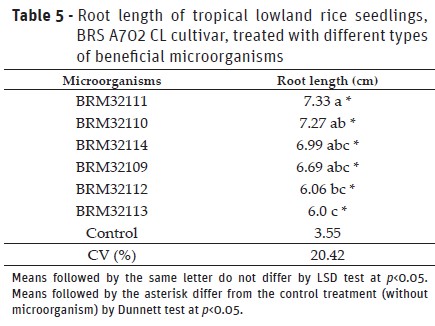
<p><font face = "Verdana" size = "2"><i>Experiment II: Effect of beneficial bacteria on the root system of tropical lowland rice seedlings</i></font></p>     <p><font face = "Verdana" size = "2">BRM32111 (<i>P. fluorescens</i>) provided the highest root growth on rice seedling and, differed to the BRM32113 (<i>B. pyrrocinia</i>) and BRM32112 (<i>Pseudomonas</i>sp.) (<a href = "#t5">Table 5</a>). Additionally, the six isolates evaluated provided increases, on average, of 89% on root length of plants and differed to the control treatment. Studies with upland rice showed that seeds treated with isolates BRM32114 (<i>Serratia</i>sp.) and BRM32109 (<i>Bacillus</i>sp.) (Sperandio <i>et al</i>., 2017), and <i>T. asperellum</i>pool, BRM32113 (<i>B. pyrrocinia</i>) and BRM32111 (<i>P. fluorescens</i>) (R&ecirc;go <i>et al</i>., 2014) produced seedling with increased on the root length compared to the control treatment. Beneficial microorganisms can produce vegetable hormones like auxins, cytokinins, and gibberellins, which provided better development of the plant root structure (Oliveira <i>et al</i>., 2003). Higher root development on the plants by the use of beneficial microorganisms can provide increases on the water and minerals uptake, resulting in the plants more vigorous and productive (Hungria, 2011).</font></p>     <p>&nbsp;</p>     <p><a name = "t5"><img src = "/img/revistas/rca/v42n4/v42n4a06t5.jpg"></a></p>     
]]></body>
<body><![CDATA[<p>&nbsp;</p>     <p><font face = "Verdana" size = "2">Thinking about to sustainability of systems production, these results of higher biomass production with plants treated with beneficial microorganisms, give real expectative of the use of beneficial microbial, in which are friendly environmental technologies, whose most important objective is the reduction of the use of the synthetic inputs as fertilizers and fungicides.</font></p>     <p><font face = "Verdana" size = "2">Besides of promising results, investigations with these microorganisms, BRM32113 and BRM32109 in BRS A702 CL cultivar should be extended to field conditions to prove the benefits of these interactions. Parallel, other investigations should be carried out, seeking out elucidate physiological and metabolic permanent alterations that occur inside the plants that provide better agronomic performance on crops.&nbsp;</font></p>     <p><font face = "Verdana" size = "3"><b>CONCLUSIONS</b></font></p>     <p><font face = "Verdana" size = "2">Rhizobacteria provided increases in gas exchange rates of rice plants. Overall, the application of beneficial microorganisms in seed-plant was efficient to provide benefits provided by these microorganisms. The isolates of rhizobacteria tested promoted increases, on average, of 89% on root length of rice seedlings. Tropical lowland rice treated with isolates BRM32109 (<i>Bacillus </i>sp.) and BRM32113 (<i>B. pyrrocinia</i>) presented an increase, on average, of 19% in shoot dry matter.</font></p>     <p>&nbsp;</p>     <p><font face = "Verdana" size = "3"><b>References</b></font></p>     <!-- ref --><p><font face = "Verdana" size = "2">Abreu, C.A.; Lopes, A.S. & Santos, G.C.G. (2007) - Micronutrientes. <i>In</i>: Novais, R.F.; Alvarez, V.V.H.; Barros, N.F.; Fontes, R.L.F.; Cantarulli, R.B. & Neves, J.C.L. (Eds.) - <i>Fertilidade do solo</i>. Vi&ccedil;osa, UFG, p. 645-736.    &nbsp;&nbsp;&nbsp;&nbsp;&nbsp;&nbsp;&nbsp;&nbsp;[&#160;<a href="javascript:void(0);" onclick="javascript: window.open('/scielo.php?script=sci_nlinks&ref=706207&pid=S0871-018X201900040000600001&lng=','','width=640,height=500,resizable=yes,scrollbars=1,menubar=yes,');">Links</a>&#160;]<!-- end-ref --></font></p>     <!-- ref --><p><font face = "Verdana" size = "2">Ahemad, M. & Kibret, M. (2014) - Mechanisms and applications of plant growth promoting rhizobacteria: current perspective. <i>Journal of King Saud University - Science</i>, vol. 26, n. 1, p. 1-20. <a href = "https://doi.org/10.1016/j.jksus.2013.05.001" target = "blank">https://doi.org/10.1016/j.jksus.2013.05.001</a></font>&nbsp;&nbsp;&nbsp;&nbsp;&nbsp;&nbsp;&nbsp;&nbsp;[&#160;<a href="javascript:void(0);" onclick="javascript: window.open('/scielo.php?script=sci_nlinks&ref=706209&pid=S0871-018X201900040000600002&lng=','','width=640,height=500,resizable=yes,scrollbars=1,menubar=yes,');">Links</a>&#160;]<!-- end-ref --><!-- ref --><p><font face = "Verdana" size = "2">Cuevas, V.C.; Sinohin, A.M. & Orajay, J.I. (2005) - Performance of selected Philippine species of Trichoderma as biocontrol agents of damping off pathogens and as growth enhancer of vegetables in farmer's field. <i>Philippine Agricultural Scientist</i>, vol. 88, n. 1, p. 63-71.    &nbsp;&nbsp;&nbsp;&nbsp;&nbsp;&nbsp;&nbsp;&nbsp;[&#160;<a href="javascript:void(0);" onclick="javascript: window.open('/scielo.php?script=sci_nlinks&ref=706210&pid=S0871-018X201900040000600003&lng=','','width=640,height=500,resizable=yes,scrollbars=1,menubar=yes,');">Links</a>&#160;]<!-- end-ref --></font></p>     <!-- ref --><p><font face = "Verdana" size = "2">Donagema, G.K.; Campos, D.V.B.; Calderano, S.B.; Teixeira, W.G. & Viana, J.H.M. (2011) - <i>Manual de m&eacute;todos de an&aacute;lise de solo</i>. 2&ordf; ed. Rio de Janeiro, Embrapa Solos, 230 p.    &nbsp;&nbsp;&nbsp;&nbsp;&nbsp;&nbsp;&nbsp;&nbsp;[&#160;<a href="javascript:void(0);" onclick="javascript: window.open('/scielo.php?script=sci_nlinks&ref=706212&pid=S0871-018X201900040000600004&lng=','','width=640,height=500,resizable=yes,scrollbars=1,menubar=yes,');">Links</a>&#160;]<!-- end-ref --></font></p>     <!-- ref --><p><font face = "Verdana" size = "2">Filippi, M.C.C.; Silva, G.B.; Lobo, V.L.S.; Cortes, M.M.C.B.; Moraes, A.J.G. & Prabhu, A.S. (2011) - Leaf blast (<i>Magnaporthe oryzae</i>) suppression and growth promotion by rhizobacteria on aerobic rice in Brazil. <i>Biological</i> <i>Control</i>, vol. 58, n. 2, p. 160-166. <a href = "https://doi.org/10.1016/j.biocontrol.2011.04.016" target = "blank">https://doi.org/10.1016/j.biocontrol.2011.04.016</a></font>&nbsp;&nbsp;&nbsp;&nbsp;&nbsp;&nbsp;&nbsp;&nbsp;[&#160;<a href="javascript:void(0);" onclick="javascript: window.open('/scielo.php?script=sci_nlinks&ref=706214&pid=S0871-018X201900040000600005&lng=','','width=640,height=500,resizable=yes,scrollbars=1,menubar=yes,');">Links</a>&#160;]<!-- end-ref --><!-- ref --><p><font face = "Verdana" size = "2">Fran&ccedil;a, S.K.S.; Cardoso, A.F.; Lustosa, D.C.; Ramos, E.M.L.S.; Filippi, M.C.C. & Silva, G.B. (2015) - Biocontrol of sheath blight by <i>Trichoderma asperellum</i> in tropical lowland rice. <i>Agronomy for Sustainable Development</i>, vol. 35, n. 1, p. 317-324. <a href = "https://doi.org/10.1007/s13593-014-0244-3" target = "blank">https://doi.org/10.1007/s13593-014-0244-3</a></font>&nbsp;&nbsp;&nbsp;&nbsp;&nbsp;&nbsp;&nbsp;&nbsp;[&#160;<a href="javascript:void(0);" onclick="javascript: window.open('/scielo.php?script=sci_nlinks&ref=706215&pid=S0871-018X201900040000600006&lng=','','width=640,height=500,resizable=yes,scrollbars=1,menubar=yes,');">Links</a>&#160;]<!-- end-ref --><!-- ref --><p><font face = "Verdana" size = "2">G&aacute;lmes, J.; &nbsp;Ribas-Carb&oacute;, M.; Medrano, H. & Flexas, J. (2011) - Rubisco activity in Mediterranean species is regulated by the chloroplastic CO<sub>2</sub>concentration under water stress. <i>Journal of Experimental Botany</i>, v. 62, n. 2, p. 653-665. <a href = "https://doi:10.1093/jxb/erq303" target = "blank">https://doi:10.1093/jxb/erq303</a></font>&nbsp;&nbsp;&nbsp;&nbsp;&nbsp;&nbsp;&nbsp;&nbsp;[&#160;<a href="javascript:void(0);" onclick="javascript: window.open('/scielo.php?script=sci_nlinks&ref=706216&pid=S0871-018X201900040000600007&lng=','','width=640,height=500,resizable=yes,scrollbars=1,menubar=yes,');">Links</a>&#160;]<!-- end-ref --><!-- ref --><p><font face = "Verdana" size = "2">Gon&ccedil;alves, G.M.O. (2016) - <i>Atributos qu&iacute;micos do solo de v&aacute;rzea tropical cultivado com arroz irrigado em raz&atilde;o do manejo de nitrog&ecirc;nio</i>. Disserta&ccedil;&atilde;o de mestrado. Goi&acirc;nia, Universidade Federal de Goi&aacute;s. 62 p.    &nbsp;&nbsp;&nbsp;&nbsp;&nbsp;&nbsp;&nbsp;&nbsp;[&#160;<a href="javascript:void(0);" onclick="javascript: window.open('/scielo.php?script=sci_nlinks&ref=706217&pid=S0871-018X201900040000600008&lng=','','width=640,height=500,resizable=yes,scrollbars=1,menubar=yes,');">Links</a>&#160;]<!-- end-ref --></font></p>     <!-- ref --><p><font face = "Verdana" size = "2">Hungria, M. (2011) - <i>Inocula&ccedil;&atilde;o com Azospirillum brasiliense: inova&ccedil;&atilde;o em rendimento a baixo custo</i>. 1&ordf; ed. Londina, Embrapa Soja, 35 p.    &nbsp;&nbsp;&nbsp;&nbsp;&nbsp;&nbsp;&nbsp;&nbsp;[&#160;<a href="javascript:void(0);" onclick="javascript: window.open('/scielo.php?script=sci_nlinks&ref=706219&pid=S0871-018X201900040000600009&lng=','','width=640,height=500,resizable=yes,scrollbars=1,menubar=yes,');">Links</a>&#160;]<!-- end-ref --></font></p>     <!-- ref --><p><font face = "Verdana" size = "2">Isawa, T.; Yasuda, M.; Awasaki, H.; Minamisawa, K.; Shinozaki, S. & Nakashita, H. (2010) - <i>Azospirillum </i>sp. strain B510 enhances rice growth and yield. <i>Microbes and</i> <i>Environments</i>, vol. 25, n. 1, p. 58-61. <a href = "https://doi.org/10.1264/jsme2.ME09174" target = "blank">https://doi.org/10.1264/jsme2.ME09174</a></font>&nbsp;&nbsp;&nbsp;&nbsp;&nbsp;&nbsp;&nbsp;&nbsp;[&#160;<a href="javascript:void(0);" onclick="javascript: window.open('/scielo.php?script=sci_nlinks&ref=706221&pid=S0871-018X201900040000600010&lng=','','width=640,height=500,resizable=yes,scrollbars=1,menubar=yes,');">Links</a>&#160;]<!-- end-ref --><!-- ref --><p><font face = "Verdana" size = "2">Kado, C.J. & Heskett, M.G. (1970) - Selective media for isolation of <i>Agrobacterium</i>, <i>Corynebacterium</i>, <i>Erwinia</i>, <i>Pseudomonas</i> and <i>Xanthomonas. Phytopathology</i>, vol. 60, n. 6, p. 969-976. <a href = "https://doi.org/10.1094/Phyto-60-969" target = "blank">https://doi.org/10.1094/Phyto-60-969</a></font>&nbsp;&nbsp;&nbsp;&nbsp;&nbsp;&nbsp;&nbsp;&nbsp;[&#160;<a href="javascript:void(0);" onclick="javascript: window.open('/scielo.php?script=sci_nlinks&ref=706222&pid=S0871-018X201900040000600011&lng=','','width=640,height=500,resizable=yes,scrollbars=1,menubar=yes,');">Links</a>&#160;]<!-- end-ref --><!-- ref --><p><font face = "Verdana" size = "2">Kumar, V. & Ladha, J.K. (2011) - Direct seeding of rice: recent developments and future research needs. <i>Advances in Agronomy</i>, vol. 111, p. 297-396. <a href = "https://doi.org/10.1016/B978-0-12-387689-8.00001-1" target = "blank">https://doi.org/10.1016/B978-0-12-387689-8.00001-1</a></font>&nbsp;&nbsp;&nbsp;&nbsp;&nbsp;&nbsp;&nbsp;&nbsp;[&#160;<a href="javascript:void(0);" onclick="javascript: window.open('/scielo.php?script=sci_nlinks&ref=706223&pid=S0871-018X201900040000600012&lng=','','width=640,height=500,resizable=yes,scrollbars=1,menubar=yes,');">Links</a>&#160;]<!-- end-ref --><!-- ref --><p><font face = "Verdana" size = "2">Malavolta, E.; Vitti, G.C. & Oliveira, S.A. (1997) - <i>Avalia&ccedil;&atilde;o do estado nutricional de plantas: princ&iacute;pios e aplica&ccedil;&otilde;es</i>. 2&ordf; ed. Piracicaba, Potaf&oacute;s, 319 p.    &nbsp;&nbsp;&nbsp;&nbsp;&nbsp;&nbsp;&nbsp;&nbsp;[&#160;<a href="javascript:void(0);" onclick="javascript: window.open('/scielo.php?script=sci_nlinks&ref=706224&pid=S0871-018X201900040000600013&lng=','','width=640,height=500,resizable=yes,scrollbars=1,menubar=yes,');">Links</a>&#160;]<!-- end-ref --></font></p>     <!-- ref --><p><font face = "Verdana" size = "2">Mattos, M.L.T.; Barrigossi, J.A.F. & Lanna, A.C. (2006) - Impacto da orizicultura na qualidade do meio ambiente. <i>In</i>: Santos, A.B.; Stone, L.F. & Vieira, N.R.A.A. (Eds.) - <i>Cultura do Arroz no Brasil</i>. Santo Ant&ocirc;nio de Goi&aacute;s, Embrapa Arroz e Feij&atilde;o, p. 933-982.    &nbsp;&nbsp;&nbsp;&nbsp;&nbsp;&nbsp;&nbsp;&nbsp;[&#160;<a href="javascript:void(0);" onclick="javascript: window.open('/scielo.php?script=sci_nlinks&ref=706226&pid=S0871-018X201900040000600014&lng=','','width=640,height=500,resizable=yes,scrollbars=1,menubar=yes,');">Links</a>&#160;]<!-- end-ref --></font></p>     <!-- ref --><p><font face = "Verdana" size = "2">Mendes, L.W.; Raaijmakers, J.M.; Hollander, M.; Mendes, R. & Tsai, S.M. (2018) - Influence of resistance breeding in common bean on rhizosphere microbiome composition and function. <i>ISME Journal</i>, vol. 12, n. 1, p. 212-224. <a href = "https://doi.org/10.1038/ismej.2017.158" target = "blank">https://doi.org/10.1038/ismej.2017.158</a></font>&nbsp;&nbsp;&nbsp;&nbsp;&nbsp;&nbsp;&nbsp;&nbsp;[&#160;<a href="javascript:void(0);" onclick="javascript: window.open('/scielo.php?script=sci_nlinks&ref=706228&pid=S0871-018X201900040000600015&lng=','','width=640,height=500,resizable=yes,scrollbars=1,menubar=yes,');">Links</a>&#160;]<!-- end-ref --><!-- ref --><p><font face = "Verdana" size = "2">Nascente, A.S.; Filippi, M.C.C.; Lanna, A.C.; Sousa, T.P.; Souza, A.C.A.; Lobo, V.L.S. & Silva, G.B. (2017a) - Effects of beneficial microorganisms on lowland rice development. <i>Environmental Science and Pollution Research</i>, vol. 24, n. 32, p. 25233-25242. <a href = "https://doi.org/10.1007/s11356-017-0212-y" target = "blank">https://doi.org/10.1007/s11356-017-0212-y</a></font>&nbsp;&nbsp;&nbsp;&nbsp;&nbsp;&nbsp;&nbsp;&nbsp;[&#160;<a href="javascript:void(0);" onclick="javascript: window.open('/scielo.php?script=sci_nlinks&ref=706229&pid=S0871-018X201900040000600016&lng=','','width=640,height=500,resizable=yes,scrollbars=1,menubar=yes,');">Links</a>&#160;]<!-- end-ref --><!-- ref --><p><font face = "Verdana" size = "2">Nascente, A.S.; Filippi, M.C.C.; Lanna, A.C.; Souza, A.C.A.; Lobo, V.L.S. & Silva, G.B. (2017b) - Biomass, gas exchange, and nutrient contents in upland rice plants affected by application forms of microorganism growth promoters. <i>Environmental Science and Pollution Research</i>, vol. 24, n. 3, p. 2956-2965. <a href = "https://doi.org/10.1007/s11356-016-8013-2" target = "blank">https://doi.org/10.1007/s11356-016-8013-2</a></font>&nbsp;&nbsp;&nbsp;&nbsp;&nbsp;&nbsp;&nbsp;&nbsp;[&#160;<a href="javascript:void(0);" onclick="javascript: window.open('/scielo.php?script=sci_nlinks&ref=706230&pid=S0871-018X201900040000600017&lng=','','width=640,height=500,resizable=yes,scrollbars=1,menubar=yes,');">Links</a>&#160;]<!-- end-ref --><!-- ref --><p><font face = "Verdana" size = "2">Oliveira, A.L.M.; Urquiaga, S. & Baldani, J.I. (2003) - <i>Processos e mecanismos envolvidos na influ&ecirc;ncia de microrganismos sobre o crescimento vegetal</i>. 1&ordf; ed. Serop&eacute;dica, Embrapa Agrobiologia, 40 p.    &nbsp;&nbsp;&nbsp;&nbsp;&nbsp;&nbsp;&nbsp;&nbsp;[&#160;<a href="javascript:void(0);" onclick="javascript: window.open('/scielo.php?script=sci_nlinks&ref=706231&pid=S0871-018X201900040000600018&lng=','','width=640,height=500,resizable=yes,scrollbars=1,menubar=yes,');">Links</a>&#160;]<!-- end-ref --></font></p>     <!-- ref --><p><font face = "Verdana" size = "2">Qin, R.; Stamp, P. & Richner, W. (2005) - Impact of tillage and banded starter fertilizer on maize root growth in the top 25 centimeters of the soil. Agronomy <i>Journal</i>, vol. 97, n. 3, p. 674-683. <a href = "https://doi.org/10.2134/agronj2004.0059" target = "blank">https://doi.org/10.2134/agronj2004.0059</a></font>&nbsp;&nbsp;&nbsp;&nbsp;&nbsp;&nbsp;&nbsp;&nbsp;[&#160;<a href="javascript:void(0);" onclick="javascript: window.open('/scielo.php?script=sci_nlinks&ref=706233&pid=S0871-018X201900040000600019&lng=','','width=640,height=500,resizable=yes,scrollbars=1,menubar=yes,');">Links</a>&#160;]<!-- end-ref --><!-- ref --><p><font face = "Verdana" size = "2">R&ecirc;go, M.C.F.; Ilkiu-borges, F.; Filippi, M.C.C.; Gon&ccedil;alves, L.A. & Silva, G.B. (2014) - Morphoanatomical and Biochemical Changes in the Roots of Rice Plants Induced by Plant Growth-Promoting Microorganisms. <i>Journal of Botany</i>, vol. 2014, art. 818797. <a href = "http://dx.doi.org/10.1155/2014/818797" target = "blank">http://dx.doi.org/10.1155/2014/818797</a></font>&nbsp;&nbsp;&nbsp;&nbsp;&nbsp;&nbsp;&nbsp;&nbsp;[&#160;<a href="javascript:void(0);" onclick="javascript: window.open('/scielo.php?script=sci_nlinks&ref=706234&pid=S0871-018X201900040000600020&lng=','','width=640,height=500,resizable=yes,scrollbars=1,menubar=yes,');">Links</a>&#160;]<!-- end-ref --><!-- ref --><p><font face = "Verdana" size = "2">Santos, H.G. Jacomine, P.K.T.; Anjos, L.H.C.; Oliveira, V.A.; Lumbreras, J.F.; Coelho, M.R.; Almeida, J.A.; Araujo-filho, J.C.; Oliveira, J.B. & Cunha, T.J.F. (2018) - <i>Sistema brasileiro de classifica&ccedil;&atilde;o de solos</i>. 5&ordf; ed. Rio de Janeiro, Centro Nacional de Pesquisa de Solos, 356 p.    &nbsp;&nbsp;&nbsp;&nbsp;&nbsp;&nbsp;&nbsp;&nbsp;[&#160;<a href="javascript:void(0);" onclick="javascript: window.open('/scielo.php?script=sci_nlinks&ref=706235&pid=S0871-018X201900040000600021&lng=','','width=640,height=500,resizable=yes,scrollbars=1,menubar=yes,');">Links</a>&#160;]<!-- end-ref --></font></p>     <!-- ref --><p><font face = "Verdana" size = "2">Shakeel, M.; Rais, A.; Hassan, M.N. & Hafeez, F.Y. (2015) - Root associated Bacillus sp. improves growth, yield and zinc translocation for basmati rice (<i>Oryza sativa</i>) varieties<i>. Frontiers in Microbiology</i>, vol. 6, art. 1286. <a href = "http://doi.org/10.3389/fmicb.2015.01286" target = "blank">http://doi.org/10.3389/fmicb.2015.01286</a></font>&nbsp;&nbsp;&nbsp;&nbsp;&nbsp;&nbsp;&nbsp;&nbsp;[&#160;<a href="javascript:void(0);" onclick="javascript: window.open('/scielo.php?script=sci_nlinks&ref=706237&pid=S0871-018X201900040000600022&lng=','','width=640,height=500,resizable=yes,scrollbars=1,menubar=yes,');">Links</a>&#160;]<!-- end-ref --><!-- ref --><p><font face = "Verdana" size = "2">Silva, M.A.; Jifon, J.L.; Santos, C.M.; Jadoski, C.J. & Silva, A.G. (2013) - Photosynthetic Capacity and Water Use Efficiency in Sugarcane Genotypes Subject to Water Deficit During Early Growth Phase. <i>Brazilian Archive of Biology and Technology</i>, vol. 56, n. 5, p. 735-748. <a href = "http://doi.org/10.1590/s1516-89132013000500004" target = "blank">http://doi.org/10.1590/s1516-89132013000500004</a></font>&nbsp;&nbsp;&nbsp;&nbsp;&nbsp;&nbsp;&nbsp;&nbsp;[&#160;<a href="javascript:void(0);" onclick="javascript: window.open('/scielo.php?script=sci_nlinks&ref=706238&pid=S0871-018X201900040000600023&lng=','','width=640,height=500,resizable=yes,scrollbars=1,menubar=yes,');">Links</a>&#160;]<!-- end-ref --><!-- ref --><p><font face = "Verdana" size = "2">Silva, J.C.; Torres, D.B.; Lustosa, D.C.; Filippi, M.C.C. & Silva, G.B. (2012) – Rice sheath blight biocontrol and growth promotion by <i>Trichodemra</i>isolates from the Amazon. <i>Amazonia Journal of Agricultural and Environmental Sciences</i>, vol. 55, n. 4, p. 243-250. <a href = "http://dx.doi.org/10.4322/rca.2012.078" target = "blank">http://dx.doi.org/10.4322/rca.2012.078</a></font>&nbsp;&nbsp;&nbsp;&nbsp;&nbsp;&nbsp;&nbsp;&nbsp;[&#160;<a href="javascript:void(0);" onclick="javascript: window.open('/scielo.php?script=sci_nlinks&ref=706239&pid=S0871-018X201900040000600024&lng=','','width=640,height=500,resizable=yes,scrollbars=1,menubar=yes,');">Links</a>&#160;]<!-- end-ref --><!-- ref --><p><font face = "Verdana" size = "2">Silva, V.N.; Guzzo, S.D.; Lucon, C.m.m. & Harakava, R. (2011) - Promo&ccedil;&atilde;o de crescimento e indu&ccedil;&atilde;o de resist&ecirc;ncia &agrave; antracnose por <i>Trichoderma</i> spp. em pepineiro. <i>Pesquisa Agropecu&aacute;ria Brasileira</i>, vol. 46, n. 12, p. 1609-1817. <a href = "http://doi.org/10.1590/s0100-204x2011001200005" target = "blank">http://doi.org/10.1590/s0100-204x2011001200005</a></font>&nbsp;&nbsp;&nbsp;&nbsp;&nbsp;&nbsp;&nbsp;&nbsp;[&#160;<a href="javascript:void(0);" onclick="javascript: window.open('/scielo.php?script=sci_nlinks&ref=706240&pid=S0871-018X201900040000600025&lng=','','width=640,height=500,resizable=yes,scrollbars=1,menubar=yes,');">Links</a>&#160;]<!-- end-ref --><!-- ref --><p><font face = "Verdana" size = "2">Sousa, T.P.; Souza, A.C.A.; Filippi, M.C.C.; Lanna, A.C.; Cort&ecirc;s, M.V.; Pinheiro, H.A. & Silva, G.B. (2018) - Bioagents and silicon promoting fast early upland Rice growth. <i>Environmental Science and Pollution Research</i>, vol. 25, n. 4, p. 3657-3668. <a href = "http://doi.org/10.1007/s11356-017-0753-0" target = "blank">http://doi.org/10.1007/s11356-017-0753-0</a></font>&nbsp;&nbsp;&nbsp;&nbsp;&nbsp;&nbsp;&nbsp;&nbsp;[&#160;<a href="javascript:void(0);" onclick="javascript: window.open('/scielo.php?script=sci_nlinks&ref=706241&pid=S0871-018X201900040000600026&lng=','','width=640,height=500,resizable=yes,scrollbars=1,menubar=yes,');">Links</a>&#160;]<!-- end-ref --><!-- ref --><p><font face = "Verdana" size = "2">Sperandio, E.M.; Vale, H.M.M.; Reis, M.S.; Cortes, M.V.C.B.; Lanna, A.C. & Filippi, M.C.C. (2017) - Evaluation of rhizobacteria in uplant rice in Brazil: growth promotion and interaction of induced defense responses against leaf blast (<i>Magnaporthe oryzae</i>). <i>Acta Physiologiae Plantarum</i>, vol. 39, n. 1, p. 258-270. <a href = "http://doi.org/10.1007/s11738-017-2547-x" target = "blank">http://doi.org/10.1007/s11738-017-2547-x</a></font>&nbsp;&nbsp;&nbsp;&nbsp;&nbsp;&nbsp;&nbsp;&nbsp;[&#160;<a href="javascript:void(0);" onclick="javascript: window.open('/scielo.php?script=sci_nlinks&ref=706242&pid=S0871-018X201900040000600027&lng=','','width=640,height=500,resizable=yes,scrollbars=1,menubar=yes,');">Links</a>&#160;]<!-- end-ref --><!-- ref --><p><font face = "Verdana" size = "2">United Nations (2017) <b>-</b><i>World Population Prospects: The 2017 revision, Key findings and advance tables.</i>Department of Economic and Social Affairs. 46 p.    &nbsp;&nbsp;&nbsp;&nbsp;&nbsp;&nbsp;&nbsp;&nbsp;[&#160;<a href="javascript:void(0);" onclick="javascript: window.open('/scielo.php?script=sci_nlinks&ref=706243&pid=S0871-018X201900040000600028&lng=','','width=640,height=500,resizable=yes,scrollbars=1,menubar=yes,');">Links</a>&#160;]<!-- end-ref --></font></p>     <p>&nbsp;</p>     <p><font face = "Verdana" size = "2">Received/recebido: 2019.05.15</font></p>     <p><font face = "Verdana" size = "2">Accepted/aceite: 2019.07.19</font></p>      ]]></body><back>
<ref-list>
<ref id="B1">
<nlm-citation citation-type="book">
<person-group person-group-type="author">
<name>
<surname><![CDATA[Abreu]]></surname>
<given-names><![CDATA[C.A.]]></given-names>
</name>
<name>
<surname><![CDATA[Lopes]]></surname>
<given-names><![CDATA[A.S.]]></given-names>
</name>
<name>
<surname><![CDATA[Santos]]></surname>
<given-names><![CDATA[G.C.G.]]></given-names>
</name>
</person-group>
<article-title xml:lang="pt"><![CDATA[Micronutrientes]]></article-title>
<person-group person-group-type="editor">
<name>
<surname><![CDATA[Novais]]></surname>
<given-names><![CDATA[R.F.]]></given-names>
</name>
<name>
<surname><![CDATA[Alvarez]]></surname>
<given-names><![CDATA[V.V.H.]]></given-names>
</name>
<name>
<surname><![CDATA[Barros]]></surname>
<given-names><![CDATA[N.F.]]></given-names>
</name>
<name>
<surname><![CDATA[Fontes]]></surname>
<given-names><![CDATA[R.L.F.]]></given-names>
</name>
<name>
<surname><![CDATA[Cantarulli]]></surname>
<given-names><![CDATA[R.B.]]></given-names>
</name>
<name>
<surname><![CDATA[Neves]]></surname>
<given-names><![CDATA[J.C.L.]]></given-names>
</name>
</person-group>
<source><![CDATA[Fertilidade do solo]]></source>
<year>2007</year>
<page-range>645-736</page-range><publisher-loc><![CDATA[Viçosa ]]></publisher-loc>
<publisher-name><![CDATA[UFG]]></publisher-name>
</nlm-citation>
</ref>
<ref id="B2">
<nlm-citation citation-type="journal">
<person-group person-group-type="author">
<name>
<surname><![CDATA[Ahemad]]></surname>
<given-names><![CDATA[M.]]></given-names>
</name>
<name>
<surname><![CDATA[Kibret]]></surname>
<given-names><![CDATA[M.]]></given-names>
</name>
</person-group>
<article-title xml:lang="en"><![CDATA[Mechanisms and applications of plant growth promoting rhizobacteria: current perspective]]></article-title>
<source><![CDATA[Journal of King Saud University - Science]]></source>
<year>2014</year>
<volume>26</volume>
<numero>1</numero>
<issue>1</issue>
<page-range>1-20</page-range></nlm-citation>
</ref>
<ref id="B3">
<nlm-citation citation-type="journal">
<person-group person-group-type="author">
<name>
<surname><![CDATA[Cuevas]]></surname>
<given-names><![CDATA[V.C.]]></given-names>
</name>
<name>
<surname><![CDATA[Sinohin]]></surname>
<given-names><![CDATA[A.M.]]></given-names>
</name>
<name>
<surname><![CDATA[Orajay]]></surname>
<given-names><![CDATA[J.I.]]></given-names>
</name>
</person-group>
<article-title xml:lang="en"><![CDATA[Performance of selected Philippine species of Trichoderma as biocontrol agents of damping off pathogens and as growth enhancer of vegetables in farmer’s field]]></article-title>
<source><![CDATA[Philippine Agricultural Scientist]]></source>
<year>2005</year>
<volume>88</volume>
<numero>1</numero>
<issue>1</issue>
<page-range>63-71</page-range></nlm-citation>
</ref>
<ref id="B4">
<nlm-citation citation-type="book">
<person-group person-group-type="author">
<name>
<surname><![CDATA[Donagema]]></surname>
<given-names><![CDATA[G.K.]]></given-names>
</name>
<name>
<surname><![CDATA[Campos]]></surname>
<given-names><![CDATA[D.V.B.]]></given-names>
</name>
<name>
<surname><![CDATA[Calderano]]></surname>
<given-names><![CDATA[S.B.]]></given-names>
</name>
<name>
<surname><![CDATA[Teixeira]]></surname>
<given-names><![CDATA[W.G.]]></given-names>
</name>
<name>
<surname><![CDATA[Viana]]></surname>
<given-names><![CDATA[J.H.M.]]></given-names>
</name>
</person-group>
<source><![CDATA[Manual de métodos de análise de solo]]></source>
<year>2011</year>
<edition>2ª</edition>
<publisher-loc><![CDATA[Rio de Janeiro ]]></publisher-loc>
<publisher-name><![CDATA[Embrapa Solos]]></publisher-name>
</nlm-citation>
</ref>
<ref id="B5">
<nlm-citation citation-type="journal">
<person-group person-group-type="author">
<name>
<surname><![CDATA[Filippi]]></surname>
<given-names><![CDATA[M.C.C.]]></given-names>
</name>
<name>
<surname><![CDATA[Silva]]></surname>
<given-names><![CDATA[G.B.]]></given-names>
</name>
<name>
<surname><![CDATA[Lobo]]></surname>
<given-names><![CDATA[V.L.S.]]></given-names>
</name>
<name>
<surname><![CDATA[Cortes]]></surname>
<given-names><![CDATA[M.M.C.B.]]></given-names>
</name>
<name>
<surname><![CDATA[Moraes]]></surname>
<given-names><![CDATA[A.J.G.]]></given-names>
</name>
<name>
<surname><![CDATA[Prabhu]]></surname>
<given-names><![CDATA[A.S.]]></given-names>
</name>
</person-group>
<article-title xml:lang="en"><![CDATA[Leaf blast (Magnaporthe oryzae) suppression and growth promotion by rhizobacteria on aerobic rice in Brazil]]></article-title>
<source><![CDATA[Biological Control]]></source>
<year>2011</year>
<volume>58</volume>
<numero>2</numero>
<issue>2</issue>
<page-range>160-166</page-range></nlm-citation>
</ref>
<ref id="B6">
<nlm-citation citation-type="journal">
<person-group person-group-type="author">
<name>
<surname><![CDATA[França]]></surname>
<given-names><![CDATA[S.K.S.]]></given-names>
</name>
<name>
<surname><![CDATA[Cardoso]]></surname>
<given-names><![CDATA[A.F.]]></given-names>
</name>
<name>
<surname><![CDATA[Lustosa]]></surname>
<given-names><![CDATA[D.C.]]></given-names>
</name>
<name>
<surname><![CDATA[Ramos]]></surname>
<given-names><![CDATA[E.M.L.S.]]></given-names>
</name>
<name>
<surname><![CDATA[Filippi]]></surname>
<given-names><![CDATA[M.C.C.]]></given-names>
</name>
<name>
<surname><![CDATA[Silva]]></surname>
<given-names><![CDATA[G.B.]]></given-names>
</name>
</person-group>
<article-title xml:lang="en"><![CDATA[Biocontrol of sheath blight by Trichoderma asperellum in tropical lowland rice]]></article-title>
<source><![CDATA[Agronomy for Sustainable Development]]></source>
<year>2015</year>
<volume>35</volume>
<numero>1</numero>
<issue>1</issue>
<page-range>317-324</page-range></nlm-citation>
</ref>
<ref id="B7">
<nlm-citation citation-type="journal">
<person-group person-group-type="author">
<name>
<surname><![CDATA[Gálmes]]></surname>
<given-names><![CDATA[J.]]></given-names>
</name>
<name>
<surname><![CDATA[Ribas-Carbó]]></surname>
<given-names><![CDATA[M.]]></given-names>
</name>
<name>
<surname><![CDATA[Medrano]]></surname>
<given-names><![CDATA[H.]]></given-names>
</name>
<name>
<surname><![CDATA[Flexas]]></surname>
<given-names><![CDATA[J.]]></given-names>
</name>
</person-group>
<article-title xml:lang="en"><![CDATA[Rubisco activity in Mediterranean species is regulated by the chloroplastic CO2concentration under water stress]]></article-title>
<source><![CDATA[Journal of Experimental Botany]]></source>
<year>2011</year>
<volume>62</volume>
<numero>2</numero>
<issue>2</issue>
<page-range>653-665</page-range></nlm-citation>
</ref>
<ref id="B8">
<nlm-citation citation-type="">
<person-group person-group-type="author">
<name>
<surname><![CDATA[Gonçalves]]></surname>
<given-names><![CDATA[G.M.O.]]></given-names>
</name>
</person-group>
<source><![CDATA[Atributos químicos do solo de várzea tropical cultivado com arroz irrigado em razão do manejo de nitrogênio]]></source>
<year>2016</year>
</nlm-citation>
</ref>
<ref id="B9">
<nlm-citation citation-type="book">
<person-group person-group-type="author">
<name>
<surname><![CDATA[Hungria]]></surname>
<given-names><![CDATA[M.]]></given-names>
</name>
</person-group>
<source><![CDATA[Inoculação com Azospirillum brasiliense: inovação em rendimento a baixo custo]]></source>
<year>2011</year>
<edition>1ª</edition>
<publisher-loc><![CDATA[Londina ]]></publisher-loc>
<publisher-name><![CDATA[Embrapa Soja]]></publisher-name>
</nlm-citation>
</ref>
<ref id="B10">
<nlm-citation citation-type="journal">
<person-group person-group-type="author">
<name>
<surname><![CDATA[Isawa]]></surname>
<given-names><![CDATA[T.]]></given-names>
</name>
<name>
<surname><![CDATA[Yasuda]]></surname>
<given-names><![CDATA[M.]]></given-names>
</name>
<name>
<surname><![CDATA[Awasaki]]></surname>
<given-names><![CDATA[H.]]></given-names>
</name>
<name>
<surname><![CDATA[Minamisawa]]></surname>
<given-names><![CDATA[K.]]></given-names>
</name>
<name>
<surname><![CDATA[Shinozaki]]></surname>
<given-names><![CDATA[S.]]></given-names>
</name>
<name>
<surname><![CDATA[Nakashita]]></surname>
<given-names><![CDATA[H.]]></given-names>
</name>
</person-group>
<article-title xml:lang="en"><![CDATA[Azospirillum sp. strain B510 enhances rice growth and yield]]></article-title>
<source><![CDATA[Microbes and Environments]]></source>
<year>2010</year>
<volume>25</volume>
<numero>1</numero>
<issue>1</issue>
<page-range>58-61</page-range></nlm-citation>
</ref>
<ref id="B11">
<nlm-citation citation-type="journal">
<person-group person-group-type="author">
<name>
<surname><![CDATA[Kado]]></surname>
<given-names><![CDATA[C.J.]]></given-names>
</name>
<name>
<surname><![CDATA[Heskett]]></surname>
<given-names><![CDATA[M.G.]]></given-names>
</name>
</person-group>
<article-title xml:lang="en"><![CDATA[Selective media for isolation of Agrobacterium, Corynebacterium, Erwinia, Pseudomonas and Xanthomonas]]></article-title>
<source><![CDATA[Phytopathology]]></source>
<year>1970</year>
<volume>60</volume>
<numero>6</numero>
<issue>6</issue>
<page-range>969-976</page-range></nlm-citation>
</ref>
<ref id="B12">
<nlm-citation citation-type="journal">
<person-group person-group-type="author">
<name>
<surname><![CDATA[Kumar]]></surname>
<given-names><![CDATA[V.]]></given-names>
</name>
<name>
<surname><![CDATA[Ladha]]></surname>
<given-names><![CDATA[J.K.]]></given-names>
</name>
</person-group>
<article-title xml:lang="en"><![CDATA[Direct seeding of rice: recent developments and future research needs]]></article-title>
<source><![CDATA[Advances in Agronomy]]></source>
<year>2011</year>
<volume>111</volume>
<page-range>297-396</page-range></nlm-citation>
</ref>
<ref id="B13">
<nlm-citation citation-type="book">
<person-group person-group-type="author">
<name>
<surname><![CDATA[Malavolta]]></surname>
<given-names><![CDATA[E.]]></given-names>
</name>
<name>
<surname><![CDATA[Vitti]]></surname>
<given-names><![CDATA[G.C.]]></given-names>
</name>
<name>
<surname><![CDATA[Oliveira]]></surname>
<given-names><![CDATA[S.A.]]></given-names>
</name>
</person-group>
<source><![CDATA[Avaliação do estado nutricional de plantas: princípios e aplicações]]></source>
<year>1997</year>
<edition>2ª</edition>
<publisher-loc><![CDATA[Piracicaba ]]></publisher-loc>
<publisher-name><![CDATA[Potafós]]></publisher-name>
</nlm-citation>
</ref>
<ref id="B14">
<nlm-citation citation-type="book">
<person-group person-group-type="author">
<name>
<surname><![CDATA[Mattos]]></surname>
<given-names><![CDATA[M.L.T.]]></given-names>
</name>
<name>
<surname><![CDATA[Barrigossi]]></surname>
<given-names><![CDATA[J.A.F.]]></given-names>
</name>
<name>
<surname><![CDATA[Lanna]]></surname>
<given-names><![CDATA[A.C.]]></given-names>
</name>
</person-group>
<article-title xml:lang="pt"><![CDATA[Impacto da orizicultura na qualidade do meio ambiente]]></article-title>
<person-group person-group-type="editor">
<name>
<surname><![CDATA[Santos]]></surname>
<given-names><![CDATA[A.B.]]></given-names>
</name>
<name>
<surname><![CDATA[Stone]]></surname>
<given-names><![CDATA[L.F.]]></given-names>
</name>
<name>
<surname><![CDATA[Vieira]]></surname>
<given-names><![CDATA[N.R.A.A.]]></given-names>
</name>
</person-group>
<source><![CDATA[Cultura do Arroz no Brasil]]></source>
<year>2006</year>
<page-range>933-982</page-range><publisher-loc><![CDATA[Santo Antônio de Goiás ]]></publisher-loc>
<publisher-name><![CDATA[Embrapa Arroz e Feijão]]></publisher-name>
</nlm-citation>
</ref>
<ref id="B15">
<nlm-citation citation-type="journal">
<person-group person-group-type="author">
<name>
<surname><![CDATA[Mendes]]></surname>
<given-names><![CDATA[L.W.]]></given-names>
</name>
<name>
<surname><![CDATA[Raaijmakers]]></surname>
<given-names><![CDATA[J.M.]]></given-names>
</name>
<name>
<surname><![CDATA[Hollander]]></surname>
<given-names><![CDATA[M.]]></given-names>
</name>
<name>
<surname><![CDATA[Mendes]]></surname>
<given-names><![CDATA[R.]]></given-names>
</name>
<name>
<surname><![CDATA[Tsai]]></surname>
<given-names><![CDATA[S.M.]]></given-names>
</name>
</person-group>
<article-title xml:lang="en"><![CDATA[Influence of resistance breeding in common bean on rhizosphere microbiome composition and function]]></article-title>
<source><![CDATA[ISME Journal]]></source>
<year>2018</year>
<volume>12</volume>
<numero>1</numero>
<issue>1</issue>
<page-range>212-224</page-range></nlm-citation>
</ref>
<ref id="B16">
<nlm-citation citation-type="journal">
<person-group person-group-type="author">
<name>
<surname><![CDATA[Nascente]]></surname>
<given-names><![CDATA[A.S.]]></given-names>
</name>
<name>
<surname><![CDATA[Filippi]]></surname>
<given-names><![CDATA[M.C.C.]]></given-names>
</name>
<name>
<surname><![CDATA[Lanna]]></surname>
<given-names><![CDATA[A.C.]]></given-names>
</name>
<name>
<surname><![CDATA[Sousa]]></surname>
<given-names><![CDATA[T.P.]]></given-names>
</name>
<name>
<surname><![CDATA[Souza]]></surname>
<given-names><![CDATA[A.C.A.]]></given-names>
</name>
<name>
<surname><![CDATA[Lobo]]></surname>
<given-names><![CDATA[V.L.S.]]></given-names>
</name>
<name>
<surname><![CDATA[Silva]]></surname>
<given-names><![CDATA[G.B.]]></given-names>
</name>
</person-group>
<article-title xml:lang="en"><![CDATA[Effects of beneficial microorganisms on lowland rice development]]></article-title>
<source><![CDATA[Environmental Science and Pollution Research]]></source>
<year>2017</year>
<month>a</month>
<volume>24</volume>
<numero>32</numero>
<issue>32</issue>
<page-range>25233-25242</page-range></nlm-citation>
</ref>
<ref id="B17">
<nlm-citation citation-type="journal">
<person-group person-group-type="author">
<name>
<surname><![CDATA[Nascente]]></surname>
<given-names><![CDATA[A.S.]]></given-names>
</name>
<name>
<surname><![CDATA[Filippi]]></surname>
<given-names><![CDATA[M.C.C.]]></given-names>
</name>
<name>
<surname><![CDATA[Lanna]]></surname>
<given-names><![CDATA[A.C.]]></given-names>
</name>
<name>
<surname><![CDATA[Souza]]></surname>
<given-names><![CDATA[A.C.A.]]></given-names>
</name>
<name>
<surname><![CDATA[Lobo]]></surname>
<given-names><![CDATA[V.L.S.]]></given-names>
</name>
<name>
<surname><![CDATA[Silva]]></surname>
<given-names><![CDATA[G.B.]]></given-names>
</name>
</person-group>
<article-title xml:lang="en"><![CDATA[Biomass, gas exchange, and nutrient contents in upland rice plants affected by application forms of microorganism growth promoters]]></article-title>
<source><![CDATA[Environmental Science and Pollution Research]]></source>
<year>2017</year>
<month>b</month>
<volume>24</volume>
<numero>3</numero>
<issue>3</issue>
<page-range>2956-2965</page-range></nlm-citation>
</ref>
<ref id="B18">
<nlm-citation citation-type="book">
<person-group person-group-type="author">
<name>
<surname><![CDATA[Oliveira]]></surname>
<given-names><![CDATA[A.L.M.]]></given-names>
</name>
<name>
<surname><![CDATA[Urquiaga]]></surname>
<given-names><![CDATA[S.]]></given-names>
</name>
<name>
<surname><![CDATA[Baldani]]></surname>
<given-names><![CDATA[J.I.]]></given-names>
</name>
</person-group>
<source><![CDATA[Processos e mecanismos envolvidos na influência de microrganismos sobre o crescimento vegetal]]></source>
<year>2003</year>
<edition>1ª</edition>
<publisher-loc><![CDATA[Seropédica ]]></publisher-loc>
<publisher-name><![CDATA[Embrapa Agrobiologia]]></publisher-name>
</nlm-citation>
</ref>
<ref id="B19">
<nlm-citation citation-type="journal">
<person-group person-group-type="author">
<name>
<surname><![CDATA[Qin]]></surname>
<given-names><![CDATA[R.]]></given-names>
</name>
<name>
<surname><![CDATA[Stamp]]></surname>
<given-names><![CDATA[P.]]></given-names>
</name>
<name>
<surname><![CDATA[Richner]]></surname>
<given-names><![CDATA[W.]]></given-names>
</name>
</person-group>
<article-title xml:lang="en"><![CDATA[Impact of tillage and banded starter fertilizer on maize root growth in the top 25 centimeters of the soil]]></article-title>
<source><![CDATA[Agronomy Journal]]></source>
<year>2005</year>
<volume>97</volume>
<numero>3</numero>
<issue>3</issue>
<page-range>674-683</page-range></nlm-citation>
</ref>
<ref id="B20">
<nlm-citation citation-type="journal">
<person-group person-group-type="author">
<name>
<surname><![CDATA[Rêgo]]></surname>
<given-names><![CDATA[M.C.F.]]></given-names>
</name>
<name>
<surname><![CDATA[Ilkiu-borges]]></surname>
<given-names><![CDATA[F.]]></given-names>
</name>
<name>
<surname><![CDATA[Filippi]]></surname>
<given-names><![CDATA[M.C.C.]]></given-names>
</name>
<name>
<surname><![CDATA[Gonçalves]]></surname>
<given-names><![CDATA[L.A.]]></given-names>
</name>
<name>
<surname><![CDATA[Silva]]></surname>
<given-names><![CDATA[G.B.]]></given-names>
</name>
</person-group>
<article-title xml:lang="en"><![CDATA[Morphoanatomical and Biochemical Changes in the Roots of Rice Plants Induced by Plant Growth-Promoting Microorganisms]]></article-title>
<source><![CDATA[Journal of Botany]]></source>
<year>2014</year>
<volume>2014</volume>
<page-range>818797</page-range></nlm-citation>
</ref>
<ref id="B21">
<nlm-citation citation-type="book">
<person-group person-group-type="author">
<name>
<surname><![CDATA[Santos]]></surname>
<given-names><![CDATA[H.G.]]></given-names>
</name>
<name>
<surname><![CDATA[Jacomine]]></surname>
<given-names><![CDATA[P.K.T.]]></given-names>
</name>
<name>
<surname><![CDATA[Anjos]]></surname>
<given-names><![CDATA[L.H.C.]]></given-names>
</name>
<name>
<surname><![CDATA[Oliveira]]></surname>
<given-names><![CDATA[V.A.]]></given-names>
</name>
<name>
<surname><![CDATA[Lumbreras]]></surname>
<given-names><![CDATA[J.F.]]></given-names>
</name>
<name>
<surname><![CDATA[Coelho]]></surname>
<given-names><![CDATA[M.R.]]></given-names>
</name>
<name>
<surname><![CDATA[Almeida]]></surname>
<given-names><![CDATA[J.A.]]></given-names>
</name>
<name>
<surname><![CDATA[Araujo-filho]]></surname>
<given-names><![CDATA[J.C.]]></given-names>
</name>
<name>
<surname><![CDATA[Oliveira]]></surname>
<given-names><![CDATA[J.B.]]></given-names>
</name>
<name>
<surname><![CDATA[Cunha]]></surname>
<given-names><![CDATA[T.J.F.]]></given-names>
</name>
</person-group>
<source><![CDATA[Sistema brasileiro de classificação de solos]]></source>
<year>2018</year>
<edition>5ª</edition>
<publisher-loc><![CDATA[Rio de Janeiro ]]></publisher-loc>
<publisher-name><![CDATA[Centro Nacional de Pesquisa de Solos]]></publisher-name>
</nlm-citation>
</ref>
<ref id="B22">
<nlm-citation citation-type="journal">
<person-group person-group-type="author">
<name>
<surname><![CDATA[Shakeel]]></surname>
<given-names><![CDATA[M.]]></given-names>
</name>
<name>
<surname><![CDATA[Rais]]></surname>
<given-names><![CDATA[A.]]></given-names>
</name>
<name>
<surname><![CDATA[Hassan]]></surname>
<given-names><![CDATA[M.N.]]></given-names>
</name>
<name>
<surname><![CDATA[Hafeez]]></surname>
<given-names><![CDATA[F.Y.]]></given-names>
</name>
</person-group>
<article-title xml:lang="en"><![CDATA[Root associated Bacillus sp. improves growth, yield and zinc translocation for basmati rice (Oryza sativa) varieties]]></article-title>
<source><![CDATA[Frontiers in Microbiology]]></source>
<year>2015</year>
<volume>6</volume>
<page-range>1286</page-range></nlm-citation>
</ref>
<ref id="B23">
<nlm-citation citation-type="journal">
<person-group person-group-type="author">
<name>
<surname><![CDATA[Silva]]></surname>
<given-names><![CDATA[M.A.]]></given-names>
</name>
<name>
<surname><![CDATA[Jifon]]></surname>
<given-names><![CDATA[J.L.]]></given-names>
</name>
<name>
<surname><![CDATA[Santos]]></surname>
<given-names><![CDATA[C.M.]]></given-names>
</name>
<name>
<surname><![CDATA[Jadoski]]></surname>
<given-names><![CDATA[C.J.]]></given-names>
</name>
<name>
<surname><![CDATA[Silva]]></surname>
<given-names><![CDATA[A.G.]]></given-names>
</name>
</person-group>
<article-title xml:lang="en"><![CDATA[Photosynthetic Capacity and Water Use Efficiency in Sugarcane Genotypes Subject to Water Deficit During Early Growth Phase]]></article-title>
<source><![CDATA[Brazilian Archive of Biology and Technology]]></source>
<year>2013</year>
<volume>56</volume>
<numero>5</numero>
<issue>5</issue>
<page-range>735-748</page-range></nlm-citation>
</ref>
<ref id="B24">
<nlm-citation citation-type="journal">
<person-group person-group-type="author">
<name>
<surname><![CDATA[Silva]]></surname>
<given-names><![CDATA[J.C.]]></given-names>
</name>
<name>
<surname><![CDATA[Torres]]></surname>
<given-names><![CDATA[D.B.]]></given-names>
</name>
<name>
<surname><![CDATA[Lustosa]]></surname>
<given-names><![CDATA[D.C.]]></given-names>
</name>
<name>
<surname><![CDATA[Filippi]]></surname>
<given-names><![CDATA[M.C.C.]]></given-names>
</name>
<name>
<surname><![CDATA[Silva]]></surname>
<given-names><![CDATA[G.B.]]></given-names>
</name>
</person-group>
<article-title xml:lang="en"><![CDATA[Rice sheath blight biocontrol and growth promotion by Trichodemraisolates from the Amazon]]></article-title>
<source><![CDATA[Amazonia Journal of Agricultural and Environmental Sciences]]></source>
<year>2012</year>
<volume>55</volume>
<numero>4</numero>
<issue>4</issue>
<page-range>243-250</page-range></nlm-citation>
</ref>
<ref id="B25">
<nlm-citation citation-type="journal">
<person-group person-group-type="author">
<name>
<surname><![CDATA[Silva]]></surname>
<given-names><![CDATA[V.N.]]></given-names>
</name>
<name>
<surname><![CDATA[Guzzo]]></surname>
<given-names><![CDATA[S.D.]]></given-names>
</name>
<name>
<surname><![CDATA[Lucon]]></surname>
<given-names><![CDATA[C.m.m.]]></given-names>
</name>
<name>
<surname><![CDATA[Harakava]]></surname>
<given-names><![CDATA[R.]]></given-names>
</name>
</person-group>
<article-title xml:lang="pt"><![CDATA[Promoção de crescimento e indução de resistência à antracnose por Trichoderma spp. em pepineiro]]></article-title>
<source><![CDATA[Pesquisa Agropecuária Brasileira]]></source>
<year>2011</year>
<volume>46</volume>
<numero>12</numero>
<issue>12</issue>
<page-range>1609-1817</page-range></nlm-citation>
</ref>
<ref id="B26">
<nlm-citation citation-type="journal">
<person-group person-group-type="author">
<name>
<surname><![CDATA[Sousa]]></surname>
<given-names><![CDATA[T.P.]]></given-names>
</name>
<name>
<surname><![CDATA[Souza]]></surname>
<given-names><![CDATA[A.C.A.]]></given-names>
</name>
<name>
<surname><![CDATA[Filippi]]></surname>
<given-names><![CDATA[M.C.C.]]></given-names>
</name>
<name>
<surname><![CDATA[Lanna]]></surname>
<given-names><![CDATA[A.C.]]></given-names>
</name>
<name>
<surname><![CDATA[Cortês]]></surname>
<given-names><![CDATA[M.V.]]></given-names>
</name>
<name>
<surname><![CDATA[Pinheiro]]></surname>
<given-names><![CDATA[H.A.]]></given-names>
</name>
<name>
<surname><![CDATA[Silva]]></surname>
<given-names><![CDATA[G.B.]]></given-names>
</name>
</person-group>
<article-title xml:lang="en"><![CDATA[Bioagents and silicon promoting fast early upland Rice growth]]></article-title>
<source><![CDATA[Environmental Science and Pollution Research]]></source>
<year>2018</year>
<volume>25</volume>
<numero>4</numero>
<issue>4</issue>
<page-range>3657-3668</page-range></nlm-citation>
</ref>
<ref id="B27">
<nlm-citation citation-type="journal">
<person-group person-group-type="author">
<name>
<surname><![CDATA[Sperandio]]></surname>
<given-names><![CDATA[E.M.]]></given-names>
</name>
<name>
<surname><![CDATA[Vale]]></surname>
<given-names><![CDATA[H.M.M.]]></given-names>
</name>
<name>
<surname><![CDATA[Reis]]></surname>
<given-names><![CDATA[M.S.]]></given-names>
</name>
<name>
<surname><![CDATA[Cortes]]></surname>
<given-names><![CDATA[M.V.C.B.]]></given-names>
</name>
<name>
<surname><![CDATA[Lanna]]></surname>
<given-names><![CDATA[A.C.]]></given-names>
</name>
<name>
<surname><![CDATA[Filippi]]></surname>
<given-names><![CDATA[M.C.C.]]></given-names>
</name>
</person-group>
<article-title xml:lang="en"><![CDATA[Evaluation of rhizobacteria in uplant rice in Brazil: growth promotion and interaction of induced defense responses against leaf blast (Magnaporthe oryzae)]]></article-title>
<source><![CDATA[Acta Physiologiae Plantarum]]></source>
<year>2017</year>
<volume>39</volume>
<numero>1</numero>
<issue>1</issue>
<page-range>258-270</page-range></nlm-citation>
</ref>
<ref id="B28">
<nlm-citation citation-type="book">
<collab>United Nations</collab>
<source><![CDATA[World Population Prospects: The 2017 revision, Key findings and advance tables]]></source>
<year>2017</year>
<publisher-name><![CDATA[Department of Economic and Social Affairs]]></publisher-name>
</nlm-citation>
</ref>
</ref-list>
</back>
</article>
