<?xml version="1.0" encoding="ISO-8859-1"?><article xmlns:mml="http://www.w3.org/1998/Math/MathML" xmlns:xlink="http://www.w3.org/1999/xlink" xmlns:xsi="http://www.w3.org/2001/XMLSchema-instance">
<front>
<journal-meta>
<journal-id>0871-018X</journal-id>
<journal-title><![CDATA[Revista de Ciências Agrárias]]></journal-title>
<abbrev-journal-title><![CDATA[Rev. de Ciências Agrárias]]></abbrev-journal-title>
<issn>0871-018X</issn>
<publisher>
<publisher-name><![CDATA[Sociedade de Ciências Agrárias de Portugal]]></publisher-name>
</publisher>
</journal-meta>
<article-meta>
<article-id>S0871-018X2019000400022</article-id>
<article-id pub-id-type="doi">10.19084/rca.18577</article-id>
<title-group>
<article-title xml:lang="pt"><![CDATA[Molecular factors associated with pathogenicity of Phytophthora cinnamomi]]></article-title>
<article-title xml:lang="en"><![CDATA[Fatores moleculares associados com a patogenicidade de Phytophthora cinnamomi]]></article-title>
</title-group>
<contrib-group>
<contrib contrib-type="author">
<name>
<surname><![CDATA[Lourenço]]></surname>
<given-names><![CDATA[Darling de Andrade]]></given-names>
</name>
<xref ref-type="aff" rid="A1"/>
</contrib>
<contrib contrib-type="author">
<name>
<surname><![CDATA[Leon]]></surname>
<given-names><![CDATA[Priscila Marques Moura de]]></given-names>
</name>
<xref ref-type="aff" rid="A1"/>
</contrib>
<contrib contrib-type="author">
<name>
<surname><![CDATA[Santos]]></surname>
<given-names><![CDATA[Luís]]></given-names>
</name>
<xref ref-type="aff" rid="A2"/>
</contrib>
<contrib contrib-type="author">
<name>
<surname><![CDATA[Choupina]]></surname>
<given-names><![CDATA[Altino Branco]]></given-names>
</name>
<xref ref-type="aff" rid="A3"/>
</contrib>
</contrib-group>
<aff id="AA1">
<institution><![CDATA[,Federal University of Pelotas Biotechnology Department Technological Development Center]]></institution>
<addr-line><![CDATA[Pelotas RS]]></addr-line>
<country>Brazil</country>
</aff>
<aff id="AA2">
<institution><![CDATA[,Polytechnic Institute of Bragança Department of Production and Plant Technology of Agricultural College of Bragança ]]></institution>
<addr-line><![CDATA[Bragança ]]></addr-line>
<country>Portugal</country>
</aff>
<aff id="AA3">
<institution><![CDATA[,Polytechnic Institute of Bragança Agricultural College of Bragança Department of Biology and Biotechnology]]></institution>
<addr-line><![CDATA[Bragança ]]></addr-line>
<country>Portugal</country>
</aff>
<pub-date pub-type="pub">
<day>00</day>
<month>12</month>
<year>2019</year>
</pub-date>
<pub-date pub-type="epub">
<day>00</day>
<month>12</month>
<year>2019</year>
</pub-date>
<volume>42</volume>
<numero>4</numero>
<fpage>211</fpage>
<lpage>220</lpage>
<copyright-statement/>
<copyright-year/>
<self-uri xlink:href="http://scielo.pt/scielo.php?script=sci_arttext&amp;pid=S0871-018X2019000400022&amp;lng=en&amp;nrm=iso"></self-uri><self-uri xlink:href="http://scielo.pt/scielo.php?script=sci_abstract&amp;pid=S0871-018X2019000400022&amp;lng=en&amp;nrm=iso"></self-uri><self-uri xlink:href="http://scielo.pt/scielo.php?script=sci_pdf&amp;pid=S0871-018X2019000400022&amp;lng=en&amp;nrm=iso"></self-uri><abstract abstract-type="short" xml:lang="en"><p><![CDATA[Phytophthora cinnamomiis soil pathogen that has a wide range of hosts in several countries and different climates. This fungus is responsible for the chestnut ink disease (Castanea sativaMiller) and death of the tree. Portugal stands out in the production of the European chestnut tree. However, between 2002 and 2004, there was a decrease of 27.3% in the distribution area of this tree due to P. cinnamomi. The aim of this study was to identify molecular factors possibly associated with the fungal pathogenicity through genomic sequences deposited at NCBI using bioinformatics tools. The first contig was used and the OFRs present in de sequences were identified. SmartBlast was used for homologous proteins. The prediction of cellular localization prediction of proteins was performed using four different tools: SignalP 4.1, Cello v.2.5, LOCTree3, Euk-mPLoc 2.0. Protein domains characterization was accomplished using PROSITE and the structure prediction was performed using Phyre2 server. We found 13 proteins probably associated with the pathogenicity of P. cinnamomi and its properties related to the infection were analyzed in silico.These results are important since they are a first step in the search for pathogenic factors.]]></p></abstract>
<abstract abstract-type="short" xml:lang="pt"><p><![CDATA[Phytophthora cinnamomié um patógeno do solo que possui uma ampla gama de hospedeiros em diversos países de diferentes climas. Esse fungo é responsável pela doença da tinta do castanheiro europeu (Castanea sativaMiller) e conduz à morte da árvore. Portugal se destaca na produção do castanheiro europeu. Entretanto, entre 2002 e 2004, houve uma redução de 27.3% na área de distribuição dessa área devido ao P. cinnamomi. O objetivo deste trabalho foi identificar fatores moleculares possivelmente associados à patogenicidade do fungo através de sequências genômicas depositadas no NCBI utilizando ferramentas de bioinformática. O primeiro contig foi utilizado e as ORFs presentes nas sequências foram identificadas. Foi utilizado o smartBlast em busca de proteínas homólogas. A predição da localização celular das proteínas foi feita através de quatro ferramentas: SignalP 4.1, Cello v.2.5, LOCTree3, Euk-mPLoc 2.0. A caracterização dos domínios dos produtos foi realizada utilizando o PROSITE e a predição das estruturas foi realizada utilizando o servidor Phyre2. Foram encontradas 13 proteínas provavelmente associadas com a patogenicidade de P. cinnamomie as suas propriedades relacionadas com a infecção foram analisadas in silico.Esses resultados são importantes uma vez que são uma primeira etapa na busca por fatores patogênicos.]]></p></abstract>
<kwd-group>
<kwd lng="en"><![CDATA[Chestnut ink disease]]></kwd>
<kwd lng="en"><![CDATA[Oomycetes]]></kwd>
<kwd lng="en"><![CDATA[Infection]]></kwd>
<kwd lng="en"><![CDATA[Bioinformatics]]></kwd>
<kwd lng="pt"><![CDATA[Tinta do castanheiro]]></kwd>
<kwd lng="pt"><![CDATA[Oomycetes]]></kwd>
<kwd lng="pt"><![CDATA[Infecção]]></kwd>
<kwd lng="pt"><![CDATA[Bioinformática]]></kwd>
</kwd-group>
</article-meta>
</front><body><![CDATA[ 

    <p align = "right"><font face = "Verdana" size = "2"><b>ARTIGO</b></font></p>

    <p><font face = "Verdana" size = "4"><b>Molecular factors associated with pathogenicity
of <i>Phytophthora</i> <i>cinnamomi</i></b></font></p>

    <p><font face = "Verdana" size = "3"><b>Fatores moleculares associados com a patogenicidade de <i>Phytophthora</i>
<i>cinnamomi</i></b></font></p>

    <p><font face = "Verdana" size = "2"><b>Darling de Andrade Lourenço</b><sup>1</sup>,
<b>Priscila Marques Moura de Leon</b><sup>1</sup>, <b>Luís Santos</b><sup>2</sup> & <b>Altino
Branco Choupina</b><sup>3,*</sup></font></p>

    <p><font face = "Verdana" size = "2"><i><sup>1
</sup>Biotechnology Department/ Technological Development Center, Federal University
of Pelotas, Campus Universitário, s/nº., 96010-900, Pelotas, RS, Brazil</i></font></p>

    <p><font face = "Verdana" size = "2"><i><sup>2</sup> Department of Production and
Plant Technology</i> <i>of  Agricultural College of Bragança, Polytechnic Institute
of Bragança, Campus Santa Apolónia, 5301-855, Bragança, Portugal</i></font></p>

    <p><font face = "Verdana" size = "2"><i><sup>3</sup> CIMO-Mountain Research Center,
Department of Biology and Biotechnology, Agricultural College of Bragança, Polytechnic
Institute of Bragança, Campus Santa Apolónia, 5301-855, Bragança, Portugal</i></font></p>

    <p><font face = "Verdana" size = "2"><i>(*E-mail: <a href = "mailto:albracho@ipb.pt" target = "_blank">albracho@ipb.pt</a>)</i></font></p>

<hr noshade size = 1>

    <p><font face = "Verdana" size = "3"><b>ABSTRACT</b></font></p>

    ]]></body>
<body><![CDATA[<p><font face = "Verdana" size = "2"><i>Phytophthora cinnamomi</i>is soil pathogen that has a
wide range of hosts in several countries and different climates. This fungus is
responsible for the chestnut ink disease (<i>Castanea sativa</i>Miller) and death
of the tree. Portugal stands out in the production of the European chestnut tree.
However, between 2002 and 2004, there was a decrease of 27.3% in the distribution
area of this tree due to <i>P. cinnamomi</i>. The aim of this study was to identify
molecular factors possibly associated with the fungal pathogenicity through genomic
sequences deposited at NCBI using bioinformatics tools. The first contig was used
and the OFRs present in de sequences were identified. SmartBlast was used for homologous
proteins. The prediction of cellular localization prediction of proteins was performed
using four different tools: SignalP 4.1, Cello v.2.5, LOCTree3, Euk-mPLoc 2.0. Protein
domains characterization was accomplished using PROSITE and the structure prediction
was performed using Phyre2 server. We found 13 proteins probably associated with
the pathogenicity of <i>P. cinnamomi</i> and its properties related to the infection
were analyzed <i>in silico.</i>These results are important since they are a first
step in the search for pathogenic factors.</font></p>

    <p><font face = "Verdana" size = "2"><b>Keywords:</b>Chestnut ink disease, Oomycetes, Infection, Bioinformatics.</font></p>

<hr noshade size = 1>

    <p><font face = "Verdana" size = "3"><b>RESUMO</b></font></p>

    <p><font face = "Verdana" size = "2"><i>Phytophthora cinnamomi</i>é um patógeno do solo que possui
uma ampla gama de hospedeiros em diversos países de diferentes climas. Esse fungo
é responsável pela doença da tinta do castanheiro europeu (<i>Castanea sativa</i>Miller)
e conduz à morte da árvore. Portugal se destaca na produção do castanheiro europeu.
Entretanto, entre 2002 e 2004, houve uma redução de 27.3% na área de distribuição
dessa área devido ao <i>P. cinnamomi</i>. O objetivo deste trabalho foi identificar
fatores moleculares possivelmente associados à patogenicidade do fungo através de
sequências genômicas depositadas no NCBI utilizando ferramentas de bioinformática.
O primeiro <i>contig</i> foi utilizado e as ORFs presentes nas sequências foram
identificadas. Foi utilizado o smartBlast em busca de proteínas homólogas. A predição
da localização celular das proteínas foi feita através de quatro ferramentas: SignalP
4.1, Cello v.2.5, LOCTree3, Euk-mPLoc 2.0. A caracterização dos domínios dos produtos
foi realizada utilizando o PROSITE e a predição das estruturas foi realizada utilizando
o servidor Phyre2. Foram encontradas 13 proteínas provavelmente associadas com a
patogenicidade de <i>P. cinnamomi</i>e as suas propriedades relacionadas com a
infecção foram analisadas <i>in silico.</i>Esses resultados são importantes uma
vez que são uma primeira etapa na busca por fatores patogênicos.</font></p>

 
    <p><font face = "Verdana" size = "2"><b>Palavras-chave:</b>Tinta do castanheiro,
Oomycetes, Infecção, Bioinformática.</font></p>

<hr noshade size = 1>

    <p><font face = "Verdana" size = "3"><b>INTRODUCTION</b></font></p>

    <p><font face = "Verdana" size = "2">The Oomycete fungus <i>Phytophthora cinnamomi</i>is
a soil pathogen extremely aggressive and it has a wide range of hosts, that includes
almost 500 plants species in more than 70 countries (Jung <i>et al</i>., 2013).
It was described firstly in Sumatra (Indonesia) by Rands (1922) as being the causative
agent of cinnamon (<i>Cinnamomum burmannii</i>) stripe cancer.</font></p>

    <p><font face = "Verdana" size = "2">Due to its potential pathogenicity, <i>P. cinnamomi
</i>generates substantial economic losses in agriculture, afforestation, and horticulture.
This pathogen is associated with the oak decline in Mediterranean Europe and with
the oak disease in California (Brasier <i>et al.</i>, 1993; Robin <i>et al</i>.,
1998; Vettraino <i>et al</i>., 2002; Garbelotto and Hüberli, 2006). Further, it
causes root rot in fynbos in South Africa, leading to its death (von Broembsen &
Kruger, 1985; Nagel <i>et al</i>., 2013). In addition, its introduction in nature
leads to severe consequences to the natural ecosystem and biodiversity (Hardham
and Blackman, 2018).</font></p>

    <p><font face = "Verdana" size = "2">The Oomycetes
class, which includes genus<i> Phytophthora</i>, belongs to Pseudofungi phylum within
the Chromista kingdom. The characteristics that define the Chromista are the asexual
reproduction of mobile spores endowed with a flagellum adorned by tubular hairs,
which are responsible for motility. These spores start the plant infection in many
species of <i>Phytophthora</i>, including <i>P. cinnamomi</i>(Beakes <i>et al.</i>,
2012; Hardham and Blackman, 2018). <i>P. cinnamomi</i>also is responsible for the
European chestnut ink disease (<i>Castanea sativa</i>Miller) and, worsening this
problem, <i>C. sativa</i> is very susceptible to infections by this pathogen (de
Sampaio e Paiva Camilo-Alves <i>et al</i>., 2013). The symptoms of this disease
include yellowing and premature fall off the leaves and the appearance of wet rot
in the roots, which will lead to the death of the tree (Fernandes, 1953; Shattock,
2001).</font></p>

    <p><font face = "Verdana" size = "2">The European chestnut
tree has economic interests due to the fruit and wood production, as well as other
<i>Castanea</i>species. Portugal is the third-largest European chestnut tree producer,
with 27.337 tons in 35.426 hectares (INE, 2016) and the Cold Land Chestnut Production
Zone is responsible for the production of 80% of the national chestnut (INIAV, 2016).
However, the <i>C. sativa</i>production has been declining over the years due to
the epidemic proportions of <i>P. cinnamomi</i>, only between 2002 and 2004, the
area of distribution decreased 27.3 % (Martins <i>et al</i>., 2007; Pereira, 2017).
</font></p>

    ]]></body>
<body><![CDATA[<p><font face = "Verdana" size = "2">Despite several species are
affected by <i>P. cinnamomi</i>, European chestnut trees receive special highlights
in Portugal due to the economic importance for the country (INIAV, 2016). Additionally,
<i>P. cinnamomi</i> is ranked as one of the most aggressive species of Phytophthora
genus to the <i>C. sativa</i> (Vettraino <i>et al</i>., 2001). However, the ink
disease still the main threat once <i>P. cinnamomi</i> is resistant to the available
fungicides and there are no effective options of pest control (Santos <i>et al</i>.,
2016). Still, the molecular mechanisms involved in the pathogenicity of <i>P. cinnamomi</i>
remains unclear.</font></p>

    <p><font face = "Verdana" size = "2">The plant infection
by <i>P. cinnamomi</i>is initiated by binding the zoospores to the plant root elongation
region (Hardham, 2005). This binding is provided by some proteins, like adhesine
Vsv1 (Hardham and Gubler, 1990; Robold and Hardham, 2005). Then, zoospores enter
the stage of encystment with the formation of biofilm from secreted proteins. Between
20-30 minutes after the zoospores encystment, the cyst germinates and the hyphae
are formed (Hua <i>et al</i>., 2013; Hardham and Blackman, 2018). These hyphae are
responsible for the production of some enzymes that will degrade the plant cell
wall, such as the ones that belong to the Cell Wall-Degrading Enzymes (CWDEs) family
(Götesson <i>et al</i>., 2002; Ospina-Giraldo <i>et al</i>., 2010; Larroque <i>et
al</i>., 2012; Blackman <i>et al</i>., 2014). The intracellular and intercellular
growth of hyphae in the radicular cortex towards the cortical and vascular tissues
leads to water stress and necrosis (Hosseini, 2010; Hardham and Blackman, 2018).
</font></p>

    <p><font face = "Verdana" size = "2">Bioinformatic provide promising
tools for analysis in silico and to support in vivo assays. In the context of this
work, ORFFinder and smartBLAST are two tools from NCBI that enable an easy and trustworthy
search for open read frames in genomic sequences and provides determination of homology
of these sequences (Rawat <i>et al</i>., 2018). Concerning the protein structures,
the SignalP 4.1 is a reliable tool for the prediction of the signal peptide (Petersen
<i>et al</i>., 2011; Ayalew <i>et al</i>., 2017). Considering that secreted proteins
are highly important to the pathogenicity of pathogens, the prediction of subcellular
localization is indispensable. Among the available online bioinformatics tools LocTree3
(Nair and Rost, 2005; Sanasam and Kumar, 2019), Cello (Yu <i>et al</i>., 2004; Thakare
<i>et al</i>., 2016) and Euk-mPLoc (Chou, 2019) stand out. In line with this, the
identification of domains and motifs of proteins are very useful to determine the
proteins functions. PROSITE is an online tool for searching for significant sites
in amino acid sequences (Gellért <i>et al</i>., 2006; Sigrist <i>et al</i>., 2009).
Finally, determine the protein structure through modeling is essential to analyze
its conformation. For this use, PHYRE2 is a very used web-based tool for modeling
amino acid sequences (Zhang <i>et al</i>., 2011; Singh and Gupta, 2016).</font></p>

    <p><font face = "Verdana" size = "2">Considering the economic losses caused by
<i>P. cinnamomi</i>in European chestnut trees it is extremely important that molecular
factors responsible for the pathogenicity of this pathogen are identified. Thus,
the aim of this study was to identify genes and its products related to the pathogenicity
of <i>P. cinnamomi</i>, as well as the characterization of the results obtained
through bioinformatics tools.</font></p>

    <p><font face = "Verdana" size = "3"><b>MATERIAL AND METHODS</b></font></p>

 
    <p><font face = "Verdana" size = "2"><i>Database of biological information</i></font></p>

    <p><font face = "Verdana" size = "2">For the search of genes, the genomic sequences
from <i>Phytophthora cinnamomi</i>used are deposited in the National Center for
Biotechnology Information (NCBI) (<a href = "https://www.ncbi.nlm.nih.gov/." target = "blank">https://www.ncbi.nlm.nih.gov/</a>). To continue the
research from the group used the sequence (REF: LGSK01000001.1) deposited by Studholme
et al. (2016) which belongs to the strain MP94-48 (BioSample: SAMN03921829;
BioProject: PRJNA290836; Assembly: GCA_001314365.1).</font></p>

    <p><font face = "Verdana" size = "2"><i>Open Read Frames (ORFs) search and homology</i></font></p>

    <p><font face = "Verdana" size = "2">In order to find de ORFs present in genomic
sequences we used the ORFFinder tool (<a href = "https://www.ncbi.nlm.nih.gov/orffinder/" target = "blank">https://www.ncbi.nlm.nih.gov/orffinder/</a>),
available by NCBI, with the following parameters: minimal ORF length: 300 nucleotides;
genetic code: Standard; ORF start codon to use: “ATG” only.</font></p>

    <p><font face = "Verdana" size = "2">The homology of proteins encoded by the ORFs founded
was determined using the Basic Local Alignment Search Tool (Blast), specifically
the smartBlast version, also available by NCBI. This tool establishes the homology
between the sequences deposited in several protein databases available.</font></p>

    ]]></body>
<body><![CDATA[<p><font face = "Verdana" size = "2"><i>Prediction of cellular localization of
proteins</i></font></p>

    <p><font face = "Verdana" size = "2">The software SignalP
4.1 (<a href = "http://www.cbs.dtu.dk/services/SignalP/" target = "blank">http://www.cbs.dtu.dk/services/SignalP/</a>) was used to analyze the presence of
signal-peptide. The following software’s were used to predict the sub-cellular location
of proteins: Cello v.2.5 (<a href = "http://cello.life.nctu.edu.tw/" target = "blank">http://cello.life.nctu.edu.tw/</a>) ; LOCTree3 (<a href = "https://rostlab.org/services/loctree3/" target = "blank">https://rostlab.org/services/loctree3/</a>);
and Euk-mPLoc 2.0 (<a href = "http://www.csbio.sjtu.edu.cn/bioinf/euk-multi-2/" target = "blank">http://www.csbio.sjtu.edu.cn/bioinf/euk-multi-2/</a>). Each one analyzes
proteins in different ways and for all tools, the selected parameters were: &quot;Eukaryotes&quot;
for organism or domain and &quot;Protein&quot; for the type of sequence.</font></p>

    <p><font face = "Verdana" size = "2"><i>Gene and proteins characterization</i></font></p>

    <p><font face = "Verdana" size = "2">Genes and their products were characterized
through bioinformatics tools that allow the identification of domains, patterns,
and motifs, as well as active center and physical-chemical characteristics. Therefore,
we used the PROSITE (<a href = "https://prosite.expasy.org/">https://prosite.expasy.org/</a>) tool, in “Quick Scan” mode, excluding
motifs with a high probability of occurrence.</font></p>

    <p><font face = "Verdana" size = "2">The structural prediction of the proteins found was performed
using the Phyre2 (<a href = "http://www.sbg.bio.ic.ac.uk/~phyre2/html/page.cgi?id=index" target = "blank">http://www.sbg.bio.ic.ac.uk/~phyre2/html/page.cgi?id=index</a>) server,
using the normal modeling mode. For visualization and representation of the structures,
we used the Jmol program.</font></p>

    <p><font face = "Verdana" size = "3"><b>RESULTS AND DISCUSSION</b></font></p>

    <p><font face = "Verdana" size = "2">1980 ORFs, larger than 300 nucleotides, established
by the ORFfinder program, were analyzed using the smartBlast in search of homology. 
Of these ORF’s, we found 13 ORFs that encoded for proteins homologous related to
the pathogenicity in different organisms mostly of the genus <i>Phytophthora</i>,
as shown in <a href = "/img/revistas/rca/v42n4/v42n4a22t1.jpg" target = "_blank">Table 1</a>. The selection method was based on a link between the protein
sequence and the pathogenicity in other organisms. This link was established with
references in the scientific literature available. The data about the genes chosen
and their related products are presented in <a href = "/img/revistas/rca/v42n4/v42n4a22t1.jpg" target = "_blank">Table 1</a>. All information about these
genes and their products including scientific references can be obtained from the
databases referred to in <a href = "/img/revistas/rca/v42n4/v42n4a22t1.jpg" target = "_blank">Table 1</a> through the accession number of each gene in the
respective database.</font></p>

    
<p><font face = "Verdana" size = "2">The prediction of cellular localization of
proteins informs their destination after leaving the endoplasmic reticulum. This
destination often depends on the signaling of a signal peptide. The results of the
prediction of cellular localization of the proteins encoded by the ORFs selected
are in <a href = "/img/revistas/rca/v42n4/v42n4a22t2.jpg" target = "_blank">Table 2</a>. To obtain these results we used: SignalP to determine the presence
or absence of signal peptide in the protein; Cello, LocTree3, and Euk-mPloc, which
from different algorithms, predict the cellular localization of proteins.</font></p>

    
<p><font face = "Verdana" size = "2">The results obtained with the three prediction
tools diverge sometimes due to the different algorithms that they use. In addition,
some of these proteins are not determined molecularly by experiments in vitro, being
determined only in silico by bioinformatics methods, a factor that hinders the prediction
by the tools. According to Dönnes and Höglund (2004), the several web-based methods
for the prediction that are available online have different localization coverage
and different means to assess their accuracy, making it impossible to compare all
methods against each other. Some examples of this divergence can be seen in <a href = "/img/revistas/rca/v42n4/v42n4a22t2.jpg" target = "_blank">Table
2</a> where it can also be observed that most proteins with a role in pathogenicity
have extracellular or membrane fate as expected as it is outside the parasite cell
and in interaction with host cells that they will exercise their action.</font></p>

    
<p><font face = "Verdana" size = "2">The characterization
of genes and its products was performed using Phyre2 server for modeling and structure
prediction. The domains and active sites were identified using PROSITE tool. The
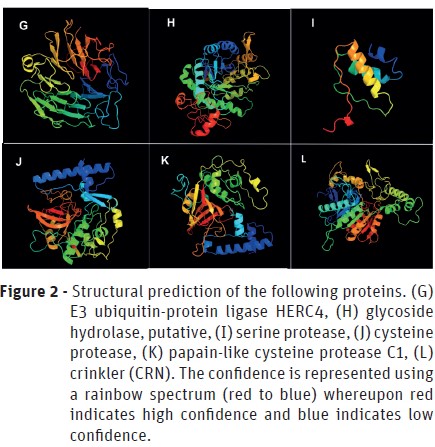
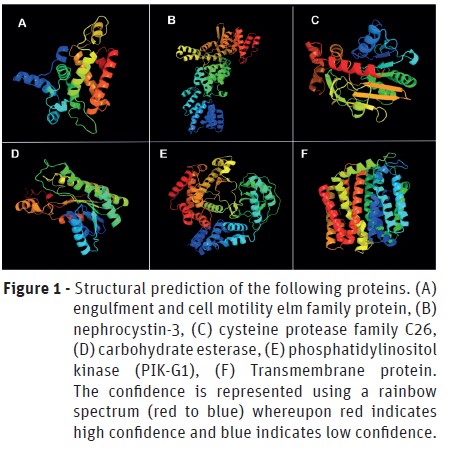
structures predicted by modeling are in <a href = "#f1">Figure 1</a> and <a href = "#f2">2</a> and in <a href = "/img/revistas/rca/v42n4/v42n4a22t3.jpg" target = "_blank">Table 3</a> is possible
to analyze the domains and active sites detected. However, the structure of E3 ubiquitin-protein
ligase HERC2 could not be predicted since it has a very long amino acid chain.</font></p>

    
]]></body>
<body><![CDATA[<p>&nbsp;</p>

    <p><a name = "f1"><img src = "/img/revistas/rca/v42n4/v42n4a22f1.jpg"></a></p>

    
<p>&nbsp;</p>

    <p><a name = "f2"><img src = "/img/revistas/rca/v42n4/v42n4a22f2.jpg"></a></p>

    
<p>&nbsp;</p>

    <p><font face = "Verdana" size = "2">The most promising protein found was the crinkler (CRN) family. This
protein is widely related to the damage caused by the <i>Phytophthora</i> genus
in its hosts (Lamour <i>et al</i>., 2007; Fawke <i>et al</i>., 2015). It was first
identified in <i>Phytophthora infestans</i> but is known to be present in almost
all species of plant pathogenic oomycetes (Torto <i>et al</i>., 2003). It is known
that CRN family interacts with the host DNA, leading to leaf wrinkles and necrosis
(Amaro <i>et al</i>., 2017). The mature CRNs are able to induce cell death through
translocation of cytoplasmatic factors and also by action on the host nucleus (Schornack
<i>et al</i>., 2010; Stam <i>et al</i>., 2013). This protein family probably is
present at the base of the late stages of <i>Phytophthora cinnamomi</i>infection
due to its functioning.</font></p>

    <p><font face = "Verdana" size = "2">Carbohydrate
esterase is an enzyme that catalyzes the reaction of hydrolysis in ester bonds in
order to remove oxygen (O) or nitrogen (N) from carbohydrates (Cantarel <i>et al</i>.,
2009). Although the sequence found does not have any specific domain found, it is
still possible to perceive its probable importance in <i>P. cinnamomi</i>infection,
through the breakdown of complex carbohydrates and glycoconjugates of the host,
such as cellulose from cells wall. Cysteine protease family C26 is a protein with
peptidase activity and involved in the metabolic process of glutamine due to its
GATASE_TYPE_1 (Glutamine amidotransferase type 1) domain. This domain is responsible
for catalyzing the reaction of removal of the ammonia group from glutamine and transfer
to another substrate to form a new carbon-nitrogen group (Buchanan, 1973). Cysteine
proteases are conserved among the animal and plant pathogenic microorganisms, besides
proteases facilitate penetration of the plant host’s physical barriers.</font></p>

    <p><font face = "Verdana" size = "2">Additionally, both cysteine protease and papain-like
cysteine protease C1 are enzymes with the proteolytic activity of the family eukaryotic
thiol proteases, which have cysteine in their active sites (Dufour, 1988). In addition
to the proteolytic action, both also have the domain of the family phosphofructokinase
B-type of carbohydrate kinases, which has a function not yet well defined, however,
it seems to be involved with the plastidial genome (Yokota <i>et al</i>., 2009).
Thus, due to the activity of these protein, it is possible to assume that they have
an influence on the pathogenicity of <i>P. cinnamomi</i>since it degrades peptides
through their proteolytic actions, facilitating the pathogen penetration into the
host’s tissues.</font></p>

    <p><font face = "Verdana" size = "2">In line with
this, serine protease has two carboxypeptidase active sites: serine/serine and serine/histidine,
involving an aspartic acid residue in the catalysis system (Liao and Remington,
1990). Carboxypeptidases have proteolytic action and cleave near the carboxyl end
site (Beekman <i>et al</i>., 2018). Several studies already associate the presence
of carboxypeptidases with pathogenicity fungi, such as <i>Pseudogymnoascus destructans
</i>(Beekman <i>et al</i>., 2018), and the bacteria of the genus <i>Neisseria</i>sp.
(Schaub & Dillard, 2019).</font></p>

    <p><font face = "Verdana" size = "2">E3
ubiquitin-protein ligase HERC4 and E3 ubiquitin-protein ligase HERC2 have the B30.2_SPRY
domain, which is well-conserved and helps to regulate spore differentiation (Nuckolls
<i>et al</i>., 1996). Considering the importance of the spores in the infection
of <i>C. sativa</i> by <i>P. cinnamomi</i> is possible that these enzymes are related
to the pathogenicity of the present pathogen in the early stages. Glycoside hydrolase
has hydrolase and transferase activity, i.e., has the ability to cleave glycosidic
bonds as well as assist in cell wall elongation (Haas <i>et al</i>., 2009). It has
two distinct domains, with one active site in each. The action of this enzyme in
the pathogenicity of <i>P. cinnamomi</i>is possibly originated in its lysing activity
in glycosidic bonds, altering the permeability of the host.</font></p>

    ]]></body>
<body><![CDATA[<p><font face = "Verdana" size = "2">As less promising proteins, yet very important, we found
that the engulfment and cell motility elm family protein (<a href = "#f1">Figure 1</a> A) belongs to
the ELMO (Engulfment and Cell Motility) family of ELMO and PH domains. The ELMO
domain is responsible for the regulatory activity of GTPases (Bowzard <i>et al</i>.,
2007), whereas the PH (Pleckstrin homology) domain occurs in several proteins that
perform intracellular signaling or constitute the cytoskeleton (Haslam <i>et al</i>.,
1993; Mayer <i>et al</i>., 1993; Musacchio <i>et al</i>., 1993; Gibson <i>et al</i>.,
1994; Ingley and Hemmings, 1994; Pawson, 1995; Saraste and Hyvönen, 1995). Besides
that, it is known that some pathogens, such as <i>Shigella flexneri</i>, promotes
bacterial entry in cells through the ELMO-Dock180 machinery (Hachani <i>et al</i>.,
2008). Due to its importance in cell motility and the evidences involving the ELMO
domain with pathogenicity, it is possible to infer that this protein participates
in the infectious process by <i>P. cinnamomi</i>in the initial stages utilizing
some homolog protein to Dock180.</font></p>

    <p><font face = "Verdana" size = "2">The nephrocystin-3 is a protein involved in the ciliary development and function
and thus, involved in cell movement (Bergmann <i>et al</i>., 2008). It has the SAM
domain (Sterile &#945; Motif), which is related to protein-protein interaction (Thanos
<i>et al</i>., 1999), as well as the TPR (Tetratrico Peptide Repeat) domain, which
is responsible for several processes, such as cell cycle control, stress response,
transcription repression, among others (Lamb <i>et al</i>., 1995). TPR domain is
present in some proteins that are directly involved in bacterial virulence-associated
functions in animal cells and tissue. These functions include the translocation
of virulence factors into host cells and adhesion to host cells (Edqvist <i>et al</i>.,
2006; Chakraborty <i>et al</i>., 2008; Chao <i>et al</i>., 2010). Due to the activities
performed by the domains of nephrocystin-3, it is possible to infer that it has
high importance in pathogenicity and cellular movements and development – both of
these processes, being essential for the infection by <i>P. cinnamomi</i>.</font></p>

    <p><font face = "Verdana" size = "2">Phosphatidylinositol kinase (PIK-G1) is an
enzyme responsible for the molecular function of the kinase (transference of phosphate
groups) and complexation of metal ions. Due to this, it is involved in the biological
processes of phosphatidylinositol phosphorylation and signaling (Kaur <i>et al</i>.,
2010). It has PH domain, reinforcing its function in intracellular signaling and,
the PI3_4_KINASE_3 (Phosphatidylinositol 3- and 4-kinases) domain, involved in cell
signaling of several metabolic pathways and cell cycle (Hiles <i>et al</i>., 1992;
Haslam <i>et al</i>., 1993; Mayer <i>et al</i>., 1993; Musacchio <i>et al</i>.,
1993; Ingley and Hemmings, 1994; Pawson, 1995; Saraste and Hyvönen, 1995). In line
with this, PIK-G1 must play a key role in the stage of cell proliferation during
the infectious process.</font></p>

    <p><font face = "Verdana" size = "2">Although
the transmembrane proteins do not integrate any metabolic pathway, they have already
been reported in the pathogenicity of several microorganisms, since it is through
them that effector molecules and toxins can be released to the host (Silveira <i>et
al</i>., 2016). Said that it is important to highlight the relevance of the transmembrane
proteins in the process of infection by <i>P. cinnamomi</i>through the release
of pathogenic effector molecules produced intracellularly.</font></p>

    <p><font face = "Verdana" size = "3"><b>CONCLUSIONS</b></font></p>

    <p><font face = "Verdana" size = "2">1. Bioinformatic tools are a reliable
source to perform prediction ins proteins sequences available in databases while
<i>in vitro</i>studies still not performed, and also as a previous step to better
target these experimental studies.</font></p>

    <p><font face = "Verdana" size = "2">2. New research using
<i>P. cinnamomi</i>genomic sequence must be carried out in order to determine its
pathogenicity mechanisms and molecules associated, and possibly develop methods
of control of the pathogens and reduce the damage to European chestnut tree.</font></p>

    <p><font face = "Verdana" size = "2">3. It is possible to deduce the role of many molecules in the metabolic pathways
by their similitude and homology, however, there is the possibility that many molecules
have roles that are still unknown today.</font></p>

    <p><font face = "Verdana" size = "2">4. As demonstrated
by (Pascoal <i>et al.</i>, 2018), we also believe that the silencing of these genes
in phytopathogenic fungi and the subsequent infection of plants by these fungi may
help to better understand the role of the enzymes expressed by these genes in the
infection mechanism.. The research for molecular factors as well as the metabolic
pathways involved in the infectious processes is an important tool for the development
of preventive strategies and control of pathogens in plants.</font></p>

    <p>&nbsp;</p>

    ]]></body>
<body><![CDATA[<p><font face = "Verdana" size = "3"><b>REFERENCES</b></font></p>

    <!-- ref --><p><font face = "Verdana" size = "2">Amaro,
T.M.M.M.; Gaëtan, J.A.; Thilliez, G.B.M. & Huitema, E. (2017) - A Perspective
on CRN Proteins in the Genomics Age: Evolution, Classification, Delivery and Function
Revisited. <i>Frontiers in Plant Science</i>, vol. 8, art. 99. <a href = "https://doi.org/10.3389/fpls.2017.00099" target = "blank">https://doi.org/10.3389/fpls.2017.00099</a></font>&nbsp;&nbsp;&nbsp;&nbsp;&nbsp;&nbsp;&nbsp;&nbsp;[&#160;<a href="javascript:void(0);" onclick="javascript: window.open('/scielo.php?script=sci_nlinks&ref=708356&pid=S0871-018X201900040002200001&lng=','','width=640,height=500,resizable=yes,scrollbars=1,menubar=yes,');">Links</a>&#160;]<!-- end-ref --><!-- ref --><p><font face = "Verdana" size = "2">Ayalew, S.; Confer, A.W.; Hartson, S.D.; Canaan,
P.J.; Payton, M. & Couger, B. (2017) - Proteomic and Bioinformatic Analyses
of Putative <i>Mannheimia haemolytica</i> Secretome by Liquid Chromatography and
Tandem Mass Spectrometry. <i>Veterinary Microbiology</i>, vol. 203, p. 73–80. <a href = "https://doi.org/10.1016/j.vetmic.2017.02.011" target = "blank">https://doi.org/10.1016/j.vetmic.2017.02.011</a></font>&nbsp;&nbsp;&nbsp;&nbsp;&nbsp;&nbsp;&nbsp;&nbsp;[&#160;<a href="javascript:void(0);" onclick="javascript: window.open('/scielo.php?script=sci_nlinks&ref=708357&pid=S0871-018X201900040002200002&lng=','','width=640,height=500,resizable=yes,scrollbars=1,menubar=yes,');">Links</a>&#160;]<!-- end-ref --><!-- ref --><p><font face = "Verdana" size = "2">Beakes, G.W.; Glockling, S.L. & Sekimoto,
S. (2012) - The Evolutionary Phylogeny of the Oomycete “Fungi”. <i>Protoplasma</i>,
vol. 249, n. 1, p. 3–19. <a href = "https://doi.org/10.1007/s00709-011-0269-2" target = "blank">https://doi.org/10.1007/s00709-011-0269-2</a></font>&nbsp;&nbsp;&nbsp;&nbsp;&nbsp;&nbsp;&nbsp;&nbsp;[&#160;<a href="javascript:void(0);" onclick="javascript: window.open('/scielo.php?script=sci_nlinks&ref=708358&pid=S0871-018X201900040002200003&lng=','','width=640,height=500,resizable=yes,scrollbars=1,menubar=yes,');">Links</a>&#160;]<!-- end-ref --><!-- ref --><p><font face = "Verdana" size = "2">Beekman, C.; Jiang, Z.; Suzuki, B.M.; Palmer,
J.M.; Lindner, D.L.; O’Donoghue, A.J.; Knudsen, G.M. & Bennett, R.J. (2018)
- Characterization of PdCP1, a Serine Carboxypeptidase from <i>Pseudogymnoascus
destructans</i>, the Causal Agent of White-Nose Syndrome. <i>Biological Chemistry</i>,
vol. 399, n. 12, p. 1375–1388. <a href = "https://doi.org/10.1515/hsz-2018-0240" target = "blank">https://doi.org/10.1515/hsz-2018-0240</a></font>&nbsp;&nbsp;&nbsp;&nbsp;&nbsp;&nbsp;&nbsp;&nbsp;[&#160;<a href="javascript:void(0);" onclick="javascript: window.open('/scielo.php?script=sci_nlinks&ref=708359&pid=S0871-018X201900040002200004&lng=','','width=640,height=500,resizable=yes,scrollbars=1,menubar=yes,');">Links</a>&#160;]<!-- end-ref --><!-- ref --><p><font face = "Verdana" size = "2">Bergmann, C.; Fliegauf, M.; Brüchle, N.O.;
Frank, V.; Olbrich, H.; Kirschner, J.; Schermer, B.; Schmedding, I.; Kispert, A.;
Kränzlin, B.; Nürnberg, G.; Becker, C.; Grimm, T.; Girschick, G.; Lynch, S.A.; Kelehan,
P.; Senderek, J.; Neuhaus, T.J.; Stallmach, T.; Zentgraf, H.; Nürnberg, P.; Gretz,
N.; Lo, C.; Lienkamp, S.; Schäfer, T.; Walz, G.; Benzing, T.; Zerres, K. & Omran,
H. (2008) - Loss of Nephrocystin-3 Function Can Cause Embryonic Lethality, Meckel-Gruber-like
Syndrome, Situs Inversus, and Renal-Hepatic-Pancreatic Dysplasia. <i>The American
Journal of Human Genetics</i>, vol. 82, n. 4, p. 959–970. <a href = "https://doi.org/10.1016/j.ajhg.2008.02.017" target = "blank">https://doi.org/10.1016/j.ajhg.2008.02.017</a></font>&nbsp;&nbsp;&nbsp;&nbsp;&nbsp;&nbsp;&nbsp;&nbsp;[&#160;<a href="javascript:void(0);" onclick="javascript: window.open('/scielo.php?script=sci_nlinks&ref=708360&pid=S0871-018X201900040002200005&lng=','','width=640,height=500,resizable=yes,scrollbars=1,menubar=yes,');">Links</a>&#160;]<!-- end-ref --><!-- ref --><p><font face = "Verdana" size = "2">Blackman, L.M.; Cullerne, D.P. & Hardham,
A.R. (2014) - Bioinformatic Characterisation of Genes Encoding Cell Wall Degrading
Enzymes in the <i>Phytophthora parasitica</i> Genome. <i>BMC Genomics</i>, vol.
15, n. 1, art. 785. <a href = "https://doi.org/10.1186/1471-2164-15-785" target = "blank">https://doi.org/10.1186/1471-2164-15-785</a></font>&nbsp;&nbsp;&nbsp;&nbsp;&nbsp;&nbsp;&nbsp;&nbsp;[&#160;<a href="javascript:void(0);" onclick="javascript: window.open('/scielo.php?script=sci_nlinks&ref=708361&pid=S0871-018X201900040002200006&lng=','','width=640,height=500,resizable=yes,scrollbars=1,menubar=yes,');">Links</a>&#160;]<!-- end-ref --><!-- ref --><p><font face = "Verdana" size = "2">Bowzard, J.B.; Cheng, D.; Peng, J. & Kahn, R.A.
(2007) - ELMOD2 Is an Arl2 GTPase-Activating Protein That Also Acts on Arfs. <i>Journal
of Biological Chemistry</i>, vol. 282, n. 24, p. 17568–17580. <a href = "https://doi.org/10.1074/jbc.M701347200" target = "blank">https://doi.org/10.1074/jbc.M701347200</a></font>&nbsp;&nbsp;&nbsp;&nbsp;&nbsp;&nbsp;&nbsp;&nbsp;[&#160;<a href="javascript:void(0);" onclick="javascript: window.open('/scielo.php?script=sci_nlinks&ref=708362&pid=S0871-018X201900040002200007&lng=','','width=640,height=500,resizable=yes,scrollbars=1,menubar=yes,');">Links</a>&#160;]<!-- end-ref --><!-- ref --><p><font face = "Verdana" size = "2">Brasier, C.M., Robredo, F. & Ferraz, J.F.P.
(1993) - Evidence for <i>Phytophthora cinnamomi</i> Involvement in Iberian Oak Decline.
<i>Plant Pathology,</i> vol. 42, n. 1, p. 140–245. <a href = "https://doi.org/10.1111/j.1365-3059.1993.tb01482.x" target = "blank">https://doi.org/10.1111/j.1365-3059.1993.tb01482.x</a></font>&nbsp;&nbsp;&nbsp;&nbsp;&nbsp;&nbsp;&nbsp;&nbsp;[&#160;<a href="javascript:void(0);" onclick="javascript: window.open('/scielo.php?script=sci_nlinks&ref=708363&pid=S0871-018X201900040002200008&lng=','','width=640,height=500,resizable=yes,scrollbars=1,menubar=yes,');">Links</a>&#160;]<!-- end-ref --><!-- ref --><p><font face = "Verdana" size = "2">von Broembsen, S. L.; Kruger, F. J. (1985).
 <i>Phytophthora cinnamomi</i>associated with mortality of native vegetation in
South Africa. <i>Plant Disease</i>, vol. 69, p. 715-717.    &nbsp;&nbsp;&nbsp;&nbsp;&nbsp;&nbsp;&nbsp;&nbsp;[&#160;<a href="javascript:void(0);" onclick="javascript: window.open('/scielo.php?script=sci_nlinks&ref=708364&pid=S0871-018X201900040002200009&lng=','','width=640,height=500,resizable=yes,scrollbars=1,menubar=yes,');">Links</a>&#160;]<!-- end-ref --></font></p>

    <!-- ref --><p><font face = "Verdana" size = "2">Buchanan, J.M. (1973) - The Amidotransferases. <i>In</i>:
<i>Advances in Enzymology and Related Areas of Molecular Biology,</i> vol. 39, p.
91–183.    &nbsp;&nbsp;&nbsp;&nbsp;&nbsp;&nbsp;&nbsp;&nbsp;[&#160;<a href="javascript:void(0);" onclick="javascript: window.open('/scielo.php?script=sci_nlinks&ref=708366&pid=S0871-018X201900040002200010&lng=','','width=640,height=500,resizable=yes,scrollbars=1,menubar=yes,');">Links</a>&#160;]<!-- end-ref --></font></p>

    <!-- ref --><p><font face = "Verdana" size = "2">Cantarel, B.L.; Coutinho,
P.M.; Rancurel, C.; Bernard, T.; Lombard, V. & Henrissat, B. (2009) - The Carbohydrate-Active
EnZymes Database (CAZy): An Expert Resource for Glycogenomics. <i>Nucleic Acids
Research</i>, vol. 37, p. D233–D238. <a href = "https://doi.org/10.1093/nar/gkn663" target = "blank">https://doi.org/10.1093/nar/gkn663</a></font>&nbsp;&nbsp;&nbsp;&nbsp;&nbsp;&nbsp;&nbsp;&nbsp;[&#160;<a href="javascript:void(0);" onclick="javascript: window.open('/scielo.php?script=sci_nlinks&ref=708368&pid=S0871-018X201900040002200011&lng=','','width=640,height=500,resizable=yes,scrollbars=1,menubar=yes,');">Links</a>&#160;]<!-- end-ref --><!-- ref --><p><font face = "Verdana" size = "2">Chakraborty, S.; Monfett, M.; Maier, T.M.;
Benach, J.L.; Frank, D.W. and Thanassi, D.G. (2008) - Type IV Pili in <i>Francisella
tularensis</i>: Roles of PilF and PilT in Fiber Assembly, Host Cell Adherence, and
Virulence. <i>Infection and Immunity</i>, vol. 76, n. 7, p. 2852–2861. <a href = "https://doi.org/10.1128/IAI.01726-07" target = "blank">https://doi.org/10.1128/IAI.01726-07</a></font>&nbsp;&nbsp;&nbsp;&nbsp;&nbsp;&nbsp;&nbsp;&nbsp;[&#160;<a href="javascript:void(0);" onclick="javascript: window.open('/scielo.php?script=sci_nlinks&ref=708369&pid=S0871-018X201900040002200012&lng=','','width=640,height=500,resizable=yes,scrollbars=1,menubar=yes,');">Links</a>&#160;]<!-- end-ref --><!-- ref --><p><font face = "Verdana" size = "2">Chao, J.; Wong, D.; Zheng, X.; Poirier, V.;
Bach, H.; Hmama, Z. & Av-Gay, Y. (2010) - Protein Kinase and Phosphatase Signaling
in <i>Mycobacterium</i> <i>tuberculosis</i> Physiology and Pathogenesis. <i>Biochimica
et Biophysica Acta</i>, vol. 1804, n. 3, p. 620–627. <a href = "https://doi.org/10.1016/j.bbapap.2009.09.008" target = "blank">https://doi.org/10.1016/j.bbapap.2009.09.008</a></font>&nbsp;&nbsp;&nbsp;&nbsp;&nbsp;&nbsp;&nbsp;&nbsp;[&#160;<a href="javascript:void(0);" onclick="javascript: window.open('/scielo.php?script=sci_nlinks&ref=708370&pid=S0871-018X201900040002200013&lng=','','width=640,height=500,resizable=yes,scrollbars=1,menubar=yes,');">Links</a>&#160;]<!-- end-ref --><!-- ref --><p><font face = "Verdana" size = "2">Chou, K.-C. (2019) - An Insightful Recollection
for Predicting Protein Subcellular Locations in Multi-Label Systems. <i>Genomics</i>,
<i>in press</i>. <a href = "https://doi.org/10.1016/j.ygeno.2019.08.008" target = "blank">https://doi.org/10.1016/j.ygeno.2019.08.008</a></font>&nbsp;&nbsp;&nbsp;&nbsp;&nbsp;&nbsp;&nbsp;&nbsp;[&#160;<a href="javascript:void(0);" onclick="javascript: window.open('/scielo.php?script=sci_nlinks&ref=708371&pid=S0871-018X201900040002200014&lng=','','width=640,height=500,resizable=yes,scrollbars=1,menubar=yes,');">Links</a>&#160;]<!-- end-ref --><!-- ref --><p><font face = "Verdana" size = "2">Dönnes, P. & Höglund, A. (2004) - Predicting Protein
Subcellular Localization: Past, Present, and Future. <i>Genomics, Proteomics &
Bioinformatics</i>, vol. 2, n. 4, p. 209–215. <a href = "https://doi.org/10.1016/S1672-0229(04)02027-3" target = "blank">https://doi.org/10.1016/S1672-0229(04)02027-3</a></font>&nbsp;&nbsp;&nbsp;&nbsp;&nbsp;&nbsp;&nbsp;&nbsp;[&#160;<a href="javascript:void(0);" onclick="javascript: window.open('/scielo.php?script=sci_nlinks&ref=708372&pid=S0871-018X201900040002200015&lng=','','width=640,height=500,resizable=yes,scrollbars=1,menubar=yes,');">Links</a>&#160;]<!-- end-ref --><!-- ref --><p><font face = "Verdana" size = "2">Dufour, E. (1988) - Sequence Homologies, Hydrophobic
Profiles and Secondary Structures of Cathepsins B, H and L: Comparison with Papain
and Actinidin. <i>Biochimie</i>, vol. 70, n. 10, p. 1335–1342. <a href = "https://doi.org/10.1016/0300-9084(88)90004-1" target = "blank">https://doi.org/10.1016/0300-9084(88)90004-1</a></font>&nbsp;&nbsp;&nbsp;&nbsp;&nbsp;&nbsp;&nbsp;&nbsp;[&#160;<a href="javascript:void(0);" onclick="javascript: window.open('/scielo.php?script=sci_nlinks&ref=708373&pid=S0871-018X201900040002200016&lng=','','width=640,height=500,resizable=yes,scrollbars=1,menubar=yes,');">Links</a>&#160;]<!-- end-ref --><!-- ref --><p><font face = "Verdana" size = "2">Edqvist, P.J.; Broms, J.E.; Betts, H.J.; Forsberg,
A.; Pallen, M.J. & Francis, M.S. (2006) - Tetratricopeptide Repeats in the Type
III Secretion Chaperone, LcrH: Their Role in Substrate Binding and Secretion. <i>Molecular
Microbiology</i>, vol. 59, n. 1, p. 31–44. <a href = "https://doi.org/10.1111/j.1365-2958.2005.04923.x" target = "blank">https://doi.org/10.1111/j.1365-2958.2005.04923.x</a></font>&nbsp;&nbsp;&nbsp;&nbsp;&nbsp;&nbsp;&nbsp;&nbsp;[&#160;<a href="javascript:void(0);" onclick="javascript: window.open('/scielo.php?script=sci_nlinks&ref=708374&pid=S0871-018X201900040002200017&lng=','','width=640,height=500,resizable=yes,scrollbars=1,menubar=yes,');">Links</a>&#160;]<!-- end-ref --><!-- ref --><p><font face = "Verdana" size = "2">Fawke, S.; Doumane, M. & Schornack, S.
(2015) - Oomycete Interactions with Plants: Infection Strategies and Resistance
Principles. <i>Microbiology and Molecular Biology Reviews</i>, vol. 79, n. 3, p.
263–280. <a href = "https://doi.org/10.1128/MMBR.00010-15" target = "blank">https://doi.org/10.1128/MMBR.00010-15</a></font>&nbsp;&nbsp;&nbsp;&nbsp;&nbsp;&nbsp;&nbsp;&nbsp;[&#160;<a href="javascript:void(0);" onclick="javascript: window.open('/scielo.php?script=sci_nlinks&ref=708375&pid=S0871-018X201900040002200018&lng=','','width=640,height=500,resizable=yes,scrollbars=1,menubar=yes,');">Links</a>&#160;]<!-- end-ref --><!-- ref --><p><font face = "Verdana" size = "2">Fernandes, C.T. (1953) - A Luta Contra a ‘Doença Da Tinta’ Dos Castanheiros
No Norte de Portugal. <i>Direção Geral Dos Serviços Florestais e Aquícolas,</i>
vol. 20, n. 2, p. 153–158.    &nbsp;&nbsp;&nbsp;&nbsp;&nbsp;&nbsp;&nbsp;&nbsp;[&#160;<a href="javascript:void(0);" onclick="javascript: window.open('/scielo.php?script=sci_nlinks&ref=708376&pid=S0871-018X201900040002200019&lng=','','width=640,height=500,resizable=yes,scrollbars=1,menubar=yes,');">Links</a>&#160;]<!-- end-ref --></font></p>

    <!-- ref --><p><font face = "Verdana" size = "2">Garbelotto,
M. & Hüberli, D. (2006) - First Report on an Infestation of <i>Phytophthora
Cinnamomi</i> in Natural Oak Woodlands of California and Its Differential Impact
on Two Native Oak Species. <i>Plant Disease</i>, vol. 90, n. 5, p. 685. <a href = "https://doi.org/10.1094/PD-90-0685C" target = "blank">https://doi.org/10.1094/PD-90-0685C</a></font>&nbsp;&nbsp;&nbsp;&nbsp;&nbsp;&nbsp;&nbsp;&nbsp;[&#160;<a href="javascript:void(0);" onclick="javascript: window.open('/scielo.php?script=sci_nlinks&ref=708378&pid=S0871-018X201900040002200020&lng=','','width=640,height=500,resizable=yes,scrollbars=1,menubar=yes,');">Links</a>&#160;]<!-- end-ref --><!-- ref --><p><font face = "Verdana" size = "2">Gellért, Á.; Salánki, K.; Náray-Szabó, G.
& Balázs, E. (2006) - Homology Modelling and Protein Structure Based Functional
Analysis of Five Cucumovirus Coat Proteins. <i>Journal of Molecular Graphics and
Modelling</i>, vol. 24, n. 5, p. 319–327. <a href = "https://doi.org/10.1016/j.jmgm.2005.09.015" target = "blank">https://doi.org/10.1016/j.jmgm.2005.09.015</a></font>&nbsp;&nbsp;&nbsp;&nbsp;&nbsp;&nbsp;&nbsp;&nbsp;[&#160;<a href="javascript:void(0);" onclick="javascript: window.open('/scielo.php?script=sci_nlinks&ref=708379&pid=S0871-018X201900040002200021&lng=','','width=640,height=500,resizable=yes,scrollbars=1,menubar=yes,');">Links</a>&#160;]<!-- end-ref --><!-- ref --><p><font face = "Verdana" size = "2">Gibson, T.J.; Hyvönen, M.; Musacchio, A.;
Saraste, M. & Birney, E. (1994) - PH Domain: The First Anniversary. <i>Trends
in Biochemical Sciences</i>, vol. 19, n. 9, p. 349–353. <a href = "https://doi.org/10.1016/0968-0004(94)90108-2" target = "blank">https://doi.org/10.1016/0968-0004(94)90108-2</a></font>&nbsp;&nbsp;&nbsp;&nbsp;&nbsp;&nbsp;&nbsp;&nbsp;[&#160;<a href="javascript:void(0);" onclick="javascript: window.open('/scielo.php?script=sci_nlinks&ref=708380&pid=S0871-018X201900040002200022&lng=','','width=640,height=500,resizable=yes,scrollbars=1,menubar=yes,');">Links</a>&#160;]<!-- end-ref --><!-- ref --><p><font face = "Verdana" size = "2">Götesson, A.; Marshall, J.S.; Jones, D.A.
& Hardham, A.R. (2002) - Characterization and Evolutionary Analysis of a Large
Polygalacturonase Gene Family in the Oomycete Plant Pathogen <i>Phytophthora cinnamomi</i>.
<i>Molecular Plant-Microbe Interactions</i>, vol. 15, n. 9, p. 907–921. <a href = "https://doi.org/10.1094/MPMI.2002.15.9.907" target = "blank">https://doi.org/10.1094/MPMI.2002.15.9.907</a></font>&nbsp;&nbsp;&nbsp;&nbsp;&nbsp;&nbsp;&nbsp;&nbsp;[&#160;<a href="javascript:void(0);" onclick="javascript: window.open('/scielo.php?script=sci_nlinks&ref=708381&pid=S0871-018X201900040002200023&lng=','','width=640,height=500,resizable=yes,scrollbars=1,menubar=yes,');">Links</a>&#160;]<!-- end-ref --><!-- ref --><p><font face = "Verdana" size = "2">Hachani, A.; Biskri, L.; Rossi, G.; Marty,
A.; Ménard, R.; Sansonetti, Ph.; Parsot, C.; van Nhieu, G.T.; Bernardini, M.L. &
Allaoui, A. (2008) - IpgB1 and IpgB2, Two Homologous Effectors Secreted via the
Mxi-Spa Type III Secretion Apparatus, Cooperate to Mediate Polarized Cell Invasion
and Inflammatory Potential of <i>Shigella Flexenri</i>. <i>Microbes and Infection</i>,
vol. 10, n. 3, p. 260–268. <a href = "https://doi.org/10.1016/j.micinf.2007.11.011" target = "blank">https://doi.org/10.1016/j.micinf.2007.11.011</a></font>&nbsp;&nbsp;&nbsp;&nbsp;&nbsp;&nbsp;&nbsp;&nbsp;[&#160;<a href="javascript:void(0);" onclick="javascript: window.open('/scielo.php?script=sci_nlinks&ref=708382&pid=S0871-018X201900040002200024&lng=','','width=640,height=500,resizable=yes,scrollbars=1,menubar=yes,');">Links</a>&#160;]<!-- end-ref --><!-- ref --><p><font face = "Verdana" size = "2">Hardham, A. & Gubler, F. (1990) - Polarity
of Attachment of Zoospores of a Root Pathogen and Pre-Alignment of the Emerging
Germ Tube. <i>Cell Biology International Reports</i>, vol. 14, n. 11, p. 947–956.
<a href = "https://doi.org/10.1016/0309-1651(90)90107-A" target = "blank">https://doi.org/10.1016/0309-1651(90)90107-A</a></font>&nbsp;&nbsp;&nbsp;&nbsp;&nbsp;&nbsp;&nbsp;&nbsp;[&#160;<a href="javascript:void(0);" onclick="javascript: window.open('/scielo.php?script=sci_nlinks&ref=708383&pid=S0871-018X201900040002200025&lng=','','width=640,height=500,resizable=yes,scrollbars=1,menubar=yes,');">Links</a>&#160;]<!-- end-ref --><!-- ref --><p><font face = "Verdana" size = "2">Hardham, A.R. (2005) - <i>Phytophthora cinnamomi</i>. <i>Molecular Plant
Pathology</i>, vol. 6, n. 6., p. 589–604. <a href = "https://doi.org/10.1111/j.1364-3703.2005.00308.x" target = "blank">https://doi.org/10.1111/j.1364-3703.2005.00308.x</a></font>&nbsp;&nbsp;&nbsp;&nbsp;&nbsp;&nbsp;&nbsp;&nbsp;[&#160;<a href="javascript:void(0);" onclick="javascript: window.open('/scielo.php?script=sci_nlinks&ref=708384&pid=S0871-018X201900040002200026&lng=','','width=640,height=500,resizable=yes,scrollbars=1,menubar=yes,');">Links</a>&#160;]<!-- end-ref --><!-- ref --><p><font face = "Verdana" size = "2">Hardham, A.R. & Blackman, L.M. (2018)
- <i>Phytophthora cinnamomi</i>. <i>Molecular Plant Pathology</i>, vol. 19, n. 2,
p. 260–285. <a href = "https://doi.org/10.1111/mpp.12568" target = "blank">https://doi.org/10.1111/mpp.12568</a></font>&nbsp;&nbsp;&nbsp;&nbsp;&nbsp;&nbsp;&nbsp;&nbsp;[&#160;<a href="javascript:void(0);" onclick="javascript: window.open('/scielo.php?script=sci_nlinks&ref=708385&pid=S0871-018X201900040002200027&lng=','','width=640,height=500,resizable=yes,scrollbars=1,menubar=yes,');">Links</a>&#160;]<!-- end-ref --><!-- ref --><p><font face = "Verdana" size = "2">Haslam, R.J.; Koide, H.B. & Hemmings, B.A. (1993) - Pleckstrin Domain
Homology. <i>Nature</i>, vol. 363, n. 6427, p. 309–310. <a href = "https://doi.org/10.1038/363309b0" target = "blank">https://doi.org/10.1038/363309b0</a></font>&nbsp;&nbsp;&nbsp;&nbsp;&nbsp;&nbsp;&nbsp;&nbsp;[&#160;<a href="javascript:void(0);" onclick="javascript: window.open('/scielo.php?script=sci_nlinks&ref=708386&pid=S0871-018X201900040002200028&lng=','','width=640,height=500,resizable=yes,scrollbars=1,menubar=yes,');">Links</a>&#160;]<!-- end-ref --><!-- ref --><p><font face = "Verdana" size = "2">Haas, B.J., Kamoun, S., Zody, M.C., Jiang,
R.H.Y., Handsaker, R.E., Cano, L.M., Grabherr, M., Kodira, C.D., Raffaele, S., Torto-Alalibo,
T., Bozkurt, T.O., Ah- Fong, A.M.V., Alvarado, L., Anderson, V.L., Armstrong, M.R.,
Avrova, A., Baxter, L., Beynon, J., Boevink, P.C., Bollmann, S.R., Bos, J.I.B.,
Bulone, V., Cai, G.H., Cakir, C., Carrington, J.C., Chawner, M., Conti, L., Costanzo,
S., Ewan, R., Fahlgren, N., Fischbach, M.A., Fugelstad, J., Gilroy, E.M., Gnerre,
S., Green, P.J., Grenville-Briggs, L.J., Griffith, J., Grunwald, N.J., Horn, K.,
Horner, N.R., Hu, C.H., Huitema, E., Jeong, D.H., Jones, A.M.E., Jones, J.D.G.,
Jones, R.W., Karlsson, E.K., Kunjeti, S.G., Lamour, K., Liu, Z.Y., Ma, L.J., Maclean,
D., Chibucos, M.C., McDonald, H., McWalters, J., Meijer, H.J.G., Morgan, W., Morris,
P.F., Munro, C.A., O’Neill, K., Ospina-Giraldo, M., Pinzon, A., Pritchard, L., Ramsahoye,
B., Ren, Q.H., Restrepo, S., Roy, S., Sadanandom, A., Savidor, A., Schornack, S.,
Schwartz, D.C., Schumann, U.D., Schwessinger, B., Seyer, L., Sharpe, T., Silvar,
C., Song, J., Studholme, D.J., Sykes, S., Thines, M., van de Vondervoort, P.J.I.,
Phuntumart, V., Wawra, S., Weide, R., Win, J., Young, C., Zhou, S.G., Fry, W., Meyers,
B.C., Van West, P., Ristaino, J., Govers, F., Birch, P.R.J., Whisson, S.C., Judelson,
H.S. and Nusbaum, C. (2009) Genome sequence and analysis of the Irish potato famine
pathogen Phytophthora infestans. <i>Nature</i>, vol. 461, p. 393–398.    &nbsp;&nbsp;&nbsp;&nbsp;&nbsp;&nbsp;&nbsp;&nbsp;[&#160;<a href="javascript:void(0);" onclick="javascript: window.open('/scielo.php?script=sci_nlinks&ref=708387&pid=S0871-018X201900040002200029&lng=','','width=640,height=500,resizable=yes,scrollbars=1,menubar=yes,');">Links</a>&#160;]<!-- end-ref --></font></p>

    <!-- ref --><p><font face = "Verdana" size = "2">Hiles, I.D.; Otsu, M.; Volinia, S.; Fry, M.J.;
Gout, I.; Dhand, R.; Panayotou, G.; Ruiz-Larrea, F.; Thompson, A. & Totty, N.F.
(1992) - Phosphatidylinositol 3-Kinase: Structure and Expression of the 110 Kd Catalytic
Subunit. <i>Cell</i>, vol. 70, n. 3, p. 419–429. <a href = "https://doi.org/10.1016/0092-8674(92)90166-A" target = "blank">https://doi.org/10.1016/0092-8674(92)90166-A</a></font>&nbsp;&nbsp;&nbsp;&nbsp;&nbsp;&nbsp;&nbsp;&nbsp;[&#160;<a href="javascript:void(0);" onclick="javascript: window.open('/scielo.php?script=sci_nlinks&ref=708389&pid=S0871-018X201900040002200030&lng=','','width=640,height=500,resizable=yes,scrollbars=1,menubar=yes,');">Links</a>&#160;]<!-- end-ref --><!-- ref --><p><font face = "Verdana" size = "2">Hosseini, S. (2010) - <i>Expression Patterns
of Pathogenicity Genes during Phytophthora pisi Infection of Pea Roots</i>. Plant
Biology-Master’s Programme, Second cycle, A1E. Uppsala: SLU, Dept. of Forest Mycology
and Plant Pathology.    &nbsp;&nbsp;&nbsp;&nbsp;&nbsp;&nbsp;&nbsp;&nbsp;[&#160;<a href="javascript:void(0);" onclick="javascript: window.open('/scielo.php?script=sci_nlinks&ref=708390&pid=S0871-018X201900040002200031&lng=','','width=640,height=500,resizable=yes,scrollbars=1,menubar=yes,');">Links</a>&#160;]<!-- end-ref --></font></p>

    <!-- ref --><p><font face = "Verdana" size = "2">Hua, C.;
Meijer, H.J.G.; de Keijzer, J.; Zhao, W.; Wang, Y. & Govers, F. (2013) - GK4,
a G-Protein-Coupled Receptor with a Phosphatidylinositol Phosphate Kinase Domain
in <i>Phytophthora infestans</i>, Is Involved in Sporangia Development and Virulence.
<i>Molecular Microbiology,</i> vol. 88, n. 2, p. 352–370. <a href = "https://doi.org/10.1111/mmi.12190" target = "blank">https://doi.org/10.1111/mmi.12190</a></font>&nbsp;&nbsp;&nbsp;&nbsp;&nbsp;&nbsp;&nbsp;&nbsp;[&#160;<a href="javascript:void(0);" onclick="javascript: window.open('/scielo.php?script=sci_nlinks&ref=708392&pid=S0871-018X201900040002200032&lng=','','width=640,height=500,resizable=yes,scrollbars=1,menubar=yes,');">Links</a>&#160;]<!-- end-ref --><!-- ref --><p><font face = "Verdana" size = "2">INE (2016) - <i>Boletim Mensal Da Agricultura
e Pescas - Dezembro 2016</i>. Instituto Nacional de Estatística, Portugal.    &nbsp;&nbsp;&nbsp;&nbsp;&nbsp;&nbsp;&nbsp;&nbsp;[&#160;<a href="javascript:void(0);" onclick="javascript: window.open('/scielo.php?script=sci_nlinks&ref=708393&pid=S0871-018X201900040002200033&lng=','','width=640,height=500,resizable=yes,scrollbars=1,menubar=yes,');">Links</a>&#160;]<!-- end-ref --></font></p>

    ]]></body>
<body><![CDATA[<!-- ref --><p><font face = "Verdana" size = "2">Ingley, E. & Hemmings, B.A. (1994) - Pleckstrin
Homology (PH) Domains in Signal Transduction. <i>Journal of Cellular Biochemistry</i>,
vol. 56, n. 4, p. 436–443. <a href = "https://doi.org/10.1002/jcb.240560403" target = "blank">https://doi.org/10.1002/jcb.240560403</a></font>&nbsp;&nbsp;&nbsp;&nbsp;&nbsp;&nbsp;&nbsp;&nbsp;[&#160;<a href="javascript:void(0);" onclick="javascript: window.open('/scielo.php?script=sci_nlinks&ref=708395&pid=S0871-018X201900040002200034&lng=','','width=640,height=500,resizable=yes,scrollbars=1,menubar=yes,');">Links</a>&#160;]<!-- end-ref --><!-- ref --><p><font face = "Verdana" size = "2">INIAV (2016) - <i>Estudo Económico de Desenvolvimento
Da Fileira Da Castanha Relatório Global</i>. INIAV, Sabugal.    &nbsp;&nbsp;&nbsp;&nbsp;&nbsp;&nbsp;&nbsp;&nbsp;[&#160;<a href="javascript:void(0);" onclick="javascript: window.open('/scielo.php?script=sci_nlinks&ref=708396&pid=S0871-018X201900040002200035&lng=','','width=640,height=500,resizable=yes,scrollbars=1,menubar=yes,');">Links</a>&#160;]<!-- end-ref --></font></p>

    <!-- ref --><p><font face = "Verdana" size = "2">Jung, T.; Colquhoun, I. J. & Hardy, G. E. St. J.
(2013) - New Insights into the Survival Strategy of the Invasive Soilborne Pathogen
<i>Phytophthora cinnamomi</i> in Different Natural Ecosystems in Western Australia.
<i>Forest Pathology</i>, vol. 43, n. 4, p. 266–88. <a href = "https://doi.org/10.1111/efp.12025" target = "blank">https://doi.org/10.1111/efp.12025</a></font>&nbsp;&nbsp;&nbsp;&nbsp;&nbsp;&nbsp;&nbsp;&nbsp;[&#160;<a href="javascript:void(0);" onclick="javascript: window.open('/scielo.php?script=sci_nlinks&ref=708398&pid=S0871-018X201900040002200036&lng=','','width=640,height=500,resizable=yes,scrollbars=1,menubar=yes,');">Links</a>&#160;]<!-- end-ref --><!-- ref --><p><font face = "Verdana" size = "2">Kaur, J.; Sawhney, M.; DattaGupta, S.; Shukla,
N.K.; Srivastava, A. & Ralhan, R. (2010) - Clinical Significance of Phosphatidyl
Inositol Synthase Overexpression in Oral Cancer. <i>BMC Cancer</i>, vol. 10, art.
168. <a href = "https://doi.org/10.1186/1471-2407-10-168" target = "blank">https://doi.org/10.1186/1471-2407-10-168</a></font>&nbsp;&nbsp;&nbsp;&nbsp;&nbsp;&nbsp;&nbsp;&nbsp;[&#160;<a href="javascript:void(0);" onclick="javascript: window.open('/scielo.php?script=sci_nlinks&ref=708399&pid=S0871-018X201900040002200037&lng=','','width=640,height=500,resizable=yes,scrollbars=1,menubar=yes,');">Links</a>&#160;]<!-- end-ref --><!-- ref --><p><font face = "Verdana" size = "2">Lamb, J.R.; Tugendreich, S. & Hieter, P. (1995) - Tetratrico Peptide
Repeat Interactions: To TPR or Not to TPR? <i>Trends in Biochemical Sciences</i>,
vol. 20, n. 7, p. 257–259. <a href = "https://doi.org/10.1016/s0968-0004(00)89037-4" target = "blank">https://doi.org/10.1016/s0968-0004(00)89037-4</a></font>&nbsp;&nbsp;&nbsp;&nbsp;&nbsp;&nbsp;&nbsp;&nbsp;[&#160;<a href="javascript:void(0);" onclick="javascript: window.open('/scielo.php?script=sci_nlinks&ref=708400&pid=S0871-018X201900040002200038&lng=','','width=640,height=500,resizable=yes,scrollbars=1,menubar=yes,');">Links</a>&#160;]<!-- end-ref --><!-- ref --><p><font face = "Verdana" size = "2">Lamour, K.H.; Win, J. & Kamoun, S. (2007)
- Oomycete Genomics: New Insights and Future Directions. <i>FEMS Microbiology Letters</i>,
vol. 274, n. 1, p. 1–8. <a href = "https://doi.org/10.1111/j.1574-6968.2007.00786.x" target = "blank">https://doi.org/10.1111/j.1574-6968.2007.00786.x</a></font>&nbsp;&nbsp;&nbsp;&nbsp;&nbsp;&nbsp;&nbsp;&nbsp;[&#160;<a href="javascript:void(0);" onclick="javascript: window.open('/scielo.php?script=sci_nlinks&ref=708401&pid=S0871-018X201900040002200039&lng=','','width=640,height=500,resizable=yes,scrollbars=1,menubar=yes,');">Links</a>&#160;]<!-- end-ref --><!-- ref --><p><font face = "Verdana" size = "2">Larroque, M.; Barriot, R.; Bottin, A.; Barre,
A.; Rougé, P.; Dumas, B. & Gaulin, E. (2012) - The Unique Architecture and Function
of Cellulose-Interacting Proteins in Oomycetes Revealed by Genomic and Structural
Analyses. <i>BMC Genomics</i>, vol. 13, n. 1, art. 605. <a href = "https://doi.org/10.1186/1471-2164-13-605" target = "blank">https://doi.org/10.1186/1471-2164-13-605</a></font>&nbsp;&nbsp;&nbsp;&nbsp;&nbsp;&nbsp;&nbsp;&nbsp;[&#160;<a href="javascript:void(0);" onclick="javascript: window.open('/scielo.php?script=sci_nlinks&ref=708402&pid=S0871-018X201900040002200040&lng=','','width=640,height=500,resizable=yes,scrollbars=1,menubar=yes,');">Links</a>&#160;]<!-- end-ref --><!-- ref --><p><font face = "Verdana" size = "2">Liao, D.I. & Remington, S.J. (1990) -
Structure of Wheat Serine Carboxypeptidase II at 3.5-A Resolution. A New Class of
Serine Proteinase. <i>The Journal of Biological Chemistry</i>, vol. 265, n. 12,
p. 6528–3651. <a href = "https://doi.org/10.2210/pdb2sc2/pdb" target = "blank">https://doi.org/10.2210/pdb2sc2/pdb</a></font>&nbsp;&nbsp;&nbsp;&nbsp;&nbsp;&nbsp;&nbsp;&nbsp;[&#160;<a href="javascript:void(0);" onclick="javascript: window.open('/scielo.php?script=sci_nlinks&ref=708403&pid=S0871-018X201900040002200041&lng=','','width=640,height=500,resizable=yes,scrollbars=1,menubar=yes,');">Links</a>&#160;]<!-- end-ref --><!-- ref --><p><font face = "Verdana" size = "2">Martins, L.; Castro, J.; Macedo, W.; Marques, C. & Abreu,
C. (2007) - Assessment of the Spread of Chestnut Ink Disease Using Remote Sensing
and Geostatistical Methods. <i>European Journal of Plant Pathology</i>, vol. 119,
n. 2, p. 159–164. <a href = "https://doi.org/10.1007/s10658-007-9155-3" target = "blank">https://doi.org/10.1007/s10658-007-9155-3</a></font>&nbsp;&nbsp;&nbsp;&nbsp;&nbsp;&nbsp;&nbsp;&nbsp;[&#160;<a href="javascript:void(0);" onclick="javascript: window.open('/scielo.php?script=sci_nlinks&ref=708404&pid=S0871-018X201900040002200042&lng=','','width=640,height=500,resizable=yes,scrollbars=1,menubar=yes,');">Links</a>&#160;]<!-- end-ref --><!-- ref --><p><font face = "Verdana" size = "2">Mayer, B.J.; Ren, R.; Clark, K.L. & Baltimore, D.
(1993) - A Putative Modular Domain Present in Diverse Signaling Proteins. <i>Cell</i>,
vol. 73, n. 4, p. 629–630. <a href = "https://doi.org/10.1016/0092-8674(93)90244-k" target = "blank">https://doi.org/10.1016/0092-8674(93)90244-k</a></font>&nbsp;&nbsp;&nbsp;&nbsp;&nbsp;&nbsp;&nbsp;&nbsp;[&#160;<a href="javascript:void(0);" onclick="javascript: window.open('/scielo.php?script=sci_nlinks&ref=708405&pid=S0871-018X201900040002200043&lng=','','width=640,height=500,resizable=yes,scrollbars=1,menubar=yes,');">Links</a>&#160;]<!-- end-ref --><!-- ref --><p><font face = "Verdana" size = "2">Musacchio, A.; Gibson, T.; Rice, P.; Thompson,
J. & Saraste, M. (1993) - The PH Domain: A Common Piece in the Structural Patchwork
of Signalling Proteins. <i>Trends in Biochemical Sciences</i>, vol. 18, n. 9, p.
343–348. <a href = "https://doi.org/10.1016/0968-0004(93)90071-t" target = "blank">https://doi.org/10.1016/0968-0004(93)90071-t</a></font>&nbsp;&nbsp;&nbsp;&nbsp;&nbsp;&nbsp;&nbsp;&nbsp;[&#160;<a href="javascript:void(0);" onclick="javascript: window.open('/scielo.php?script=sci_nlinks&ref=708406&pid=S0871-018X201900040002200044&lng=','','width=640,height=500,resizable=yes,scrollbars=1,menubar=yes,');">Links</a>&#160;]<!-- end-ref --><!-- ref --><p><font face = "Verdana" size = "2">Nagel, J.H.; Gryzenhout, M.; Slippers, B. & Wingfield,
M.J. (2013) - The Occurrence and Impact of <i>Phytophthora</i> on the African Continent.
<i>In:</i> <i>Phytophthora</i>: a global perspective. Wallingford: CABI, p. 204–214.    &nbsp;&nbsp;&nbsp;&nbsp;&nbsp;&nbsp;&nbsp;&nbsp;[&#160;<a href="javascript:void(0);" onclick="javascript: window.open('/scielo.php?script=sci_nlinks&ref=708407&pid=S0871-018X201900040002200045&lng=','','width=640,height=500,resizable=yes,scrollbars=1,menubar=yes,');">Links</a>&#160;]<!-- end-ref --></font></p>

    <!-- ref --><p><font face = "Verdana" size = "2">Nair, R. & Rost, B. (2005) - Mimicking
Cellular Sorting Improves Prediction of Subcellular Localization. <i>Journal of
Molecular Biology</i>, vol. 348, n. 1, p. 85–100. <a href = "https://doi.org/10.1016/j.jmb.2005.02.025" target = "blank">https://doi.org/10.1016/j.jmb.2005.02.025</a></font>&nbsp;&nbsp;&nbsp;&nbsp;&nbsp;&nbsp;&nbsp;&nbsp;[&#160;<a href="javascript:void(0);" onclick="javascript: window.open('/scielo.php?script=sci_nlinks&ref=708409&pid=S0871-018X201900040002200046&lng=','','width=640,height=500,resizable=yes,scrollbars=1,menubar=yes,');">Links</a>&#160;]<!-- end-ref --><!-- ref --><p><font face = "Verdana" size = "2">Nuckolls, G.H.; Osherov, N.; Loomis, W.F.
& Spudich, J.A. (1996) - The Dictyostelium Dual-Specificity Kinase SplA Is Essential
for Spore Differentiation. <i>Development</i>, vol. 122, n. 10, p. 3295–3305.    &nbsp;&nbsp;&nbsp;&nbsp;&nbsp;&nbsp;&nbsp;&nbsp;[&#160;<a href="javascript:void(0);" onclick="javascript: window.open('/scielo.php?script=sci_nlinks&ref=708410&pid=S0871-018X201900040002200047&lng=','','width=640,height=500,resizable=yes,scrollbars=1,menubar=yes,');">Links</a>&#160;]<!-- end-ref --></font></p>

    <!-- ref --><p><font face = "Verdana" size = "2">Ospina-Giraldo, M.D.; Griffith, J.G.; Laird,
E.W. & Mingora, C. (2010) - The CAZyome of <i>Phytophthora</i> spp.: A Comprehensive
Analysis of the Gene Complement Coding for Carbohydrate-Active Enzymes in Species
of the Genus <i>Phytophthora</i>. <i>BMC Genomics</i>, vol. 11, n. 1, art. 525.
<a href = "https://doi.org/10.1186/1471-2164-11-525" target = "blank">https://doi.org/10.1186/1471-2164-11-525</a></font>&nbsp;&nbsp;&nbsp;&nbsp;&nbsp;&nbsp;&nbsp;&nbsp;[&#160;<a href="javascript:void(0);" onclick="javascript: window.open('/scielo.php?script=sci_nlinks&ref=708412&pid=S0871-018X201900040002200048&lng=','','width=640,height=500,resizable=yes,scrollbars=1,menubar=yes,');">Links</a>&#160;]<!-- end-ref --><!-- ref --><p><font face = "Verdana" size = "2">Pascoal, A.; Estevinho, L.M.; Martins, I.M. & Choupina, A.B (2018)
- Novel Sources and Functions of Microbial Lipases and Their Role in the Infection
Mechanisms. <i>Physiological and Molecular Plant Pathology</i>, vol. 104, p. 119–126.
<a href = "https://doi.org/10.1016/j.pmpp.2018.08.003" target = "blank">https://doi.org/10.1016/j.pmpp.2018.08.003</a></font>&nbsp;&nbsp;&nbsp;&nbsp;&nbsp;&nbsp;&nbsp;&nbsp;[&#160;<a href="javascript:void(0);" onclick="javascript: window.open('/scielo.php?script=sci_nlinks&ref=708413&pid=S0871-018X201900040002200049&lng=','','width=640,height=500,resizable=yes,scrollbars=1,menubar=yes,');">Links</a>&#160;]<!-- end-ref --><!-- ref --><p><font face = "Verdana" size = "2">Pawson, T. (1995) - Protein Modules and Signalling Networks. <i>Nature</i>,
vol. 373, n. 6515, p. 573–580. <a href = "https://doi.org/10.1038/373573a0" target = "blank">https://doi.org/10.1038/373573a0</a></font>&nbsp;&nbsp;&nbsp;&nbsp;&nbsp;&nbsp;&nbsp;&nbsp;[&#160;<a href="javascript:void(0);" onclick="javascript: window.open('/scielo.php?script=sci_nlinks&ref=708414&pid=S0871-018X201900040002200050&lng=','','width=640,height=500,resizable=yes,scrollbars=1,menubar=yes,');">Links</a>&#160;]<!-- end-ref --><!-- ref --><p><font face = "Verdana" size = "2">Pereira, N.A.F.N. (2017) - <i>Caracterização de Fatores
Moleculares Implicados Na Patogenicidade de Phytophthora cinnamomi</i>. Dissertação
de Mestrado, Instituto Politécnico de Bragança.    &nbsp;&nbsp;&nbsp;&nbsp;&nbsp;&nbsp;&nbsp;&nbsp;[&#160;<a href="javascript:void(0);" onclick="javascript: window.open('/scielo.php?script=sci_nlinks&ref=708415&pid=S0871-018X201900040002200051&lng=','','width=640,height=500,resizable=yes,scrollbars=1,menubar=yes,');">Links</a>&#160;]<!-- end-ref --></font></p>

    <!-- ref --><p><font face = "Verdana" size = "2">Petersen, T.N.; Brunak, S.; von Heijne, G. & Nielsen, H. (2011) -
SignalP 4.0: Discriminating Signal Peptides from Transmembrane Regions. <i>Nature
Methods</i>, vol. 8, n. 10, p. 785–786. <a href = "https://doi.org/10.1038/nmeth.1701" target = "blank">https://doi.org/10.1038/nmeth.1701</a></font>&nbsp;&nbsp;&nbsp;&nbsp;&nbsp;&nbsp;&nbsp;&nbsp;[&#160;<a href="javascript:void(0);" onclick="javascript: window.open('/scielo.php?script=sci_nlinks&ref=708417&pid=S0871-018X201900040002200052&lng=','','width=640,height=500,resizable=yes,scrollbars=1,menubar=yes,');">Links</a>&#160;]<!-- end-ref --><!-- ref --><p><font face = "Verdana" size = "2">Rands, R.D. (1922) - <i>Streepkanker van Kaneel,
Veroorzaakt Door Phytophthora Cinnamomi n. sp</i>. Batavia: Ruygrok.    &nbsp;&nbsp;&nbsp;&nbsp;&nbsp;&nbsp;&nbsp;&nbsp;[&#160;<a href="javascript:void(0);" onclick="javascript: window.open('/scielo.php?script=sci_nlinks&ref=708418&pid=S0871-018X201900040002200053&lng=','','width=640,height=500,resizable=yes,scrollbars=1,menubar=yes,');">Links</a>&#160;]<!-- end-ref --></font></p>

    <!-- ref --><p><font face = "Verdana" size = "2">Rawat, N.; Shanker, A. & Joshi, G.K. (2018)
- Bioinformatics Analysis of a Novel Glutaredoxin Gene Segment from a Hot Spring
Metagenomic DNA Library. <i>Meta Gene</i>, vol. 18, p. 107–111. <a href = "https://doi.org/10.1016/j.mgene.2018.08.007" target = "blank">https://doi.org/10.1016/j.mgene.2018.08.007</a></font>&nbsp;&nbsp;&nbsp;&nbsp;&nbsp;&nbsp;&nbsp;&nbsp;[&#160;<a href="javascript:void(0);" onclick="javascript: window.open('/scielo.php?script=sci_nlinks&ref=708420&pid=S0871-018X201900040002200054&lng=','','width=640,height=500,resizable=yes,scrollbars=1,menubar=yes,');">Links</a>&#160;]<!-- end-ref --><!-- ref --><p><font face = "Verdana" size = "2">Robin, C.; Desprez-Loustau, M.-L.; Capron,
G. & Delatour, C. (1998) - First Record of <i>Phytophthora cinnamomi</i> on
Cork and Holm Oaks in France and Evidence of Pathogenicity. <i>Annales des Sciences
Forestières</i>, vol. 55, n. 8, p. 869–883. <a href = "https://doi.org/10.1051/forest:19980801" target = "blank">https://doi.org/10.1051/forest:19980801</a></font>&nbsp;&nbsp;&nbsp;&nbsp;&nbsp;&nbsp;&nbsp;&nbsp;[&#160;<a href="javascript:void(0);" onclick="javascript: window.open('/scielo.php?script=sci_nlinks&ref=708421&pid=S0871-018X201900040002200055&lng=','','width=640,height=500,resizable=yes,scrollbars=1,menubar=yes,');">Links</a>&#160;]<!-- end-ref --><!-- ref --><p><font face = "Verdana" size = "2">Robold, A.V. & Hardham, A.R. (2005) -
During Attachment <i>Phytophthora</i> Spores Secrete Proteins Containing Thrombospondin
Type 1 Repeats. <i>Current Genetics</i>, vol. 47, n. 5, p. 307–315. <a href = "https://doi.org/10.1007/s00294-004-0559-8" target = "blank">https://doi.org/10.1007/s00294-004-0559-8</a></font>&nbsp;&nbsp;&nbsp;&nbsp;&nbsp;&nbsp;&nbsp;&nbsp;[&#160;<a href="javascript:void(0);" onclick="javascript: window.open('/scielo.php?script=sci_nlinks&ref=708422&pid=S0871-018X201900040002200056&lng=','','width=640,height=500,resizable=yes,scrollbars=1,menubar=yes,');">Links</a>&#160;]<!-- end-ref --><!-- ref --><p><font face = "Verdana" size = "2">de Sampaio e Paiva Camilo-Alves, C.; da Clara,
M.I.E. & de Almeida Ribeiro, N.M.C. (2013) - Decline of Mediterranean Oak Trees
and Its Association with <i>Phytophthora cinnamomi</i>: A Review. <i>European Journal
of Forest Research</i>, vol. 132, n. 3, p. 411–432. <a href = "https://doi.org/10.1007/s10342-013-0688-z" target = "blank">https://doi.org/10.1007/s10342-013-0688-z</a></font>&nbsp;&nbsp;&nbsp;&nbsp;&nbsp;&nbsp;&nbsp;&nbsp;[&#160;<a href="javascript:void(0);" onclick="javascript: window.open('/scielo.php?script=sci_nlinks&ref=708423&pid=S0871-018X201900040002200057&lng=','','width=640,height=500,resizable=yes,scrollbars=1,menubar=yes,');">Links</a>&#160;]<!-- end-ref --><!-- ref --><p><font face = "Verdana" size = "2">Sanasam, B.D. & Kumar, S. (2019) - PRE-Binding
Protein of <i>Plasmodium falciparum</i> Is a Potential Candidate for Vaccine Design
and Development: An in Silico Evaluation of the Hypothesis. <i>Medical Hypotheses</i>,
vol. 125, p. 119–123. <a href = "https://doi.org/10.1016/j.mehy.2019.01.006" target = "blank">https://doi.org/10.1016/j.mehy.2019.01.006</a></font>&nbsp;&nbsp;&nbsp;&nbsp;&nbsp;&nbsp;&nbsp;&nbsp;[&#160;<a href="javascript:void(0);" onclick="javascript: window.open('/scielo.php?script=sci_nlinks&ref=708424&pid=S0871-018X201900040002200058&lng=','','width=640,height=500,resizable=yes,scrollbars=1,menubar=yes,');">Links</a>&#160;]<!-- end-ref --><!-- ref --><p><font face = "Verdana" size = "2">Santos, C.; Machado, H.; Serrazina, S.; Gomes, F.; Gomes-Laranjo,
J.; Correia, I.; Zhebentyayeva, T.; Duarte, S.; Bragança, H.; Fevereiro, P.; Dana
Nelson, C. & Costa, R. (2016) - Comprehension of Resistance to Diseases in Chestnut.
<i>Revista de Ciências Agrárias</i>, vol. 39, n. 2, p. 189–193. <a href = "http://dx.doi.org/10.19084/RCA15145" target = "blank">http://dx.doi.org/10.19084/RCA15145</a></font>&nbsp;&nbsp;&nbsp;&nbsp;&nbsp;&nbsp;&nbsp;&nbsp;[&#160;<a href="javascript:void(0);" onclick="javascript: window.open('/scielo.php?script=sci_nlinks&ref=708425&pid=S0871-018X201900040002200059&lng=','','width=640,height=500,resizable=yes,scrollbars=1,menubar=yes,');">Links</a>&#160;]<!-- end-ref --><!-- ref --><p><font face = "Verdana" size = "2">Saraste, M. & Hyvönen, M. (1995) - Pleckstrin
Homology Domains: A Fact File. <i>Current Opinion in Structural Biology</i>, vol.
5, n. 3, p. 403–408. <a href = "https://doi.org/10.1016/0959-440x(95)80104-9" target = "blank">https://doi.org/10.1016/0959-440x(95)80104-9</a></font>&nbsp;&nbsp;&nbsp;&nbsp;&nbsp;&nbsp;&nbsp;&nbsp;[&#160;<a href="javascript:void(0);" onclick="javascript: window.open('/scielo.php?script=sci_nlinks&ref=708426&pid=S0871-018X201900040002200060&lng=','','width=640,height=500,resizable=yes,scrollbars=1,menubar=yes,');">Links</a>&#160;]<!-- end-ref --><!-- ref --><p><font face = "Verdana" size = "2">Schaub, R.E. & Dillard, J.P. (2019) - The
Pathogenic <i>Neisseria</i> Use a Streamlined Set of Peptidoglycan Degradation Proteins
for Peptidoglycan Remodeling, Recycling, and Toxic Fragment Release. <i>Frontiers
in Microbiology</i>, vol. 10, art. 73. <a href = "https://doi.org/10.3389/fmicb.2019.00073" target = "blank">https://doi.org/10.3389/fmicb.2019.00073</a></font>&nbsp;&nbsp;&nbsp;&nbsp;&nbsp;&nbsp;&nbsp;&nbsp;[&#160;<a href="javascript:void(0);" onclick="javascript: window.open('/scielo.php?script=sci_nlinks&ref=708427&pid=S0871-018X201900040002200061&lng=','','width=640,height=500,resizable=yes,scrollbars=1,menubar=yes,');">Links</a>&#160;]<!-- end-ref --><!-- ref --><p><font face = "Verdana" size = "2">Schornack, S.; van Damme, M.; Bozkurt, T.O.;
Cano, L.M.; Smoker, M.; Thines, M.; Gaulin, E.; Kamoun, S. & Huitema, E. (2010)
- Ancient Class of Translocated Oomycete Effectors Targets the Host Nucleus. <i>Proceedings
of the National Academy of Sciences of the United States of America</i>, vol. 107,
n. 40, p. 17421–17426. <a href = "https://doi.org/10.1073/pnas.1008491107" target = "blank">https://doi.org/10.1073/pnas.1008491107</a></font>&nbsp;&nbsp;&nbsp;&nbsp;&nbsp;&nbsp;&nbsp;&nbsp;[&#160;<a href="javascript:void(0);" onclick="javascript: window.open('/scielo.php?script=sci_nlinks&ref=708428&pid=S0871-018X201900040002200062&lng=','','width=640,height=500,resizable=yes,scrollbars=1,menubar=yes,');">Links</a>&#160;]<!-- end-ref --><!-- ref --><p><font face = "Verdana" size = "2">Shattock, R. (2001) - <i>Diseases of Woody Ornamentals
and Trees in Nurseries</i>. Vol. 50. John Wiley & Sons, Ltd.    &nbsp;&nbsp;&nbsp;&nbsp;&nbsp;&nbsp;&nbsp;&nbsp;[&#160;<a href="javascript:void(0);" onclick="javascript: window.open('/scielo.php?script=sci_nlinks&ref=708429&pid=S0871-018X201900040002200063&lng=','','width=640,height=500,resizable=yes,scrollbars=1,menubar=yes,');">Links</a>&#160;]<!-- end-ref --></font></p>

    <!-- ref --><p><font face = "Verdana" size = "2">Sigrist, C.J.A.; Cerutti, L.; de Castro, E.; Langendijk-Genevaux,
P.S.; Bulliard, V.; Bairoch, A. & Hulo, N. (2009) - PROSITE, a Protein Domain
Database for Functional Characterization and Annotation. <i>Nucleic Acids Research</i>,
vol. 38, p. D161-D166. <a href = "https://dx.doi.org/10.1093%2Fnar%2Fgkp885" target = "blank">https://dx.doi.org/10.1093%2Fnar%2Fgkp885</a></font>&nbsp;&nbsp;&nbsp;&nbsp;&nbsp;&nbsp;&nbsp;&nbsp;[&#160;<a href="javascript:void(0);" onclick="javascript: window.open('/scielo.php?script=sci_nlinks&ref=708431&pid=S0871-018X201900040002200064&lng=','','width=640,height=500,resizable=yes,scrollbars=1,menubar=yes,');">Links</a>&#160;]<!-- end-ref --><!-- ref --><p><font face = "Verdana" size = "2">Silveira, D.R.; Milan, C.; Viana da Rosa, J. & Dias
Timm, C. (2016) - Fatores de Patogenicidade de <i>Vibrio</i> Spp. de Importância
Em Doenças Transmitidas Por Alimentos. <i>Arquivos do Instituto Biológico</i>, vol.
83, art. e1252013. <a href = "http://dx.doi.org/10.1590/1808-1657001252013" target = "blank">http://dx.doi.org/10.1590/1808-1657001252013</a></font>&nbsp;&nbsp;&nbsp;&nbsp;&nbsp;&nbsp;&nbsp;&nbsp;[&#160;<a href="javascript:void(0);" onclick="javascript: window.open('/scielo.php?script=sci_nlinks&ref=708432&pid=S0871-018X201900040002200065&lng=','','width=640,height=500,resizable=yes,scrollbars=1,menubar=yes,');">Links</a>&#160;]<!-- end-ref --><!-- ref --><p><font face = "Verdana" size = "2">Singh, Y. & Gupta, R. (2016) - Novel S-Enantioselective
Lipase TALipB from <i>Trichosporon asahii</i> MSR54: Heterologous Expression, Characterization,
Conformational Stability and Homology Modeling. <i>Enzyme and Microbial Technology</i>,
vol. 83, p. 29–39. <a href = "https://doi.org/10.1016/j.enzmictec.2015.11.003" target = "blank">https://doi.org/10.1016/j.enzmictec.2015.11.003</a></font>&nbsp;&nbsp;&nbsp;&nbsp;&nbsp;&nbsp;&nbsp;&nbsp;[&#160;<a href="javascript:void(0);" onclick="javascript: window.open('/scielo.php?script=sci_nlinks&ref=708433&pid=S0871-018X201900040002200066&lng=','','width=640,height=500,resizable=yes,scrollbars=1,menubar=yes,');">Links</a>&#160;]<!-- end-ref --><!-- ref --><p><font face = "Verdana" size = "2">Stam, R.; Jupe, J.; Howden, A.J.M.; Morris,
J.A.; Boevink, P.C.; Hedley, P.E. & Huitema, E. (2013) - Identification and
Characterisation CRN Effectors in <i>Phytophthora capsici</i> Shows Modularity and
Functional Diversity. <i>PLoS ONE</i>, vol. 8, n. 3, art. e59517. <a href = "https://doi.org/10.1371/journal.pone.0059517" target = "blank">https://doi.org/10.1371/journal.pone.0059517</a></font>&nbsp;&nbsp;&nbsp;&nbsp;&nbsp;&nbsp;&nbsp;&nbsp;[&#160;<a href="javascript:void(0);" onclick="javascript: window.open('/scielo.php?script=sci_nlinks&ref=708434&pid=S0871-018X201900040002200067&lng=','','width=640,height=500,resizable=yes,scrollbars=1,menubar=yes,');">Links</a>&#160;]<!-- end-ref --><!-- ref --><p><font face = "Verdana" size = "2">Studholme, D.J.; McDougal, R.L.; Sambles,
C.; Hansen, E.; Hardy, G.; Grant, M.; Ganley, R.J. & Williams, N.M. (2016) -
Genome Sequences of Six <i>Phytophthora</i> Species Associated with Forests in New
Zealand. <i>Genomics Data</i>, vol. 7, p. 54–56. <a href = "https://doi.org/10.1016/j.gdata.2015.11.015" target = "blank">https://doi.org/10.1016/j.gdata.2015.11.015</a></font>&nbsp;&nbsp;&nbsp;&nbsp;&nbsp;&nbsp;&nbsp;&nbsp;[&#160;<a href="javascript:void(0);" onclick="javascript: window.open('/scielo.php?script=sci_nlinks&ref=708435&pid=S0871-018X201900040002200068&lng=','','width=640,height=500,resizable=yes,scrollbars=1,menubar=yes,');">Links</a>&#160;]<!-- end-ref --><!-- ref --><p><font face = "Verdana" size = "2">Thakare, H.S.; Meshram, D.B.; Jangam, C.M.;
Labhasetwar, P.; Roychoudhary, K. & Ingle, A.B. (2016) - Comparative Genomics
for Understanding the Structure, Function and Sub-Cellular Localization of Hypothetical
Proteins in <i>Thermanerovibrio acidaminovorans</i> DSM 6589 (Tai). <i>Computational
Biology and Chemistry</i>, vol. 61, p. 226–228. <a href = "https://doi.org/10.1016/j.compbiolchem.2016.02.018" target = "blank">https://doi.org/10.1016/j.compbiolchem.2016.02.018</a></font>&nbsp;&nbsp;&nbsp;&nbsp;&nbsp;&nbsp;&nbsp;&nbsp;[&#160;<a href="javascript:void(0);" onclick="javascript: window.open('/scielo.php?script=sci_nlinks&ref=708436&pid=S0871-018X201900040002200069&lng=','','width=640,height=500,resizable=yes,scrollbars=1,menubar=yes,');">Links</a>&#160;]<!-- end-ref --><!-- ref --><p><font face = "Verdana" size = "2">Thanos, C.D.; Goodwill, K.E. & Bowie,
J. U. (1999) - Oligomeric Structure of the Human EphB2 Receptor SAM Domain. <i>Science</i>,
vol. 283, n. 5403, p. 833–836. <a href = "https://doi.org/10.1126/science.283.5403.833" target = "blank">https://doi.org/10.1126/science.283.5403.833</a></font>&nbsp;&nbsp;&nbsp;&nbsp;&nbsp;&nbsp;&nbsp;&nbsp;[&#160;<a href="javascript:void(0);" onclick="javascript: window.open('/scielo.php?script=sci_nlinks&ref=708437&pid=S0871-018X201900040002200070&lng=','','width=640,height=500,resizable=yes,scrollbars=1,menubar=yes,');">Links</a>&#160;]<!-- end-ref --><!-- ref --><p><font face = "Verdana" size = "2">Torto, T.A.; Li, S.; Styer, A.; Huitema, E.;
Testa, A.; Gow, N.A.R.; van West, P. & Kamoun, S. (2003) - EST Mining and Functional
Expression Assays Identify Extracellular Effector Proteins From the Plant Pathogen
<i>Phytophthora</i>. <i>Genome Research</i>, vol. 13, n. 7, p. 1675–1685. <a href = "https://doi.org/10.1101/gr.910003" target = "blank">https://doi.org/10.1101/gr.910003</a></font>&nbsp;&nbsp;&nbsp;&nbsp;&nbsp;&nbsp;&nbsp;&nbsp;[&#160;<a href="javascript:void(0);" onclick="javascript: window.open('/scielo.php?script=sci_nlinks&ref=708438&pid=S0871-018X201900040002200071&lng=','','width=640,height=500,resizable=yes,scrollbars=1,menubar=yes,');">Links</a>&#160;]<!-- end-ref --><!-- ref --><p><font face = "Verdana" size = "2">Vettraino, A.M.; Barzanti, G.P.; Bianco, M.C.;
Ragazzi, A.; Capretti, P.; Paoletti, E.; Luisi, N.; Anselmi, N. & Vanninim A.
(2002) - Occurrence of <i>Phytophthora</i> Species in Oak Stands in Italy and Their
Association with Declining Oak Trees. <i>Forest Pathology</i>, vol. 32, n. 1, p.
19–28. <a href = "https://doi.org/10.1046/j.1439-0329.2002.00264.x" target = "blank">https://doi.org/10.1046/j.1439-0329.2002.00264.x</a></font>&nbsp;&nbsp;&nbsp;&nbsp;&nbsp;&nbsp;&nbsp;&nbsp;[&#160;<a href="javascript:void(0);" onclick="javascript: window.open('/scielo.php?script=sci_nlinks&ref=708439&pid=S0871-018X201900040002200072&lng=','','width=640,height=500,resizable=yes,scrollbars=1,menubar=yes,');">Links</a>&#160;]<!-- end-ref --><!-- ref --><p><font face = "Verdana" size = "2">Vettraino, A.M.; Natili, G.; Anselmi, N. & Vannini, A.
(2001) - Recovery and Pathogenicity of <i>Phytophthora</i> Species Associated with
a Resurgence of Ink Disease in <i>Castanea sativa</i> in Italy. <i>Plant Pathology</i>,
vol. 50, n. 1, p. 90–96. <a href = "https://doi.org/10.1046/j.1365-3059.2001.00528.x" target = "blank">https://doi.org/10.1046/j.1365-3059.2001.00528.x</a></font>&nbsp;&nbsp;&nbsp;&nbsp;&nbsp;&nbsp;&nbsp;&nbsp;[&#160;<a href="javascript:void(0);" onclick="javascript: window.open('/scielo.php?script=sci_nlinks&ref=708440&pid=S0871-018X201900040002200073&lng=','','width=640,height=500,resizable=yes,scrollbars=1,menubar=yes,');">Links</a>&#160;]<!-- end-ref --><!-- ref --><p><font face = "Verdana" size = "2">Yokota, A.; Nishimura, K.; Takase, H.; Aoki,
T.; Ogawa, T.; Tomizawa, K.I. & Ashida, H. (2009) - A Phosphofructokinase B-Type
Carbohydrate Kinase Family Protein, NARA5, for Massive Expressions of Plastid-Encoded
Photosynthetic Genes in <i>Arabidopsis</i>. <i>Plant Physiology</i>, vol. 151n.
1, p. 114–128. <a href = "https://doi.org/10.1104/pp.109.139683" target = "blank">https://doi.org/10.1104/pp.109.139683</a></font>&nbsp;&nbsp;&nbsp;&nbsp;&nbsp;&nbsp;&nbsp;&nbsp;[&#160;<a href="javascript:void(0);" onclick="javascript: window.open('/scielo.php?script=sci_nlinks&ref=708441&pid=S0871-018X201900040002200074&lng=','','width=640,height=500,resizable=yes,scrollbars=1,menubar=yes,');">Links</a>&#160;]<!-- end-ref --><!-- ref --><p><font face = "Verdana" size = "2">Yu, C.-S.; Lin, C.-J. & Hwang, J.-K. (2004) - Predicting
Subcellular Localization of Proteins for Gram-Negative Bacteria by Support Vector
Machines Based on n -Peptide Compositions. <i>Protein Science</i>, vol. 13, n. 5,
p. 1402–1406. <a href = "https://doi.org/10.1110/ps.03479604" target = "blank">https://doi.org/10.1110/ps.03479604</a></font>&nbsp;&nbsp;&nbsp;&nbsp;&nbsp;&nbsp;&nbsp;&nbsp;[&#160;<a href="javascript:void(0);" onclick="javascript: window.open('/scielo.php?script=sci_nlinks&ref=708442&pid=S0871-018X201900040002200075&lng=','','width=640,height=500,resizable=yes,scrollbars=1,menubar=yes,');">Links</a>&#160;]<!-- end-ref --><!-- ref --><p><font face = "Verdana" size = "2">Zhang, J.; Shang, Z.; Zhang, X. & Zhang, Y. (2011) - Modeling
and Analysis of <i>Schistosoma</i> Argonaute Protein Molecular Spatial Conformation.
<i>Asian Pacific Journal of Tropical Biomedicine</i>, vol. 1, n. 4, p. 275–278.
<a href = "https://dx.doi.org/10.1016%2FS2221-1691(11)60042-7" target = "blank">https://dx.doi.org/10.1016%2FS2221-1691(11)60042-7</a></font>&nbsp;&nbsp;&nbsp;&nbsp;&nbsp;&nbsp;&nbsp;&nbsp;[&#160;<a href="javascript:void(0);" onclick="javascript: window.open('/scielo.php?script=sci_nlinks&ref=708443&pid=S0871-018X201900040002200076&lng=','','width=640,height=500,resizable=yes,scrollbars=1,menubar=yes,');">Links</a>&#160;]<!-- end-ref --><p>&nbsp;</p>

    ]]></body>
<body><![CDATA[<p><font face = "Verdana" size = "3"><b>ACKNOWLEDGMENT</b></font></p>

    <p><font face = "Verdana" size = "2">The
authors are grateful to Polytechnic Institute of Bragança (IPB) and especially to
the Agricultural College of Bragança (IPB) for providing support to carry out this
work.</font></p>

    <p>&nbsp;</p>

    <p><font face = "Verdana" size = "2">Received/recebido: 2019.09.14</font></p>

    <p><font face = "Verdana" size = "2">Accepted/aceite: 2019.11.29</font></p>

     ]]></body><back>
<ref-list>
<ref id="B1">
<nlm-citation citation-type="journal">
<person-group person-group-type="author">
<name>
<surname><![CDATA[Amaro]]></surname>
<given-names><![CDATA[T.M.M.M.]]></given-names>
</name>
<name>
<surname><![CDATA[Gaëtan]]></surname>
<given-names><![CDATA[J.A.]]></given-names>
</name>
<name>
<surname><![CDATA[Thilliez]]></surname>
<given-names><![CDATA[G.B.M.]]></given-names>
</name>
<name>
<surname><![CDATA[Huitema]]></surname>
<given-names><![CDATA[E.]]></given-names>
</name>
</person-group>
<article-title xml:lang="en"><![CDATA[A Perspective on CRN Proteins in the Genomics Age: Evolution, Classification, Delivery and Function Revisited]]></article-title>
<source><![CDATA[Frontiers in Plant Science]]></source>
<year>2017</year>
<volume>8</volume>
<page-range>99</page-range></nlm-citation>
</ref>
<ref id="B2">
<nlm-citation citation-type="journal">
<person-group person-group-type="author">
<name>
<surname><![CDATA[Ayalew]]></surname>
<given-names><![CDATA[S.]]></given-names>
</name>
<name>
<surname><![CDATA[Confer]]></surname>
<given-names><![CDATA[A.W.]]></given-names>
</name>
<name>
<surname><![CDATA[Hartson]]></surname>
<given-names><![CDATA[S.D.]]></given-names>
</name>
<name>
<surname><![CDATA[Canaan]]></surname>
<given-names><![CDATA[P.J.]]></given-names>
</name>
<name>
<surname><![CDATA[Payton]]></surname>
<given-names><![CDATA[M.]]></given-names>
</name>
<name>
<surname><![CDATA[Couger]]></surname>
<given-names><![CDATA[B.]]></given-names>
</name>
</person-group>
<article-title xml:lang="en"><![CDATA[Proteomic and Bioinformatic Analyses of Putative Mannheimia haemolytica Secretome by Liquid Chromatography and Tandem Mass Spectrometry]]></article-title>
<source><![CDATA[Veterinary Microbiology]]></source>
<year>2017</year>
<volume>203</volume>
<page-range>73-80</page-range></nlm-citation>
</ref>
<ref id="B3">
<nlm-citation citation-type="journal">
<person-group person-group-type="author">
<name>
<surname><![CDATA[Beakes]]></surname>
<given-names><![CDATA[G.W.]]></given-names>
</name>
<name>
<surname><![CDATA[Glockling]]></surname>
<given-names><![CDATA[S.L.]]></given-names>
</name>
<name>
<surname><![CDATA[Sekimoto]]></surname>
<given-names><![CDATA[S.]]></given-names>
</name>
</person-group>
<article-title xml:lang="en"><![CDATA[The Evolutionary Phylogeny of the Oomycete “Fungi”]]></article-title>
<source><![CDATA[Protoplasma]]></source>
<year>2012</year>
<volume>249</volume>
<numero>1</numero>
<issue>1</issue>
<page-range>3-19</page-range></nlm-citation>
</ref>
<ref id="B4">
<nlm-citation citation-type="journal">
<person-group person-group-type="author">
<name>
<surname><![CDATA[Beekman]]></surname>
<given-names><![CDATA[C.]]></given-names>
</name>
<name>
<surname><![CDATA[Jiang]]></surname>
<given-names><![CDATA[Z.]]></given-names>
</name>
<name>
<surname><![CDATA[Suzuki]]></surname>
<given-names><![CDATA[B.M.]]></given-names>
</name>
<name>
<surname><![CDATA[Palmer]]></surname>
<given-names><![CDATA[J.M.]]></given-names>
</name>
<name>
<surname><![CDATA[Lindner]]></surname>
<given-names><![CDATA[D.L.]]></given-names>
</name>
<name>
<surname><![CDATA[O’Donoghue]]></surname>
<given-names><![CDATA[A.J.]]></given-names>
</name>
<name>
<surname><![CDATA[Knudsen]]></surname>
<given-names><![CDATA[G.M.]]></given-names>
</name>
<name>
<surname><![CDATA[Bennett]]></surname>
<given-names><![CDATA[R.J.]]></given-names>
</name>
</person-group>
<article-title xml:lang="en"><![CDATA[Characterization of PdCP1, a Serine Carboxypeptidase from Pseudogymnoascus destructans, the Causal Agent of White-Nose Syndrome]]></article-title>
<source><![CDATA[Biological Chemistry]]></source>
<year>2018</year>
<volume>399</volume>
<numero>12</numero>
<issue>12</issue>
<page-range>1375-1388</page-range></nlm-citation>
</ref>
<ref id="B5">
<nlm-citation citation-type="journal">
<person-group person-group-type="author">
<name>
<surname><![CDATA[Bergmann]]></surname>
<given-names><![CDATA[C.]]></given-names>
</name>
<name>
<surname><![CDATA[Fliegauf]]></surname>
<given-names><![CDATA[M.]]></given-names>
</name>
<name>
<surname><![CDATA[Brüchle]]></surname>
<given-names><![CDATA[N.O.]]></given-names>
</name>
<name>
<surname><![CDATA[Frank]]></surname>
<given-names><![CDATA[V.]]></given-names>
</name>
<name>
<surname><![CDATA[Olbrich]]></surname>
<given-names><![CDATA[H.]]></given-names>
</name>
<name>
<surname><![CDATA[Kirschner]]></surname>
<given-names><![CDATA[J.]]></given-names>
</name>
<name>
<surname><![CDATA[Schermer]]></surname>
<given-names><![CDATA[B.]]></given-names>
</name>
<name>
<surname><![CDATA[Schmedding]]></surname>
<given-names><![CDATA[I.]]></given-names>
</name>
<name>
<surname><![CDATA[Kispert]]></surname>
<given-names><![CDATA[A.]]></given-names>
</name>
<name>
<surname><![CDATA[Kränzlin]]></surname>
<given-names><![CDATA[B.]]></given-names>
</name>
<name>
<surname><![CDATA[Nürnberg]]></surname>
<given-names><![CDATA[G.]]></given-names>
</name>
<name>
<surname><![CDATA[Becker]]></surname>
<given-names><![CDATA[C.]]></given-names>
</name>
<name>
<surname><![CDATA[Grimm]]></surname>
<given-names><![CDATA[T.]]></given-names>
</name>
<name>
<surname><![CDATA[Girschick]]></surname>
<given-names><![CDATA[G.]]></given-names>
</name>
<name>
<surname><![CDATA[Lynch]]></surname>
<given-names><![CDATA[S.A.]]></given-names>
</name>
<name>
<surname><![CDATA[Kelehan]]></surname>
<given-names><![CDATA[P.]]></given-names>
</name>
<name>
<surname><![CDATA[Senderek]]></surname>
<given-names><![CDATA[J.]]></given-names>
</name>
<name>
<surname><![CDATA[Neuhaus]]></surname>
<given-names><![CDATA[T.J.]]></given-names>
</name>
<name>
<surname><![CDATA[Stallmach]]></surname>
<given-names><![CDATA[T.]]></given-names>
</name>
<name>
<surname><![CDATA[Zentgraf]]></surname>
<given-names><![CDATA[H.]]></given-names>
</name>
<name>
<surname><![CDATA[Nürnberg]]></surname>
<given-names><![CDATA[P.]]></given-names>
</name>
<name>
<surname><![CDATA[Gretz]]></surname>
<given-names><![CDATA[N.]]></given-names>
</name>
<name>
<surname><![CDATA[Lo]]></surname>
<given-names><![CDATA[C.]]></given-names>
</name>
<name>
<surname><![CDATA[Lienkamp]]></surname>
<given-names><![CDATA[S.]]></given-names>
</name>
<name>
<surname><![CDATA[Schäfer]]></surname>
<given-names><![CDATA[T.]]></given-names>
</name>
<name>
<surname><![CDATA[Walz]]></surname>
<given-names><![CDATA[G.]]></given-names>
</name>
<name>
<surname><![CDATA[Benzing]]></surname>
<given-names><![CDATA[T.]]></given-names>
</name>
<name>
<surname><![CDATA[Zerres]]></surname>
<given-names><![CDATA[K.]]></given-names>
</name>
<name>
<surname><![CDATA[Omran]]></surname>
<given-names><![CDATA[H.]]></given-names>
</name>
</person-group>
<article-title xml:lang="en"><![CDATA[Loss of Nephrocystin-3 Function Can Cause Embryonic Lethality, Meckel-Gruber-like Syndrome, Situs Inversus, and Renal-Hepatic-Pancreatic Dysplasia]]></article-title>
<source><![CDATA[The American Journal of Human Genetics]]></source>
<year>2008</year>
<volume>82</volume>
<numero>4</numero>
<issue>4</issue>
<page-range>959-970</page-range></nlm-citation>
</ref>
<ref id="B6">
<nlm-citation citation-type="journal">
<person-group person-group-type="author">
<name>
<surname><![CDATA[Blackman]]></surname>
<given-names><![CDATA[L.M.]]></given-names>
</name>
<name>
<surname><![CDATA[Cullerne]]></surname>
<given-names><![CDATA[D.P.]]></given-names>
</name>
<name>
<surname><![CDATA[Hardham]]></surname>
<given-names><![CDATA[A.R.]]></given-names>
</name>
</person-group>
<article-title xml:lang="en"><![CDATA[Bioinformatic Characterisation of Genes Encoding Cell Wall Degrading Enzymes in the Phytophthora parasitica Genome]]></article-title>
<source><![CDATA[BMC Genomics]]></source>
<year>2014</year>
<volume>15</volume>
<numero>1</numero>
<issue>1</issue>
<page-range>785</page-range></nlm-citation>
</ref>
<ref id="B7">
<nlm-citation citation-type="journal">
<person-group person-group-type="author">
<name>
<surname><![CDATA[Bowzard]]></surname>
<given-names><![CDATA[J.B.]]></given-names>
</name>
<name>
<surname><![CDATA[Cheng]]></surname>
<given-names><![CDATA[D.]]></given-names>
</name>
<name>
<surname><![CDATA[Peng]]></surname>
<given-names><![CDATA[J.]]></given-names>
</name>
<name>
<surname><![CDATA[Kahn]]></surname>
<given-names><![CDATA[R.A.]]></given-names>
</name>
</person-group>
<article-title xml:lang="en"><![CDATA[ELMOD2 Is an Arl2 GTPase-Activating Protein That Also Acts on Arfs]]></article-title>
<source><![CDATA[Journal of Biological Chemistry]]></source>
<year>2007</year>
<volume>282</volume>
<numero>24</numero>
<issue>24</issue>
<page-range>17568-17580</page-range></nlm-citation>
</ref>
<ref id="B8">
<nlm-citation citation-type="journal">
<person-group person-group-type="author">
<name>
<surname><![CDATA[Brasier]]></surname>
<given-names><![CDATA[C.M.]]></given-names>
</name>
<name>
<surname><![CDATA[Robredo]]></surname>
<given-names><![CDATA[F.]]></given-names>
</name>
<name>
<surname><![CDATA[Ferraz]]></surname>
<given-names><![CDATA[J.F.P.]]></given-names>
</name>
</person-group>
<article-title xml:lang="en"><![CDATA[Evidence for Phytophthora cinnamomi Involvement in Iberian Oak Decline]]></article-title>
<source><![CDATA[Plant Pathology]]></source>
<year>1993</year>
<volume>42</volume>
<numero>1</numero>
<issue>1</issue>
<page-range>140-245</page-range></nlm-citation>
</ref>
<ref id="B9">
<nlm-citation citation-type="journal">
<person-group person-group-type="author">
<name>
<surname><![CDATA[von Broembsen]]></surname>
<given-names><![CDATA[S. L.]]></given-names>
</name>
<name>
<surname><![CDATA[Kruger]]></surname>
<given-names><![CDATA[F. J.]]></given-names>
</name>
</person-group>
<article-title xml:lang="en"><![CDATA[Phytophthora cinnamomiassociated with mortality of native vegetation in South Africa]]></article-title>
<source><![CDATA[Plant Disease]]></source>
<year>1985</year>
<volume>69</volume>
<page-range>715-717</page-range></nlm-citation>
</ref>
<ref id="B10">
<nlm-citation citation-type="">
<person-group person-group-type="author">
<name>
<surname><![CDATA[Buchanan]]></surname>
<given-names><![CDATA[J.M.]]></given-names>
</name>
</person-group>
<article-title xml:lang="en"><![CDATA[The Amidotransferases]]></article-title>
<source><![CDATA[Advances in Enzymology and Related Areas of Molecular Biology]]></source>
<year>1973</year>
<volume>39</volume>
<page-range>91-183</page-range></nlm-citation>
</ref>
<ref id="B11">
<nlm-citation citation-type="journal">
<person-group person-group-type="author">
<name>
<surname><![CDATA[Cantarel]]></surname>
<given-names><![CDATA[B.L.]]></given-names>
</name>
<name>
<surname><![CDATA[Coutinho]]></surname>
<given-names><![CDATA[P.M.]]></given-names>
</name>
<name>
<surname><![CDATA[Rancurel]]></surname>
<given-names><![CDATA[C.]]></given-names>
</name>
<name>
<surname><![CDATA[Bernard]]></surname>
<given-names><![CDATA[T.]]></given-names>
</name>
<name>
<surname><![CDATA[Lombard]]></surname>
<given-names><![CDATA[V.]]></given-names>
</name>
<name>
<surname><![CDATA[Henrissat]]></surname>
<given-names><![CDATA[B.]]></given-names>
</name>
</person-group>
<article-title xml:lang="en"><![CDATA[The Carbohydrate-Active EnZymes Database (CAZy): An Expert Resource for Glycogenomics]]></article-title>
<source><![CDATA[Nucleic Acids Research]]></source>
<year>2009</year>
<volume>37</volume>
<page-range>D233-D238</page-range></nlm-citation>
</ref>
<ref id="B12">
<nlm-citation citation-type="journal">
<person-group person-group-type="author">
<name>
<surname><![CDATA[Chakraborty]]></surname>
<given-names><![CDATA[S.]]></given-names>
</name>
<name>
<surname><![CDATA[Monfett]]></surname>
<given-names><![CDATA[M.]]></given-names>
</name>
<name>
<surname><![CDATA[Maier]]></surname>
<given-names><![CDATA[T.M.]]></given-names>
</name>
<name>
<surname><![CDATA[Benach]]></surname>
<given-names><![CDATA[J.L.]]></given-names>
</name>
<name>
<surname><![CDATA[Frank]]></surname>
<given-names><![CDATA[D.W.]]></given-names>
</name>
<name>
<surname><![CDATA[Thanassi]]></surname>
<given-names><![CDATA[D.G.]]></given-names>
</name>
</person-group>
<article-title xml:lang="en"><![CDATA[Type IV Pili in Francisella tularensis: Roles of PilF and PilT in Fiber Assembly, Host Cell Adherence, and Virulence]]></article-title>
<source><![CDATA[Infection and Immunity]]></source>
<year>2008</year>
<volume>76</volume>
<numero>7</numero>
<issue>7</issue>
<page-range>2852-2861</page-range></nlm-citation>
</ref>
<ref id="B13">
<nlm-citation citation-type="journal">
<person-group person-group-type="author">
<name>
<surname><![CDATA[Chao]]></surname>
<given-names><![CDATA[J.]]></given-names>
</name>
<name>
<surname><![CDATA[Wong]]></surname>
<given-names><![CDATA[D.]]></given-names>
</name>
<name>
<surname><![CDATA[Zheng]]></surname>
<given-names><![CDATA[X.]]></given-names>
</name>
<name>
<surname><![CDATA[Poirier]]></surname>
<given-names><![CDATA[V.]]></given-names>
</name>
<name>
<surname><![CDATA[Bach]]></surname>
<given-names><![CDATA[H.]]></given-names>
</name>
<name>
<surname><![CDATA[Hmama]]></surname>
<given-names><![CDATA[Z.]]></given-names>
</name>
<name>
<surname><![CDATA[Av-Gay]]></surname>
<given-names><![CDATA[Y.]]></given-names>
</name>
</person-group>
<article-title xml:lang="en"><![CDATA[Protein Kinase and Phosphatase Signaling in Mycobacterium tuberculosis Physiology and Pathogenesis]]></article-title>
<source><![CDATA[Biochimica et Biophysica Acta]]></source>
<year>2010</year>
<volume>1804</volume>
<numero>3</numero>
<issue>3</issue>
<page-range>620-627</page-range></nlm-citation>
</ref>
<ref id="B14">
<nlm-citation citation-type="journal">
<person-group person-group-type="author">
<name>
<surname><![CDATA[Chou]]></surname>
<given-names><![CDATA[K.-C.]]></given-names>
</name>
</person-group>
<article-title xml:lang="en"><![CDATA[An Insightful Recollection for Predicting Protein Subcellular Locations in Multi-Label Systems]]></article-title>
<source><![CDATA[Genomics]]></source>
<year>2019</year>
</nlm-citation>
</ref>
<ref id="B15">
<nlm-citation citation-type="journal">
<person-group person-group-type="author">
<name>
<surname><![CDATA[Dönnes]]></surname>
<given-names><![CDATA[P.]]></given-names>
</name>
<name>
<surname><![CDATA[Höglund]]></surname>
<given-names><![CDATA[A.]]></given-names>
</name>
</person-group>
<article-title xml:lang="en"><![CDATA[Predicting Protein Subcellular Localization: Past, Present, and Future]]></article-title>
<source><![CDATA[Genomics, Proteomics & Bioinformatics]]></source>
<year>2004</year>
<volume>2</volume>
<numero>4</numero>
<issue>4</issue>
<page-range>209-215</page-range></nlm-citation>
</ref>
<ref id="B16">
<nlm-citation citation-type="journal">
<person-group person-group-type="author">
<name>
<surname><![CDATA[Dufour]]></surname>
<given-names><![CDATA[E.]]></given-names>
</name>
</person-group>
<article-title xml:lang="en"><![CDATA[Sequence Homologies, Hydrophobic Profiles and Secondary Structures of Cathepsins B, H and L: Comparison with Papain and Actinidin]]></article-title>
<source><![CDATA[Biochimie]]></source>
<year>1988</year>
<volume>70</volume>
<numero>10</numero>
<issue>10</issue>
<page-range>1335-1342</page-range></nlm-citation>
</ref>
<ref id="B17">
<nlm-citation citation-type="journal">
<person-group person-group-type="author">
<name>
<surname><![CDATA[Edqvist]]></surname>
<given-names><![CDATA[P.J.]]></given-names>
</name>
<name>
<surname><![CDATA[Broms]]></surname>
<given-names><![CDATA[J.E.]]></given-names>
</name>
<name>
<surname><![CDATA[Betts]]></surname>
<given-names><![CDATA[H.J.]]></given-names>
</name>
<name>
<surname><![CDATA[Forsberg]]></surname>
<given-names><![CDATA[A.]]></given-names>
</name>
<name>
<surname><![CDATA[Pallen]]></surname>
<given-names><![CDATA[M.J.]]></given-names>
</name>
<name>
<surname><![CDATA[Francis]]></surname>
<given-names><![CDATA[M.S.]]></given-names>
</name>
</person-group>
<article-title xml:lang="en"><![CDATA[Tetratricopeptide Repeats in the Type III Secretion Chaperone, LcrH: Their Role in Substrate Binding and Secretion]]></article-title>
<source><![CDATA[Molecular Microbiology]]></source>
<year>2006</year>
<volume>59</volume>
<numero>1</numero>
<issue>1</issue>
<page-range>31-44</page-range></nlm-citation>
</ref>
<ref id="B18">
<nlm-citation citation-type="journal">
<person-group person-group-type="author">
<name>
<surname><![CDATA[Fawke]]></surname>
<given-names><![CDATA[S.]]></given-names>
</name>
<name>
<surname><![CDATA[Doumane]]></surname>
<given-names><![CDATA[M.]]></given-names>
</name>
<name>
<surname><![CDATA[Schornack]]></surname>
<given-names><![CDATA[S.]]></given-names>
</name>
</person-group>
<article-title xml:lang="en"><![CDATA[Oomycete Interactions with Plants: Infection Strategies and Resistance Principles]]></article-title>
<source><![CDATA[Microbiology and Molecular Biology Reviews]]></source>
<year>2015</year>
<volume>79</volume>
<numero>3</numero>
<issue>3</issue>
<page-range>263-280</page-range></nlm-citation>
</ref>
<ref id="B19">
<nlm-citation citation-type="journal">
<person-group person-group-type="author">
<name>
<surname><![CDATA[Fernandes]]></surname>
<given-names><![CDATA[C.T.]]></given-names>
</name>
</person-group>
<article-title xml:lang="pt"><![CDATA[A Luta Contra a ‘Doença Da Tinta’ Dos Castanheiros No Norte de Portugal]]></article-title>
<source><![CDATA[Direção Geral Dos Serviços Florestais e Aquícolas]]></source>
<year>1953</year>
<volume>20</volume>
<numero>2</numero>
<issue>2</issue>
<page-range>153-158</page-range></nlm-citation>
</ref>
<ref id="B20">
<nlm-citation citation-type="journal">
<person-group person-group-type="author">
<name>
<surname><![CDATA[Garbelotto]]></surname>
<given-names><![CDATA[M.]]></given-names>
</name>
<name>
<surname><![CDATA[Hüberli]]></surname>
<given-names><![CDATA[D.]]></given-names>
</name>
</person-group>
<article-title xml:lang="en"><![CDATA[First Report on an Infestation of Phytophthora Cinnamomi in Natural Oak Woodlands of California and Its Differential Impact on Two Native Oak Species]]></article-title>
<source><![CDATA[Plant Disease]]></source>
<year>2006</year>
<volume>90</volume>
<numero>5</numero>
<issue>5</issue>
<page-range>685</page-range></nlm-citation>
</ref>
<ref id="B21">
<nlm-citation citation-type="journal">
<person-group person-group-type="author">
<name>
<surname><![CDATA[Gellért]]></surname>
<given-names><![CDATA[Á.]]></given-names>
</name>
<name>
<surname><![CDATA[Salánki]]></surname>
<given-names><![CDATA[K.]]></given-names>
</name>
<name>
<surname><![CDATA[Náray-Szabó]]></surname>
<given-names><![CDATA[G.]]></given-names>
</name>
<name>
<surname><![CDATA[Balázs]]></surname>
<given-names><![CDATA[E.]]></given-names>
</name>
</person-group>
<article-title xml:lang="en"><![CDATA[Homology Modelling and Protein Structure Based Functional Analysis of Five Cucumovirus Coat Proteins]]></article-title>
<source><![CDATA[Journal of Molecular Graphics and Modelling]]></source>
<year>2006</year>
<volume>24</volume>
<numero>5</numero>
<issue>5</issue>
<page-range>319-327</page-range></nlm-citation>
</ref>
<ref id="B22">
<nlm-citation citation-type="journal">
<person-group person-group-type="author">
<name>
<surname><![CDATA[Gibson]]></surname>
<given-names><![CDATA[T.J.]]></given-names>
</name>
<name>
<surname><![CDATA[Hyvönen]]></surname>
<given-names><![CDATA[M.]]></given-names>
</name>
<name>
<surname><![CDATA[Musacchio]]></surname>
<given-names><![CDATA[A.]]></given-names>
</name>
<name>
<surname><![CDATA[Saraste]]></surname>
<given-names><![CDATA[M.]]></given-names>
</name>
<name>
<surname><![CDATA[Birney]]></surname>
<given-names><![CDATA[E.]]></given-names>
</name>
</person-group>
<article-title xml:lang="en"><![CDATA[PH Domain: The First Anniversary]]></article-title>
<source><![CDATA[Trends in Biochemical Sciences]]></source>
<year>1994</year>
<volume>19</volume>
<numero>9</numero>
<issue>9</issue>
<page-range>349-353</page-range></nlm-citation>
</ref>
<ref id="B23">
<nlm-citation citation-type="journal">
<person-group person-group-type="author">
<name>
<surname><![CDATA[Götesson]]></surname>
<given-names><![CDATA[A.]]></given-names>
</name>
<name>
<surname><![CDATA[Marshall]]></surname>
<given-names><![CDATA[J.S.]]></given-names>
</name>
<name>
<surname><![CDATA[Jones]]></surname>
<given-names><![CDATA[D.A.]]></given-names>
</name>
<name>
<surname><![CDATA[Hardham]]></surname>
<given-names><![CDATA[A.R.]]></given-names>
</name>
</person-group>
<article-title xml:lang="en"><![CDATA[Characterization and Evolutionary Analysis of a Large Polygalacturonase Gene Family in the Oomycete Plant Pathogen Phytophthora cinnamomi]]></article-title>
<source><![CDATA[Molecular Plant-Microbe Interactions]]></source>
<year>2002</year>
<volume>15</volume>
<numero>9</numero>
<issue>9</issue>
<page-range>907-921</page-range></nlm-citation>
</ref>
<ref id="B24">
<nlm-citation citation-type="journal">
<person-group person-group-type="author">
<name>
<surname><![CDATA[Hachani]]></surname>
<given-names><![CDATA[A.]]></given-names>
</name>
<name>
<surname><![CDATA[Biskri]]></surname>
<given-names><![CDATA[L.]]></given-names>
</name>
<name>
<surname><![CDATA[Rossi]]></surname>
<given-names><![CDATA[G.]]></given-names>
</name>
<name>
<surname><![CDATA[Marty]]></surname>
<given-names><![CDATA[A.]]></given-names>
</name>
<name>
<surname><![CDATA[Ménard]]></surname>
<given-names><![CDATA[R.]]></given-names>
</name>
<name>
<surname><![CDATA[Sansonetti]]></surname>
<given-names><![CDATA[Ph.]]></given-names>
</name>
<name>
<surname><![CDATA[Parsot]]></surname>
<given-names><![CDATA[C.]]></given-names>
</name>
<name>
<surname><![CDATA[van Nhieu]]></surname>
<given-names><![CDATA[G.T.]]></given-names>
</name>
<name>
<surname><![CDATA[Bernardini]]></surname>
<given-names><![CDATA[M.L.]]></given-names>
</name>
<name>
<surname><![CDATA[Allaoui]]></surname>
<given-names><![CDATA[A.]]></given-names>
</name>
</person-group>
<article-title xml:lang="en"><![CDATA[IpgB1 and IpgB2, Two Homologous Effectors Secreted via the Mxi-Spa Type III Secretion Apparatus, Cooperate to Mediate Polarized Cell Invasion and Inflammatory Potential of Shigella Flexenri]]></article-title>
<source><![CDATA[Microbes and Infection]]></source>
<year>2008</year>
<volume>10</volume>
<numero>3</numero>
<issue>3</issue>
<page-range>260-268</page-range></nlm-citation>
</ref>
<ref id="B25">
<nlm-citation citation-type="journal">
<person-group person-group-type="author">
<name>
<surname><![CDATA[Hardham]]></surname>
<given-names><![CDATA[A.]]></given-names>
</name>
<name>
<surname><![CDATA[Gubler]]></surname>
<given-names><![CDATA[F.]]></given-names>
</name>
</person-group>
<article-title xml:lang="en"><![CDATA[Polarity of Attachment of Zoospores of a Root Pathogen and Pre-Alignment of the Emerging Germ Tube]]></article-title>
<source><![CDATA[Cell Biology International Reports]]></source>
<year>1990</year>
<volume>14</volume>
<numero>11</numero>
<issue>11</issue>
<page-range>947-956</page-range></nlm-citation>
</ref>
<ref id="B26">
<nlm-citation citation-type="journal">
<person-group person-group-type="author">
<name>
<surname><![CDATA[Hardham]]></surname>
<given-names><![CDATA[A.R.]]></given-names>
</name>
</person-group>
<article-title xml:lang="en"><![CDATA[Phytophthora cinnamomi]]></article-title>
<source><![CDATA[Molecular Plant Pathology]]></source>
<year>2005</year>
<volume>6</volume>
<numero>6</numero>
<issue>6</issue>
<page-range>589-604</page-range></nlm-citation>
</ref>
<ref id="B27">
<nlm-citation citation-type="journal">
<person-group person-group-type="author">
<name>
<surname><![CDATA[Hardham]]></surname>
<given-names><![CDATA[A.R.]]></given-names>
</name>
<name>
<surname><![CDATA[Blackman]]></surname>
<given-names><![CDATA[L.M.]]></given-names>
</name>
</person-group>
<article-title xml:lang="en"><![CDATA[Phytophthora cinnamomi]]></article-title>
<source><![CDATA[Molecular Plant Pathology]]></source>
<year>2018</year>
<volume>19</volume>
<numero>2</numero>
<issue>2</issue>
<page-range>260-285</page-range></nlm-citation>
</ref>
<ref id="B28">
<nlm-citation citation-type="journal">
<person-group person-group-type="author">
<name>
<surname><![CDATA[Haslam]]></surname>
<given-names><![CDATA[R.J.]]></given-names>
</name>
<name>
<surname><![CDATA[Koide]]></surname>
<given-names><![CDATA[H.B.]]></given-names>
</name>
<name>
<surname><![CDATA[Hemmings]]></surname>
<given-names><![CDATA[B.A.]]></given-names>
</name>
</person-group>
<article-title xml:lang="en"><![CDATA[Pleckstrin Domain Homology]]></article-title>
<source><![CDATA[Nature]]></source>
<year>1993</year>
<volume>363</volume>
<numero>6427</numero>
<issue>6427</issue>
<page-range>309-310</page-range></nlm-citation>
</ref>
<ref id="B29">
<nlm-citation citation-type="journal">
<person-group person-group-type="author">
<name>
<surname><![CDATA[Haas]]></surname>
<given-names><![CDATA[B.J.]]></given-names>
</name>
<name>
<surname><![CDATA[Kamoun]]></surname>
<given-names><![CDATA[S.]]></given-names>
</name>
<name>
<surname><![CDATA[Zody]]></surname>
<given-names><![CDATA[M.C.]]></given-names>
</name>
<name>
<surname><![CDATA[Jiang]]></surname>
<given-names><![CDATA[R.H.Y.]]></given-names>
</name>
<name>
<surname><![CDATA[Handsaker]]></surname>
<given-names><![CDATA[R.E.]]></given-names>
</name>
<name>
<surname><![CDATA[Cano]]></surname>
<given-names><![CDATA[L.M.]]></given-names>
</name>
<name>
<surname><![CDATA[Grabherr]]></surname>
<given-names><![CDATA[M.]]></given-names>
</name>
<name>
<surname><![CDATA[Kodira]]></surname>
<given-names><![CDATA[C.D.]]></given-names>
</name>
<name>
<surname><![CDATA[Raffaele]]></surname>
<given-names><![CDATA[S.]]></given-names>
</name>
<name>
<surname><![CDATA[Torto-Alalibo]]></surname>
<given-names><![CDATA[T.]]></given-names>
</name>
<name>
<surname><![CDATA[Bozkurt]]></surname>
<given-names><![CDATA[T.O.]]></given-names>
</name>
<name>
<surname><![CDATA[Ah- Fong]]></surname>
<given-names><![CDATA[A.M.V.]]></given-names>
</name>
<name>
<surname><![CDATA[Alvarado]]></surname>
<given-names><![CDATA[L.]]></given-names>
</name>
<name>
<surname><![CDATA[Anderson]]></surname>
<given-names><![CDATA[V.L.]]></given-names>
</name>
<name>
<surname><![CDATA[Armstrong]]></surname>
<given-names><![CDATA[M.R.]]></given-names>
</name>
<name>
<surname><![CDATA[Avrova]]></surname>
<given-names><![CDATA[A.]]></given-names>
</name>
<name>
<surname><![CDATA[Baxter]]></surname>
<given-names><![CDATA[L.]]></given-names>
</name>
<name>
<surname><![CDATA[Beynon]]></surname>
<given-names><![CDATA[J.]]></given-names>
</name>
<name>
<surname><![CDATA[Boevink]]></surname>
<given-names><![CDATA[P.C.]]></given-names>
</name>
<name>
<surname><![CDATA[Bollmann]]></surname>
<given-names><![CDATA[S.R.]]></given-names>
</name>
<name>
<surname><![CDATA[Bos]]></surname>
<given-names><![CDATA[J.I.B.]]></given-names>
</name>
<name>
<surname><![CDATA[Bulone]]></surname>
<given-names><![CDATA[V.]]></given-names>
</name>
<name>
<surname><![CDATA[Cai]]></surname>
<given-names><![CDATA[G.H.]]></given-names>
</name>
<name>
<surname><![CDATA[Cakir]]></surname>
<given-names><![CDATA[C.]]></given-names>
</name>
<name>
<surname><![CDATA[Carrington]]></surname>
<given-names><![CDATA[J.C.]]></given-names>
</name>
<name>
<surname><![CDATA[Chawner]]></surname>
<given-names><![CDATA[M.]]></given-names>
</name>
<name>
<surname><![CDATA[Conti]]></surname>
<given-names><![CDATA[L.]]></given-names>
</name>
<name>
<surname><![CDATA[Costanzo]]></surname>
<given-names><![CDATA[S.]]></given-names>
</name>
<name>
<surname><![CDATA[Ewan]]></surname>
<given-names><![CDATA[R.]]></given-names>
</name>
<name>
<surname><![CDATA[Fahlgren]]></surname>
<given-names><![CDATA[N.]]></given-names>
</name>
<name>
<surname><![CDATA[Fischbach]]></surname>
<given-names><![CDATA[M.A.]]></given-names>
</name>
<name>
<surname><![CDATA[Fugelstad]]></surname>
<given-names><![CDATA[J.]]></given-names>
</name>
<name>
<surname><![CDATA[Gilroy]]></surname>
<given-names><![CDATA[E.M.]]></given-names>
</name>
<name>
<surname><![CDATA[Gnerre]]></surname>
<given-names><![CDATA[S.]]></given-names>
</name>
<name>
<surname><![CDATA[Green]]></surname>
<given-names><![CDATA[P.J.]]></given-names>
</name>
<name>
<surname><![CDATA[Grenville-Briggs]]></surname>
<given-names><![CDATA[L.J.]]></given-names>
</name>
<name>
<surname><![CDATA[Griffith]]></surname>
<given-names><![CDATA[J.]]></given-names>
</name>
<name>
<surname><![CDATA[Grunwald]]></surname>
<given-names><![CDATA[N.J.]]></given-names>
</name>
<name>
<surname><![CDATA[Horn]]></surname>
<given-names><![CDATA[K.]]></given-names>
</name>
<name>
<surname><![CDATA[Horner]]></surname>
<given-names><![CDATA[N.R.]]></given-names>
</name>
<name>
<surname><![CDATA[Hu]]></surname>
<given-names><![CDATA[C.H.]]></given-names>
</name>
<name>
<surname><![CDATA[Huitema]]></surname>
<given-names><![CDATA[E.]]></given-names>
</name>
<name>
<surname><![CDATA[Jeong]]></surname>
<given-names><![CDATA[D.H.]]></given-names>
</name>
<name>
<surname><![CDATA[Jones]]></surname>
<given-names><![CDATA[A.M.E.]]></given-names>
</name>
<name>
<surname><![CDATA[Jones]]></surname>
<given-names><![CDATA[J.D.G.]]></given-names>
</name>
<name>
<surname><![CDATA[Jones]]></surname>
<given-names><![CDATA[R.W.]]></given-names>
</name>
<name>
<surname><![CDATA[Karlsson]]></surname>
<given-names><![CDATA[E.K.]]></given-names>
</name>
<name>
<surname><![CDATA[Kunjeti]]></surname>
<given-names><![CDATA[S.G.]]></given-names>
</name>
<name>
<surname><![CDATA[Lamour]]></surname>
<given-names><![CDATA[K.]]></given-names>
</name>
<name>
<surname><![CDATA[Liu]]></surname>
<given-names><![CDATA[Z.Y.]]></given-names>
</name>
<name>
<surname><![CDATA[Ma]]></surname>
<given-names><![CDATA[L.J.]]></given-names>
</name>
<name>
<surname><![CDATA[Maclean]]></surname>
<given-names><![CDATA[D.]]></given-names>
</name>
<name>
<surname><![CDATA[Chibucos]]></surname>
<given-names><![CDATA[M.C.]]></given-names>
</name>
<name>
<surname><![CDATA[McDonald]]></surname>
<given-names><![CDATA[H.]]></given-names>
</name>
<name>
<surname><![CDATA[McWalters]]></surname>
<given-names><![CDATA[J.]]></given-names>
</name>
<name>
<surname><![CDATA[Meijer]]></surname>
<given-names><![CDATA[H.J.G.]]></given-names>
</name>
<name>
<surname><![CDATA[Morgan]]></surname>
<given-names><![CDATA[W.]]></given-names>
</name>
<name>
<surname><![CDATA[Morris]]></surname>
<given-names><![CDATA[P.F.]]></given-names>
</name>
<name>
<surname><![CDATA[Munro]]></surname>
<given-names><![CDATA[C.A.]]></given-names>
</name>
<name>
<surname><![CDATA[O’Neill]]></surname>
<given-names><![CDATA[K.]]></given-names>
</name>
<name>
<surname><![CDATA[Ospina-Giraldo]]></surname>
<given-names><![CDATA[M.]]></given-names>
</name>
<name>
<surname><![CDATA[Pinzon]]></surname>
<given-names><![CDATA[A.]]></given-names>
</name>
<name>
<surname><![CDATA[Pritchard]]></surname>
<given-names><![CDATA[L.]]></given-names>
</name>
<name>
<surname><![CDATA[Ramsahoye]]></surname>
<given-names><![CDATA[B.]]></given-names>
</name>
<name>
<surname><![CDATA[Ren]]></surname>
<given-names><![CDATA[Q.H.]]></given-names>
</name>
<name>
<surname><![CDATA[Restrepo]]></surname>
<given-names><![CDATA[S.]]></given-names>
</name>
<name>
<surname><![CDATA[Roy]]></surname>
<given-names><![CDATA[S.]]></given-names>
</name>
<name>
<surname><![CDATA[Sadanandom]]></surname>
<given-names><![CDATA[A.]]></given-names>
</name>
<name>
<surname><![CDATA[Savidor]]></surname>
<given-names><![CDATA[A.]]></given-names>
</name>
<name>
<surname><![CDATA[Schornack]]></surname>
<given-names><![CDATA[S.]]></given-names>
</name>
<name>
<surname><![CDATA[Schwartz]]></surname>
<given-names><![CDATA[D.C.]]></given-names>
</name>
<name>
<surname><![CDATA[Schumann]]></surname>
<given-names><![CDATA[U.D.]]></given-names>
</name>
<name>
<surname><![CDATA[Schwessinger]]></surname>
<given-names><![CDATA[B.]]></given-names>
</name>
<name>
<surname><![CDATA[Seyer]]></surname>
<given-names><![CDATA[L.]]></given-names>
</name>
<name>
<surname><![CDATA[Sharpe]]></surname>
<given-names><![CDATA[T.]]></given-names>
</name>
<name>
<surname><![CDATA[Silvar]]></surname>
<given-names><![CDATA[C.]]></given-names>
</name>
<name>
<surname><![CDATA[Song]]></surname>
<given-names><![CDATA[J.]]></given-names>
</name>
<name>
<surname><![CDATA[Studholme]]></surname>
<given-names><![CDATA[D.J.]]></given-names>
</name>
<name>
<surname><![CDATA[Sykes]]></surname>
<given-names><![CDATA[S.]]></given-names>
</name>
<name>
<surname><![CDATA[Thines]]></surname>
<given-names><![CDATA[M.]]></given-names>
</name>
<name>
<surname><![CDATA[van de Vondervoort]]></surname>
<given-names><![CDATA[P.J.I.]]></given-names>
</name>
<name>
<surname><![CDATA[Phuntumart]]></surname>
<given-names><![CDATA[V.]]></given-names>
</name>
<name>
<surname><![CDATA[Wawra]]></surname>
<given-names><![CDATA[S.]]></given-names>
</name>
<name>
<surname><![CDATA[Weide]]></surname>
<given-names><![CDATA[R.]]></given-names>
</name>
<name>
<surname><![CDATA[Win]]></surname>
<given-names><![CDATA[J.]]></given-names>
</name>
<name>
<surname><![CDATA[Young]]></surname>
<given-names><![CDATA[C.]]></given-names>
</name>
<name>
<surname><![CDATA[Zhou]]></surname>
<given-names><![CDATA[S.G.]]></given-names>
</name>
<name>
<surname><![CDATA[Fry]]></surname>
<given-names><![CDATA[W.]]></given-names>
</name>
<name>
<surname><![CDATA[Meyers]]></surname>
<given-names><![CDATA[B.C.]]></given-names>
</name>
<name>
<surname><![CDATA[Van West]]></surname>
<given-names><![CDATA[P.]]></given-names>
</name>
<name>
<surname><![CDATA[Ristaino]]></surname>
<given-names><![CDATA[J.]]></given-names>
</name>
<name>
<surname><![CDATA[Govers]]></surname>
<given-names><![CDATA[F.]]></given-names>
</name>
<name>
<surname><![CDATA[Birch]]></surname>
<given-names><![CDATA[P.R.J.]]></given-names>
</name>
<name>
<surname><![CDATA[Whisson]]></surname>
<given-names><![CDATA[S.C.]]></given-names>
</name>
<name>
<surname><![CDATA[Judelson]]></surname>
<given-names><![CDATA[H.S.]]></given-names>
</name>
<name>
<surname><![CDATA[Nusbaum]]></surname>
<given-names><![CDATA[C.]]></given-names>
</name>
</person-group>
<article-title xml:lang="en"><![CDATA[Genome sequence and analysis of the Irish potato famine pathogen Phytophthora infestans]]></article-title>
<source><![CDATA[Nature]]></source>
<year>2009</year>
<volume>461</volume>
<page-range>393-398</page-range></nlm-citation>
</ref>
<ref id="B30">
<nlm-citation citation-type="journal">
<person-group person-group-type="author">
<name>
<surname><![CDATA[Hiles]]></surname>
<given-names><![CDATA[I.D.]]></given-names>
</name>
<name>
<surname><![CDATA[Otsu]]></surname>
<given-names><![CDATA[M.]]></given-names>
</name>
<name>
<surname><![CDATA[Volinia]]></surname>
<given-names><![CDATA[S.]]></given-names>
</name>
<name>
<surname><![CDATA[Fry]]></surname>
<given-names><![CDATA[M.J.]]></given-names>
</name>
<name>
<surname><![CDATA[Gout]]></surname>
<given-names><![CDATA[I.]]></given-names>
</name>
<name>
<surname><![CDATA[Dhand]]></surname>
<given-names><![CDATA[R.]]></given-names>
</name>
<name>
<surname><![CDATA[Panayotou]]></surname>
<given-names><![CDATA[G.]]></given-names>
</name>
<name>
<surname><![CDATA[Ruiz-Larrea]]></surname>
<given-names><![CDATA[F.]]></given-names>
</name>
<name>
<surname><![CDATA[Thompson]]></surname>
<given-names><![CDATA[A.]]></given-names>
</name>
<name>
<surname><![CDATA[Totty]]></surname>
<given-names><![CDATA[N.F.]]></given-names>
</name>
</person-group>
<article-title xml:lang="en"><![CDATA[Phosphatidylinositol 3-Kinase: Structure and Expression of the 110 Kd Catalytic Subunit]]></article-title>
<source><![CDATA[Cell]]></source>
<year>1992</year>
<volume>70</volume>
<numero>3</numero>
<issue>3</issue>
<page-range>419-429</page-range></nlm-citation>
</ref>
<ref id="B31">
<nlm-citation citation-type="book">
<person-group person-group-type="author">
<name>
<surname><![CDATA[Hosseini]]></surname>
<given-names><![CDATA[S.]]></given-names>
</name>
</person-group>
<source><![CDATA[Expression Patterns of Pathogenicity Genes during Phytophthora pisi Infection of Pea Roots]]></source>
<year>2010</year>
<publisher-name><![CDATA[Plant Biology-Master’s Programme, Second cycle, A1E. Uppsala: SLU, Dept. of Forest Mycology and Plant Pathology]]></publisher-name>
</nlm-citation>
</ref>
<ref id="B32">
<nlm-citation citation-type="journal">
<person-group person-group-type="author">
<name>
<surname><![CDATA[Hua]]></surname>
<given-names><![CDATA[C.]]></given-names>
</name>
<name>
<surname><![CDATA[Meijer]]></surname>
<given-names><![CDATA[H.J.G.]]></given-names>
</name>
<name>
<surname><![CDATA[de Keijzer]]></surname>
<given-names><![CDATA[J.]]></given-names>
</name>
<name>
<surname><![CDATA[Zhao]]></surname>
<given-names><![CDATA[W.]]></given-names>
</name>
<name>
<surname><![CDATA[Wang]]></surname>
<given-names><![CDATA[Y.]]></given-names>
</name>
<name>
<surname><![CDATA[Govers]]></surname>
<given-names><![CDATA[F.]]></given-names>
</name>
</person-group>
<article-title xml:lang="en"><![CDATA[GK4, a G-Protein-Coupled Receptor with a Phosphatidylinositol Phosphate Kinase Domain in Phytophthora infestans, Is Involved in Sporangia Development and Virulence]]></article-title>
<source><![CDATA[Molecular Microbiology]]></source>
<year>2013</year>
<volume>88</volume>
<numero>2</numero>
<issue>2</issue>
<page-range>352-370</page-range></nlm-citation>
</ref>
<ref id="B33">
<nlm-citation citation-type="book">
<collab>INE</collab>
<source><![CDATA[Boletim Mensal Da Agricultura e Pescas - Dezembro 2016]]></source>
<year>2016</year>
<publisher-name><![CDATA[Instituto Nacional de Estatística]]></publisher-name>
</nlm-citation>
</ref>
<ref id="B34">
<nlm-citation citation-type="journal">
<person-group person-group-type="author">
<name>
<surname><![CDATA[Ingley]]></surname>
<given-names><![CDATA[E.]]></given-names>
</name>
<name>
<surname><![CDATA[Hemmings]]></surname>
<given-names><![CDATA[B.A.]]></given-names>
</name>
</person-group>
<article-title xml:lang="en"><![CDATA[Pleckstrin Homology (PH) Domains in Signal Transduction]]></article-title>
<source><![CDATA[Journal of Cellular Biochemistry]]></source>
<year>1994</year>
<volume>56</volume>
<numero>4</numero>
<issue>4</issue>
<page-range>436-443</page-range></nlm-citation>
</ref>
<ref id="B35">
<nlm-citation citation-type="book">
<collab>INIAV</collab>
<source><![CDATA[Estudo Económico de Desenvolvimento Da Fileira Da Castanha Relatório Global]]></source>
<year>2016</year>
<publisher-loc><![CDATA[Sabugal ]]></publisher-loc>
<publisher-name><![CDATA[INIAV]]></publisher-name>
</nlm-citation>
</ref>
<ref id="B36">
<nlm-citation citation-type="journal">
<person-group person-group-type="author">
<name>
<surname><![CDATA[Jung]]></surname>
<given-names><![CDATA[T.]]></given-names>
</name>
<name>
<surname><![CDATA[Colquhoun]]></surname>
<given-names><![CDATA[I. J.]]></given-names>
</name>
<name>
<surname><![CDATA[Hardy]]></surname>
<given-names><![CDATA[G. E. St. J.]]></given-names>
</name>
</person-group>
<article-title xml:lang="en"><![CDATA[New Insights into the Survival Strategy of the Invasive Soilborne Pathogen Phytophthora cinnamomi in Different Natural Ecosystems in Western Australia]]></article-title>
<source><![CDATA[Forest Pathology]]></source>
<year>2013</year>
<volume>43</volume>
<numero>4</numero>
<issue>4</issue>
<page-range>266-88</page-range></nlm-citation>
</ref>
<ref id="B37">
<nlm-citation citation-type="journal">
<person-group person-group-type="author">
<name>
<surname><![CDATA[Kaur]]></surname>
<given-names><![CDATA[J.]]></given-names>
</name>
<name>
<surname><![CDATA[Sawhney]]></surname>
<given-names><![CDATA[M.]]></given-names>
</name>
<name>
<surname><![CDATA[DattaGupta]]></surname>
<given-names><![CDATA[S.]]></given-names>
</name>
<name>
<surname><![CDATA[Shukla]]></surname>
<given-names><![CDATA[N.K.]]></given-names>
</name>
<name>
<surname><![CDATA[Srivastava]]></surname>
<given-names><![CDATA[A.]]></given-names>
</name>
<name>
<surname><![CDATA[Ralhan]]></surname>
<given-names><![CDATA[R.]]></given-names>
</name>
</person-group>
<article-title xml:lang="en"><![CDATA[Clinical Significance of Phosphatidyl Inositol Synthase Overexpression in Oral Cancer]]></article-title>
<source><![CDATA[BMC Cancer]]></source>
<year>2010</year>
<volume>10</volume>
<page-range>168</page-range></nlm-citation>
</ref>
<ref id="B38">
<nlm-citation citation-type="journal">
<person-group person-group-type="author">
<name>
<surname><![CDATA[Lamb]]></surname>
<given-names><![CDATA[J.R.]]></given-names>
</name>
<name>
<surname><![CDATA[Tugendreich]]></surname>
<given-names><![CDATA[S.]]></given-names>
</name>
<name>
<surname><![CDATA[Hieter]]></surname>
<given-names><![CDATA[P.]]></given-names>
</name>
</person-group>
<article-title xml:lang="en"><![CDATA[Tetratrico Peptide Repeat Interactions: To TPR or Not to TPR?]]></article-title>
<source><![CDATA[Trends in Biochemical Sciences]]></source>
<year>1995</year>
<volume>20</volume>
<numero>7</numero>
<issue>7</issue>
<page-range>257-259</page-range></nlm-citation>
</ref>
<ref id="B39">
<nlm-citation citation-type="journal">
<person-group person-group-type="author">
<name>
<surname><![CDATA[Lamour]]></surname>
<given-names><![CDATA[K.]]></given-names>
</name>
<name>
<surname><![CDATA[Win]]></surname>
<given-names><![CDATA[J.]]></given-names>
</name>
<name>
<surname><![CDATA[Kamoun]]></surname>
<given-names><![CDATA[S.]]></given-names>
</name>
</person-group>
<article-title xml:lang="en"><![CDATA[Oomycete Genomics: New Insights and Future Directions]]></article-title>
<source><![CDATA[FEMS Microbiology Letters]]></source>
<year>2007</year>
<volume>274</volume>
<numero>1</numero>
<issue>1</issue>
<page-range>1-8</page-range></nlm-citation>
</ref>
<ref id="B40">
<nlm-citation citation-type="journal">
<person-group person-group-type="author">
<name>
<surname><![CDATA[Larroque]]></surname>
<given-names><![CDATA[M.]]></given-names>
</name>
<name>
<surname><![CDATA[Barriot]]></surname>
<given-names><![CDATA[R.]]></given-names>
</name>
<name>
<surname><![CDATA[Bottin]]></surname>
<given-names><![CDATA[A.]]></given-names>
</name>
<name>
<surname><![CDATA[Barre]]></surname>
<given-names><![CDATA[A.]]></given-names>
</name>
<name>
<surname><![CDATA[Rougé]]></surname>
<given-names><![CDATA[P.]]></given-names>
</name>
<name>
<surname><![CDATA[Dumas]]></surname>
<given-names><![CDATA[B.]]></given-names>
</name>
<name>
<surname><![CDATA[Gaulin]]></surname>
<given-names><![CDATA[E.]]></given-names>
</name>
</person-group>
<article-title xml:lang="en"><![CDATA[The Unique Architecture and Function of Cellulose-Interacting Proteins in Oomycetes Revealed by Genomic and Structural Analyses]]></article-title>
<source><![CDATA[BMC Genomics]]></source>
<year>2012</year>
<volume>13</volume>
<numero>1</numero>
<issue>1</issue>
<page-range>605</page-range></nlm-citation>
</ref>
<ref id="B41">
<nlm-citation citation-type="journal">
<person-group person-group-type="author">
<name>
<surname><![CDATA[Liao]]></surname>
<given-names><![CDATA[D.I.]]></given-names>
</name>
<name>
<surname><![CDATA[Remington]]></surname>
<given-names><![CDATA[S.J.]]></given-names>
</name>
</person-group>
<article-title xml:lang="en"><![CDATA[Structure of Wheat Serine Carboxypeptidase II at 3.5-A Resolution: A New Class of Serine Proteinase]]></article-title>
<source><![CDATA[The Journal of Biological Chemistry]]></source>
<year>1990</year>
<volume>265</volume>
<numero>12</numero>
<issue>12</issue>
<page-range>6528-3651</page-range></nlm-citation>
</ref>
<ref id="B42">
<nlm-citation citation-type="journal">
<person-group person-group-type="author">
<name>
<surname><![CDATA[Martins]]></surname>
<given-names><![CDATA[L.]]></given-names>
</name>
<name>
<surname><![CDATA[Castro]]></surname>
<given-names><![CDATA[J.]]></given-names>
</name>
<name>
<surname><![CDATA[Macedo]]></surname>
<given-names><![CDATA[W.]]></given-names>
</name>
<name>
<surname><![CDATA[Marques]]></surname>
<given-names><![CDATA[C.]]></given-names>
</name>
<name>
<surname><![CDATA[Abreu]]></surname>
<given-names><![CDATA[C.]]></given-names>
</name>
</person-group>
<article-title xml:lang="en"><![CDATA[Assessment of the Spread of Chestnut Ink Disease Using Remote Sensing and Geostatistical Methods]]></article-title>
<source><![CDATA[European Journal of Plant Pathology]]></source>
<year>2007</year>
<volume>119</volume>
<numero>2</numero>
<issue>2</issue>
<page-range>159-164</page-range></nlm-citation>
</ref>
<ref id="B43">
<nlm-citation citation-type="journal">
<person-group person-group-type="author">
<name>
<surname><![CDATA[Mayer]]></surname>
<given-names><![CDATA[B.J.]]></given-names>
</name>
<name>
<surname><![CDATA[Ren]]></surname>
<given-names><![CDATA[R.]]></given-names>
</name>
<name>
<surname><![CDATA[Clark]]></surname>
<given-names><![CDATA[K.L.]]></given-names>
</name>
<name>
<surname><![CDATA[Baltimore]]></surname>
<given-names><![CDATA[D.]]></given-names>
</name>
</person-group>
<article-title xml:lang="en"><![CDATA[A Putative Modular Domain Present in Diverse Signaling Proteins]]></article-title>
<source><![CDATA[Cell]]></source>
<year>1993</year>
<volume>73</volume>
<numero>4</numero>
<issue>4</issue>
<page-range>629-630</page-range></nlm-citation>
</ref>
<ref id="B44">
<nlm-citation citation-type="journal">
<person-group person-group-type="author">
<name>
<surname><![CDATA[Musacchio]]></surname>
<given-names><![CDATA[A.]]></given-names>
</name>
<name>
<surname><![CDATA[Gibson]]></surname>
<given-names><![CDATA[T.]]></given-names>
</name>
<name>
<surname><![CDATA[Rice]]></surname>
<given-names><![CDATA[P.]]></given-names>
</name>
<name>
<surname><![CDATA[Thompson]]></surname>
<given-names><![CDATA[J.]]></given-names>
</name>
<name>
<surname><![CDATA[Saraste]]></surname>
<given-names><![CDATA[M.]]></given-names>
</name>
</person-group>
<article-title xml:lang="en"><![CDATA[The PH Domain: A Common Piece in the Structural Patchwork of Signalling Proteins]]></article-title>
<source><![CDATA[Trends in Biochemical Sciences]]></source>
<year>1993</year>
<volume>18</volume>
<numero>9</numero>
<issue>9</issue>
<page-range>343-348</page-range></nlm-citation>
</ref>
<ref id="B45">
<nlm-citation citation-type="book">
<person-group person-group-type="author">
<name>
<surname><![CDATA[Nagel]]></surname>
<given-names><![CDATA[J.H.]]></given-names>
</name>
<name>
<surname><![CDATA[Gryzenhout]]></surname>
<given-names><![CDATA[M.]]></given-names>
</name>
<name>
<surname><![CDATA[Slippers]]></surname>
<given-names><![CDATA[B.]]></given-names>
</name>
<name>
<surname><![CDATA[Wingfield]]></surname>
<given-names><![CDATA[M.J.]]></given-names>
</name>
</person-group>
<article-title xml:lang="en"><![CDATA[The Occurrence and Impact of Phytophthora on the African Continent]]></article-title>
<source><![CDATA[Phytophthora: a global perspective]]></source>
<year>2013</year>
<page-range>204-214</page-range><publisher-loc><![CDATA[Wallingford ]]></publisher-loc>
<publisher-name><![CDATA[CABI]]></publisher-name>
</nlm-citation>
</ref>
<ref id="B46">
<nlm-citation citation-type="journal">
<person-group person-group-type="author">
<name>
<surname><![CDATA[Nair]]></surname>
<given-names><![CDATA[R.]]></given-names>
</name>
<name>
<surname><![CDATA[Rost]]></surname>
<given-names><![CDATA[B.]]></given-names>
</name>
</person-group>
<article-title xml:lang="en"><![CDATA[Mimicking Cellular Sorting Improves Prediction of Subcellular Localization]]></article-title>
<source><![CDATA[Journal of Molecular Biology]]></source>
<year>2005</year>
<volume>348</volume>
<numero>1</numero>
<issue>1</issue>
<page-range>85-100</page-range></nlm-citation>
</ref>
<ref id="B47">
<nlm-citation citation-type="journal">
<person-group person-group-type="author">
<name>
<surname><![CDATA[Nuckolls]]></surname>
<given-names><![CDATA[G.H.]]></given-names>
</name>
<name>
<surname><![CDATA[Osherov]]></surname>
<given-names><![CDATA[N.]]></given-names>
</name>
<name>
<surname><![CDATA[Loomis]]></surname>
<given-names><![CDATA[W.F.]]></given-names>
</name>
<name>
<surname><![CDATA[Spudich]]></surname>
<given-names><![CDATA[J.A.]]></given-names>
</name>
</person-group>
<article-title xml:lang="en"><![CDATA[The Dictyostelium Dual-Specificity Kinase SplA Is Essential for Spore Differentiation]]></article-title>
<source><![CDATA[Development]]></source>
<year>1996</year>
<volume>122</volume>
<numero>10</numero>
<issue>10</issue>
<page-range>3295-3305</page-range></nlm-citation>
</ref>
<ref id="B48">
<nlm-citation citation-type="journal">
<person-group person-group-type="author">
<name>
<surname><![CDATA[Ospina-Giraldo]]></surname>
<given-names><![CDATA[M.]]></given-names>
</name>
<name>
<surname><![CDATA[Griffith]]></surname>
<given-names><![CDATA[J.]]></given-names>
</name>
<name>
<surname><![CDATA[Laird]]></surname>
<given-names><![CDATA[E.W.]]></given-names>
</name>
<name>
<surname><![CDATA[Mingora]]></surname>
<given-names><![CDATA[C.]]></given-names>
</name>
</person-group>
<article-title xml:lang="en"><![CDATA[The CAZyome of Phytophthora spp.: A Comprehensive Analysis of the Gene Complement Coding for Carbohydrate-Active Enzymes in Species of the Genus Phytophthora]]></article-title>
<source><![CDATA[BMC Genomics]]></source>
<year>2010</year>
<volume>11</volume>
<numero>1</numero>
<issue>1</issue>
<page-range>525</page-range></nlm-citation>
</ref>
<ref id="B49">
<nlm-citation citation-type="journal">
<person-group person-group-type="author">
<name>
<surname><![CDATA[Pascoal]]></surname>
<given-names><![CDATA[A.]]></given-names>
</name>
<name>
<surname><![CDATA[Estevinho]]></surname>
<given-names><![CDATA[L.M.]]></given-names>
</name>
<name>
<surname><![CDATA[Martins]]></surname>
<given-names><![CDATA[I.M.]]></given-names>
</name>
<name>
<surname><![CDATA[Choupina]]></surname>
<given-names><![CDATA[A.B]]></given-names>
</name>
</person-group>
<article-title xml:lang="en"><![CDATA[Novel Sources and Functions of Microbial Lipases and Their Role in the Infection Mechanisms]]></article-title>
<source><![CDATA[Physiological and Molecular Plant Pathology]]></source>
<year>2018</year>
<volume>104</volume>
<page-range>119-126</page-range></nlm-citation>
</ref>
<ref id="B50">
<nlm-citation citation-type="journal">
<person-group person-group-type="author">
<name>
<surname><![CDATA[Pawson]]></surname>
<given-names><![CDATA[T.]]></given-names>
</name>
</person-group>
<article-title xml:lang="en"><![CDATA[Protein Modules and Signalling Networks]]></article-title>
<source><![CDATA[Nature]]></source>
<year>1995</year>
<volume>373</volume>
<numero>6515</numero>
<issue>6515</issue>
<page-range>573-580</page-range></nlm-citation>
</ref>
<ref id="B51">
<nlm-citation citation-type="">
<person-group person-group-type="author">
<name>
<surname><![CDATA[Pereira]]></surname>
<given-names><![CDATA[N.A.F.N.]]></given-names>
</name>
</person-group>
<source><![CDATA[Caracterização de Fatores Moleculares Implicados Na Patogenicidade de Phytophthora cinnamomi]]></source>
<year>2017</year>
</nlm-citation>
</ref>
<ref id="B52">
<nlm-citation citation-type="journal">
<person-group person-group-type="author">
<name>
<surname><![CDATA[Petersen]]></surname>
<given-names><![CDATA[T.N.]]></given-names>
</name>
<name>
<surname><![CDATA[Brunak]]></surname>
<given-names><![CDATA[S.]]></given-names>
</name>
<name>
<surname><![CDATA[von Heijne]]></surname>
<given-names><![CDATA[G.]]></given-names>
</name>
<name>
<surname><![CDATA[Nielsen]]></surname>
<given-names><![CDATA[H.]]></given-names>
</name>
</person-group>
<article-title xml:lang="en"><![CDATA[SignalP 4.0: Discriminating Signal Peptides from Transmembrane Regions]]></article-title>
<source><![CDATA[Nature Methods]]></source>
<year>2011</year>
<volume>8</volume>
<numero>10</numero>
<issue>10</issue>
<page-range>785-786</page-range></nlm-citation>
</ref>
<ref id="B53">
<nlm-citation citation-type="book">
<person-group person-group-type="author">
<name>
<surname><![CDATA[Rands]]></surname>
<given-names><![CDATA[R.D.]]></given-names>
</name>
</person-group>
<source><![CDATA[Streepkanker van Kaneel, Veroorzaakt Door Phytophthora Cinnamomi]]></source>
<year>1922</year>
<publisher-loc><![CDATA[Batavia ]]></publisher-loc>
<publisher-name><![CDATA[Ruygrok]]></publisher-name>
</nlm-citation>
</ref>
<ref id="B54">
<nlm-citation citation-type="journal">
<person-group person-group-type="author">
<name>
<surname><![CDATA[Rawat]]></surname>
<given-names><![CDATA[N.]]></given-names>
</name>
<name>
<surname><![CDATA[Shanker]]></surname>
<given-names><![CDATA[A.]]></given-names>
</name>
<name>
<surname><![CDATA[Joshi]]></surname>
<given-names><![CDATA[G.K.]]></given-names>
</name>
</person-group>
<article-title xml:lang="en"><![CDATA[Bioinformatics Analysis of a Novel Glutaredoxin Gene Segment from a Hot Spring Metagenomic DNA Library]]></article-title>
<source><![CDATA[Meta Gene]]></source>
<year>2018</year>
<volume>18</volume>
<page-range>107-111</page-range></nlm-citation>
</ref>
<ref id="B55">
<nlm-citation citation-type="journal">
<person-group person-group-type="author">
<name>
<surname><![CDATA[Robin]]></surname>
<given-names><![CDATA[C.]]></given-names>
</name>
<name>
<surname><![CDATA[Desprez-Loustau]]></surname>
<given-names><![CDATA[M.-L.]]></given-names>
</name>
<name>
<surname><![CDATA[Capron]]></surname>
<given-names><![CDATA[G.]]></given-names>
</name>
<name>
<surname><![CDATA[Delatour]]></surname>
<given-names><![CDATA[C.]]></given-names>
</name>
</person-group>
<article-title xml:lang="en"><![CDATA[First Record of Phytophthora cinnamomi on Cork and Holm Oaks in France and Evidence of Pathogenicity]]></article-title>
<source><![CDATA[Annales des Sciences Forestières]]></source>
<year>1998</year>
<volume>55</volume>
<numero>8</numero>
<issue>8</issue>
<page-range>869-883</page-range></nlm-citation>
</ref>
<ref id="B56">
<nlm-citation citation-type="journal">
<person-group person-group-type="author">
<name>
<surname><![CDATA[Robold]]></surname>
<given-names><![CDATA[A.V.]]></given-names>
</name>
<name>
<surname><![CDATA[Hardham]]></surname>
<given-names><![CDATA[A.R.]]></given-names>
</name>
</person-group>
<article-title xml:lang="en"><![CDATA[During Attachment Phytophthora Spores Secrete Proteins Containing Thrombospondin Type 1 Repeats]]></article-title>
<source><![CDATA[Current Genetics]]></source>
<year>2005</year>
<volume>47</volume>
<numero>5</numero>
<issue>5</issue>
<page-range>307-315</page-range></nlm-citation>
</ref>
<ref id="B57">
<nlm-citation citation-type="journal">
<person-group person-group-type="author">
<name>
<surname><![CDATA[de Sampaio e Paiva Camilo-Alves]]></surname>
<given-names><![CDATA[C.]]></given-names>
</name>
<name>
<surname><![CDATA[da Clara]]></surname>
<given-names><![CDATA[M.I.E.]]></given-names>
</name>
<name>
<surname><![CDATA[de Almeida Ribeiro]]></surname>
<given-names><![CDATA[N.M.C.]]></given-names>
</name>
</person-group>
<article-title xml:lang="en"><![CDATA[Decline of Mediterranean Oak Trees and Its Association with Phytophthora cinnamomi: A Review]]></article-title>
<source><![CDATA[European Journal of Forest Research]]></source>
<year>2013</year>
<volume>132</volume>
<numero>3</numero>
<issue>3</issue>
<page-range>411-432</page-range></nlm-citation>
</ref>
<ref id="B58">
<nlm-citation citation-type="journal">
<person-group person-group-type="author">
<name>
<surname><![CDATA[Sanasam]]></surname>
<given-names><![CDATA[B.D.]]></given-names>
</name>
<name>
<surname><![CDATA[Kumar]]></surname>
<given-names><![CDATA[S.]]></given-names>
</name>
</person-group>
<article-title xml:lang="en"><![CDATA[PRE-Binding Protein of Plasmodium falciparum Is a Potential Candidate for Vaccine Design and Development: An in Silico Evaluation of the Hypothesis]]></article-title>
<source><![CDATA[Medical Hypotheses]]></source>
<year>2019</year>
<volume>125</volume>
<page-range>119-123</page-range></nlm-citation>
</ref>
<ref id="B59">
<nlm-citation citation-type="journal">
<person-group person-group-type="author">
<name>
<surname><![CDATA[Santos]]></surname>
<given-names><![CDATA[C.]]></given-names>
</name>
<name>
<surname><![CDATA[Machado]]></surname>
<given-names><![CDATA[H.]]></given-names>
</name>
<name>
<surname><![CDATA[Serrazina]]></surname>
<given-names><![CDATA[S.]]></given-names>
</name>
<name>
<surname><![CDATA[Gomes]]></surname>
<given-names><![CDATA[F.]]></given-names>
</name>
<name>
<surname><![CDATA[Gomes-Laranjo]]></surname>
<given-names><![CDATA[J.]]></given-names>
</name>
<name>
<surname><![CDATA[Correia]]></surname>
<given-names><![CDATA[I.]]></given-names>
</name>
<name>
<surname><![CDATA[Zhebentyayeva]]></surname>
<given-names><![CDATA[T.]]></given-names>
</name>
<name>
<surname><![CDATA[Duarte]]></surname>
<given-names><![CDATA[S.]]></given-names>
</name>
<name>
<surname><![CDATA[Bragança]]></surname>
<given-names><![CDATA[H.]]></given-names>
</name>
<name>
<surname><![CDATA[Fevereiro]]></surname>
<given-names><![CDATA[P.]]></given-names>
</name>
<name>
<surname><![CDATA[Dana Nelson]]></surname>
<given-names><![CDATA[C.]]></given-names>
</name>
<name>
<surname><![CDATA[Costa]]></surname>
<given-names><![CDATA[R.]]></given-names>
</name>
</person-group>
<article-title xml:lang="en"><![CDATA[Comprehension of Resistance to Diseases in Chestnut]]></article-title>
<source><![CDATA[Revista de Ciências Agrárias]]></source>
<year>2016</year>
<volume>39</volume>
<numero>2</numero>
<issue>2</issue>
<page-range>189-193</page-range></nlm-citation>
</ref>
<ref id="B60">
<nlm-citation citation-type="journal">
<person-group person-group-type="author">
<name>
<surname><![CDATA[Saraste]]></surname>
<given-names><![CDATA[M.]]></given-names>
</name>
<name>
<surname><![CDATA[Hyvönen]]></surname>
<given-names><![CDATA[M.]]></given-names>
</name>
</person-group>
<article-title xml:lang="en"><![CDATA[Pleckstrin Homology Domains: A Fact File]]></article-title>
<source><![CDATA[Current Opinion in Structural Biology]]></source>
<year>1995</year>
<volume>5</volume>
<numero>3</numero>
<issue>3</issue>
<page-range>403-408</page-range></nlm-citation>
</ref>
<ref id="B61">
<nlm-citation citation-type="journal">
<person-group person-group-type="author">
<name>
<surname><![CDATA[Schaub]]></surname>
<given-names><![CDATA[R.E.]]></given-names>
</name>
<name>
<surname><![CDATA[Dillard]]></surname>
<given-names><![CDATA[J.P.]]></given-names>
</name>
</person-group>
<article-title xml:lang="en"><![CDATA[The Pathogenic Neisseria Use a Streamlined Set of Peptidoglycan Degradation Proteins for Peptidoglycan Remodeling, Recycling, and Toxic Fragment Release]]></article-title>
<source><![CDATA[Frontiers in Microbiology]]></source>
<year>2019</year>
<volume>10</volume>
<page-range>73</page-range></nlm-citation>
</ref>
<ref id="B62">
<nlm-citation citation-type="journal">
<person-group person-group-type="author">
<name>
<surname><![CDATA[Schornack]]></surname>
<given-names><![CDATA[S.]]></given-names>
</name>
<name>
<surname><![CDATA[van Damme]]></surname>
<given-names><![CDATA[M.]]></given-names>
</name>
<name>
<surname><![CDATA[Bozkurt]]></surname>
<given-names><![CDATA[T.O.]]></given-names>
</name>
<name>
<surname><![CDATA[Cano]]></surname>
<given-names><![CDATA[L.M.]]></given-names>
</name>
<name>
<surname><![CDATA[Smoker]]></surname>
<given-names><![CDATA[M.]]></given-names>
</name>
<name>
<surname><![CDATA[Thines]]></surname>
<given-names><![CDATA[M.]]></given-names>
</name>
<name>
<surname><![CDATA[Gaulin]]></surname>
<given-names><![CDATA[E.]]></given-names>
</name>
<name>
<surname><![CDATA[Kamoun]]></surname>
<given-names><![CDATA[S.]]></given-names>
</name>
<name>
<surname><![CDATA[Huitema]]></surname>
<given-names><![CDATA[E.]]></given-names>
</name>
</person-group>
<article-title xml:lang="en"><![CDATA[Ancient Class of Translocated Oomycete Effectors Targets the Host Nucleus]]></article-title>
<source><![CDATA[Proceedings of the National Academy of Sciences of the United States of America]]></source>
<year>2010</year>
<volume>107</volume>
<numero>40</numero>
<issue>40</issue>
<page-range>17421-17426</page-range></nlm-citation>
</ref>
<ref id="B63">
<nlm-citation citation-type="book">
<person-group person-group-type="author">
<name>
<surname><![CDATA[Shattock]]></surname>
<given-names><![CDATA[R.]]></given-names>
</name>
</person-group>
<source><![CDATA[Diseases of Woody Ornamentals and Trees in Nurseries]]></source>
<year>2001</year>
<volume>50</volume>
<publisher-name><![CDATA[John Wiley & Sons, Ltd]]></publisher-name>
</nlm-citation>
</ref>
<ref id="B64">
<nlm-citation citation-type="journal">
<person-group person-group-type="author">
<name>
<surname><![CDATA[Sigrist]]></surname>
<given-names><![CDATA[C.J.A.]]></given-names>
</name>
<name>
<surname><![CDATA[Cerutti]]></surname>
<given-names><![CDATA[L.]]></given-names>
</name>
<name>
<surname><![CDATA[de Castro]]></surname>
<given-names><![CDATA[E.]]></given-names>
</name>
<name>
<surname><![CDATA[Langendijk-Genevaux]]></surname>
<given-names><![CDATA[P.S.]]></given-names>
</name>
<name>
<surname><![CDATA[Bulliard]]></surname>
<given-names><![CDATA[V.]]></given-names>
</name>
<name>
<surname><![CDATA[Bairoch]]></surname>
<given-names><![CDATA[A.]]></given-names>
</name>
<name>
<surname><![CDATA[Hulo]]></surname>
<given-names><![CDATA[N.]]></given-names>
</name>
</person-group>
<article-title xml:lang="en"><![CDATA[PROSITE, a Protein Domain Database for Functional Characterization and Annotation]]></article-title>
<source><![CDATA[Nucleic Acids Research]]></source>
<year>2009</year>
<volume>38</volume>
<page-range>D161-D166</page-range></nlm-citation>
</ref>
<ref id="B65">
<nlm-citation citation-type="journal">
<person-group person-group-type="author">
<name>
<surname><![CDATA[Silveira]]></surname>
<given-names><![CDATA[D.R.]]></given-names>
</name>
<name>
<surname><![CDATA[Milan]]></surname>
<given-names><![CDATA[C.]]></given-names>
</name>
<name>
<surname><![CDATA[Viana da Rosa]]></surname>
<given-names><![CDATA[J.]]></given-names>
</name>
<name>
<surname><![CDATA[Dias Timm]]></surname>
<given-names><![CDATA[C.]]></given-names>
</name>
</person-group>
<article-title xml:lang="pt"><![CDATA[Fatores de Patogenicidade de Vibrio Spp. de Importância Em Doenças Transmitidas Por Alimentos]]></article-title>
<source><![CDATA[Arquivos do Instituto Biológico]]></source>
<year>2016</year>
<volume>83</volume>
<page-range>e1252013</page-range></nlm-citation>
</ref>
<ref id="B66">
<nlm-citation citation-type="journal">
<person-group person-group-type="author">
<name>
<surname><![CDATA[Singh]]></surname>
<given-names><![CDATA[Y.]]></given-names>
</name>
<name>
<surname><![CDATA[Gupta]]></surname>
<given-names><![CDATA[R.]]></given-names>
</name>
</person-group>
<article-title xml:lang="en"><![CDATA[Novel S-Enantioselective Lipase TALipB from Trichosporon asahii MSR54: Heterologous Expression, Characterization, Conformational Stability and Homology Modeling]]></article-title>
<source><![CDATA[Enzyme and Microbial Technology]]></source>
<year>2016</year>
<volume>83</volume>
<page-range>29-39</page-range></nlm-citation>
</ref>
<ref id="B67">
<nlm-citation citation-type="journal">
<person-group person-group-type="author">
<name>
<surname><![CDATA[Stam]]></surname>
<given-names><![CDATA[R.]]></given-names>
</name>
<name>
<surname><![CDATA[Jupe]]></surname>
<given-names><![CDATA[J.]]></given-names>
</name>
<name>
<surname><![CDATA[Howden]]></surname>
<given-names><![CDATA[A.J.M.]]></given-names>
</name>
<name>
<surname><![CDATA[Morris]]></surname>
<given-names><![CDATA[J.A.]]></given-names>
</name>
<name>
<surname><![CDATA[Boevink]]></surname>
<given-names><![CDATA[P.C.]]></given-names>
</name>
<name>
<surname><![CDATA[Hedley]]></surname>
<given-names><![CDATA[P.E.]]></given-names>
</name>
<name>
<surname><![CDATA[Huitema]]></surname>
<given-names><![CDATA[E.]]></given-names>
</name>
</person-group>
<article-title xml:lang="en"><![CDATA[Identification and Characterisation CRN Effectors in Phytophthora capsici Shows Modularity and Functional Diversity]]></article-title>
<source><![CDATA[PLoS ONE]]></source>
<year>2013</year>
<volume>8</volume>
<numero>3</numero>
<issue>3</issue>
<page-range>e59517</page-range></nlm-citation>
</ref>
<ref id="B68">
<nlm-citation citation-type="journal">
<person-group person-group-type="author">
<name>
<surname><![CDATA[Studholme]]></surname>
<given-names><![CDATA[D.J.]]></given-names>
</name>
<name>
<surname><![CDATA[McDougal]]></surname>
<given-names><![CDATA[R.L.]]></given-names>
</name>
<name>
<surname><![CDATA[Sambles]]></surname>
<given-names><![CDATA[C.]]></given-names>
</name>
<name>
<surname><![CDATA[Hansen]]></surname>
<given-names><![CDATA[E.]]></given-names>
</name>
<name>
<surname><![CDATA[Hardy]]></surname>
<given-names><![CDATA[G.]]></given-names>
</name>
<name>
<surname><![CDATA[Grant]]></surname>
<given-names><![CDATA[M.]]></given-names>
</name>
<name>
<surname><![CDATA[Ganley]]></surname>
<given-names><![CDATA[R.J.]]></given-names>
</name>
<name>
<surname><![CDATA[Williams]]></surname>
<given-names><![CDATA[N.M.]]></given-names>
</name>
</person-group>
<article-title xml:lang="en"><![CDATA[Genome Sequences of Six Phytophthora Species Associated with Forests in New Zealand]]></article-title>
<source><![CDATA[Genomics Data]]></source>
<year>2016</year>
<volume>7</volume>
<page-range>54-56</page-range></nlm-citation>
</ref>
<ref id="B69">
<nlm-citation citation-type="journal">
<person-group person-group-type="author">
<name>
<surname><![CDATA[Thakare]]></surname>
<given-names><![CDATA[H.S.]]></given-names>
</name>
<name>
<surname><![CDATA[Meshram]]></surname>
<given-names><![CDATA[D.B.]]></given-names>
</name>
<name>
<surname><![CDATA[Jangam]]></surname>
<given-names><![CDATA[C.M.]]></given-names>
</name>
<name>
<surname><![CDATA[Labhasetwar]]></surname>
<given-names><![CDATA[P.]]></given-names>
</name>
<name>
<surname><![CDATA[Roychoudhary]]></surname>
<given-names><![CDATA[K.]]></given-names>
</name>
<name>
<surname><![CDATA[Ingle]]></surname>
<given-names><![CDATA[A.B.]]></given-names>
</name>
</person-group>
<article-title xml:lang="en"><![CDATA[Comparative Genomics for Understanding the Structure, Function and Sub-Cellular Localization of Hypothetical Proteins in Thermanerovibrio acidaminovorans DSM 6589 (Tai)]]></article-title>
<source><![CDATA[Computational Biology and Chemistry]]></source>
<year>2016</year>
<volume>61</volume>
<page-range>226-228</page-range></nlm-citation>
</ref>
<ref id="B70">
<nlm-citation citation-type="journal">
<person-group person-group-type="author">
<name>
<surname><![CDATA[Thanos]]></surname>
<given-names><![CDATA[C.D.]]></given-names>
</name>
<name>
<surname><![CDATA[Goodwill]]></surname>
<given-names><![CDATA[K.E.]]></given-names>
</name>
<name>
<surname><![CDATA[Bowie]]></surname>
<given-names><![CDATA[J. U.]]></given-names>
</name>
</person-group>
<article-title xml:lang="en"><![CDATA[Oligomeric Structure of the Human EphB2 Receptor SAM Domain]]></article-title>
<source><![CDATA[Science]]></source>
<year>1999</year>
<volume>283</volume>
<numero>5403</numero>
<issue>5403</issue>
<page-range>833-836</page-range></nlm-citation>
</ref>
<ref id="B71">
<nlm-citation citation-type="journal">
<person-group person-group-type="author">
<name>
<surname><![CDATA[Torto]]></surname>
<given-names><![CDATA[T.A.]]></given-names>
</name>
<name>
<surname><![CDATA[Li]]></surname>
<given-names><![CDATA[S.]]></given-names>
</name>
<name>
<surname><![CDATA[Styer]]></surname>
<given-names><![CDATA[A.]]></given-names>
</name>
<name>
<surname><![CDATA[Huitema]]></surname>
<given-names><![CDATA[E.]]></given-names>
</name>
<name>
<surname><![CDATA[Testa]]></surname>
<given-names><![CDATA[A.]]></given-names>
</name>
<name>
<surname><![CDATA[Gow]]></surname>
<given-names><![CDATA[N.A.R.]]></given-names>
</name>
<name>
<surname><![CDATA[van West]]></surname>
<given-names><![CDATA[P.]]></given-names>
</name>
<name>
<surname><![CDATA[Kamoun]]></surname>
<given-names><![CDATA[S.]]></given-names>
</name>
</person-group>
<article-title xml:lang="en"><![CDATA[EST Mining and Functional Expression Assays Identify Extracellular Effector Proteins From the Plant Pathogen Phytophthora]]></article-title>
<source><![CDATA[Genome Research]]></source>
<year>2003</year>
<volume>13</volume>
<numero>7</numero>
<issue>7</issue>
<page-range>1675-1685</page-range></nlm-citation>
</ref>
<ref id="B72">
<nlm-citation citation-type="journal">
<person-group person-group-type="author">
<name>
<surname><![CDATA[Vettraino]]></surname>
<given-names><![CDATA[A.M.]]></given-names>
</name>
<name>
<surname><![CDATA[Barzanti]]></surname>
<given-names><![CDATA[G.P.]]></given-names>
</name>
<name>
<surname><![CDATA[Bianco]]></surname>
<given-names><![CDATA[M.C.]]></given-names>
</name>
<name>
<surname><![CDATA[Ragazzi]]></surname>
<given-names><![CDATA[A.]]></given-names>
</name>
<name>
<surname><![CDATA[Capretti]]></surname>
<given-names><![CDATA[P.]]></given-names>
</name>
<name>
<surname><![CDATA[Paoletti]]></surname>
<given-names><![CDATA[E.]]></given-names>
</name>
<name>
<surname><![CDATA[Luisi]]></surname>
<given-names><![CDATA[N.]]></given-names>
</name>
<name>
<surname><![CDATA[Anselmi]]></surname>
<given-names><![CDATA[N.]]></given-names>
</name>
<name>
<surname><![CDATA[Vanninim]]></surname>
<given-names><![CDATA[A.]]></given-names>
</name>
</person-group>
<article-title xml:lang="en"><![CDATA[Occurrence of Phytophthora Species in Oak Stands in Italy and Their Association with Declining Oak Trees]]></article-title>
<source><![CDATA[Forest Pathology]]></source>
<year>2002</year>
<volume>32</volume>
<numero>1</numero>
<issue>1</issue>
<page-range>19-28</page-range></nlm-citation>
</ref>
<ref id="B73">
<nlm-citation citation-type="journal">
<person-group person-group-type="author">
<name>
<surname><![CDATA[Vettraino]]></surname>
<given-names><![CDATA[A.M.]]></given-names>
</name>
<name>
<surname><![CDATA[Natili]]></surname>
<given-names><![CDATA[G.]]></given-names>
</name>
<name>
<surname><![CDATA[Anselmi]]></surname>
<given-names><![CDATA[N.]]></given-names>
</name>
<name>
<surname><![CDATA[Vannini]]></surname>
<given-names><![CDATA[A.]]></given-names>
</name>
</person-group>
<article-title xml:lang="en"><![CDATA[Recovery and Pathogenicity of Phytophthora Species Associated with a Resurgence of Ink Disease in Castanea sativa in Italy]]></article-title>
<source><![CDATA[Plant Pathology]]></source>
<year>2001</year>
<volume>50</volume>
<numero>1</numero>
<issue>1</issue>
<page-range>90-96</page-range></nlm-citation>
</ref>
<ref id="B74">
<nlm-citation citation-type="journal">
<person-group person-group-type="author">
<name>
<surname><![CDATA[Yokota]]></surname>
<given-names><![CDATA[A.]]></given-names>
</name>
<name>
<surname><![CDATA[Nishimura]]></surname>
<given-names><![CDATA[K.]]></given-names>
</name>
<name>
<surname><![CDATA[Takase]]></surname>
<given-names><![CDATA[H.]]></given-names>
</name>
<name>
<surname><![CDATA[Aoki]]></surname>
<given-names><![CDATA[T.]]></given-names>
</name>
<name>
<surname><![CDATA[Ogawa]]></surname>
<given-names><![CDATA[T.]]></given-names>
</name>
<name>
<surname><![CDATA[Tomizawa]]></surname>
<given-names><![CDATA[K.I.]]></given-names>
</name>
<name>
<surname><![CDATA[Ashida]]></surname>
<given-names><![CDATA[H.]]></given-names>
</name>
</person-group>
<article-title xml:lang="en"><![CDATA[A Phosphofructokinase B-Type Carbohydrate Kinase Family Protein, NARA5, for Massive Expressions of Plastid-Encoded Photosynthetic Genes in Arabidopsis]]></article-title>
<source><![CDATA[Plant Physiology]]></source>
<year>2009</year>
<volume>151</volume>
<numero>1</numero>
<issue>1</issue>
<page-range>114-128</page-range></nlm-citation>
</ref>
<ref id="B75">
<nlm-citation citation-type="journal">
<person-group person-group-type="author">
<name>
<surname><![CDATA[Yu]]></surname>
<given-names><![CDATA[C.-S.]]></given-names>
</name>
<name>
<surname><![CDATA[Lin]]></surname>
<given-names><![CDATA[C.-J.]]></given-names>
</name>
<name>
<surname><![CDATA[Hwang]]></surname>
<given-names><![CDATA[J.-K.]]></given-names>
</name>
</person-group>
<article-title xml:lang="en"><![CDATA[Predicting Subcellular Localization of Proteins for Gram-Negative Bacteria by Support Vector Machines Based on n -Peptide Compositions]]></article-title>
<source><![CDATA[Protein Science]]></source>
<year>2004</year>
<volume>13</volume>
<numero>5</numero>
<issue>5</issue>
<page-range>1402-1406</page-range></nlm-citation>
</ref>
<ref id="B76">
<nlm-citation citation-type="journal">
<person-group person-group-type="author">
<name>
<surname><![CDATA[Zhang]]></surname>
<given-names><![CDATA[J.]]></given-names>
</name>
<name>
<surname><![CDATA[Shang]]></surname>
<given-names><![CDATA[Z.]]></given-names>
</name>
<name>
<surname><![CDATA[Zhang]]></surname>
<given-names><![CDATA[X.]]></given-names>
</name>
<name>
<surname><![CDATA[Zhang]]></surname>
<given-names><![CDATA[Y.]]></given-names>
</name>
</person-group>
<article-title xml:lang="en"><![CDATA[Modeling and Analysis of Schistosoma Argonaute Protein Molecular Spatial Conformation]]></article-title>
<source><![CDATA[Asian Pacific Journal of Tropical Biomedicine]]></source>
<year>2011</year>
<volume>1</volume>
<numero>4</numero>
<issue>4</issue>
<page-range>275-278</page-range></nlm-citation>
</ref>
</ref-list>
</back>
</article>