<?xml version="1.0" encoding="ISO-8859-1"?><article xmlns:mml="http://www.w3.org/1998/Math/MathML" xmlns:xlink="http://www.w3.org/1999/xlink" xmlns:xsi="http://www.w3.org/2001/XMLSchema-instance">
<front>
<journal-meta>
<journal-id>0871-018X</journal-id>
<journal-title><![CDATA[Revista de Ciências Agrárias]]></journal-title>
<abbrev-journal-title><![CDATA[Rev. de Ciências Agrárias]]></abbrev-journal-title>
<issn>0871-018X</issn>
<publisher>
<publisher-name><![CDATA[Sociedade de Ciências Agrárias de Portugal]]></publisher-name>
</publisher>
</journal-meta>
<article-meta>
<article-id>S0871-018X2019000400023</article-id>
<article-id pub-id-type="doi">10.19084/rca.17723</article-id>
<title-group>
<article-title xml:lang="en"><![CDATA[Carbohydrate fractionation, fermentation and aerobic stability of silages with different maize hybrids]]></article-title>
<article-title xml:lang="pt"><![CDATA[Fracionamento de hidratos de carbono, fermentação e estabilidade aeróbia da silagem de diferentes híbridos de milho]]></article-title>
</title-group>
<contrib-group>
<contrib contrib-type="author">
<name>
<surname><![CDATA[Horst]]></surname>
<given-names><![CDATA[Egon H.]]></given-names>
</name>
<xref ref-type="aff" rid="A1"/>
</contrib>
<contrib contrib-type="author">
<name>
<surname><![CDATA[Bumbieris Junior]]></surname>
<given-names><![CDATA[Valter H.]]></given-names>
</name>
<xref ref-type="aff" rid="A1"/>
</contrib>
<contrib contrib-type="author">
<name>
<surname><![CDATA[Neumann]]></surname>
<given-names><![CDATA[Mikal]]></given-names>
</name>
<xref ref-type="aff" rid="A2"/>
</contrib>
<contrib contrib-type="author">
<name>
<surname><![CDATA[Souza]]></surname>
<given-names><![CDATA[André M.]]></given-names>
</name>
<xref ref-type="aff" rid="A2"/>
</contrib>
<contrib contrib-type="author">
<name>
<surname><![CDATA[Stadler Junior]]></surname>
<given-names><![CDATA[Edelmir S.]]></given-names>
</name>
<xref ref-type="aff" rid="A2"/>
</contrib>
<contrib contrib-type="author">
<name>
<surname><![CDATA[Dochowat]]></surname>
<given-names><![CDATA[André]]></given-names>
</name>
<xref ref-type="aff" rid="A2"/>
</contrib>
</contrib-group>
<aff id="AA1">
<institution><![CDATA[,State University of Londrina Department of Animal Science ]]></institution>
<addr-line><![CDATA[Londrina PR]]></addr-line>
<country>Brazil</country>
</aff>
<aff id="AA2">
<institution><![CDATA[,State University of the Middle-West Department of Veterinary Medicine ]]></institution>
<addr-line><![CDATA[Guarapuava PR]]></addr-line>
<country>Brazil</country>
</aff>
<pub-date pub-type="pub">
<day>00</day>
<month>12</month>
<year>2019</year>
</pub-date>
<pub-date pub-type="epub">
<day>00</day>
<month>12</month>
<year>2019</year>
</pub-date>
<volume>42</volume>
<numero>4</numero>
<fpage>221</fpage>
<lpage>230</lpage>
<copyright-statement/>
<copyright-year/>
<self-uri xlink:href="http://scielo.pt/scielo.php?script=sci_arttext&amp;pid=S0871-018X2019000400023&amp;lng=en&amp;nrm=iso"></self-uri><self-uri xlink:href="http://scielo.pt/scielo.php?script=sci_abstract&amp;pid=S0871-018X2019000400023&amp;lng=en&amp;nrm=iso"></self-uri><self-uri xlink:href="http://scielo.pt/scielo.php?script=sci_pdf&amp;pid=S0871-018X2019000400023&amp;lng=en&amp;nrm=iso"></self-uri><abstract abstract-type="short" xml:lang="en"><p><![CDATA[The objective of this study was to evaluate the chemical composition and the fermentative variables of different maize hybrids and their interference in the aerobic stability of silage. The hybrids used were the Maximus VIP3, Defender VIP and Feroz VIP, being simple, triple and double hybrids, respectively. The chemical composition and the aerobic stability were evaluated 60 days after the silos were sealed. One kilo of sample from each replicate was placed in polypropylene containers lined with plastic bags and transferred to a climatic chamber at 25 ± 2°C, and the silage temperatures were measured three times a day for seven days. In the chemical composition, only the fraction A of the non-fibrous carbohydrates presented a difference between the treatments. The Maximus VIP3 hybrid was superior in relation to the others for acetic acid production and did not differ from the Defender VIP hybrid in lactic acid concentration. A longer time was required for the Maximus VIP3 silage temperature to increase by 2°C (125.3 hours), while the other silages did not differ significantly (53.3 and 45.3 hours for Defender VIP and Feroz VIP). The hybrid Maximus VIP3 is recommended for silage production due to its characteristics, including a high concentration of sugars and a greater aerobic stability.]]></p></abstract>
<abstract abstract-type="short" xml:lang="pt"><p><![CDATA[O objetivo do trabalho foi avaliar a composição química e variáveis fermentativas de diferentes híbridos de milho e sua interferência na estabilidade aeróbia da silagem. Os híbridos utilizados foram o Maximus VIP3, Defender VIP e Feroz VIP, sendo híbridos simples, triplo e duplo, respectivamente. A composição química e a estabilidade aeróbia foi avaliada 60 dias após a vedação dos silos. Amostras de um quilo foram colocadas em recipientes de polipropileno revestido com saco plástico e transferidos para câmara climática à temperatura de 25 ± 2 °C, e as temperaturas das silagens foram medidas três vezes ao dia durante sete dias. Na composição química, apenas a fração A dos hidratos de carbono não fibrosos apresentou diferença entre os tratamentos. O híbrido Maximus VIP3 foi superior em relação aos demais para produção de ácido acético, e não diferiu do híbrido Defender VIP na concentração de ácido lático. Tempo significativamente mais longo foi necessário para que a temperatura da silagem de Maximus VIP3 aumentasse em 2°C (125,3 horas), enquanto as outras silagens não diferiram entre si (53,3 e 45,3 horas para Defender VIP e Feroz VIP). O híbrido Maximus VIP3 apresentou alta concentração de açucares e maior estabilidade aeróbia, sendo recomendado para produção de silagem pelas suas características.]]></p></abstract>
<kwd-group>
<kwd lng="en"><![CDATA[bromatology]]></kwd>
<kwd lng="en"><![CDATA[deterioration]]></kwd>
<kwd lng="en"><![CDATA[organic acids]]></kwd>
<kwd lng="en"><![CDATA[temperature]]></kwd>
<kwd lng="en"><![CDATA[Zea mays L.]]></kwd>
<kwd lng="pt"><![CDATA[ácidos orgânicos]]></kwd>
<kwd lng="pt"><![CDATA[bromatologia]]></kwd>
<kwd lng="pt"><![CDATA[deterioração]]></kwd>
<kwd lng="pt"><![CDATA[temperatura]]></kwd>
<kwd lng="pt"><![CDATA[Zea mays L.]]></kwd>
</kwd-group>
</article-meta>
</front><body><![CDATA[ 

    <p align = "right"><font face = "Verdana" size = "2"><b>ARTIGO</b></font></p>

    <p><font face = "Verdana" size = "4"><b>Carbohydrate fractionation, fermentation
and aerobic stability of silages with different maize hybrids<sup>†</sup></b></font></p>

    <p><font face = "Verdana" size = "3"><b>Fracionamento de hidratos de carbono, fermentação e estabilidade
aeróbia da silagem de diferentes híbridos de milho</b></font></p>

    <p><font face = "Verdana" size = "2"><b>Egon H. Horst</b><sup>1,*,†</sup></i>,
<b>Valter H. Bumbieris Junior</b><sup>1</sup>, <b>Mikal Neumann</b><sup>2</sup>, <b>André M. Souza</b><sup>2</sup>,
<b>Edelmir S. Stadler Junior</b><sup>2</sup> and <b>André Dochowat</b><sup>2</sup></font></p>

    <p><font face = "Verdana" size = "2"><i><sup>1</sup> Department of Animal Science,
State University of Londrina (UEL), 86057-970, Londrina, PR, Brazil</i></font></p>

    <p><font face = "Verdana" size = "2"><i><sup>2</sup> Department of Veterinary Medicine,
State University of the Middle-West (UNICENTRO), 85040-080, Guarapuava, PR, Brazil</i></font></p>

    <p><font face = "Verdana" size = "2"><i>(*E-mail: <a href = "mailto:egonhh@yahoo.com.br" target = "_blank">egonhh@yahoo.com.br</a>)</i></font></p>

<hr noshade size = 1>

    <p><font face = "Verdana" size = "3"><b>ABSTRACT</b></font></p>

    <p><font face = "Verdana" size = "2">The objective of this study was to evaluate the chemical composition and the
fermentative variables of different maize hybrids and their interference in the
aerobic stability of silage. The hybrids used were the Maximus VIP3, Defender VIP
and Feroz VIP, being simple, triple and double hybrids, respectively. The chemical
composition and the aerobic stability were evaluated 60 days after the silos were
sealed. One kilo of sample from each replicate was placed in polypropylene containers
lined with plastic bags and transferred to a climatic chamber at 25 ± 2°C, and the
silage temperatures were measured three times a day for seven days. In the chemical
composition, only the fraction A of the non-fibrous carbohydrates presented a difference
between the treatments. The Maximus VIP3 hybrid was superior in relation to the
others for acetic acid production and did not differ from the Defender VIP hybrid
in lactic acid concentration. A longer time was required for the Maximus VIP3 silage
temperature to increase by 2°C (125.3 hours), while the other silages did not differ
significantly (53.3 and 45.3 hours for Defender VIP and Feroz VIP). The hybrid Maximus
VIP3 is recommended for silage production due to its characteristics, including
a high concentration of sugars and a greater aerobic stability.</font></p>

    ]]></body>
<body><![CDATA[<p><font face = "Verdana" size = "2"><b>Keywords:</b>bromatology, deterioration, organic acids, temperature, <i>Zea
mays</i> L.</font></p>

<hr noshade size = 1>

    <p><font face = "Verdana" size = "3"><b>RESUMO</b></font></p>

    <p><font face = "Verdana" size = "2">O objetivo do trabalho foi avaliar a composição química e
variáveis fermentativas de diferentes híbridos de milho e sua interferência na estabilidade
aeróbia da silagem. Os híbridos utilizados foram o Maximus VIP3, Defender VIP e
Feroz VIP, sendo híbridos simples, triplo e duplo, respectivamente. A composição
química e a estabilidade aeróbia foi avaliada 60 dias após a vedação dos silos.
Amostras de um quilo foram colocadas em recipientes de polipropileno revestido com
saco plástico e transferidos para câmara climática à temperatura de 25 ± 2 °C, e
as temperaturas das silagens foram medidas três vezes ao dia durante sete dias.
Na composição química, apenas a fração A dos hidratos de carbono não fibrosos apresentou
diferença entre os tratamentos. O híbrido Maximus VIP3 foi superior em relação aos
demais para produção de ácido acético, e não diferiu do híbrido Defender VIP na
concentração de ácido lático. Tempo significativamente mais longo foi necessário
para que a temperatura da silagem de Maximus VIP3 aumentasse em 2°C (125,3 horas),
enquanto as outras silagens não diferiram entre si (53,3 e 45,3 horas para Defender
VIP e Feroz VIP). O híbrido Maximus VIP3 apresentou alta concentração de açucares
e maior estabilidade aeróbia, sendo recomendado para produção de silagem pelas suas
características.</font></p>

    <p><font face = "Verdana" size = "2"><b>Palavras-chave:</b>ácidos orgânicos, bromatologia,
deterioração, temperatura, <i>Zea mays</i> L.</font></p>

<hr noshade size = 1>

    <p><font face = "Verdana" size = "3"><b>INTRODUCTION</b></font></p>

    <p><font face = "Verdana" size = "2">The use of deteriorated silage
in ruminant feed can result in decreased dry matter intake and animal performance
(Dolci <i>et al</i>., 2011), which compromises production. The most commonly observed
indicators of deterioration are the development of molds, loss of dry matter, increase
of pH, ammonia nitrogen and fiber concentrations and reduction in nutrient digestibility,
as well as spontaneous heating, which is translated to a loss of aerobic stability.</font></p>

    <p><font face = "Verdana" size = "2">By definition, aerobic stability is the resistance
that the ensiled mass gives to deterioration after being exposed to air (Tres <i>et
al</i>., 2014a), and according to the same authors, several factors interfere with
this stability and, consequently, the maintenance of the quality of silage, thereby
emphasizing the forage species, the dry matter and soluble sugars content, the concentration
and species of aerobic and anaerobic microorganisms, as well as the concentration
of organic acids.</font></p>

    <p><font face = "Verdana" size = "2">The organic
acids that were produced, which were predominantly lactic acid and acetic acid,
are dependent on the genre of epiphytic bacteria that is present in the plant (Aoki
<i>et al</i>., 2013), knowing that the predominance of homofermentative bacteria
results in the low aerobic stability of silage, and those rich in heterofermentative
bacteria generate relatively stable silages (Holzer <i>et al</i>., 2003).</font></p>

    <p><font face = "Verdana" size = "2">Another factor of importance is related to
the chemical quality of the plant, mainly due to the concentrations of soluble carbohydrates
through which these organic acids are produced during the initial fermentation process,
which contribute to a reduction of the pH values of silage (Santos <i>et al</i>.,
2010).</font></p>

    <p><font face = "Verdana" size = "2">Regarding
the fermentation characteristics, the maize crop can be considered ideal because
it presents high concentrations of soluble carbohydrates and low buffering power
(Bernardes <i>et al</i>., 2012). However, Santos <i>et al</i>. (2013) indicate that
the composition of a microbiological community of silage directly affects its fermentation
standard and its aerobic stability. Liu <i>et al</i>. (2012) stated that different
maize genotypes have different microorganisms coexisting in plants and that the
nutritional composition is mainly responsible for this distinction.</font></p>

    ]]></body>
<body><![CDATA[<p><font face = "Verdana" size = "2">Diver studies have been conducted to compare
the potential of different maize genotypes (Emygdio <i>et al</i>., 2010), but these
studies are still scarce in the field of silage production. Therefore, this study
compares different hybrid maize genotypes through aerobic stability assessments.</font></p>

    <p><font face = "Verdana" size = "3"><b>MATERIALS AND METHODS</b></font></p>

    <p><font face = "Verdana" size = "2">The experiment was conducted at the Animal Production
Center (NUPRAN) of the Agrarian and Environmental Sciences Sector of the State University
of the Middle-West (UNICENTRO, Guarapuava – PR), in partnership with the State University
of Londrina (UEL, Londrina – PR).</font></p>

    <p><font face = "Verdana" size = "2">The hybrids Maximus VIP3, Defender VIP and Feroz VIP (Syngenta<sup>®</sup>)
were single, triple and double hybrids, respectively, and were implanted with a
density of 65,000 plants ha<sup>-1</sup> under the recommendations of soil analysis
(CQFS RS/SC, 2004). The harvesting of silage occurred when the plants reached approximately
35% dry matter. Subsequently, the silage was ensiled in experimental PVC tubes that
were 20 cm in diameter and 40 cm in height and then were compressed to obtain compaction
of 600 kg fresh matter m<sup>-3</sup>.</font></p>

    <p><font face = "Verdana" size = "2">The silos were stored in a covered area for a period of 60 days,
and after opening, a 10-cm layer was discarded. A 500-g sample of each replicate
was collected, which were weighed and pre-dried in a forced air oven at 55°C until
a constant weight for determination of the dry matter (DM), according to AOAC (1995).
Afterwards, the samples were milled in a &quot;Wiley&quot; type mill with a 1-mm
mesh sieve.</font></p>

    <p><font face = "Verdana" size = "2">The total dry matter
was determined in an oven at 105°C, the crude protein (CP) by the micro Kjeldahl
method, mineral matter (MM) and ethereal extract (EE), according to AOAC (1995).
The neutral detergent fiber (NDF) contents were determined using thermostable &#945;-amylase
(Termamyl 120 L, Novozymes Latin America Ltda.) according to Van Soest <i>et al</i>.
(1991), and the acid detergent fiber (ADF) contents were determined according to
Goering and Van Soest (1970). The non-fibrous carbohydrates were obtained through
the equation proposed by Sniffen <i>et al</i>. (1992). The soluble sugar contents
were determined according to Hall (2000), and the organic acids were determined
according to Silva and Queiroz (2009). The determination of the starch content was
performed according to the methodology described by Walter <i>et al</i>. (2005).
The total digestible nutrient contents (NDT) were obtained from the equation of
Bolsen <i>et al</i>. (1992). The determination of ammoniacal nitrogen (NH-<sub>3</sub>N)
was obtained by using the methodology described by Bolsen <i>et al</i>. (1992).</font></p>

    <p><font face = "Verdana" size = "2">Immediately after opening the
silos, one kilo of samples were deposited in polypropylene containers lined with
plastic bags and transferred to a climatic chamber at a temperature of 25 ± 2°C.
Silage temperatures were measured three times a day for seven days, with a thermometer
inserted at 10 cm in the center of the mass. The loss of aerobic stability was defined
as the time required for the silage to show an elevation of 2°C relative to the
ambient temperature (Taylor and Kung Jr., 2002). As a physical measure, the aerobic
dry matter loss was evaluated at the end of the seven days.</font></p>

    <p><font face = "Verdana" size = "2">Another group of containers with one kilo
of silage each was transferred to the climatic chamber with the objective to determine
the pH changes according to Silva and Queiroz (2009), with measurements taken every
eight hours.</font></p>

    <p><font face = "Verdana" size = "2">The
experimental design was completely randomized, with three replications. The data
were submitted to the Shapiro-Wilk and Bartlett tests in order to verify the assumptions
of normality and the homogeneity of variance, respectively. The F test was applied
to a 5% probability of confidence using an analysis of variance (ANOVA) and then
the Tukey test of the comparison of multiples means at 5% of significance. For the
pH data of the aerobic stability, a polynomial regression analysis was also performed
through the &quot;proc reg&quot; procedure of the statistical SAS program (v. 9.2;
SAS Institute Inc., Cary, NC).</font></p>

    <p><font face = "Verdana" size = "3"><b>RESULTS AND DISCUSSION</b></font></p>

    ]]></body>
<body><![CDATA[<p><font face = "Verdana" size = "2">The methodology used in selecting a favorable
harvesting time for dry matter contents was similar between the treatments, according
to Rabelo <i>et al</i>. (2014), which is ideal, because there is no interference
of the different osmotic pressures. From this, it was observed that the silages
stabilized their fermentation process with very close pH values.</font></p>

    <p><font face = "Verdana" size = "2"><a href = "/img/revistas/rca/v42n4/v42n4a23t1.jpg" target = "_blank">Table 1</a> shows the values of chemical composition and
the fermentation products of silages with different maize hybrids. In general, the
data presented values that were similar to those described by Tres <i>et al</i>.
(2014b), which highlighted the high productive potential of simple hybrids in comparison
to double and triple hybrids, but without significant differences in chemical composition.
Emygdio <i>et al</i>. (2010) emphasized the trend of superiority in the grain production
of the simple hybrids, which may explain the starch values found in the present
study (P = 0.0620), with 37.27% for the Maximus VIP3 hybrid, compared to 34.33%
and 34.09% for the Defender VIP and Feroz VIP hybrids, respectively.</font></p>

    
<p><font face = "Verdana" size = "2">In the chemical composition, only fraction
A of non-fibrous carbohydrates, which are composed of soluble sugars and organic
acids, presented a difference between the silages (P &lt;0.05). After the silo fence,
the lactic acid bacteria preferentially consume glucose and fructose, converting
them to organic acids; with higher concentrations of these sugars, there is a greater
the tendency to produce lactic and acetic acid (Bernardes <i>et al</i>., 2012).
This affirmation is confirmed by the fact that the Maximus VIP3 hybrid had the highest
value of soluble sugars and, consequently, a higher value of organic acids (4.55%
and 6.25%, respectively).</font></p>

    <p><font face = "Verdana" size = "2">The
Maximus VIP3 hybrid was superior (P &lt;0.05) in relation to the others for acetic
acid production; however, it did not differ statistically from the Defender VIP
hybrid in lactic acid concentration, which, according to Liu <i>et al</i>. (2012),
may be due to the profiles of epiphytic microbiota for each material. Nishino <i>et
al</i>. (2012) corroborate that the microbiological community standard of silage
also provides different ratios of acids. It is worth adding that the value of acetic
acid that was obtained for this hybrid resembles the findings by Szucs <i>et al</i>.
(2012) in silages inoculated with <i>Lactobacillus buchneri</i> (3x10<sup>5</sup>
cfu g FM<sup>-1</sup>), and other treatments that were approximate to those found
by the same authors in their control treatment.</font></p>

    <p><font face = "Verdana" size = "2">The ratio of lactic acid: acetic acid was 0.94, 1.77 and 1.52 for Maximus
VIP3, Defender VIP and Feroz VIP silages, respectively (<a href = "/img/revistas/rca/v42n4/v42n4a23t1.jpg" target = "_blank">Table 1</a>). These results
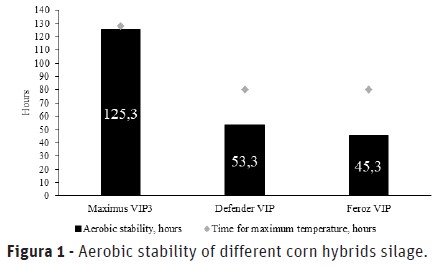
suggest that not only higher concentrations of acetic acid, but lower lactic acid:
acetic ratios may be related to the higher aerobic stability of silage (<a href = "/img/revistas/rca/v42n4/v42n4a23t2.jpg" target = "_blank">Table 2</a>;
<a href = "#f1">Figure 1</a>).</font></p>

    
<p>&nbsp;</p>

    <p><a name = "f1"><img src = "/img/revistas/rca/v42n4/v42n4a23f1.jpg"></a></p>

    
<p>&nbsp;</p>

    <p><font face = "Verdana" size = "2"><a href = "/img/revistas/rca/v42n4/v42n4a23t2.jpg" target = "_blank">Table 2</a> summarizes the parameters related
to the aerobic stability of maize silages. Significantly longer time was required
for the Maximus VIP3 silage temperature to increase by 2°C (125.3 hours), which
is a value similar to that described by Szucs <i>et al</i>. (2012). The other silages
did not differ significantly among themselves (53.3 and 45.3 hours for Defender
VIP and Feroz VIP).</font></p>

    
<p><font face = "Verdana" size = "2">The long
aerobic stabilities highlighted here might not occur in field conditions due to
unavoidable environmental contaminations; tests performed under laboratory conditions
may not provide accurate aerobic stability values in practice, but it is an appropriate
procedure for comparing different treatments in a controlled environment.</font></p>

    ]]></body>
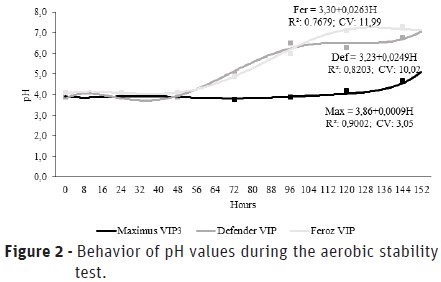
<body><![CDATA[<p><font face = "Verdana" size = "2">The pH values after aerobic stability test,
which lasted 152 hours, were different (P &lt;0.05), and the silages with a loss
of faster stability ended up with the highest pH values (7.0 and 7.1 to Defend VIP
and Feroz VIP). Similar values were described by Rabelo <i>et al</i>. (2012). Balieiro
Neto <i>et al</i>. (2009) already verified higher pH values in sugarcane silage,
approximately 8.3 after 152 hours of exposure to oxygen, probably due to the different
characteristics of the materials studied by the authors.</font></p>

    <p><font face = "Verdana" size = "2">These results allow us to affirm that silages
with good aerobic stability do not necessarily result from silages that present
a more adequate fermentation profile. According to criteria suggested by Santos
<i>et al</i>. (2010), the Maximus VIP hybrid silage was classified as good (85),
while the Defender VIP and Feroz VIP hybrids silages were excellent (90), because
the authors took into account only the maleic effects of acetic acid, such as their
correlation with dry matter and energy losses.</font></p>

    <p><font face = "Verdana" size = "2"><a href = "#f2">Figure 2</a> shows the behavior of the pH values of silages during the aerobic
stability test. Maximus VIP3 silage, which had the highest aerobic stability, showed
a lower increase in pH values with an hourly advance (0.0009 pH points hour<sup>-1</sup>),
while the silages of Defender VIP and Feroz VIP hybrids added 0.0249 and 0.0263
pH points hour<sup>-1</sup>, respectively.</font></p>

    <p>&nbsp;</p>

    <p><a name = "f2"><img src = "/img/revistas/rca/v42n4/v42n4a23f2.jpg"></a></p>

    
<p>&nbsp;</p>

    <p><font face = "Verdana" size = "2">It is possible to observe that the pH curves, for all the silages, beginning
with their advances being near to those that registered a loss stability for temperature.
Similar behavior can be observed in the study of Silva <i>et al</i>. (2016), with
high moisture grain silage indicating that a pH should be considered as a complement
to the tests on the aerobic stability of the temperature increase.</font></p>

    <p><font face = "Verdana" size = "3"><b>CONCLUSION</b></font></p>

    <p><font face = "Verdana" size = "2">The
variation of the maize hybrid and the genotype can affect the chemical composition
of silage, the fermentation profile and the aerobic stability. Among the evaluated
materials, the Maximus VIP hybrid is recommended because of its quality and high
aerobic stability.</font></p>

    <p>&nbsp;</p>

    ]]></body>
<body><![CDATA[<p><font face = "Verdana" size = "3"><b>References</b></font></p>

    <!-- ref --><p><font face = "Verdana" size = "2">Aoki, Y.; Oshita, T.; Namekawa, H.; Nemoto, E. & Aoki,
M. (2013) - Effect of cutting height on the chemical composition, nutritional value
and yield, fermentative quality and aerobic stability of corn silage and relationship
with plant maturity at harvest. <i>Grassland Science</i>, vol. 59, n. 4, p. 211-220.
<a href = "https://doi.org/10.1111/grs.12033" target = "blank">https://doi.org/10.1111/grs.12033</a></font>&nbsp;&nbsp;&nbsp;&nbsp;&nbsp;&nbsp;&nbsp;&nbsp;[&#160;<a href="javascript:void(0);" onclick="javascript: window.open('/scielo.php?script=sci_nlinks&ref=708581&pid=S0871-018X201900040002300001&lng=','','width=640,height=500,resizable=yes,scrollbars=1,menubar=yes,');">Links</a>&#160;]<!-- end-ref --><!-- ref --><p><font face = "Verdana" size = "2">AOAC (1995) - <i>Official methods of analysis</i>. 16th ed. Association of Official
Analytical Chemists, Washington, DC. 2000 p.    &nbsp;&nbsp;&nbsp;&nbsp;&nbsp;&nbsp;&nbsp;&nbsp;[&#160;<a href="javascript:void(0);" onclick="javascript: window.open('/scielo.php?script=sci_nlinks&ref=708582&pid=S0871-018X201900040002300002&lng=','','width=640,height=500,resizable=yes,scrollbars=1,menubar=yes,');">Links</a>&#160;]<!-- end-ref --></font></p>

    <!-- ref --><p><font face = "Verdana" size = "2">Balieiro Neto, G.; Junior, E.F.; Nogueira, J.R.; Possenti, R.; Paulino,
V.T. & Sartori, M.B. (2009) - Perdas fermentativas e estabilidade aeróbia de
silagens de cana de-açúcar aditivadas com cal virgem. <i>Revista Brasileira de Saúde
e Produção Animal</i>, vol. 10, n. 1, p. 24-33.    &nbsp;&nbsp;&nbsp;&nbsp;&nbsp;&nbsp;&nbsp;&nbsp;[&#160;<a href="javascript:void(0);" onclick="javascript: window.open('/scielo.php?script=sci_nlinks&ref=708584&pid=S0871-018X201900040002300003&lng=','','width=640,height=500,resizable=yes,scrollbars=1,menubar=yes,');">Links</a>&#160;]<!-- end-ref --></font></p>

    <!-- ref --><p><font face = "Verdana" size = "2">Bernardes, T.F.; Nussio, L.G. & Amaral, R.C. (2012) - Top spoilage
losses in maize silage sealed with plastic films with different permeabilities to
oxygen. <i>Grass and Forage Science</i>, vol. 67, n. 1, p. 34-42. <a href = "https://doi.org/10.1111/j.1365-2494.2011.00823.x" target = "blank">https://doi.org/10.1111/j.1365-2494.2011.00823.x</a></font>&nbsp;&nbsp;&nbsp;&nbsp;&nbsp;&nbsp;&nbsp;&nbsp;[&#160;<a href="javascript:void(0);" onclick="javascript: window.open('/scielo.php?script=sci_nlinks&ref=708586&pid=S0871-018X201900040002300004&lng=','','width=640,height=500,resizable=yes,scrollbars=1,menubar=yes,');">Links</a>&#160;]<!-- end-ref --><!-- ref --><p><font face = "Verdana" size = "2">Bolsen, K.K.; Lin, C.; Brent, B.E.; Feyerherm,
A.M.; Urban, J.E. & Aimutis, W.R. (1992) - Effect of Silage Additives on Microbial
Succession and Fermentation Process of Alfalfa and Corn Silages. <i>Journal of Dairy
Science</i>, vol. 75, n. 11, p. 3066-3083. <a href = "https://doi.org/10.3168/jds.S0022-0302(92)78070-9" target = "blank">https://doi.org/10.3168/jds.S0022-0302(92)78070-9</a></font>&nbsp;&nbsp;&nbsp;&nbsp;&nbsp;&nbsp;&nbsp;&nbsp;[&#160;<a href="javascript:void(0);" onclick="javascript: window.open('/scielo.php?script=sci_nlinks&ref=708587&pid=S0871-018X201900040002300005&lng=','','width=640,height=500,resizable=yes,scrollbars=1,menubar=yes,');">Links</a>&#160;]<!-- end-ref --><!-- ref --><p><font face = "Verdana" size = "2">Dolci, P.; Tabacco, E.; Cocolin, L. &
Borreani, G. (2011) - Microbial dynamics during aerobic exposure of corn silage
stored under oxygen barrier or polyethylene films. <i>Applied and Environmental
Microbiology</i>, vol. 77, n. 21, p. 7499-7507. <a href = "https://doi.org/10.1128/AEM.05050-11" target = "blank">https://doi.org/10.1128/AEM.05050-11</a></font>&nbsp;&nbsp;&nbsp;&nbsp;&nbsp;&nbsp;&nbsp;&nbsp;[&#160;<a href="javascript:void(0);" onclick="javascript: window.open('/scielo.php?script=sci_nlinks&ref=708588&pid=S0871-018X201900040002300006&lng=','','width=640,height=500,resizable=yes,scrollbars=1,menubar=yes,');">Links</a>&#160;]<!-- end-ref --><!-- ref --><p><font face = "Verdana" size = "2">Emygdio, B.M.; Ignaczak, J.C. & Cargnelutti
Filho, A. (2010) - Potencial de rendimento de grãos de híbridos comerciais simples,
triplos e duplos de milho. <i>Revista Brasileira de Milho e Sorgo</i>, vol. 6, n.
1, p. 95-103. <a href = "https://doi.org/10.18512/1980-6477/rbms.v6n1p95-103" target = "blank">https://doi.org/10.18512/1980-6477/rbms.v6n1p95-103</a></font>&nbsp;&nbsp;&nbsp;&nbsp;&nbsp;&nbsp;&nbsp;&nbsp;[&#160;<a href="javascript:void(0);" onclick="javascript: window.open('/scielo.php?script=sci_nlinks&ref=708589&pid=S0871-018X201900040002300007&lng=','','width=640,height=500,resizable=yes,scrollbars=1,menubar=yes,');">Links</a>&#160;]<!-- end-ref --><!-- ref --><p><font face = "Verdana" size = "2">Goering, H.K. & Van Soest, P.J. (1970)
- Forage fiber analysis: apparatus reagents, procedures and some applications. [s.n.],
<i>Agricultural Handbook</i>, p.379.    &nbsp;&nbsp;&nbsp;&nbsp;&nbsp;&nbsp;&nbsp;&nbsp;[&#160;<a href="javascript:void(0);" onclick="javascript: window.open('/scielo.php?script=sci_nlinks&ref=708590&pid=S0871-018X201900040002300008&lng=','','width=640,height=500,resizable=yes,scrollbars=1,menubar=yes,');">Links</a>&#160;]<!-- end-ref --></font></p>

    <!-- ref --><p><font face = "Verdana" size = "2">Holzer, M.; Mayrhuber, E.; Danner, H. & Braun, R. (2003) - The role of
<i>Lactobacillus buchneri</i> in forage preservation. <i>Trends in Biotechnology</i>,
vol. 21, n. 6, p. 282-287. <a href = "https://doi.org/10.1016/S0167-7799(03)00106-9" target = "blank">https://doi.org/10.1016/S0167-7799(03)00106-9</a></font>&nbsp;&nbsp;&nbsp;&nbsp;&nbsp;&nbsp;&nbsp;&nbsp;[&#160;<a href="javascript:void(0);" onclick="javascript: window.open('/scielo.php?script=sci_nlinks&ref=708592&pid=S0871-018X201900040002300009&lng=','','width=640,height=500,resizable=yes,scrollbars=1,menubar=yes,');">Links</a>&#160;]<!-- end-ref --><!-- ref --><p><font face = "Verdana" size = "2">Liu, Y.; Zuo, S.; Xu, L.; Zou, Y. & Song,
W. (2012) - Study on diversity of endophytic bacterial communities in seeds of hybrid
maize and their parental lines. <i>Archives of Microbiology</i>, vol. 194, n. 12,
p. 1001-1012. <a href = "https://doi.org/10.1007/s00203-012-0836-8 " target = "blank">https://doi.org/10.1007/s00203-012-0836-8</a></font>&nbsp;&nbsp;&nbsp;&nbsp;&nbsp;&nbsp;&nbsp;&nbsp;[&#160;<a href="javascript:void(0);" onclick="javascript: window.open('/scielo.php?script=sci_nlinks&ref=708593&pid=S0871-018X201900040002300010&lng=','','width=640,height=500,resizable=yes,scrollbars=1,menubar=yes,');">Links</a>&#160;]<!-- end-ref --><!-- ref --><p><font face = "Verdana" size = "2">Nishino, N.; Li, Y.; Wang, C. & Parvin, S. (2012)
- Effects of wilting and molasses addition on fermentation and bacterial community
in guinea grass silage. <i>Letters in Applied Microbiology</i>, vol. 54, n. 3, p.
175-181. <a href = "https://doi.org/10.1111/j.1472-765X.2011.03191.x" target = "blank">https://doi.org/10.1111/j.1472-765X.2011.03191.x</a></font>&nbsp;&nbsp;&nbsp;&nbsp;&nbsp;&nbsp;&nbsp;&nbsp;[&#160;<a href="javascript:void(0);" onclick="javascript: window.open('/scielo.php?script=sci_nlinks&ref=708594&pid=S0871-018X201900040002300011&lng=','','width=640,height=500,resizable=yes,scrollbars=1,menubar=yes,');">Links</a>&#160;]<!-- end-ref --><!-- ref --><p><font face = "Verdana" size = "2">Rabelo, C.H.S.; de Rezende, A.V.; Rabelo, F.H.S.; Nogueira,
D.A.; Senedese, S.S.; de Figueiredo Vieira, P. & Carvalho, A. (2014) - Silagens
de milho inoculadas microbiologicamente em diferentes estádios de maturidade: perdas
fermentativas, composição bromatológica e digestibilidade <i>in vitro</i>. <i>Ciência
Rural</i>, vol. 44, n. 2, p. 368-373. <a href = "https://doi.org/10.1590/S0103-84782014000200028" target = "blank">https://doi.org/10.1590/S0103-84782014000200028</a></font>&nbsp;&nbsp;&nbsp;&nbsp;&nbsp;&nbsp;&nbsp;&nbsp;[&#160;<a href="javascript:void(0);" onclick="javascript: window.open('/scielo.php?script=sci_nlinks&ref=708595&pid=S0871-018X201900040002300012&lng=','','width=640,height=500,resizable=yes,scrollbars=1,menubar=yes,');">Links</a>&#160;]<!-- end-ref --><!-- ref --><p><font face = "Verdana" size = "2">Rabelo, C.H.S.; Rezende, A.V.D.; Nogueira,
D.A.; Rabelo, F.H.S.; Senedese, S.S.; Vieira, P.D.F. & Carvalho, A. (2012) -
Perdas fermentativas e estabilidade aeróbia de silagens de milho inoculadas com
bactérias ácido-láticas em diferentes estádios de maturidade. <i>Revista Brasileira
de Saúde e Produção Animal</i>, vol. 13, n. 3, p. 656-668. <a href = "http://dx.doi.org/10.1590/S1519-99402012000300006 " target = "blank">http://dx.doi.org/10.1590/S1519-99402012000300006</a></font>&nbsp;&nbsp;&nbsp;&nbsp;&nbsp;&nbsp;&nbsp;&nbsp;[&#160;<a href="javascript:void(0);" onclick="javascript: window.open('/scielo.php?script=sci_nlinks&ref=708596&pid=S0871-018X201900040002300013&lng=','','width=640,height=500,resizable=yes,scrollbars=1,menubar=yes,');">Links</a>&#160;]<!-- end-ref --><!-- ref --><p><font face = "Verdana" size = "2">Santos, A.O.; Ávila, C.L.S.
& Schwan, R.F. (2013) - Selection of tropical lactic acid bacteria for enhancing
the quality of maize silage. <i>Journal of Dairy Science</i>, vol. 96, n. 12, p.
7777-7789. <a href = "https://doi.org/10.3168/jds.2013-6782" target = "blank">https://doi.org/10.3168/jds.2013-6782</a></font>&nbsp;&nbsp;&nbsp;&nbsp;&nbsp;&nbsp;&nbsp;&nbsp;[&#160;<a href="javascript:void(0);" onclick="javascript: window.open('/scielo.php?script=sci_nlinks&ref=708597&pid=S0871-018X201900040002300014&lng=','','width=640,height=500,resizable=yes,scrollbars=1,menubar=yes,');">Links</a>&#160;]<!-- end-ref --><!-- ref --><p><font face = "Verdana" size = "2">Santos, R.D.; Pereira, L.G.R.; Neves, A.L.A.; Araujo, G.G.L.; Voltolini,
T.V.; Brandão, L.G.N. & Dórea, J.R.R. (2010) - Características de fermentação
da silagem de seis variedades de milho indicadas para a região semiárida brasileira.
<i>Arquivo Brasileiro de Medicina Veterinária e Zootecnia</i>, v. 62, n. 6, p. 1423-1429.
<a href = "http://dx.doi.org/10.1590/S0102-09352010000600019 " target = "blank">http://dx.doi.org/10.1590/S0102-09352010000600019</a></font>&nbsp;&nbsp;&nbsp;&nbsp;&nbsp;&nbsp;&nbsp;&nbsp;[&#160;<a href="javascript:void(0);" onclick="javascript: window.open('/scielo.php?script=sci_nlinks&ref=708598&pid=S0871-018X201900040002300015&lng=','','width=640,height=500,resizable=yes,scrollbars=1,menubar=yes,');">Links</a>&#160;]<!-- end-ref --><!-- ref --><p><font face = "Verdana" size = "2">Silva, C.M.; Amaral, P.N.C.; Baggio, R.A.; Tubin, J.S.B.; Conte,
R.A.; Pivo, J.C.D.; Krahl, G.; Zampar, A. & Paiano, D. (2016) - Estabilidade
de silagens de grãos úmidos de milho e milho reidratado. <i>Revista Brasileira de
Saúde e Produção Animal</i>, v. 17, n. 3, p. 331-343. <a href = "http://dx.doi.org/10.1590/S1519-99402016000300001" target = "blank">http://dx.doi.org/10.1590/S1519-99402016000300001</a></font>&nbsp;&nbsp;&nbsp;&nbsp;&nbsp;&nbsp;&nbsp;&nbsp;[&#160;<a href="javascript:void(0);" onclick="javascript: window.open('/scielo.php?script=sci_nlinks&ref=708599&pid=S0871-018X201900040002300016&lng=','','width=640,height=500,resizable=yes,scrollbars=1,menubar=yes,');">Links</a>&#160;]<!-- end-ref --><!-- ref --><p><font face = "Verdana" size = "2">Silva, D.J. & Queiroz, A.C.
(2009) - <i>Análise de alimentos, métodos químicos e biológicos</i>. 3ª reimpressão.
Universidade Federal de Viçosa, 235p.    &nbsp;&nbsp;&nbsp;&nbsp;&nbsp;&nbsp;&nbsp;&nbsp;[&#160;<a href="javascript:void(0);" onclick="javascript: window.open('/scielo.php?script=sci_nlinks&ref=708600&pid=S0871-018X201900040002300017&lng=','','width=640,height=500,resizable=yes,scrollbars=1,menubar=yes,');">Links</a>&#160;]<!-- end-ref --></font></p>

    <!-- ref --><p><font face = "Verdana" size = "2">Sniffen, C.J.; O'connor, J.D.; Van Soest, P.J.; Fox, D.G. & Russell, J.B.
(1992) - A net carbohydrate and protein system for evaluating cattle diets: II.
Carbohydrate and protein availability. <i>Journal of Animal Science</i>, vol. 70,
n. 11, p. 3562-3577. <a href = "https://doi.org/10.2527/1992.70113562x " target = "blank">https://doi.org/10.2527/1992.70113562x</a></font>&nbsp;&nbsp;&nbsp;&nbsp;&nbsp;&nbsp;&nbsp;&nbsp;[&#160;<a href="javascript:void(0);" onclick="javascript: window.open('/scielo.php?script=sci_nlinks&ref=708602&pid=S0871-018X201900040002300018&lng=','','width=640,height=500,resizable=yes,scrollbars=1,menubar=yes,');">Links</a>&#160;]<!-- end-ref --><!-- ref --><p><font face = "Verdana" size = "2">Szucs, J.P.; Suli, A.; Meszaros, A.; Bodnar, E.S. &
Avasi, Z. (2012) - Use of Biological Additives with Grass Containing Medium and
High Levels of WSC for Effective Conservation and Aerobic Stability. <i>Animal Science
and Biotechnologies</i>, vol. 45, n. 1, p. 96-100.    &nbsp;&nbsp;&nbsp;&nbsp;&nbsp;&nbsp;&nbsp;&nbsp;[&#160;<a href="javascript:void(0);" onclick="javascript: window.open('/scielo.php?script=sci_nlinks&ref=708603&pid=S0871-018X201900040002300019&lng=','','width=640,height=500,resizable=yes,scrollbars=1,menubar=yes,');">Links</a>&#160;]<!-- end-ref --></font></p>

    <!-- ref --><p><font face = "Verdana" size = "2">Taylor, C.C. & Kung Junior, L. (2002) - The effect of
<i>Lactobacillus buchneri</i> on fermentation and aerobic stability of high moisture
corn in laboratory silos. <i>Journal of Dairy Science</i>, vol. 85, n. 6, p. 126-1532.
<a href = "https://doi.org/10.3168/jds.S0022-0302(02)74222-7" target = "blank">https://doi.org/10.3168/jds.S0022-0302(02)74222-7</a></font>&nbsp;&nbsp;&nbsp;&nbsp;&nbsp;&nbsp;&nbsp;&nbsp;[&#160;<a href="javascript:void(0);" onclick="javascript: window.open('/scielo.php?script=sci_nlinks&ref=708605&pid=S0871-018X201900040002300020&lng=','','width=640,height=500,resizable=yes,scrollbars=1,menubar=yes,');">Links</a>&#160;]<!-- end-ref --><!-- ref --><p><font face = "Verdana" size = "2">Tres, T.; Jobim, C.C.; Pinto, B.R.J.; Souza Neto, I.L.; Scapim,
C.A. & Silva, J.M.S. (2014a) - Composição nutricional e digestibilidade “in
vitro” de genótipos de milho produzidos em dois anos agrícolas. <i>Semina: Ciências
Agrárias</i>, vol. 35, n. 6, p. 3249-3261. <a href = "https://doi.org/10.5433/1679-0359.2014v35n6p3249" target = "blank">https://doi.org/10.5433/1679-0359.2014v35n6p3249</a></font>&nbsp;&nbsp;&nbsp;&nbsp;&nbsp;&nbsp;&nbsp;&nbsp;[&#160;<a href="javascript:void(0);" onclick="javascript: window.open('/scielo.php?script=sci_nlinks&ref=708606&pid=S0871-018X201900040002300021&lng=','','width=640,height=500,resizable=yes,scrollbars=1,menubar=yes,');">Links</a>&#160;]<!-- end-ref --><!-- ref --><p><font face = "Verdana" size = "2">Tres, T.T.; Jobim, C.C.; Rossi, R.M.; Silva,
M.S.D. & Poppi, E.C. (2014b) - Silagem de grãos de milho, com adição de soja:
estabilidade aeróbia e desempenho de vacas leiteiras. <i>Revista Brasileira de Saúde
e Produção Animal</i>, vol. 15, n. 1, p. 248-260. <a href = "http://dx.doi.org/10.1590/S1519-99402014000100002" target = "blank">http://dx.doi.org/10.1590/S1519-99402014000100002</a></font>&nbsp;&nbsp;&nbsp;&nbsp;&nbsp;&nbsp;&nbsp;&nbsp;[&#160;<a href="javascript:void(0);" onclick="javascript: window.open('/scielo.php?script=sci_nlinks&ref=708607&pid=S0871-018X201900040002300022&lng=','','width=640,height=500,resizable=yes,scrollbars=1,menubar=yes,');">Links</a>&#160;]<!-- end-ref --><!-- ref --><p><font face = "Verdana" size = "2">Van Soest, P.V.; Robertson,
J.B. & Lewis, B.A. (1991) - Methods for dietary fiber, neutral detergent fiber,
and nonstarch polysaccharides in relation to nutrition animal. <i>Journal of Dairy
Science</i>, vol. 74, p. 3583-3597. <a href = "https://doi.org/10.3168/jds.S0022-0302(91)78551-2" target = "blank">https://doi.org/10.3168/jds.S0022-0302(91)78551-2</a></font>&nbsp;&nbsp;&nbsp;&nbsp;&nbsp;&nbsp;&nbsp;&nbsp;[&#160;<a href="javascript:void(0);" onclick="javascript: window.open('/scielo.php?script=sci_nlinks&ref=708608&pid=S0871-018X201900040002300023&lng=','','width=640,height=500,resizable=yes,scrollbars=1,menubar=yes,');">Links</a>&#160;]<!-- end-ref --><!-- ref --><p><font face = "Verdana" size = "2">Walter, M.; Silva, L.P. & Emanuelli, T.
(2005) - Amido resistente: características físico-químicas, propriedades fisiológicas
e metodologias de quantificação<i>. Ciência Rural</i>, vol. 35, n. 4, p. 974-980.
<a href = "http://dx.doi.org/10.1590/S0103-84782005000400041" target = "blank">http://dx.doi.org/10.1590/S0103-84782005000400041</a></font>&nbsp;&nbsp;&nbsp;&nbsp;&nbsp;&nbsp;&nbsp;&nbsp;[&#160;<a href="javascript:void(0);" onclick="javascript: window.open('/scielo.php?script=sci_nlinks&ref=708609&pid=S0871-018X201900040002300024&lng=','','width=640,height=500,resizable=yes,scrollbars=1,menubar=yes,');">Links</a>&#160;]<!-- end-ref --><p>&nbsp;</p>

    <p><font face = "Verdana" size = "3"><b>Acknowledgments</b></font></p>

    <p><font face = "Verdana" size = "2">To the Coordination of Improvement of Higher Education
Personnel (CAPES).</font></p>

    <p>&nbsp;</p>

    <p><font face = "Verdana" size = "2"><i>† Part of first author's thesis</i></font></p>

    <p>&nbsp;</p>

    <p><font face = "Verdana" size = "2">Received/recebido: 2019.04.25</font></p>

    <p><font face = "Verdana" size = "2">Accepted/aceite: 2019.09.26</font></p>

     ]]></body><back>
<ref-list>
<ref id="B1">
<nlm-citation citation-type="journal">
<person-group person-group-type="author">
<name>
<surname><![CDATA[Aoki]]></surname>
<given-names><![CDATA[Y.]]></given-names>
</name>
<name>
<surname><![CDATA[Oshita]]></surname>
<given-names><![CDATA[T.]]></given-names>
</name>
<name>
<surname><![CDATA[Namekawa]]></surname>
<given-names><![CDATA[H.]]></given-names>
</name>
<name>
<surname><![CDATA[Nemoto]]></surname>
<given-names><![CDATA[E.]]></given-names>
</name>
<name>
<surname><![CDATA[Aoki]]></surname>
<given-names><![CDATA[M.]]></given-names>
</name>
</person-group>
<article-title xml:lang="en"><![CDATA[Effect of cutting height on the chemical composition, nutritional value and yield, fermentative quality and aerobic stability of corn silage and relationship with plant maturity at harvest]]></article-title>
<source><![CDATA[Grassland Science]]></source>
<year>2013</year>
<volume>59</volume>
<numero>4</numero>
<issue>4</issue>
<page-range>211-220</page-range></nlm-citation>
</ref>
<ref id="B2">
<nlm-citation citation-type="book">
<collab>AOAC</collab>
<source><![CDATA[Official methods of analysis]]></source>
<year>1995</year>
<edition>16th</edition>
<publisher-loc><![CDATA[Washington, DC ]]></publisher-loc>
<publisher-name><![CDATA[Association of Official Analytical Chemists]]></publisher-name>
</nlm-citation>
</ref>
<ref id="B3">
<nlm-citation citation-type="journal">
<person-group person-group-type="author">
<name>
<surname><![CDATA[Balieiro Neto]]></surname>
<given-names><![CDATA[G.]]></given-names>
</name>
<name>
<surname><![CDATA[Junior]]></surname>
<given-names><![CDATA[E.F.]]></given-names>
</name>
<name>
<surname><![CDATA[Nogueira]]></surname>
<given-names><![CDATA[J.R.]]></given-names>
</name>
<name>
<surname><![CDATA[Possenti]]></surname>
<given-names><![CDATA[R.]]></given-names>
</name>
<name>
<surname><![CDATA[Paulino]]></surname>
<given-names><![CDATA[V.T.]]></given-names>
</name>
<name>
<surname><![CDATA[Sartori]]></surname>
<given-names><![CDATA[M.B.]]></given-names>
</name>
</person-group>
<article-title xml:lang="pt"><![CDATA[Perdas fermentativas e estabilidade aeróbia de silagens de cana de-açúcar aditivadas com cal virgem]]></article-title>
<source><![CDATA[Revista Brasileira de Saúde e Produção Animal]]></source>
<year>2009</year>
<volume>10</volume>
<numero>1</numero>
<issue>1</issue>
<page-range>24-33</page-range></nlm-citation>
</ref>
<ref id="B4">
<nlm-citation citation-type="journal">
<person-group person-group-type="author">
<name>
<surname><![CDATA[Bernardes]]></surname>
<given-names><![CDATA[T.F.]]></given-names>
</name>
<name>
<surname><![CDATA[Nussio]]></surname>
<given-names><![CDATA[L.G.]]></given-names>
</name>
<name>
<surname><![CDATA[Amaral]]></surname>
<given-names><![CDATA[R.C.]]></given-names>
</name>
</person-group>
<article-title xml:lang="en"><![CDATA[Top spoilage losses in maize silage sealed with plastic films with different permeabilities to oxygen]]></article-title>
<source><![CDATA[Grass and Forage Science]]></source>
<year>2012</year>
<volume>67</volume>
<numero>1</numero>
<issue>1</issue>
<page-range>34-42</page-range></nlm-citation>
</ref>
<ref id="B5">
<nlm-citation citation-type="journal">
<person-group person-group-type="author">
<name>
<surname><![CDATA[Bolsen]]></surname>
<given-names><![CDATA[K.K.]]></given-names>
</name>
<name>
<surname><![CDATA[Lin]]></surname>
<given-names><![CDATA[C.]]></given-names>
</name>
<name>
<surname><![CDATA[Brent]]></surname>
<given-names><![CDATA[B.E.]]></given-names>
</name>
<name>
<surname><![CDATA[Feyerherm]]></surname>
<given-names><![CDATA[A.M.]]></given-names>
</name>
<name>
<surname><![CDATA[Urban]]></surname>
<given-names><![CDATA[J.E.]]></given-names>
</name>
<name>
<surname><![CDATA[Aimutis]]></surname>
<given-names><![CDATA[W.R.]]></given-names>
</name>
</person-group>
<article-title xml:lang="en"><![CDATA[Effect of Silage Additives on Microbial Succession and Fermentation Process of Alfalfa and Corn Silages]]></article-title>
<source><![CDATA[Journal of Dairy Science]]></source>
<year>1992</year>
<volume>75</volume>
<numero>11</numero>
<issue>11</issue>
<page-range>3066-3083</page-range></nlm-citation>
</ref>
<ref id="B6">
<nlm-citation citation-type="journal">
<person-group person-group-type="author">
<name>
<surname><![CDATA[Dolci]]></surname>
<given-names><![CDATA[P.]]></given-names>
</name>
<name>
<surname><![CDATA[Tabacco]]></surname>
<given-names><![CDATA[E.]]></given-names>
</name>
<name>
<surname><![CDATA[Cocolin]]></surname>
<given-names><![CDATA[L.]]></given-names>
</name>
<name>
<surname><![CDATA[Borreani]]></surname>
<given-names><![CDATA[G.]]></given-names>
</name>
</person-group>
<article-title xml:lang="en"><![CDATA[Microbial dynamics during aerobic exposure of corn silage stored under oxygen barrier or polyethylene films]]></article-title>
<source><![CDATA[Applied and Environmental Microbiology]]></source>
<year>2011</year>
<volume>77</volume>
<numero>21</numero>
<issue>21</issue>
<page-range>7499-7507</page-range></nlm-citation>
</ref>
<ref id="B7">
<nlm-citation citation-type="journal">
<person-group person-group-type="author">
<name>
<surname><![CDATA[Emygdio]]></surname>
<given-names><![CDATA[B.M.]]></given-names>
</name>
<name>
<surname><![CDATA[Ignaczak]]></surname>
<given-names><![CDATA[J.C.]]></given-names>
</name>
<name>
<surname><![CDATA[Cargnelutti Filho]]></surname>
<given-names><![CDATA[A.]]></given-names>
</name>
</person-group>
<article-title xml:lang="pt"><![CDATA[Potencial de rendimento de grãos de híbridos comerciais simples, triplos e duplos de milho]]></article-title>
<source><![CDATA[Revista Brasileira de Milho e Sorgo]]></source>
<year>2010</year>
<volume>6</volume>
<numero>1</numero>
<issue>1</issue>
<page-range>95-103</page-range></nlm-citation>
</ref>
<ref id="B8">
<nlm-citation citation-type="">
<person-group person-group-type="author">
<name>
<surname><![CDATA[Goering]]></surname>
<given-names><![CDATA[H.K.]]></given-names>
</name>
<name>
<surname><![CDATA[Van Soest]]></surname>
<given-names><![CDATA[P.J.]]></given-names>
</name>
</person-group>
<source><![CDATA[Forage fiber analysis: apparatus reagents, procedures and some applications]]></source>
<year>1970</year>
<page-range>379</page-range></nlm-citation>
</ref>
<ref id="B9">
<nlm-citation citation-type="journal">
<person-group person-group-type="author">
<name>
<surname><![CDATA[Holzer]]></surname>
<given-names><![CDATA[M.]]></given-names>
</name>
<name>
<surname><![CDATA[Mayrhuber]]></surname>
<given-names><![CDATA[E.]]></given-names>
</name>
<name>
<surname><![CDATA[Danner]]></surname>
<given-names><![CDATA[H.]]></given-names>
</name>
<name>
<surname><![CDATA[Braun]]></surname>
<given-names><![CDATA[R.]]></given-names>
</name>
</person-group>
<article-title xml:lang="en"><![CDATA[The role of Lactobacillus buchneri in forage preservation]]></article-title>
<source><![CDATA[Trends in Biotechnology]]></source>
<year>2003</year>
<volume>21</volume>
<numero>6</numero>
<issue>6</issue>
<page-range>282-287</page-range></nlm-citation>
</ref>
<ref id="B10">
<nlm-citation citation-type="journal">
<person-group person-group-type="author">
<name>
<surname><![CDATA[Liu]]></surname>
<given-names><![CDATA[Y.]]></given-names>
</name>
<name>
<surname><![CDATA[Zuo]]></surname>
<given-names><![CDATA[S.]]></given-names>
</name>
<name>
<surname><![CDATA[Xu]]></surname>
<given-names><![CDATA[L.]]></given-names>
</name>
<name>
<surname><![CDATA[Zou]]></surname>
<given-names><![CDATA[Y.]]></given-names>
</name>
<name>
<surname><![CDATA[Song]]></surname>
<given-names><![CDATA[W.]]></given-names>
</name>
</person-group>
<article-title xml:lang="en"><![CDATA[Study on diversity of endophytic bacterial communities in seeds of hybrid maize and their parental lines]]></article-title>
<source><![CDATA[Archives of Microbiology]]></source>
<year>2012</year>
<volume>194</volume>
<numero>12</numero>
<issue>12</issue>
<page-range>1001-1012</page-range></nlm-citation>
</ref>
<ref id="B11">
<nlm-citation citation-type="journal">
<person-group person-group-type="author">
<name>
<surname><![CDATA[Nishino]]></surname>
<given-names><![CDATA[N.]]></given-names>
</name>
<name>
<surname><![CDATA[Li]]></surname>
<given-names><![CDATA[Y.]]></given-names>
</name>
<name>
<surname><![CDATA[Wang]]></surname>
<given-names><![CDATA[C.]]></given-names>
</name>
<name>
<surname><![CDATA[Parvin]]></surname>
<given-names><![CDATA[S.]]></given-names>
</name>
</person-group>
<article-title xml:lang="en"><![CDATA[Effects of wilting and molasses addition on fermentation and bacterial community in guinea grass silage]]></article-title>
<source><![CDATA[Letters in Applied Microbiology]]></source>
<year>2012</year>
<volume>54</volume>
<numero>3</numero>
<issue>3</issue>
<page-range>175-181</page-range></nlm-citation>
</ref>
<ref id="B12">
<nlm-citation citation-type="journal">
<person-group person-group-type="author">
<name>
<surname><![CDATA[Rabelo]]></surname>
<given-names><![CDATA[C.H.S.]]></given-names>
</name>
<name>
<surname><![CDATA[de Rezende]]></surname>
<given-names><![CDATA[A.V.]]></given-names>
</name>
<name>
<surname><![CDATA[Rabelo]]></surname>
<given-names><![CDATA[F.H.S.]]></given-names>
</name>
<name>
<surname><![CDATA[Nogueira]]></surname>
<given-names><![CDATA[D.A.]]></given-names>
</name>
<name>
<surname><![CDATA[Senedese]]></surname>
<given-names><![CDATA[S.S.]]></given-names>
</name>
<name>
<surname><![CDATA[de Figueiredo Vieira]]></surname>
<given-names><![CDATA[P.]]></given-names>
</name>
<name>
<surname><![CDATA[Carvalho]]></surname>
<given-names><![CDATA[A.]]></given-names>
</name>
</person-group>
<article-title xml:lang="pt"><![CDATA[Silagens de milho inoculadas microbiologicamente em diferentes estádios de maturidade: perdas fermentativas, composição bromatológica e digestibilidade in vitro]]></article-title>
<source><![CDATA[Ciência Rural]]></source>
<year>2014</year>
<volume>44</volume>
<numero>2</numero>
<issue>2</issue>
<page-range>368-373</page-range></nlm-citation>
</ref>
<ref id="B13">
<nlm-citation citation-type="journal">
<person-group person-group-type="author">
<name>
<surname><![CDATA[Rabelo]]></surname>
<given-names><![CDATA[C.H.S.]]></given-names>
</name>
<name>
<surname><![CDATA[Rezende]]></surname>
<given-names><![CDATA[A.V.D.]]></given-names>
</name>
<name>
<surname><![CDATA[Nogueira]]></surname>
<given-names><![CDATA[D.A.]]></given-names>
</name>
<name>
<surname><![CDATA[Rabelo]]></surname>
<given-names><![CDATA[F.H.S.]]></given-names>
</name>
<name>
<surname><![CDATA[Senedese]]></surname>
<given-names><![CDATA[S.S.]]></given-names>
</name>
<name>
<surname><![CDATA[Vieira]]></surname>
<given-names><![CDATA[P.D.F.]]></given-names>
</name>
<name>
<surname><![CDATA[Carvalho]]></surname>
<given-names><![CDATA[A.]]></given-names>
</name>
</person-group>
<article-title xml:lang="pt"><![CDATA[Perdas fermentativas e estabilidade aeróbia de silagens de milho inoculadas com bactérias ácido-láticas em diferentes estádios de maturidade]]></article-title>
<source><![CDATA[Revista Brasileira de Saúde e Produção Animal]]></source>
<year>2012</year>
<volume>13</volume>
<numero>3</numero>
<issue>3</issue>
<page-range>656-668</page-range></nlm-citation>
</ref>
<ref id="B14">
<nlm-citation citation-type="journal">
<person-group person-group-type="author">
<name>
<surname><![CDATA[Santos]]></surname>
<given-names><![CDATA[A.O.]]></given-names>
</name>
<name>
<surname><![CDATA[Ávila]]></surname>
<given-names><![CDATA[C.L.S.]]></given-names>
</name>
<name>
<surname><![CDATA[Schwan]]></surname>
<given-names><![CDATA[R.F.]]></given-names>
</name>
</person-group>
<article-title xml:lang="en"><![CDATA[Selection of tropical lactic acid bacteria for enhancing the quality of maize silage]]></article-title>
<source><![CDATA[Journal of Dairy Science]]></source>
<year>2013</year>
<volume>96</volume>
<numero>12</numero>
<issue>12</issue>
<page-range>7777-7789</page-range></nlm-citation>
</ref>
<ref id="B15">
<nlm-citation citation-type="journal">
<person-group person-group-type="author">
<name>
<surname><![CDATA[Santos]]></surname>
<given-names><![CDATA[R.D.]]></given-names>
</name>
<name>
<surname><![CDATA[Pereira]]></surname>
<given-names><![CDATA[L.G.R.]]></given-names>
</name>
<name>
<surname><![CDATA[Neves]]></surname>
<given-names><![CDATA[A.L.A.]]></given-names>
</name>
<name>
<surname><![CDATA[Araujo]]></surname>
<given-names><![CDATA[G.G.L.]]></given-names>
</name>
<name>
<surname><![CDATA[Voltolini]]></surname>
<given-names><![CDATA[T.V.]]></given-names>
</name>
<name>
<surname><![CDATA[Brandão]]></surname>
<given-names><![CDATA[L.G.N.]]></given-names>
</name>
<name>
<surname><![CDATA[Dórea]]></surname>
<given-names><![CDATA[J.R.R.]]></given-names>
</name>
</person-group>
<article-title xml:lang="pt"><![CDATA[Características de fermentação da silagem de seis variedades de milho indicadas para a região semiárida brasileira]]></article-title>
<source><![CDATA[Arquivo Brasileiro de Medicina Veterinária e Zootecnia]]></source>
<year>2010</year>
<volume>62</volume>
<numero>6</numero>
<issue>6</issue>
<page-range>1423-1429</page-range></nlm-citation>
</ref>
<ref id="B16">
<nlm-citation citation-type="journal">
<person-group person-group-type="author">
<name>
<surname><![CDATA[Silva]]></surname>
<given-names><![CDATA[C.M.]]></given-names>
</name>
<name>
<surname><![CDATA[Amaral]]></surname>
<given-names><![CDATA[P.N.C.]]></given-names>
</name>
<name>
<surname><![CDATA[Baggio]]></surname>
<given-names><![CDATA[R.A.]]></given-names>
</name>
<name>
<surname><![CDATA[Tubin]]></surname>
<given-names><![CDATA[J.S.B.]]></given-names>
</name>
<name>
<surname><![CDATA[Conte]]></surname>
<given-names><![CDATA[R.A.]]></given-names>
</name>
<name>
<surname><![CDATA[Pivo]]></surname>
<given-names><![CDATA[J.C.D.]]></given-names>
</name>
<name>
<surname><![CDATA[Krahl]]></surname>
<given-names><![CDATA[G.]]></given-names>
</name>
<name>
<surname><![CDATA[Zampar]]></surname>
<given-names><![CDATA[A.]]></given-names>
</name>
<name>
<surname><![CDATA[Paiano]]></surname>
<given-names><![CDATA[D.]]></given-names>
</name>
</person-group>
<article-title xml:lang="pt"><![CDATA[Estabilidade de silagens de grãos úmidos de milho e milho reidratado]]></article-title>
<source><![CDATA[Revista Brasileira de Saúde e Produção Animal]]></source>
<year>2016</year>
<volume>17</volume>
<numero>3</numero>
<issue>3</issue>
<page-range>331-343</page-range></nlm-citation>
</ref>
<ref id="B17">
<nlm-citation citation-type="book">
<person-group person-group-type="author">
<name>
<surname><![CDATA[Silva]]></surname>
<given-names><![CDATA[D.J.]]></given-names>
</name>
<name>
<surname><![CDATA[Queiroz]]></surname>
<given-names><![CDATA[A.C.]]></given-names>
</name>
</person-group>
<source><![CDATA[Análise de alimentos, métodos químicos e biológicos]]></source>
<year>2009</year>
<edition>3ª</edition>
<publisher-name><![CDATA[Universidade Federal de Viçosa]]></publisher-name>
</nlm-citation>
</ref>
<ref id="B18">
<nlm-citation citation-type="journal">
<person-group person-group-type="author">
<name>
<surname><![CDATA[Sniffen]]></surname>
<given-names><![CDATA[C.J.]]></given-names>
</name>
<name>
<surname><![CDATA[O'connor]]></surname>
<given-names><![CDATA[J.D.]]></given-names>
</name>
<name>
<surname><![CDATA[Van Soest]]></surname>
<given-names><![CDATA[P.J.]]></given-names>
</name>
<name>
<surname><![CDATA[Fox]]></surname>
<given-names><![CDATA[D.G.]]></given-names>
</name>
<name>
<surname><![CDATA[Russell]]></surname>
<given-names><![CDATA[J.B.]]></given-names>
</name>
</person-group>
<article-title xml:lang="en"><![CDATA[A net carbohydrate and protein system for evaluating cattle diets: II. Carbohydrate and protein availability]]></article-title>
<source><![CDATA[Journal of Animal Science]]></source>
<year>1992</year>
<volume>70</volume>
<numero>11</numero>
<issue>11</issue>
<page-range>3562-3577</page-range></nlm-citation>
</ref>
<ref id="B19">
<nlm-citation citation-type="journal">
<person-group person-group-type="author">
<name>
<surname><![CDATA[Szucs]]></surname>
<given-names><![CDATA[J.P.]]></given-names>
</name>
<name>
<surname><![CDATA[Suli]]></surname>
<given-names><![CDATA[A.]]></given-names>
</name>
<name>
<surname><![CDATA[Meszaros]]></surname>
<given-names><![CDATA[A.]]></given-names>
</name>
<name>
<surname><![CDATA[Bodnar]]></surname>
<given-names><![CDATA[E.S.]]></given-names>
</name>
<name>
<surname><![CDATA[Avasi]]></surname>
<given-names><![CDATA[Z.]]></given-names>
</name>
</person-group>
<article-title xml:lang="en"><![CDATA[Use of Biological Additives with Grass Containing Medium and High Levels of WSC for Effective Conservation and Aerobic Stability]]></article-title>
<source><![CDATA[Animal Science and Biotechnologies]]></source>
<year>2012</year>
<volume>45</volume>
<numero>1</numero>
<issue>1</issue>
<page-range>96-100</page-range></nlm-citation>
</ref>
<ref id="B20">
<nlm-citation citation-type="journal">
<person-group person-group-type="author">
<name>
<surname><![CDATA[Taylor]]></surname>
<given-names><![CDATA[C.C.]]></given-names>
</name>
<name>
<surname><![CDATA[Kung Junior]]></surname>
<given-names><![CDATA[L.]]></given-names>
</name>
</person-group>
<article-title xml:lang="en"><![CDATA[The effect of Lactobacillus buchneri on fermentation and aerobic stability of high moisture corn in laboratory silos]]></article-title>
<source><![CDATA[Journal of Dairy Science]]></source>
<year>2002</year>
<volume>85</volume>
<numero>6</numero>
<issue>6</issue>
<page-range>126-1532</page-range></nlm-citation>
</ref>
<ref id="B21">
<nlm-citation citation-type="journal">
<person-group person-group-type="author">
<name>
<surname><![CDATA[Tres]]></surname>
<given-names><![CDATA[T.]]></given-names>
</name>
<name>
<surname><![CDATA[Jobim]]></surname>
<given-names><![CDATA[C.C.]]></given-names>
</name>
<name>
<surname><![CDATA[Pinto]]></surname>
<given-names><![CDATA[B.R.J.]]></given-names>
</name>
<name>
<surname><![CDATA[Souza Neto]]></surname>
<given-names><![CDATA[I.L.]]></given-names>
</name>
<name>
<surname><![CDATA[Scapim]]></surname>
<given-names><![CDATA[C.A.]]></given-names>
</name>
<name>
<surname><![CDATA[Silva]]></surname>
<given-names><![CDATA[J.M.S.]]></given-names>
</name>
</person-group>
<article-title xml:lang="pt"><![CDATA[Composição nutricional e digestibilidade “in vitro” de genótipos de milho produzidos em dois anos agrícolas]]></article-title>
<source><![CDATA[Semina]]></source>
<year>2014</year>
<month>a</month>
<volume>35</volume>
<numero>6</numero>
<issue>6</issue>
<page-range>3249-3261</page-range></nlm-citation>
</ref>
<ref id="B22">
<nlm-citation citation-type="journal">
<person-group person-group-type="author">
<name>
<surname><![CDATA[Tres]]></surname>
<given-names><![CDATA[T.]]></given-names>
</name>
<name>
<surname><![CDATA[Jobim]]></surname>
<given-names><![CDATA[C.C.]]></given-names>
</name>
<name>
<surname><![CDATA[Rossi]]></surname>
<given-names><![CDATA[R.M.]]></given-names>
</name>
<name>
<surname><![CDATA[Silva]]></surname>
<given-names><![CDATA[M.S.D.]]></given-names>
</name>
<name>
<surname><![CDATA[Poppi]]></surname>
<given-names><![CDATA[E.C.]]></given-names>
</name>
</person-group>
<article-title xml:lang="pt"><![CDATA[Silagem de grãos de milho, com adição de soja: estabilidade aeróbia e desempenho de vacas leiteiras]]></article-title>
<source><![CDATA[Revista Brasileira de Saúde e Produção Animal]]></source>
<year>2014</year>
<month>b</month>
<volume>15</volume>
<numero>1</numero>
<issue>1</issue>
<page-range>248-260</page-range></nlm-citation>
</ref>
<ref id="B23">
<nlm-citation citation-type="journal">
<person-group person-group-type="author">
<name>
<surname><![CDATA[Van Soest]]></surname>
<given-names><![CDATA[P.V.]]></given-names>
</name>
<name>
<surname><![CDATA[Robertson]]></surname>
<given-names><![CDATA[J.B.]]></given-names>
</name>
<name>
<surname><![CDATA[Lewis]]></surname>
<given-names><![CDATA[B.A.]]></given-names>
</name>
</person-group>
<article-title xml:lang="en"><![CDATA[Methods for dietary fiber, neutral detergent fiber, and nonstarch polysaccharides in relation to nutrition animal]]></article-title>
<source><![CDATA[Journal of Dairy Science]]></source>
<year>1991</year>
<volume>74</volume>
<page-range>3583-3597</page-range></nlm-citation>
</ref>
<ref id="B24">
<nlm-citation citation-type="journal">
<person-group person-group-type="author">
<name>
<surname><![CDATA[Walter]]></surname>
<given-names><![CDATA[M.]]></given-names>
</name>
<name>
<surname><![CDATA[Silva]]></surname>
<given-names><![CDATA[L.P.]]></given-names>
</name>
<name>
<surname><![CDATA[Emanuelli]]></surname>
<given-names><![CDATA[T.]]></given-names>
</name>
</person-group>
<article-title xml:lang="pt"><![CDATA[Amido resistente: características físico-químicas, propriedades fisiológicas e metodologias de quantificação]]></article-title>
<source><![CDATA[Ciência Rural]]></source>
<year>2005</year>
<volume>35</volume>
<numero>4</numero>
<issue>4</issue>
<page-range>974-980</page-range></nlm-citation>
</ref>
</ref-list>
</back>
</article>