<?xml version="1.0" encoding="ISO-8859-1"?><article xmlns:mml="http://www.w3.org/1998/Math/MathML" xmlns:xlink="http://www.w3.org/1999/xlink" xmlns:xsi="http://www.w3.org/2001/XMLSchema-instance">
<front>
<journal-meta>
<journal-id>0872-0169</journal-id>
<journal-title><![CDATA[Portuguese Journal of Nephrology & Hypertension]]></journal-title>
<abbrev-journal-title><![CDATA[Port J Nephrol Hypert]]></abbrev-journal-title>
<issn>0872-0169</issn>
<publisher>
<publisher-name><![CDATA[Sociedade Portuguesa de Nefrologia]]></publisher-name>
</publisher>
</journal-meta>
<article-meta>
<article-id>S0872-01692012000200003</article-id>
<title-group>
<article-title xml:lang="en"><![CDATA[Phosphate balance in chronic kidney disease?: the chicken or the egg]]></article-title>
</title-group>
<contrib-group>
<contrib contrib-type="author">
<name>
<surname><![CDATA[Adragão]]></surname>
<given-names><![CDATA[Teresa]]></given-names>
</name>
<xref ref-type="aff" rid="A01"/>
</contrib>
<contrib contrib-type="author">
<name>
<surname><![CDATA[Frazão]]></surname>
<given-names><![CDATA[João M.]]></given-names>
</name>
<xref ref-type="aff" rid="A02"/>
<xref ref-type="aff" rid="A03"/>
</contrib>
</contrib-group>
<aff id="A01">
<institution><![CDATA[,Hospital de Santa Cruz Nephrology Department ]]></institution>
<addr-line><![CDATA[Carnaxide ]]></addr-line>
<country>Portugal</country>
</aff>
<aff id="A02">
<institution><![CDATA[,University of Porto School of Medicine Nephrology Research amd Development Unit]]></institution>
<addr-line><![CDATA[ ]]></addr-line>
</aff>
<aff id="A03">
<institution><![CDATA[,Hospital S. João Nephrology Department ]]></institution>
<addr-line><![CDATA[Porto ]]></addr-line>
<country>Portugal</country>
</aff>
<pub-date pub-type="pub">
<day>00</day>
<month>04</month>
<year>2012</year>
</pub-date>
<pub-date pub-type="epub">
<day>00</day>
<month>04</month>
<year>2012</year>
</pub-date>
<volume>26</volume>
<numero>2</numero>
<fpage>149</fpage>
<lpage>156</lpage>
<copyright-statement/>
<copyright-year/>
<self-uri xlink:href="http://scielo.pt/scielo.php?script=sci_arttext&amp;pid=S0872-01692012000200003&amp;lng=en&amp;nrm=iso"></self-uri><self-uri xlink:href="http://scielo.pt/scielo.php?script=sci_abstract&amp;pid=S0872-01692012000200003&amp;lng=en&amp;nrm=iso"></self-uri><self-uri xlink:href="http://scielo.pt/scielo.php?script=sci_pdf&amp;pid=S0872-01692012000200003&amp;lng=en&amp;nrm=iso"></self-uri><abstract abstract-type="short" xml:lang="en"><p><![CDATA[In chronic kidney disease patients there are three main stimuli for parathyroid hormone (PTH) secretion by the chief cell in the parathyroid glands: hypocalcaemia, low 1,25(OH)2D3 levels and hyperphosphataemia. FGF23 is a regulator of phosphate and vitamin D metabolism. The discovery of FGF23 actions enlightened our understanding of the development of secondary hyperparathyroidism in CKD patients. The main systemic factors that stimulate FGF23 secretion by the osteocyte in the bone appear to be phosphate load and 1,25(OH)2D3. In the kidney, FGF23 decreases the number of Na/Pi co-transporters IIa and IIc in the tubular cell and promotes phosphaturia. FGF23 also reduces 1,25(OH)2D3 levels by inhibiting, in the kidney, its production by 1-alpha-hydroxylase and stimulating its degradation by 24-hydroxylase. Increase in FGF23 levels has been described in early 2 and 3 CKD stages preceding the decrease of 1,25(OH)2D3 levels and hyperphosphatemia. In this sequence of events, increase of FGF23 in CKD patients seems to be a novel mechanism for the early decline of 1,25(OH)2D3 levels observed in these patients. It was hypothesised that klotho deficiency creates a tissue resistance to FGF23 which is responsible for the increase of FGF23 levels. Reduced renal expression of klotho has been demonstrated in CKD patients preceding FGF23 increase. Chronic kidney disease may be considered a state of klotho deficiency with increase of FGF23 levels. Klotho deficiency may be the initial alteration for the development of phosphate retention and secondary hyperparathyroidism in CKD patients. In this article we review the classic and new pathways involved in the development of secondary hyperparathyroidism in chronic kidney disease and the subsequent actions ensuing from this knowledge. It is possible that, in 3 and 4 CKD stages, an early therapeutic intervention consisting of a low phosphate diet and/or phosphate binders, even in the presence of normophosphataemia, might retard the development of secondary hyperparathyroidism]]></p></abstract>
<kwd-group>
<kwd lng="en"><![CDATA[Bone-kidney-parathyroid endocrine axis]]></kwd>
<kwd lng="en"><![CDATA[chronic kidney disease]]></kwd>
<kwd lng="en"><![CDATA[FGF23]]></kwd>
<kwd lng="en"><![CDATA[Klotho]]></kwd>
<kwd lng="en"><![CDATA[phosphate balance]]></kwd>
</kwd-group>
</article-meta>
</front><body><![CDATA[ <p><b>Phosphate balance in chronic kidney disease: the chicken or the egg?</b></p>      <p>&nbsp;</p>      <p><b>Teresa Adragão<sup>1</sup>, João M. Frazão<sup>2</sup></b></p>     <p><sup>1</sup> Nephrology Department, Hospital de Santa Cruz. Carnaxide, Portugal.</p>      <p><sup>2</sup>Nephrology Research and Development Unit and School of Medicine, University of Porto; and Nephrology Department, Hospital S. João, Porto, Portugal.</p>      <p><b><a name="topc0" id="topc0"></a><a href="#c0">correspondence to:</a></b></p>      <p>&nbsp;</p>      <p><b>ABSTRACT</b></p>      <p>In chronic kidney disease patients there are three main stimuli for parathyroid hormone (PTH) secretion by the chief cell in the parathyroid glands: hypocalcaemia, low 1,25(OH)<sub>2</sub>D<sub>3</sub> levels and hyperphosphataemia.</p>      <p>FGF23 is a regulator of phosphate and vitamin D metabolism. The discovery of FGF<sub>23</sub> actions enlightened our understanding of the development of secondary hyperparathyroidism in CKD patients. The main systemic factors that stimulate FGF<sub>23</sub> secretion by the osteocyte in the bone appear to be phosphate load and 1,25(OH)<sub>2</sub>D<sub>3</sub>. In the kidney, FGF<sub>23 </sub>decreases the number of Na/Pi co-transporters IIa and IIc in the tubular cell and promotes phosphaturia. FGF23 also reduces 1,25(OH)<sub>2</sub>D<sub>3</sub> levels by inhibiting, in the kidney, its production by 1-alpha-hydroxylase and stimulating its degradation by 24-hydroxylase. Increase in FGF<sub>23</sub> levels has been described in early 2 and 3 CKD stages preceding the decrease of 1,25(OH)<sub>2</sub>D<sub>3</sub> levels and hyperphosphatemia. In this sequence of events, increase of FGF<sub>23</sub> in CKD patients seems to be a novel mechanism for the early decline of 1,25(OH)<sub>2</sub>D<sub>3</sub> levels observed in these patients. It was hypothesised that klotho deficiency creates a tissue resistance to FGF<sub>23</sub> which is responsible for the increase of FGF<sub>23</sub> levels. Reduced renal expression of klotho has been demonstrated in CKD patients preceding FGF<sub>23</sub> increase. Chronic kidney disease may be considered a state of klotho deficiency with increase of FGF<sub>23</sub> levels. Klotho deficiency may be the initial alteration for the development of phosphate retention and secondary hyperparathyroidism in CKD patients. In this article we review the classic and new pathways involved in the development of secondary hyperparathyroidism in chronic kidney disease and the subsequent actions ensuing from this knowledge.</p>      ]]></body>
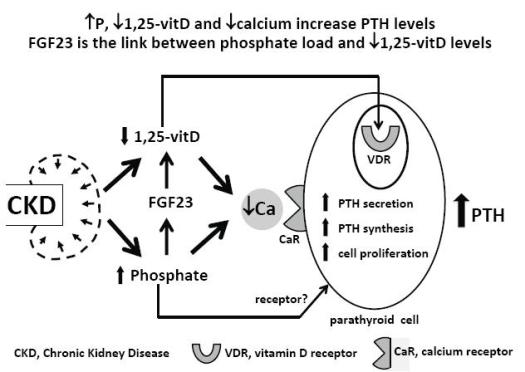
<body><![CDATA[<p>It is possible that, in 3 and 4 CKD stages, an early therapeutic intervention consisting of a low phosphate diet and/or phosphate binders, even in the presence of normophosphataemia, might retard the development of secondary hyperparathyroidism.</p>       <p><b>Key-Words: </b>Bone-kidney-parathyroid endocrine axis; chronic kidney disease; FGF<sub>23</sub>; Klotho; phosphate balance.</p>      <p>&nbsp;</p>      <p><b>STIMULI FOR PARATHYROID HORMONE SYNTHESIS AND SECRETION WITH THE CONSEQUENT DEVELOPMENT OF SECONDARY HYPERPARATHYROIDISM IN CHRONIC KIDNEY DISEASE</b></p>      <p> In chronic kidney disease (CKD) patients there are three main stimuli for parathyroid hormone (PTH) secretion by the chief cell in the parathyroid glands: hypocalcaemia, low 1,25(OH)<sub>2</sub>D<sub>3</sub> levels and hyperphosphataemia<sup>1</sup> (Fig.1). Low 1,25(OH)<sub>2</sub>D<sub>3</sub> levels and low calcium levels directly stimulate the parathyroid cell through their action on specific receptors, the vitamin D receptor<sup>2</sup> in the nucleus and the calcium receptor<sup>3</sup> in the cell membrane, respectively. A receptor for phosphate has not yet been identified in the parathyroid cell, but a direct effect of hyperphosphataemia on PTH secretion, independent of its effect on calcium and 1,25(OH)<sub>2</sub>D<sub>3</sub>, has already been demonstrated<sup>4-6</sup>; 1,25(OH)<sub>2</sub>D<sub>3</sub> decreases PTH gene transcription<sup>7</sup> and calcium and phosphate regulate the PTH gene post-transcriptionally<sup>8</sup>.</p>       <p>&nbsp;</p>      <p><a name="f1"></a></p>     <p><img src="/img/revistas/nep/v26n2/26n2a03f1.jpg"></p>     
<p><b><a href="#topf1">Figure 1</a></b></p>     <p> Development of secondary hyperparathyroidism in CKD<b></b></p>       ]]></body>
<body><![CDATA[<p>&nbsp;</p>       <p>In the normal parathyroid gland few cells proliferate. In secondary hyperparathyroidism there is an increase in parathyroid cell number, in PTH gene expression and secretion. Hypocalcaemia, hyperphosphataemia and uraemia lead to parathyroid cell proliferation<sup>9</sup>.</p>        <p><b>CALCIUM, PHOSPHATE AND 1,25(OH)2D3 LEVELS DURING CKD PROGRESSION</b></p>      <p><b>1.Hyperphosphataemia contributes to the development of secondary hyperparathyroidism</b></p>      <p>The trade-off hypothesis has conferred on phosphate a pivotal role in the development of secondary hyperparathyroidism<sup>10</sup> and hyperphosphataemia has been considered the primordial stimulus for the development of this pathological condition<sup>11</sup>. The observation that hyperphosphataemia is only present in late 4 and 5 CKD stages<sup>12,13</sup> has cast doubts on phosphate’s alleged role in stimulating PTH secretion in early CKD stages. However, this imaginative hypothesis holds true when applied to more advanced CKD stages. The mechanisms commonly considered as explaining the development of hyperparathyroidism in consequence of hyperphosphataemia are the phosphorus-induced decrease in 1,25(OH)<sub>2</sub>D<sub>3</sub> levels, the phosphorus-induced hypocalcaemia and the direct independent effect of phosphorus on parathyroid cell function<sup>11</sup>.</p>       <p><b>2. 1 ,25(OH)2D3 deficiency contributes to the development of secondary hyperparathyroidism</b></p>      <p>The hypothesis that vitamin D plays the primordial role in the progression of secondary hyperparathyroidism has also been raised<sup>14</sup>. This hypothesis has been strengthened by more recent studies demonstrating that reductions of 1,25(OH)<sub>2</sub>D<sub>3</sub> levels appear in early CKD stages and precede the development of hyperphosphataemia<sup>15,16.</sup></p>      <p><b>3. H ypocalcaemia contributes to the development of secondary hyperparathyroidism</b></p>      <p>The development of hypocalcaemia is an event that occurs in late CKD stages<sup>12,13 </sup>and has been explained by several factors, such as the lower renal tubular reabsorption from the failing kidney, the lower intestinal absorption of calcium in relation with low 1,25(OH)<sub>2</sub>D<sub>3</sub> levels and the lower release of Ca from bone in relation to hyperphosphataemia<sup>17</sup>.</p>      <p>Inappropriate postprandial calciuria with episodic relative hypocalcaemia and increase in PTH levels in 3 and 4 CKD stages is a new proposed mechanism for the development of secondary hyperparathyroidism driven by hypocalcaemia in early CKD stages<sup>18</sup>.</p>        ]]></body>
<body><![CDATA[<p><b>FIBROBLAST GROWTH FACTOR 23</b></p>      <p>Fibroblast growth factors family members are now defined as humoral factors which have in common a three-dimensional &#946;-trefoil structure. To date, twenty-two human fibroblast growth factors have been identified (1 to 14 and 16 to 23) and grouped into seven subfamilies. Fibroblast growth factor (FGF) 23 was identified as the last member of the FGF superfamily and belongs to the FGF<sub>19</sub> subfamily.</p>      <p>FGFs execute their biological action by binding to an FGF receptor (FGFR) with an extracellular domain, a single-pass transmembrane domain and an intracellular domain responsible for a tyrosine kinase activity<sup>19</sup>. Contrary to the other FGFs which act in a paracrine way, FGF<sub>19</sub> subfamily members achieve their activities in an endocrine fashion. In paracrine FGFs, stable FGF-FGFR binding is regulated by heparin and heparan sulphate<sup>20</sup>. In the FGF<sub>19</sub> subfamily heparin or heparan sulphate have a poor ability to promote binding to FGFR, and FGF<sub>19 </sub>subfamily members require the presence of Klotho or beta-Klotho in their target tissues<sup>21</sup>. Membrane Klotho forms a complex with FGFR and functions as an obligate co-receptor for FGF<sub>23</sub><sup>21</sup>. The restricted tissular expression of Klotho proteins also contributes to the endocrine behavior of this subfamily by limiting the signalling of these ligands to the specific tissues<sup>21</sup>. Membrane Klotho has been identified in kidney, in choroid plexus in brain and in parathyroid glands.</p>      <p>The FGFs are now considered to play substantial roles in development, angiogenesis, haematopoiesis and tumorigenesis. FGF<sub>19</sub> subfamily members regulate diverse physiological processes uncommon to classical FGFs<sup>21</sup>, namely bile acid homeostasis (FGF<sub>19</sub>), glucose and lipid metabolism (FGF<sub>21</sub>) and phosphate and vitamin D homeostasis (FGF<sub>23</sub>).</p>        <p><b>FGF23 AND THE BONE-KIDNEYPARATHYROID ENDOCRINE AXIS: A LINK BETWEEN PHOSPHATE LOAD AND LOW VITAMIN D LEVELS</b></p>      <p>FGF23 is a regulator of phosphate and vitamin D metabolism. It is a 32-kDa protein with 251 amino acids that is secreted mainly by osteocytes in bone<sup>22</sup>.</p>      <p>The discovery of FGF<sub>23</sub> actions enlightened our understanding of the development of secondary hyperparathyroidism in CKD patients. The main systemic factors that stimulate FGF<sub>23</sub> secretion by the osteocyte in the bone appear to be phosphate load<sup>23</sup> and 1,25(OH)<sub>2</sub>D<sub>3</sub><sup>24</sup>. In the kidney, FGF<sub>23</sub> decreases the number of Na/Pi co-transporters IIa and IIc in the tubular cell and promotes phosphaturia<sup>25,26</sup>.</p>      <p>FGF23 also reduces 1,25(OH)<sub>2</sub>D<sub>3</sub> levels by inhibiting, in the kidney, its production by 1-alpha-hydroxylase<sup>25,26</sup> and stimulating its degradation by 24-hydroxylase<sup>26</sup>.</p>      <p>In parathyroid glands, FGF<sub>23</sub> suppresses production and secretion of PTH. Suppression of PTH contributes to the reduction of 1,25(OH)<sub>2</sub>D<sub>3</sub> levels.</p>      <p>Klotho is much more abundant in distal convoluted tubules than in proximal tubules. It is not known whether FGF<sub>23</sub> acts directly or indirectly in the proximal tubule, promoting phosphaturia and inhibiting 1,25(OH)<sub>2</sub>D<sub>3</sub><sup>27</sup>.</p>      ]]></body>
<body><![CDATA[<p>Increase in FGF<sub>23</sub> levels has been described in early 2 and 3 CKD stages<sup>28-30 </sup>preceding the decrease of 1,25(OH)<sub>2</sub>D<sub>3</sub> levels and hyperphosphataemia<sup>30,31</sup>.</p>      <p>In this sequence of events, increase of FGF<sub>23</sub> in CKD patients seems to be a novel mechanism for the early decline of 1,25(OH)<sub>2</sub>D<sub>3</sub> levels observed in these patients<sup>32</sup>. Increased phosphate load stimulates the synthesis of FGF<sub>23</sub><sup>25</sup> and FGF<sub>23</sub> promotes phosphaturia and maintains phosphate levels between normal ranges. The price to maintain normal phosphate levels is the decrease in 1,25(OH)<sub>2</sub>D<sub>3</sub> levels with the subsequent stimulation of PTH synthesis. In this new paradigm FGF<sub>23</sub> is a determinant player in the pathophysiology of secondary hyperparathyroidism in early CKD stages<sup>32</sup>.</p>       <p><b><FGF<sub>23</sub>, PHOSPHATE LOAD AND PHOSPHATE RESTRICTION</b></p>      <p>Phosphate loading in mice increases FGF<sub>23</sub> levels<sup>25</sup>, but the data in humans are  conflicting. Hyperphosphataemia induced by intravenous phosphorus infusion was not associated with increase in FGF<sub>23</sub> levels<sup>33</sup>. After an oral phosphate load, an increase in the fractional excretion of phosphate was observed in early CKD patients<sup>18</sup> and healthy volunteers<sup>34</sup> but FGF<sub>23</sub> levels did not increase immediately after the oral phosphate load. However, 8 hours after phosphate ingestion, a 20% increase of FGF<sub>23</sub> levels was observed in healthy volunteers<sup>34</sup>.</p>      <p>The mechanism by which phosphate regulates FGF<sub>23</sub> production is still unknown. A phosphate sensor that controls FGF<sub>23</sub> production has not been identified and extracellular phosphate has not been shown to regulate FGF<sub>23</sub> gene transcription in osteoblast cultures<sup>24</sup>, raising the possibility that phosphate effects on FGF<sub>23</sub> production might be indirect<sup>35</sup>.</p>      <p>In theory, a low phosphate diet and/or the administration of phosphate binders in CKD stages<sub>3</sub> and <sub>4</sub>, even with normophosphataemia, may prevent the development of mineral abnormalities associated with secondary hyperparathyroidism<sup>36</sup>. Some of the beneficial effects of phosphate restriction in early CKD stages were described more than 25 years ago<sup>37,38</sup>. It was found that a restriction in the dietary intake of phosphorus in patients with moderate renal insufficiency was associated with a decrease in fractional excretion of phosphate<sup>37</sup>, increase in 1,25(OH)<sub>2</sub>D<sub>3</sub> levels<sup>37,38 </sup>and a decrease in iPTH levels<sup>37,38</sup>.</p>      <p>These findings, due to the recent discovery of FGF<sub>23</sub> actions, may now be interpreted in a new light.</p>      <p>The effect of phosphate binders in preventing gastrointestinal phosphate absorption and phosphate load has been evaluated in two pilot studies in normophosphataemic CKD stages 3 and 4 patients<sup>39,40</sup>. During a 6-wk period followed by a 2-wk washout period, calcium acetate and sevelamer treatment were associated with a decrease in PTH levels and urinary phosphate; in the sevelamer group but not in the calcium acetate group there was also a decrease in FGF<sub>23</sub> levels after the 4th week of treatment<sup>39</sup>. This latter observation of a different effect of calcium acetate and sevelamer on FGF<sub>23</sub> levels still is not fully understandable in the light of present knowledge, but some authors suggest that might be the consequence of a direct effect of calcium load on osteocytes. This study raises the interesting possibility of controlling the mineral metabolism disturbances and secondary hyperparathyroidism with the early control of phosphate loading.</p>      <p>In a very short study with only a 2-wk duration<sup>40</sup>, lanthanum carbonate and dietary phosphate restriction lowered urinary phosphate excretion without lowering FGF<sub>23</sub>.</p>      <p>These interesting preliminary results need to be confirmed in appropriate clinical trials.</p>      ]]></body>
<body><![CDATA[<p>The source of protein has also a different effect on phosphorus homeostasis<sup>36</sup>. The diurnal variation of phosphate levels, fractional excretion of phosphate and iPTH levels were consistently lower in a vegetarian diet than a meat diet with similar protein and phosphate content<sup>36</sup>. The source of phosphate should, therefore, be included in the dietary counseling for CKD patients.</p>        <p><b>FGF23 AND CLINICAL OUTCOMES</b></p>      <p>FGF<sup>23</sup> is a more robust predictor of adverse outcomes in CKD patients than serum phosphate levels<sup>31</sup>.</p>      <p>Increased levels of FGF<sub>23</sub> have been associated with mortality in incident<sup>41</sup> and prevalent<sup>42</sup> haemodialysis patients and in patients with stable coronary disease, without end-stage renal disease<sup>43</sup>. Increased risk of cardiovascular events has been also predicted by high FGF<sub>23</sub> levels in CKD patients not on dialysis<sup>44</sup>.</p>      <p>FGF23 increase has been associated with left ventricular hypertrophy<sup>45</sup>, left ventricular mass, severe vascular calcification<sup>46</sup> and with increased risk of CKD progression<sup>47</sup>. However, all these observational studies can only demonstrate an association effect between high FGF<sub>23</sub> levels and adverse clinical outcomes, and another type of evidence, such as randomised clinical trials, is needed to demonstrate that high FGF<sub>23</sub> levels are the cause of these adverse outcomes.</p>      <p>Another intriguing aspect of the possible causal relationship between FGF<sub>23</sub> and cardiovascular events is the fact that although klotho is needed as a co-factor for FGF<sub>23</sub> klotho is not expressed in the cardiovascular system, and there is a klotho deficiency in CKD patients<sup>48</sup>. It was hypothesised that very high FGF<sub>23</sub> levels, independent of klotho collaboration, may activate other FGF receptors<sup>31</sup> but klotho deficiency also contributes directly to vascular calcification<sup>48</sup>. A recent study has definitely demonstrated a direct contribution of FGF<sub>23</sub>, independent of klotho, in the development of left ventricular hypertrophy in mice<sup>49</sup>.</p>        <p><b>KLOTHO, PHOSPHATE AND FGF<sub>23</sub></b></p>      <p>Animal models lacking klotho or FGF<sub>23</sub> develop similar phenotypes with growth retardation, shortened life span, phosphate retention, osteopaenia and vascular and ectopic calcifications, among other alterations, revealing an unexpected link between phosphate and aging<sup>50,51</sup>. These similar phenotypes of klotho and FGF<sub>23</sub> knockout mice have been explained by the discovery that FGF<sub>23</sub> requires klotho to bind with high affinity to the FGF receptor<sup>21</sup>.</p>      <p>However, in CKD patients, it is the increase of FGF<sub>23</sub> levels and not FGF<sub>23</sub> level decrease that is associated with mortality, higher risk of cardiovascular events and vascular calcifications<sup>41-47</sup>. This discrepancy with the FGF<sub>23</sub> knockout phenotype may be explained by the finding that mice lacking klotho show, similarly, high levels of FGF<sub>23</sub><sup>52</sup> (Table I). It was hypothesised that klotho deficiency creates a tissue resistance to FGF<sub>23</sub> which is responsible for the increase of FGF<sub>23</sub> levels<sup>52</sup>. Reduced renal expression of klotho has been demonstrated in CKD patients<sup>53</sup> preceding FGF<sub>23</sub> increase<sup>54</sup>. Chronic kidney disease may be considered a state of klotho deficiency with increase of FGF<sub>23</sub> levels similar to what is observed in klotho-deficient mice. The rescue of klotho-deficient or FGF<sub>23</sub>-deficient mice has been performed by correcting the hyperphosphataemia or hypervitaminosis D with dietary or genetic interventions.</p>       <p>&nbsp;</p>       ]]></body>
<body><![CDATA[<p><b>Table I</b></p>     <p> CKD shares some manifestations of Klotho knockout and FGF<sub>23</sub> knockout Models</p>     <p><img src="/img/revistas/nep/v26n2/26n2a03t1.jpg"></p>       
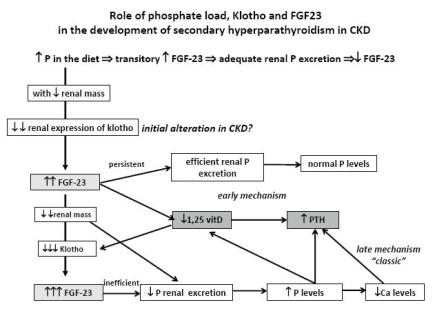
<p>&nbsp;</p>        <p>These mice do not develop vascular calcifications and show an increase in life span. All these interventions have in common the reduction of phosphate levels, with opposite effects on Ca and vitamin D levels, suggesting that phosphate is primarily responsible for these aging-like phenotypes<sup>54</sup>. Klotho deficiency may be the initial alteration for the development of phosphate retention and secondary hyperparathyroidism in CKD patients<sup>54</sup>.</p>        <p><b>PROPOSED ROLE OF KLOTHO AND FGF23 IN THE DEVELOPMENT OF SECONDARY HYPERPARATHYROIDISM IN CKD (Fig. 2)</b></p>      <p>Phosphate load in the diet transitorily stimulates FGF<sub>23</sub><sup>23,25 </sup>with a consequent and adequate phosphaturic action<sup>25,26</sup>, contributing to the maintenance of normal phosphate blood levels. In CKD patients, with reduction of renal mass, there is a decrease in the renal expression of klotho<sup>53</sup>, contributing to the increased levels of FGF<sub>23</sub><sup>52</sup>. In initial CKD stages, this increase of FGF<sub>23</sub> levels maintains an efficient phosphate excretion and is associated with an increase of fractional excretion of phosphate and with normal phosphate levels. At the same time FGF<sub>23</sub> decreases 1,25(OH)<sub>2</sub>D<sub>3</sub><sup>25,26 </sup>by decreasing its synthesis and increasing its catabolism. The decrease of 1,25(OH)<sub>2</sub>D<sub>3</sub> is a stimulus for the increase in the synthesis of PTH<sup>7</sup>.</p>      <p>&nbsp;</p>     <p><a name="f2"></a></p>     <p><img src="/img/revistas/nep/v26n2/26n2a03f2.jpg"></p>     
]]></body>
<body><![CDATA[<p><b><a href="#topf2">Figure 2</a></b></p>     <p>Role of phosphate load, klotho and FGF<sub>23</sub> in the development of secondary hyperparathyroidism in CKD.</p>       <p>&nbsp;</p>      <p>As the kidney insufficiency progresses there is a greater decrease of renal klotho expression to which 1,25(OH)<sub>2</sub>D<sub>3</sub> also deficiency contributes. This decrease in klotho expression contributes to a further increase in FGF<sub>23</sub> levels. At this stage, with important reduction of renal mass, FGF<sub>23</sub> increase is no longer efficient, and reduced phosphaturia is responsible for the appearance of hyperphosphataemia.<b></b></p>        <p>In this proposed pathway for the development of secondary hyperparathyroidism two main mechanisms are recognised: an early mechanism resulting from the increase of FGF<sub>23</sub>, associated with low 1,25(OH)<sub>2</sub>D<sub>3</sub> levels<sup>32</sup> and a late mechanism, corresponding to the classic trade-off hypothesis derived from hyperphosphataemia. The decrease in the renal expression of klotho precedes the increase of FGF<sub>23</sub> levels<sup>54</sup> and may be the initial alteration in CKD patients responsible for the development of secondary hyperparathyroidism<sup>54</sup>.</p>        <p><b>CONCLUSIONS</b></p>      <p>FGF<sub>23</sub> is a regulator of phosphate and vitamin D metabolism. FGF<sub>23</sub> levels are increased in early CKD stages. Increase of FGF<sub>23</sub> seems to be a novel mechanism for the early decline of 1,25(OH)<sub>2</sub>D<sub>3</sub> levels observed in CKD patients. Phosphate is one of the recogniaed stimuli for FGF<sub>23</sub> secretion. In this new updated model for secondary hyperparathyroidism, FGF<sub>23</sub> may act as a link between phosphate load and low vitamin D levels [Figs <a href="#f1">1</a><a name="topf1"></a> and <a href="#f2">2</a><a name="topf2"></a>]. The discovery of klotho and FGF<sub>23</sub> actions has given back to phosphate a primordial role in the development of secondary hyperparathyroidism.</p>      <p>It is possible that in CKD stages<sub>3</sub> and <sub>4</sub> an early therapeutic intervention on phosphate with a low phosphate diet and/or phosphate binders, even in the presence of normophosphataemia<sup>36</sup>, might retard the development of secondary hyperparathyroidism.</p>       <p>&nbsp;</p>      <p><b>References</b></p>      ]]></body>
<body><![CDATA[<!-- ref --><p><b><sup>1.</sup></b> Silver J, Moallem E, Killav R, <i>et al</i>. New insights into the regulation of parathyroid hormone synthesis and secretion in chronic renal failure. Nephrol Dial Transplant 1996;11 (Suppl 3):2-5&nbsp;&nbsp;&nbsp;&nbsp;&nbsp;&nbsp;&nbsp;&nbsp;[&#160;<a href="javascript:void(0);" onclick="javascript: window.open('/scielo.php?script=sci_nlinks&ref=000083&pid=S0872-0169201200020000300001&lng=','','width=640,height=500,resizable=yes,scrollbars=1,menubar=yes,');">Links</a>&#160;]<!-- end-ref --><!-- ref --><p><b><sup>2.</sup></b> Haussler MR, Norman AW. Chromosomal receptor for a vitamin D metabolite. Proc Natl Acad Sci USA 1969;62:155-62&nbsp;&nbsp;&nbsp;&nbsp;&nbsp;&nbsp;&nbsp;&nbsp;[&#160;<a href="javascript:void(0);" onclick="javascript: window.open('/scielo.php?script=sci_nlinks&ref=000084&pid=S0872-0169201200020000300002&lng=','','width=640,height=500,resizable=yes,scrollbars=1,menubar=yes,');">Links</a>&#160;]<!-- end-ref --><!-- ref --><p><b><sup>3.</sup></b> Brown E, Gambia G, Riccardi D, <i>et al</i>. Cloning and characterization of an extracellular calcium sensing receptor from bovine parasthyroid. Nature 1993;366:575-580&nbsp;&nbsp;&nbsp;&nbsp;&nbsp;&nbsp;&nbsp;&nbsp;[&#160;<a href="javascript:void(0);" onclick="javascript: window.open('/scielo.php?script=sci_nlinks&ref=000085&pid=S0872-0169201200020000300003&lng=','','width=640,height=500,resizable=yes,scrollbars=1,menubar=yes,');">Links</a>&#160;]<!-- end-ref --><!-- ref --><p><b><sup>4.</sup></b> Kilav R, Silver J, Naveh-Many T. Parathyroid hormone gene expression in hypophosphatemic rats. J Clin Invest 1995;96:327-33&nbsp;&nbsp;&nbsp;&nbsp;&nbsp;&nbsp;&nbsp;&nbsp;[&#160;<a href="javascript:void(0);" onclick="javascript: window.open('/scielo.php?script=sci_nlinks&ref=000086&pid=S0872-0169201200020000300004&lng=','','width=640,height=500,resizable=yes,scrollbars=1,menubar=yes,');">Links</a>&#160;]<!-- end-ref --><!-- ref --><p><b><sup>5.</sup></b> Hernandez A, Concepcion MT, Rodriguez M, Salido E, Torres A. High phosphorus diet increases prepro PTHm RNA independent of calcium and calcitriol in normal rats. Kidney Int 1996;50:1872-8&nbsp;&nbsp;&nbsp;&nbsp;&nbsp;&nbsp;&nbsp;&nbsp;[&#160;<a href="javascript:void(0);" onclick="javascript: window.open('/scielo.php?script=sci_nlinks&ref=000087&pid=S0872-0169201200020000300005&lng=','','width=640,height=500,resizable=yes,scrollbars=1,menubar=yes,');">Links</a>&#160;]<!-- end-ref --><!-- ref --><p><b><sup>6.</sup></b> Kates DM, Sherrard DJ, Andress DL. Evidence that serum phosphate is independently associated with serum PTH in patients with chronic renal failure. Am J Kidney Dis 1997;30:809-13&nbsp;&nbsp;&nbsp;&nbsp;&nbsp;&nbsp;&nbsp;&nbsp;[&#160;<a href="javascript:void(0);" onclick="javascript: window.open('/scielo.php?script=sci_nlinks&ref=000088&pid=S0872-0169201200020000300006&lng=','','width=640,height=500,resizable=yes,scrollbars=1,menubar=yes,');">Links</a>&#160;]<!-- end-ref --><!-- ref --><p><b><sup>7.</sup></b> Silver J, Naveh-Many T, Mayer H, <i>et al</i>. Regulation by vitamin D metabolites of parathyroid hormone gene transcription <i>in vivo </i>in the rat. J Clin Invest 1986;78:1296-301&nbsp;&nbsp;&nbsp;&nbsp;&nbsp;&nbsp;&nbsp;&nbsp;[&#160;<a href="javascript:void(0);" onclick="javascript: window.open('/scielo.php?script=sci_nlinks&ref=000089&pid=S0872-0169201200020000300007&lng=','','width=640,height=500,resizable=yes,scrollbars=1,menubar=yes,');">Links</a>&#160;]<!-- end-ref --><!-- ref --><p><b><sup>8.</sup></b> Moallem E, Silver J, Kilav R, <i>et al</i>. RNA protein binding and post-transcriptional regulation of PTH gene expression by calcium and phosphate. J Biol Chem 1998; 273:5253-9&nbsp;&nbsp;&nbsp;&nbsp;&nbsp;&nbsp;&nbsp;&nbsp;[&#160;<a href="javascript:void(0);" onclick="javascript: window.open('/scielo.php?script=sci_nlinks&ref=000090&pid=S0872-0169201200020000300008&lng=','','width=640,height=500,resizable=yes,scrollbars=1,menubar=yes,');">Links</a>&#160;]<!-- end-ref --><!-- ref --><p><b><sup>9.</sup></b> Navey-Many T, Rahamimov R, Livni N, <i>et al</i>. Parathyroid cell proliferation in normal and chronic renal failure rats. The effects of calcium, phosphate and vitamin D. J Clin Invest 1995;96:1786-93 &nbsp;&nbsp;&nbsp;&nbsp;&nbsp;&nbsp;&nbsp;&nbsp;[&#160;<a href="javascript:void(0);" onclick="javascript: window.open('/scielo.php?script=sci_nlinks&ref=000091&pid=S0872-0169201200020000300009&lng=','','width=640,height=500,resizable=yes,scrollbars=1,menubar=yes,');">Links</a>&#160;]<!-- end-ref --><!-- ref --><p><b><sup>10.</sup></b> Bricker NS: On the pathogenesis of the uremic state. An exposition of the “trade-off hypothesis”. N Engl J Med 1972;286:1093-9&nbsp;&nbsp;&nbsp;&nbsp;&nbsp;&nbsp;&nbsp;&nbsp;[&#160;<a href="javascript:void(0);" onclick="javascript: window.open('/scielo.php?script=sci_nlinks&ref=000092&pid=S0872-0169201200020000300010&lng=','','width=640,height=500,resizable=yes,scrollbars=1,menubar=yes,');">Links</a>&#160;]<!-- end-ref --><!-- ref --><p><b><sup>11.</sup></b> Slatopolsky E, Delmez JA: Pathogenesis of secondary hyperparathyroidism. Nephrol Dial Transplant 1996;11 (Suppl 3):130-5&nbsp;&nbsp;&nbsp;&nbsp;&nbsp;&nbsp;&nbsp;&nbsp;[&#160;<a href="javascript:void(0);" onclick="javascript: window.open('/scielo.php?script=sci_nlinks&ref=000093&pid=S0872-0169201200020000300011&lng=','','width=640,height=500,resizable=yes,scrollbars=1,menubar=yes,');">Links</a>&#160;]<!-- end-ref --><!-- ref --><p><b><sup>12.</sup></b> Levin A, Bakris GL, Molitch M. <i>et al</i>. Prevalence of abnormal serum vitamin D, PTH, calcium, and phosphorus in patients with chronic kidney disease: Results of the study to evaluate early kidney disease. Kidney Int 2007;71:31-8&nbsp;&nbsp;&nbsp;&nbsp;&nbsp;&nbsp;&nbsp;&nbsp;[&#160;<a href="javascript:void(0);" onclick="javascript: window.open('/scielo.php?script=sci_nlinks&ref=000094&pid=S0872-0169201200020000300012&lng=','','width=640,height=500,resizable=yes,scrollbars=1,menubar=yes,');">Links</a>&#160;]<!-- end-ref --><!-- ref --><p><b><sup>13.</sup></b> Kestenbaum B, Sampson JN, Rudser KD, <i>et al</i>. Serum phosphate levels and mortality risk among people with chronic kidney disease. J Am Soc Nephrol 2005;16520-8&nbsp;&nbsp;&nbsp;&nbsp;&nbsp;&nbsp;&nbsp;&nbsp;[&#160;<a href="javascript:void(0);" onclick="javascript: window.open('/scielo.php?script=sci_nlinks&ref=000095&pid=S0872-0169201200020000300013&lng=','','width=640,height=500,resizable=yes,scrollbars=1,menubar=yes,');">Links</a>&#160;]<!-- end-ref --><!-- ref --><p><b><sup>14.</sup></b> Llach F, Yudd M. Pathogenic, clinical, and therapeutic aspects of secondary hyperparathyroidism in chronic renal failure. Am J Kidney Dis 1998;32 2 Suppl 2):S3-S12&nbsp;&nbsp;&nbsp;&nbsp;&nbsp;&nbsp;&nbsp;&nbsp;[&#160;<a href="javascript:void(0);" onclick="javascript: window.open('/scielo.php?script=sci_nlinks&ref=000096&pid=S0872-0169201200020000300014&lng=','','width=640,height=500,resizable=yes,scrollbars=1,menubar=yes,');">Links</a>&#160;]<!-- end-ref --><!-- ref --><p><b><sup>15.</sup></b> Llach F. Secondary hyperparathyroidism in renal failure: the trade-off hypothesis revisited. Am J Kidney Dis 1995;25:663-79&nbsp;&nbsp;&nbsp;&nbsp;&nbsp;&nbsp;&nbsp;&nbsp;[&#160;<a href="javascript:void(0);" onclick="javascript: window.open('/scielo.php?script=sci_nlinks&ref=000097&pid=S0872-0169201200020000300015&lng=','','width=640,height=500,resizable=yes,scrollbars=1,menubar=yes,');">Links</a>&#160;]<!-- end-ref --><!-- ref --><p><b><sup>16.</sup></b> Llach F, Yudd M. Pathogenic, clinical, and therapeutic aspects of secondary hyperparathyroidism in chronic renal failure. Am J Kidney Dis 1998;32 (2 Suppl 2):S3-S12&nbsp;&nbsp;&nbsp;&nbsp;&nbsp;&nbsp;&nbsp;&nbsp;[&#160;<a href="javascript:void(0);" onclick="javascript: window.open('/scielo.php?script=sci_nlinks&ref=000098&pid=S0872-0169201200020000300016&lng=','','width=640,height=500,resizable=yes,scrollbars=1,menubar=yes,');">Links</a>&#160;]<!-- end-ref --><!-- ref --><p><b><sup>17.</sup></b> Kaye M. Hypocalcemia after an acute phosphate load is secondary to reduced calcium efflux from bone: studies in patients with minimal renal function and varying parathyroid activity. J Am Soc Nephrol 1995;6:273-80&nbsp;&nbsp;&nbsp;&nbsp;&nbsp;&nbsp;&nbsp;&nbsp;[&#160;<a href="javascript:void(0);" onclick="javascript: window.open('/scielo.php?script=sci_nlinks&ref=000099&pid=S0872-0169201200020000300017&lng=','','width=640,height=500,resizable=yes,scrollbars=1,menubar=yes,');">Links</a>&#160;]<!-- end-ref --><!-- ref --><p><b><sup>18.</sup></b> Isakova T, Gutierrez O, Shah A, <i>et al</i>. Postprandial mineral metabolism and secondary hyperparathyroidism in early CKD. J Am Soc Nephrol 2008;19:615-23&nbsp;&nbsp;&nbsp;&nbsp;&nbsp;&nbsp;&nbsp;&nbsp;[&#160;<a href="javascript:void(0);" onclick="javascript: window.open('/scielo.php?script=sci_nlinks&ref=000100&pid=S0872-0169201200020000300018&lng=','','width=640,height=500,resizable=yes,scrollbars=1,menubar=yes,');">Links</a>&#160;]<!-- end-ref --><!-- ref --><p><b><sup>19.</sup></b> Mohammadi M, Olsen S.K, Ibrahimi O.A. Structural basis for fibroblast growth factor receptor activation. Cytokine Growth Factor Ver 2005;16:107-37&nbsp;&nbsp;&nbsp;&nbsp;&nbsp;&nbsp;&nbsp;&nbsp;[&#160;<a href="javascript:void(0);" onclick="javascript: window.open('/scielo.php?script=sci_nlinks&ref=000101&pid=S0872-0169201200020000300019&lng=','','width=640,height=500,resizable=yes,scrollbars=1,menubar=yes,');">Links</a>&#160;]<!-- end-ref --><!-- ref --><p><b><sup>20.</sup></b> Ornitz DM, Itoh N. Fibroblast growth factors. Genome Biol 2001;2(3):reviews 3005&nbsp;&nbsp;&nbsp;&nbsp;&nbsp;&nbsp;&nbsp;&nbsp;[&#160;<a href="javascript:void(0);" onclick="javascript: window.open('/scielo.php?script=sci_nlinks&ref=000102&pid=S0872-0169201200020000300020&lng=','','width=640,height=500,resizable=yes,scrollbars=1,menubar=yes,');">Links</a>&#160;]<!-- end-ref --><!-- ref --><p><b><sup>21.</sup></b> Kurosu H, Ogawa Y, Miyoshi M, <i>et al</i>. Regulation of fibroblast growth factor-23 signaling by klotho. J Biol Chem 2006;281:6120-3&nbsp;&nbsp;&nbsp;&nbsp;&nbsp;&nbsp;&nbsp;&nbsp;[&#160;<a href="javascript:void(0);" onclick="javascript: window.open('/scielo.php?script=sci_nlinks&ref=000103&pid=S0872-0169201200020000300021&lng=','','width=640,height=500,resizable=yes,scrollbars=1,menubar=yes,');">Links</a>&#160;]<!-- end-ref --><!-- ref --><p><b><sup>22.</sup></b> Liu S, Zhou J, Tang W <i> et al. </i>Pathogenic role of FGF 23 in Hyp mice. Am J Physiol Endocrinol Metab 2006;291:E38-49&nbsp;&nbsp;&nbsp;&nbsp;&nbsp;&nbsp;&nbsp;&nbsp;[&#160;<a href="javascript:void(0);" onclick="javascript: window.open('/scielo.php?script=sci_nlinks&ref=000104&pid=S0872-0169201200020000300022&lng=','','width=640,height=500,resizable=yes,scrollbars=1,menubar=yes,');">Links</a>&#160;]<!-- end-ref --><!-- ref --><p><b><sup>23.</sup></b> Saito H, Maeda A, Ohtomo S, <i>et al</i>. Circulating FGF-23 is regulated by 1alpha,25-dihydroxyvitamin D3and phosphorus in vivo. J Biol Chem 2005;280:2543-9&nbsp;&nbsp;&nbsp;&nbsp;&nbsp;&nbsp;&nbsp;&nbsp;[&#160;<a href="javascript:void(0);" onclick="javascript: window.open('/scielo.php?script=sci_nlinks&ref=000105&pid=S0872-0169201200020000300023&lng=','','width=640,height=500,resizable=yes,scrollbars=1,menubar=yes,');">Links</a>&#160;]<!-- end-ref --><!-- ref --><p><b><sup>24.</sup></b> Liu S, Tang W, Zhou J, <i>et al</i>. Fibroblast growth factor 23 is a counter-regulatory phosphaturic hormone for vitamin D. J Am Soc Nephrol 2006;17:1305-15&nbsp;&nbsp;&nbsp;&nbsp;&nbsp;&nbsp;&nbsp;&nbsp;[&#160;<a href="javascript:void(0);" onclick="javascript: window.open('/scielo.php?script=sci_nlinks&ref=000106&pid=S0872-0169201200020000300024&lng=','','width=640,height=500,resizable=yes,scrollbars=1,menubar=yes,');">Links</a>&#160;]<!-- end-ref --><!-- ref --><p><b><sup>25.</sup></b> Saito H, Kusano K, Kinosaki M, <i>et al</i>. Human fibroblast growth factor-23 mutants suppress Na-dependent phosphate co-transport activity and 1alpha,25- dihydroxyvitamin D3 production. J Biol Chem 2003;278:2206-11&nbsp;&nbsp;&nbsp;&nbsp;&nbsp;&nbsp;&nbsp;&nbsp;[&#160;<a href="javascript:void(0);" onclick="javascript: window.open('/scielo.php?script=sci_nlinks&ref=000107&pid=S0872-0169201200020000300025&lng=','','width=640,height=500,resizable=yes,scrollbars=1,menubar=yes,');">Links</a>&#160;]<!-- end-ref --><!-- ref --><p><b><sup>26.</sup></b> Shimada T, Hasegawa H, Yamazaki Y, <i>et al</i>. FGF-23 is a potent regulator of vitamin D metabolism and phosphate homeostasis. J Bone Miner Res 2004; 19:429-35&nbsp;&nbsp;&nbsp;&nbsp;&nbsp;&nbsp;&nbsp;&nbsp;[&#160;<a href="javascript:void(0);" onclick="javascript: window.open('/scielo.php?script=sci_nlinks&ref=000108&pid=S0872-0169201200020000300026&lng=','','width=640,height=500,resizable=yes,scrollbars=1,menubar=yes,');">Links</a>&#160;]<!-- end-ref --><!-- ref --><p><b><sup>27.</sup></b> Kuro-o M. Klotho in chronic kidney disease – What’s new? Nephrol Dial Transplant 2009;24:1705-8&nbsp;&nbsp;&nbsp;&nbsp;&nbsp;&nbsp;&nbsp;&nbsp;[&#160;<a href="javascript:void(0);" onclick="javascript: window.open('/scielo.php?script=sci_nlinks&ref=000109&pid=S0872-0169201200020000300027&lng=','','width=640,height=500,resizable=yes,scrollbars=1,menubar=yes,');">Links</a>&#160;]<!-- end-ref --><!-- ref --><p><b><sup>28.</sup></b> Larsson T, Nisbeth U, Ljunggren O, <i>et al</i>. Circulating concentration of FGF-23 increases as renal function declines in patients with chronic kidney disease, but does not change in response to variation in phosphate intake in healthy volunteers. Kidney Int 2003;64:2272-9&nbsp;&nbsp;&nbsp;&nbsp;&nbsp;&nbsp;&nbsp;&nbsp;[&#160;<a href="javascript:void(0);" onclick="javascript: window.open('/scielo.php?script=sci_nlinks&ref=000110&pid=S0872-0169201200020000300028&lng=','','width=640,height=500,resizable=yes,scrollbars=1,menubar=yes,');">Links</a>&#160;]<!-- end-ref --><!-- ref --><p><b><sup>29.</sup></b> Gutierrez O, Isakova T, Rhee E, <i>et al</i>. Fibroblast growth factor-23 mitigates hyperphosphatemia but accentuates calcitriol deficiency in chronic kidney disease. J Am Soc Nephrol 2005;16:2205-15&nbsp;&nbsp;&nbsp;&nbsp;&nbsp;&nbsp;&nbsp;&nbsp;[&#160;<a href="javascript:void(0);" onclick="javascript: window.open('/scielo.php?script=sci_nlinks&ref=000111&pid=S0872-0169201200020000300029&lng=','','width=640,height=500,resizable=yes,scrollbars=1,menubar=yes,');">Links</a>&#160;]<!-- end-ref --><!-- ref --><p><b><sup>30.</sup></b> Evenepoel P, Meijers B, Viaene L, <i>et al</i>. Fibroblast growth factor-23 in early chronic kidney disease: additional supporting favor of a phosphate-centric paradigm for the pathogenesis of secondary hyperparathyroidism. Clin J Am Soc Nephrol 2010;5:1268-76&nbsp;&nbsp;&nbsp;&nbsp;&nbsp;&nbsp;&nbsp;&nbsp;[&#160;<a href="javascript:void(0);" onclick="javascript: window.open('/scielo.php?script=sci_nlinks&ref=000112&pid=S0872-0169201200020000300030&lng=','','width=640,height=500,resizable=yes,scrollbars=1,menubar=yes,');">Links</a>&#160;]<!-- end-ref --><!-- ref --><p><b><sup>31.</sup></b> Wolf M. Forging forward with 10 burning questions on FGF23 in kidney disease. J Am Soc Nephrol 2010;21:1427-35&nbsp;&nbsp;&nbsp;&nbsp;&nbsp;&nbsp;&nbsp;&nbsp;[&#160;<a href="javascript:void(0);" onclick="javascript: window.open('/scielo.php?script=sci_nlinks&ref=000113&pid=S0872-0169201200020000300031&lng=','','width=640,height=500,resizable=yes,scrollbars=1,menubar=yes,');">Links</a>&#160;]<!-- end-ref --><!-- ref --><p><b><sup>32.</sup></b> Gutiérrez OM. Fibroblast growth factor 23 and disordered vitamin D metabolism in chronic kidney disease: updating the “trade-off” hypothesis. Clin J Am Soc Nephrol 2010:5:1710-6&nbsp;&nbsp;&nbsp;&nbsp;&nbsp;&nbsp;&nbsp;&nbsp;[&#160;<a href="javascript:void(0);" onclick="javascript: window.open('/scielo.php?script=sci_nlinks&ref=000114&pid=S0872-0169201200020000300032&lng=','','width=640,height=500,resizable=yes,scrollbars=1,menubar=yes,');">Links</a>&#160;]<!-- end-ref --><!-- ref --><p><b><sup>33.</sup></b> Ito N, Fukumoto S, Takeuchi Y, <i>et al</i>. Effect of acute changes of serum phosphate on fibroblast growth factor (FGF)23 levels in humans. J Bone Miner Metab 2007; 25:419-22&nbsp;&nbsp;&nbsp;&nbsp;&nbsp;&nbsp;&nbsp;&nbsp;[&#160;<a href="javascript:void(0);" onclick="javascript: window.open('/scielo.php?script=sci_nlinks&ref=000115&pid=S0872-0169201200020000300033&lng=','','width=640,height=500,resizable=yes,scrollbars=1,menubar=yes,');">Links</a>&#160;]<!-- end-ref --><!-- ref --><p><b><sup>34</sup></b> Nishida Y, Taketani Y, Yamanaka-Okumura H, <i>et al</i>. Acute effect of oral phosphate loading on serum fibroblast growth factor 23 levels in healthy men. Kidney Int 2006;70:2141-7&nbsp;&nbsp;&nbsp;&nbsp;&nbsp;&nbsp;&nbsp;&nbsp;[&#160;<a href="javascript:void(0);" onclick="javascript: window.open('/scielo.php?script=sci_nlinks&ref=000116&pid=S0872-0169201200020000300034&lng=','','width=640,height=500,resizable=yes,scrollbars=1,menubar=yes,');">Links</a>&#160;]<!-- end-ref --><!-- ref --><p><b><sup>35.</sup></b> Liu S, Quarles LD. How fibroblast growth factor 23 works. J Am Soc Nephrol 2007;18:1637-47&nbsp;&nbsp;&nbsp;&nbsp;&nbsp;&nbsp;&nbsp;&nbsp;[&#160;<a href="javascript:void(0);" onclick="javascript: window.open('/scielo.php?script=sci_nlinks&ref=000117&pid=S0872-0169201200020000300035&lng=','','width=640,height=500,resizable=yes,scrollbars=1,menubar=yes,');">Links</a>&#160;]<!-- end-ref --><!-- ref --><p><b><sup>36.</sup></b> Moe SM, Zidehsarai MP, Chambers MA, <i>et al</i>.Vegetarian compared with meat dietary protein source and phosphorus homeostasis in chronic kidney disease. Clin J Am Soc Nephrol 2011;6:257-64&nbsp;&nbsp;&nbsp;&nbsp;&nbsp;&nbsp;&nbsp;&nbsp;[&#160;<a href="javascript:void(0);" onclick="javascript: window.open('/scielo.php?script=sci_nlinks&ref=000118&pid=S0872-0169201200020000300036&lng=','','width=640,height=500,resizable=yes,scrollbars=1,menubar=yes,');">Links</a>&#160;]<!-- end-ref --><!-- ref --><p><b><sup>37.</sup></b>Portale AA, Booth BE, Halloran BP, <i>et al</i>. Effect of dietary phosphorus on circulating concentrations of 1,25-dihydroxyvitamin D and immunoreactive parathyroid hormone in children with moderate renal insufficiency. J Clin Invest 1984; 73:1580-9&nbsp;&nbsp;&nbsp;&nbsp;&nbsp;&nbsp;&nbsp;&nbsp;[&#160;<a href="javascript:void(0);" onclick="javascript: window.open('/scielo.php?script=sci_nlinks&ref=000119&pid=S0872-0169201200020000300037&lng=','','width=640,height=500,resizable=yes,scrollbars=1,menubar=yes,');">Links</a>&#160;]<!-- end-ref --><!-- ref --><p><b><sup>38.</sup></b> Llach F, Massry SG. On the mechanism of secondary hyperparathyroidism in moderate renal insufficiency. J Clin Endocrinol Metab 1985;61:601-6&nbsp;&nbsp;&nbsp;&nbsp;&nbsp;&nbsp;&nbsp;&nbsp;[&#160;<a href="javascript:void(0);" onclick="javascript: window.open('/scielo.php?script=sci_nlinks&ref=000120&pid=S0872-0169201200020000300038&lng=','','width=640,height=500,resizable=yes,scrollbars=1,menubar=yes,');">Links</a>&#160;]<!-- end-ref --><!-- ref --><p><b><sup>39.</sup></b> Oliveira RB, Cancela AL, Graciolli FG, <i>et al</i>. Early control of PTH and FGF23 in normophosphatemic CKD patients: a new target in CKD-MBD therapy? Clin J Am Soc Nephrol 2010;5:286-91&nbsp;&nbsp;&nbsp;&nbsp;&nbsp;&nbsp;&nbsp;&nbsp;[&#160;<a href="javascript:void(0);" onclick="javascript: window.open('/scielo.php?script=sci_nlinks&ref=000121&pid=S0872-0169201200020000300039&lng=','','width=640,height=500,resizable=yes,scrollbars=1,menubar=yes,');">Links</a>&#160;]<!-- end-ref --><!-- ref --><p><b><sup>40.</sup></b> Isakova T, Gutiérrez OM, Smith K, <i>et al</i>. Pilot study of dietary phosphorus restriction and phosphorus binders to target fibroblast growth factor 23 in patients with chronic kidney disease. Nephrol Dial Transplant 2011;26:584-91&nbsp;&nbsp;&nbsp;&nbsp;&nbsp;&nbsp;&nbsp;&nbsp;[&#160;<a href="javascript:void(0);" onclick="javascript: window.open('/scielo.php?script=sci_nlinks&ref=000122&pid=S0872-0169201200020000300040&lng=','','width=640,height=500,resizable=yes,scrollbars=1,menubar=yes,');">Links</a>&#160;]<!-- end-ref --><!-- ref --><p><b><sup>41.</sup></b> Gutierrez OM, Mannstadt M, Isakova T, <i>et al</i>. Fibroblast growth factor 23 and mortality among patients undergoing hemodialysis. N Engl J Med 2008;359:584-92&nbsp;&nbsp;&nbsp;&nbsp;&nbsp;&nbsp;&nbsp;&nbsp;[&#160;<a href="javascript:void(0);" onclick="javascript: window.open('/scielo.php?script=sci_nlinks&ref=000123&pid=S0872-0169201200020000300041&lng=','','width=640,height=500,resizable=yes,scrollbars=1,menubar=yes,');">Links</a>&#160;]<!-- end-ref --><!-- ref --><p><b><sup>42.</sup></b> Jean G, Terrat JC, Vanel T<i>, et al</i>. High levels of serum fibroblast growth factor (FGF)-23 are associated with increased mortality in long hemodialysis patients. Nephrol Dial Transplant 2009;24:2792-6&nbsp;&nbsp;&nbsp;&nbsp;&nbsp;&nbsp;&nbsp;&nbsp;[&#160;<a href="javascript:void(0);" onclick="javascript: window.open('/scielo.php?script=sci_nlinks&ref=000124&pid=S0872-0169201200020000300042&lng=','','width=640,height=500,resizable=yes,scrollbars=1,menubar=yes,');">Links</a>&#160;]<!-- end-ref --><!-- ref --><p><b><sup>43.</sup></b> Parker BD, Schurgers LJ, Brandenburg VM, <i>et al</i>. The associations of fibroblast growth factor 23 and uncarboxylated matrix Gla protein with mortality in coronary artery disease: the Heart and Soul Study. Ann Intern Med 2010;18;152:640-8&nbsp;&nbsp;&nbsp;&nbsp;&nbsp;&nbsp;&nbsp;&nbsp;[&#160;<a href="javascript:void(0);" onclick="javascript: window.open('/scielo.php?script=sci_nlinks&ref=000125&pid=S0872-0169201200020000300043&lng=','','width=640,height=500,resizable=yes,scrollbars=1,menubar=yes,');">Links</a>&#160;]<!-- end-ref --><!-- ref --><p><b><sup>44.</sup></b>Seiler S, Reichart B, Roth D, <i>et al</i>. FGF-23 and future cardiovascular events in patients with chronic kidney disease before initiation of dialysis treatment. Nephrol Dial Transplant 2010 25:3983-9&nbsp;&nbsp;&nbsp;&nbsp;&nbsp;&nbsp;&nbsp;&nbsp;[&#160;<a href="javascript:void(0);" onclick="javascript: window.open('/scielo.php?script=sci_nlinks&ref=000126&pid=S0872-0169201200020000300044&lng=','','width=640,height=500,resizable=yes,scrollbars=1,menubar=yes,');">Links</a>&#160;]<!-- end-ref --><!-- ref --><p><b><sup>45.</sup></b>Gutierrez OM, Januzzi JL, Isakova T, <i>et al</i>. Fibroblast growth factor 23 and left ventricular hypertrophy in chronic kidney disease. Circulation 2009;119:2545-52&nbsp;&nbsp;&nbsp;&nbsp;&nbsp;&nbsp;&nbsp;&nbsp;[&#160;<a href="javascript:void(0);" onclick="javascript: window.open('/scielo.php?script=sci_nlinks&ref=000127&pid=S0872-0169201200020000300045&lng=','','width=640,height=500,resizable=yes,scrollbars=1,menubar=yes,');">Links</a>&#160;]<!-- end-ref --><!-- ref --><p><b><sup>46.</sup></b> Jean G, Bresson E, Terrat JC, <i>et al</i>. Peripheral vascular calcification in long-hemodialysis patients: associated factors and survival consequences. Nephrol Dial Transplant 2009;24:948-55&nbsp;&nbsp;&nbsp;&nbsp;&nbsp;&nbsp;&nbsp;&nbsp;[&#160;<a href="javascript:void(0);" onclick="javascript: window.open('/scielo.php?script=sci_nlinks&ref=000128&pid=S0872-0169201200020000300046&lng=','','width=640,height=500,resizable=yes,scrollbars=1,menubar=yes,');">Links</a>&#160;]<!-- end-ref --><!-- ref --><p><b><sup>47.</sup></b> Fliser D, Kollerits B, Neyer U, <i>et al</i>. Fibroblast growth factor 23 (FGF23) predicts progression of chronic kidney disease: The Mild to Moderate Kidney Disease (MMKD) Study. J Am Soc Nephrol 2007;18:2600-8&nbsp;&nbsp;&nbsp;&nbsp;&nbsp;&nbsp;&nbsp;&nbsp;[&#160;<a href="javascript:void(0);" onclick="javascript: window.open('/scielo.php?script=sci_nlinks&ref=000129&pid=S0872-0169201200020000300047&lng=','','width=640,height=500,resizable=yes,scrollbars=1,menubar=yes,');">Links</a>&#160;]<!-- end-ref --><!-- ref --><p><b><sup>48.</sup></b> Hu MC, Shi M, Zhang J, <i>et al</i>. Klotho deficiency causes vascular calcification in chronic kidney disease. J Am Soc Nephrol 2011:22:124-36&nbsp;&nbsp;&nbsp;&nbsp;&nbsp;&nbsp;&nbsp;&nbsp;[&#160;<a href="javascript:void(0);" onclick="javascript: window.open('/scielo.php?script=sci_nlinks&ref=000130&pid=S0872-0169201200020000300048&lng=','','width=640,height=500,resizable=yes,scrollbars=1,menubar=yes,');">Links</a>&#160;]<!-- end-ref --><!-- ref --><p><b><sup>49.</sup></b> Faul C,AmaralAP,Oskouei B, <i>et al</i>. FGF23 induces left ventricular hypertrophy. J Clin Invest 2011;121:4393-408&nbsp;&nbsp;&nbsp;&nbsp;&nbsp;&nbsp;&nbsp;&nbsp;[&#160;<a href="javascript:void(0);" onclick="javascript: window.open('/scielo.php?script=sci_nlinks&ref=000131&pid=S0872-0169201200020000300049&lng=','','width=640,height=500,resizable=yes,scrollbars=1,menubar=yes,');">Links</a>&#160;]<!-- end-ref --><!-- ref --><p><b><sup>50.</sup></b> Kuro-o M, Matsumura Y, Aizawa H, <i> et al</i>. Mutation of the mouse klotho gene leads to a syndrome resembling ageing. Nature 1997;390:45-51&nbsp;&nbsp;&nbsp;&nbsp;&nbsp;&nbsp;&nbsp;&nbsp;[&#160;<a href="javascript:void(0);" onclick="javascript: window.open('/scielo.php?script=sci_nlinks&ref=000132&pid=S0872-0169201200020000300050&lng=','','width=640,height=500,resizable=yes,scrollbars=1,menubar=yes,');">Links</a>&#160;]<!-- end-ref --><!-- ref --><p><b><sup>51.</sup></b> Shimada T, KakitaniM, Yamazaki Y, <i> et al</i> . Targeted ablation of FGF23 demonstrates as essential physiological role of FGF23 in phosphate and vitamin D metabolism. J ClinInvest 2004;113:561-8&nbsp;&nbsp;&nbsp;&nbsp;&nbsp;&nbsp;&nbsp;&nbsp;[&#160;<a href="javascript:void(0);" onclick="javascript: window.open('/scielo.php?script=sci_nlinks&ref=000133&pid=S0872-0169201200020000300051&lng=','','width=640,height=500,resizable=yes,scrollbars=1,menubar=yes,');">Links</a>&#160;]<!-- end-ref --><!-- ref --><p><b><sup>52.</sup></b>Urakawa I Yamazaki Y, Shimada T, <i> et al</i>. Klothoconverts canonical FGF receptor into a specific receptor for FGF23. Nature 2006;444:770-4&nbsp;&nbsp;&nbsp;&nbsp;&nbsp;&nbsp;&nbsp;&nbsp;[&#160;<a href="javascript:void(0);" onclick="javascript: window.open('/scielo.php?script=sci_nlinks&ref=000134&pid=S0872-0169201200020000300052&lng=','','width=640,height=500,resizable=yes,scrollbars=1,menubar=yes,');">Links</a>&#160;]<!-- end-ref --><!-- ref --><p><b><sup>53.</sup></b> Koh N, Fujimori T, Nishiguchi S <i>et al</i>. Severely reduced production of klothoin human chronic renal failure kidney. BiochemBiophys Res Commun2001;280:1015-20&nbsp;&nbsp;&nbsp;&nbsp;&nbsp;&nbsp;&nbsp;&nbsp;[&#160;<a href="javascript:void(0);" onclick="javascript: window.open('/scielo.php?script=sci_nlinks&ref=000135&pid=S0872-0169201200020000300053&lng=','','width=640,height=500,resizable=yes,scrollbars=1,menubar=yes,');">Links</a>&#160;]<!-- end-ref --><!-- ref --><p><b><sup>54.</sup></b> Kuro-o M. Phosphate and Klotho. Kidney Int2011;79(Suppl121):S20-S23&nbsp;&nbsp;&nbsp;&nbsp;&nbsp;&nbsp;&nbsp;&nbsp;[&#160;<a href="javascript:void(0);" onclick="javascript: window.open('/scielo.php?script=sci_nlinks&ref=000136&pid=S0872-0169201200020000300054&lng=','','width=640,height=500,resizable=yes,scrollbars=1,menubar=yes,');">Links</a>&#160;]<!-- end-ref --><p>&nbsp;</p>     <p><b><a name="c0"></a><a href="#topc0">Correspondence to:</a></b></p>     <p>Dra. Teresa Adragão</p>     <p> Nephrology Department, Hospital de Santa Cruz</p>     <p>Carnaxide, Portugal</p>     <p>Email:<a href="mailto:tadragao@netcabo.pt">tadragao@netcabo.pt</a></p>        ]]></body>
<body><![CDATA[<p>&nbsp;</p>      <p><b><i>Conflict of interest statement.</i></b> </b>None declared</p>      <p>&nbsp;</p>      <p><b>Received for publication: </b>26/10/2011</p>     <p><b>Accepted in revised form: </b>28/02/2012</p>         ]]></body><back>
<ref-list>
<ref id="B1">
<label>1.</label><nlm-citation citation-type="journal">
<person-group person-group-type="author">
<name>
<surname><![CDATA[Silver]]></surname>
<given-names><![CDATA[J]]></given-names>
</name>
<name>
<surname><![CDATA[Moallem]]></surname>
<given-names><![CDATA[E]]></given-names>
</name>
<name>
<surname><![CDATA[Killav]]></surname>
<given-names><![CDATA[R]]></given-names>
</name>
</person-group>
<article-title xml:lang="en"><![CDATA[New insights into the regulation of parathyroid hormone synthesis and secretion in chronic renal failure]]></article-title>
<source><![CDATA[Nephrol Dial Transplant]]></source>
<year>1996</year>
<volume>11</volume>
<numero>^s3</numero>
<issue>^s3</issue>
<supplement>3</supplement>
<page-range>2-5</page-range></nlm-citation>
</ref>
<ref id="B2">
<label>2.</label><nlm-citation citation-type="journal">
<person-group person-group-type="author">
<name>
<surname><![CDATA[Haussler]]></surname>
<given-names><![CDATA[MR]]></given-names>
</name>
<name>
<surname><![CDATA[Norman]]></surname>
<given-names><![CDATA[AW]]></given-names>
</name>
</person-group>
<article-title xml:lang="en"><![CDATA[Chromosomal receptor for a vitamin D metabolite]]></article-title>
<source><![CDATA[Proc Natl Acad Sci USA]]></source>
<year>1969</year>
<volume>62</volume>
<page-range>155-62</page-range></nlm-citation>
</ref>
<ref id="B3">
<label>3.</label><nlm-citation citation-type="journal">
<person-group person-group-type="author">
<name>
<surname><![CDATA[Brown]]></surname>
<given-names><![CDATA[E]]></given-names>
</name>
<name>
<surname><![CDATA[Gambia]]></surname>
<given-names><![CDATA[G]]></given-names>
</name>
<name>
<surname><![CDATA[Riccardi]]></surname>
<given-names><![CDATA[D]]></given-names>
</name>
</person-group>
<article-title xml:lang="en"><![CDATA[Cloning and characterization of an extracellular calcium sensing receptor from bovine parasthyroid]]></article-title>
<source><![CDATA[Nature]]></source>
<year>1993</year>
<volume>366</volume>
<page-range>575-58</page-range></nlm-citation>
</ref>
<ref id="B4">
<label>4.</label><nlm-citation citation-type="journal">
<person-group person-group-type="author">
<name>
<surname><![CDATA[Kilav]]></surname>
<given-names><![CDATA[R]]></given-names>
</name>
<name>
<surname><![CDATA[Silver]]></surname>
<given-names><![CDATA[J]]></given-names>
</name>
<name>
<surname><![CDATA[Naveh-Many]]></surname>
<given-names><![CDATA[T]]></given-names>
</name>
</person-group>
<article-title xml:lang="en"><![CDATA[Parathyroid hormone gene expression in hypophosphatemic rats]]></article-title>
<source><![CDATA[J Clin Invest]]></source>
<year>1995</year>
<volume>96</volume>
<page-range>327-33</page-range></nlm-citation>
</ref>
<ref id="B5">
<label>5.</label><nlm-citation citation-type="journal">
<person-group person-group-type="author">
<name>
<surname><![CDATA[Hernandez]]></surname>
<given-names><![CDATA[A]]></given-names>
</name>
<name>
<surname><![CDATA[Concepcion]]></surname>
<given-names><![CDATA[MT]]></given-names>
</name>
<name>
<surname><![CDATA[Rodriguez]]></surname>
<given-names><![CDATA[M]]></given-names>
</name>
<name>
<surname><![CDATA[Salido]]></surname>
<given-names><![CDATA[E]]></given-names>
</name>
<name>
<surname><![CDATA[Torres]]></surname>
<given-names><![CDATA[A]]></given-names>
</name>
</person-group>
<article-title xml:lang="en"><![CDATA[High phosphorus diet increases prepro PTHm RNA independent of calcium and calcitriol in normal rats]]></article-title>
<source><![CDATA[Kidney Int]]></source>
<year>1996</year>
<volume>50</volume>
<page-range>1872-8</page-range></nlm-citation>
</ref>
<ref id="B6">
<label>6.</label><nlm-citation citation-type="journal">
<person-group person-group-type="author">
<name>
<surname><![CDATA[Kates]]></surname>
<given-names><![CDATA[DM]]></given-names>
</name>
<name>
<surname><![CDATA[Sherrard]]></surname>
<given-names><![CDATA[DJ]]></given-names>
</name>
<name>
<surname><![CDATA[Andress]]></surname>
<given-names><![CDATA[DL]]></given-names>
</name>
</person-group>
<article-title xml:lang="en"><![CDATA[Evidence that serum phosphate is independently associated with serum PTH in patients with chronic renal failure]]></article-title>
<source><![CDATA[Am J Kidney Dis]]></source>
<year>1997</year>
<volume>30</volume>
<page-range>809-13</page-range></nlm-citation>
</ref>
<ref id="B7">
<label>7.</label><nlm-citation citation-type="journal">
<person-group person-group-type="author">
<name>
<surname><![CDATA[Silver]]></surname>
<given-names><![CDATA[J]]></given-names>
</name>
<name>
<surname><![CDATA[Naveh-Many]]></surname>
<given-names><![CDATA[T]]></given-names>
</name>
<name>
<surname><![CDATA[Mayer]]></surname>
<given-names><![CDATA[H]]></given-names>
</name>
</person-group>
<article-title xml:lang="en"><![CDATA[Regulation by vitamin D metabolites of parathyroid hormone gene transcription in vivo in the rat]]></article-title>
<source><![CDATA[J Clin Invest]]></source>
<year>1986</year>
<volume>78</volume>
<page-range>1296-301</page-range></nlm-citation>
</ref>
<ref id="B8">
<label>8.</label><nlm-citation citation-type="journal">
<person-group person-group-type="author">
<name>
<surname><![CDATA[Moallem]]></surname>
<given-names><![CDATA[E]]></given-names>
</name>
<name>
<surname><![CDATA[Silver]]></surname>
<given-names><![CDATA[J]]></given-names>
</name>
<name>
<surname><![CDATA[Kilav]]></surname>
<given-names><![CDATA[R]]></given-names>
</name>
</person-group>
<article-title xml:lang="en"><![CDATA[RNA protein binding and post-transcriptional regulation of PTH gene expression by calcium and phosphate]]></article-title>
<source><![CDATA[J Biol Chem]]></source>
<year>1998</year>
<volume>273</volume>
<page-range>5253-9</page-range></nlm-citation>
</ref>
<ref id="B9">
<label>9.</label><nlm-citation citation-type="journal">
<person-group person-group-type="author">
<name>
<surname><![CDATA[Navey-Many]]></surname>
<given-names><![CDATA[T]]></given-names>
</name>
<name>
<surname><![CDATA[Rahamimov]]></surname>
<given-names><![CDATA[R]]></given-names>
</name>
<name>
<surname><![CDATA[Livni]]></surname>
<given-names><![CDATA[N]]></given-names>
</name>
</person-group>
<article-title xml:lang="en"><![CDATA[Parathyroid cell proliferation in normal and chronic renal failure rats. The effects of calcium, phosphate and vitamin D]]></article-title>
<source><![CDATA[J Clin Invest]]></source>
<year>1995</year>
<volume>96</volume>
<page-range>1786-93</page-range></nlm-citation>
</ref>
<ref id="B10">
<label>10.</label><nlm-citation citation-type="journal">
<person-group person-group-type="author">
<name>
<surname><![CDATA[Bricker]]></surname>
<given-names><![CDATA[NS]]></given-names>
</name>
</person-group>
<article-title xml:lang="en"><![CDATA[. On the pathogenesis of the uremic state. An exposition of the “trade-off hypothesis”]]></article-title>
<source><![CDATA[N Engl J Med]]></source>
<year>1972</year>
<volume>286</volume>
<page-range>1093-9</page-range></nlm-citation>
</ref>
<ref id="B11">
<label>11.</label><nlm-citation citation-type="journal">
<person-group person-group-type="author">
<name>
<surname><![CDATA[Slatopolsky]]></surname>
<given-names><![CDATA[E]]></given-names>
</name>
<name>
<surname><![CDATA[Delmez]]></surname>
<given-names><![CDATA[JA]]></given-names>
</name>
</person-group>
<article-title xml:lang="en"><![CDATA[Pathogenesis of secondary hyperparathyroidism]]></article-title>
<source><![CDATA[Nephrol Dial Transplant]]></source>
<year>1996</year>
<volume>11</volume>
<numero>^s3</numero>
<issue>^s3</issue>
<supplement>3</supplement>
<page-range>130-5</page-range></nlm-citation>
</ref>
<ref id="B12">
<label>12.</label><nlm-citation citation-type="journal">
<person-group person-group-type="author">
<name>
<surname><![CDATA[Levin]]></surname>
<given-names><![CDATA[A]]></given-names>
</name>
<name>
<surname><![CDATA[Bakris]]></surname>
<given-names><![CDATA[GL]]></given-names>
</name>
<name>
<surname><![CDATA[Molitch]]></surname>
<given-names><![CDATA[M]]></given-names>
</name>
</person-group>
<article-title xml:lang="en"><![CDATA[Prevalence of abnormal serum vitamin D, PTH, calcium, and phosphorus in patients with chronic kidney disease: Results of the study to evaluate early kidney disease]]></article-title>
<source><![CDATA[Kidney Int]]></source>
<year>2007</year>
<volume>71</volume>
<page-range>31-8</page-range></nlm-citation>
</ref>
<ref id="B13">
<label>13.</label><nlm-citation citation-type="journal">
<person-group person-group-type="author">
<name>
<surname><![CDATA[Kestenbaum]]></surname>
<given-names><![CDATA[B]]></given-names>
</name>
<name>
<surname><![CDATA[Sampson]]></surname>
<given-names><![CDATA[JN]]></given-names>
</name>
<name>
<surname><![CDATA[Rudser]]></surname>
<given-names><![CDATA[KD]]></given-names>
</name>
</person-group>
<article-title xml:lang="en"><![CDATA[Serum phosphate levels and mortality risk among people with chronic kidney disease]]></article-title>
<source><![CDATA[J Am Soc Nephrol]]></source>
<year>2005</year>
<page-range>16520-8</page-range></nlm-citation>
</ref>
<ref id="B14">
<label>14.</label><nlm-citation citation-type="journal">
<person-group person-group-type="author">
<name>
<surname><![CDATA[Llach]]></surname>
<given-names><![CDATA[F]]></given-names>
</name>
<name>
<surname><![CDATA[Yudd]]></surname>
<given-names><![CDATA[M]]></given-names>
</name>
</person-group>
<article-title xml:lang="en"><![CDATA[Pathogenic, clinical, and therapeutic aspects of secondary hyperparathyroidism in chronic renal failure]]></article-title>
<source><![CDATA[Am J Kidney Dis]]></source>
<year>1998</year>
<volume>32</volume>
<numero>^s2</numero>
<issue>^s2</issue>
<supplement>2</supplement>
<page-range>S3-S12</page-range></nlm-citation>
</ref>
<ref id="B15">
<label>15.</label><nlm-citation citation-type="journal">
<person-group person-group-type="author">
<name>
<surname><![CDATA[Llach]]></surname>
<given-names><![CDATA[F]]></given-names>
</name>
</person-group>
<article-title xml:lang="en"><![CDATA[Secondary hyperparathyroidism in renal failure: the trade-off hypothesis revisited]]></article-title>
<source><![CDATA[Am J Kidney Dis]]></source>
<year>1995</year>
<volume>25</volume>
<page-range>663-79</page-range></nlm-citation>
</ref>
<ref id="B16">
<label>16.</label><nlm-citation citation-type="journal">
<person-group person-group-type="author">
<name>
<surname><![CDATA[Llach]]></surname>
<given-names><![CDATA[F]]></given-names>
</name>
<name>
<surname><![CDATA[Yudd]]></surname>
<given-names><![CDATA[M]]></given-names>
</name>
</person-group>
<article-title xml:lang="en"><![CDATA[Pathogenic, clinical, and therapeutic aspects of secondary hyperparathyroidism in chronic renal failure]]></article-title>
<source><![CDATA[Am J Kidney Dis]]></source>
<year>1998</year>
<volume>32</volume>
<numero>^s2</numero>
<issue>^s2</issue>
<supplement>2</supplement>
<page-range>S3-S12</page-range></nlm-citation>
</ref>
<ref id="B17">
<label>17.</label><nlm-citation citation-type="journal">
<person-group person-group-type="author">
<name>
<surname><![CDATA[Kaye]]></surname>
<given-names><![CDATA[M]]></given-names>
</name>
</person-group>
<article-title xml:lang="en"><![CDATA[Hypocalcemia after an acute phosphate load is secondary to reduced calcium efflux from bone: studies in patients with minimal renal function and varying parathyroid activity]]></article-title>
<source><![CDATA[J Am Soc Nephrol]]></source>
<year>1995</year>
<volume>6</volume>
<page-range>273-80</page-range></nlm-citation>
</ref>
<ref id="B18">
<label>18.</label><nlm-citation citation-type="journal">
<person-group person-group-type="author">
<name>
<surname><![CDATA[Isakova]]></surname>
<given-names><![CDATA[T]]></given-names>
</name>
<name>
<surname><![CDATA[Gutierrez]]></surname>
<given-names><![CDATA[O]]></given-names>
</name>
<name>
<surname><![CDATA[Shah]]></surname>
<given-names><![CDATA[A]]></given-names>
</name>
</person-group>
<article-title xml:lang="en"><![CDATA[Postprandial mineral metabolism and secondary hyperparathyroidism in early CKD]]></article-title>
<source><![CDATA[J Am Soc Nephrol]]></source>
<year>2008</year>
<volume>19</volume>
<page-range>615-23</page-range></nlm-citation>
</ref>
<ref id="B19">
<label>19.</label><nlm-citation citation-type="journal">
<person-group person-group-type="author">
<name>
<surname><![CDATA[Mohammadi]]></surname>
<given-names><![CDATA[M]]></given-names>
</name>
<name>
<surname><![CDATA[Olsen]]></surname>
<given-names><![CDATA[S.K]]></given-names>
</name>
<name>
<surname><![CDATA[Ibrahimi]]></surname>
<given-names><![CDATA[O.A]]></given-names>
</name>
</person-group>
<article-title xml:lang="en"><![CDATA[Structural basis for fibroblast growth factor receptor activation]]></article-title>
<source><![CDATA[Cytokine Growth Factor Ver]]></source>
<year>2005</year>
<volume>16</volume>
<page-range>107-37</page-range></nlm-citation>
</ref>
<ref id="B20">
<label>20.</label><nlm-citation citation-type="journal">
<person-group person-group-type="author">
<name>
<surname><![CDATA[Ornitz]]></surname>
<given-names><![CDATA[DM]]></given-names>
</name>
<name>
<surname><![CDATA[Itoh]]></surname>
<given-names><![CDATA[N]]></given-names>
</name>
</person-group>
<article-title xml:lang="en"><![CDATA[Fibroblast growth factors]]></article-title>
<source><![CDATA[Genome Biol]]></source>
<year>2001</year>
<volume>2</volume>
<numero>3</numero>
<issue>3</issue>
<page-range>3005</page-range></nlm-citation>
</ref>
<ref id="B21">
<label>21.</label><nlm-citation citation-type="journal">
<person-group person-group-type="author">
<name>
<surname><![CDATA[Kurosu]]></surname>
<given-names><![CDATA[H]]></given-names>
</name>
<name>
<surname><![CDATA[Ogawa]]></surname>
<given-names><![CDATA[Y]]></given-names>
</name>
<name>
<surname><![CDATA[Miyoshi]]></surname>
<given-names><![CDATA[M]]></given-names>
</name>
</person-group>
<article-title xml:lang="en"><![CDATA[Regulation of fibroblast growth factor-23 signaling by klotho]]></article-title>
<source><![CDATA[J Biol Chem]]></source>
<year>2006</year>
<volume>281</volume>
<page-range>6120-3</page-range></nlm-citation>
</ref>
<ref id="B22">
<label>22.</label><nlm-citation citation-type="journal">
<person-group person-group-type="author">
<name>
<surname><![CDATA[Liu]]></surname>
<given-names><![CDATA[S]]></given-names>
</name>
<name>
<surname><![CDATA[Zhou]]></surname>
<given-names><![CDATA[J]]></given-names>
</name>
<name>
<surname><![CDATA[Tang]]></surname>
<given-names><![CDATA[W]]></given-names>
</name>
</person-group>
<article-title xml:lang="en"><![CDATA[Pathogenic role of FGF 23 in Hyp mice]]></article-title>
<source><![CDATA[Am J Physiol Endocrinol Metab]]></source>
<year>2006</year>
<volume>291</volume>
<page-range>E38-49</page-range></nlm-citation>
</ref>
<ref id="B23">
<label>23.</label><nlm-citation citation-type="journal">
<person-group person-group-type="author">
<name>
<surname><![CDATA[Saito]]></surname>
<given-names><![CDATA[H]]></given-names>
</name>
<name>
<surname><![CDATA[Maeda]]></surname>
<given-names><![CDATA[A]]></given-names>
</name>
<name>
<surname><![CDATA[Ohtomo]]></surname>
<given-names><![CDATA[S]]></given-names>
</name>
</person-group>
<article-title xml:lang="en"><![CDATA[Circulating FGF-23 is regulated by 1alpha,25-dihydroxyvitamin D3and phosphorus in vivo]]></article-title>
<source><![CDATA[J Biol Chem]]></source>
<year>2005</year>
<volume>280</volume>
<page-range>2543-9</page-range></nlm-citation>
</ref>
<ref id="B24">
<label>24.</label><nlm-citation citation-type="journal">
<person-group person-group-type="author">
<name>
<surname><![CDATA[Liu]]></surname>
<given-names><![CDATA[S]]></given-names>
</name>
<name>
<surname><![CDATA[Tang]]></surname>
<given-names><![CDATA[W]]></given-names>
</name>
<name>
<surname><![CDATA[Zhou]]></surname>
<given-names><![CDATA[J]]></given-names>
</name>
</person-group>
<article-title xml:lang="en"><![CDATA[Fibroblast growth factor 23 is a counter-regulatory phosphaturic hormone for vitamin D]]></article-title>
<source><![CDATA[J Am Soc Nephrol]]></source>
<year>2006</year>
<volume>17</volume>
<page-range>1305-15</page-range></nlm-citation>
</ref>
<ref id="B25">
<label>25.</label><nlm-citation citation-type="journal">
<person-group person-group-type="author">
<name>
<surname><![CDATA[Saito]]></surname>
<given-names><![CDATA[H]]></given-names>
</name>
<name>
<surname><![CDATA[Kusano]]></surname>
<given-names><![CDATA[K]]></given-names>
</name>
<name>
<surname><![CDATA[Kinosaki]]></surname>
<given-names><![CDATA[M]]></given-names>
</name>
</person-group>
<article-title xml:lang="en"><![CDATA[Human fibroblast growth factor-23 mutants suppress Na-dependent phosphate co-transport activity and 1alpha,25- dihydroxyvitamin D3 production]]></article-title>
<source><![CDATA[J Biol Chem]]></source>
<year>2003</year>
<volume>278</volume>
<page-range>2206-11</page-range></nlm-citation>
</ref>
<ref id="B26">
<label>26.</label><nlm-citation citation-type="journal">
<person-group person-group-type="author">
<name>
<surname><![CDATA[Shimada]]></surname>
<given-names><![CDATA[T]]></given-names>
</name>
<name>
<surname><![CDATA[Hasegawa]]></surname>
<given-names><![CDATA[H]]></given-names>
</name>
<name>
<surname><![CDATA[Yamazaki]]></surname>
<given-names><![CDATA[Y]]></given-names>
</name>
</person-group>
<article-title xml:lang="en"><![CDATA[FGF-23 is a potent regulator of vitamin D metabolism and phosphate homeostasis]]></article-title>
<source><![CDATA[J Bone Miner Res]]></source>
<year>2004</year>
<volume>19</volume>
<page-range>429-35</page-range></nlm-citation>
</ref>
<ref id="B27">
<label>27.</label><nlm-citation citation-type="journal">
<person-group person-group-type="author">
<name>
<surname><![CDATA[Kuro-o]]></surname>
<given-names><![CDATA[M]]></given-names>
</name>
</person-group>
<article-title xml:lang="en"><![CDATA[Klotho in chronic kidney disease - What’s new]]></article-title>
<source><![CDATA[Nephrol Dial Transplant]]></source>
<year>2009</year>
<volume>24</volume>
<page-range>1705-8</page-range></nlm-citation>
</ref>
<ref id="B28">
<label>28.</label><nlm-citation citation-type="journal">
<person-group person-group-type="author">
<name>
<surname><![CDATA[Larsson]]></surname>
<given-names><![CDATA[T]]></given-names>
</name>
<name>
<surname><![CDATA[Nisbeth]]></surname>
<given-names><![CDATA[U]]></given-names>
</name>
<name>
<surname><![CDATA[Ljunggren]]></surname>
<given-names><![CDATA[O]]></given-names>
</name>
</person-group>
<article-title xml:lang="en"><![CDATA[Circulating concentration of FGF-23 increases as renal function declines in patients with chronic kidney disease, but does not change in response to variation in phosphate intake in healthy volunteers]]></article-title>
<source><![CDATA[Kidney Int]]></source>
<year>2003</year>
<volume>64</volume>
<page-range>2272-9</page-range></nlm-citation>
</ref>
<ref id="B29">
<label>29.</label><nlm-citation citation-type="journal">
<person-group person-group-type="author">
<name>
<surname><![CDATA[Gutierrez]]></surname>
<given-names><![CDATA[O]]></given-names>
</name>
<name>
<surname><![CDATA[Isakova]]></surname>
<given-names><![CDATA[T]]></given-names>
</name>
<name>
<surname><![CDATA[Rhee]]></surname>
<given-names><![CDATA[E]]></given-names>
</name>
</person-group>
<article-title xml:lang="en"><![CDATA[Fibroblast growth factor-23 mitigates hyperphosphatemia but accentuates calcitriol deficiency in chronic kidney disease]]></article-title>
<source><![CDATA[J Am Soc Nephrol]]></source>
<year>2005</year>
<volume>16</volume>
<page-range>2205-15</page-range></nlm-citation>
</ref>
<ref id="B30">
<label>30.</label><nlm-citation citation-type="journal">
<person-group person-group-type="author">
<name>
<surname><![CDATA[Evenepoel]]></surname>
<given-names><![CDATA[P]]></given-names>
</name>
<name>
<surname><![CDATA[Meijers]]></surname>
<given-names><![CDATA[B]]></given-names>
</name>
<name>
<surname><![CDATA[Viaene]]></surname>
<given-names><![CDATA[L]]></given-names>
</name>
</person-group>
<source><![CDATA[Clin J Am Soc Nephrol]]></source>
<year>2010</year>
<volume>5</volume>
<page-range>1268-76</page-range></nlm-citation>
</ref>
<ref id="B31">
<label>31.</label><nlm-citation citation-type="journal">
<person-group person-group-type="author">
<name>
<surname><![CDATA[Wolf]]></surname>
<given-names><![CDATA[M]]></given-names>
</name>
</person-group>
<article-title xml:lang="en"><![CDATA[Forging forward with 10 burning questions on FGF23 in kidney disease]]></article-title>
<source><![CDATA[J Am Soc Nephrol]]></source>
<year>2010</year>
<volume>21</volume>
<page-range>1427-35</page-range></nlm-citation>
</ref>
<ref id="B32">
<label>32.</label><nlm-citation citation-type="journal">
<person-group person-group-type="author">
<name>
<surname><![CDATA[Gutiérrez]]></surname>
<given-names><![CDATA[OM]]></given-names>
</name>
</person-group>
<article-title xml:lang="en"><![CDATA[Fibroblast growth factor 23 and disordered vitamin D metabolism in chronic kidney disease: updating the “trade-off” hypothesis]]></article-title>
<source><![CDATA[Clin J Am Soc Nephrol]]></source>
<year>2010</year>
<volume>5</volume>
<page-range>1710-6</page-range></nlm-citation>
</ref>
<ref id="B33">
<label>33.</label><nlm-citation citation-type="journal">
<person-group person-group-type="author">
<name>
<surname><![CDATA[Ito]]></surname>
<given-names><![CDATA[N]]></given-names>
</name>
<name>
<surname><![CDATA[Fukumoto]]></surname>
<given-names><![CDATA[S]]></given-names>
</name>
<name>
<surname><![CDATA[Takeuchi]]></surname>
<given-names><![CDATA[Y]]></given-names>
</name>
</person-group>
<article-title xml:lang="en"><![CDATA[Effect of acute changes of serum phosphate on fibroblast growth factor (FGF)23 levels in humans]]></article-title>
<source><![CDATA[J Bone Miner Metab]]></source>
<year>2007</year>
<volume>25</volume>
<page-range>419-22</page-range></nlm-citation>
</ref>
<ref id="B34">
<label>34.</label><nlm-citation citation-type="journal">
<person-group person-group-type="author">
<name>
<surname><![CDATA[Nishida]]></surname>
<given-names><![CDATA[Y]]></given-names>
</name>
<name>
<surname><![CDATA[Taketani]]></surname>
<given-names><![CDATA[Y]]></given-names>
</name>
<name>
<surname><![CDATA[Yamanaka-Okumura]]></surname>
<given-names><![CDATA[H]]></given-names>
</name>
</person-group>
<article-title xml:lang="en"><![CDATA[Acute effect of oral phosphate loading on serum fibroblast growth factor 23 levels in healthy men]]></article-title>
<source><![CDATA[Kidney Int]]></source>
<year>2006</year>
<volume>70</volume>
<page-range>2141-7</page-range></nlm-citation>
</ref>
<ref id="B35">
<label>35.</label><nlm-citation citation-type="journal">
<person-group person-group-type="author">
<name>
<surname><![CDATA[Liu]]></surname>
<given-names><![CDATA[S]]></given-names>
</name>
<name>
<surname><![CDATA[Quarles]]></surname>
<given-names><![CDATA[LD]]></given-names>
</name>
</person-group>
<article-title xml:lang="en"><![CDATA[How fibroblast growth factor 23 works]]></article-title>
<source><![CDATA[J Am Soc Nephrol]]></source>
<year>2007</year>
<volume>18</volume>
<page-range>1637-47</page-range></nlm-citation>
</ref>
<ref id="B36">
<label>36.</label><nlm-citation citation-type="journal">
<person-group person-group-type="author">
<name>
<surname><![CDATA[Moe]]></surname>
<given-names><![CDATA[SM]]></given-names>
</name>
<name>
<surname><![CDATA[Zidehsarai]]></surname>
<given-names><![CDATA[MP]]></given-names>
</name>
<name>
<surname><![CDATA[Chambers]]></surname>
<given-names><![CDATA[MA]]></given-names>
</name>
</person-group>
<article-title xml:lang="en"><![CDATA[Vegetarian compared with meat dietary protein source and phosphorus homeostasis in chronic kidney disease]]></article-title>
<source><![CDATA[Clin J Am Soc Nephrol]]></source>
<year>2011</year>
<volume>6</volume>
<page-range>257-64</page-range></nlm-citation>
</ref>
<ref id="B37">
<label>37.</label><nlm-citation citation-type="journal">
<person-group person-group-type="author">
<name>
<surname><![CDATA[Portale]]></surname>
<given-names><![CDATA[AA]]></given-names>
</name>
<name>
<surname><![CDATA[Booth]]></surname>
<given-names><![CDATA[BE]]></given-names>
</name>
<name>
<surname><![CDATA[Halloran]]></surname>
<given-names><![CDATA[BP]]></given-names>
</name>
</person-group>
<article-title xml:lang="en"><![CDATA[Effect of dietary phosphorus on circulating concentrations of 1,25-dihydroxyvitamin D and immunoreactive parathyroid hormone in children with moderate renal insufficiency]]></article-title>
<source><![CDATA[J Clin Invest]]></source>
<year>1984</year>
<volume>73</volume>
<page-range>1580-9</page-range></nlm-citation>
</ref>
<ref id="B38">
<label>38.</label><nlm-citation citation-type="journal">
<person-group person-group-type="author">
<name>
<surname><![CDATA[Llach]]></surname>
<given-names><![CDATA[F]]></given-names>
</name>
<name>
<surname><![CDATA[Massry]]></surname>
<given-names><![CDATA[SG]]></given-names>
</name>
</person-group>
<article-title xml:lang="en"><![CDATA[On the mechanism of secondary hyperparathyroidism in moderate renal insufficiency]]></article-title>
<source><![CDATA[J Clin Endocrinol Metab]]></source>
<year>1985</year>
<volume>61</volume>
<page-range>601-6</page-range></nlm-citation>
</ref>
<ref id="B39">
<label>39.</label><nlm-citation citation-type="journal">
<person-group person-group-type="author">
<name>
<surname><![CDATA[Oliveira]]></surname>
<given-names><![CDATA[RB]]></given-names>
</name>
<name>
<surname><![CDATA[Cancela]]></surname>
<given-names><![CDATA[AL]]></given-names>
</name>
<name>
<surname><![CDATA[Graciolli]]></surname>
<given-names><![CDATA[FG]]></given-names>
</name>
</person-group>
<article-title xml:lang="en"><![CDATA[Early control of PTH and FGF23 in normophosphatemic CKD patients: a new target in CKD-MBD therapy]]></article-title>
<source><![CDATA[Clin J Am Soc Nephrol]]></source>
<year>2010</year>
<volume>5</volume>
<page-range>286-91</page-range></nlm-citation>
</ref>
<ref id="B40">
<label>40.</label><nlm-citation citation-type="journal">
<person-group person-group-type="author">
<name>
<surname><![CDATA[Isakova]]></surname>
<given-names><![CDATA[T]]></given-names>
</name>
<name>
<surname><![CDATA[Gutiérrez]]></surname>
<given-names><![CDATA[OM]]></given-names>
</name>
<name>
<surname><![CDATA[Smith]]></surname>
<given-names><![CDATA[K]]></given-names>
</name>
</person-group>
<article-title xml:lang="en"><![CDATA[Pilot study of dietary phosphorus restriction and phosphorus binders to target fibroblast growth factor 23 in patients with chronic kidney disease]]></article-title>
<source><![CDATA[Nephrol Dial Transplant]]></source>
<year>2011</year>
<volume>26</volume>
<page-range>584-91</page-range></nlm-citation>
</ref>
<ref id="B41">
<label>41.</label><nlm-citation citation-type="journal">
<person-group person-group-type="author">
<name>
<surname><![CDATA[Gutierrez]]></surname>
<given-names><![CDATA[OM]]></given-names>
</name>
<name>
<surname><![CDATA[Mannstadt]]></surname>
<given-names><![CDATA[M]]></given-names>
</name>
<name>
<surname><![CDATA[Isakova]]></surname>
<given-names><![CDATA[T]]></given-names>
</name>
</person-group>
<article-title xml:lang="en"><![CDATA[Fibroblast growth factor 23 and mortality among patients undergoing hemodialysis]]></article-title>
<source><![CDATA[N Engl J Med]]></source>
<year>2008</year>
<volume>359</volume>
<page-range>584-92</page-range></nlm-citation>
</ref>
<ref id="B42">
<label>42.</label><nlm-citation citation-type="journal">
<person-group person-group-type="author">
<name>
<surname><![CDATA[Jean]]></surname>
<given-names><![CDATA[G]]></given-names>
</name>
<name>
<surname><![CDATA[Terrat]]></surname>
<given-names><![CDATA[JC]]></given-names>
</name>
<name>
<surname><![CDATA[Vanel]]></surname>
<given-names><![CDATA[T]]></given-names>
</name>
</person-group>
<article-title xml:lang="en"><![CDATA[High levels of serum fibroblast growth factor (FGF)-23 are associated with increased mortality in long hemodialysis patients]]></article-title>
<source><![CDATA[Nephrol Dial Transplant]]></source>
<year>2009</year>
<volume>24</volume>
<page-range>2792-6</page-range></nlm-citation>
</ref>
<ref id="B43">
<label>43.</label><nlm-citation citation-type="journal">
<person-group person-group-type="author">
<name>
<surname><![CDATA[Parker]]></surname>
<given-names><![CDATA[BD]]></given-names>
</name>
<name>
<surname><![CDATA[Schurgers]]></surname>
<given-names><![CDATA[LJ]]></given-names>
</name>
<name>
<surname><![CDATA[Brandenburg]]></surname>
<given-names><![CDATA[VM]]></given-names>
</name>
</person-group>
<article-title xml:lang="en"><![CDATA[The associations of fibroblast growth factor 23 and uncarboxylated matrix Gla protein with mortality in coronary artery disease: the Heart and Soul Study]]></article-title>
<source><![CDATA[Ann Intern Med]]></source>
<year>2010</year>
<volume>18;152</volume>
<page-range>640-8</page-range></nlm-citation>
</ref>
<ref id="B44">
<label>44.</label><nlm-citation citation-type="journal">
<person-group person-group-type="author">
<name>
<surname><![CDATA[Seiler]]></surname>
<given-names><![CDATA[S]]></given-names>
</name>
<name>
<surname><![CDATA[Reichart]]></surname>
<given-names><![CDATA[B]]></given-names>
</name>
<name>
<surname><![CDATA[Roth]]></surname>
<given-names><![CDATA[D]]></given-names>
</name>
</person-group>
<article-title xml:lang="en"><![CDATA[FGF-23 and future cardiovascular events in patients with chronic kidney disease before initiation of dialysis treatment]]></article-title>
<source><![CDATA[Nephrol Dial Transplant]]></source>
<year>2010</year>
<volume>25</volume>
<page-range>3983-9</page-range></nlm-citation>
</ref>
<ref id="B45">
<label>45.</label><nlm-citation citation-type="journal">
<person-group person-group-type="author">
<name>
<surname><![CDATA[Gutierrez]]></surname>
<given-names><![CDATA[OM]]></given-names>
</name>
<name>
<surname><![CDATA[Januzzi]]></surname>
<given-names><![CDATA[JL]]></given-names>
</name>
<name>
<surname><![CDATA[Isakova]]></surname>
<given-names><![CDATA[T]]></given-names>
</name>
</person-group>
<article-title xml:lang="en"><![CDATA[Fibroblast growth factor 23 and left ventricular hypertrophy in chronic kidney disease]]></article-title>
<source><![CDATA[Circulation]]></source>
<year>2009</year>
<volume>119</volume>
<page-range>2545-52</page-range></nlm-citation>
</ref>
<ref id="B46">
<label>46.</label><nlm-citation citation-type="journal">
<person-group person-group-type="author">
<name>
<surname><![CDATA[Jean]]></surname>
<given-names><![CDATA[G]]></given-names>
</name>
<name>
<surname><![CDATA[Bresson]]></surname>
<given-names><![CDATA[E]]></given-names>
</name>
<name>
<surname><![CDATA[Terrat]]></surname>
<given-names><![CDATA[JC]]></given-names>
</name>
</person-group>
<article-title xml:lang="en"><![CDATA[Peripheral vascular calcification in long-hemodialysis patients: associated factors and survival consequences]]></article-title>
<source><![CDATA[Nephrol Dial Transplant]]></source>
<year>2009</year>
<volume>24</volume>
<page-range>948-55</page-range></nlm-citation>
</ref>
<ref id="B47">
<label>47.</label><nlm-citation citation-type="journal">
<person-group person-group-type="author">
<name>
<surname><![CDATA[Fliser]]></surname>
<given-names><![CDATA[D]]></given-names>
</name>
<name>
<surname><![CDATA[Kollerits]]></surname>
<given-names><![CDATA[B]]></given-names>
</name>
<name>
<surname><![CDATA[Neyer]]></surname>
<given-names><![CDATA[U]]></given-names>
</name>
</person-group>
<article-title xml:lang="en"><![CDATA[Fibroblast growth factor 23 (FGF23) predicts progression of chronic kidney disease: The Mild to Moderate Kidney Disease (MMKD) Study]]></article-title>
<source><![CDATA[J Am Soc Nephrol]]></source>
<year>2007</year>
<volume>18</volume>
<page-range>2600-8</page-range></nlm-citation>
</ref>
<ref id="B48">
<label>48.</label><nlm-citation citation-type="journal">
<person-group person-group-type="author">
<name>
<surname><![CDATA[Hu]]></surname>
<given-names><![CDATA[MC]]></given-names>
</name>
<name>
<surname><![CDATA[Shi]]></surname>
<given-names><![CDATA[M]]></given-names>
</name>
<name>
<surname><![CDATA[Zhang]]></surname>
<given-names><![CDATA[J]]></given-names>
</name>
</person-group>
<article-title xml:lang="en"><![CDATA[Klotho deficiency causes vascular calcification in chronic kidney disease]]></article-title>
<source><![CDATA[J Am Soc Nephrol]]></source>
<year>2011</year>
<volume>22</volume>
<page-range>124-36</page-range></nlm-citation>
</ref>
<ref id="B49">
<label>49.</label><nlm-citation citation-type="journal">
<person-group person-group-type="author">
<name>
<surname><![CDATA[Faul]]></surname>
<given-names><![CDATA[C]]></given-names>
</name>
<name>
<surname><![CDATA[Amaral]]></surname>
<given-names><![CDATA[AP]]></given-names>
</name>
<name>
<surname><![CDATA[Oskouei]]></surname>
<given-names><![CDATA[B]]></given-names>
</name>
</person-group>
<article-title xml:lang="en"><![CDATA[FGF23 induces left ventricular hypertrophy]]></article-title>
<source><![CDATA[J Clin Invest]]></source>
<year>2011</year>
<volume>121</volume>
<page-range>4393-408</page-range></nlm-citation>
</ref>
<ref id="B50">
<label>50.</label><nlm-citation citation-type="journal">
<person-group person-group-type="author">
<name>
<surname><![CDATA[Kuro-o]]></surname>
<given-names><![CDATA[M]]></given-names>
</name>
<name>
<surname><![CDATA[Matsumura]]></surname>
<given-names><![CDATA[Y]]></given-names>
</name>
<name>
<surname><![CDATA[Aizawa]]></surname>
<given-names><![CDATA[H]]></given-names>
</name>
</person-group>
<article-title xml:lang="en"><![CDATA[Mutation of the mouse klotho gene leads to a syndrome resembling ageing]]></article-title>
<source><![CDATA[Nature]]></source>
<year>1997</year>
<volume>390</volume>
<page-range>45-51</page-range></nlm-citation>
</ref>
<ref id="B51">
<label>51.</label><nlm-citation citation-type="journal">
<person-group person-group-type="author">
<name>
<surname><![CDATA[Shimada]]></surname>
<given-names><![CDATA[T]]></given-names>
</name>
<name>
<surname><![CDATA[Kakitani]]></surname>
<given-names><![CDATA[M]]></given-names>
</name>
<name>
<surname><![CDATA[Yamazaki]]></surname>
<given-names><![CDATA[Y]]></given-names>
</name>
</person-group>
<article-title xml:lang="en"><![CDATA[Targeted ablation of FGF23 demonstrates as essential physiological role of FGF23 in phosphate and vitamin D metabolism]]></article-title>
<source><![CDATA[J ClinInvest]]></source>
<year>2004</year>
<volume>113</volume>
<page-range>561-8</page-range></nlm-citation>
</ref>
<ref id="B52">
<label>52.</label><nlm-citation citation-type="journal">
<person-group person-group-type="author">
<name>
<surname><![CDATA[Urakawa]]></surname>
<given-names><![CDATA[I]]></given-names>
</name>
<name>
<surname><![CDATA[Yamazaki]]></surname>
<given-names><![CDATA[Y]]></given-names>
</name>
<name>
<surname><![CDATA[Shimada]]></surname>
<given-names><![CDATA[T]]></given-names>
</name>
</person-group>
<article-title xml:lang="en"><![CDATA[Klothoconverts canonical FGF receptor into a specific receptor for FGF23]]></article-title>
<source><![CDATA[Nature]]></source>
<year>2006</year>
<volume>444</volume>
<page-range>770-4</page-range></nlm-citation>
</ref>
<ref id="B53">
<label>53</label><nlm-citation citation-type="journal">
<person-group person-group-type="author">
<name>
<surname><![CDATA[Koh]]></surname>
<given-names><![CDATA[N]]></given-names>
</name>
<name>
<surname><![CDATA[Fujimori]]></surname>
<given-names><![CDATA[T]]></given-names>
</name>
<name>
<surname><![CDATA[Nishiguchi]]></surname>
<given-names><![CDATA[S]]></given-names>
</name>
</person-group>
<article-title xml:lang="en"><![CDATA[Severely reduced production of klothoin human chronic renal failure kidney]]></article-title>
<source><![CDATA[BiochemBiophys Res Commun]]></source>
<year>2001</year>
<volume>280</volume>
<page-range>1015-20</page-range></nlm-citation>
</ref>
<ref id="B54">
<label>54.</label><nlm-citation citation-type="journal">
<person-group person-group-type="author">
<name>
<surname><![CDATA[Kuro-o]]></surname>
<given-names><![CDATA[M]]></given-names>
</name>
</person-group>
<article-title xml:lang="en"><![CDATA[Phosphate and Klotho]]></article-title>
<source><![CDATA[Kidney Int]]></source>
<year>2011</year>
<volume>79</volume>
<numero>^sl121</numero>
<issue>^sl121</issue>
<supplement>l121</supplement>
<page-range>S20-S23</page-range></nlm-citation>
</ref>
</ref-list>
</back>
</article>