<?xml version="1.0" encoding="ISO-8859-1"?><article xmlns:mml="http://www.w3.org/1998/Math/MathML" xmlns:xlink="http://www.w3.org/1999/xlink" xmlns:xsi="http://www.w3.org/2001/XMLSchema-instance">
<front>
<journal-meta>
<journal-id>0872-0169</journal-id>
<journal-title><![CDATA[Portuguese Journal of Nephrology & Hypertension]]></journal-title>
<abbrev-journal-title><![CDATA[Port J Nephrol Hypert]]></abbrev-journal-title>
<issn>0872-0169</issn>
<publisher>
<publisher-name><![CDATA[Sociedade Portuguesa de Nefrologia]]></publisher-name>
</publisher>
</journal-meta>
<article-meta>
<article-id>S0872-01692016000400004</article-id>
<title-group>
<article-title xml:lang="en"><![CDATA[An Automated Peritoneal Dialysis regimen is not detrimental to Residual Renal Function]]></article-title>
</title-group>
<contrib-group>
<contrib contrib-type="author">
<name>
<surname><![CDATA[Candido]]></surname>
<given-names><![CDATA[Cristina]]></given-names>
</name>
<xref ref-type="aff" rid="A01"/>
</contrib>
<contrib contrib-type="author">
<name>
<surname><![CDATA[del Peso]]></surname>
<given-names><![CDATA[Gloria]]></given-names>
</name>
<xref ref-type="aff" rid="A02"/>
</contrib>
<contrib contrib-type="author">
<name>
<surname><![CDATA[Carreño]]></surname>
<given-names><![CDATA[Gilda]]></given-names>
</name>
<xref ref-type="aff" rid="A02"/>
</contrib>
<contrib contrib-type="author">
<name>
<surname><![CDATA[Santacruz]]></surname>
<given-names><![CDATA[Juan]]></given-names>
</name>
<xref ref-type="aff" rid="A02"/>
</contrib>
<contrib contrib-type="author">
<name>
<surname><![CDATA[Sánchez-Villanueva]]></surname>
<given-names><![CDATA[Rafael]]></given-names>
</name>
<xref ref-type="aff" rid="A02"/>
</contrib>
<contrib contrib-type="author">
<name>
<surname><![CDATA[Aguilar]]></surname>
<given-names><![CDATA[Ana]]></given-names>
</name>
<xref ref-type="aff" rid="A02"/>
</contrib>
<contrib contrib-type="author">
<name>
<surname><![CDATA[Rodriguez-Gayo]]></surname>
<given-names><![CDATA[Lucía]]></given-names>
</name>
<xref ref-type="aff" rid="A02"/>
</contrib>
<contrib contrib-type="author">
<name>
<surname><![CDATA[Selgas]]></surname>
<given-names><![CDATA[Rafael]]></given-names>
</name>
<xref ref-type="aff" rid="A02"/>
</contrib>
<contrib contrib-type="author">
<name>
<surname><![CDATA[Bajo]]></surname>
<given-names><![CDATA[Mª Auxiliadora]]></given-names>
</name>
<xref ref-type="aff" rid="A02"/>
</contrib>
</contrib-group>
<aff id="A01">
<institution><![CDATA[,Centro Hospitalar de Setúbal Serviço de Nefrologia ]]></institution>
<addr-line><![CDATA[Setúbal ]]></addr-line>
<country>Portugal</country>
</aff>
<aff id="A02">
<institution><![CDATA[,Hospital Universitario La Paz Serviço de Nefrologia ]]></institution>
<addr-line><![CDATA[Madrid ]]></addr-line>
<country>Espanha</country>
</aff>
<pub-date pub-type="pub">
<day>00</day>
<month>12</month>
<year>2016</year>
</pub-date>
<pub-date pub-type="epub">
<day>00</day>
<month>12</month>
<year>2016</year>
</pub-date>
<volume>30</volume>
<numero>4</numero>
<fpage>277</fpage>
<lpage>284</lpage>
<copyright-statement/>
<copyright-year/>
<self-uri xlink:href="http://scielo.pt/scielo.php?script=sci_arttext&amp;pid=S0872-01692016000400004&amp;lng=en&amp;nrm=iso"></self-uri><self-uri xlink:href="http://scielo.pt/scielo.php?script=sci_abstract&amp;pid=S0872-01692016000400004&amp;lng=en&amp;nrm=iso"></self-uri><self-uri xlink:href="http://scielo.pt/scielo.php?script=sci_pdf&amp;pid=S0872-01692016000400004&amp;lng=en&amp;nrm=iso"></self-uri><abstract abstract-type="short" xml:lang="en"><p><![CDATA[Background Residual Renal Function (RRF) preservation is related to survival in Peritoneal Dialysis (PD) patients. The effect of different PD modalities on RRF is unclear. Objectives: To analyse the evolution of RRF function in patients in PD, maintained with automated peritoneal dialysis (APD) and continuous ambulatory peritoneal dialysis (CAPD), and study other possible factors related to RRF decline. Methods: A single-centre retrospective study with 104 incident PD patients (48 CAPD and 56 APD). Patients with no RRF function at PD beginning were excluded. The mean age was 52.1±16 years, 70% were male and 16% diabetics. Thirteen patients used low glucose degradation product (GDP) solutions and 57 patients were using icodextrin. The use of diuretics, angiotensinconverting enzyme inhibitors and angiotensin II receptor blockers was also analysed. RRF and diuresis were analysed every 3 months and peritoneal transport every 6 months, forl a total of 48 months. The mean follow-up was 29.3±19 months. Results: CAPD patients were older, had higher prevalence of diabetes, used less icodextrin and more low GDP solutions and were followed for a longer time. No significant differences in RRF were observed in either modality in basal or during the follow-up: RRF at 24 months with 3.67±3.5ml/min in CAPD patients and 3.82±2.5ml/min in APD patients; or in diuresis: 883±807ml/day and 1333±905ml/day respectively. Neither group showed significant differences in peritoneal transport parameters over time. The use of icodextrin was related to a higher diuresis preservation at 24 months: 1519±1035ml/day in patients using icodextrin and 767±633ml/day in patients without icodextrin (p=0.01). No differences were found in RRF evolution in either group. Conclusions: We conclude that DP modality does not influence either the RRF function or diuresis outcomes or peritoneal transport parameters. The initial use of icodextrin was related to better diuresis preservation without changes in RRF]]></p></abstract>
</article-meta>
</front><body><![CDATA[ <p align="right"><b>ORIGINAL ARTICLE</b></p>          <p><b>An Automated Peritoneal Dialysis regimen is not detrimental to Residual Renal Function</b></p>      <p>&nbsp;</p>      <p><b>Cristina Candido<sup>1</sup>, Gloria del Peso<sup>2</sup>, Gilda Carreño<sup>2</sup>, Juan Santacruz<sup>2</sup>, Rafael Sánchez-Villanueva<sup>2</sup>, Ana Aguilar<sup>2</sup>, Lucía Rodriguez-Gayo<sup>2</sup>, Rafael Selgas<sup>2</sup>, Mª Auxiliadora Bajo<sup>2</sup></b></p>       <p><sup>1</sup> Centro Hospitalar de Setúbal, Serviço de Nefrologia; Rua Camilo Castelo Branco; 2910 – 446 Setúbal, Portugal.</p>      <p><sup>2</sup> Hospital Universitario La Paz. IdiPAZ. FRIAT-IRSIN. REDinREN. Servicio de Nefrología. Pº de la Castellana, 261; 28046 – Madrid, Espanha.</p>      <p>&nbsp;</p>     <p><b><a name="topc0" id="topc0"></a><a href="#c0">Correspondence to:</a></b></p>     <p>&nbsp;</p>       <p><b>ABSTRACT</b></p>      ]]></body>
<body><![CDATA[<p><b>Background</b> Residual Renal Function (RRF) preservation is related to survival in Peritoneal Dialysis (PD) patients. The effect of different PD modalities on RRF is unclear. <b>Objectives</b>: To analyse the evolution of RRF function in patients in PD, maintained with automated peritoneal dialysis (APD) and continuous ambulatory peritoneal dialysis (CAPD), and study other possible factors related to RRF decline. <b>Methods</b>: A single-centre retrospective study with 104 incident PD patients (48 CAPD and 56 APD). Patients with no RRF function at PD beginning were excluded. The mean age was 52.1±16 years, 70% were male and 16% diabetics. Thirteen patients used low glucose degradation product (GDP) solutions and 57 patients were using icodextrin. The use of diuretics, angiotensinconverting enzyme inhibitors and angiotensin II receptor blockers was also analysed. RRF and diuresis were analysed every 3 months and peritoneal transport every 6 months, forl a total of 48 months. The mean follow-up was 29.3±19 months. <b>Results: </b>CAPD patients were older, had higher prevalence of diabetes, used less icodextrin and more low GDP solutions and were followed for a longer time. No significant differences in RRF were observed in either modality in basal or during the follow-up: RRF at 24 months with 3.67±3.5ml/min in CAPD patients and 3.82±2.5ml/min in APD patients; or in diuresis: 883±807ml/day and 1333±905ml/day respectively. Neither group showed significant differences in peritoneal transport parameters over time. The use of icodextrin was related to a higher diuresis preservation at 24 months: 1519±1035ml/day in patients using icodextrin and 767±633ml/day in patients without icodextrin (<i>p=</i>0.01). No differences were found in RRF evolution in either group. <b>Conclusions:</b> We conclude that DP modality does not influence either the RRF function or diuresis outcomes or peritoneal transport parameters. The initial use of icodextrin was related to better diuresis preservation without changes in RRF.</p>      <p>&nbsp;</p>      <p><b>INTRODUCTION</b></p>      <p>The preservation of residual renal function (RRF) in dialysis patients is one of the main challenges nephrologists face when starting a patient on dialysis. RRF contributes not only to salt and water removal, but also to the clearance of small and medium-sized molecular weight uraemic toxins. Because medium-sized molecular weight uraemic toxins are not readily removed by dialysis, preservation of RRF is an important issue for patients with end-stage renal disease to prevent uraemic symptoms and for the better preservation of renal endocrine and metabolic function and superior volume homeostasis<sup>1</sup>. Furthermore, RRF is associated with better overall health, well-being and survival<sup>2-6</sup>. Consequently, understanding the risk factors associated with a decline in RRF has made it an important area of research. It has previously been shown that starting a dialysis career on peritoneal dialysis (PD) instead of  haemodialysis (HD) gives a better preservation of RRF<sup>7-9</sup>. In relation to PD, many studies have recently been conducted regarding the preservation of FRR,  namely the influence that PD modality can have on FRR preservation.</p>     <p>In some cases, it has been suggested that automated peritoneal dialysis (APD) is associated with a more rapid loss of RRF<sup>10-12</sup>. However, in other studies, no significant difference in the rate of decline of RRF was found when comparing the two PD modalities<sup>13-16</sup>. No adequately powered, randomized, controlled trial has helped to determine if the PD modality has an independent effect on the rate of decline of RRF. Taking into account that APD has increased substantially over the last few years, namely in this centre, we consider it a major factor to know its influence on RRF when choosing this modality. We undertook this single-centre retrospective study to investigate if there were differences of decline of RRF according to the PD modality.</p>        <p><b>SUBJECTS AND METHODS</b></p>      <p><b>Patients</b></p>      <p>We reviewed the medical records of incident PD patients who were treated in the Nephrology Department of Hospital Universitario La Paz between January 1995 and December 2006. Patients who had no FRR (diuresis&lt;100 ml/day) when starting this technique or who had stopped during the first three months were excluded from this study, as were patients from other hospitals with an unknown medical history. Patients temporarily treated with HD were considered for this study only if the duration of the break was 1 month. According to the study protocol, a total of 104 patients were finally eligible.</p>      <p><b>Data collection</b></p>      <p>Demographic and clinical data at the time of PD initiation, including age, gender, presence of diabetes and primary kidney disease were reviewed from medical records taken from the electronic clinical management.</p>      ]]></body>
<body><![CDATA[<p>One hundred and four patients were included in incident PD, 54% in APD and the remainder in CAPD. Fiftyseven patients used icodextrin; 13 low glucose degradation product (GDP) solutions and the rest conventional solutions.</p>      <p>Every 3 months for a total of 48 months, RRF was assessed to an average of 24-hour urine urea, and creatinine clearance measured. RRF was normalized to 1.73 m2 body surface area and expressed as mL/min/1.73 m2. Also every 3 months diuresis was quantified and the use of angiotensin-converting enzyme inhibitors (ACEi) and angiotensin II receptor blockers (ARB) and diuretics was recorded over a month before the result date of the RRF.</p>      <p>Every 6 months the peritoneal transport was analysed using urea and creatinine mass transfer area coefficient (MTAC), creatinine D/P ratio and ultrafiltration (UF) volume after 4 hours with 3.86% glucose solutions.</p>      <p>A check was made if there was any abuse of dextrose solutions during this period (&#8805; 25% of 3.86% glucose solutions or 100% of 2.27% glucose solutions).</p>        <p><b>Statistical Analyses</b></p>      <p>Differences between APD and CAPD patients at baseline were tested with the t-test and x2 or Fisher´s exact test, whichever was appropriate. A p-value of &lt;0.05 was considered statistically significant.</p>      <p>Statistical analyses were performed using SPSS for Windows version 19.0 (SPSS Inc., Chicago, IL, USA).</p>      <p>Intention-to-treat analysis was performed. The data of patients were used until a complete loss of RRF or the end of follow-up.</p>      <p>A comparison of the functional peritoneal parameters’ evolution according to time and type of PD solution used was performed using mixed models. The interpretation of the results is as follows:</p>      <p>• “significant group”: there are differences in function of the type of PD solution used in each group, but the variation during time is similar in both.</p>      ]]></body>
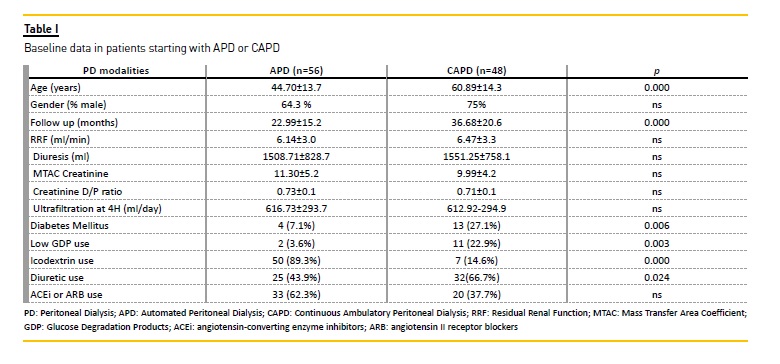
<body><![CDATA[<p>• “significant time”: time affects both groups at a similar level.</p>      <p>• “significant model”: there is an interaction between group and time which is significant (p&lt;0.05).</p>        <p><b>RESULTS</b></p>      <p>At 96%, PD was the leading substitutive therapy, 3% were from renal transplantation and 1% from haemodialysis (HD).</p>       <p>CAPD patients where older, had higher prevalence of diabetes, used less icodextrin and more low GDPs solutions and were followed for a longer time than APD patients (<a href ="/img/revistas/nep/v30n4/30n4a04t1.jpg">Table I</a>). The average follow-up time was 29.3±19 months (range 7-92).</p>      
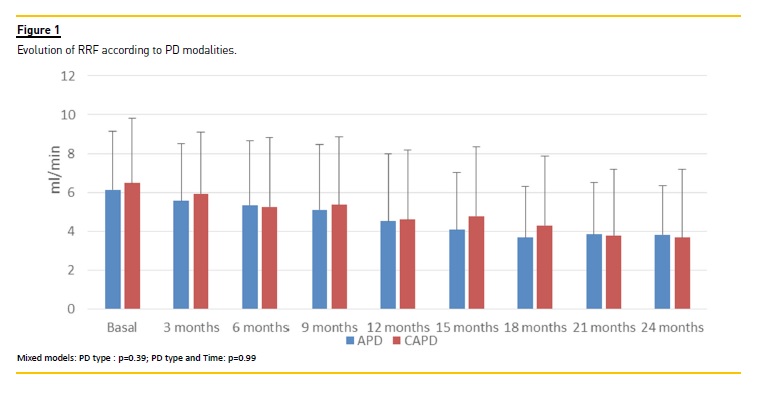
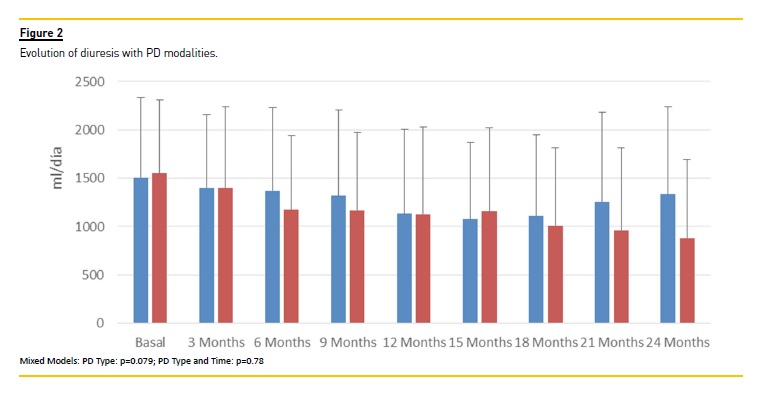
<p>At the beginning, RRF was 6.47±3.3ml/min and diuresis 1551±758ml/day in CAPD patients, and 6.1±3ml/min and 1508±828 ml/day in APD patients (p=NS). No significant differences in RR were observed in either group at 24 months F (3.67±3.5ml/min in CAPD patients vs. 3.82±2.5ml/min in APD patients) (<a href ="/img/revistas/nep/v30n4/30n4a04f1.jpg">Fig.1</a>) or in diuresis (883±807 ml/day and 1333±905 ml/day, respectively) (<a href ="/img/revistas/nep/v30n4/30n4a04f2.jpg">Fig.2</a>).</p>      
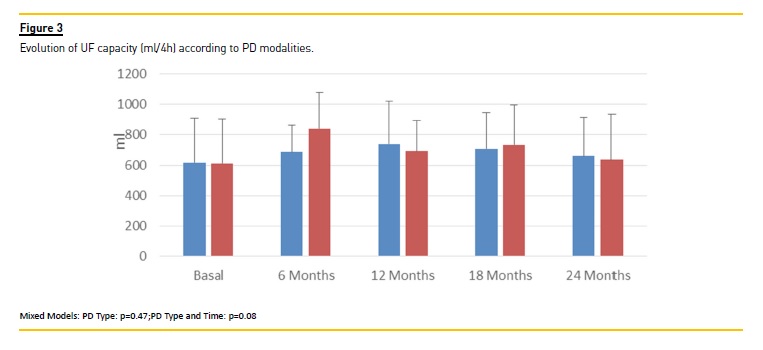
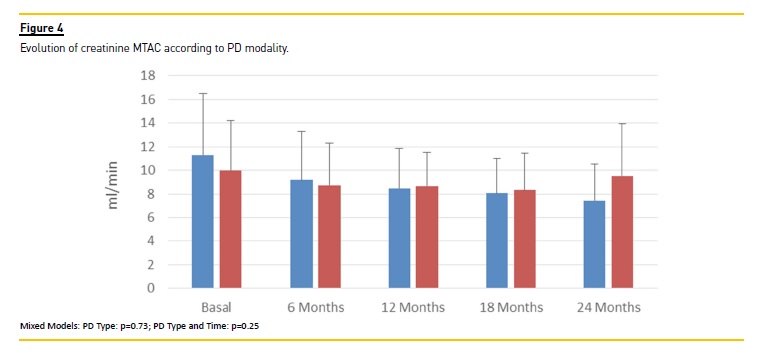
<p>Neither group showed significant differences in peritoneal functional parameters, MTAC creatinine and UF capacity (<i>p</i>=0.25)(Figs.<a href ="/img/revistas/nep/v30n4/30n4a04f3.jpg">3</a> and <a href ="/img/revistas/nep/v30n4/30n4a04f4.jpg">4</a>).</p>       
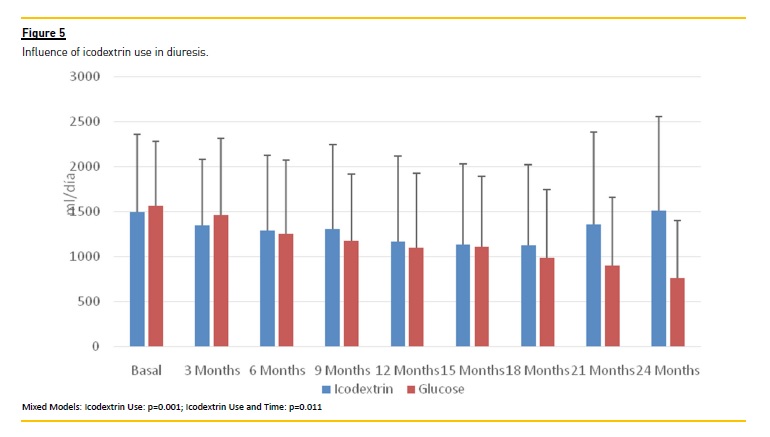
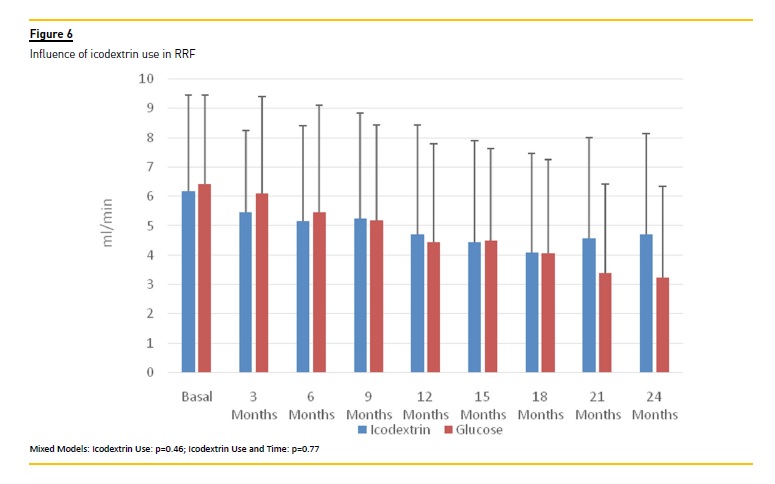
<p>The use of icodextrin was related to higher diuresis preservation at 24 months: 1519±1035 ml/min treated with icodextrin and 767±633 ml/min without icodextrin (<i>p</i>=0.011) (<a href ="/img/revistas/nep/v30n4/30n4a04f5.jpg">Fig.5</a>), with no differences found in RRF evolution (p=0.77)(<a href ="/img/revistas/nep/v30n4/30n4a04f6.jpg">Fig.6</a>). At baseline, the diuresis and RRF were similar in patients with or without icodextrin.</p>      
<p>In neither group did the use of ACEi or ARB modify FRR evolution; the use of diuretics was related to higher diuresis throughout the follow-up time and the use of low GDPs solutions did not correlate with a different FRR evolution.</p>        <p><b>DISCUSSION</b></p>      ]]></body>
<body><![CDATA[<p>In our study, no significant differences in RRF and diuresis were observed in either modality (CAPD and APD) during the follow-up. Neither groups presented significant differences in peritoneal transport parameters over time. The use of icodextrin was related to higher diuresis preservation at 24 months but no differences were found in RRF evolution.</p>      <p>Several risk factors, such as male gender, diabetes, uncontrolled hypertension, and heavy proteinuria, have been demonstrated to be associated with a rapid decline in RRF<sup>17</sup>. However, the influence of PD modalities on RRF after the initiation of PD therapy remains unclear because of the contradictory results of the studies carried out up to the present time.</p>      <p>The main result of this study is that DP modality does not influence RRF function, in line with previous studies<sup>18-20</sup>. More recently, registry data from the NECOSAD study reported a higher risk of loss of RRF with APD, particularly in the first year of treatment, with an adjusted hazard ratio 2.66 (confidence interval 1.60–2.44)21. Apart from the NECOSAD study21, nearly all the other studies are potentially confounded by patient selection bias and underlying original kidney disease, as generally older and more comorbid patients were treated by CAPD<sup>19</sup>.</p>      <p>In contrast, earlier reports showed a faster decline in RRF in APD compared to CAPD patients. One reason for the faster decline in RRF in APD patients might be the more intensive ultrafiltration during shorter dwell times in APD compared to the more gradual fluid removal during CAPD. Surprisingly, in the study by Rodríguez-Carmona et al., the decline in RRF with APD was faster when compared to CAPD, despite a lower ultrafiltration volume (APD 1067 ml/day vs. CAPD 1310mL/day)<sup>22</sup>.</p>      <p>Another interesting finding in our study is related to peritoneal transport parameters. The incidence of UF failure and altered transport characteristics with time on PD may reflect the chronic damage of the peritoneal membrane by the use of “unphysiological” solutions.</p>      <p>It is speculated that low pH, glucose, and the formation of advanced glycosylation end products influence transcapillary and transcellular (aquaporins) water transport in PD patients<sup>23</sup>. Although the influence of PD treatment time and peritonitis episodes on transport characteristics are under debate, little is known about the influence of the PD modality (CAPD or APD) on peritoneal transport. Several possible disadvantages have been associated with APD: a faster decline in RRF, less sodium removal, more protein loss, and higher costs<sup>13,24,25</sup>. However, the influence of APD on the time course of peritoneal transport in long-term PD is unknown. It is known that hypertonic glucose and its degradation products play a role in alterations of the peritoneal membrane, eventually causing alterations in peritoneal transport<sup>26, 27</sup>. Compared with CAPD, APD uses dwells that are shorter and more frequent.</p>      <p>The peritoneal membrane of an APD patient is more intensively exposed to bioincompatible dialysis solutions. Thus, compared with patients being treated with CAPD, those being treated with APD might be at a higher risk of developing structural and functional changes of the peritoneum<sup>28</sup>.</p>      <p>Peritoneal transport measured by means of a peritoneal function test has been compared between APD and CAPD in four studies that were either cross-sectional in nature or had a short follow-up<sup>25,29,30</sup>. Michels et al, was the first study to compare the long-term time course of peritoneal transport in patients treated with APD or CAPD. They concluded that those starting on APD might have a faster decline of transcapillary ultrafiltration and effective lymphatic absorption rate. Other transport parameters were not different over time<sup>28</sup>.</p>      <p>Although angiotensin-converting enzyme inhibitors (ACEIs) and angiotensin-receptor blockers (ARBs) have been convincingly demonstrated to reduce the rate of progression and proteinuria in CKD patients<sup>28</sup>, it is unclear whether they have a benefit in PD patients<sup>7</sup>. The results of observational studies have been variable, with a large retrospective study from USRDS on incident and prevalent PD reporting ACEIs had a protective effect on RRF<sup>9</sup>, whereas a study of 160 incident PD patients from Australia, and 451 from the Netherlands showed no benefit<sup>16;31</sup>. In our study, ACEi or ARB prescription did not modify the RRF evolution, in line with other observational studies.</p>      <p>In clinical practice, diuretics are commonly prescribed to PD to aid volume control, but hypovolaemia may lead to acute kidney injury and loss of RRF. Previous studies have either reported no effect on RRF<sup>9;32</sup>, or a loss of RRF. At the moment, there is no convincing data showing that loop diuretics, such as furosemide, maintain RRF, whereas they increase urine output and sodium excretion and may benefit volume-overloaded patients<sup>33</sup>. In our study, diuretics did not modify RRF evolution but an increase in urine output during the follow-up was found.</p>      ]]></body>
<body><![CDATA[<p>New solutions in multi-compartment solution bags with a higher pH and reduced glucose degradation products are accepted as more biocompatible. Those solutions are thought to improve the function and viability of peritoneal mesothelial cells and to preserve RRF<sup>34</sup>.</p>      <p>However, in our study, the use of solutions low in GDPs was not correlated with different RRF evolution; similar results have been shown by other studies<sup>35;36</sup>.</p>      <p>The initial use of icodextrin is related to a better diuresis preservation without changing RRF. As icodextrin decreases extracellular water (ECW)<sup>37</sup>, there have been concerns that may lead to dehydration and loss of RRF<sup>38</sup>. One randomized study measuring body composition and ECW reported that icodextrin reduced ECW, but also reduced urine output and GFR<sup>38</sup>. Only one small single-centre study reported that icodextrin usage helped preserve RRF<sup>39</sup>. In our study, the use of icodextrin was related to higher diuresis preservation at 24 months but no differences were found in RRF evolution.</p>      <p>The present database has limitations: it is a small sample to evaluate a biological variable with many conditioners; the temporary pause even if short may have impact on RRF; low penetration of use of low GDPs solutions is known to protect RRF; no information on blood pressure, infection episodes and volume parameters. In addition, it is a retrospective design study. Moreover, this study suffers from the general limitations of observational studies and results should thus be interpreted with caution.</p>      <p>In conclusion, in this observational study, DP modality does not influence the RRF, neither the peritoneal transport parameters. The initial use of icodextrin is related to a better diuresis preservation without changes in RRF.</p>      <p>&nbsp;</p>      <p><b>References</b></p>      <!-- ref --><p><b>1. </b>Chandna SM, Farrington K. Residual renal function: considerations on its importance and preservation in dialysis patients. Semin Dial 2004;17(3):196-201. doi:10.1111/j.0894-0959.2004.17306.x.    &nbsp;&nbsp;&nbsp;&nbsp;&nbsp;&nbsp;&nbsp;&nbsp;[&#160;<a href="javascript:void(0);" onclick="javascript: window.open('/scielo.php?script=sci_nlinks&ref=1159767&pid=S0872-0169201600040000400001&lng=','','width=640,height=500,resizable=yes,scrollbars=1,menubar=yes,');">Links</a>&#160;]<!-- end-ref --></p>      <!-- ref --><p><b>2. </b>Liao C-T, Chen Y-M, Shiao C-C, et al. Rate of decline of residual renal function is associated with all-cause mortality and technique failure in patients on long-term peritonealdialysis. Nephrol Dial Transplant 2009;24(9):2909-2914. doi:10.1093/ndt/gfp056.    &nbsp;&nbsp;&nbsp;&nbsp;&nbsp;&nbsp;&nbsp;&nbsp;[&#160;<a href="javascript:void(0);" onclick="javascript: window.open('/scielo.php?script=sci_nlinks&ref=1159769&pid=S0872-0169201600040000400002&lng=','','width=640,height=500,resizable=yes,scrollbars=1,menubar=yes,');">Links</a>&#160;]<!-- end-ref --></p>      <!-- ref --><p><b>3. </b>Marrón B, Remón C, Pérez-Fontán M, Quirós P, Ortíz A. Benefits of preserving residual renal function in peritoneal dialysis. Kidney Int Suppl 2008;(108):S42-S51. doi:10.1038/sj.ki.5002600.    &nbsp;&nbsp;&nbsp;&nbsp;&nbsp;&nbsp;&nbsp;&nbsp;[&#160;<a href="javascript:void(0);" onclick="javascript: window.open('/scielo.php?script=sci_nlinks&ref=1159771&pid=S0872-0169201600040000400003&lng=','','width=640,height=500,resizable=yes,scrollbars=1,menubar=yes,');">Links</a>&#160;]<!-- end-ref --></p>      <!-- ref --><p><b>4. </b>Canada-USA (CANUSA) Peritoneal Dialysis Study Group. Adequacy of dialysis and nutritionin continuous peritoneal dialysis: association with clinical outcomes. J Am Soc Nephrol 1996;7(2):198-207. <a href="http://www.ncbi.nlm.nih.gov/pubmed/8785388" target="_blank">http://www.ncbi.nlm.nih.gov/pubmed/8785388</a>. Accessed November 5, 2015.    &nbsp;&nbsp;&nbsp;&nbsp;&nbsp;&nbsp;&nbsp;&nbsp;[&#160;<a href="javascript:void(0);" onclick="javascript: window.open('/scielo.php?script=sci_nlinks&ref=1159773&pid=S0872-0169201600040000400004&lng=','','width=640,height=500,resizable=yes,scrollbars=1,menubar=yes,');">Links</a>&#160;]<!-- end-ref --></p>      <!-- ref --><p><b>5. </b>Bargman JM, Golper TA. The importance of residual renal function for patients on dialysis. Nephrol Dial Transplant 2005;20(4):671-673. doi:10.1093/ndt/gfh723.    &nbsp;&nbsp;&nbsp;&nbsp;&nbsp;&nbsp;&nbsp;&nbsp;[&#160;<a href="javascript:void(0);" onclick="javascript: window.open('/scielo.php?script=sci_nlinks&ref=1159775&pid=S0872-0169201600040000400005&lng=','','width=640,height=500,resizable=yes,scrollbars=1,menubar=yes,');">Links</a>&#160;]<!-- end-ref --></p>      <!-- ref --><p><b>6. </b>Wang AY-M, Lai K-N. The importance of residual renal function in dialysis patients. Kidney Int 2006;69(10):1726-1732. doi:10.1038/sj.ki.5000382.    &nbsp;&nbsp;&nbsp;&nbsp;&nbsp;&nbsp;&nbsp;&nbsp;[&#160;<a href="javascript:void(0);" onclick="javascript: window.open('/scielo.php?script=sci_nlinks&ref=1159777&pid=S0872-0169201600040000400006&lng=','','width=640,height=500,resizable=yes,scrollbars=1,menubar=yes,');">Links</a>&#160;]<!-- end-ref --></p>      <!-- ref --><p><b>7. </b>Jansen MAM, Hart AAM, Korevaar JC, Dekker FW, Boeschoten EW, Krediet RT. Predictors of the rate of decline of residual renal function in incident dialysis patients. Kidney Int 2002;62(3):1046-1053. doi:10.1046/j.1523-1755.2002.00505.x.    &nbsp;&nbsp;&nbsp;&nbsp;&nbsp;&nbsp;&nbsp;&nbsp;[&#160;<a href="javascript:void(0);" onclick="javascript: window.open('/scielo.php?script=sci_nlinks&ref=1159779&pid=S0872-0169201600040000400007&lng=','','width=640,height=500,resizable=yes,scrollbars=1,menubar=yes,');">Links</a>&#160;]<!-- end-ref --></p>      <!-- ref --><p><b>8. </b>Lameire NH. The impact of residual renal function on the adequacy of peritoneal dialysis. Nephron 1997;77(1):13-28. <a href="http://www.ncbi.nlm.nih.gov/pubmed/9380234" target="_blank">http://www.ncbi.nlm.nih.gov/pubmed/9380234</a>. Accessed November 5, 2015.    &nbsp;&nbsp;&nbsp;&nbsp;&nbsp;&nbsp;&nbsp;&nbsp;[&#160;<a href="javascript:void(0);" onclick="javascript: window.open('/scielo.php?script=sci_nlinks&ref=1159781&pid=S0872-0169201600040000400008&lng=','','width=640,height=500,resizable=yes,scrollbars=1,menubar=yes,');">Links</a>&#160;]<!-- end-ref --></p>      <!-- ref --><p><b>9. </b>Moist LM, Port FK, Orzol SM, et al. Predictors of loss of residual renal function among new dialysis patients. J Am Soc Nephrol 2000;11(3):556-564. <a href="http://www.ncbi.nlm.nih.gov/pubmed/10703680" target="_blank">http://www.ncbi.nlm.nih.gov/pubmed/10703680</a>. Accessed November 5, 2015.    &nbsp;&nbsp;&nbsp;&nbsp;&nbsp;&nbsp;&nbsp;&nbsp;[&#160;<a href="javascript:void(0);" onclick="javascript: window.open('/scielo.php?script=sci_nlinks&ref=1159783&pid=S0872-0169201600040000400009&lng=','','width=640,height=500,resizable=yes,scrollbars=1,menubar=yes,');">Links</a>&#160;]<!-- end-ref --></p>      <!-- ref --><p><b>10. </b>Hiroshige K, Yuu K, Soejima M, Takasugi M, Kuroiwa A. Rapid decline of residual renal function in patients on automated peritoneal dialysis. Perit Dial Int 1996;16(3):307-315. <a href="http://www.ncbi.nlm.nih.gov/pubmed/8761546" target="_blank">http://www.ncbi.nlm.nih.gov/pubmed/8761546</a>. Accessed November 5, 2015.    &nbsp;&nbsp;&nbsp;&nbsp;&nbsp;&nbsp;&nbsp;&nbsp;[&#160;<a href="javascript:void(0);" onclick="javascript: window.open('/scielo.php?script=sci_nlinks&ref=1159785&pid=S0872-0169201600040000400010&lng=','','width=640,height=500,resizable=yes,scrollbars=1,menubar=yes,');">Links</a>&#160;]<!-- end-ref --></p>      <!-- ref --><p><b>11. </b>Hufnagel G, Michel C, Queffeulou G, Skhiri H, Damieri H, Mignon F. The influence of automated peritoneal dialysis on the decrease in residual renal function. Nephrol Dial Transpl 1999;14(5):1224-1228. doi:10.1093/ndt/14.5.1224.    &nbsp;&nbsp;&nbsp;&nbsp;&nbsp;&nbsp;&nbsp;&nbsp;[&#160;<a href="javascript:void(0);" onclick="javascript: window.open('/scielo.php?script=sci_nlinks&ref=1159787&pid=S0872-0169201600040000400011&lng=','','width=640,height=500,resizable=yes,scrollbars=1,menubar=yes,');">Links</a>&#160;]<!-- end-ref --></p>      <!-- ref --><p><b>12. </b>Michels WM, Verduijn M, Grootendorst DC, et al. Decline in Residual Renal Function in Automated Compared with Continuous Ambulatory Peritoneal Dialysis. Clin J Am Soc Nephrol 2011;6(3):537-542. doi:10.2215/CJN.00470110.    &nbsp;&nbsp;&nbsp;&nbsp;&nbsp;&nbsp;&nbsp;&nbsp;[&#160;<a href="javascript:void(0);" onclick="javascript: window.open('/scielo.php?script=sci_nlinks&ref=1159789&pid=S0872-0169201600040000400012&lng=','','width=640,height=500,resizable=yes,scrollbars=1,menubar=yes,');">Links</a>&#160;]<!-- end-ref --></p>      <!-- ref --><p><b>13. </b>Bro S, Bjorner JB, Tofte-Jensen P, et al. A prospective, randomized multicenter study comparing APD and CAPD treatment. Perit Dial Int 1999;19(6):526-533. <a href="http://www.ncbi.nlm.nih.gov/pubmed/10641772" target="_blank">http://www.ncbi.nlm.nih.gov/pubmed/10641772</a>. Accessed November 5, 2015.    &nbsp;&nbsp;&nbsp;&nbsp;&nbsp;&nbsp;&nbsp;&nbsp;[&#160;<a href="javascript:void(0);" onclick="javascript: window.open('/scielo.php?script=sci_nlinks&ref=1159791&pid=S0872-0169201600040000400013&lng=','','width=640,height=500,resizable=yes,scrollbars=1,menubar=yes,');">Links</a>&#160;]<!-- end-ref --></p>      <!-- ref --><p><b>14. </b>de Fijter CW, Oe LP, Nauta JJ, et al. Clinical efficacy and morbidity associated with continuous cyclic compared with continuous ambulatory peritoneal dialysis. Ann Intern Med 1994;120(4):264-271. <a href="http://www.ncbi.nlm.nih.gov/pubmed/8291819" target="_blank">http://www.ncbi.nlm.nih.gov/pubmed/8291819</a>. Accessed November 5, 2015.    &nbsp;&nbsp;&nbsp;&nbsp;&nbsp;&nbsp;&nbsp;&nbsp;[&#160;<a href="javascript:void(0);" onclick="javascript: window.open('/scielo.php?script=sci_nlinks&ref=1159793&pid=S0872-0169201600040000400014&lng=','','width=640,height=500,resizable=yes,scrollbars=1,menubar=yes,');">Links</a>&#160;]<!-- end-ref --></p>      <!-- ref --><p><b>15. </b>Hamada C, Osada S, Inoue S, et al. Effects of automated peritoneal dialysis on residual urinary volume. Perit Dial Int 2000;20(2):239-241. <a href="http://www.ncbi.nlm.nih.gov/pubmed/10809252" target="_blank">http://www.ncbi.nlm.nih.gov/pubmed/10809252</a>. Accessed November 5, 2015.    &nbsp;&nbsp;&nbsp;&nbsp;&nbsp;&nbsp;&nbsp;&nbsp;[&#160;<a href="javascript:void(0);" onclick="javascript: window.open('/scielo.php?script=sci_nlinks&ref=1159795&pid=S0872-0169201600040000400015&lng=','','width=640,height=500,resizable=yes,scrollbars=1,menubar=yes,');">Links</a>&#160;]<!-- end-ref --></p>      <!-- ref --><p><b>16. </b>Johnson DW, Mudge DW, Sturtevant JM, et al. Predictors of decline of residual renal function in new peritoneal dialysis patients. Perit Dial Int 2003;23(3):276-283. <a href="http://www.ncbi.nlm.nih.gov/pubmed/12938830" target="_blank">http://www.ncbi.nlm.nih.gov/pubmed/12938830</a>. Accessed November 5, 2015.    &nbsp;&nbsp;&nbsp;&nbsp;&nbsp;&nbsp;&nbsp;&nbsp;[&#160;<a href="javascript:void(0);" onclick="javascript: window.open('/scielo.php?script=sci_nlinks&ref=1159797&pid=S0872-0169201600040000400016&lng=','','width=640,height=500,resizable=yes,scrollbars=1,menubar=yes,');">Links</a>&#160;]<!-- end-ref --></p>      <!-- ref --><p><b>17. </b>Kim C-H, Oh H-J, Lee M-J, et al. Effect of peritoneal dialysis modality on the 1-year rate of decline of residual renal function. Yonsei Med J 2014;55(1):141-148. doi:10.3349/ymj.2014.55.1.141.    &nbsp;&nbsp;&nbsp;&nbsp;&nbsp;&nbsp;&nbsp;&nbsp;[&#160;<a href="javascript:void(0);" onclick="javascript: window.open('/scielo.php?script=sci_nlinks&ref=1159799&pid=S0872-0169201600040000400017&lng=','','width=640,height=500,resizable=yes,scrollbars=1,menubar=yes,');">Links</a>&#160;]<!-- end-ref --></p>      <!-- ref --><p><b>18. </b>Haynes R, Staplin N, Emberson J, et al. Evaluating the contribution of the cause of kidney disease to prognosis in CKD: results from the Study of Heart and Renal Protection (SHARP). Am J Kidney Dis 2014;64(1):40-48. doi:10.1053/j.ajkd.2013.12.013.    &nbsp;&nbsp;&nbsp;&nbsp;&nbsp;&nbsp;&nbsp;&nbsp;[&#160;<a href="javascript:void(0);" onclick="javascript: window.open('/scielo.php?script=sci_nlinks&ref=1159801&pid=S0872-0169201600040000400018&lng=','','width=640,height=500,resizable=yes,scrollbars=1,menubar=yes,');">Links</a>&#160;]<!-- end-ref --></p>      <!-- ref --><p><b>19. </b>Balasubramanian G, McKitty K, Fan SL-S. Comparing automated peritoneal dialysis with continuous ambulatory peritoneal dialysis: survival and quality of life differences? Nephrol Dial Transplant 2011;26(5):1702-1708. doi:10.1093/ndt/gfq607.    &nbsp;&nbsp;&nbsp;&nbsp;&nbsp;&nbsp;&nbsp;&nbsp;[&#160;<a href="javascript:void(0);" onclick="javascript: window.open('/scielo.php?script=sci_nlinks&ref=1159803&pid=S0872-0169201600040000400019&lng=','','width=640,height=500,resizable=yes,scrollbars=1,menubar=yes,');">Links</a>&#160;]<!-- end-ref --></p>      <!-- ref --><P><b>20. </b>de Fijter CW, ter Wee PM, Donker AJ. The influence of automated peritoneal dialysis on the decrease in residual renal function. Nephrol Dial Transplant 2000;15(7):1094-1096. <a href="http://www.ncbi.nlm.nih.gov/pubmed/10862659" target="_blank">http://www.ncbi.nlm.nih.gov/pubmed/10862659</a>. Accessed November 5, 2015.    &nbsp;&nbsp;&nbsp;&nbsp;&nbsp;&nbsp;&nbsp;&nbsp;[&#160;<a href="javascript:void(0);" onclick="javascript: window.open('/scielo.php?script=sci_nlinks&ref=1159805&pid=S0872-0169201600040000400020&lng=','','width=640,height=500,resizable=yes,scrollbars=1,menubar=yes,');">Links</a>&#160;]<!-- end-ref --></p>      <!-- ref --><P><b>21. </b>Michels WM, Verduijn M, Grootendorst DC, et al. Decline in residual renal function in automated compared with continuous ambulatory peritoneal dialysis. Clin J Am Soc Nephrol 2011;6(3):537-542. doi:10.2215/CJN.00470110.    &nbsp;&nbsp;&nbsp;&nbsp;&nbsp;&nbsp;&nbsp;&nbsp;[&#160;<a href="javascript:void(0);" onclick="javascript: window.open('/scielo.php?script=sci_nlinks&ref=1159807&pid=S0872-0169201600040000400021&lng=','','width=640,height=500,resizable=yes,scrollbars=1,menubar=yes,');">Links</a>&#160;]<!-- end-ref --></p>      <!-- ref --><P><b>22. </b>Su YJ, Lee CT, Chuang FR, et al. Comparison of clinical characteristics between automated peritoneal dialysis and continuous ambulatory peritoneal dialysis: a 2-year singlecenter observational study. Ren Fail 2010;32(7):817-824. doi:10.3109/088602 2X.2010.494799.    &nbsp;&nbsp;&nbsp;&nbsp;&nbsp;&nbsp;&nbsp;&nbsp;[&#160;<a href="javascript:void(0);" onclick="javascript: window.open('/scielo.php?script=sci_nlinks&ref=1159809&pid=S0872-0169201600040000400022&lng=','','width=640,height=500,resizable=yes,scrollbars=1,menubar=yes,');">Links</a>&#160;]<!-- end-ref --></p>      <!-- ref --><p><b>23. </b>Fusshöller A, zur Nieden S, Grabensee B, Plum J. Peritoneal fluid and solute transport: influence of treatment time, peritoneal dialysis modality, and peritonitis incidence. J Am Soc Nephrol 2002;13(4):1055-1060. <a href="http://www.ncbi.nlm.nih.gov/pubmed/11912266" target="_blank">http://www.ncbi.nlm.nih.gov/pubmed/11912266</a>.    &nbsp;&nbsp;&nbsp;&nbsp;&nbsp;&nbsp;&nbsp;&nbsp;[&#160;<a href="javascript:void(0);" onclick="javascript: window.open('/scielo.php?script=sci_nlinks&ref=1159811&pid=S0872-0169201600040000400023&lng=','','width=640,height=500,resizable=yes,scrollbars=1,menubar=yes,');">Links</a>&#160;]<!-- end-ref --></p>      <!-- ref --><p><b>24. </b>Gallar P, Ortega O, Carreno A, Vigil A. Rate of decline in residual renal fuction is equal in CAPD and automated peritoneal dialysis patients. Perit Dial Int 20(6):803-805. <a href="http://www.ncbi.nlm.nih.gov/pubmed/11216585" target="_blank">http://www.ncbi.nlm.nih.gov/pubmed/11216585</a>. Accessed November 5, 2015.    &nbsp;&nbsp;&nbsp;&nbsp;&nbsp;&nbsp;&nbsp;&nbsp;[&#160;<a href="javascript:void(0);" onclick="javascript: window.open('/scielo.php?script=sci_nlinks&ref=1159813&pid=S0872-0169201600040000400024&lng=','','width=640,height=500,resizable=yes,scrollbars=1,menubar=yes,');">Links</a>&#160;]<!-- end-ref --></p>      <!-- ref --><p><b>25. </b>Ortega O, Gallar P, Carreño A, et al. Peritoneal sodium mass removal in continuous ambulatory peritoneal dialysis and automated peritoneal dialysis: influence on blood pressure control. Am J Nephrol 2001;21(3):189-193. doi:46246.    &nbsp;&nbsp;&nbsp;&nbsp;&nbsp;&nbsp;&nbsp;&nbsp;[&#160;<a href="javascript:void(0);" onclick="javascript: window.open('/scielo.php?script=sci_nlinks&ref=1159815&pid=S0872-0169201600040000400025&lng=','','width=640,height=500,resizable=yes,scrollbars=1,menubar=yes,');">Links</a>&#160;]<!-- end-ref --></p>      <!-- ref --><p><b>26. </b>Selgas R, Fernandez-Reyes MJ, Bosque E, et al. Functional longevity of the human peritoneum: how long is continuous peritoneal dialysis possible? Results of a prospective medium long-term study. Am J Kidney Dis 1994;23(1):64-73.  <a href="http://www.ncbi.nlm.nih.gov/pubmed/8285200" target="_blank">http://www.ncbi.nlm.nih.gov/pubmed/8285200</a>. Accessed November 5, 2015.    &nbsp;&nbsp;&nbsp;&nbsp;&nbsp;&nbsp;&nbsp;&nbsp;[&#160;<a href="javascript:void(0);" onclick="javascript: window.open('/scielo.php?script=sci_nlinks&ref=1159817&pid=S0872-0169201600040000400026&lng=','','width=640,height=500,resizable=yes,scrollbars=1,menubar=yes,');">Links</a>&#160;]<!-- end-ref --></p>      <!-- ref --><p><b>27. </b>Williams JD, Craig KJ, Topley N, et al. Morphologic changes in the peritoneal membrane of patients with renal disease. J Am Soc Nephrol 2002;13(2):470-479.  <a href="http://www.ncbi.nlm.nih.gov/pubmed/11805177" target="_blank">http://www.ncbi.nlm.nih.gov/pubmed/11805177</a>. Accessed November 5, 2015.    &nbsp;&nbsp;&nbsp;&nbsp;&nbsp;&nbsp;&nbsp;&nbsp;[&#160;<a href="javascript:void(0);" onclick="javascript: window.open('/scielo.php?script=sci_nlinks&ref=1159819&pid=S0872-0169201600040000400027&lng=','','width=640,height=500,resizable=yes,scrollbars=1,menubar=yes,');">Links</a>&#160;]<!-- end-ref --></p>      <!-- ref --><p><b>28. </b>Michels WM, Verduijn M, Parikova A, et al. Time course of peritoneal function in automated and continuous peritoneal dialysis. Perit Dial Int 2012;32(6):605-611. doi:10.3747/pdi.2011.00166.    &nbsp;&nbsp;&nbsp;&nbsp;&nbsp;&nbsp;&nbsp;&nbsp;[&#160;<a href="javascript:void(0);" onclick="javascript: window.open('/scielo.php?script=sci_nlinks&ref=1159821&pid=S0872-0169201600040000400028&lng=','','width=640,height=500,resizable=yes,scrollbars=1,menubar=yes,');">Links</a>&#160;]<!-- end-ref --></p>      <!-- ref --><p><b>29. </b>La Milia V, Limardo M, Cavalli A, Crepaldi M, Locatelli F. Transport of peritoneal membrane assessed before and after the start of peritoneal dialysis. Nephrol Dial Transplant 2009;24(9):2894-2898. doi:10.1093/ndt/gfp151.    &nbsp;&nbsp;&nbsp;&nbsp;&nbsp;&nbsp;&nbsp;&nbsp;[&#160;<a href="javascript:void(0);" onclick="javascript: window.open('/scielo.php?script=sci_nlinks&ref=1159823&pid=S0872-0169201600040000400029&lng=','','width=640,height=500,resizable=yes,scrollbars=1,menubar=yes,');">Links</a>&#160;]<!-- end-ref --></p>      <!-- ref --><p><b>30. </b>Rodriguez-Carmona A, Perez-Fontan M, Garca-Naveiro R, Villaverde P, Peteiro J. Compared time profiles of ultrafiltration, sodium removal, and renal function in incident CAPD and automated peritoneal dialysis patients. Am J Kidney Dis 2004;44(1):132-145. doi:10.1053/j.ajkd.2004.03.035.    &nbsp;&nbsp;&nbsp;&nbsp;&nbsp;&nbsp;&nbsp;&nbsp;[&#160;<a href="javascript:void(0);" onclick="javascript: window.open('/scielo.php?script=sci_nlinks&ref=1159825&pid=S0872-0169201600040000400030&lng=','','width=640,height=500,resizable=yes,scrollbars=1,menubar=yes,');">Links</a>&#160;]<!-- end-ref --></p>      <!-- ref --><p><b>31. </b>Kolesnyk I, Noordzij M, Dekker FW, Boeschoten EW, Krediet RT. Treatment with angiotensin II inhibitors and residual renal function in peritoneal dialysis patients. Perit Dial Int 2001;31(1):53-59. doi:10.3747/pdi.2009.00088.    &nbsp;&nbsp;&nbsp;&nbsp;&nbsp;&nbsp;&nbsp;&nbsp;[&#160;<a href="javascript:void(0);" onclick="javascript: window.open('/scielo.php?script=sci_nlinks&ref=1159827&pid=S0872-0169201600040000400031&lng=','','width=640,height=500,resizable=yes,scrollbars=1,menubar=yes,');">Links</a>&#160;]<!-- end-ref --></p>      <!-- ref --><p><b>32. </b>Johnson DW, Mudge DW, Sturtevant JM, et al. Predictors of Decline of Residual Renal Function Perit Dial Int 2003;23(16):276-283.    &nbsp;&nbsp;&nbsp;&nbsp;&nbsp;&nbsp;&nbsp;&nbsp;[&#160;<a href="javascript:void(0);" onclick="javascript: window.open('/scielo.php?script=sci_nlinks&ref=1159829&pid=S0872-0169201600040000400032&lng=','','width=640,height=500,resizable=yes,scrollbars=1,menubar=yes,');">Links</a>&#160;]<!-- end-ref --></p>      <!-- ref --><p><b>33. </b>Nongnuch A, Assanatham M, Panorchan K, Davenport A. Strategies for preserving residual renal function in peritoneal dialysis patients. Clin Kidney J 2015;8(2):202-211. doi:10.1093/ckj/sfu140.    &nbsp;&nbsp;&nbsp;&nbsp;&nbsp;&nbsp;&nbsp;&nbsp;[&#160;<a href="javascript:void(0);" onclick="javascript: window.open('/scielo.php?script=sci_nlinks&ref=1159831&pid=S0872-0169201600040000400033&lng=','','width=640,height=500,resizable=yes,scrollbars=1,menubar=yes,');">Links</a>&#160;]<!-- end-ref --></p>      <!-- ref --><p><b>34. </b>Tam P. Peritoneal dialysis and preservation of residual renal function. Perit Dial Int 2009;29 Suppl.(2):S108-S110.  <a href="http://www.ncbi.nlm.nih.gov/pubmed/23227581" target="_blank">http://www.ncbi.nlm.nih.gov/pubmed/23227581</a>.    &nbsp;&nbsp;&nbsp;&nbsp;&nbsp;&nbsp;&nbsp;&nbsp;[&#160;<a href="javascript:void(0);" onclick="javascript: window.open('/scielo.php?script=sci_nlinks&ref=1159833&pid=S0872-0169201600040000400034&lng=','','width=640,height=500,resizable=yes,scrollbars=1,menubar=yes,');">Links</a>&#160;]<!-- end-ref --> </p>      <!-- ref --><p><b>35. </b>Coles GA, O’Donoghue DJ, Pritchard N, et al. A controlled trial of two bicarbonatecontaining dialysis fluids for CAPD–final report. Nephrol Dial Transplant 1998;13(12):3165-3171. <a href="http://www.ncbi.nlm.nih.gov/pubmed/9870483" target="_blank">http://www.ncbi.nlm.nih.gov/pubmed/9870483</a>. Accessed November 5, 2015.    &nbsp;&nbsp;&nbsp;&nbsp;&nbsp;&nbsp;&nbsp;&nbsp;[&#160;<a href="javascript:void(0);" onclick="javascript: window.open('/scielo.php?script=sci_nlinks&ref=1159835&pid=S0872-0169201600040000400035&lng=','','width=640,height=500,resizable=yes,scrollbars=1,menubar=yes,');">Links</a>&#160;]<!-- end-ref --></p>      <!-- ref --><p><b>36. </b>Pajek J, Kveder R, Bren A, et al. Short-term effects of bicarbonate/lactate-buffered and conventional lactate-buffered dialysis solutions on peritoneal ultrafiltration: a comparative crossover study. Nephrol Dial Transplant 2009;24(5):1617-1625. doi:10.1093/ndt/gfn673.    &nbsp;&nbsp;&nbsp;&nbsp;&nbsp;&nbsp;&nbsp;&nbsp;[&#160;<a href="javascript:void(0);" onclick="javascript: window.open('/scielo.php?script=sci_nlinks&ref=1159837&pid=S0872-0169201600040000400036&lng=','','width=640,height=500,resizable=yes,scrollbars=1,menubar=yes,');">Links</a>&#160;]<!-- end-ref --></p>      <!-- ref --><p><b>37. </b>Davies SJ, Garcia Lopez E, Woodrow G, et al. Longitudinal relationships between fluid status, inflammation, urine volume and plasma metabolites of icodextrin in patients randomized to glucose or icodextrin for the long exchange. Nephrol Dial Transplant 2008;23(9):2982-2988. doi:10.1093/ndt/gfn176.    &nbsp;&nbsp;&nbsp;&nbsp;&nbsp;&nbsp;&nbsp;&nbsp;[&#160;<a href="javascript:void(0);" onclick="javascript: window.open('/scielo.php?script=sci_nlinks&ref=1159839&pid=S0872-0169201600040000400037&lng=','','width=640,height=500,resizable=yes,scrollbars=1,menubar=yes,');">Links</a>&#160;]<!-- end-ref --></p>      <!-- ref --><p><b>38. </b>Konings CJAM, Kooman JP, Schonck M, et al. Effect of icodextrin on volume status, blood pressure and echocardiographic parameters: a randomized study. Kidney Int 2003;63(4):1556-1563. doi:10.1046/j.1523-1755.2003.00887.x.    &nbsp;&nbsp;&nbsp;&nbsp;&nbsp;&nbsp;&nbsp;&nbsp;[&#160;<a href="javascript:void(0);" onclick="javascript: window.open('/scielo.php?script=sci_nlinks&ref=1159841&pid=S0872-0169201600040000400038&lng=','','width=640,height=500,resizable=yes,scrollbars=1,menubar=yes,');">Links</a>&#160;]<!-- end-ref --></p>      <!-- ref --><p><b>39. </b>Adachi Y, Nakagawa Y, Nishio A. Icodextrin preserves residual renal function in patients treated with automated peritoneal dialysis. Perit Dial Int 26(3):405-407.  <a href="http://www.ncbi.nlm.nih.gov/pubmed/16722036" target="_blank">http://www.ncbi.nlm.nih.gov/pubmed/16722036</a>. Accessed November 5, 2015.    &nbsp;&nbsp;&nbsp;&nbsp;&nbsp;&nbsp;&nbsp;&nbsp;[&#160;<a href="javascript:void(0);" onclick="javascript: window.open('/scielo.php?script=sci_nlinks&ref=1159843&pid=S0872-0169201600040000400039&lng=','','width=640,height=500,resizable=yes,scrollbars=1,menubar=yes,');">Links</a>&#160;]<!-- end-ref --></p>      <p>&nbsp;</p>     <p><b><a name="c0"></a><a href="#topc0">Correspondence to:</a></b></p>      <p>Cristina Dias Cândido</p>     <p>Nephrology Department, Centro Hospitalar de Setúbal,</p>     <p>Setúbal, Portugal</p>     ]]></body>
<body><![CDATA[<p>Rua Camilo Castelo Branco</p>     <p>2910-446 Setúbal, Portugal</p>     <p>E-mail: <a href="mailto:cristinadcandido@gmail.com">cristinadcandido@gmail.com</a></p>      <p>&nbsp;</p>       <p><b>Disclosure of Potential Conflicts of Interest:</b> None declared.</p>      <p>&nbsp;</p>      <p><b>Received for publication: </b>May 12, 2016</p>     <p><b>Accepted in revised form: </b>Jun 30, 2016</p>      <p>&nbsp;</p>         ]]></body><back>
<ref-list>
<ref id="B1">
<label>1.</label><nlm-citation citation-type="journal">
<person-group person-group-type="author">
<name>
<surname><![CDATA[Chandna]]></surname>
<given-names><![CDATA[SM]]></given-names>
</name>
<name>
<surname><![CDATA[Farrington]]></surname>
<given-names><![CDATA[K]]></given-names>
</name>
</person-group>
<article-title xml:lang="en"><![CDATA[Residual renal function: considerations on its importance and preservation in dialysis patients]]></article-title>
<source><![CDATA[Semin Dial]]></source>
<year>2004</year>
<volume>17</volume>
<numero>3</numero>
<issue>3</issue>
<page-range>196-201</page-range></nlm-citation>
</ref>
<ref id="B2">
<label>2.</label><nlm-citation citation-type="journal">
<person-group person-group-type="author">
<name>
<surname><![CDATA[Liao]]></surname>
<given-names><![CDATA[C-T]]></given-names>
</name>
<name>
<surname><![CDATA[Chen]]></surname>
<given-names><![CDATA[Y-M]]></given-names>
</name>
<name>
<surname><![CDATA[Shiao]]></surname>
<given-names><![CDATA[C-C]]></given-names>
</name>
</person-group>
<article-title xml:lang="en"><![CDATA[Rate of decline of residual renal function is associated with all-cause mortality and technique failure in patients on long-term peritonealdialysis]]></article-title>
<source><![CDATA[Nephrol Dial Transplant]]></source>
<year>2009</year>
<volume>24</volume>
<numero>9</numero>
<issue>9</issue>
<page-range>2909-2914</page-range></nlm-citation>
</ref>
<ref id="B3">
<label>3.</label><nlm-citation citation-type="journal">
<person-group person-group-type="author">
<name>
<surname><![CDATA[Marrón]]></surname>
<given-names><![CDATA[B]]></given-names>
</name>
<name>
<surname><![CDATA[Remón]]></surname>
<given-names><![CDATA[C]]></given-names>
</name>
<name>
<surname><![CDATA[Pérez-Fontán]]></surname>
<given-names><![CDATA[M]]></given-names>
</name>
<name>
<surname><![CDATA[Quirós]]></surname>
<given-names><![CDATA[P]]></given-names>
</name>
<name>
<surname><![CDATA[Ortíz]]></surname>
<given-names><![CDATA[A]]></given-names>
</name>
</person-group>
<article-title xml:lang="en"><![CDATA[Benefits of preserving residual renal function in peritoneal dialysis]]></article-title>
<source><![CDATA[Kidney Int Suppl]]></source>
<year>2008</year>
<numero>108</numero>
<issue>108</issue>
<page-range>S42-S51</page-range><page-range>10.1038/sj.ki.5002600</page-range></nlm-citation>
</ref>
<ref id="B4">
<label>4.</label><nlm-citation citation-type="journal">
<collab>Canada-USA (CANUSA) Peritoneal Dialysis Study Group</collab>
<article-title xml:lang="en"><![CDATA[Adequacy of dialysis and nutritionin continuous peritoneal dialysis: association with clinical outcomes]]></article-title>
<source><![CDATA[J Am Soc Nephrol]]></source>
<year>1996</year>
<volume>7</volume>
<numero>2</numero>
<issue>2</issue>
<page-range>198-207</page-range></nlm-citation>
</ref>
<ref id="B5">
<label>5.</label><nlm-citation citation-type="journal">
<person-group person-group-type="author">
<name>
<surname><![CDATA[Bargman]]></surname>
<given-names><![CDATA[JM]]></given-names>
</name>
<name>
<surname><![CDATA[Golper]]></surname>
<given-names><![CDATA[TA]]></given-names>
</name>
</person-group>
<article-title xml:lang="en"><![CDATA[The importance of residual renal function for patients on dialysis]]></article-title>
<source><![CDATA[Nephrol Dial Transplant]]></source>
<year>2005</year>
<volume>20</volume>
<numero>4</numero>
<issue>4</issue>
<page-range>671-673</page-range></nlm-citation>
</ref>
<ref id="B6">
<label>6.</label><nlm-citation citation-type="journal">
<person-group person-group-type="author">
<name>
<surname><![CDATA[Wang]]></surname>
<given-names><![CDATA[AY-M]]></given-names>
</name>
<name>
<surname><![CDATA[Lai]]></surname>
<given-names><![CDATA[K-N]]></given-names>
</name>
</person-group>
<article-title xml:lang="en"><![CDATA[The importance of residual renal function in dialysis patients]]></article-title>
<source><![CDATA[Kidney Int]]></source>
<year>2006</year>
<volume>69</volume>
<numero>10</numero>
<issue>10</issue>
<page-range>1726-1732</page-range></nlm-citation>
</ref>
<ref id="B7">
<label>7.</label><nlm-citation citation-type="journal">
<person-group person-group-type="author">
<name>
<surname><![CDATA[Jansen]]></surname>
<given-names><![CDATA[MAM]]></given-names>
</name>
<name>
<surname><![CDATA[Hart]]></surname>
<given-names><![CDATA[AAM]]></given-names>
</name>
<name>
<surname><![CDATA[Korevaar]]></surname>
<given-names><![CDATA[JC]]></given-names>
</name>
<name>
<surname><![CDATA[Dekker]]></surname>
<given-names><![CDATA[FW]]></given-names>
</name>
<name>
<surname><![CDATA[Boeschoten]]></surname>
<given-names><![CDATA[EW]]></given-names>
</name>
<name>
<surname><![CDATA[Krediet]]></surname>
<given-names><![CDATA[RT]]></given-names>
</name>
</person-group>
<article-title xml:lang="en"><![CDATA[Predictors of the rate of decline of residual renal function in incident dialysis patients]]></article-title>
<source><![CDATA[Kidney Int]]></source>
<year>2002</year>
<volume>62</volume>
<numero>3</numero>
<issue>3</issue>
<page-range>1046-1053</page-range></nlm-citation>
</ref>
<ref id="B8">
<label>8.</label><nlm-citation citation-type="journal">
<person-group person-group-type="author">
<name>
<surname><![CDATA[Lameire]]></surname>
<given-names><![CDATA[NH]]></given-names>
</name>
</person-group>
<article-title xml:lang="en"><![CDATA[The impact of residual renal function on the adequacy of peritoneal dialysis]]></article-title>
<source><![CDATA[Nephron]]></source>
<year>1997</year>
<volume>77</volume>
<numero>1</numero>
<issue>1</issue>
<page-range>13-28</page-range></nlm-citation>
</ref>
<ref id="B9">
<label>9.</label><nlm-citation citation-type="journal">
<person-group person-group-type="author">
<name>
<surname><![CDATA[Moist]]></surname>
<given-names><![CDATA[LM]]></given-names>
</name>
<name>
<surname><![CDATA[Port]]></surname>
<given-names><![CDATA[FK]]></given-names>
</name>
<name>
<surname><![CDATA[Orzol]]></surname>
<given-names><![CDATA[SM]]></given-names>
</name>
</person-group>
<article-title xml:lang="en"><![CDATA[Predictors of loss of residual renal function among new dialysis patients]]></article-title>
<source><![CDATA[J Am Soc Nephrol]]></source>
<year>2000</year>
<volume>11</volume>
<numero>3</numero>
<issue>3</issue>
<page-range>556-564</page-range></nlm-citation>
</ref>
<ref id="B10">
<label>10.</label><nlm-citation citation-type="journal">
<person-group person-group-type="author">
<name>
<surname><![CDATA[Hiroshige]]></surname>
<given-names><![CDATA[K]]></given-names>
</name>
<name>
<surname><![CDATA[Yuu]]></surname>
<given-names><![CDATA[K]]></given-names>
</name>
<name>
<surname><![CDATA[Soejima]]></surname>
<given-names><![CDATA[M]]></given-names>
</name>
<name>
<surname><![CDATA[Takasugi]]></surname>
<given-names><![CDATA[M]]></given-names>
</name>
<name>
<surname><![CDATA[Kuroiwa]]></surname>
<given-names><![CDATA[A]]></given-names>
</name>
</person-group>
<article-title xml:lang="en"><![CDATA[Rapid decline of residual renal function in patients on automated peritoneal dialysis]]></article-title>
<source><![CDATA[Perit Dial Int]]></source>
<year>1996</year>
<volume>16</volume>
<numero>3</numero>
<issue>3</issue>
<page-range>307-315</page-range></nlm-citation>
</ref>
<ref id="B11">
<label>11.</label><nlm-citation citation-type="journal">
<person-group person-group-type="author">
<name>
<surname><![CDATA[Hufnagel]]></surname>
<given-names><![CDATA[G]]></given-names>
</name>
<name>
<surname><![CDATA[Michel]]></surname>
<given-names><![CDATA[C]]></given-names>
</name>
<name>
<surname><![CDATA[Queffeulou]]></surname>
<given-names><![CDATA[G]]></given-names>
</name>
<name>
<surname><![CDATA[Skhiri]]></surname>
<given-names><![CDATA[H]]></given-names>
</name>
<name>
<surname><![CDATA[Damieri]]></surname>
<given-names><![CDATA[H]]></given-names>
</name>
<name>
<surname><![CDATA[Mignon]]></surname>
<given-names><![CDATA[F]]></given-names>
</name>
</person-group>
<article-title xml:lang="en"><![CDATA[The influence of automated peritoneal dialysis on the decrease in residual renal function]]></article-title>
<source><![CDATA[Nephrol Dial Transpl]]></source>
<year>1999</year>
<volume>14</volume>
<numero>5</numero>
<issue>5</issue>
<page-range>1224-1228</page-range></nlm-citation>
</ref>
<ref id="B12">
<label>12.</label><nlm-citation citation-type="journal">
<person-group person-group-type="author">
<name>
<surname><![CDATA[Michels]]></surname>
<given-names><![CDATA[WM]]></given-names>
</name>
<name>
<surname><![CDATA[Verduijn]]></surname>
<given-names><![CDATA[M]]></given-names>
</name>
<name>
<surname><![CDATA[Grootendorst]]></surname>
<given-names><![CDATA[DC]]></given-names>
</name>
</person-group>
<article-title xml:lang="en"><![CDATA[Decline in Residual Renal Function in Automated Compared with Continuous Ambulatory Peritoneal Dialysis]]></article-title>
<source><![CDATA[J Am Soc Nephrol]]></source>
<year>2011</year>
<volume>6</volume>
<numero>3</numero>
<issue>3</issue>
<page-range>537-542</page-range></nlm-citation>
</ref>
<ref id="B13">
<label>13.</label><nlm-citation citation-type="journal">
<person-group person-group-type="author">
<name>
<surname><![CDATA[Bro]]></surname>
<given-names><![CDATA[S]]></given-names>
</name>
<name>
<surname><![CDATA[Bjorner]]></surname>
<given-names><![CDATA[JB]]></given-names>
</name>
<name>
<surname><![CDATA[Tofte-Jensen]]></surname>
<given-names><![CDATA[P]]></given-names>
</name>
</person-group>
<article-title xml:lang="en"><![CDATA[A prospective, randomized multicenter study comparing APD and CAPD treatment]]></article-title>
<source><![CDATA[Perit Dial Int]]></source>
<year>1999</year>
<volume>19</volume>
<numero>6</numero>
<issue>6</issue>
<page-range>526-533</page-range></nlm-citation>
</ref>
<ref id="B14">
<label>14.</label><nlm-citation citation-type="journal">
<person-group person-group-type="author">
<name>
<surname><![CDATA[de Fijter]]></surname>
<given-names><![CDATA[CW]]></given-names>
</name>
<name>
<surname><![CDATA[Oe]]></surname>
<given-names><![CDATA[LP]]></given-names>
</name>
<name>
<surname><![CDATA[Nauta]]></surname>
<given-names><![CDATA[JJ]]></given-names>
</name>
</person-group>
<article-title xml:lang="en"><![CDATA[Clinical efficacy and morbidity associated with continuous cyclic compared with continuous ambulatory peritoneal dialysis]]></article-title>
<source><![CDATA[Ann Intern Med]]></source>
<year>1994</year>
<volume>120</volume>
<numero>4</numero>
<issue>4</issue>
<page-range>264-271</page-range></nlm-citation>
</ref>
<ref id="B15">
<label>15.</label><nlm-citation citation-type="journal">
<person-group person-group-type="author">
<name>
<surname><![CDATA[Hamada]]></surname>
<given-names><![CDATA[C]]></given-names>
</name>
<name>
<surname><![CDATA[Osada]]></surname>
<given-names><![CDATA[S]]></given-names>
</name>
<name>
<surname><![CDATA[Inoue]]></surname>
<given-names><![CDATA[S]]></given-names>
</name>
</person-group>
<article-title xml:lang="en"><![CDATA[Effects of automated peritoneal dialysis on residual urinary volume]]></article-title>
<source><![CDATA[Perit Dial Int]]></source>
<year>2000</year>
<volume>20</volume>
<numero>2</numero>
<issue>2</issue>
<page-range>239-241</page-range></nlm-citation>
</ref>
<ref id="B16">
<label>16.</label><nlm-citation citation-type="journal">
<person-group person-group-type="author">
<name>
<surname><![CDATA[Johnson]]></surname>
<given-names><![CDATA[DW]]></given-names>
</name>
<name>
<surname><![CDATA[Mudge]]></surname>
<given-names><![CDATA[DW]]></given-names>
</name>
<name>
<surname><![CDATA[Sturtevant]]></surname>
<given-names><![CDATA[JM]]></given-names>
</name>
</person-group>
<article-title xml:lang="en"><![CDATA[Predictors of decline of residual renal function in new peritoneal dialysis patients]]></article-title>
<source><![CDATA[Perit Dial Int]]></source>
<year>2003</year>
<volume>23</volume>
<numero>3</numero>
<issue>3</issue>
<page-range>276-283</page-range></nlm-citation>
</ref>
<ref id="B17">
<label>17.</label><nlm-citation citation-type="journal">
<person-group person-group-type="author">
<name>
<surname><![CDATA[Kim]]></surname>
<given-names><![CDATA[C-H]]></given-names>
</name>
<name>
<surname><![CDATA[Oh]]></surname>
<given-names><![CDATA[H-J]]></given-names>
</name>
<name>
<surname><![CDATA[Lee]]></surname>
<given-names><![CDATA[M-J]]></given-names>
</name>
</person-group>
<article-title xml:lang="en"><![CDATA[Effect of peritoneal dialysis modality on the 1-year rate of decline of residual renal function]]></article-title>
<source><![CDATA[Yonsei Med J]]></source>
<year>2014</year>
<volume>55</volume>
<numero>1</numero>
<issue>1</issue>
<page-range>141-148</page-range></nlm-citation>
</ref>
<ref id="B18">
<label>18.</label><nlm-citation citation-type="journal">
<person-group person-group-type="author">
<name>
<surname><![CDATA[Haynes]]></surname>
<given-names><![CDATA[R]]></given-names>
</name>
<name>
<surname><![CDATA[Staplin]]></surname>
<given-names><![CDATA[N]]></given-names>
</name>
<name>
<surname><![CDATA[Emberson]]></surname>
<given-names><![CDATA[J]]></given-names>
</name>
</person-group>
<article-title xml:lang="en"><![CDATA[Evaluating the contribution of the cause of kidney disease to prognosis in CKD: results from the Study of Heart and Renal Protection (SHARP)]]></article-title>
<source><![CDATA[Am J Kidney Dis]]></source>
<year>2014</year>
<volume>64</volume>
<numero>1</numero>
<issue>1</issue>
<page-range>40-48</page-range></nlm-citation>
</ref>
<ref id="B19">
<label>19.</label><nlm-citation citation-type="journal">
<person-group person-group-type="author">
<name>
<surname><![CDATA[Balasubramanian]]></surname>
<given-names><![CDATA[G]]></given-names>
</name>
<name>
<surname><![CDATA[McKitty]]></surname>
<given-names><![CDATA[K]]></given-names>
</name>
<name>
<surname><![CDATA[Fan]]></surname>
<given-names><![CDATA[SL-S]]></given-names>
</name>
</person-group>
<article-title xml:lang="en"><![CDATA[Comparing automated peritoneal dialysis with continuous ambulatory peritoneal dialysis: survival and quality of life differences?]]></article-title>
<source><![CDATA[Nephrol Dial Transpl ant]]></source>
<year>2011</year>
<volume>26</volume>
<numero>5</numero>
<issue>5</issue>
<page-range>1702-1708</page-range></nlm-citation>
</ref>
<ref id="B20">
<label>20.</label><nlm-citation citation-type="journal">
<person-group person-group-type="author">
<name>
<surname><![CDATA[de Fijter]]></surname>
<given-names><![CDATA[CW]]></given-names>
</name>
<name>
<surname><![CDATA[ter Wee]]></surname>
<given-names><![CDATA[PM]]></given-names>
</name>
<name>
<surname><![CDATA[Donker]]></surname>
<given-names><![CDATA[AJ]]></given-names>
</name>
</person-group>
<article-title xml:lang="en"><![CDATA[The influence of automated peritoneal dialysis on the decrease in residual renal function]]></article-title>
<source><![CDATA[Nephrol Dial Transpl ant]]></source>
<year>2000</year>
<volume>15</volume>
<numero>7</numero>
<issue>7</issue>
<page-range>1094-1096</page-range></nlm-citation>
</ref>
<ref id="B21">
<label>21.</label><nlm-citation citation-type="journal">
<person-group person-group-type="author">
<name>
<surname><![CDATA[Michels]]></surname>
<given-names><![CDATA[WM]]></given-names>
</name>
<name>
<surname><![CDATA[Verduijn]]></surname>
<given-names><![CDATA[M]]></given-names>
</name>
<name>
<surname><![CDATA[Grootendorst]]></surname>
<given-names><![CDATA[DC]]></given-names>
</name>
</person-group>
<article-title xml:lang="en"><![CDATA[Decline in residual renal function in automated compared with continuous ambulatory peritoneal dialysis]]></article-title>
<source><![CDATA[Clin J Am Soc Nephrol]]></source>
<year>2011</year>
<volume>6</volume>
<numero>3</numero>
<issue>3</issue>
<page-range>537-542</page-range></nlm-citation>
</ref>
<ref id="B22">
<label>22.</label><nlm-citation citation-type="journal">
<person-group person-group-type="author">
<name>
<surname><![CDATA[Su]]></surname>
<given-names><![CDATA[YJ]]></given-names>
</name>
<name>
<surname><![CDATA[Lee]]></surname>
<given-names><![CDATA[CT]]></given-names>
</name>
<name>
<surname><![CDATA[Chuang]]></surname>
<given-names><![CDATA[FR]]></given-names>
</name>
</person-group>
<article-title xml:lang="en"><![CDATA[Comparison of clinical characteristics between automated peritoneal dialysis and continuous ambulatory peritoneal dialysis: a 2-year singlecenter observational study]]></article-title>
<source><![CDATA[Ren Fail]]></source>
<year>2010</year>
<volume>32</volume>
<numero>7</numero>
<issue>7</issue>
<page-range>817-824</page-range></nlm-citation>
</ref>
<ref id="B23">
<label>23.</label><nlm-citation citation-type="journal">
<person-group person-group-type="author">
<name>
<surname><![CDATA[Fusshöller]]></surname>
<given-names><![CDATA[A]]></given-names>
</name>
<name>
<surname><![CDATA[zur Nieden]]></surname>
<given-names><![CDATA[S]]></given-names>
</name>
<name>
<surname><![CDATA[Grabensee]]></surname>
<given-names><![CDATA[B]]></given-names>
</name>
<name>
<surname><![CDATA[Plum]]></surname>
<given-names><![CDATA[J]]></given-names>
</name>
</person-group>
<article-title xml:lang="en"><![CDATA[Peritoneal fluid and solute transport: influence of treatment time, peritoneal dialysis modality, and peritonitis incidence]]></article-title>
<source><![CDATA[J Am Soc Nephrol]]></source>
<year>2002</year>
<volume>13</volume>
<numero>4</numero>
<issue>4</issue>
<page-range>1055-1060</page-range></nlm-citation>
</ref>
<ref id="B24">
<label>24.</label><nlm-citation citation-type="journal">
<person-group person-group-type="author">
<name>
<surname><![CDATA[Gallar]]></surname>
<given-names><![CDATA[P]]></given-names>
</name>
<name>
<surname><![CDATA[Ortega]]></surname>
<given-names><![CDATA[O]]></given-names>
</name>
<name>
<surname><![CDATA[Carreno]]></surname>
<given-names><![CDATA[A]]></given-names>
</name>
<name>
<surname><![CDATA[Vigil]]></surname>
<given-names><![CDATA[A]]></given-names>
</name>
</person-group>
<article-title xml:lang="en"><![CDATA[Rate of decline in residual renal fuction is equal in CAPD and automated peritoneal dialysis patients]]></article-title>
<source><![CDATA[Perit Dial Int]]></source>
<year></year>
<volume>20</volume>
<numero>6</numero>
<issue>6</issue>
<page-range>803-805</page-range></nlm-citation>
</ref>
<ref id="B25">
<label>25.</label><nlm-citation citation-type="journal">
<person-group person-group-type="author">
<name>
<surname><![CDATA[Ortega]]></surname>
<given-names><![CDATA[O]]></given-names>
</name>
<name>
<surname><![CDATA[Gallar]]></surname>
<given-names><![CDATA[P]]></given-names>
</name>
<name>
<surname><![CDATA[Carreño]]></surname>
<given-names><![CDATA[A]]></given-names>
</name>
</person-group>
<article-title xml:lang="en"><![CDATA[Peritoneal sodium mass removal in continuous ambulatory peritoneal dialysis and automated peritoneal dialysis: influence on blood pressure control]]></article-title>
<source><![CDATA[Am J Nephrol]]></source>
<year>2001</year>
<volume>21</volume>
<numero>3</numero>
<issue>3</issue>
<page-range>189-193</page-range></nlm-citation>
</ref>
<ref id="B26">
<label>26.</label><nlm-citation citation-type="journal">
<person-group person-group-type="author">
<name>
<surname><![CDATA[Selgas]]></surname>
<given-names><![CDATA[R]]></given-names>
</name>
<name>
<surname><![CDATA[Fernandez-Reyes]]></surname>
<given-names><![CDATA[MJ]]></given-names>
</name>
<name>
<surname><![CDATA[Bosque]]></surname>
<given-names><![CDATA[E]]></given-names>
</name>
</person-group>
<article-title xml:lang="en"><![CDATA[Functional longevity of the human peritoneum: how long is continuous peritoneal dialysis possible? Results of a prospective medium long-term study]]></article-title>
<source><![CDATA[Am J Kidney Dis]]></source>
<year>1994</year>
<volume>23</volume>
<numero>1</numero>
<issue>1</issue>
<page-range>64-73</page-range></nlm-citation>
</ref>
<ref id="B27">
<label>27.</label><nlm-citation citation-type="journal">
<person-group person-group-type="author">
<name>
<surname><![CDATA[Williams]]></surname>
<given-names><![CDATA[JD]]></given-names>
</name>
<name>
<surname><![CDATA[Craig]]></surname>
<given-names><![CDATA[KJ]]></given-names>
</name>
<name>
<surname><![CDATA[Topley]]></surname>
<given-names><![CDATA[N]]></given-names>
</name>
</person-group>
<article-title xml:lang="en"><![CDATA[Morphologic changes in the peritoneal membrane of patients with renal disease]]></article-title>
<source><![CDATA[J Am Soc Nephrol]]></source>
<year>2002</year>
<volume>13</volume>
<numero>2</numero>
<issue>2</issue>
<page-range>470-479</page-range></nlm-citation>
</ref>
<ref id="B28">
<label>28.</label><nlm-citation citation-type="journal">
<person-group person-group-type="author">
<name>
<surname><![CDATA[Michels]]></surname>
<given-names><![CDATA[WM]]></given-names>
</name>
<name>
<surname><![CDATA[Verduijn]]></surname>
<given-names><![CDATA[M]]></given-names>
</name>
<name>
<surname><![CDATA[Parikova]]></surname>
<given-names><![CDATA[A]]></given-names>
</name>
</person-group>
<article-title xml:lang="en"><![CDATA[Time course of peritoneal function in automated and continuous peritoneal dialysis]]></article-title>
<source><![CDATA[Perit Dial Int]]></source>
<year>2012</year>
<volume>32</volume>
<numero>6</numero>
<issue>6</issue>
<page-range>605-611</page-range></nlm-citation>
</ref>
<ref id="B29">
<label>29.</label><nlm-citation citation-type="journal">
<person-group person-group-type="author">
<name>
<surname><![CDATA[La Milia]]></surname>
<given-names><![CDATA[V]]></given-names>
</name>
<name>
<surname><![CDATA[Limardo]]></surname>
<given-names><![CDATA[M]]></given-names>
</name>
<name>
<surname><![CDATA[Cavalli]]></surname>
<given-names><![CDATA[A]]></given-names>
</name>
<name>
<surname><![CDATA[Crepaldi]]></surname>
<given-names><![CDATA[M]]></given-names>
</name>
<name>
<surname><![CDATA[Locatelli]]></surname>
<given-names><![CDATA[F]]></given-names>
</name>
</person-group>
<article-title xml:lang="en"><![CDATA[Transport of peritoneal membrane assessed before and after the start of peritoneal dialysis]]></article-title>
<source><![CDATA[Nephrol Dial Transpl ant]]></source>
<year>2009</year>
<volume>24</volume>
<numero>9</numero>
<issue>9</issue>
<page-range>2894-2898</page-range></nlm-citation>
</ref>
<ref id="B30">
<label>30.</label><nlm-citation citation-type="journal">
<person-group person-group-type="author">
<name>
<surname><![CDATA[Rodriguez-Carmona]]></surname>
<given-names><![CDATA[A]]></given-names>
</name>
<name>
<surname><![CDATA[Perez-Fontan]]></surname>
<given-names><![CDATA[M]]></given-names>
</name>
<name>
<surname><![CDATA[Garca-Naveiro]]></surname>
<given-names><![CDATA[R]]></given-names>
</name>
<name>
<surname><![CDATA[Villaverde]]></surname>
<given-names><![CDATA[P]]></given-names>
</name>
<name>
<surname><![CDATA[Peteiro]]></surname>
<given-names><![CDATA[J]]></given-names>
</name>
</person-group>
<article-title xml:lang="en"><![CDATA[Compared time profiles of ultrafiltration, sodium removal, and renal function in incident CAPD and automated peritoneal dialysis patients]]></article-title>
<source><![CDATA[Am J Kidney Dis]]></source>
<year>2004</year>
<volume>44</volume>
<numero>1</numero>
<issue>1</issue>
<page-range>132-145</page-range></nlm-citation>
</ref>
<ref id="B31">
<label>31.</label><nlm-citation citation-type="journal">
<person-group person-group-type="author">
<name>
<surname><![CDATA[Kolesnyk]]></surname>
<given-names><![CDATA[I]]></given-names>
</name>
<name>
<surname><![CDATA[Noordzij]]></surname>
<given-names><![CDATA[M]]></given-names>
</name>
<name>
<surname><![CDATA[Dekker]]></surname>
<given-names><![CDATA[FW]]></given-names>
</name>
<name>
<surname><![CDATA[Boeschoten]]></surname>
<given-names><![CDATA[EW]]></given-names>
</name>
<name>
<surname><![CDATA[Krediet]]></surname>
<given-names><![CDATA[RT]]></given-names>
</name>
</person-group>
<article-title xml:lang="en"><![CDATA[Treatment with angiotensin II inhibitors and residual renal function in peritoneal dialysis patients]]></article-title>
<source><![CDATA[Perit Dial Int]]></source>
<year>2001</year>
<volume>31</volume>
<numero>1</numero>
<issue>1</issue>
<page-range>53-59</page-range></nlm-citation>
</ref>
<ref id="B32">
<label>32.</label><nlm-citation citation-type="journal">
<person-group person-group-type="author">
<name>
<surname><![CDATA[Johnson]]></surname>
<given-names><![CDATA[DW]]></given-names>
</name>
<name>
<surname><![CDATA[Mudge]]></surname>
<given-names><![CDATA[DW]]></given-names>
</name>
<name>
<surname><![CDATA[Sturtevant]]></surname>
<given-names><![CDATA[JM]]></given-names>
</name>
</person-group>
<article-title xml:lang="en"><![CDATA[Predictors of Decline of Residual Renal Function]]></article-title>
<source><![CDATA[Perit Dial Int]]></source>
<year>2003</year>
<volume>23</volume>
<numero>16</numero>
<issue>16</issue>
<page-range>276-283</page-range></nlm-citation>
</ref>
<ref id="B33">
<label>33.</label><nlm-citation citation-type="journal">
<person-group person-group-type="author">
<name>
<surname><![CDATA[Nongnuch]]></surname>
<given-names><![CDATA[A]]></given-names>
</name>
<name>
<surname><![CDATA[Assanatham]]></surname>
<given-names><![CDATA[M]]></given-names>
</name>
<name>
<surname><![CDATA[Panorchan]]></surname>
<given-names><![CDATA[K]]></given-names>
</name>
<name>
<surname><![CDATA[Davenport]]></surname>
<given-names><![CDATA[A]]></given-names>
</name>
</person-group>
<article-title xml:lang="en"><![CDATA[Strategies for preserving residual renal function in peritoneal dialysis patients]]></article-title>
<source><![CDATA[Clin Kidney J]]></source>
<year>2015</year>
<volume>8</volume>
<numero>2</numero>
<issue>2</issue>
<page-range>202-211</page-range></nlm-citation>
</ref>
<ref id="B34">
<label>34.</label><nlm-citation citation-type="journal">
<person-group person-group-type="author">
<name>
<surname><![CDATA[Tam]]></surname>
<given-names><![CDATA[P]]></given-names>
</name>
</person-group>
<article-title xml:lang="en"><![CDATA[Peritoneal dialysis and preservation of residual renal function]]></article-title>
<source><![CDATA[Perit Dial Int]]></source>
<year></year>
</nlm-citation>
</ref>
<ref id="B35">
<label>35.</label><nlm-citation citation-type="journal">
<person-group person-group-type="author">
<name>
<surname><![CDATA[Coles]]></surname>
<given-names><![CDATA[GA]]></given-names>
</name>
<name>
<surname><![CDATA[O’Donoghue]]></surname>
<given-names><![CDATA[DJ]]></given-names>
</name>
<name>
<surname><![CDATA[Pritchard]]></surname>
<given-names><![CDATA[N]]></given-names>
</name>
</person-group>
<article-title xml:lang="en"><![CDATA[A controlled trial of two bicarbonatecontaining dialysis fluids for CAPD-final report]]></article-title>
<source><![CDATA[Nephrol Dial Transpl ant]]></source>
<year>1998</year>
<volume>13</volume>
<numero>12</numero>
<issue>12</issue>
<page-range>3165-3171</page-range></nlm-citation>
</ref>
<ref id="B36">
<label>36.</label><nlm-citation citation-type="journal">
<person-group person-group-type="author">
<name>
<surname><![CDATA[Pajek]]></surname>
<given-names><![CDATA[J]]></given-names>
</name>
<name>
<surname><![CDATA[Kveder]]></surname>
<given-names><![CDATA[R]]></given-names>
</name>
<name>
<surname><![CDATA[Bren]]></surname>
<given-names><![CDATA[A]]></given-names>
</name>
</person-group>
<article-title xml:lang="en"><![CDATA[Short-term effects of bicarbonate/lactate-buffered and conventional lactate-buffered dialysis solutions on peritoneal ultrafiltration: a comparative crossover study]]></article-title>
<source><![CDATA[Nephrol Dial Transpl ant]]></source>
<year>2009</year>
<volume>24</volume>
<numero>5</numero>
<issue>5</issue>
<page-range>1617-1625</page-range></nlm-citation>
</ref>
<ref id="B37">
<label>37.</label><nlm-citation citation-type="journal">
<person-group person-group-type="author">
<name>
<surname><![CDATA[Davies]]></surname>
<given-names><![CDATA[SJ]]></given-names>
</name>
<name>
<surname><![CDATA[Garcia Lopez]]></surname>
<given-names><![CDATA[E]]></given-names>
</name>
<name>
<surname><![CDATA[Woodrow]]></surname>
<given-names><![CDATA[G]]></given-names>
</name>
</person-group>
<article-title xml:lang="en"><![CDATA[Longitudinal relationships between fluid status, inflammation, urine volume and plasma metabolites of icodextrin in patients randomized to glucose or icodextrin for the long exchange]]></article-title>
<source><![CDATA[Nephrol Dial Transpl ant]]></source>
<year>2008</year>
<volume>23</volume>
<numero>9</numero>
<issue>9</issue>
<page-range>2982-2988</page-range></nlm-citation>
</ref>
<ref id="B38">
<label>38.</label><nlm-citation citation-type="journal">
<person-group person-group-type="author">
<name>
<surname><![CDATA[Konings]]></surname>
<given-names><![CDATA[CJAM]]></given-names>
</name>
<name>
<surname><![CDATA[Kooman]]></surname>
<given-names><![CDATA[JP]]></given-names>
</name>
<name>
<surname><![CDATA[Schonck]]></surname>
<given-names><![CDATA[M]]></given-names>
</name>
</person-group>
<article-title xml:lang="en"><![CDATA[Effect of icodextrin on volume status, blood pressure and echocardiographic parameters: a randomized study]]></article-title>
<source><![CDATA[Kidney Int]]></source>
<year>2003</year>
<volume>63</volume>
<numero>4</numero>
<issue>4</issue>
<page-range>1556-1563</page-range></nlm-citation>
</ref>
<ref id="B39">
<label>39.</label><nlm-citation citation-type="journal">
<person-group person-group-type="author">
<name>
<surname><![CDATA[Adachi]]></surname>
<given-names><![CDATA[Y]]></given-names>
</name>
<name>
<surname><![CDATA[Nakagawa]]></surname>
<given-names><![CDATA[Y]]></given-names>
</name>
<name>
<surname><![CDATA[Nishio]]></surname>
<given-names><![CDATA[A]]></given-names>
</name>
</person-group>
<article-title xml:lang="en"><![CDATA[Icodextrin preserves residual renal function in patients treated with automated peritoneal dialysis]]></article-title>
<source><![CDATA[Perit Dial Int]]></source>
<year></year>
<volume>26</volume>
<numero>3</numero>
<issue>3</issue>
<page-range>405-407</page-range></nlm-citation>
</ref>
</ref-list>
</back>
</article>