<?xml version="1.0" encoding="ISO-8859-1"?><article xmlns:mml="http://www.w3.org/1998/Math/MathML" xmlns:xlink="http://www.w3.org/1999/xlink" xmlns:xsi="http://www.w3.org/2001/XMLSchema-instance">
<front>
<journal-meta>
<journal-id>0872-0169</journal-id>
<journal-title><![CDATA[Portuguese Journal of Nephrology & Hypertension]]></journal-title>
<abbrev-journal-title><![CDATA[Port J Nephrol Hypert]]></abbrev-journal-title>
<issn>0872-0169</issn>
<publisher>
<publisher-name><![CDATA[Sociedade Portuguesa de Nefrologia]]></publisher-name>
</publisher>
</journal-meta>
<article-meta>
<article-id>S0872-01692018000100002</article-id>
<title-group>
<article-title xml:lang="en"><![CDATA[Fighting glomerular hegemony: giving the renal tubule the credits it deserves]]></article-title>
</title-group>
<contrib-group>
<contrib contrib-type="author">
<name>
<surname><![CDATA[Calado]]></surname>
<given-names><![CDATA[Joaquim]]></given-names>
</name>
<xref ref-type="aff" rid="AFF"/>
<xref ref-type="aff" rid="AAF"/>
</contrib>
</contrib-group>
<aff id="AF1">
<institution><![CDATA[,Centro Hospitalar de Lisboa Central Department of Nephrology ]]></institution>
<addr-line><![CDATA[ ]]></addr-line>
</aff>
<aff id="AF2">
<institution><![CDATA[,Universidade Nova de Lisboa Nova Medical School Genetics, Oncology and Human Toxicology]]></institution>
<addr-line><![CDATA[ ]]></addr-line>
</aff>
<pub-date pub-type="pub">
<day>00</day>
<month>03</month>
<year>2018</year>
</pub-date>
<pub-date pub-type="epub">
<day>00</day>
<month>03</month>
<year>2018</year>
</pub-date>
<volume>32</volume>
<numero>1</numero>
<fpage>9</fpage>
<lpage>10</lpage>
<copyright-statement/>
<copyright-year/>
<self-uri xlink:href="http://scielo.pt/scielo.php?script=sci_arttext&amp;pid=S0872-01692018000100002&amp;lng=en&amp;nrm=iso"></self-uri><self-uri xlink:href="http://scielo.pt/scielo.php?script=sci_abstract&amp;pid=S0872-01692018000100002&amp;lng=en&amp;nrm=iso"></self-uri><self-uri xlink:href="http://scielo.pt/scielo.php?script=sci_pdf&amp;pid=S0872-01692018000100002&amp;lng=en&amp;nrm=iso"></self-uri></article-meta>
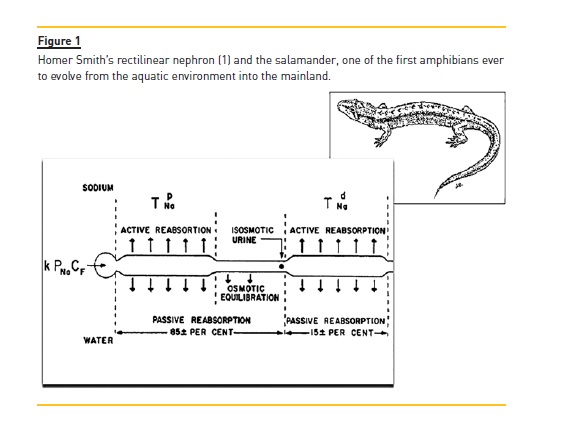
</front><body><![CDATA[ <p align="right"><b>EDITORIAL</b></p>      <p>&nbsp;</p>  <b>Fighting glomerular hegemony: giving the renal tubule the credits it deserves</b></p>      <p>&nbsp;</p>      <p><b>Joaquim Calado</b></p>      <p>Department of Nephrology, Centro Hospitalar de Lisboa Central; Centre for Toxicogenomics and Human Health (ToxOmics), Genetics, Oncology and Human Toxicology, Nova Medical School/Faculdade de Ciências Médicas, Universidade Nova de Lisboa</p>       <p>&nbsp;</p>      <p>Department of Nephrology, Centro Hospitalar de Lisboa Central; Centre for Toxicogenomics and Human Health (ToxOmics), Genetics, Oncology and Human Toxicology, Nova Medical School/Faculdade de Ciências Médicas, Universidade Nova de Lisboa.</p>       <p>This new editorial feature, the <b>tubular quiz</b>, aims at renewing the interest of Portuguese nephrologists in both clinical evaluation and research in renal physiology and disorders that affect the renal tubule. The Editor strongly believes in the axiomatic statement that physiology must always precede pathology. Understanding the “functioning logic” of the kidney is quintessential for every nephrologist.</p>      <p>Of all organs and complex systems of higher organisms, the kidney was among the first to have its physiology dissected (<a href="#f1">Figure 1</a>), in the early years of the second half of the twentieth century, largely due to the pioneer work of Homer W. Smith (1895-1962).</p>       <p>&nbsp;</p>  <a name="f1">  <img src="/img/revistas/nep/v32n1/32n1a02f1.jpg">      
]]></body>
<body><![CDATA[<p>&nbsp;</p>       <p>In tubular physiology, one must also understand the two singularities inherent to the kidney’s “functioning logic” that have boosted our understanding of tubular function. Firstly, the end-product of the kidney’s processing of the extra-cellular compartment (i.e., urine) is, unlike any other organ, easily available to everyone: from the physician in the emergency room to the most state-of-the-art physiology lab investigator. By simply looking into the urine, its pH, density, osmolality, presence and/or excretional fraction of solutes, a huge amount of information can be gained.</p>      <p>And secondly, the renal tubule, like any other epithelia, is a highly polarized structure, meaning that all the channels, pumps and transporters that populate it must be expressed in the right cell and targeted to the proper subcellular compartment. Mutations in any of those will lead to a specific phenotype, the study of which, in turn, will generate more information on the affected tubular segment. Mendelian inherited phenotypes have been, accordingly, a major source of knowledge regarding tubular function.</p>      <p>With this in mind, we invite all PJHN readers to submit to the Editor a short clinical vignette concerning cases they have experienced and covering acid-base, water and electrolyte disorders, of either inherited selective tubulopathies or acquired generalized tubular dysfunction, in pediatric or adult patients and affecting native or transplanted kidneys. Tables and imaging are welcome.</p>      <p>Selected cases will be jointly presented and discussed by the Editor and authors, with highlights or multiple choice questions for the most pertinent topics.</p>      <p>&nbsp;</p>      <p><b>References</b></p>      <!-- ref --><p><b>1. </b>Smith HW. The Fate of Sodium and Water in the Renal Tubules. <i>Bull N Y Acad Med</i>. 1959;35(5):293-316.    &nbsp;&nbsp;&nbsp;&nbsp;&nbsp;&nbsp;&nbsp;&nbsp;[&#160;<a href="javascript:void(0);" onclick="javascript: window.open('/scielo.php?script=sci_nlinks&ref=1163612&pid=S0872-0169201800010000200001&lng=','','width=640,height=500,resizable=yes,scrollbars=1,menubar=yes,');">Links</a>&#160;]<!-- end-ref --></p>       <p>&nbsp;</p>       ]]></body>
<body><![CDATA[<p><b><a name="c0"></a><a href="#topc0">Correspondence to:</a></b></p>     <p>Joaquim Calado, MD, PhD</p>     <p> Department of Nephrology, Centro Hospitalar de Lisboa Central</p>     <p>E-mail: <a href="mailto:jcalado@nms.unl.pt">jcalado@nms.unl.pt</a> </p>      <p>&nbsp;</p>      <p><b>Disclosure of potential conflicts of interest:<i> </i></b>none declared</p>      <p>&nbsp;</p>      <p><b>Received for publication:</b> Mar 30, 2018</p>     <p><b>Accepted in revised form:</b> Mar 30, 2018</p>        ]]></body><back>
<ref-list>
<ref id="B1">
<label>1.</label><nlm-citation citation-type="journal">
<person-group person-group-type="author">
<name>
<surname><![CDATA[Smith]]></surname>
<given-names><![CDATA[HW]]></given-names>
</name>
</person-group>
<article-title xml:lang="en"><![CDATA[The Fate of Sodium and Water in the Renal Tubules]]></article-title>
<source><![CDATA[Bull N Y Acad Med]]></source>
<year>1959</year>
<volume>35</volume>
<numero>5</numero>
<issue>5</issue>
<page-range>293-316</page-range></nlm-citation>
</ref>
</ref-list>
</back>
</article>