<?xml version="1.0" encoding="ISO-8859-1"?><article xmlns:mml="http://www.w3.org/1998/Math/MathML" xmlns:xlink="http://www.w3.org/1999/xlink" xmlns:xsi="http://www.w3.org/2001/XMLSchema-instance">
<front>
<journal-meta>
<journal-id>0872-0754</journal-id>
<journal-title><![CDATA[Nascer e Crescer]]></journal-title>
<abbrev-journal-title><![CDATA[Nascer e Crescer]]></abbrev-journal-title>
<issn>0872-0754</issn>
<publisher>
<publisher-name><![CDATA[Centro Hospitalar do Porto]]></publisher-name>
</publisher>
</journal-meta>
<article-meta>
<article-id>S0872-07542014000100006</article-id>
<title-group>
<article-title xml:lang="en"><![CDATA[Gradenigo syndrome: an unexpected otitis complication]]></article-title>
<article-title xml:lang="pt"><![CDATA[Síndrome de Gradenigo: uma complicação inesperada da otite]]></article-title>
</title-group>
<contrib-group>
<contrib contrib-type="author">
<name>
<surname><![CDATA[Catarina]]></surname>
<given-names><![CDATA[Mendes]]></given-names>
</name>
<xref ref-type="aff" rid="A01"/>
</contrib>
<contrib contrib-type="author">
<name>
<surname><![CDATA[Garrido]]></surname>
<given-names><![CDATA[Cristina]]></given-names>
</name>
<xref ref-type="aff" rid="A01"/>
</contrib>
<contrib contrib-type="author">
<name>
<surname><![CDATA[Guedes]]></surname>
<given-names><![CDATA[Margarida]]></given-names>
</name>
<xref ref-type="aff" rid="A01"/>
</contrib>
<contrib contrib-type="author">
<name>
<surname><![CDATA[Marques]]></surname>
<given-names><![CDATA[Laura]]></given-names>
</name>
<xref ref-type="aff" rid="A01"/>
</contrib>
</contrib-group>
<aff id="A01">
<institution><![CDATA[,Centro Hospitalar do Porto Serviço de Pediatria ]]></institution>
<addr-line><![CDATA[Porto ]]></addr-line>
</aff>
<pub-date pub-type="pub">
<day>00</day>
<month>03</month>
<year>2014</year>
</pub-date>
<pub-date pub-type="epub">
<day>00</day>
<month>03</month>
<year>2014</year>
</pub-date>
<volume>23</volume>
<numero>1</numero>
<fpage>25</fpage>
<lpage>28</lpage>
<copyright-statement/>
<copyright-year/>
<self-uri xlink:href="http://scielo.pt/scielo.php?script=sci_arttext&amp;pid=S0872-07542014000100006&amp;lng=en&amp;nrm=iso"></self-uri><self-uri xlink:href="http://scielo.pt/scielo.php?script=sci_abstract&amp;pid=S0872-07542014000100006&amp;lng=en&amp;nrm=iso"></self-uri><self-uri xlink:href="http://scielo.pt/scielo.php?script=sci_pdf&amp;pid=S0872-07542014000100006&amp;lng=en&amp;nrm=iso"></self-uri><abstract abstract-type="short" xml:lang="en"><p><![CDATA[Introduction: Gradenigo syndrome (also known as apical petrositis) is a clinical triad of otitis media, trigeminal neuralgia and ipsilateral abducens nerve palsy. In the era of antibiotic therapy, it is an exceptional but potentially life threatening complication of acute otitis media, requiring prompt diagnosis and treatment. Case report: A seven-year-old girl with previous history of otitis, presented with left ear pain, headache, diplopia and fever. Diagnosis of Gradenigo syndrome was established and she was treated with systemic broad-spectrum antibiotics and myringotomy with timpanostomy tube placement. Clinical outcome was favourable. Conclusion: This case documents therapeutic success and total recovery with a conservative approach in an immunocompetent child with Gradenigo syndrome.]]></p></abstract>
<abstract abstract-type="short" xml:lang="pt"><p><![CDATA[Introdução: O síndrome Gradenigo (também conhecido como petrosite apical) é uma tríade clínica definida por otite média, nevralgia do trigémeo e parésia ipsilateral do nervo abducente. Desde o advento da antibioterapia, passou a ser uma complicação rara da otite média aguda mas potencialmente fatal, requerendo diagnóstico e tratamento atempados. Caso clínico: Criança do sexo feminino, com sete anos de idade e história prévia de otite, com quadro de otalgia, cefaleia, diplopia e febre. Foi feito o diagnóstico de síndrome de Gradenigo e instituída antibioterapia de amplo espectro e miringotomia com colocação de tubos de ventilação transtimpânicos. A evolução clínica foi favorável. Conclusão: Este caso documenta o sucesso terapêutico e a recuperação total de uma criança imunocompetente com síndrome de Gradenigo com recurso a uma abordagem conservadora.]]></p></abstract>
<kwd-group>
<kwd lng="en"><![CDATA[Gradenigo]]></kwd>
<kwd lng="en"><![CDATA[otitis media]]></kwd>
<kwd lng="en"><![CDATA[petrositis]]></kwd>
<kwd lng="pt"><![CDATA[Gradenigo]]></kwd>
<kwd lng="pt"><![CDATA[otite média]]></kwd>
<kwd lng="pt"><![CDATA[petrosite]]></kwd>
</kwd-group>
</article-meta>
</front><body><![CDATA[ <p align="right"><font size="2" face="Verdana"><b>CASOS CL&Iacute;NICOS / CASE REPORTS</b></font></p>     <p align="left">&nbsp;</p>     <p align="left"><font size="4" face="Verdana"><b>Gradenigo syndrome: an unexpected otitis   complication</b></b></font></p>     <p>&nbsp;</p>     <p><b><font size="3" face="Verdana">S&iacute;ndrome de Gradenigo: uma complica&ccedil;&atilde;o inesperada da otite</font></b></p>     <p>&nbsp;</p>     <p>&nbsp;</p>     <p><b><font size="2" face="Verdana">Catarina Mendes<sup>I</sup>; Cristina   Garrido<sup>I</sup>; Margarida Guedes<sup>I</sup>; Laura Marques<sup>I</sup></font></b></p>     <p><font size="2" face="Verdana"><sup>I</sup>S. Pediatria, CH Porto,   4099-001 Porto,   Portugal. E-mail: <a href="mailto:catarinamendes@gmail.com">catarinamendes@gmail.com</a>; <a href="mailto:cgarridopt@gmail.com">cgarridopt@gmail.com</a>; <a href="mailto:margguedes@gmail.com">margguedes@gmail.com</a>; <a href="mailto:laurahoramarques@gmail.com">laurahoramarques@gmail.com</a></font></p>     <p><font size="2" face="Verdana"><a href="#end">Endere&ccedil;o para correspond&ecirc;ncia</a><a name="topo" id="topo"></a></font></p>     ]]></body>
<body><![CDATA[<p>&nbsp;</p>     <p>&nbsp;</p> <hr noshade size="1">     <p><font size="2" face="Verdana"><b>RESUMO</b></font></p>     <p><font size="2" face="Verdana"><b>Introdução</b>: O síndrome Gradenigo (também conhecido como petrosite apical) é uma tríade clínica   definida por otite média, nevralgia do trigémeo   e parésia ipsilateral do nervo abducente. Desde o advento da antibioterapia, passou a ser uma complicação rara   da otite média   aguda mas potencialmente fatal, requerendo diagnóstico e tratamento atempados.</font></p>     <p><font size="2" face="Verdana"><b>Caso clínico</b>: Criança do sexo feminino, com sete anos de idade e história prévia de otite, com quadro de otalgia,   cefaleia, diplopia   e febre. Foi feito   o diagnóstico de síndrome de Gradenigo e instituída   antibioterapia de amplo espectro e miringotomia com colocação de tubos   de ventilação transtimpânicos. A evolução clínica foi favorável.</font></p>     <p><font size="2" face="Verdana"><b>Conclusão</b>: Este caso documenta o sucesso terapêutico e a recuperação total   de uma criança   imunocompetente com síndrome de Gradenigo com recurso a uma abordagem conservadora.</font></p>     <p><font size="2" face="Verdana"><b>Palavras-chave</b>: Gradenigo, otite média, petrosite.</font></p> <hr noshade size="1">     <p><font size="2" face="Verdana"><b>ABSTRACT</b></font></p>     <p><font size="2" face="Verdana"><b>Introduction</b>: Gradenigo   syndrome (also known as apical petrositis) is a clinical   triad of otitis media, trigeminal neuralgia and ipsilateral abducens   nerve palsy. In the era of antibiotic therapy, it is an exceptional but potentially life   threatening complication of acute otitis media,   requiring prompt diagnosis   and treatment.</font></p>     <p><font size="2" face="Verdana"><b>Case   report</b>: A seven-year-old girl with   previous history of otitis, presented with left ear pain, headache, diplopia and fever. Diagnosis of Gradenigo syndrome was established and she was treated with systemic broad-spectrum antibiotics and myringotomy with timpanostomy tube placement.   Clinical outcome was favourable.</font></p>     ]]></body>
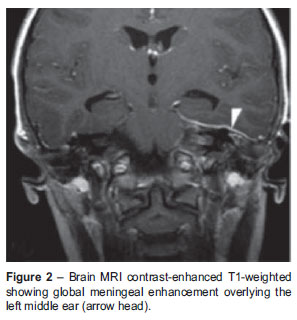
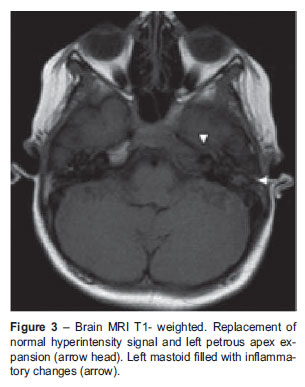
<body><![CDATA[<p><font size="2" face="Verdana"><b>Conclusion</b>: This case documents therapeutic success and total recovery with a conservative approach in an immunocompetent child with Gradenigo syndrome.</font></p>     <p><font size="2" face="Verdana"><b>Key-words</b>: Gradenigo, otitis   media, petrositis.</font></p> <hr noshade size="1">     <p>&nbsp;</p>     <p>&nbsp;</p>     <p><b><font size="3" face="Verdana">INTRODUCTION</font></b></p>     <p><font size="2" face="Verdana">Gradenigo syndrome, first described in 1907 by Giuseppe Gradenigo, is characterized by the clinical triad   of acute otitis media, facial   pain in the fifth cranial   nerve distribution and ipsilateral abducens nerve palsy.<sup>(1)</sup> It is a serious   complication of acute otitis media and mastoiditis, although increasingly rare   due to wide antibiotic availability, and results   of direct extension of the infectious process into the petrous apex.<sup>(2)</sup> Cranial nerve dysfunction is caused by osteitis   and local leptomeningitis near the petrous apex. In that location, the trigeminal nerve ganglion and the abducens nerve lie closely   together, making them vulnerable to any local inflammatory process.<sup>(2,3)</sup> Infections   in the petrous   apex can be life threatening, given their   propensity to spread medially   and to involve   meninges, cavernous sinus and brain.<sup>(3)</sup></font></p>     <p><font size="2" face="Verdana">Acute petrositis diagnosis requires   imaging studies, namely, computed tomography (CT), magnetic resonance   imaging (MRI) or nuclear   imaging techniques, to identify the petrous   apex as the site of the inflammatory process.<sup>(3)</sup> The treatment of Gradenigo syndrome   is not consensual and should be managed on an individual basis.<sup>(4)</sup></font></p>     <p>&nbsp;</p>     <p><b><font size="3" face="Verdana">CASE REPORT</font></b></p>     <p><font size="2" face="Verdana">A   seven-year old caucasian girl was admitted   to our hospital for meningitis and acute onset strabismus. The patient   had previous history of acute otitis media (about one or two episodes per year), the last one occurring the previous month. She had been examined seven days before for left otalgia, without fever or any other complaints and was discharged with symptomatic treatment.   On admission day, she complained of diplopia, photophobia and left facial pain; left strabismus was noticed. On physical examination, she presented   fever, meningeal signs   and left acute otitis media without clinical   signs of mastoiditis. Left convergent strabismus was evident with abduction impairment of the same eye. Brain CT scan showed inflammatory changes   of the sphenoidal sinus and both mastoid cavities; brain parenchyma was normal, no deviation   from the midline   structures was found and cerebrospinal fluid   spaces showed no signs   of hydrocephaly (<a href="#f1">Figure 1</a>). Laboratory tests revealed elevated inflammatory parameters, with a white blood cell count   of 18.500/mm3, polymorphonuclear   neutrophils of 15.000/mm3 and C-reactive protein of 317 mg/L. Lumbar puncture revealed   cloudy cerebrospinal fluid (CSF), with cytochemical examination showing pleocytosis (736 cells,   91% polymorphonuclear and 3% of mononuclear cells), hypoglycorrhachia (0,09 g/L) and hyperproteinorhachia (3,18 g/L). A single   dose of dexamethasone was administered and intravenous antibiotic treatment with ceftriaxone (100 mg/kg) and vancomycin (60 mg/kg)   was started. Brain MRI (<a href="#f2">Figure 2</a>) found   global meningeal   enhancement, in particular within the region overlying the left middle ear, suggesting an inflammatory/infectious process centred   in the left ear, with extension into the cranial cavity. Venous sinus thrombosis was excluded.</font></p>     ]]></body>
<body><![CDATA[<p><a name="f1"></a></p>     <p>&nbsp;</p>     <p align="center"><img src="/img/revistas/nas/v23n1/23n1a06f1.jpg" width="324" height="365"></p>     
<p>&nbsp;</p>     <p><a name="f2"></a></p>     <p>&nbsp;</p>     <p align="center"><img src="/img/revistas/nas/v23n1/23n1a06f2.jpg" width="297" height="320"></p>     
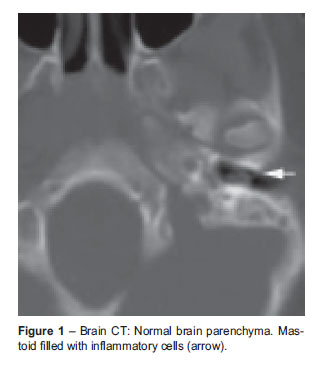
<p>&nbsp;</p>     <p><font size="2" face="Verdana">On second day of admission,   the patient was submitted to a left myringotomy with tympanostomy tube placement, with relief of pain complaints.</font></p>     <p><font size="2" face="Verdana">On CSF, <i>Staphylococcus capitis   </i>was isolated and interpreted as a probable contaminat; Herpes simplex   virus 1,2 and Enterovirus were negative. Polymerase chain reaction for <i>Mycobacterium tuberculosis </i>and <i>Streptococcus pneumoniae </i>and <i>Borrelia burgdoferi </i>serology were negative. Blood   culture proved sterile and ear pus culture revealed   commensal flora. Adenosine deaminase serum levels and Interferon-gamma release assay   were within   normal ranges. Tuberculin test was negative   and chest x-ray showed no pathological signs. A second   MRI was performed after three weeks of initial   symptoms, showing the left mastoid filled with inflammatory changes, left petrous apex expansion and adjacent pachymeningeal enhancement, features suggestive of apical petrositis (<a href="#f3">Figure   3</a>). Inflammatory changes had no apparent   extension to the cavernous sinus or Gasser ganglion cistern. These findings confirmed Gradenigo syndrome.</font></p>     ]]></body>
<body><![CDATA[<p><a name="f3"></a></p>     <p align="center"><img src="/img/revistas/nas/v23n1/23n1a06f3.jpg" width="305" height="387"></p>     
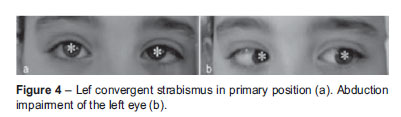
<p>&nbsp;</p>     <p><font size="2" face="Verdana">The child received thirty-three days of intravenous ceftriaxone and vancomycin, with clinical   and radiological improvement. There was a gradual improvement of the abducens   paresis. By the time she was discharged   her left eye abduction was still impaired to about one third of total width (<a href="#f4">Figure 4</a>). Cefuroxime axetil (30 mg/kg)   was continued for eight weeks along with eyealternating occlusion,   initiated on admission. Full   recovery of the strabismus was achieved by the time she ended antibiotic   therapy and no hearing loss was noticed.   Immunoglobulin IgA, IgG, IgM, IgE, specific IgG antibody   levels for Pneumococcal capsular polysaccharide and Tetanus toxoid   were normal. HIV test was negative.   During the 4-month   follow-up period, no further complications occurred.  </font></p>     <p><a name="f4"></a></p>     <p>&nbsp;</p>     <p align="center"><img src="/img/revistas/nas/v23n1/23n1a06f4.jpg" width="401" height="117"></p>     
<p>&nbsp;</p>     <p>&nbsp;</p>     <p><b><font size="3" face="Verdana">DISCUSSION</font></b></p>     ]]></body>
<body><![CDATA[<p><font size="2" face="Verdana">Gradenigo syndrome affects   about two in every 100.000   children with otitis media.<sup>(5)</sup> It can, however, be fatal.<sup>(3,4)</sup> The petrous apex contains a pneumatized cell system that communicates with the middle   ear; when inflammation occurs, its mucosa   becomes thickened causing   petrous apex obstruction. Inflammation spread can lead to meningitis, empyema, brain abscess, venous thrombosis, cranial nerve paralysis   and internal carotid artery stenosis.<sup>(3-8)</sup> Time lapse between   otological symptoms   and cranial nerve dysfunction varies from 1 to 12 weeks.<sup>(2,7)</sup> Radiologic imaging is essential to petrositis   diagnosis, allowing staging and exclusion of other diagnosis, namely septic   sinus thrombosis, tumours or aneurisms.<sup>(4,7)</sup> Therefore, any child presenting with acute otitis media with suspected   intracranial complication, should undergo   imaging testing.<sup>(7)</sup> CT scan is the first choice of imaging, since it is widely available and detects changes   in bone structures, including destruction of trabecular bone and erosion of the petrous apex.<sup>(4,9)</sup> MRI is more sensitive   in detecting dural thickening and enhancement as well as intracranial complications. An MRI angiography may be performed   to rule out signs of sinus thrombosis.<sup>(9)</sup></font></p>     <p><font size="2" face="Verdana">In this case, anamnesis and imaging studies   revealed consistent findings of acute petrositis. The time interval between otitis onset and cranial nerves dysfunction (left facial pain and VI pair paresis) was seven days. As reported   in the literature, this period   probably reflected the infection   extension into meninges and apex.<sup>(2,7)</sup> Despite thorough workup no agent was identified. Exclusion of meningeal tuberculosis and Lyme disease   was paramount, because of cranial   nerve involvement and meningitis without significant CSF growth. The fact that an apparently healthy child developed   such a serious and rare complication is surprising. Reviewing Gradenigo’s cases recently described in the literature it appears that affected   children had either unremarkable previous medical history or previous recurrent   ear infections only.<sup>(2-8)</sup> This child was investigated for immunodeficiency and no abnormalities were found. HIV infection was also excluded.</font></p>     <p><font size="2" face="Verdana">Therapeutic management of Gradenigo syndrome is controversial and challenging. Antibiotics will usually treat   the infection before   dural involvement, hence Gradenigo’s cases are currently rare.<sup>(2,3,7,10)</sup> Although early reports advocate the need for radical surgery, recent   cases have shown positive   results with a conservative approach, with medical   treatment and minimal surgical intervention   (namely antibiotics, steroids and myringotomy with ear tube   placement).<sup>(2-4,7,8)</sup> Medical treatment should   include broad-spectrum intravenous antibiotics, targeted   at common agents involved   in bacterial mastoiditis (<i>Staphylococcus aureus</i>, <i>Streptococcus pneumoniae</i>, <i>Streptococcus pyogenes </i>and <i>Pseu-     domonas aerugino</i>sa); anaerobic organisms can also be considered.<sup>(9,10)</sup> Aggressive surgery   (mastoidectomy) is recommended when conservative therapy   fails, despite   suitable antibiotic   therapy; when there is an obvious   middle ear chronic pathology or within the presence of potentially fatal complications.<sup>(2,3,7)</sup></font></p>     <p><font size="2" face="Verdana">In this case, a conservative approach was proposed and the patient was managed   with broad-spectrum intravenous antibiotics and myringotomy with timpanostomy tube placement.   There was a clinical   and analytical favourable outcome and absence of coalescence or bone resorption. Although an optimal treatment duration   has not yet been established, in recent   cases the treatment period ranged from 3 to 5 weeks.(3,4,7) Our patient   showed immediate   pain relief and fever resolution after surgery   and antibiotic therapy was started. Abducens palsy showed slow improvement, therefore antibiotic therapy was sustained until she fully recovered.</font></p>     <p>&nbsp;</p>     <p><b><font size="3" face="Verdana">REFERENCES</font></b></p>     <!-- ref --><p><font size="2" face="Verdana">1.&nbsp;&nbsp;&nbsp;&nbsp;&nbsp;   Gradenigo G. Über die paralyse des nervus abducens bei otitis. Arch Ohrenheilk 1907; 774:149-87.    &nbsp;&nbsp;&nbsp;&nbsp;&nbsp;&nbsp;&nbsp;&nbsp;[&#160;<a href="javascript:void(0);" onclick="javascript: window.open('/scielo.php?script=sci_nlinks&ref=000059&pid=S0872-0754201400010000600001&lng=','','width=640,height=500,resizable=yes,scrollbars=1,menubar=yes,');">Links</a>&#160;]<!-- end-ref --></font></p>     <!-- ref --><p><font size="2" face="Verdana">2.&nbsp;&nbsp;&nbsp;&nbsp;&nbsp; Marianowski R, Rocton S, Ait-Amer JL, Morisseau-Durand MP, Manach Y. Conservative management of Gradenigo syndrome in a child. Int J Pediatr Otorhinolaryngol 2001; 57:79-83.    &nbsp;&nbsp;&nbsp;&nbsp;&nbsp;&nbsp;&nbsp;&nbsp;[&#160;<a href="javascript:void(0);" onclick="javascript: window.open('/scielo.php?script=sci_nlinks&ref=000061&pid=S0872-0754201400010000600002&lng=','','width=640,height=500,resizable=yes,scrollbars=1,menubar=yes,');">Links</a>&#160;]<!-- end-ref --></font></p>     ]]></body>
<body><![CDATA[<!-- ref --><p><font size="2" face="Verdana">3.&nbsp;&nbsp;&nbsp;&nbsp;&nbsp;   Finkelstein Y, Marcus N, Mosseri   R, Bar-Sever Z, Garty BZ. Streptococcus acidominimus infection in a child causing Gradenigo syndrome. Int J Pediatr Otorhinolaryngol 2003; 67:815-7.    &nbsp;&nbsp;&nbsp;&nbsp;&nbsp;&nbsp;&nbsp;&nbsp;[&#160;<a href="javascript:void(0);" onclick="javascript: window.open('/scielo.php?script=sci_nlinks&ref=000063&pid=S0872-0754201400010000600003&lng=','','width=640,height=500,resizable=yes,scrollbars=1,menubar=yes,');">Links</a>&#160;]<!-- end-ref --></font></p>     <!-- ref --><p><font size="2" face="Verdana">4.&nbsp;&nbsp;&nbsp;&nbsp;&nbsp;   Gibier L, Darrouzet V, Franco-Vidal V. Gradenigo syndrome without acute otitis media. Pediatr Neurol 2009; 41:215-9.    &nbsp;&nbsp;&nbsp;&nbsp;&nbsp;&nbsp;&nbsp;&nbsp;[&#160;<a href="javascript:void(0);" onclick="javascript: window.open('/scielo.php?script=sci_nlinks&ref=000065&pid=S0872-0754201400010000600004&lng=','','width=640,height=500,resizable=yes,scrollbars=1,menubar=yes,');">Links</a>&#160;]<!-- end-ref --></font></p>     <!-- ref --><p><font size="2" face="Verdana">5.&nbsp;&nbsp;&nbsp;&nbsp;&nbsp;   Goldstein NA, Casselbrandt ML, Bluestone CD, Kurs-Lasky M. Intratemporal complications of acute otitis media in infants and children. Otolaryngol Head Neck Surg 1998; 119:444-54.    &nbsp;&nbsp;&nbsp;&nbsp;&nbsp;&nbsp;&nbsp;&nbsp;[&#160;<a href="javascript:void(0);" onclick="javascript: window.open('/scielo.php?script=sci_nlinks&ref=000067&pid=S0872-0754201400010000600005&lng=','','width=640,height=500,resizable=yes,scrollbars=1,menubar=yes,');">Links</a>&#160;]<!-- end-ref --></font></p>     <!-- ref --><p><font size="2" face="Verdana">6.&nbsp;&nbsp;&nbsp;&nbsp;&nbsp;   Dorn M, Liener K, Rozsasi A, Keck T. Prolonged   diplopia following sinus vein mimicking Gradenigo’s syndrome. Int J Pediatr Otorhinolaryngol 2006; 70:741-3.    &nbsp;&nbsp;&nbsp;&nbsp;&nbsp;&nbsp;&nbsp;&nbsp;[&#160;<a href="javascript:void(0);" onclick="javascript: window.open('/scielo.php?script=sci_nlinks&ref=000069&pid=S0872-0754201400010000600006&lng=','','width=640,height=500,resizable=yes,scrollbars=1,menubar=yes,');">Links</a>&#160;]<!-- end-ref --></font></p>     <!-- ref --><p><font size="2" face="Verdana">7.&nbsp;&nbsp;&nbsp;&nbsp;&nbsp;   Guedes V, Gallegos P, Ferrero A, García-Minúzzi M, Casanovas A, Georgetti B, et al. Gradenigo’s syndrome: a casereport. Arch Argent Pediatr 2010; 108:e74-e75.    &nbsp;&nbsp;&nbsp;&nbsp;&nbsp;&nbsp;&nbsp;&nbsp;[&#160;<a href="javascript:void(0);" onclick="javascript: window.open('/scielo.php?script=sci_nlinks&ref=000071&pid=S0872-0754201400010000600007&lng=','','width=640,height=500,resizable=yes,scrollbars=1,menubar=yes,');">Links</a>&#160;]<!-- end-ref --></font></p>     ]]></body>
<body><![CDATA[<!-- ref --><p><font size="2" face="Verdana">8.&nbsp;&nbsp;&nbsp;&nbsp;&nbsp;   Kong SK, Lee IW, Goh EK, Park SE. Acute otitis mediainduced petrous apicitis presenting   as the Gradenigo syndrome: successfully treated by ventilation tube insertion. Am J Otolaryngol 2011; 32:445-7.    &nbsp;&nbsp;&nbsp;&nbsp;&nbsp;&nbsp;&nbsp;&nbsp;[&#160;<a href="javascript:void(0);" onclick="javascript: window.open('/scielo.php?script=sci_nlinks&ref=000073&pid=S0872-0754201400010000600008&lng=','','width=640,height=500,resizable=yes,scrollbars=1,menubar=yes,');">Links</a>&#160;]<!-- end-ref --></font></p>     <!-- ref --><p><font size="2" face="Verdana">9.&nbsp;&nbsp;&nbsp;&nbsp;&nbsp;   Luntz M, Brodsky   A, Nusem S, Kronenberg J, Keren G, Migirov L,   et   al. Acute mastoiditis the antibiotic era: a multicenter study. Int J Pediatr Otorhinolaryngol 2001; 57:1-9.    &nbsp;&nbsp;&nbsp;&nbsp;&nbsp;&nbsp;&nbsp;&nbsp;[&#160;<a href="javascript:void(0);" onclick="javascript: window.open('/scielo.php?script=sci_nlinks&ref=000075&pid=S0872-0754201400010000600009&lng=','','width=640,height=500,resizable=yes,scrollbars=1,menubar=yes,');">Links</a>&#160;]<!-- end-ref --></font></p>     <!-- ref --><p><font size="2" face="Verdana">10.&nbsp;&nbsp;   Jacobsen CL, Bruhn   MA, Yavarian Y, Gaihede M. Mastoiditis and Gradenigo’s Syndrome with anaerobic bacteria. BMC Ear, Nose and Throat Disorders 2012; 12:10.    &nbsp;&nbsp;&nbsp;&nbsp;&nbsp;&nbsp;&nbsp;&nbsp;[&#160;<a href="javascript:void(0);" onclick="javascript: window.open('/scielo.php?script=sci_nlinks&ref=000077&pid=S0872-0754201400010000600010&lng=','','width=640,height=500,resizable=yes,scrollbars=1,menubar=yes,');">Links</a>&#160;]<!-- end-ref --></font></p>     <p>&nbsp;</p>     <p>&nbsp;</p>     <p><font size="2" face="Verdana"><b><a name="end" id="topo2"></a><a href="#topo">Endere&ccedil;o para correspond&ecirc;ncia</a></b></font>    <br>   <font size="2" face="Verdana">Ana Catarina Barbedo Mendes     ]]></body>
<body><![CDATA[<br>   Centro Hospitalar do Porto    <br>   Largo Professor Abel Salazar       <br>   4099-001 Porto, Portugal    <br> E-mail: <a href="mailto:catarinamendes@gmail.com">catarinamendes@gmail.com</a> </font></p>     <p><font size="2" face="Verdana">Recebido a 08.01.2013 | Aceite a 30.06.2013</font></p>      ]]></body><back>
<ref-list>
<ref id="B1">
<label>1</label><nlm-citation citation-type="journal">
<person-group person-group-type="author">
<name>
<surname><![CDATA[Gradenigo]]></surname>
<given-names><![CDATA[G]]></given-names>
</name>
</person-group>
<article-title xml:lang="en"><![CDATA[Über die paralyse des nervus abducens bei otitis]]></article-title>
<source><![CDATA[Arch Ohrenheilk]]></source>
<year>1907</year>
<volume>774</volume>
<page-range>149-87</page-range></nlm-citation>
</ref>
<ref id="B2">
<label>2</label><nlm-citation citation-type="journal">
<person-group person-group-type="author">
<name>
<surname><![CDATA[Marianowski]]></surname>
<given-names><![CDATA[R]]></given-names>
</name>
<name>
<surname><![CDATA[Rocton]]></surname>
<given-names><![CDATA[S]]></given-names>
</name>
<name>
<surname><![CDATA[Ait-Amer]]></surname>
<given-names><![CDATA[JL]]></given-names>
</name>
<name>
<surname><![CDATA[Morisseau-Durand]]></surname>
<given-names><![CDATA[MP]]></given-names>
</name>
<name>
<surname><![CDATA[Manach]]></surname>
<given-names><![CDATA[Y]]></given-names>
</name>
</person-group>
<article-title xml:lang="en"><![CDATA[Conservative management of Gradenigo syndrome in a child]]></article-title>
<source><![CDATA[Int J Pediatr Otorhinolaryngol]]></source>
<year>2001</year>
<volume>57</volume>
<page-range>79-83</page-range></nlm-citation>
</ref>
<ref id="B3">
<label>3</label><nlm-citation citation-type="journal">
<person-group person-group-type="author">
<name>
<surname><![CDATA[Finkelstein]]></surname>
<given-names><![CDATA[Y]]></given-names>
</name>
<name>
<surname><![CDATA[Marcus]]></surname>
<given-names><![CDATA[N]]></given-names>
</name>
<name>
<surname><![CDATA[Mosseri]]></surname>
<given-names><![CDATA[R]]></given-names>
</name>
<name>
<surname><![CDATA[Bar-Sever]]></surname>
<given-names><![CDATA[Z]]></given-names>
</name>
<name>
<surname><![CDATA[Garty]]></surname>
<given-names><![CDATA[BZ]]></given-names>
</name>
</person-group>
<article-title xml:lang="en"><![CDATA[Streptococcus acidominimus infection in a child causing Gradenigo syndrome]]></article-title>
<source><![CDATA[Int J Pediatr Otorhinolaryngol]]></source>
<year>2003</year>
<volume>67</volume>
<page-range>815-7</page-range></nlm-citation>
</ref>
<ref id="B4">
<label>4</label><nlm-citation citation-type="journal">
<person-group person-group-type="author">
<name>
<surname><![CDATA[Gibier]]></surname>
<given-names><![CDATA[L]]></given-names>
</name>
<name>
<surname><![CDATA[Darrouzet]]></surname>
<given-names><![CDATA[V]]></given-names>
</name>
<name>
<surname><![CDATA[Franco-Vidal]]></surname>
<given-names><![CDATA[V]]></given-names>
</name>
</person-group>
<article-title xml:lang="en"><![CDATA[Gradenigo syndrome without acute otitis media]]></article-title>
<source><![CDATA[Pediatr Neurol]]></source>
<year>2009</year>
<volume>41</volume>
<page-range>215-9</page-range></nlm-citation>
</ref>
<ref id="B5">
<label>5</label><nlm-citation citation-type="journal">
<person-group person-group-type="author">
<name>
<surname><![CDATA[Goldstein]]></surname>
<given-names><![CDATA[NA]]></given-names>
</name>
<name>
<surname><![CDATA[Casselbrandt]]></surname>
<given-names><![CDATA[ML]]></given-names>
</name>
<name>
<surname><![CDATA[Bluestone]]></surname>
<given-names><![CDATA[CD]]></given-names>
</name>
<name>
<surname><![CDATA[Kurs-Lasky]]></surname>
<given-names><![CDATA[M]]></given-names>
</name>
</person-group>
<article-title xml:lang="en"><![CDATA[Intratemporal complications of acute otitis media in infants and children]]></article-title>
<source><![CDATA[Otolaryngol Head Neck Surg]]></source>
<year>1998</year>
<volume>119</volume>
<page-range>444-54</page-range></nlm-citation>
</ref>
<ref id="B6">
<label>6</label><nlm-citation citation-type="journal">
<person-group person-group-type="author">
<name>
<surname><![CDATA[Dorn]]></surname>
<given-names><![CDATA[M]]></given-names>
</name>
<name>
<surname><![CDATA[Liener]]></surname>
<given-names><![CDATA[K]]></given-names>
</name>
<name>
<surname><![CDATA[Rozsasi]]></surname>
<given-names><![CDATA[A]]></given-names>
</name>
<name>
<surname><![CDATA[Keck]]></surname>
<given-names><![CDATA[T]]></given-names>
</name>
</person-group>
<article-title xml:lang="en"><![CDATA[Prolonged diplopia following sinus vein mimicking Gradenigo’s syndrome]]></article-title>
<source><![CDATA[Int J Pediatr Otorhinolaryngol]]></source>
<year>2006</year>
<volume>70</volume>
<page-range>741-3</page-range></nlm-citation>
</ref>
<ref id="B7">
<label>7</label><nlm-citation citation-type="journal">
<person-group person-group-type="author">
<name>
<surname><![CDATA[Guedes]]></surname>
<given-names><![CDATA[V]]></given-names>
</name>
<name>
<surname><![CDATA[Gallegos]]></surname>
<given-names><![CDATA[P]]></given-names>
</name>
<name>
<surname><![CDATA[Ferrero]]></surname>
<given-names><![CDATA[A]]></given-names>
</name>
<name>
<surname><![CDATA[García-Minúzzi]]></surname>
<given-names><![CDATA[M]]></given-names>
</name>
<name>
<surname><![CDATA[Casanovas]]></surname>
<given-names><![CDATA[A]]></given-names>
</name>
<name>
<surname><![CDATA[Georgetti]]></surname>
<given-names><![CDATA[B]]></given-names>
</name>
</person-group>
<article-title xml:lang="en"><![CDATA[Gradenigo’s syndrome: a casereport]]></article-title>
<source><![CDATA[Arch Argent Pediatr]]></source>
<year>2010</year>
<volume>108</volume>
<page-range>e74-e75</page-range></nlm-citation>
</ref>
<ref id="B8">
<label>8</label><nlm-citation citation-type="journal">
<person-group person-group-type="author">
<name>
<surname><![CDATA[Kong]]></surname>
<given-names><![CDATA[SK]]></given-names>
</name>
<name>
<surname><![CDATA[Lee]]></surname>
<given-names><![CDATA[IW]]></given-names>
</name>
<name>
<surname><![CDATA[Goh]]></surname>
<given-names><![CDATA[EK]]></given-names>
</name>
<name>
<surname><![CDATA[Park]]></surname>
<given-names><![CDATA[SE]]></given-names>
</name>
</person-group>
<article-title xml:lang="en"><![CDATA[Acute otitis mediainduced petrous apicitis presenting as the Gradenigo syndrome: successfully treated by ventilation tube insertion]]></article-title>
<source><![CDATA[Am J Otolaryngol]]></source>
<year>2011</year>
<volume>32</volume>
<page-range>445-7</page-range></nlm-citation>
</ref>
<ref id="B9">
<label>9</label><nlm-citation citation-type="journal">
<person-group person-group-type="author">
<name>
<surname><![CDATA[Luntz]]></surname>
<given-names><![CDATA[M]]></given-names>
</name>
<name>
<surname><![CDATA[Brodsky]]></surname>
<given-names><![CDATA[A]]></given-names>
</name>
<name>
<surname><![CDATA[Nusem]]></surname>
<given-names><![CDATA[S]]></given-names>
</name>
<name>
<surname><![CDATA[Kronenberg]]></surname>
<given-names><![CDATA[J]]></given-names>
</name>
<name>
<surname><![CDATA[Keren]]></surname>
<given-names><![CDATA[G]]></given-names>
</name>
<name>
<surname><![CDATA[Migirov]]></surname>
<given-names><![CDATA[L]]></given-names>
</name>
</person-group>
<article-title xml:lang="en"><![CDATA[Acute mastoiditis the antibiotic era: a multicenter study]]></article-title>
<source><![CDATA[Int J Pediatr Otorhinolaryngol]]></source>
<year>2001</year>
<volume>57</volume>
<page-range>1-9</page-range></nlm-citation>
</ref>
<ref id="B10">
<label>10</label><nlm-citation citation-type="journal">
<person-group person-group-type="author">
<name>
<surname><![CDATA[Jacobsen]]></surname>
<given-names><![CDATA[CL]]></given-names>
</name>
<name>
<surname><![CDATA[Bruhn]]></surname>
<given-names><![CDATA[MA]]></given-names>
</name>
<name>
<surname><![CDATA[Yavarian]]></surname>
<given-names><![CDATA[Y]]></given-names>
</name>
<name>
<surname><![CDATA[Gaihede]]></surname>
<given-names><![CDATA[M]]></given-names>
</name>
</person-group>
<article-title xml:lang="en"><![CDATA[Mastoiditis and Gradenigo’s Syndrome with anaerobic bacteria]]></article-title>
<source><![CDATA[BMC Ear, Nose and Throat Disorders]]></source>
<year>2012</year>
<volume>12</volume>
<page-range>10</page-range></nlm-citation>
</ref>
</ref-list>
</back>
</article>