<?xml version="1.0" encoding="ISO-8859-1"?><article xmlns:mml="http://www.w3.org/1998/Math/MathML" xmlns:xlink="http://www.w3.org/1999/xlink" xmlns:xsi="http://www.w3.org/2001/XMLSchema-instance">
<front>
<journal-meta>
<journal-id>0872-0754</journal-id>
<journal-title><![CDATA[Nascer e Crescer]]></journal-title>
<abbrev-journal-title><![CDATA[Nascer e Crescer]]></abbrev-journal-title>
<issn>0872-0754</issn>
<publisher>
<publisher-name><![CDATA[Centro Hospitalar do Porto]]></publisher-name>
</publisher>
</journal-meta>
<article-meta>
<article-id>S0872-07542014000500004</article-id>
<title-group>
<article-title xml:lang="en"><![CDATA[Oesophageal atresia: a 10-year experience of a Paediatric Intensive Care Unit]]></article-title>
<article-title xml:lang="pt"><![CDATA[Atrésia esofágica: 10 anos de experiência de um serviço de cuidados intensivos pediátricos]]></article-title>
</title-group>
<contrib-group>
<contrib contrib-type="author">
<name>
<surname><![CDATA[Pinho]]></surname>
<given-names><![CDATA[Liliana]]></given-names>
</name>
<xref ref-type="aff" rid="A01"/>
</contrib>
<contrib contrib-type="author">
<name>
<surname><![CDATA[Margatho]]></surname>
<given-names><![CDATA[Maristela]]></given-names>
</name>
<xref ref-type="aff" rid="A01"/>
</contrib>
<contrib contrib-type="author">
<name>
<surname><![CDATA[Dias]]></surname>
<given-names><![CDATA[Andrea]]></given-names>
</name>
<xref ref-type="aff" rid="A01"/>
</contrib>
<contrib contrib-type="author">
<name>
<surname><![CDATA[Pinto]]></surname>
<given-names><![CDATA[Carla]]></given-names>
</name>
<xref ref-type="aff" rid="A01"/>
</contrib>
<contrib contrib-type="author">
<name>
<surname><![CDATA[Lopes]]></surname>
<given-names><![CDATA[Maria Francelina]]></given-names>
</name>
<xref ref-type="aff" rid="A02"/>
</contrib>
<contrib contrib-type="author">
<name>
<surname><![CDATA[Neves]]></surname>
<given-names><![CDATA[Farela]]></given-names>
</name>
<xref ref-type="aff" rid="A01"/>
</contrib>
</contrib-group>
<aff id="A01">
<institution><![CDATA[,Centro Hospitalar e Universitário de Coimbra Hospital Pediátrico Carmona da Mota Serviço de Cuidados Intensivos Pediátricos]]></institution>
<addr-line><![CDATA[Coimbra ]]></addr-line>
<country>Portugal</country>
</aff>
<aff id="A02">
<institution><![CDATA[,Centro Hospitalar e Universitário de Coimbra Hospital Pediátrico Carmona da Mota Serviço de Cirurgia Pediátrica]]></institution>
<addr-line><![CDATA[Coimbra ]]></addr-line>
<country>Portugal</country>
</aff>
<pub-date pub-type="pub">
<day>01</day>
<month>09</month>
<year>2014</year>
</pub-date>
<pub-date pub-type="epub">
<day>01</day>
<month>09</month>
<year>2014</year>
</pub-date>
<volume>23</volume>
<numero>3</numero>
<fpage>140</fpage>
<lpage>144</lpage>
<copyright-statement/>
<copyright-year/>
<self-uri xlink:href="http://scielo.pt/scielo.php?script=sci_arttext&amp;pid=S0872-07542014000500004&amp;lng=en&amp;nrm=iso"></self-uri><self-uri xlink:href="http://scielo.pt/scielo.php?script=sci_abstract&amp;pid=S0872-07542014000500004&amp;lng=en&amp;nrm=iso"></self-uri><self-uri xlink:href="http://scielo.pt/scielo.php?script=sci_pdf&amp;pid=S0872-07542014000500004&amp;lng=en&amp;nrm=iso"></self-uri><abstract abstract-type="short" xml:lang="en"><p><![CDATA[Background/Purpose: Oesophageal atresia (OA) is a congenital malformation with a variable prognosis. The aims were to establish OA’s incidence in the central region, to characterize infants with OA admitted and to compare its clinical outcome after surgical repair, according to OA classification. Methods: A retrospective review of infants with OA admitted to a PICU, after surgical repair, between 2002 and 2011. Patient characteristics, OA’s classification, surgery, morbidity and mortality were analyzed. Two groups were compared according to OA classification. Results: Thirty-four infants were admitted, out of which 65% were male, with a median gestational age of 36 weeks and birth weight of 2310g. Nineteen of them presented other malformations, mainly cardiac. Nine cases were classified as long-gap OA. Fistula ligation and primary oesophageal anastomosis was the most common surgical option (n=27). Early complications occurred in 13 infants (38%), mostly anastomotic leak, and were similar according to gap length (p=0.704). PICU stay and mechanical ventilation were longer in long-gap OA patients (p=0.009 and p<0.001 respectively) and in infants with other malformations (p=0.027 and p=0.003 respectively). There was no mortality. Conclusions: The frequency of OA associated malformations implies a systematic screening of these patients. Gap length and presence of associated malformations were the major determinants of length of intensive care stay and ventilation days in OA patients.]]></p></abstract>
<abstract abstract-type="short" xml:lang="pt"><p><![CDATA[Introdução/Objetivos: A atrésia esofágica (AE) é uma malformação congénita com prognóstico variável. Os objetivos do estudo foram estabelecer a incidência de AE na região centro, caracterizar os lactentes com AE admitidos e comparar a evolução após cirurgia, atendendo ao tipo de AE. Métodos: Estudo descritivo com colheita retrospetiva de dados dos lactentes admitidos no Serviço de Cuidados Intensivos (CIPE) no pós-operatório de AE, entre 2002 e 2011. Foram analisados os seguintes parâmetros: características dos doentes, classificação da AE, tipo de cirurgia, morbilidade e mortalidade. Comparação dos dois grupos de acordo com a classificação da AE. Resultados: Foram admitidas 34 crianças, 65% do sexo masculino. A mediana da idade gestacional foi 36 semanas e do peso ao nascer 2310g. Foram detetadas malformações associadas em 19 crianças, sobretudo cardíacas. Nove casos foram classificados como hiato longo (HL). A opção cirúrgica mais frequente foi laqueação de fístula e esófago-esofagostomia primária (n=27). Registaram-se complicações precoces em 13 lactentes (38%), sobretudo deiscência da anastomose, não se registando diferença em relação ao tamanho do hiato (p=0.704). A duração do internamento em cuidados intensivos e o tempo de ventilação mecânica foram superiores nas situações de HL (p=0.009 e p<0.001 respetivamente) e na presença de malformações associadas (p=0.027 e p=0.003 respetivamente). Não se registaram óbitos. Conclusões: A frequência de malformações associadas obriga a um rastreio sistemático. A presença de HL e malformações associadas foram os principais determinantes da duração de internamento em cuidados intensivos e do período de ventilação mecânica nos doentes com AE.]]></p></abstract>
<kwd-group>
<kwd lng="en"><![CDATA[Complications]]></kwd>
<kwd lng="en"><![CDATA[oesophageal atresia]]></kwd>
<kwd lng="en"><![CDATA[outcome]]></kwd>
<kwd lng="en"><![CDATA[surgery]]></kwd>
<kwd lng="pt"><![CDATA[Atrésia esofágica]]></kwd>
<kwd lng="pt"><![CDATA[cirurgia]]></kwd>
<kwd lng="pt"><![CDATA[complicações]]></kwd>
<kwd lng="pt"><![CDATA[evolução]]></kwd>
</kwd-group>
</article-meta>
</front><body><![CDATA[ <p align="right"><font size="2" face="Verdana"><b><b>ARTIGO ORIGINAL / ORIGINAL  ARTICLE</b></b></font></p>     <p align="right">&nbsp;</p>     <p><font size="4" face="Verdana"><b>Oesophageal atresia:   a 10-year experience of a Paediatric Intensive Care Unit</b></font></p>     <p>&nbsp;</p>     <p><b><font size="3" face="Verdana">Atr&eacute;sia  esof&aacute;gica: 10 anos de experi&ecirc;ncia de um servi&ccedil;o de cuidados intensivos  pedi&aacute;tricos</font></b></p>     <p>&nbsp;</p>     <p>&nbsp;</p>     <p><b><font size="2" face="Verdana">Liliana Pinho<sup>I</sup>; Maristela Margatho<sup>I</sup>; Andrea Dias<sup>I</sup>; Carla   Pinto<sup>I</sup>; Maria Francelina Lopes<sup>II</sup>; Farela Neves<sup>I</sup></font></b></p>     <p><font size="2" face="Verdana"><sup>I</sup>S. Cuidados Intensivos Pedi&aacute;tricos, H Pedi&aacute;trico Carmona   da Mota, CH e Universit&aacute;rio de Coimbra. 3000-602 Coimbra,   Portugal. E-mail: <a href="mailto:liliana.pinho@gmail.com">liliana.pinho@gmail.com</a>; <a href="mailto:margatho1979@gmail.com">margatho1979@gmail.com</a>;   <a href="mailto:sofia.andrea@gmail.com">sofia.andrea@gmail.com</a>; <a href="mailto:carla.regina.pinto@gmail.com">carla.regina.pinto@gmail.com</a>;<a href="mailto:farela@chc.min-saude.pt"> farela@chc.min-saude.pt</a>    <br>   <sup>I</sup>S. Cirurgia   Pedi&aacute;trica, H Pedi&aacute;trico Carmona da Mota,   CH e Universit&aacute;rio de Coimbra, 3000-602 Coimbra,   Portugal. E-mail: </font><font size="2" face="Verdana"><a href="mailto:mfrancelina@yahoo.com">mfrancelina@yahoo.com</a></font></p>     ]]></body>
<body><![CDATA[<p><font size="2" face="Verdana"><a href="#end">Correspondence to</a><a name="topo" id="topo"></a></font></p>     <p><font size="2" face="Verdana"><b></b></font></p>     <p>&nbsp;</p> <hr noshade size="1">     <p><font size="2" face="Verdana"><b>ABSTRACT</b></font></p>     <p><font size="2" face="Verdana"><b>Background/Purpose: </b>Oesophageal atresia (OA) is a congenital malformation with a variable   prognosis. The aims were   to establish OA&rsquo;s   incidence in the central region,   to characterize infants with OA admitted and to compare   its clinical outcome   after surgical repair, according to OA classification.</font></p>     <p><font size="2" face="Verdana"><b>Methods: </b>A retrospective review   of infants with OA admitted to a PICU, after   surgical repair, between   2002 and 2011.   Patient characteristics, OA&rsquo;s classification, surgery,   morbidity and mortality were analyzed.   Two groups were compared according to OA classification.</font></p>     <p><font size="2" face="Verdana"><b>Results: </b>Thirty-four infants   were admitted, out of which 65% were male, with a median gestational age of 36 weeks and birth   weight of 2310g. Nineteen   of them presented other malformations, mainly cardiac. Nine cases were classified as long-gap OA. Fistula ligation   and primary oesophageal anastomosis was the most common   surgical option (n=27).   Early complications occurred in 13 infants (38%), mostly anastomotic   leak, and were similar according to gap length   (p=0.704). PICU stay and mechanical ventilation were longer in long-gap   OA patients (p=0.009   and p&lt;0.001 respectively) and in infants   with other malformations (p=0.027 and p=0.003   respectively). There was no   mortality.</font></p>     <p><font size="2" face="Verdana"><b>Conclusions: </b>The frequency of OA associated malformations implies a systematic screening   of these patients. Gap length and presence   of associated malformations were the major   determinants of length   of intensive care stay and ventilation days in OA patients.</font></p>     <p><font size="2" face="Verdana"><b>Key-words: </b>Complications, oesophageal atresia, outcome, surgery.</font></p> <hr noshade size="1">     <p><font size="2" face="Verdana"><b>RESUMO</b></font></p>     ]]></body>
<body><![CDATA[<p><font size="2" face="Verdana"><b>Introdu&ccedil;&atilde;o/Objetivos: </b>A atr&eacute;sia esof&aacute;gica (AE) &eacute; uma   malforma&ccedil;&atilde;o   cong&eacute;nita com progn&oacute;stico vari&aacute;vel. Os objetivos do estudo foram estabelecer a incid&ecirc;ncia de AE na regi&atilde;o centro, caracterizar os lactentes com AE admitidos e comparar a evolu&ccedil;&atilde;o ap&oacute;s cirurgia, atendendo ao tipo   de AE.</font></p>     <p><font size="2" face="Verdana"><b>M&eacute;todos: </b>Estudo descritivo com   colheita retrospetiva de dados dos lactentes admitidos no Servi&ccedil;o   de Cuidados Intensivos (CIPE)   no p&oacute;s-operat&oacute;rio de AE, entre 2002 e 2011. Foram analisados os seguintes par&acirc;metros: caracter&iacute;sticas dos doentes, classifica&ccedil;&atilde;o da AE, tipo de cirurgia,   morbilidade e mortalidade. Compara&ccedil;&atilde;o dos dois grupos   de acordo com a classifica&ccedil;&atilde;o da AE.</font></p>     <p><font size="2" face="Verdana"><b>Resultados: </b>Foram admitidas 34 crian&ccedil;as, 65% do sexo masculino. A mediana da idade gestacional foi 36 semanas   e do peso ao nascer 2310g. Foram detetadas malforma&ccedil;&otilde;es associadas em 19 crian&ccedil;as, sobretudo card&iacute;acas. Nove casos foram classificados como hiato longo   (HL). A op&ccedil;&atilde;o   cir&uacute;rgica mais frequente foi laquea&ccedil;&atilde;o   de f&iacute;stula e es&oacute;fago-esofagostomia prim&aacute;ria   (n=27). Registaram-se complica&ccedil;&otilde;es precoces em 13 lactentes (38%),   sobretudo deisc&ecirc;ncia da anastomose, n&atilde;o se registando diferen&ccedil;a em rela&ccedil;&atilde;o ao tamanho do hiato (p=0.704). A dura&ccedil;&atilde;o do internamento em cuidados intensivos e o tempo de ventila&ccedil;&atilde;o mec&acirc;nica foram superiores nas situa&ccedil;&otilde;es de HL (p=0.009 e p&lt;0.001 respetivamente) e na presen&ccedil;a de malforma&ccedil;&otilde;es associadas (p=0.027   e p=0.003 respetivamente). N&atilde;o se registaram &oacute;bitos.</font></p>     <p><font size="2" face="Verdana"><b>Conclus&otilde;es: </b>A frequ&ecirc;ncia de malforma&ccedil;&otilde;es associadas obriga a um rastreio sistem&aacute;tico. A presen&ccedil;a de HL e malforma&ccedil;&otilde;es associadas foram   os principais determinantes da dura&ccedil;&atilde;o de internamento em cuidados intensivos e do per&iacute;odo   de ventila&ccedil;&atilde;o mec&acirc;nica nos   doentes com AE.</font></p>     <p><font size="2" face="Verdana"><b>Palavras-chave: </b>Atr&eacute;sia esof&aacute;gica, cirurgia, complica&ccedil;&otilde;es,   evolu&ccedil;&atilde;o.</font></p> <hr noshade size="1">     <p>&nbsp;</p>     <p>&nbsp;</p>     <p><font size="3" face="Verdana"><b>BACKGROUND</b></font></p>     <p><font size="2" face="Verdana">Oesophageal atresia (OA) is a congenital anomaly that occurs in approximately 1 in 2500 to 4500 live births.   It is characterized by complete   interruption in the continuity of the oesophageal lumen which is usually associated to a persistent communication with the trachea(1-3).</font></p>     <p><font size="2" face="Verdana">Its etiology is thought to be complex and multifactorial with involvement of both genetic and environmental factors. In a small percentage of patients (6-10%), a well-defi   genetic syndrome can be   diagnosed, leaving the majority of cases   with unknown cause.   There are associated anomalies in half of the cases, often as part of the VACTERL association (vertebral, anorectal, cardiac, tracheo-oesophageal, renal and limb defects)(4,5).</font></p>     ]]></body>
<body><![CDATA[<p><font size="2" face="Verdana">OA   is generally classified according to its anatomic configuration (Gross, 1953): type   A – isolated OA without   fistula, type B – OA with proximal   tracheo-oesophageal fistula (TOF), type C – OA with distal   TOF, type D – OA with proximal and distal TOF and type E – isolated fistula without atresia (or H-type). Almost all cases correspond to type C OA(3).</font></p>     <p><font size="2" face="Verdana">The   diagnosis of OA may be suspected around the 18th week of gestation, based on the presence of polyhydramnios associated   with a small or absent   stomach on fetal   ultrasound. Infants with OA become   symptomatic soon after birth with feeding difficulties, drooling, choking and respiratory distress. If present, a distal TOF may lead to gastric   distension. Aspiration pneumonia may result   from gastric content   reflux and contributes to morbidity. The diagnosis can be made by attempting to insert a gastric tube into the stomach that will not pass beyond   10-15 cm from the lips. Chest radiography will confirm this diagnosis by demonstrating the tube curled in the upper oesophageal pouch. If TOF   is present, the   radiograph film reveals   a gas-filled gastrointestinal tract(1,3).</font></p>     <p><font size="2" face="Verdana">Survival with OA is only possible   with surgical correction which consists in anastomosis of the oesophageal segments and fistula ligation when a TOF is present.   Primary repair is generally not possible in long-gap OA which is usually defined by a gap greater   than 2 cm or 2-3 vertebral bodies between the two oesophageal pouches(1,6-8).</font></p>     <p><font size="2" face="Verdana">Outcome depends mainly upon associated anomalies. Birth weight and OA gap length also may determine the prognosis. The Spitz classification for survival in OA is based on birth weight and presence   of cardiac defects   which were identified as the main responsible for the mortality (<i>group I</i>:   birth weight over 1500g without   major cardiac defect   defined as either cyanotic congenital heart disease that required palliative or corrective</font></p>     <p>&nbsp;</p>     <p><font size="3" face="Verdana"><b>METHODS</b></font></p>     <p><font size="3" face="Verdana"></font><font size="2" face="Verdana">A   longitudinal observational study from newborns   with OA admitted to a PICU of a tertiary   care Portuguese Pediatric Hospital between 2002 and 2011   (10 years) was performed. This hospital is the reference for all paediatric surgical patients from central region   of Portugal. Patients   with isolated TOF (type E or H-type TOF) were not included in this study.</font></p>     <p><font size="2" face="Verdana">Data collection was retrospective, through consultation of clinical files and PICU database. Data items included   in this analysis were: prenatal   evaluation, gender, gestational age and birth weight, age at diagnosis, associated malformations, type of corrective surgery, age at corrective surgery,   presence of anastomotic tension, length of ventilation after   surgery and length of PICU stay. Early complications during PICU stay,   after corrective surgery,   were also recorded.   Gastroesophageal reflux was not considered as an early   complication because it is usually associated with OA.</font></p>     <p><font size="2" face="Verdana">OA   was classified according to gap length   (long and nonlong) and Gross classification (types A, B, C and D; H-type   was not considered in the scope of this study).   Since there is no precise definition of long-gap OA, in this study, it was defined   as a distance greater than 2 cm or 2-3 vertebral bodies   between the two oesophageal ends. We did not distinguish between longgap and “ultra-long” gap. Non long-gap   includes OA with   short and intermediate gap. Patients   were classified according to the risk categorization and prognosis using   the Spitz classification. Sepsis was defined according to International Pediatric Sepsis Consensus Conference(10).</font></p>     <p><font size="2" face="Verdana">Statistical analysis was carried out with SPSS®  version</font></p>     ]]></body>
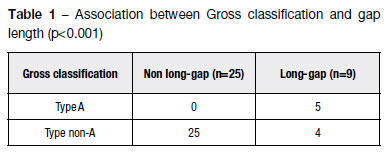
<body><![CDATA[<p><font size="2" face="Verdana">19.0. It included descriptive statistics with   absolute and relative frequencies and central trend and dispersion measures. Length of PICU   stay, duration of ventilation   after surgery and complications according to different OA classification systems   were compared through   the application of adequate statistical tests (Mann-Whitney U test for quantitative variables; chisquare and   Fisher exact test   for qualitative variables). Statistical significance was assigned to a p value &lt;   0.05 with a confidence interval of 95%.</font></p>     <p>&nbsp;</p>     <p><font size="3" face="Verdana"><b>RESULTS</b></font></p>      <p><font size="2" face="Verdana">Between 2002 and 2011, thirty-four infants with OA were    included. According to data collected in the study, during this    period, the incidence of OA in the central region of Portugal    was 1.8 in 10000 live births. The terminated pregnancies were    not included. Twenty two (65%) infants were male. The median  gestational age was 36 weeks (P<sub>25</sub><sub></sub>: 33.75; P<sub>75</sub><sub></sub>: 38) and 19 (56%)    infants were preterm (&lt;37 weeks of gestation). The median birth    weight was 2310g (P<sub>25</sub><sub></sub>: 1740; P<sub>75</sub><sub></sub>: 2691) with 21 (62%) low-birthweight    newborns (&lt; 2500g) and 5 (15%) very-low-birth-weight    newborns (&lt;1500g). OA was suspected in 7 (21%) infants based    on antenatal ultrasound. Definitive diagnosis was made in the    first day of life in 29 (85%) infants, in the second in 3 (9%) and    in the third in 2 (6%). All patients underwent echocardiography    before surgery. Nineteen infants (56%) presented congenital malformations other than OA. Cardiovascular defects were the most frequent associated malformations (n= 12), followed    by anorectal (n=4), vertebral (n=3) and renal defects (n=2). Five    infants (15%) met diagnostic criteria for VACTERL association.    Chromosomal abnormalities were detected in 2 of the 9 patients    (22%) who underwent karyotype analysis (deletion 11q; partial    monosomy 2q and partial trisomy 3p). </font></p>     <p><font size="2" face="Verdana">Most of the patients (n=27; 79%) were classified in group I    of Spitz classification, while the remaining seven were included    in group II. </font></p>     <p><font size="2" face="Verdana">According to the Gross classification the patients on this    study were classified in three types of OA: 5 (15%) were type    A, 27 (79%) were type C and 2 (6%) were type D. There were 9    cases of long-gap OA (26%). OA other type than A were mostly    non long-gap (p&lt;0,001) (<a href="#t1">Table 1</a>).</font></p>     <p><a name="t1"></a></p>     <p>&nbsp;</p>     <p align="center"><img src="/img/revistas/nas/v23n3/23n3a04t1.jpg" width="389" height="157"></p>     
<p>&nbsp;</p>     ]]></body>
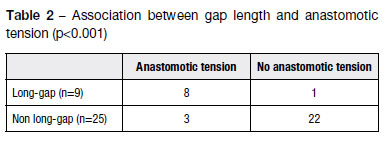
<body><![CDATA[<p><font size="2" face="Verdana">Until surgical correction a Replogle&reg; suction tube was    placed. Fistula ligation and primary oesophageal anastomosis    was the most frequent surgical option (n=27), followed by    Foker procedure with delayed oesophageal anastomosis (n=4)    and delayed oesophageal anastomosis with no previous Foker    (n=3). All patients were submitted to an open repair through    thoracotomy and extrapleural was the preferred surgical    approach. Median age at corrective surgery was 1.5 days (P<sub>25</sub>:   1; P<sub>75</sub>: 4). Surgical repair was performed earlier in patients with    non long-gap OA with a median of 1 day in this group (minimum    1; maximum 4 days) vs. a median of 105 days in long-gap OA    (minimum 1, maximum 165 days), p=0.002. Anastomotic tension    was described in 11 patients (32%), more often in long-gap OA    group (89% patients with long-gap OA vs. 12% patients with    non long-gap OA, p &lt;0.001) (<a href="#t2">Table 2</a>).</font></p>     <p><a name="t2"></a></p>     <p>&nbsp;</p>     <p align="center"><img src="/img/revistas/nas/v23n3/23n3a04t2.jpg" width="387" height="146"></p>     
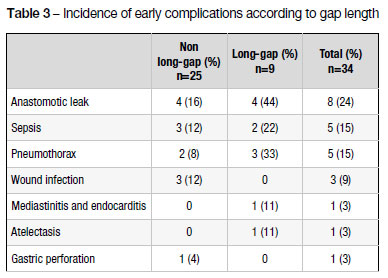
<p>&nbsp;</p>     <p><font size="2" face="Verdana">The median length of ventilation after surgery was 4 days    (P<sub>25</sub>: 2; P<sub>75</sub>: 5), being longer in long-gap OA patients (2 days in    non long-gap OA vs. 7 days in long-gap OA, p&lt;0.001), in cases    with anastomotic tension (6 days in the presence of anastomotic    tension vs. 2 days when anastomotic tension was not present,    p&lt;0.001) and in infants with associated malformations (2    days in patients without other defects vs. 4 days when other    malformations were present, p=0.003).    <br>   Early postoperative complications occurred in 13 patients    (38%). The most frequent were anastomotic leak (n=8) followed    by sepsis (n=5) and pneumothorax (n=5). <a href="#t3">Table 3</a> shows each    early complication distribution in non long-gap and long-gap OA    patients. Early complications were slightly more common in longgap    OA patients: 4 of the long-gap OA patients (44%) presented    early complications, while 9 of the non long-gap OA patients    (36%) suffered from this type of complication, however this    association failed to achieve statistical significance (p=0.704).</font></p>     <p><a name="t3"></a></p>     <p>&nbsp;</p>     <p align="center"><font size="2" face="Verdana"><img src="/img/revistas/nas/v23n3/23n3a04t3.jpg" width="388" height="278"></font></p>     
]]></body>
<body><![CDATA[<p>&nbsp;</p>     <p><font size="2" face="Verdana">The proportion of early complications was similar in both    groups of Spitz&rsquo;s classification (41% in group I vs. 29% in group    II, p=0,682) and was not related with the presence of other    malformations (42% when other malformations were present vs.    33% in patients without other defects, p=0.601).    The median of PICU length of stay was 12 days (P<sub>25</sub>: 1; P<sub>75</sub>:    81), being longer in long-gap OA patients (10 days in non longgap    OA vs. 23 days in long-gap OA, p=0.008) and in infants with    associated malformations (10.5 days in patients without other    defects vs. 15 days when other malformations were present;    p=0.027). Birth weight and gestational age were not associated    with PICU length of stay. There was no mortality during PICU stay.</font></p>     <p>&nbsp;</p>     <p><font size="2"><b><font face="Verdana"></font></b></font><b><font size="3" face="Verdana">DISCUSSION</font></b></p>     <p><font size="2" face="Verdana">Between 2002 and 2011, the incidence   of OA in the Central Region of Portugal was 1.8 in 10000 live births, lower than the overall incidence   recently reported by EUROCAT in 23 European regions (2.43 in 10000 live births).   It could be related    </font><font size="2" face="Verdana">to the small   size of our sample that represents only the central region of Portugal. In our study,   there was a male predominance which was also shown by EUROCAT Working   Group(6). There is no apparent explanation for this, but a similar   pattern is also seen in other congenital anomalies(11). More than half of the patients were preterm, what could be related to the associated polyhydramnios.</font></p>     <p><font size="2" face="Verdana">Less than a quarter   of the cases had a prenatal diagnosis. The diagnosis of oesophageal  atresia may be suspected prenatally   by the finding   of a small or absent   stomach bubble on ultrasound. In combination with   polyhydramnios the sensitivity is higher, but isolated polyhydramnios is a weak signal for OA. Given this, the accuracy of antenatal ultrasound appears to be greater in isolated OA(3), what could explain the low prenatal detection rate verified   in our study with a predominance of OA with TOF. Nevertheless, an early postnatal diagnosis, in the first 72 hours of life, was made in all cases.   An attempt to introduce a gastric tube immediately after birth might be made if any antenatal suspicion was present.</font></p>     <p><font size="2" face="Verdana">As described   in literature, additional malformations were detected   in more than half of the cases,   mostly cardiac defects.   As recommended, all patients had an echocardiogram prior to surgery.   Besides allowing detection of a cardiac   defect that may need intervention, the echocardiogram also defines any structural anomaly   of the heart or great blood vessels like a right-sided aortic arch which determinates the side for surgical approach(1,3). Some authors recommend performing a preoperative bronchoscopy to exclude   an upper pouch fistula which is 3-4 times more common in the gasless abdomen OA(3).</font></p>     <p><font size="2" face="Verdana">Type C OA was the most common, followed   by type A, which is in agreement   with literature(12,13). We found an association between isolated   OA and presence of a long-gap which   may alert physicians at the time   of diagnosis: when   the radiography fi does not reveal a gas-fi  gastrointestinal tract, there is a high probability of being a type A and as consequence a longgap OA.</font></p>     <p><font size="2" face="Verdana">Primary oesophageal anastomosis with fistula ligation was the most common surgical option,   reflecting the higher prevalence of type C and non long-gap OA. Long-gap OA correction is a major   surgical and medical   challenge and there are many   treatment options described in literature. In this study,   delayed oesophageal anastomosis was often preceded   by Foker procedure (application of graduated tension   on the oesophageal ends)(1,3,8,14,15). Consequently, the age at corrective surgery   was different according to gap length and it was lower in the group of non long-gap   OA. As we report, a primary surgical   repair in neonatal   period is possible   in the majority of patients   with type C OA, including   the ones with long-gap OA. In opposition to that, primary anastomosis in neonatal period   is exceptional in type A OA. In our study,   only one type   A OA was submitted to a primary repair, but after an awaiting period of time.</font></p>     <p><font size="2" face="Verdana">Median length of ventilation after surgery was higher in longgap OA patients, which was related   to an higher frequency of anastomotic tension in this group. The gap between   the two ends of the oesophagus is a critical factor in determining tension at   the anastomotic point   as it has been shown   in some studies(16). When the oesophageal anastomosis is performed under tension, many centers recommend   that the infant   should be electively paralyzed and mechanically ventilated for a variable period of time(3). According to our experience, this time should   be as shorter as   possible in order to protect both, the anastomosis and the lung.</font></p>     ]]></body>
<body><![CDATA[<p><font size="2" face="Verdana">Early postoperative complications were common, especially   anastomotic leak, sepsis   and pneumothorax, what may reflect   the complexity of the surgery performed. The Spitz classification has proved to be a useful tool in determining long-term outcome(3), but it seems not to influence the risk of early complications in our study. Shortly after corrective surgery,   gap length and associated malformations seemed to be a better   predictor of PICU length of stay than the Spitz classification, probably   due to improvement of care   of low birth   weight neonates. Our study failed to achieve statistically significant difference in occurrence of early complications according   to gap length. Recently, other authors concluded   that long-gap was a major predictor of post-repair complications(13). It should be noted that this is a retrospective study, with its subjacent limitations, and the sample is small.   Nevertheless, as far as we know, it is the first analysis   on the outcome of OA patients during PICU stay.</font></p>     <p><font size="2" face="Verdana">Low   mortality rates were also recently   reported by other studies that   considered a longer period follow-up.(12,13)</font></p>     <p><font size="2" face="Verdana">In conclusion, the frequency of OA associated malformations implies a systematic screening   of these patients. Gap length and the presence of associated malformations were the major determinants of PICU length   of stay and ventilation in OA patients, in our study.</font></p>     <p>&nbsp;</p>     <p><b><font size="3" face="Verdana">REFERENCES</font></b></p>     <!-- ref --><p><font size="2" face="Verdana">1.&nbsp;&nbsp;&nbsp;&nbsp;&nbsp;   Holland AJA, Fitzgerald DA. Oesophageal atresia   and trachea-oesophageal fistula: current management strategies and complications. Paediatric Respiratory Reviews 2010; 11:100-7.    &nbsp;&nbsp;&nbsp;&nbsp;&nbsp;&nbsp;&nbsp;&nbsp;[&#160;<a href="javascript:void(0);" onclick="javascript: window.open('/scielo.php?script=sci_nlinks&ref=000078&pid=S0872-0754201400050000400001&lng=','','width=640,height=500,resizable=yes,scrollbars=1,menubar=yes,');">Links</a>&#160;]<!-- end-ref --></font></p>     <!-- ref --><p><font size="2" face="Verdana">2.&nbsp;&nbsp;&nbsp;&nbsp;&nbsp;   Kovesi T, Rubin S. Long-term complications of congenital oesophageal atresia and/or tracheo-oesophageal fistula. Chest 2004; 126:915-25.    &nbsp;&nbsp;&nbsp;&nbsp;&nbsp;&nbsp;&nbsp;&nbsp;[&#160;<a href="javascript:void(0);" onclick="javascript: window.open('/scielo.php?script=sci_nlinks&ref=000080&pid=S0872-0754201400050000400002&lng=','','width=640,height=500,resizable=yes,scrollbars=1,menubar=yes,');">Links</a>&#160;]<!-- end-ref --></font></p>     <!-- ref --><p><font size="2" face="Verdana">3.&nbsp;&nbsp;&nbsp;&nbsp;&nbsp;   Spitz L. Oesophageal atresia. Orphanet J Rare Dis 2007; 2:24.    &nbsp;&nbsp;&nbsp;&nbsp;&nbsp;&nbsp;&nbsp;&nbsp;[&#160;<a href="javascript:void(0);" onclick="javascript: window.open('/scielo.php?script=sci_nlinks&ref=000082&pid=S0872-0754201400050000400003&lng=','','width=640,height=500,resizable=yes,scrollbars=1,menubar=yes,');">Links</a>&#160;]<!-- end-ref --></font></p>     <!-- ref --><p><font size="2" face="Verdana">4.&nbsp;&nbsp;&nbsp;&nbsp;&nbsp;   Jong EM, Felix JF, Klein A, Tibboel D. Etiology of oesophageal   atresia and tracheooesophageal fistula: “mind the gap”. Curr Gastroenterol Rep 2010; 12:215-22.    &nbsp;&nbsp;&nbsp;&nbsp;&nbsp;&nbsp;&nbsp;&nbsp;[&#160;<a href="javascript:void(0);" onclick="javascript: window.open('/scielo.php?script=sci_nlinks&ref=000084&pid=S0872-0754201400050000400004&lng=','','width=640,height=500,resizable=yes,scrollbars=1,menubar=yes,');">Links</a>&#160;]<!-- end-ref --></font></p>     <!-- ref --><p><font size="2" face="Verdana">5.&nbsp;&nbsp;&nbsp;&nbsp;&nbsp;   Solomon BD. VACTERL/VATER association. Orphanet J Rare Dis 2011; 6:56.    &nbsp;&nbsp;&nbsp;&nbsp;&nbsp;&nbsp;&nbsp;&nbsp;[&#160;<a href="javascript:void(0);" onclick="javascript: window.open('/scielo.php?script=sci_nlinks&ref=000086&pid=S0872-0754201400050000400005&lng=','','width=640,height=500,resizable=yes,scrollbars=1,menubar=yes,');">Links</a>&#160;]<!-- end-ref --></font></p>     <!-- ref --><p><font size="2" face="Verdana">6.&nbsp;&nbsp;&nbsp;&nbsp;&nbsp;   Pedersen RN, Calzolari E, Husby S, Garne E; EUROCAT Working group. Oesophageal atresia: prevalence, prenatal   diagnosis and associated anomalies in 23 European   regions. Arch Dis Child 2012; 97:227-32.    &nbsp;&nbsp;&nbsp;&nbsp;&nbsp;&nbsp;&nbsp;&nbsp;[&#160;<a href="javascript:void(0);" onclick="javascript: window.open('/scielo.php?script=sci_nlinks&ref=000088&pid=S0872-0754201400050000400006&lng=','','width=640,height=500,resizable=yes,scrollbars=1,menubar=yes,');">Links</a>&#160;]<!-- end-ref --></font></p>     <!-- ref --><p><font size="2" face="Verdana">7.&nbsp;&nbsp;&nbsp;&nbsp;&nbsp;   Aslanabadi S, Ghabili K, Rouzrokh M, Hosseini MB, Jamshidi   M, Adi FH, et al. Associated congenital anomalies between neonates with short-gap   and long-gap oesophageal atresia: a comparative study.   Int J Gen Med 2011; 4:487-91.    &nbsp;&nbsp;&nbsp;&nbsp;&nbsp;&nbsp;&nbsp;&nbsp;[&#160;<a href="javascript:void(0);" onclick="javascript: window.open('/scielo.php?script=sci_nlinks&ref=000090&pid=S0872-0754201400050000400007&lng=','','width=640,height=500,resizable=yes,scrollbars=1,menubar=yes,');">Links</a>&#160;]<!-- end-ref --></font></p>     <!-- ref --><p><font size="2" face="Verdana">8.&nbsp;&nbsp;&nbsp;&nbsp;&nbsp;   Hunter CJ, Petrosyan M, Connelly ME, Ford Hr, Nguyen NX. Repair of long-gap oesophageal atresia: gastric conduits may improve   outcome – a 20-year single   center experience. Pediatr Surg Int 2009; 25:1087-91.    &nbsp;&nbsp;&nbsp;&nbsp;&nbsp;&nbsp;&nbsp;&nbsp;[&#160;<a href="javascript:void(0);" onclick="javascript: window.open('/scielo.php?script=sci_nlinks&ref=000092&pid=S0872-0754201400050000400008&lng=','','width=640,height=500,resizable=yes,scrollbars=1,menubar=yes,');">Links</a>&#160;]<!-- end-ref --></font></p>     <!-- ref --><p><font size="2" face="Verdana">9.&nbsp;&nbsp;&nbsp;&nbsp;&nbsp;   Driver CP, Shankar KR,   Jones MO, Lamont   GA, Turnock RR, Lloyd DA, et al. Phenotypic presentation and outcome of oesophageal atresia in the era of the Spitz classification. J Pediatr Surg 2001; 36:1419-21.    &nbsp;&nbsp;&nbsp;&nbsp;&nbsp;&nbsp;&nbsp;&nbsp;[&#160;<a href="javascript:void(0);" onclick="javascript: window.open('/scielo.php?script=sci_nlinks&ref=000094&pid=S0872-0754201400050000400009&lng=','','width=640,height=500,resizable=yes,scrollbars=1,menubar=yes,');">Links</a>&#160;]<!-- end-ref --></font></p>     <!-- ref --><p><font size="2" face="Verdana">10.&nbsp;&nbsp;   Goldstein B, Giroir B, Randolph A. International pediatric   sepsis consensus conference: definitions for sepsis and organ dysfunction in pediatrics. Pediatr Crit Care Med 2005; 6:2-8.    &nbsp;&nbsp;&nbsp;&nbsp;&nbsp;&nbsp;&nbsp;&nbsp;[&#160;<a href="javascript:void(0);" onclick="javascript: window.open('/scielo.php?script=sci_nlinks&ref=000096&pid=S0872-0754201400050000400010&lng=','','width=640,height=500,resizable=yes,scrollbars=1,menubar=yes,');">Links</a>&#160;]<!-- end-ref --></font></p>     <!-- ref --><p><font size="2" face="Verdana">11.&nbsp;&nbsp;   Krogh C, Gørtz S, Wohlfahrt J, Biggar RJ, Melbye M, Fischer TK. Pre and perinatal risk factors for pyloric stenosis and their influence on the male predominance. Am J Epidemiol 2012; 176:24-31.    &nbsp;&nbsp;&nbsp;&nbsp;&nbsp;&nbsp;&nbsp;&nbsp;[&#160;<a href="javascript:void(0);" onclick="javascript: window.open('/scielo.php?script=sci_nlinks&ref=000098&pid=S0872-0754201400050000400011&lng=','','width=640,height=500,resizable=yes,scrollbars=1,menubar=yes,');">Links</a>&#160;]<!-- end-ref --></font></p>     <!-- ref --><p><font size="2" face="Verdana">12.&nbsp;&nbsp; Burge DM, Shah K, Spark P, Shenker N, Pierce M, Kurinczuk JJ, et al. Contemporary management and outcomes for infants born with oesophageal atresia. Br J Surg 2013; 100:515-21.    &nbsp;&nbsp;&nbsp;&nbsp;&nbsp;&nbsp;&nbsp;&nbsp;[&#160;<a href="javascript:void(0);" onclick="javascript: window.open('/scielo.php?script=sci_nlinks&ref=000100&pid=S0872-0754201400050000400012&lng=','','width=640,height=500,resizable=yes,scrollbars=1,menubar=yes,');">Links</a>&#160;]<!-- end-ref --></font></p>     <!-- ref --><p><font size="2" face="Verdana">13.&nbsp;&nbsp;   Koivusalo AI, Pakarinen MP, Rintala RJ. Modern outcomes   of oesophageal atresia:   Single centre experience over the last twenty years. J Pediatr Surg 2013; 48:297-303.    &nbsp;&nbsp;&nbsp;&nbsp;&nbsp;&nbsp;&nbsp;&nbsp;[&#160;<a href="javascript:void(0);" onclick="javascript: window.open('/scielo.php?script=sci_nlinks&ref=000102&pid=S0872-0754201400050000400013&lng=','','width=640,height=500,resizable=yes,scrollbars=1,menubar=yes,');">Links</a>&#160;]<!-- end-ref --></font></p>     <!-- ref --><p><font size="2" face="Verdana">14.&nbsp;&nbsp;   Lopes MF, Botelho MF. Midterm follow-up of esophageal anastomosis   for esophageal atresia   repair: long-gap versus non long-gap. Dis Esophagus 2007; 20:428-35.    &nbsp;&nbsp;&nbsp;&nbsp;&nbsp;&nbsp;&nbsp;&nbsp;[&#160;<a href="javascript:void(0);" onclick="javascript: window.open('/scielo.php?script=sci_nlinks&ref=000104&pid=S0872-0754201400050000400014&lng=','','width=640,height=500,resizable=yes,scrollbars=1,menubar=yes,');">Links</a>&#160;]<!-- end-ref --></font></p>     <!-- ref --><p><font size="2" face="Verdana">15.&nbsp;&nbsp;   Lopes MF, Reis A, Coutinho S, Pires A. Very long gap esophageal   atresia successfully treated   by esophageal lengthening   using external traction   sutures. J Pediatr Surg 2004; 39:1286-7.    &nbsp;&nbsp;&nbsp;&nbsp;&nbsp;&nbsp;&nbsp;&nbsp;[&#160;<a href="javascript:void(0);" onclick="javascript: window.open('/scielo.php?script=sci_nlinks&ref=000106&pid=S0872-0754201400050000400015&lng=','','width=640,height=500,resizable=yes,scrollbars=1,menubar=yes,');">Links</a>&#160;]<!-- end-ref --></font></p>     <!-- ref --><p><font size="2" face="Verdana">16.&nbsp;&nbsp;   Mansur SH, Talat N, Ahmed S. Oesophageal atresia:   role of gap length in determining the outcome. Biomedica 2005; 21:125-8.    &nbsp;&nbsp;&nbsp;&nbsp;&nbsp;&nbsp;&nbsp;&nbsp;[&#160;<a href="javascript:void(0);" onclick="javascript: window.open('/scielo.php?script=sci_nlinks&ref=000108&pid=S0872-0754201400050000400016&lng=','','width=640,height=500,resizable=yes,scrollbars=1,menubar=yes,');">Links</a>&#160;]<!-- end-ref --></font></p>     <p>&nbsp;</p>     <p>&nbsp;</p>     <p><font size="2" face="Verdana"><b><a name="end" id="topo2"></a><a href="#topo">Correspondence to    ]]></body>
<body><![CDATA[<br> </a></b></font><font size="2" face="Verdana">Andrea Dias</font>    <br>   <font size="2" face="Verdana">Serviço   de Cuidados Intensivos   Pediátricos    <br>   Hospital Pediátrico Carmona da Mota    <br>   </font><font size="2" face="Verdana">Av. Afonso Romão,   Santo António dos Olivais     <br> 3000-602 Coimbra, Portugal    <br> </font><font size="2" face="Verdana">E-mail: <a href="mailto:sofia.andrea@gmail.com">sofia.andrea@gmail.com</a></font></p>     <p><font size="2" face="Verdana">Recebido a 03.02.2014 | Aceite a 10.04.2014</font></p>      ]]></body><back>
<ref-list>
<ref id="B1">
<label>1</label><nlm-citation citation-type="journal">
<person-group person-group-type="author">
<name>
<surname><![CDATA[Holland]]></surname>
<given-names><![CDATA[AJA]]></given-names>
</name>
<name>
<surname><![CDATA[Fitzgerald]]></surname>
<given-names><![CDATA[DA]]></given-names>
</name>
</person-group>
<article-title xml:lang="en"><![CDATA[Oesophageal atresia and trachea-oesophageal fistula: current management strategies and complications]]></article-title>
<source><![CDATA[Paediatric Respiratory Reviews]]></source>
<year>2010</year>
<volume>11</volume>
<page-range>100-7</page-range></nlm-citation>
</ref>
<ref id="B2">
<label>2</label><nlm-citation citation-type="journal">
<person-group person-group-type="author">
<name>
<surname><![CDATA[Kovesi]]></surname>
<given-names><![CDATA[T]]></given-names>
</name>
<name>
<surname><![CDATA[Rubin]]></surname>
<given-names><![CDATA[S]]></given-names>
</name>
</person-group>
<article-title xml:lang="en"><![CDATA[Long-term complications of congenital oesophageal atresia and/or tracheo-oesophageal fistula]]></article-title>
<source><![CDATA[Chest]]></source>
<year>2004</year>
<volume>126</volume>
<page-range>915-25</page-range></nlm-citation>
</ref>
<ref id="B3">
<label>3</label><nlm-citation citation-type="journal">
<person-group person-group-type="author">
<name>
<surname><![CDATA[Spitz]]></surname>
<given-names><![CDATA[L]]></given-names>
</name>
</person-group>
<article-title xml:lang="en"><![CDATA[Oesophageal atresia]]></article-title>
<source><![CDATA[Orphanet J Rare Dis]]></source>
<year>2007</year>
<volume>2</volume>
<page-range>24</page-range></nlm-citation>
</ref>
<ref id="B4">
<label>4</label><nlm-citation citation-type="journal">
<person-group person-group-type="author">
<name>
<surname><![CDATA[Jong]]></surname>
<given-names><![CDATA[EM]]></given-names>
</name>
<name>
<surname><![CDATA[Felix]]></surname>
<given-names><![CDATA[JF]]></given-names>
</name>
<name>
<surname><![CDATA[Klein]]></surname>
<given-names><![CDATA[A]]></given-names>
</name>
<name>
<surname><![CDATA[Tibboel]]></surname>
<given-names><![CDATA[D]]></given-names>
</name>
</person-group>
<article-title xml:lang="en"><![CDATA[Etiology of oesophageal atresia and tracheooesophageal fistula: “mind the gap”]]></article-title>
<source><![CDATA[Curr Gastroenterol Rep]]></source>
<year>2010</year>
<volume>12</volume>
<page-range>215-22</page-range></nlm-citation>
</ref>
<ref id="B5">
<label>5</label><nlm-citation citation-type="journal">
<person-group person-group-type="author">
<name>
<surname><![CDATA[Solomon]]></surname>
<given-names><![CDATA[BD]]></given-names>
</name>
</person-group>
<article-title xml:lang="en"><![CDATA[VACTERL/VATER association]]></article-title>
<source><![CDATA[Orphanet J Rare Dis]]></source>
<year>2011</year>
<volume>6</volume>
<page-range>56</page-range></nlm-citation>
</ref>
<ref id="B6">
<label>6</label><nlm-citation citation-type="journal">
<person-group person-group-type="author">
<name>
<surname><![CDATA[Pedersen]]></surname>
<given-names><![CDATA[RN]]></given-names>
</name>
<name>
<surname><![CDATA[Calzolari]]></surname>
<given-names><![CDATA[E]]></given-names>
</name>
<name>
<surname><![CDATA[Husby]]></surname>
<given-names><![CDATA[S]]></given-names>
</name>
<name>
<surname><![CDATA[Garne]]></surname>
<given-names><![CDATA[E]]></given-names>
</name>
</person-group>
<article-title xml:lang="en"><![CDATA[EUROCAT Working group: Oesophageal atresia: prevalence, prenatal diagnosis and associated anomalies in 23 European regions]]></article-title>
<source><![CDATA[Arch Dis Child]]></source>
<year>2012</year>
<volume>97</volume>
<page-range>227-32</page-range></nlm-citation>
</ref>
<ref id="B7">
<label>7</label><nlm-citation citation-type="journal">
<person-group person-group-type="author">
<name>
<surname><![CDATA[Aslanabadi]]></surname>
<given-names><![CDATA[S]]></given-names>
</name>
<name>
<surname><![CDATA[Ghabili]]></surname>
<given-names><![CDATA[K]]></given-names>
</name>
<name>
<surname><![CDATA[Rouzrokh]]></surname>
<given-names><![CDATA[M]]></given-names>
</name>
<name>
<surname><![CDATA[Hosseini]]></surname>
<given-names><![CDATA[MB]]></given-names>
</name>
<name>
<surname><![CDATA[Jamshidi]]></surname>
<given-names><![CDATA[M]]></given-names>
</name>
<name>
<surname><![CDATA[Adi]]></surname>
<given-names><![CDATA[FH]]></given-names>
</name>
</person-group>
<article-title xml:lang="en"><![CDATA[Associated congenital anomalies between neonates with short-gap and long-gap oesophageal atresia: a comparative study]]></article-title>
<source><![CDATA[Int J Gen Med]]></source>
<year>2011</year>
<volume>4</volume>
<page-range>487-91</page-range></nlm-citation>
</ref>
<ref id="B8">
<label>8</label><nlm-citation citation-type="journal">
<person-group person-group-type="author">
<name>
<surname><![CDATA[Hunter]]></surname>
<given-names><![CDATA[CJ]]></given-names>
</name>
<name>
<surname><![CDATA[Petrosyan]]></surname>
<given-names><![CDATA[M]]></given-names>
</name>
<name>
<surname><![CDATA[Connelly]]></surname>
<given-names><![CDATA[ME]]></given-names>
</name>
<name>
<surname><![CDATA[Ford]]></surname>
<given-names><![CDATA[Hr]]></given-names>
</name>
<name>
<surname><![CDATA[Nguyen]]></surname>
<given-names><![CDATA[NX]]></given-names>
</name>
</person-group>
<article-title xml:lang="en"><![CDATA[Repair of long-gap oesophageal atresia: gastric conduits may improve outcome - a 20-year single center experience]]></article-title>
<source><![CDATA[Pediatr Surg Int]]></source>
<year>2009</year>
<volume>25</volume>
<page-range>1087-91</page-range></nlm-citation>
</ref>
<ref id="B9">
<label>9</label><nlm-citation citation-type="journal">
<person-group person-group-type="author">
<name>
<surname><![CDATA[Driver]]></surname>
<given-names><![CDATA[CP]]></given-names>
</name>
<name>
<surname><![CDATA[Shankar]]></surname>
<given-names><![CDATA[KR]]></given-names>
</name>
<name>
<surname><![CDATA[Jones]]></surname>
<given-names><![CDATA[MO]]></given-names>
</name>
<name>
<surname><![CDATA[Lamont]]></surname>
<given-names><![CDATA[GA]]></given-names>
</name>
<name>
<surname><![CDATA[Turnock]]></surname>
<given-names><![CDATA[RR]]></given-names>
</name>
<name>
<surname><![CDATA[Lloyd]]></surname>
<given-names><![CDATA[DA]]></given-names>
</name>
</person-group>
<article-title xml:lang="en"><![CDATA[Phenotypic presentation and outcome of oesophageal atresia in the era of the Spitz classification]]></article-title>
<source><![CDATA[J Pediatr Surg]]></source>
<year>2001</year>
<volume>36</volume>
<page-range>1419-21</page-range></nlm-citation>
</ref>
<ref id="B10">
<label>10</label><nlm-citation citation-type="journal">
<person-group person-group-type="author">
<name>
<surname><![CDATA[Goldstein]]></surname>
<given-names><![CDATA[B]]></given-names>
</name>
<name>
<surname><![CDATA[Giroir]]></surname>
<given-names><![CDATA[B]]></given-names>
</name>
<name>
<surname><![CDATA[Randolph]]></surname>
<given-names><![CDATA[A]]></given-names>
</name>
</person-group>
<article-title xml:lang="en"><![CDATA[International pediatric sepsis consensus conference: definitions for sepsis and organ dysfunction in pediatrics]]></article-title>
<source><![CDATA[Pediatr Crit Care Med]]></source>
<year>2005</year>
<volume>6</volume>
<page-range>2-8</page-range></nlm-citation>
</ref>
<ref id="B11">
<label>11</label><nlm-citation citation-type="journal">
<person-group person-group-type="author">
<name>
<surname><![CDATA[Krogh]]></surname>
<given-names><![CDATA[C]]></given-names>
</name>
<name>
<surname><![CDATA[Gørtz]]></surname>
<given-names><![CDATA[S]]></given-names>
</name>
<name>
<surname><![CDATA[Wohlfahrt]]></surname>
<given-names><![CDATA[J]]></given-names>
</name>
<name>
<surname><![CDATA[Biggar]]></surname>
<given-names><![CDATA[RJ]]></given-names>
</name>
<name>
<surname><![CDATA[Melbye]]></surname>
<given-names><![CDATA[M]]></given-names>
</name>
<name>
<surname><![CDATA[Fischer]]></surname>
<given-names><![CDATA[TK]]></given-names>
</name>
</person-group>
<article-title xml:lang="en"><![CDATA[Pre and perinatal risk factors for pyloric stenosis and their influence on the male predominance]]></article-title>
<source><![CDATA[Am J Epidemiol]]></source>
<year>2012</year>
<volume>176</volume>
<page-range>24-31</page-range></nlm-citation>
</ref>
<ref id="B12">
<label>12</label><nlm-citation citation-type="journal">
<person-group person-group-type="author">
<name>
<surname><![CDATA[Burge]]></surname>
<given-names><![CDATA[DM]]></given-names>
</name>
<name>
<surname><![CDATA[Shah]]></surname>
<given-names><![CDATA[K]]></given-names>
</name>
<name>
<surname><![CDATA[Spark]]></surname>
<given-names><![CDATA[P]]></given-names>
</name>
<name>
<surname><![CDATA[Shenker]]></surname>
<given-names><![CDATA[N]]></given-names>
</name>
<name>
<surname><![CDATA[Pierce]]></surname>
<given-names><![CDATA[M]]></given-names>
</name>
<name>
<surname><![CDATA[Kurinczuk]]></surname>
<given-names><![CDATA[JJ]]></given-names>
</name>
</person-group>
<article-title xml:lang="en"><![CDATA[Contemporary management and outcomes for infants born with oesophageal atresia]]></article-title>
<source><![CDATA[Br J Surg]]></source>
<year>2013</year>
<volume>100</volume>
<page-range>515-21</page-range></nlm-citation>
</ref>
<ref id="B13">
<label>13</label><nlm-citation citation-type="journal">
<person-group person-group-type="author">
<name>
<surname><![CDATA[Koivusalo]]></surname>
<given-names><![CDATA[AI]]></given-names>
</name>
<name>
<surname><![CDATA[Pakarinen]]></surname>
<given-names><![CDATA[MP]]></given-names>
</name>
<name>
<surname><![CDATA[Rintala]]></surname>
<given-names><![CDATA[RJ]]></given-names>
</name>
</person-group>
<article-title xml:lang="en"><![CDATA[Modern outcomes of oesophageal atresia: Single centre experience over the last twenty years]]></article-title>
<source><![CDATA[J Pediatr Surg]]></source>
<year>2013</year>
<volume>48</volume>
<page-range>297-303</page-range></nlm-citation>
</ref>
<ref id="B14">
<label>14</label><nlm-citation citation-type="journal">
<person-group person-group-type="author">
<name>
<surname><![CDATA[Lopes]]></surname>
<given-names><![CDATA[MF]]></given-names>
</name>
<name>
<surname><![CDATA[Botelho]]></surname>
<given-names><![CDATA[MF]]></given-names>
</name>
</person-group>
<article-title xml:lang="en"><![CDATA[Midterm follow-up of esophageal anastomosis for esophageal atresia repair: long-gap versus non long-gap]]></article-title>
<source><![CDATA[Dis Esophagus]]></source>
<year>2007</year>
<volume>20</volume>
<page-range>428-35</page-range></nlm-citation>
</ref>
<ref id="B15">
<label>15</label><nlm-citation citation-type="journal">
<person-group person-group-type="author">
<name>
<surname><![CDATA[Lopes]]></surname>
<given-names><![CDATA[MF]]></given-names>
</name>
<name>
<surname><![CDATA[Reis]]></surname>
<given-names><![CDATA[A]]></given-names>
</name>
<name>
<surname><![CDATA[Coutinho]]></surname>
<given-names><![CDATA[S]]></given-names>
</name>
<name>
<surname><![CDATA[Pires]]></surname>
<given-names><![CDATA[A]]></given-names>
</name>
</person-group>
<article-title xml:lang="en"><![CDATA[Very long gap esophageal atresia successfully treated by esophageal lengthening using external traction sutures]]></article-title>
<source><![CDATA[J Pediatr Surg]]></source>
<year>2004</year>
<volume>39</volume>
<page-range>1286-7</page-range></nlm-citation>
</ref>
<ref id="B16">
<label>16</label><nlm-citation citation-type="journal">
<person-group person-group-type="author">
<name>
<surname><![CDATA[Mansur]]></surname>
<given-names><![CDATA[SH]]></given-names>
</name>
<name>
<surname><![CDATA[Talat]]></surname>
<given-names><![CDATA[N]]></given-names>
</name>
<name>
<surname><![CDATA[Ahmed]]></surname>
<given-names><![CDATA[S]]></given-names>
</name>
</person-group>
<article-title xml:lang="en"><![CDATA[Oesophageal atresia: role of gap length in determining the outcome]]></article-title>
<source><![CDATA[Biomedica]]></source>
<year>2005</year>
<volume>21</volume>
<page-range>125-8</page-range></nlm-citation>
</ref>
</ref-list>
</back>
</article>