EDITORIAL
Investigator initiated clinical trials in children
Luísa LobatoI
I Department of Education, Training and Research & Department of Nephrology, Centro Hospitalar do Porto (CHP), Porto, Portugal. Multidisciplinary Unit for Biomedical Research (UMIB), Instituto de Ciências Biomédicas Abel Salazar, University of Porto, Portugal. 4099-001 Porto, Portugal. lmlobato@icbas.up.pt
]]> Investigator initiated clinical trials (IICT) are clinical trials not supported by pharmaceutical for profitable aims, but usually driven by individual investigators, universities or hospitals to improvement of treatments. The researchers develop the idea and are responsible for the regulatory duties, for organization and conduction of the clinical study.
Some authors considered investigator driven trials to be of greater clinical significance, more than that from industry. The IICT pose unanswered clinical demands that differ from those of the industry and new understanding of the drugs, but they are more difficult for the researchers to support and to obtain grants for their studies. Their management requires also a hard work of the investigation team and a clinical site with a good structure in medical research.
The specific ethical, methodological, and technical obstacles to pediatric trials are well recognized, as is the lack of financial rewards for the pharmaceutical industry.1
The extension of new drugs for pediatric use is complex compared to adults, particularly in IICT. The assessments in the protocol should be suitable for child, adolescents and parents. Information for parents must be clear and they should have access to FAQs before the decision of participation (or not) in a trial. Good general and well organized information can be obtained at Pediatric Inflammatory Bowel Disease Consortium.2
In a study involving the main stakeholders in carrying out a trial, the authors suggested that embedding trials as part of routine clinical care, streamlining regulatory approvals, increasing international collaboration, establishing centralized trials infrastructure and aligning research to child health priorities will be desirable to encourage trials.3
CHALLENGES FOR ACADEMIC INVESTIGATOR-INITIATED PEDIATRIC TRIALS
When we applied IICT to pediatric population extra concerns and difficulties for academic researchers may appear. The European network for cancer research in children and adolescents (ENCCA) transmitted that the majority of clinical trials in cancer are investigator-driven and sponsored by academic institutions. However, in every EU Member States there are different organizational and sponsorship models, resulting in a lack of co-ordination and in a significant duplication of efforts and costs.4 The funds obtained from industry, private and university should be suitable to encourage transparency, high-quality, relevant pediatric trials across the world.
Investigation conducted concerning problems around IICT showed that the principal investigators felt that too many parties were involved during trial implementation and that coordination among these parties was poor. The perceived result was inadequate communication and loss of information.5
]]> AREAS OF CLINICAL TRIALS
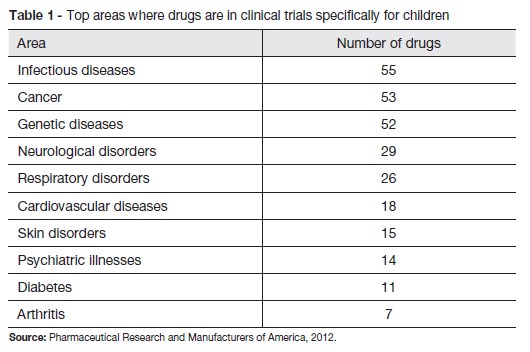
Studies usually include anorexia, asthma, Attention Deficit Hyperactivity Disorder (ADHD), birth defects, cancers in children, child depression, growth deficiencies, juvenile diabetes, obesity, strep throat and vaccines (https://www.centerwatch.com/clinical-trials). In table 1 we can appreciate the top areas of drugs are in clinical trials for children (Pharmaceutical Research and Manufacturers of America).
WHAT IS ADVISABLE?
To consult the WHO International Clinical Trials Registry Platform (ICTRP) as a member involved in health care decision making. The mission of the WHO ICTRP is to ensure that a complete view of research is accessible to all those involved in health care.6 The aim of that site is to improve awareness and make it easier to access accurate, up to date, understandable information relevant to the conduct of clinical trials in children. These details are published on a publicly-accessible website managed by a registry conforming to WHO standards.
To consult the “Harmonized Clinical Guidelines for the Conduct of Clinical Trials of Medicines in Pediatric Populations“ as a culture to stimulate the knowledge and participation in clinical trials.7
]]> Keywords: Clinical trials; academic; information; problems; World Health Organization
REFERENCES
1. Osuntokun B (2006) Clinical trials in pediatrics: The drug delivery dimension. Adv. Drug Deliv. Rev 2006; 58: 90–105
2. http://www.pedsibd.org/parents/clin_research.html; accessed in 30th January 2017.
3. Pathma D. Joseph, Jonathan C. Craig, Allison Tong, Patrina H.Y. Caldwell. Researchers’, Regulators’, and Sponsors’ Views on Pediatric Clinical Trials: A Multinational Study. Pediatrics 2016; 138: e20161171.
4. http://www.encca.eu/community/researchershealthcareprofessionals; accessed in 30th January 2017.
5. Delphine Girard, Olivier Bourdon, Hendy Abdoul, Sonia Prot-Labarthe, Françoise Brion, Annick Tibi, Corinne Alberti. How to Improve the Implementation of Academic Clinical Pediatric Trials Involving Drug Therapy? A Qualitative Study of Multiple Stakeholders. PLOS ONE 2013; 8: e64516.
6. http://www.who.int/ictrp/child/en/; accessed in 30th January 2017.
7. http://www.ich.org/home.html; accessed in 30th January 2017.
]]>