<?xml version="1.0" encoding="ISO-8859-1"?><article xmlns:mml="http://www.w3.org/1998/Math/MathML" xmlns:xlink="http://www.w3.org/1999/xlink" xmlns:xsi="http://www.w3.org/2001/XMLSchema-instance">
<front>
<journal-meta>
<journal-id>0872-0754</journal-id>
<journal-title><![CDATA[Nascer e Crescer]]></journal-title>
<abbrev-journal-title><![CDATA[Nascer e Crescer]]></abbrev-journal-title>
<issn>0872-0754</issn>
<publisher>
<publisher-name><![CDATA[Centro Hospitalar do Porto]]></publisher-name>
</publisher>
</journal-meta>
<article-meta>
<article-id>S0872-07542017000100005</article-id>
<title-group>
<article-title xml:lang="en"><![CDATA[Brain Magnetic Resonance evaluation and pubertal development variations among female adolescents]]></article-title>
<article-title xml:lang="pt"><![CDATA[Tradução neuroimagiológica dos ritmos de maturação pubertária em adolescentes do sexo feminino]]></article-title>
</title-group>
<contrib-group>
<contrib contrib-type="author">
<name>
<surname><![CDATA[Fonseca]]></surname>
<given-names><![CDATA[Paula]]></given-names>
</name>
<xref ref-type="aff" rid="A01"/>
</contrib>
<contrib contrib-type="author">
<name>
<surname><![CDATA[Seixas]]></surname>
<given-names><![CDATA[Daniela]]></given-names>
</name>
<xref ref-type="aff" rid="A02"/>
<xref ref-type="aff" rid="A03"/>
</contrib>
<contrib contrib-type="author">
<name>
<surname><![CDATA[Fonseca]]></surname>
<given-names><![CDATA[Helena]]></given-names>
</name>
<xref ref-type="aff" rid="A04"/>
</contrib>
<contrib contrib-type="author">
<name>
<surname><![CDATA[Brandão]]></surname>
<given-names><![CDATA[Sofia]]></given-names>
</name>
<xref ref-type="aff" rid="A05"/>
</contrib>
<contrib contrib-type="author">
<name>
<surname><![CDATA[Fontoura]]></surname>
<given-names><![CDATA[Manuel]]></given-names>
</name>
<xref ref-type="aff" rid="A06"/>
</contrib>
</contrib-group>
<aff id="A01">
<institution><![CDATA[,Centro Hospitalar Médio Ave Unidade de Vila Nova Famalicão Department of Pediatrics]]></institution>
<addr-line><![CDATA[Vila Nova de Famalicão ]]></addr-line>
<country>Portugal</country>
</aff>
<aff id="A02">
<institution><![CDATA[,Universidade do Porto Faculdade de Medicina Department of Experimental Biology]]></institution>
<addr-line><![CDATA[Porto ]]></addr-line>
<country>Portugal</country>
</aff>
<aff id="A03">
<institution><![CDATA[,Centro Hospitalar de Vila Nova de Gaia/Espinho Department of Imaging ]]></institution>
<addr-line><![CDATA[Vila Nova de Gaia ]]></addr-line>
<country>Portugal</country>
</aff>
<aff id="A04">
<institution><![CDATA[,Universidade de Lisboa Faculdade de Medicina Department of Pediatrics]]></institution>
<addr-line><![CDATA[Lisboa ]]></addr-line>
<country>Portugal</country>
</aff>
<aff id="A05">
<institution><![CDATA[,Centro Hospitalar São João Magnetic Ressonance Unit ]]></institution>
<addr-line><![CDATA[Porto ]]></addr-line>
<country>Portugal</country>
</aff>
<aff id="A06">
<institution><![CDATA[,Universidade do Porto Faculdade de Medicina Department of Pediatrics]]></institution>
<addr-line><![CDATA[Porto ]]></addr-line>
<country>Portugal</country>
</aff>
<pub-date pub-type="pub">
<day>01</day>
<month>03</month>
<year>2017</year>
</pub-date>
<pub-date pub-type="epub">
<day>01</day>
<month>03</month>
<year>2017</year>
</pub-date>
<volume>26</volume>
<numero>1</numero>
<fpage>36</fpage>
<lpage>42</lpage>
<copyright-statement/>
<copyright-year/>
<self-uri xlink:href="http://scielo.pt/scielo.php?script=sci_arttext&amp;pid=S0872-07542017000100005&amp;lng=en&amp;nrm=iso"></self-uri><self-uri xlink:href="http://scielo.pt/scielo.php?script=sci_abstract&amp;pid=S0872-07542017000100005&amp;lng=en&amp;nrm=iso"></self-uri><self-uri xlink:href="http://scielo.pt/scielo.php?script=sci_pdf&amp;pid=S0872-07542017000100005&amp;lng=en&amp;nrm=iso"></self-uri><abstract abstract-type="short" xml:lang="en"><p><![CDATA[Aim: There is evidence that adolescents with distinct rhythms of pubertal maturation have different psychosocial behaviours. However, a relation between pubertal maturation and the development of the prefrontal cortex and limbic system was not yet established. The aim of this study was to apply brain magnetic resonance imaging to investigate brain development of teenagers with similar age but distinct timing of pubertal maturation. Methods: We compared the hormonal profiles and brain structure and volume using magnetic resonance imaging of two groups of 14 year-old girls, four with an early pubertal development (group 1) and three with an average pubertal development (group 2). Results: The age at onset of puberty was the only biological variable that distinguished the two groups (p = 0,05). There were no differences regarding global brain volume. However, early-maturers showed a tendency for an increased volume of all subcortical structures except for nucleus accumbens. Conclusion: To our knowledge, this is the first work to address the relation of pubertal maturation timing and central nervous system development using brain magnetic resonance imaging. The observed tendency for an increased volume of the subcortical structures may be related to a possible delayed development of the nucleus accumbens in early-maturers, and may explain the increased vulnerability of this group to risk behaviours.]]></p></abstract>
<abstract abstract-type="short" xml:lang="pt"><p><![CDATA[Introdução: Há evidência que adolescentes com a mesma idade cronológica mas com estádios pubertários distintos têm comportamentos psicossociais diferentes. Desconhece-se, no entanto, se existe alguma relação entre o ritmo de maturação pubertária e o desenvolvimento do córtex pré-frontal e sistema límbico. Objetivo: Pretendeu-se com este trabalho avaliar através de ressonância magnética, o desenvolvimento cerebral de adolescentes do sexo feminino com a mesma idade cronológica mas com distintos ritmos de maturação pubertária. Material e Métodos: Avaliaram-se parâmetros hormonais e imagiológicos (idade óssea, ultrassonografia pélvica e ressonância magnética cerebral estrutural) a adolescentes de sexo feminino de 14 anos de idade. Resultados: Foram incluídas no estudo quatro adolescentes maturadoras precoces (grupo 1) e três maturadoras médias (grupo 2), A idade de início da puberdade foi a única variável biológica que distinguiu os 2 grupos (p=0,05). Apesar de não se encontrar significado estatístico, verificou-se que as maturadoras precoces, apresentavam volumes de todas as estruturas subcorticais estudadas superiores às maturadoras médias, com exceção do núcleo accumbens. Conclusões: Com base na pesquisa bibliográfica efetuada, este estudo foi o primeiro a tentar relacionar os ritmos de maturação pubertária e o desenvolvimento cerebral através da ressonância magnética. A tendência observada para o aumento do volume das estruturas subcorticais poderá estar relacionado com um possível atraso na maturação do núcleo accumbens nas maturadoras precoces e poderá explicar o aumento da vulnerabilidade deste grupo para comportamentos de risco. Consideramos que poderá constituir o ponto de partida para investigações futuras, de forma a compreender melhor o desenvolvimento adolescente e assim permitir encontrar formas mais eficazes de intervenção.]]></p></abstract>
<kwd-group>
<kwd lng="en"><![CDATA[Adolescence]]></kwd>
<kwd lng="en"><![CDATA[brain development]]></kwd>
<kwd lng="en"><![CDATA[magnetic resonance imaging]]></kwd>
<kwd lng="en"><![CDATA[neuroimaging]]></kwd>
<kwd lng="en"><![CDATA[puberty]]></kwd>
<kwd lng="pt"><![CDATA[Adolescência]]></kwd>
<kwd lng="pt"><![CDATA[desenvolvimento cerebral]]></kwd>
<kwd lng="pt"><![CDATA[neuroimagem]]></kwd>
<kwd lng="pt"><![CDATA[puberdade]]></kwd>
<kwd lng="pt"><![CDATA[ressonância magnética]]></kwd>
</kwd-group>
</article-meta>
</front><body><![CDATA[ <p align="right"><font face="Verdana" size="2">    <b>ARTIGOS ORIGINAIS | ORIGINAL ARTICLES</b></font></p>     <p>&nbsp;</p>      <p><font size="4" face="Verdana"><b>Brain Magnetic Resonance evaluation and pubertal development variations among female adolescents</b></font></p> <font face="Verdana" size="2">     <p>&nbsp;</p> </font>     <p><font size="3" face="Verdana"><b>Tradu&ccedil;&atilde;o neuroimagiol&oacute;gica dos ritmos de matura&ccedil;&atilde;o pubert&aacute;ria  em adolescentes do sexo feminino</b></font></p> <font face="Verdana" size="2">     <p>&nbsp;</p>     <p>&nbsp;</p>     <p><b>Paula Fonseca<sup>I</sup>; Daniela   Seixas<sup>II, III</sup>; Helena Fonseca<sup>IV</sup>; Sofia Brandão<sup>V</sup>; Manuel Fontoura<sup>VI</sup></b></p>     <p><sup>I </sup>Department   of Pediatrics, Unidade de Vila Nova Famalicão, Centro Hospitalar Médio Ave. 4761-917 Vila Nova de Famalicão, Portugal. <a href="mailto:paulamrfonseca@hotmail.com">paulamrfonseca@hotmail.com    <br> </a><sup>II </sup>Department of   Experimental Biology, Faculdade de Medicina, Universidade do Porto. 4200-319 Porto, Portugal. <a href="mailto:seixas@med.up.pt">seixas@med.up.pt    ]]></body>
<body><![CDATA[<br> </a><sup>III </sup>Department   of Imaging, Centro Hospitalar de Vila Nova de Gaia/Espinho. 4434-502 Vila Nova de Gaia, Portugal. <a href="mailto:dseixas@med.up.pt">dseixas@med.up.pt    <br> </a><sup>IV </sup>Department   of Pediatrics, Faculdade de Medicina, Universidade de Lisboa. 1649-028 Lisboa, Portugal. <a href="mailto:helenaregalofonseca@gmail.com">helenaregalofonseca@gmail.com    <br> </a><sup>V </sup>Magnetic Ressonance Unit, Centro Hospitalar São João. 4200-319 Porto, Portugal. <a href="mailto:sofia.brand@gmail.com">sofia.brand@gmail.com    <br> </a><sup>VI </sup>Department   of Pediatrics, Faculdade de Medicina, Universidade do Porto. 4200-319 Porto, Portugal. <a href="mailto:manuelfontoura@hotmail.com">manuelfontoura@hotmail.com</a></p> <a href="#end">Correspondence to</a><a name="topo" id="topo"></a>     <p>&nbsp;</p>     <p>&nbsp;</p> </font> <hr noshade size="1"> <font face="Verdana" size="2">     <p><b>ABSTRACT</b></p>     <p><b>Aim: </b>There is   evidence that adolescents with distinct rhythms of pubertal maturation have   different psychosocial behaviours. However, a relation between pubertal   maturation and the development of the prefrontal cortex and limbic system was   not yet established. The aim of this study was to apply brain magnetic   resonance imaging to investigate brain development of teenagers with similar age but distinct timing of pubertal maturation.</p>     <p><b>Methods: </b>We compared   the hormonal profiles and brain structure and volume using magnetic resonance   imaging of two groups of 14 year-old girls, four with an early pubertal development (group 1) and three with an average pubertal development (group 2).</p>     <p><b>Results: </b>The age at   onset of puberty was the only biological variable that distinguished the two   groups (p = 0,05). There were no differences regarding global brain volume.   However, early-maturers showed a tendency for an increased volume of all subcortical structures except for nucleus accumbens.</p>     ]]></body>
<body><![CDATA[<p><b>Conclusion: </b>To our   knowledge, this is the first work to address the relation of pubertal   maturation timing and central nervous system development using brain magnetic   resonance imaging. The observed tendency for an increased volume of the   subcortical structures may be related to a possible delayed development of the   nucleus accumbens in early-maturers, and may explain the increased vulnerability of this group to risk behaviours.</p>     <p><b>Keywords</b>:   Adolescence; brain development; magnetic resonance imaging; neuroimaging; puberty</p> </font> <hr noshade size="1"> <font face="Verdana" size="2">     <p><b>RESUMO</b></p>     <p><b>Introdução: </b>Há evidência   que adolescentes com a mesma idade cronológica mas com estádios pubertários   distintos têm comportamentos psicossociais diferentes. Desconhece-se, no   entanto, se existe alguma relação entre o ritmo de maturação pubertária e o desenvolvimento do córtex pré-frontal e sistema límbico.</p>     <p><b>Objetivo: </b>Pretendeu-se   com este trabalho avaliar através de ressonância magnética, o desenvolvimento   cerebral de adolescentes do sexo feminino com a mesma idade cronológica mas com distintos ritmos de maturação pubertária.</p>     <p><b>Material e Métodos: </b>Avaliaram-se   parâmetros hormonais e imagiológicos (idade óssea, ultrassonografia pélvica e   ressonância magnética cerebral estrutural) a adolescentes de sexo feminino de 14 anos de idade.</p>     <p><b>Resultados: </b>Foram   incluídas no estudo quatro adolescentes maturadoras precoces (grupo 1) e três   maturadoras médias (grupo 2), A idade de início da puberdade foi a única variável biológica que distinguiu os 2 grupos (p=0,05). Apesar de não se encontrar significado estatístico, verificou-se que as maturadoras precoces,   apresentavam volumes de todas as estruturas subcorticais estudadas superiores às maturadoras médias, com exceção do núcleo accumbens.</p>     <p><b>Conclusões: </b>Com base na   pesquisa bibliográfica efetuada, este estudo foi o primeiro a tentar relacionar   os ritmos de maturação pubertária e o desenvolvimento cerebral através da   ressonância magnética. A tendência observada para o aumento do volume das   estruturas subcorticais poderá estar relacionado com um possível atraso na   maturação do núcleo accumbens nas maturadoras precoces e poderá explicar o aumento da vulnerabilidade deste grupo para comportamentos de risco. Consideramos que poderá   constituir o ponto de partida para investigações futuras, de forma a   compreender melhor o desenvolvimento adolescente e assim permitir encontrar formas mais eficazes de intervenção.</p>     <p><b>Palavras-chave: </b>Adolescência; desenvolvimento cerebral; neuroimagem, puberdade; ressonância magnética</p> </font> <hr noshade size="1"> <font face="Verdana" size="2">     <p>&nbsp;</p>     ]]></body>
<body><![CDATA[<p>&nbsp;</p> </font>     <p><font size="3" face="Verdana"><b>INTRODUCTION</b></font></p>     <p><font size="3" face="Verdana"></font><font size="2" face="Verdana">Adolescence is defined by marked   physical and psychosocial changes.<sup>1-6 </sup>It is a   period of great vulnerability, particularly associated to experimentation and   risk behaviours.<sup>7 </sup>The   transition between childhood and adulthood is not straightforward and it is   well known that adolescents with distinct rhythms of pubertal maturation have   different psychosocial behaviours.<sup>2,8-10 </sup>Three   distinct theories try to explain such differences: the “stressful change   hypothesis”, the “off-time hypothesis” and the “early- timing hypothesis”.<sup>9 </sup>The first   theory predicts that regardless of timing, girls experiencing the pubertal   transition will manifest higher levels of emotional disturbance than pre or   post-pubertal girls. The “off-time hypothesis” explains that both early and   late maturing girls will manifest more psychological problems than their on-time   age-mates. Finally, the “early-time hypothesis” advocates that girls maturing   earlier than their peers will be less emotionally stable and will have more   behaviour problems. Indeed, several studies have shown that early-maturer girls   have a lower self-esteem, a higher risk of drug use and misuse and tend to carry a psychopathological profile, being more vulnerable to peer pressure.<sup>3,5,6</sup></font></p> <font face="Verdana" size="2">     <p>Although influenced by numerous   factors such as genetics, nutritionandethnicity,   whichmayinfluencephysicaldevelopment, puberty is essentially a hormonal and   neuroendocrinological process.<sup>1,4,7,11,12 </sup>Among girls, puberty starts between eight and 13 years of age (mean age: 10 years) with the onset of the <sub>thelarche.</sub>2,5,7,13,14</p>     <p>Notably, adolescence is   recognized as the largest and most dynamic period of neuronal development.   Longitudinal studies have revealed that grey matter maturation is represented   by an inverted U-shape curve during childhood and adolescence, occurring from   posterior to anterior regions of the brain. Accordingly, the prefrontal cortex   (PFC), which participates in risk-benefit assessment and decision-making, is   described as the last brain region to mature.<sup>6,13,15-19 </sup>As a result,   the immature motivational circuit – limbic system/PFC – favours activity in brain   emotional areas, including the nucleus accumbens and the amygdala.<sup>4,13,15 </sup>These data   suggest that there may be a brain developmental explanation for the impulsivity and risk behaviours of adolescence.<sup>8</sup></p>     <p>Magnetic resonance imaging (MRI)   has been invaluable in the study of the central nervous system in humans <i>in     vivo</i>, since it is an innocuous, reproducible and repeatable technique that offers high tissue contrast and spatial resolution.<sup>18-20</sup></p>     <p>The purpose of this study was to   investigate with MRI the brain development of female adolescents with the same chronological age but distinct rhythms of pubertal maturation.</p>     <p>To avoid potential confounding   variables (such sex or endocrinology pathology) only healthy female adolescents were selected.</p>     <p>&nbsp;</p> </font>     <p><font size="3" face="Verdana"><b>METHODS</b></font></p> <font face="Verdana" size="2">     ]]></body>
<body><![CDATA[<p><i>Sample</i></p>     <p>The sample was identified and   recruited from the Outpatient Clinic of the Pediatric Endocrinology Unit of Centro Hospitalar</p>     <p>São João - EPE, Porto, Portugal.   All the volunteers were previously followed in this unit by suspected (not confirmed) pathology.</p>     <p>The inclusion criteria were the   following: adolescent females of 14 years of age who had the thelarche between   eight and nine years of age (early-maturers) or between 10 and 11 years of age   (average-maturers). Exclusion criteria included having an associated pathology   and / or being under pharmacological therapy. The study was approved by the   Ethics Committee of the Centro Hospitalar São João - EPE. All volunteers and   their legal representatives signed an informed consent according to the Helsinki Declaration.<sup>21</sup></p>     <p><i>Clinical data</i></p>     <p>The following data was collected   from the individual clinical files: weight, height, body mass index (BMI), the age   at thelarche andmenarche, sexualmaturityrating(Tannerstage)(TS), hormonal   profile previously performed within three months (including FSH –   follicle-stimulating hormone; LH – luteinizing hormone; estradiol; 17OHP – 17 –   hydroxyprogesterone; testosterone; DHEAS – dehydroepiandrosterone sulphate;   androstenedione; IGF1 – insulin-like growth factor 1 (somatomedin C); FT4 –   free thyroxine; TSH – thyroid stimulating hormone), bone age and pelvic   ultrasound (including ovary volume, uterine volume and presence of endocavitary line).</p>     <p><i>Magnetic resonance imaging and brain volumetry</i></p>     <p>MRI brain examinations were   conducted in the Department of Radiology of the Centro Hospitalar São João,   EPE, using a 3.0T system (MAGNETOM<sup>® </sup>Tim Trio,   Siemens Medical Solutions, Erlangen, Germany), equipped with a 12-channel head   phased- array coil. All the datasets were acquired in a single session, with   the presence of a neuroradiologyst. A 3D-T1-w pulse sequence (magnetisation   prepared rapid acquisition gradient echo – MPRAGE) was acquired with the   following parameters: 160 slices, 265 mm field-of-view (FOV); spatial   resolution 1x1x1mm<sup>3</sup>, TR/TE/f.a. = 2030/2.96ms/9º.</p>     <p>Image processing was performed   using the FMRIB Software Library (FSL) analysis tools.<sup>22,24 </sup>Brain   volumetry (total brain, white matter and grey matter volumes) were calculated   with the Sienax package from FSL, while the volume of subcortical structures   (hippocampus, amygdala, thalamus, caudate nucleus, putamen, globus pallidus and nucleus accumbens) were measured with the FIRST toolbox, also part of FSL.<sup>22,26,27</sup></p>     <p><i>Statistical analysis</i></p>     ]]></body>
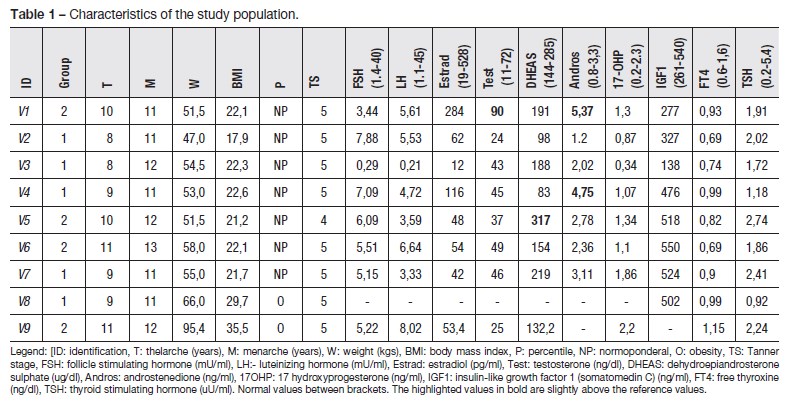
<body><![CDATA[<p>Frequency distributions were   generated for every categorical variable for the descriptive statistics. For   non-homogenous variances, the <i>Mann-Whitney </i>test was adopted. Relations   between hormone levels and subcortical structures were assessed using Spearman   correlation coefficients. Statistical analyses were performed using SPSS 21   (IBM SPSS software). Results of the brain volumetry and of the volume of   subcortical structures are presented as median and standard deviation (SD). Statistical significance was considered for p&#8804;0.05.</p>     <p>&nbsp;</p> </font>     <p><font size="3" face="Verdana"><b>RESULTS</b></font></p> <font face="Verdana" size="2">     <p>Thirteen adolescents were   identified. Four were excluded due to no parental authorization (n=3) and   participation refusal (n=1). From the nine volunteers that were included in the   study, five were early-maturers (group 1) and four were average-maturers (group 2). The demographic characteristics of the sample are detailed in <a href="/img/revistas/nas/v26n1/26n1a05t1.jpg">Table1</a>.</p>     
<p>The mean age of onset of puberty   was 8,75 years for the early-maturers (range 8-11y) and 10,3 years for the   average- maturers (range 10-11y), respectively. Menarche was at mean age of 11y   for group 1 (minimum 11 years, maximum 12 years) and 12y for group 2 (minimum   11 years, maximum 13 years). All adolescents were TS 5, except for volunteer 5   who was stage 4.   There were no differences between groups regarding age at menarche (p = 0,229), weight (p = 0,857) and BMI (p = 0,857).</p>     <p>Pelvic ultrasound evaluation was   compatible with the respective pubertal development in all cases. Bone age  was higher than chronological age in all adolescents (mean 15.4 ± 0.73 y). The hormonal   profile was obtained for eight of the total of nine adolescents (<a href="/img/revistas/nas/v26n1/26n1a05t2.jpg">Table 2</a>).   Hormonal results of all adolescents were within the reference values for age   and gender, except for volunteer 1, 4 and 5, highlighted in <a href="/img/revistas/nas/v26n1/26n1a05t1.jpg">Table 1</a>, which were   slightly above the reference values but without pathological relevance. Group 1   had higher levels than group 2 (not statistically significant) for FSH (p =   0,400), FT4 (p = 0,400), androstenedione (p = 1) and estradiol (p = 1); and   lower levels of LH (p = 0,400), testosterone (p = 0,400), DHEAS (p = 0,400), IgF1 (p = 1), 17OHP (p = 0,700) and TSH (p = 0,629).</p>     
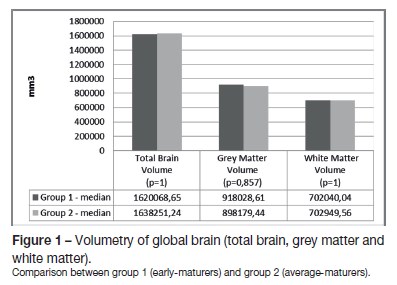
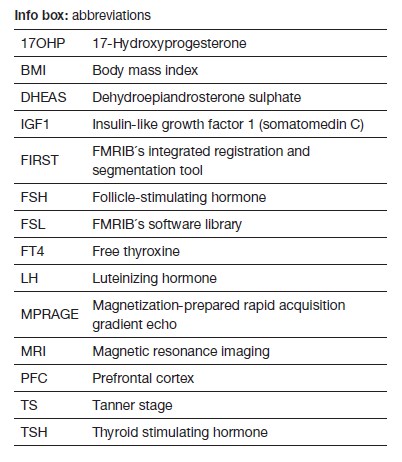
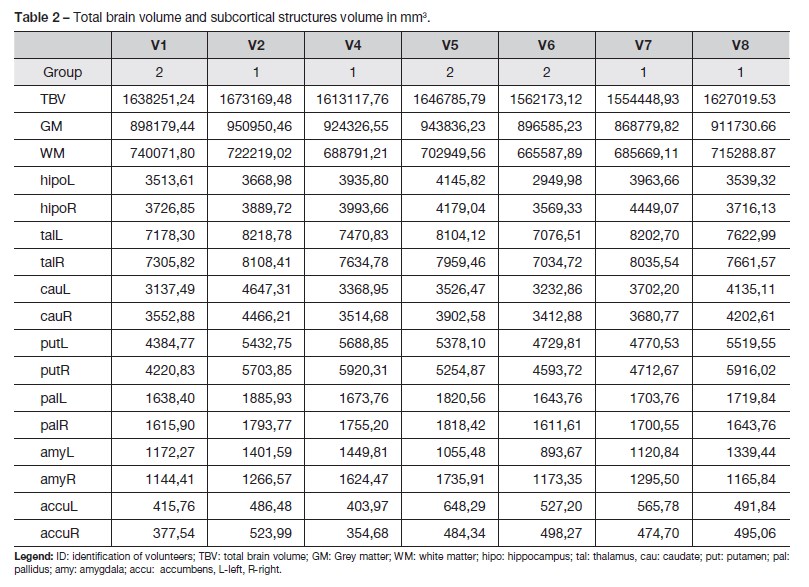
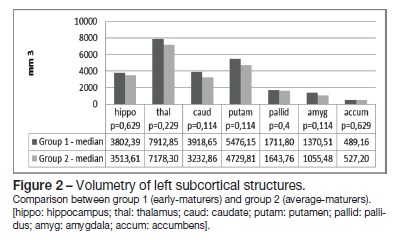
<p>Regarding brain MRI, one   adolescent did not complete the brain scan (V9). A diencephalic lesion was   incidentally detected in another volunteer (V3), which was diagnosed later as a pilocytic astrocytoma. Threrefore both volunteer (V3 and V9) were excluded.</p>     <p>Global brain and subcortical   structures volumetry results are presented in <a href="/img/revistas/nas/v26n1/26n1a05t2.jpg">Table 2</a>. There were no   statistical differences between the two groups for total brain volume, as well   as for grey matter and white matter volumes (<a href="#f1">Figure 1</a>). Concerning the volume   of the subcortical structures, group 1 evidenced higher volumes for all   subcortical structures (left and right-sided) than group 2, except for the nucleus accumbens (Figures <a href="#f2">2</a> and <a href="#f3">3</a>).</p>     
<p><a name="f1"></a></p>     <p>&nbsp;</p>     ]]></body>
<body><![CDATA[<p align="center"><img src="/img/revistas/nas/v26n1/26n1a05f1.jpg" width="397" height="285"></p>     
<p>&nbsp;</p>     <p><a name="f2"></a></p>     <p>&nbsp;</p>     <p align="center"><img src="/img/revistas/nas/v26n1/26n1a05f2.jpg" width="401" height="240"></p>     
<p>&nbsp;</p>     <p><a name="f3"></a></p>     <p>&nbsp;</p>     <p align="center"><img src="/img/revistas/nas/v26n1/26n1a05f3.jpg" width="396" height="249"></p>     
<p>&nbsp;</p>     ]]></body>
<body><![CDATA[<p>Correlation of the subcortical   brain structures volume and hormone levels was performed (<a href="/img/revistas/nas/v26n1/26n1a05t3.jpg">Table 3</a>). We found a   positive correlation between FSH levels and the volume of the putamina (r =   0,886), and as well as between DHEAS levels and the volume of the left nucleus   accumbens (r = 0,829). Negative correlations were found between LH levels and   the left (r = -0,943) and right hippocampi volume (r = -1); between testosterone levels and the left caudate nucleus (r = -0,829), left and right putamina (r = -0,829) and globus pallidus   (left r = -0,943; right r = -0,886); between estradiol and the left nucleus   accumbens (r = -0,886); and between androstenedione levels and the right nucleus accumbens volume (r = -0,943).</p>     
<p>&nbsp;</p> </font>     <p><font size="3" face="Verdana"><b>DISCUSSION</b></font></p> <font face="Verdana" size="2">     <p>Our research aimed at assessing   brain neurodevelopment by using brain MRI on a clinical sample of adolescents   with distinct maturing rhythms. To our knowledge, this study is among the first   to address the relation of pubertal maturation timing and the central nervous system development using MRI.</p>     <p>Regarding total brain volume,   there were no differences between the early and average-maturers, despite   early-maturers had had higher volumes for all subcortical structures except for   the nucleus accumbens. It is well known that this nucleus is   involved in the connection between the limbic system   and the PFC, and is associated with pleasure and reward.</p>     <p>(28) The observed tendency for   the higher volumes of all other subcortical structures among early-maturers may   be explained by a possible delayed development of the nucleus accubens in this   group and this could potentially translate into the increased vulnerability and engagement in risk behaviours typical of early-maturers.</p>     <p>Regarding the hormonal profile,   we found that group 1 had higher levels of androstenedione and lower levels of   testosterone and DHEAS than group 2, despite not reaching statistical   significance. Although no causal linearity has been established between the   hormonal profiles and behaviour so far, it has been shown that boys and girls   with maladaptive behaviours have higher levels of androstenedione and lower   levels of testosterone and DHEAS during their early and middle adolescence,   what is in line with the tendency of our results. Furthermore, it is well known   the relevant role of the gonadal hormones on the central nervous system   maturation, with for example both progesterone and estradiol facilitating   myelination in adolescent females, while testosterone has a similar role in   males.<sup>4,7 </sup>It is known   as well that the hippocampus and the amygdala have a higher number of estrogen   and androgen receptors, respectively, what may explain the largest volume of   the amygdala among males during adolescence and hippocampal volume only among females.<sup>17,18</sup></p>     <p>While the association between the   levels of circulating gonadal hormones and sex-specific differences is well   established, the effects of sexual hormones and pubertal stage on brain   development, is not yet well understood. Studies are not consensual, with some   suggesting a pubertal-related maturation of the hippocampus, amygdala and   cortical grey-matter, and others not having been able to find a significant association between sexual hormones and the subcortical structures.<sup>12,29,30</sup></p>     <p>The strong correlations between   hormones with direct influence on the sexual development (FSH, LH, estradiol,   testosterone, DHEAS, androstenedione) and the brain subcortical structures found in our study should be further explored.</p>     <p>The most important limitation of   our study was the small sample size, which was related to difficulties in   recruiting voluntary adolescents. The accidental finding of a diencephalic   tumour in an asymptomatic volunteer, allowed timely surgery, with complete resection.</p>     ]]></body>
<body><![CDATA[<p>In spite of the small sample, our   results support the hypothesis that brain maturation of early-maturers is not   proportionate to biological maturation, in particular to the nucleus accumbens.   This study should be seen as a starting point for future research for better   understanding adolescent’s behavior and allowing the design of more efficacious interventions.</p>     <p>&nbsp;</p> </font>     <p><font size="3" face="Verdana"><b>ACKNOWLEDGEMENTS</b></font></p> <font face="Verdana" size="2">     <p>Professor Isabel Ramos, Director   of the Department of Radiology of Centro Hospitalar São João - EPE, and of the   Group of Medical Imaging and Signal Processing of the Faculty of Medicine of Porto University, Portugal.</p>     <p>&nbsp;</p> </font>     <p align="center"><font size="3" face="Verdana"><b><img src="/img/revistas/nas/v26n1/26n1a05q1.jpg" width="402" height="462"></b></font></p>     
<p align="center">&nbsp;</p>     <p><font size="3" face="Verdana"><b>REFERÊNCIAS BIBLIOGRÁFICAS</b></font><font face="Verdana" size="2"></font></p> <font face="Verdana" size="2">    <!-- ref --><p>1.             Bordini B, Rosenfield RL. Normal pubertal development: Part I: The endocrine basis of puberty. Pediatr Rev 2011; 32: 223-9.    &nbsp;&nbsp;&nbsp;&nbsp;&nbsp;&nbsp;&nbsp;&nbsp;[&#160;<a href="javascript:void(0);" onclick="javascript: window.open('/scielo.php?script=sci_nlinks&ref=1102930&pid=S0872-0754201700010000500001&lng=','','width=640,height=500,resizable=yes,scrollbars=1,menubar=yes,');">Links</a>&#160;]<!-- end-ref --></p>     ]]></body>
<body><![CDATA[<!-- ref --><p>2.             Neinstein L. Adolescent health care – A pratical guide.   5<sup>th </sup>edition. Lippincott Williams and Wilkins. Philadelphia. 2008, pp 3-31.    &nbsp;&nbsp;&nbsp;&nbsp;&nbsp;&nbsp;&nbsp;&nbsp;[&#160;<a href="javascript:void(0);" onclick="javascript: window.open('/scielo.php?script=sci_nlinks&ref=1102932&pid=S0872-0754201700010000500002&lng=','','width=640,height=500,resizable=yes,scrollbars=1,menubar=yes,');">Links</a>&#160;]<!-- end-ref --></p>     <!-- ref --><p>3.             Patton GC, Viner R. Pubertal transitions in Health. Lancet 2007; 369: 1130-7.    &nbsp;&nbsp;&nbsp;&nbsp;&nbsp;&nbsp;&nbsp;&nbsp;[&#160;<a href="javascript:void(0);" onclick="javascript: window.open('/scielo.php?script=sci_nlinks&ref=1102934&pid=S0872-0754201700010000500003&lng=','','width=640,height=500,resizable=yes,scrollbars=1,menubar=yes,');">Links</a>&#160;]<!-- end-ref --></p>     <!-- ref --><p>4.             Vigil P, Orellana RF, Cortes ME, Molina CT, Switzer BE, Klaus H. Endocrine modulation of the brain: A review. J Pediatr Adoles Gynecol 2011; 24(6): 330-7.    &nbsp;&nbsp;&nbsp;&nbsp;&nbsp;&nbsp;&nbsp;&nbsp;[&#160;<a href="javascript:void(0);" onclick="javascript: window.open('/scielo.php?script=sci_nlinks&ref=1102936&pid=S0872-0754201700010000500004&lng=','','width=640,height=500,resizable=yes,scrollbars=1,menubar=yes,');">Links</a>&#160;]<!-- end-ref --></p>     <!-- ref --><p>5.             Rosenfield R. Normal Pubertal Development: Part II: Clinical aspects of puberty. Pediatr Rev 2011; 32: 281-91.    &nbsp;&nbsp;&nbsp;&nbsp;&nbsp;&nbsp;&nbsp;&nbsp;[&#160;<a href="javascript:void(0);" onclick="javascript: window.open('/scielo.php?script=sci_nlinks&ref=1102938&pid=S0872-0754201700010000500005&lng=','','width=640,height=500,resizable=yes,scrollbars=1,menubar=yes,');">Links</a>&#160;]<!-- end-ref --></p>     <!-- ref --><p>6.             Hazen E, Schlozman S, Beresin E. Adolescent Psychological Development: A review. Pediatr Rev 2008; 29: 161-8.    &nbsp;&nbsp;&nbsp;&nbsp;&nbsp;&nbsp;&nbsp;&nbsp;[&#160;<a href="javascript:void(0);" onclick="javascript: window.open('/scielo.php?script=sci_nlinks&ref=1102940&pid=S0872-0754201700010000500006&lng=','','width=640,height=500,resizable=yes,scrollbars=1,menubar=yes,');">Links</a>&#160;]<!-- end-ref --></p>     ]]></body>
<body><![CDATA[<!-- ref --><p>7.             Spear LP. The adolescent brain and age-related behavioral manifestations. Neurosci Biobehav Rev 2000; 24: 417-63.    &nbsp;&nbsp;&nbsp;&nbsp;&nbsp;&nbsp;&nbsp;&nbsp;[&#160;<a href="javascript:void(0);" onclick="javascript: window.open('/scielo.php?script=sci_nlinks&ref=1102942&pid=S0872-0754201700010000500007&lng=','','width=640,height=500,resizable=yes,scrollbars=1,menubar=yes,');">Links</a>&#160;]<!-- end-ref --></p>     <!-- ref --><p>8.             Romer D. Adolescent risk taking, impulsivity and brain development: Implications for prevention. Dev Psychobiol 2010; 52: 263-76.    &nbsp;&nbsp;&nbsp;&nbsp;&nbsp;&nbsp;&nbsp;&nbsp;[&#160;<a href="javascript:void(0);" onclick="javascript: window.open('/scielo.php?script=sci_nlinks&ref=1102944&pid=S0872-0754201700010000500008&lng=','','width=640,height=500,resizable=yes,scrollbars=1,menubar=yes,');">Links</a>&#160;]<!-- end-ref --></p>     <!-- ref --><p>9.             Ge X, Conger RD, Jr Glen HE. Coming of age too early:   pubertal influences on girls` vulnerability to psychological distress. Child Dev 1996; 67: 3386-400.    &nbsp;&nbsp;&nbsp;&nbsp;&nbsp;&nbsp;&nbsp;&nbsp;[&#160;<a href="javascript:void(0);" onclick="javascript: window.open('/scielo.php?script=sci_nlinks&ref=1102946&pid=S0872-0754201700010000500009&lng=','','width=640,height=500,resizable=yes,scrollbars=1,menubar=yes,');">Links</a>&#160;]<!-- end-ref --></p>     <!-- ref --><p>10.          Graber JA, Levinsohn PM, Seeley JR, Brooks-Gunn J. Is   Psychopathology associated with the timing of pubertal development? J Am Acad Child Adolesc Psychiatry 1997; 36:1768-76.    &nbsp;&nbsp;&nbsp;&nbsp;&nbsp;&nbsp;&nbsp;&nbsp;[&#160;<a href="javascript:void(0);" onclick="javascript: window.open('/scielo.php?script=sci_nlinks&ref=1102948&pid=S0872-0754201700010000500010&lng=','','width=640,height=500,resizable=yes,scrollbars=1,menubar=yes,');">Links</a>&#160;]<!-- end-ref --></p>     <!-- ref --><p>11.&nbsp;&nbsp;&nbsp;&nbsp;&nbsp;&nbsp;&nbsp;&nbsp;&nbsp; Sisk CL, Zehr JL. Pubertal   Hormones organize the adolescent brain and behavior. Front Neuroendocrinol   2005; 26: 163-74.    &nbsp;&nbsp;&nbsp;&nbsp;&nbsp;&nbsp;&nbsp;&nbsp;[&#160;<a href="javascript:void(0);" onclick="javascript: window.open('/scielo.php?script=sci_nlinks&ref=1102950&pid=S0872-0754201700010000500011&lng=','','width=640,height=500,resizable=yes,scrollbars=1,menubar=yes,');">Links</a>&#160;]<!-- end-ref --></p>     ]]></body>
<body><![CDATA[<!-- ref --><p>12.&nbsp;&nbsp;&nbsp;&nbsp;&nbsp;&nbsp;&nbsp;&nbsp;&nbsp; Neufang S, Specht K, Hausmann   M, Gurturkun O, Herpertez-Dahlmann B, Fink G <i>et al</i>.   Sex differences and the impact of steroid hormones on the developing human brain. Cereb Cortex 2009; 19: 464-73.    &nbsp;&nbsp;&nbsp;&nbsp;&nbsp;&nbsp;&nbsp;&nbsp;[&#160;<a href="javascript:void(0);" onclick="javascript: window.open('/scielo.php?script=sci_nlinks&ref=1102952&pid=S0872-0754201700010000500012&lng=','','width=640,height=500,resizable=yes,scrollbars=1,menubar=yes,');">Links</a>&#160;]<!-- end-ref --></p>     <!-- ref --><p>13.&nbsp;&nbsp;&nbsp;&nbsp;&nbsp;&nbsp;&nbsp;&nbsp;&nbsp; Blakmore SJ, Burnett S, Dahl   RE. The role of puberty in the developing adolescent brain. Hum Brain Mapp   2010; 31: 926-33.    &nbsp;&nbsp;&nbsp;&nbsp;&nbsp;&nbsp;&nbsp;&nbsp;[&#160;<a href="javascript:void(0);" onclick="javascript: window.open('/scielo.php?script=sci_nlinks&ref=1102954&pid=S0872-0754201700010000500013&lng=','','width=640,height=500,resizable=yes,scrollbars=1,menubar=yes,');">Links</a>&#160;]<!-- end-ref --></p>     <!-- ref --><p>14.&nbsp;&nbsp;&nbsp;&nbsp;&nbsp;&nbsp;&nbsp;&nbsp;&nbsp; Kaplowitz PB. Delayed Puberty. Pediatric Rev 2010; 31: 189-95.    &nbsp;&nbsp;&nbsp;&nbsp;&nbsp;&nbsp;&nbsp;&nbsp;[&#160;<a href="javascript:void(0);" onclick="javascript: window.open('/scielo.php?script=sci_nlinks&ref=1102956&pid=S0872-0754201700010000500014&lng=','','width=640,height=500,resizable=yes,scrollbars=1,menubar=yes,');">Links</a>&#160;]<!-- end-ref --></p>     <!-- ref --><p>15.          Jonhson SB, Blum R, Giedd J. Adolescent Maturity and the   Brain: The promise and Pitfalls of Neuroscience Research in Adolescent Health Policy. J Adolesc Health 2009; 45: 216- 21.    &nbsp;&nbsp;&nbsp;&nbsp;&nbsp;&nbsp;&nbsp;&nbsp;[&#160;<a href="javascript:void(0);" onclick="javascript: window.open('/scielo.php?script=sci_nlinks&ref=1102958&pid=S0872-0754201700010000500015&lng=','','width=640,height=500,resizable=yes,scrollbars=1,menubar=yes,');">Links</a>&#160;]<!-- end-ref --></p>     <!-- ref --><p>16.          Blakemore SJ. The social brain in adolescence. Nature Rev Neurosci 2008; 9: 267-77.    &nbsp;&nbsp;&nbsp;&nbsp;&nbsp;&nbsp;&nbsp;&nbsp;[&#160;<a href="javascript:void(0);" onclick="javascript: window.open('/scielo.php?script=sci_nlinks&ref=1102960&pid=S0872-0754201700010000500016&lng=','','width=640,height=500,resizable=yes,scrollbars=1,menubar=yes,');">Links</a>&#160;]<!-- end-ref --></p>     ]]></body>
<body><![CDATA[<!-- ref --><p>17.          Giedd JN. The Teen Brain: Insights from Neuroimaging. J Adolesc Health 2008; 42: 335-343.    &nbsp;&nbsp;&nbsp;&nbsp;&nbsp;&nbsp;&nbsp;&nbsp;[&#160;<a href="javascript:void(0);" onclick="javascript: window.open('/scielo.php?script=sci_nlinks&ref=1102962&pid=S0872-0754201700010000500017&lng=','','width=640,height=500,resizable=yes,scrollbars=1,menubar=yes,');">Links</a>&#160;]<!-- end-ref --></p>     <!-- ref --><p>18.          Giedd JN, Stockman M, Weddle C, Liverpool M, Alexander-   Bloch A, Wallace GL, <i>et al</i>. Anatomic magnetic resonance imaging of   developing and adolescent brain and effects of genetic variation. Neuropsychol Rev 2010; 20: 349-61.    &nbsp;&nbsp;&nbsp;&nbsp;&nbsp;&nbsp;&nbsp;&nbsp;[&#160;<a href="javascript:void(0);" onclick="javascript: window.open('/scielo.php?script=sci_nlinks&ref=1102964&pid=S0872-0754201700010000500018&lng=','','width=640,height=500,resizable=yes,scrollbars=1,menubar=yes,');">Links</a>&#160;]<!-- end-ref --></p>     <!-- ref --><p>19.          Luna B, Padmanabhan A, O’Hearn K. What has fMRI told us   about the development of cognitive control through adolescence? Brain Cogn 2010; 72: 101-13.    &nbsp;&nbsp;&nbsp;&nbsp;&nbsp;&nbsp;&nbsp;&nbsp;[&#160;<a href="javascript:void(0);" onclick="javascript: window.open('/scielo.php?script=sci_nlinks&ref=1102966&pid=S0872-0754201700010000500019&lng=','','width=640,height=500,resizable=yes,scrollbars=1,menubar=yes,');">Links</a>&#160;]<!-- end-ref --></p>     <!-- ref --><p>20.          Burnett S, Sebastian C, Kadosh KC, Blakemore SJ.   The social brain in adolescence:   Evidence from functional magnetic resonance imaging and behavioural studies. Neurosci Biobehav Rev 2011; 35: 1654-64.    &nbsp;&nbsp;&nbsp;&nbsp;&nbsp;&nbsp;&nbsp;&nbsp;[&#160;<a href="javascript:void(0);" onclick="javascript: window.open('/scielo.php?script=sci_nlinks&ref=1102968&pid=S0872-0754201700010000500020&lng=','','width=640,height=500,resizable=yes,scrollbars=1,menubar=yes,');">Links</a>&#160;]<!-- end-ref --></p>     <!-- ref --><p>21.          WMA Declaration of Helsinki - Ethical Principles for   Medical Research Involving Human Subjects. October 2013. [Cited 2014 november 11]. Available from URL: <a href="http://www.wma.net/en/30publications/10policies/b3/" target="_blank">www.wma.net/en/30publications/10policies/b3/</a> .    &nbsp;&nbsp;&nbsp;&nbsp;&nbsp;&nbsp;&nbsp;&nbsp;[&#160;<a href="javascript:void(0);" onclick="javascript: window.open('/scielo.php?script=sci_nlinks&ref=1102970&pid=S0872-0754201700010000500021&lng=','','width=640,height=500,resizable=yes,scrollbars=1,menubar=yes,');">Links</a>&#160;]<!-- end-ref --></p>     ]]></body>
<body><![CDATA[<!-- ref --><p>22.          Jenkinson M, Beckmann CF, Behrens TE, Woolrich MW, Smith SM. FSL. Neuroimage 2012; 62: 782-90.    &nbsp;&nbsp;&nbsp;&nbsp;&nbsp;&nbsp;&nbsp;&nbsp;[&#160;<a href="javascript:void(0);" onclick="javascript: window.open('/scielo.php?script=sci_nlinks&ref=1102972&pid=S0872-0754201700010000500022&lng=','','width=640,height=500,resizable=yes,scrollbars=1,menubar=yes,');">Links</a>&#160;]<!-- end-ref --></p>     <!-- ref --><p>23.          Woolrich MW, Jbabdi S, Patenaude B, Chappell M, Makni S,   Behrens T, <i>et al</i>. Bayesian analysis of neuroimaging data in FSL. Neuroimage 2009; 45: S173-86.    &nbsp;&nbsp;&nbsp;&nbsp;&nbsp;&nbsp;&nbsp;&nbsp;[&#160;<a href="javascript:void(0);" onclick="javascript: window.open('/scielo.php?script=sci_nlinks&ref=1102974&pid=S0872-0754201700010000500023&lng=','','width=640,height=500,resizable=yes,scrollbars=1,menubar=yes,');">Links</a>&#160;]<!-- end-ref --></p>     <!-- ref --><p>24.          Smith SM, Jenkinson M, Woolrich MW, Beckmann CF, Behrens   TEJ, Johansen-Berg H, <i>et al</i>. Advances in functional and structural MR image analysis and implementation as FSL. Neuroimage 2004; 23: 208-19.    &nbsp;&nbsp;&nbsp;&nbsp;&nbsp;&nbsp;&nbsp;&nbsp;[&#160;<a href="javascript:void(0);" onclick="javascript: window.open('/scielo.php?script=sci_nlinks&ref=1102976&pid=S0872-0754201700010000500024&lng=','','width=640,height=500,resizable=yes,scrollbars=1,menubar=yes,');">Links</a>&#160;]<!-- end-ref --></p>     <!-- ref --><p>25.          Smith SM. Fast robust automated brain extraction. Hum Brain Mapp 2002; 7: 43-55.    &nbsp;&nbsp;&nbsp;&nbsp;&nbsp;&nbsp;&nbsp;&nbsp;[&#160;<a href="javascript:void(0);" onclick="javascript: window.open('/scielo.php?script=sci_nlinks&ref=1102978&pid=S0872-0754201700010000500025&lng=','','width=640,height=500,resizable=yes,scrollbars=1,menubar=yes,');">Links</a>&#160;]<!-- end-ref --></p>     <!-- ref --><p>26.          Smith SM, De Stefano N, Jenkinson M, Matthews P.M.   Normalised accurate measurement of longitudinal brain change. J Comput Assist Tomogr 2001; 25: 466-75.    &nbsp;&nbsp;&nbsp;&nbsp;&nbsp;&nbsp;&nbsp;&nbsp;[&#160;<a href="javascript:void(0);" onclick="javascript: window.open('/scielo.php?script=sci_nlinks&ref=1102980&pid=S0872-0754201700010000500026&lng=','','width=640,height=500,resizable=yes,scrollbars=1,menubar=yes,');">Links</a>&#160;]<!-- end-ref --></p>     ]]></body>
<body><![CDATA[<!-- ref --><p>27.          Patenaude B, Smith SM, Kennedy DN, Jenkinson M. A Bayesian   model of shape and appearance for subcortical brain segmentation. Neuroimage 2011; 56: 907-22.    &nbsp;&nbsp;&nbsp;&nbsp;&nbsp;&nbsp;&nbsp;&nbsp;[&#160;<a href="javascript:void(0);" onclick="javascript: window.open('/scielo.php?script=sci_nlinks&ref=1102982&pid=S0872-0754201700010000500027&lng=','','width=640,height=500,resizable=yes,scrollbars=1,menubar=yes,');">Links</a>&#160;]<!-- end-ref --></p>     <!-- ref --><p>28.          Costa VD, Lang PJ, Sabatinelli D, Versace F, Bradley MM.   Emotional imagery: Assessing pleasure and arousal in the brain’s reward circuitry. Hum Brain Mapp 2010; 31: 1446–57.    &nbsp;&nbsp;&nbsp;&nbsp;&nbsp;&nbsp;&nbsp;&nbsp;[&#160;<a href="javascript:void(0);" onclick="javascript: window.open('/scielo.php?script=sci_nlinks&ref=1102984&pid=S0872-0754201700010000500028&lng=','','width=640,height=500,resizable=yes,scrollbars=1,menubar=yes,');">Links</a>&#160;]<!-- end-ref --></p>     <!-- ref --><p>29.          Bramen JE, Hranilovich JA, Dahl RE, Forbes EE, Chen J, et   al. Puberty influences medial temporal lobe and cortical gray matter maturation   differently in boys than girls matched for sexual maturity. Cereb Cortex 2011; 21: 636-46.    &nbsp;&nbsp;&nbsp;&nbsp;&nbsp;&nbsp;&nbsp;&nbsp;[&#160;<a href="javascript:void(0);" onclick="javascript: window.open('/scielo.php?script=sci_nlinks&ref=1102986&pid=S0872-0754201700010000500029&lng=','','width=640,height=500,resizable=yes,scrollbars=1,menubar=yes,');">Links</a>&#160;]<!-- end-ref --></p>     <!-- ref --><p>30.          Koolschijn PCMP, Peper JS, Crone EA. The Influence of Sex   Steroids on Structural Brain Maturation in Adolescence. Plos One 2014; 9: e83929.    &nbsp;&nbsp;&nbsp;&nbsp;&nbsp;&nbsp;&nbsp;&nbsp;[&#160;<a href="javascript:void(0);" onclick="javascript: window.open('/scielo.php?script=sci_nlinks&ref=1102988&pid=S0872-0754201700010000500030&lng=','','width=640,height=500,resizable=yes,scrollbars=1,menubar=yes,');">Links</a>&#160;]<!-- end-ref --></p>     <p>&nbsp;</p>     <p>&nbsp;</p> <b><a name="end" id="topo2"></a> <a href="#topo">CORRESPONDENCE TO</a></b>    ]]></body>
<body><![CDATA[<br> Paula Fonseca     <br> Department of Pediatrics     <br> Unidade de Famalicão    <br> Centro Hospitalar Médio Ave     <br> Rua Cupertino de Miranda, Apartado 31, 4761-917 Vila Nova de Famalicão     <br> Email: <a href="mailto:paulamrfonseca@hotmail.com">paulamrfonseca@hotmail.com</a>     <p>Received for publication: 04.04.2016 Accepted in revised form: 13.10.2016</p> </font>      ]]></body><back>
<ref-list>
<ref id="B1">
<label>1</label><nlm-citation citation-type="journal">
<person-group person-group-type="author">
<name>
<surname><![CDATA[Bordini]]></surname>
<given-names><![CDATA[B]]></given-names>
</name>
<name>
<surname><![CDATA[Rosenfield]]></surname>
<given-names><![CDATA[RL]]></given-names>
</name>
</person-group>
<article-title xml:lang="en"><![CDATA[Normal pubertal development: Part I: The endocrine basis of puberty]]></article-title>
<source><![CDATA[Pediatr Rev]]></source>
<year>2011</year>
<volume>32</volume>
<page-range>223-9</page-range></nlm-citation>
</ref>
<ref id="B2">
<label>2</label><nlm-citation citation-type="book">
<person-group person-group-type="author">
<name>
<surname><![CDATA[Neinstein]]></surname>
<given-names><![CDATA[L]]></given-names>
</name>
</person-group>
<source><![CDATA[Adolescent health care: A pratical guide]]></source>
<year>2008</year>
<edition>5</edition>
<page-range>3-31</page-range><publisher-loc><![CDATA[Philadelphia ]]></publisher-loc>
<publisher-name><![CDATA[Lippincott Williams and Wilkins]]></publisher-name>
</nlm-citation>
</ref>
<ref id="B3">
<label>3</label><nlm-citation citation-type="journal">
<person-group person-group-type="author">
<name>
<surname><![CDATA[Patton]]></surname>
<given-names><![CDATA[GC]]></given-names>
</name>
<name>
<surname><![CDATA[Viner]]></surname>
<given-names><![CDATA[R]]></given-names>
</name>
</person-group>
<article-title xml:lang="en"><![CDATA[Pubertal transitions in Health]]></article-title>
<source><![CDATA[Lancet]]></source>
<year>2007</year>
<volume>369</volume>
<page-range>1130-7</page-range></nlm-citation>
</ref>
<ref id="B4">
<label>4</label><nlm-citation citation-type="journal">
<person-group person-group-type="author">
<name>
<surname><![CDATA[Vigil]]></surname>
<given-names><![CDATA[P]]></given-names>
</name>
<name>
<surname><![CDATA[Orellana]]></surname>
<given-names><![CDATA[RF]]></given-names>
</name>
<name>
<surname><![CDATA[Cortes]]></surname>
<given-names><![CDATA[ME]]></given-names>
</name>
<name>
<surname><![CDATA[Molina]]></surname>
<given-names><![CDATA[CT]]></given-names>
</name>
<name>
<surname><![CDATA[Switzer]]></surname>
<given-names><![CDATA[BE]]></given-names>
</name>
<name>
<surname><![CDATA[Klaus]]></surname>
<given-names><![CDATA[H]]></given-names>
</name>
</person-group>
<article-title xml:lang="en"><![CDATA[Endocrine modulation of the brain: A review]]></article-title>
<source><![CDATA[J Pediatr Adoles Gynecol]]></source>
<year>2011</year>
<volume>24</volume>
<numero>6</numero>
<issue>6</issue>
<page-range>330-7</page-range></nlm-citation>
</ref>
<ref id="B5">
<label>5</label><nlm-citation citation-type="journal">
<person-group person-group-type="author">
<name>
<surname><![CDATA[Rosenfield]]></surname>
<given-names><![CDATA[R]]></given-names>
</name>
</person-group>
<article-title xml:lang="en"><![CDATA[Normal Pubertal Development: Part II: Clinical aspects of puberty]]></article-title>
<source><![CDATA[Pediatr Rev]]></source>
<year>2011</year>
<volume>32</volume>
<page-range>281-91</page-range></nlm-citation>
</ref>
<ref id="B6">
<label>6</label><nlm-citation citation-type="journal">
<person-group person-group-type="author">
<name>
<surname><![CDATA[Hazen]]></surname>
<given-names><![CDATA[E]]></given-names>
</name>
<name>
<surname><![CDATA[Schlozman]]></surname>
<given-names><![CDATA[S]]></given-names>
</name>
<name>
<surname><![CDATA[Beresin]]></surname>
<given-names><![CDATA[E]]></given-names>
</name>
</person-group>
<article-title xml:lang="en"><![CDATA[Adolescent Psychological Development: A review]]></article-title>
<source><![CDATA[Pediatr Rev]]></source>
<year>2008</year>
<volume>29</volume>
<page-range>161-8</page-range></nlm-citation>
</ref>
<ref id="B7">
<label>7</label><nlm-citation citation-type="journal">
<person-group person-group-type="author">
<name>
<surname><![CDATA[Spear]]></surname>
<given-names><![CDATA[LP]]></given-names>
</name>
</person-group>
<article-title xml:lang="en"><![CDATA[The adolescent brain and age-related behavioral manifestations]]></article-title>
<source><![CDATA[Neurosci Biobehav Rev]]></source>
<year>2000</year>
<volume>24</volume>
<page-range>417-63</page-range></nlm-citation>
</ref>
<ref id="B8">
<label>8</label><nlm-citation citation-type="journal">
<person-group person-group-type="author">
<name>
<surname><![CDATA[Romer]]></surname>
<given-names><![CDATA[D]]></given-names>
</name>
</person-group>
<article-title xml:lang="en"><![CDATA[Adolescent risk taking, impulsivity and brain development: Implications for prevention]]></article-title>
<source><![CDATA[Dev Psychobiol]]></source>
<year>2010</year>
<volume>52</volume>
<page-range>263-76</page-range></nlm-citation>
</ref>
<ref id="B9">
<label>9</label><nlm-citation citation-type="journal">
<person-group person-group-type="author">
<name>
<surname><![CDATA[Ge]]></surname>
<given-names><![CDATA[X]]></given-names>
</name>
<name>
<surname><![CDATA[Conger]]></surname>
<given-names><![CDATA[RD]]></given-names>
</name>
<name>
<surname><![CDATA[Jr Glen]]></surname>
<given-names><![CDATA[HE]]></given-names>
</name>
</person-group>
<article-title xml:lang="en"><![CDATA[Coming of age too early: pubertal influences on girls` vulnerability to psychological distress]]></article-title>
<source><![CDATA[Child Dev]]></source>
<year>1996</year>
<volume>67</volume>
<page-range>3386-400</page-range></nlm-citation>
</ref>
<ref id="B10">
<label>10</label><nlm-citation citation-type="journal">
<person-group person-group-type="author">
<name>
<surname><![CDATA[Graber]]></surname>
<given-names><![CDATA[JA]]></given-names>
</name>
<name>
<surname><![CDATA[Levinsohn]]></surname>
<given-names><![CDATA[PM]]></given-names>
</name>
<name>
<surname><![CDATA[Seeley]]></surname>
<given-names><![CDATA[JR]]></given-names>
</name>
<name>
<surname><![CDATA[Brooks-Gunn]]></surname>
<given-names><![CDATA[J]]></given-names>
</name>
</person-group>
<article-title xml:lang="en"><![CDATA[Is Psychopathology associated with the timing of pubertal development?]]></article-title>
<source><![CDATA[J Am Acad Child Adolesc Psychiatry]]></source>
<year>1997</year>
<volume>36</volume>
<page-range>1768-76</page-range></nlm-citation>
</ref>
<ref id="B11">
<label>11</label><nlm-citation citation-type="journal">
<person-group person-group-type="author">
<name>
<surname><![CDATA[Sisk]]></surname>
<given-names><![CDATA[CL]]></given-names>
</name>
<name>
<surname><![CDATA[Zehr]]></surname>
<given-names><![CDATA[JL]]></given-names>
</name>
</person-group>
<article-title xml:lang="en"><![CDATA[Pubertal Hormones organize the adolescent brain and behavior]]></article-title>
<source><![CDATA[Front Neuroendocrinol]]></source>
<year>2005</year>
<volume>26</volume>
<page-range>163-74</page-range></nlm-citation>
</ref>
<ref id="B12">
<label>12</label><nlm-citation citation-type="journal">
<person-group person-group-type="author">
<name>
<surname><![CDATA[Neufang]]></surname>
<given-names><![CDATA[S]]></given-names>
</name>
<name>
<surname><![CDATA[Specht]]></surname>
<given-names><![CDATA[K]]></given-names>
</name>
<name>
<surname><![CDATA[Hausmann]]></surname>
<given-names><![CDATA[M]]></given-names>
</name>
<name>
<surname><![CDATA[Gurturkun]]></surname>
<given-names><![CDATA[O]]></given-names>
</name>
<name>
<surname><![CDATA[Herpertez-Dahlmann]]></surname>
<given-names><![CDATA[B]]></given-names>
</name>
<name>
<surname><![CDATA[Fink]]></surname>
<given-names><![CDATA[G]]></given-names>
</name>
</person-group>
<article-title xml:lang="en"><![CDATA[Sex differences and the impact of steroid hormones on the developing human brain]]></article-title>
<source><![CDATA[Cereb Cortex]]></source>
<year>2009</year>
<volume>19</volume>
<page-range>464-73</page-range></nlm-citation>
</ref>
<ref id="B13">
<label>13</label><nlm-citation citation-type="journal">
<person-group person-group-type="author">
<name>
<surname><![CDATA[Blakmore]]></surname>
<given-names><![CDATA[SJ]]></given-names>
</name>
<name>
<surname><![CDATA[Burnett]]></surname>
<given-names><![CDATA[S]]></given-names>
</name>
<name>
<surname><![CDATA[Dahl]]></surname>
<given-names><![CDATA[RE]]></given-names>
</name>
</person-group>
<article-title xml:lang="en"><![CDATA[The role of puberty in the developing adolescent brain]]></article-title>
<source><![CDATA[Hum Brain Mapp]]></source>
<year>2010</year>
<volume>31</volume>
<page-range>926-33</page-range></nlm-citation>
</ref>
<ref id="B14">
<label>14</label><nlm-citation citation-type="journal">
<person-group person-group-type="author">
<name>
<surname><![CDATA[Kaplowitz]]></surname>
<given-names><![CDATA[PB]]></given-names>
</name>
</person-group>
<article-title xml:lang="en"><![CDATA[Delayed Puberty]]></article-title>
<source><![CDATA[Pediatric Rev]]></source>
<year>2010</year>
<volume>31</volume>
<page-range>189-95</page-range></nlm-citation>
</ref>
<ref id="B15">
<label>15</label><nlm-citation citation-type="journal">
<person-group person-group-type="author">
<name>
<surname><![CDATA[Jonhson]]></surname>
<given-names><![CDATA[SB]]></given-names>
</name>
<name>
<surname><![CDATA[Blum]]></surname>
<given-names><![CDATA[R]]></given-names>
</name>
<name>
<surname><![CDATA[Giedd]]></surname>
<given-names><![CDATA[J]]></given-names>
</name>
</person-group>
<article-title xml:lang="en"><![CDATA[Adolescent Maturity and the Brain: The promise and Pitfalls of Neuroscience Research in Adolescent Health Policy]]></article-title>
<source><![CDATA[J Adolesc Health]]></source>
<year>2009</year>
<volume>45</volume>
<page-range>216- 21</page-range></nlm-citation>
</ref>
<ref id="B16">
<label>16</label><nlm-citation citation-type="journal">
<person-group person-group-type="author">
<name>
<surname><![CDATA[Blakemore]]></surname>
<given-names><![CDATA[SJ]]></given-names>
</name>
</person-group>
<article-title xml:lang="en"><![CDATA[The social brain in adolescence]]></article-title>
<source><![CDATA[Nature Rev Neurosci]]></source>
<year>2008</year>
<volume>9</volume>
<page-range>267-77</page-range></nlm-citation>
</ref>
<ref id="B17">
<label>17</label><nlm-citation citation-type="journal">
<person-group person-group-type="author">
<name>
<surname><![CDATA[Giedd]]></surname>
<given-names><![CDATA[JN]]></given-names>
</name>
</person-group>
<article-title xml:lang="en"><![CDATA[The Teen Brain: Insights from Neuroimaging]]></article-title>
<source><![CDATA[J Adolesc Health]]></source>
<year>2008</year>
<volume>42</volume>
<page-range>335-343</page-range></nlm-citation>
</ref>
<ref id="B18">
<label>18</label><nlm-citation citation-type="journal">
<person-group person-group-type="author">
<name>
<surname><![CDATA[Giedd]]></surname>
<given-names><![CDATA[JN]]></given-names>
</name>
<name>
<surname><![CDATA[Stockman]]></surname>
<given-names><![CDATA[M]]></given-names>
</name>
<name>
<surname><![CDATA[Weddle]]></surname>
<given-names><![CDATA[C]]></given-names>
</name>
<name>
<surname><![CDATA[Liverpool]]></surname>
<given-names><![CDATA[M]]></given-names>
</name>
<name>
<surname><![CDATA[Alexander- Bloch]]></surname>
<given-names><![CDATA[A]]></given-names>
</name>
<name>
<surname><![CDATA[Wallace]]></surname>
<given-names><![CDATA[GL]]></given-names>
</name>
</person-group>
<article-title xml:lang="en"><![CDATA[Anatomic magnetic resonance imaging of developing and adolescent brain and effects of genetic variation]]></article-title>
<source><![CDATA[Neuropsychol Rev]]></source>
<year>2010</year>
<volume>20</volume>
<page-range>349-61</page-range></nlm-citation>
</ref>
<ref id="B19">
<label>19</label><nlm-citation citation-type="journal">
<person-group person-group-type="author">
<name>
<surname><![CDATA[Luna]]></surname>
<given-names><![CDATA[B]]></given-names>
</name>
<name>
<surname><![CDATA[Padmanabhan]]></surname>
<given-names><![CDATA[A]]></given-names>
</name>
<name>
<surname><![CDATA[O’Hearn]]></surname>
<given-names><![CDATA[K]]></given-names>
</name>
</person-group>
<article-title xml:lang="en"><![CDATA[What has fMRI told us about the development of cognitive control through adolescence?]]></article-title>
<source><![CDATA[Brain Cogn]]></source>
<year>2010</year>
<volume>72</volume>
<page-range>101-13</page-range></nlm-citation>
</ref>
<ref id="B20">
<label>20</label><nlm-citation citation-type="journal">
<person-group person-group-type="author">
<name>
<surname><![CDATA[Burnett]]></surname>
<given-names><![CDATA[S]]></given-names>
</name>
<name>
<surname><![CDATA[Sebastian]]></surname>
<given-names><![CDATA[C]]></given-names>
</name>
<name>
<surname><![CDATA[Kadosh]]></surname>
<given-names><![CDATA[KC]]></given-names>
</name>
<name>
<surname><![CDATA[Blakemore]]></surname>
<given-names><![CDATA[SJ]]></given-names>
</name>
</person-group>
<article-title xml:lang="en"><![CDATA[The social brain in adolescence: Evidence from functional magnetic resonance imaging and behavioural studies]]></article-title>
<source><![CDATA[Neurosci Biobehav Rev]]></source>
<year>2011</year>
<volume>35</volume>
<page-range>1654-64</page-range></nlm-citation>
</ref>
<ref id="B21">
<label>21</label><nlm-citation citation-type="">
<source><![CDATA[WMA Declaration of Helsinki: Ethical Principles for Medical Research Involving Human Subjects]]></source>
<year>Octo</year>
<month>be</month>
<day>r </day>
</nlm-citation>
</ref>
<ref id="B22">
<label>22</label><nlm-citation citation-type="journal">
<person-group person-group-type="author">
<name>
<surname><![CDATA[Jenkinson]]></surname>
<given-names><![CDATA[M]]></given-names>
</name>
<name>
<surname><![CDATA[Beckmann]]></surname>
<given-names><![CDATA[CF]]></given-names>
</name>
<name>
<surname><![CDATA[Behrens]]></surname>
<given-names><![CDATA[TE]]></given-names>
</name>
<name>
<surname><![CDATA[Woolrich]]></surname>
<given-names><![CDATA[MW]]></given-names>
</name>
<name>
<surname><![CDATA[Smith]]></surname>
<given-names><![CDATA[SM]]></given-names>
</name>
</person-group>
<article-title xml:lang="en"><![CDATA[FSL]]></article-title>
<source><![CDATA[Neuroimage]]></source>
<year>2012</year>
<volume>62</volume>
<page-range>782-90</page-range></nlm-citation>
</ref>
<ref id="B23">
<label>23</label><nlm-citation citation-type="journal">
<person-group person-group-type="author">
<name>
<surname><![CDATA[Woolrich]]></surname>
<given-names><![CDATA[MW]]></given-names>
</name>
<name>
<surname><![CDATA[Jbabdi]]></surname>
<given-names><![CDATA[S]]></given-names>
</name>
<name>
<surname><![CDATA[Patenaude]]></surname>
<given-names><![CDATA[B]]></given-names>
</name>
<name>
<surname><![CDATA[Chappell]]></surname>
<given-names><![CDATA[M]]></given-names>
</name>
<name>
<surname><![CDATA[Makni]]></surname>
<given-names><![CDATA[S]]></given-names>
</name>
<name>
<surname><![CDATA[Behrens]]></surname>
<given-names><![CDATA[T]]></given-names>
</name>
</person-group>
<article-title xml:lang="en"><![CDATA[Bayesian analysis of neuroimaging data in FSL]]></article-title>
<source><![CDATA[Neuroimage]]></source>
<year>2009</year>
<volume>45</volume>
<page-range>S173-86</page-range></nlm-citation>
</ref>
<ref id="B24">
<label>24</label><nlm-citation citation-type="journal">
<person-group person-group-type="author">
<name>
<surname><![CDATA[Smith]]></surname>
<given-names><![CDATA[SM]]></given-names>
</name>
<name>
<surname><![CDATA[Jenkinson]]></surname>
<given-names><![CDATA[M]]></given-names>
</name>
<name>
<surname><![CDATA[Woolrich]]></surname>
<given-names><![CDATA[MW]]></given-names>
</name>
<name>
<surname><![CDATA[Beckmann]]></surname>
<given-names><![CDATA[CF]]></given-names>
</name>
<name>
<surname><![CDATA[Behrens]]></surname>
<given-names><![CDATA[TEJ]]></given-names>
</name>
<name>
<surname><![CDATA[Johansen-Berg]]></surname>
<given-names><![CDATA[H]]></given-names>
</name>
</person-group>
<article-title xml:lang="en"><![CDATA[Advances in functional and structural MR image analysis and implementation as FSL]]></article-title>
<source><![CDATA[Neuroimage]]></source>
<year>2004</year>
<volume>23</volume>
<page-range>208-19</page-range></nlm-citation>
</ref>
<ref id="B25">
<label>25</label><nlm-citation citation-type="journal">
<person-group person-group-type="author">
<name>
<surname><![CDATA[Smith]]></surname>
<given-names><![CDATA[SM]]></given-names>
</name>
</person-group>
<article-title xml:lang="en"><![CDATA[Fast robust automated brain extraction]]></article-title>
<source><![CDATA[Hum Brain Mapp]]></source>
<year>2002</year>
<volume>7</volume>
<page-range>43-55</page-range></nlm-citation>
</ref>
<ref id="B26">
<label>26</label><nlm-citation citation-type="journal">
<person-group person-group-type="author">
<name>
<surname><![CDATA[Smith]]></surname>
<given-names><![CDATA[SM]]></given-names>
</name>
<name>
<surname><![CDATA[De Stefano]]></surname>
<given-names><![CDATA[N]]></given-names>
</name>
<name>
<surname><![CDATA[Jenkinson]]></surname>
<given-names><![CDATA[M]]></given-names>
</name>
<name>
<surname><![CDATA[Matthews]]></surname>
<given-names><![CDATA[P.M.]]></given-names>
</name>
</person-group>
<article-title xml:lang="en"><![CDATA[Normalised accurate measurement of longitudinal brain change]]></article-title>
<source><![CDATA[J Comput Assist Tomogr]]></source>
<year>2001</year>
<volume>25</volume>
<page-range>466-75</page-range></nlm-citation>
</ref>
<ref id="B27">
<label>27</label><nlm-citation citation-type="journal">
<person-group person-group-type="author">
<name>
<surname><![CDATA[Patenaude]]></surname>
<given-names><![CDATA[B]]></given-names>
</name>
<name>
<surname><![CDATA[Smith]]></surname>
<given-names><![CDATA[SM]]></given-names>
</name>
<name>
<surname><![CDATA[Kennedy]]></surname>
<given-names><![CDATA[DN]]></given-names>
</name>
<name>
<surname><![CDATA[Jenkinson]]></surname>
<given-names><![CDATA[M]]></given-names>
</name>
</person-group>
<article-title xml:lang="en"><![CDATA[A Bayesian model of shape and appearance for subcortical brain segmentation]]></article-title>
<source><![CDATA[Neuroimage]]></source>
<year>2011</year>
<volume>56</volume>
<page-range>907-22</page-range></nlm-citation>
</ref>
<ref id="B28">
<label>28</label><nlm-citation citation-type="journal">
<person-group person-group-type="author">
<name>
<surname><![CDATA[Costa]]></surname>
<given-names><![CDATA[VD]]></given-names>
</name>
<name>
<surname><![CDATA[Lang]]></surname>
<given-names><![CDATA[PJ]]></given-names>
</name>
<name>
<surname><![CDATA[Sabatinelli]]></surname>
<given-names><![CDATA[D]]></given-names>
</name>
<name>
<surname><![CDATA[Versace]]></surname>
<given-names><![CDATA[F]]></given-names>
</name>
<name>
<surname><![CDATA[Bradley]]></surname>
<given-names><![CDATA[MM]]></given-names>
</name>
</person-group>
<article-title xml:lang="en"><![CDATA[Emotional imagery: Assessing pleasure and arousal in the brain’s reward circuitry]]></article-title>
<source><![CDATA[Hum Brain Mapp]]></source>
<year>2010</year>
<volume>31</volume>
<page-range>1446-57</page-range></nlm-citation>
</ref>
<ref id="B29">
<label>29</label><nlm-citation citation-type="journal">
<person-group person-group-type="author">
<name>
<surname><![CDATA[Bramen]]></surname>
<given-names><![CDATA[JE]]></given-names>
</name>
<name>
<surname><![CDATA[Hranilovich]]></surname>
<given-names><![CDATA[JA]]></given-names>
</name>
<name>
<surname><![CDATA[Dahl]]></surname>
<given-names><![CDATA[RE]]></given-names>
</name>
<name>
<surname><![CDATA[Forbes]]></surname>
<given-names><![CDATA[EE]]></given-names>
</name>
<name>
<surname><![CDATA[Chen]]></surname>
<given-names><![CDATA[J]]></given-names>
</name>
</person-group>
<article-title xml:lang="en"><![CDATA[Puberty influences medial temporal lobe and cortical gray matter maturation differently in boys than girls matched for sexual maturity]]></article-title>
<source><![CDATA[Cereb Cortex]]></source>
<year>2011</year>
<volume>21</volume>
<page-range>636-46</page-range></nlm-citation>
</ref>
<ref id="B30">
<label>30</label><nlm-citation citation-type="journal">
<person-group person-group-type="author">
<name>
<surname><![CDATA[Koolschijn]]></surname>
<given-names><![CDATA[PCMP]]></given-names>
</name>
<name>
<surname><![CDATA[Peper]]></surname>
<given-names><![CDATA[JS]]></given-names>
</name>
<name>
<surname><![CDATA[Crone]]></surname>
<given-names><![CDATA[EA]]></given-names>
</name>
</person-group>
<article-title xml:lang="en"><![CDATA[The Influence of Sex Steroids on Structural Brain Maturation in Adolescence]]></article-title>
<source><![CDATA[Plos One]]></source>
<year>2014</year>
<volume>9</volume>
<page-range>e83929</page-range></nlm-citation>
</ref>
</ref-list>
</back>
</article>