<?xml version="1.0" encoding="ISO-8859-1"?><article xmlns:mml="http://www.w3.org/1998/Math/MathML" xmlns:xlink="http://www.w3.org/1999/xlink" xmlns:xsi="http://www.w3.org/2001/XMLSchema-instance">
<front>
<journal-meta>
<journal-id>0872-0754</journal-id>
<journal-title><![CDATA[Nascer e Crescer]]></journal-title>
<abbrev-journal-title><![CDATA[Nascer e Crescer]]></abbrev-journal-title>
<issn>0872-0754</issn>
<publisher>
<publisher-name><![CDATA[Centro Hospitalar do Porto]]></publisher-name>
</publisher>
</journal-meta>
<article-meta>
<article-id>S0872-07542017000400009</article-id>
<title-group>
<article-title xml:lang="en"><![CDATA[X - linked Hypohidrotic Ectodermal Dysplasia and atopic eczema: case report and discussion on mechanisms of eczema]]></article-title>
<article-title xml:lang="pt"><![CDATA[Displasia Ectodérmica Hipohidrótica ligada ao X e eczema atópico: relato de um caso e discussão sobre os mecanismos do eczema]]></article-title>
</title-group>
<contrib-group>
<contrib contrib-type="author">
<name>
<surname><![CDATA[Moreira]]></surname>
<given-names><![CDATA[Catarina]]></given-names>
</name>
<xref ref-type="aff" rid="A01"/>
<xref ref-type="aff" rid="A02"/>
</contrib>
<contrib contrib-type="author">
<name>
<surname><![CDATA[Duarte]]></surname>
<given-names><![CDATA[Ana Filipa]]></given-names>
</name>
<xref ref-type="aff" rid="A03"/>
</contrib>
<contrib contrib-type="author">
<name>
<surname><![CDATA[Azevedo]]></surname>
<given-names><![CDATA[Filomena]]></given-names>
</name>
<xref ref-type="aff" rid="A02"/>
</contrib>
<contrib contrib-type="author">
<name>
<surname><![CDATA[Mota]]></surname>
<given-names><![CDATA[Alberto]]></given-names>
</name>
<xref ref-type="aff" rid="A01"/>
<xref ref-type="aff" rid="A02"/>
</contrib>
</contrib-group>
<aff id="A01">
<institution><![CDATA[,Centro Hospitalar São João Department of Dermatology and Venereology ]]></institution>
<addr-line><![CDATA[Porto ]]></addr-line>
<country>Portugal</country>
</aff>
<aff id="A02">
<institution><![CDATA[,University of Porto Faculty of Medicine ]]></institution>
<addr-line><![CDATA[Porto ]]></addr-line>
<country>Portugal</country>
</aff>
<aff id="A03">
<institution><![CDATA[,Instituto CUF Porto Centro de Dermatologia Epidermis ]]></institution>
<addr-line><![CDATA[Senhora da Hora ]]></addr-line>
<country>Portugal</country>
</aff>
<pub-date pub-type="pub">
<day>12</day>
<month>00</month>
<year>2017</year>
</pub-date>
<pub-date pub-type="epub">
<day>12</day>
<month>00</month>
<year>2017</year>
</pub-date>
<volume>26</volume>
<numero>4</numero>
<fpage>251</fpage>
<lpage>254</lpage>
<copyright-statement/>
<copyright-year/>
<self-uri xlink:href="http://scielo.pt/scielo.php?script=sci_arttext&amp;pid=S0872-07542017000400009&amp;lng=en&amp;nrm=iso"></self-uri><self-uri xlink:href="http://scielo.pt/scielo.php?script=sci_abstract&amp;pid=S0872-07542017000400009&amp;lng=en&amp;nrm=iso"></self-uri><self-uri xlink:href="http://scielo.pt/scielo.php?script=sci_pdf&amp;pid=S0872-07542017000400009&amp;lng=en&amp;nrm=iso"></self-uri><abstract abstract-type="short" xml:lang="en"><p><![CDATA[X-linked Hypohidrotic Ectodermal Dysplasia (XHED) is an inherited disorder that involves defective development of tissues derived from embryonic ectoderm and it is generally suspected by the triad of hypohidrosis, hypotrichosis and hypodontia. We report a four-year-old boy with a persistent and severe eczema, anodontia, a sparse, thin and blonde hair, periorbital wrinkling with hyperpigmentation and absence of sweating. Laboratory results showed elevation of total serum IgE and IgE specific to house dust mites and grass pollen. Skin biopsy revealed absence of eccrine and sebaceous glands and hair follicles. The genetic molecular study disclosed a c.463C>T (p.Arg155Cys) mutation of the EDA1 gene, consistent with X-linked HED. Although XHED has a favorable prognosis, eczema is a major problem and the eczematous characteristics of patient’s skin resemble those of atopic dermatitis. Ceramide profile, reduction of natural moisturizing factors due to hypohidrosis and skin barrier dysfunction elicited by airborne proteins likely contribute to persistent and difficult-to-control AD-like eczema. As a consequence of the rarity of the disease, obtaining a significant number of clinical studies to clarify and validate the pathways involved in skin barrier dysfunction and the consequent eczematous lesions in HED patients will probably remain a challenge.]]></p></abstract>
<abstract abstract-type="short" xml:lang="pt"><p><![CDATA[A Displasia Ectodérmica Hipohidrótica ligada ao X (DEHX) é uma patologia hereditária responsável por defeitos no desenvolvimento dos tecidos de origem ectodérmica, sendo geralmente sugerida pela tríade de hipohidrose, hipotricose e hipodontia. Reportamos o caso de uma criança de quatro anos, do género masculino, com um eczema grave e persistente, anodontia, cabelo fino e esparso, pregueamento periorbitário e ausência de sudorese. Os exames laboratoriais mostraram elevação da IgE sérica total e das IgE’s específicas para ácaros e pólens. A biópsia cutânea realizada evidenciou ausência de glândulas écrinas e sebáceas e de folículos pilosos. O estudo genético molecular revelou uma mutação c.463C>T (p.Arg155Cys) no gene EDA1, consistente com DEHX. Embora a DEHX tenha um prognóstico favorável, o eczema constitui um problema importante e as características eczematosas da pele dos doentes relembram as dos doentes com dermatite atópica. O perfil de ceramidas, a redução dos fatores emolientes naturais devido à hipohidrose e a disfunção da barreira cutânea potenciada por proteínas aerotransportadas, parecem constituir fatores contributivos para o eczema persistente e de difícil controlo. Em virtude da raridade da doença, é provável que se mantenha desafiadora a obtenção de um número significativo de estudos clínicos que clarifiquem e validem os mecanismos envolvidos na disfunção da barreira cutânea e das lesões cutâneas eczematosas nestes doentes.]]></p></abstract>
<kwd-group>
<kwd lng="en"><![CDATA[Atopic dermatitis]]></kwd>
<kwd lng="en"><![CDATA[developmental defects]]></kwd>
<kwd lng="en"><![CDATA[ectodermal dysplasia]]></kwd>
<kwd lng="pt"><![CDATA[Dermatite atópica]]></kwd>
<kwd lng="pt"><![CDATA[defeitos do desenvolvimento]]></kwd>
<kwd lng="pt"><![CDATA[displasia ectodérmica]]></kwd>
</kwd-group>
</article-meta>
</front><body><![CDATA[ <p align="right"><font face="Verdana" size="2">         <b> CASE REPORTS | CASOS CL&Iacute;NICOS </b> </font></p> <font face="Verdana" size="2">     <p>&nbsp;</p> </font>     <p><font size="4"><b><font face="Verdana">X &ndash; linked Hypohidrotic   Ectodermal Dysplasia and atopic eczema &ndash; case report and discussion on   mechanisms of eczema</font> </b></font></p>     <p>&nbsp;</p>     <p><b><font size="3" face="Verdana">Displasia   Ectod&eacute;rmica Hipohidr&oacute;tica ligada ao X e eczema at&oacute;pico - relato de um caso e   discuss&atilde;o sobre os mecanismos do eczema</font></b></p>     <p>&nbsp;</p>     <p>&nbsp;</p>     <p><font size="2" face="Verdana"><b>Catarina Moreira<sup>I,II</sup>; Ana Filipa Duarte<sup>III</sup>; Filomena Azevedo<sup>II</sup>; Alberto Mota<sup>I,II</sup></b></font></p>     <p><font size="2" face="Verdana"><sup>I</sup> Department of Dermatology and Venereology, Centro Hospitalar São João. 4200-319 Porto, Portugal. <a href="mailto:cat_moreira@icloud.com">cat_moreira@icloud.com</a>; <a href="mailto:filomena.azevedo@hsjoao.min-saude.pt">filomena.azevedo@hsjoao.min-saude.pt</a>; <a href="mailto:ajvmota@gmail.com">ajvmota@gmail.com</a>    <br> <sup>II</sup> Faculty of Medicine, University of Porto. 4200-319 Porto, Portugal. <a href="mailto:cat_moreira@icloud.com">cat_moreira@icloud.com</a>; <a href="mailto:ajvmota@gmail.com">ajvmota@gmail.com</a>    ]]></body>
<body><![CDATA[<br> <sup>III</sup> Centro de Dermatologia Epidermis, Instituto&nbsp;CUF&nbsp;Porto.  4460-188 Senhora da Hora, Portugal. <a href="mailto:duarte.af.t30@gmail.com">duarte.af.t30@gmail.com</a></font></p>      <p><font face="Verdana" size="2"></font><font face="Verdana" size="2"><a href="#end">Correspondence to</a><a name="topo" id="topo"></a> </font></p> <font face="Verdana" size="2">    <p>&nbsp;</p>     <p>&nbsp;</p> </font> <hr noshade size="1"> <font face="Verdana" size="2">     <p><b>ABSTRACT</b></p>     <p>X-linked Hypohidrotic Ectodermal Dysplasia (XHED) is an inherited   disorder that involves defective development of tissues derived from embryonic   ectoderm and it is generally suspected by the triad of hypohidrosis, hypotrichosis and hypodontia. We report a four-year-old   boy with a persistent and severe eczema, anodontia, a sparse, thin and blonde   hair, periorbital wrinkling with hyperpigmentation and absence of sweating.   Laboratory results showed elevation of total serum IgE and IgE specific to   house dust mites and grass pollen. Skin biopsy revealed absence of eccrine and   sebaceous glands and hair follicles. The genetic molecular study disclosed a   c.463C&gt;T (p.Arg155Cys) mutation of the EDA1 gene, consistent with X-linked HED. Although XHED has a favorable prognosis, eczema is a major problem and   the eczematous characteristics of patient’s skin resemble those of atopic   dermatitis. Ceramide profile, reduction of natural moisturizing factors due to   hypohidrosis and skin barrier dysfunction elicited by airborne proteins likely   contribute to persistent and difficult-to-control AD-like eczema. As a   consequence of the rarity of the disease, obtaining a significant number of   clinical studies to clarify and validate the pathways involved in skin barrier   dysfunction and the consequent eczematous lesions in HED patients will probably remain a challenge. </p>     <p><b>Keywords:</b> Atopic dermatitis; developmental defects; ectodermal dysplasia</p> </font> <hr noshade size="1"> <font face="Verdana" size="2">     <p><b>RESUMO</b></p>     <p>A Displasia Ectodérmica   Hipohidrótica ligada ao X (DEHX) é uma patologia hereditária responsável por   defeitos no desenvolvimento dos tecidos de origem ectodérmica, sendo geralmente sugerida pela tríade de hipohidrose, hipotricose e hipodontia. Reportamos o caso de uma   criança de quatro anos, do género masculino, com um eczema grave e persistente,   anodontia, cabelo fino e esparso, pregueamento periorbitário e ausência de   sudorese. Os exames laboratoriais mostraram elevação da IgE sérica   total e das IgE’s específicas para   ácaros e pólens. A biópsia cutânea realizada evidenciou ausência de glândulas écrinas e sebáceas e de folículos pilosos. O estudo   genético molecular revelou uma mutação c.463C&gt;T (p.Arg155Cys) no gene EDA1, consistente com DEHX. Embora a DEHX tenha um   prognóstico favorável, o eczema constitui um problema importante e as   características eczematosas da pele dos doentes relembram as dos doentes com   dermatite atópica. O perfil de ceramidas, a redução dos fatores emolientes   naturais devido à hipohidrose e a disfunção da barreira cutânea potenciada por   proteínas aerotransportadas, parecem constituir fatores contributivos para o   eczema persistente e de difícil controlo. Em virtude da raridade da doença, é   provável que se mantenha desafiadora a obtenção de um número significativo de   estudos clínicos que clarifiquem e validem os mecanismos envolvidos na disfunção da barreira cutânea e das lesões cutâneas eczematosas nestes doentes.</p>     <p><b>Palavras-chave:</b> Dermatite atópica; defeitos do desenvolvimento; displasia ectodérmica</p> </font> <hr noshade size="1"> <font face="Verdana" size="2">     ]]></body>
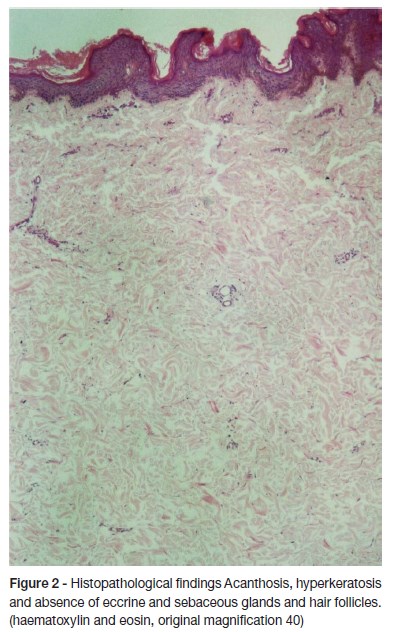
<body><![CDATA[<p>&nbsp;</p>     <p>&nbsp;</p> </font>     <p><font size="3" face="Verdana"><b>INTRODUCTION</b></font></p> <font face="Verdana" size="2">     <p>Ectodermal dysplasias (ED) comprise a large, heterogeneous group of   inherited disorders defined by primary defects in the development of two or   more tissues derived from embryonic ectoderm, primarily the skin and its   appendages (hair follicles, eccrine glands, sebaceous glands and nails) and also the teeth.<sup>1</sup></p>     <p>Hypohidrotic ectodermal dysplasia (HED) is the most common form of ED,   and the majority of HED cases are associated with mutations or deletions in the   ectodysplasin (EDA) gene inherited on the X-chromosome. X-linked Hypohidrotic   Ectodermal Dysplasia (XLHED) is generally suspected by the triad of hypohidrosis, hypotrichosis and hypodontia.<sup>2</sup></p>     <p>&nbsp;</p> </font><b><font size="3" face="Verdana">CASE   REPORT</font></b><font face="Verdana" size="2">     <p>A   4-year-old boy was referred due to a persistent and severe eczema since he was   four months old. Treatment with moisturizers and topical corticosteroids was   unsuccessful. Physical examination revealed a generalized eczema with   lichenification and scaling more intense in the face, arms and hands,   anodontia, a sparse, thin and brittle blonde hair, periorbital wrinkling with   hyperpigmentation and absence of sweating (<a href="#f1">figure 1</a>). Previous history of   recurrent upper respiratory tract infections and episodes of hyperpyrexia were   recorded. The parents and the four brothers were apparently healthy.</p>     <p>&nbsp;</p>     <p><a name="f1"></a></p>     <p align="center"><img src="/img/revistas/nas/v26n4/26n4a09f1.jpg" width="567" height="605"></p>     
]]></body>
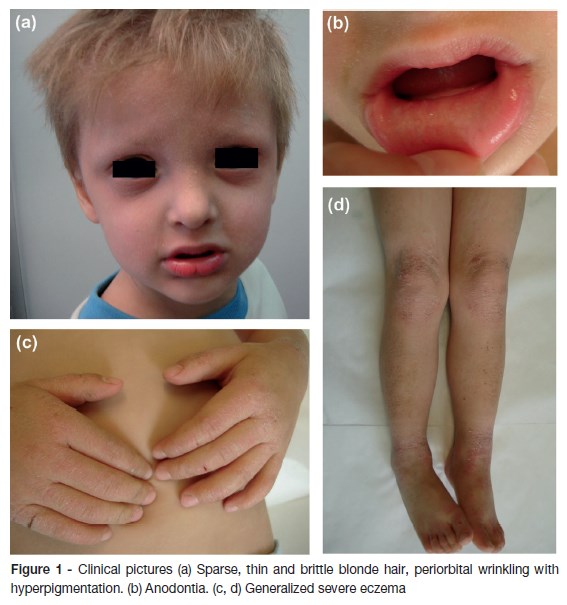
<body><![CDATA[<p>&nbsp;</p>     <p>Laboratory results showed a   raised serum immunoglobulin E (IgE) level (2598 kU/L; normal range: &lt; 107   kU/L) with normal chemistry and complete blood count. High levels of specific   IgE antibodies to dermatophagoides pteronyssinus (&gt;100.00 kU/L),   dermatophagoides farinae (85.40 kU/L) and grass pollen (99.10 kU/L) were also   detected. Skin biopsy showed acanthosis, hyperkeratosis and absence of eccrine   and sebaceous glands and hair follicles (<a href="#f2">figure 2</a>). An orthopantography   confirmed maxilla hypoplasia and anodontia. The genetic molecular study was   consistent with clinical diagnosis, revealing a c.463C&gt;T (p.Arg155Cys) mutation of the EDA1 gene.</p>     <p><a name="f2"></a></p>     <p>&nbsp;</p>     <p align="center"><img src="/img/revistas/nas/v26n4/26n4a09f2.jpg" width="393" height="632"></p>     
<p>&nbsp;</p>     <p>&nbsp;</p>   </font><b><font face="Verdana">DISCUSSION</font></b><font face="Verdana" size="2">     <p>The   cardinal clinical features of XLHED comprise deficient sweating, partial or   complete absence of dentition and sparse hair. Other physical findings include   saddle-shaped nose or depressed nasal bridge, thick and protruding lips, sparse or absent eyebrows, dry skin with eczematous changes and periorbital pigmentation.<sup>3</sup></p>     <p>It has been widely accepted   that patients with HED have an increased risk of death from hyperpyrexia due to   the inability to sweat and regulate core body temperatures, but recent studies   show that prognosis has improved over the last decades, probably as a result of more prompt recognition and adequate management.<sup>4</sup></p>     <p>Although mortality of HED has decreased, complications often occur and   the greatest impact on quality of life seems to be related to cutaneous   symptoms. In fact, hypohidrosis can lead to severe heat intolerance, imposing   sufficient hydration and avoidance of excessive heat exposure, which may have a   major impact on daily planning and activities. Eczema has also been reported a   major problem influencing quality of life and seems to affect up to two-thirds of the male HED patients.<sup>5</sup></p>     ]]></body>
<body><![CDATA[<p>From a clinical point of   view, the eczematous characteristics of ED skin resemble those of atopic   dermatitis (AD). For AD, recent knowledge suggests that barrier dysfunction is   the central cause.<sup>6</sup> Although in AD, filaggrin mutations and   abnormalities in epidermal lipids are recognized mechanisms to skin barrier   dysfunction, few data are available about the lipid profile and the filaggrin   status in the stratum corneum of patients with HED. <i>Jungersted</i> <i>et al</i>. demonstrated that HED patients have a ceramide profile   similar to that observed in AD skin, which could indicate some resemblance in   the pathogenesis of both diseases.<sup>7</sup> A study found that filaggrin   expression in the skin of patients with HED was similar to normal subjects and   concluded that atopic diathesis in HED appear not to be associated with   filaggrin.<sup>8</sup> Recently, <i>Watabe</i> <i>et al</i>. compared the   concentrations of various natural moisturizing factors in the stratum corneum   between anhidrotic regions and normal skin areas in patients with acquired   idiopathic generalized anhidrosis and with segmental anhidrosis.<sup>9</sup>   The levels of lactate, urea, sodium, and potassium were significantly lower in   anhidrotic areas, so the authors claimed that several natural moisturising   factors components are mostly derived from sweat gland function and play a   crucial role in maintaining the physiological hydration state of the stratum   corneum. Therefore, it is plausible to speculate that in HED patients,   hypohidrosis or anhidrosis by itself might contribute to skin barrier disruption.</p>     <p>It was interesting to   observe that our patient had a generalized eczema that was more intense in   air-exposed skin surfaces. In fact, it has been previously indicated that   periorbital dermatitis could be one of the characteristics of HED skin lesions.<sup>8</sup>   However, the meaning of this finding and the elucidation of the underlying   mechanism are lacking. It is recognized that in a subset of patients with AD,   airborne proteins are a contributing factor to the disease, and this group   typically shows lesions predominately on air-exposed skin surfaces including   the face, neck and arms and a more severe disease, resistant to conventional   therapies. The most common airborne   proteins significant in AD include house dust mites, cockroach, pet dander and   multiple pollens. The reactions to airborne proteins are likely mediated by   multiple mechanisms, including direct proteolytic activity leading to   degradation of the stratum corneum, direct activation of proteinase-activated   receptors-2 itch receptors, and IgE binding leading to increased local   inflammation. Although, atopy patch test has the best evidence for identifying   AD patients with a relevant airborne protein reaction driving their disease, it   has also been demonstrated a linear correlation between increasing severity of   AD and increasing levels of IgE specific to house dust mites and other proteins.<sup>10</sup></p>     <p>In the light of these views, it is possible that in our patient, a   significant skin barrier dysfunction was elicited by airborne proteins, for   which high levels of specific IgE to house dust and grass pollen were   demonstrated. This effect acting synergistically with the reduction of natural   moisturizing factors due to hypohidrosis as discussed previously, likely contributed to the persistent and difficult-to-control AD-like eczema.</p>     <p>As a consequence of the rarity of the disease, obtaining a significant   number of clinical studies to clarify and validate the pathways involved in   skin barrier dysfunction and the consequent eczematous lesions in HED patients will probably remain a challeng.</p>     <p>&nbsp;</p> </font><font size="3" face="Verdana"><b>REFER&Ecirc;NCIAS BIBLIOGR&Aacute;FICAS</b></font><font face="Verdana" size="2">     <!-- ref --><p>1. Itin PH. Ectodermal dysplasia: thoughts   and practical concepts concerning disease classification - the role of   functional pathways in the molecular genetic diagnosis. Dermatology. 2013; 226:111-4.    &nbsp;&nbsp;&nbsp;&nbsp;&nbsp;&nbsp;&nbsp;&nbsp;[&#160;<a href="javascript:void(0);" onclick="javascript: window.open('/scielo.php?script=sci_nlinks&ref=1107528&pid=S0872-0754201700040000900001&lng=','','width=640,height=500,resizable=yes,scrollbars=1,menubar=yes,');">Links</a>&#160;]<!-- end-ref --> </p>     <!-- ref --><p>2. Fete   M, Hermann J, Behrens J, Huttner KM. X-linked hypohidrotic ectodermal dysplasia   (XLHED): clinical and diagnostic insights from an international patient registry. Am J Med Genet A. 2014; 164A:2437-42.    &nbsp;&nbsp;&nbsp;&nbsp;&nbsp;&nbsp;&nbsp;&nbsp;[&#160;<a href="javascript:void(0);" onclick="javascript: window.open('/scielo.php?script=sci_nlinks&ref=1107530&pid=S0872-0754201700040000900002&lng=','','width=640,height=500,resizable=yes,scrollbars=1,menubar=yes,');">Links</a>&#160;]<!-- end-ref --> </p>     <!-- ref --><p>3. Callea M, Teggi R, Yavuz I, Tadini G,   Priolo M, Crovella S, <i>et al</i>. Ear nose throat manifestations in hypoidrotic ectodermal dysplasia. Int J Pediatr Otorhinolaryngol. 2013; 77:1801-4.    &nbsp;&nbsp;&nbsp;&nbsp;&nbsp;&nbsp;&nbsp;&nbsp;[&#160;<a href="javascript:void(0);" onclick="javascript: window.open('/scielo.php?script=sci_nlinks&ref=1107532&pid=S0872-0754201700040000900003&lng=','','width=640,height=500,resizable=yes,scrollbars=1,menubar=yes,');">Links</a>&#160;]<!-- end-ref --></p>     <!-- ref --><p>4. Bluschke   G, Nusken KD, Schneider H. Prevalence and prevention of severe complications of hypohidrotic ectodermal dysplasia in infancy. Early Hum Dev. 2010; 86:397-9.    &nbsp;&nbsp;&nbsp;&nbsp;&nbsp;&nbsp;&nbsp;&nbsp;[&#160;<a href="javascript:void(0);" onclick="javascript: window.open('/scielo.php?script=sci_nlinks&ref=1107534&pid=S0872-0754201700040000900004&lng=','','width=640,height=500,resizable=yes,scrollbars=1,menubar=yes,');">Links</a>&#160;]<!-- end-ref --> </p>     <!-- ref --><p>5. Pavlis   MB, Rice ZP, Veledar E, Bradley BR, Spraker MK, Chen SC. Quality of life of   cutaneous disease in the ectodermal dysplasias. Pediatr Dermatol. 2010; 27:260-5.    &nbsp;&nbsp;&nbsp;&nbsp;&nbsp;&nbsp;&nbsp;&nbsp;[&#160;<a href="javascript:void(0);" onclick="javascript: window.open('/scielo.php?script=sci_nlinks&ref=1107536&pid=S0872-0754201700040000900005&lng=','','width=640,height=500,resizable=yes,scrollbars=1,menubar=yes,');">Links</a>&#160;]<!-- end-ref --> </p>     <!-- ref --><p>6. Weidinger   S, Novak N. Atopic dermatitis. Lancet 2016; 387:1109-22.    &nbsp;&nbsp;&nbsp;&nbsp;&nbsp;&nbsp;&nbsp;&nbsp;[&#160;<a href="javascript:void(0);" onclick="javascript: window.open('/scielo.php?script=sci_nlinks&ref=1107538&pid=S0872-0754201700040000900006&lng=','','width=640,height=500,resizable=yes,scrollbars=1,menubar=yes,');">Links</a>&#160;]<!-- end-ref --> </p>     <!-- ref --><p>7. Jungersted   JM, Hogh JK, Hellgren LI, Agner T, Jemec GB. Ceramide profile in hypohidrotic ectodermal dysplasia. Clin Exp Dermatol. 2012; 37:153-5.    &nbsp;&nbsp;&nbsp;&nbsp;&nbsp;&nbsp;&nbsp;&nbsp;[&#160;<a href="javascript:void(0);" onclick="javascript: window.open('/scielo.php?script=sci_nlinks&ref=1107540&pid=S0872-0754201700040000900007&lng=','','width=640,height=500,resizable=yes,scrollbars=1,menubar=yes,');">Links</a>&#160;]<!-- end-ref --> </p>     <!-- ref --><p>8. Koguchi-Yoshioka H, Wataya-Kaneda M,   Yutani M, Murota H, Nakano H, Sawamura D, <i>et al</i>. Atopic diathesis   in hypohidrotic/anhidrotic ectodermal dysplasia. Acta Derm Venereol. 2015; 95:476-9.    &nbsp;&nbsp;&nbsp;&nbsp;&nbsp;&nbsp;&nbsp;&nbsp;[&#160;<a href="javascript:void(0);" onclick="javascript: window.open('/scielo.php?script=sci_nlinks&ref=1107542&pid=S0872-0754201700040000900008&lng=','','width=640,height=500,resizable=yes,scrollbars=1,menubar=yes,');">Links</a>&#160;]<!-- end-ref --> </p>     <!-- ref --><p>9. Watabe   A, Sugawara T, Kikuchi K, Yamasaki K, Sakai S, Aiba S. Sweat constitutes   several natural moisturizing factors, lactate, urea, sodium, and potassium. J Dermatol Sci. 2013; 72:177-82.    &nbsp;&nbsp;&nbsp;&nbsp;&nbsp;&nbsp;&nbsp;&nbsp;[&#160;<a href="javascript:void(0);" onclick="javascript: window.open('/scielo.php?script=sci_nlinks&ref=1107544&pid=S0872-0754201700040000900009&lng=','','width=640,height=500,resizable=yes,scrollbars=1,menubar=yes,');">Links</a>&#160;]<!-- end-ref --></p>     <!-- ref --><p>10. Schafer   T, Heinrich J, Wjst M, Adam H, Ring J, Wichmann HE. Association between   severity of atopic eczema and degree of sensitization to aeroallergens in   schoolchildren. J Allergy Clin Immunol. 1999; 104:1280-4.    &nbsp;&nbsp;&nbsp;&nbsp;&nbsp;&nbsp;&nbsp;&nbsp;[&#160;<a href="javascript:void(0);" onclick="javascript: window.open('/scielo.php?script=sci_nlinks&ref=1107546&pid=S0872-0754201700040000900010&lng=','','width=640,height=500,resizable=yes,scrollbars=1,menubar=yes,');">Links</a>&#160;]<!-- end-ref --></p>     <p>&nbsp;</p>     <p>&nbsp;</p>     <p><b><a name="end" id="topo2"></a><a href="#topo">CORRESPONDENCE TO</a></b></p>     <p>Catarina Moreira    <br>   Department of Dermatology and Venereology    ]]></body>
<body><![CDATA[<br> Centro Hospitalar São João    <br> Alameda Prof. Hernâni Monteiro,    <br> 4200-319 Porto    <br> Email: <a href="mailto:cat_moreira@icloud.com">cat_moreira@icloud.com</a></p>     <p>Received for publication: 30.12.2016 Accepted in revised form: 06.02.2017</p> </font>      ]]></body><back>
<ref-list>
<ref id="B1">
<label>1.</label><nlm-citation citation-type="journal">
<person-group person-group-type="author">
<name>
<surname><![CDATA[Itin]]></surname>
<given-names><![CDATA[PH]]></given-names>
</name>
</person-group>
<article-title xml:lang="en"><![CDATA[Ectodermal dysplasia: thoughts and practical concepts concerning disease classification - the role of functional pathways in the molecular genetic diagnosis]]></article-title>
<source><![CDATA[Dermatology]]></source>
<year>2013</year>
<volume>226</volume>
<page-range>111-4</page-range></nlm-citation>
</ref>
<ref id="B2">
<label>2.</label><nlm-citation citation-type="journal">
<person-group person-group-type="author">
<name>
<surname><![CDATA[Fete]]></surname>
<given-names><![CDATA[M]]></given-names>
</name>
<name>
<surname><![CDATA[Hermann]]></surname>
<given-names><![CDATA[J]]></given-names>
</name>
<name>
<surname><![CDATA[Behrens]]></surname>
<given-names><![CDATA[J]]></given-names>
</name>
<name>
<surname><![CDATA[Huttner]]></surname>
<given-names><![CDATA[KM]]></given-names>
</name>
</person-group>
<article-title xml:lang="en"><![CDATA[X-linked hypohidrotic ectodermal dysplasia (XLHED): clinical and diagnostic insights from an international patient registry]]></article-title>
<source><![CDATA[Am J Med Genet A]]></source>
<year>2014</year>
<volume>164A</volume>
<page-range>2437-42</page-range></nlm-citation>
</ref>
<ref id="B3">
<label>3.</label><nlm-citation citation-type="journal">
<person-group person-group-type="author">
<name>
<surname><![CDATA[Callea]]></surname>
<given-names><![CDATA[M]]></given-names>
</name>
<name>
<surname><![CDATA[Teggi]]></surname>
<given-names><![CDATA[R]]></given-names>
</name>
<name>
<surname><![CDATA[Yavuz]]></surname>
<given-names><![CDATA[I]]></given-names>
</name>
<name>
<surname><![CDATA[Tadini]]></surname>
<given-names><![CDATA[G]]></given-names>
</name>
<name>
<surname><![CDATA[Priolo]]></surname>
<given-names><![CDATA[M]]></given-names>
</name>
<name>
<surname><![CDATA[Crovella]]></surname>
<given-names><![CDATA[S]]></given-names>
</name>
</person-group>
<article-title xml:lang="en"><![CDATA[Ear nose throat manifestations in hypoidrotic ectodermal dysplasia]]></article-title>
<source><![CDATA[Int J Pediatr Otorhinolaryngol]]></source>
<year>2013</year>
<volume>77</volume>
<page-range>1801-4</page-range></nlm-citation>
</ref>
<ref id="B4">
<label>4.</label><nlm-citation citation-type="journal">
<person-group person-group-type="author">
<name>
<surname><![CDATA[Bluschke]]></surname>
<given-names><![CDATA[G]]></given-names>
</name>
<name>
<surname><![CDATA[Nusken]]></surname>
<given-names><![CDATA[KD]]></given-names>
</name>
<name>
<surname><![CDATA[Schneider]]></surname>
<given-names><![CDATA[H]]></given-names>
</name>
</person-group>
<article-title xml:lang="en"><![CDATA[Prevalence and prevention of severe complications of hypohidrotic ectodermal dysplasia in infancy]]></article-title>
<source><![CDATA[Early Hum Dev]]></source>
<year>2010</year>
<volume>86</volume>
<page-range>397-9</page-range></nlm-citation>
</ref>
<ref id="B5">
<label>5.</label><nlm-citation citation-type="journal">
<person-group person-group-type="author">
<name>
<surname><![CDATA[Pavlis]]></surname>
<given-names><![CDATA[MB]]></given-names>
</name>
<name>
<surname><![CDATA[Rice]]></surname>
<given-names><![CDATA[ZP]]></given-names>
</name>
<name>
<surname><![CDATA[Veledar]]></surname>
<given-names><![CDATA[E]]></given-names>
</name>
<name>
<surname><![CDATA[Bradley]]></surname>
<given-names><![CDATA[BR]]></given-names>
</name>
<name>
<surname><![CDATA[Spraker]]></surname>
<given-names><![CDATA[MK]]></given-names>
</name>
<name>
<surname><![CDATA[Chen]]></surname>
<given-names><![CDATA[SC]]></given-names>
</name>
</person-group>
<article-title xml:lang="en"><![CDATA[Quality of life of cutaneous disease in the ectodermal dysplasias]]></article-title>
<source><![CDATA[Pediatr Dermatol]]></source>
<year>2010</year>
<volume>27</volume>
<page-range>260-5</page-range></nlm-citation>
</ref>
<ref id="B6">
<label>6.</label><nlm-citation citation-type="journal">
<person-group person-group-type="author">
<name>
<surname><![CDATA[Weidinger]]></surname>
<given-names><![CDATA[S]]></given-names>
</name>
<name>
<surname><![CDATA[Novak]]></surname>
<given-names><![CDATA[N]]></given-names>
</name>
</person-group>
<article-title xml:lang="en"><![CDATA[Atopic dermatitis]]></article-title>
<source><![CDATA[Lancet]]></source>
<year>2016</year>
<volume>387</volume>
<page-range>1109-22</page-range></nlm-citation>
</ref>
<ref id="B7">
<label>7.</label><nlm-citation citation-type="journal">
<person-group person-group-type="author">
<name>
<surname><![CDATA[Jungersted]]></surname>
<given-names><![CDATA[JM]]></given-names>
</name>
<name>
<surname><![CDATA[Hogh]]></surname>
<given-names><![CDATA[JK]]></given-names>
</name>
<name>
<surname><![CDATA[Hellgren]]></surname>
<given-names><![CDATA[LI]]></given-names>
</name>
<name>
<surname><![CDATA[Agner]]></surname>
<given-names><![CDATA[T]]></given-names>
</name>
<name>
<surname><![CDATA[Jemec]]></surname>
<given-names><![CDATA[GB]]></given-names>
</name>
</person-group>
<article-title xml:lang="en"><![CDATA[Ceramide profile in hypohidrotic ectodermal dysplasia]]></article-title>
<source><![CDATA[Clin Exp Dermatol]]></source>
<year>2012</year>
<volume>37</volume>
<page-range>153-5</page-range></nlm-citation>
</ref>
<ref id="B8">
<label>8.</label><nlm-citation citation-type="journal">
<person-group person-group-type="author">
<name>
<surname><![CDATA[Koguchi-Yoshioka]]></surname>
<given-names><![CDATA[H]]></given-names>
</name>
<name>
<surname><![CDATA[Wataya-Kaneda]]></surname>
<given-names><![CDATA[M]]></given-names>
</name>
<name>
<surname><![CDATA[Yutani]]></surname>
<given-names><![CDATA[M]]></given-names>
</name>
<name>
<surname><![CDATA[Murota]]></surname>
<given-names><![CDATA[H]]></given-names>
</name>
<name>
<surname><![CDATA[Nakano]]></surname>
<given-names><![CDATA[H]]></given-names>
</name>
<name>
<surname><![CDATA[Sawamura]]></surname>
<given-names><![CDATA[D]]></given-names>
</name>
</person-group>
<article-title xml:lang="en"><![CDATA[Atopic diathesis in hypohidrotic/anhidrotic ectodermal dysplasia]]></article-title>
<source><![CDATA[Acta Derm Venereol]]></source>
<year>2015</year>
<volume>95</volume>
<page-range>476-9</page-range></nlm-citation>
</ref>
<ref id="B9">
<label>9.</label><nlm-citation citation-type="journal">
<person-group person-group-type="author">
<name>
<surname><![CDATA[Watabe]]></surname>
<given-names><![CDATA[A]]></given-names>
</name>
<name>
<surname><![CDATA[Sugawara]]></surname>
<given-names><![CDATA[T]]></given-names>
</name>
<name>
<surname><![CDATA[Kikuchi]]></surname>
<given-names><![CDATA[K]]></given-names>
</name>
<name>
<surname><![CDATA[Yamasaki]]></surname>
<given-names><![CDATA[K]]></given-names>
</name>
<name>
<surname><![CDATA[Sakai]]></surname>
<given-names><![CDATA[S]]></given-names>
</name>
<name>
<surname><![CDATA[Aiba]]></surname>
<given-names><![CDATA[S]]></given-names>
</name>
</person-group>
<article-title xml:lang="en"><![CDATA[Sweat constitutes several natural moisturizing factors, lactate, urea, sodium, and potassium]]></article-title>
<source><![CDATA[J Dermatol Sci.]]></source>
<year>2013</year>
<volume>72</volume>
<page-range>177-82</page-range></nlm-citation>
</ref>
<ref id="B10">
<label>10.</label><nlm-citation citation-type="journal">
<person-group person-group-type="author">
<name>
<surname><![CDATA[Schafer]]></surname>
<given-names><![CDATA[T]]></given-names>
</name>
<name>
<surname><![CDATA[Heinrich]]></surname>
<given-names><![CDATA[J]]></given-names>
</name>
<name>
<surname><![CDATA[Wjst]]></surname>
<given-names><![CDATA[M]]></given-names>
</name>
<name>
<surname><![CDATA[Adam]]></surname>
<given-names><![CDATA[H]]></given-names>
</name>
<name>
<surname><![CDATA[Ring]]></surname>
<given-names><![CDATA[J]]></given-names>
</name>
<name>
<surname><![CDATA[Wichmann]]></surname>
<given-names><![CDATA[HE]]></given-names>
</name>
</person-group>
<article-title xml:lang="en"><![CDATA[Association between severity of atopic eczema and degree of sensitization to aeroallergens in schoolchildren]]></article-title>
<source><![CDATA[J Allergy Clin Immunol]]></source>
<year>1999</year>
<volume>104</volume>
<page-range>1280-4</page-range></nlm-citation>
</ref>
</ref-list>
</back>
</article>