<?xml version="1.0" encoding="ISO-8859-1"?><article xmlns:mml="http://www.w3.org/1998/Math/MathML" xmlns:xlink="http://www.w3.org/1999/xlink" xmlns:xsi="http://www.w3.org/2001/XMLSchema-instance">
<front>
<journal-meta>
<journal-id>0872-0754</journal-id>
<journal-title><![CDATA[Nascer e Crescer]]></journal-title>
<abbrev-journal-title><![CDATA[Nascer e Crescer]]></abbrev-journal-title>
<issn>0872-0754</issn>
<publisher>
<publisher-name><![CDATA[Centro Hospitalar do Porto]]></publisher-name>
</publisher>
</journal-meta>
<article-meta>
<article-id>S0872-07542017000400010</article-id>
<title-group>
<article-title xml:lang="en"><![CDATA[Lumbar tattoo and labour analgesia: a case of surgical approach]]></article-title>
<article-title xml:lang="pt"><![CDATA[Tatuagem lombar e analgesia de trabalho de parto: um caso de abordagem cirúrgica]]></article-title>
</title-group>
<contrib-group>
<contrib contrib-type="author">
<name>
<surname><![CDATA[Duque]]></surname>
<given-names><![CDATA[Mélanie]]></given-names>
</name>
<xref ref-type="aff" rid="A01"/>
</contrib>
<contrib contrib-type="author">
<name>
<surname><![CDATA[Lopes]]></surname>
<given-names><![CDATA[José]]></given-names>
</name>
<xref ref-type="aff" rid="A01"/>
</contrib>
<contrib contrib-type="author">
<name>
<surname><![CDATA[Ribeiro]]></surname>
<given-names><![CDATA[Sandy]]></given-names>
</name>
<xref ref-type="aff" rid="A01"/>
</contrib>
<contrib contrib-type="author">
<name>
<surname><![CDATA[Araújo]]></surname>
<given-names><![CDATA[Isabel]]></given-names>
</name>
<xref ref-type="aff" rid="A01"/>
</contrib>
</contrib-group>
<aff id="A01">
<institution><![CDATA[,Centro Hospitalar Tondela-Viseu Hospital de São Teotónio Department of Anesthesiology]]></institution>
<addr-line><![CDATA[Viseu ]]></addr-line>
<country>Portugal</country>
</aff>
<pub-date pub-type="pub">
<day>12</day>
<month>00</month>
<year>2017</year>
</pub-date>
<pub-date pub-type="epub">
<day>12</day>
<month>00</month>
<year>2017</year>
</pub-date>
<volume>26</volume>
<numero>4</numero>
<fpage>255</fpage>
<lpage>257</lpage>
<copyright-statement/>
<copyright-year/>
<self-uri xlink:href="http://scielo.pt/scielo.php?script=sci_arttext&amp;pid=S0872-07542017000400010&amp;lng=en&amp;nrm=iso"></self-uri><self-uri xlink:href="http://scielo.pt/scielo.php?script=sci_abstract&amp;pid=S0872-07542017000400010&amp;lng=en&amp;nrm=iso"></self-uri><self-uri xlink:href="http://scielo.pt/scielo.php?script=sci_pdf&amp;pid=S0872-07542017000400010&amp;lng=en&amp;nrm=iso"></self-uri><abstract abstract-type="short" xml:lang="en"><p><![CDATA[Introduction: Pregnant women with lumbar tattoo presenting for labour analgesia are currently increasing in number. Many anaesthesiologists are hesitant in placing an epidural catheter over a lumbar tattoo based on a theory that tissue coring of fragments of tattoo pigment into the epidural, subdural or subarachnoid space, could lead to epidermoid tumours or arachnoiditis. For these reasons, it has been recommended to avoid the introduction of epidural needle directly through skin with tattoo pigments. Case Report: We describe a case where the placement of the epidural catheter was made after a surgical incision of the skin to obtain a puncture field free from ink pigment. Conclusion: Surgical approach to epidural catheter placement reduces the risk of the pigment-entrainment phenomenon from the skin to the epidural space.]]></p></abstract>
<abstract abstract-type="short" xml:lang="pt"><p><![CDATA[Introdução: As mulheres grávidas para analgesia de parto com tatuagem lombar estão atualmente a aumentar em número. Muitos anestesistas são hesitantes em colocar um cateter epidural através da tatuagem lombar com base na teoria de arrastamento de tecidos e fragmentos de pigmento da tatuagem para o espaço epidural, subdural ou subaracnóide. Este arrastamento pode levar ao desenvolvimento de tumores epidermóide ou aracnoidites. Por estas razões, tem sido recomendado evitar a introdução de agulha epidural diretamente através da pele com pigmentos de tatuagem. Relato de Caso: Descrevemos um caso em que a colocação do cateter epidural foi feita após uma incisão cirúrgica na pele para obter um campo de punção livre de pigmento de tinta da tatuagem. Conclusão: A abordagem cirúrgica para a colocação do cateter epidural reduz o risco de arrastamento do pigmento da pele para o espaço epidural.]]></p></abstract>
<kwd-group>
<kwd lng="en"><![CDATA[Epidural]]></kwd>
<kwd lng="en"><![CDATA[pregnant]]></kwd>
<kwd lng="en"><![CDATA[skin incision]]></kwd>
<kwd lng="en"><![CDATA[tattoo]]></kwd>
<kwd lng="pt"><![CDATA[Epidural]]></kwd>
<kwd lng="pt"><![CDATA[grávida]]></kwd>
<kwd lng="pt"><![CDATA[incisão da pele]]></kwd>
<kwd lng="pt"><![CDATA[tatuagem]]></kwd>
</kwd-group>
</article-meta>
</front><body><![CDATA[ <p align="right"><font face="Verdana" size="2">         <b> CASE REPORTS | CASOS CL&Iacute;NICOS </b> </font></p> <font face="Verdana" size="2">     <p>&nbsp;</p> </font>     <p><font size="4" face="Verdana"><b>Lumbar tattoo and   labour analgesia: a case of surgical approach</b></font></p>     <p>&nbsp;</p>     <p><b><font size="3" face="Verdana">Tatuagem lombar e analgesia   de trabalho de parto: um caso de abordagem cir&uacute;rgica </font></b><font face="Verdana" size="2">   </font></p> <font face="Verdana" size="2">     <p>&nbsp;</p>     <p>&nbsp;</p>     <p><b>Mélanie Duque<sup>I</sup>,   José Lopes<sup>I</sup>, Sandy Ribeiro<sup>I</sup>, Isabel Araújo<sup>I</sup></b></p>     <p><sup>I</sup> Department of Anesthesiology,   Hospital de São Teotónio, Centro Hospitalar Tondela-Viseu. 3504-509 Viseu, Portugal. <a href="mailto:melanieduque@gmail.com">melanieduque@gmail.com</a>; <a href="mailto:jduartecl@gmail.com">jduartecl@gmail.com</a>; <a href="mailto:sandy.ribeiro@sapo.pt">sandy.ribeiro@sapo.pt</a>; <a href="mailto:isabelguedesaraujo@hotmail.com">isabelguedesaraujo@hotmail.com</a></p>     <p><a href="#end">Correspondence to</a><a name="topo" id="topo"></a></p>     ]]></body>
<body><![CDATA[<p>&nbsp;</p>     <p>&nbsp;</p> </font> <hr noshade size="1"> <font face="Verdana" size="2">     <p><b>ABSTRACT</b></p>     <p><b>Introduction:</b> Pregnant women   with lumbar tattoo presenting for labour analgesia are currently increasing in   number. Many anaesthesiologists are hesitant in placing an epidural catheter   over a lumbar tattoo based on a theory that tissue coring of fragments of   tattoo pigment into the epidural, subdural or subarachnoid space, could lead to   epidermoid tumours or arachnoiditis. For these reasons, it has been recommended   to avoid the introduction of epidural needle directly through skin with tattoo pigments. </p>     <p><b>Case Report: </b>We describe a   case where the placement of the epidural catheter was made after a surgical incision of the skin to obtain a puncture field free from ink pigment. </p>     <p><b>Conclusion: </b>Surgical approach to epidural catheter placement   reduces the risk of the pigment-entrainment phenomenon from the skin to the epidural space.</p>     <p><b>Keywords</b>: Epidural; pregnant; skin incision; tattoo</p> </font> <hr noshade size="1"> <font face="Verdana" size="2">     <p><b>RESUMO</b></p>     <p><b>Introdução:</b> As mulheres grávidas para analgesia de parto com   tatuagem lombar estão atualmente a aumentar em número. Muitos anestesistas são   hesitantes em colocar um cateter epidural através da tatuagem lombar com base   na teoria de arrastamento de tecidos e fragmentos de pigmento da tatuagem para   o espaço epidural, subdural ou subaracnóide. Este arrastamento pode levar ao   desenvolvimento de tumores epidermóide ou aracnoidites. Por estas razões, tem   sido recomendado evitar a introdução de agulha epidural diretamente através da pele com pigmentos de tatuagem.</p>     <p><b>Relato de Caso: </b>Descrevemos um caso em que a colocação do cateter   epidural foi feita após uma incisão cirúrgica na pele para obter um campo de punção livre de pigmento de tinta da tatuagem.</p>     ]]></body>
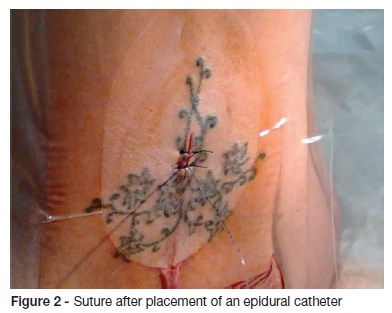
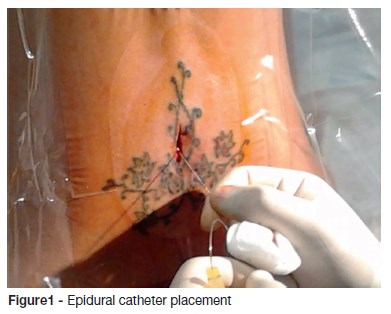
<body><![CDATA[<p><b>Conclusão: </b>A abordagem cirúrgica para a colocação do cateter   epidural reduz o risco de arrastamento do pigmento da pele para o espaço epidural.</p>     <p><b>Palavras-chave:   </b>Epidural; grávida; incisão da pele; tatuagem</p> </font> <hr noshade size="1"> <font face="Verdana" size="2">     <p>&nbsp;</p>     <p>&nbsp;</p> </font>     <p><b><font size="3" face="Verdana">INTRODUCTION</font></b><font face="Verdana" size="2"> </font></p> <font face="Verdana" size="2">    <p>Pregnant women with lumbar   tattoo presenting for labour analgesia are currently increasing in number.<sup>1</sup>   This is mainly due to the fact that the group with the highest percentage of   individuals having a tattoo was born between 1977 and 1986 and about one third   of the individuals with any form of body art (tattoos or piercings) are women.<sup>2</sup>   Epidural is the gold standard technique for labour analgesia.<sup>3</sup> Many   anaesthesiologists are hesitant in placing an epidural catheter over a lumbar   tattoo based on a theory that tissue coring of fragments of tattoo pigment into   the epidural, subdural or subarachnoid space, could lead to epidermoid tumours or arachnoiditis.<sup>4-6</sup> </p>     <p>A Medline search of English literature using the key words: spinal,   epidural, tattoos, tattooing, skin incision, did not find any reports   describing the execution of neuroaxial anaesthesia through a skin incision in   tattooed areas. We present a case report where the placement of the epidural   catheter was made after a surgical incision of the skin to obtain a puncture field free from ink pigment.</p>     <p>&nbsp;</p> </font><font size="3" face="Verdana"><b>CASE DESCRIPTION</b></font><font face="Verdana" size="2">     <p>A   26-year-old woman, ASA physical status II, 39 weeks into her first pregnancy,   entered our hospital in active phase of labour. She had a lower back midline   tattoo extending from L1 to L5. The woman requested epidural analgesia and   refused alternative methods of analgesia like intravenous remifentanil. In face   of that, a surgical skin incision for placement of the epidural catheter was   proposed, to which the pregnant woman consented. The lumbar intervertebral   space between L3 and L4 was selected and anaesthesia of the skin of this area   was obtained with EMLA® Cream (lidocaine 2.5% and prilocaine 2.5%). After   aseptic measures recommended for epidural technique, a vertical midline incision,   about two centimetres long, was made using a scalpel blade over the level of   the L3 - L4 intervertebral space until the first muscle-ligament plane was   reached. No major bleeding occurred. The Tuohy needle (18 Gauge, eight   centimetres long) was introduced directly into the interspinous ligaments   without contacting with the dermis, and the epidural space was searched by the   loss of resistance to air technique. Loss of resistance occurred at a depth of   seven centimetres and the catheter was introduced cephalad until the 11   centimetres mark, leaving four centimetres of catheter in the epidural space.   (Figure <a href="#f1">1</a> and <a href="#f2">2</a>) Simple interrupted suture with instrument tie was performed   using a 2-0 silk filament and the LOCKIT Plus® epidural catheter securement device   was fixed directly over the suture. Epidural analgesia was effective throughout   labour. The catheter was removed the same day after delivery without   complications by simply pulling the catheter without removing the skin suture.   At discharge date, 48 hours after delivery, the scar showed good evolution:   close borders without signs of infection or haemorrhage.  The patient was satisfied with the procedure. Thirty days   after de delivery, the patient was examined; the scar was healed without colloid formation. </p>     <p>&nbsp;</p>     ]]></body>
<body><![CDATA[<p><a name="f1"></a></p>     <p align="center"><img src="/img/revistas/nas/v26n4/26n4a10f1.jpg" width="391" height="314"></p>     
<p>&nbsp;</p>     <p>&nbsp;</p>     <p><a name="f2"></a></p>     <p align="center"><img src="/img/revistas/nas/v26n4/26n4a10f2.jpg" width="392" height="313"></p>     
<p>&nbsp;</p>     <p>&nbsp;</p> </font><b><font size="3" face="Verdana">DISCUSSION</font></b><font face="Verdana" size="2">     <p>The   placement of an epidural catheter through a tattoo is a controversial topic. In   our country, Portugal, a survey was conducted to investigate anaesthesiologists   behaviour when faced with a patient, for possible neuroaxial block, with a lumbar   tattoo. This study was published on 2010. Of the 162 anaesthesiologists   responding to the survey, 92 (59,8%)had already been   requested to carry out a neuroaxial block on a patient with midline back   tattoo. Of these, 55 executed the neuroaxial block on pigment-free skin and 6   (6,5%) always refuse to place an epidural catheter in these patients. Of the 70   respondents that had never been confronted with this situation, 25,7% said they   would refuse to perform this technique and 67,2% would prefer to perform a   neuroaxial block through tattoo free skin, as they were not sure what the   effects of the ink pigment would be when “dragged” into the spinal canal.<sup>4   </sup>The coring and deposition of tattoo-ink pigment into epidural space is   the main issue of concern claimed by anaesthesiologists who avoid inserting   epidural catheters in patients with back tattoos.<sup>5,6</sup> These concerns   were mainly raised by Douglas and Swenerton based on a theory that tissue   coring of fragments of tattoo pigment into the epidural, subdural or   subarachnoid space, could lead to epidermoid tumours or arachnoiditis.<sup>7</sup>   Hollow needles, with or without a stylet, entrap tissue fragments (cores) in   their bore as they pass to deeper structures and the injection through these   needles may then result in this entrapped tissue being deposited in the deeper   site.<sup>7</sup> Ferraz IL. <i>et al</i> demonstrated, in a study in rabbits,   that intrathecal insertion of a  puncture   needle through tattooed skin produced histological changes in the meninges, and   that these changes were not prevented by the use of needles with stylet.<sup>8</sup>   Although a direct relationship between tattoo ink pigments and epidermoid   tumours or chemical arachnoiditis in humans has not been proven, many   anaesthesiologists are reluctant because there is still a remote possibility of   the development of these serious long-term complications. There is still no   evidence-based guideline that excludes the possibility of developing long-term   epidural complications by the entrainment of tattoo pigment from the dermis to the epidural space.<sup>9</sup></p>     <p>For these reasons, it is   suggested to avoid the introduction of epidural needle directly through skin   with tattoo pigments by either selecting a tattoo-free intervertebral space,   using a paramedian approach, or by finding a pigment-free skin spot within the area of the tattoo.<sup>9,10</sup></p>     ]]></body>
<body><![CDATA[<p>However, the latter does not assure the absence of ink pigments because   they are taken by macrophages from other areas far from the visible limits of the tattoo.<sup>7</sup></p>     <p>Epidural   is the gold standard technique for labour analgesia with excellent pain relief,   delivering higher maternal satisfaction compared with other techniques of pain   relief.<sup>3</sup> However, because of our patient’s midline lumbar tattoo, we   proposed an intravenous perfusion of remifentanil as alternative analgesia but   she refused and insisted on the epidural. After explaining all the possible   risks, we proceeded with an epidural block for analgesia. Surgical incision for   placement of epidural has already been proposed as a possible technique but, to   our knowledge, has not yet been described in the literature.<sup>4,6,11</sup> With the skin incision, the authors aimed to   reduce the tissue-coring phenomenon of tattoo-ink pigment into the epidural   space.  During the tattooing process,   tattoo pigments are deposited along the entire needle tract but only the   pigment that is in the dermis remains permanently since the epidermis undergoes   constant regeneration. The surrounding macrophages phagocyte these pigments and   carry them to regional lymphatic and perivascular lymph nodes.<sup>7 </sup>A   report of axillary lymphadenopathy clinically mimicking metastatic melanoma 30   years after a decorative tattoo was described. Microscopic examination of the   routine haematoxylin and eosin sections of the lymph node of this patient   showed tattoo pigment lying within the macrophages and dispersed outside them   in the sinuses.<sup>12</sup> To this moment tattoo inks are not regulated by a   health organism like the Food and Drug Administration or the Infarmed, so the   risk of using non identified toxic pigments that could lead to major   complications exists. The authors chose not to consider the placement of the   epidural on a pigment free skin spot within the area of the tattoo because of   the risk of pigment ink migration and decided to perform a skin incision until the muscle-ligament plane was reached.</p>     <p>Although surgical approach to epidural catheter placement is an invasive   procedure with possible complications associated, it seems to be a legitimate   alternative since it reduces the risk of the pigment-entrainment phenomenon from the skin to the epidural space.</p>     <p>&nbsp;</p> </font>     <p><b><font size="3" face="Verdana">REFER&Ecirc;NCIAS BIBLIOGR&Aacute;FICAS</font></b></p> <font face="Verdana" size="2">       <!-- ref --><p>1. Kluger N. Body art and pregnancy. Eur J   Obstet Gynecol Reprod Biol. 2010; 153: 3-7.    &nbsp;&nbsp;&nbsp;&nbsp;&nbsp;&nbsp;&nbsp;&nbsp;[&#160;<a href="javascript:void(0);" onclick="javascript: window.open('/scielo.php?script=sci_nlinks&ref=1107617&pid=S0872-0754201700040001000001&lng=','','width=640,height=500,resizable=yes,scrollbars=1,menubar=yes,');">Links</a>&#160;]<!-- end-ref --></p>       <!-- ref --><p>2. Laumann   AE, Derick AJ. Tattoos and body piercings in the United States: a national data set. J Am Acad Dermatol 2006; 55:413–21.    &nbsp;&nbsp;&nbsp;&nbsp;&nbsp;&nbsp;&nbsp;&nbsp;[&#160;<a href="javascript:void(0);" onclick="javascript: window.open('/scielo.php?script=sci_nlinks&ref=1107619&pid=S0872-0754201700040001000002&lng=','','width=640,height=500,resizable=yes,scrollbars=1,menubar=yes,');">Links</a>&#160;]<!-- end-ref --></p>       <!-- ref --><p>3. Sng   BL, Kwok SC, Sia AT. Modern neuraxial labour analgesia. Curr Opin Anaesthesiol. 2015; 28:285-9.    &nbsp;&nbsp;&nbsp;&nbsp;&nbsp;&nbsp;&nbsp;&nbsp;[&#160;<a href="javascript:void(0);" onclick="javascript: window.open('/scielo.php?script=sci_nlinks&ref=1107621&pid=S0872-0754201700040001000003&lng=','','width=640,height=500,resizable=yes,scrollbars=1,menubar=yes,');">Links</a>&#160;]<!-- end-ref --> </p>       <!-- ref --><p>4. Gaspar   A, Serrano N. Neuroaxial blocks and tattoos: a dilemma? Arch Gynecol Obstet. 2010; 282:255–60.    &nbsp;&nbsp;&nbsp;&nbsp;&nbsp;&nbsp;&nbsp;&nbsp;[&#160;<a href="javascript:void(0);" onclick="javascript: window.open('/scielo.php?script=sci_nlinks&ref=1107623&pid=S0872-0754201700040001000004&lng=','','width=640,height=500,resizable=yes,scrollbars=1,menubar=yes,');">Links</a>&#160;]<!-- end-ref --></p>       <!-- ref --><p>5. Sleth JC, Guillot B, Kluger N. Lumbar tattoos and   neuraxial anaesthesia in obstetrics: practice survey in Languedoc-Roussillon, France. Ann Fr Anesth Reanim. 2010; 29:397–401.    &nbsp;&nbsp;&nbsp;&nbsp;&nbsp;&nbsp;&nbsp;&nbsp;[&#160;<a href="javascript:void(0);" onclick="javascript: window.open('/scielo.php?script=sci_nlinks&ref=1107625&pid=S0872-0754201700040001000005&lng=','','width=640,height=500,resizable=yes,scrollbars=1,menubar=yes,');">Links</a>&#160;]<!-- end-ref --></p>       <!-- ref --><p>6. Raynaud   L, Mercier FJ, Auroy Y, Benhamou D; SOS ALR. Epidural anaesthesia and lumbar tattoo: what to do? Ann Fr Anesth Reanim. 2006; 25:71-3.    &nbsp;&nbsp;&nbsp;&nbsp;&nbsp;&nbsp;&nbsp;&nbsp;[&#160;<a href="javascript:void(0);" onclick="javascript: window.open('/scielo.php?script=sci_nlinks&ref=1107627&pid=S0872-0754201700040001000006&lng=','','width=640,height=500,resizable=yes,scrollbars=1,menubar=yes,');">Links</a>&#160;]<!-- end-ref --> </p>       <!-- ref --><p>7. Douglas   M J, Swenerton J E. Epidural anesthesia in three &#8232;parturients with lumbar tattoos: A review of possible implications. Can J Anesth 2002; 49:1057–60.    &nbsp;&nbsp;&nbsp;&nbsp;&nbsp;&nbsp;&nbsp;&nbsp;[&#160;<a href="javascript:void(0);" onclick="javascript: window.open('/scielo.php?script=sci_nlinks&ref=1107629&pid=S0872-0754201700040001000007&lng=','','width=640,height=500,resizable=yes,scrollbars=1,menubar=yes,');">Links</a>&#160;]<!-- end-ref --> </p>       <!-- ref --><p>8. Ferraz IL, GA Barros Ferreira Neto PG, <i>et   al</i>. Does Spinal Block Through Tattooed Skin Cause Histological Changes in   Nervous Tissue and Meninges?: An Experimental Model in Rabbits. Reg Anesth Pain Med 2015; 40:533-8.    &nbsp;&nbsp;&nbsp;&nbsp;&nbsp;&nbsp;&nbsp;&nbsp;[&#160;<a href="javascript:void(0);" onclick="javascript: window.open('/scielo.php?script=sci_nlinks&ref=1107631&pid=S0872-0754201700040001000008&lng=','','width=640,height=500,resizable=yes,scrollbars=1,menubar=yes,');">Links</a>&#160;]<!-- end-ref --></p>       <!-- ref --><p>9. Welliver   D, Welliver M, Carroll T, James P. Lumbar epidural   catheter placement in the presence of low back tattoos: a review of the safety concerns. AANA J. 2010; 78:197–201.    &nbsp;&nbsp;&nbsp;&nbsp;&nbsp;&nbsp;&nbsp;&nbsp;[&#160;<a href="javascript:void(0);" onclick="javascript: window.open('/scielo.php?script=sci_nlinks&ref=1107633&pid=S0872-0754201700040001000009&lng=','','width=640,height=500,resizable=yes,scrollbars=1,menubar=yes,');">Links</a>&#160;]<!-- end-ref --></p>       <!-- ref --><p>10. Mercier   FJ, Bonnet MP. Tattooing and various piercing: anaesthetic considerations. Curr Opin Anaesthesiol. 2009; 22:436-41.    &nbsp;&nbsp;&nbsp;&nbsp;&nbsp;&nbsp;&nbsp;&nbsp;[&#160;<a href="javascript:void(0);" onclick="javascript: window.open('/scielo.php?script=sci_nlinks&ref=1107635&pid=S0872-0754201700040001000010&lng=','','width=640,height=500,resizable=yes,scrollbars=1,menubar=yes,');">Links</a>&#160;]<!-- end-ref --></p>       <!-- ref --><p>11. Aguilar   Godoy J, Alonso Chico A, González Zarco LM, Ruiz Uchupi P. Comment on the   letter “Spinal anesthesia and tattos”. Rev Esp Anestesiol Reanim. 2004; 51:412-3.    &nbsp;&nbsp;&nbsp;&nbsp;&nbsp;&nbsp;&nbsp;&nbsp;[&#160;<a href="javascript:void(0);" onclick="javascript: window.open('/scielo.php?script=sci_nlinks&ref=1107637&pid=S0872-0754201700040001000011&lng=','','width=640,height=500,resizable=yes,scrollbars=1,menubar=yes,');">Links</a>&#160;]<!-- end-ref --></p>       <!-- ref --><p>12. Jack   CM, Adwani A, Krishnan H. Tattoo pigment in an axillary lymph node simulating metastatic malignant melanoma. Int Semin Surg Oncol. 2005; 2:28.    &nbsp;&nbsp;&nbsp;&nbsp;&nbsp;&nbsp;&nbsp;&nbsp;[&#160;<a href="javascript:void(0);" onclick="javascript: window.open('/scielo.php?script=sci_nlinks&ref=1107639&pid=S0872-0754201700040001000012&lng=','','width=640,height=500,resizable=yes,scrollbars=1,menubar=yes,');">Links</a>&#160;]<!-- end-ref --></p>       <p>&nbsp;</p>   <b><a name="end" id="topo2"></a><a href="#topo">CORRESPONDENCE TO</a>  </b>       ]]></body>
<body><![CDATA[<p>Mélanie Duque    <br>   Department of Anesthesiology    <br> Hospital de São Teotónio    <br> Centro Hospitalar Tondela-Viseu    <br> Avenida Rei D. Duarte    <br> 3504-509 Viseu    <br> Email: <a href="mailto:melanieduque@gmail.com">melanieduque@gmail.com</a></p>       <p>Received for publication: 13.08.2016 Accepted in revised form:   02.03.2017</p> </font>      ]]></body><back>
<ref-list>
<ref id="B1">
<label>1.</label><nlm-citation citation-type="journal">
<person-group person-group-type="author">
<name>
<surname><![CDATA[Kluger]]></surname>
<given-names><![CDATA[N]]></given-names>
</name>
</person-group>
<article-title xml:lang="en"><![CDATA[Body art and pregnancy]]></article-title>
<source><![CDATA[Eur J Obstet Gynecol Reprod Biol]]></source>
<year>2010</year>
<volume>153</volume>
<page-range>3-7</page-range></nlm-citation>
</ref>
<ref id="B2">
<label>2.</label><nlm-citation citation-type="journal">
<person-group person-group-type="author">
<name>
<surname><![CDATA[Laumann]]></surname>
<given-names><![CDATA[AE]]></given-names>
</name>
<name>
<surname><![CDATA[Derick]]></surname>
<given-names><![CDATA[AJ]]></given-names>
</name>
</person-group>
<article-title xml:lang="en"><![CDATA[Tattoos and body piercings in the United States: a national data set]]></article-title>
<source><![CDATA[J Am Acad Dermatol]]></source>
<year>2006</year>
<volume>55</volume>
<page-range>413-21</page-range></nlm-citation>
</ref>
<ref id="B3">
<label>3.</label><nlm-citation citation-type="journal">
<person-group person-group-type="author">
<name>
<surname><![CDATA[Sng]]></surname>
<given-names><![CDATA[BL]]></given-names>
</name>
<name>
<surname><![CDATA[Kwok]]></surname>
<given-names><![CDATA[SC]]></given-names>
</name>
<name>
<surname><![CDATA[Sia]]></surname>
<given-names><![CDATA[AT]]></given-names>
</name>
</person-group>
<article-title xml:lang="en"><![CDATA[Modern neuraxial labour analgesia]]></article-title>
<source><![CDATA[Curr Opin Anaesthesiol]]></source>
<year>2015</year>
<volume>28</volume>
<page-range>285-9</page-range></nlm-citation>
</ref>
<ref id="B4">
<label>4.</label><nlm-citation citation-type="journal">
<person-group person-group-type="author">
<name>
<surname><![CDATA[Gaspar]]></surname>
<given-names><![CDATA[A]]></given-names>
</name>
<name>
<surname><![CDATA[Serrano]]></surname>
<given-names><![CDATA[N]]></given-names>
</name>
</person-group>
<article-title xml:lang="en"><![CDATA[Neuroaxial blocks and tattoos: a dilemma?]]></article-title>
<source><![CDATA[Arch Gynecol Obstet]]></source>
<year>2010</year>
<volume>282</volume>
<page-range>255-60</page-range></nlm-citation>
</ref>
<ref id="B5">
<label>5.</label><nlm-citation citation-type="journal">
<person-group person-group-type="author">
<name>
<surname><![CDATA[Sleth]]></surname>
<given-names><![CDATA[JC]]></given-names>
</name>
<name>
<surname><![CDATA[Guillot]]></surname>
<given-names><![CDATA[B]]></given-names>
</name>
<name>
<surname><![CDATA[Kluger]]></surname>
<given-names><![CDATA[N]]></given-names>
</name>
</person-group>
<article-title xml:lang="en"><![CDATA[Lumbar tattoos and neuraxial anaesthesia in obstetrics: practice survey in Languedoc-Roussillon, France]]></article-title>
<source><![CDATA[Ann Fr Anesth Reanim]]></source>
<year>2010</year>
<volume>29</volume>
<page-range>397-401</page-range></nlm-citation>
</ref>
<ref id="B6">
<label>6.</label><nlm-citation citation-type="journal">
<person-group person-group-type="author">
<name>
<surname><![CDATA[Raynaud]]></surname>
<given-names><![CDATA[L]]></given-names>
</name>
<name>
<surname><![CDATA[Mercier]]></surname>
<given-names><![CDATA[FJ]]></given-names>
</name>
<name>
<surname><![CDATA[Auroy]]></surname>
<given-names><![CDATA[Y]]></given-names>
</name>
<name>
<surname><![CDATA[Benhamou]]></surname>
<given-names><![CDATA[D]]></given-names>
</name>
<name>
<surname><![CDATA[SOS]]></surname>
<given-names><![CDATA[ALR]]></given-names>
</name>
</person-group>
<article-title xml:lang="en"><![CDATA[Epidural anaesthesia and lumbar tattoo: what to do?]]></article-title>
<source><![CDATA[Ann Fr Anesth Reanim]]></source>
<year>2006</year>
<volume>25</volume>
<page-range>71-3</page-range></nlm-citation>
</ref>
<ref id="B7">
<label>7.</label><nlm-citation citation-type="journal">
<person-group person-group-type="author">
<name>
<surname><![CDATA[Douglas]]></surname>
<given-names><![CDATA[M J]]></given-names>
</name>
<name>
<surname><![CDATA[Swenerton]]></surname>
<given-names><![CDATA[J E]]></given-names>
</name>
</person-group>
<article-title xml:lang="en"><![CDATA[Epidural anesthesia in three &#8232;parturients with lumbar tattoos: A review of possible implications]]></article-title>
<source><![CDATA[Can J Anesth]]></source>
<year>2002</year>
<volume>49</volume>
<page-range>1057-60</page-range></nlm-citation>
</ref>
<ref id="B8">
<label>8.</label><nlm-citation citation-type="journal">
<person-group person-group-type="author">
<name>
<surname><![CDATA[Ferraz]]></surname>
<given-names><![CDATA[IL]]></given-names>
</name>
<name>
<surname><![CDATA[Barros Ferreira]]></surname>
<given-names><![CDATA[GA]]></given-names>
</name>
<name>
<surname><![CDATA[Neto]]></surname>
<given-names><![CDATA[PG]]></given-names>
</name>
</person-group>
<article-title xml:lang="en"><![CDATA[Does Spinal Block Through Tattooed Skin Cause Histological Changes in Nervous Tissue and Meninges?: An Experimental Model in Rabbits]]></article-title>
<source><![CDATA[Reg Anesth Pain Med]]></source>
<year>2015</year>
<volume>40</volume>
<page-range>533-8</page-range></nlm-citation>
</ref>
<ref id="B9">
<label>9.</label><nlm-citation citation-type="journal">
<person-group person-group-type="author">
<name>
<surname><![CDATA[Welliver]]></surname>
<given-names><![CDATA[D]]></given-names>
</name>
<name>
<surname><![CDATA[Welliver]]></surname>
<given-names><![CDATA[M]]></given-names>
</name>
<name>
<surname><![CDATA[Carroll]]></surname>
<given-names><![CDATA[T]]></given-names>
</name>
<name>
<surname><![CDATA[James]]></surname>
<given-names><![CDATA[P]]></given-names>
</name>
</person-group>
<article-title xml:lang="en"><![CDATA[Lumbar epidural catheter placement in the presence of low back tattoos: a review of the safety concerns]]></article-title>
<source><![CDATA[AANA J]]></source>
<year>2010</year>
<volume>78</volume>
<page-range>197-201</page-range></nlm-citation>
</ref>
<ref id="B10">
<label>10.</label><nlm-citation citation-type="journal">
<person-group person-group-type="author">
<name>
<surname><![CDATA[Mercier]]></surname>
<given-names><![CDATA[FJ]]></given-names>
</name>
<name>
<surname><![CDATA[Bonnet]]></surname>
<given-names><![CDATA[MP]]></given-names>
</name>
</person-group>
<article-title xml:lang="en"><![CDATA[Tattooing and various piercing: anaesthetic considerations]]></article-title>
<source><![CDATA[Curr Opin Anaesthesiol]]></source>
<year>2009</year>
<volume>22</volume>
<page-range>436-41</page-range></nlm-citation>
</ref>
<ref id="B11">
<label>11.</label><nlm-citation citation-type="journal">
<person-group person-group-type="author">
<name>
<surname><![CDATA[Aguilar Godoy]]></surname>
<given-names><![CDATA[J]]></given-names>
</name>
<name>
<surname><![CDATA[Alonso Chico]]></surname>
<given-names><![CDATA[A]]></given-names>
</name>
<name>
<surname><![CDATA[González Zarco]]></surname>
<given-names><![CDATA[LM]]></given-names>
</name>
<name>
<surname><![CDATA[Ruiz Uchupi]]></surname>
<given-names><![CDATA[P]]></given-names>
</name>
</person-group>
<article-title xml:lang="en"><![CDATA[Comment on the letter “Spinal anesthesia and tattos”]]></article-title>
<source><![CDATA[Rev Esp Anestesiol Reanim]]></source>
<year>2004</year>
<volume>51</volume>
<page-range>412-3</page-range></nlm-citation>
</ref>
<ref id="B12">
<label>12.</label><nlm-citation citation-type="journal">
<person-group person-group-type="author">
<name>
<surname><![CDATA[Jack]]></surname>
<given-names><![CDATA[CM]]></given-names>
</name>
<name>
<surname><![CDATA[Adwani]]></surname>
<given-names><![CDATA[A]]></given-names>
</name>
<name>
<surname><![CDATA[Krishnan]]></surname>
<given-names><![CDATA[H]]></given-names>
</name>
</person-group>
<article-title xml:lang="en"><![CDATA[Tattoo pigment in an axillary lymph node simulating metastatic malignant melanoma]]></article-title>
<source><![CDATA[Int Semin Surg Oncol]]></source>
<year>2005</year>
<volume>2</volume>
<page-range>28</page-range></nlm-citation>
</ref>
</ref-list>
</back>
</article>