<?xml version="1.0" encoding="ISO-8859-1"?><article xmlns:mml="http://www.w3.org/1998/Math/MathML" xmlns:xlink="http://www.w3.org/1999/xlink" xmlns:xsi="http://www.w3.org/2001/XMLSchema-instance">
<front>
<journal-meta>
<journal-id>0872-0754</journal-id>
<journal-title><![CDATA[Nascer e Crescer]]></journal-title>
<abbrev-journal-title><![CDATA[Nascer e Crescer]]></abbrev-journal-title>
<issn>0872-0754</issn>
<publisher>
<publisher-name><![CDATA[Centro Hospitalar do Porto]]></publisher-name>
</publisher>
</journal-meta>
<article-meta>
<article-id>S0872-07542017000400012</article-id>
<title-group>
<article-title xml:lang="pt"><![CDATA[Caso ortopédico]]></article-title>
<article-title xml:lang="en"><![CDATA[Orthopedic case]]></article-title>
</title-group>
<contrib-group>
<contrib contrib-type="author">
<name>
<surname><![CDATA[Afonso]]></surname>
<given-names><![CDATA[Ivete]]></given-names>
</name>
<xref ref-type="aff" rid="A01"/>
</contrib>
<contrib contrib-type="author">
<name>
<surname><![CDATA[Martins]]></surname>
<given-names><![CDATA[Andreia A.]]></given-names>
</name>
<xref ref-type="aff" rid="A01"/>
</contrib>
<contrib contrib-type="author">
<name>
<surname><![CDATA[Quelhas]]></surname>
<given-names><![CDATA[Monjardim]]></given-names>
</name>
<xref ref-type="aff" rid="A02"/>
</contrib>
</contrib-group>
<aff id="A01">
<institution><![CDATA[,Unidade Local de Saúde de Matosinhos Hospital Pedro Hispano Department of Pediatrics]]></institution>
<addr-line><![CDATA[Senhora da Hora ]]></addr-line>
<country>Portugal</country>
</aff>
<aff id="A02">
<institution><![CDATA[,Unidade Local de Saúde de Matosinhos Hospital Pedro Hispano Department of Orthopedic]]></institution>
<addr-line><![CDATA[Senhora da Hora ]]></addr-line>
<country>Portugal</country>
</aff>
<pub-date pub-type="pub">
<day>12</day>
<month>00</month>
<year>2017</year>
</pub-date>
<pub-date pub-type="epub">
<day>12</day>
<month>00</month>
<year>2017</year>
</pub-date>
<volume>26</volume>
<numero>4</numero>
<fpage>261</fpage>
<lpage>263</lpage>
<copyright-statement/>
<copyright-year/>
<self-uri xlink:href="http://scielo.pt/scielo.php?script=sci_arttext&amp;pid=S0872-07542017000400012&amp;lng=en&amp;nrm=iso"></self-uri><self-uri xlink:href="http://scielo.pt/scielo.php?script=sci_abstract&amp;pid=S0872-07542017000400012&amp;lng=en&amp;nrm=iso"></self-uri><self-uri xlink:href="http://scielo.pt/scielo.php?script=sci_pdf&amp;pid=S0872-07542017000400012&amp;lng=en&amp;nrm=iso"></self-uri><abstract abstract-type="short" xml:lang="pt"><p><![CDATA[Recém-nascido de termo, fruto de uma gestação vigiada, com hipoplasia dos ossos da perna direita e desvio do pé ipsilateral detetados nas ecografias obstétricas, apresenta ao nascimento desvio medial do terço inferior da perna direita e pé direito em dorsiflexão. A radiografia do membro inferior direito demonstrou angulação póstero-medial da tíbia, confirmando a suspeita clinica de deformidade congénita póstero-medial da tíbia (DCPMT). Optou-se por tratamento conservador, com boa resposta aos onze meses de idade. A DCPMT é a mais benigna das deformidades congénitas da tíbia. É habitualmente evidente ao nascimento como uma deformidade calcâneo-valga. Tende a resolver espontaneamente, sendo o tratamento conservador adotado na maioria dos casos. A dismetria dos membros é a principal complicação, pelo que está recomendada vigilância até maturidade esquelética. Devido à raridade destas deformidades, o reconhecimento e referenciação precoces são fundamentais.]]></p></abstract>
<abstract abstract-type="short" xml:lang="en"><p><![CDATA[A term newborn, from a medically supervised pregnancy, had a hypoplasia of the right leg bones and ipsilateral deviation of the foot on the obstetric ultrasounds and presented at birth with a medial deviation of the inferior third of the right leg and dorsiflexion of the right foot. A right leg x-ray showed a congenital posteromedial bowing of the tibia (CPMBT). A favorable outcome was achieved with a conservative approach at eleven months old. CPMBT is the most benign of all the congenital deformities of the tibia. Usually it is obvious at birth as a calcaneal valgus deformity. It tends to resolve spontaneously, thus a conservative approach is adopted in most cases. Limb length discrepancy is the main complication, and so follow-up is recommended until skeletal maturity. Due to the rarity of these deformities, an early recognition and referral are fundamental.]]></p></abstract>
<kwd-group>
<kwd lng="pt"><![CDATA[Deformidades congénitas dos membros inferiores]]></kwd>
<kwd lng="pt"><![CDATA[doença óssea]]></kwd>
<kwd lng="pt"><![CDATA[tíbia]]></kwd>
<kwd lng="en"><![CDATA[Bone disease]]></kwd>
<kwd lng="en"><![CDATA[congenital]]></kwd>
<kwd lng="en"><![CDATA[lower extremity deformities]]></kwd>
<kwd lng="en"><![CDATA[tibia]]></kwd>
</kwd-group>
</article-meta>
</front><body><![CDATA[ <p align="right"><font face="Verdana" size="2">         <b>QUAL O SEU DIAGN&Oacute;STICO? | WHAT IS YOUR DIAGNOSIS?</b> </font></p> <font face="Verdana" size="2">     <p>&nbsp;</p> </font>     <p><font size="4" face="Verdana"><b>Caso ortop&eacute;dico</b></font></p> <font face="Verdana" size="2">     <p>&nbsp;</p> </font>     <p><font size="3" face="Verdana"><b>Orthopedic case</b></font></p> <font face="Verdana" size="2">     <p>&nbsp;</p>     <p>&nbsp;</p>     <p><b>Ivete Afonso<sup>I</sup>;   Andreia A. Martins<sup>I</sup>; Monjardim Quelhas<sup>II</sup></b></p>     <p><sup>I </sup>Department   of Pediatrics, Hospital Pedro Hispano, Unidade Local de Saúde de Matosinhos. 4464-513 Senhora da Hora, Portugal. <a href="mailto:ivete.afonso@hotmail.com">ivete.afonso@hotmail.com</a>; <a href="mailto:andreiaamartins87@gmail.com">andreiaamartins87@gmail.com    <br> </a><sup>II </sup>Department of Orthopedic, Hospital Pedro Hispano, Unidade Local de Saúde de Matosinhos. 4464-513 Senhora da Hora, Portugal. <a href="mailto:jorge.quelhas@ulsm.min-saude.pt">jorge.quelhas@ulsm.min-saude.pt</a></p>     ]]></body>
<body><![CDATA[<p><a href="#end">Correspondence to</a><a name="topo" id="topo"></a></p>     <p>&nbsp;</p>     <p>&nbsp;</p> </font> <hr noshade size="1"> <font face="Verdana" size="2">     <p><b>RESUMO</b></p>     <p>Recém-nascido de termo, fruto de   uma gestação vigiada, com hipoplasia dos ossos da perna direita e desvio do pé   ipsilateral detetados nas ecografias obstétricas, apresenta ao nascimento   desvio medial do terço inferior da perna direita e pé direito em dorsiflexão. A   radiografia do membro inferior direito demonstrou angulação póstero-medial da   tíbia, confirmando a suspeita clinica de deformidade congénita póstero-medial da tíbia (DCPMT).</p>     <p>Optou-se por tratamento conservador, com boa resposta aos onze meses de idade.</p>     <p>A DCPMT é a mais benigna das   deformidades congénitas da tíbia. É habitualmente evidente ao nascimento como   uma deformidade calcâneo-valga. Tende a resolver espontaneamente, sendo o   tratamento conservador adotado na maioria dos casos. A dismetria dos membros é   a principal complicação, pelo que está recomendada vigilância até maturidade esquelética.</p>     <p>Devido à raridade destas deformidades, o reconhecimento e referenciação precoces são fundamentais.</p>     <p><b>Palavras-chave:</b> Deformidades congénitas dos membros inferiores; doença óssea; tíbia</p> </font> <hr noshade size="1"> <font face="Verdana" size="2">     <p><b>ABSTRACT</b></p>     ]]></body>
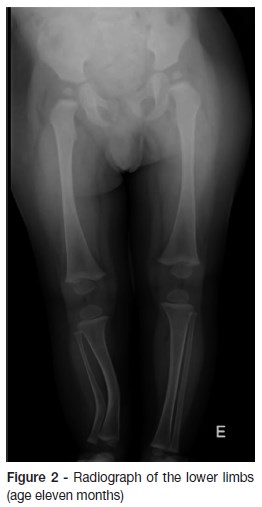
<body><![CDATA[<p>A term newborn, from a medically   supervised pregnancy, had a hypoplasia of the right leg bones and ipsilateral   deviation of the foot on the obstetric ultrasounds and presented at birth with   a medial deviation of the inferior third of the right leg and dorsiflexion of   the right foot. A right leg x-ray showed a congenital posteromedial bowing of   the tibia (CPMBT). A favorable outcome was achieved with a conservative approach at eleven months old.</p>     <p>CPMBT is the most benign of all the   congenital deformities of the tibia. Usually it is obvious at birth as a   calcaneal valgus deformity. It tends to resolve spontaneously, thus a   conservative approach is adopted in most cases. Limb length discrepancy is the main complication, and so follow-up is recommended until skeletal maturity.</p>     <p>Due to the rarity of these deformities, an early recognition and referral are fundamental.</p>     <p><b>Keywords:</b> Bone disease; congenital; lower extremity deformities; tibia</p> </font> <hr noshade size="1">     <p>&nbsp;</p>     <p>&nbsp;</p> <font face="Verdana" size="2">     <p>A male newborn, from a medically   supervised pregnancy, had obstetric ultrasounds showing a hypoplasia of the   right leg bones and ipsilateral deviation of the foot. He was born at 38 weeks’   gestation by vaginal delivery. On physical examination at birth, a medial deviation   of the inferior third of the right leg and dorsiflexion of the right foot was   noticed, with no other findings. The right leg x-ray showed a posteromedial   bowing of the tibia (<a href="#f1">figure 1</a>).</p>     <p>&nbsp;</p>     <p><a name="f1"></a></p>     <p align="center"><img src="/img/revistas/nas/v26n4/26n4a12f1.jpg" width="304" height="516"></p>     
]]></body>
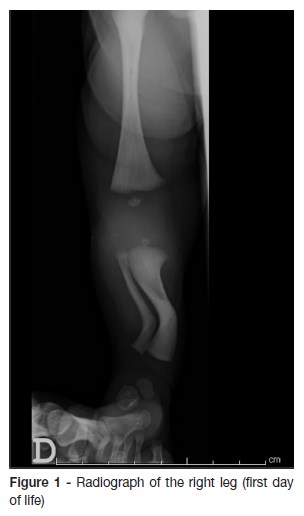
<body><![CDATA[<p>&nbsp;</p>     <p>He had an excellent outcome with a   conservative approach (<a href="#f2">figure 2</a>).</p>     <p>&nbsp;</p>     <p><a name="f2"></a></p>     <p align="center"><img src="/img/revistas/nas/v26n4/26n4a12f2.jpg" width="262" height="507"></p>     
<p>&nbsp;</p>     <p><b>What is your Diagnosis?</b></p>     <p>&nbsp;</p> </font>     <p><font size="3" face="Verdana"><b>DIAGNOSIS</b></font></p> <font face="Verdana" size="2">     <p>Congenital posteromedial bowing of the tibia (CPMBT)</p>     ]]></body>
<body><![CDATA[<p>&nbsp;</p> </font>     <p><font size="3" face="Verdana"><b>DISCUSSION</b></font></p> <font face="Verdana" size="2">     <p>Congenital deformities of the tibia   are characterized by a bowing of the tibial diaphysis. According to the   direction of the apex of the deformity, they can be classified in anterolateral, anteromedial and posteromedial.<sup>1-3</sup></p>     <p>CPMBT is characterized by a   calcaneal valgus deformity and is the most benign of all the congenital   deformities of the tibia.<sup>1-5</sup> If there is a large angulation of the   diaphysis, the deformity is usually obvious at birth.<sup>1-3</sup> However, if   there is only a slight angulation, only a thorough examination of the lower   limbs can identify it.<sup>1</sup> CPMBT is distinguishable from the   anterolateral bowing due to the absence of pseudoarthrosis or association with   type I Neurofibromatosis (featured in 50% of the latter) and distinguishable   from the anteromedial bowing because it is not associated with the absence of fibula or lateral segments of the foot.<sup>1,4</sup></p>     <p>The etiology of this deformity has   not yet been clarified, however three hypotheses have been proposed: an abnormal positioning in the uterus; circulatory changes; embrionary changes.<sup>1,4</sup></p>     <p>Usually CPMBT resolves   spontaneously until the age of eight. Limb length discrepancy is the main   complication. To avoid it, clinical and imagological surveillance is recommended until the skeletal maturity.<sup>1,6 </sup></p>     <p>A conservative approach is the   first line in most cases. However, the choice of treatment varies with the   degree of limb length discrepancy, age, target height and family/patient preference.<sup>4</sup></p>     <p>This case pretends to enlighten the   rarity of this skeletal deformities and its possible association with other   diseases. It is fundamental that Neonatologists/Pediatricians are aware of these pathologies to assure an early and correct referral.</p>     <p>&nbsp;</p> </font>     <p><font size="3" face="Verdana"><b>REFERÊNCIAS BIBLIOGRÁFICAS</b></font></p> <font face="Verdana" size="2">     ]]></body>
<body><![CDATA[<!-- ref --><p>1. Dias AIM,   Pinheiro L, Almeida E. Deformidade póstero-medial congénita da tíbia: a propósito de 2 casos clínicos. Nascer e Crescer. 2013; 22:171-3.    &nbsp;&nbsp;&nbsp;&nbsp;&nbsp;&nbsp;&nbsp;&nbsp;[&#160;<a href="javascript:void(0);" onclick="javascript: window.open('/scielo.php?script=sci_nlinks&ref=1107791&pid=S0872-0754201700040001200001&lng=','','width=640,height=500,resizable=yes,scrollbars=1,menubar=yes,');">Links</a>&#160;]<!-- end-ref --></p>     <!-- ref --><p>2. Kaufman SD, Fagg JA, Jones S, Bell MJ,   Saleh M, Fernandes JA. Limb lengthening in congenital posteromedial bow of the tibia. Strat Traum Limb Recon. 2012; 7:147–53.    &nbsp;&nbsp;&nbsp;&nbsp;&nbsp;&nbsp;&nbsp;&nbsp;[&#160;<a href="javascript:void(0);" onclick="javascript: window.open('/scielo.php?script=sci_nlinks&ref=1107793&pid=S0872-0754201700040001200002&lng=','','width=640,height=500,resizable=yes,scrollbars=1,menubar=yes,');">Links</a>&#160;]<!-- end-ref --></p>     <!-- ref --><p>3. Ferguson J, Wainwright A. Tibial bowing in children. Orthopaedics And Trauma. 2012; 27:30-41.    &nbsp;&nbsp;&nbsp;&nbsp;&nbsp;&nbsp;&nbsp;&nbsp;[&#160;<a href="javascript:void(0);" onclick="javascript: window.open('/scielo.php?script=sci_nlinks&ref=1107795&pid=S0872-0754201700040001200003&lng=','','width=640,height=500,resizable=yes,scrollbars=1,menubar=yes,');">Links</a>&#160;]<!-- end-ref --></p>     <!-- ref --><p>4. McCarthy J. Tibial bowing.   Emedicine.medscape.com. Abril, 2015. (Accessed 5 june 2017). Available at: <a href="http://emedicine.medscape.com" target="_blank">http://emedicine.medscape.com</a>.    &nbsp;&nbsp;&nbsp;&nbsp;&nbsp;&nbsp;&nbsp;&nbsp;[&#160;<a href="javascript:void(0);" onclick="javascript: window.open('/scielo.php?script=sci_nlinks&ref=1107797&pid=S0872-0754201700040001200004&lng=','','width=640,height=500,resizable=yes,scrollbars=1,menubar=yes,');">Links</a>&#160;]<!-- end-ref --></p>     <!-- ref --><p>5. Shah H, Rousset M, Canavese F. Congenital   pseudarthrosis of the tibia: Management and complications. Indian J Orthop. 2012; 4:616-26.    &nbsp;&nbsp;&nbsp;&nbsp;&nbsp;&nbsp;&nbsp;&nbsp;[&#160;<a href="javascript:void(0);" onclick="javascript: window.open('/scielo.php?script=sci_nlinks&ref=1107799&pid=S0872-0754201700040001200005&lng=','','width=640,height=500,resizable=yes,scrollbars=1,menubar=yes,');">Links</a>&#160;]<!-- end-ref --></p>     ]]></body>
<body><![CDATA[<!-- ref --><p>6. Shah HH, Doddabasappa SN, Joseph B.   Congenital posteromedial bowing of the tibia: a retrospective analysis of   growth abnormalities in the leg. J Pediatr Orthop B 2009; 18:120-8.    &nbsp;&nbsp;&nbsp;&nbsp;&nbsp;&nbsp;&nbsp;&nbsp;[&#160;<a href="javascript:void(0);" onclick="javascript: window.open('/scielo.php?script=sci_nlinks&ref=1107801&pid=S0872-0754201700040001200006&lng=','','width=640,height=500,resizable=yes,scrollbars=1,menubar=yes,');">Links</a>&#160;]<!-- end-ref --></p>     <p>&nbsp;</p>     <p>&nbsp;</p> <b><a name="end" id="topo2"></a><a href="#topo">CORRESPONDENCE TO</a></b>     <p>Ivete   Afonso    <br>   Department   of Pediatrics    <br>   Hospital Pedro Hispano    <br>   Unidade Local de Saúde de   Matosinhos    <br>   Rua Dr. Eduardo Torres    <br>   4464-513 Senhora da Hora,   Matosinhos    ]]></body>
<body><![CDATA[<br>   Email: <a href="mailto:ivete.afonso@hotmail.com">ivete.afonso@hotmail.com</a></p>     <p>Received for   publication: 14.06.2017 Accepted in revised form: 23.10.2017</p> </font>      ]]></body><back>
<ref-list>
<ref id="B1">
<label>1.</label><nlm-citation citation-type="journal">
<person-group person-group-type="author">
<name>
<surname><![CDATA[Dias]]></surname>
<given-names><![CDATA[AIM]]></given-names>
</name>
<name>
<surname><![CDATA[Pinheiro]]></surname>
<given-names><![CDATA[L]]></given-names>
</name>
<name>
<surname><![CDATA[Almeida]]></surname>
<given-names><![CDATA[E]]></given-names>
</name>
</person-group>
<article-title xml:lang="pt"><![CDATA[Deformidade póstero-medial congénita da tíbia: a propósito de 2 casos clínicos]]></article-title>
<source><![CDATA[Nascer e Crescer]]></source>
<year>2013</year>
<volume>22</volume>
<page-range>171-3</page-range></nlm-citation>
</ref>
<ref id="B2">
<label>2.</label><nlm-citation citation-type="journal">
<person-group person-group-type="author">
<name>
<surname><![CDATA[Kaufman]]></surname>
<given-names><![CDATA[SD]]></given-names>
</name>
<name>
<surname><![CDATA[Fagg]]></surname>
<given-names><![CDATA[JA]]></given-names>
</name>
<name>
<surname><![CDATA[Jones]]></surname>
<given-names><![CDATA[S]]></given-names>
</name>
<name>
<surname><![CDATA[Bell]]></surname>
<given-names><![CDATA[MJ]]></given-names>
</name>
<name>
<surname><![CDATA[Saleh]]></surname>
<given-names><![CDATA[M]]></given-names>
</name>
<name>
<surname><![CDATA[Fernandes]]></surname>
<given-names><![CDATA[JA]]></given-names>
</name>
</person-group>
<article-title xml:lang="en"><![CDATA[Limb lengthening in congenital posteromedial bow of the tibia]]></article-title>
<source><![CDATA[Strat Traum Limb Recon]]></source>
<year>2012</year>
<volume>7</volume>
<page-range>147-53</page-range></nlm-citation>
</ref>
<ref id="B3">
<label>3.</label><nlm-citation citation-type="journal">
<person-group person-group-type="author">
<name>
<surname><![CDATA[Ferguson]]></surname>
<given-names><![CDATA[J]]></given-names>
</name>
<name>
<surname><![CDATA[Wainwright]]></surname>
<given-names><![CDATA[A]]></given-names>
</name>
</person-group>
<article-title xml:lang="en"><![CDATA[Tibial bowing in children]]></article-title>
<source><![CDATA[Orthopaedics And Trauma]]></source>
<year>2012</year>
<volume>27</volume>
<page-range>30-41</page-range></nlm-citation>
</ref>
<ref id="B4">
<label>4.</label><nlm-citation citation-type="">
<person-group person-group-type="author">
<name>
<surname><![CDATA[McCarthy]]></surname>
<given-names><![CDATA[J]]></given-names>
</name>
</person-group>
<source><![CDATA[Tibial bowing]]></source>
<year>Abri</year>
<month>l,</month>
<day> 2</day>
</nlm-citation>
</ref>
<ref id="B5">
<label>5.</label><nlm-citation citation-type="journal">
<person-group person-group-type="author">
<name>
<surname><![CDATA[Shah]]></surname>
<given-names><![CDATA[H]]></given-names>
</name>
<name>
<surname><![CDATA[Rousset]]></surname>
<given-names><![CDATA[M]]></given-names>
</name>
<name>
<surname><![CDATA[Canavese]]></surname>
<given-names><![CDATA[F]]></given-names>
</name>
</person-group>
<article-title xml:lang="en"><![CDATA[Congenital pseudarthrosis of the tibia: Management and complications]]></article-title>
<source><![CDATA[Indian J Orthop]]></source>
<year>2012</year>
<volume>4</volume>
<page-range>616-26</page-range></nlm-citation>
</ref>
<ref id="B6">
<label>6.</label><nlm-citation citation-type="journal">
<person-group person-group-type="author">
<name>
<surname><![CDATA[Shah]]></surname>
<given-names><![CDATA[HH]]></given-names>
</name>
<name>
<surname><![CDATA[Doddabasappa]]></surname>
<given-names><![CDATA[SN]]></given-names>
</name>
<name>
<surname><![CDATA[Joseph]]></surname>
<given-names><![CDATA[B]]></given-names>
</name>
</person-group>
<article-title xml:lang="en"><![CDATA[Congenital posteromedial bowing of the tibia: a retrospective analysis of growth abnormalities in the leg]]></article-title>
<source><![CDATA[J Pediatr Orthop B]]></source>
<year>2009</year>
<volume>18</volume>
<page-range>120-8</page-range></nlm-citation>
</ref>
</ref-list>
</back>
</article>