<?xml version="1.0" encoding="ISO-8859-1"?><article xmlns:mml="http://www.w3.org/1998/Math/MathML" xmlns:xlink="http://www.w3.org/1999/xlink" xmlns:xsi="http://www.w3.org/2001/XMLSchema-instance">
<front>
<journal-meta>
<journal-id>0872-0754</journal-id>
<journal-title><![CDATA[Nascer e Crescer]]></journal-title>
<abbrev-journal-title><![CDATA[Nascer e Crescer]]></abbrev-journal-title>
<issn>0872-0754</issn>
<publisher>
<publisher-name><![CDATA[Centro Hospitalar do Porto]]></publisher-name>
</publisher>
</journal-meta>
<article-meta>
<article-id>S0872-07542017000400013</article-id>
<title-group>
<article-title xml:lang="pt"><![CDATA[Caso estomatológico]]></article-title>
<article-title xml:lang="en"><![CDATA[Oral pathology case]]></article-title>
</title-group>
<contrib-group>
<contrib contrib-type="author">
<name>
<surname><![CDATA[Amorim]]></surname>
<given-names><![CDATA[José M. S.]]></given-names>
</name>
<xref ref-type="aff" rid="A01"/>
</contrib>
</contrib-group>
<aff id="A01">
<institution><![CDATA[,Centro Hospitalar do Porto Pediatric Unit Department of Stomatology and Maxillofacial Surgery]]></institution>
<addr-line><![CDATA[Porto ]]></addr-line>
<country>Portugal</country>
</aff>
<pub-date pub-type="pub">
<day>12</day>
<month>00</month>
<year>2017</year>
</pub-date>
<pub-date pub-type="epub">
<day>12</day>
<month>00</month>
<year>2017</year>
</pub-date>
<volume>26</volume>
<numero>4</numero>
<fpage>264</fpage>
<lpage>265</lpage>
<copyright-statement/>
<copyright-year/>
<self-uri xlink:href="http://scielo.pt/scielo.php?script=sci_arttext&amp;pid=S0872-07542017000400013&amp;lng=en&amp;nrm=iso"></self-uri><self-uri xlink:href="http://scielo.pt/scielo.php?script=sci_abstract&amp;pid=S0872-07542017000400013&amp;lng=en&amp;nrm=iso"></self-uri><self-uri xlink:href="http://scielo.pt/scielo.php?script=sci_pdf&amp;pid=S0872-07542017000400013&amp;lng=en&amp;nrm=iso"></self-uri><abstract abstract-type="short" xml:lang="pt"><p><![CDATA[Adolescente de 12 anos referenciado à consulta de Estomatologia Pediátrica devido a não erupção do dente incisivo central superior esquerdo. Ao exame objetivo apresentava agenesia de 21, bem como abaulamento da cortical vestibular na região da inclusão. Realizou OPG e TAC maxilar, que evidenciou inclusão do dente 21 com quisto (provavelmente dentígero) envolvendo o mesmo e ainda a presença de um mesiodens incluso. Realizou enucleação da lesão quística, bem como extração do incisivo associado e do mesiodens, tendo-se preenchido a cavidade com substituto de osso e isolado com membrana.]]></p></abstract>
<abstract abstract-type="short" xml:lang="en"><p><![CDATA[An 12-year-old boy was referred to the Pediatric Stomatology Clinic for absence of eruption of permanent maxillary left incisive tooth. Physical examination revealed bulging of the vestibular cortical bone of the 2nd quadrant, agenesis of the tooth 21. Physical examination: Orthopantomography and CT scan of the upper jaw revealed a large radiolucent image that occupied the maxillary sinus and tooth 2.1 within the cyst and the presence of a mesiodens included. A presumptive diagnosis of an odontogenic dentigerous cyst was made. Treatment procedure comprised cystic enucleation with extraction of 2.1. The bone defect was filled with bone substitute (Geistlich Bio-Oss) and collagen membrane (Geistlich Bio-Gide).]]></p></abstract>
<kwd-group>
<kwd lng="pt"><![CDATA[Enucleação cística]]></kwd>
<kwd lng="pt"><![CDATA[imagem radiolúcida]]></kwd>
<kwd lng="pt"><![CDATA[inclusão de mesiodens]]></kwd>
<kwd lng="pt"><![CDATA[quisto dentígeno odontogénico]]></kwd>
<kwd lng="en"><![CDATA[Cystic enucleation]]></kwd>
<kwd lng="en"><![CDATA[mesiodens included]]></kwd>
<kwd lng="en"><![CDATA[odontogenic dentigerous cyst]]></kwd>
<kwd lng="en"><![CDATA[radiolucent image]]></kwd>
</kwd-group>
</article-meta>
</front><body><![CDATA[ <p align="right"><b><font face="Verdana" size="2"> QUAL O SEU DIAGNÓSTICO? | WHAT IS YOUR DIAGNOSIS? </font></b></p> <font face="Verdana" size="2">     <p>&nbsp;</p> </font>     <p><font size="4" face="Verdana"><b>Caso estomatol&oacute;gico</b></font></p> <font face="Verdana" size="2">     <p>&nbsp;</p> </font>     <p><font size="3" face="Verdana"><b>Oral pathology case</b></font></p> <font face="Verdana" size="2">     <p>&nbsp;</p>     <p>&nbsp;</p>     <p><b>José M. S. Amorim<sup>I</sup></b></p>     <p><sup>I </sup>Department of Stomatology and Maxillofacial Surgery, Pediatric Unit, Centro Hospitalar do Porto. 4099-001 Porto, Portugal. <a href="mailto:joseamorim.dia@chporto.min-saude.pt">joseamorim.dia@chporto.min-saude.pt</a></p>     <p><a href="#end">Correspondence to</a><a name="topo" id="topo"></a></p>     ]]></body>
<body><![CDATA[<p>&nbsp;</p>     <p>&nbsp;</p> </font> <hr noshade size="1"> <font face="Verdana" size="2">     <p><b>RESUMO</b></p>     <p>Adolescente de 12 anos referenciado   à consulta de Estomatologia Pediátrica devido a não erupção do dente incisivo   central superior esquerdo. Ao exame objetivo apresentava agenesia de 21, bem   como abaulamento da cortical vestibular na região da inclusão. Realizou OPG e   TAC maxilar, que evidenciou inclusão do dente 21   com quisto (provavelmente dentígero) envolvendo o mesmo e ainda a presença de um mesiodens incluso.</p>     <p>Realizou enucleação da lesão   quística, bem como extração do incisivo associado e do mesiodens, tendo-se preenchido a cavidade com substituto de osso e isolado com membrana.</p>     <p><b>Palavras-chave:</b> Enucleação cística; imagem radiolúcida; inclusão de mesiodens; quisto dentígeno odontogénico</p> </font> <hr noshade size="1"> <font face="Verdana" size="2">     <p><b>ABSTRACT</b></p>     <p>An 12-year-old boy was referred to   the Pediatric Stomatology Clinic for absence of eruption of permanent maxillary   left incisive tooth. Physical examination revealed bulging of the vestibular cortical bone of the 2nd quadrant, agenesis of the tooth 21. </p>     <p>Physical examination:   Orthopantomography and CT scan of the upper jaw revealed a large radiolucent   image that occupied the maxillary sinus and tooth 2.1 within the cyst and the presence of a mesiodens included.</p>     <p>A presumptive diagnosis of an odontogenic dentigerous cyst was made. </p>     ]]></body>
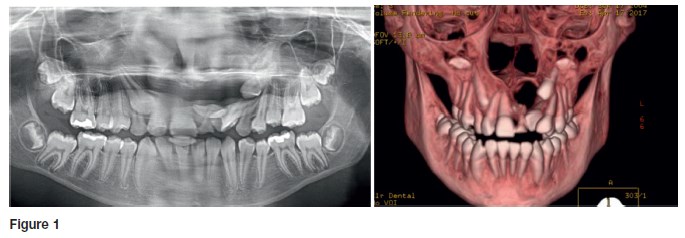
<body><![CDATA[<p>Treatment procedure comprised   cystic enucleation with extraction of 2.1. The bone defect was filled with bone substitute (Geistlich Bio-Oss) and collagen membrane (Geistlich Bio-Gide).</p>     <p><b>Keywords</b>: Cystic   enucleation; mesiodens included; odontogenic dentigerous cyst; radiolucent image </p> </font> <hr noshade size="1"> <font face="Verdana" size="2">     <p>&nbsp;</p>     <p>&nbsp;</p> </font><font face="Verdana" size="2">     <p>A 12-year-old male was referred to   the Pediatric Stomatology clinic, due to the non-appearance of the tooth 21 in   the left maxillary arch and swelling of the vestibular cortical bone in the region of the non-erupted tooth.</p>     <p>Personal and family history were irrelevant. </p>     <p>Physical examination revealed   painless, soft and depressible bulging of the vestibular cortical bone of the 2<sup>nd</sup>   quadrant, without fistula; agenesis of the tooth 21, with contralateral incisor   tooth (11) completely erupted, no dental caries; no gingivitis.   Orthopantomography (OPG) showed a large radiolucent image, occupying an   important part of the maxillary sinus, with the tooth 21 included and a   supernumerary tooth included in space 11-21. To assess correct evaluation of   the limits and dimension of the cyst Maxillary computerized tomography (MCT) was performed (<a href="/img/revistas/nas/v26n4/26n4a13f1.jpg">Fig.1</a>).</p>     
<p><b>What is your Diagnosis?</b></p>     <p><b>What is your clinical management?</b></p>     <p>&nbsp;</p> </font>     ]]></body>
<body><![CDATA[<p><font size="3" face="Verdana"><b>DISCUSSION</b></font></p> <font face="Verdana" size="2">     <p>The clinical case report is an <b>odontogenic   cyst</b> probably <b>dentigerous</b>, as well as the presence of a supernumerary tooth - mesiodens.</p>     <p>Odontogenic cysts are divided into   two major groups: developmental and inflammatory cysts. In the group of   developmental cysts, the dentigerous cysts are the most frequent, and they are   always associated with an included tooth; this clinical situation is very frequent in the maxilla.</p>     <p>The dentigerous odontogenic cyst is   defined radiologically as a radiolucent image associated with an included tooth   and may have very variable dimensions when they have free space to expand (for example, for the maxillary sinus).</p>     <p>Whenever a   tooth does not make its appearance in the dental arcade in the expected time   and a dental cyst or dental inclusion is suspected, the request of a OPG is the correct procedure.</p>     <p>These cysts are rare in the   deciduous dentition and are commonly associated with the most frequently   included teeth: third molars and maxillary canines. The inclusion of incisor   teeth is not a frequent clinical situation. They occur mostly in males with no ethnicity&nbsp;predominance</p>     <p>Treatment is always surgical and   consists on cystic enucleation, as well as the extraction of the included   tooth. In some clinical situations the cyst is marsupialized to reduce its size   before it is enucleated. In the present case the bone defect was filled with bone substitute (Geistlich Bio-Oss) and collagen membrane (Geistlich Bio-Gide).</p>     <p>The histological study confirmed the clinical suspicion of dentigerous cyst.</p>     <p>The prognosis is good. The   mesiodens is the most common supernumerary tooth in the dental maxillary arch, located in the midline of the maxilla, between the upper central incisors.</p>     <p>When a definitive maxillary central   incisor tooth does not make its appearance in the dental arch at the expected   time, either the tooth does not exist (dental agenesis), or there is a supernumerary tooth that prevents the eruption of the definitive tooth.</p>     ]]></body>
<body><![CDATA[<p>Orthopantomography is the most habitual radiographic investigation to visualize supernumerary teeth.</p>     <p>The treatment   plan consists of extraction of the supernumerary tooth and regular observation to monitor proper eruption and alignment of the definitive tooth. </p>     <p>&nbsp;</p> </font>     <p><font size="3" face="Verdana"><b>REFERÊNCIAS BIBLIOGRÁFICAS</b></font></p> <font face="Verdana" size="2">     <!-- ref --><p>1. Cawson RA, Odell   EW. Cawson´s Essencials of Oral Pathology and Oral Medicine. 17<sup>th</sup> London: Elsevier Health Sciences; 2002. p.108-10&nbsp;&nbsp;&nbsp;&nbsp;&nbsp;&nbsp;&nbsp;&nbsp;[&#160;<a href="javascript:void(0);" onclick="javascript: window.open('/scielo.php?script=sci_nlinks&ref=1107867&pid=S0872-0754201700040001300001&lng=','','width=640,height=500,resizable=yes,scrollbars=1,menubar=yes,');">Links</a>&#160;]<!-- end-ref --><!-- ref --><p>2. Leache EB. Odontopediatría. Barcelona: Masson; 2003. p. 60-8.    &nbsp;&nbsp;&nbsp;&nbsp;&nbsp;&nbsp;&nbsp;&nbsp;[&#160;<a href="javascript:void(0);" onclick="javascript: window.open('/scielo.php?script=sci_nlinks&ref=1107868&pid=S0872-0754201700040001300002&lng=','','width=640,height=500,resizable=yes,scrollbars=1,menubar=yes,');">Links</a>&#160;]<!-- end-ref --></p>     <!-- ref --><p>3. Regezi JA,   Sciubla JJ, Pogrel MA. Atlas of Oral and Maxillofacial Pathology. 1<sup>nd</sup>. Philadelphia: Saunders; 2000. p. 147.    &nbsp;&nbsp;&nbsp;&nbsp;&nbsp;&nbsp;&nbsp;&nbsp;[&#160;<a href="javascript:void(0);" onclick="javascript: window.open('/scielo.php?script=sci_nlinks&ref=1107870&pid=S0872-0754201700040001300003&lng=','','width=640,height=500,resizable=yes,scrollbars=1,menubar=yes,');">Links</a>&#160;]<!-- end-ref --></p>     <p>&nbsp;</p>     ]]></body>
<body><![CDATA[<p><b><a name="end" id="topo2"></a><a href="#topo">CORRESPONDENCE TO</a></b></p>     <p>José M. S.   Amorim    <br>   Department   of Stomatology and Maxillofacial Surgery    <br>   Pediatric Unit    <br>   Centro Hospitalar do Porto.    <br>   Largo do Prof. Abel Salazar,    <br>   4099-001  Porto    <br> Email: <a href="joseamorim.dia@chporto.min-saude.pt">joseamorim.dia@chporto.min-saude.pt</a></p>     <p>Received for   publication: 04.09.2017 Accepted in revised form: 11.09.2017</p> </font>      ]]></body><back>
<ref-list>
<ref id="B1">
<label>1.</label><nlm-citation citation-type="book">
<person-group person-group-type="author">
<name>
<surname><![CDATA[Cawson]]></surname>
<given-names><![CDATA[RA]]></given-names>
</name>
<name>
<surname><![CDATA[Odell]]></surname>
<given-names><![CDATA[EW]]></given-names>
</name>
</person-group>
<source><![CDATA[Cawson´s Essencials of Oral Pathology and Oral Medicine]]></source>
<year>2002</year>
<edition>17</edition>
<page-range>108-10</page-range><publisher-loc><![CDATA[London ]]></publisher-loc>
<publisher-name><![CDATA[Elsevier Health Sciences]]></publisher-name>
</nlm-citation>
</ref>
<ref id="B2">
<label>2.</label><nlm-citation citation-type="book">
<person-group person-group-type="author">
<name>
<surname><![CDATA[Leache]]></surname>
<given-names><![CDATA[EB]]></given-names>
</name>
</person-group>
<source><![CDATA[Odontopediatría]]></source>
<year>2003</year>
<page-range>60-8</page-range><publisher-loc><![CDATA[Barcelona ]]></publisher-loc>
<publisher-name><![CDATA[Masson]]></publisher-name>
</nlm-citation>
</ref>
<ref id="B3">
<label>3.</label><nlm-citation citation-type="book">
<person-group person-group-type="author">
<name>
<surname><![CDATA[Regezi]]></surname>
<given-names><![CDATA[JA]]></given-names>
</name>
<name>
<surname><![CDATA[Sciubla]]></surname>
<given-names><![CDATA[JJ]]></given-names>
</name>
<name>
<surname><![CDATA[Pogrel]]></surname>
<given-names><![CDATA[MA]]></given-names>
</name>
</person-group>
<source><![CDATA[Atlas of Oral and Maxillofacial Pathology]]></source>
<year>2000</year>
<edition>1</edition>
<page-range>147</page-range><publisher-loc><![CDATA[Philadelphia ]]></publisher-loc>
<publisher-name><![CDATA[Saunders]]></publisher-name>
</nlm-citation>
</ref>
</ref-list>
</back>
</article>