<?xml version="1.0" encoding="ISO-8859-1"?><article xmlns:mml="http://www.w3.org/1998/Math/MathML" xmlns:xlink="http://www.w3.org/1999/xlink" xmlns:xsi="http://www.w3.org/2001/XMLSchema-instance">
<front>
<journal-meta>
<journal-id>0872-0754</journal-id>
<journal-title><![CDATA[Nascer e Crescer]]></journal-title>
<abbrev-journal-title><![CDATA[Nascer e Crescer]]></abbrev-journal-title>
<issn>0872-0754</issn>
<publisher>
<publisher-name><![CDATA[Centro Hospitalar do Porto]]></publisher-name>
</publisher>
</journal-meta>
<article-meta>
<article-id>S0872-07542018000100011</article-id>
<title-group>
<article-title xml:lang="en"><![CDATA[Dermatology case]]></article-title>
<article-title xml:lang="pt"><![CDATA[Caso dermatológico]]></article-title>
</title-group>
<contrib-group>
<contrib contrib-type="author">
<name>
<surname><![CDATA[Camões]]></surname>
<given-names><![CDATA[Sílvia]]></given-names>
</name>
<xref ref-type="aff" rid="A01"/>
</contrib>
<contrib contrib-type="author">
<name>
<surname><![CDATA[Selores]]></surname>
<given-names><![CDATA[Manuela]]></given-names>
</name>
<xref ref-type="aff" rid="A02"/>
<xref ref-type="aff" rid="A03"/>
</contrib>
</contrib-group>
<aff id="A01">
<institution><![CDATA[,Agrupamento de Centros de Saúde do Porto Ocidental Unidade de Saúde Familiar Espaço Saúde General and Family Medicine]]></institution>
<addr-line><![CDATA[Porto ]]></addr-line>
<country>Portugal</country>
</aff>
<aff id="A02">
<institution><![CDATA[,Centro Hospitalar do Porto Research Unit in Dermatology Department of Dermatology]]></institution>
<addr-line><![CDATA[Porto ]]></addr-line>
<country>Portugal</country>
</aff>
<aff id="A03">
<institution><![CDATA[,Instituto de Ciências Biomédicas Abel Salazar Unit for Multidisciplinary Research in Biomedicine ]]></institution>
<addr-line><![CDATA[Porto ]]></addr-line>
<country>Portugal</country>
</aff>
<pub-date pub-type="pub">
<day>01</day>
<month>03</month>
<year>2018</year>
</pub-date>
<pub-date pub-type="epub">
<day>01</day>
<month>03</month>
<year>2018</year>
</pub-date>
<volume>27</volume>
<numero>1</numero>
<fpage>59</fpage>
<lpage>60</lpage>
<copyright-statement/>
<copyright-year/>
<self-uri xlink:href="http://scielo.pt/scielo.php?script=sci_arttext&amp;pid=S0872-07542018000100011&amp;lng=en&amp;nrm=iso"></self-uri><self-uri xlink:href="http://scielo.pt/scielo.php?script=sci_abstract&amp;pid=S0872-07542018000100011&amp;lng=en&amp;nrm=iso"></self-uri><self-uri xlink:href="http://scielo.pt/scielo.php?script=sci_pdf&amp;pid=S0872-07542018000100011&amp;lng=en&amp;nrm=iso"></self-uri><abstract abstract-type="short" xml:lang="en"><p><![CDATA[We report the case of a child with a laptop-induced erythema ab Igne. Erythema ab Igne is an hyperpigmented and reticulated erythema that results from prolonged thermal radiation exposure insufficient to cause burn. It has been described in patients using portable electronics devices including laptops. The lesions are characteristically located on the thighs and asymmetric (left side). The diagnosis is based on the clinical appearance of the lesions and exposure history. The treatment is the avoidance of heat source.]]></p></abstract>
<abstract abstract-type="short" xml:lang="pt"><p><![CDATA[Relatamos o caso de uma criança com um eritema ab Igne induzido pelo computador portátil. Eritema ab Igne consiste num eritema reticulado e hiperpigmentado que resulta da exposição prolongada à radiação térmica insuficiente para causar queimadura. Foi descrito em pacientes que utilizam dispositivos eletrónicos portáteis, incluindo computadores portáteis. As lesões estão caracteristicamente localizadas nas coxas e são assimétricas (lado esquerdo). O diagnóstico baseia-se na aparência clínica das lesões e na história de exposição. O tratamento é evitar a fonte de calor.]]></p></abstract>
<kwd-group>
<kwd lng="en"><![CDATA[Dermatosis]]></kwd>
<kwd lng="en"><![CDATA[erythema]]></kwd>
<kwd lng="en"><![CDATA[laptop computer]]></kwd>
<kwd lng="pt"><![CDATA[Computador portátil]]></kwd>
<kwd lng="pt"><![CDATA[dermatose]]></kwd>
<kwd lng="pt"><![CDATA[eritema]]></kwd>
</kwd-group>
</article-meta>
</front><body><![CDATA[  <font face="Verdana" size="2">     <p align="right"><b>QUAL O SEU DIAGN&Oacute;STICO? | WHAT IS YOUR DIAGNOSIS?</b></p>     <p>&nbsp;</p> </font>     <p><font size="4" face="Verdana"><b>Dermatology case</b></font></p>     <p>&nbsp;</p>     <p><font size="3" face="Verdana"><b>Caso dermatol&oacute;gico</b></font></p> <font face="Verdana" size="2">     <p>&nbsp;</p> </font><font face="Verdana" size="2">     <p>&nbsp;</p>     <p><b>Sílvia Camões<sup>I</sup>, Manuela Selores<sup>II,III</sup></b></p>     <p><sup>I  </sup>General and Family Medicine, Unidade de Saúde Familiar Espaço Saúde, Agrupamento de Centros de Saúde do Porto Ocidental. 4150-502 Porto, Portugal. <a href="mailto:silviacamoes@gmail.com">silviacamoes@gmail.com    ]]></body>
<body><![CDATA[<br> </a><sup>II </sup>Department of Dermatology; Research Unit in Dermatology, Centro Hospitalar do Porto. 4099-001 Porto, Portugal. <a href="mailto:dermat@sapo.pt">dermat@sapo.pt    <br> </a><sup>III </sup>Unit   for Multidisciplinary Research in Biomedicine, Instituto   de Ciências Biomédicas Abel Salazar. 4050-313 Porto, Portugal. <a href="mailto:dermat@sapo.pt">dermat@sapo.pt</a></p> <a href="#end">Correspondence to</a><a name="topo" id="topo"></a>     <p>&nbsp;</p>     <p>&nbsp;</p> </font> <hr noshade size="1"> <font face="Verdana" size="2">     <p><b>ABSTRACT</b></p>     <p>We report the case of a child with a laptop-induced erythema <i>ab Igne</i>.</p>     <p>Erythema <i>ab   Igne</i> is an hyperpigmented and reticulated erythema that results from   prolonged thermal radiation exposure insufficient to cause burn.  It has been described in patients using   portable electronics devices including laptops. The lesions are characteristically   located on the thighs and asymmetric (left side). The diagnosis is based on the   clinical appearance of the lesions and exposure history. The treatment is the avoidance of heat source.</p>     <p><b>Keywords: </b>Dermatosis, erythema, laptop computer. </p> </font> <hr noshade size="1"> <font face="Verdana" size="2">     <p><b>RESUMO</b></p>     <p>Relatamos o caso de uma criança com um eritema <i>ab Igne</i> induzido pelo computador portátil.</p>     ]]></body>
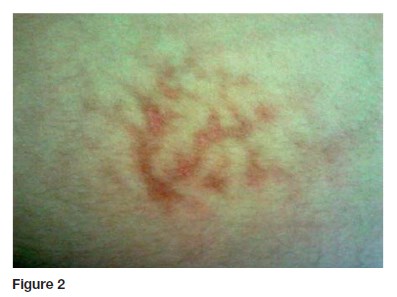
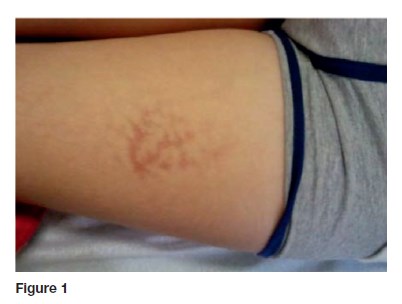
<body><![CDATA[<p>Eritema <i>ab Igne </i>consiste num   eritema reticulado e hiperpigmentado que resulta da exposição prolongada à   radiação térmica insuficiente para causar queimadura. Foi descrito em pacientes   que utilizam dispositivos eletrónicos portáteis, incluindo computadores   portáteis. As lesões estão caracteristicamente localizadas nas coxas e são   assimétricas (lado esquerdo). O diagnóstico baseia-se na aparência clínica das lesões e na história de exposição. O tratamento é evitar a fonte de calor.</p>     <p><b>Palavras-chave:</b> Computador portátil, dermatose, eritema.</p> </font> <hr noshade size="1"> <font face="Verdana" size="2">     <p>&nbsp;</p>     <p>&nbsp;</p>     <p>A eleven-year-old boy, with no   relevant pathological history or usual medication, was referred to Dermatology   consultation due to asymptomatic cutaneous lesion in the anterior region of the left thigh with one year of evolution.</p>     <p>Physical examination revealed a   macular lesion, with imprecise limits, reticulated pattern of   erythematous-violet coloration, located on the anterior region of the left   thigh (Figures <a href="#f1">1</a> and <a href="#f2">2</a>). The lesion was painless to the touch and did not   disappear with digital pressure. Remaining physical examination with no other relevant findings.</p>     <p><a name="f1"></a></p>     <p>&nbsp;</p>     <p align="center"><img src="/img/revistas/nas/v27n1/27n1a11f1.jpg" width="402" height="304"></p>     
<p>&nbsp;</p>     ]]></body>
<body><![CDATA[<p><a name="f2"></a></p>     <p>&nbsp;</p>     <p align="center"><img src="/img/revistas/nas/v27n1/27n1a11f2.jpg" width="397" height="297"></p>     
<p>&nbsp;</p>     <p><b>What is your diagnosis?</b></p>     <p>&nbsp;</p> </font>     <p><font size="3" face="Verdana"><b>DIAGNOSIS</b></font></p> <font face="Verdana" size="2">     <p>Laptop Computer-Induced Erythema <i>ab Igne</i>.</p>     <p>&nbsp;</p> </font>     <p><font face="Verdana"><b>DISCUSSION</b></font></p> <font face="Verdana" size="2">     ]]></body>
<body><![CDATA[<p>Erythema <i>ab Igne</i> consists of a localized   reticular erythematous and posteriorly pigmented, sometimes, telangiectatic   dermatosis, caused by prolonged and repeated exposure to heat.<sup>1</sup> The   lesions are located in the areas of incidence of the heat source, having irregular contours due to the interposition between the skin and the clothing.</p>     <p>Temperatures between 43 and 47<sup>o</sup>C are sufficient to cause these lesions.<sup>2</sup></p>     <p>Numerous sources of heat were reported as the cause of these lesions. In   the elderly, erythema <i>ab Igne</i> develops due to the abusive use of hot   compresses or electric blankets.<sup>3</sup> Repeated or prolonged exposure to a heater, steam radiator or brazier is a common cause. </p>     <p>The lesions are very characteristic; initially a slight transient   erythema develops, but with prolonged and repeated exposure the lesion becomes   permanent, with a reticular and hyperpigmented appearance.<sup>1,2</sup> Exceptionally it can develop malignancy for squamous cell carcinoma.<sup>1,2</sup></p>     <p>Some differential diagnoses with dermatosis that manifest with poikiloderma,   livedo reticularis, vasculitis and contact dermatitis should be considered. The   diagnosis is clinical and the treatment is the eviction of the heat source.   Complete resolution of the lesions may occur in months if they are still in an early stage. In case of doubt biopsy of the lesion may be performed.<sup>2</sup></p>     <p>Laptop Computer-Induced Erythema <i>ab Igne</i> is a dermatosis in rise   and has appeared in younger and younger ages. Characteristically it is located   on the thighs and is asymmetrical, more typically on the left thigh. The heat source comes from the battery or the fan normally located on the left side.<sup>3,4</sup></p>     <p>In this case the child referred prolonged use of the laptop on the thighs (two to three hours a day).</p>     <p>Based on the history and clinical   findings a diagnosis of erythema <i>ab igne</i> secondary to laptop use was   made. The use of a protective pad was recommended and an appointment was   scheduled in three months. At the second visit, there was minimal clinical improvement, and counselling was reinforced.</p>     <p>The recent popularity of laptop   computers and other electronics emitting strong heat has made erythema ab igne a problem in younger generations.</p>     <p>&nbsp;</p> </font>     ]]></body>
<body><![CDATA[<p><font size="3" face="Verdana"><b>REFERÊNCIAS BIBLIOGRÁFICAS</b></font></p> <font face="Verdana" size="2"> <ol>       <li>         <p>Bolognia JL,       Jorizzo JL, Schaffer JV. Dermatology. Third edition. Elsevier; 2012. </p>   </li>       <li>         <p>AL-Otaibi L.       Erithema Ab Igne. Outubro,       2016. (Accessed 11 January 2017). Available at: http://www.medscape.com.</p>   </li>       <li>         <p>Arnold A, W Itin P. Laptop       Computer-Induced Erythema ab Igne in a Child and Review of the Liturature.       Pediatrics. 2010; 126:e1227-30.</p>   </li>       <li>         <p>Riahi R, Cohen P. Laptop-induced erythema       ab igne: report and review of literature. Dermatology Online Journal. 2012;       18:5.</p>   </li>     </ol>     ]]></body>
<body><![CDATA[<p>&nbsp;</p>     <p>&nbsp;</p> <b><a name="end" id="topo2"></a><a href="#topo">CORRESPONDENCE TO</a></b>     <p>Sílvia Camões    <br>   General and Family Medicine    <br> Unidade de Saúde Familiar Espaço Saúde    <br> Agrupamento de Centros de Saúde do&nbsp;Porto Ocidental    <br> Rua do Molhe 181,    <br> 4150-502 Porto    <br> Email: <a href="MAILTO:silviacamoes@gmail.com">silviacamoes@gmail.com</a></p>     <p>Received for publication: 07.02.2017 Accepted in revised form: 20.02.2017</p> </font>     ]]></body>
<body><![CDATA[ ]]></body><back>
<ref-list>
<ref id="B1">
<label>1</label><nlm-citation citation-type="book">
<person-group person-group-type="author">
<name>
<surname><![CDATA[Bolognia]]></surname>
<given-names><![CDATA[JL]]></given-names>
</name>
<name>
<surname><![CDATA[Jorizzo]]></surname>
<given-names><![CDATA[JL]]></given-names>
</name>
<name>
<surname><![CDATA[Schaffer]]></surname>
<given-names><![CDATA[JV]]></given-names>
</name>
</person-group>
<source><![CDATA[Dermatology]]></source>
<year>2012</year>
<edition>Third</edition>
<publisher-name><![CDATA[Elsevier]]></publisher-name>
</nlm-citation>
</ref>
<ref id="B2">
<label>2</label><nlm-citation citation-type="">
<person-group person-group-type="author">
<name>
<surname><![CDATA[AL-Otaibi]]></surname>
<given-names><![CDATA[L]]></given-names>
</name>
</person-group>
<source><![CDATA[Erithema Ab Igne]]></source>
<year>Outu</year>
<month>br</month>
<day>o,</day>
</nlm-citation>
</ref>
<ref id="B3">
<label>3</label><nlm-citation citation-type="journal">
<person-group person-group-type="author">
<name>
<surname><![CDATA[Arnold]]></surname>
<given-names><![CDATA[A]]></given-names>
</name>
<name>
<surname><![CDATA[W Itin]]></surname>
<given-names><![CDATA[P]]></given-names>
</name>
</person-group>
<article-title xml:lang="en"><![CDATA[Laptop Computer-Induced Erythema ab Igne in a Child and Review of the Liturature]]></article-title>
<source><![CDATA[Pediatrics]]></source>
<year>2010</year>
<volume>126</volume>
<page-range>e1227-30</page-range></nlm-citation>
</ref>
<ref id="B4">
<label>4</label><nlm-citation citation-type="journal">
<person-group person-group-type="author">
<name>
<surname><![CDATA[Riahi]]></surname>
<given-names><![CDATA[R]]></given-names>
</name>
<name>
<surname><![CDATA[Cohen]]></surname>
<given-names><![CDATA[P]]></given-names>
</name>
</person-group>
<article-title xml:lang="en"><![CDATA[Laptop-induced erythema ab igne: report and review of literature]]></article-title>
<source><![CDATA[Dermatology Online Journal]]></source>
<year>2012</year>
<volume>18</volume>
<page-range>5</page-range></nlm-citation>
</ref>
</ref-list>
</back>
</article>