<?xml version="1.0" encoding="ISO-8859-1"?><article xmlns:mml="http://www.w3.org/1998/Math/MathML" xmlns:xlink="http://www.w3.org/1999/xlink" xmlns:xsi="http://www.w3.org/2001/XMLSchema-instance">
<front>
<journal-meta>
<journal-id>0872-0754</journal-id>
<journal-title><![CDATA[Nascer e Crescer]]></journal-title>
<abbrev-journal-title><![CDATA[Nascer e Crescer]]></abbrev-journal-title>
<issn>0872-0754</issn>
<publisher>
<publisher-name><![CDATA[Centro Hospitalar do Porto]]></publisher-name>
</publisher>
</journal-meta>
<article-meta>
<article-id>S0872-07542018000200009</article-id>
<title-group>
<article-title xml:lang="en"><![CDATA[Uncommon Pathogens Causing an Infrequent Disease: Two cases of Nonpuerperal Mastitis]]></article-title>
<article-title xml:lang="pt"><![CDATA[Patógenos Incomuns Causam Doença Infrequente: Dois Casos de Mastite Não Puerperal]]></article-title>
</title-group>
<contrib-group>
<contrib contrib-type="author">
<name>
<surname><![CDATA[Maio]]></surname>
<given-names><![CDATA[Inês]]></given-names>
</name>
<xref ref-type="aff" rid="A01"/>
</contrib>
<contrib contrib-type="author">
<name>
<surname><![CDATA[Lorenzo]]></surname>
<given-names><![CDATA[Joana]]></given-names>
</name>
<xref ref-type="aff" rid="A01"/>
</contrib>
<contrib contrib-type="author">
<name>
<surname><![CDATA[Tavares]]></surname>
<given-names><![CDATA[Susana]]></given-names>
</name>
<xref ref-type="aff" rid="A02"/>
</contrib>
</contrib-group>
<aff id="A01">
<institution><![CDATA[,Centro Hospitalar do Porto Centro Materno-Infantil do Norte Department of Pediatrics]]></institution>
<addr-line><![CDATA[Porto ]]></addr-line>
<country>Portugal</country>
</aff>
<aff id="A02">
<institution><![CDATA[,Centro Hospitalar Entre Douro e Vouga Department of Pediatrics and Neonatology ]]></institution>
<addr-line><![CDATA[Santa Maria da Feira ]]></addr-line>
<country>Portugal</country>
</aff>
<pub-date pub-type="pub">
<day>01</day>
<month>06</month>
<year>2018</year>
</pub-date>
<pub-date pub-type="epub">
<day>01</day>
<month>06</month>
<year>2018</year>
</pub-date>
<volume>27</volume>
<numero>2</numero>
<fpage>116</fpage>
<lpage>118</lpage>
<copyright-statement/>
<copyright-year/>
<self-uri xlink:href="http://scielo.pt/scielo.php?script=sci_arttext&amp;pid=S0872-07542018000200009&amp;lng=en&amp;nrm=iso"></self-uri><self-uri xlink:href="http://scielo.pt/scielo.php?script=sci_abstract&amp;pid=S0872-07542018000200009&amp;lng=en&amp;nrm=iso"></self-uri><self-uri xlink:href="http://scielo.pt/scielo.php?script=sci_pdf&amp;pid=S0872-07542018000200009&amp;lng=en&amp;nrm=iso"></self-uri><abstract abstract-type="short" xml:lang="en"><p><![CDATA[Mastitis is an uncommon condition in children and non-puerperal adolescents that is mostly caused by Staphylococcus aureus. We describe two cases, at different ages, without recalled trauma, and with an identification of atypical causative agents. Both patients were successfully treated with oral antibiotics.]]></p></abstract>
<abstract abstract-type="short" xml:lang="pt"><p><![CDATA[A Mastite é uma patologia incomum em crianças e em adolescentes não puérperas, causada mais frequentemente pelo Staphylococcus aureus. Descrevemos dois casos em idades distintas, sem história de trauma e com identificação de agentes causais atípicos. Ambos os doentes foram tratados, com sucesso, com recurso a antibióticos orais.]]></p></abstract>
<kwd-group>
<kwd lng="en"><![CDATA[Adolescents]]></kwd>
<kwd lng="en"><![CDATA[Aeromonas]]></kwd>
<kwd lng="en"><![CDATA[Children]]></kwd>
<kwd lng="en"><![CDATA[Elizabethkingia]]></kwd>
<kwd lng="en"><![CDATA[Mastitis]]></kwd>
<kwd lng="pt"><![CDATA[Adolescentes]]></kwd>
<kwd lng="pt"><![CDATA[Aeromonas]]></kwd>
<kwd lng="pt"><![CDATA[Crianças]]></kwd>
<kwd lng="pt"><![CDATA[Elizabethkingia]]></kwd>
<kwd lng="pt"><![CDATA[Mastite]]></kwd>
</kwd-group>
</article-meta>
</front><body><![CDATA[ <font face="Verdana" size="2">      <p align="right"><b>CASE REPORTS | CASOS CLÍNICOS </b></p>     <p>&nbsp; </p> </font>     <p><font size="4" face="Verdana"><b>Uncommon Pathogens Causing an Infrequent Disease - Two cases of Nonpuerperal Mastitis</b></font></p>     <p>&nbsp;</p>     <p><font size="3" face="Verdana"><b>Pat&oacute;genos Incomuns Causam Doen&ccedil;a Infrequente &ndash; Dois Casos de Mastite N&atilde;o Puerperal</b> </font></p> <font face="Verdana" size="2">     <p>&nbsp;</p>     <p>&nbsp;</p>     <p><b>Inês Maio<sup>I</sup>; Joana Lorenzo<sup>I</sup>; Susana Tavares<sup>II</sup></b></p>     <p><sup>I</sup>  Department of Pediatrics, Centro Materno-Infantil do Norte, Centro Hospitalar do Porto. 4099-001 Porto, Portugal. <a href="mailto:inesmaiogoncalves@gmail.com">inesmaiogoncalves@gmail.com</a>; <a href="mailto:joanalorenzof@gmail.com">joanalorenzof@gmail.com</a>    ]]></body>
<body><![CDATA[<br> <sup>II</sup> Department of Pediatrics and Neonatology, Centro Hospitalar Entre Douro e Vouga. 4520-161 Santa Maria da Feira, Portugal. <a href="mailto:susanamrtavares@gmail.com">susanamrtavares@gmail.com</a></p> <a href="#end">Correspondence to</a><a name="topo" id="topo"></a>     <p>&nbsp;</p>     <p>&nbsp;</p> </font> <hr noshade size="1"> <font face="Verdana" size="2">     <p><b>ABSTRACT</b></p>     <p>Mastitis is an uncommon condition in children and non-puerperal   adolescents that is mostly caused by <i>Staphylococcus aureus</i>. We describe   two cases, at different ages, without recalled trauma, and with an   identification of atypical causative agents. Both patients were successfully treated with oral antibiotics.</p>     <p><b>Keywords:</b> Adolescents<i>; Aeromonas</i>; Children; <i>Elizabethkingia</i>; Mastitis</p> </font> <hr noshade size="1"> <font face="Verdana" size="2">     <p><b>RESUMO</b></p>     <p>A Mastite é uma patologia incomum   em crianças e em adolescentes não puérperas,   causada mais frequentemente pelo <i>Staphylococcus     aureus</i>. Descrevemos dois casos em idades distintas, sem história de trauma   e com identificação de agentes causais atípicos. Ambos os doentes foram tratados, com sucesso, com recurso a antibióticos orais.</p>     <p><b>Palavras-Chave:</b> Adolescentes;<i> Aeromonas</i>; Crianças; <i>Elizabethkingia</i>; Mastite</p> </font> <hr noshade size="1"> <font face="Verdana" size="2">     <p>&nbsp;</p>     ]]></body>
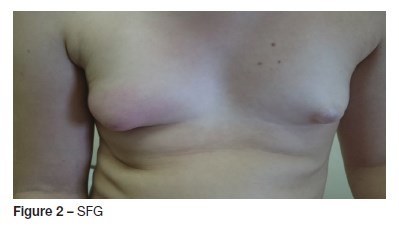
<body><![CDATA[<p>&nbsp;</p> </font>     <p><font size="3" face="Verdana"><b>INTRODUCTION</b></font></p> <font face="Verdana" size="2">     <p>Mastitis, an inflammation of the breast tissue, are most frequently   described in lactating women and neonates.<sup>1,2</sup> Mastitis in children   and adolescents is an uncommon condition whose risk factors and pathophysiology are not fully understood.<sup>1</sup></p>     <p><i>Staphylococcus aureus </i>(<i>S.   aureus</i>) and Gram negatives, such as <i>Escherichia coli</i>, are the   most common isolates in this condition.<sup>1-4</sup> <i>S. aureus</i> accounts for more than 75% of all cases.<sup>2</sup></p>     <p>Whenever possible, the pus should be sent to   culture and the empirical treatment should use antibiotics that cover the most   common pathogens. The treatment can be reviewed later, according to the   identified bacteria, its resistance profile and the clinical evolution. The   surgical treatment with open drainage should be reserved to large abscesses   (&gt;5cm), cases with systemic sepsis, or for abscesses that recur despite percutaneous drainage, since in these cases oral antibiotics are not effective.<sup>4</sup></p>     <p>&nbsp;</p> </font>     <p><font size="3" face="Verdana"><b>CASE DESCRIPTION</b></font></p> <font face="Verdana" size="2">     <p><b>Case 1</b></p>     <p>TLQ, a four-year-old boy, without relevant past medical history, namely   of recurrent infections, resident in an urban household, was admitted to the   emergency Department (ED) with right peri-mammillary edema erythema and   persistent multiple discharge manifestations in the previous 24 hours. He was   afebrile and there was no recalled trauma. An inverted nipple was observed on   physical exploration (<a href="#f1">Figure 1</a>). There were no visible skin lesions (such as fissures) and no palpable lymphadenopathies.</p>     <p><a name="f1"></a></p>     ]]></body>
<body><![CDATA[<p>&nbsp;</p>     <p align="center"><img src="/img/revistas/nas/v27n2/27n2a09f1.jpg" width="405" height="228"></p>     
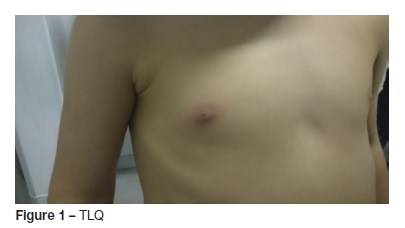
<p align="left">&nbsp;</p>     <p>Oral antibiotic (flucloxacillin) was started, empirically and nipple damage was sent for culture and gram stain.</p>     <p>Three days later, redness and swelling   persisted. The culture of the exudate was positive for <i>Elizabethkingia     meningoseptica</i>, resistant to Flucloxacillin, so the antibiotic treatment was substituted to cotrimoxazole with favorable outcome after seven days.</p>     <p><b>Case 2</b></p>     <p>SFG is an 11 year-old girl, resident in an urban household, without   relevant past medical history, premenarchal and a Tanner stage P2M2. She was   brought to our ED because in the last 24 hours she had developed redness, edema   and pain of the right breast without spontaneous discharge (<a href="#f2">Figure 2</a>). Trauma   wasn’t recalled. She manifested fever - 39. ºC (for the first time). No other symptoms or cutaneous lesions or lymphadenopathies were present.</p>     <p><a name="f2"></a></p>     <p>&nbsp;</p>     <p align="center"><img src="/img/revistas/nas/v27n2/27n2a09f2.jpg" width="399" height="227"></p>     
]]></body>
<body><![CDATA[<p>&nbsp;</p>     <p>A swab of the pus was retrieved after gentle expression of the nipple   and sent to culture. No other lab tests were thought necessary and the girl was medicated with oral Flucloxacillin for seven days. </p>     <p><i>Aeromonas hydrophilia</i> resistant   to that antibiotic was isolated in the pus, but as the girl experienced a complete recovery no change was made to the therapy.</p>     <p>&nbsp;</p> </font>     <p><font size="3" face="Verdana"><b>DISCUSSION/CONCLUSIONS</b></font></p> <font face="Verdana" size="2">     <p>Flucloxacillin was our drug of choice in both cases to cover the most   common isolate described in the literature - <i>S. aureus</i> and oral   antibiotics are usually very effective in treating children with mastitis, as we observed in both cases.<sup>1-3</sup></p>     <p>The duration of the treatment and the first-line antimicrobial drug are   difficult to propose, given the scarcity of clinical essays in this area.<sup>1,2</sup> The authors, however, deem reasonable to opt for   drug that covers <i>S. aureus</i> (according to the resistance profile of that   region) and for a duration similar to that described for other <i>Staphylococcus</i>-associated   skin and soft tissues infections – eg.: anti-Staphyloccal Penicillin or Amoxicilin/Clavulanate for seven to ten days.<sup>5</sup></p>     <p>The causal factor proposed to explain mastitis in this age group is the   enlargement of the breast tissue during puberty.<sup>2</sup> This hypothesis, however, could only be applicable in our second case. </p>     <p>In case 1, we propose that the inverted nipple may cause duct obstruction and consequently the infectious process.<sup>3,4</sup></p>     <p>Clinicians should be aware that several precipitating factors (such as   trauma, duct ectasia, epidermal cysts, skin infection, cystic breast disease or   even rarer entities such as Syphilitic chancre, tuberculosis or Granulomatosis   with Polyangiitis can be the cause of mastitis and should be ruled out, especially when the patient does not evolve favorably.<sup>3</sup></p>     ]]></body>
<body><![CDATA[<p>In case 2, who presented with fever, we opted not to order lab tests   since the girl didn’t have a persistent fever, the infectious focus was very   apparent and she had no systemic signs. The good outcome she experienced supported our clinical choice.</p>     <p>Ultrasonography was not considered necessary, since it is most useful to   rule out abscess formation and the physical examination was not suggestive of a   large abscess and smaller collections can be managed with oral antibiotics.<sup>4</sup>   The rate of abscess formation is also lower in this age group than in neonates.<sup>1</sup></p>     <p><i>Elizabethkingia meningoseptica</i>, formerly known as <i>Flavobacterium meningosepticum</i>, is a   Gram-negative bacterium that has been described as a human pathogen , but there   is no available data in the literature about these bacteria causing mastitis.<sup>6</sup>   The fact that these bacteria are not usual commensal agents, was the only   isolate in the pus and that the boy improved after the adjustment of   antibiotics according to this agent’s antibiogram, is highly suggestive that <i>E. meningosepstica</i> was indeed the responsible agent for the infection. </p>     <p><i>Aeromonas hydrophilia </i>is   also a Gram-negative bacterium that is known to cause soft tissue infections in   humans, including the breast tissue.<sup>7,8</sup> The   bacteria are usually transmitted by contaminated water.<sup>7</sup> In this   case, even though the antibiogram revealed resistance to Flucloxacilin, clinically the patient responded, so we opted to maintain the treatment.</p>     <p>The prognosis of this clinical condition is almost universally   favorable.<sup>1,2</sup> Whenever there is an atypical   clinical course (persistence of inflammatory signs or recurrence of the   disease), clinicians should consider the possibility of antimicrobial resistant   organisms, the presence of abscesses in need of drainage, the existence of the aforementioned precipitating factors or a differential diagnosis. </p>     <p>The differential diagnoses to be considered in non-puerperal mastitis   are: lactational mastitis; Mondor’s disease, an infrequent condition consisting   of a superficial phlebitis of the breast skin that can be precipitated by   trauma and that usually improves spontaneously; breast trauma (ruled out in both cases by history); mammary duct ectasia and recurrent subareolar abscess.<sup>3</sup></p>     <p>Clinicians should be aware of the existence of this condition in   children and non-puerperal adolescents and of the pertinence of the microbiological analysis of the exudates to direct microbial therapy.</p>     <p>&nbsp;</p> </font>     <p><font face="Verdana"><b>REFERENCES</b></font></p> <font face="Verdana" size="2">     <!-- ref --><p>1.&nbsp;&nbsp;&nbsp;&nbsp;   Stricker T,&nbsp;Navratil   F,&nbsp;Forster I,&nbsp;Hürlimann R,&nbsp;Sennhauser FH. Nonpuerperal mastitis in adolescents. J Pediatr.&nbsp;2006; 148:278-81.    &nbsp;&nbsp;&nbsp;&nbsp;&nbsp;&nbsp;&nbsp;&nbsp;[&#160;<a href="javascript:void(0);" onclick="javascript: window.open('/scielo.php?script=sci_nlinks&ref=1110571&pid=S0872-0754201800020000900001&lng=','','width=640,height=500,resizable=yes,scrollbars=1,menubar=yes,');">Links</a>&#160;]<!-- end-ref --></p>     <!-- ref --><p>2.&nbsp;&nbsp;&nbsp;&nbsp;   Faden H. Mastitis in children from birth to 17 years. Pediatr Infect Dis J.&nbsp;2005; 24:1113.    &nbsp;&nbsp;&nbsp;&nbsp;&nbsp;&nbsp;&nbsp;&nbsp;[&#160;<a href="javascript:void(0);" onclick="javascript: window.open('/scielo.php?script=sci_nlinks&ref=1110573&pid=S0872-0754201800020000900002&lng=','','width=640,height=500,resizable=yes,scrollbars=1,menubar=yes,');">Links</a>&#160;]<!-- end-ref --></p>     <!-- ref --><p>3.&nbsp;&nbsp;&nbsp;&nbsp;   Greydanus   DE, Matytsina L, Gains M. <i>Breast Disorders in Children and Adolescents</i>.  Primary Care: Clinics in Office Practice. 2006; 33:455-502.    &nbsp;&nbsp;&nbsp;&nbsp;&nbsp;&nbsp;&nbsp;&nbsp;[&#160;<a href="javascript:void(0);" onclick="javascript: window.open('/scielo.php?script=sci_nlinks&ref=1110575&pid=S0872-0754201800020000900003&lng=','','width=640,height=500,resizable=yes,scrollbars=1,menubar=yes,');">Links</a>&#160;]<!-- end-ref --></p>     <!-- ref --><p>4.&nbsp;&nbsp;&nbsp;&nbsp; Warren R, Degnim AC. Uncommon Benign Breast Abnormalities in   Adolescents. Semin Plast Surg. 2013; 27:26–8.    &nbsp;&nbsp;&nbsp;&nbsp;&nbsp;&nbsp;&nbsp;&nbsp;[&#160;<a href="javascript:void(0);" onclick="javascript: window.open('/scielo.php?script=sci_nlinks&ref=1110577&pid=S0872-0754201800020000900004&lng=','','width=640,height=500,resizable=yes,scrollbars=1,menubar=yes,');">Links</a>&#160;]<!-- end-ref --></p>     <!-- ref --><p>5.&nbsp;&nbsp;&nbsp;&nbsp; Bradley JS,   Nelson JD. 2015 Nelson’s Pediatric Antimicrobial Therapy. 21<sup>st</sup>. American Academy of Pediatrics; 2015.    &nbsp;&nbsp;&nbsp;&nbsp;&nbsp;&nbsp;&nbsp;&nbsp;[&#160;<a href="javascript:void(0);" onclick="javascript: window.open('/scielo.php?script=sci_nlinks&ref=1110579&pid=S0872-0754201800020000900005&lng=','','width=640,height=500,resizable=yes,scrollbars=1,menubar=yes,');">Links</a>&#160;]<!-- end-ref --></p>     <!-- ref --><p>6.&nbsp;&nbsp;&nbsp;&nbsp;   Beato JN,   Espinar MJ, Figueira L, Eremina YO, Ribeiro M, Moreira R, et al. Elizabethkingia meningoseptica e o Uso de Lentes de Contato. Acta Med Port 2016; 29:287-9.    &nbsp;&nbsp;&nbsp;&nbsp;&nbsp;&nbsp;&nbsp;&nbsp;[&#160;<a href="javascript:void(0);" onclick="javascript: window.open('/scielo.php?script=sci_nlinks&ref=1110581&pid=S0872-0754201800020000900006&lng=','','width=640,height=500,resizable=yes,scrollbars=1,menubar=yes,');">Links</a>&#160;]<!-- end-ref --></p>     <!-- ref --><p>7.&nbsp;&nbsp;&nbsp;&nbsp;   Chao CM,&nbsp;Lai CC,&nbsp;Tang HJ,&nbsp;Ko   WC,&nbsp;Hsueh PR. Skin and soft-tissue infections caused by Aeromonas species. Eur J Clin Microbiol Infect Dis.&nbsp;2013; 32:543-7.    &nbsp;&nbsp;&nbsp;&nbsp;&nbsp;&nbsp;&nbsp;&nbsp;[&#160;<a href="javascript:void(0);" onclick="javascript: window.open('/scielo.php?script=sci_nlinks&ref=1110583&pid=S0872-0754201800020000900007&lng=','','width=640,height=500,resizable=yes,scrollbars=1,menubar=yes,');">Links</a>&#160;]<!-- end-ref --></p>     <!-- ref --><p>8.&nbsp;&nbsp;&nbsp;&nbsp; García-Lozano T, Oroval EA, Mojarrieta JC, Badía FM. Lesiones Vesículo-ampollosas En Un Paciente Oncológico   Inmunideprimido. Revista Argentina de Microbiologia; 2012.    &nbsp;&nbsp;&nbsp;&nbsp;&nbsp;&nbsp;&nbsp;&nbsp;[&#160;<a href="javascript:void(0);" onclick="javascript: window.open('/scielo.php?script=sci_nlinks&ref=1110585&pid=S0872-0754201800020000900008&lng=','','width=640,height=500,resizable=yes,scrollbars=1,menubar=yes,');">Links</a>&#160;]<!-- end-ref --></p>     <p>&nbsp;</p>     <p>&nbsp;</p> <b><a name="end" id="topo2"></a><a href="#topo">CORRESPONDENCE TO</a></b>     <p>Inês Maio    <br>   Department of Pediatrics    <br>   Centro Materno-Infantil do Norte    ]]></body>
<body><![CDATA[<br>   Centro Hospitalar do Porto    <br>   Largo Professor Abel Salazar    <br>   4099-001 Porto    <br>   Email: <a href="mailto:inesmaiogoncalves@gmail.com">inesmaiogoncalves@gmail.com</a></p>     <p>Received for publication: 13.02.2017    <br> Accepted in revised form: 25.09.2017</p> </font>      ]]></body><back>
<ref-list>
<ref id="B1">
<label>1</label><nlm-citation citation-type="journal">
<person-group person-group-type="author">
<name>
<surname><![CDATA[Stricker]]></surname>
<given-names><![CDATA[T]]></given-names>
</name>
<name>
<surname><![CDATA[Navratil]]></surname>
<given-names><![CDATA[F]]></given-names>
</name>
<name>
<surname><![CDATA[Forster]]></surname>
<given-names><![CDATA[I]]></given-names>
</name>
<name>
<surname><![CDATA[Hürlimann]]></surname>
<given-names><![CDATA[R]]></given-names>
</name>
<name>
<surname><![CDATA[Sennhauser]]></surname>
<given-names><![CDATA[FH]]></given-names>
</name>
</person-group>
<article-title xml:lang="en"><![CDATA[Nonpuerperal mastitis in adolescents]]></article-title>
<source><![CDATA[J Pediatr]]></source>
<year>2006</year>
<volume>148</volume>
<page-range>278-81</page-range></nlm-citation>
</ref>
<ref id="B2">
<label>2</label><nlm-citation citation-type="journal">
<person-group person-group-type="author">
<name>
<surname><![CDATA[Faden]]></surname>
<given-names><![CDATA[H]]></given-names>
</name>
</person-group>
<article-title xml:lang="en"><![CDATA[Mastitis in children from birth to 17 years]]></article-title>
<source><![CDATA[Pediatr Infect Dis J.]]></source>
<year>2005</year>
<volume>24</volume>
<page-range>1113</page-range></nlm-citation>
</ref>
<ref id="B3">
<label>3</label><nlm-citation citation-type="journal">
<person-group person-group-type="author">
<name>
<surname><![CDATA[Greydanus]]></surname>
<given-names><![CDATA[DE]]></given-names>
</name>
<name>
<surname><![CDATA[Matytsina]]></surname>
<given-names><![CDATA[L]]></given-names>
</name>
<name>
<surname><![CDATA[Gains]]></surname>
<given-names><![CDATA[M]]></given-names>
</name>
</person-group>
<article-title xml:lang="en"><![CDATA[Breast Disorders in Children and Adolescents]]></article-title>
<source><![CDATA[Primary Care: Clinics in Office Practice]]></source>
<year>2006</year>
<volume>33</volume>
<page-range>455-502</page-range></nlm-citation>
</ref>
<ref id="B4">
<label>4</label><nlm-citation citation-type="journal">
<person-group person-group-type="author">
<name>
<surname><![CDATA[Warren]]></surname>
<given-names><![CDATA[R]]></given-names>
</name>
<name>
<surname><![CDATA[Degnim]]></surname>
<given-names><![CDATA[AC]]></given-names>
</name>
</person-group>
<article-title xml:lang="en"><![CDATA[Uncommon Benign Breast Abnormalities in Adolescents]]></article-title>
<source><![CDATA[Semin Plast Surg]]></source>
<year>2013</year>
<volume>27</volume>
<page-range>26-8</page-range></nlm-citation>
</ref>
<ref id="B5">
<label>5</label><nlm-citation citation-type="confpro">
<person-group person-group-type="author">
<name>
<surname><![CDATA[Bradley]]></surname>
<given-names><![CDATA[JS]]></given-names>
</name>
<name>
<surname><![CDATA[Nelson]]></surname>
<given-names><![CDATA[JD]]></given-names>
</name>
</person-group>
<source><![CDATA[Nelson’s Pediatric Antimicrobial Therapy]]></source>
<year>2015</year>
<conf-name><![CDATA[21 American Academy of Pediatrics]]></conf-name>
<conf-date>2015</conf-date>
<conf-loc> </conf-loc>
</nlm-citation>
</ref>
<ref id="B6">
<label>6</label><nlm-citation citation-type="journal">
<person-group person-group-type="author">
<name>
<surname><![CDATA[Beato]]></surname>
<given-names><![CDATA[JN]]></given-names>
</name>
<name>
<surname><![CDATA[Espinar]]></surname>
<given-names><![CDATA[MJ]]></given-names>
</name>
<name>
<surname><![CDATA[Figueira]]></surname>
<given-names><![CDATA[L]]></given-names>
</name>
<name>
<surname><![CDATA[Eremina]]></surname>
<given-names><![CDATA[YO]]></given-names>
</name>
<name>
<surname><![CDATA[Ribeiro]]></surname>
<given-names><![CDATA[M]]></given-names>
</name>
<name>
<surname><![CDATA[Moreira]]></surname>
<given-names><![CDATA[R]]></given-names>
</name>
</person-group>
<article-title xml:lang="pt"><![CDATA[Elizabethkingia meningoseptica e o Uso de Lentes de Contato]]></article-title>
<source><![CDATA[Acta Med Port]]></source>
<year>2016</year>
<volume>29</volume>
<page-range>287-9</page-range></nlm-citation>
</ref>
<ref id="B7">
<label>7</label><nlm-citation citation-type="journal">
<person-group person-group-type="author">
<name>
<surname><![CDATA[Chao]]></surname>
<given-names><![CDATA[CM]]></given-names>
</name>
<name>
<surname><![CDATA[Lai]]></surname>
<given-names><![CDATA[CC]]></given-names>
</name>
<name>
<surname><![CDATA[Tang]]></surname>
<given-names><![CDATA[HJ]]></given-names>
</name>
<name>
<surname><![CDATA[Ko]]></surname>
<given-names><![CDATA[WC]]></given-names>
</name>
<name>
<surname><![CDATA[Hsueh]]></surname>
<given-names><![CDATA[PR]]></given-names>
</name>
</person-group>
<article-title xml:lang="en"><![CDATA[Skin and soft-tissue infections caused by Aeromonas species]]></article-title>
<source><![CDATA[Eur J Clin Microbiol Infect Dis]]></source>
<year>2013</year>
<volume>32</volume>
<page-range>543-7</page-range></nlm-citation>
</ref>
<ref id="B8">
<label>8</label><nlm-citation citation-type="journal">
<person-group person-group-type="author">
<name>
<surname><![CDATA[García-Lozano]]></surname>
<given-names><![CDATA[T]]></given-names>
</name>
<name>
<surname><![CDATA[Oroval]]></surname>
<given-names><![CDATA[EA]]></given-names>
</name>
<name>
<surname><![CDATA[Mojarrieta]]></surname>
<given-names><![CDATA[JC]]></given-names>
</name>
<name>
<surname><![CDATA[Badía]]></surname>
<given-names><![CDATA[FM]]></given-names>
</name>
</person-group>
<article-title xml:lang="es"><![CDATA[Lesiones Vesículo-ampollosas En Un Paciente Oncológico Inmunideprimido]]></article-title>
<source><![CDATA[Revista Argentina de Microbiologia]]></source>
<year>2012</year>
</nlm-citation>
</ref>
</ref-list>
</back>
</article>