<?xml version="1.0" encoding="ISO-8859-1"?><article xmlns:mml="http://www.w3.org/1998/Math/MathML" xmlns:xlink="http://www.w3.org/1999/xlink" xmlns:xsi="http://www.w3.org/2001/XMLSchema-instance">
<front>
<journal-meta>
<journal-id>0872-0754</journal-id>
<journal-title><![CDATA[Nascer e Crescer]]></journal-title>
<abbrev-journal-title><![CDATA[Nascer e Crescer]]></abbrev-journal-title>
<issn>0872-0754</issn>
<publisher>
<publisher-name><![CDATA[Centro Hospitalar do Porto]]></publisher-name>
</publisher>
</journal-meta>
<article-meta>
<article-id>S0872-07542018000200012</article-id>
<title-group>
<article-title xml:lang="en"><![CDATA[Imaging case]]></article-title>
<article-title xml:lang="pt"><![CDATA[Caso imagiológico]]></article-title>
</title-group>
<contrib-group>
<contrib contrib-type="author">
<name>
<surname><![CDATA[Pereira]]></surname>
<given-names><![CDATA[Sandra]]></given-names>
</name>
<xref ref-type="aff" rid="A01"/>
</contrib>
<contrib contrib-type="author">
<name>
<surname><![CDATA[Rangel]]></surname>
<given-names><![CDATA[Maria Adriana]]></given-names>
</name>
<xref ref-type="aff" rid="A02"/>
</contrib>
<contrib contrib-type="author">
<name>
<surname><![CDATA[Martins]]></surname>
<given-names><![CDATA[Alexandra]]></given-names>
</name>
<xref ref-type="aff" rid="A03"/>
</contrib>
<contrib contrib-type="author">
<name>
<surname><![CDATA[Sousa]]></surname>
<given-names><![CDATA[Marta]]></given-names>
</name>
<xref ref-type="aff" rid="A04"/>
</contrib>
<contrib contrib-type="author">
<name>
<surname><![CDATA[Rocha]]></surname>
<given-names><![CDATA[Cristina]]></given-names>
</name>
<xref ref-type="aff" rid="A03"/>
</contrib>
<contrib contrib-type="author">
<name>
<surname><![CDATA[Oliveira]]></surname>
<given-names><![CDATA[Arménia]]></given-names>
</name>
<xref ref-type="aff" rid="A03"/>
</contrib>
</contrib-group>
<aff id="A01">
<institution><![CDATA[,Centro Hospitalar de São João Department of Pediatrics ]]></institution>
<addr-line><![CDATA[Porto ]]></addr-line>
<country>Portugal</country>
</aff>
<aff id="A02">
<institution><![CDATA[,Centro Hospitalar Vila Nova de Gaia/Espinho Department of Pediatrics ]]></institution>
<addr-line><![CDATA[Vila Nova de Gaia ]]></addr-line>
<country>Portugal</country>
</aff>
<aff id="A03">
<institution><![CDATA[,Centro Hospitalar Entre o Douro e Vouga Department of Pediatrics ]]></institution>
<addr-line><![CDATA[Santa Maria da Feira ]]></addr-line>
<country>Portugal</country>
</aff>
<aff id="A04">
<institution><![CDATA[,Centro Hospitalar Entre o Douro e Vouga Department of Radiology and Medical Imaging ]]></institution>
<addr-line><![CDATA[Santa Maria da Feira ]]></addr-line>
<country>Portugal</country>
</aff>
<pub-date pub-type="pub">
<day>01</day>
<month>06</month>
<year>2018</year>
</pub-date>
<pub-date pub-type="epub">
<day>01</day>
<month>06</month>
<year>2018</year>
</pub-date>
<volume>27</volume>
<numero>2</numero>
<fpage>129</fpage>
<lpage>132</lpage>
<copyright-statement/>
<copyright-year/>
<self-uri xlink:href="http://scielo.pt/scielo.php?script=sci_arttext&amp;pid=S0872-07542018000200012&amp;lng=en&amp;nrm=iso"></self-uri><self-uri xlink:href="http://scielo.pt/scielo.php?script=sci_abstract&amp;pid=S0872-07542018000200012&amp;lng=en&amp;nrm=iso"></self-uri><self-uri xlink:href="http://scielo.pt/scielo.php?script=sci_pdf&amp;pid=S0872-07542018000200012&amp;lng=en&amp;nrm=iso"></self-uri><abstract abstract-type="short" xml:lang="en"><p><![CDATA[Introduction: Congenital Bochdalek Diaphragmatic Hernia (CBDH) is a relatively rare entity and may be underdiagnosed due to not being correctly recognized after the neonatal period. Case report: An eight-month-old Caucasian infant with failure to thrive, presented to the emergency service with productive cough since the previous week. He was amoxicillin/clavulanic acid prescribed seven days before for an acute otitis media and was afebrile for the past four days. Past history revealed failure to thrive and feeding difficulties. Chest radiograph was misleading, with multiple differential diagnosis, namely eventration and necrotizing pneumonia. Abdominal ultrasonography and thoracoabdominal magnetic resonance imaging revealed CBDH with non-obstructive gastric volvulus. Discussion: Pediatricians should include late-onset CBDH as a differential diagnosis in any child with recurrent non-specific respiratory or gastrointestinal tract symptoms. Early surgical correction of diaphragmatic defect is crucial to prevent the possible risk of strangulation and severe respiratory problems.]]></p></abstract>
<abstract abstract-type="short" xml:lang="pt"><p><![CDATA[Introdução: A Hérnia Diafragmática Congénita de Bochdalek (HDCB) é uma entidade relativamente rara que pode ser subdiagnosticada por não ser corretamente reconhecida após o período neonatal. Caso Clínico: Criança de oito meses, sexo masculino, caucasiano, recorreu ao Serviço de Urgência por tosse produtiva desde a última semana, sem sinais de dificuldade respiratória. Estava medicado com amoxicilina/ácido clavulânico desde há sete dias por otite média aguda, estando apirético nos últimos quatro dias. Antecedentes de má evolução ponderal e dificuldades alimentares. A radiografia de tórax foi controversa, colocando-se vários diagnósticos diferenciais, como eventração e pneumonia necrotizante. A ecografia abdominal e a ressonância magnética tóraco-abdominal revelaram HDCB com vólvulo gástrico não obstrutivo. Discussão: Os pediatras devem colocar a HDCB de início tardio como hipótese diagnóstica sempre que uma criança apresente sintomas do aparelho respiratório ou gastrointestinal recorrentes e inespecíficos. A correção cirúrgica precoce do defeito diafragmático é crucial para evitar o potencial risco de estrangulamento ou de problemas respiratórios graves.]]></p></abstract>
<kwd-group>
<kwd lng="en"><![CDATA[Congenital diaphragmatic hernia]]></kwd>
<kwd lng="en"><![CDATA[cough]]></kwd>
<kwd lng="en"><![CDATA[failure to thrive]]></kwd>
<kwd lng="en"><![CDATA[pediatrics]]></kwd>
<kwd lng="pt"><![CDATA[Hérnia diafragmática congénita]]></kwd>
<kwd lng="pt"><![CDATA[idade pediátrica]]></kwd>
<kwd lng="pt"><![CDATA[má evolução estaturo-ponderal]]></kwd>
<kwd lng="pt"><![CDATA[tosse]]></kwd>
</kwd-group>
</article-meta>
</front><body><![CDATA[ <font face="Verdana" size="2">        <P align="right"><b>  QUAL O SEU DIAGNÓSTICO? | WHAT IS YOUR DIAGNOSIS?  </b></P>     <p>&nbsp;</p> </font>     <p><font size="4" face="Verdana"><b>Imaging case</b></font></p> <font face="Verdana" size="2">     <p>&nbsp;</p> </font>     <p><font size="3" face="Verdana"><b>Caso imagiol&oacute;gico</b></font></p> <font face="Verdana" size="2">     <p>&nbsp;</p>     <p>&nbsp;</p>     <p><b>Sandra Pereira<sup>I</sup>; Maria Adriana Rangel<sup>II</sup>; Alexandra Martins<sup>III</sup>; Marta Sousa<sup>IV</sup>; Cristina Rocha<sup>III</sup>; Arménia Oliveira<sup>III</sup></b></p>     <p><sup>I   </sup>Department of Pediatrics, Centro Hospitalar de São João. 4200-319 Porto, Portugal. <a href="mailto:sandravdpereira@gmail.com">sandravdpereira@gmail.com</a>    ]]></body>
<body><![CDATA[<br> <sup>II  </sup> Department of Pediatrics, Centro Hospitalar Vila Nova de Gaia/Espinho. 4434-502&nbsp;Vila Nova de Gaia, Portugal. <a href="mailto:mariaadrianarangel@hotmail.com">mariaadrianarangel@hotmail.com</a>    <br> <sup>III </sup>Department of Pediatrics, Centro Hospitalar Entre o Douro e Vouga. 4520-161 Santa Maria da Feira, Portugal. <a href="mailto:lmartins.alexandra@gmail.com">lmartins.alexandra@gmail.com</a>; <a href="mailto:cristinamsrocha@gmail.com">cristinamsrocha@gmail.com</a>; <a href="mailto:armeoliveira13@gmail.com">armeoliveira13@gmail.com</a>    <br> <sup>IV </sup>Department of Radiology and Medical Imaging, Centro Hospitalar Entre o Douro e Vouga. 4520-161 Santa Maria da Feira, Portugal. <a href="mailto:martareisdesousa@gmail.com">martareisdesousa@gmail.com</a></p> </font>     <p><font face="Verdana" size="2"><a href="#end">Correspondence to</a><a name="topo" id="topo"></a> </font></p>     <p>&nbsp;</p>     <p>&nbsp;</p> <hr noshade size="1"> <font face="Verdana" size="2">    <p><b>ABSTRACT</b></p>     <p><b>Introduction:</b> Congenital   Bochdalek Diaphragmatic Hernia (CBDH) is a relatively rare entity and may be underdiagnosed due to not being correctly recognized after the neonatal period.</p>     <p><b>Case report:</b> An   eight-month-old Caucasian infant with failure to thrive, presented to the   emergency service with productive cough since the previous week. He was   amoxicillin/clavulanic acid prescribed seven days before for an acute otitis   media and was afebrile for the past four days. Past history revealed failure to   thrive and feeding difficulties. Chest radiograph was misleading, with multiple   differential diagnosis, namely eventration and necrotizing pneumonia. Abdominal   ultrasonography and thoracoabdominal magnetic resonance imaging revealed CBDH with non-obstructive gastric volvulus.</p>     <p><b>Discussion:</b> Pediatricians   should include late-onset CBDH as a differential diagnosis in any child with   recurrent non-specific respiratory or gastrointestinal tract symptoms. Early   surgical correction of diaphragmatic defect is crucial to prevent the possible risk of strangulation and severe respiratory problems. </p>     ]]></body>
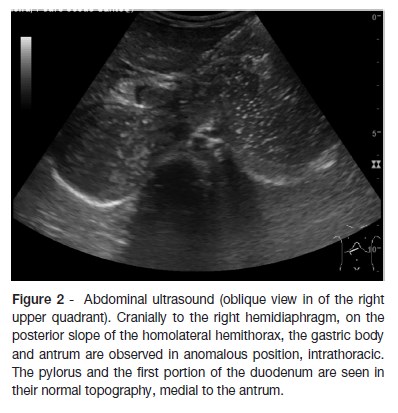
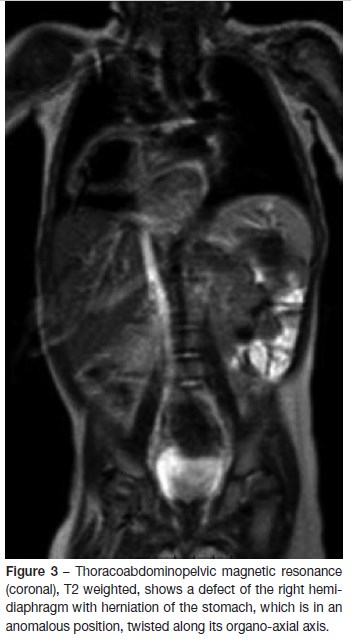
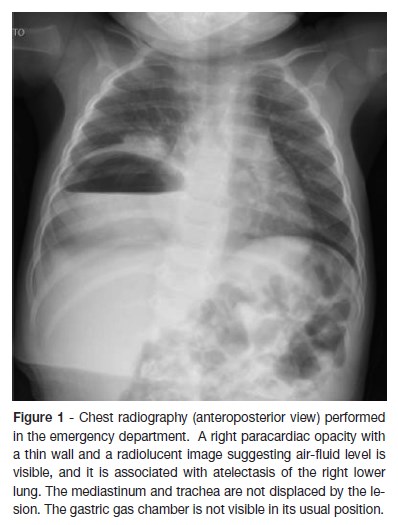
<body><![CDATA[<p><b>Keywords: </b>Congenital diaphragmatic hernia; cough; failure to thrive; pediatrics</p> </font> <hr noshade size="1"> <font face="Verdana" size="2">     <p><b>RESUMO</b></p>     <p><b>Introdução:</b> A Hérnia Diafragmática Congénita de Bochdalek   (HDCB) é uma entidade relativamente rara que pode ser subdiagnosticada por não ser corretamente reconhecida após o período neonatal.</p>     <p><b>Caso Clínico:</b> Criança de oito meses, sexo masculino, caucasiano,   recorreu ao Serviço de Urgência por tosse produtiva desde a última semana, sem   sinais de dificuldade respiratória. Estava medicado com amoxicilina/ácido   clavulânico desde há sete dias por otite média aguda, estando apirético nos   últimos quatro dias. Antecedentes de má evolução ponderal e dificuldades   alimentares. A radiografia de tórax foi controversa, colocando-se vários diagnósticos   diferenciais, como eventração e pneumonia necrotizante. A ecografia abdominal e   a ressonância magnética tóraco-abdominal revelaram HDCB com vólvulo gástrico não obstrutivo.</p>     <p><b>Discussão:</b> Os pediatras devem colocar a HDCB de início tardio   como hipótese diagnóstica sempre que uma criança apresente sintomas do aparelho   respiratório ou gastrointestinal recorrentes e inespecíficos. A correção   cirúrgica precoce do defeito diafragmático é crucial para evitar o potencial risco de estrangulamento ou de problemas respiratórios graves.</p>     <p><b>Palavras-chave:</b> Hérnia   diafragmática congénita; idade   pediátrica; má evolução estaturo-ponderal; tosse</p> </font> <hr noshade size="1">     <p>&nbsp;</p>     <p>&nbsp;</p> <font face="Verdana" size="2">     <p>An   eight-month-old Caucasian infant, infant presented at the emergency department   due to a productive cough starting in the previous week. He was under   medication with  amoxicillin/clavulanic   acid during the past seven days for an acute otitis media  and was afebrile three days after beginning   of therapy. Past history revealed failure to thrive (crossing percentiles since   he was two-month-old: from 50th at birth to below 3rd), without previous   etiologic investigation. Food diversification was started at the age of four   months and, according to the mother, he was fed in small amounts, more   frequently than expected for his age, to avoid vomiting. No other   gastrointestinal complaints. On physical examination, he was pale and had an   emaciated appearance, without signs of respiratory distress and a normal   frequency respiratory rate, with transcutaneous oxygen saturation (SpO2) of 93%   at room air. On pulmonary auscultation he had diminished breath sounds in the   right pulmonary base, without any adventitious sounds or bulkiness on   percussion. Laboratory findings were normal, with negative inflammatory   parameters. Chest x-ray (<a href="#f1">figure 1</a>) detected a paracardiac and right basal   nodular shadow with a radiolucent image, as well as a reduction of right lung   volume. Differential diagnosis included eventration, congenital diaphragmatic   hernia, necrotizing pneumonia, congenital cyst adenomatoid malformation and   subphrenic abscess. Abdominal ultrasound (<a href="#f2">figure 2</a>) showed the gastric body and   antrum at an anomalous topography, cranially to the right hemidiaphragm, on the   posterior slope of the homolateral hemithorax with associated gastric rotation   (non-obstructive volvulus); the pylorus and the first portion of the duodenum   were in normal topography. Thoracoabdominopelvic magnetic resonance imaging (<a href="#f3">figure 3</a>), confirmed the ultrasound findings.</p>     <p><a name="f1"></a></p>     ]]></body>
<body><![CDATA[<p>&nbsp;</p>     <p align="center"><img src="/img/revistas/nas/v27n2/27n2a12f1.jpg" width="398" height="525"></p>     
<p>&nbsp;</p>     <p><a name="f2"></a></p>     <p>&nbsp;</p>     <p align="center"><img src="/img/revistas/nas/v27n2/27n2a12f2.jpg" width="398" height="413"></p>     
<p>&nbsp;</p>     <p><a name="f3"></a></p>     <p>&nbsp;</p>     <p align="center"><img src="/img/revistas/nas/v27n2/27n2a12f3.jpg" width="351" height="639"></p>     
]]></body>
<body><![CDATA[<p>&nbsp;</p>     <p><b>What is your diagnosis?</b></p>     <p>&nbsp;</p> </font>     <p><font size="3" face="Verdana"><b>DIAGNOSIS</b></font></p> <font face="Verdana" size="2">     <p>Right-sided Congenital Bochdalek Diaphragmatic Hernia (CBDH)</p>     <p>&nbsp;</p> </font>     <p><font size="3" face="Verdana"><b>DISCUSSION</b></font></p> <font face="Verdana" size="2">     <p>Although the great majority   of CBDH are seen in newborns and are unilateral and left-sided, a smaller group   of patients present outside neonatal period with an anatomic defect on the   right side, as in the case presented. CBDH is the most common embryologic   defect of the diaphragm, due to the persistence of the posterolateral   pleuroperitoneal canal.<sup>1,2</sup> Early-presenting CBDH shows acute   symptoms with respiratory compromise after birth, so it is readily diagnosed   and requires prompt intervention to prevent death in the neonatal period.<sup>1-3</sup>   However, a small subset of patients, with a variable prevalence of 2,6-25% off   all cases, present this congenital defect beyond this period.<sup>1,3-7</sup>   Among late-presentation CBDH, unilateral postero-lateral defects constitute   more than 96%, with 79,4% and 20,6% left and right-sided hernias, respectively,   and is more frequent in males with a ratio of 2:1.<sup>1,3,5,6,8</sup> An   important epidemiologic feature of late-onset CBHD is a very low incidence of   associated anomalies.<sup>1,2,5,6</sup> The diagnosis of late-onset congenital   diaphragmatic hernia is complicated because it is rare and has a wide spectrum   of clinical presentation with inconsistent radiologic findings.<sup>1-5,9,10</sup>   Presenting symptoms can be both respiratory and gastrointestinal, such as our   case, but the later are more common in left-sided CBDH, whereas respiratory   symptoms predominate in right-sided hernias.<sup>2,5,10</sup> It has been   speculated that partial liver herniation, which is a common finding in the   right CBHD, may block further herniation of hollow viscera, preventing the   development of gastrointestinal symptoms and delaying diagnosis.<sup>2,8,10</sup>   However, organ herniating into the thorax can cause bilateral mass effects with   subsequent respiratory compromise. In our patient, compression of the lung may   have led to respiratory symptoms or it may have been a respiratory tract   infection that led to the diagnosis while carrying out a chest x-ray. Gastric   volvulus led to feeding difficulties and therefore failure to thrive. Cevizci <i>et     al</i> reported a case of a 6,5-year-old girl with later presenting CBHD, that   was diagnosed in the setting of upper gastrointestinal bleeding due to gastric   volvulus with incarceration.<sup>1</sup> Malrotation has been found in many   patients with late-onset CBDH.<sup>5,7</sup> The first-choice technique for   assessing diaphragmatic integrity is pulmonary x-ray however it is frequently   misdiagnosed.<sup>1,3,4,9,10</sup> The most common incorrect radiographic   interpretations include pneumonia, congenital cyst adenomatoid malformation,   eventration, pneumothorax and pleural effusion, the latter having been associated   with inappropriate chest tube insertion with risk of gastrointestinal   perforation or bleeding from the thoracic liver.<sup>3,4,7-10</sup> Wrong   interpretation can be eliminated by inserting a nasogastric tube before   scanning.<sup>3,8,10</sup> For patients with right CBDH, thoraco-abdominal   ultrasound, computerized tomography or magnetic resonance seem to be the best   diagnostic option.<sup>3,4,8</sup> In this case magnetic resonance imaging   findings confirmed Bochdalek hernia and associated gastric volvulus (<a href="#f3">figure 3</a>).   The prompt diagnosis of late-presenting CBDH will reduce morbidity and   mortality. Early surgical correction of diaphragmatic defect is crucial to   prevent the possible risk of strangulation and severe respiratory problems.<sup>3</sup>   Therefore, accurate diagnosis and timely minimally invasive surgical   intervention ensure an excellent prognosis.<sup>3,6-8,10</sup> Our patient underwent laparoscopic surgery, with good clinical evolution.</p>     <p>In summary,   late-presenting CBDH should be considered in the differential diagnosis of   recurrent non-specific respiratory or gastrointestinal tract symptoms in a   child. Although the prognosis associated with late-presenting CBDH is usually   favorable, CBDH still requires surgery intervention to alleviate the symptoms   and prevent life-threatening complications. Clinicians must maintain a high   degree of suspicion for CBDH even beyond the neonatal period, regardless of its   presentation, to avoid misdiagnosis, which can result in higher morbidity and   mortality. The atypical presentation of this case:  failure to thrive in the first months of life   and feeding difficulties, and an abnormal chest x-ray, highlights the need of awareness to this condition in order to allow early diagnosis and management.</p>     <p>&nbsp;</p> </font>     ]]></body>
<body><![CDATA[<p><font size="3" face="Verdana"><b>REFERENCES</b></font></p> <font face="Verdana" size="2">     <!-- ref --><p>1.   Cevizci MN, Erdemir G, Cayir A. A Rare Cause   of Haemorrhage in the Upper Gastrointestinal System: Bochdalek Hernia. West Indian Med J 2015; 64:154-6.    &nbsp;&nbsp;&nbsp;&nbsp;&nbsp;&nbsp;&nbsp;&nbsp;[&#160;<a href="javascript:void(0);" onclick="javascript: window.open('/scielo.php?script=sci_nlinks&ref=1110913&pid=S0872-0754201800020001200001&lng=','','width=640,height=500,resizable=yes,scrollbars=1,menubar=yes,');">Links</a>&#160;]<!-- end-ref --></p>     <!-- ref --><p>2.   Chang SW, Lee HC, Yeung CY, Chan WT, Hsu CH,   Kao HA, et al. A twenty-year review of early and late-presenting congenital   Bochdalek diaphragmatic hernia: are they different clinical spectra? Pediatr Neonatol 2010; 51:26-30.    &nbsp;&nbsp;&nbsp;&nbsp;&nbsp;&nbsp;&nbsp;&nbsp;[&#160;<a href="javascript:void(0);" onclick="javascript: window.open('/scielo.php?script=sci_nlinks&ref=1110915&pid=S0872-0754201800020001200002&lng=','','width=640,height=500,resizable=yes,scrollbars=1,menubar=yes,');">Links</a>&#160;]<!-- end-ref --></p>     <!-- ref --><p>3.   Cigdem MK, Onen A, Otcu S, Okur H.   Late presentation of bochdalek-type congenital diaphragmatic hernia in children: a 23-year experience at a single center. Surg Today 2007; 37:642-5.    &nbsp;&nbsp;&nbsp;&nbsp;&nbsp;&nbsp;&nbsp;&nbsp;[&#160;<a href="javascript:void(0);" onclick="javascript: window.open('/scielo.php?script=sci_nlinks&ref=1110917&pid=S0872-0754201800020001200003&lng=','','width=640,height=500,resizable=yes,scrollbars=1,menubar=yes,');">Links</a>&#160;]<!-- end-ref --> </p>     <!-- ref --><p>4.   Bag&#322;aj M, Dorobisz U.   Late-presenting congenital diaphragmatic hernia in children: a literature review. Pediatr Radiol 2005; 35:478-88.    &nbsp;&nbsp;&nbsp;&nbsp;&nbsp;&nbsp;&nbsp;&nbsp;[&#160;<a href="javascript:void(0);" onclick="javascript: window.open('/scielo.php?script=sci_nlinks&ref=1110919&pid=S0872-0754201800020001200004&lng=','','width=640,height=500,resizable=yes,scrollbars=1,menubar=yes,');">Links</a>&#160;]<!-- end-ref --> </p>     <!-- ref --><p>5.   Bag&#322;aj M. Late-presenting   congenital diaphragmatic hernia in children: a clinical spectrum. Pediatr Surg Int 2004; 20:658-69.    &nbsp;&nbsp;&nbsp;&nbsp;&nbsp;&nbsp;&nbsp;&nbsp;[&#160;<a href="javascript:void(0);" onclick="javascript: window.open('/scielo.php?script=sci_nlinks&ref=1110921&pid=S0872-0754201800020001200005&lng=','','width=640,height=500,resizable=yes,scrollbars=1,menubar=yes,');">Links</a>&#160;]<!-- end-ref --> </p>     <!-- ref --><p>6.   Al Ghafri M, Al Sidairi I, Nayar M.   Late presentation of congenital diaphragmatic hernia: a case report. Oman Med J 2014; 29:223-5.    &nbsp;&nbsp;&nbsp;&nbsp;&nbsp;&nbsp;&nbsp;&nbsp;[&#160;<a href="javascript:void(0);" onclick="javascript: window.open('/scielo.php?script=sci_nlinks&ref=1110923&pid=S0872-0754201800020001200006&lng=','','width=640,height=500,resizable=yes,scrollbars=1,menubar=yes,');">Links</a>&#160;]<!-- end-ref --></p>     <!-- ref --><p>7.   Mei-Zahav M, Solomon M, Trachsel D,   Langer JC. Bochdalek diaphragmatic hernia: not only a neonatal disease. Arch Dis Child 2003; 88:532-5.    &nbsp;&nbsp;&nbsp;&nbsp;&nbsp;&nbsp;&nbsp;&nbsp;[&#160;<a href="javascript:void(0);" onclick="javascript: window.open('/scielo.php?script=sci_nlinks&ref=1110925&pid=S0872-0754201800020001200007&lng=','','width=640,height=500,resizable=yes,scrollbars=1,menubar=yes,');">Links</a>&#160;]<!-- end-ref --></p>     <!-- ref --><p>8.   Radovi&#263; SV. Late Presentation   of Congenital Diaphragmatic Hernia - Case Report. Srp Arh Celok Lek 2015; 143:604-8.    &nbsp;&nbsp;&nbsp;&nbsp;&nbsp;&nbsp;&nbsp;&nbsp;[&#160;<a href="javascript:void(0);" onclick="javascript: window.open('/scielo.php?script=sci_nlinks&ref=1110927&pid=S0872-0754201800020001200008&lng=','','width=640,height=500,resizable=yes,scrollbars=1,menubar=yes,');">Links</a>&#160;]<!-- end-ref --></p>     <!-- ref --><p>9.   Rankin   JH, Elkhunovich M, Seif D, Chilstrom M. Point-of-Care Ultrasound Diagnosis of   Diaphragmatic Hernia in an Infant With Respiratory Distress. Pediatr Emerg Care 2016; 32:731-3.    &nbsp;&nbsp;&nbsp;&nbsp;&nbsp;&nbsp;&nbsp;&nbsp;[&#160;<a href="javascript:void(0);" onclick="javascript: window.open('/scielo.php?script=sci_nlinks&ref=1110929&pid=S0872-0754201800020001200009&lng=','','width=640,height=500,resizable=yes,scrollbars=1,menubar=yes,');">Links</a>&#160;]<!-- end-ref --> </p>     <p>10. Kitano Y, Lally   KP, Lally PA. Congenital Diaphragmatic Hernia Study Group. Late-presenting congenital diaphragmatic hernia. J Pediatr Surg 2005; 40:1839-43<i>. </i></p>     ]]></body>
<body><![CDATA[<p>&nbsp;</p>     <p>&nbsp;</p> <b><a name="end" id="topo2"></a><a href="#topo">CORRESPONDENCE TO</a></b>     <p>Sandra Pereira    <br>   Department of Pediatrics    <br>   Centro Hospitalar de São   João    <br>   Alameda Prof. Hernâni   Monteiro    <br>   4200–319 Porto    <br>   Email: <a href="mailto:sandravdpereira@gmail.com">sandravdpereira@gmail.com</a></p>     <p>Received   for publication: 13.10.2017    <br> Accepted in revised form: 29.01.2018</p> </font>     ]]></body>
<body><![CDATA[ ]]></body><back>
<ref-list>
<ref id="B1">
<label>1</label><nlm-citation citation-type="journal">
<person-group person-group-type="author">
<name>
<surname><![CDATA[Cevizci]]></surname>
<given-names><![CDATA[MN]]></given-names>
</name>
<name>
<surname><![CDATA[Erdemir]]></surname>
<given-names><![CDATA[G]]></given-names>
</name>
<name>
<surname><![CDATA[Cayir]]></surname>
<given-names><![CDATA[A]]></given-names>
</name>
</person-group>
<article-title xml:lang="en"><![CDATA[A Rare Cause of Haemorrhage in the Upper Gastrointestinal System: Bochdalek Hernia]]></article-title>
<source><![CDATA[West Indian Med J]]></source>
<year>2015</year>
<volume>64</volume>
<page-range>154-6</page-range></nlm-citation>
</ref>
<ref id="B2">
<label>2</label><nlm-citation citation-type="journal">
<person-group person-group-type="author">
<name>
<surname><![CDATA[Chang]]></surname>
<given-names><![CDATA[SW]]></given-names>
</name>
<name>
<surname><![CDATA[Lee]]></surname>
<given-names><![CDATA[HC]]></given-names>
</name>
<name>
<surname><![CDATA[Yeung]]></surname>
<given-names><![CDATA[CY]]></given-names>
</name>
<name>
<surname><![CDATA[Chan]]></surname>
<given-names><![CDATA[WT]]></given-names>
</name>
<name>
<surname><![CDATA[Hsu]]></surname>
<given-names><![CDATA[CH]]></given-names>
</name>
<name>
<surname><![CDATA[Kao]]></surname>
<given-names><![CDATA[HA]]></given-names>
</name>
</person-group>
<article-title xml:lang="en"><![CDATA[A twenty-year review of early and late-presenting congenital Bochdalek diaphragmatic hernia: are they different clinical spectra?]]></article-title>
<source><![CDATA[Pediatr Neonatol]]></source>
<year>2010</year>
<volume>51</volume>
<page-range>26-30</page-range></nlm-citation>
</ref>
<ref id="B3">
<label>3</label><nlm-citation citation-type="journal">
<person-group person-group-type="author">
<name>
<surname><![CDATA[Cigdem]]></surname>
<given-names><![CDATA[MK]]></given-names>
</name>
<name>
<surname><![CDATA[Onen]]></surname>
<given-names><![CDATA[A]]></given-names>
</name>
<name>
<surname><![CDATA[Otcu]]></surname>
<given-names><![CDATA[S]]></given-names>
</name>
<name>
<surname><![CDATA[Okur]]></surname>
<given-names><![CDATA[H]]></given-names>
</name>
</person-group>
<article-title xml:lang="en"><![CDATA[Late presentation of bochdalek-type congenital diaphragmatic hernia in children: a 23-year experience at a single center]]></article-title>
<source><![CDATA[Surg Today]]></source>
<year>2007</year>
<volume>37</volume>
<page-range>642-5</page-range></nlm-citation>
</ref>
<ref id="B4">
<label>4</label><nlm-citation citation-type="journal">
<person-group person-group-type="author">
<name>
<surname><![CDATA[Bag&#322;aj]]></surname>
<given-names><![CDATA[M]]></given-names>
</name>
<name>
<surname><![CDATA[Dorobisz]]></surname>
<given-names><![CDATA[U]]></given-names>
</name>
</person-group>
<article-title xml:lang="en"><![CDATA[Late-presenting congenital diaphragmatic hernia in children: a literature review]]></article-title>
<source><![CDATA[Pediatr Radiol]]></source>
<year>2005</year>
<volume>35</volume>
<page-range>478-88</page-range></nlm-citation>
</ref>
<ref id="B5">
<label>5</label><nlm-citation citation-type="journal">
<person-group person-group-type="author">
<name>
<surname><![CDATA[Bag&#322;aj]]></surname>
<given-names><![CDATA[M]]></given-names>
</name>
</person-group>
<article-title xml:lang="en"><![CDATA[Late-presenting congenital diaphragmatic hernia in children: a clinical spectrum]]></article-title>
<source><![CDATA[Pediatr Surg Int]]></source>
<year>2004</year>
<volume>20</volume>
<page-range>658-69</page-range></nlm-citation>
</ref>
<ref id="B6">
<label>6</label><nlm-citation citation-type="journal">
<person-group person-group-type="author">
<name>
<surname><![CDATA[Al Ghafri]]></surname>
<given-names><![CDATA[M]]></given-names>
</name>
<name>
<surname><![CDATA[Al Sidairi]]></surname>
<given-names><![CDATA[I]]></given-names>
</name>
<name>
<surname><![CDATA[Nayar]]></surname>
<given-names><![CDATA[M]]></given-names>
</name>
</person-group>
<article-title xml:lang="en"><![CDATA[Late presentation of congenital diaphragmatic hernia: a case report]]></article-title>
<source><![CDATA[Oman Med J]]></source>
<year>2014</year>
<volume>29</volume>
<page-range>223-5</page-range></nlm-citation>
</ref>
<ref id="B7">
<label>7</label><nlm-citation citation-type="journal">
<person-group person-group-type="author">
<name>
<surname><![CDATA[Mei-Zahav]]></surname>
<given-names><![CDATA[M]]></given-names>
</name>
<name>
<surname><![CDATA[Solomon]]></surname>
<given-names><![CDATA[M]]></given-names>
</name>
<name>
<surname><![CDATA[Trachsel]]></surname>
<given-names><![CDATA[D]]></given-names>
</name>
<name>
<surname><![CDATA[Langer]]></surname>
<given-names><![CDATA[JC]]></given-names>
</name>
</person-group>
<article-title xml:lang="en"><![CDATA[Bochdalek diaphragmatic hernia: not only a neonatal disease]]></article-title>
<source><![CDATA[Arch Dis Child]]></source>
<year>2003</year>
<volume>88</volume>
<page-range>532-5</page-range></nlm-citation>
</ref>
<ref id="B8">
<label>8</label><nlm-citation citation-type="journal">
<person-group person-group-type="author">
<name>
<surname><![CDATA[Radovi&#263;]]></surname>
<given-names><![CDATA[SV]]></given-names>
</name>
</person-group>
<article-title xml:lang="en"><![CDATA[Late Presentation of Congenital Diaphragmatic Hernia: Case Report]]></article-title>
<source><![CDATA[Srp Arh Celok Lek]]></source>
<year>2015</year>
<volume>143</volume>
<page-range>604-8</page-range></nlm-citation>
</ref>
<ref id="B9">
<label>9</label><nlm-citation citation-type="journal">
<person-group person-group-type="author">
<name>
<surname><![CDATA[Rankin]]></surname>
<given-names><![CDATA[JH]]></given-names>
</name>
<name>
<surname><![CDATA[Elkhunovich]]></surname>
<given-names><![CDATA[M]]></given-names>
</name>
<name>
<surname><![CDATA[Seif]]></surname>
<given-names><![CDATA[D]]></given-names>
</name>
<name>
<surname><![CDATA[Chilstrom]]></surname>
<given-names><![CDATA[M]]></given-names>
</name>
</person-group>
<article-title xml:lang="en"><![CDATA[Point-of-Care Ultrasound Diagnosis of Diaphragmatic Hernia in an Infant With Respiratory Distress]]></article-title>
<source><![CDATA[Pediatr Emerg Care]]></source>
<year>2016</year>
<volume>32</volume>
<page-range>731-3</page-range></nlm-citation>
</ref>
<ref id="B10">
<label>10</label><nlm-citation citation-type="journal">
<person-group person-group-type="author">
<name>
<surname><![CDATA[Kitano]]></surname>
<given-names><![CDATA[Y, KP]]></given-names>
</name>
<name>
<surname><![CDATA[Lally]]></surname>
<given-names><![CDATA[PA]]></given-names>
</name>
</person-group>
<article-title xml:lang="en"><![CDATA[Congenital Diaphragmatic Hernia Study Group: Late-presenting congenital diaphragmatic hernia]]></article-title>
<source><![CDATA[J Pediatr Surg]]></source>
<year>2005</year>
<volume>40</volume>
<page-range>1839-43</page-range></nlm-citation>
</ref>
</ref-list>
</back>
</article>