<?xml version="1.0" encoding="ISO-8859-1"?><article xmlns:mml="http://www.w3.org/1998/Math/MathML" xmlns:xlink="http://www.w3.org/1999/xlink" xmlns:xsi="http://www.w3.org/2001/XMLSchema-instance">
<front>
<journal-meta>
<journal-id>0872-0754</journal-id>
<journal-title><![CDATA[Nascer e Crescer]]></journal-title>
<abbrev-journal-title><![CDATA[Nascer e Crescer]]></abbrev-journal-title>
<issn>0872-0754</issn>
<publisher>
<publisher-name><![CDATA[Centro Hospitalar do Porto]]></publisher-name>
</publisher>
</journal-meta>
<article-meta>
<article-id>S0872-07542018000300002</article-id>
<article-id pub-id-type="doi">10.25753/BirthGrowthMJ.v27.i3.13202</article-id>
<title-group>
<article-title xml:lang="en"><![CDATA[Continuous Subcutaneous Insulin Infusion (CSII): Impact on Metabolic Control and Quality of Life of the Informal Caregiver]]></article-title>
<article-title xml:lang="pt"><![CDATA[Perfusão Subcutânea Continua de Insulina (PSCI): Impacto sobre o Controlo Metabólico e Qualidade de Vida do Cuidador Informal]]></article-title>
</title-group>
<contrib-group>
<contrib contrib-type="author">
<name>
<surname><![CDATA[Rangel]]></surname>
<given-names><![CDATA[Maria Adriana]]></given-names>
</name>
<xref ref-type="aff" rid="A01"/>
</contrib>
<contrib contrib-type="author">
<name>
<surname><![CDATA[Baptista]]></surname>
<given-names><![CDATA[Carolina]]></given-names>
</name>
<xref ref-type="aff" rid="A01"/>
</contrib>
<contrib contrib-type="author">
<name>
<surname><![CDATA[Lima]]></surname>
<given-names><![CDATA[Conceição]]></given-names>
</name>
<xref ref-type="aff" rid="A02"/>
</contrib>
<contrib contrib-type="author">
<name>
<surname><![CDATA[Leite]]></surname>
<given-names><![CDATA[Ana Luísa]]></given-names>
</name>
<xref ref-type="aff" rid="A02"/>
</contrib>
<contrib contrib-type="author">
<name>
<surname><![CDATA[Campos]]></surname>
<given-names><![CDATA[Rosa Arménia]]></given-names>
</name>
<xref ref-type="aff" rid="A01"/>
</contrib>
</contrib-group>
<aff id="A01">
<institution><![CDATA[,Centro Hospitalar Vila Nova de Gaia/Espinho Department of Pediatrics ]]></institution>
<addr-line><![CDATA[Vila Nova de Gaia ]]></addr-line>
<country>Portugal</country>
</aff>
<aff id="A02">
<institution><![CDATA[,Centro Hospitalar Vila Nova de Gaia/Espinho Department of Pediatrics Unit of Pediatric Endocrinology]]></institution>
<addr-line><![CDATA[Vila Nova de Gaia ]]></addr-line>
<country>Portugal</country>
</aff>
<pub-date pub-type="pub">
<day>01</day>
<month>09</month>
<year>2018</year>
</pub-date>
<pub-date pub-type="epub">
<day>01</day>
<month>09</month>
<year>2018</year>
</pub-date>
<volume>27</volume>
<numero>3</numero>
<fpage>154</fpage>
<lpage>161</lpage>
<copyright-statement/>
<copyright-year/>
<self-uri xlink:href="http://scielo.pt/scielo.php?script=sci_arttext&amp;pid=S0872-07542018000300002&amp;lng=en&amp;nrm=iso"></self-uri><self-uri xlink:href="http://scielo.pt/scielo.php?script=sci_abstract&amp;pid=S0872-07542018000300002&amp;lng=en&amp;nrm=iso"></self-uri><self-uri xlink:href="http://scielo.pt/scielo.php?script=sci_pdf&amp;pid=S0872-07542018000300002&amp;lng=en&amp;nrm=iso"></self-uri><abstract abstract-type="short" xml:lang="en"><p><![CDATA[Aim: To describe the population of children treated with Continuous Insulin Subcutaneous Infusion (CSII) in a single-center unit and assess the impact on metabolic control. As an additional purpose, we also assessed the perceived burden of the caregivers of children with type 1 diabetes (T1DM) and correlated with the insulin delivery method (CSII vs. multiple daily injections - MDIs). Methods: Descriptive, cross-sectional, observational study, of all patients with T1DM under CSII treatment, followed in a Pediatric Endocrinology Clinic between January 2011 and September 2016. Outcomes regarding metabolic control were assessed at three points: on initiation of CSII, after three to six months’ period and at the last appointment. On a second phase of our study, we applied the Informal Caregiver Burden Assessment Questionnaire, drawn and validated for the Portuguese population, to parents of children under CSII and compared them with a sample of parents of children under MDIs. Results: Of a total of 112 T1DM patients followed, 22 patients under CSII treatment were included, with a mean HbA1c of 7.6 ± 0.9%. CSII use was associated with a reduction on body mass index (BMI) z-score over time, and no differences on HbA1C, blood pressure (BP) and lipid profile. Frequency of severe hypoglycaemia and number of hospitalization for metabolic decompensation were significantly reduced. A total of 44 caregivers answered the questionnaire, aged between 27-52 years, the majority of the female gender (77.3%). The overall overload perceived was not high (Median [Md]=23.0%; Interquartil range [IQR]: 9.8-35.7). Emotional overload (Md=34.4%), family support (Md=25.0%) and personal life implications (Md=23.9%) were the dimensions that contributed the most to the negative overload felted. When compared between groups (n=20 CSII; n=24 MDIs), there were no differences in total or partial quotation. Conclusion: CSII was associated with a reduction in BMI z-score, number of severe hypoglycaemia and hospitalization, with no differences in HbA1C, BP or lipid profile. Although many studies indicate an improvement in the quality of life of children with CSII and their caregivers, our study does not point to a reduction in the overload experienced. Addressing caregiver psychological distress and burden, ideally through specific and validated diabetes questionnaires, in family-based treatments such as T1DM are of valuable interest and may improve, overtime, health outcomes.]]></p></abstract>
<abstract abstract-type="short" xml:lang="pt"><p><![CDATA[Objetivo: Descrever a população de crianças tratadas com dispositivos de Perfusão Subcutânea Contínua de Insulina (PSCI) numa unidade e avaliar o impacto no controle metabólico. Como objetivo adicional, avaliar a sobrecarga sentida pelos cuidadores de crianças com diabetes mellitus tipo 1 (DM1) e correlacionar com o método de administração de insulina (PSCI versus múltiplas injeções diárias - MIDs). Métodos: Estudo descritivo, transversal e observacional, de todos os pacientes com DM1 utilizadores de dispositivos de PSCI, sob acompanhamento na unidade de Endocrinologia Pediátrica entre janeiro de 2011 e setembro de 2016. Os resultados relativos ao controle metabólico foram avaliados em três momentos: no início da PSCI, três a seis meses após e na última consulta. Numa segunda fase do estudo, aplicamos o Questionário da Avaliação da Sobrecarga do Cuidador Informal, desenhado e validado para a população portuguesa, aos pais de crianças sob PSCI e comparamos com uma amostra de pais de crianças com MIDs. Resultados: De um total de 112 pacientes com DM1 em seguimento na unidade, foram incluídos 22 pacientes com dispositivos de PSCI, cuja HbA1c média era de 7,6 ± 0,9%. O uso de PSCI foi associado a uma redução no z-score do índice de massa corporal (IMC) ao longo do tempo, não se verificando diferenças na HbA1C, pressão arterial (PA) e perfil lipídico. A frequência de hipoglicemias graves e o número de internamentos por descompensação metabólica foram significativamente reduzidas. Um total de 44 cuidadores responderam ao questionário enviado, com idade entre 27 e 52 anos, a maioria do sexo feminino (77,3%). A sobrecarga global sentida não foi alta (Mediana [Md]=23,0%; amplitude interquartil [AIQ] 9,8-35,7). A sobrecarga emocional (Md=34,4%), o suporte familiar (Md=25,0%) e as implicações na vida pessoal (Md=23,9%) foram as dimensões que mais contribuíram para a sobrecarga negativa sentida. Quando comparado entre grupos (n = 20 PSCI; n = 24 MIDs), não existiram diferenças na cotação total ou parcial. Conclusão: A PSCI foi associada a uma redução no z-score do IMC, número de hipoglicemias graves e internamentos, sem diferenças na HbA1C, na PA, ou no perfil lipídico. Embora muitos estudos indiquem uma melhoria na qualidade de vida das crianças com PSCI e seus cuidadores, o nosso estudo não aponta para uma redução na sobrecarga sentida. Avaliar o impacto psicológico e a sobrecarga do cuidador, idealmente através de questionários específicos e validados para a diabetes, em tratamentos centrados na família como no caso da DM1, são de particular interesse e podem melhorar, ao longo do tempo, os resultados obtidos.]]></p></abstract>
<kwd-group>
<kwd lng="en"><![CDATA[Body mass index]]></kwd>
<kwd lng="en"><![CDATA[diabetes mellitus type 1]]></kwd>
<kwd lng="en"><![CDATA[quality of life]]></kwd>
<kwd lng="pt"><![CDATA[Diabetes mellitus tipo 1]]></kwd>
<kwd lng="pt"><![CDATA[índice de massa corporal]]></kwd>
<kwd lng="pt"><![CDATA[qualidade de vida]]></kwd>
</kwd-group>
</article-meta>
</front><body><![CDATA[ <p align="right"><font face="Verdana" size="2"><b><b>ORIGINAL ARTICLES | ARTIGOS ORIGINAIS</b></b></font></p>     <p>&nbsp;</p>     <p><font size="4" face="Verdana"><b>Continuous Subcutaneous Insulin Infusion (CSII) – Impact on   Metabolic Control and Quality of Life of the Informal Caregiver</b></font></p>     <p>&nbsp;</p> <font size="3" face="Verdana"><b>Perfus&atilde;o Subcut&acirc;nea Continua de Insulina (PSCI) - Impacto sobre o Controlo Metab&oacute;lico e Qualidade de Vida do Cuidador Informal</b></font><font face="Verdana" size="2">     <p>&nbsp;</p>     <p>&nbsp;</p>     <p><b>Maria Adriana   Rangel<sup>I</sup>; Carolina Baptista<sup>I</sup>; Conceição Lima<sup>II</sup>; Ana Luísa Leite<sup>II</sup>; Rosa Arménia Campos<sup>I</sup></b></p>     <p><sup>I</sup> Department of Pediatrics, Centro Hospitalar   Vila Nova de Gaia/Espinho. 4400-129 Vila Nova de Gaia, Portugal. <a href="mailto:mariaadrianarangel@hotmail.com">mariaadrianarangel@hotmail.com</a>;   <a href="mailto:carolina.baptista@gmail.com">carolina.baptista@gmail.com    <br> </a><sup>II </sup>Unit of Pediatric   Endocrinology, Department of Pediatrics, Centro Hospitalar Vila Nova de Gaia/Espinho. 4400-129 Vila Nova de Gaia, Portugal. <a href="mailto:conceicao2@gmail.com">conceicao2@gmail.com</a>; <a href="mailto:ana.luisa20@gmail.com">ana.luisa20@gmail.com</a>; <a href="mailto:menacampos2@gmail.com">menacampos2@gmail.com</a></p>     <p><a href="#end">Correspondence to</a><a name="topo" id="topo"></a></p>     ]]></body>
<body><![CDATA[<p>&nbsp;</p>     <p>&nbsp;</p> </font> <hr noshade size="1"> <font face="Verdana" size="2">     <p><b>ABSTRACT</b></p>     <p><b>Aim</b>: To describe the population of children treated with Continuous Insulin   Subcutaneous Infusion (CSII) in a single-center unit and assess the impact on   metabolic control. As an additional purpose, we also assessed the perceived   burden of the caregivers of children with type 1 diabetes (T1DM) and correlated with the insulin delivery method (CSII vs. multiple daily injections - MDIs). </p>     <p><b>Methods</b>: Descriptive, cross-sectional,   observational study, of all patients with T1DM under CSII treatment, followed   in a Pediatric Endocrinology Clinic between January 2011 and September 2016.   Outcomes regarding metabolic control were assessed at three points: on   initiation of CSII, after three to six months’ period and at the last   appointment. On a second phase of our study, we applied the Informal Caregiver   Burden Assessment Questionnaire, drawn and validated for the Portuguese   population, to parents of children under CSII and compared them with a sample of parents of children under MDIs. </p>     <p><b>Results</b>: Of a total of 112 T1DM patients   followed, 22 patients under CSII treatment were included, with a mean HbA1c of   7.6 ± 0.9%. CSII use was associated with a reduction on body mass index (BMI)   z-score over time, and no differences on HbA1C, blood pressure (BP) and lipid   profile. Frequency of severe hypoglycaemia and number of hospitalization for metabolic decompensation were significantly reduced. </p>     <p>A total of 44 caregivers answered the questionnaire, aged between 27-52   years, the majority of the female gender (77.3%). The overall overload   perceived was not high (Median [Md]=23.0%; Interquartil range [IQR]: 9.8-35.7).   Emotional overload (Md=34.4%), family support (Md=25.0%) and personal life   implications (Md=23.9%) were the dimensions that contributed the most to the   negative overload felted. When compared between groups (n=20 CSII; n=24 MDIs),   there were no differences in total or partial quotation.</p>     <p><b>Conclusion</b>: CSII was associated with a reduction in BMI   z-score, number of severe hypoglycaemia and hospitalization, with no   differences in HbA1C, BP or lipid profile. Although many studies indicate an   improvement in the quality of life of children with CSII and their caregivers,   our study does not point to a reduction in the overload experienced. Addressing   caregiver psychological distress and burden, ideally through specific and   validated diabetes questionnaires, in family-based treatments such as T1DM are of valuable interest and may improve, overtime, health outcomes.</p>     <p><b>Key-words:</b> Body mass index; diabetes mellitus type 1; quality of life</p> </font> <hr noshade size="1"> <font face="Verdana" size="2">     <p><b>RESUMO</b></p>     ]]></body>
<body><![CDATA[<p><b>Objetivo</b>: Descrever a   população de crianças tratadas com dispositivos de Perfusão Subcutânea Contínua   de Insulina (PSCI) numa unidade e avaliar o impacto no controle metabólico.   Como objetivo adicional, avaliar a sobrecarga sentida pelos cuidadores de   crianças com diabetes mellitus tipo 1 (DM1) e correlacionar com o método de administração de insulina (PSCI versus múltiplas injeções diárias - MIDs).</p>     <p><b>Métodos</b>: Estudo descritivo, transversal e observacional, de todos os pacientes   com DM1 utilizadores de dispositivos de PSCI, sob acompanhamento na unidade de   Endocrinologia Pediátrica entre janeiro de 2011 e setembro de 2016. Os   resultados relativos ao controle metabólico foram avaliados em três momentos:   no início da PSCI, três a seis meses após e na última consulta. Numa segunda   fase do estudo, aplicamos o Questionário da Avaliação da Sobrecarga do Cuidador   Informal, desenhado e validado para a população portuguesa, aos pais de crianças sob PSCI e comparamos com uma amostra de pais de crianças com MIDs.</p>     <p><b>Resultados</b>: De um total de 112 pacientes com DM1 em seguimento na unidade, foram   incluídos 22 pacientes com dispositivos de PSCI, cuja HbA1c média era de 7,6 ±   0,9%. O uso de PSCI foi associado a uma redução no z-score do índice de massa   corporal (IMC) ao longo do tempo, não se verificando diferenças na HbA1C,   pressão arterial (PA) e perfil lipídico. A frequência de hipoglicemias graves e   o número de internamentos por descompensação metabólica foram significativamente reduzidas. </p>     <p>Um total de 44 cuidadores   responderam ao questionário enviado, com idade entre 27 e 52 anos, a maioria do   sexo feminino (77,3%). A sobrecarga global sentida não foi alta (Mediana   [Md]=23,0%; amplitude interquartil [AIQ] 9,8-35,7). A sobrecarga emocional   (Md=34,4%), o suporte familiar (Md=25,0%) e as implicações na vida pessoal   (Md=23,9%) foram as dimensões que mais contribuíram para a sobrecarga negativa   sentida. Quando comparado entre grupos (n = 20 PSCI; n = 24 MIDs), não existiram diferenças na cotação total ou parcial.</p>     <p><b>Conclusão</b>: A PSCI foi   associada a uma redução no z-score do IMC, número de hipoglicemias graves e   internamentos, sem diferenças na HbA1C, na PA, ou no perfil lipídico. Embora   muitos estudos indiquem uma melhoria na qualidade de vida das crianças com PSCI   e seus cuidadores, o nosso estudo não aponta para uma redução na sobrecarga   sentida. Avaliar o impacto psicológico e a sobrecarga do cuidador, idealmente   através de questionários específicos e validados para a diabetes, em   tratamentos centrados na família como no caso da DM1, são de particular interesse e podem melhorar, ao longo do tempo, os resultados obtidos.</p>     <p><b>Palavras-chave: </b>Diabetes mellitus tipo 1; índice de massa corporal; qualidade de vida</p> </font> <hr noshade size="1"> <font face="Verdana" size="2">     <p>&nbsp;</p>     <p>&nbsp;</p> </font>     <p><font size="3" face="Verdana"><b>INTRODUCTION</b></font></p> <font face="Verdana" size="2">     <p>Type 1 diabetes (T1DM) accounts for over 90% of childhood and adolescent   diabetes. Results from pancreatic &#946;-cell destruction ultimately leading to complete insulin deficiency.<sup>1,2   </sup>T1DM is one of the most common chronic disease in childhood, with 17.5   new cases per 100.000 children under nineteen years old in Portugal in 2014, and is continually increasing in the last couple of years.<sup>3</sup></p>     ]]></body>
<body><![CDATA[<p>T1DM diagnosis obliges initiation of lifelong insulin therapy, alongside   with frequent blood glucose monitoring (BGM) and healthy lifestyle changes,   namely in nutrition management and exercise planning. Intensive therapy leads   to better metabolic control and a reduction in insulin requirements. In order   to reduce risks of vascular complications, as close to physiological insulin   replacement as possible and optimal glycemic control are the current   recommendations in all age groups. Continuous subcutaneous insulin infusion   (CSII) has proven to be an important ally in the intensive treatment of   diabetes.<sup>4 </sup>It is able to closely simulate the normal pattern of   insulin secretion, namely continuous 24-hour “basal” delivery of insulin upon   which are superimposed prandial “boluses”.<sup>5</sup> It has several advantages, particularly useful in young patients, namely:</p> </font> <ul>       <li><font face="Verdana" size="2">Allowing smaller     doses of insulin and 24-hour adjustable “basal” delivery according to the     patient’s circadian variation in insulin sensitivity. Valuable in patients with     widely fluctuating glucose levels and pronounced dawn effect;</font></li>       <li><font face="Verdana" size="2">More predictable insulin absorption     profile;</font></li>       <li><font face="Verdana" size="2">Reduced number of injections (important in     children with needle phobia). Insertion of the infusion set is done every 2 to     3 days or whenever persistently high BGM values indicate a potential site     failure;</font></li>       <li><font face="Verdana" size="2">Most currently available insulin pumps are     “smart” pumps – both insulin-to-carbohydrate ratio and insulin sensitivity     factor are programmed to create a bolus calculator;</font></li>       <li><font face="Verdana" size="2">In young children and “picky” eaters, a     small priming bolus of insulin can be given before the meal, followed by     additional bolus doses depending on how many carbohydrates are actually     consumed.</font></li>     </ul> <font face="Verdana" size="2">     <p>Due to its beneficial effects on glucose control, CSII therapy in T1DM   is increasingly used worldwide. <sup>4,5 </sup>Accordingly, in Portugal, the   number of patients using CSII devices is increasing (2.6 times since 2010),   with up to 40% being used by children and adolescents under 18 years old.<sup>3</sup>   The current recommendations in Portugal are that all children and adolescents eligible with T1DM have, by 2019, access to CSII treatment.<sup> 6</sup></p>     <p>Besides its benefits on metabolic control, CSII seems to improve the   quality of life (QoL) of children by decreasing the frequency of severe   hypoglycaemia, allowing a more flexible lifestyle (namely during exercise   time), offering greater sense of control and independence and, hence, higher   levels of satisfaction. However, there is discordance between studies in terms   of impact on QoL.<sup> 5,7,8</sup> Fewer studies, however, analyze the   beneficial effect in the QoL of the patient caregiver, but CSII seems to   decrease overall parenting stress and fear of hypoglycaemia, lessen problems   with nutrition management and improve general well-being.<sup> 9,10</sup>   Furthermore, there seems to be a positive effect on glycaemic control by decreasing the caregiver psychological distress.<sup> 11,12</sup></p>     <p>&nbsp;</p> </font>     ]]></body>
<body><![CDATA[<p><font size="3" face="Verdana"><b>AIMS</b></font></p> <font face="Verdana" size="2">     <p>To describe the population of children treated with CSII at a   single-center unit and to assess the impact on metabolic control over time. As   an additional purpose, and on a second phase of the study, we also assessed the   perceived burden of the caregivers of children with T1DM and correlated with the insulin delivery method (CSII vs. MDIs).</p>     <p>&nbsp;</p> </font>     <p><font size="3" face="Verdana"><b>METHODS</b></font></p> <font face="Verdana" size="2">     <p>The study was conducted at a single-center Portuguese Pediatric   Endocrinology Clinic, one of the specialized centers providing CSII therapy in   Portugal. The records of all patients with T1DM that were users of CSII were   retrospectively reviewed with focus on demographic, clinical, and analytical   data, between January 2011 and September 2016. Patients were included if age   was inferior to 18 years by the time of CSII initiation. Exclusion criteria   included follow-up time shorter than three months or discontinuation of CSII therapy and returning to MDIs during follow-up. </p>     <p>We recorded variables in three instants: immediately before initiation   of CSII therapy, three to six months after and at the time of the last   appointment. The following variables for each patient were recorded: glycated   hemoglobin levels (HbA1C), body mass index (BMI) z-scores accordingly to   World’s Health Organization (WHO, 2006), blood pressure (BP) z-scores   accordingly to American Heart Association (AHA, 2005), lipid profile, frequency   of severe hypoglycaemia and need for hospitalization due to metabolic   decompensation in the past year. Severe hypoglycaemia was defined accordingly   to International Society for Pediatric and Adolescent Diabetes (ISPAD) as an   event associated with severe neuroglycopenia resulting in coma or seizure   and/or requiring parenteral therapy (glucagon or intravenous glucose).<sup>13</sup>   Frequency of hypo and hyperglycaemia, through patient’s clinical records of BGM, were also collected. </p>     <p>On a second phase of the study, we aimed to   assess the burden of the caregiver of the T1DM child and to correlate with the   insulin delivery method. A validated questionnaire for the Portuguese   population (Informal Caregiver Burden Assessment Questionnaire) was   sent electronically to a sample of parents of children on CSII and MDIs from   whom e-mail addresses were available, with anonymous and online completion.<sup>14</sup>   Before filling out the questionnaire, parents answered some demographic   questions (such as age, schooling, affiliation) as well as the insulin delivery   method. The Informal Caregiver Burden Assessment Questionnaire has 32 questions   that weigh seven different dimensions, organized in subscales, namely (1) <i>emotional     burden,</i> (2) <i>implications to personal life,</i> (3)<i> financial burden, </i>(4)   <i>reactions and requirements, </i>(5) <i>efficacy and control mechanisms, </i>(6)   <i>family support, </i>and (7) <i>satisfaction with the role and family. </i>The   total and partial quotation of the different subscales were calculated and   compared between groups. Primary caregivers were the caregivers who self-identified themselves as primarily responsible for diabetes management. </p>     <p>Statistical analysis was performed using <i>Statistical Package for the   Social Sciences</i>® (SPSS IBM®, Statistics Inc.,   Chicago), 21st version. The <i>Shapiro-Wilk test</i> (p&gt; 0.05) was used to test the normality   of the quantitative variables. Values were expressed as percentages for   discrete variables, or as mean and standard deviation (SD) for continuous   parametric variables. Median (Md) and interquartile ranges (IQR) were used for   nonparametric variables. The statistical significance (p&lt;0.05) and the model   fit of each independent variable were assessed with de Independent Sample t-test, Paired-sample t-test, Mann-Whitney Test, Fischer’s exact test and &#935;<sup>2</sup> analysis.</p>     <p>This study was approved by the ethics committee of our hospital.</p>     <p>&nbsp;</p> </font>     ]]></body>
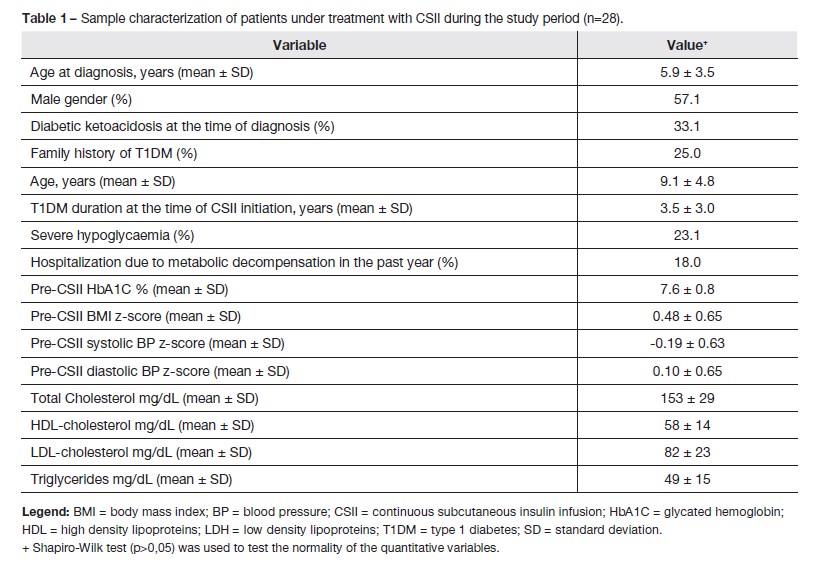
<body><![CDATA[<p><font size="3" face="Verdana"><b>RESULTS</b></font></p> <font face="Verdana" size="2">     <p>During the study period 28 patients were treated   with CSII, which corresponds to 25% of the total sample of T1DM patients   followed in the Clinic by that time (n=112). Clinical characteristics of this   sample are presented in <a href="/img/revistas/nas/v27n3/27n3a02t1.jpg">table 1</a>. Six patients were excluded from the subsequent   analysis: four patients because of insufficient time of follow-up and two   patients for suspending CSII treatment during follow-up. These two patients   were both male adolescents, and acquired CSII device privately instead of the   National Health Service. They discontinued after a three years and a five years   period on CSII for maladaptation to the system (one following an episode of   hyperosmolar hyperglycaemic syndrome due to malfunction of the catheter; the other for reasons of personal incompatibility with physical activity practice).</p>     
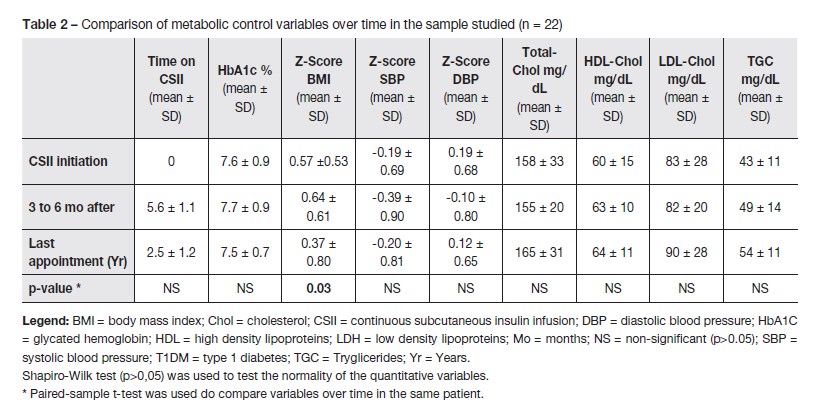
<p>Ultimately, 22 patients were included in the analysis. As seen in <a href="/img/revistas/nas/v27n3/27n3a02t2.jpg">table   2</a>, over time there was an improvement in the patient BMI z-score (p=0.03) with   CSII treatment. No statistically significant differences were observed in terms   of HbA1C, BP and lipid profile. Clinically, there was a reduction in the number   of severe hypoglycaemia episodes from 18.2% at the beginning to 0% in the last   appointment. The rate of hospitalization also decreased (from 13% before CSII   to 0% in the last appointment). In the 3-6 month period post-CSII, there was an   increase in the frequency of hyperglycaemia (22.7% to 59.1%) that reduced between that time point and the last appointment (13.5%).</p>     
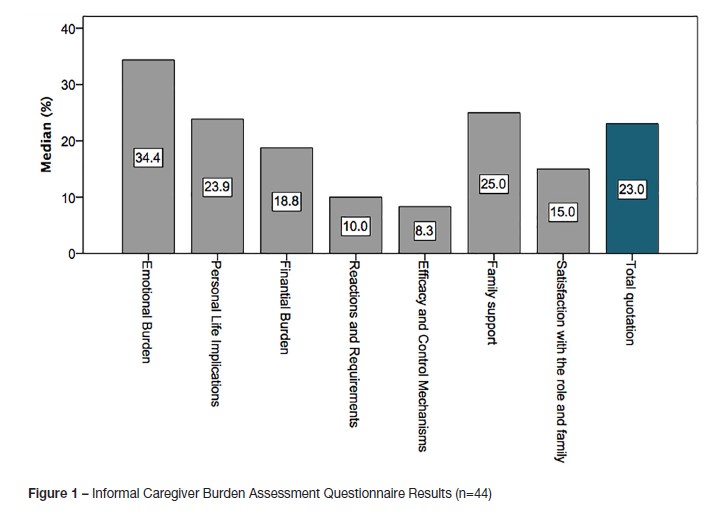
<p>To analyse the physical, emotional and social burden of patient’s   caregiver, 68 Informal Caregiver Burden Assessment Questionnaires were sent   electronically. Forty-four parents (65%) consented to participate and returned   the questionnaire completed: 20 parents of children on CSII (for a mean of 2.2   ± 2.3 years) and 24 parents of children on MDIs. There was a high degree of   internal consistency (&#593; de Cronbach = 0.932). Parents who answered were the main caregivers   (77.3%). The majority of them were females (77.3%) and aged between 27 and 52   years (mean 41.8 ± 4.5). The overall overload perceived was 23.0% (IQR:   9.8-35.7). Emotional overload (Md=34.4%; IQR: 12.5-50.0), family support   (Md=25.0; IQR: 0.0-50.0) and personal life implications (Md=23.9; IQR:   6.8-39.8) were the dimensions that contributed the most to the negative   overload felted (<a href="/img/revistas/nas/v27n3/27n3a02f1.jpg">fig. 1</a>). There were no statistically differences (p&gt;0,05)   between total or partial quotation and age, gender, schooling, role of primary caregiver, as well as the duration of treatment with CSII. </p>     
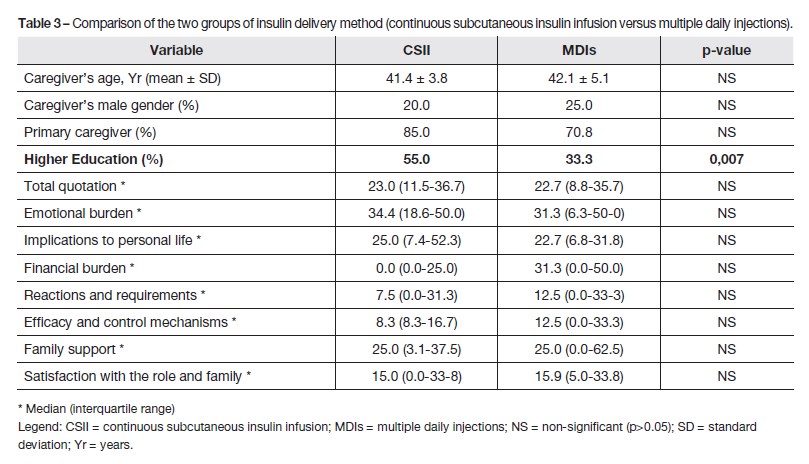
<p>When comparing the two groups (<a href="/img/revistas/nas/v27n3/27n3a02t3.jpg">table 3</a>), parents in the CSII group had a   higher education level (p&lt;0,01). There were no differences in total or partial quotation on the subscales of the questionnaire.</p>     
<p>&nbsp;</p> </font>     <p><font size="3" face="Verdana"><b>DISCUSSION</b></font></p> <font face="Verdana" size="2">     <p>Current literature establishes that CSII attains better glycaemia   control, measured by the significant lower level of HbA1C achieved; it also   enables a reduction of total daily insulin requirements, a lower BMI z-score, a reduction of severe episodes of hypoglycaemia and ketoacidosis (KA).<sup>15-17</sup></p>     <p>Our findings showed a decrease in BMI z-score, and a reduction in the   number severe hypoglycaemia and hospitalizations for metabolic decompensation   (namely KA episodes). There was no significant reduction in HbA1c. However,   this may be the result of a relatively low HbA1c <i>ad initium </i>(7.6 ±   0.9%). HbA1c remained at nearly adequate levels (7.5 ± 0.7%) at 2.5 ± 1.2 years   of follow-up. Fear of hypoglycaemia has been described as an issue that can   lead to hypoglycaemia avoidance behaviours by parents which adversely affect   glycaemic control.<sup> 18</sup> We noted an increase in the frequency of   hyperglycaemia (22.7% to 59.1%) in the three to six month period post-CSII,   that was overcomed, and even reduced, in the last appointment (13.5%), without   jeopardizing HbA1c. This may have resulted from fear of hypoglycaemia, that   improved as parents felt more confident and self-assured on CSII therapy, as   this system leaves no depot in the subcutaneous tissue, and therefore allows a more predictable insulin effect.<sup>10</sup></p>     <p>Overall, in our sample of patients, CSII was generally well accepted -   only two patients discontinuing treatment with CSII and returning to MDIs.   Also, proved to be an adequate therapy, allowing to maintain adequate glycaemic   control (with stable satisfactory values of HbA1C), with reduction on severe hypoglycaemia and rates of hospitalization.</p>     ]]></body>
<body><![CDATA[<p>However, optimal management of the child with   T1DM requires a holistic approach, considering the overall level of function of   the child and family, the nutritional and lifestyle patterns specific to that   child, and attention to the overall development stages of childhood and   adolescence.<sup>2</sup> There is no single insulin regime or meal plan   appropriate to every patient. The diabetes care plan should fit whenever   possible into the surrounding home and school environments.<sup>2</sup> Also,   the primary childhood tasks of education, socialization, growth, and maturity   should continue unhindered by the extra responsibilities diabetes care entails.<sup>2   </sup>As healthcare providers, we must understand the impact of diabetes and   its treatment on the lives of our patients and their families. From the patient   and family perspective, the greatest benefits may lie in outcomes beyond   measures of glycemic control, such as QoL, and this may have a strong influence   on adherence and metabolic control.<sup> 19</sup> Recognizing these vital aspects is necessary if optimal outcomes are to be achieved.</p>     <p>Most of the published studies, however, focused on medical outcomes such   as HbA1c, hypoglycaemia and acute complications. The psychosocial benefits are   not as easily measurable as well defined biomedical parameters and, hence,   conflicting evidence regarding the impact of CSII on QoL exist.<sup>8,9</sup>   Because of differences in the age and maturity of the study subjects as well as   various forms of diabetes QoL questionnaires used, the results are difficult to analyze and compare. </p>     <p>In a study by Cunningham NR <i>et al</i> , higher A1C values   were associated with more caregiver depressive and anxiety symptoms, with   stronger association for depressive symptoms.<sup>11</sup> Depressive symptoms   may lead the caregiver to feel overburdened, and he/she can subsequently   withdraw from diabetes management tasks and supervision; anxious caregivers, on   the other hand, may remain involved, but be over-extended. When caregivers feel   burned by diabetes management, they may be more inclined to transfer   responsibility to the adolescent/child or others (grandparents, school   assistants, etc.), or to be a less efficient partner in management. These   findings, and others, led to consider how perceived burden impacts glycemic   control on T1DM and highlights the importance of addressing this issue as part of the diabetes care plane.<sup>12</sup> </p>     <p>Overall, CSII appears to improve satisfaction with treatment and the   burden perceived.<sup>7,15,20,21</sup> CSII use seems to decrease   hypoglycaemia-related worries, feeding behavior problems and parenting stress,   as well as parents burden.<sup>10,20</sup> By allowing a more flexible   lifestyle, both children and their parents feel more comfortable in going out   (such as dinner, parties) and to participate in activities such as travelling,   camping and playing, offering greater sense of control and independence and, hence, higher levels of satisfaction.<sup>9,21</sup></p>     <p>It can be more challenging and require certain skills to master the   technology, mechanical and operational aspects of the pump, which can increase   (at least initially) the stress and burden perceived by the parents.<sup>9,22</sup>   Despite all these challenges, after an initial learning period, CSII allows   greater flexibility and autonomy in the management of diabetes, sometimes reducing parents’ workload.<sup>9</sup></p>     <p>As an additional purpose to our work, we attempted to assess the   perceived burden of the caregivers of children with T1DM and to correlate it   with the insulin delivery method (CSII vs. MDIs) since we hypothesized that the   CSII would reduce the burden of patient caregiver. We applied a validated   questionnaire for the Portuguese population (Informal Caregiver Burden Assessment Questionnaire), although not specific for T1DM.<sup>14</sup> </p>     <p>In our study, the majority of the caregivers who answered the   questionnaire were female (34/44) and the main caregiver of the child. This   difference is possibly due to reflections of cultural patterns, with the role   of women in the family as main or primary caregiver. Parents in the CSII group   had a higher education level, and this may result from a selection bias. The   overall overload perceived was not high (23.9 ± 15.4%), at least comparing with   previous studies applying the same questionnaire.<sup>23-25</sup> According to   what was expected, emotional overload, family support and personal life   implications were the dimensions most contributing to the negative overload   felt. The total and partial quotations weren’t related to age, gender,   schooling, role of primary caregiver or duration of treatment with CSII. There   were no differences between the treatment groups (CSII vs. MDIs), which   emphasizes that the choice of insulin delivery method should be based not only   on the one that achieves better glycemic control, but also to which the family   and child best adjust - two factors that can themselves reduce the burden of the disease. </p>     <p>Several limitations should be taken in account.   We used a convenience sample: caregivers that had provided the e-mail address,   which may have introduced a selection bias. Data on burden was obtain mainly on   the female gender, which may differ from the male gender in their roles and perceived   burden, namely emotional (although we didn’t find any statistically significant   differences in the total and partial quotations and gender). It will be   important to obtain a larger sample of caregivers and their perspectives on   distress and burden and explicitly through time (in a prospective manner).   Also, it would be interesting to correlate the burden felt to the HbA1c of the   patients, as is to be expected that one would affect the other. Although we   used a validated questionnaire for the Portuguese population to assess   caregiver’s burden, this is not a specific questionnaire for diabetes care, and   can miss some specific concerns in the treatment and management of children   with diabetes, especially in younger ones. Additionally, we have limited studies   to compare the results obtained. A standard QoL questionnaire should be   translated and validated for our population that taking into consideration the   disease impact, treatment satisfaction and the parents’ anxiety level, such as “<i>Problem Areas in Diabetes – Parent Revised Version (PAID-PR)</i>”.<sup>26</sup></p>     <p>In summary, our study showed that CSII is, as described in the   literature, a generally well accepted therapy and allowed to maintain good   glycaemic control (as monitored by HbA1c), with improvement in BMI Z-score and   reduction of the number of severe hypoglycaemia and hospitalization rates.   Addressing caregiver psychological distress and burden, particularly depressive   symptoms and concerns about diabetes care, ideally through specific and   validated diabetes questionnaires, in family-based treatments such as T1DM are of valuable interest and may improve, overtime, health outcomes.</p>     <p>&nbsp;</p> </font>     ]]></body>
<body><![CDATA[<p><font size="3" face="Verdana"><b>REFERENCES</b></font></p> <font face="Verdana" size="2">     <!-- ref --><p>1. Craig ME, Jefferies C, Dabelea D, Balde N,   Seth A, Donaghue KC, <i>et al</i>. ISPAD Clinical Practice Consensus Guidelines   2014. Definition, epidemiology, and classification of diabetes in children and adolescents. Pediatr Diabetes. 2014; 15 Suppl 20:4-17.    &nbsp;&nbsp;&nbsp;&nbsp;&nbsp;&nbsp;&nbsp;&nbsp;[&#160;<a href="javascript:void(0);" onclick="javascript: window.open('/scielo.php?script=sci_nlinks&ref=1111197&pid=S0872-0754201800030000200001&lng=','','width=640,height=500,resizable=yes,scrollbars=1,menubar=yes,');">Links</a>&#160;]<!-- end-ref --></p>     <!-- ref --><p>2. Sperling MT, Tamborlane WV, Battelino T,   Weinzimer SA, Phillip M. Diabetes mellitus. In: Sperling M, editor. Pediatric   Endocrinology. 4<sup>th</sup> Edition ed. Philadelphia, PA Sauders, Elsevier Inc; 2014. p. 849-93.    &nbsp;&nbsp;&nbsp;&nbsp;&nbsp;&nbsp;&nbsp;&nbsp;[&#160;<a href="javascript:void(0);" onclick="javascript: window.open('/scielo.php?script=sci_nlinks&ref=1111199&pid=S0872-0754201800030000200002&lng=','','width=640,height=500,resizable=yes,scrollbars=1,menubar=yes,');">Links</a>&#160;]<!-- end-ref --></p>     <!-- ref --><p>3. Sociedade   Portuguesa de Diabetologia. Diabetes: Factos e Números – O Ano de 2015 &#8722; Relatório Anual do Observatório Nacional da Diabetes. Diabetologia SPd; 2016.    &nbsp;&nbsp;&nbsp;&nbsp;&nbsp;&nbsp;&nbsp;&nbsp;[&#160;<a href="javascript:void(0);" onclick="javascript: window.open('/scielo.php?script=sci_nlinks&ref=1111201&pid=S0872-0754201800030000200003&lng=','','width=640,height=500,resizable=yes,scrollbars=1,menubar=yes,');">Links</a>&#160;]<!-- end-ref --></p>     <!-- ref --><p>4. Danne T,   Bangstad HJ, Deeb L, Jarosz-Chobot P, Mungaie L, Saboo B,<i> et al</i>. ISPAD Clinical Practice Consensus Guidelines 2014. Insulin treatment in   children and adolescents with diabetes. Pediatr Diabetes. 2014; 15 Suppl 20:115-34.    &nbsp;&nbsp;&nbsp;&nbsp;&nbsp;&nbsp;&nbsp;&nbsp;[&#160;<a href="javascript:void(0);" onclick="javascript: window.open('/scielo.php?script=sci_nlinks&ref=1111203&pid=S0872-0754201800030000200004&lng=','','width=640,height=500,resizable=yes,scrollbars=1,menubar=yes,');">Links</a>&#160;]<!-- end-ref --></p>     <!-- ref --><p>5. Phillip M, Battelino T, Rodriguez H, Danne   T, Kaufman F, European Society for Paediatric E, <i>et al</i>. Use of insulin   pump therapy in the pediatric age-group: consensus statement from the European   Society for Paediatric Endocrinology, the Lawson Wilkins Pediatric Endocrine   Society, and the International Society for Pediatric and Adolescent Diabetes,   endorsed by the American Diabetes Association and the European Association for   the Study of Diabetes. Diabetes Care. 2007; 30:1653-62.    &nbsp;&nbsp;&nbsp;&nbsp;&nbsp;&nbsp;&nbsp;&nbsp;[&#160;<a href="javascript:void(0);" onclick="javascript: window.open('/scielo.php?script=sci_nlinks&ref=1111205&pid=S0872-0754201800030000200005&lng=','','width=640,height=500,resizable=yes,scrollbars=1,menubar=yes,');">Links</a>&#160;]<!-- end-ref --></p>     <!-- ref --><p>6. Saúde   GdSdEAed. Despacho nº 13277/2016. Diário da República: Diário da República; 2016.    &nbsp;&nbsp;&nbsp;&nbsp;&nbsp;&nbsp;&nbsp;&nbsp;[&#160;<a href="javascript:void(0);" onclick="javascript: window.open('/scielo.php?script=sci_nlinks&ref=1111207&pid=S0872-0754201800030000200006&lng=','','width=640,height=500,resizable=yes,scrollbars=1,menubar=yes,');">Links</a>&#160;]<!-- end-ref --></p>     <!-- ref --><p>7. Misso ML, Egberts KJ, Page M, O’Connor D,   Shaw J. Continuous subcutaneous insulin infusion (CSII) versus multiple insulin   injections for type 1 diabetes mellitus. Cochrane Database Syst Rev. 2010:CD005103.    &nbsp;&nbsp;&nbsp;&nbsp;&nbsp;&nbsp;&nbsp;&nbsp;[&#160;<a href="javascript:void(0);" onclick="javascript: window.open('/scielo.php?script=sci_nlinks&ref=1111209&pid=S0872-0754201800030000200007&lng=','','width=640,height=500,resizable=yes,scrollbars=1,menubar=yes,');">Links</a>&#160;]<!-- end-ref --></p>     <!-- ref --><p>8. Barnard KD, Lloyd CE, Skinner TC.   Systematic literature review: quality of life associated with insulin pump use in Type 1 diabetes. Diabet Med. 2007; 24:607-17.    &nbsp;&nbsp;&nbsp;&nbsp;&nbsp;&nbsp;&nbsp;&nbsp;[&#160;<a href="javascript:void(0);" onclick="javascript: window.open('/scielo.php?script=sci_nlinks&ref=1111211&pid=S0872-0754201800030000200008&lng=','','width=640,height=500,resizable=yes,scrollbars=1,menubar=yes,');">Links</a>&#160;]<!-- end-ref --></p>     <!-- ref --><p>9. Alsaleh FM, Smith FJ, Thompson R, Al-Saleh   MA, Taylor KM. Insulin pump therapy: impact on the lives of children/young   people with diabetes mellitus and their parents. Int J Clin Pharm. 2014; 36:1023-30.    &nbsp;&nbsp;&nbsp;&nbsp;&nbsp;&nbsp;&nbsp;&nbsp;[&#160;<a href="javascript:void(0);" onclick="javascript: window.open('/scielo.php?script=sci_nlinks&ref=1111213&pid=S0872-0754201800030000200009&lng=','','width=640,height=500,resizable=yes,scrollbars=1,menubar=yes,');">Links</a>&#160;]<!-- end-ref --></p>     <!-- ref --><p>10. Muller-Godeffroy E, Treichel S, Wagner VM,   German Working Group for Paediatric Pump T. Investigation of quality of life   and family burden issues during insulin pump therapy in children with Type 1   diabetes mellitus--a large-scale multicentre pilot study. Diabet Med. 2009; 26:493-501.    &nbsp;&nbsp;&nbsp;&nbsp;&nbsp;&nbsp;&nbsp;&nbsp;[&#160;<a href="javascript:void(0);" onclick="javascript: window.open('/scielo.php?script=sci_nlinks&ref=1111215&pid=S0872-0754201800030000200010&lng=','','width=640,height=500,resizable=yes,scrollbars=1,menubar=yes,');">Links</a>&#160;]<!-- end-ref --></p>     <!-- ref --><p>11. Cunningham NR, Vesco AT, Dolan LM, Hood   KK. From caregiver psychological distress to adolescent glycemic control: the   mediating role of perceived burden around diabetes management. J Pediatr Psychol. 2011; 36:196-205.    &nbsp;&nbsp;&nbsp;&nbsp;&nbsp;&nbsp;&nbsp;&nbsp;[&#160;<a href="javascript:void(0);" onclick="javascript: window.open('/scielo.php?script=sci_nlinks&ref=1111217&pid=S0872-0754201800030000200011&lng=','','width=640,height=500,resizable=yes,scrollbars=1,menubar=yes,');">Links</a>&#160;]<!-- end-ref --></p>     <!-- ref --><p>12. Butler DA, Zuehlke JB, Tovar A, Volkening   LK, Anderson BJ, Laffel LM. The impact of modifiable family factors on glycemic control among youth with type 1 diabetes. Pediatr Diabetes. 2008; 9:373-81.    &nbsp;&nbsp;&nbsp;&nbsp;&nbsp;&nbsp;&nbsp;&nbsp;[&#160;<a href="javascript:void(0);" onclick="javascript: window.open('/scielo.php?script=sci_nlinks&ref=1111219&pid=S0872-0754201800030000200012&lng=','','width=640,height=500,resizable=yes,scrollbars=1,menubar=yes,');">Links</a>&#160;]<!-- end-ref --></p>     <!-- ref --><p>13. Ly TT, Maahs DM, Rewers A, Dunger D,   Oduwole A, Jones TW, <i>et al</i>. ISPAD Clinical Practice Consensus Guidelines   2014. Assessment and management of hypoglycemia in children and adolescents   with diabetes. Pediatr Diabetes. 2014;15 Suppl 20:180-92.    &nbsp;&nbsp;&nbsp;&nbsp;&nbsp;&nbsp;&nbsp;&nbsp;[&#160;<a href="javascript:void(0);" onclick="javascript: window.open('/scielo.php?script=sci_nlinks&ref=1111221&pid=S0872-0754201800030000200013&lng=','','width=640,height=500,resizable=yes,scrollbars=1,menubar=yes,');">Links</a>&#160;]<!-- end-ref --></p>     <!-- ref --><p>14. Martins TR,   JP; Garrett, C. Estudo de Validação do Questionário de Avaliação da Sobrecarga   para Cuidadores Informais. Psicologia, Saúde &amp; Doenças. 2003; 4:131-48.    &nbsp;&nbsp;&nbsp;&nbsp;&nbsp;&nbsp;&nbsp;&nbsp;[&#160;<a href="javascript:void(0);" onclick="javascript: window.open('/scielo.php?script=sci_nlinks&ref=1111223&pid=S0872-0754201800030000200014&lng=','','width=640,height=500,resizable=yes,scrollbars=1,menubar=yes,');">Links</a>&#160;]<!-- end-ref --></p>     <!-- ref --><p>15. Pankowska E, Blazik M, Dziechciarz P,   Szypowska A, Szajewska H. Continuous subcutaneous insulin infusion vs. multiple   daily injections in children with type 1 diabetes: a systematic review and meta-analysis of randomized control trials. Pediatr Diabetes. 2009; 10:52-8.    &nbsp;&nbsp;&nbsp;&nbsp;&nbsp;&nbsp;&nbsp;&nbsp;[&#160;<a href="javascript:void(0);" onclick="javascript: window.open('/scielo.php?script=sci_nlinks&ref=1111225&pid=S0872-0754201800030000200015&lng=','','width=640,height=500,resizable=yes,scrollbars=1,menubar=yes,');">Links</a>&#160;]<!-- end-ref --></p>     <!-- ref --><p>16. Sherr JL, Hermann JM, Campbell F, Foster   NC, Hofer SE, Allgrove J, <i>et al</i>. Use of insulin pump therapy in children   and adolescents with type 1 diabetes and its impact on metabolic control:   comparison of results from three large, transatlantic paediatric registries. Diabetologia. 2016; 59:87-91.    &nbsp;&nbsp;&nbsp;&nbsp;&nbsp;&nbsp;&nbsp;&nbsp;[&#160;<a href="javascript:void(0);" onclick="javascript: window.open('/scielo.php?script=sci_nlinks&ref=1111227&pid=S0872-0754201800030000200016&lng=','','width=640,height=500,resizable=yes,scrollbars=1,menubar=yes,');">Links</a>&#160;]<!-- end-ref --></p>     <!-- ref --><p>17. Szypowska A, Schwandt A, Svensson J,   Shalitin S, Cardona-Hernandez R, Forsander G, <i>et al.</i> Insulin pump   therapy in children with type 1 diabetes: analysis of data from the SWEET registry. Pediatr Diabetes. 2016;17 Suppl 23:38-45.    &nbsp;&nbsp;&nbsp;&nbsp;&nbsp;&nbsp;&nbsp;&nbsp;[&#160;<a href="javascript:void(0);" onclick="javascript: window.open('/scielo.php?script=sci_nlinks&ref=1111229&pid=S0872-0754201800030000200017&lng=','','width=640,height=500,resizable=yes,scrollbars=1,menubar=yes,');">Links</a>&#160;]<!-- end-ref --></p>     <!-- ref --><p>18. Barnard K, Thomas S, Royle P, Noyes K,   Waugh N. Fear of hypoglycaemia in parents of young children with type 1 diabetes: a systematic review. BMC Pediatr. 2010; 10:50.    &nbsp;&nbsp;&nbsp;&nbsp;&nbsp;&nbsp;&nbsp;&nbsp;[&#160;<a href="javascript:void(0);" onclick="javascript: window.open('/scielo.php?script=sci_nlinks&ref=1111231&pid=S0872-0754201800030000200018&lng=','','width=640,height=500,resizable=yes,scrollbars=1,menubar=yes,');">Links</a>&#160;]<!-- end-ref --></p>     <!-- ref --><p>19. Faulkner MS, Clark FS. Quality of life for   parents of children and adolescents with type 1 diabetes. Diabetes Educ. 1998; 24:721-7.    &nbsp;&nbsp;&nbsp;&nbsp;&nbsp;&nbsp;&nbsp;&nbsp;[&#160;<a href="javascript:void(0);" onclick="javascript: window.open('/scielo.php?script=sci_nlinks&ref=1111233&pid=S0872-0754201800030000200019&lng=','','width=640,height=500,resizable=yes,scrollbars=1,menubar=yes,');">Links</a>&#160;]<!-- end-ref --></p>     <!-- ref --><p>20. Lukacs A, Kiss-Toth E, Varga B, Soos A,   Takac P, Barkai L. Benefits of continuous subcutaneous insulin infusion on quality of life. Int J Technol Assess Health Care. 2013; 29:48-52.    &nbsp;&nbsp;&nbsp;&nbsp;&nbsp;&nbsp;&nbsp;&nbsp;[&#160;<a href="javascript:void(0);" onclick="javascript: window.open('/scielo.php?script=sci_nlinks&ref=1111235&pid=S0872-0754201800030000200020&lng=','','width=640,height=500,resizable=yes,scrollbars=1,menubar=yes,');">Links</a>&#160;]<!-- end-ref --></p>     <!-- ref --><p>21. Cherubini V, Gesuita R, Bonfanti R,   Franzese A, Frongia AP, Iafusco D, <i>et al</i>. Health-related quality of life and treatment preferences in adolescents with type 1 diabetes. The VIPKIDS study. Acta Diabetol. 2014; 51:43-51.    &nbsp;&nbsp;&nbsp;&nbsp;&nbsp;&nbsp;&nbsp;&nbsp;[&#160;<a href="javascript:void(0);" onclick="javascript: window.open('/scielo.php?script=sci_nlinks&ref=1111237&pid=S0872-0754201800030000200021&lng=','','width=640,height=500,resizable=yes,scrollbars=1,menubar=yes,');">Links</a>&#160;]<!-- end-ref --></p>     <!-- ref --><p>22. Awadalla AW, Ohaeri JU, Al-Awadi SA,   Tawfiq AM. Diabetes mellitus patients’ family caregivers’ subjective quality of   life. J Natl Med Assoc. 2006; 98:727-36.    &nbsp;&nbsp;&nbsp;&nbsp;&nbsp;&nbsp;&nbsp;&nbsp;[&#160;<a href="javascript:void(0);" onclick="javascript: window.open('/scielo.php?script=sci_nlinks&ref=1111239&pid=S0872-0754201800030000200022&lng=','','width=640,height=500,resizable=yes,scrollbars=1,menubar=yes,');">Links</a>&#160;]<!-- end-ref --></p>     <!-- ref --><p>23. Castelhano P.   A sobrecarga dos pais enquanto cuidadores principais da criança com Espinha Bífida: Escola Superior de Enfermagem de Coimbra; 2012.    &nbsp;&nbsp;&nbsp;&nbsp;&nbsp;&nbsp;&nbsp;&nbsp;[&#160;<a href="javascript:void(0);" onclick="javascript: window.open('/scielo.php?script=sci_nlinks&ref=1111241&pid=S0872-0754201800030000200023&lng=','','width=640,height=500,resizable=yes,scrollbars=1,menubar=yes,');">Links</a>&#160;]<!-- end-ref --></p>     <!-- ref --><p>24. Rodrigues D. Sobrecarga e Estratégias de Coping em Cuidadores Informais   de Idosos dependentes. Instituto Politécnico de Viseu, Escola Superior de Saúde de Viseu. 2012.    &nbsp;&nbsp;&nbsp;&nbsp;&nbsp;&nbsp;&nbsp;&nbsp;[&#160;<a href="javascript:void(0);" onclick="javascript: window.open('/scielo.php?script=sci_nlinks&ref=1111243&pid=S0872-0754201800030000200024&lng=','','width=640,height=500,resizable=yes,scrollbars=1,menubar=yes,');">Links</a>&#160;]<!-- end-ref --></p>     <!-- ref --><p>25. de Souza LR,   Hanus JS, Libera LBD, Silva VM, Mangilli EM, Simões PW, <i>et al</i>. Overload in care, stress and impact on the quality of life of surveyed caregivers assisted in primary care. Cad Saúde Colet. 2015; 23:140-9.    &nbsp;&nbsp;&nbsp;&nbsp;&nbsp;&nbsp;&nbsp;&nbsp;[&#160;<a href="javascript:void(0);" onclick="javascript: window.open('/scielo.php?script=sci_nlinks&ref=1111245&pid=S0872-0754201800030000200025&lng=','','width=640,height=500,resizable=yes,scrollbars=1,menubar=yes,');">Links</a>&#160;]<!-- end-ref --></p>     <!-- ref --><p>26. Markowitz JT, Volkening LK, Butler DA,   Antisdel-Lomaglio J, Anderson BJ, Laffel LM. Re-examining a measure of   diabetes-related burden in parents of young people with Type 1 diabetes: the   Problem Areas in Diabetes Survey - Parent Revised version (PAID-PR). Diabet Med. 2012; 29:526-30.    &nbsp;&nbsp;&nbsp;&nbsp;&nbsp;&nbsp;&nbsp;&nbsp;[&#160;<a href="javascript:void(0);" onclick="javascript: window.open('/scielo.php?script=sci_nlinks&ref=1111247&pid=S0872-0754201800030000200026&lng=','','width=640,height=500,resizable=yes,scrollbars=1,menubar=yes,');">Links</a>&#160;]<!-- end-ref --></p>     <p>&nbsp;</p>     <p>&nbsp;</p>     <p> <b><a name="end" id="topo2"></a><a href="#topo">CORRESPONDENCE TO</a></b> </p>     <p>Maria Adriana Rangel    <br> Department of Pediatrics    <br> Centro Hospitalar Vila Nova de Gaia/Espinho    <br> Rua Francisco Sá Carneiro,    ]]></body>
<body><![CDATA[<br> 4400-129 Vila Nova de Gaia    <br> Email:  <a href="mailto:mariaadrianarangel@hotmail.com">mariaadrianarangel@hotmail.com</a></p>     <p>Received for publication: 07.10.2017    <br> Accepted in revised form: 08.01.2018</p> </font>      ]]></body><back>
<ref-list>
<ref id="B1">
<label>1</label><nlm-citation citation-type="journal">
<person-group person-group-type="author">
<name>
<surname><![CDATA[Craig]]></surname>
<given-names><![CDATA[ME]]></given-names>
</name>
<name>
<surname><![CDATA[Jefferies]]></surname>
<given-names><![CDATA[C]]></given-names>
</name>
<name>
<surname><![CDATA[Dabelea]]></surname>
<given-names><![CDATA[D]]></given-names>
</name>
<name>
<surname><![CDATA[Balde]]></surname>
<given-names><![CDATA[N]]></given-names>
</name>
<name>
<surname><![CDATA[Seth]]></surname>
<given-names><![CDATA[A]]></given-names>
</name>
<name>
<surname><![CDATA[Donaghue]]></surname>
<given-names><![CDATA[KC]]></given-names>
</name>
</person-group>
<article-title xml:lang="en"><![CDATA[ISPAD Clinical Practice Consensus Guidelines 2014: Definition, epidemiology, and classification of diabetes in children and adolescents]]></article-title>
<source><![CDATA[Pediatr Diabetes]]></source>
<year>2014</year>
<volume>15</volume>
<numero>^s20</numero>
<issue>^s20</issue>
<supplement>20</supplement>
<page-range>4-17</page-range></nlm-citation>
</ref>
<ref id="B2">
<label>2</label><nlm-citation citation-type="book">
<person-group person-group-type="author">
<name>
<surname><![CDATA[Sperling]]></surname>
<given-names><![CDATA[MT]]></given-names>
</name>
<name>
<surname><![CDATA[Tamborlane]]></surname>
<given-names><![CDATA[WV]]></given-names>
</name>
<name>
<surname><![CDATA[Battelino]]></surname>
<given-names><![CDATA[T]]></given-names>
</name>
<name>
<surname><![CDATA[Weinzimer]]></surname>
<given-names><![CDATA[SA]]></given-names>
</name>
<name>
<surname><![CDATA[Phillip]]></surname>
<given-names><![CDATA[M]]></given-names>
</name>
</person-group>
<article-title xml:lang="en"><![CDATA[Diabetes mellitus]]></article-title>
<person-group person-group-type="editor">
<name>
<surname><![CDATA[Sperling]]></surname>
<given-names><![CDATA[M]]></given-names>
</name>
</person-group>
<source><![CDATA[Pediatric Endocrinology]]></source>
<year>2014</year>
<edition>4</edition>
<page-range>849-93</page-range><publisher-loc><![CDATA[Philadelphia ]]></publisher-loc>
<publisher-name><![CDATA[PA Sauders, Elsevier Inc]]></publisher-name>
</nlm-citation>
</ref>
<ref id="B3">
<label>3</label><nlm-citation citation-type="book">
<collab>Sociedade Portuguesa de Diabetologia</collab>
<source><![CDATA[Diabetes: Factos e Números - O Ano de 2015 &#8722; Relatório Anual do Observatório Nacional da Diabetes]]></source>
<year>2016</year>
<publisher-name><![CDATA[Diabetologia SPd]]></publisher-name>
</nlm-citation>
</ref>
<ref id="B4">
<label>4</label><nlm-citation citation-type="journal">
<person-group person-group-type="author">
<name>
<surname><![CDATA[Danne]]></surname>
<given-names><![CDATA[T]]></given-names>
</name>
<name>
<surname><![CDATA[Bangstad]]></surname>
<given-names><![CDATA[HJ]]></given-names>
</name>
<name>
<surname><![CDATA[Deeb]]></surname>
<given-names><![CDATA[L]]></given-names>
</name>
<name>
<surname><![CDATA[Jarosz-Chobot]]></surname>
<given-names><![CDATA[P]]></given-names>
</name>
<name>
<surname><![CDATA[Mungaie]]></surname>
<given-names><![CDATA[L]]></given-names>
</name>
<name>
<surname><![CDATA[Saboo]]></surname>
<given-names><![CDATA[B]]></given-names>
</name>
</person-group>
<article-title xml:lang="en"><![CDATA[ISPAD Clinical Practice Consensus Guidelines 2014: Insulin treatment in children and adolescents with diabetes]]></article-title>
<source><![CDATA[Pediatr Diabetes]]></source>
<year>2014</year>
<volume>15</volume>
<numero>^s20</numero>
<issue>^s20</issue>
<supplement>20</supplement>
<page-range>115-34</page-range></nlm-citation>
</ref>
<ref id="B5">
<label>5</label><nlm-citation citation-type="journal">
<person-group person-group-type="author">
<name>
<surname><![CDATA[Phillip]]></surname>
<given-names><![CDATA[M]]></given-names>
</name>
<name>
<surname><![CDATA[Battelino]]></surname>
<given-names><![CDATA[T]]></given-names>
</name>
<name>
<surname><![CDATA[Rodriguez]]></surname>
<given-names><![CDATA[H]]></given-names>
</name>
<name>
<surname><![CDATA[Danne]]></surname>
<given-names><![CDATA[T]]></given-names>
</name>
<name>
<surname><![CDATA[Kaufman]]></surname>
<given-names><![CDATA[F]]></given-names>
</name>
</person-group>
<collab>European Society for Paediatric E</collab>
<article-title xml:lang="en"><![CDATA[Use of insulin pump therapy in the pediatric age-group: consensus statement from the European Society for Paediatric Endocrinology, the Lawson Wilkins Pediatric Endocrine Society, and the International Society for Pediatric and Adolescent Diabetes, endorsed by the American Diabetes Association and the European Association for the Study of Diabetes]]></article-title>
<source><![CDATA[Diabetes Care]]></source>
<year>2007</year>
<volume>30</volume>
<page-range>1653-62</page-range></nlm-citation>
</ref>
<ref id="B6">
<label>6</label><nlm-citation citation-type="journal">
<collab>Saúde GdSdEAed</collab>
<article-title xml:lang="pt"><![CDATA[Despacho nº 13277/2016]]></article-title>
<source><![CDATA[Diário da República]]></source>
<year>2016</year>
<publisher-name><![CDATA[Diário da República]]></publisher-name>
</nlm-citation>
</ref>
<ref id="B7">
<label>7</label><nlm-citation citation-type="journal">
<person-group person-group-type="author">
<name>
<surname><![CDATA[Misso]]></surname>
<given-names><![CDATA[ML]]></given-names>
</name>
<name>
<surname><![CDATA[Egberts]]></surname>
<given-names><![CDATA[KJ]]></given-names>
</name>
<name>
<surname><![CDATA[Page]]></surname>
<given-names><![CDATA[M]]></given-names>
</name>
<name>
<surname><![CDATA[O’Connor]]></surname>
<given-names><![CDATA[D]]></given-names>
</name>
<name>
<surname><![CDATA[Shaw]]></surname>
<given-names><![CDATA[J]]></given-names>
</name>
</person-group>
<article-title xml:lang="en"><![CDATA[Continuous subcutaneous insulin infusion (CSII) versus multiple insulin injections for type 1 diabetes mellitus]]></article-title>
<source><![CDATA[Cochrane Database Syst Rev]]></source>
<year>2010</year>
<page-range>CD005103</page-range></nlm-citation>
</ref>
<ref id="B8">
<label>8</label><nlm-citation citation-type="journal">
<person-group person-group-type="author">
<name>
<surname><![CDATA[Barnard]]></surname>
<given-names><![CDATA[KD]]></given-names>
</name>
<name>
<surname><![CDATA[Lloyd]]></surname>
<given-names><![CDATA[CE]]></given-names>
</name>
<name>
<surname><![CDATA[Skinner]]></surname>
<given-names><![CDATA[TC]]></given-names>
</name>
</person-group>
<article-title xml:lang="en"><![CDATA[Systematic literature review: quality of life associated with insulin pump use in Type 1 diabetes]]></article-title>
<source><![CDATA[Diabet Med]]></source>
<year>2007</year>
<volume>24</volume>
<page-range>607-17</page-range></nlm-citation>
</ref>
<ref id="B9">
<label>9</label><nlm-citation citation-type="journal">
<person-group person-group-type="author">
<name>
<surname><![CDATA[Alsaleh]]></surname>
<given-names><![CDATA[FM]]></given-names>
</name>
<name>
<surname><![CDATA[Smith]]></surname>
<given-names><![CDATA[FJ]]></given-names>
</name>
<name>
<surname><![CDATA[Thompson]]></surname>
<given-names><![CDATA[R]]></given-names>
</name>
<name>
<surname><![CDATA[Al-Saleh]]></surname>
<given-names><![CDATA[MA]]></given-names>
</name>
<name>
<surname><![CDATA[Taylor]]></surname>
<given-names><![CDATA[KM]]></given-names>
</name>
</person-group>
<article-title xml:lang="en"><![CDATA[Insulin pump therapy: impact on the lives of children/young people with diabetes mellitus and their parents]]></article-title>
<source><![CDATA[Int J Clin Pharm]]></source>
<year>2014</year>
<volume>36</volume>
<page-range>1023-30</page-range></nlm-citation>
</ref>
<ref id="B10">
<label>10</label><nlm-citation citation-type="journal">
<person-group person-group-type="author">
<name>
<surname><![CDATA[Muller-Godeffroy]]></surname>
<given-names><![CDATA[E]]></given-names>
</name>
<name>
<surname><![CDATA[Treichel]]></surname>
<given-names><![CDATA[S]]></given-names>
</name>
<name>
<surname><![CDATA[Wagner]]></surname>
<given-names><![CDATA[VM]]></given-names>
</name>
</person-group>
<collab>German Working Group for Paediatric Pump T</collab>
<article-title xml:lang="en"><![CDATA[Investigation of quality of life and family burden issues during insulin pump therapy in children with Type 1 diabetes mellitus: a large-scale multicentre pilot study]]></article-title>
<source><![CDATA[Diabet Med]]></source>
<year>2009</year>
<volume>26</volume>
<page-range>493-501</page-range></nlm-citation>
</ref>
<ref id="B11">
<label>11</label><nlm-citation citation-type="journal">
<person-group person-group-type="author">
<name>
<surname><![CDATA[Cunningham]]></surname>
<given-names><![CDATA[NR]]></given-names>
</name>
<name>
<surname><![CDATA[Vesco]]></surname>
<given-names><![CDATA[AT]]></given-names>
</name>
<name>
<surname><![CDATA[Dolan]]></surname>
<given-names><![CDATA[LM]]></given-names>
</name>
<name>
<surname><![CDATA[Hood]]></surname>
<given-names><![CDATA[KK]]></given-names>
</name>
</person-group>
<article-title xml:lang="en"><![CDATA[From caregiver psychological distress to adolescent glycemic control: the mediating role of perceived burden around diabetes management]]></article-title>
<source><![CDATA[J Pediatr Psychol]]></source>
<year>2011</year>
<volume>36</volume>
<page-range>196-205</page-range></nlm-citation>
</ref>
<ref id="B12">
<label>12</label><nlm-citation citation-type="journal">
<person-group person-group-type="author">
<name>
<surname><![CDATA[Butler]]></surname>
<given-names><![CDATA[DA]]></given-names>
</name>
<name>
<surname><![CDATA[Zuehlke]]></surname>
<given-names><![CDATA[JB]]></given-names>
</name>
<name>
<surname><![CDATA[Tovar]]></surname>
<given-names><![CDATA[A]]></given-names>
</name>
<name>
<surname><![CDATA[Volkening]]></surname>
<given-names><![CDATA[LK]]></given-names>
</name>
<name>
<surname><![CDATA[Anderson]]></surname>
<given-names><![CDATA[BJ]]></given-names>
</name>
<name>
<surname><![CDATA[Laffel]]></surname>
<given-names><![CDATA[LM]]></given-names>
</name>
</person-group>
<article-title xml:lang="en"><![CDATA[The impact of modifiable family factors on glycemic control among youth with type 1 diabetes]]></article-title>
<source><![CDATA[Pediatr Diabetes]]></source>
<year>2008</year>
<volume>9</volume>
<page-range>373-81</page-range></nlm-citation>
</ref>
<ref id="B13">
<label>13</label><nlm-citation citation-type="journal">
<person-group person-group-type="author">
<name>
<surname><![CDATA[Ly]]></surname>
<given-names><![CDATA[TT]]></given-names>
</name>
<name>
<surname><![CDATA[Maahs]]></surname>
<given-names><![CDATA[DM]]></given-names>
</name>
<name>
<surname><![CDATA[Rewers]]></surname>
<given-names><![CDATA[A]]></given-names>
</name>
<name>
<surname><![CDATA[Dunger]]></surname>
<given-names><![CDATA[D]]></given-names>
</name>
<name>
<surname><![CDATA[Oduwole]]></surname>
<given-names><![CDATA[A]]></given-names>
</name>
<name>
<surname><![CDATA[Jones]]></surname>
<given-names><![CDATA[TW]]></given-names>
</name>
</person-group>
<article-title xml:lang="en"><![CDATA[ISPAD Clinical Practice Consensus Guidelines 2014: Assessment and management of hypoglycemia in children and adolescents with diabetes]]></article-title>
<source><![CDATA[Pediatr Diabetes]]></source>
<year>2014</year>
<volume>15</volume>
<numero>^s20</numero>
<issue>^s20</issue>
<supplement>20</supplement>
<page-range>180-92</page-range></nlm-citation>
</ref>
<ref id="B14">
<label>14</label><nlm-citation citation-type="journal">
<person-group person-group-type="author">
<name>
<surname><![CDATA[Martins]]></surname>
<given-names><![CDATA[TR, JP]]></given-names>
</name>
<name>
<surname><![CDATA[Garrett]]></surname>
<given-names><![CDATA[C]]></given-names>
</name>
</person-group>
<article-title xml:lang="pt"><![CDATA[Estudo de Validação do Questionário de Avaliação da Sobrecarga para Cuidadores Informais]]></article-title>
<source><![CDATA[Psicologia, Saúde & Doenças]]></source>
<year>2003</year>
<volume>4</volume>
<page-range>131-48</page-range></nlm-citation>
</ref>
<ref id="B15">
<label>15</label><nlm-citation citation-type="journal">
<person-group person-group-type="author">
<name>
<surname><![CDATA[Pankowska]]></surname>
<given-names><![CDATA[E]]></given-names>
</name>
<name>
<surname><![CDATA[Blazik]]></surname>
<given-names><![CDATA[M]]></given-names>
</name>
<name>
<surname><![CDATA[Dziechciarz]]></surname>
<given-names><![CDATA[P]]></given-names>
</name>
<name>
<surname><![CDATA[Szypowska]]></surname>
<given-names><![CDATA[A]]></given-names>
</name>
<name>
<surname><![CDATA[Szajewska]]></surname>
<given-names><![CDATA[H]]></given-names>
</name>
</person-group>
<article-title xml:lang="en"><![CDATA[Continuous subcutaneous insulin infusion vs. multiple daily injections in children with type 1 diabetes: a systematic review and meta-analysis of randomized control trials]]></article-title>
<source><![CDATA[Pediatr Diabetes]]></source>
<year>2009</year>
<volume>10</volume>
<page-range>52-8</page-range></nlm-citation>
</ref>
<ref id="B16">
<label>16</label><nlm-citation citation-type="journal">
<person-group person-group-type="author">
<name>
<surname><![CDATA[Sherr]]></surname>
<given-names><![CDATA[JL]]></given-names>
</name>
<name>
<surname><![CDATA[Hermann]]></surname>
<given-names><![CDATA[JM]]></given-names>
</name>
<name>
<surname><![CDATA[Campbell]]></surname>
<given-names><![CDATA[F]]></given-names>
</name>
<name>
<surname><![CDATA[Foster]]></surname>
<given-names><![CDATA[NC]]></given-names>
</name>
<name>
<surname><![CDATA[Hofer]]></surname>
<given-names><![CDATA[SE]]></given-names>
</name>
<name>
<surname><![CDATA[Allgrove]]></surname>
<given-names><![CDATA[J]]></given-names>
</name>
</person-group>
<article-title xml:lang="en"><![CDATA[Use of insulin pump therapy in children and adolescents with type 1 diabetes and its impact on metabolic control: comparison of results from three large, transatlantic paediatric registries]]></article-title>
<source><![CDATA[Diabetologia]]></source>
<year>2016</year>
<volume>59</volume>
<page-range>87-91</page-range></nlm-citation>
</ref>
<ref id="B17">
<label>17</label><nlm-citation citation-type="journal">
<person-group person-group-type="author">
<name>
<surname><![CDATA[Szypowska]]></surname>
<given-names><![CDATA[A]]></given-names>
</name>
<name>
<surname><![CDATA[Schwandt]]></surname>
<given-names><![CDATA[A]]></given-names>
</name>
<name>
<surname><![CDATA[Svensson]]></surname>
<given-names><![CDATA[J]]></given-names>
</name>
<name>
<surname><![CDATA[Shalitin]]></surname>
<given-names><![CDATA[S]]></given-names>
</name>
<name>
<surname><![CDATA[Cardona-Hernandez]]></surname>
<given-names><![CDATA[R]]></given-names>
</name>
<name>
<surname><![CDATA[Forsander]]></surname>
<given-names><![CDATA[G]]></given-names>
</name>
</person-group>
<article-title xml:lang="en"><![CDATA[Insulin pump therapy in children with type 1 diabetes: analysis of data from the SWEET registry]]></article-title>
<source><![CDATA[Pediatr Diabetes]]></source>
<year>2016</year>
<volume>17</volume>
<numero>^s23</numero>
<issue>^s23</issue>
<supplement>23</supplement>
<page-range>38-45</page-range></nlm-citation>
</ref>
<ref id="B18">
<label>18</label><nlm-citation citation-type="journal">
<person-group person-group-type="author">
<name>
<surname><![CDATA[Barnard]]></surname>
<given-names><![CDATA[K]]></given-names>
</name>
<name>
<surname><![CDATA[Thomas]]></surname>
<given-names><![CDATA[S]]></given-names>
</name>
<name>
<surname><![CDATA[Royle]]></surname>
<given-names><![CDATA[P]]></given-names>
</name>
<name>
<surname><![CDATA[Noyes]]></surname>
<given-names><![CDATA[K]]></given-names>
</name>
<name>
<surname><![CDATA[Waugh]]></surname>
<given-names><![CDATA[N]]></given-names>
</name>
</person-group>
<article-title xml:lang="en"><![CDATA[Fear of hypoglycaemia in parents of young children with type 1 diabetes: a systematic review]]></article-title>
<source><![CDATA[BMC Pediatr]]></source>
<year>2010</year>
<volume>10</volume>
<page-range>50</page-range></nlm-citation>
</ref>
<ref id="B19">
<label>19</label><nlm-citation citation-type="journal">
<person-group person-group-type="author">
<name>
<surname><![CDATA[Faulkner]]></surname>
<given-names><![CDATA[MS]]></given-names>
</name>
<name>
<surname><![CDATA[Clark]]></surname>
<given-names><![CDATA[FS]]></given-names>
</name>
</person-group>
<article-title xml:lang="en"><![CDATA[Quality of life for parents of children and adolescents with type 1 diabetes]]></article-title>
<source><![CDATA[Diabetes Educ]]></source>
<year>1998</year>
<volume>24</volume>
<page-range>721-7</page-range></nlm-citation>
</ref>
<ref id="B20">
<label>20</label><nlm-citation citation-type="journal">
<person-group person-group-type="author">
<name>
<surname><![CDATA[Lukacs]]></surname>
<given-names><![CDATA[A]]></given-names>
</name>
<name>
<surname><![CDATA[Kiss-Toth]]></surname>
<given-names><![CDATA[E]]></given-names>
</name>
<name>
<surname><![CDATA[Varga]]></surname>
<given-names><![CDATA[B]]></given-names>
</name>
<name>
<surname><![CDATA[Soos]]></surname>
<given-names><![CDATA[A]]></given-names>
</name>
<name>
<surname><![CDATA[Takac]]></surname>
<given-names><![CDATA[P]]></given-names>
</name>
<name>
<surname><![CDATA[Barkai]]></surname>
<given-names><![CDATA[L]]></given-names>
</name>
</person-group>
<article-title xml:lang="en"><![CDATA[Benefits of continuous subcutaneous insulin infusion on quality of life]]></article-title>
<source><![CDATA[Int J Technol Assess Health Care]]></source>
<year>2013</year>
<volume>29</volume>
<page-range>48-52</page-range></nlm-citation>
</ref>
<ref id="B21">
<label>21</label><nlm-citation citation-type="journal">
<person-group person-group-type="author">
<name>
<surname><![CDATA[Cherubini]]></surname>
<given-names><![CDATA[V]]></given-names>
</name>
<name>
<surname><![CDATA[Gesuita]]></surname>
<given-names><![CDATA[R]]></given-names>
</name>
<name>
<surname><![CDATA[Bonfanti]]></surname>
<given-names><![CDATA[R]]></given-names>
</name>
<name>
<surname><![CDATA[Franzese]]></surname>
<given-names><![CDATA[A]]></given-names>
</name>
<name>
<surname><![CDATA[Frongia]]></surname>
<given-names><![CDATA[AP]]></given-names>
</name>
<name>
<surname><![CDATA[Iafusco]]></surname>
<given-names><![CDATA[D]]></given-names>
</name>
</person-group>
<article-title xml:lang="en"><![CDATA[Health-related quality of life and treatment preferences in adolescents with type 1 diabetes: The VIPKIDS study]]></article-title>
<source><![CDATA[Acta Diabetol]]></source>
<year>2014</year>
<volume>51</volume>
<page-range>43-51</page-range></nlm-citation>
</ref>
<ref id="B22">
<label>22</label><nlm-citation citation-type="journal">
<person-group person-group-type="author">
<name>
<surname><![CDATA[Awadalla]]></surname>
<given-names><![CDATA[AW]]></given-names>
</name>
<name>
<surname><![CDATA[Ohaeri]]></surname>
<given-names><![CDATA[JU]]></given-names>
</name>
<name>
<surname><![CDATA[Al-Awadi]]></surname>
<given-names><![CDATA[SA]]></given-names>
</name>
<name>
<surname><![CDATA[Tawfiq]]></surname>
<given-names><![CDATA[AM]]></given-names>
</name>
</person-group>
<article-title xml:lang="en"><![CDATA[Diabetes mellitus patients’ family caregivers’ subjective quality of life]]></article-title>
<source><![CDATA[J Natl Med Assoc]]></source>
<year>2006</year>
<volume>98</volume>
<page-range>727-36</page-range></nlm-citation>
</ref>
<ref id="B23">
<label>23</label><nlm-citation citation-type="">
<person-group person-group-type="author">
<name>
<surname><![CDATA[Castelhano]]></surname>
<given-names><![CDATA[P.]]></given-names>
</name>
</person-group>
<source><![CDATA[A sobrecarga dos pais enquanto cuidadores principais da criança com Espinha Bífida]]></source>
<year></year>
</nlm-citation>
</ref>
<ref id="B24">
<label>24</label><nlm-citation citation-type="">
<person-group person-group-type="author">
<name>
<surname><![CDATA[Rodrigues]]></surname>
<given-names><![CDATA[D]]></given-names>
</name>
</person-group>
<source><![CDATA[Sobrecarga e Estratégias de Coping em Cuidadores Informais de Idosos dependentes]]></source>
<year></year>
</nlm-citation>
</ref>
<ref id="B25">
<label>25</label><nlm-citation citation-type="journal">
<person-group person-group-type="author">
<name>
<surname><![CDATA[de Souza]]></surname>
<given-names><![CDATA[LR]]></given-names>
</name>
<name>
<surname><![CDATA[Hanus]]></surname>
<given-names><![CDATA[JS]]></given-names>
</name>
<name>
<surname><![CDATA[Libera]]></surname>
<given-names><![CDATA[LBD]]></given-names>
</name>
<name>
<surname><![CDATA[Silva]]></surname>
<given-names><![CDATA[VM]]></given-names>
</name>
<name>
<surname><![CDATA[Mangilli]]></surname>
<given-names><![CDATA[EM]]></given-names>
</name>
<name>
<surname><![CDATA[Simões]]></surname>
<given-names><![CDATA[PW]]></given-names>
</name>
</person-group>
<article-title xml:lang="en"><![CDATA[Overload in care, stress and impact on the quality of life of surveyed caregivers assisted in primary care]]></article-title>
<source><![CDATA[Cad Saúde Colet]]></source>
<year>2015</year>
<volume>23</volume>
<page-range>140-9</page-range></nlm-citation>
</ref>
<ref id="B26">
<label>26</label><nlm-citation citation-type="journal">
<person-group person-group-type="author">
<name>
<surname><![CDATA[Markowitz]]></surname>
<given-names><![CDATA[JT]]></given-names>
</name>
<name>
<surname><![CDATA[Volkening]]></surname>
<given-names><![CDATA[LK]]></given-names>
</name>
<name>
<surname><![CDATA[Butler]]></surname>
<given-names><![CDATA[DA]]></given-names>
</name>
<name>
<surname><![CDATA[Antisdel-Lomaglio]]></surname>
<given-names><![CDATA[J]]></given-names>
</name>
<name>
<surname><![CDATA[Anderson]]></surname>
<given-names><![CDATA[BJ]]></given-names>
</name>
<name>
<surname><![CDATA[Laffel]]></surname>
<given-names><![CDATA[LM]]></given-names>
</name>
</person-group>
<article-title xml:lang="en"><![CDATA[Re-examining a measure of diabetes-related burden in parents of young people with Type 1 diabetes: the Problem Areas in Diabetes Survey - Parent Revised version (PAID-PR)]]></article-title>
<source><![CDATA[Diabet Med]]></source>
<year>2012</year>
<volume>29</volume>
<page-range>526-30</page-range></nlm-citation>
</ref>
</ref-list>
</back>
</article>