<?xml version="1.0" encoding="ISO-8859-1"?><article xmlns:mml="http://www.w3.org/1998/Math/MathML" xmlns:xlink="http://www.w3.org/1999/xlink" xmlns:xsi="http://www.w3.org/2001/XMLSchema-instance">
<front>
<journal-meta>
<journal-id>0872-0754</journal-id>
<journal-title><![CDATA[Nascer e Crescer]]></journal-title>
<abbrev-journal-title><![CDATA[Nascer e Crescer]]></abbrev-journal-title>
<issn>0872-0754</issn>
<publisher>
<publisher-name><![CDATA[Centro Hospitalar do Porto]]></publisher-name>
</publisher>
</journal-meta>
<article-meta>
<article-id>S0872-07542018000300003</article-id>
<article-id pub-id-type="doi">10.25753/BirthGrowthMJ.v27.i3.11983</article-id>
<title-group>
<article-title xml:lang="en"><![CDATA[Assessment of asthmatic child inhalation device technique]]></article-title>
<article-title xml:lang="pt"><![CDATA[Avaliação da Técnica Inalatória em Idade Pediátrica]]></article-title>
</title-group>
<contrib-group>
<contrib contrib-type="author">
<name>
<surname><![CDATA[Pinto]]></surname>
<given-names><![CDATA[Pedro Tiago]]></given-names>
</name>
<xref ref-type="aff" rid="A01"/>
</contrib>
<contrib contrib-type="author">
<name>
<surname><![CDATA[Jeri]]></surname>
<given-names><![CDATA[Miguel]]></given-names>
</name>
<xref ref-type="aff" rid="A01"/>
</contrib>
<contrib contrib-type="author">
<name>
<surname><![CDATA[Barbosa]]></surname>
<given-names><![CDATA[Telma]]></given-names>
</name>
<xref ref-type="aff" rid="A01"/>
</contrib>
</contrib-group>
<aff id="A01">
<institution><![CDATA[,Unidade de Saúde Familiar São João do Porto  ]]></institution>
<addr-line><![CDATA[Porto ]]></addr-line>
<country>Portugal</country>
</aff>
<aff id="A02">
<institution><![CDATA[,Centro Hospitalar do Porto Centro Materno Infantil do Norte Department of Pediatrics]]></institution>
<addr-line><![CDATA[Porto ]]></addr-line>
<country>Portugal</country>
</aff>
<pub-date pub-type="pub">
<day>01</day>
<month>09</month>
<year>2018</year>
</pub-date>
<pub-date pub-type="epub">
<day>01</day>
<month>09</month>
<year>2018</year>
</pub-date>
<volume>27</volume>
<numero>3</numero>
<fpage>162</fpage>
<lpage>165</lpage>
<copyright-statement/>
<copyright-year/>
<self-uri xlink:href="http://scielo.pt/scielo.php?script=sci_arttext&amp;pid=S0872-07542018000300003&amp;lng=en&amp;nrm=iso"></self-uri><self-uri xlink:href="http://scielo.pt/scielo.php?script=sci_abstract&amp;pid=S0872-07542018000300003&amp;lng=en&amp;nrm=iso"></self-uri><self-uri xlink:href="http://scielo.pt/scielo.php?script=sci_pdf&amp;pid=S0872-07542018000300003&amp;lng=en&amp;nrm=iso"></self-uri><abstract abstract-type="short" xml:lang="en"><p><![CDATA[Introduction: In Portugal, asthma is a very common disease, particularly in pediatric age, and many children are treated with medications delivered by inhalation devices. It is known that child inhaler technique is often throughout the world. Aim: The aim of this paper is to describe the performance of asthmatic child device technique in a Portuguese children hospital in the city of Porto, (Centro Materno-Infantil do Norte - CMIN). Methods: The authors assessed inhalation device technique of children aged 6 to 18 years, according to standardized checklists, (similar to those on the Aerosol Drug Management Improvement Team (ADMIT) Website) between September and October 2016, during follow-up of pediatric pneumology consultations in CMIN. Results: Twenty one children met the inclusion criteria and 22 inhalation devices assessments were made. The majority (86%) used dry-powder inhalers; the most common error was failure to exhale before actuation (in 61%). Discussion/Conclusion: Our results confirm a relatively high percentage of children failing in their performance in the use of the inhalation devices. Pediatricians and primary care physicians should assess the inhalation technique of asthmatic children regularly, in order to ensure a good asthma control in the pediatric age.]]></p></abstract>
<abstract abstract-type="short" xml:lang="pt"><p><![CDATA[Introdução: Em Portugal a asma é uma doença muito comum, particularmente na idade pediátrica, e muitas crianças são tratadas com fármacos sob forma de dispositivos inalatórios. Sabe-se que a técnica inalatória é frequentemente feita de forma incorreta um pouco por todo o mundo. Objetivo: O objetivo deste estudo foi o de avaliar a técnica inalatória de crianças num hospital pediátrico na cidade do Porto (Centro Materno-Infantil do Norte - CMIN). Métodos: Os autores avaliaram a técnica inalatória de crianças dos 6 aos 18 anos de acordo com checklists standardizadas (semelhantes às descritas em Aerosol Drug Management Improvement Team (ADMIT) Website) entre setembro e outubro de 2016 durante consultas de seguimento de crianças em consulta de pneumologia pediátrica, no CMIN. Resultados: Vinte e uma crianças possuíam os critérios de inclusão e foram realizadas 22 avaliações de dispositivos. A maioria das crianças usava um inalador de pó seco (86%), 61% destas não exalando o volume residual, previamente à inalação, sendo este o erro mais comum. Discussão/Conclusão: Verificou-se uma alta percentagem de crianças com erros na sua técnica inalatória, sendo esses resultados concordantes com a literatura. Os pediatras e médicos de família devem avaliar regularmente a técnica inalatória da criança asmática, a fim de garantir um correto uso do dispositivo inalatório, contribuindo deste modo para o controlo da asma em idade pediátrica.]]></p></abstract>
<kwd-group>
<kwd lng="en"><![CDATA[Asthma]]></kwd>
<kwd lng="en"><![CDATA[dry powder inhalers]]></kwd>
<kwd lng="en"><![CDATA[metered dose inhalers]]></kwd>
<kwd lng="pt"><![CDATA[Asma]]></kwd>
<kwd lng="pt"><![CDATA[inaladores de dose calibrada]]></kwd>
<kwd lng="pt"><![CDATA[inaladores de pó seco]]></kwd>
</kwd-group>
</article-meta>
</front><body><![CDATA[ <p align="right"><font face="Verdana" size="2">       <b><b>ORIGINAL ARTICLES | ARTIGOS ORIGINAIS</b></b></font></p>     <p>&nbsp;</p>      <p><font size="4" face="Verdana"><b>Assessment of asthmatic child inhalation device technique</b></font></p>     <p>&nbsp;</p> <font size="3" face="Verdana"><b>Avalia&ccedil;&atilde;o da T&eacute;cnica Inalat&oacute;ria em Idade Pedi&aacute;trica</b></font><font face="Verdana" size="2">     <p>&nbsp;</p>     <p>&nbsp;</p>     <p><b>Pedro Tiago Pinto<sup>I</sup>;   Miguel Jeri<sup>I</sup>; Telma Barbosa<sup>II</sup></b></p>     <p><sup>I</sup> Unidade de Saúde Familiar São João do Porto. 4050-377 Porto, Portugal. <a href="mailto:gomespinto.pedro@gmail.com">gomespinto.pedro@gmail.com</a>;   <a href="mailto:miguel.jeri.med@gmail.com">miguel.jeri.med@gmail.com    <br> </a><sup>II</sup> Department of Pediatrics, Centro Materno Infantil do Norte, Centro Hospitalar do Porto. 4050-371 Porto, Portugal. <a href="mailto:telmab@gmail.com">telmab@gmail.com</a></p> <a href="#end">Correspondence to</a><a name="topo" id="topo"></a>     <p>&nbsp;</p>     ]]></body>
<body><![CDATA[<p>&nbsp;</p> </font> <hr noshade size="1"> <font face="Verdana" size="2">     <p><b>ABSTRACT</b></p>     <p><b>Introduction:</b> In Portugal,   asthma is a very common disease, particularly in pediatric age, and many   children are treated with medications delivered by inhalation devices. It is known that child inhaler technique is often throughout the world. </p>     <p><b>Aim:</b> The aim of   this paper is to describe the performance of asthmatic child device technique   in a Portuguese children hospital in the city of Porto, (Centro Materno-Infantil do Norte - CMIN).</p>     <p><b>Methods:</b> The authors   assessed inhalation device technique of children aged 6 to 18 years, according   to standardized checklists, (similar to those on the Aerosol Drug Management   Improvement Team (ADMIT) Website) between September and October 2016, during follow-up of pediatric pneumology consultations in CMIN.</p>     <p><b>Results:</b> Twenty one   children met the inclusion criteria and 22 inhalation devices assessments were   made. The majority (86%) used dry-powder inhalers; the most common error was failure to exhale before actuation (in 61%).</p>     <p><b>Discussion/Conclusion:</b> Our   results  confirm a relatively high   percentage of children failing in their performance in the use of the   inhalation devices. Pediatricians and primary care physicians should assess the   inhalation technique of asthmatic children regularly, in order to ensure a good asthma control in the pediatric age.</p>     <p><b>Keywords:</b> Asthma; dry powder inhalers; metered dose inhalers</p> </font> <hr noshade size="1"> <font face="Verdana" size="2">     <p><b>RESUMO</b></p>     <p><b>Introdução:</b> Em Portugal a   asma é uma doença muito comum, particularmente na idade pediátrica, e muitas   crianças são tratadas com fármacos sob forma de dispositivos inalatórios.   Sabe-se que a técnica inalatória é frequentemente feita de forma incorreta um pouco por todo o mundo. </p>     ]]></body>
<body><![CDATA[<p><b>Objetivo:</b> O objetivo   deste estudo foi o de avaliar a técnica inalatória de crianças num hospital pediátrico na cidade do Porto (Centro Materno-Infantil do Norte - CMIN).</p>     <p><b>Métodos:</b> Os autores   avaliaram a técnica inalatória de crianças dos 6 aos 18 anos de acordo com   checklists standardizadas (semelhantes às descritas em Aerosol Drug Management   Improvement Team (ADMIT) Website) entre setembro e outubro de 2016 durante consultas de seguimento de crianças em consulta de pneumologia pediátrica, no CMIN.</p>     <p><b>Resultados:</b> Vinte e uma crianças possuíam os critérios de inclusão e foram   realizadas 22 avaliações de dispositivos. A maioria das crianças usava um   inalador de pó seco (86%), 61% destas não exalando o volume residual, previamente à inalação, sendo este o erro mais comum.</p>     <p><b>Discussão/Conclusão:</b> Verificou-se   uma alta percentagem de crianças com erros na sua técnica inalatória, sendo esses resultados concordantes com a literatura. Os pediatras e médicos de família   devem avaliar regularmente a técnica inalatória da criança asmática, a fim de   garantir um correto uso do dispositivo inalatório, contribuindo deste modo para o controlo da asma em idade pediátrica.</p>     <p><b>Palavras-chave:</b> Asma; inaladores de dose calibrada; inaladores de pó seco</p> </font> <hr noshade size="1"> <font face="Verdana" size="2">     <p>&nbsp;</p>     <p>&nbsp;</p> </font>     <p><font size="3" face="Verdana"><b>INTRODUCTION AND GOALS</b></font></p> <font face="Verdana" size="2">     <p>In Portugal, asthma in children is a very common disease with an   estimated national prevalence of 12.4%.<sup>1</sup> Even though allergen   eviction (like dust mites) is important, asthmatic children are usually treated   with medications delivered by inhalation devices. Younger children should use a   pressurized metered-dose inhaler with a spacer to overcome hand-lung poor coordination,   whereas older children, with a good inspiratory capacity, should use a dry powder inhaler device.<sup>2,3</sup></p>     <p>It is well known that child inhaler technique is usually incorrectly   performed throughout the world, and that different devices have different rates   of optimal technique.<sup>4</sup> Inadequate inhalation technique can result in   decreased asthma control, less quality of life and high burden of costs.<sup>5</sup>   Evidence also shows that teaching children the proper use of inhalers during every consultation is an effective measure to correct technique.<sup>4</sup></p>     ]]></body>
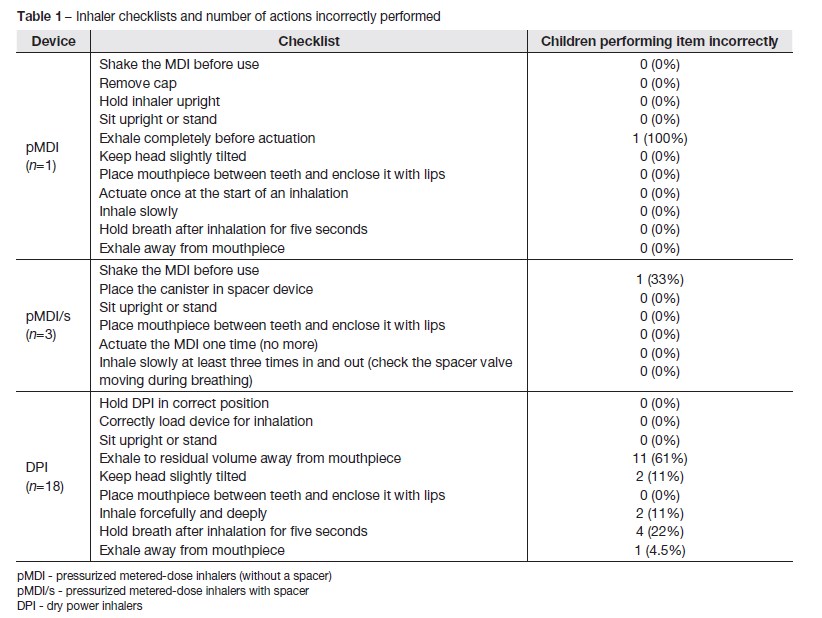
<body><![CDATA[<p>Although both caregivers and children are the mainstream of treatment,   general practitioners and pediatricians should have an important role providing   children assessment of their inhaler technique and correct them when errors are detected at every opportunity, which is essential for good asthma control.<sup>6-8</sup></p>     <p>This paper describes the performance of asthmatic child device technique in a Portuguese children hospital. </p>     <p>&nbsp;</p> </font>     <p><font size="3" face="Verdana"><b>METHODS AND MATERIALS</b></font></p> <font face="Verdana" size="2">     <p>Inhalation device technique was assessed during September and October 2016 during follow-up of pediatric pneumology consultations.</p>     <p>The subjects eligible for this study were asthmatic children aged 6 to 18 years, on daily inhaling medication.</p>     <p>Informed consent was obtained from all included children and their parents. </p>     <p>Inhalation technique was evaluated once using standardized checklists similar to those on the <i>Aerosol Drug Management Improvement Team</i>&nbsp;(ADMIT) Website (<a href="/img/revistas/nas/v27n3/27n3a03t1.jpg">Table 1</a>).<sup>9</sup></p>     
<p>The study was observational; no instructions were given prior to the assessment. </p>     <p>Asthma control was evaluated according to Global Initiative for Asthma   (GINA) 2015 Guidelines (“In the past four weeks, the patient had: 1- Daytime   symptoms more than twice/week? Yes/No; 2- Any night waking due to asthma?   Yes/No; 3- Reliever needed more than twice/week? Yes/No; 4-Any activity   limitation due to asthma? Yes/No. If none of these: well controlled; If 1-2 of these: partly controlled; If 3-4 of these: uncontrolled”).<sup>10</sup> &nbsp;</p>     ]]></body>
<body><![CDATA[<p>The authors considered three categories of inhalers: dry powder inhalers   (DPI) and pressurized metered-dose inhalers with and without a spacer device (pMDI/s and pMDI, respectively).</p>     <p>It was considered that a correct technique had all steps performed with no errors, and an incorrect technique had at least one incorrect step. </p>     <p>In univariate analysis, the authors related inhalation technique to age,   gender duration of asthma, asthma control, read-information about asthma, existence of a written plan and supervision of a caregiver.</p>     <p>Data-analysis was performed with SPSS for Windows (v 12.2) (SPSS, Inc.).</p>     <p>&nbsp;</p> </font>     <p><font size="3" face="Verdana"><b>RESULTS</b></font></p> <font face="Verdana" size="2">     <p>Twenty-one children met the   inclusion criteria (43% female; mean age 12.2 years) and twenty-two devices were assessed according to the checklists (<a href="/img/revistas/nas/v27n3/27n3a03t1.jpg">Table 1</a>). Devices used were:</p> </font> <ul>       
<li><font face="Verdana" size="2">DPI:     Turbuhaler (<i>n</i>=13), Novolizer (<i>n</i>=3), Diskus (<i>n</i>=2)</font></li>       <li><font face="Verdana" size="2">pMDI/s (<i>n</i>=3)</font></li>       <li><font face="Verdana" size="2">pMDI (<i>n</i>=1)</font></li>     ]]></body>
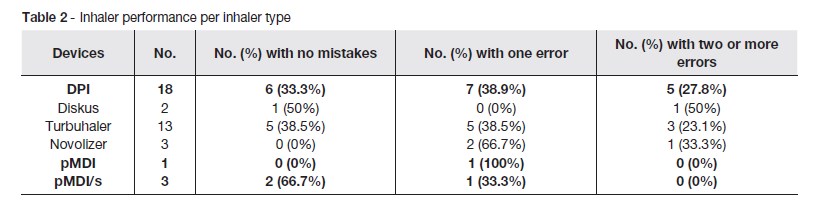
<body><![CDATA[</ul> <font face="Verdana" size="2">     <p>The patient using pMDI was 16 years old.</p>     <p>Of the 22 device assessments, only   36% (<i>n</i>=8) had no errors in the performance. The most common error in the   DPI devices was not exhaling to residual volume before inhaling the asthma   medication (61%). Four of the patients 18 (22%) forgot to hold breath after inhalation for five seconds. </p>     <p>Of the four pMDI assessments, three   (75%) used it with a spacer device with a mask; only those had a family   surveillance during technique. In one of these cases, the shaking prior to use was forgotten by the caregiver (<a href="/img/revistas/nas/v27n3/27n3a03t2.jpg">Table 2</a>).</p>     
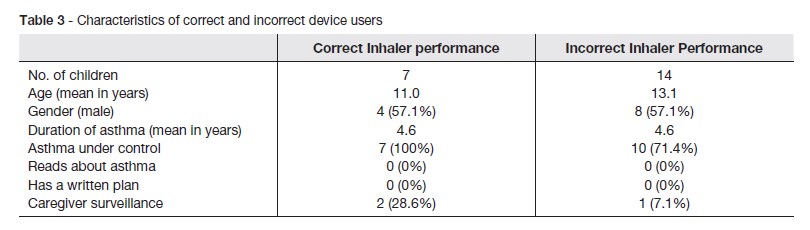
<p>In <a href="/img/revistas/nas/v27n3/27n3a03t3.jpg">Table 3</a> the authors compared the   correct (all steps correct) and incorrect (at least one step incorrect) performances with some features of children whose technique was assessed.</p>     
<p>According to these results, the   mean age of an incorrect inhaler performance is higher than those who perform   with no mistakes. Although we couldn’t find statistical significance (<i>p</i>=0.145,   Mann-Whitney U test), the results point a higher probability of an incorrect inhaler technique among older children.</p>     <p>According to gender and asthma   duration, there are no differences in the percentage of children who performed the technique correct or incorrectly.</p>     <p>In the assessments made, all   children who didn’t have their asthma under control (uncontrolled (n=2) or partially controlled (n=2)) had incorrect performances.</p>     <p>None of the children usually read asthma information neither follow a written plan for inhaler performance.</p>     <p>Only three children had adult supervision, all of them using pMDI/s.</p>     ]]></body>
<body><![CDATA[<p>&nbsp;</p> </font>     <p><font face="Verdana"><b>DISCUSSION/CONCLUSION</b></font></p> <font face="Verdana" size="2">     <p>The authors assessed the inhalation   technique of asthmatic children aged between 6-18 years. There was a relative   high percentage of children failing in their performance, findings similar to   what scientific evidence reports.<sup>4,10</sup> Results support the idea that   health providers should assess children’s inhalation technique on every   consultation. Although the results are in compliance with literature, they   differ regarding duration of asthma: <i>Have</i> <i>et al.</i> found that   children with asthma diagnosis for a longer time had more errors in the performance.<sup>10</sup></p>     <p>A limitation of this study is the   small number of assessments, due to the short period of data collection imposed   by mandatory schedule issues. Another limitation is the fact that inhalation   technique performance during the assessment might not mimic the performance at   home. However it is doubtful that they can do it better at home, because it   isn’t expected that they pay as much attention to their performance as in the assessment.</p>     <p>Although they were given a plan   with instructions on how to use the inhaler at the time of the prescription, most of them didn’t follow it.</p>     <p>Pediatricians and primary care   physicians should assess the inhalation technique of all asthmatic children who   were prescribed an inhaler in order to guarantee its correct use, which is essential for a good asthma control in the pediatric age.</p>     <p>Furthermore, caregivers should also   be able to manage the device and supervise the children technique in every   consultation and not only in the beginning of treatment. This strategy will, no doubt improve the efficacy of the drug administration.</p>     <p>&nbsp;</p> </font>     <p><font size="3" face="Verdana"><b>REFERENCES</b></font></p> <font face="Verdana" size="2">     <!-- ref --><p>1. Sá-Sousa A,   Azevedo LF, Carvalho R, Jacinto T, Todo-Bom A, Loureiro C, <i>et al</i>. Prevalence of asthma in Portugal - The Portuguese National Asthma Survey. Clin Transl Allergy. 2012; 2:15.    &nbsp;&nbsp;&nbsp;&nbsp;&nbsp;&nbsp;&nbsp;&nbsp;[&#160;<a href="javascript:void(0);" onclick="javascript: window.open('/scielo.php?script=sci_nlinks&ref=1111359&pid=S0872-0754201800030000300001&lng=','','width=640,height=500,resizable=yes,scrollbars=1,menubar=yes,');">Links</a>&#160;]<!-- end-ref --></p>     <!-- ref --><p>2. Devadason SG. Recent advances in aerossol therapy for children with asthma. J Aerosol Med. 2006; 19:61-6.    &nbsp;&nbsp;&nbsp;&nbsp;&nbsp;&nbsp;&nbsp;&nbsp;[&#160;<a href="javascript:void(0);" onclick="javascript: window.open('/scielo.php?script=sci_nlinks&ref=1111361&pid=S0872-0754201800030000300002&lng=','','width=640,height=500,resizable=yes,scrollbars=1,menubar=yes,');">Links</a>&#160;]<!-- end-ref --></p>     <!-- ref --><p>3. Bindels PJ, vand der Wouden JC, Ponsioen   BP, Brand PL, Salome PL, Van Hensbergen W, <i>et al</i>. NHG-Standaard Astma   Bij Kinderen. Juisarts Wet 2006; 49:557-72.    &nbsp;&nbsp;&nbsp;&nbsp;&nbsp;&nbsp;&nbsp;&nbsp;[&#160;<a href="javascript:void(0);" onclick="javascript: window.open('/scielo.php?script=sci_nlinks&ref=1111363&pid=S0872-0754201800030000300003&lng=','','width=640,height=500,resizable=yes,scrollbars=1,menubar=yes,');">Links</a>&#160;]<!-- end-ref --></p>     <!-- ref --><p>4. Gillete C, Rockich-Winston N, Kuhn JA,   Flesher S, Shepherd M. INhaler Technique in Children with Asthma: A Systematic Review. Acad Pediatr. 2016; 16:605-15.    &nbsp;&nbsp;&nbsp;&nbsp;&nbsp;&nbsp;&nbsp;&nbsp;[&#160;<a href="javascript:void(0);" onclick="javascript: window.open('/scielo.php?script=sci_nlinks&ref=1111365&pid=S0872-0754201800030000300004&lng=','','width=640,height=500,resizable=yes,scrollbars=1,menubar=yes,');">Links</a>&#160;]<!-- end-ref --></p>     <!-- ref --><p>5. Kwok PCL, Chan HK. Delivery of inhalation   drugs to children for asthma and other respiratory disease. Adv Drug Deliv Ver. 2014; 83: 83-8.    &nbsp;&nbsp;&nbsp;&nbsp;&nbsp;&nbsp;&nbsp;&nbsp;[&#160;<a href="javascript:void(0);" onclick="javascript: window.open('/scielo.php?script=sci_nlinks&ref=1111367&pid=S0872-0754201800030000300005&lng=','','width=640,height=500,resizable=yes,scrollbars=1,menubar=yes,');">Links</a>&#160;]<!-- end-ref --></p>     <!-- ref --><p>6. National Asthma Education and Prevention   Program. Expert Panel Report: Guidelines for the Diagnosis and Management of   Asthma. National Institutes of Health. August, 2007. (Accessed November 5, 2016). Available at: <a href="http://www.nhlbi.nih.gov/files/docs/guidelines/asthgdln.pdf" target="_blank">http://www.nhlbi.nih.gov/files/docs/guidelines/asthgdln.pdf</a>.    &nbsp;&nbsp;&nbsp;&nbsp;&nbsp;&nbsp;&nbsp;&nbsp;[&#160;<a href="javascript:void(0);" onclick="javascript: window.open('/scielo.php?script=sci_nlinks&ref=1111369&pid=S0872-0754201800030000300006&lng=','','width=640,height=500,resizable=yes,scrollbars=1,menubar=yes,');">Links</a>&#160;]<!-- end-ref --></p>     <!-- ref --><p>7. Sleath B,   Ayala G, Gillette C, Williams D, Davis S, Tudor G, <i>et al</i>, Provider   Demonstration and Assessment of Child Device Technique During Pediatric Asthma Visits, Pediatrics. 2011; 127:642-8.    &nbsp;&nbsp;&nbsp;&nbsp;&nbsp;&nbsp;&nbsp;&nbsp;[&#160;<a href="javascript:void(0);" onclick="javascript: window.open('/scielo.php?script=sci_nlinks&ref=1111371&pid=S0872-0754201800030000300007&lng=','','width=640,height=500,resizable=yes,scrollbars=1,menubar=yes,');">Links</a>&#160;]<!-- end-ref --></p>     <!-- ref --><p>8. ADMIT Website (<a href="http://www.admit-online.info/en/" target="_blank">http://www.admit-online.info/en/</a>).    &nbsp;&nbsp;&nbsp;&nbsp;&nbsp;&nbsp;&nbsp;&nbsp;[&#160;<a href="javascript:void(0);" onclick="javascript: window.open('/scielo.php?script=sci_nlinks&ref=1111373&pid=S0872-0754201800030000300008&lng=','','width=640,height=500,resizable=yes,scrollbars=1,menubar=yes,');">Links</a>&#160;]<!-- end-ref --></p>     <!-- ref --><p>9.  Global   Initiative for Asthma. Pocket guide for Asthma management and prevention (for   Adults and Children older than 5 years). 2015. Available at: <a href="https://ginasthma.org/archived-reports/" target="_blank">https://ginasthma.org/archived-reports/</a>.    &nbsp;&nbsp;&nbsp;&nbsp;&nbsp;&nbsp;&nbsp;&nbsp;[&#160;<a href="javascript:void(0);" onclick="javascript: window.open('/scielo.php?script=sci_nlinks&ref=1111375&pid=S0872-0754201800030000300009&lng=','','width=640,height=500,resizable=yes,scrollbars=1,menubar=yes,');">Links</a>&#160;]<!-- end-ref --></p>     <!-- ref --><p>10. Have W, Berg   N, Bindels P, Aalderen W, Palen J. Assessment of Inhalation Technique in Children   in General Practice: Increased Risk of Incorrect Performance with New Device. Journal of Asthma. 2008; 45:67-71.    &nbsp;&nbsp;&nbsp;&nbsp;&nbsp;&nbsp;&nbsp;&nbsp;[&#160;<a href="javascript:void(0);" onclick="javascript: window.open('/scielo.php?script=sci_nlinks&ref=1111377&pid=S0872-0754201800030000300010&lng=','','width=640,height=500,resizable=yes,scrollbars=1,menubar=yes,');">Links</a>&#160;]<!-- end-ref --></p>     <p>&nbsp;</p>     ]]></body>
<body><![CDATA[<p>&nbsp;</p> <b><a name="end" id="topo2"></a><a href="#topo">CORRESPONDENCE TO</a></b>     <p>Pedro Tiago Pinto    <br>   Unidade de Saúde Familiar    <br>   São João do Porto    <br>   Rua Miguel Bombarda, 234    <br>   4050-377 Porto    <br> Email: <a href="mailto:gomespinto.pedro@gmail.com">gomespinto.pedro@gmail.com</a></p>     <p>Received for   publication: 08.05.2017    <br>   Accepted in revised form: 13.07.2018</p> </font>      ]]></body><back>
<ref-list>
<ref id="B1">
<label>1</label><nlm-citation citation-type="journal">
<person-group person-group-type="author">
<name>
<surname><![CDATA[Sá-Sousa]]></surname>
<given-names><![CDATA[A]]></given-names>
</name>
<name>
<surname><![CDATA[Azevedo]]></surname>
<given-names><![CDATA[LF]]></given-names>
</name>
<name>
<surname><![CDATA[Carvalho]]></surname>
<given-names><![CDATA[R]]></given-names>
</name>
<name>
<surname><![CDATA[Jacinto]]></surname>
<given-names><![CDATA[T]]></given-names>
</name>
<name>
<surname><![CDATA[Todo-Bom]]></surname>
<given-names><![CDATA[A]]></given-names>
</name>
<name>
<surname><![CDATA[Loureiro]]></surname>
<given-names><![CDATA[C]]></given-names>
</name>
</person-group>
<article-title xml:lang="en"><![CDATA[Prevalence of asthma in Portugal: The Portuguese National Asthma Survey]]></article-title>
<source><![CDATA[Clin Transl Allergy]]></source>
<year>2012</year>
<volume>2</volume>
<page-range>15</page-range></nlm-citation>
</ref>
<ref id="B2">
<label>2</label><nlm-citation citation-type="journal">
<person-group person-group-type="author">
<name>
<surname><![CDATA[Devadason]]></surname>
<given-names><![CDATA[SG]]></given-names>
</name>
</person-group>
<article-title xml:lang="en"><![CDATA[Recent advances in aerossol therapy for children with asthma]]></article-title>
<source><![CDATA[J Aerosol Med]]></source>
<year>2006</year>
<volume>19</volume>
<page-range>61-6</page-range></nlm-citation>
</ref>
<ref id="B3">
<label>3</label><nlm-citation citation-type="journal">
<person-group person-group-type="author">
<name>
<surname><![CDATA[Bindels]]></surname>
<given-names><![CDATA[PJ]]></given-names>
</name>
<name>
<surname><![CDATA[vand der Wouden]]></surname>
<given-names><![CDATA[JC]]></given-names>
</name>
<name>
<surname><![CDATA[Ponsioen]]></surname>
<given-names><![CDATA[BP]]></given-names>
</name>
<name>
<surname><![CDATA[Brand]]></surname>
<given-names><![CDATA[PL]]></given-names>
</name>
<name>
<surname><![CDATA[Salome]]></surname>
<given-names><![CDATA[PL]]></given-names>
</name>
<name>
<surname><![CDATA[Van Hensbergen]]></surname>
<given-names><![CDATA[W]]></given-names>
</name>
</person-group>
<article-title xml:lang="nl"><![CDATA[NHG-Standaard Astma Bij Kinderen]]></article-title>
<source><![CDATA[Juisarts Wet]]></source>
<year>2006</year>
<volume>49</volume>
<numero>557-72</numero>
<issue>557-72</issue>
</nlm-citation>
</ref>
<ref id="B4">
<label>4</label><nlm-citation citation-type="journal">
<person-group person-group-type="author">
<name>
<surname><![CDATA[Gillete]]></surname>
<given-names><![CDATA[C]]></given-names>
</name>
<name>
<surname><![CDATA[Rockich-Winston]]></surname>
<given-names><![CDATA[N]]></given-names>
</name>
<name>
<surname><![CDATA[Kuhn]]></surname>
<given-names><![CDATA[JA]]></given-names>
</name>
<name>
<surname><![CDATA[Flesher]]></surname>
<given-names><![CDATA[S]]></given-names>
</name>
<name>
<surname><![CDATA[Shepherd]]></surname>
<given-names><![CDATA[M]]></given-names>
</name>
</person-group>
<article-title xml:lang="en"><![CDATA[INhaler Technique in Children with Asthma: A Systematic Review]]></article-title>
<source><![CDATA[Acad Pediatr]]></source>
<year>2016</year>
<volume>16</volume>
<page-range>605-15</page-range></nlm-citation>
</ref>
<ref id="B5">
<label>5</label><nlm-citation citation-type="journal">
<person-group person-group-type="author">
<name>
<surname><![CDATA[Kwok]]></surname>
<given-names><![CDATA[PCL]]></given-names>
</name>
<name>
<surname><![CDATA[Chan]]></surname>
<given-names><![CDATA[HK]]></given-names>
</name>
</person-group>
<article-title xml:lang="en"><![CDATA[Delivery of inhalation drugs to children for asthma and other respiratory disease]]></article-title>
<source><![CDATA[Adv Drug Deliv Ver]]></source>
<year>2014</year>
<volume>83</volume>
<page-range>83-8</page-range></nlm-citation>
</ref>
<ref id="B6">
<label>6</label><nlm-citation citation-type="book">
<collab>National Asthma Education and Prevention Program</collab>
<source><![CDATA[Expert Panel Report: Guidelines for the Diagnosis and Management of Asthma]]></source>
<year>Augu</year>
<month>st</month>
<day>, </day>
<publisher-name><![CDATA[National Institutes of Health]]></publisher-name>
</nlm-citation>
</ref>
<ref id="B7">
<label>7</label><nlm-citation citation-type="journal">
<person-group person-group-type="author">
<name>
<surname><![CDATA[Sleath]]></surname>
<given-names><![CDATA[B]]></given-names>
</name>
<name>
<surname><![CDATA[Ayala]]></surname>
<given-names><![CDATA[G]]></given-names>
</name>
<name>
<surname><![CDATA[Gillette]]></surname>
<given-names><![CDATA[C]]></given-names>
</name>
<name>
<surname><![CDATA[Williams]]></surname>
<given-names><![CDATA[D]]></given-names>
</name>
<name>
<surname><![CDATA[Davis]]></surname>
<given-names><![CDATA[S]]></given-names>
</name>
<name>
<surname><![CDATA[Tudor]]></surname>
<given-names><![CDATA[G]]></given-names>
</name>
</person-group>
<article-title xml:lang="en"><![CDATA[Provider Demonstration and Assessment of Child Device Technique During Pediatric Asthma Visits]]></article-title>
<source><![CDATA[Pediatrics]]></source>
<year>2011</year>
<volume>127</volume>
<page-range>642-8</page-range></nlm-citation>
</ref>
<ref id="B8">
<label>8</label><nlm-citation citation-type="">
<source><![CDATA[ADMIT Website]]></source>
<year></year>
</nlm-citation>
</ref>
<ref id="B9">
<label>9</label><nlm-citation citation-type="">
<collab>Global Initiative for Asthma</collab>
<source><![CDATA[Pocket guide for Asthma management and prevention (for Adults and Children older than 5 years)]]></source>
<year>2015</year>
</nlm-citation>
</ref>
<ref id="B10">
<label>10</label><nlm-citation citation-type="journal">
<person-group person-group-type="author">
<name>
<surname><![CDATA[Have]]></surname>
<given-names><![CDATA[W]]></given-names>
</name>
<name>
<surname><![CDATA[Berg]]></surname>
<given-names><![CDATA[N]]></given-names>
</name>
<name>
<surname><![CDATA[Bindels]]></surname>
<given-names><![CDATA[P]]></given-names>
</name>
<name>
<surname><![CDATA[Aalderen]]></surname>
<given-names><![CDATA[W]]></given-names>
</name>
<name>
<surname><![CDATA[Palen]]></surname>
<given-names><![CDATA[J]]></given-names>
</name>
</person-group>
<article-title xml:lang="en"><![CDATA[Assessment of Inhalation Technique in Children in General Practice: Increased Risk of Incorrect Performance with New Device]]></article-title>
<source><![CDATA[Journal of Asthma]]></source>
<year>2008</year>
<volume>45</volume>
<page-range>67-71</page-range></nlm-citation>
</ref>
</ref-list>
</back>
</article>