<?xml version="1.0" encoding="ISO-8859-1"?><article xmlns:mml="http://www.w3.org/1998/Math/MathML" xmlns:xlink="http://www.w3.org/1999/xlink" xmlns:xsi="http://www.w3.org/2001/XMLSchema-instance">
<front>
<journal-meta>
<journal-id>0872-0754</journal-id>
<journal-title><![CDATA[Nascer e Crescer]]></journal-title>
<abbrev-journal-title><![CDATA[Nascer e Crescer]]></abbrev-journal-title>
<issn>0872-0754</issn>
<publisher>
<publisher-name><![CDATA[Centro Hospitalar do Porto]]></publisher-name>
</publisher>
</journal-meta>
<article-meta>
<article-id>S0872-07542018000300006</article-id>
<article-id pub-id-type="doi">10.25753/BirthGrowthMJ.v27.i3.11686</article-id>
<title-group>
<article-title xml:lang="en"><![CDATA[Trisomy 20 mosaicism: a subtle phenotype]]></article-title>
<article-title xml:lang="pt"><![CDATA[Trissomia 20 em mosaico: um fenótipo subtil]]></article-title>
</title-group>
<contrib-group>
<contrib contrib-type="author">
<name>
<surname><![CDATA[Medeiros]]></surname>
<given-names><![CDATA[Inês]]></given-names>
</name>
<xref ref-type="aff" rid="A01"/>
</contrib>
<contrib contrib-type="author">
<name>
<surname><![CDATA[Faria]]></surname>
<given-names><![CDATA[Catarina]]></given-names>
</name>
<xref ref-type="aff" rid="A01"/>
</contrib>
<contrib contrib-type="author">
<name>
<surname><![CDATA[Carvalho]]></surname>
<given-names><![CDATA[Fábia]]></given-names>
</name>
<xref ref-type="aff" rid="A01"/>
</contrib>
<contrib contrib-type="author">
<name>
<surname><![CDATA[Rocha]]></surname>
<given-names><![CDATA[Miguel Gonçalves]]></given-names>
</name>
<xref ref-type="aff" rid="A02"/>
</contrib>
<contrib contrib-type="author">
<name>
<surname><![CDATA[Silva]]></surname>
<given-names><![CDATA[Helena]]></given-names>
</name>
<xref ref-type="aff" rid="A01"/>
</contrib>
</contrib-group>
<aff id="A01">
<institution><![CDATA[,Hospital de Braga Department of Pediatrics ]]></institution>
<addr-line><![CDATA[Braga ]]></addr-line>
<country>Portugal</country>
</aff>
<aff id="A02">
<institution><![CDATA[,Hospital de Braga Department of Genetics ]]></institution>
<addr-line><![CDATA[Braga ]]></addr-line>
<country>Portugal</country>
</aff>
<pub-date pub-type="pub">
<day>01</day>
<month>09</month>
<year>2018</year>
</pub-date>
<pub-date pub-type="epub">
<day>01</day>
<month>09</month>
<year>2018</year>
</pub-date>
<volume>27</volume>
<numero>3</numero>
<fpage>182</fpage>
<lpage>184</lpage>
<copyright-statement/>
<copyright-year/>
<self-uri xlink:href="http://scielo.pt/scielo.php?script=sci_arttext&amp;pid=S0872-07542018000300006&amp;lng=en&amp;nrm=iso"></self-uri><self-uri xlink:href="http://scielo.pt/scielo.php?script=sci_abstract&amp;pid=S0872-07542018000300006&amp;lng=en&amp;nrm=iso"></self-uri><self-uri xlink:href="http://scielo.pt/scielo.php?script=sci_pdf&amp;pid=S0872-07542018000300006&amp;lng=en&amp;nrm=iso"></self-uri><abstract abstract-type="short" xml:lang="en"><p><![CDATA[Introduction: Trisomy 20 mosaicism is one of the most common cytogenetic abnormalities found in prenatal diagnosis. The outcome of these pregnancies is normal in most of the reported cases, but clinical implications of diagnosis and prognosis in a long term basis are not clear. Case report: The authors present a case of trisomy 20 mosaicism, with no prenatal diagnosis, followed-up for a period of 13 years, aiming to demonstrate the existence of a subtle phenotype, which represents a challenge in diagnosis. Discussion/Conclusion: No specific phenotype has been associated with the cytogenetic findings but certain features, although subtle, appear to be consistent.]]></p></abstract>
<abstract abstract-type="short" xml:lang="pt"><p><![CDATA[Introdução: A trissomia 20 em mosaico é um dos tipos mais comuns de alterações citogenéticas detetadas no diagnóstico pré-natal. O produto destas gestações é normal na maioria dos casos descritos, mas as implicações clínicas do diagnóstico e o prognóstico da doença a longo prazo não são totalmente claros. Caso clínico: Os autores apresentam um caso de trissomia 20 em mosaico, sem diagnóstico pré-natal e com um período de seguimento de 13 anos, pretendendo ilustrar a existência de um fenótipo subtil, o que constitui um desafio no diagnóstico. Discussão/Conclusão: Nenhum fenótipo específico tem sido associado com os achados citogenéticos, mas certas características apesar de subtis parecem ser consistentes.]]></p></abstract>
<kwd-group>
<kwd lng="en"><![CDATA[Mosaicism]]></kwd>
<kwd lng="en"><![CDATA[phenotype]]></kwd>
<kwd lng="en"><![CDATA[trisomy 20]]></kwd>
<kwd lng="pt"><![CDATA[fenótipo]]></kwd>
<kwd lng="pt"><![CDATA[mosaicismo]]></kwd>
<kwd lng="pt"><![CDATA[trissomia 20]]></kwd>
</kwd-group>
</article-meta>
</front><body><![CDATA[ <p align="right"><font size="2" face="Verdana"><b>CASE REPORTS | CASOS CL&Iacute;NICOS</b></font><font face="Verdana" size="2"></font></p> <font face="Verdana" size="2">    <p>&nbsp;</p> </font>     <p><font size="4" face="Verdana"><b>Trisomy 20   mosaicism – a subtle phenotype</b></font></p> <font face="Verdana" size="2">     <p>&nbsp;</p> </font><font size="3" face="Verdana"><b>Trissomia 20 em mosaico &ndash; um fen&oacute;tipo subtil</b></font><font face="Verdana" size="2">     <p>&nbsp;</p>     <p>&nbsp;</p>     <p><b>Inês Medeiros<sup>I</sup>;   Catarina Faria<sup>I</sup>; Fábia Carvalho<sup>I</sup>; Miguel Gonçalves Rocha<sup>II</sup>;   Helena Silva<sup>I</sup></b></p>     <p><sup>I</sup>Department of Pediatrics, Hospital de Braga. 4710-243 Braga, Portugal. <a href="mailto:inesdemedeiros@hotmail.com">inesdemedeiros@hotmail.com</a>; <a href="mailto:catmagalhaesfaria@gmail.com">catmagalhaesfaria@gmail.com</a>; <a href="mailto:fsgc_carvalho@hotmail.com">fsgc_carvalho@hotmail.com</a>;   <a href="mailto:tizleite@hortmail.com">tizleite@hortmail.com    <br>   </a><sup>II</sup>Department of Genetics, Hospital de Braga. 4710-243 Braga, Portugal. <a href="mailto:miguel.rocha@hospitaldebraga.pt">miguel.rocha@hospitaldebraga.pt</a></p> <a href="#end">Correspondence to</a><a name="topo" id="topo"></a>     <p>&nbsp;</p>     ]]></body>
<body><![CDATA[<p>&nbsp;</p> </font> <hr noshade size="1"> <font face="Verdana" size="2">     <p><b>ABSTRACT</b></p>     <p><b>Introduction:</b> Trisomy 20   mosaicism is one of the most common cytogenetic abnormalities found in prenatal   diagnosis. The outcome of these pregnancies is normal in most of the reported   cases, but clinical implications of diagnosis and prognosis in a long term basis are not clear.</p>     <p><b>Case report:</b> The authors   present a case of trisomy 20 mosaicism, with no prenatal diagnosis, followed-up   for a period of 13 years, aiming to demonstrate the existence of a subtle phenotype, which represents a challenge in diagnosis.</p>     <p><b>Discussion/Conclusion</b>: No specific   phenotype has been associated with the cytogenetic findings but certain features, although subtle, appear to be consistent.</p>     <p><b>Keywords: </b>Mosaicism; phenotype; trisomy 20</p> </font> <hr noshade size="1"> <font face="Verdana" size="2">     <p><b>RESUMO</b></p>     <p><b>Introdução:</b> A trissomia   20 em mosaico é um dos tipos mais comuns de alterações   citogenéticas detetadas no diagnóstico pré-natal. O produto destas gestações é   normal na maioria dos casos descritos, mas as implicações clínicas do diagnóstico e o prognóstico da doença a longo prazo não são totalmente claros. </p>     <p><b>Caso clínico:</b> Os autores   apresentam um caso de trissomia 20 em mosaico, sem diagnóstico pré-natal e com   um período de seguimento de 13 anos, pretendendo ilustrar a existência de um fenótipo subtil, o que constitui um desafio no diagnóstico.</p>     <p><b>Discussão/Conclusão:</b> Nenhum   fenótipo específico tem sido associado com os achados citogenéticos, mas certas características apesar de subtis parecem ser consistentes.</p>     ]]></body>
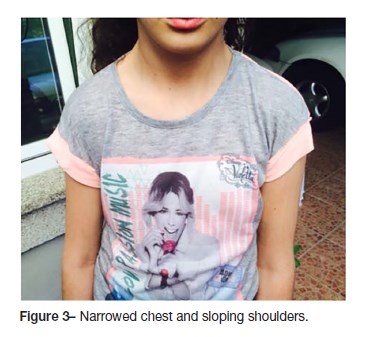
<body><![CDATA[<p><b>Palavras-chave: </b>fenótipo; mosaicismo; trissomia 20</p> </font> <hr noshade size="1"> <font face="Verdana" size="2">     <p> </p> </font>     <p><font size="3" face="Verdana"><b>INTRODUCTION</b></font></p> <font face="Verdana" size="2">     <p>Despite being a frequently found   cytogenetic abnormality in amniocentesis and chorionic villus sampling (1 out   of 7000 pregnancies), clinical trisomy 20 mosaicism is rarely identified in the   postnatal period.<sup>1,2</sup> In this condition, an extra copy of chromosome   20 (or a portion of it) is found in some cell lines. The outcome of these   pregnancies is normal in 90-93% of cases with prenatal diagnosis; however, most   studies only consider clinical features at birth and have a short follow-up period. Non-mosaic trisomy 20 is, in most cases, incompatible with life.<sup>1,3</sup></p>     <p>Clinical findings at birth include   hypotonia and skin pigmentation; later, delayed psychomotor development may be   noticed. Other findings include vertebral column abnormalities (vertebral   fusion and kyphosis), narrowed chest and sloping shoulders, congenital heart and kidney defects, visual alterations and learning difficulties.<sup>2,4,8,9</sup></p>     <p>Cytogenetic analysis of skin   fibroblasts is the most appropriate technique for postnatal confirmation of the   diagnosis, as most trisomy 20 mosaicism cases have a normal pheripheral blood karyotype.<sup>10</sup></p>     <p>&nbsp;</p> </font>     <p><font size="3" face="Verdana"><b>CASE REPORT</b></font></p> <font face="Verdana" size="2">     <p>The authors present a   thirteen-year-old female, born at 39 weeks by eutocic delivery. Third-trimester   serologies were unremarkable. Fetal ultrasound detected a bilateral   hydronephrosis and reduced left renal parenchyma. Family history was irrelevant with no parental consanguinity.</p>     <p>Hypotonia and multiple   equimosis-like lesions in the lumbar region and limbs were noticed at birth.   Coagulation study was normal and renal-pelvic ultrasound performed during the first week of life revealed left renal agenesis and right hydronephrosis.</p>     ]]></body>
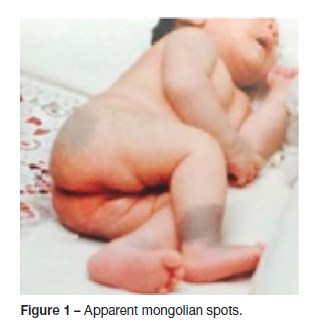
<body><![CDATA[<p>At five months, the infant   developed bilateral convergent strabismus. The equimosis-like lesions gave   place to cutaneous lesions similar to mongolian spots of atypical configuration   (<a href="#f1">Figure 1</a>). Hypotonia was sustained. Transfontanelar ultrasound and   cranioencephalic magnetic resonance imaging (MRI) excluded a neurocutaneous syndrome.</p>     <p><a name="f1"></a></p>     <p>&nbsp;</p>     <p align="center"><img src="/img/revistas/nas/v27n3/27n3a06f1.jpg" width="318" height="330"></p>     
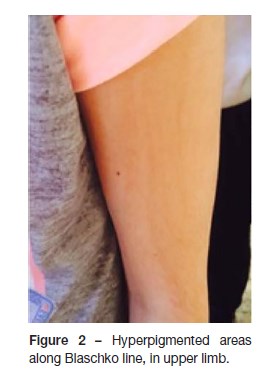
<p>&nbsp;</p>     <p>At nine months, a delay in   psychomotor development was noticed. Peripheral blood karyotype, observed in 10   cells, was 46,XX; metabolic study and auditory evoked potential were   unremarkable. She maintained bilateral convergent strabismus and initiate ocular occlusion.</p>     <p>A scoliotic   position and changes in gait were noted at the age of 20 months. Vertebral   magnetic resonance imaging confirmed severe dorsal scoliosis and revealed   anterior fusion of the first two ribs. A heart murmur was detected and the   echocardiogram identified a bicuspid aortic valve, without regurgitation or stenosis.</p>     <p>Between the age of three and six   years, speech and learning disabilities were detected. The child started speech   therapy and was engaged into special pedagogic support. At six years, she repeated cranioencephalic MRI, which showed no alterations. </p>     <p>At the age of   nine, the apparent mongolian-like spots became progressively clearer and linear   areas of hyperpigmentation along Blaschko lines (<a href="#f2">Figure 2</a>). Skin biopsy   karyotype was performed and two distinct cell lines were identified: the first   one with 47 chromosomes and an extra chromosome 20 and the other one with 46 chromosomes, of normal constitution (47,XX,+20[23]/46,XX[27]).</p>     <p><a name="f2"></a></p>     ]]></body>
<body><![CDATA[<p>&nbsp;</p>     <p align="center"><img src="/img/revistas/nas/v27n3/27n3a06f2.jpg" width="275" height="380"></p>     
<p>&nbsp;</p>     <p>Currently, at the age of thirteen years,   the adolescent presents low cognitive functioning (Intelligence Quotient 71)   according to the <i>Wechsler Intelligence Scale for Children III</i>,   maintaining the need for individualized pedagogical support at school. She   presents a mild strabismus even after several correction surgeries and needs to   wear glasses,  a narrow chest and sloping   shoulders (<a href="#f3">Figure 3</a>),  mild hypotonia and   fine motor skills disabilities and is under  physiatric treatment. She has a multidisciplinary follow-up (Pediatrics, Physical and Rehabilitation Medicine, Ophthalmology, Orthopedics and Cardiology) and surgical correction of scoliosis is planned.</p>     <p><a name="f3"></a> </p>     <p>&nbsp;</p>     <p align="center"><img src="/img/revistas/nas/v27n3/27n3a06f3.jpg" width="366" height="337"></p>     
<p>&nbsp;</p>     <p>&nbsp;</p> </font>     <p><font size="3" face="Verdana"><b>DISCUSSION/CONCLUSION</b></font></p> <font face="Verdana" size="2">     ]]></body>
<body><![CDATA[<p>There are few clinical cases of   trisomy 20 mosaicism reported in the literature. The number of prenatally detected   cases is higher than the true number of children with pathology, so it is   suspected that many trisomy cells are restricted to the placenta.<sup>4</sup>   It is suggested that a higher percentage of affected cells in the prenatal   period increases the risk of an abnormal outcome; however, this correlation is not considered significant for genetic counseling.<sup>5,6,7</sup> </p>     <p>Although there is no specific   phenotype or syndrome described, certain clinical features appear to be   recurrent, including skin pigmentation alterations, hypotonia and delayed   psychomotor development.<sup>1,2,4</sup> Long-term follow-up is required, as sometimes orthopedic, ophthalmologic, cardiac and renal features may arise.</p>     <p>The authors underline the fact that   the exclusion of mosaicism implies counting a minimum of 30 cells. The   peripheral blood karyotype did not excluded mosaicism reliably, once only 10 cells were observed, but the skin karyotype confirmed our clinical suspicion. </p>     <p>Our case sets forth the challenge   of diagnosis in the absence of prenatal finding of cytogenetic abnormalities.   As the clinical implications and prognosis of this pathology are not yet clear   the authors consider important to accurately characterize all detected cases   and follow them closely as well as providing genetic counselling for the parents.</p>     <p>&nbsp;</p> </font>     <p><font size="3" face="Verdana"><b>REFERENCES</b></font></p> <font face="Verdana" size="2">     <!-- ref --><p>1. Hsu L, Kaffe   S, Perlis T. A revisit of trisomy 20 mosaicism in prenatal diagnosis – an overview of 103 cases. Prenat Diagn. 1991; 1:7-15.    &nbsp;&nbsp;&nbsp;&nbsp;&nbsp;&nbsp;&nbsp;&nbsp;[&#160;<a href="javascript:void(0);" onclick="javascript: window.open('/scielo.php?script=sci_nlinks&ref=1111924&pid=S0872-0754201800030000600001&lng=','','width=640,height=500,resizable=yes,scrollbars=1,menubar=yes,');">Links</a>&#160;]<!-- end-ref --></p>     <!-- ref --><p>2. Bui T-H,   Iselius L, Lindsten J. European collaborative study on prenatal diagnosis:   Mosaicism, pseudomosaicism and single abnormal cells in amniotic fluid cell cultures. Prenat Diagn. 1984; 4:145-62.    &nbsp;&nbsp;&nbsp;&nbsp;&nbsp;&nbsp;&nbsp;&nbsp;[&#160;<a href="javascript:void(0);" onclick="javascript: window.open('/scielo.php?script=sci_nlinks&ref=1111926&pid=S0872-0754201800030000600002&lng=','','width=640,height=500,resizable=yes,scrollbars=1,menubar=yes,');">Links</a>&#160;]<!-- end-ref --></p>     ]]></body>
<body><![CDATA[<!-- ref --><p>3. Beke A,   Tóth-Pál E, Hargitai B, Szigeti Z, Papp C, Papp Z. Trisomy 20 mosaicism and nonmosaic trisomy 20: a report of 2 cases. J Reprod Med. 2006; 51:209-12.    &nbsp;&nbsp;&nbsp;&nbsp;&nbsp;&nbsp;&nbsp;&nbsp;[&#160;<a href="javascript:void(0);" onclick="javascript: window.open('/scielo.php?script=sci_nlinks&ref=1111928&pid=S0872-0754201800030000600003&lng=','','width=640,height=500,resizable=yes,scrollbars=1,menubar=yes,');">Links</a>&#160;]<!-- end-ref --></p>     <!-- ref --><p>4. Willis MJ,   Bird LM, Dell’Aquilla M, Jones MC. Expanding the Phenotype of Mosaic Trisomy 20. Am J Med Genet A. 2008; 146A:330-6.    &nbsp;&nbsp;&nbsp;&nbsp;&nbsp;&nbsp;&nbsp;&nbsp;[&#160;<a href="javascript:void(0);" onclick="javascript: window.open('/scielo.php?script=sci_nlinks&ref=1111930&pid=S0872-0754201800030000600004&lng=','','width=640,height=500,resizable=yes,scrollbars=1,menubar=yes,');">Links</a>&#160;]<!-- end-ref --></p>     <!-- ref --><p>5. Robinson WP,   McGillivray B, Lewis ME, Arbour L, Barrett I, Kalousek DK. Prenatally detected trisomy 20 mosaicism. Prenatal Diagnosis. 2005; 25:239-44.    &nbsp;&nbsp;&nbsp;&nbsp;&nbsp;&nbsp;&nbsp;&nbsp;[&#160;<a href="javascript:void(0);" onclick="javascript: window.open('/scielo.php?script=sci_nlinks&ref=1111932&pid=S0872-0754201800030000600005&lng=','','width=640,height=500,resizable=yes,scrollbars=1,menubar=yes,');">Links</a>&#160;]<!-- end-ref --></p>     <!-- ref --><p>6. Chen CP, Chang   SD, Chueh HY. Discrepancy in the trisomy mosaicism level between cultured   amniocytes and uncultured amniocytes in prenatally detected mosaic trisomy 20. Taiwan J Obstet Gynecol. 2013;145-6.    &nbsp;&nbsp;&nbsp;&nbsp;&nbsp;&nbsp;&nbsp;&nbsp;[&#160;<a href="javascript:void(0);" onclick="javascript: window.open('/scielo.php?script=sci_nlinks&ref=1111934&pid=S0872-0754201800030000600006&lng=','','width=640,height=500,resizable=yes,scrollbars=1,menubar=yes,');">Links</a>&#160;]<!-- end-ref --> </p>     <!-- ref --><p>7. Bianca S, Boemi   G, Barrano B, Cataliotti A, Ingegnosi C, Indaco L, <i>et al.</i> Mosaic trisomy 20: considerations for genetic counseling. Am J Med Genet. 2008; 146A:1897-8.    &nbsp;&nbsp;&nbsp;&nbsp;&nbsp;&nbsp;&nbsp;&nbsp;[&#160;<a href="javascript:void(0);" onclick="javascript: window.open('/scielo.php?script=sci_nlinks&ref=1111936&pid=S0872-0754201800030000600007&lng=','','width=640,height=500,resizable=yes,scrollbars=1,menubar=yes,');">Links</a>&#160;]<!-- end-ref --></p>     ]]></body>
<body><![CDATA[<!-- ref --><p>8. Baty BJ, Olson   SB, Magenis RE, Carey JC. Trissomy 20 mosaicism in two unrelated girls with   skin hypopigmentation and normal intellectual development. Am J Med Genet. 2001; 99:210-6.    &nbsp;&nbsp;&nbsp;&nbsp;&nbsp;&nbsp;&nbsp;&nbsp;[&#160;<a href="javascript:void(0);" onclick="javascript: window.open('/scielo.php?script=sci_nlinks&ref=1111938&pid=S0872-0754201800030000600008&lng=','','width=640,height=500,resizable=yes,scrollbars=1,menubar=yes,');">Links</a>&#160;]<!-- end-ref --></p>     <!-- ref --><p>9. Hartmann A,   Hofmann UB, Hoehn H, Broecker EB, Hamm H. Postnatal Confirmation of Prenatally   Diagnosed Trisomy 20 Mosaicism in a Patient with Linear and Whorled Nevoid Hypermelanosis. Ped Dermatology. 2004; 21:636-41.    &nbsp;&nbsp;&nbsp;&nbsp;&nbsp;&nbsp;&nbsp;&nbsp;[&#160;<a href="javascript:void(0);" onclick="javascript: window.open('/scielo.php?script=sci_nlinks&ref=1111940&pid=S0872-0754201800030000600009&lng=','','width=640,height=500,resizable=yes,scrollbars=1,menubar=yes,');">Links</a>&#160;]<!-- end-ref --></p>     <!-- ref --><p>10. Taibjee SM,   Hall D, Balderson D, Larkins S, Stubbs T, Moss C. Keratinocyte cytogenetics in   10 patients with pigmentary mosaicism: identification of one case of trisomy 20 mosaicism confined to keranocytes. Clin Exp Dermatol. 2009;34:823-9.    &nbsp;&nbsp;&nbsp;&nbsp;&nbsp;&nbsp;&nbsp;&nbsp;[&#160;<a href="javascript:void(0);" onclick="javascript: window.open('/scielo.php?script=sci_nlinks&ref=1111942&pid=S0872-0754201800030000600010&lng=','','width=640,height=500,resizable=yes,scrollbars=1,menubar=yes,');">Links</a>&#160;]<!-- end-ref --> </p> </font>     <p>&nbsp;</p>     <p>&nbsp;</p>     <p><font face="Verdana" size="2"><b><a name="end" id="topo2"></a><a href="#topo">CORRESPONDENCE TO</a></b> </font></p> <font face="Verdana" size="2">     <p>Inês Medeiros    ]]></body>
<body><![CDATA[<br> Department of Pediatrics    <br> Hospital de Braga    <br> Rua das Sete Fontes    <br> 4710-243 Braga    <br> Email: <a href="mailto:inesdemedeiros@hotmail.com">inesdemedeiros@hotmail.com</a></p>     <p>Received for publication: 05.03.2017    <br> Accepted in revised form: 02.10.2017</p> </font>      ]]></body><back>
<ref-list>
<ref id="B1">
<label>1</label><nlm-citation citation-type="journal">
<person-group person-group-type="author">
<name>
<surname><![CDATA[Hsu]]></surname>
<given-names><![CDATA[L]]></given-names>
</name>
<name>
<surname><![CDATA[Kaffe]]></surname>
<given-names><![CDATA[S]]></given-names>
</name>
<name>
<surname><![CDATA[Perlis]]></surname>
<given-names><![CDATA[T]]></given-names>
</name>
</person-group>
<article-title xml:lang="en"><![CDATA[A revisit of trisomy 20 mosaicism in prenatal diagnosis: an overview of 103 cases]]></article-title>
<source><![CDATA[Prenat Diagn]]></source>
<year>1991</year>
<volume>1</volume>
<page-range>7-15</page-range></nlm-citation>
</ref>
<ref id="B2">
<label>2</label><nlm-citation citation-type="journal">
<person-group person-group-type="author">
<name>
<surname><![CDATA[Bui]]></surname>
<given-names><![CDATA[T-H]]></given-names>
</name>
<name>
<surname><![CDATA[Iselius]]></surname>
<given-names><![CDATA[L]]></given-names>
</name>
<name>
<surname><![CDATA[Lindsten]]></surname>
<given-names><![CDATA[J]]></given-names>
</name>
</person-group>
<article-title xml:lang="en"><![CDATA[European collaborative study on prenatal diagnosis: Mosaicism, pseudomosaicism and single abnormal cells in amniotic fluid cell cultures]]></article-title>
<source><![CDATA[Prenat Diagn]]></source>
<year>1984</year>
<volume>4</volume>
<page-range>145-62</page-range></nlm-citation>
</ref>
<ref id="B3">
<label>3</label><nlm-citation citation-type="journal">
<person-group person-group-type="author">
<name>
<surname><![CDATA[Beke]]></surname>
<given-names><![CDATA[A]]></given-names>
</name>
<name>
<surname><![CDATA[Tóth-Pál]]></surname>
<given-names><![CDATA[E]]></given-names>
</name>
<name>
<surname><![CDATA[Hargitai]]></surname>
<given-names><![CDATA[B]]></given-names>
</name>
<name>
<surname><![CDATA[Szigeti]]></surname>
<given-names><![CDATA[Z]]></given-names>
</name>
<name>
<surname><![CDATA[Papp]]></surname>
<given-names><![CDATA[C]]></given-names>
</name>
<name>
<surname><![CDATA[Papp]]></surname>
<given-names><![CDATA[Z]]></given-names>
</name>
</person-group>
<article-title xml:lang="en"><![CDATA[Trisomy 20 mosaicism and nonmosaic trisomy 20: a report of 2 cases]]></article-title>
<source><![CDATA[J Reprod Med]]></source>
<year>2006</year>
<volume>51</volume>
<page-range>209-12</page-range></nlm-citation>
</ref>
<ref id="B4">
<label>4</label><nlm-citation citation-type="journal">
<person-group person-group-type="author">
<name>
<surname><![CDATA[Willis]]></surname>
<given-names><![CDATA[MJ]]></given-names>
</name>
<name>
<surname><![CDATA[Bird]]></surname>
<given-names><![CDATA[LM]]></given-names>
</name>
<name>
<surname><![CDATA[Dell’Aquilla]]></surname>
<given-names><![CDATA[M]]></given-names>
</name>
<name>
<surname><![CDATA[Jones]]></surname>
<given-names><![CDATA[MC]]></given-names>
</name>
</person-group>
<article-title xml:lang="en"><![CDATA[Expanding the Phenotype of Mosaic Trisomy 20]]></article-title>
<source><![CDATA[Am J Med Genet A]]></source>
<year>2008</year>
<volume>146A</volume>
<page-range>330-6</page-range></nlm-citation>
</ref>
<ref id="B5">
<label>5</label><nlm-citation citation-type="journal">
<person-group person-group-type="author">
<name>
<surname><![CDATA[Robinson]]></surname>
<given-names><![CDATA[WP]]></given-names>
</name>
<name>
<surname><![CDATA[McGillivray]]></surname>
<given-names><![CDATA[B]]></given-names>
</name>
<name>
<surname><![CDATA[Lewis]]></surname>
<given-names><![CDATA[ME]]></given-names>
</name>
<name>
<surname><![CDATA[Arbour]]></surname>
<given-names><![CDATA[L]]></given-names>
</name>
<name>
<surname><![CDATA[Barrett]]></surname>
<given-names><![CDATA[I]]></given-names>
</name>
<name>
<surname><![CDATA[Kalousek]]></surname>
<given-names><![CDATA[DK]]></given-names>
</name>
</person-group>
<article-title xml:lang="en"><![CDATA[Prenatally detected trisomy 20 mosaicism]]></article-title>
<source><![CDATA[Prenatal Diagnosis]]></source>
<year>2005</year>
<volume>25</volume>
<page-range>239-44</page-range></nlm-citation>
</ref>
<ref id="B6">
<label>6</label><nlm-citation citation-type="journal">
<person-group person-group-type="author">
<name>
<surname><![CDATA[Chen]]></surname>
<given-names><![CDATA[CP]]></given-names>
</name>
<name>
<surname><![CDATA[Chang]]></surname>
<given-names><![CDATA[SD]]></given-names>
</name>
<name>
<surname><![CDATA[Chueh]]></surname>
<given-names><![CDATA[HY]]></given-names>
</name>
</person-group>
<article-title xml:lang="en"><![CDATA[Discrepancy in the trisomy mosaicism level between cultured amniocytes and uncultured amniocytes in prenatally detected mosaic trisomy 20]]></article-title>
<source><![CDATA[Taiwan J Obstet Gynecol]]></source>
<year>2013</year>
<page-range>145-6</page-range></nlm-citation>
</ref>
<ref id="B7">
<label>7</label><nlm-citation citation-type="journal">
<person-group person-group-type="author">
<name>
<surname><![CDATA[Bianca]]></surname>
<given-names><![CDATA[S]]></given-names>
</name>
<name>
<surname><![CDATA[Boemi]]></surname>
<given-names><![CDATA[G]]></given-names>
</name>
<name>
<surname><![CDATA[Barrano]]></surname>
<given-names><![CDATA[B]]></given-names>
</name>
<name>
<surname><![CDATA[Cataliotti]]></surname>
<given-names><![CDATA[A]]></given-names>
</name>
<name>
<surname><![CDATA[Ingegnosi]]></surname>
<given-names><![CDATA[C]]></given-names>
</name>
<name>
<surname><![CDATA[Indaco]]></surname>
<given-names><![CDATA[L]]></given-names>
</name>
</person-group>
<article-title xml:lang="en"><![CDATA[Mosaic trisomy 20: considerations for genetic counseling]]></article-title>
<source><![CDATA[Am J Med Genet]]></source>
<year>2008</year>
<volume>146A</volume>
<page-range>1897-8</page-range></nlm-citation>
</ref>
<ref id="B8">
<label>8</label><nlm-citation citation-type="journal">
<person-group person-group-type="author">
<name>
<surname><![CDATA[Baty]]></surname>
<given-names><![CDATA[BJ]]></given-names>
</name>
<name>
<surname><![CDATA[Olson]]></surname>
<given-names><![CDATA[SB]]></given-names>
</name>
<name>
<surname><![CDATA[Magenis]]></surname>
<given-names><![CDATA[RE]]></given-names>
</name>
<name>
<surname><![CDATA[Carey]]></surname>
<given-names><![CDATA[JC]]></given-names>
</name>
</person-group>
<article-title xml:lang="en"><![CDATA[Trissomy 20 mosaicism in two unrelated girls with skin hypopigmentation and normal intellectual development]]></article-title>
<source><![CDATA[Am J Med Genet]]></source>
<year>2001</year>
<volume>99</volume>
<page-range>210-6</page-range></nlm-citation>
</ref>
<ref id="B9">
<label>9</label><nlm-citation citation-type="journal">
<person-group person-group-type="author">
<name>
<surname><![CDATA[Hartmann]]></surname>
<given-names><![CDATA[A]]></given-names>
</name>
<name>
<surname><![CDATA[Hofmann]]></surname>
<given-names><![CDATA[UB]]></given-names>
</name>
<name>
<surname><![CDATA[Hoehn]]></surname>
<given-names><![CDATA[H]]></given-names>
</name>
<name>
<surname><![CDATA[Broecker]]></surname>
<given-names><![CDATA[EB]]></given-names>
</name>
<name>
<surname><![CDATA[Hamm]]></surname>
<given-names><![CDATA[H]]></given-names>
</name>
</person-group>
<article-title xml:lang="en"><![CDATA[Postnatal Confirmation of Prenatally Diagnosed Trisomy 20 Mosaicism in a Patient with Linear and Whorled Nevoid Hypermelanosis]]></article-title>
<source><![CDATA[Ped Dermatology]]></source>
<year>2004</year>
<volume>21</volume>
<page-range>636-41</page-range></nlm-citation>
</ref>
<ref id="B10">
<label>10</label><nlm-citation citation-type="journal">
<person-group person-group-type="author">
<name>
<surname><![CDATA[Taibjee]]></surname>
<given-names><![CDATA[SM]]></given-names>
</name>
<name>
<surname><![CDATA[Hall]]></surname>
<given-names><![CDATA[D]]></given-names>
</name>
<name>
<surname><![CDATA[Balderson]]></surname>
<given-names><![CDATA[D]]></given-names>
</name>
<name>
<surname><![CDATA[Larkins]]></surname>
<given-names><![CDATA[S]]></given-names>
</name>
<name>
<surname><![CDATA[Stubbs]]></surname>
<given-names><![CDATA[T]]></given-names>
</name>
<name>
<surname><![CDATA[Moss]]></surname>
<given-names><![CDATA[C]]></given-names>
</name>
</person-group>
<article-title xml:lang="en"><![CDATA[Keratinocyte cytogenetics in 10 patients with pigmentary mosaicism: identification of one case of trisomy 20 mosaicism confined to keranocytes]]></article-title>
<source><![CDATA[Clin Exp Dermatol.]]></source>
<year>2009</year>
<volume>34</volume>
<page-range>823-9</page-range></nlm-citation>
</ref>
</ref-list>
</back>
</article>