<?xml version="1.0" encoding="ISO-8859-1"?><article xmlns:mml="http://www.w3.org/1998/Math/MathML" xmlns:xlink="http://www.w3.org/1999/xlink" xmlns:xsi="http://www.w3.org/2001/XMLSchema-instance">
<front>
<journal-meta>
<journal-id>0872-0754</journal-id>
<journal-title><![CDATA[Nascer e Crescer]]></journal-title>
<abbrev-journal-title><![CDATA[Nascer e Crescer]]></abbrev-journal-title>
<issn>0872-0754</issn>
<publisher>
<publisher-name><![CDATA[Centro Hospitalar do Porto]]></publisher-name>
</publisher>
</journal-meta>
<article-meta>
<article-id>S0872-07542018000300009</article-id>
<article-id pub-id-type="doi">10.25753/BirthGrowthMJ.v27.i3.12753</article-id>
<title-group>
<article-title xml:lang="en"><![CDATA[Dark skin - constitutional or pathological?: A X-linked Adrenoleukodystrophy case report]]></article-title>
<article-title xml:lang="pt"><![CDATA[Pele escura - constitucional ou patológica?: Um caso clinico de Adrenoleucodistrofia ligada ao X]]></article-title>
</title-group>
<contrib-group>
<contrib contrib-type="author">
<name>
<surname><![CDATA[Preto]]></surname>
<given-names><![CDATA[Clara]]></given-names>
</name>
<xref ref-type="aff" rid="A01"/>
</contrib>
<contrib contrib-type="author">
<name>
<surname><![CDATA[Alves]]></surname>
<given-names><![CDATA[José Eduardo]]></given-names>
</name>
<xref ref-type="aff" rid="A02"/>
</contrib>
<contrib contrib-type="author">
<name>
<surname><![CDATA[Fonseca]]></surname>
<given-names><![CDATA[Marcelo]]></given-names>
</name>
<xref ref-type="aff" rid="A03"/>
</contrib>
<contrib contrib-type="author">
<name>
<surname><![CDATA[Santos]]></surname>
<given-names><![CDATA[Manuela]]></given-names>
</name>
</contrib>
<contrib contrib-type="author">
<name>
<surname><![CDATA[Miguel]]></surname>
<given-names><![CDATA[Natalina]]></given-names>
</name>
<xref ref-type="aff" rid="A01"/>
</contrib>
</contrib-group>
<aff id="A01">
<institution><![CDATA[,Centro Hospitalar de Trás-os-Montes e Alto Douro Department of Pediatrics ]]></institution>
<addr-line><![CDATA[Vila Real ]]></addr-line>
<country>Portugal</country>
</aff>
<aff id="A02">
<institution><![CDATA[,Centro Hospitalar do Porto Department of Neuroradiology ]]></institution>
<addr-line><![CDATA[Porto ]]></addr-line>
<country>Portugal</country>
</aff>
<aff id="A03">
<institution><![CDATA[,Unidade Local de Saúde de Matosinhos Hospital Pedro Hispano Department of Pediatric Endocrinology]]></institution>
<addr-line><![CDATA[Senhora da Hora ]]></addr-line>
<country>Portugal</country>
</aff>
<aff id="A04">
<institution><![CDATA[,Centro Hospitalar do Porto Centro Materno Infantil do Norte Department of Neuropediatrics]]></institution>
<addr-line><![CDATA[Porto ]]></addr-line>
<country>Portugal</country>
</aff>
<pub-date pub-type="pub">
<day>01</day>
<month>09</month>
<year>2018</year>
</pub-date>
<pub-date pub-type="epub">
<day>01</day>
<month>09</month>
<year>2018</year>
</pub-date>
<volume>27</volume>
<numero>3</numero>
<fpage>191</fpage>
<lpage>195</lpage>
<copyright-statement/>
<copyright-year/>
<self-uri xlink:href="http://scielo.pt/scielo.php?script=sci_arttext&amp;pid=S0872-07542018000300009&amp;lng=en&amp;nrm=iso"></self-uri><self-uri xlink:href="http://scielo.pt/scielo.php?script=sci_abstract&amp;pid=S0872-07542018000300009&amp;lng=en&amp;nrm=iso"></self-uri><self-uri xlink:href="http://scielo.pt/scielo.php?script=sci_pdf&amp;pid=S0872-07542018000300009&amp;lng=en&amp;nrm=iso"></self-uri><abstract abstract-type="short" xml:lang="en"><p><![CDATA[Introduction: X-linked adrenoleukodystrophy is a genetically determined peroxisomal disease. Clinical case: An eleven-year-old boy was referred to a pediatric clinic due to generalized hyperpigmentation beginning at the age of six. By ten years of age he started to present behavior changes and decreased school perfomance. History of cutaneous hyperpigmentation was documented in the boy’s maternal uncle. Blood tests were compatible with adrenal insufficiency. Brain Magnetic Resonance Imaging showed frontal leukoencephalopathy. The elevated plasmatic concentration of very long-chain fatty acids and the genotype sequencing of ABCD1 gene established the diagnosis of X-linked adrenoleukodystrophy. The boy´s general condition improved with adrenal insufficiency corticoesteroid treatment however progressive cognitive function deterioration was maintained. Discussion/Conclusion: Early diagnosis and treatment of this rare condition is very important as it can change the disease course. In this case report, given the severity of neurological involvement at diagnosis, no treatment was available to halt neurological disease progression.]]></p></abstract>
<abstract abstract-type="short" xml:lang="pt"><p><![CDATA[Introdução: A adrenoleucodistrofia ligada ao X é uma doença peroxissomal geneticamente determinada. Caso clínico: Criança de 11 anos, encaminhada para a consulta de Pediatria por hiperpigmentação generalizada com início aos seis anos de idade. Apresentava comportamento regressivo e diminuição do desempenho escolar desde os dez anos. Documentada história de hiperpigmentação cutânea num tio materno. Os exames laboratoriais foram compatíveis com insuficiência suprarrenal. A Ressonância Magnética Cerebral revelou leucoencefalopatia frontal. A concentração plasmática elevada de ácidos gordos de cadeia muito longa e a sequenciação do gene ABCD1 permitiram a confirmação do diagnóstico de Adrenoleucodistrofia ligada ao X. O estado geral da criança melhorou com o tratamento sintomático; no entanto a deterioração progressiva da função cognitiva manteve-se. Discussão/Conclusão: O diagnóstico e tratamento precoce desta condição rara é muito importante, uma vez que pode mudar o curso da doença. Neste caso clínico, dada a gravidade do envolvimento neurológico ao diagnóstico, não existe tratamento disponível que seja eficaz na interrupção da progressão da doença neurológica.]]></p></abstract>
<kwd-group>
<kwd lng="en"><![CDATA[Adrenal insufficiency]]></kwd>
<kwd lng="en"><![CDATA[cerebral demyelination]]></kwd>
<kwd lng="en"><![CDATA[dark skin]]></kwd>
<kwd lng="en"><![CDATA[X-linked adrenoleukodystrophy]]></kwd>
<kwd lng="pt"><![CDATA[Adrenoleucodistrofia ligada ao X]]></kwd>
<kwd lng="pt"><![CDATA[desmielinização cerebral]]></kwd>
<kwd lng="pt"><![CDATA[insuficiência supra-renal]]></kwd>
<kwd lng="pt"><![CDATA[pele escura]]></kwd>
</kwd-group>
</article-meta>
</front><body><![CDATA[ <p align="right"><font face="Verdana" size="2">    <b>CASE REPORTS | CASOS CL&Iacute;NICOS</b></font></p>     <p>&nbsp;</p>      <p><font size="4"><b><font face="Verdana">Dark skin -   constitutional or pathological? A X-linked Adrenoleukodystrophy case report</font></b></font></p> <font face="Verdana" size="2">     <p>&nbsp;</p> </font><font size="3" face="Verdana"><b>Pele escura &ndash; constitucional ou patol&oacute;gica? Um caso clinico de Adrenoleucodistrofia ligada ao X</b></font><font face="Verdana" size="2">     <p>&nbsp;</p>     <p>&nbsp;</p>     <p><b>Clara Preto<sup>I</sup>;   José Eduardo Alves<sup>II</sup>; Marcelo Fonseca<sup>III</sup>; Manuela Santos; Natalina Miguel<sup>I</sup></b></p>     <p><sup>I</sup>  Department of Pediatrics, Centro Hospitalar de   Trás-os-Montes e Alto Douro. 5000-508 Vila Real, Portugal. <a href="mailto:clarampreto@hotmail.com">clarampreto@hotmail.com</a>;   <a href="mailto:natalina.miguel@gmail.com">natalina.miguel@gmail.com</a>    <br>   <sup>II</sup> Department of Neuroradiology, Centro Hospitalar   do Porto. 4099-001 Porto, Portugal. <a href="mailto:zeedualves@gmail.com">zeedualves@gmail.com    <br>   </a><sup>III</sup> Department   of Pediatric Endocrinology, Hospital Pedro Hispano, Unidade Local   de Saúde de Matosinhos. 4460-352 Senhora da Hora, Portugal. <a href="mailto:mmarcelo.fonseca@gmail.com">mmarcelo.fonseca@gmail.com    ]]></body>
<body><![CDATA[<br>   </a><sup>IV</sup> Department of Neuropediatrics,   Centro Materno Infantil do Norte, Centro Hospitalar do Porto. 4099-001 Porto, Portugal. <a href="mailto:manuela.a.santos@gmail.com">manuela.a.santos@gmail.com</a></p> <a href="#end">Correspondence to</a><a name="topo" id="topo"></a>     <p>&nbsp;</p>     <p>&nbsp;</p> </font> <hr noshade size="1"> <font face="Verdana" size="2">     <p><b>ABSTRACT</b></p>     <p><b>Introduction:</b> X-linked   adrenoleukodystrophy is a genetically determined peroxisomal disease.</p>     <p><b>Clinical case:</b> An   eleven-year-old boy was referred to a pediatric clinic due to generalized   hyperpigmentation beginning at the age of six. By ten years of age he started   to present behavior changes and decreased school perfomance. History of   cutaneous hyperpigmentation was documented in the boy’s maternal uncle. Blood   tests were compatible with adrenal insufficiency. Brain Magnetic Resonance   Imaging showed frontal leukoencephalopathy. The elevated plasmatic   concentration of very long-chain fatty acids and the genotype sequencing of <i>ABCD1</i>   gene established the diagnosis of X-linked adrenoleukodystrophy. The boy´s   general condition improved with adrenal insufficiency corticoesteroid treatment however progressive cognitive function deterioration was maintained. </p>     <p><b>Discussion/Conclusion:</b> Early   diagnosis and treatment of this rare condition is very important as it can   change the disease course. In this case report, given the severity of   neurological involvement at diagnosis, no treatment was available to halt neurological disease progression.   </p>     <p><b>Keywords:</b> Adrenal   insufficiency; cerebral demyelination; dark skin; X-linked adrenoleukodystrophy</p> </font> <hr noshade size="1"> <font face="Verdana" size="2">     <p><b>RESUMO</b></p>     <p><b>Introdução:</b> A   adrenoleucodistrofia ligada ao X é uma doença peroxissomal geneticamente determinada. </p>     ]]></body>
<body><![CDATA[<p><b>Caso clínico:</b> Criança de 11   anos, encaminhada para a consulta de Pediatria por hiperpigmentação   generalizada com início aos seis anos de idade. Apresentava comportamento   regressivo e diminuição do desempenho escolar desde os dez anos. Documentada   história de hiperpigmentação cutânea num tio materno. Os exames laboratoriais   foram compatíveis com insuficiência suprarrenal. A Ressonância Magnética   Cerebral revelou leucoencefalopatia frontal. A concentração plasmática elevada   de ácidos gordos de cadeia muito longa e a sequenciação do gene <i>ABCD1 </i>permitiram   a confirmação do diagnóstico de Adrenoleucodistrofia ligada ao X. O estado   geral da criança melhorou com o tratamento sintomático; no entanto a deterioração progressiva da função cognitiva manteve-se.</p>     <p><b>Discussão/Conclusão:</b> O diagnóstico   e tratamento precoce desta condição rara é muito importante, uma vez que pode   mudar o curso da doença. Neste caso clínico, dada a gravidade do envolvimento   neurológico ao diagnóstico, não existe tratamento disponível que seja eficaz na interrupção da progressão da doença neurológica.</p>     <p><b>Palavras-chave:</b>   Adrenoleucodistrofia ligada ao X; desmielinização cerebral; insuficiência supra-renal; pele escura</p> </font> <hr noshade size="1"> <font face="Verdana" size="2">     <p>&nbsp;</p>     <p>&nbsp;</p> </font>     <p><font face="Verdana"><b>INTRODUCTION</b></font></p> <font face="Verdana" size="2">     <p>X-linked adrenoleukodystrophy   (X-ALD) is a genetically determined disorder, characterized by accumulation of very-long-chain   fatty acids (VLCFA) in plasma, fibroblasts and tissues and progressive   demyelination within central and peripheral nervous system, associated with primary adrenocortical insufficiency.<sup>1-3</sup></p>     <p>X-ALD results from mutations in the   <i>ABCD1</i> gene, located on the X-chromosome, which encodes a peroxisomal   transmembrane protein (ALD protein) member of the ATP-binding cassette   transporter superfamily.<sup>2</sup> This protein transports VLCFA or their   Coenzyme A (CoA) ester derivatives into the peroxisomes, where they are   degraded by a peroxisomal beta-oxidation system.<sup>1-3</sup> Mutations in   this gene results in accumulation of VLCFA in plasma and tissues, mostly in the brain and adrenal cortex, the hallmark of this disease.<sup>3</sup></p>     <p>X-ALD is the most common   peroxisomal disease.<sup>1 </sup>The global incidence is 1:17.000 including   hemizygotes and heterozygotes both of which frequently symptomatic.<sup>1</sup>   The phenotype does not correlate with the genotype, suggesting that modifier   genes or environmental factors model the clinical outcome of the disease.<sup>2 </sup></p>     <p>The X-ALD clinical spectrum is very   broad and cannot be predicted through levels of VLCFA or family history.<sup>4&nbsp;</sup>Three main phenotypes can be distinguished.</p>     ]]></body>
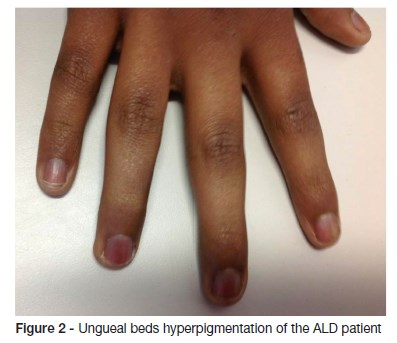
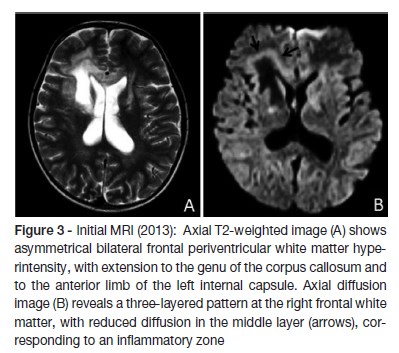
<body><![CDATA[<p>Childhood cerebral form is the most   devastating and rapidly progressive phenotype, commonly leading to total   disability in six months to two years followed by death at varying ages.<sup>4</sup>   It occurs in 37% of X-ALD cases and primarily affects boys.<sup>2,4</sup>   Presentation occurs, most frequently, between the ages of four and eight years.<sup>4</sup>   Typically they present learning disabilities and behavior problems, followed by   neurological deterioration that includes increasing cognitive and behavioral   abnormalities, blindness, deafness, cerebellar ataxia, seizures or spastic   tetraparesis. Brain Magnetic Resonance Imaging (MRI) classically demonstrates cerebral white matter demyelination in occipitoparietal region.<sup>5</sup></p>     <p>Adrenomyeloneuropathy usually   presents in young adults (second to fourth decade) and comprises approximately   40 to 45% of&nbsp;X-ALD cases.<sup>4</sup> The primary manifestation is spinal   cord dysfunction with progressive stiffness and weakness of the legs, abnormal   sphincter control, and sexual dysfunction.<sup>4 </sup>Cerebral demyelination can be present in about 40%-45% of cases.<sup>4</sup></p>     <p>Isolated adrenal insufficiency   (Addison disease only) can occur in 10% of X-ALD cases and may be present in   more than 50% of patients with cerebral X-ALD / AMN.<sup>6</sup> The signs of   high ACTH secretion may include unexplained vomiting, weakness, coma or   hyperpigmentation. X-ALD is a frequent cause of Addison’s disease (35%), particularly when circulating adrenocortical autoantibodies are absent.<sup>1</sup></p>     <p>Phenotypes are not static.<sup>1</sup>   Non-symptomatic patients are at risk of developing neurologic (cerebral X-ALD,   AMN) or endocrinologic (Addison’s disease) symptoms. The X-ALD severity and progression cannot be individually predicted.<sup>1</sup></p>     <p>The clinical history as well as the   findings of physical examination suggests the X-ALD diagnosis. The VLCFA panel   is highly sensitive for detecting X-ALD and is the appropriate first step in   diagnosis. If the initial screening shows high serum VLCFA levels, or abnormal   ratios of VLCFA, <i>ABCD1</i> gene analysis should be performed to accomplish the diagnosis.<sup>1,2</sup></p>     <p>There are few effective therapeutic   options for X-ALD patients. Hematopoietic stem cell transplantation (HCT) is   the only available therapeutic approach that can stop cerebral demyelination   and results in long term quality of life, provided the procedure is performed at an early stage of disease.<sup>7</sup></p>     <p>&nbsp;</p> </font>     <p><font size="3" face="Verdana"><b>CASE REPORT</b></font></p> <font face="Verdana" size="2">     <p>An eleven-year-old boy was referred to pediatric clinic care due to   generalized hyperpigmentation beginning at the age of six. Until he was ten, no   abnormal psycho-motor development or limited academic performance was   documented. Since then, concentration and memory deficit, as well as decreased   performance at school developed. Additionally, the boy presented hyperkinesia   and akathisia. Gastrointestinal complaints like nausea or vomiting were not   reported. No other relevant facts of his medical history were noticed. He was   the first child of unrelated healthy parents. Mild cutaneous hyperpigmentation was notice in a maternal uncle. </p>     <p>Examination findings revealed adynamia and generalized skin   hyperpigmentation, oral mucosa, palmar creases, ungueal beds and nipples.   (<a href="#f1">Figure 1</a> and <a href="#f2">2</a>) Growth parameters were normal for sex and age and the body   mass index was in the fifth percentile. His blood pressure was within normal   limits. Concerning his sexual development, he was in stage one of Tanner.   Neurological examination disclosed disturbed attention, unable to stay still,   apraxia and brisk reflexes. There were no other significant findings in the remainder of the clinical examination.</p>     ]]></body>
<body><![CDATA[<p><a name="f1"></a></p>     <p>&nbsp;</p>     <p align="center"><img src="/img/revistas/nas/v27n3/27n3a09f1.jpg" width="397" height="501"></p>     
<p>&nbsp;</p>     <p><a name="f2"></a></p>     <p>&nbsp;</p>     <p align="center"><img src="/img/revistas/nas/v27n3/27n3a09f2.jpg" width="397" height="343"></p>     
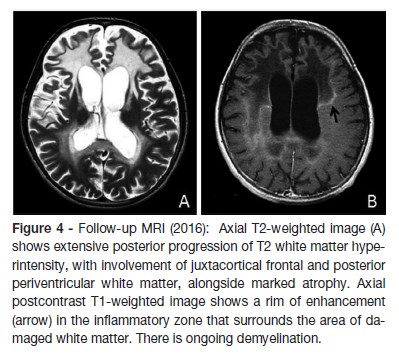
<p>&nbsp;</p>     <p>Laboratory results showed blood count,   electrolytes (sodium, potassium, calcium), liver and renal function within   normal limits. The decreased level of cortisol (1.5 nmol/L) and increased level   of adrenocorticotrohin hormone (ACTH - 2000 ng/dL) confirmed adrenal   insufficiency. The levels of renin and aldosterone were within normal range. The   quantification of very long chain fatty acid showed abnormally high levels,   compatible with a peroxisomal beta-oxidation disease: C26:0 0.97 &#956;g/ml (normal range 0.16 - 0.57); C24:0/C22:0 1.62   &#956;g/ml (normal range 0.63 - 1.10); C26:0/C22:0   0.078 &#956;g/ml (normal range 0.004 - 0.022). The   biochemical diagnosis was confirmed by molecular analysis: <i>ABCD1</i> gene   sequencing revealed the previously described c.1866-10G&gt;A (p.R622fs*16)   pathological variant in hemizygosity. Upper abdomen computed tomography scan   showed no structural abnormalities. Brain MRI showed bilateral periventricular   frontal white matter T2 hyperintensity (asymmetrical, with right predominance),   that extended to genu of the corpus callosum, to the anterior limb, to genu of   the internal capsules and to the anterior thalami. Right frontal   periventricular white matter involvement displayed a three-layered pattern with   an internal zone of high diffusibility and an intermediate rim of reduced diffusion, depicting ongoing inflammation/demyelination. (<a href="#f3">Figure 3</a>)</p>     <p><a name="f3"></a></p>     ]]></body>
<body><![CDATA[<p>&nbsp;</p>     <p align="center"><img src="/img/revistas/nas/v27n3/27n3a09f3.jpg" width="399" height="353"></p>     
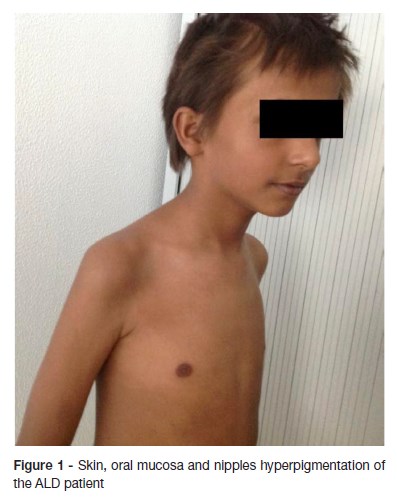
<p>&nbsp;</p>     <p>Treatment was started with glucocorticoid replacement (hydrocortisone in   increasing doses, maximum of 30mg/m<sup>2</sup> and fludrocortisone was added   to maximize results), diet therapy with decreased intake of fatty foods,   Lorenzo´s oil and physiotherapy. One year later, the Lorenzo´s oil was   suspended due to the development of a severe thrombocytopenia. After beginning   of this therapeutic approach he had an improvement in his general condition,   gait and skin color. Nevertheless he progressively developed dementia and pyramidal   syndrome. Three years after the diagnosis, he started seizures, some of them   difficult to control, with admission in pediatric intensive care unit due to   status epilepticus. Follow-up MRI showed extensive progression of T2 white   matter hyperintensity, with involvement of frontal justacortical and posterior   periventricular white matter, as well marked atrophy (<a href="#f4">Figure 4</a>). Four years   after the diagnosis, he is unable to fulfill orders, has poor social contact,   and restlessness when standing up. He presents language disturbances namely   echolalia. Eye contact and visual acuity remains normal and bilateral grasping and sucking are present. Epilepsy is controlled with three antiepileptic drugs.</p>     <p><a name="f4"></a></p>     <p>&nbsp;</p>     <p align="center"><img src="/img/revistas/nas/v27n3/27n3a09f4.jpg" width="399" height="361"></p>     
<p>&nbsp;</p>     <p>The family was referred for genetic counseling.</p>     <p>&nbsp;</p> </font>     ]]></body>
<body><![CDATA[<p><font size="3" face="Verdana"><b>DISCUSSION</b></font></p> <font face="Verdana" size="2">     <p>X-ALD is a   frequent cause of Addison’s disease in boys and adult males.<sup>8</sup>   Adrenocortical insufficiency can be its presenting symptom and occur years   before the onset of neurological manifestations.<sup>8</sup> The only symptom   related to the adrenocortical insufficiency present in this case was the   cutaneous darkening from the age of six, but it was overlooked due to family   clinical history of cutaneous hyperpigmentation.  Symptoms due to low cortisol levels, such as   weakness and hypotension, were not referred. Therefore, an early diagnosis of   adrenocortical insufficiency was hindered and even masked. Nonspecific   neurological presentation is common at the early stage of X-ALD disease and may   lead to a wrong and/or delayed diagnosis.<sup>4</sup> Typically the initial   phase is followed by impaired cognition, behavior, vision, hearing and motor   function. In the present case, one year before the diagnosis, learning   disabilities and behavior problems were indeed observed, reflecting the early   predominant involvement of the frontal lobe. The observation of dark cutaneous   and mucosal color associated with neurological symptoms first suggested X-ALD   disease, which was supported by high ACTH and low cortisol serum levels, and   confirmed by high VLCFA levels in plasma and a pathogenic mutation in the <i>ABCD1</i>   gene. The changes in MRI confirmed the cerebral involvement. Most patients with   cerebral X-ALD present posterior predominant periventricular white matter   demyelinating lesions, extending to the splenium of corpus callosum.<sup>5</sup>   Nevertheless, in 20% of the cases, initial demyelization occurs in the genu of   corpus callosum and then progresses symmetrically or asymmetrically to the periventricular frontal white matter, as occurred in this case.<sup>5</sup> </p>     <p>Treatment was based on corticosteroid   replacement therapy targeted to adrenal insufficiency, despite its lack of effect on the neurological abnormalities in X-ALD cases.<sup>9 </sup></p>     <p>Hematopoietic stem cell   transplantation (HCT) is the only available treatment that can arrest cerebral   demyelination of X-ALD in boys.<sup>7</sup> Best outcomes are obtained in   patients whose HCT is performed in an early stage of the disease and from a   related donor.<sup>7</sup> The ideal candidates for HCT are males with mild or   no neurological deficits and evidence of MRI cerebral involvement presented   early in their disease course.<sup>4 </sup>HCT is not recommended for boys   without MRI evidence of cerebral involvement, since many of them will remain   free of neurological disease, or in boys with advanced neurological disease,   given the scarce evidence of clinical improvement in these patients and the   significant morbidity and mortality of this procedure.<sup>4</sup> Only 30% of   patients who might benefit from a HCT will have a full human leukocyte antigene   (HLA) matched donor that is considered to be the best choice. For patients that   have no full HLA matched donor and need immediate treatment, transplantation of   haploidentical stem cells combined with the infusion of umbilical cord blood   can be an option.<sup>10</sup> The severity of neurological impairment and the   neuroimaging assessment presented in our patient was not in accordance with HCT recommendations.</p>     <p>Early results of an ongoing,   multicenter, phase 2-3 study, suggests that hematopoietic stem cell gene   therapy with a lentiviral vector is a safe and effective alternative to allogeneic HCT in an early stage of cerebral X-ALD.<sup>11</sup></p>     <p>Statins can reduce VLCFA level but   have no influence in neuronal and endocrine functions.<sup>12</sup> This therapeutic approach was not considered for our patient. </p>     <p>Oral administration of ‘Lorenzo’s   oil’, a 4:1 mixture of glyceryl trioleate and glyceryl trierucate, plus   moderate reduction of fat in the diet, can normalize the VLCFA levels in   plasma, however its clinical efficacy and clinical indications for its use have   been controversial for many years. Several studies concluded that there is no   clinically relevant benefit from dietary treatment with Lorenzo’s oil in both   asymptomatic and symptomatic patients.<sup>13,14</sup> However subsequently,   Moser and colleagues demonstrated in a cohort of 89 patients that Lorenzo’s oil   blunts the progress of X-ALD, but only if it is begun before the onset of   either MRI changes or neurological manifestations.<sup>15</sup> Due to the   adverse effects of Lorenzo’s oil, including thrombocytopenia and elevated liver   enzymes, its use requires a careful laboratory monitoring. In this case report,   although questionable, given the lack of therapeutic options and the expected   poor prognosis, a therapeutic trial was carried out being only interrupted one year later due to development of moderate thrombocytopenia.</p>     <p>Corticosteroid replacement improved   the boy´s strength, his well being and decreased the hyperpigmentation   although, as expected, it had no effect on cerebral disease.  Given the severity of neurological   involvement at diagnosis, there was no treatment that could stop and reverse   his neurological disease progression. Therefore, the child progressed to a dementia status and developed seizures.  </p>     <p>We aim, in this report, to   highlight the importance of an earlier diagnosis of this rare disease, not only   due to its severe morbidity and mortality, but also because early   treatment of this disorder can prevent its neurological progression. It is   therefore important to consider X-ALD in all the boys with Addison’s disease, especially if accompanied by neurological symptoms.</p>     <p>&nbsp;</p> </font>     ]]></body>
<body><![CDATA[<p><font size="3" face="Verdana"><b>REFERENCES</b></font></p> <font face="Verdana" size="2">     <!-- ref --><p>1. Engelen M,   Kemp S, Visser M <i>et al</i>. Clinical presentation and guidelines for   diagnosis, follow-up and management. Orphanet Journal of Rare Diseases 2012; 7:51-64.    &nbsp;&nbsp;&nbsp;&nbsp;&nbsp;&nbsp;&nbsp;&nbsp;[&#160;<a href="javascript:void(0);" onclick="javascript: window.open('/scielo.php?script=sci_nlinks&ref=1112212&pid=S0872-0754201800030000900001&lng=','','width=640,height=500,resizable=yes,scrollbars=1,menubar=yes,');">Links</a>&#160;]<!-- end-ref --></p>     <!-- ref --><p>2. Wiesinger   C,&nbsp;Eichler FS,&nbsp;Berger J. The genetic landscape of X-linked   adrenoleukodystrophy: inheritance, mutations, modifier genes, and diagnosis. Appl Clin Genet&nbsp;2015; 8:109-21.    &nbsp;&nbsp;&nbsp;&nbsp;&nbsp;&nbsp;&nbsp;&nbsp;[&#160;<a href="javascript:void(0);" onclick="javascript: window.open('/scielo.php?script=sci_nlinks&ref=1112214&pid=S0872-0754201800030000900002&lng=','','width=640,height=500,resizable=yes,scrollbars=1,menubar=yes,');">Links</a>&#160;]<!-- end-ref --></p>     <!-- ref --><p>3. Brett EM,&nbsp;Auchus RJ. Genetic forms of   adrenal insufficiency. Endocr Pract&nbsp;2015; 21:395-9.    &nbsp;&nbsp;&nbsp;&nbsp;&nbsp;&nbsp;&nbsp;&nbsp;[&#160;<a href="javascript:void(0);" onclick="javascript: window.open('/scielo.php?script=sci_nlinks&ref=1112216&pid=S0872-0754201800030000900003&lng=','','width=640,height=500,resizable=yes,scrollbars=1,menubar=yes,');">Links</a>&#160;]<!-- end-ref --></p>     <!-- ref --><p>4. Moser HW,   Moser AB, Steinberg SJ. X-linked adrenoleukodystrophy. GeneReviews. <a href="http://www.genetests.org" target="_blank">www.genetests.org</a>. (Last Update 09, 2015).    &nbsp;&nbsp;&nbsp;&nbsp;&nbsp;&nbsp;&nbsp;&nbsp;[&#160;<a href="javascript:void(0);" onclick="javascript: window.open('/scielo.php?script=sci_nlinks&ref=1112218&pid=S0872-0754201800030000900004&lng=','','width=640,height=500,resizable=yes,scrollbars=1,menubar=yes,');">Links</a>&#160;]<!-- end-ref --></p>     <!-- ref --><p>5. Van der Knaap   MS, Valk J: X-linked adrenoleukodystrophy. In: Magnetic Resonance of   Myelination and Myelin Disorders. Heilmann U (3rd edition). Berlin-Heidelberg-New York: Springer; 2005:176-90.    &nbsp;&nbsp;&nbsp;&nbsp;&nbsp;&nbsp;&nbsp;&nbsp;[&#160;<a href="javascript:void(0);" onclick="javascript: window.open('/scielo.php?script=sci_nlinks&ref=1112220&pid=S0872-0754201800030000900005&lng=','','width=640,height=500,resizable=yes,scrollbars=1,menubar=yes,');">Links</a>&#160;]<!-- end-ref --></p>     <!-- ref --><p>6. Ronghe MD,   Barton J, Jardine PE <i>et al</i>. The importance of testing for   adrenoleucodystrophy in males with idiopathic Addison’s disease. Arch Dis Child 2002; 86:185-9.    &nbsp;&nbsp;&nbsp;&nbsp;&nbsp;&nbsp;&nbsp;&nbsp;[&#160;<a href="javascript:void(0);" onclick="javascript: window.open('/scielo.php?script=sci_nlinks&ref=1112222&pid=S0872-0754201800030000900006&lng=','','width=640,height=500,resizable=yes,scrollbars=1,menubar=yes,');">Links</a>&#160;]<!-- end-ref --></p>     <!-- ref --><p>7. Saute JA,   Souza CF, Poswar FO, Donis KC, Campos LG, Deyl AV, <i>et al</i>. Neurological   outcomes after hematopoietic stem cell transplantation for cerebral X-linked   adrenoleukodystrophy, late onset metachromatic leukodystrophy and Hurler syndrome. Arq Neuropsiquiatr 2016; 74:953-66.    &nbsp;&nbsp;&nbsp;&nbsp;&nbsp;&nbsp;&nbsp;&nbsp;[&#160;<a href="javascript:void(0);" onclick="javascript: window.open('/scielo.php?script=sci_nlinks&ref=1112224&pid=S0872-0754201800030000900007&lng=','','width=640,height=500,resizable=yes,scrollbars=1,menubar=yes,');">Links</a>&#160;]<!-- end-ref --></p>     <!-- ref --><p>8. Laureti   S,&nbsp;Casucci G,&nbsp;Santeusanio F,&nbsp;Angeletti G,&nbsp;Aubourg P,&nbsp;Brunetti   P. X-linked adrenoleukodystrophy is a frequent cause of idiopathic Addison’s disease in young adult male patients. J Clin Endocrinol Metab 1996; 81:470-4.    &nbsp;&nbsp;&nbsp;&nbsp;&nbsp;&nbsp;&nbsp;&nbsp;[&#160;<a href="javascript:void(0);" onclick="javascript: window.open('/scielo.php?script=sci_nlinks&ref=1112226&pid=S0872-0754201800030000900008&lng=','','width=640,height=500,resizable=yes,scrollbars=1,menubar=yes,');">Links</a>&#160;]<!-- end-ref --></p>     <!-- ref --><p>9. Berger J,   Pujol A, Aubourg P, Forss-Petter S. Current and Future Pharmacological   Treatment Strategies in X Linked Adrenoleukodystrophy. Brain Pathol. 2010; 20:845-56.    &nbsp;&nbsp;&nbsp;&nbsp;&nbsp;&nbsp;&nbsp;&nbsp;[&#160;<a href="javascript:void(0);" onclick="javascript: window.open('/scielo.php?script=sci_nlinks&ref=1112228&pid=S0872-0754201800030000900009&lng=','','width=640,height=500,resizable=yes,scrollbars=1,menubar=yes,');">Links</a>&#160;]<!-- end-ref --></p>     <!-- ref --><p>10. Jiang H, Jiang MY, Liu S, Cai YN, Liang   CL, Liu L. Combination of a Haploidentical Stem Cell Transplant With Umbilical Cord Blood for Cerebral X-Linked&nbsp;Adrenoleukodystrophy. Pediatr Neurol&nbsp;2015; 53:163-5.    &nbsp;&nbsp;&nbsp;&nbsp;&nbsp;&nbsp;&nbsp;&nbsp;[&#160;<a href="javascript:void(0);" onclick="javascript: window.open('/scielo.php?script=sci_nlinks&ref=1112230&pid=S0872-0754201800030000900010&lng=','','width=640,height=500,resizable=yes,scrollbars=1,menubar=yes,');">Links</a>&#160;]<!-- end-ref --></p>     <!-- ref --><p>11. Eichler F,   Duncan C, Musolino PL, Orchard PJ, Oliveira S, Thrasher AJ et al. Hematopoietic   Stem-Cell Gene Therapy for Cerebral Adrenoleukodystrophy. N Engl J Med 2017; 377: 1630-8.    &nbsp;&nbsp;&nbsp;&nbsp;&nbsp;&nbsp;&nbsp;&nbsp;[&#160;<a href="javascript:void(0);" onclick="javascript: window.open('/scielo.php?script=sci_nlinks&ref=1112232&pid=S0872-0754201800030000900011&lng=','','width=640,height=500,resizable=yes,scrollbars=1,menubar=yes,');">Links</a>&#160;]<!-- end-ref --></p>     <!-- ref --><p>12. Engelen M,   Ofman R, Dijkgraaf MG, <i>et al</i>. Lovastatin in X-linked adrenoleukodystrophy. N Engl J Med 2010; 362:276-7.    &nbsp;&nbsp;&nbsp;&nbsp;&nbsp;&nbsp;&nbsp;&nbsp;[&#160;<a href="javascript:void(0);" onclick="javascript: window.open('/scielo.php?script=sci_nlinks&ref=1112234&pid=S0872-0754201800030000900012&lng=','','width=640,height=500,resizable=yes,scrollbars=1,menubar=yes,');">Links</a>&#160;]<!-- end-ref --></p>     <!-- ref --><p>13. Aubourg P,   Adamsbaum C, Lavallard-Rousseau MC, Rocchiccioli F, Cartier N, Jambaqué I, <i>et     al.</i> A two-year trial of oleic and erucic acids (“Lorenzo’s oil”) as treatment for adrenomyeloneuropathy. N Engl J Med 1993; 329:745-52.    &nbsp;&nbsp;&nbsp;&nbsp;&nbsp;&nbsp;&nbsp;&nbsp;[&#160;<a href="javascript:void(0);" onclick="javascript: window.open('/scielo.php?script=sci_nlinks&ref=1112236&pid=S0872-0754201800030000900013&lng=','','width=640,height=500,resizable=yes,scrollbars=1,menubar=yes,');">Links</a>&#160;]<!-- end-ref --></p>     <!-- ref --><p>14. van Geel BM,   Assies J, Haverkort EB, Koelman JH, Verbeeten B Jr, Wanders RJ, <i>et al.</i>   Progression of abnormalities in adrenomyeloneuropathy and neurologically   asymptomatic X linked adrenoleukodystrophy despite treatment with “Lorenzo’s oil”. J Neurol Neurosurg Psychiatry 1999; 67:290-9.    &nbsp;&nbsp;&nbsp;&nbsp;&nbsp;&nbsp;&nbsp;&nbsp;[&#160;<a href="javascript:void(0);" onclick="javascript: window.open('/scielo.php?script=sci_nlinks&ref=1112238&pid=S0872-0754201800030000900014&lng=','','width=640,height=500,resizable=yes,scrollbars=1,menubar=yes,');">Links</a>&#160;]<!-- end-ref --></p>     <!-- ref --><p>15. Moser HW,   Raymond GV, Lu SE, Muenz LR, Moser AB, Xu J, <i>et al.</i> Follow-up of 89   asymptomatic patients with adrenoleukodystrophy treated with Lorenzo’s oil. Arch Neurol 2005; 62:1073-80.    &nbsp;&nbsp;&nbsp;&nbsp;&nbsp;&nbsp;&nbsp;&nbsp;[&#160;<a href="javascript:void(0);" onclick="javascript: window.open('/scielo.php?script=sci_nlinks&ref=1112240&pid=S0872-0754201800030000900015&lng=','','width=640,height=500,resizable=yes,scrollbars=1,menubar=yes,');">Links</a>&#160;]<!-- end-ref --></p>     <p>&nbsp;</p>     <p>&nbsp;</p> <b><a name="end" id="topo2"></a><a href="#topo">CORRESPONDENCE TO</a></b>     <p>Clara Preto    <br>   Department of Pediatrics    <br>   Centro Hospitalar de Trás-os-Montes   e Alto Douro    <br>   Avenida Noruega    <br>   5000-508 Vila Real    <br> Email: <a href="mailto:clarampreto@hotmail.com">clarampreto@hotmail.com</a></p>     <p>Received   for publication: 06.08.2017    ]]></body>
<body><![CDATA[<br> Accepted in revised form: 20.11.2017</p> </font>      ]]></body><back>
<ref-list>
<ref id="B1">
<label>1</label><nlm-citation citation-type="journal">
<person-group person-group-type="author">
<name>
<surname><![CDATA[Engelen]]></surname>
<given-names><![CDATA[M]]></given-names>
</name>
<name>
<surname><![CDATA[Kemp]]></surname>
<given-names><![CDATA[S]]></given-names>
</name>
<name>
<surname><![CDATA[Visser]]></surname>
<given-names><![CDATA[M]]></given-names>
</name>
</person-group>
<article-title xml:lang="en"><![CDATA[Clinical presentation and guidelines for diagnosis, follow-up and management]]></article-title>
<source><![CDATA[Orphanet Journal of Rare Diseases]]></source>
<year>2012</year>
<volume>7</volume>
<page-range>51-64</page-range></nlm-citation>
</ref>
<ref id="B2">
<label>2</label><nlm-citation citation-type="journal">
<person-group person-group-type="author">
<name>
<surname><![CDATA[Wiesinger]]></surname>
<given-names><![CDATA[C]]></given-names>
</name>
<name>
<surname><![CDATA[Eichler]]></surname>
<given-names><![CDATA[FS]]></given-names>
</name>
<name>
<surname><![CDATA[Berger]]></surname>
<given-names><![CDATA[J]]></given-names>
</name>
</person-group>
<article-title xml:lang="en"><![CDATA[The genetic landscape of X-linked adrenoleukodystrophy: inheritance, mutations, modifier genes, and diagnosis]]></article-title>
<source><![CDATA[Appl Clin Genet]]></source>
<year>2015</year>
<volume>8</volume>
<page-range>109-21</page-range></nlm-citation>
</ref>
<ref id="B3">
<label>3</label><nlm-citation citation-type="journal">
<person-group person-group-type="author">
<name>
<surname><![CDATA[Brett]]></surname>
<given-names><![CDATA[EM]]></given-names>
</name>
<name>
<surname><![CDATA[Auchus]]></surname>
<given-names><![CDATA[RJ]]></given-names>
</name>
</person-group>
<article-title xml:lang="en"><![CDATA[Genetic forms of adrenal insufficiency]]></article-title>
<source><![CDATA[Endocr Pract]]></source>
<year>2015</year>
<volume>21</volume>
<page-range>395-9</page-range></nlm-citation>
</ref>
<ref id="B4">
<label>4</label><nlm-citation citation-type="journal">
<person-group person-group-type="author">
<name>
<surname><![CDATA[Moser]]></surname>
<given-names><![CDATA[HW]]></given-names>
</name>
<name>
<surname><![CDATA[Moser]]></surname>
<given-names><![CDATA[AB]]></given-names>
</name>
<name>
<surname><![CDATA[Steinberg]]></surname>
<given-names><![CDATA[SJ]]></given-names>
</name>
</person-group>
<article-title xml:lang="en"><![CDATA[X-linked adrenoleukodystrophy]]></article-title>
<source><![CDATA[GeneReviews]]></source>
<year></year>
</nlm-citation>
</ref>
<ref id="B5">
<label>5</label><nlm-citation citation-type="book">
<person-group person-group-type="author">
<name>
<surname><![CDATA[Van der Knaap]]></surname>
<given-names><![CDATA[MS]]></given-names>
</name>
<name>
<surname><![CDATA[Valk]]></surname>
<given-names><![CDATA[J]]></given-names>
</name>
</person-group>
<article-title xml:lang="en"><![CDATA[X-linked adrenoleukodystrophy]]></article-title>
<person-group person-group-type="editor">
<name>
<surname><![CDATA[Heilmann]]></surname>
<given-names><![CDATA[U]]></given-names>
</name>
</person-group>
<source><![CDATA[Magnetic Resonance of Myelination and Myelin Disorders]]></source>
<year>2005</year>
<edition>3</edition>
<page-range>176-90</page-range><publisher-loc><![CDATA[Berlin-Heidelberg-New York ]]></publisher-loc>
<publisher-name><![CDATA[Springer]]></publisher-name>
</nlm-citation>
</ref>
<ref id="B6">
<label>6</label><nlm-citation citation-type="journal">
<person-group person-group-type="author">
<name>
<surname><![CDATA[Ronghe]]></surname>
<given-names><![CDATA[MD]]></given-names>
</name>
<name>
<surname><![CDATA[Barton]]></surname>
<given-names><![CDATA[J]]></given-names>
</name>
<name>
<surname><![CDATA[Jardine]]></surname>
<given-names><![CDATA[PE]]></given-names>
</name>
</person-group>
<article-title xml:lang="en"><![CDATA[The importance of testing for adrenoleucodystrophy in males with idiopathic Addison’s disease]]></article-title>
<source><![CDATA[Arch Dis Child]]></source>
<year>2002</year>
<volume>86</volume>
<page-range>185-9</page-range></nlm-citation>
</ref>
<ref id="B7">
<label>7</label><nlm-citation citation-type="journal">
<person-group person-group-type="author">
<name>
<surname><![CDATA[Saute]]></surname>
<given-names><![CDATA[JA]]></given-names>
</name>
<name>
<surname><![CDATA[Souza]]></surname>
<given-names><![CDATA[CF]]></given-names>
</name>
<name>
<surname><![CDATA[Poswar]]></surname>
<given-names><![CDATA[FO]]></given-names>
</name>
<name>
<surname><![CDATA[Donis]]></surname>
<given-names><![CDATA[KC]]></given-names>
</name>
<name>
<surname><![CDATA[Campos]]></surname>
<given-names><![CDATA[LG]]></given-names>
</name>
<name>
<surname><![CDATA[Deyl]]></surname>
<given-names><![CDATA[AV]]></given-names>
</name>
</person-group>
<article-title xml:lang="en"><![CDATA[Neurological outcomes after hematopoietic stem cell transplantation for cerebral X-linked adrenoleukodystrophy, late onset metachromatic leukodystrophy and Hurler syndrome]]></article-title>
<source><![CDATA[Arq Neuropsiquiatr]]></source>
<year>2016</year>
<volume>74</volume>
<page-range>953-66</page-range></nlm-citation>
</ref>
<ref id="B8">
<label>8</label><nlm-citation citation-type="journal">
<person-group person-group-type="author">
<name>
<surname><![CDATA[Laureti]]></surname>
<given-names><![CDATA[S]]></given-names>
</name>
<name>
<surname><![CDATA[Casucci]]></surname>
<given-names><![CDATA[G]]></given-names>
</name>
<name>
<surname><![CDATA[Santeusanio]]></surname>
<given-names><![CDATA[F]]></given-names>
</name>
<name>
<surname><![CDATA[Angeletti]]></surname>
<given-names><![CDATA[G]]></given-names>
</name>
<name>
<surname><![CDATA[Aubourg]]></surname>
<given-names><![CDATA[P]]></given-names>
</name>
<name>
<surname><![CDATA[Brunetti]]></surname>
<given-names><![CDATA[P]]></given-names>
</name>
</person-group>
<article-title xml:lang="en"><![CDATA[X-linked adrenoleukodystrophy is a frequent cause of idiopathic Addison’s disease in young adult male patients]]></article-title>
<source><![CDATA[J Clin Endocrinol Metab]]></source>
<year>1996</year>
<volume>81</volume>
<page-range>470-4</page-range></nlm-citation>
</ref>
<ref id="B9">
<label>9</label><nlm-citation citation-type="journal">
<person-group person-group-type="author">
<name>
<surname><![CDATA[Berger]]></surname>
<given-names><![CDATA[J]]></given-names>
</name>
<name>
<surname><![CDATA[Pujol]]></surname>
<given-names><![CDATA[A]]></given-names>
</name>
<name>
<surname><![CDATA[Aubourg]]></surname>
<given-names><![CDATA[P]]></given-names>
</name>
<name>
<surname><![CDATA[Forss-Petter]]></surname>
<given-names><![CDATA[S]]></given-names>
</name>
</person-group>
<article-title xml:lang="en"><![CDATA[Current and Future Pharmacological Treatment Strategies in X Linked Adrenoleukodystrophy]]></article-title>
<source><![CDATA[Brain Pathol]]></source>
<year>2010</year>
<volume>20</volume>
<page-range>845-56</page-range></nlm-citation>
</ref>
<ref id="B10">
<label>10</label><nlm-citation citation-type="journal">
<person-group person-group-type="author">
<name>
<surname><![CDATA[Jiang]]></surname>
<given-names><![CDATA[H]]></given-names>
</name>
<name>
<surname><![CDATA[Jiang]]></surname>
<given-names><![CDATA[MY]]></given-names>
</name>
<name>
<surname><![CDATA[Liu]]></surname>
<given-names><![CDATA[S]]></given-names>
</name>
<name>
<surname><![CDATA[Cai]]></surname>
<given-names><![CDATA[YN]]></given-names>
</name>
<name>
<surname><![CDATA[Liang]]></surname>
<given-names><![CDATA[CL]]></given-names>
</name>
<name>
<surname><![CDATA[Liu]]></surname>
<given-names><![CDATA[L]]></given-names>
</name>
</person-group>
<article-title xml:lang="en"><![CDATA[Combination of a Haploidentical Stem Cell Transplant With Umbilical Cord Blood for Cerebral X-Linked Adrenoleukodystrophy]]></article-title>
<source><![CDATA[Pediatr Neurol]]></source>
<year>2015</year>
<volume>53</volume>
<page-range>163-5</page-range></nlm-citation>
</ref>
<ref id="B11">
<label>11</label><nlm-citation citation-type="journal">
<person-group person-group-type="author">
<name>
<surname><![CDATA[Eichler]]></surname>
<given-names><![CDATA[F]]></given-names>
</name>
<name>
<surname><![CDATA[Duncan]]></surname>
<given-names><![CDATA[C]]></given-names>
</name>
<name>
<surname><![CDATA[Musolino]]></surname>
<given-names><![CDATA[PL]]></given-names>
</name>
<name>
<surname><![CDATA[Orchard]]></surname>
<given-names><![CDATA[PJ]]></given-names>
</name>
<name>
<surname><![CDATA[Oliveira]]></surname>
<given-names><![CDATA[S]]></given-names>
</name>
<name>
<surname><![CDATA[Thrasher]]></surname>
<given-names><![CDATA[AJ]]></given-names>
</name>
</person-group>
<article-title xml:lang="en"><![CDATA[Hematopoietic Stem-Cell Gene Therapy for Cerebral Adrenoleukodystrophy]]></article-title>
<source><![CDATA[N Engl J Med]]></source>
<year>2017</year>
<volume>377</volume>
<page-range>1630-8</page-range></nlm-citation>
</ref>
<ref id="B12">
<label>12</label><nlm-citation citation-type="journal">
<person-group person-group-type="author">
<name>
<surname><![CDATA[Engelen]]></surname>
<given-names><![CDATA[M]]></given-names>
</name>
<name>
<surname><![CDATA[Ofman]]></surname>
<given-names><![CDATA[R]]></given-names>
</name>
<name>
<surname><![CDATA[Dijkgraaf]]></surname>
<given-names><![CDATA[MG]]></given-names>
</name>
</person-group>
<article-title xml:lang="en"><![CDATA[Lovastatin in X-linked adrenoleukodystrophy]]></article-title>
<source><![CDATA[N Engl J Med]]></source>
<year>2010</year>
<volume>362</volume>
<page-range>276-7</page-range></nlm-citation>
</ref>
<ref id="B13">
<label>13</label><nlm-citation citation-type="journal">
<person-group person-group-type="author">
<name>
<surname><![CDATA[Aubourg]]></surname>
<given-names><![CDATA[P]]></given-names>
</name>
<name>
<surname><![CDATA[Adamsbaum]]></surname>
<given-names><![CDATA[C]]></given-names>
</name>
<name>
<surname><![CDATA[Lavallard-Rousseau]]></surname>
<given-names><![CDATA[MC]]></given-names>
</name>
<name>
<surname><![CDATA[Rocchiccioli]]></surname>
<given-names><![CDATA[F]]></given-names>
</name>
<name>
<surname><![CDATA[Cartier]]></surname>
<given-names><![CDATA[N]]></given-names>
</name>
<name>
<surname><![CDATA[Jambaqué]]></surname>
<given-names><![CDATA[I]]></given-names>
</name>
</person-group>
<article-title xml:lang="en"><![CDATA[A two-year trial of oleic and erucic acids (“Lorenzo’s oil”) as treatment for adrenomyeloneuropathy]]></article-title>
<source><![CDATA[N Engl J Med]]></source>
<year>1993</year>
<volume>329</volume>
<page-range>745-52</page-range></nlm-citation>
</ref>
<ref id="B14">
<label>14</label><nlm-citation citation-type="journal">
<person-group person-group-type="author">
<name>
<surname><![CDATA[van Geel]]></surname>
<given-names><![CDATA[BM]]></given-names>
</name>
<name>
<surname><![CDATA[Assies]]></surname>
<given-names><![CDATA[J]]></given-names>
</name>
<name>
<surname><![CDATA[Haverkort]]></surname>
<given-names><![CDATA[EB]]></given-names>
</name>
<name>
<surname><![CDATA[Koelman]]></surname>
<given-names><![CDATA[JH]]></given-names>
</name>
<name>
<surname><![CDATA[Verbeeten]]></surname>
<given-names><![CDATA[B Jr]]></given-names>
</name>
<name>
<surname><![CDATA[Wanders]]></surname>
<given-names><![CDATA[RJ]]></given-names>
</name>
</person-group>
<article-title xml:lang="en"><![CDATA[Progression of abnormalities in adrenomyeloneuropathy and neurologically asymptomatic X linked adrenoleukodystrophy despite treatment with “Lorenzo’s oil”]]></article-title>
<source><![CDATA[J Neurol Neurosurg Psychiatry]]></source>
<year>1999</year>
<volume>67</volume>
<page-range>290-9</page-range></nlm-citation>
</ref>
<ref id="B15">
<label>15</label><nlm-citation citation-type="journal">
<person-group person-group-type="author">
<name>
<surname><![CDATA[Moser]]></surname>
<given-names><![CDATA[HW]]></given-names>
</name>
<name>
<surname><![CDATA[Raymond]]></surname>
<given-names><![CDATA[GV]]></given-names>
</name>
<name>
<surname><![CDATA[Lu]]></surname>
<given-names><![CDATA[SE]]></given-names>
</name>
<name>
<surname><![CDATA[Muenz]]></surname>
<given-names><![CDATA[LR]]></given-names>
</name>
<name>
<surname><![CDATA[Moser]]></surname>
<given-names><![CDATA[AB]]></given-names>
</name>
<name>
<surname><![CDATA[Xu]]></surname>
<given-names><![CDATA[J]]></given-names>
</name>
</person-group>
<article-title xml:lang="en"><![CDATA[Follow-up of 89 asymptomatic patients with adrenoleukodystrophy treated with Lorenzo’s oil]]></article-title>
<source><![CDATA[Arch Neurol]]></source>
<year>2005</year>
<volume>62</volume>
<page-range>1073-80</page-range></nlm-citation>
</ref>
</ref-list>
</back>
</article>