<?xml version="1.0" encoding="ISO-8859-1"?><article xmlns:mml="http://www.w3.org/1998/Math/MathML" xmlns:xlink="http://www.w3.org/1999/xlink" xmlns:xsi="http://www.w3.org/2001/XMLSchema-instance">
<front>
<journal-meta>
<journal-id>0872-0754</journal-id>
<journal-title><![CDATA[Nascer e Crescer]]></journal-title>
<abbrev-journal-title><![CDATA[Nascer e Crescer]]></abbrev-journal-title>
<issn>0872-0754</issn>
<publisher>
<publisher-name><![CDATA[Centro Hospitalar do Porto]]></publisher-name>
</publisher>
</journal-meta>
<article-meta>
<article-id>S0872-07542018000300010</article-id>
<article-id pub-id-type="doi">10.25753/BirthGrowthMJ.v27.i3.10562</article-id>
<title-group>
<article-title xml:lang="en"><![CDATA[Spondylodiscitis in pediatric age: a diagnostic challenge]]></article-title>
<article-title xml:lang="pt"><![CDATA[Espondilodiscite em idade pediátrica: um desafio diagnóstico]]></article-title>
</title-group>
<contrib-group>
<contrib contrib-type="author">
<name>
<surname><![CDATA[Ferreira]]></surname>
<given-names><![CDATA[Joana]]></given-names>
</name>
<xref ref-type="aff" rid="A01"/>
</contrib>
<contrib contrib-type="author">
<name>
<surname><![CDATA[Alves]]></surname>
<given-names><![CDATA[Marta]]></given-names>
</name>
<xref ref-type="aff" rid="A01"/>
</contrib>
<contrib contrib-type="author">
<name>
<surname><![CDATA[Rebelo]]></surname>
<given-names><![CDATA[Alícia]]></given-names>
</name>
<xref ref-type="aff" rid="A01"/>
</contrib>
<contrib contrib-type="author">
<name>
<surname><![CDATA[Simão]]></surname>
<given-names><![CDATA[Teresa São]]></given-names>
</name>
<xref ref-type="aff" rid="A01"/>
</contrib>
<contrib contrib-type="author">
<name>
<surname><![CDATA[Tavares]]></surname>
<given-names><![CDATA[Cláudia]]></given-names>
</name>
<xref ref-type="aff" rid="A01"/>
</contrib>
<contrib contrib-type="author">
<name>
<surname><![CDATA[Ferreira]]></surname>
<given-names><![CDATA[Cristina]]></given-names>
</name>
<xref ref-type="aff" rid="A01"/>
</contrib>
</contrib-group>
<aff id="A01">
<institution><![CDATA[,Hospital Senhora da Oliveira Department of Pediatrics ]]></institution>
<addr-line><![CDATA[Guimarães ]]></addr-line>
<country>Portugal</country>
</aff>
<pub-date pub-type="pub">
<day>01</day>
<month>09</month>
<year>2018</year>
</pub-date>
<pub-date pub-type="epub">
<day>01</day>
<month>09</month>
<year>2018</year>
</pub-date>
<volume>27</volume>
<numero>3</numero>
<fpage>196</fpage>
<lpage>202</lpage>
<copyright-statement/>
<copyright-year/>
<self-uri xlink:href="http://scielo.pt/scielo.php?script=sci_arttext&amp;pid=S0872-07542018000300010&amp;lng=en&amp;nrm=iso"></self-uri><self-uri xlink:href="http://scielo.pt/scielo.php?script=sci_abstract&amp;pid=S0872-07542018000300010&amp;lng=en&amp;nrm=iso"></self-uri><self-uri xlink:href="http://scielo.pt/scielo.php?script=sci_pdf&amp;pid=S0872-07542018000300010&amp;lng=en&amp;nrm=iso"></self-uri><abstract abstract-type="short" xml:lang="en"><p><![CDATA[Spondylodiscitis is an inflammatory process of the intervertebral disc and the adjacent vertebral endplates and mainly involves the lumbar spine. Clinical suspicion is not raised in most instances, often resulting in difficult and delayed diagnosis. The onset may be insidious and clinical signs can be mild and unspecific. This is also true with laboratory tests, which often remain within the normal range. Refusal to walk and back pain are the main symptoms, and magnetic resonance imaging of the spine is the gold standard for the diagnosis. The duration and type of treatment are controversial, but the use of antimicrobial therapy together with rest and immobilization showed good results in specific cases, leading to a progressive recovery. We describe a previously healthy two-year old boy with spondylodiscitis, in whom no direct infectious pathogen was identified. We discuss the clinical features, laboratory findings, as well as the outcome of this clinical entity based on a review of the reported cases.]]></p></abstract>
<abstract abstract-type="short" xml:lang="pt"><p><![CDATA[A espondilodiscite é um processo inflamatório do disco intervertebral e da superfície dos corpos vertebrais com predileção pela região lombar. Do ponto de vista clínico e laboratorial é uma doença com achados inespecíficos, o que pode resultar em dificuldades e atrasos no diagnóstico se não existir uma elevada suspeição clínica. A recusa da marcha e a dor lombar são os principais sintomas, sendo a ressonância magnética da coluna o ideal para o diagnóstico. A etiologia e o tratamento ainda não são consensuais. O uso de antibióticos, juntamente com o repouso e a imobilização da coluna vertebral têm-se associado, na maioria dos casos, a uma evolução clínica favorável. Apresenta-se o caso de uma criança com dois anos de idade, previamente saudável, com espondilodiscite sem agente patogénico direto identificado e discute-se a apresentação clínica, as alterações nos exames laboratoriais, bem como a evolução desta entidade com base numa revisão da literatura.]]></p></abstract>
<kwd-group>
<kwd lng="en"><![CDATA[Back pain]]></kwd>
<kwd lng="en"><![CDATA[discitis]]></kwd>
<kwd lng="en"><![CDATA[spondylodiscitis]]></kwd>
<kwd lng="en"><![CDATA[vertebral infection]]></kwd>
<kwd lng="pt"><![CDATA[Discite]]></kwd>
<kwd lng="pt"><![CDATA[espondilodiscite]]></kwd>
<kwd lng="pt"><![CDATA[infeção vertebral]]></kwd>
<kwd lng="pt"><![CDATA[lombalgia]]></kwd>
</kwd-group>
</article-meta>
</front><body><![CDATA[ <p align="right"><font face="Verdana" size="2">    <b>CASE REPORTS | CASOS CL&Iacute;NICOS</b></font></p>     <p align="right">&nbsp;</p>     <p><font size="4" face="Verdana"><b>Spondylodiscitis   in pediatric age – a diagnostic challenge</b></font></p> <font face="Verdana" size="2">     <p>&nbsp;</p> </font><font size="3" face="Verdana"><b>Espondilodiscite em idade pedi&aacute;trica &ndash; um desafio diagn&oacute;stico</b></font><font face="Verdana" size="2">     <p>&nbsp;</p>     <p>&nbsp;</p>     <p><b>Joana Ferreira<sup>I</sup>,   Marta Alves<sup>I</sup>, Alícia Rebelo<sup>I</sup>, Teresa São Simão<sup>I</sup>,   Cláudia Tavares<sup>I</sup>, Cristina Ferreira<sup>I</sup></b></p>     <p><sup>I</sup> Department of Pediatrics, Hospital Senhora da   Oliveira – Guimarães. 4835-025 Guimarães, Portugal. <a href="mailto:joanaferreira.med@gmail.com">joanaferreira.med@gmail.com</a>;   <a href="mailto:martasfariaalves@gmail.com">martasfariaalves@gmail.com</a>; <a href="mailto:aliciarebelo88@gmail.com">aliciarebelo88@gmail.com</a>;   <a href="mailto:teresinhaped@gmail.com">teresinhaped@gmail.com</a>; <a href="mailto:anapediatra@gmail.com">anapediatra@gmail.com</a>; <a href="mailto:crispediatra@gmail.com">crispediatra@gmail.com</a></p> <a href="#end">Correspondence to</a><a name="topo" id="topo"></a>     <p>&nbsp;</p>     <p>&nbsp;</p> </font> <hr noshade size="1"> <font face="Verdana" size="2">     ]]></body>
<body><![CDATA[<p><b>ABSTRACT</b></p>     <p>Spondylodiscitis   is an inflammatory process of the intervertebral disc and the adjacent   vertebral endplates and mainly involves the lumbar spine. Clinical suspicion is   not raised in most instances, often resulting in difficult and delayed   diagnosis. The onset may be insidious and clinical signs can be mild and   unspecific. This is also true with laboratory tests, which often remain within   the normal range. Refusal to walk and back pain are the main symptoms, and   magnetic resonance imaging of the spine is the gold standard for the diagnosis.   The duration and type of treatment are controversial, but the use of   antimicrobial therapy together with rest and immobilization showed good results in specific cases, leading to a progressive recovery. </p>     <p>We describe a previously healthy   two-year old boy with spondylodiscitis, in whom no direct infectious pathogen   was identified. We discuss the clinical features, laboratory findings, as well as the outcome of this clinical entity based on a review of the reported cases.</p>     <p><b>Keywords: </b>Back pain; discitis; spondylodiscitis; vertebral infection</p> </font> <hr noshade size="1"> <font face="Verdana" size="2">     <p><b>RESUMO</b></p>     <p>A espondilodiscite é um processo   inflamatório do disco intervertebral e da superfície dos corpos vertebrais com predileção pela região lombar.</p>     <p>Do ponto de vista clínico e   laboratorial é uma doença com achados inespecíficos, o que pode resultar em   dificuldades e atrasos no diagnóstico se não existir uma elevada suspeição   clínica. A recusa da marcha e a dor lombar são os principais sintomas, sendo a   ressonância magnética da coluna o ideal para o diagnóstico. A etiologia e o   tratamento ainda não são consensuais. O uso de antibióticos, juntamente com o   repouso e a imobilização da coluna vertebral têm-se associado, na maioria dos casos, a uma evolução clínica favorável.</p>     <p>Apresenta-se o caso de uma criança   com dois anos de idade, previamente saudável, com espondilodiscite sem agente   patogénico direto identificado e discute-se a apresentação clínica, as   alterações nos exames laboratoriais, bem como a evolução desta entidade com base numa revisão da literatura. </p>     <p><b>Palavras-chave</b>: Discite; espondilodiscite; infeção vertebral; lombalgia</p> </font> <hr noshade size="1"> <font face="Verdana" size="2">     <p>&nbsp;</p>     ]]></body>
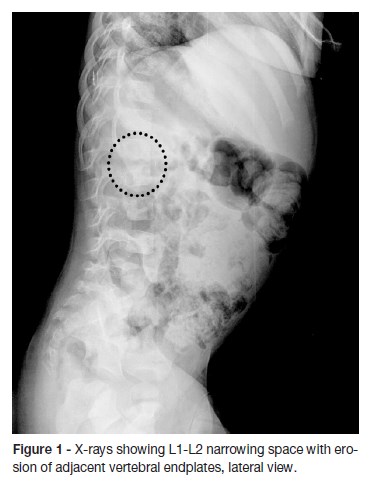
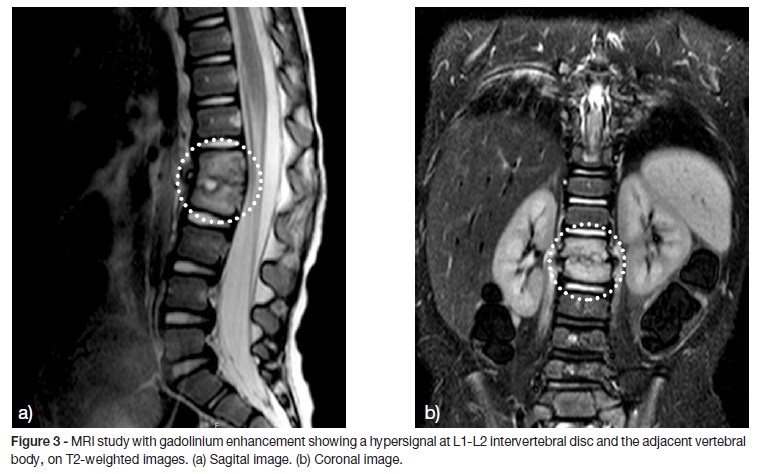
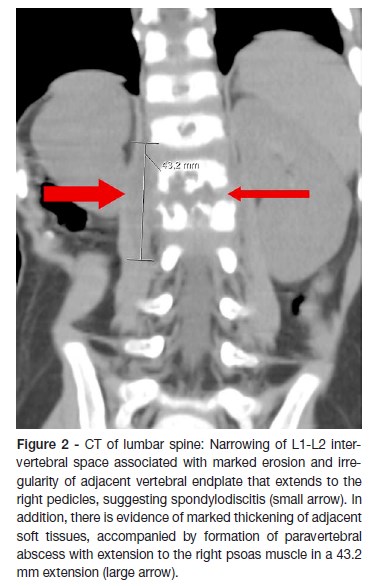
<body><![CDATA[<p>&nbsp;</p> </font>     <p><font size="3" face="Verdana"><b>INTRODUCTION</b></font></p> <font face="Verdana" size="2">     <p>Pyogenic infection of the spine was   first reported by Lannelongue in 1879, however spondylodiscitis was not defined as an independent entity until 1925, by Mayer.<sup>1,2</sup> </p>     <p>The term spondylodiscitis covers   vertebral osteomyelitis, spondylitis and discitis, which are different   manifestations of the same pathological process.<sup>1-5</sup> It is an   uncommon disorder with an estimated incidence ranging from one to two cases per   32.500 pediatric hospital evaluations per year.<sup>1-6</sup> The average age   for the diagnosis in children is approximately two to eight years, although   some cases can occur in adolescence.<sup>1,7-9 </sup>The etiology is still   debated in literature and various pathogenic factors have been identified.<sup>1-5,10,11   </sup>From a clinical point of view, it is a disease with unspecific signs and   symptoms, sometimes resulting in a difficult and delayed diagnosis. In   addition, laboratory investigations are often unhelpful and blood cultures are   negative in approximately 50% of patients.<sup>12</sup> The long-term outcome usually is good.<sup>1,3,7,13</sup> </p>     <p>The authors report a child affected   by spondylodiscitis who was successfully treated with antimicrobial therapy.   This clinical report reinforces the need to consider this diagnosis when a child refuses to walk. </p>     <p>&nbsp;</p> </font>     <p><font size="3" face="Verdana"><b>CASE REPORT</b></font></p> <font face="Verdana" size="2">     <p>A two-year old boy was born at term after an uncomplicated pregnancy and   a normal delivery. The family history was unremarkable. He was brought to the   emergency department with a two-day history of irritability, abdominal pain and   a reluctance to sit and walk. The parents stated that about two months before   admission the boy has had a foot sprain at school (the level of injury was   unclear) which was treated at home with rest and paracetamol. A week before the   admission, the boy started nasal congestion,&nbsp;cough and decreased   appetite. On physical examination, the infant had refusal to flex the spine. He   was afebrile with normal vital signs and had no neurological dysfunction. No   lumbar lesions or regional lymphadenopathy were appreciated. A complete blood   count revealed 10200 white blood cells (WBCs)/uL with 30,2% neutrophils, 61,1%   lymphocytes, 1,3% eosinophils and 6,8% monocytes; hemoglobin level at 10,6   g/dL; and platelet count at 587000/uL. Hepatic function panel and urine   analysis were normal. Erythrocyte sedimentation rate (ESR) was increased at   32mm/hour (reference values between 0–10mm/hour). The other laboratory tests,   including C-reactive protein (CRP) serum concentration were within normal   range. Chest radiography was normal. Lumbosacral spine radiography showed a   reduction of disc space with erosions of adjacent vertebral endplates at L1-L2   (<a href="#f1">Figure 1</a>). He was hospitalized for further etiological investigation and   treatment after suspicion of spondylodiscitis diagnosis. Computed tomography   (CT) (<a href="#f2">Figure 2</a>) and magnetic resonance imaging (MRI) of the spine (<a href="/img/revistas/nas/v27n3/27n3a10f3.jpg">Figure 3</a>)   showed diffuse L1-L2 intervertebral disc and the adjacent vertebral body   infiltration consistent with spondylodiscitis, accompanied by formation of   paravertebral abscess with extension to the right psoas muscle. Empirical treatment with intravenous ceftriaxone and flucloxaciline was started. </p>     
<p><a name="f1"></a></p>     <p>&nbsp;</p>     ]]></body>
<body><![CDATA[<p align="center"><img src="/img/revistas/nas/v27n3/27n3a10f1.jpg" width="372" height="487"></p>     
<p>&nbsp;</p>     <p><a name="f2"></a></p>     <p>&nbsp;</p>     <p align="center"><img src="/img/revistas/nas/v27n3/27n3a10f2.jpg" width="376" height="586"></p>     
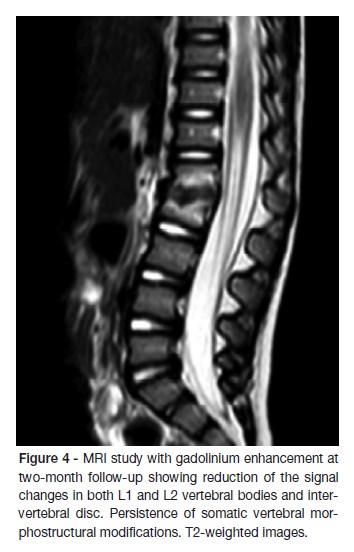
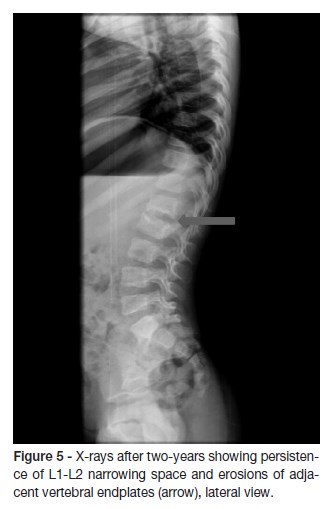
<p>&nbsp;</p>     <p>Serum antibodies, anti-Herpes Simplex Virus 1 and 2, Adenovirus,   Cytomegalovirus, <i>Mycoplasma pneumoniae</i>, <i>Borrelia burgdorferi</i>, <i>Brucella     melitensis</i> and <i>Epstein–Barr</i> virus and blood culture results (obtained from two samples) were negative. </p>     <p>Mantoux tuberculin&nbsp;skin&nbsp;test and Interferon-Gamma Release Assays (IGRA) blood test for   tuberculosis were equivocal (first one was nonreactive and second one was   indeterminate). Polymerase chain reaction (PCR) for <i>M. tuberculosis</i> from   early morning gastric washing samples was negative. Pathology staining for acid-fast bacilli and cultures for mycobacteria were also reported as negative.</p>     <p>After the first week of treatment the child had no abdominal or spinal   pain and laboratory tests showed a decrease in the ESR value to 3mm/hour, with   the level of WBC count and CRP remaining within normal range. Two weeks later   the patient began to sit and to walk. After three weeks he had a full clinical   recovery, the inflammatory markers were normal and intravenous treatment was   then switched to oral for another three weeks. Bed rest was carried out and   combined with the administration of antibiotics until evidence of clinical and laboratory resolution of the condition. </p>     <p>At the first month follow-up, IGRA   test was repeated with negative result. At the two-month follow-up, a new   spinal MRI showed a reduction of the signal changes in both L1 and L2 vertebral   bodies and intervertebral disc, despite the persistence of somatic vertebral   morphostructural modifications (<a href="#f4">Figure 4</a>). X-rays taken after two-years showed   persistence of segmental reduction at L1-L2 but with no functional significance   (<a href="#f5">Figure 5</a>). The child asymptomatic and presents a normal neurological examination.</p>     ]]></body>
<body><![CDATA[<p><a name="f4"></a></p>     <p>&nbsp;</p>     <p align="center"><img src="/img/revistas/nas/v27n3/27n3a10f4.jpg" width="354" height="552"></p>     
<p>&nbsp;</p>     <p><a name="f5"></a></p>     <p>&nbsp;</p>     <p align="center"><img src="/img/revistas/nas/v27n3/27n3a10f5.jpg" width="331" height="509"></p>     
<p>&nbsp;</p>     <p>&nbsp;</p> </font>     <p><font size="3" face="Verdana"><b>DISCUSSION</b></font></p> <font face="Verdana" size="2">     ]]></body>
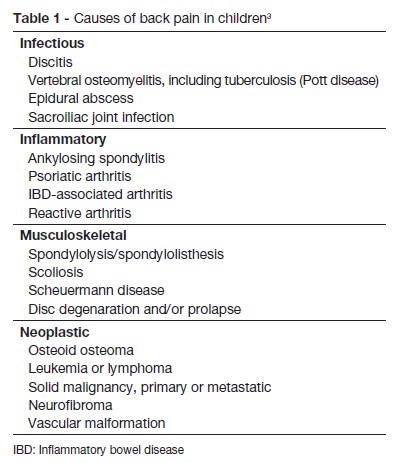
<body><![CDATA[<p>This case has highlights the   importance of clinical suspicion in the early diagnosis of spondylodiscitis an   insidious disorder, not always accompanied by specific laboratory findings.   However it is important to reinforce the need to consider the diagnosis every   time a child suddenly refuses to walk, crawl or stand up. In fact, Brown <i>et     al</i> reported a series of 11 consecutive cases where those signs were present   in 63% of patients.<sup>14</sup> Back pain is also often reported. Fever is   usually low grade or absent and abdominal pain may be the predominant complaint   in lesions involving L1, as occurred in this case.<sup>12,15,16</sup> When the   cervical spine is affected, manifestations may include dysphagia and stiff   neck.<sup>16</sup> Contracture and spasm of paravertebral and psoas muscles occur   with limited mobility of the spine, which can be extremely painful and cause   loss of the lumbar lordosis.<sup>3,10,12,14,16,17 </sup>Other findings may   include percussion tenderness over the involved spine, decreased muscle   strength or reflexes or ileus (with high lesions: T8-L1). Unspecific symptoms   are also common such as fatigue, irritability, loss of appetite, and a lack of   desire to play.<sup>13,16</sup> <a href="#t1">Table 1</a> shows other causes of back pain in   children, which have different implications for treatment or prognosis, and   must also be considered. A review of the literature of spondylodiscitis in   children suggests that it has a biphasic age distribution primarily affecting   the young toddler, with a second peak in adolescence.<sup>9,15</sup> The   pathophysiology of the condition has not been clearly established. Trauma,   inflammation and infection have all been implicated.<sup>3,18,19</sup> The   pathogens can infect the spine from three sources: by haematogenous spread   (arterial or venous), by external direct inoculation, or by contiguous spread   from adjacent tissues. The predominant form is blood haematogenous. Unlike   adults, the intervertebral disc in young children is vascularized.<sup>13,20</sup>   Vascularization in children is made up of vessels across the cartilaginous   vertebral plate and into the ring; after eight years of age, these vessels   disappear, but a rich anastomotic network of vessels remains in the periphery   of the disc. The vascularized nature of the intervertebral disc in children   explains the higher incidence of this disease in this age group. According to   various studies, this fact explains the hypothesis of bacterial etiology, and   also the satisfactory response to treatment with antibiotics.<sup>7,12,18,20,21</sup>   In tuberculosis, the destruction starts with the vertebral body and spreads to   the adjacent vertebra through the ligaments. Extensive bone infarcts lead to   the formation of cavitation and compression fractures. Failure to control the   infection can cause paravertebral, psoas or epidural abscess.<sup>16</sup>   Pyogenic spondylodiscitis from the haematogenous source particularly affects   the lumbar spine, followed by the thoracic and cervical spine, reflecting the   volume of blood flow.<sup>3,6,22</sup> In tuberculosis, we observed involvement of the thoracic spine.<sup>16</sup></p>     <p><a name="t1"></a></p>     <p>&nbsp;</p>     <p align="center"><img src="/img/revistas/nas/v27n3/27n3a10t1.jpg" width="402" height="463"></p>     
<p>&nbsp;</p>     <p>We noticed that the patient had an   episode of trauma two months before the development of spondylodiscitis which   could have been implicated in the etiology for the condition as well as explain   the presence of spinal radiographic changes at the time of the diagnosis   (usually not seen until second or third week of onset of the disease). On the   other hand, the presence of a prodromal illness one week before the admission   to the hospital could lead to believe in the infectious nature for the process.   The absence of a marked systemic response could have simply reflected an   appropriate local host response to a pathogen of low virulence, such as <i>Kingella kingae</i>.</p>     <p>When reviewing the laboratory   investigations, we found that the WBCs and CRP values were normal, but ESR had   increased above 30mm/hour. In fact, ESR is usually elevated in &#8805;90 percent of patients.<sup>1,4,15,23</sup> </p>     <p>As seen in   other reported cases, blood cultures were negative and thus unable to provide   sufficient etiologic information. In series where positive cultures were   present, <i>Staphylococcus aureus </i>was the most common isolated organism.<sup>1,6,22,24</sup>   Recently the reported number of cases of <i>K. kingae </i>infection has   markedly increased. Many studies have demonstrated that this pathogen has   become the leading cause of spondylodiscitis in children aged between 6 and 48   months and the microorganism is currently recognized to account for   30% to 93.8% of all culture-positive osteoarticular infection.<sup>24,27</sup>   The high rate of sterile blood cultures and the frequent failure to identify   the causative pathogen, even on disk or vertebral aspiration, is another very   suggestive argument that most cases of the infantile form of spondylodiscitis   are due to <i>K. kingae</i>. In fact, the recovery of <i>K. kingae </i>from   purulent specimens seeded onto solid culture media is suboptimal and results   are negative in a frustrating proportion of cases.<sup>23</sup> Thus sterile   blood cultures can be interpreted as false-negative results correlated to   inappropriate techniques of <i>K. kingae </i>identification in   spondylodiscitis. In our case, we could not prove that the spondylodiscitis was   actually caused by <i>K. kingae</i>, as we did not made specific culture nor   used molecular detection methods. We also did not perform any biopsies or   needle aspirations for diagnostic purposes which reflected our risk/benefit   analysis based on the low rate (less than 50%) of positive cultures reported in   previous series.<sup>7,9</sup> According to some authors, this procedure should be reserved for children not responding to intravenous antibiotics.<sup>7</sup></p>     <p><i>Mycobacterium</i> and <i>Brucella</i>   infection were also investigated. Brucellosis still has a high incidence in   many parts of the world, including the Mediterranean littoral and remains an   important cause of granulomatous spondylodiscitis.<sup>25,28</sup> It should be   noted that in the early stages, the differential diagnosis between unspecific   infection (pyogenic discitis) and granulomatous infection (spinal tuberculosis   or brucellosis) can be difficult. In this case, patient’s clinical improvement with empiric antibiotic therapy led us to exclude the tuberculosis hypothesis. </p>     <p>We used CT and MRI to establish the   diagnosis. MRI has high sensitivity (96%) and specificity (94%), and remains   the gold standard complementary imaging method for the investigation of   pyogenic infection of the spine, particularly in the early stages.<sup>1,7,15,17,22,26</sup>   MRI can also exclude alternative diagnoses such as vertebral osteomyelitis and tumors.<sup>1,22</sup> </p>     ]]></body>
<body><![CDATA[<p>In our case, changes such as   reduced disc space and erosion of the end-plate were evident in spine   radiography, suggesting that the disease had been present for at least two to three weeks (<a href="#f1">Figure 1</a>).<sup>7,9</sup> </p>     <p>Bone scintigraphy with   technetium-99m pyrophosphate shows positive signs within one to two days of the   onset of the infection. The drawbacks of the technique however include low   specificity and insufficient spatial resolution of the affected site. Moreover,   the high accuracy of the MRI has led to scintigraphy falling into disuse.<sup>10,13,27</sup>   Computed tomography (CT) scan is easy to perform, faster and more affordable   than MRI. The areas of erosion of the endplates that appear early in the   affected vertebral levels are easier to detect by CT scan than by the images from plain radiographs.<sup>10,13,27</sup> </p>     <p>Management for spondylodiscitis is not standardized. Some retrospective   data suggests that initial treatment with intravenous antibiotics until the   child shows clinical improvement followed by oral antibiotics is associated   with a somewhat earlier response and fewer relapses than treatment with   analgesia alone.<sup>1,4</sup> Due to this, our hospital routinely prescribe   antibiotics as a first-line treatment for the condition. The recommended   empiric antibiotic therapy is a combination of a third-generation cephalosporin   combined with an antistaphylococcal agent.<sup>1,14,21</sup> Immobilization, either   through bed rest, or occasionally, bracing or casting, may assist with pain   control. In our case we favor immobilization through bed rest; no body plaster   or orthosis was used. Restricted activities should be maintained for 10–12   weeks, or until evidence of clinical and laboratory resolution.<sup>6,12</sup>   Treatment with antibiotics and rest was efficacious in this case leading to clinical resolution and recovery in a few weeks.</p>     <p>Recommendations regarding the duration of   treatment, varies between institutions, ranging from one week to three weeks   intravenously, followed by supplementary oral therapy until resolution of the   inflammation and clinical improvement.<sup>3,4,12,15,16,27</sup> The total   treatment can last from two weeks to six months, according to the patient’s   response.<sup>3,7,10,14,21</sup> In our case we used a combination of regular   clinical assessment and serial measurement of inflammatory markers as a guide   to the duration of treatment. The criteria for the discontinuation of the   antimicrobial treatment included resolution of the symptoms and normalization   of ESR e CRP. The ESR usually increases during the first few days of treatment   and then declines slowly in the follow weeks. CRP returns to normal much more   rapidly than ESR and it has been proposed that a weekly reduction of 50% in CRP   represents favorable evolution.<sup>3,10,16,27</sup> We also used MRI for   monitoring the therapeutic response during the course of spinal infection,   however we recognize that MRI scans ordered in patients responding well   clinically often gives conflicting results and that we should be cautious in   interpreting follow-up MRI images.<sup>24</sup> Persistent or increased   gadolinium enhancement seen in the context of clinical improvement does not necessarily represent deterioration or treatment failure, as seen in this case.</p>     <p>Surgery is rarely indicated for disc infection in children. It may be   necessary in cases of neurological deficit due to medullary or root   compression, major destruction of the vertebral bodies, progressing to rapid   transformation of the deformity into kyphosis, spinal instability, or failure of conservative treatment.<sup>9,12,14,16,20</sup></p>     <p>The outcome is usually good, although anomalies of the disc space and   adjacent vertebrae (often asymptomatic) are common findings, as reported in 50   out of 55 patients in two series.<sup>1</sup> In our case, radiographic   assessment at two years follow-up, showed persistent abnormalities but no   restriction of spinal movements. As a result, we believe that long-term follow-up is necessary for all children with this disorder.</p>     <p>&nbsp;</p> </font>     <p><font size="3" face="Verdana"><b>CONCLUSION</b></font></p> <font face="Verdana" size="2">     <p>In summary, spondylodiscitis in   children is an uncommon disorder and diagnosis is challenging since symptoms   and signs are often insidious and nonspecific; refusal to walk and back pain   are the most common.<sup>2</sup> The etiology and the best treatment are still   under debate. Blood cultures are usually negative, and identification of the   causative pathogen can be challenging.<sup>6</sup> Radiographic changes may   only be seen within two to three weeks after the onset of the disease and   spine MRI remains the gold standard to confirm the diagnosis.<sup>7-9,15,16,29</sup>   This case highlights the importance of clinical suspicion and early diagnosis to reduce the risk of negative outcomes. </p>     <p>&nbsp;</p> </font>     ]]></body>
<body><![CDATA[<p><font size="3" face="Verdana"><b>REFERENCES</b></font></p> <font face="Verdana" size="2">     <!-- ref --><p>1. Nigrovic PA.   Back pain in children and adolescents: causes [consultado em 01 de dezembro de 2016]. Disponível em <a href="mailto:https://www.uptodate.com" target="_blank">https://www.uptodate.com</a>.    &nbsp;&nbsp;&nbsp;&nbsp;&nbsp;&nbsp;&nbsp;&nbsp;[&#160;<a href="javascript:void(0);" onclick="javascript: window.open('/scielo.php?script=sci_nlinks&ref=1112342&pid=S0872-0754201800030001000001&lng=','','width=640,height=500,resizable=yes,scrollbars=1,menubar=yes,');">Links</a>&#160;]<!-- end-ref --></p>     <!-- ref --><p>2. Oliveira SKF.   Dor e infecção. Reumatologia para Pediatras. Revinter. Rio de Janeiro 2003: 245-82.    &nbsp;&nbsp;&nbsp;&nbsp;&nbsp;&nbsp;&nbsp;&nbsp;[&#160;<a href="javascript:void(0);" onclick="javascript: window.open('/scielo.php?script=sci_nlinks&ref=1112344&pid=S0872-0754201800030001000002&lng=','','width=640,height=500,resizable=yes,scrollbars=1,menubar=yes,');">Links</a>&#160;]<!-- end-ref --></p>     <!-- ref --><p>3. Early SD, Kay RM, Tolo VT. Childhood diskitis. J Am Acad Orthop Surg 2003; 11:413-20.    &nbsp;&nbsp;&nbsp;&nbsp;&nbsp;&nbsp;&nbsp;&nbsp;[&#160;<a href="javascript:void(0);" onclick="javascript: window.open('/scielo.php?script=sci_nlinks&ref=1112346&pid=S0872-0754201800030001000003&lng=','','width=640,height=500,resizable=yes,scrollbars=1,menubar=yes,');">Links</a>&#160;]<!-- end-ref --></p>     <!-- ref --><p>4. Ring D, Johnston CE 2nd, Wenger DR.   Pyogenic infectious spondylitis in children: the convergence of discitis and vertebral osteomyelitis. J Pediatr Orthop 1995; 15:652–60.    &nbsp;&nbsp;&nbsp;&nbsp;&nbsp;&nbsp;&nbsp;&nbsp;[&#160;<a href="javascript:void(0);" onclick="javascript: window.open('/scielo.php?script=sci_nlinks&ref=1112348&pid=S0872-0754201800030001000004&lng=','','width=640,height=500,resizable=yes,scrollbars=1,menubar=yes,');">Links</a>&#160;]<!-- end-ref --></p>     <!-- ref --><p>5. Rocco HD, Eyring EJ. Intervertebral disk infections in children. Am J. Dis. Child. 1972; 123:448-51.    &nbsp;&nbsp;&nbsp;&nbsp;&nbsp;&nbsp;&nbsp;&nbsp;[&#160;<a href="javascript:void(0);" onclick="javascript: window.open('/scielo.php?script=sci_nlinks&ref=1112350&pid=S0872-0754201800030001000005&lng=','','width=640,height=500,resizable=yes,scrollbars=1,menubar=yes,');">Links</a>&#160;]<!-- end-ref --></p>     <!-- ref --><p>6. Fucs P, Mevez R, Yamada H. Spinal infections in children: a review. Int Orthop. 2012; 36:387–95.    &nbsp;&nbsp;&nbsp;&nbsp;&nbsp;&nbsp;&nbsp;&nbsp;[&#160;<a href="javascript:void(0);" onclick="javascript: window.open('/scielo.php?script=sci_nlinks&ref=1112352&pid=S0872-0754201800030001000006&lng=','','width=640,height=500,resizable=yes,scrollbars=1,menubar=yes,');">Links</a>&#160;]<!-- end-ref --></p>     <!-- ref --><p>7. Brown R, Hussain M, McHugh K, Novelli V, Jones D. Discitis in young children.&nbsp;J. Bone Jt. Surg 2001; 83:106–11.    &nbsp;&nbsp;&nbsp;&nbsp;&nbsp;&nbsp;&nbsp;&nbsp;[&#160;<a href="javascript:void(0);" onclick="javascript: window.open('/scielo.php?script=sci_nlinks&ref=1112354&pid=S0872-0754201800030001000007&lng=','','width=640,height=500,resizable=yes,scrollbars=1,menubar=yes,');">Links</a>&#160;]<!-- end-ref --></p>     <!-- ref --><p>8. Carty H. Radionuclide bone scanning. Arch Dis Child 1993; 69:160-5.    &nbsp;&nbsp;&nbsp;&nbsp;&nbsp;&nbsp;&nbsp;&nbsp;[&#160;<a href="javascript:void(0);" onclick="javascript: window.open('/scielo.php?script=sci_nlinks&ref=1112356&pid=S0872-0754201800030001000008&lng=','','width=640,height=500,resizable=yes,scrollbars=1,menubar=yes,');">Links</a>&#160;]<!-- end-ref --></p>     <!-- ref --><p>9. Fernandez M, Carrol CL, Baker CJ. Discitis   and vertebral osteomyelitis in children: an 18-year review.&nbsp;Pediatrics&nbsp;2000; 105:1299–304.    &nbsp;&nbsp;&nbsp;&nbsp;&nbsp;&nbsp;&nbsp;&nbsp;[&#160;<a href="javascript:void(0);" onclick="javascript: window.open('/scielo.php?script=sci_nlinks&ref=1112358&pid=S0872-0754201800030001000009&lng=','','width=640,height=500,resizable=yes,scrollbars=1,menubar=yes,');">Links</a>&#160;]<!-- end-ref --></p>     <!-- ref --><p>10. Garron E, Viehweger E, Launay F, Guillaume   JM, Jouve JL, Bollini G. Nontuberculous spondylodiscitis in children.&nbsp;J. Pediatr. Orthop.&nbsp;2002; 22:321–8.    &nbsp;&nbsp;&nbsp;&nbsp;&nbsp;&nbsp;&nbsp;&nbsp;[&#160;<a href="javascript:void(0);" onclick="javascript: window.open('/scielo.php?script=sci_nlinks&ref=1112360&pid=S0872-0754201800030001000010&lng=','','width=640,height=500,resizable=yes,scrollbars=1,menubar=yes,');">Links</a>&#160;]<!-- end-ref --></p>     <!-- ref --><p>11. Rubio B, Calvo   Rey C, Garcia-Consuegra J, Ciria L, Navarro ML, Ramos JT. Spondylodiscitis in the autonomus community of Madrid (Spain).&nbsp;An Pediatr (Barc)&nbsp;2005; 62:147–52.    &nbsp;&nbsp;&nbsp;&nbsp;&nbsp;&nbsp;&nbsp;&nbsp;[&#160;<a href="javascript:void(0);" onclick="javascript: window.open('/scielo.php?script=sci_nlinks&ref=1112362&pid=S0872-0754201800030001000011&lng=','','width=640,height=500,resizable=yes,scrollbars=1,menubar=yes,');">Links</a>&#160;]<!-- end-ref --></p>     <!-- ref --><p>12. Skaf GS, Kanafani ZA, Araj GF, Kanj SS.   Non-pyogenic infections of the spine.&nbsp;Int. J. Antimicrob. Agents.&nbsp;2010; 36:99–105.    &nbsp;&nbsp;&nbsp;&nbsp;&nbsp;&nbsp;&nbsp;&nbsp;[&#160;<a href="javascript:void(0);" onclick="javascript: window.open('/scielo.php?script=sci_nlinks&ref=1112364&pid=S0872-0754201800030001000012&lng=','','width=640,height=500,resizable=yes,scrollbars=1,menubar=yes,');">Links</a>&#160;]<!-- end-ref --></p>     <!-- ref --><p>13. Kayser R, Mahlfeld K, Greulich M,   Grasshoff H. Spondylodiscitis in childhood: results of a long-term study.&nbsp;Spine&nbsp;2005; 30:318–23.    &nbsp;&nbsp;&nbsp;&nbsp;&nbsp;&nbsp;&nbsp;&nbsp;[&#160;<a href="javascript:void(0);" onclick="javascript: window.open('/scielo.php?script=sci_nlinks&ref=1112366&pid=S0872-0754201800030001000013&lng=','','width=640,height=500,resizable=yes,scrollbars=1,menubar=yes,');">Links</a>&#160;]<!-- end-ref --></p>     <!-- ref --><p>14. Dormans JP, Moroz L. Infection and tumors of the spine in children. J Bone Joint Surg Am. 2007; 89(Suppl 1):79-97.    &nbsp;&nbsp;&nbsp;&nbsp;&nbsp;&nbsp;&nbsp;&nbsp;[&#160;<a href="javascript:void(0);" onclick="javascript: window.open('/scielo.php?script=sci_nlinks&ref=1112368&pid=S0872-0754201800030001000014&lng=','','width=640,height=500,resizable=yes,scrollbars=1,menubar=yes,');">Links</a>&#160;]<!-- end-ref --></p>     <!-- ref --><p>15. Cushing AH. Diskitis in children.&nbsp;Clin Infect Dis.&nbsp;1993; 17:1–6.    &nbsp;&nbsp;&nbsp;&nbsp;&nbsp;&nbsp;&nbsp;&nbsp;[&#160;<a href="javascript:void(0);" onclick="javascript: window.open('/scielo.php?script=sci_nlinks&ref=1112370&pid=S0872-0754201800030001000015&lng=','','width=640,height=500,resizable=yes,scrollbars=1,menubar=yes,');">Links</a>&#160;]<!-- end-ref --></p>     <!-- ref --><p>16. Gouliouris T, Aliyu SH, Brown NM.   Spondylodiscitis: Update on diagnosis and management.&nbsp;J. Antimicrob. Chemother.&nbsp;2010; 65 Suppl 3:iii11-24.    &nbsp;&nbsp;&nbsp;&nbsp;&nbsp;&nbsp;&nbsp;&nbsp;[&#160;<a href="javascript:void(0);" onclick="javascript: window.open('/scielo.php?script=sci_nlinks&ref=1112372&pid=S0872-0754201800030001000016&lng=','','width=640,height=500,resizable=yes,scrollbars=1,menubar=yes,');">Links</a>&#160;]<!-- end-ref --></p>     <!-- ref --><p>17. Gabriel KR, Crawford AH. Magnetic   resonance imaging in child who had clinical signs of discitis. Report of a case. J Bone Joint Surg Am 1988; 70:938-41.    &nbsp;&nbsp;&nbsp;&nbsp;&nbsp;&nbsp;&nbsp;&nbsp;[&#160;<a href="javascript:void(0);" onclick="javascript: window.open('/scielo.php?script=sci_nlinks&ref=1112374&pid=S0872-0754201800030001000017&lng=','','width=640,height=500,resizable=yes,scrollbars=1,menubar=yes,');">Links</a>&#160;]<!-- end-ref --></p>     <!-- ref --><p>18. Crawford AH, Kucharzyk DW, Ruda R,   Smitherman HC. Diskitis in children.&nbsp;Clin Orthop Relat Res.&nbsp;1991:70–9.    &nbsp;&nbsp;&nbsp;&nbsp;&nbsp;&nbsp;&nbsp;&nbsp;[&#160;<a href="javascript:void(0);" onclick="javascript: window.open('/scielo.php?script=sci_nlinks&ref=1112376&pid=S0872-0754201800030001000018&lng=','','width=640,height=500,resizable=yes,scrollbars=1,menubar=yes,');">Links</a>&#160;]<!-- end-ref --></p>     <!-- ref --><p>19. Spiegel PG, Kengla KW, Isaacson AS, Wilson   JC. Intervertebral disc-space Inflammation in Children. J Bone Joint Surg Am. 1972; 54:284-96.    &nbsp;&nbsp;&nbsp;&nbsp;&nbsp;&nbsp;&nbsp;&nbsp;[&#160;<a href="javascript:void(0);" onclick="javascript: window.open('/scielo.php?script=sci_nlinks&ref=1112378&pid=S0872-0754201800030001000019&lng=','','width=640,height=500,resizable=yes,scrollbars=1,menubar=yes,');">Links</a>&#160;]<!-- end-ref --></p>     <!-- ref --><p>20. Avanzi O, Chih LY, Meves R, Mattos C.   Treatment of discitis in the child.&nbsp;Rev Assoc Med Bras.&nbsp;2005; 51:113–6.    &nbsp;&nbsp;&nbsp;&nbsp;&nbsp;&nbsp;&nbsp;&nbsp;[&#160;<a href="javascript:void(0);" onclick="javascript: window.open('/scielo.php?script=sci_nlinks&ref=1112380&pid=S0872-0754201800030001000020&lng=','','width=640,height=500,resizable=yes,scrollbars=1,menubar=yes,');">Links</a>&#160;]<!-- end-ref --></p>     <!-- ref --><p>21. Waizy H, Heckel M, Seller K, Schroten H,   Wild A. Remodeling of the spine in spondylodiscitis of children at the age of 3 years or younger. Arch Orthop Trauma Surg. 2007; 127:403-7.    &nbsp;&nbsp;&nbsp;&nbsp;&nbsp;&nbsp;&nbsp;&nbsp;[&#160;<a href="javascript:void(0);" onclick="javascript: window.open('/scielo.php?script=sci_nlinks&ref=1112382&pid=S0872-0754201800030001000021&lng=','','width=640,height=500,resizable=yes,scrollbars=1,menubar=yes,');">Links</a>&#160;]<!-- end-ref --></p>     <!-- ref --><p>22. Chandrasenan J, Klezl Z, Bommireddy R,   Calthorpe D. Spondylodiscitis in children: a retrospective series.&nbsp;J Bone Joint Surg Br.&nbsp;2011; 93:1122–5.    &nbsp;&nbsp;&nbsp;&nbsp;&nbsp;&nbsp;&nbsp;&nbsp;[&#160;<a href="javascript:void(0);" onclick="javascript: window.open('/scielo.php?script=sci_nlinks&ref=1112384&pid=S0872-0754201800030001000022&lng=','','width=640,height=500,resizable=yes,scrollbars=1,menubar=yes,');">Links</a>&#160;]<!-- end-ref --></p>     <!-- ref --><p>23. Ceroni D, Belaieff W, Kanavaki A, <i>et   al.</i> Possible association of&nbsp;<i>Kingella kingae</i>&nbsp;with infantile spondylodiscitis.&nbsp;Pediatr. Infect. Dis. J.&nbsp;2013; 32:1296–8.    &nbsp;&nbsp;&nbsp;&nbsp;&nbsp;&nbsp;&nbsp;&nbsp;[&#160;<a href="javascript:void(0);" onclick="javascript: window.open('/scielo.php?script=sci_nlinks&ref=1112386&pid=S0872-0754201800030001000023&lng=','','width=640,height=500,resizable=yes,scrollbars=1,menubar=yes,');">Links</a>&#160;]<!-- end-ref --></p>     <!-- ref --><p>24. Cottle L, Riordan T. Infectious spondylodiscitis.&nbsp;J. Infect.&nbsp;2008; 56:401-12.    &nbsp;&nbsp;&nbsp;&nbsp;&nbsp;&nbsp;&nbsp;&nbsp;[&#160;<a href="javascript:void(0);" onclick="javascript: window.open('/scielo.php?script=sci_nlinks&ref=1112388&pid=S0872-0754201800030001000024&lng=','','width=640,height=500,resizable=yes,scrollbars=1,menubar=yes,');">Links</a>&#160;]<!-- end-ref --></p>     <!-- ref --><p>25. Colmenero JD, &nbsp;Jiménez-Mejías ME,   Sánchez-Lora FJ, <i>et al. </i>Pyogenic, tuberculous, and brucellar vertebral   osteomyelitis: a descriptive and comparative study of 219 cases. Ann Rheum Dis. 1997; 56:709-15.    &nbsp;&nbsp;&nbsp;&nbsp;&nbsp;&nbsp;&nbsp;&nbsp;[&#160;<a href="javascript:void(0);" onclick="javascript: window.open('/scielo.php?script=sci_nlinks&ref=1112390&pid=S0872-0754201800030001000025&lng=','','width=640,height=500,resizable=yes,scrollbars=1,menubar=yes,');">Links</a>&#160;]<!-- end-ref --></p>     <!-- ref --><p>26. Kim CJ, Song KH, Jeon JH, <i>et al.</i> A   comparative estudy of pyogenic and tuberculous spondylodiscitis. Spine (Phila Pa 1976). 2010; 35:E1096-100.    &nbsp;&nbsp;&nbsp;&nbsp;&nbsp;&nbsp;&nbsp;&nbsp;[&#160;<a href="javascript:void(0);" onclick="javascript: window.open('/scielo.php?script=sci_nlinks&ref=1112392&pid=S0872-0754201800030001000026&lng=','','width=640,height=500,resizable=yes,scrollbars=1,menubar=yes,');">Links</a>&#160;]<!-- end-ref --></p>     <!-- ref --><p>27. Sobottke R, Seifert H, Fätkenheuer G,   Schmidt M, Gossmann A, Eysel P. Current diagnosis and treatment of spondylodiscitis. Dtsch Arztebl Int. 2008; 105:181-7.    &nbsp;&nbsp;&nbsp;&nbsp;&nbsp;&nbsp;&nbsp;&nbsp;[&#160;<a href="javascript:void(0);" onclick="javascript: window.open('/scielo.php?script=sci_nlinks&ref=1112394&pid=S0872-0754201800030001000027&lng=','','width=640,height=500,resizable=yes,scrollbars=1,menubar=yes,');">Links</a>&#160;]<!-- end-ref --></p>     <!-- ref --><p>28. Faella FS, Rossi M, Pagliano P, <i>et al.</i>   Non post-operative spondylodiskitis. Our experience during the period 1990-2001. Infez Med 2002; 10:157-62.    &nbsp;&nbsp;&nbsp;&nbsp;&nbsp;&nbsp;&nbsp;&nbsp;[&#160;<a href="javascript:void(0);" onclick="javascript: window.open('/scielo.php?script=sci_nlinks&ref=1112396&pid=S0872-0754201800030001000028&lng=','','width=640,height=500,resizable=yes,scrollbars=1,menubar=yes,');">Links</a>&#160;]<!-- end-ref --></p>     <!-- ref --><p>29. Rudert M, Tillman B. Lymph and blood   supply of the human intervertebral disc. Cadaver study of correlations to discitis. Acta Orthop Scand. 1993; 64:37-40.    &nbsp;&nbsp;&nbsp;&nbsp;&nbsp;&nbsp;&nbsp;&nbsp;[&#160;<a href="javascript:void(0);" onclick="javascript: window.open('/scielo.php?script=sci_nlinks&ref=1112398&pid=S0872-0754201800030001000029&lng=','','width=640,height=500,resizable=yes,scrollbars=1,menubar=yes,');">Links</a>&#160;]<!-- end-ref --></p> </font>     <p>&nbsp;</p>     ]]></body>
<body><![CDATA[<p>&nbsp;</p>     <p><font face="Verdana" size="2"><b><a name="end" id="topo2"></a><a href="#topo">CORRESPONDENCE TO</a></b> </font></p> <font face="Verdana" size="2">     <p>Joana Ferreira    <br>   Department of Pediatrics    <br>   Hospital Senhora da Oliveira    <br>   Rua dos Cutileiros 114,    <br>   Creixomil, 4835-025 Guimarães    <br> Email: <a href="mailto:joanaferreira.med@gmail.com">joanaferreira.med@gmail.com</a></p>     <p>Received for publication: 29.12.2016    <br> Accepted in revised form: 27.11.2017</p> </font>     ]]></body>
<body><![CDATA[ ]]></body><back>
<ref-list>
<ref id="B1">
<label>1</label><nlm-citation citation-type="">
<person-group person-group-type="author">
<name>
<surname><![CDATA[Nigrovic]]></surname>
<given-names><![CDATA[PA]]></given-names>
</name>
</person-group>
<source><![CDATA[Back pain in children and adolescents: causes]]></source>
<year></year>
</nlm-citation>
</ref>
<ref id="B2">
<label>2</label><nlm-citation citation-type="book">
<person-group person-group-type="author">
<name>
<surname><![CDATA[Oliveira]]></surname>
<given-names><![CDATA[SKF]]></given-names>
</name>
</person-group>
<source><![CDATA[Dor e infecção: Reumatologia para Pediatras]]></source>
<year>2003</year>
<page-range>245-82</page-range><publisher-loc><![CDATA[Rio de Janeiro ]]></publisher-loc>
<publisher-name><![CDATA[Revinter]]></publisher-name>
</nlm-citation>
</ref>
<ref id="B3">
<label>3</label><nlm-citation citation-type="journal">
<person-group person-group-type="author">
<name>
<surname><![CDATA[Early]]></surname>
<given-names><![CDATA[SD]]></given-names>
</name>
<name>
<surname><![CDATA[Kay]]></surname>
<given-names><![CDATA[RM]]></given-names>
</name>
<name>
<surname><![CDATA[Tolo]]></surname>
<given-names><![CDATA[VT]]></given-names>
</name>
</person-group>
<article-title xml:lang="en"><![CDATA[Childhood diskitis]]></article-title>
<source><![CDATA[J Am Acad Orthop Surg]]></source>
<year>2003</year>
<volume>11</volume>
<page-range>413-20</page-range></nlm-citation>
</ref>
<ref id="B4">
<label>4</label><nlm-citation citation-type="journal">
<person-group person-group-type="author">
<name>
<surname><![CDATA[Ring]]></surname>
<given-names><![CDATA[D]]></given-names>
</name>
<name>
<surname><![CDATA[Johnston]]></surname>
<given-names><![CDATA[CE]]></given-names>
</name>
<name>
<surname><![CDATA[Wenger]]></surname>
<given-names><![CDATA[DR]]></given-names>
</name>
</person-group>
<article-title xml:lang="en"><![CDATA[Pyogenic infectious spondylitis in children: the convergence of discitis and vertebral osteomyelitis]]></article-title>
<source><![CDATA[J Pediatr Orthop]]></source>
<year>1995</year>
<volume>15</volume>
<page-range>652-60</page-range></nlm-citation>
</ref>
<ref id="B5">
<label>5</label><nlm-citation citation-type="journal">
<person-group person-group-type="author">
<name>
<surname><![CDATA[Rocco]]></surname>
<given-names><![CDATA[HD]]></given-names>
</name>
<name>
<surname><![CDATA[Eyring]]></surname>
<given-names><![CDATA[EJ]]></given-names>
</name>
</person-group>
<article-title xml:lang="en"><![CDATA[Intervertebral disk infections in children]]></article-title>
<source><![CDATA[Am J. Dis. Child]]></source>
<year>1972</year>
<volume>123</volume>
<page-range>448-51</page-range></nlm-citation>
</ref>
<ref id="B6">
<label>6</label><nlm-citation citation-type="journal">
<person-group person-group-type="author">
<name>
<surname><![CDATA[Fucs]]></surname>
<given-names><![CDATA[P]]></given-names>
</name>
<name>
<surname><![CDATA[Mevez]]></surname>
<given-names><![CDATA[R]]></given-names>
</name>
<name>
<surname><![CDATA[Yamada]]></surname>
<given-names><![CDATA[H]]></given-names>
</name>
</person-group>
<article-title xml:lang="en"><![CDATA[Spinal infections in children: a review]]></article-title>
<source><![CDATA[Int Orthop]]></source>
<year>2012</year>
<volume>36</volume>
<page-range>387-95</page-range></nlm-citation>
</ref>
<ref id="B7">
<label>7</label><nlm-citation citation-type="journal">
<person-group person-group-type="author">
<name>
<surname><![CDATA[Brown]]></surname>
<given-names><![CDATA[R]]></given-names>
</name>
<name>
<surname><![CDATA[Hussain]]></surname>
<given-names><![CDATA[M]]></given-names>
</name>
<name>
<surname><![CDATA[McHugh]]></surname>
<given-names><![CDATA[K]]></given-names>
</name>
<name>
<surname><![CDATA[Novelli]]></surname>
<given-names><![CDATA[V]]></given-names>
</name>
<name>
<surname><![CDATA[Jones]]></surname>
<given-names><![CDATA[D]]></given-names>
</name>
</person-group>
<article-title xml:lang="en"><![CDATA[Discitis in young children]]></article-title>
<source><![CDATA[J. Bone Jt. Surg]]></source>
<year>2001</year>
<volume>83</volume>
<page-range>106-11</page-range></nlm-citation>
</ref>
<ref id="B8">
<label>8</label><nlm-citation citation-type="journal">
<person-group person-group-type="author">
<name>
<surname><![CDATA[Carty]]></surname>
<given-names><![CDATA[H]]></given-names>
</name>
</person-group>
<article-title xml:lang="en"><![CDATA[Radionuclide bone scanning]]></article-title>
<source><![CDATA[Arch Dis Child]]></source>
<year>1993</year>
<volume>69</volume>
<page-range>160-5</page-range></nlm-citation>
</ref>
<ref id="B9">
<label>9</label><nlm-citation citation-type="journal">
<person-group person-group-type="author">
<name>
<surname><![CDATA[Fernandez]]></surname>
<given-names><![CDATA[M]]></given-names>
</name>
<name>
<surname><![CDATA[Carrol]]></surname>
<given-names><![CDATA[CL]]></given-names>
</name>
<name>
<surname><![CDATA[Baker]]></surname>
<given-names><![CDATA[CJ]]></given-names>
</name>
</person-group>
<article-title xml:lang="en"><![CDATA[Discitis and vertebral osteomyelitis in children: an 18-year review]]></article-title>
<source><![CDATA[Pediatrics]]></source>
<year>2000</year>
<volume>105</volume>
<page-range>1299-304</page-range></nlm-citation>
</ref>
<ref id="B10">
<label>10</label><nlm-citation citation-type="journal">
<person-group person-group-type="author">
<name>
<surname><![CDATA[Garron]]></surname>
<given-names><![CDATA[E]]></given-names>
</name>
<name>
<surname><![CDATA[Viehweger]]></surname>
<given-names><![CDATA[E]]></given-names>
</name>
<name>
<surname><![CDATA[Launay]]></surname>
<given-names><![CDATA[F]]></given-names>
</name>
<name>
<surname><![CDATA[Guillaume]]></surname>
<given-names><![CDATA[JM]]></given-names>
</name>
<name>
<surname><![CDATA[Jouve]]></surname>
<given-names><![CDATA[JL]]></given-names>
</name>
<name>
<surname><![CDATA[Bollini]]></surname>
<given-names><![CDATA[G]]></given-names>
</name>
</person-group>
<article-title xml:lang="en"><![CDATA[Nontuberculous spondylodiscitis in children]]></article-title>
<source><![CDATA[J. Pediatr. Orthop.]]></source>
<year>2002</year>
<volume>22</volume>
<page-range>321-8</page-range></nlm-citation>
</ref>
<ref id="B11">
<label>11</label><nlm-citation citation-type="journal">
<person-group person-group-type="author">
<name>
<surname><![CDATA[Rubio]]></surname>
<given-names><![CDATA[B]]></given-names>
</name>
<name>
<surname><![CDATA[Calvo Rey]]></surname>
<given-names><![CDATA[C]]></given-names>
</name>
<name>
<surname><![CDATA[Garcia-Consuegra]]></surname>
<given-names><![CDATA[J]]></given-names>
</name>
<name>
<surname><![CDATA[Ciria]]></surname>
<given-names><![CDATA[L]]></given-names>
</name>
<name>
<surname><![CDATA[Navarro]]></surname>
<given-names><![CDATA[ML]]></given-names>
</name>
<name>
<surname><![CDATA[Ramos]]></surname>
<given-names><![CDATA[JT]]></given-names>
</name>
</person-group>
<article-title xml:lang="en"><![CDATA[Spondylodiscitis in the autonomus community of Madrid (Spain)]]></article-title>
<source><![CDATA[An Pediatr (Barc)]]></source>
<year>2005</year>
<volume>62</volume>
<page-range>147-52</page-range></nlm-citation>
</ref>
<ref id="B12">
<label>12</label><nlm-citation citation-type="journal">
<person-group person-group-type="author">
<name>
<surname><![CDATA[Skaf]]></surname>
<given-names><![CDATA[GS]]></given-names>
</name>
<name>
<surname><![CDATA[Kanafani]]></surname>
<given-names><![CDATA[ZA]]></given-names>
</name>
<name>
<surname><![CDATA[Araj]]></surname>
<given-names><![CDATA[GF]]></given-names>
</name>
<name>
<surname><![CDATA[Kanj]]></surname>
<given-names><![CDATA[SS]]></given-names>
</name>
</person-group>
<article-title xml:lang="en"><![CDATA[Non-pyogenic infections of the spine]]></article-title>
<source><![CDATA[Int. J. Antimicrob. Agents.]]></source>
<year>2010</year>
<volume>36</volume>
<page-range>99-105</page-range></nlm-citation>
</ref>
<ref id="B13">
<label>13</label><nlm-citation citation-type="journal">
<person-group person-group-type="author">
<name>
<surname><![CDATA[Kayser]]></surname>
<given-names><![CDATA[R]]></given-names>
</name>
<name>
<surname><![CDATA[Mahlfeld]]></surname>
<given-names><![CDATA[K]]></given-names>
</name>
<name>
<surname><![CDATA[Greulich]]></surname>
<given-names><![CDATA[M]]></given-names>
</name>
<name>
<surname><![CDATA[Grasshoff]]></surname>
<given-names><![CDATA[H]]></given-names>
</name>
</person-group>
<article-title xml:lang="en"><![CDATA[Spondylodiscitis in childhood: results of a long-term study]]></article-title>
<source><![CDATA[Spine]]></source>
<year>2005</year>
<volume>30</volume>
<page-range>318-23</page-range></nlm-citation>
</ref>
<ref id="B14">
<label>14</label><nlm-citation citation-type="journal">
<person-group person-group-type="author">
<name>
<surname><![CDATA[Dormans]]></surname>
<given-names><![CDATA[JP]]></given-names>
</name>
<name>
<surname><![CDATA[Moroz]]></surname>
<given-names><![CDATA[L]]></given-names>
</name>
</person-group>
<article-title xml:lang="en"><![CDATA[Infection and tumors of the spine in children]]></article-title>
<source><![CDATA[J Bone Joint Surg Am]]></source>
<year>2007</year>
<volume>89</volume>
<numero>^s1</numero>
<issue>^s1</issue>
<supplement>1</supplement>
<page-range>79-97</page-range></nlm-citation>
</ref>
<ref id="B15">
<label>15</label><nlm-citation citation-type="journal">
<person-group person-group-type="author">
<name>
<surname><![CDATA[Cushing]]></surname>
<given-names><![CDATA[AH]]></given-names>
</name>
</person-group>
<article-title xml:lang="en"><![CDATA[Diskitis in children]]></article-title>
<source><![CDATA[Clin Infect Dis]]></source>
<year>1993</year>
<volume>17</volume>
<page-range>1-6</page-range></nlm-citation>
</ref>
<ref id="B16">
<label>16</label><nlm-citation citation-type="journal">
<person-group person-group-type="author">
<name>
<surname><![CDATA[Gouliouris]]></surname>
<given-names><![CDATA[T]]></given-names>
</name>
<name>
<surname><![CDATA[Aliyu]]></surname>
<given-names><![CDATA[SH]]></given-names>
</name>
<name>
<surname><![CDATA[Brown]]></surname>
<given-names><![CDATA[NM]]></given-names>
</name>
</person-group>
<article-title xml:lang="en"><![CDATA[Spondylodiscitis: Update on diagnosis and management]]></article-title>
<source><![CDATA[J. Antimicrob. Chemother]]></source>
<year>2010</year>
<volume>65</volume>
<numero>^s3</numero>
<issue>^s3</issue>
<supplement>3</supplement>
<page-range>11-24</page-range></nlm-citation>
</ref>
<ref id="B17">
<label>17</label><nlm-citation citation-type="journal">
<person-group person-group-type="author">
<name>
<surname><![CDATA[Gabriel]]></surname>
<given-names><![CDATA[KR]]></given-names>
</name>
<name>
<surname><![CDATA[Crawford]]></surname>
<given-names><![CDATA[AH]]></given-names>
</name>
</person-group>
<article-title xml:lang="en"><![CDATA[Magnetic resonance imaging in child who had clinical signs of discitis: Report of a case]]></article-title>
<source><![CDATA[J Bone Joint Surg Am]]></source>
<year>1988</year>
<volume>70</volume>
<page-range>938-41</page-range></nlm-citation>
</ref>
<ref id="B18">
<label>18</label><nlm-citation citation-type="journal">
<person-group person-group-type="author">
<name>
<surname><![CDATA[Crawford]]></surname>
<given-names><![CDATA[AH]]></given-names>
</name>
<name>
<surname><![CDATA[Kucharzyk]]></surname>
<given-names><![CDATA[DW]]></given-names>
</name>
<name>
<surname><![CDATA[Ruda]]></surname>
<given-names><![CDATA[R]]></given-names>
</name>
<name>
<surname><![CDATA[Smitherman]]></surname>
<given-names><![CDATA[HC]]></given-names>
</name>
</person-group>
<article-title xml:lang="en"><![CDATA[Diskitis in children]]></article-title>
<source><![CDATA[Clin Orthop Relat Res]]></source>
<year>1991</year>
<page-range>70-9</page-range></nlm-citation>
</ref>
<ref id="B19">
<label>19</label><nlm-citation citation-type="journal">
<person-group person-group-type="author">
<name>
<surname><![CDATA[Spiegel]]></surname>
<given-names><![CDATA[PG]]></given-names>
</name>
<name>
<surname><![CDATA[Kengla]]></surname>
<given-names><![CDATA[KW]]></given-names>
</name>
<name>
<surname><![CDATA[Isaacson]]></surname>
<given-names><![CDATA[AS]]></given-names>
</name>
<name>
<surname><![CDATA[Wilson]]></surname>
<given-names><![CDATA[JC]]></given-names>
</name>
</person-group>
<article-title xml:lang="en"><![CDATA[Intervertebral disc-space Inflammation in Children]]></article-title>
<source><![CDATA[J Bone Joint Surg Am.]]></source>
<year>1972</year>
<volume>54</volume>
<page-range>284-96</page-range></nlm-citation>
</ref>
<ref id="B20">
<label>20</label><nlm-citation citation-type="journal">
<person-group person-group-type="author">
<name>
<surname><![CDATA[Avanzi]]></surname>
<given-names><![CDATA[O]]></given-names>
</name>
<name>
<surname><![CDATA[Chih]]></surname>
<given-names><![CDATA[LY]]></given-names>
</name>
<name>
<surname><![CDATA[Meves]]></surname>
<given-names><![CDATA[R]]></given-names>
</name>
<name>
<surname><![CDATA[Mattos]]></surname>
<given-names><![CDATA[C]]></given-names>
</name>
</person-group>
<article-title xml:lang="en"><![CDATA[Treatment of discitis in the child]]></article-title>
<source><![CDATA[Rev Assoc Med Bras.]]></source>
<year>2005</year>
<volume>51</volume>
<page-range>113-6</page-range></nlm-citation>
</ref>
<ref id="B21">
<label>21</label><nlm-citation citation-type="journal">
<person-group person-group-type="author">
<name>
<surname><![CDATA[Waizy]]></surname>
<given-names><![CDATA[H]]></given-names>
</name>
<name>
<surname><![CDATA[Heckel]]></surname>
<given-names><![CDATA[M]]></given-names>
</name>
<name>
<surname><![CDATA[Seller]]></surname>
<given-names><![CDATA[K]]></given-names>
</name>
<name>
<surname><![CDATA[Schroten]]></surname>
<given-names><![CDATA[H]]></given-names>
</name>
<name>
<surname><![CDATA[Wild]]></surname>
<given-names><![CDATA[A]]></given-names>
</name>
</person-group>
<article-title xml:lang="en"><![CDATA[Remodeling of the spine in spondylodiscitis of children at the age of 3 years or younger]]></article-title>
<source><![CDATA[Arch Orthop Trauma Surg]]></source>
<year>2007</year>
<volume>127</volume>
<page-range>403-7</page-range></nlm-citation>
</ref>
<ref id="B22">
<label>22</label><nlm-citation citation-type="journal">
<person-group person-group-type="author">
<name>
<surname><![CDATA[Chandrasenan]]></surname>
<given-names><![CDATA[J]]></given-names>
</name>
<name>
<surname><![CDATA[Klezl]]></surname>
<given-names><![CDATA[Z]]></given-names>
</name>
<name>
<surname><![CDATA[Bommireddy]]></surname>
<given-names><![CDATA[R]]></given-names>
</name>
<name>
<surname><![CDATA[Calthorpe]]></surname>
<given-names><![CDATA[D]]></given-names>
</name>
</person-group>
<article-title xml:lang="en"><![CDATA[Spondylodiscitis in children: a retrospective series]]></article-title>
<source><![CDATA[J Bone Joint Surg Br]]></source>
<year>2011</year>
<volume>93</volume>
<page-range>1122-5</page-range></nlm-citation>
</ref>
<ref id="B23">
<label>23</label><nlm-citation citation-type="journal">
<person-group person-group-type="author">
<name>
<surname><![CDATA[Ceroni]]></surname>
<given-names><![CDATA[D]]></given-names>
</name>
<name>
<surname><![CDATA[Belaieff]]></surname>
<given-names><![CDATA[W]]></given-names>
</name>
<name>
<surname><![CDATA[Kanavaki]]></surname>
<given-names><![CDATA[A]]></given-names>
</name>
</person-group>
<article-title xml:lang="en"><![CDATA[Possible association of Kingella kingae with infantile spondylodiscitis]]></article-title>
<source><![CDATA[Pediatr. Infect. Dis. J.]]></source>
<year>2013</year>
<volume>32</volume>
<page-range>1296-8</page-range></nlm-citation>
</ref>
<ref id="B24">
<label>24</label><nlm-citation citation-type="journal">
<person-group person-group-type="author">
<name>
<surname><![CDATA[Cottle]]></surname>
<given-names><![CDATA[L]]></given-names>
</name>
<name>
<surname><![CDATA[Riordan]]></surname>
<given-names><![CDATA[T]]></given-names>
</name>
</person-group>
<article-title xml:lang="en"><![CDATA[Infectious spondylodiscitis]]></article-title>
<source><![CDATA[J. Infect.]]></source>
<year>2008</year>
<volume>56</volume>
<page-range>401-12</page-range></nlm-citation>
</ref>
<ref id="B25">
<label>25</label><nlm-citation citation-type="journal">
<person-group person-group-type="author">
<name>
<surname><![CDATA[Colmenero]]></surname>
<given-names><![CDATA[JD]]></given-names>
</name>
<name>
<surname><![CDATA[Jiménez-Mejías]]></surname>
<given-names><![CDATA[ME]]></given-names>
</name>
<name>
<surname><![CDATA[Sánchez-Lora]]></surname>
<given-names><![CDATA[FJ]]></given-names>
</name>
</person-group>
<article-title xml:lang="en"><![CDATA[Pyogenic, tuberculous, and brucellar vertebral osteomyelitis: a descriptive and comparative study of 219 cases]]></article-title>
<source><![CDATA[Ann Rheum Dis]]></source>
<year>1997</year>
<volume>56</volume>
<page-range>709-15</page-range></nlm-citation>
</ref>
<ref id="B26">
<label>26</label><nlm-citation citation-type="journal">
<person-group person-group-type="author">
<name>
<surname><![CDATA[Kim]]></surname>
<given-names><![CDATA[CJ]]></given-names>
</name>
<name>
<surname><![CDATA[Song]]></surname>
<given-names><![CDATA[KH]]></given-names>
</name>
<name>
<surname><![CDATA[Jeon]]></surname>
<given-names><![CDATA[JH]]></given-names>
</name>
</person-group>
<article-title xml:lang="en"><![CDATA[A comparative estudy of pyogenic and tuberculous spondylodiscitis]]></article-title>
<source><![CDATA[Spine (Phila Pa 1976).]]></source>
<year>2010</year>
<volume>35</volume>
<page-range>E1096-100</page-range></nlm-citation>
</ref>
<ref id="B27">
<label>27</label><nlm-citation citation-type="journal">
<person-group person-group-type="author">
<name>
<surname><![CDATA[Sobottke]]></surname>
<given-names><![CDATA[R]]></given-names>
</name>
<name>
<surname><![CDATA[Seifert]]></surname>
<given-names><![CDATA[H]]></given-names>
</name>
<name>
<surname><![CDATA[Fätkenheuer]]></surname>
<given-names><![CDATA[G]]></given-names>
</name>
<name>
<surname><![CDATA[Schmidt]]></surname>
<given-names><![CDATA[M]]></given-names>
</name>
<name>
<surname><![CDATA[Gossmann]]></surname>
<given-names><![CDATA[A]]></given-names>
</name>
<name>
<surname><![CDATA[Eysel]]></surname>
<given-names><![CDATA[P]]></given-names>
</name>
</person-group>
<article-title xml:lang="en"><![CDATA[Current diagnosis and treatment of spondylodiscitis]]></article-title>
<source><![CDATA[Dtsch Arztebl Int.]]></source>
<year>2008</year>
<volume>105</volume>
<page-range>181-7</page-range></nlm-citation>
</ref>
<ref id="B28">
<label>28</label><nlm-citation citation-type="journal">
<person-group person-group-type="author">
<name>
<surname><![CDATA[Faella]]></surname>
<given-names><![CDATA[FS]]></given-names>
</name>
<name>
<surname><![CDATA[Rossi]]></surname>
<given-names><![CDATA[M]]></given-names>
</name>
<name>
<surname><![CDATA[Pagliano]]></surname>
<given-names><![CDATA[P]]></given-names>
</name>
</person-group>
<article-title xml:lang="en"><![CDATA[Non post-operative spondylodiskitis: Our experience during the period 1990-2001]]></article-title>
<source><![CDATA[Infez Med]]></source>
<year>2002</year>
<volume>10</volume>
<page-range>157-62</page-range></nlm-citation>
</ref>
<ref id="B29">
<label>29</label><nlm-citation citation-type="journal">
<person-group person-group-type="author">
<name>
<surname><![CDATA[Rudert]]></surname>
<given-names><![CDATA[M]]></given-names>
</name>
<name>
<surname><![CDATA[Tillman]]></surname>
<given-names><![CDATA[B]]></given-names>
</name>
</person-group>
<article-title xml:lang="en"><![CDATA[Lymph and blood supply of the human intervertebral disc: Cadaver study of correlations to discitis]]></article-title>
<source><![CDATA[Acta Orthop Scand]]></source>
<year>1993</year>
<volume>64</volume>
<page-range>37-40</page-range></nlm-citation>
</ref>
</ref-list>
</back>
</article>