<?xml version="1.0" encoding="ISO-8859-1"?><article xmlns:mml="http://www.w3.org/1998/Math/MathML" xmlns:xlink="http://www.w3.org/1999/xlink" xmlns:xsi="http://www.w3.org/2001/XMLSchema-instance">
<front>
<journal-meta>
<journal-id>0872-0754</journal-id>
<journal-title><![CDATA[Nascer e Crescer]]></journal-title>
<abbrev-journal-title><![CDATA[Nascer e Crescer]]></abbrev-journal-title>
<issn>0872-0754</issn>
<publisher>
<publisher-name><![CDATA[Centro Hospitalar do Porto]]></publisher-name>
</publisher>
</journal-meta>
<article-meta>
<article-id>S0872-07542018000300012</article-id>
<article-id pub-id-type="doi">10.25753/BirthGrowthMJ.v27.i3.12801</article-id>
<title-group>
<article-title xml:lang="en"><![CDATA[Imaging case]]></article-title>
<article-title xml:lang="pt"><![CDATA[Caso imagiológico]]></article-title>
</title-group>
<contrib-group>
<contrib contrib-type="author">
<name>
<surname><![CDATA[Duarte]]></surname>
<given-names><![CDATA[Élcio Roberto]]></given-names>
</name>
<xref ref-type="aff" rid="A01"/>
</contrib>
<contrib contrib-type="author">
<name>
<surname><![CDATA[Santos]]></surname>
<given-names><![CDATA[Lucas Ribeiro dos]]></given-names>
</name>
<xref ref-type="aff" rid="A03"/>
</contrib>
<contrib contrib-type="author">
<name>
<surname><![CDATA[Duarte]]></surname>
<given-names><![CDATA[Márcio Luís]]></given-names>
</name>
<xref ref-type="aff" rid="A01"/>
<xref ref-type="aff" rid="A03"/>
</contrib>
</contrib-group>
<aff id="A01">
<institution><![CDATA[,Clínica Radiológica e Especialidades Médicas São Gabriel  ]]></institution>
<addr-line><![CDATA[São Paulo ]]></addr-line>
<country>Brasil</country>
</aff>
<aff id="A02">
<institution><![CDATA[,WEBIMAGEM  ]]></institution>
<addr-line><![CDATA[São Paulo ]]></addr-line>
<country>Brasil</country>
</aff>
<aff id="A03">
<institution><![CDATA[,Faculdade de Ciências Médicas de Santos  ]]></institution>
<addr-line><![CDATA[São Paulo ]]></addr-line>
<country>Brasil</country>
</aff>
<pub-date pub-type="pub">
<day>01</day>
<month>09</month>
<year>2018</year>
</pub-date>
<pub-date pub-type="epub">
<day>01</day>
<month>09</month>
<year>2018</year>
</pub-date>
<volume>27</volume>
<numero>3</numero>
<fpage>206</fpage>
<lpage>208</lpage>
<copyright-statement/>
<copyright-year/>
<self-uri xlink:href="http://scielo.pt/scielo.php?script=sci_arttext&amp;pid=S0872-07542018000300012&amp;lng=en&amp;nrm=iso"></self-uri><self-uri xlink:href="http://scielo.pt/scielo.php?script=sci_abstract&amp;pid=S0872-07542018000300012&amp;lng=en&amp;nrm=iso"></self-uri><self-uri xlink:href="http://scielo.pt/scielo.php?script=sci_pdf&amp;pid=S0872-07542018000300012&amp;lng=en&amp;nrm=iso"></self-uri><abstract abstract-type="short" xml:lang="en"><p><![CDATA[Inguinal hernias are a common pathology, with an estimated incidence of 20 cases per 1,000 live births, constituting the most common form of hernias of the abdominal wall. This problem affects boys about six times more often than girls. The canal of Nuck in the female is a protrusion, tubular fold of the peritoneum through the internal inguinal ring, following the round ligament and extending to the labia. The canal of Nuck is patent in up to 90% of newborns, with an increased prevalence in prematures and a tendency to spontaneously close over the first year of life. We report a case of a six-year-old girl with an ovary containing canal of Nuck hernia diagnosed by ultrasonography. According to the present literature, there are less than twenty ultrasonographic published studies which report ovary containing canal of Nuck hernias.]]></p></abstract>
<abstract abstract-type="short" xml:lang="pt"><p><![CDATA[As hérnias inguinais são uma patologia comum, com uma incidência estimada de 20 casos por 1.000 nados-vivos, sendo a forma mais comum de hérnia da parede abdominal. Este problema afecta os rapazes cerca de seis vezes mais do que as raparigas. O canal de Nuck é uma protrusão tubular do peritoneu no sexo feminino, através do anel inguinal interno, seguindo o ligamento redondo e com extensão até ao lábio vaginal. O canal de Nuck está patente em até 90% dos recém-nascidos, sendo mais prevalentes nos recém-nascidos prematuros e apresentando uma tendência para o seu encerramento espontâneo ao longo do primeiro ano de vida. Apresentamos um caso de uma menina de 6 anos com uma hérnia do canal de Nuck contendo o ovário, diagnosticada por ecografia. De acordo com a literatura, existem menos de duas dezenas de estudos ecográficos publicados que descrevem o encarceramento ovárico neste tipo de hérnias.]]></p></abstract>
<kwd-group>
<kwd lng="en"><![CDATA[Color doppler]]></kwd>
<kwd lng="en"><![CDATA[Hernia]]></kwd>
<kwd lng="en"><![CDATA[Inguinal/diagnostic imaging]]></kwd>
<kwd lng="en"><![CDATA[Ovarian Diseases/diagnostic imaging]]></kwd>
<kwd lng="en"><![CDATA[Ultrasonography]]></kwd>
<kwd lng="pt"><![CDATA[Doenças ováricas/diagnóstico por imagem]]></kwd>
<kwd lng="pt"><![CDATA[Ecografia Doppler a Cores]]></kwd>
<kwd lng="pt"><![CDATA[Hernia]]></kwd>
<kwd lng="pt"><![CDATA[Inguinal/diagnóstico por imagem]]></kwd>
</kwd-group>
</article-meta>
</front><body><![CDATA[ <p align="right"><font size="2"><b> <font face="Verdana">QUAL O SEU DIAGN&Oacute;STICO? | WHAT IS YOUR DIAGNOSIS?</font></b></font></p>     <p align="right">&nbsp;</p>     <p><b><font size="4" face="Verdana">Imaging case</font></b></p>     <p>&nbsp;</p>     <p><font size="3" face="Verdana"><b>Caso imagiol&oacute;gico</b></font></p> <font face="Verdana" size="2">     <p>&nbsp;</p>     <p>&nbsp;</p>     <p><b>Élcio   Roberto Duarte<sup>I</sup>; Lucas     Ribeiro dos Santos<sup>III</sup>; Márcio Luís Duarte<sup>I,II</sup> </b></p>     <p><sup>I </sup>Clínica Radiológica e Especialidades Médicas São Gabriel. 11701-370 São Paulo, Brasil. <a href="mailto:elcioroberto09@hotmail.com">elcioroberto09@hotmail.com</a>; <a href="mailto:marcioluisduarte@gmail.com">marcioluisduarte@gmail.com    <br> </a><sup>II </sup>WEBIMAGEM. 04104-020 São Paulo, Brasil. <a href="mailto:marcioluisduarte@gmail.com">marcioluisduarte@gmail.com    ]]></body>
<body><![CDATA[<br> </a><sup>III </sup>Faculdade de Ciências Médicas de Santos. 11013-330 São Paulo, Brasil. <a href="mailto:lrs1985@uol.com">lrs1985@uol.com</a></p> </font>     <p><font face="Verdana" size="2"><a href="#end">Correspondence to</a><a name="topo" id="topo"></a> </font></p>     <p>&nbsp;</p>     <p>&nbsp;</p> <hr noshade size="1"> <font face="Verdana" size="2">    <p><b>ABSTRACT</b></p>     <p>Inguinal hernias are a common pathology, with an estimated incidence of   20 cases per 1,000 live births, constituting the most common form of hernias of   the abdominal wall. This problem affects boys about six times more often than girls. </p>     <p>The canal of Nuck in the female is a protrusion, tubular fold of the   peritoneum through the internal inguinal ring, following the round ligament and   extending to the labia. The canal of Nuck is patent in up to 90% of newborns,   with an increased prevalence in prematures and a tendency to spontaneously close over the first year of life. </p>     <p>We report a case of a six-year-old girl with an ovary containing canal   of Nuck hernia diagnosed by ultrasonography.  According to the present literature, there are less than twenty ultrasonographic published studies which report ovary containing canal of Nuck hernias.  </p>     <p><b>Keywords: </b>Color doppler; Hernia; Inguinal/diagnostic   imaging; Ovarian Diseases/diagnostic imaging; Ultrasonography</p> </font> <hr noshade size="1"> <font face="Verdana" size="2">     <p><b>RESUMO</b></p>     ]]></body>
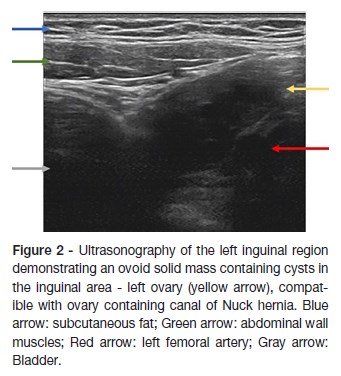
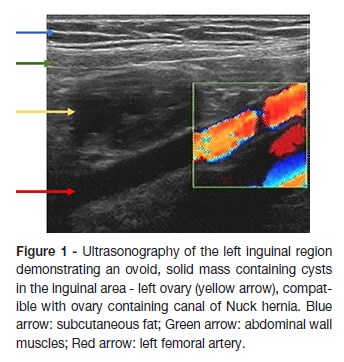
<body><![CDATA[<p>As hérnias inguinais são uma   patologia comum, com uma incidência estimada de 20 casos por 1.000 nados-vivos,   sendo a forma mais comum de hérnia da parede abdominal. Este problema afecta os rapazes cerca de seis vezes mais do que as raparigas. </p>     <p>O canal de Nuck é uma protrusão   tubular do peritoneu no sexo feminino, através do anel inguinal interno,   seguindo o ligamento redondo e com extensão até ao lábio vaginal. O canal de   Nuck está patente em até 90% dos recém-nascidos, sendo mais prevalentes nos recém-nascidos prematuros e apresentando uma tendência para o seu encerramento espontâneo ao longo do primeiro ano de vida. </p>     <p>Apresentamos um caso de uma menina   de 6 anos com uma hérnia do canal de Nuck contendo o ovário, diagnosticada por   ecografia. De acordo com a literatura, existem menos de duas dezenas de estudos   ecográficos publicados que descrevem o encarceramento ovárico neste tipo de hérnias.</p>     <p><b>Palavras-chave:</b> Doenças   ováricas/diagnóstico por imagem; Ecografia Doppler a Cores; Hernia; Inguinal/diagnóstico por imagem</p> </font> <hr noshade size="1"> <font face="Verdana" size="2">     <p>&nbsp;</p>     <p>&nbsp;</p>     <p>A six-year-old   girl who presented at the pediatrician with a complaint of a bulge in the left   inguinal region, presenting pain associated with physical activity, for the   last eight months, with no improvement after use of analgesic or anti-spasmodic   medication. Her physical examination showed a tender but reducible mass in her   left inguinal region. Ultrasonography of the left inguinal region detected an   inguinal hernia, containing the left ovary (<a href="#f1">Figures 1</a> and <a href="#f2">2</a>) reporting normal   vascularization in the Doppler study. The patient was operated a week later and the follow-up was uneventful.</p>     <p><a name="f1"></a></p>     <p>&nbsp;</p>     <p align="center"><img src="/img/revistas/nas/v27n3/27n3a12f1.jpg" width="344" height="362"></p>     
]]></body>
<body><![CDATA[<p>&nbsp;</p>     <p><a name="f2"></a></p>     <p>&nbsp;</p>     <p align="center"><img src="/img/revistas/nas/v27n3/27n3a12f2.jpg" width="341" height="376"></p>     
<p>&nbsp;</p>     <p><b>What is your diagnosis?</b></p>     <p>&nbsp;</p> </font>     <p><font size="3" face="Verdana"><b>DIAGNOSIS</b></font></p> <font face="Verdana" size="2">     <p>Ovary-containing Hernia of the Canal of Nuck</p>     <p><b>DIscussion</b></p>     ]]></body>
<body><![CDATA[<p>Inguinal hernias are a common   pathology, occurring up to 20 cases per 1.000 live births, especially during   the first year of life, representing the most common form of hernias of the   abdominal wall. These hernias affects boys about six times more often than girls.<sup>1-3</sup></p>     <p>The canal of Nuck in the female is   a protrusion, tubular fold of the peritoneum through the internal inguinal   ring, following the round ligament and extending to the labia.<sup>4</sup> The   canal of Nuck is patent in up to 90% of newborns, with a tendency to   spontaneously close over the first year of life. The congenital origin of this problem justifies its increased incidence in preterm children.<sup>5</sup> </p>     <p>All viscera   and internal organs herniation can occur through the inguinal canal, but the   ovary, specifically, is found in up to 30% of the cases, with its incidence   decreasing along with age.<sup>1,4,6,7 </sup>Constipation, lung disorders, and   conditions that raise intra-abdominal pressure, increase the risk of inguinal   herniation.<sup>8 </sup>There are less than 20 ultrasonography (US)   descriptions of ovary-containing hernias of the Nuck canal, according to Yang <i>et al</i>.<sup>9</sup></p>     <p>The US is an excellent method for   the evaluation of superficial regions such as the groin, being very sensitive   in superficial structures and must be the first diagnostic method   for pediatric patients with abdominal pain and irritability.<sup>3,8,9 </sup>US   has also the possibility of using color Doppler, and may also detect the   deficiency of vascularization of the herniated structure, or in the case of the   ovary, a torsion - early diagnosis is essential to evaluate gonadal tissue and   to preserve fertility.<sup>8,9 </sup>US should be indicated in female patients with an inguinal hernia containing a palpable movable mass.<sup>10</sup></p>     <p>The treatment for this condition is   surgical, consisting on ligation of the sac proximally, with its subsequent   invagination into the peritoneal cavity through the internal ring, while   confirming the reposition of the ovary into the peritoneal cavity.<sup>11</sup>   Ultrasonography with color Doppler is of great value in establishing the   urgency of this procedure. This exam can be particularly useful in defining the   blood supply of the ovary, thus evaluating if it is ischemic or not.<sup>8,9</sup>   This finding can be important in the management of the patient regarding   the  best surgical approach and the adequate timing of the procedure.</p>     <p>&nbsp;</p> </font>     <p><font size="3" face="Verdana"><b>REFERENCES</b></font></p> <font face="Verdana" size="2">     <!-- ref --><p>1.   Kapur P, Caty MG, Glick PL. Pediatric hernias   and hydroceles. Pediatr Clin North Am. 1998. 45:773-89&nbsp;&nbsp;&nbsp;&nbsp;&nbsp;&nbsp;&nbsp;&nbsp;[&#160;<a href="javascript:void(0);" onclick="javascript: window.open('/scielo.php?script=sci_nlinks&ref=1112567&pid=S0872-0754201800030001200001&lng=','','width=640,height=500,resizable=yes,scrollbars=1,menubar=yes,');">Links</a>&#160;]<!-- end-ref --><!-- ref --><p>2.   Manoharan S, Samarakkody U, Kulkarni M, Blakelock R, Brown S.   Evidence-based change of practice in the management of unilateral inguinal hernia. J Pediatr Surg. 2005; 40:1163-6&nbsp;&nbsp;&nbsp;&nbsp;&nbsp;&nbsp;&nbsp;&nbsp;[&#160;<a href="javascript:void(0);" onclick="javascript: window.open('/scielo.php?script=sci_nlinks&ref=1112568&pid=S0872-0754201800030001200002&lng=','','width=640,height=500,resizable=yes,scrollbars=1,menubar=yes,');">Links</a>&#160;]<!-- end-ref --><!-- ref --><p>3.   George   EK, Oudesluys-Murphy AM, Madern GC, Cleyndert P, Blomjous JG. Inguinal hernias   containing the uterus, fallopian tube, and ovary in premature female infants. J Pediatr. 2000 May;136:696-8.    &nbsp;&nbsp;&nbsp;&nbsp;&nbsp;&nbsp;&nbsp;&nbsp;[&#160;<a href="javascript:void(0);" onclick="javascript: window.open('/scielo.php?script=sci_nlinks&ref=1112569&pid=S0872-0754201800030001200003&lng=','','width=640,height=500,resizable=yes,scrollbars=1,menubar=yes,');">Links</a>&#160;]<!-- end-ref --></p>     <!-- ref --><p>4.   Goldstein   IR, Potts WJ. Inguinal hernia in female infants and children. Ann Surg. 1958; 148:819–22.    &nbsp;&nbsp;&nbsp;&nbsp;&nbsp;&nbsp;&nbsp;&nbsp;[&#160;<a href="javascript:void(0);" onclick="javascript: window.open('/scielo.php?script=sci_nlinks&ref=1112571&pid=S0872-0754201800030001200004&lng=','','width=640,height=500,resizable=yes,scrollbars=1,menubar=yes,');">Links</a>&#160;]<!-- end-ref --></p>     <!-- ref --><p>5.   Ando   H, Kaneko K, Ito F, Seo T, Ito T. Anatomy of the round ligament in female infants and children with an inguinal hernia. Br J Surg. 1997; 84:404-5.    &nbsp;&nbsp;&nbsp;&nbsp;&nbsp;&nbsp;&nbsp;&nbsp;[&#160;<a href="javascript:void(0);" onclick="javascript: window.open('/scielo.php?script=sci_nlinks&ref=1112573&pid=S0872-0754201800030001200005&lng=','','width=640,height=500,resizable=yes,scrollbars=1,menubar=yes,');">Links</a>&#160;]<!-- end-ref --></p>     <!-- ref --><p>6.   Fowler   CL. Sliding indirect hernia containing both ovaries. J Pediatr Surg. 2005; 40:e13–4.    &nbsp;&nbsp;&nbsp;&nbsp;&nbsp;&nbsp;&nbsp;&nbsp;[&#160;<a href="javascript:void(0);" onclick="javascript: window.open('/scielo.php?script=sci_nlinks&ref=1112575&pid=S0872-0754201800030001200006&lng=','','width=640,height=500,resizable=yes,scrollbars=1,menubar=yes,');">Links</a>&#160;]<!-- end-ref --></p>     <!-- ref --><p>7.   George   EK, Oudesluys-Murphy AM, Madern GC, Cleyndert P, Blomjous JG. Inguinal hernias   containing the uterus, fallopian tube, and ovary in premature female infants. J Pediatr. 2000; 136:696-8.    &nbsp;&nbsp;&nbsp;&nbsp;&nbsp;&nbsp;&nbsp;&nbsp;[&#160;<a href="javascript:void(0);" onclick="javascript: window.open('/scielo.php?script=sci_nlinks&ref=1112577&pid=S0872-0754201800030001200007&lng=','','width=640,height=500,resizable=yes,scrollbars=1,menubar=yes,');">Links</a>&#160;]<!-- end-ref --></p>     <!-- ref --><p>8.   Aydin   R, Polat AV, Ozaydin I, Aydin G. Gray-scale and color Doppler ultrasound   imaging findings of an ovarian inguinal hernia and torsion of the herniated ovary: a case report. Pediatr Emerg Care. 2013; 29:364-5.    &nbsp;&nbsp;&nbsp;&nbsp;&nbsp;&nbsp;&nbsp;&nbsp;[&#160;<a href="javascript:void(0);" onclick="javascript: window.open('/scielo.php?script=sci_nlinks&ref=1112579&pid=S0872-0754201800030001200008&lng=','','width=640,height=500,resizable=yes,scrollbars=1,menubar=yes,');">Links</a>&#160;]<!-- end-ref --></p>     <!-- ref --><p>9.   Yang   DM, Kim HC, Kim SW, Lim SJ, Park SJ, Lim JW. Ultrasonographic diagnosis of ovary-containing hernias of the canal of Nuck. Ultrasonography. 2014; 33:178-83.    &nbsp;&nbsp;&nbsp;&nbsp;&nbsp;&nbsp;&nbsp;&nbsp;[&#160;<a href="javascript:void(0);" onclick="javascript: window.open('/scielo.php?script=sci_nlinks&ref=1112581&pid=S0872-0754201800030001200009&lng=','','width=640,height=500,resizable=yes,scrollbars=1,menubar=yes,');">Links</a>&#160;]<!-- end-ref --></p>     <!-- ref --><p>10. Huang   CS, Luo CC, Chao HC, Chu SM, Yu YJ, Yen JB. The presentation of asymptomatic   palpable movable mass in female inguinal hernia. Eur J Pediatr. 2003; 162:493-5.    &nbsp;&nbsp;&nbsp;&nbsp;&nbsp;&nbsp;&nbsp;&nbsp;[&#160;<a href="javascript:void(0);" onclick="javascript: window.open('/scielo.php?script=sci_nlinks&ref=1112583&pid=S0872-0754201800030001200010&lng=','','width=640,height=500,resizable=yes,scrollbars=1,menubar=yes,');">Links</a>&#160;]<!-- end-ref --></p>     <p>&nbsp;</p>     <p>&nbsp;</p> <b><a name="end" id="topo2"></a><a href="#topo">CORRESPONDENCE TO</a></b>     <p>Márcio Luís Duarte    <br>   Clínica Radiológica e Especialidades Médicas São Gabriel    <br> Rua Mihailo Lukich, 94    ]]></body>
<body><![CDATA[<br> Boqueirão, Praia Grande    <br> 11701-370 São Paulo    <br> Email: <a href="mailto:marcioluisduarte@gmail.com">marcioluisduarte@gmail.com</a></p>     <p>Received for   publication: 11.08.2017    <br> Accepted in revised form: 12.02.2018</p> </font>      ]]></body><back>
<ref-list>
<ref id="B1">
<label>1</label><nlm-citation citation-type="journal">
<person-group person-group-type="author">
<name>
<surname><![CDATA[Kapur]]></surname>
<given-names><![CDATA[P]]></given-names>
</name>
<name>
<surname><![CDATA[Caty]]></surname>
<given-names><![CDATA[MG]]></given-names>
</name>
<name>
<surname><![CDATA[Glick]]></surname>
<given-names><![CDATA[PL]]></given-names>
</name>
</person-group>
<article-title xml:lang="en"><![CDATA[Pediatric hernias and hydroceles]]></article-title>
<source><![CDATA[Pediatr Clin North Am.]]></source>
<year>1998</year>
<volume>45</volume>
<page-range>773-89</page-range></nlm-citation>
</ref>
<ref id="B2">
<label>2</label><nlm-citation citation-type="journal">
<person-group person-group-type="author">
<name>
<surname><![CDATA[Manoharan]]></surname>
<given-names><![CDATA[S]]></given-names>
</name>
<name>
<surname><![CDATA[Samarakkody]]></surname>
<given-names><![CDATA[U]]></given-names>
</name>
<name>
<surname><![CDATA[Kulkarni]]></surname>
<given-names><![CDATA[M]]></given-names>
</name>
<name>
<surname><![CDATA[Blakelock]]></surname>
<given-names><![CDATA[R]]></given-names>
</name>
<name>
<surname><![CDATA[Brown]]></surname>
<given-names><![CDATA[S]]></given-names>
</name>
</person-group>
<article-title xml:lang="en"><![CDATA[Evidence-based change of practice in the management of unilateral inguinal hernia]]></article-title>
<source><![CDATA[J Pediatr Surg]]></source>
<year>2005</year>
<volume>40</volume>
<page-range>1163-6</page-range></nlm-citation>
</ref>
<ref id="B3">
<label>3</label><nlm-citation citation-type="journal">
<person-group person-group-type="author">
<name>
<surname><![CDATA[George]]></surname>
<given-names><![CDATA[EK]]></given-names>
</name>
<name>
<surname><![CDATA[Oudesluys-Murphy]]></surname>
<given-names><![CDATA[AM]]></given-names>
</name>
<name>
<surname><![CDATA[Madern]]></surname>
<given-names><![CDATA[GC]]></given-names>
</name>
<name>
<surname><![CDATA[Cleyndert]]></surname>
<given-names><![CDATA[P]]></given-names>
</name>
<name>
<surname><![CDATA[Blomjous]]></surname>
<given-names><![CDATA[JG]]></given-names>
</name>
</person-group>
<article-title xml:lang="en"><![CDATA[Inguinal hernias containing the uterus, fallopian tube, and ovary in premature female infants]]></article-title>
<source><![CDATA[J Pediatr.]]></source>
<year>2000</year>
<month> M</month>
<day>ay</day>
<volume>136</volume>
<page-range>696-8</page-range></nlm-citation>
</ref>
<ref id="B4">
<label>4</label><nlm-citation citation-type="journal">
<person-group person-group-type="author">
<name>
<surname><![CDATA[Goldstein]]></surname>
<given-names><![CDATA[IR]]></given-names>
</name>
<name>
<surname><![CDATA[Potts]]></surname>
<given-names><![CDATA[WJ]]></given-names>
</name>
</person-group>
<article-title xml:lang="en"><![CDATA[Inguinal hernia in female infants and children]]></article-title>
<source><![CDATA[Ann Surg]]></source>
<year>1958</year>
<volume>148</volume>
<page-range>819-22</page-range></nlm-citation>
</ref>
<ref id="B5">
<label>5</label><nlm-citation citation-type="journal">
<person-group person-group-type="author">
<name>
<surname><![CDATA[Ando]]></surname>
<given-names><![CDATA[H]]></given-names>
</name>
<name>
<surname><![CDATA[Kaneko]]></surname>
<given-names><![CDATA[K]]></given-names>
</name>
<name>
<surname><![CDATA[Ito]]></surname>
<given-names><![CDATA[F]]></given-names>
</name>
<name>
<surname><![CDATA[Seo]]></surname>
<given-names><![CDATA[T]]></given-names>
</name>
<name>
<surname><![CDATA[Ito]]></surname>
<given-names><![CDATA[T]]></given-names>
</name>
</person-group>
<article-title xml:lang="en"><![CDATA[Anatomy of the round ligament in female infants and children with an inguinal hernia]]></article-title>
<source><![CDATA[Br J Surg]]></source>
<year>1997</year>
<volume>84</volume>
<page-range>404-5</page-range></nlm-citation>
</ref>
<ref id="B6">
<label>6</label><nlm-citation citation-type="journal">
<person-group person-group-type="author">
<name>
<surname><![CDATA[Fowler]]></surname>
<given-names><![CDATA[CL]]></given-names>
</name>
</person-group>
<article-title xml:lang="en"><![CDATA[Sliding indirect hernia containing both ovaries]]></article-title>
<source><![CDATA[J Pediatr Surg.]]></source>
<year>2005</year>
<volume>40</volume>
<page-range>e13-4</page-range></nlm-citation>
</ref>
<ref id="B7">
<label>7</label><nlm-citation citation-type="journal">
<person-group person-group-type="author">
<name>
<surname><![CDATA[George]]></surname>
<given-names><![CDATA[EK]]></given-names>
</name>
<name>
<surname><![CDATA[Oudesluys-Murphy]]></surname>
<given-names><![CDATA[AM]]></given-names>
</name>
<name>
<surname><![CDATA[Madern]]></surname>
<given-names><![CDATA[GC]]></given-names>
</name>
<name>
<surname><![CDATA[Cleyndert]]></surname>
<given-names><![CDATA[P]]></given-names>
</name>
<name>
<surname><![CDATA[Blomjous]]></surname>
<given-names><![CDATA[JG]]></given-names>
</name>
</person-group>
<article-title xml:lang="en"><![CDATA[Inguinal hernias containing the uterus, fallopian tube, and ovary in premature female infants]]></article-title>
<source><![CDATA[J Pediatr.]]></source>
<year>2000</year>
<volume>136</volume>
<page-range>696-8</page-range></nlm-citation>
</ref>
<ref id="B8">
<label>8</label><nlm-citation citation-type="journal">
<person-group person-group-type="author">
<name>
<surname><![CDATA[Aydin]]></surname>
<given-names><![CDATA[R]]></given-names>
</name>
<name>
<surname><![CDATA[Polat]]></surname>
<given-names><![CDATA[AV]]></given-names>
</name>
<name>
<surname><![CDATA[Ozaydin]]></surname>
<given-names><![CDATA[I]]></given-names>
</name>
<name>
<surname><![CDATA[Aydin]]></surname>
<given-names><![CDATA[G]]></given-names>
</name>
</person-group>
<article-title xml:lang="en"><![CDATA[Gray-scale and color Doppler ultrasound imaging findings of an ovarian inguinal hernia and torsion of the herniated ovary: a case report]]></article-title>
<source><![CDATA[Pediatr Emerg Care]]></source>
<year>2013</year>
<volume>29</volume>
<page-range>364-5</page-range></nlm-citation>
</ref>
<ref id="B9">
<label>9</label><nlm-citation citation-type="journal">
<person-group person-group-type="author">
<name>
<surname><![CDATA[Yang]]></surname>
<given-names><![CDATA[DM]]></given-names>
</name>
<name>
<surname><![CDATA[Kim]]></surname>
<given-names><![CDATA[HC]]></given-names>
</name>
<name>
<surname><![CDATA[Kim]]></surname>
<given-names><![CDATA[SW]]></given-names>
</name>
<name>
<surname><![CDATA[Lim]]></surname>
<given-names><![CDATA[SJ]]></given-names>
</name>
<name>
<surname><![CDATA[Park]]></surname>
<given-names><![CDATA[SJ]]></given-names>
</name>
<name>
<surname><![CDATA[Lim]]></surname>
<given-names><![CDATA[JW]]></given-names>
</name>
</person-group>
<article-title xml:lang="en"><![CDATA[Ultrasonographic diagnosis of ovary-containing hernias of the canal of Nuck]]></article-title>
<source><![CDATA[Ultrasonography]]></source>
<year>2014</year>
<volume>33</volume>
<page-range>178-83</page-range></nlm-citation>
</ref>
<ref id="B10">
<label>10</label><nlm-citation citation-type="journal">
<person-group person-group-type="author">
<name>
<surname><![CDATA[Huang]]></surname>
<given-names><![CDATA[CS]]></given-names>
</name>
<name>
<surname><![CDATA[Luo]]></surname>
<given-names><![CDATA[CC]]></given-names>
</name>
<name>
<surname><![CDATA[Chao]]></surname>
<given-names><![CDATA[HC]]></given-names>
</name>
<name>
<surname><![CDATA[Chu]]></surname>
<given-names><![CDATA[SM]]></given-names>
</name>
<name>
<surname><![CDATA[Yu]]></surname>
<given-names><![CDATA[YJ]]></given-names>
</name>
<name>
<surname><![CDATA[Yen]]></surname>
<given-names><![CDATA[JB]]></given-names>
</name>
</person-group>
<article-title xml:lang="en"><![CDATA[The presentation of asymptomatic palpable movable mass in female inguinal hernia]]></article-title>
<source><![CDATA[Eur J Pediatr.]]></source>
<year>2003</year>
<volume>162</volume>
<page-range>493-5</page-range></nlm-citation>
</ref>
</ref-list>
</back>
</article>