<?xml version="1.0" encoding="ISO-8859-1"?><article xmlns:mml="http://www.w3.org/1998/Math/MathML" xmlns:xlink="http://www.w3.org/1999/xlink" xmlns:xsi="http://www.w3.org/2001/XMLSchema-instance">
<front>
<journal-meta>
<journal-id>0872-0754</journal-id>
<journal-title><![CDATA[Nascer e Crescer]]></journal-title>
<abbrev-journal-title><![CDATA[Nascer e Crescer]]></abbrev-journal-title>
<issn>0872-0754</issn>
<publisher>
<publisher-name><![CDATA[Centro Hospitalar do Porto]]></publisher-name>
</publisher>
</journal-meta>
<article-meta>
<article-id>S0872-07542018000300013</article-id>
<article-id pub-id-type="doi">10.25753/BirthGrowthMJ.v27.i3.12889</article-id>
<title-group>
<article-title xml:lang="pt"><![CDATA[Caso ortopédico]]></article-title>
<article-title xml:lang="en"><![CDATA[Orthopedic case]]></article-title>
</title-group>
<contrib-group>
<contrib contrib-type="author">
<name>
<surname><![CDATA[Ferreira]]></surname>
<given-names><![CDATA[Jorge Abreu]]></given-names>
</name>
<xref ref-type="aff" rid="A01"/>
</contrib>
<contrib contrib-type="author">
<name>
<surname><![CDATA[Martins]]></surname>
<given-names><![CDATA[Cristiana]]></given-names>
</name>
<xref ref-type="aff" rid="A01"/>
</contrib>
<contrib contrib-type="author">
<name>
<surname><![CDATA[Peixoto]]></surname>
<given-names><![CDATA[Paulo]]></given-names>
</name>
<xref ref-type="aff" rid="A02"/>
</contrib>
<contrib contrib-type="author">
<name>
<surname><![CDATA[Duarte]]></surname>
<given-names><![CDATA[Filipe]]></given-names>
</name>
<xref ref-type="aff" rid="A03"/>
</contrib>
<contrib contrib-type="author">
<name>
<surname><![CDATA[Torres]]></surname>
<given-names><![CDATA[José Samaniego]]></given-names>
</name>
<xref ref-type="aff" rid="A01"/>
</contrib>
<contrib contrib-type="author">
<name>
<surname><![CDATA[Santos]]></surname>
<given-names><![CDATA[Jorge França]]></given-names>
</name>
<xref ref-type="aff" rid="A01"/>
</contrib>
</contrib-group>
<aff id="A01">
<institution><![CDATA[,Centro Hospitalar de Trás-os-Montes e Alto Douro Department of Pediatrics ]]></institution>
<addr-line><![CDATA[Vila Real ]]></addr-line>
<country>Portugal</country>
</aff>
<aff id="A02">
<institution><![CDATA[,Centro Hospitalar de Trás-os-Montes e Alto Douro Unidade Hospitalar de Chaves Department of Orthopedics]]></institution>
<addr-line><![CDATA[Chaves ]]></addr-line>
<country>Portugal</country>
</aff>
<aff id="A03">
<institution><![CDATA[,Centro Hospitalar de São João Department of Orthopedics ]]></institution>
<addr-line><![CDATA[Porto ]]></addr-line>
<country>Portugal</country>
</aff>
<pub-date pub-type="pub">
<day>01</day>
<month>09</month>
<year>2018</year>
</pub-date>
<pub-date pub-type="epub">
<day>01</day>
<month>09</month>
<year>2018</year>
</pub-date>
<volume>27</volume>
<numero>3</numero>
<fpage>209</fpage>
<lpage>211</lpage>
<copyright-statement/>
<copyright-year/>
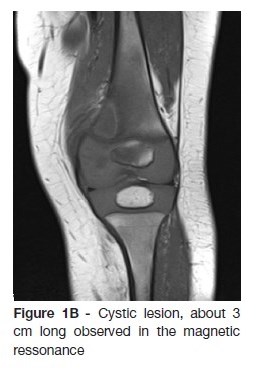
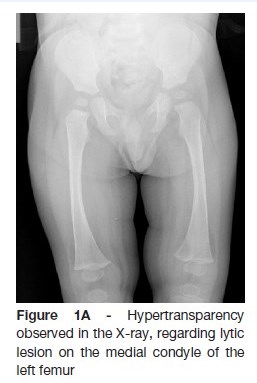
<self-uri xlink:href="http://scielo.pt/scielo.php?script=sci_arttext&amp;pid=S0872-07542018000300013&amp;lng=en&amp;nrm=iso"></self-uri><self-uri xlink:href="http://scielo.pt/scielo.php?script=sci_abstract&amp;pid=S0872-07542018000300013&amp;lng=en&amp;nrm=iso"></self-uri><self-uri xlink:href="http://scielo.pt/scielo.php?script=sci_pdf&amp;pid=S0872-07542018000300013&amp;lng=en&amp;nrm=iso"></self-uri><abstract abstract-type="short" xml:lang="en"><p><![CDATA[A previously healthy 12-month-old boy, was observed in the emergency department due to refusal to walk, initially diagnosed as transient synovitis of the hip. After one month, he is again observed due to the persistence of symptoms and fever. On objective examination he presented refusal to walk, reporting no difficulties in crawling. A conventional radiography showed lytic lesion on the medial condyle of the left femur and computed tomography (CT) revealed a probable Brodie abscess. Patient was referred to pediatric orthopedics consultation and then performed a magnetic ressonance that confirmed osteomyelitis with an intraosseous abscess. He was submitted to surgical drainage and four weeks of antibiotic therapy, with no sequelae after one year. Brodie’s abscess is a subtype of subacute osteomyelitis characterized by the formation of an intramedullary abscess, predominantly in the long bones. It is difficult to diagnose since the symptoms can be mild, mimicking several malignant or benign conditions. Radiology plays a key role in its identification. The treatment can be medical or medical-surgical, usually with a good prognosis.]]></p></abstract>
<abstract abstract-type="short" xml:lang="pt"><p><![CDATA[Criança de 12 meses de idade, sexo masculino, observada no serviço de urgência por recusa da marcha. Inicialmente diagnosticada como sinovite transitória da anca. Reobservada após um mês por manutenção dos sintomas e febre. Ao exame objetivo recusava marcha, mas gatinhava bem. Realizou radiografia que mostrou lesão lítica no côndilo medial do fémur esquerdo e tomografia computorizada, que revelou provável abcesso de Brodie. Transferido para observação por ortopedia pediátrica, realizou ressonância magnética, que confirmou osteomielite com abcesso intraósseo. Submetido a drenagem cirúrgica e quatro semanas de antibioterapia, encontrando-se sem sequelas após um ano. O abcesso de Brodie é um subtipo de osteomielite subaguda caracterizada pela formação de um abcesso intramedular, predominantemente nos ossos longos. É de difícil diagnóstico, uma vez que a sintomatologia é pouco exuberante, podendo mimetizar algumas condições benignas ou malignas. A imagiologia tem um papel fundamental na sua identificação. O tratamento pode ser médico ou médico-cirúrgico, habitualmente com bom prognóstico.]]></p></abstract>
<kwd-group>
<kwd lng="en"><![CDATA[Brodie’s abscess]]></kwd>
<kwd lng="en"><![CDATA[osteomyelitis]]></kwd>
<kwd lng="en"><![CDATA[transient synovitis of the hip]]></kwd>
<kwd lng="pt"><![CDATA[Abcesso de Brodie]]></kwd>
<kwd lng="pt"><![CDATA[osteomielite]]></kwd>
<kwd lng="pt"><![CDATA[sinovite transitória da anca]]></kwd>
</kwd-group>
</article-meta>
</front><body><![CDATA[ <p align="right"> <font size="2"><b><font face="Verdana">QUAL O SEU DIAGN&Oacute;STICO? | WHAT IS YOUR DIAGNOSIS?</font></b></font></p>     <p>&nbsp;</p>     <p><font size="4" face="Verdana"><b>Caso ortop&eacute;dico</b></font></p>     <p>&nbsp;</p>     <p><font size="3" face="Verdana"><b>Orthopedic case</b></font></p> <font face="Verdana" size="2">     <p>&nbsp;</p>     <p>&nbsp;</p>     <p><b>Jorge Abreu   Ferreira<sup>I</sup>; Cristiana Martins<sup>I</sup>; Paulo Peixoto<sup>II</sup>; Filipe Duarte<sup>III</sup>; José Samaniego Torres<sup>I</sup>; Jorge França Santos<sup>I</sup></b></p>     <p><sup>I </sup>Department of Pediatrics, Centro Hospitalar de Trás-os-Montes e Alto Douro. 5000-508 Vila Real, Portugal. <a href="mailto:jorgeabreuferreira@gmail.com">jorgeabreuferreira@gmail.com</a>; <a href="mailto:cristianamartins@ymail.com">cristianamartins@ymail.com</a>; <a href="mailto:jossama1@yahoo.es">jossama1@yahoo.es</a>; <a href="mailto:jmfrancasantos@hotmail.com">jmfrancasantos@hotmail.com</a>    <br> <sup>II </sup>Department of Orthopedics, Centro Hospitalar de Trás-os-Montes e Alto Douro. Unidade Hospitalar de Chaves. 5400-279 – Chaves, Portugal. <a href="mailto:paulojrpeixoto@gmail.com">paulojrpeixoto@gmail.com</a>    ]]></body>
<body><![CDATA[<br> <sup>III </sup>Department of Orthopedics, Centro Hospitalar de São João. 4200–319 Porto, Portugal. <a href="mailto:filiperduarte@hotmail.com">filiperduarte@hotmail.com</a></p> </font>     <p><font face="Verdana" size="2"><a href="#end">Correspondence to</a><a name="topo" id="topo"></a> </font></p>     <p>&nbsp;</p>     <p>&nbsp;</p> <hr noshade size="1">     <p><font size="2"><b><font face="Verdana">ABSTRACT</font></b></font></p>     <p><font size="2" face="Verdana">A previously healthy 12-month-old   boy, was observed in the emergency department due to refusal to walk, initially   diagnosed as transient synovitis of the hip. After one month, he is again   observed due to the persistence of symptoms and fever. On objective examination   he presented refusal to walk, reporting no difficulties in crawling. A   conventional radiography showed lytic lesion on the medial condyle of the left   femur and computed tomography (CT) revealed a probable Brodie abscess. Patient   was referred to pediatric orthopedics consultation and then performed a   magnetic ressonance that confirmed osteomyelitis with an intraosseous abscess.   He was submitted to surgical drainage and four weeks of antibiotic therapy, with no sequelae after one year.</font></p>     <p><font size="2" face="Verdana">Brodie’s abscess is a subtype of   subacute osteomyelitis characterized by the formation of an intramedullary   abscess, predominantly in the long bones. It is difficult to diagnose since the   symptoms can be mild, mimicking several malignant or benign conditions.   Radiology plays a key role in its identification. The treatment can be medical or medical-surgical, usually with a good prognosis.</font></p>     <p><font size="2" face="Verdana"><b>Keywords: </b>Brodie’s   abscess; osteomyelitis; transient synovitis of the hip</font></p> <hr noshade size="1">     <p><font size="2" face="Verdana"><b>RESUMO</b></font></p>     <p><font size="2" face="Verdana">Criança de 12 meses de idade, sexo   masculino, observada no serviço de urgência por recusa da marcha. Inicialmente   diagnosticada como sinovite transitória da anca. Reobservada após um mês por   manutenção dos sintomas e febre. Ao exame objetivo recusava marcha, mas   gatinhava bem. Realizou radiografia que mostrou lesão lítica no côndilo medial   do fémur esquerdo e tomografia computorizada, que revelou provável abcesso de   Brodie. Transferido para observação por ortopedia pediátrica, realizou   ressonância magnética, que confirmou osteomielite com abcesso intraósseo.   Submetido a drenagem cirúrgica e quatro semanas de antibioterapia, encontrando-se sem sequelas após um ano.</font></p>     ]]></body>
<body><![CDATA[<p><font size="2" face="Verdana">O abcesso de Brodie é um subtipo de   osteomielite subaguda caracterizada pela formação de um abcesso intramedular,   predominantemente nos ossos longos. É de difícil diagnóstico, uma vez que a   sintomatologia é pouco exuberante, podendo mimetizar algumas condições benignas   ou malignas. A imagiologia tem um papel fundamental na sua identificação. O   tratamento pode ser médico ou médico-cirúrgico, habitualmente com bom prognóstico. </font></p>     <p><font size="2" face="Verdana"><b>Palavras-chave: </b>Abcesso de Brodie; osteomielite; sinovite transitória da anca</font></p> <hr noshade size="1">     <p>&nbsp;</p>     <p>&nbsp;</p> <font face="Verdana" size="2">     <p>A previously healthy 12-month-old   boy was admitted in the emergency department due to refusal to walk and a limp   on the left leg with a 5-day evolution. There was no history of fever, trauma   or recent infection. On admission, besides the refusal to walk, he crawled well   and physical examination was unremarkable. Conventional hip radiography and   blood tests were normal. Anti-inflammatory medicines were prescribed and he was   discharged with the clinical diagnosis of transient synovitis of the hip. After   several observations in the emergency department and a month after the initial   complaint, he was once again observed due to the persistence of symptoms and fever. </p>     <p>The   radiography showed a lytic lesion on the medial femoral condyle (<a href="#f1">Figure 1A</a>)   which was later confirmed by computed tomography and magnetic resonance (<a href="#f2">Figure 1B</a>).</p>     <p><a name="f1"></a></p>     <p>&nbsp;</p>     <p align="center"><img src="/img/revistas/nas/v27n3/27n3a13f1.jpg" width="257" height="383"></p>     
<p>&nbsp;</p>     ]]></body>
<body><![CDATA[<p><a name="f2"></a></p>     <p>&nbsp;</p>     <p align="center"><img src="/img/revistas/nas/v27n3/27n3a13f2.jpg" width="256" height="382"></p>     
<p>&nbsp;</p>     <p><b>What is your diagnosis?</b></p>     <p>&nbsp;</p> </font>     <p><font size="3" face="Verdana"><b>DIAGNOSIS</b></font></p> <font face="Verdana" size="2">     <p>Brodie’s abscess</p>     <p>&nbsp;</p> </font>     <p><font size="3" face="Verdana"><b>DISCUSSION</b></font></p> <font face="Verdana" size="2">     ]]></body>
<body><![CDATA[<p>Firstly diagnosed by Sir Benjamin   Brodie in 1832, Brodie’s abscess is an uncommon subtype of a subacute   osteomyelitis with the formation of an intramedullary abscess. It usually   affects the cancellous portion of the metaphyseal, epiphyseal, and diaphyseal   long bone and is normally caused by Staphylococcus species.<sup>1 </sup>The   disease has an indolent course due to the combination of host resistance with   low virulence of the causative organisms. It is more common in males and usually occurs in young patients.<sup>1,2</sup> </p>     <p>Pain is the most consistent   complaint followed by loss of function or limping.  Actually, diagnosis is challenging because patients present with mild symptoms and almost normal blood tests.<sup>1</sup></p>     <p>Brodie’s abscess may mimic various   benign and malignant conditions such as osteoid osteoma or Ewing’s sarcoma.   Radiology plays an important role in the differential diagnosis, being the magnetic resonance the most commonly used for this purpose.<sup>2,3</sup></p>     <p>Biopsy of the Brodie’s abscess   cavity does not usually enable isolation of the microorganism, and therefore it   is regarded as non-essential. The initial treatment is primarily conservative,   with intravenous antibiotics. Surgical therapy may be an option, in cases of   uncertain diagnosis, non-responsiveness to antibiotics, and larger lesions or presenting more aggressive features.<sup>1,3</sup></p>     <p>Once the diagnosis is confirmed and   the treatment is initiated, results are typically excellent either with medical or medical and surgical treatment.<sup>3,4</sup></p>     <p>&nbsp;</p> </font>     <p><font size="3" face="Verdana"><b>CASE TREATMENT AND CLINICAL OUTCOME</b></font></p> <font face="Verdana" size="2">     <p>The patient initiated empirical   antibiotic therapy and was referred to a Pediatric Orthopedist specialist.   Given the intraosseous abscess size, it was surgically drained. Blood and local   exsudate cultures were negative. He completed a two weeks course of intravenous   antibiotics (cefuroxime and gentamicin), followed by two weeks of oral antibiotics (cefixime). No sequelae were reported one year after the treatment.</p>     <p>&nbsp;</p> </font>     <p><font size="3" face="Verdana"><b>CONCLUSIONS</b></font></p> <font face="Verdana" size="2">     ]]></body>
<body><![CDATA[<p>Although well documented in the   literature, Brodie’s abscess is a rare entity. In this case, normal crawling   and hip radiography pointed to an initial misdiagnosis. The authors emphasize   the importance of clinical suspicion in a child with refusal to walk, since   Brodie’s abscess can mimic various diseases.  Radiology plays a key role in those insidious situations.   </p>     <p>&nbsp;</p> </font>     <p><font size="3" face="Verdana"><b>REFERENCES</b></font></p> <font face="Verdana" size="2">     <!-- ref --><p>1.   Abdulhadi MA, White AM, Pollock AN. Brodie abscess. Pediatr Emerg Care. 2012; 28:1249-51.    &nbsp;&nbsp;&nbsp;&nbsp;&nbsp;&nbsp;&nbsp;&nbsp;[&#160;<a href="javascript:void(0);" onclick="javascript: window.open('/scielo.php?script=sci_nlinks&ref=1112662&pid=S0872-0754201800030001300001&lng=','','width=640,height=500,resizable=yes,scrollbars=1,menubar=yes,');">Links</a>&#160;]<!-- end-ref --></p>     <!-- ref --><p>2.   Agarwal S, Akhtar MN, Bareh J. Brodie’s abscess of the cuboid in a pediatric male. J Foot Ankle Surg. 2012; 51:258-61.    &nbsp;&nbsp;&nbsp;&nbsp;&nbsp;&nbsp;&nbsp;&nbsp;[&#160;<a href="javascript:void(0);" onclick="javascript: window.open('/scielo.php?script=sci_nlinks&ref=1112664&pid=S0872-0754201800030001300002&lng=','','width=640,height=500,resizable=yes,scrollbars=1,menubar=yes,');">Links</a>&#160;]<!-- end-ref --></p>     <!-- ref --><p>3.   Kornaat PR, Camerlinck M, Vanhoenacker FM, De Praeter G, Kroon HM. Brodie’s abscess revisited. JBR-BTR. 2010; 93:81-6.    &nbsp;&nbsp;&nbsp;&nbsp;&nbsp;&nbsp;&nbsp;&nbsp;[&#160;<a href="javascript:void(0);" onclick="javascript: window.open('/scielo.php?script=sci_nlinks&ref=1112666&pid=S0872-0754201800030001300003&lng=','','width=640,height=500,resizable=yes,scrollbars=1,menubar=yes,');">Links</a>&#160;]<!-- end-ref --></p>     <!-- ref --><p>4.   Olasinde AA, Oluwadiya KS, Adegbehingbe OO.   Treatment of Brodie’s abscess: excellent results from curettage, bone grafting and antibiotics. Singapore Med J. 2011; 52:436.    &nbsp;&nbsp;&nbsp;&nbsp;&nbsp;&nbsp;&nbsp;&nbsp;[&#160;<a href="javascript:void(0);" onclick="javascript: window.open('/scielo.php?script=sci_nlinks&ref=1112668&pid=S0872-0754201800030001300004&lng=','','width=640,height=500,resizable=yes,scrollbars=1,menubar=yes,');">Links</a>&#160;]<!-- end-ref --></p>     <p>&nbsp;</p>     <p>&nbsp;</p> <b><a name="end" id="topo2"></a><a href="#topo">CORRESPONDENCE TO</a></b>     <p>Jorge Abreu Ferreira    <br>   Department of Pediatrics,    <br>   Centro Hospitalar de Trás-os-Montes   e Alto Douro    <br>   Av. Noruega, Lordelo    <br>   5000-508 Vila Real, Portugal.    <br>   Email: <a href="mailto:jorgeabreuferreira@gmail.com">jorgeabreuferreira@gmail.com</a></p>     <p>Received for   publication: 21.08.2017    ]]></body>
<body><![CDATA[<br> Accepted in revised form: 10.01.2018</p> </font>      ]]></body><back>
<ref-list>
<ref id="B1">
<label>1</label><nlm-citation citation-type="journal">
<person-group person-group-type="author">
<name>
<surname><![CDATA[Abdulhadi]]></surname>
<given-names><![CDATA[MA]]></given-names>
</name>
<name>
<surname><![CDATA[White]]></surname>
<given-names><![CDATA[AM]]></given-names>
</name>
<name>
<surname><![CDATA[Pollock]]></surname>
<given-names><![CDATA[AN]]></given-names>
</name>
</person-group>
<article-title xml:lang="en"><![CDATA[Brodie abscess]]></article-title>
<source><![CDATA[Pediatr Emerg Care]]></source>
<year>2012</year>
<volume>28</volume>
<page-range>1249-51</page-range></nlm-citation>
</ref>
<ref id="B2">
<label>2</label><nlm-citation citation-type="journal">
<person-group person-group-type="author">
<name>
<surname><![CDATA[Agarwal]]></surname>
<given-names><![CDATA[S]]></given-names>
</name>
<name>
<surname><![CDATA[Akhtar]]></surname>
<given-names><![CDATA[MN]]></given-names>
</name>
<name>
<surname><![CDATA[Bareh]]></surname>
<given-names><![CDATA[J]]></given-names>
</name>
</person-group>
<article-title xml:lang="en"><![CDATA[Brodie’s abscess of the cuboid in a pediatric male]]></article-title>
<source><![CDATA[J Foot Ankle Surg]]></source>
<year>2012</year>
<volume>51</volume>
<page-range>258-61</page-range></nlm-citation>
</ref>
<ref id="B3">
<label>3</label><nlm-citation citation-type="journal">
<person-group person-group-type="author">
<name>
<surname><![CDATA[Kornaat]]></surname>
<given-names><![CDATA[PR]]></given-names>
</name>
<name>
<surname><![CDATA[Camerlinck]]></surname>
<given-names><![CDATA[M]]></given-names>
</name>
<name>
<surname><![CDATA[Vanhoenacker]]></surname>
<given-names><![CDATA[FM]]></given-names>
</name>
<name>
<surname><![CDATA[De Praeter]]></surname>
<given-names><![CDATA[G]]></given-names>
</name>
<name>
<surname><![CDATA[Kroon]]></surname>
<given-names><![CDATA[HM]]></given-names>
</name>
</person-group>
<article-title xml:lang="en"><![CDATA[Brodie’s abscess revisited]]></article-title>
<source><![CDATA[JBR-BTR]]></source>
<year>2010</year>
<volume>93</volume>
<page-range>81-6</page-range></nlm-citation>
</ref>
<ref id="B4">
<label>4</label><nlm-citation citation-type="journal">
<person-group person-group-type="author">
<name>
<surname><![CDATA[Olasinde]]></surname>
<given-names><![CDATA[AA]]></given-names>
</name>
<name>
<surname><![CDATA[Oluwadiya]]></surname>
<given-names><![CDATA[KS]]></given-names>
</name>
<name>
<surname><![CDATA[Adegbehingbe]]></surname>
<given-names><![CDATA[OO]]></given-names>
</name>
</person-group>
<article-title xml:lang="en"><![CDATA[Treatment of Brodie’s abscess: excellent results from curettage, bone grafting and antibiotics]]></article-title>
<source><![CDATA[Singapore Med J.]]></source>
<year>2011</year>
<volume>52</volume>
<page-range>436</page-range></nlm-citation>
</ref>
</ref-list>
</back>
</article>