<?xml version="1.0" encoding="ISO-8859-1"?><article xmlns:mml="http://www.w3.org/1998/Math/MathML" xmlns:xlink="http://www.w3.org/1999/xlink" xmlns:xsi="http://www.w3.org/2001/XMLSchema-instance">
<front>
<journal-meta>
<journal-id>0872-0754</journal-id>
<journal-title><![CDATA[Nascer e Crescer]]></journal-title>
<abbrev-journal-title><![CDATA[Nascer e Crescer]]></abbrev-journal-title>
<issn>0872-0754</issn>
<publisher>
<publisher-name><![CDATA[Centro Hospitalar do Porto]]></publisher-name>
</publisher>
</journal-meta>
<article-meta>
<article-id>S0872-07542018000400004</article-id>
<article-id pub-id-type="doi">10.25753/BirthGrowthMJ.v27.i4.13021</article-id>
<title-group>
<article-title xml:lang="en"><![CDATA[Linear IgA bullous dermatosis: report of an exuberant clinical case and literature review]]></article-title>
<article-title xml:lang="pt"><![CDATA[Dermatose bolhosa iga linear: relato de um caso exuberante e revisão da literatura]]></article-title>
</title-group>
<contrib-group>
<contrib contrib-type="author">
<name>
<surname><![CDATA[Pereira]]></surname>
<given-names><![CDATA[Sandra]]></given-names>
</name>
<xref ref-type="aff" rid="A1"/>
</contrib>
<contrib contrib-type="author">
<name>
<surname><![CDATA[Martins]]></surname>
<given-names><![CDATA[Alexandra]]></given-names>
</name>
<xref ref-type="aff" rid="A2"/>
</contrib>
<contrib contrib-type="author">
<name>
<surname><![CDATA[Oliveira]]></surname>
<given-names><![CDATA[Teresa]]></given-names>
</name>
<xref ref-type="aff" rid="A2"/>
</contrib>
<contrib contrib-type="author">
<name>
<surname><![CDATA[Monteiro]]></surname>
<given-names><![CDATA[Virgínia]]></given-names>
</name>
<xref ref-type="aff" rid="A2"/>
</contrib>
</contrib-group>
<aff id="AA1">
<institution><![CDATA[,Centro Hospitalar Universitário São João Hospital Pediátrico Integrado Pediatrics Department]]></institution>
<addr-line><![CDATA[Porto ]]></addr-line>
<country>Portugal</country>
</aff>
<aff id="AA2">
<institution><![CDATA[,Centro Hospitalar Entre Douro e Vouga Pediatrics Department ]]></institution>
<addr-line><![CDATA[Santa Maria da Feira ]]></addr-line>
<country>Portugal</country>
</aff>
<pub-date pub-type="pub">
<day>00</day>
<month>12</month>
<year>2018</year>
</pub-date>
<pub-date pub-type="epub">
<day>00</day>
<month>12</month>
<year>2018</year>
</pub-date>
<volume>27</volume>
<numero>4</numero>
<fpage>238</fpage>
<lpage>242</lpage>
<copyright-statement/>
<copyright-year/>
<self-uri xlink:href="http://scielo.pt/scielo.php?script=sci_arttext&amp;pid=S0872-07542018000400004&amp;lng=en&amp;nrm=iso"></self-uri><self-uri xlink:href="http://scielo.pt/scielo.php?script=sci_abstract&amp;pid=S0872-07542018000400004&amp;lng=en&amp;nrm=iso"></self-uri><self-uri xlink:href="http://scielo.pt/scielo.php?script=sci_pdf&amp;pid=S0872-07542018000400004&amp;lng=en&amp;nrm=iso"></self-uri><abstract abstract-type="short" xml:lang="en"><p><![CDATA[Introduction: Linear IgA dermatosis (LIGAD) is a rare acquired disease, with a probable autoimmune origin. Its differential diagnosis involves other bullous dermatosis. Case Report: A previously healthy 12-month-old male was observed at the Emergency Department due to a 4-day itchy vesiculobullous rash in the perineal region, lower abdomen, hands, and feet. Analytical study was normal. Flucloxacillin and hydroxyzine were initiated without improvement. New (some of which confluent) lesions, erosions, and serohematic crusts developed on the periphery of previous lesions. A skin biopsy was performed at this time, revealing a subepidermal blister with neutrophilic infiltrate at histological examination. Direct immunofluorescence uncovered linear IgA deposits along the basement membrane. Lesion remission occurred without further therapeutic measures. Discussion: Although clinically exuberant, LIGAD is usually a self-limited disease. A high degree of suspicion is important, since immunofluorescence is diagnostic and pathognomonic, avoiding late diagnosis, unnecessary treatments, and parental anxiety.]]></p></abstract>
<abstract abstract-type="short" xml:lang="pt"><p><![CDATA[Introdução: A dermatose IgA linear (DIGAL) infantil é uma doença adquirida rara, de origem autoimune provável, que implica diagnóstico diferencial com outras dermatoses bolhosas. Caso Clínico: Uma criança de 12 meses, saudável, do género masculino, foi observada no Serviço de Urgência por erupção vesico-bolhosa, pruriginosa, com quatro dias de evolução, na região perineal, abdominal inferior, mãos e pés. O estudo analítico não revelou alterações. A criança iniciou flucloxacilina e hidroxizina, sem melhoria. Verificou-se o aparecimento de novas lesões (algumas confluentes) na periferia das antigas, assim como erosões e crostas serohemorrágicas. Foi efetuada uma biópsia cutânea, cujo exame histológico revelou bolha subepidérmica com infiltrado neutrofílico. A imunofluorescência direta revelou depósitos lineares de IgA ao longo da membrana basal. Observou-se evolução com remissão das lesões sem medidas terapêuticas adicionais. Conclusão: A DIGAL, apesar de clinicamente exuberante, é geralmente autolimitada. É necessário um elevado índice de suspeição, já que a imunofluorescência é diagnóstica e patognomónica, permitindo evitar diagnósticos tardios, tratamentos desnecessários e ansiedade parental.]]></p></abstract>
<kwd-group>
<kwd lng="en"><![CDATA[Linear IgA bullous dermatosis]]></kwd>
<kwd lng="en"><![CDATA[pediatrics]]></kwd>
<kwd lng="en"><![CDATA[skin diseases]]></kwd>
<kwd lng="en"><![CDATA[vesiculobullous]]></kwd>
<kwd lng="pt"><![CDATA[Dermatose bolhosa IgA linear]]></kwd>
<kwd lng="pt"><![CDATA[pediatria]]></kwd>
<kwd lng="pt"><![CDATA[doenças cutâneas]]></kwd>
<kwd lng="pt"><![CDATA[vesico-bolhoso]]></kwd>
</kwd-group>
</article-meta>
</front><body><![CDATA[ <p align="right"><font size="2"><b>CASE REPORTS | CASOS CLÍNICOS</b></font></p>     <p><font size="4"><b>Linear IgA bullous dermatosis: report of an exuberant clinical    case and literature review</b></font></p>     <p><font size="3"><b>Dermatose bolhosa iga linear: relato de um caso exuberante    e revisão da literatura</b></font></p>     <p><b>Sandra Pereira<sup>I</sup>, Alexandra Martins<sup>II</sup>, Teresa Oliveira<sup>II</sup>,    Virgínia Monteiro<sup>II</sup></b></p>     <p><sup>I</sup> Pediatrics Department, Hospital Pediátrico Integrado. Centro Hospitalar    Universitário São João. 4200-319 Porto, Portugal. <a href="mailto:sandravdpereira@gmail.com">sandravdpereira@gmail.com</a></p>     <p><sup>II</sup> Pediatrics Department, Centro Hospitalar Entre Douro e Vouga.    4520-211 Santa Maria da Feira, Portugal. <a href="mailto:lmartins.alexandra@gmail.com">lmartins.alexandra@gmail.com</a>;    <a href="mailto:teresapoliveira@gmail.com">teresapoliveira@gmail.com</a>; <a href="mailto:virginiacostamonteiro@gmail.com">virginiacostamonteiro@gmail.com</a></p>     <p><a href="#c0">Endere&ccedil;o para correspond&ecirc;ncia</a> | <a href="#c0">Direcci&oacute;n    para correspondencia</a> | <a href="#c0">Correspondence</a><a name="topc0"></a></p> <hr/>     <p>&nbsp;</p>     <p><b>ABSTRACT</b></p>     <p><b>Introduction:</b> Linear IgA dermatosis (LIGAD) is a rare acquired disease,    with a probable autoimmune origin. Its differential diagnosis involves other    bullous dermatosis.</p>     ]]></body>
<body><![CDATA[<p><b>Case Report:</b> A previously healthy 12-month-old male was observed at    the Emergency Department due to a 4-day itchy vesiculobullous rash in the perineal    region, lower abdomen, hands, and feet. Analytical study was normal. Flucloxacillin    and hydroxyzine were initiated without improvement. New (some of which confluent)    lesions, erosions, and serohematic crusts developed on the periphery of previous    lesions. A skin biopsy was performed at this time, revealing a subepidermal    blister with neutrophilic infiltrate at histological examination. Direct immunofluorescence    uncovered linear IgA deposits along the basement membrane. Lesion remission    occurred without further therapeutic measures.</p>     <p><b>Discussion:</b> Although clinically exuberant, LIGAD is usually a self-limited    disease. A high degree of suspicion is important, since immunofluorescence is    diagnostic and pathognomonic, avoiding late diagnosis, unnecessary treatments,    and parental anxiety.</p>     <p><b>Keywords:</b> Linear IgA bullous dermatosis; pediatrics; skin diseases;    vesiculobullous</p> <hr/>     <p>&nbsp;</p>     <p><b>RESUMO</b></p>     <p><b>Introdução:</b> A dermatose IgA linear (DIGAL) infantil é uma doença adquirida    rara, de origem autoimune provável, que implica diagnóstico diferencial com    outras dermatoses bolhosas. </p>     <p><b>Caso Clínico:</b> Uma criança de 12 meses, saudável, do género masculino,    foi observada no Serviço de Urgência por erupção vesico-bolhosa, pruriginosa,    com quatro dias de evolução, na região perineal, abdominal inferior, mãos e    pés. O estudo analítico não revelou alterações. A criança iniciou flucloxacilina    e hidroxizina, sem melhoria. Verificou-se o aparecimento de novas lesões (algumas    confluentes) na periferia das antigas, assim como erosões e crostas serohemorrágicas.    Foi efetuada uma biópsia cutânea, cujo exame histológico revelou bolha subepidérmica    com infiltrado neutrofílico. A imunofluorescência direta revelou depósitos lineares    de IgA ao longo da membrana basal. Observou-se evolução com remissão das lesões    sem medidas terapêuticas adicionais.</p>     <p><b>Conclusão:</b> A DIGAL, apesar de clinicamente exuberante, é geralmente    autolimitada. É necessário um elevado índice de suspeição, já que a imunofluorescência    é diagnóstica e patognomónica, permitindo evitar diagnósticos tardios, tratamentos    desnecessários e ansiedade parental.</p>     <p><b>Palavras-chave:</b> Dermatose bolhosa IgA linear; pediatria; doenças cutâneas;    vesico-bolhoso</p> <hr/>     <p>&nbsp;</p>     ]]></body>
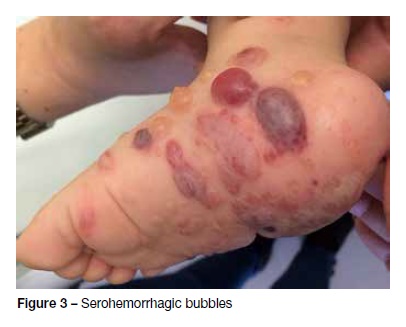
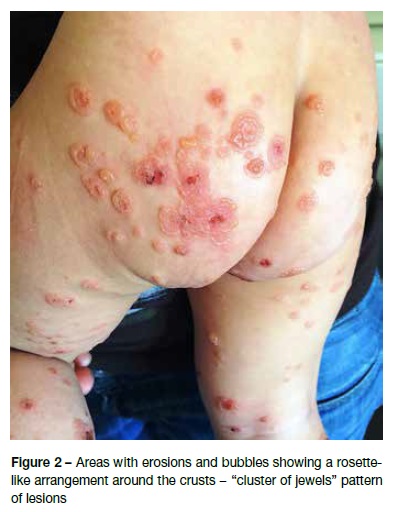
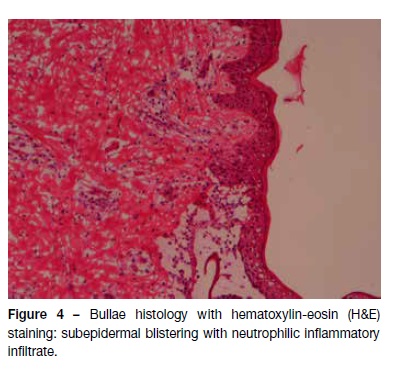
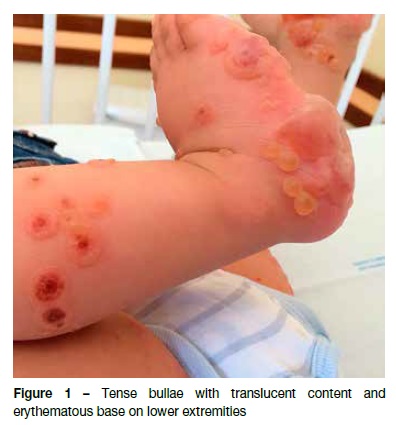
<body><![CDATA[<p><b>Introduction</b></p>     <p>Autoimmune vesiculobullous diseases of the skin are rare in children, with    linear immunoglobulin (Ig) A dermatosis (LIGAD) being the most common autoimmune    bullous dermatosis at this stage of life.<sup>1-4 </sup>Pediatric prevalence    of LIGAD is unknown.<sup>5</sup> It is an acquired bullous disease, probably    of autoimmune etiology, which manifests by the presence of vesiculobullous eruption,    erosions and/or secondary crusts, usually limited to the skin but possibly also    involving the mucosa.<sup>1,2,4,6-9</sup> It can be clinically misdiagnosed    as dermatitis herpetiformis, bullous pemphigoid, bullous impetigo, or epidermolysis    bullous. Therefore, when a child presents with bullous dermatosis, a diagnosis    of LIGAD should be considered.<sup>1,2,6,7</sup> Histologically, it is characterized    by presence of a subepidermal cleavage with neutrophilic and eosinophilic inflammatory    infiltrate.<sup>1,2,5,7,10</sup> </p>     <p>The advent of direct immunofluorescence (DIF) in the 1970&rsquo;s allowed for a precise    diagnosis of the disease by identifying linear IgA antibody deposition in the    basement membrane, which is pathognomonic of LIGAD.<sup>1,2,5-7,9-11</sup> Secondary    dermatosis results from development of IgA antibodies against normal basement    membrane components, although the target antigen is not fully identified yet.<sup>1</sup>    Antibodies are found either in the skin or blood.<sup>1,2 </sup></p>     <p><b>Case report</b></p>     <p>A 12-month-old male, with irrelevant personal or family background, was observed    in the Emergency Department due to vesiculobullous eruption with intense pruritus    developing four days earlier. It was initially detected in the perineum and    progressed to the trunk and limbs. The infant had no history of infections,    trauma, or recent medications, or any other associated symptoms. Physical examination    disclosed vesicles and tense bullous of citrus content (<a href="#f1">Figure    1</a>), with negative Nikolsky&rsquo;s sign, some of which on normal skin and others    on an erythematous base. They were symmetrically distributed and located in    the perineum, lower abdominal quadrants, and extremities, some of which with    local inflammatory signs. Areas of erythematous skin surrounded by bullous were    also visible, in a pattern of &ldquo;cluster of jewels&rdquo;, with a rosette-like arrangement    around the crusts (<a href="#f2">Figure 2</a>). Blood tests, including complete    blood count, hepatic and renal function were normal and rapid antigen Group    A Streptococcus test was negative. Due to suspicion of infectious pathology    (possibly bullous impetigo), flucloxacillin and hydroxyzine were initiated,    and the child was admitted to the Pediatric Department. No improvement was observed    after 48 hours, but instead new lesions were observed in the periphery of old    ones &#8722; some of which confluent and others grouped in a &ldquo;cluster of jewels&rdquo;    &#8722;, as well as erosions and serohemorrhagic blisters (<a href="#f3">Figure    3</a>). No perioral or ocular attainment was observed. Autoimmune dermatosis    skin biopsies were also performed. Histological examination showed a subepidermal    blister with neutrophilic infiltrate in the dermal papillae (<a href="#f4">Figure    4</a>) and direct immunofluorescence confirmed the diagnosis of LIGAD by showing    a linear arrangement of IgA along the basement membrane. As from the sixth day    of hospitalization, and without institution of other therapeutic measures, a    significant lesion improvement was observed. The infant completed 14 days of    antibiotic therapy and was discharged upon referral to the Dermatology and Pediatrics    consultations, remaining in complete remission after 12 months of follow-up.</p>     <p>&nbsp;</p>     <p align="center"><a name="f1"></a><img src="/img/revistas/nas/v27n4/27n4a04f1.jpg"/></p>     
<p>&nbsp;</p>     <p align="center"><a name="f2"></a><img src="/img/revistas/nas/v27n4/27n4a04f2.jpg"/></p>     
<p>&nbsp;</p>     ]]></body>
<body><![CDATA[<p align="center"><a name="f3"></a><img src="/img/revistas/nas/v27n4/27n4a04f3.jpg"/></p>     
<p>&nbsp;</p>     <p align="center"><a name="f4"></a><img src="/img/revistas/nas/v27n4/27n4a04f4.jpg"/></p>     
<p>&nbsp;</p>     <p><b>Discussion</b></p>     <p>LIGAD is a bullous dermatosis with probable autoimmune etiology, resulting    from IgA antibodies elicited against basement membrane components.<sup>1,2,4,10,12,13</sup>    It has a worldwide distribution, being more prevalent in developing countries    and in the female gender.<sup>2,3,6,9</sup> Although target antigen is not fully    identified, IgA antibodies are deposited on the basement membrane of all patients    at the macroscopic lesion site, and circulating antibodies are detected in most    cases.<sup>1,2</sup> Through western immunoblot is possible to characterize    potential antigens, particularly of 97 kDa (LABD-97) and 120 kDa (LAD-1), which    are located in the lucid lamina and represent fragments of the extracellular    domain of collagen XVII (BP180), bullous pemphigoid antigen 2 (BPAG2, 180 KDa).<sup>2,3,6,8,11,14</sup>    Other antigens, such as collagen VII (250 kDa) and BP230 (BPAG1, 230 kDa) have    also been recognized.<sup>3,8,14</sup> Although no precipitating factor has    been identified in this patient, LIGAD may be triggered by such diverse causes    as prodromal diseases &#8722; including upper airway (Epstein-Barr virus and    cytomegalovirus) or urinary tract infections &#8722;, brucellosis, acute gastroenteritis    (<i>Salmonella</i> enteritis), tetanus, or immunizations (varicella or influenza    vaccine).<sup>1,2,15</sup> Drug-induced LIGAD, although less frequent in pediatric    ages, is more atypical and severe than spontaneous forms, with lesions mimicking    toxic epidermal necrolysis and positive Nikolsky&rsquo;s signal.<sup>11</sup> Cases    associated with antibiotics (most frequently vancomycin, but also ceftriaxone,    amoxicillin-clavulanic acid, and trimethoprim-sulfamethazol), amiodarone, non-steroidal    anti-inflammatory agents, and diuretics such as captopril have also been reported.<sup>1-3,5,6,9,11,12,14</sup></p>     <p>In the case of a three-year-old boy, identification of trimethoprim-sulfamethazol    as the causative drug was accomplished after rechallenge. Lesion resolution    occurred spontaneously within two to seven weeks after medication withdrawal.<sup>5</sup>    Most studies do not confirm a correlation with autoimmune diseases, but associations    with Celiac Disease, Crohn&rsquo;s Disease, Ulcerative Colitis, and Sjogren&rsquo;s Syndrome    have been reported<sup>1,5,7</sup>, as well as with lymphoproliferative diseases    and solid tumors (carcinoma of bladder).<sup>7</sup> </p>     <p>LIGAD frequently presents with cutaneous-mucosal attainment, without affecting    other organs or systems.<sup>1,4</sup> It usually has an abrupt onset and occurs    in children after the age of six months, with a peak incidence at pre-school    age (four to five years). Development of vesicles and stray blisters on the    apparently normal or erythematous base of the skin is observed after non-specific    pruritus or burning prodromes.<sup>1-6,9,14,15</sup> However, cases of LIGAD    in newborns, with involvement of (particularly ocular) mucous membranes and    more severe clinical presentations have been reported.<sup>4,15</sup> Systemic    symptoms, such as fever and anorexia, may occur and have an insidious onset.<sup>1</sup>    Development of new tense vesicles at the periphery of old lesions is common,    usually grouping in rosette or &ldquo;cluster of jewels&rdquo;.<sup>1-4,8,9,11,13,14</sup>    It typically affects the perineum and lower abdomen, extending to the thorax    and extensor surface of the limbs<sup>1-4</sup>, as in the reported clinical    case. </p>     <p>Involvement of mucous membranes manifests by conjunctivitis and oral and nasal    erosions.<sup>4,13</sup> Perioral lesions are difficult to distinguish from    aphthous ulcers, although they appears less frequently than in the adult form.<sup>1-3,6</sup>    An ocular examination should be performed, due to risk of subconjunctival fibrosis,    symblepharon, trichiasis, cicatricial entropion and, rarely, corneal opacities.<sup>2-4,    8</sup></p>     <p>In the present clinical case, the child did not present ocular symptoms and    ocular examination was normal. It should be noted that there is no correlation    between severity and disease duration.<sup>1</sup> Because this is clinically    indistinguishable from other autoimmune bullous dermatoses, the differential    diagnosis should include bullous pemphigoid and dermatitis herpetiformis as    main diagnoses to be considered, as well as acquired epidermolysis bullosa and    bullous lupus erythematosus.<sup>1,2,7-9,13,15</sup> When lesions are limited    to the perineal region, bullous impetigo and herpes simplex should be considered.<sup>1</sup></p>     ]]></body>
<body><![CDATA[<p>Dermatitis herpetiformis is characteristically associated with sensitive enteropathy    to gluten and presents with complaints of more intense pruritus, more diffuse    neutrophilic infiltration, granular deposition of IgA on the basement membrane,    and detection of anti-gliadin and anti-transglutaminase antibodies.<sup>2</sup>    On the other hand, bullous pemphigoid usually occurs in older age groups, shows    a predominantly eosinophilic inflammatory infiltrate, linear deposition of IgG    and C3 in the basement membrane at DIF, and detection of anti-BP180 and anti-BP230    antibodies.<sup>2</sup> As LIGAD is a rare disease, usually late diagnosed,    high suspicion is necessary, since an early biopsy is confirmatory.<sup>1,2</sup>  </p>     <p>Delayed diagnosis predisposes to lesion secondary infection and, less frequently,    to comorbidities such as ocular scarring and pharyngolaryngeal stenosis.<sup>3</sup>    Histologically, subepidermal blisters are observed in association with neutrophilic    and, sometimes, eosinophilic infiltrate, which is also observed in bullous pemphigoid    and dermatitis herpetiformis.<sup>1-3,6,9,13</sup> A definitive diagnosis is    possible through DIF, which is pathognomonic and evidences the linear deposits    of IgA on the basement membrane.<sup>1,2,13</sup> Therapy is symptomatic, and    when triggering factors are identified, their disruption is key.<sup>1,2</sup>    In most exuberant cases, first-line treatment for bullous lesions consists of    dapsone, with sulfonamides also being an option.<sup>1-3,9,10,13,15</sup></p>     <p>Dapsone acts by interfering with folate biosynthesis and neutrophil activity    and is used at an initial dose of 1 to 2 mg/Kg/day. Response occurs rapidly    (within 24 to 48 hours) and, depending on the patient&rsquo;s tolerability, a gradual    dose increase is recommended.<sup>1,3</sup> The drug&rsquo;s use is limited by side    effects, such as hemolysis, methemoglobinemia, neutropenia, motor neuropathy,    and hepatitis, reason why a blood count should be performed weekly during the    first month, monthly during the 2<sup>nd</sup> to 5<sup>th</sup> months, and    then twice a year after the first six months. Renal and hepatic function should    also be controlled at the 6<sup>th</sup> month of treatment and then annually.<sup>1,2,13</sup>    Glucose-6-phosphate dehydrogenase deficiency should be excluded before starting    treatment, due to risk of severe hemolytic anemia,<sup>1-3,9,13,15</sup> as    well as severe hemolytic anemias, bone marrow suppression, and dapsone hypersensitivity    syndrome.<sup>2,15</sup> Duration of treatment should be individualized, although    most clinicians keep patients on maintenance treatment for 3&#8722;21 months.<sup>8</sup>    Sulphapyridine at 35 mg/kg/day may be alternatively used and blood count monitoring    should be performed.<sup>2</sup></p>     <p>Prednisolone is administered at 0.5&#8722;2 mg/kg/day and dose should be gradually    reduced two weeks after lesions resolved. It is not usually used as a first-line    option, but as an adjunct to dapsone or sulphapyridine.<sup>1,2,8,9,13</sup>    However, cases with good clinical response to corticosteroids alone, especially    in drug-induced forms, have been described.<sup>2</sup> Alternative therapy    with colchicine is indicated only in exceptional cases, for patients who are    not candidates for sulfones.<sup>1,2</sup> Mycophenolate mofetil may be used    as monotherapy or in combination, as a corticosteroid sparing agent.<sup>1,2</sup>  </p>     <p>Sporadic success cases with antibiotics have been reported, including with    flucloxacillin, dicloxacillin, erythromycin, and cotrimoxazole.<sup>2,3,8,9,15    </sup>As flucloxacillin was initiated in the present clinical case, it is not    possible to determine whether resolution was spontaneous or influenced by this    antibiotic therapy. Cases have been reported in the literature of rapid and    long-term remissions with flucloxacillin, but also of the drug&rsquo;s ineffectiveness.<sup>2,15</sup>    Its use requires hepatic monitoring due to risk of cholestatic hepatitis.<sup>2</sup>    Intravenous immunoglobulin should be considered for patients refractory to these    treatments, at a dose of 1&#8722;2 g/kg monthly in 3-day cycles.<sup>2,13</sup>    Studies describing the use of intravenous immunoglobulin reported average treatment    durations ranging from months to years.<sup>7,8</sup> Although LIGAD is a benign    condition, it often presents with recurrences until complete resolution. It    may also be self-limited, with remission and no sequelae in two to four years.<sup>2,3,9,10,15</sup>    In absence of infections or itching, cutaneous lesions heal without scarring.<sup>8,9</sup>    Persistence after puberty is rare, particularly in adulthood.<sup>1,3 </sup>Most    cases require pharmacological treatment and its early initiation (within the    first month) may be a decisive factor in inducing an early remission.<sup>2,8,15</sup></p>     <p>This case illustrates an exuberant presentation of an uncommon childhood illness,    with a favorable response without dapsone or corticosteroid therapy. The authors    intend to raise awareness to this entity and stress the importance of an early    diagnosis and adequate parental guidance to avoid untimely treatment, distress,    and parental anxiety.</p>     <p>&nbsp;</p>     <p><b>REFERENCES</b></p>     <!-- ref --><p>1. Rocha F, Silva A, Fonseca P, Teixeira P, Vieira AP, Oliveira JMG. Dermatose    Bolhosa Crónica Linear por IgA: Apresentação de um Caso Clínico e Revisão da    Literatura. Acta Pediatr Port. 2004; 35:521-4.    &nbsp;&nbsp;&nbsp;&nbsp;&nbsp;&nbsp;&nbsp;&nbsp;[&#160;<a href="javascript:void(0);" onclick="javascript: window.open('/scielo.php?script=sci_nlinks&ref=1113135&pid=S0872-0754201800040000400001&lng=','','width=640,height=500,resizable=yes,scrollbars=1,menubar=yes,');">Links</a>&#160;]<!-- end-ref --></p>     ]]></body>
<body><![CDATA[<!-- ref --><p>2. Ferreira O, Mota A, Morais P, Duarte AF, Bettencourt H, <i>et al</i>. Dermatose    IgA linear da Infância - Apresentação em cacho de uva escrotal. Revista SPDV    2011; 69:621-5.    &nbsp;&nbsp;&nbsp;&nbsp;&nbsp;&nbsp;&nbsp;&nbsp;[&#160;<a href="javascript:void(0);" onclick="javascript: window.open('/scielo.php?script=sci_nlinks&ref=1113137&pid=S0872-0754201800040000400002&lng=','','width=640,height=500,resizable=yes,scrollbars=1,menubar=yes,');">Links</a>&#160;]<!-- end-ref --> </p>     <!-- ref --><p>3. Souza BC, Fregonesi NC, Tebcherani AJ, Sanchez AP, Aoki V, et al. Linear    IgA bullous dermatosis: report of an exuberant case. An Bras Dermatol 2013.    88:67-70.    &nbsp;&nbsp;&nbsp;&nbsp;&nbsp;&nbsp;&nbsp;&nbsp;[&#160;<a href="javascript:void(0);" onclick="javascript: window.open('/scielo.php?script=sci_nlinks&ref=1113139&pid=S0872-0754201800040000400003&lng=','','width=640,height=500,resizable=yes,scrollbars=1,menubar=yes,');">Links</a>&#160;]<!-- end-ref --></p>     <!-- ref --><p>4. Magalhães JC, Oliveira AC, Machado S, Reis MG. Dermatose bolhosa IgA linear.    Acta Pediatr Port. 2013; 44:46-7.    &nbsp;&nbsp;&nbsp;&nbsp;&nbsp;&nbsp;&nbsp;&nbsp;[&#160;<a href="javascript:void(0);" onclick="javascript: window.open('/scielo.php?script=sci_nlinks&ref=1113141&pid=S0872-0754201800040000400004&lng=','','width=640,height=500,resizable=yes,scrollbars=1,menubar=yes,');">Links</a>&#160;]<!-- end-ref --></p>     <!-- ref --><p>5. Alajlan A, Al-Khawajah M, Al-Sheikh O, Al-Saif F, Al-Rasheed S, Al-Hoqail    I, <i>et al</i>. Treatment of linear IgA bullous dermatosis of childhood with    flucloxacillin. J Am Acad Dermatol. 2006; 54:652-6.    &nbsp;&nbsp;&nbsp;&nbsp;&nbsp;&nbsp;&nbsp;&nbsp;[&#160;<a href="javascript:void(0);" onclick="javascript: window.open('/scielo.php?script=sci_nlinks&ref=1113143&pid=S0872-0754201800040000400005&lng=','','width=640,height=500,resizable=yes,scrollbars=1,menubar=yes,');">Links</a>&#160;]<!-- end-ref --></p>     <p>6. Romani L, Diociaiuti A, D&rsquo;Argenio P, El Hachem M, Gargiullo L, Boldrini    R, <i>et al</i>. A Case of Neonatal Linear IgA Bullous Dermatosis with Severe    Eye Involvement. Acta Derm Venereol. 2015 4; 95:1015-7. </p>     <!-- ref --><p>7. Lings K, Bygum A. Linear IgA bullous dermatosis: a retrospective study of    23 patients in Denmark. Acta Derm Venereol. 2015; 95:466-71.    &nbsp;&nbsp;&nbsp;&nbsp;&nbsp;&nbsp;&nbsp;&nbsp;[&#160;<a href="javascript:void(0);" onclick="javascript: window.open('/scielo.php?script=sci_nlinks&ref=1113146&pid=S0872-0754201800040000400007&lng=','','width=640,height=500,resizable=yes,scrollbars=1,menubar=yes,');">Links</a>&#160;]<!-- end-ref --> </p>     <!-- ref --><p>8. Reyes-Baraona F, Andino R, Carrasco JE, Arriagada C, Guerrero S. Linear    IgA bullous dermatosis of childhood: case report. Arch Argent Pediatr. 2014;    112:e57-60.    &nbsp;&nbsp;&nbsp;&nbsp;&nbsp;&nbsp;&nbsp;&nbsp;[&#160;<a href="javascript:void(0);" onclick="javascript: window.open('/scielo.php?script=sci_nlinks&ref=1113148&pid=S0872-0754201800040000400008&lng=','','width=640,height=500,resizable=yes,scrollbars=1,menubar=yes,');">Links</a>&#160;]<!-- end-ref --></p>     <!-- ref --><p>9. Chanal J, Ingen-Housz-Oro S, Ortonne N, Duong TA, Thomas M, Valeyrie-Allanore    L, <i>et al</i>. Linear IgA bullous dermatosis: comparison between the drug-induced    and spontaneous forms. Br J Dermatol. 2013; 169:1041-8.    &nbsp;&nbsp;&nbsp;&nbsp;&nbsp;&nbsp;&nbsp;&nbsp;[&#160;<a href="javascript:void(0);" onclick="javascript: window.open('/scielo.php?script=sci_nlinks&ref=1113150&pid=S0872-0754201800040000400009&lng=','','width=640,height=500,resizable=yes,scrollbars=1,menubar=yes,');">Links</a>&#160;]<!-- end-ref --> </p>     <!-- ref --><p>10. Venning VA. Linear IgA disease: clinical presentation, diagnosis, and pathogenesis.    Immunol Allergy Clin North Am. 2012; 32:245-53.    &nbsp;&nbsp;&nbsp;&nbsp;&nbsp;&nbsp;&nbsp;&nbsp;[&#160;<a href="javascript:void(0);" onclick="javascript: window.open('/scielo.php?script=sci_nlinks&ref=1113152&pid=S0872-0754201800040000400010&lng=','','width=640,height=500,resizable=yes,scrollbars=1,menubar=yes,');">Links</a>&#160;]<!-- end-ref --></p>     <!-- ref --><p>11. Kharfi M, Khaled A, Karaa A, Zaraa I, Fazaa B, Kamoun MR. Linear IgA bullous    dermatosis: the more frequent bullous dermatosis of children. Dermatol Online    J. 2010 15; 16:2.    &nbsp;&nbsp;&nbsp;&nbsp;&nbsp;&nbsp;&nbsp;&nbsp;[&#160;<a href="javascript:void(0);" onclick="javascript: window.open('/scielo.php?script=sci_nlinks&ref=1113154&pid=S0872-0754201800040000400011&lng=','','width=640,height=500,resizable=yes,scrollbars=1,menubar=yes,');">Links</a>&#160;]<!-- end-ref --></p>     <!-- ref --><p>12. Nantel-Battista M, Al Dhaybi R, Hatami A, Marcoux D, Desroches A, Kokta    V. Childhood linear IgA bullous disease induced by trimethoprim-sulfamethoxazole.    J Dermatol Case Rep. 2010 19; 4:33-5.    &nbsp;&nbsp;&nbsp;&nbsp;&nbsp;&nbsp;&nbsp;&nbsp;[&#160;<a href="javascript:void(0);" onclick="javascript: window.open('/scielo.php?script=sci_nlinks&ref=1113156&pid=S0872-0754201800040000400012&lng=','','width=640,height=500,resizable=yes,scrollbars=1,menubar=yes,');">Links</a>&#160;]<!-- end-ref --></p>     <!-- ref --><p>13. Patsatsi A. Chronic Bullous Disease or Linear IgA Dermatosis of Childhood    -Revisited. J Genet Syndr Gene Ther 2013; 4:151.    &nbsp;&nbsp;&nbsp;&nbsp;&nbsp;&nbsp;&nbsp;&nbsp;[&#160;<a href="javascript:void(0);" onclick="javascript: window.open('/scielo.php?script=sci_nlinks&ref=1113158&pid=S0872-0754201800040000400013&lng=','','width=640,height=500,resizable=yes,scrollbars=1,menubar=yes,');">Links</a>&#160;]<!-- end-ref --></p>     <!-- ref --><p>14. Moleiro S, Santos V, Calha M, Pessoa G. Atypical response to treatment    in linear IgA bullous dermatosis of childhood: Revision of literature. Dermatol    Online J. 2011; 17:5.    &nbsp;&nbsp;&nbsp;&nbsp;&nbsp;&nbsp;&nbsp;&nbsp;[&#160;<a href="javascript:void(0);" onclick="javascript: window.open('/scielo.php?script=sci_nlinks&ref=1113160&pid=S0872-0754201800040000400014&lng=','','width=640,height=500,resizable=yes,scrollbars=1,menubar=yes,');">Links</a>&#160;]<!-- end-ref --></p>     <!-- ref --><p>15. Horiguchi Y, Ikoma A, Sakai R, Masatsugu A, Ohta M, Hashimoto T. Linear    IgA dermatosis: report of an infantile case and analysis of 213 cases in Japan.    J Dermatol. 2008; 35:737-43.    &nbsp;&nbsp;&nbsp;&nbsp;&nbsp;&nbsp;&nbsp;&nbsp;[&#160;<a href="javascript:void(0);" onclick="javascript: window.open('/scielo.php?script=sci_nlinks&ref=1113162&pid=S0872-0754201800040000400015&lng=','','width=640,height=500,resizable=yes,scrollbars=1,menubar=yes,');">Links</a>&#160;]<!-- end-ref --> </p>     <p>&nbsp;</p>     <p><a href="#topc0">Endere&ccedil;o para correspond&ecirc;ncia</a> | <a href="#topc0">Direcci&oacute;n    para correspondencia</a> | <a href="#topc0">Correspondence</a><a name="c0"></a></p>     <p>Sandra Pereira    ]]></body>
<body><![CDATA[<br>   Pediatrics Department    <br>   Hospital Pediátrico Integrado    <br>   Centro Hospitalar Universitário São João    <br>   Alameda Prof. Hernâni Monteiro,     <br>   4200-319 Porto    <br>   Email: <a href="mailto:sandravdpereira@gmail.com">sandravdpereira@gmail.com</a></p>     <p>&nbsp;</p>     <p>Received for publication: 06.09.2017</p>     <p>Accepted in revised form: 11.12.2017</p>      ]]></body><back>
<ref-list>
<ref id="B1">
<label>1</label><nlm-citation citation-type="journal">
<person-group person-group-type="author">
<name>
<surname><![CDATA[Rocha]]></surname>
<given-names><![CDATA[F]]></given-names>
</name>
<name>
<surname><![CDATA[Silva]]></surname>
<given-names><![CDATA[A]]></given-names>
</name>
<name>
<surname><![CDATA[Fonseca]]></surname>
<given-names><![CDATA[P]]></given-names>
</name>
<name>
<surname><![CDATA[Teixeira]]></surname>
<given-names><![CDATA[P]]></given-names>
</name>
<name>
<surname><![CDATA[Vieira]]></surname>
<given-names><![CDATA[AP]]></given-names>
</name>
<name>
<surname><![CDATA[Oliveira]]></surname>
<given-names><![CDATA[JMG]]></given-names>
</name>
</person-group>
<article-title xml:lang="pt"><![CDATA[Dermatose Bolhosa Crónica Linear por IgA: Apresentação de um Caso Clínico e Revisão da Literatura]]></article-title>
<source><![CDATA[Acta Pediatr Port]]></source>
<year>2004</year>
<volume>35</volume>
<page-range>521-4</page-range></nlm-citation>
</ref>
<ref id="B2">
<label>2</label><nlm-citation citation-type="journal">
<person-group person-group-type="author">
<name>
<surname><![CDATA[Ferreira]]></surname>
<given-names><![CDATA[O]]></given-names>
</name>
<name>
<surname><![CDATA[Mota]]></surname>
<given-names><![CDATA[A]]></given-names>
</name>
<name>
<surname><![CDATA[Morais]]></surname>
<given-names><![CDATA[P]]></given-names>
</name>
<name>
<surname><![CDATA[Duarte]]></surname>
<given-names><![CDATA[AF]]></given-names>
</name>
<name>
<surname><![CDATA[Bettencourt]]></surname>
<given-names><![CDATA[H]]></given-names>
</name>
</person-group>
<article-title xml:lang="pt"><![CDATA[Dermatose IgA linear da Infância: Apresentação em cacho de uva escrotal]]></article-title>
<source><![CDATA[Revista SPDV]]></source>
<year>2011</year>
<volume>69</volume>
<page-range>621-5</page-range></nlm-citation>
</ref>
<ref id="B3">
<label>3</label><nlm-citation citation-type="journal">
<person-group person-group-type="author">
<name>
<surname><![CDATA[Souza]]></surname>
<given-names><![CDATA[BC]]></given-names>
</name>
<name>
<surname><![CDATA[Fregonesi]]></surname>
<given-names><![CDATA[NC]]></given-names>
</name>
<name>
<surname><![CDATA[Tebcherani]]></surname>
<given-names><![CDATA[AJ]]></given-names>
</name>
<name>
<surname><![CDATA[Sanchez]]></surname>
<given-names><![CDATA[AP]]></given-names>
</name>
<name>
<surname><![CDATA[Aoki]]></surname>
<given-names><![CDATA[V]]></given-names>
</name>
</person-group>
<article-title xml:lang="en"><![CDATA[Linear IgA bullous dermatosis: report of an exuberant case]]></article-title>
<source><![CDATA[An Bras Dermatol]]></source>
<year>2013</year>
<volume>88</volume>
<page-range>67-70</page-range></nlm-citation>
</ref>
<ref id="B4">
<label>4</label><nlm-citation citation-type="journal">
<person-group person-group-type="author">
<name>
<surname><![CDATA[Magalhães]]></surname>
<given-names><![CDATA[JC]]></given-names>
</name>
<name>
<surname><![CDATA[Oliveira]]></surname>
<given-names><![CDATA[AC]]></given-names>
</name>
<name>
<surname><![CDATA[Machado]]></surname>
<given-names><![CDATA[S]]></given-names>
</name>
<name>
<surname><![CDATA[Reis]]></surname>
<given-names><![CDATA[MG]]></given-names>
</name>
</person-group>
<article-title xml:lang="pt"><![CDATA[Dermatose bolhosa IgA linear]]></article-title>
<source><![CDATA[Acta Pediatr Port]]></source>
<year>2013</year>
<volume>44</volume>
<page-range>46-7</page-range></nlm-citation>
</ref>
<ref id="B5">
<label>5</label><nlm-citation citation-type="journal">
<person-group person-group-type="author">
<name>
<surname><![CDATA[Alajlan]]></surname>
<given-names><![CDATA[A]]></given-names>
</name>
<name>
<surname><![CDATA[Al-Khawajah]]></surname>
<given-names><![CDATA[M]]></given-names>
</name>
<name>
<surname><![CDATA[Al-Sheikh]]></surname>
<given-names><![CDATA[O]]></given-names>
</name>
<name>
<surname><![CDATA[Al-Saif]]></surname>
<given-names><![CDATA[F]]></given-names>
</name>
<name>
<surname><![CDATA[Al-Rasheed]]></surname>
<given-names><![CDATA[S]]></given-names>
</name>
<name>
<surname><![CDATA[Al-Hoqail]]></surname>
<given-names><![CDATA[I]]></given-names>
</name>
</person-group>
<article-title xml:lang="en"><![CDATA[Treatment of linear IgA bullous dermatosis of childhood with flucloxacillin]]></article-title>
<source><![CDATA[J Am Acad Dermatol]]></source>
<year>2006</year>
<volume>54</volume>
<page-range>652-6</page-range></nlm-citation>
</ref>
<ref id="B6">
<label>6</label><nlm-citation citation-type="journal">
<person-group person-group-type="author">
<name>
<surname><![CDATA[Romani]]></surname>
<given-names><![CDATA[L]]></given-names>
</name>
<name>
<surname><![CDATA[Diociaiuti]]></surname>
<given-names><![CDATA[A]]></given-names>
</name>
<name>
<surname><![CDATA[D’Argenio]]></surname>
<given-names><![CDATA[P]]></given-names>
</name>
<name>
<surname><![CDATA[El Hachem]]></surname>
<given-names><![CDATA[M]]></given-names>
</name>
<name>
<surname><![CDATA[Gargiullo]]></surname>
<given-names><![CDATA[L]]></given-names>
</name>
<name>
<surname><![CDATA[Boldrini]]></surname>
<given-names><![CDATA[R]]></given-names>
</name>
</person-group>
<article-title xml:lang="en"><![CDATA[A Case of Neonatal Linear IgA Bullous Dermatosis with Severe Eye Involvement]]></article-title>
<source><![CDATA[Acta Derm Venereol]]></source>
<year>2015</year>
<volume>4</volume>
<numero>95</numero>
<issue>95</issue>
<page-range>1015-7</page-range></nlm-citation>
</ref>
<ref id="B7">
<label>7</label><nlm-citation citation-type="journal">
<person-group person-group-type="author">
<name>
<surname><![CDATA[Lings]]></surname>
<given-names><![CDATA[K]]></given-names>
</name>
<name>
<surname><![CDATA[Bygum]]></surname>
<given-names><![CDATA[A]]></given-names>
</name>
</person-group>
<article-title xml:lang="en"><![CDATA[Linear IgA bullous dermatosis: a retrospective study of 23 patients in Denmark]]></article-title>
<source><![CDATA[Acta Derm Venereol]]></source>
<year>2015</year>
<volume>95</volume>
<page-range>466-71</page-range></nlm-citation>
</ref>
<ref id="B8">
<label>8</label><nlm-citation citation-type="journal">
<person-group person-group-type="author">
<name>
<surname><![CDATA[Reyes-Baraona]]></surname>
<given-names><![CDATA[F]]></given-names>
</name>
<name>
<surname><![CDATA[Andino]]></surname>
<given-names><![CDATA[R]]></given-names>
</name>
<name>
<surname><![CDATA[Carrasco]]></surname>
<given-names><![CDATA[JE]]></given-names>
</name>
<name>
<surname><![CDATA[Arriagada]]></surname>
<given-names><![CDATA[C]]></given-names>
</name>
<name>
<surname><![CDATA[Guerrero]]></surname>
<given-names><![CDATA[S]]></given-names>
</name>
</person-group>
<article-title xml:lang="en"><![CDATA[Linear IgA bullous dermatosis of childhood: case report]]></article-title>
<source><![CDATA[Arch Argent Pediatr]]></source>
<year>2014</year>
<volume>112</volume>
<page-range>e57-60</page-range></nlm-citation>
</ref>
<ref id="B9">
<label>9</label><nlm-citation citation-type="journal">
<person-group person-group-type="author">
<name>
<surname><![CDATA[Chanal]]></surname>
<given-names><![CDATA[J]]></given-names>
</name>
<name>
<surname><![CDATA[Ingen-Housz-Oro]]></surname>
<given-names><![CDATA[S]]></given-names>
</name>
<name>
<surname><![CDATA[Ortonne]]></surname>
<given-names><![CDATA[N]]></given-names>
</name>
<name>
<surname><![CDATA[Duong]]></surname>
<given-names><![CDATA[TA]]></given-names>
</name>
<name>
<surname><![CDATA[Thomas]]></surname>
<given-names><![CDATA[M]]></given-names>
</name>
<name>
<surname><![CDATA[Valeyrie-Allanore]]></surname>
<given-names><![CDATA[L]]></given-names>
</name>
</person-group>
<article-title xml:lang="en"><![CDATA[Linear IgA bullous dermatosis: comparison between the drug-induced and spontaneous forms]]></article-title>
<source><![CDATA[Br J Dermatol]]></source>
<year>2013</year>
<volume>169</volume>
<page-range>1041-8</page-range></nlm-citation>
</ref>
<ref id="B10">
<label>10</label><nlm-citation citation-type="journal">
<person-group person-group-type="author">
<name>
<surname><![CDATA[Venning]]></surname>
<given-names><![CDATA[VA]]></given-names>
</name>
</person-group>
<article-title xml:lang="en"><![CDATA[Linear IgA disease: clinical presentation, diagnosis, and pathogenesis]]></article-title>
<source><![CDATA[Immunol Allergy Clin North Am]]></source>
<year>2012</year>
<volume>32</volume>
<page-range>245-53</page-range></nlm-citation>
</ref>
<ref id="B11">
<label>11</label><nlm-citation citation-type="journal">
<person-group person-group-type="author">
<name>
<surname><![CDATA[Kharfi]]></surname>
<given-names><![CDATA[M]]></given-names>
</name>
<name>
<surname><![CDATA[Khaled]]></surname>
<given-names><![CDATA[A]]></given-names>
</name>
<name>
<surname><![CDATA[Karaa]]></surname>
<given-names><![CDATA[A]]></given-names>
</name>
<name>
<surname><![CDATA[Zaraa]]></surname>
<given-names><![CDATA[I]]></given-names>
</name>
<name>
<surname><![CDATA[Fazaa]]></surname>
<given-names><![CDATA[B]]></given-names>
</name>
<name>
<surname><![CDATA[Kamoun]]></surname>
<given-names><![CDATA[MR]]></given-names>
</name>
</person-group>
<article-title xml:lang="en"><![CDATA[Linear IgA bullous dermatosis: the more frequent bullous dermatosis of children]]></article-title>
<source><![CDATA[Dermatol Online J]]></source>
<year>2010</year>
<volume>15</volume>
<page-range>16:2</page-range></nlm-citation>
</ref>
<ref id="B12">
<label>12</label><nlm-citation citation-type="journal">
<person-group person-group-type="author">
<name>
<surname><![CDATA[Nantel-Battista]]></surname>
<given-names><![CDATA[M]]></given-names>
</name>
<name>
<surname><![CDATA[Al Dhaybi]]></surname>
<given-names><![CDATA[R]]></given-names>
</name>
<name>
<surname><![CDATA[Hatami]]></surname>
<given-names><![CDATA[A]]></given-names>
</name>
<name>
<surname><![CDATA[Marcoux]]></surname>
<given-names><![CDATA[D]]></given-names>
</name>
<name>
<surname><![CDATA[Desroches]]></surname>
<given-names><![CDATA[A]]></given-names>
</name>
<name>
<surname><![CDATA[Kokta]]></surname>
<given-names><![CDATA[V]]></given-names>
</name>
</person-group>
<article-title xml:lang="en"><![CDATA[Childhood linear IgA bullous disease induced by trimethoprim-sulfamethoxazole]]></article-title>
<source><![CDATA[J Dermatol Case Rep]]></source>
<year>2010</year>
<volume>19</volume>
<numero>4</numero>
<issue>4</issue>
<page-range>33-5</page-range></nlm-citation>
</ref>
<ref id="B13">
<label>13</label><nlm-citation citation-type="journal">
<person-group person-group-type="author">
<name>
<surname><![CDATA[Patsatsi]]></surname>
<given-names><![CDATA[A]]></given-names>
</name>
</person-group>
<article-title xml:lang="en"><![CDATA[Chronic Bullous Disease or Linear IgA Dermatosis of Childhood -Revisited]]></article-title>
<source><![CDATA[J Genet Syndr Gene Ther]]></source>
<year>2013</year>
<volume>4</volume>
<page-range>151</page-range></nlm-citation>
</ref>
<ref id="B14">
<label>14</label><nlm-citation citation-type="journal">
<person-group person-group-type="author">
<name>
<surname><![CDATA[Moleiro]]></surname>
<given-names><![CDATA[S]]></given-names>
</name>
<name>
<surname><![CDATA[Santos]]></surname>
<given-names><![CDATA[V]]></given-names>
</name>
<name>
<surname><![CDATA[Calha]]></surname>
<given-names><![CDATA[M]]></given-names>
</name>
<name>
<surname><![CDATA[Pessoa]]></surname>
<given-names><![CDATA[G]]></given-names>
</name>
</person-group>
<article-title xml:lang="en"><![CDATA[Atypical response to treatment in linear IgA bullous dermatosis of childhood: Revision of literature]]></article-title>
<source><![CDATA[Dermatol Online J]]></source>
<year>2011</year>
<volume>17</volume>
<page-range>5</page-range></nlm-citation>
</ref>
<ref id="B15">
<label>15</label><nlm-citation citation-type="journal">
<person-group person-group-type="author">
<name>
<surname><![CDATA[Horiguchi]]></surname>
<given-names><![CDATA[Y]]></given-names>
</name>
<name>
<surname><![CDATA[Ikoma]]></surname>
<given-names><![CDATA[A]]></given-names>
</name>
<name>
<surname><![CDATA[Sakai]]></surname>
<given-names><![CDATA[R]]></given-names>
</name>
<name>
<surname><![CDATA[Masatsugu]]></surname>
<given-names><![CDATA[A]]></given-names>
</name>
<name>
<surname><![CDATA[Ohta]]></surname>
<given-names><![CDATA[M]]></given-names>
</name>
<name>
<surname><![CDATA[Hashimoto]]></surname>
<given-names><![CDATA[T]]></given-names>
</name>
</person-group>
<article-title xml:lang="en"><![CDATA[Linear IgA dermatosis: report of an infantile case and analysis of 213 cases in Japan]]></article-title>
<source><![CDATA[J Dermatol]]></source>
<year>2008</year>
<volume>35</volume>
<page-range>737-43</page-range></nlm-citation>
</ref>
</ref-list>
</back>
</article>