<?xml version="1.0" encoding="ISO-8859-1"?><article xmlns:mml="http://www.w3.org/1998/Math/MathML" xmlns:xlink="http://www.w3.org/1999/xlink" xmlns:xsi="http://www.w3.org/2001/XMLSchema-instance">
<front>
<journal-meta>
<journal-id>0872-0754</journal-id>
<journal-title><![CDATA[Nascer e Crescer]]></journal-title>
<abbrev-journal-title><![CDATA[Nascer e Crescer]]></abbrev-journal-title>
<issn>0872-0754</issn>
<publisher>
<publisher-name><![CDATA[Centro Hospitalar do Porto]]></publisher-name>
</publisher>
</journal-meta>
<article-meta>
<article-id>S0872-07542018000400008</article-id>
<article-id pub-id-type="doi">10.25753/BirthGrowthMJ.v27.i4.13065</article-id>
<title-group>
<article-title xml:lang="en"><![CDATA[Arthrogryposis multiplex congenita affecting a monochorionic diamniotic twin pregnancy]]></article-title>
<article-title xml:lang="pt"><![CDATA[Artrogripose múltipla congénita em gestação gemelar monocoriónica biamniótica]]></article-title>
</title-group>
<contrib-group>
<contrib contrib-type="author">
<name>
<surname><![CDATA[Brás]]></surname>
<given-names><![CDATA[Rafael]]></given-names>
</name>
<xref ref-type="aff" rid="A1"/>
</contrib>
<contrib contrib-type="author">
<name>
<surname><![CDATA[Veloso]]></surname>
<given-names><![CDATA[Helena]]></given-names>
</name>
<xref ref-type="aff" rid="A1"/>
</contrib>
<contrib contrib-type="author">
<name>
<surname><![CDATA[Moleiro]]></surname>
<given-names><![CDATA[Maria]]></given-names>
</name>
<xref ref-type="aff" rid="A1"/>
</contrib>
<contrib contrib-type="author">
<name>
<surname><![CDATA[Rodrigues]]></surname>
<given-names><![CDATA[Sofia]]></given-names>
</name>
<xref ref-type="aff" rid="A1"/>
</contrib>
<contrib contrib-type="author">
<name>
<surname><![CDATA[Inocêncio]]></surname>
<given-names><![CDATA[Gonçalo]]></given-names>
</name>
<xref ref-type="aff" rid="A1"/>
</contrib>
<contrib contrib-type="author">
<name>
<surname><![CDATA[Mota]]></surname>
<given-names><![CDATA[Céu]]></given-names>
</name>
<xref ref-type="aff" rid="A2"/>
</contrib>
<contrib contrib-type="author">
<name>
<surname><![CDATA[Soares]]></surname>
<given-names><![CDATA[Gabriela]]></given-names>
</name>
<xref ref-type="aff" rid="A3"/>
</contrib>
<contrib contrib-type="author">
<name>
<surname><![CDATA[Rodrigues]]></surname>
<given-names><![CDATA[Maria do Céu]]></given-names>
</name>
<xref ref-type="aff" rid="A1"/>
</contrib>
<contrib contrib-type="author">
<name>
<surname><![CDATA[Braga]]></surname>
<given-names><![CDATA[Jorge]]></given-names>
</name>
<xref ref-type="aff" rid="A1"/>
</contrib>
</contrib-group>
<aff id="AA1">
<institution><![CDATA[,Centro Hospitalar Universitário do Porto Centro Materno-Infantil do Norte Obstetrics and Gynecology Department]]></institution>
<addr-line><![CDATA[Porto ]]></addr-line>
<country>Portugal</country>
</aff>
<aff id="AA2">
<institution><![CDATA[,Centro Hospitalar Universitário do Porto Centro Materno-Infantil do Norte Pediatrics and Neonatology Department]]></institution>
<addr-line><![CDATA[Porto ]]></addr-line>
<country>Portugal</country>
</aff>
<aff id="AA3">
<institution><![CDATA[,Centro Hospitalar Universitário do Porto Centro Materno-Infantil do Norte Medical Genetics Department]]></institution>
<addr-line><![CDATA[Porto ]]></addr-line>
<country>Portugal</country>
</aff>
<pub-date pub-type="pub">
<day>00</day>
<month>12</month>
<year>2018</year>
</pub-date>
<pub-date pub-type="epub">
<day>00</day>
<month>12</month>
<year>2018</year>
</pub-date>
<volume>27</volume>
<numero>4</numero>
<fpage>253</fpage>
<lpage>257</lpage>
<copyright-statement/>
<copyright-year/>
<self-uri xlink:href="http://scielo.pt/scielo.php?script=sci_arttext&amp;pid=S0872-07542018000400008&amp;lng=en&amp;nrm=iso"></self-uri><self-uri xlink:href="http://scielo.pt/scielo.php?script=sci_abstract&amp;pid=S0872-07542018000400008&amp;lng=en&amp;nrm=iso"></self-uri><self-uri xlink:href="http://scielo.pt/scielo.php?script=sci_pdf&amp;pid=S0872-07542018000400008&amp;lng=en&amp;nrm=iso"></self-uri><abstract abstract-type="short" xml:lang="en"><p><![CDATA[Arthrogryposis multiplex congenita is a clinically and etiologically heterogeneous group of diseases characterized by presence of contractures involving at least two different body areas. It is observed in one in every 3000-5000 live births. A case of singleton arthrogryposis in a spontaneous monochorionic diamniotic twin pregnancy is reported. Diagnosis was established after morphological ultrasound. There were no further complications during pregnancy. After cesarean delivery, diagnosis of amyoplasia involving the four limbs was confirmed. Newborn is currently undergoing motor rehabilitation. The higher risk of singleton arthrogryposis in monochorionic twin pregnancies is documented and appears to be related with vascular changes early in the course of pregnancy. In amyoplasia, some degree of disability and dependency is expected, even with postnatal rehabilitation.]]></p></abstract>
<abstract abstract-type="short" xml:lang="pt"><p><![CDATA[A artrogripose múltipla congénita é um grupo clinica e etiologicamente heterogéneo de doenças, caracterizado pela presença de contraturas envolvendo pelo menos duas áreas corporais distintas. Tem uma incidência de 1 em cada 3000-5000 recém-nascidos. É reportado um caso clínico de artrogripose unifetal em gravidez gemelar monocoriónica biamniótica espontânea. O diagnóstico foi estabelecido após ecografia morfológica, tendo a gravidez decorrido sem outras intercorrências. Após parto por cesariana, confirmou-se o diagnóstico de amioplasia envolvendo os quatro membros. O recém-nascido encontra-se atualmente em processo de reabilitação motora. Está documentado o aumento da incidência de artrogripose unifetal na gravidez gemelar monocoriónica, que parece relacionar-se com alterações vasculares na gravidez inicial. Em situações de amioplasia, é de prever a manutenção de algum grau de dependência e incapacidade motora, mesmo com reabilitação pós-natal.]]></p></abstract>
<kwd-group>
<kwd lng="en"><![CDATA[Amyoplasia]]></kwd>
<kwd lng="en"><![CDATA[Arthrogryposis]]></kwd>
<kwd lng="en"><![CDATA[Monochorionic]]></kwd>
<kwd lng="en"><![CDATA[Twin]]></kwd>
<kwd lng="pt"><![CDATA[Amioplasia]]></kwd>
<kwd lng="pt"><![CDATA[Artrogripose]]></kwd>
<kwd lng="pt"><![CDATA[Gemelar]]></kwd>
<kwd lng="pt"><![CDATA[Monocoriónica]]></kwd>
</kwd-group>
</article-meta>
</front><body><![CDATA[ <p align="right"><font size="2"><b>CASE REPORTS | CASOS CLÍNICOS</b></font></p>     <p><font size="4"><b>Arthrogryposis multiplex congenita affecting a monochorionic    diamniotic twin pregnancy</b></font></p>     <p><font size="3"><b>Artrogripose múltipla congénita em gestação gemelar monocoriónica    biamniótica</b></font></p>     <p><b>Rafael Brás<sup>I</sup>, Helena Veloso<sup>I</sup>, Maria Moleiro<sup>I</sup>,    Sofia Rodrigues<sup>I</sup>, Gonçalo Inocêncio<sup>I</sup>, Céu Mota<sup>II</sup>,    Gabriela Soares<sup>III</sup>, Maria do Céu Rodrigues<sup>I</sup>, Jorge Braga<sup>I</sup></b></p>     <p><sup>I</sup> Obstetrics and Gynecology Department, Centro Materno-Infantil    do Norte, Centro Hospitalar Universitário do Porto. 4050-651 Porto, Portugal.    <a href="mailto:rafaelduartebras@gmail.com">rafaelduartebras@gmail.com</a>;    <a href="mailto:h.bragaveloso@gmail.com">h.bragaveloso@gmail.com</a>; <a href="mailto:lucia.moleiro@gmail.com">lucia.moleiro@gmail.com</a>;    <a href="mailto:sofiapinarodrigues@gmail.com">sofiapinarodrigues@gmail.com</a>;    <a href="mailto:dr.inocencio@gmail.com">dr.inocencio@gmail.com</a>; <a href="mailto:mcpprodrigues@gmail.com">mcpprodrigues@gmail.com</a>;    <a href="mailto:jorgesousabraga@gmail.com">jorgesousabraga@gmail.com</a></p>     <p><sup>II</sup> Pediatrics and Neonatology Department, Centro Materno-Infantil    do Norte, Centro Hospitalar Universitário do Porto. 4050-651 Porto, Portugal.    <a href="mailto:ceurmota@gmail.com">ceurmota@gmail.com</a></p>     <p><sup>III</sup> Medical Genetics Department, Centro Hospitalar Universitário    do Porto. 4099-001 Porto, Portugal. <a href="mailto:rafz1@hotmail.com">rafz1@hotmail.com</a></p>     <p><a href="#c0">Endere&ccedil;o para correspond&ecirc;ncia</a> | <a href="#c0">Direcci&oacute;n    para correspondencia</a> | <a href="#c0">Correspondence</a><a name="topc0"></a></p> <hr/>     <p>&nbsp;</p>     <p><b>ABSTRACT</b></p>     ]]></body>
<body><![CDATA[<p>Arthrogryposis multiplex congenita is a clinically and etiologically heterogeneous    group of diseases characterized by presence of contractures involving at least    two different body areas. It is observed in one in every 3000&#8722;5000 live    births. A case of singleton arthrogryposis in a spontaneous monochorionic diamniotic    twin pregnancy is reported. Diagnosis was established after morphological ultrasound.    There were no further complications during pregnancy. After cesarean delivery,    diagnosis of amyoplasia involving the four limbs was confirmed. Newborn is currently    undergoing motor rehabilitation. The higher risk of singleton arthrogryposis    in monochorionic twin pregnancies is documented and appears to be related with    vascular changes early in the course of pregnancy. In amyoplasia, some degree    of disability and dependency is expected, even with postnatal rehabilitation.</p>     <p><b>Keywords:</b> Amyoplasia; Arthrogryposis; Monochorionic; Twin</p> <hr/>     <p>&nbsp;</p>     <p><b>RESUMO</b></p>     <p>A artrogripose múltipla congénita é um grupo clinica e etiologicamente heterogéneo    de doenças, caracterizado pela presença de contraturas envolvendo pelo menos    duas áreas corporais distintas. Tem uma incidência de 1 em cada 3000&#8722;5000    recém-nascidos. É reportado um caso clínico de artrogripose unifetal em gravidez    gemelar monocoriónica biamniótica espontânea. O diagnóstico foi estabelecido    após ecografia morfológica, tendo a gravidez decorrido sem outras intercorrências.    Após parto por cesariana, confirmou-se o diagnóstico de amioplasia envolvendo    os quatro membros. O recém-nascido encontra-se atualmente em processo de reabilitação    motora. Está documentado o aumento da incidência de artrogripose unifetal na    gravidez gemelar monocoriónica, que parece relacionar-se com alterações vasculares    na gravidez inicial. Em situações de amioplasia, é de prever a manutenção de    algum grau de dependência e incapacidade motora, mesmo com reabilitação pós-natal.</p>     <p><b>Palavras-chave:</b> Amioplasia; Artrogripose; Gemelar; Monocoriónica</p> <hr/>     <p>&nbsp;</p>     <p><b>Introduction</b></p>     <p>Congenital contractures refer to a group of disorders characterized by a decrease    in passive/active joint movement amplitude affecting two or more different body    areas. They are caused by structural and/or functional anomalies on the surrounding    tissues, such as the joint capsule and the periarticular ligaments. In newborns    (NBs), incidence of congenital contractures ranges from 1/100 to 1/200, with    several possible etiologies and different stages of severity and prognosis.<sup>1,2</sup></p>     <p>Arthrogryposis multiplex congenita is a clinically and etiologically heterogeneous    group of diseases characterized by the presence of contractures involving at    least two distinct body areas. With an incidence of one in every 3000&#8722;5000    NBs, it is associated with more than 300 pathologies with a wide range of etiologies.<sup>3</sup></p>     ]]></body>
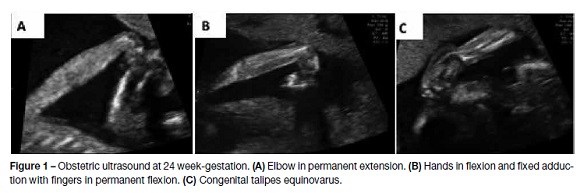
<body><![CDATA[<p>The different forms of arthrogryposis can be grouped into six categories concerning    etiopathogenesis: (i) myopathic processes (20&#8722;30% of cases); (ii) neurologic    abnormalities (70&#8722;80% of cases); (iii) connective tissue abnormalities;    (iv) intrauterine compression; (v) maternal exposure (including to infections    as rubella and diseases as diabetes, multiple sclerosis, and myasthenia gravis    [the latter of which can cause transient myasthenia of the newborn in about    10% of cases through transplacental passage of antibodies against the recipient,    exposure to teratogens, medications, and drugs]); and (vi) vascular compromise    of developing fetus, which may explain the high incidence of discordant monozygotic    twins.<sup>1,3</sup></p>     <p>Amyoplasia is the most common form of arthrogryposis and diagnosis is based    on clinical findings.</p>     <p>The case of a prenatal diagnosis of arthrogryposis multiplex congenita in one    fetus from a monochorionic diamniotic twin pregnancy is presented.</p>     <p><b>Case report</b></p>     <p>A 33-year-old pregnant woman, with two miscarriages and one healthy child (G4P1)    and diet-managed gestational diabetes reported a spontaneous monochorionic diamniotic    twin pregnancy. The couple was non-consanguineous, with no relevant family history.</p>     <p>Patient was referred to the Prenatal Diagnosis Department at 23 weeks of gestation    due to detection of joint motion abnormalities on the second fetus in morphological    ultrasound evaluation.</p>     <p>First trimester ultrasound was normal, with low combined risk of 21, 18, and    13 trisomies.</p>     <p>Amniocentesis was performed at the local hospital. Chromosome 13, 18, and 21    aneuploidies were excluded. Array-CGH was normal and myotonic dystrophy type    one study, negative.</p>     <p>Ultrasound study revealed a monochorionic diamniotic twin pregnancy, with the    second fetus presenting a bilateral equinovarus foot, permanently flexed knee    joint, permanently extended elbows, and hands in fixed flexion and adduction    with permanently flexed fingers (<a href="#f1">Figure 1</a>). These findings    were compatible with the diagnosis of amyoplasia.</p>     <p>&nbsp;</p>     ]]></body>
<body><![CDATA[<p align="center"><a name="f1"></a><img src="/img/revistas/nas/v27n4/27n4a08f1.jpg"/></p>     
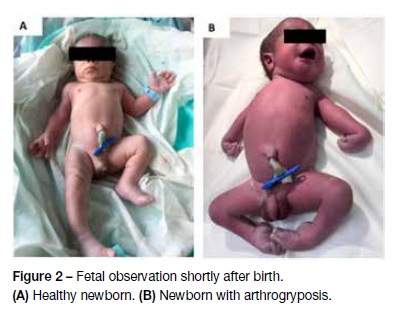
<p>&nbsp;</p>     <p>Pregnancy progressed with no further complications.</p>     <p>A cesarean section was performed at 37 weeks, resulting in two live births    adequately weighted considering gestational age and Apgar scores of 9/10 for    both (<a href="#f2">Figure 2</a>).</p>     <p>&nbsp;</p>     <p align="center"><a name="f2"></a><img src="/img/revistas/nas/v27n4/27n4a08f2.jpg"/></p>     
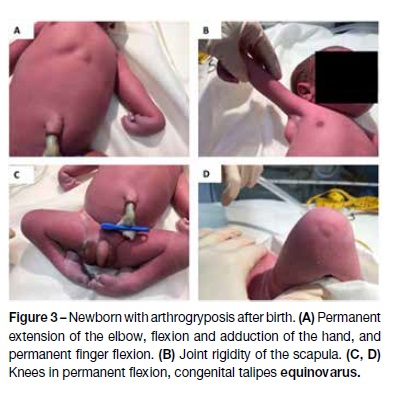
<p>&nbsp;</p>     <p>Physical examination of the first fetus was normal.</p>     <p>Physical examination of the second fetus confirmed arthrogryposis involving    upper and lower limbs. Positional dolichocephaly, slight thoracic asymmetry    without intermammary space increase, and absence of lumbar or cervical contractures    were reported, with no facial dysmorphia or other physical abnormalities (<a href="#f3">Figure    3</a>). </p>     <p>&nbsp;</p>     ]]></body>
<body><![CDATA[<p align="center"><a name="f3"></a><img src="/img/revistas/nas/v27n4/27n4a08f3.jpg"/></p>     
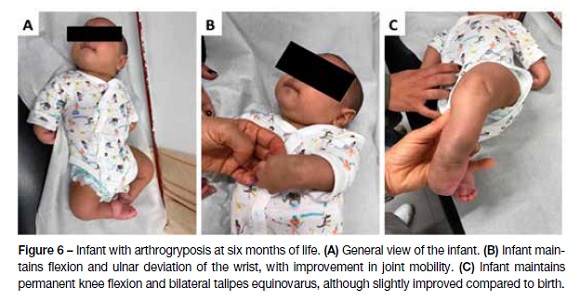
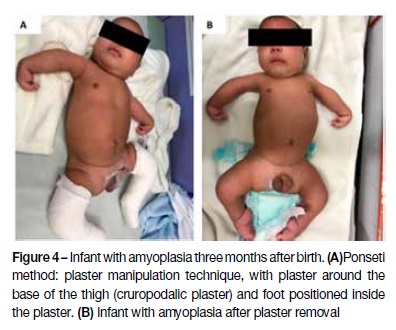
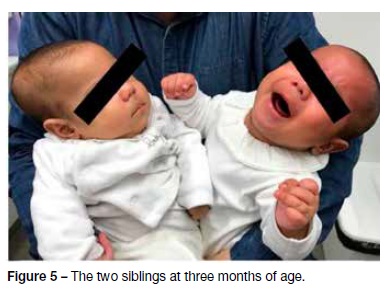
<p>&nbsp;</p>     <p>Hospital admission of the newborn at the Neonatal Special Care Unit was uneventful.    Physical evaluation revealed no analytical abnormalities and normal transfontanellar    and abdominal ultrasounds. Electromyography at the 9<sup>th</sup> day of life    showed signs compatible with acute denervation of distal limb muscles, which    were absent from more proximal muscles. Although such signs can be found in    cases of non-progressive distal spinal muscular atrophy, a diagnosis of polyneuropathy    was less likely due to the normal sensory potential. </p>     <p>Multidisciplinary (Neurology, Medical Genetics, Pediatrics, Orthopedics, Physical    Medicine and Rehabilitation) evaluation determined congenital amyoplasia as    the most probable diagnosis. Nevertheless, infant&rsquo;s close follow-up was considered    essential, as diagnosis of other rare forms of arthrogryposis was not definitely    excluded.</p>     <p>The infant, currently six months old, is undergoing motor rehabilitation with    a slight limb mobility improvement (<a href="#f4">Figure 4</a>, <a href="#f5">5</a>,    and <a href="#f6">6</a>).</p>     <p>&nbsp;</p>     <p align="center"><a name="f4"></a><img src="/img/revistas/nas/v27n4/27n4a08f4.jpg"/></p>     
<p>&nbsp;</p>     <p align="center"><a name="f5"></a><img src="/img/revistas/nas/v27n4/27n4a08f5.jpg"/></p>     
<p>&nbsp;</p>     ]]></body>
<body><![CDATA[<p align="center"><a name="f6"></a><img src="/img/revistas/nas/v27n4/27n4a08f6.jpg"/></p>     
<p>&nbsp;</p>     <p><b>Discussion</b></p>     <p>According to the literature, detection rate of arthrogryposis in the prenatal    period is around 25% <sup>4</sup>. In cases of clinical suspicion, either due    to decreased fetal movements perceived by the mother or to fetal anatomy anomalies,    a thorough echographic evaluation of fetal body movement patterns should be    performed.<sup> 4</sup></p>     <p>The increased incidence of singleton arthrogryposis in monozygotic twins has    been documented, and is thought to be related to vascular changes early in the    course of pregnancy.<sup>5</sup> Approximately 70% of monozygotic twins are    also monochorionic, in which cases an uneven distribution of placental blood    circulation may occur.<sup>3</sup> When placental blood flow decreases or is    disrupted, the developing fetal structures &#8722; such as muscles, neuronal    structures, and bones - can be easily damaged, with potential impact on fetal    development stages. Fetal vascular compromise impairing normal development of    nerves or causing death of the anterior horn cells would likely cause fetal    neuron, muscle, and bone damage, as well as secondary multiple joint contractures.</p>     <p>Vascular compromise of neuromuscular fetal structures, even transiently, may    result in fetal akinesia and joint contractures. Vascular changes are also believed    to play a role in the development of abdominal wall defects such as gastroschisis,    intestinal atresia, and partial or total absence of finger phalanges.<sup>1,5</sup></p>     <p>Amyoplasia is the most common form of arthrogryposis, with an incidence of    1 in 10.000 NB.<sup>6</sup> It represents about 30% of all forms of congenital    contractures.<sup>6 </sup>Most cases are sporadic, with etiopathogenesis not    fully established. The diagnosis is clinical<sup>5</sup> and replacement of    normal by fibrous limb muscle tissue and adipocytes is observed.<sup>7</sup>    Clinically, it is characterized by symmetrical involvement of the four limbs    in 60&#8722;92% of cases, isolated involvement of lower limbs in 7&#8722;24%    of cases, and isolated involvement of the upper limbs in 1&#8722;13% of cases.<sup>1,8</sup></p>     <p>Physical examination of newborns affected with amyoplasia involving the four    limbs usually evidences an internal rotation and adduction of the shoulders,    extension of the elbows, flexion and ulnar deviation of the wrist, flexion and    stiffness of the fingers with adducted thumbs. In the lower limbs, knees appear    in flexion or in fixed extension and bilateral equinovarus foot is usually observed.    Amyoplasia-affected newborns may also present with dislocated hips.<sup>5,9    </sup></p>     <p>Patients with amyoplasia have a normal cognitive development.<sup>6</sup></p>     <p>Once the diagnosis of amyoplasia is made, rehabilitation should be initiated    as soon as possible. Treatment aims to improve quality of life and should engage    a multidisciplinary team including pediatrician, orthopedic surgeon, geneticist,    physiotherapist, and psychologist. It should be individually planned and include    motion rehabilitation of affected joints, active motion restoration in every    functional muscle, and correction of fixed deformities affecting daily life    activities.<sup>6</sup></p>     ]]></body>
<body><![CDATA[<p>In 85% of cases, walking can be assured by the age of five.<sup>6,9</sup> Success    of rehabilitation depends on contracture severity and type of treatment. Pelvic    girdle and femoral quadriceps motor capacity play an important role in this    process.<sup>10</sup></p>     <p>Quality of life seems to be mainly determined by motor function of the upper    limbs and ability to perform self-care activities.<sup>11</sup> Sells <i>et    al</i>. demonstrated that around 75% of patients with arthrogryposis are able    to self-feed, while only 10% are able to dress unassisted and 35% can perform    self-care activities without support.<sup>9</sup></p>     <p>If known entities have been excluded, the empiric risk of arthrogryposis recurrence    for unaffected parents with an affected child is 3&#8722;5%.<sup>12</sup> </p>     <p>In conclusion, prenatal diagnosis of arthrogryposis is complex. Upon clinical    suspicion, a complete evaluation of fetal body movement patterns should be performed.    A wide spectrum of conditions can lead to arthrogryposis, and diagnosis of amyoplasia    is usually accomplished by excluding other conditions. After delivery, amyoplasia-affected    newborn should initiate a complete rehabilitation program. The aim of treatment    is to improve quality of life.</p>     <p>&nbsp;</p>     <p><b>REFERENCES</b></p>     <!-- ref --><p>1. Rink BD. Arthrogryposis: a review and approach to prenatal diagnosis. Obstet    Gynecol Survey. 2011; 66:369-77.    &nbsp;&nbsp;&nbsp;&nbsp;&nbsp;&nbsp;&nbsp;&nbsp;[&#160;<a href="javascript:void(0);" onclick="javascript: window.open('/scielo.php?script=sci_nlinks&ref=1113532&pid=S0872-0754201800040000800001&lng=','','width=640,height=500,resizable=yes,scrollbars=1,menubar=yes,');">Links</a>&#160;]<!-- end-ref --></p>     <!-- ref --><p>2. Hall JG. Arthrogryposis multiplex congenita: etiology, genetics, classification,    diagnostic approach and general aspects. J Pediatr Orthop B. 1997; 6:159-66.    &nbsp;&nbsp;&nbsp;&nbsp;&nbsp;&nbsp;&nbsp;&nbsp;[&#160;<a href="javascript:void(0);" onclick="javascript: window.open('/scielo.php?script=sci_nlinks&ref=1113534&pid=S0872-0754201800040000800002&lng=','','width=640,height=500,resizable=yes,scrollbars=1,menubar=yes,');">Links</a>&#160;]<!-- end-ref --></p>     ]]></body>
<body><![CDATA[<!-- ref --><p>3. Hall JG. Arthrogryposis (multiple congenital contractures): Diagnostic approach    to etiology, classification, genetics, and general principles. <i>European Journal    of Medical Genetics</i>. 2014; 57:464-72.    &nbsp;&nbsp;&nbsp;&nbsp;&nbsp;&nbsp;&nbsp;&nbsp;[&#160;<a href="javascript:void(0);" onclick="javascript: window.open('/scielo.php?script=sci_nlinks&ref=1113536&pid=S0872-0754201800040000800003&lng=','','width=640,height=500,resizable=yes,scrollbars=1,menubar=yes,');">Links</a>&#160;]<!-- end-ref --></p>     <!-- ref --><p>4. Filges I, Hall JG. Failure to identify antenatal multiple congenital contractures    and fetal akinesia - proposal of guidelines to improve diagnosis. Prenatal Diagnosis    2013; 33:61-74.    &nbsp;&nbsp;&nbsp;&nbsp;&nbsp;&nbsp;&nbsp;&nbsp;[&#160;<a href="javascript:void(0);" onclick="javascript: window.open('/scielo.php?script=sci_nlinks&ref=1113538&pid=S0872-0754201800040000800004&lng=','','width=640,height=500,resizable=yes,scrollbars=1,menubar=yes,');">Links</a>&#160;]<!-- end-ref --></p>     <!-- ref --><p>5. Hall JG, Aldinger KA, Tanaka KI. Amyoplasia revisited. <i>American Journal    of Medical Genetics Part A</i>. 2014; 164:700-30.    &nbsp;&nbsp;&nbsp;&nbsp;&nbsp;&nbsp;&nbsp;&nbsp;[&#160;<a href="javascript:void(0);" onclick="javascript: window.open('/scielo.php?script=sci_nlinks&ref=1113540&pid=S0872-0754201800040000800005&lng=','','width=640,height=500,resizable=yes,scrollbars=1,menubar=yes,');">Links</a>&#160;]<!-- end-ref --></p>     <p>6. Kowalczyk B, Felu&#347; J. Arthrogryposis: An update on clinical aspects,    etiology, and treatment strategies. <i>Archives of Medical Science</i>. 2016;    1:10-24.</p>     <!-- ref --><p>7. Hall JG, Reed SD, McGillivray BC, Herrmann J, Partington MW, Schinzel A,    et al. Part II. Amyoplasia: twinning in amyoplasia - a specific type of arthrogryposis    with an apparent excess of discordantly affected identical twins. Am J Med Genet    1983; 15:591-9.    &nbsp;&nbsp;&nbsp;&nbsp;&nbsp;&nbsp;&nbsp;&nbsp;[&#160;<a href="javascript:void(0);" onclick="javascript: window.open('/scielo.php?script=sci_nlinks&ref=1113543&pid=S0872-0754201800040000800007&lng=','','width=640,height=500,resizable=yes,scrollbars=1,menubar=yes,');">Links</a>&#160;]<!-- end-ref --></p>     <!-- ref --><p>8. Kalampokas E, Kalampokas T, Sofoudis C, Deligeoroglou E, Botsis E. Diagnosing    arthrogryposis multiplex congenita: a review. ISRN Obstet Gynecol. 2012; 2012:264918.    &nbsp;&nbsp;&nbsp;&nbsp;&nbsp;&nbsp;&nbsp;&nbsp;[&#160;<a href="javascript:void(0);" onclick="javascript: window.open('/scielo.php?script=sci_nlinks&ref=1113545&pid=S0872-0754201800040000800008&lng=','','width=640,height=500,resizable=yes,scrollbars=1,menubar=yes,');">Links</a>&#160;]<!-- end-ref --></p>     <!-- ref --><p>9. Sells JM, Jaffe KM, Hall JG. Amyoplasia, the most common type of arthrogryposis:    the potential for good outcome. Pediatrics. 1996; 97:225-31.    &nbsp;&nbsp;&nbsp;&nbsp;&nbsp;&nbsp;&nbsp;&nbsp;[&#160;<a href="javascript:void(0);" onclick="javascript: window.open('/scielo.php?script=sci_nlinks&ref=1113547&pid=S0872-0754201800040000800009&lng=','','width=640,height=500,resizable=yes,scrollbars=1,menubar=yes,');">Links</a>&#160;]<!-- end-ref --></p>     <!-- ref --><p>10. Hoffer M, Swank S, Eastman F, Clark D, Teitge R. Ambulation in severe arthrogryposis.    J Pediatr Orthop. 1983; 3:293-7.    &nbsp;&nbsp;&nbsp;&nbsp;&nbsp;&nbsp;&nbsp;&nbsp;[&#160;<a href="javascript:void(0);" onclick="javascript: window.open('/scielo.php?script=sci_nlinks&ref=1113549&pid=S0872-0754201800040000800010&lng=','','width=640,height=500,resizable=yes,scrollbars=1,menubar=yes,');">Links</a>&#160;]<!-- end-ref --></p>     <!-- ref --><p>11. Fassier A, Wicart P, Dubosset J, Seringe R. Arthrogryposis multiplex congenita.    Long term follow up study from birth until skeletal maturity. J Child Orthop.    2009; 3:383-90.    &nbsp;&nbsp;&nbsp;&nbsp;&nbsp;&nbsp;&nbsp;&nbsp;[&#160;<a href="javascript:void(0);" onclick="javascript: window.open('/scielo.php?script=sci_nlinks&ref=1113551&pid=S0872-0754201800040000800011&lng=','','width=640,height=500,resizable=yes,scrollbars=1,menubar=yes,');">Links</a>&#160;]<!-- end-ref --></p>     <!-- ref --><p>12. Firth HV, Hurst JA. Arthrogryposis (arthrogryposis multiplex congenita).    In: Hall JG ed. Oxford Desk Reference Clinical Genetics. 1st ed. Oxford: Oxford    University Press; 2005.    &nbsp;&nbsp;&nbsp;&nbsp;&nbsp;&nbsp;&nbsp;&nbsp;[&#160;<a href="javascript:void(0);" onclick="javascript: window.open('/scielo.php?script=sci_nlinks&ref=1113553&pid=S0872-0754201800040000800012&lng=','','width=640,height=500,resizable=yes,scrollbars=1,menubar=yes,');">Links</a>&#160;]<!-- end-ref --> </p>     <p>&nbsp;</p>     ]]></body>
<body><![CDATA[<p><a href="#topc0">Endere&ccedil;o para correspond&ecirc;ncia</a> | <a href="#topc0">Direcci&oacute;n    para correspondencia</a> | <a href="#topc0">Correspondence</a><a name="c0"></a></p>     <p>Rafael Brás    <br>   Obstetrics and Gynecology Department,     <br>   Centro Materno-Infantil do Norte    <br>   Largo da Maternidade de Júlio Dinis,     <br>   4050-651 Porto    <br>   Email: <a href="mailto:rafaelduartebras@gmail.com">rafaelduartebras@gmail.com</a></p>     <p>&nbsp;</p>     <p>Received for publication: 13.09.2017</p>     <p>Accepted in revised form: 05.07.2018</p>     ]]></body>
<body><![CDATA[ ]]></body><back>
<ref-list>
<ref id="B1">
<label>1</label><nlm-citation citation-type="journal">
<person-group person-group-type="author">
<name>
<surname><![CDATA[Rink]]></surname>
<given-names><![CDATA[BD]]></given-names>
</name>
</person-group>
<article-title xml:lang="en"><![CDATA[Arthrogryposis: a review and approach to prenatal diagnosis]]></article-title>
<source><![CDATA[Obstet Gynecol Survey]]></source>
<year>2011</year>
<volume>66</volume>
<page-range>369-77</page-range></nlm-citation>
</ref>
<ref id="B2">
<label>2</label><nlm-citation citation-type="journal">
<person-group person-group-type="author">
<name>
<surname><![CDATA[Hall]]></surname>
<given-names><![CDATA[JG]]></given-names>
</name>
</person-group>
<article-title xml:lang="en"><![CDATA[Arthrogryposis multiplex congenita: etiology, genetics, classification, diagnostic approach and general aspects]]></article-title>
<source><![CDATA[J Pediatr Orthop B]]></source>
<year>1997</year>
<volume>6</volume>
<page-range>159-66</page-range></nlm-citation>
</ref>
<ref id="B3">
<label>3</label><nlm-citation citation-type="journal">
<person-group person-group-type="author">
<name>
<surname><![CDATA[Hall]]></surname>
<given-names><![CDATA[JG]]></given-names>
</name>
</person-group>
<article-title xml:lang="en"><![CDATA[Arthrogryposis (multiple congenital contractures): Diagnostic approach to etiology, classification, genetics, and general principles]]></article-title>
<source><![CDATA[European Journal of Medical Genetics]]></source>
<year>2014</year>
<volume>57</volume>
<page-range>464-72</page-range></nlm-citation>
</ref>
<ref id="B4">
<label>4</label><nlm-citation citation-type="journal">
<person-group person-group-type="author">
<name>
<surname><![CDATA[Filges]]></surname>
<given-names><![CDATA[I]]></given-names>
</name>
<name>
<surname><![CDATA[Hall]]></surname>
<given-names><![CDATA[JG]]></given-names>
</name>
</person-group>
<article-title xml:lang="en"><![CDATA[Failure to identify antenatal multiple congenital contractures and fetal akinesia: proposal of guidelines to improve diagnosis]]></article-title>
<source><![CDATA[Prenatal Diagnosis]]></source>
<year>2013</year>
<volume>33</volume>
<page-range>61-74</page-range></nlm-citation>
</ref>
<ref id="B5">
<label>5</label><nlm-citation citation-type="journal">
<person-group person-group-type="author">
<name>
<surname><![CDATA[Hall]]></surname>
<given-names><![CDATA[JG]]></given-names>
</name>
<name>
<surname><![CDATA[Aldinger]]></surname>
<given-names><![CDATA[KA]]></given-names>
</name>
<name>
<surname><![CDATA[Tanaka]]></surname>
<given-names><![CDATA[KI]]></given-names>
</name>
</person-group>
<article-title xml:lang="en"><![CDATA[Amyoplasia revisited]]></article-title>
<source><![CDATA[American Journal of Medical Genetics Part A]]></source>
<year>2014</year>
<volume>164</volume>
<page-range>700-30</page-range></nlm-citation>
</ref>
<ref id="B6">
<label>6</label><nlm-citation citation-type="journal">
<person-group person-group-type="author">
<name>
<surname><![CDATA[Kowalczyk]]></surname>
<given-names><![CDATA[B]]></given-names>
</name>
<name>
<surname><![CDATA[Felus]]></surname>
<given-names><![CDATA[J]]></given-names>
</name>
</person-group>
<article-title xml:lang="en"><![CDATA[Arthrogryposis: An update on clinical aspects, etiology, and treatment strategies]]></article-title>
<source><![CDATA[Archives of Medical Science]]></source>
<year>2016</year>
<volume>1</volume>
<page-range>10-24</page-range></nlm-citation>
</ref>
<ref id="B7">
<label>7</label><nlm-citation citation-type="journal">
<person-group person-group-type="author">
<name>
<surname><![CDATA[Hall]]></surname>
<given-names><![CDATA[JG]]></given-names>
</name>
<name>
<surname><![CDATA[Reed]]></surname>
<given-names><![CDATA[SD]]></given-names>
</name>
<name>
<surname><![CDATA[McGillivray]]></surname>
<given-names><![CDATA[BC]]></given-names>
</name>
<name>
<surname><![CDATA[Herrmann]]></surname>
<given-names><![CDATA[J]]></given-names>
</name>
<name>
<surname><![CDATA[Partington]]></surname>
<given-names><![CDATA[MW]]></given-names>
</name>
<name>
<surname><![CDATA[Schinzel]]></surname>
<given-names><![CDATA[A]]></given-names>
</name>
</person-group>
<article-title xml:lang="en"><![CDATA[Part II. Amyoplasia: twinning in amyoplasia - a specific type of arthrogryposis with an apparent excess of discordantly affected identical twins]]></article-title>
<source><![CDATA[Am J Med Genet]]></source>
<year>1983</year>
<volume>15</volume>
<page-range>591-9</page-range></nlm-citation>
</ref>
<ref id="B8">
<label>8</label><nlm-citation citation-type="journal">
<person-group person-group-type="author">
<name>
<surname><![CDATA[Kalampokas]]></surname>
<given-names><![CDATA[E]]></given-names>
</name>
<name>
<surname><![CDATA[Kalampokas]]></surname>
<given-names><![CDATA[T]]></given-names>
</name>
<name>
<surname><![CDATA[Sofoudis]]></surname>
<given-names><![CDATA[C]]></given-names>
</name>
<name>
<surname><![CDATA[Deligeoroglou]]></surname>
<given-names><![CDATA[E]]></given-names>
</name>
<name>
<surname><![CDATA[Botsis]]></surname>
<given-names><![CDATA[E]]></given-names>
</name>
</person-group>
<article-title xml:lang="en"><![CDATA[Diagnosing arthrogryposis multiplex congenita: a review]]></article-title>
<source><![CDATA[ISRN Obstet Gynecol]]></source>
<year>2012</year>
<volume>2012</volume>
<page-range>264918</page-range></nlm-citation>
</ref>
<ref id="B9">
<label>9</label><nlm-citation citation-type="journal">
<person-group person-group-type="author">
<name>
<surname><![CDATA[Sells]]></surname>
<given-names><![CDATA[JM]]></given-names>
</name>
<name>
<surname><![CDATA[Jaffe]]></surname>
<given-names><![CDATA[KM]]></given-names>
</name>
<name>
<surname><![CDATA[Hall]]></surname>
<given-names><![CDATA[JG]]></given-names>
</name>
</person-group>
<article-title xml:lang="en"><![CDATA[Amyoplasia, the most common type of arthrogryposis: the potential for good outcome]]></article-title>
<source><![CDATA[Pediatrics]]></source>
<year>1996</year>
<volume>97</volume>
<page-range>225-31</page-range></nlm-citation>
</ref>
<ref id="B10">
<label>10</label><nlm-citation citation-type="journal">
<person-group person-group-type="author">
<name>
<surname><![CDATA[Hoffer]]></surname>
<given-names><![CDATA[M]]></given-names>
</name>
<name>
<surname><![CDATA[Swank]]></surname>
<given-names><![CDATA[S]]></given-names>
</name>
<name>
<surname><![CDATA[Eastman]]></surname>
<given-names><![CDATA[F]]></given-names>
</name>
<name>
<surname><![CDATA[Clark]]></surname>
<given-names><![CDATA[D]]></given-names>
</name>
<name>
<surname><![CDATA[Teitge]]></surname>
<given-names><![CDATA[R]]></given-names>
</name>
</person-group>
<article-title xml:lang="en"><![CDATA[Ambulation in severe arthrogryposis]]></article-title>
<source><![CDATA[J Pediatr Orthop]]></source>
<year>1983</year>
<volume>3</volume>
<page-range>293-7</page-range></nlm-citation>
</ref>
<ref id="B11">
<label>11</label><nlm-citation citation-type="journal">
<person-group person-group-type="author">
<name>
<surname><![CDATA[Fassier]]></surname>
<given-names><![CDATA[A]]></given-names>
</name>
<name>
<surname><![CDATA[Wicart]]></surname>
<given-names><![CDATA[P]]></given-names>
</name>
<name>
<surname><![CDATA[Dubosset]]></surname>
<given-names><![CDATA[J]]></given-names>
</name>
<name>
<surname><![CDATA[Seringe]]></surname>
<given-names><![CDATA[R]]></given-names>
</name>
</person-group>
<article-title xml:lang="en"><![CDATA[Arthrogryposis multiplex congenita: Long term follow up study from birth until skeletal maturity]]></article-title>
<source><![CDATA[J Child Orthop. 2009]]></source>
<year></year>
<volume>3</volume>
<page-range>383-90</page-range></nlm-citation>
</ref>
<ref id="B12">
<label>12</label><nlm-citation citation-type="book">
<person-group person-group-type="author">
<name>
<surname><![CDATA[Firth]]></surname>
<given-names><![CDATA[HV]]></given-names>
</name>
<name>
<surname><![CDATA[Hurst]]></surname>
<given-names><![CDATA[JA]]></given-names>
</name>
</person-group>
<article-title xml:lang="en"><![CDATA[Arthrogryposis (arthrogryposis multiplex congenita)]]></article-title>
<person-group person-group-type="editor">
<name>
<surname><![CDATA[Hall]]></surname>
<given-names><![CDATA[JG]]></given-names>
</name>
</person-group>
<source><![CDATA[Oxford Desk Reference Clinical Genetics]]></source>
<year>2005</year>
<edition>1</edition>
<publisher-loc><![CDATA[Oxford ]]></publisher-loc>
<publisher-name><![CDATA[Oxford University Press]]></publisher-name>
</nlm-citation>
</ref>
</ref-list>
</back>
</article>