<?xml version="1.0" encoding="ISO-8859-1"?><article xmlns:mml="http://www.w3.org/1998/Math/MathML" xmlns:xlink="http://www.w3.org/1999/xlink" xmlns:xsi="http://www.w3.org/2001/XMLSchema-instance">
<front>
<journal-meta>
<journal-id>0872-0754</journal-id>
<journal-title><![CDATA[Nascer e Crescer]]></journal-title>
<abbrev-journal-title><![CDATA[Nascer e Crescer]]></abbrev-journal-title>
<issn>0872-0754</issn>
<publisher>
<publisher-name><![CDATA[Centro Hospitalar do Porto]]></publisher-name>
</publisher>
</journal-meta>
<article-meta>
<article-id>S0872-07542019000100003</article-id>
<article-id pub-id-type="doi">10.25753/BirthGrowthMJ.v28.i1.13781</article-id>
<title-group>
<article-title xml:lang="en"><![CDATA[Ulcerated infantile hemangioma]]></article-title>
<article-title xml:lang="pt"><![CDATA[Hemangioma infantil ulcerado]]></article-title>
</title-group>
<contrib-group>
<contrib contrib-type="author">
<name>
<surname><![CDATA[Belo]]></surname>
<given-names><![CDATA[Nídia]]></given-names>
</name>
<xref ref-type="aff" rid="A1"/>
</contrib>
<contrib contrib-type="author">
<name>
<surname><![CDATA[Maio]]></surname>
<given-names><![CDATA[Patrícia]]></given-names>
</name>
<xref ref-type="aff" rid="A1"/>
</contrib>
<contrib contrib-type="author">
<name>
<surname><![CDATA[Gomes]]></surname>
<given-names><![CDATA[Susana]]></given-names>
</name>
<xref ref-type="aff" rid="A1"/>
</contrib>
<contrib contrib-type="author">
<name>
<surname><![CDATA[Cruz]]></surname>
<given-names><![CDATA[Carla]]></given-names>
</name>
<xref ref-type="aff" rid="A1"/>
</contrib>
<contrib contrib-type="author">
<name>
<surname><![CDATA[Lopes]]></surname>
<given-names><![CDATA[Maria João P.]]></given-names>
</name>
<xref ref-type="aff" rid="A2"/>
</contrib>
</contrib-group>
<aff id="AA1">
<institution><![CDATA[,Hospital do Espírito Santo de Évora Pediatrics Department ]]></institution>
<addr-line><![CDATA[Évora ]]></addr-line>
<country>Portugal</country>
</aff>
<aff id="AA2">
<institution><![CDATA[,Centro Hospitalar Lisboa Central Dermatology Department ]]></institution>
<addr-line><![CDATA[Lisboa ]]></addr-line>
<country>Portugal</country>
</aff>
<pub-date pub-type="pub">
<day>00</day>
<month>03</month>
<year>2019</year>
</pub-date>
<pub-date pub-type="epub">
<day>00</day>
<month>03</month>
<year>2019</year>
</pub-date>
<volume>28</volume>
<numero>1</numero>
<fpage>18</fpage>
<lpage>21</lpage>
<copyright-statement/>
<copyright-year/>
<self-uri xlink:href="http://scielo.pt/scielo.php?script=sci_arttext&amp;pid=S0872-07542019000100003&amp;lng=en&amp;nrm=iso"></self-uri><self-uri xlink:href="http://scielo.pt/scielo.php?script=sci_abstract&amp;pid=S0872-07542019000100003&amp;lng=en&amp;nrm=iso"></self-uri><self-uri xlink:href="http://scielo.pt/scielo.php?script=sci_pdf&amp;pid=S0872-07542019000100003&amp;lng=en&amp;nrm=iso"></self-uri><abstract abstract-type="short" xml:lang="en"><p><![CDATA[Infantile hemangiomas are the most frequent vascular tumors in pediatric age. Diagnostic can be challenging due to variable clinical presentation and natural history. Most cases have a favorable evolution. Treatment may be required according to tumor location, extension, and complications. Propranolol is an effective and safe treatment. The case of an infant with perianal ulcerated hemangiomas treated with propranolol with clinical improvement is reported.]]></p></abstract>
<abstract abstract-type="short" xml:lang="pt"><p><![CDATA[Os hemangiomas infantis são os tumores vasculares mais comuns em pediatria, mas o seu diagnóstico pode ser dificultado pela apresentação clínica e história natural variáveis. A maioria dos casos apresenta evolução favorável, porém a sua localização, extensão e complicações podem determinar necessidade terapêutica. O propranolol é uma terapêutica eficaz e segura. É apresentado o caso de uma lactente com hemangioma perianal ulcerado tratado com propranolol com boa evolução clínica.]]></p></abstract>
<kwd-group>
<kwd lng="en"><![CDATA[infantile hemangioma]]></kwd>
<kwd lng="en"><![CDATA[propranolol]]></kwd>
<kwd lng="en"><![CDATA[ulceration]]></kwd>
<kwd lng="pt"><![CDATA[hemangioma infantil]]></kwd>
<kwd lng="pt"><![CDATA[propranolol]]></kwd>
<kwd lng="pt"><![CDATA[ulceração]]></kwd>
</kwd-group>
</article-meta>
</front><body><![CDATA[ <p align="right"><font size="2"><b>CASE REPORTS | CASOS CLÍNICOS</b></font></p>     <p><font size="4"><b>Ulcerated infantile hemangioma</b></font></p>     <p><font size="3"><b>Hemangioma infantil ulcerado</b></font></p>     <p><b>Nídia Belo<sup>I</sup>, Patrícia Maio<sup>I</sup>, Susana Gomes<sup>I</sup>,    Carla Cruz<sup>I</sup>, Maria João P. Lopes<sup>II</sup></b></p>     <p><sup>I</sup> Pediatrics Department, Hospital do Espírito Santo de Évora. 7000-811    Évora, Portugal. <a href="mailto:nidia.belo@gmail.com">nidia.belo@gmail.com</a>;    <a href="mailto:patriciaspmaio@gmail.com">patriciaspmaio@gmail.com</a>; <a href="mailto:susana_gomes@netcabo.pt">susana_gomes@netcabo.pt</a>;    <a href="mailto:carla.cruz.aguiar@gmail.com">carla.cruz.aguiar@gmail.com</a></p>     <p><sup>II</sup> Dermatology Department, Centro Hospitalar Lisboa Central. 1169-050    Lisboa, Portugal. <a href="mailto:mjfigueiroa@sapo.pt">mjfigueiroa@sapo.pt</a></p>     <p><a href="#c0">Endere&ccedil;o para correspond&ecirc;ncia</a> | <a href="#c0">Direcci&oacute;n    para correspondencia</a> | <a href="#c0">Correspondence</a><a name="topc0"></a></p> <hr/>     <p>&nbsp;</p>     <p><b>ABSTRACT</b></p>     <p>Infantile hemangiomas are the most frequent vascular tumors in pediatric age.    Diagnostic can be challenging due to variable clinical presentation and natural    history. Most cases have a favorable evolution. Treatment may be required according    to tumor location, extension, and complications. Propranolol is an effective    and safe treatment.</p>     ]]></body>
<body><![CDATA[<p>The case of an infant with perianal ulcerated hemangiomas treated with propranolol    with clinical improvement is reported.</p>     <p><b>Keywords: </b>infantile hemangioma; propranolol; ulceration</p> <hr/>     <p>&nbsp;</p>     <p><b>RESUMO</b></p>     <p>Os hemangiomas infantis são os tumores vasculares mais comuns em pediatria,    mas o seu diagnóstico pode ser dificultado pela apresentação clínica e história    natural variáveis. A maioria dos casos apresenta evolução favorável, porém a    sua localização, extensão e complicações podem determinar necessidade terapêutica.    O propranolol é uma terapêutica eficaz e segura.</p>     <p>É apresentado o caso de uma lactente com hemangioma perianal ulcerado tratado    com propranolol com boa evolução clínica.</p>     <p><b>Palavras-chave: </b>hemangioma infantil; propranolol; ulceração</p> <hr/>     <p>&nbsp;</p>     <p><b>Introduction</b></p>     <p>Infantile hemangioma (IH) is a benign vascular tumor affecting approximately    4&#8722;5% of children. It is more frequent in the Caucasian population, females,    premature infants, low-birth-weight newborns, and twins. IH usually appears    in the first weeks of life and may be preceded by a precursor lesion.<sup>1</sup></p>     ]]></body>
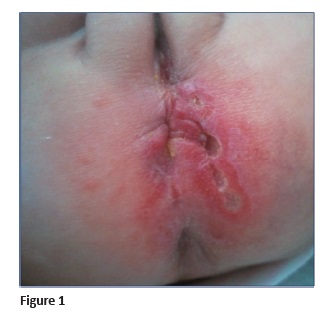
<body><![CDATA[<p>Natural history of IH has three phases.<sup>2 </sup>The proliferative phase    is characterized by a rapid growth in the first months of life, often lasting    three months. It is followed by a stabilization phase and a subsequent spontaneous    gradual resolution (involutive) phase, lasting for two to six years. Complete    resolution is usually attained by the age of ten. After involution, residual    lesions as scarring, telangiectasia, or cutaneous atrophy may remain.<sup>2    </sup>Complete resolution of the condition seems to be related to the early    onset of its involution.<sup>3</sup></p>     <p>IH diagnosis is clinical, based on history and clinical examination, but it    can be challenging in cases of deep hemangiomas, atypical location, or when    IH is associated with complications.<sup>4 </sup>Radiology may be useful in    differential diagnosis, evaluation of size, type, and extension of IH, as well    as in monitoring treatment response.<sup>3</sup></p>     <p>Most IHs have a favorable evolution, hence an expectant attitude is recommended.    Treatment should be considered according to patient&rsquo;s age, size, number, and    location of IH, associated symptoms, and evolutionary phase of the IH.<sup>3    </sup>Treatment is often required within the first months of life for cases    associated with vital, organic, or esthetic commitment, or complicated IH, such    as ulcerated hemangiomas.<sup>1</sup></p>     <p>Classic therapeutic approach includes systemic or intralesional corticosteroids.    In IH sensitive to steroids, a favorable response is observed one week after    therapeutic initiation. However, adverse effects are not negligible and may    include cushingoid facies, arterial hypertension, growth retardation, and an    increased risk of fungal infections.<sup>5 </sup>After therapeutic suspension,    rebound effect and IH relapse may occur.</p>     <p>Treatment with oral propranolol has emerged as an effective and safe option    and is currently considered the first-line therapy in IH. Propranolol is a non-selective    beta-blocker with a not fully clarified mechanism of action. Beneficial effects    in the treatment of IH are attributed to its vasoconstriction action, inhibition    of angiogenesis, and induction of apoptosis.<sup>1,6</sup></p>     <p>A multidisciplinary approach is required, encompassing Pediatrics, Dermatology,    Cardiology, and other medical specialties, when appropriate.<sup>7</sup></p>     <p><b>Clinical case</b></p>     <p>The case of a female infant with irrelevant family history and prenatal background    with no intercurrences is presented. At 15 days of age, she presented a perianal    erythematous lesion that evolved to a flat ulcer (15mm) with marginal erythema    and perilesional exsudate. The lesion was painful mainly during hygiene procedures    and defecation. According to the mother, the child had a skin thickening at    the lesion site since birth. She maintained a linear weight and length progression    without other cutaneous or mucosal lesions and reported no episodes of infectious    diseases or gastrointestinal alterations.</p>     <p>At the age of one month, the child was hospitalized to treat a presumed infected    perianal ulcer and was medicated with systemic and topical antibiotics and topical    antiseptic, with no improvement (<a href="#f1">Figure 1</a>).</p>     <p>&nbsp;</p>     ]]></body>
<body><![CDATA[<p align="center"><a name="f1"></a><img src="/img/revistas/nas/v28n1/28n1a03f1.jpg"/></p>     
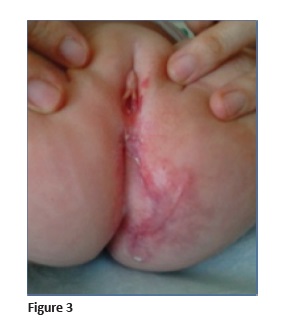
<p>&nbsp;</p>     <p>Laboratory tests revealed no indirect parameters of bacterial infection, and    immunity study and determination of seric zinc were normal.</p>     <p>By two months old, she presented small-dimension vascular formations, perilesional    and in the large left lip (<a href="#f2">Figure 2</a>). At this time, a diagnostic    hypothesis of ulcerative perianal hemangioma was raised. Abdominopelvic and    lumbosacral nuclear magnetic resonance revealed an image compatible with vascular    structure and excluded extension of the lesion to deep planes, organic invasion,    and other structural anomalies.</p>     <p>&nbsp;</p>     <p align="center"><a name="f2"></a><img src="/img/revistas/nas/v28n1/28n1a03f2.jpg"/></p>     
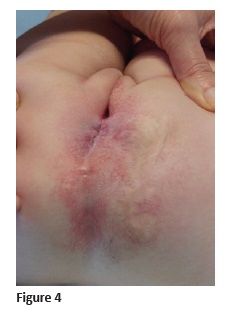
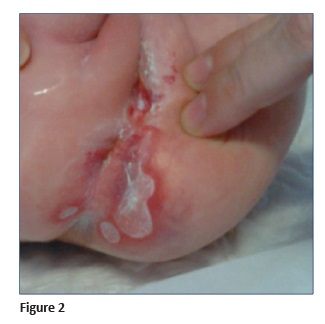
<p>&nbsp;</p>     <p>The girl was submitted to a pre-therapeutic evaluation which included electrocardiogram,    blood pressure, and blood glucose. She initiated propranolol therapy at three    months of age. Treatment was started in elective hospitalization under monitoring    according to the national protocol, with oral propranolol up to a target dose    of 3mg/ kg/day, tid.<sup>9</sup></p>     <p>The infant had a regular follow-up. A rapid and favorable response was observed,    with ulcer healing one month after treatment initiation and progressive involution    of IH with formation of fibrotic scar tissue (<a href="#f3">Figure 3</a>&#8722;<a href="#f4">4</a>).    Therapy was well tolerated, with no complications or adverse events observed.</p>     <p>&nbsp;</p>     ]]></body>
<body><![CDATA[<p align="center"><a name="f3"></a><img src="/img/revistas/nas/v28n1/28n1a03f3.jpg"/></p>     
<p>&nbsp;</p>     <p align="center"><a name="f4"></a><img src="/img/revistas/nas/v28n1/28n1a03f4.jpg"/></p>     
<p>&nbsp;</p>     <p>The child underwent a total of 16 months of therapy, with progressive reduction    of propranolol dose until suspension.</p>     <p>At 24 months of age, corresponding to the fifth month post- treatment suspension,    she presented residual fibrosis, with no relapses (<a href="#f4">Figure 4</a>).    No evidence of other hemangiomas was observed.</p>     <p><b>Discussion</b></p>     <p>The variable natural evolution and clinical presentation of IH complicate the    diagnosis, especially when angiomatous lesion is preceded by complications.    Ulceration is the most common complication, occurring mainly in the proliferative    phase. This complication causes intense pain and discomfort, especially when    ulceration affects the lips, perianal, and genital regions.<sup>2-4 </sup>Consideration    of IH diagnosis is essential to avoid unnecessary testing and treatment.</p>     <p>Most IHs evolve with spontaneous regression, and an expectant attitude can    be adopted. When treatment is indicated, propranolol should be started as soon    as possible.</p>     <p>In this clinical case, given IH location, local ulceration, and intense pain,    decision to start propranolol was made. An excellent initial response was observed    during the proliferative IH phase, with progressive involution of the hemangioma,    probably due to the early therapeutic institution. As a consequence, a good    analgesic response was observed.</p>     ]]></body>
<body><![CDATA[<p>Although safe, propranolol is not free of adverse effects. They are, however,    uncommon, and include bradycardia, hypotension, hypoglycemia, wheezing, and    sleep disorders.<sup>8 </sup>Their monitoring is essential, especially during    the therapeutic induction phase.</p>     <p>Protocols for induction, maintenance, dose, and duration of propranolol therapy    are variable. The recommended target dose is 1 to 3 mg/kg/day in three doses    after an initial period of therapeutic induction. Treatment should be maintained    up to 12&#8722;16 months of age.<sup>8-9</sup></p>     <p>Rate of relapse after therapeutic withdrawal is estimated at 19&#8722;25%,    especially if propranolol suspension occurs before the age of nine months.<sup>10</sup></p>     <p>Further studies are required to develop consensual guidelines.</p>     <p>IH with lumbosacral or anogenital location may be associated with medullar    dysraphism or anogenital anomalies. Magnetic resonance is the gold standard    examination for this investigation. In the present case, imaging allowed to    evaluate lesion extent and to exclude associated anomalies.</p>     <p><b>Key messages</b></p>     <p>1. Diagnosis of infantile hemangioma can be difficult, especially when complicated.</p>     <p>2. Early diagnosis is essential to avoid unnecessary testing and treatment.</p>     <p>3. Propranolol initiated in an early stage allows a good response.</p>     <p>4. The lumbosacral or anogenital location imposes investigation of spinal cord    dysraphism or anogenital anomalies.</p>     ]]></body>
<body><![CDATA[<p>&nbsp;</p>     <p><b>REFERENCES</b></p>     <!-- ref --><p>1. Ravenscroft J. Management of infantile haemangioma. Paediatrics and Child    Health. 2014; 25:2.    &nbsp;&nbsp;&nbsp;&nbsp;&nbsp;&nbsp;&nbsp;&nbsp;[&#160;<a href="javascript:void(0);" onclick="javascript: window.open('/scielo.php?script=sci_nlinks&ref=1114159&pid=S0872-0754201900010000300001&lng=','','width=640,height=500,resizable=yes,scrollbars=1,menubar=yes,');">Links</a>&#160;]<!-- end-ref --></p>     <!-- ref --><p>2. Nina BID, Oliveira ZNP, Machado MCMR, Macea JM. Apresentação, evolução e    tratamento dos hemangiomas cutâneos - experiência do Ambulatório de Dermatologia    Infantil do Hospital das Clínicas da Faculdade de Medicina da Universidade de    São Paulo. An Bras Dermatol. 2006; 81: 323-7.    &nbsp;&nbsp;&nbsp;&nbsp;&nbsp;&nbsp;&nbsp;&nbsp;[&#160;<a href="javascript:void(0);" onclick="javascript: window.open('/scielo.php?script=sci_nlinks&ref=1114161&pid=S0872-0754201900010000300002&lng=','','width=640,height=500,resizable=yes,scrollbars=1,menubar=yes,');">Links</a>&#160;]<!-- end-ref --></p>     <!-- ref --><p>3. Gontijo B, Silva CMR, Pereira LB. Hemangioma da infância. An Bras Dermatol.    2003; 78: 651-73.    &nbsp;&nbsp;&nbsp;&nbsp;&nbsp;&nbsp;&nbsp;&nbsp;[&#160;<a href="javascript:void(0);" onclick="javascript: window.open('/scielo.php?script=sci_nlinks&ref=1114163&pid=S0872-0754201900010000300003&lng=','','width=640,height=500,resizable=yes,scrollbars=1,menubar=yes,');">Links</a>&#160;]<!-- end-ref --></p>     <!-- ref --><p>4. Lanoel A, Tosi V, Bocian M, Lubieniecki F, Poblete SB, García HO, <i>et    al</i>. Úlceras perianales sobre hemangioma con crecimiento mínimo o detenido    segmentário. Actas Dermosifiliogr. 2012; 103: 820-3.    &nbsp;&nbsp;&nbsp;&nbsp;&nbsp;&nbsp;&nbsp;&nbsp;[&#160;<a href="javascript:void(0);" onclick="javascript: window.open('/scielo.php?script=sci_nlinks&ref=1114165&pid=S0872-0754201900010000300004&lng=','','width=640,height=500,resizable=yes,scrollbars=1,menubar=yes,');">Links</a>&#160;]<!-- end-ref --></p>     ]]></body>
<body><![CDATA[<!-- ref --><p>5. Bonini FK, Bellodi FS, Souza EM. Hemangioma infantil tratado com propranolol.    An Bras Dermatol. 2011; 86:763-6.    &nbsp;&nbsp;&nbsp;&nbsp;&nbsp;&nbsp;&nbsp;&nbsp;[&#160;<a href="javascript:void(0);" onclick="javascript: window.open('/scielo.php?script=sci_nlinks&ref=1114167&pid=S0872-0754201900010000300005&lng=','','width=640,height=500,resizable=yes,scrollbars=1,menubar=yes,');">Links</a>&#160;]<!-- end-ref --></p>     <!-- ref --><p>6. Hiraki PY, Goldenberg DC. Diagnóstico e tratamento do hemangioma infantil.    Rev Bras Cir Plást. 2010; 25:388-97.    &nbsp;&nbsp;&nbsp;&nbsp;&nbsp;&nbsp;&nbsp;&nbsp;[&#160;<a href="javascript:void(0);" onclick="javascript: window.open('/scielo.php?script=sci_nlinks&ref=1114169&pid=S0872-0754201900010000300006&lng=','','width=640,height=500,resizable=yes,scrollbars=1,menubar=yes,');">Links</a>&#160;]<!-- end-ref --></p>     <!-- ref --><p>7. Melo IS, Gonçalves V, Anjos R. Propranolol nos hemangiomas infantis: casuística    nacional com 30 doentes. Acta Pediatr Port 2012; 43:190-4.    &nbsp;&nbsp;&nbsp;&nbsp;&nbsp;&nbsp;&nbsp;&nbsp;[&#160;<a href="javascript:void(0);" onclick="javascript: window.open('/scielo.php?script=sci_nlinks&ref=1114171&pid=S0872-0754201900010000300007&lng=','','width=640,height=500,resizable=yes,scrollbars=1,menubar=yes,');">Links</a>&#160;]<!-- end-ref --></p>     <!-- ref --><p>8. Drolet BA, Frommelt PC, Chamlin SL, Haggstrom A, Bauman NM, Chiu YE, <i>et    al</i>. Initiation and use of propranolol for infantile hemangioma: Report of    a Consensus Conference. Pediatrics. 2013; 131:128- 40.    &nbsp;&nbsp;&nbsp;&nbsp;&nbsp;&nbsp;&nbsp;&nbsp;[&#160;<a href="javascript:void(0);" onclick="javascript: window.open('/scielo.php?script=sci_nlinks&ref=1114173&pid=S0872-0754201900010000300008&lng=','','width=640,height=500,resizable=yes,scrollbars=1,menubar=yes,');">Links</a>&#160;]<!-- end-ref --></p>     <!-- ref --><p>9. Lawley LP. Siegfried E, Todd JL. Propranolol treatment for hemangioma of    infancy: risks and recomendations. Pediatr Dermatol. 2009; 26:610-4.    &nbsp;&nbsp;&nbsp;&nbsp;&nbsp;&nbsp;&nbsp;&nbsp;[&#160;<a href="javascript:void(0);" onclick="javascript: window.open('/scielo.php?script=sci_nlinks&ref=1114175&pid=S0872-0754201900010000300009&lng=','','width=640,height=500,resizable=yes,scrollbars=1,menubar=yes,');">Links</a>&#160;]<!-- end-ref --></p>     ]]></body>
<body><![CDATA[<!-- ref --><p>10. Shah SD, Baselga E, McCuaig C, Pope E, Coulie J, Boon LM. Rebound growth    of infantile hemangiomas after propranolol therapy. Pediatrics. 2016; 137:1-8.    &nbsp;&nbsp;&nbsp;&nbsp;&nbsp;&nbsp;&nbsp;&nbsp;[&#160;<a href="javascript:void(0);" onclick="javascript: window.open('/scielo.php?script=sci_nlinks&ref=1114177&pid=S0872-0754201900010000300010&lng=','','width=640,height=500,resizable=yes,scrollbars=1,menubar=yes,');">Links</a>&#160;]<!-- end-ref --></p>     <p>&nbsp;</p>     <p><a href="#topc0">Endere&ccedil;o para correspond&ecirc;ncia</a> | <a href="#topc0">Direcci&oacute;n    para correspondencia</a> | <a href="#topc0">Correspondence</a><a name="c0"></a></p>     <p>Nídia Belo    <br>   Pediatrics Department    <br>   Hospital do Espírito Santo de Évora Largo Sr. da Pobreza    <br>   7000-811 Évora    <br>   Email:<a href="mailto:nidia.belo@gmail.com"> nidia.belo@gmail.com</a></p>     <p>&nbsp;</p>     ]]></body>
<body><![CDATA[<p>Received for publication: 17.01.2018 </p>     <p>Accepted in revised form: 05.09.2018</p>      ]]></body><back>
<ref-list>
<ref id="B1">
<label>1</label><nlm-citation citation-type="journal">
<person-group person-group-type="author">
<name>
<surname><![CDATA[Ravenscroft]]></surname>
<given-names><![CDATA[J]]></given-names>
</name>
</person-group>
<article-title xml:lang="en"><![CDATA[Management of infantile haemangioma]]></article-title>
<source><![CDATA[Paediatrics and Child Health]]></source>
<year>2014</year>
<volume>25</volume>
<page-range>2</page-range></nlm-citation>
</ref>
<ref id="B2">
<label>2</label><nlm-citation citation-type="journal">
<person-group person-group-type="author">
<name>
<surname><![CDATA[Nina]]></surname>
<given-names><![CDATA[BID]]></given-names>
</name>
<name>
<surname><![CDATA[Oliveira]]></surname>
<given-names><![CDATA[ZNP]]></given-names>
</name>
<name>
<surname><![CDATA[Machado]]></surname>
<given-names><![CDATA[MCMR]]></given-names>
</name>
<name>
<surname><![CDATA[Macea]]></surname>
<given-names><![CDATA[JM]]></given-names>
</name>
</person-group>
<article-title xml:lang="pt"><![CDATA[Apresentação, evolução e tratamento dos hemangiomas cutâneos: experiência do Ambulatório de Dermatologia Infantil do Hospital das Clínicas da Faculdade de Medicina da Universidade de São Paulo]]></article-title>
<source><![CDATA[An Bras Dermatol]]></source>
<year>2006</year>
<volume>81</volume>
<page-range>323-7</page-range></nlm-citation>
</ref>
<ref id="B3">
<label>3</label><nlm-citation citation-type="journal">
<person-group person-group-type="author">
<name>
<surname><![CDATA[Gontijo]]></surname>
<given-names><![CDATA[B]]></given-names>
</name>
<name>
<surname><![CDATA[Silva]]></surname>
<given-names><![CDATA[CMR]]></given-names>
</name>
<name>
<surname><![CDATA[Pereira]]></surname>
<given-names><![CDATA[LB]]></given-names>
</name>
</person-group>
<article-title xml:lang="pt"><![CDATA[Hemangioma da infância]]></article-title>
<source><![CDATA[An Bras Dermatol]]></source>
<year>2003</year>
<volume>78</volume>
<page-range>651-73</page-range></nlm-citation>
</ref>
<ref id="B4">
<label>4</label><nlm-citation citation-type="journal">
<person-group person-group-type="author">
<name>
<surname><![CDATA[Lanoel]]></surname>
<given-names><![CDATA[A]]></given-names>
</name>
<name>
<surname><![CDATA[Tosi]]></surname>
<given-names><![CDATA[V]]></given-names>
</name>
<name>
<surname><![CDATA[Bocian]]></surname>
<given-names><![CDATA[M]]></given-names>
</name>
<name>
<surname><![CDATA[Lubieniecki]]></surname>
<given-names><![CDATA[F]]></given-names>
</name>
<name>
<surname><![CDATA[Poblete]]></surname>
<given-names><![CDATA[SB]]></given-names>
</name>
<name>
<surname><![CDATA[García]]></surname>
<given-names><![CDATA[HO]]></given-names>
</name>
</person-group>
<article-title xml:lang="pt"><![CDATA[Úlceras perianales sobre hemangioma con crecimiento mínimo o detenido segmentário]]></article-title>
<source><![CDATA[Actas Dermosifiliogr]]></source>
<year>2012</year>
<volume>103</volume>
<page-range>820-3</page-range></nlm-citation>
</ref>
<ref id="B5">
<label>5</label><nlm-citation citation-type="journal">
<person-group person-group-type="author">
<name>
<surname><![CDATA[Bonini]]></surname>
<given-names><![CDATA[FK]]></given-names>
</name>
<name>
<surname><![CDATA[Bellodi]]></surname>
<given-names><![CDATA[FS]]></given-names>
</name>
<name>
<surname><![CDATA[Souza]]></surname>
<given-names><![CDATA[EM]]></given-names>
</name>
</person-group>
<article-title xml:lang="pt"><![CDATA[Hemangioma infantil tratado com propranolol]]></article-title>
<source><![CDATA[An Bras Dermatol]]></source>
<year>2011</year>
<volume>86</volume>
<page-range>763-6</page-range></nlm-citation>
</ref>
<ref id="B6">
<label>6</label><nlm-citation citation-type="journal">
<person-group person-group-type="author">
<name>
<surname><![CDATA[Hiraki]]></surname>
<given-names><![CDATA[PY]]></given-names>
</name>
<name>
<surname><![CDATA[Goldenberg]]></surname>
<given-names><![CDATA[DC]]></given-names>
</name>
</person-group>
<article-title xml:lang="pt"><![CDATA[Diagnóstico e tratamento do hemangioma infantil]]></article-title>
<source><![CDATA[Rev Bras Cir Plást]]></source>
<year>2010</year>
<volume>25</volume>
<page-range>388-97</page-range></nlm-citation>
</ref>
<ref id="B7">
<label>7</label><nlm-citation citation-type="journal">
<person-group person-group-type="author">
<name>
<surname><![CDATA[Melo]]></surname>
<given-names><![CDATA[IS]]></given-names>
</name>
<name>
<surname><![CDATA[Gonçalves]]></surname>
<given-names><![CDATA[V]]></given-names>
</name>
<name>
<surname><![CDATA[Anjos]]></surname>
<given-names><![CDATA[R]]></given-names>
</name>
</person-group>
<article-title xml:lang="pt"><![CDATA[Propranolol nos hemangiomas infantis: casuística nacional com 30 doentes]]></article-title>
<source><![CDATA[Acta Pediatr Port]]></source>
<year>2012</year>
<volume>43</volume>
<page-range>190-4</page-range></nlm-citation>
</ref>
<ref id="B8">
<label>8</label><nlm-citation citation-type="">
<person-group person-group-type="author">
<name>
<surname><![CDATA[Drolet]]></surname>
<given-names><![CDATA[BA]]></given-names>
</name>
<name>
<surname><![CDATA[Frommelt]]></surname>
<given-names><![CDATA[PC]]></given-names>
</name>
<name>
<surname><![CDATA[Chamlin]]></surname>
<given-names><![CDATA[SL]]></given-names>
</name>
<name>
<surname><![CDATA[Haggstrom]]></surname>
<given-names><![CDATA[A]]></given-names>
</name>
<name>
<surname><![CDATA[Bauman]]></surname>
<given-names><![CDATA[NM]]></given-names>
</name>
<name>
<surname><![CDATA[Chiu]]></surname>
<given-names><![CDATA[YE]]></given-names>
</name>
</person-group>
<article-title xml:lang="en"><![CDATA[Initiation and use of propranolol for infantile hemangioma: Report of a Consensus Conference]]></article-title>
<source><![CDATA[]]></source>
<year></year>
</nlm-citation>
</ref>
<ref id="B9">
<label>9</label><nlm-citation citation-type="journal">
<person-group person-group-type="author">
<name>
<surname><![CDATA[Lawley]]></surname>
<given-names><![CDATA[LP]]></given-names>
</name>
<name>
<surname><![CDATA[Siegfried]]></surname>
<given-names><![CDATA[E]]></given-names>
</name>
<name>
<surname><![CDATA[Todd]]></surname>
<given-names><![CDATA[JL]]></given-names>
</name>
</person-group>
<article-title xml:lang="en"><![CDATA[Propranolol treatment for hemangioma of infancy: risks and recomendations]]></article-title>
<source><![CDATA[Pediatr Dermatol]]></source>
<year>2009</year>
<volume>26</volume>
<page-range>610-4</page-range></nlm-citation>
</ref>
<ref id="B10">
<label>10</label><nlm-citation citation-type="journal">
<person-group person-group-type="author">
<name>
<surname><![CDATA[Shah]]></surname>
<given-names><![CDATA[SD]]></given-names>
</name>
<name>
<surname><![CDATA[Baselga]]></surname>
<given-names><![CDATA[E]]></given-names>
</name>
<name>
<surname><![CDATA[McCuaig]]></surname>
<given-names><![CDATA[C]]></given-names>
</name>
<name>
<surname><![CDATA[Pope]]></surname>
<given-names><![CDATA[E]]></given-names>
</name>
<name>
<surname><![CDATA[Coulie]]></surname>
<given-names><![CDATA[J]]></given-names>
</name>
<name>
<surname><![CDATA[Boon]]></surname>
<given-names><![CDATA[LM]]></given-names>
</name>
</person-group>
<article-title xml:lang="en"><![CDATA[Rebound growth of infantile hemangiomas after propranolol therapy]]></article-title>
<source><![CDATA[Pediatrics]]></source>
<year>2016</year>
<volume>137</volume>
<page-range>1-8</page-range></nlm-citation>
</ref>
</ref-list>
</back>
</article>