<?xml version="1.0" encoding="ISO-8859-1"?><article xmlns:mml="http://www.w3.org/1998/Math/MathML" xmlns:xlink="http://www.w3.org/1999/xlink" xmlns:xsi="http://www.w3.org/2001/XMLSchema-instance">
<front>
<journal-meta>
<journal-id>0872-0754</journal-id>
<journal-title><![CDATA[Nascer e Crescer]]></journal-title>
<abbrev-journal-title><![CDATA[Nascer e Crescer]]></abbrev-journal-title>
<issn>0872-0754</issn>
<publisher>
<publisher-name><![CDATA[Centro Hospitalar do Porto]]></publisher-name>
</publisher>
</journal-meta>
<article-meta>
<article-id>S0872-07542019000100004</article-id>
<article-id pub-id-type="doi">10.25753/BirthGrowthMJ.v28.i1.13536</article-id>
<title-group>
<article-title xml:lang="en"><![CDATA[Ureteropelvic junction obstruction: three clinical cases with first symptoms during adolescence]]></article-title>
<article-title xml:lang="pt"><![CDATA[Síndrome de junção ureteropélvica: três casos clínicos com início dos sintomas na adolescência]]></article-title>
</title-group>
<contrib-group>
<contrib contrib-type="author">
<name>
<surname><![CDATA[Abreu]]></surname>
<given-names><![CDATA[Mariana]]></given-names>
</name>
<xref ref-type="aff" rid="A1"/>
</contrib>
<contrib contrib-type="author">
<name>
<surname><![CDATA[Pinto]]></surname>
<given-names><![CDATA[Alexandra]]></given-names>
</name>
<xref ref-type="aff" rid="A2"/>
</contrib>
<contrib contrib-type="author">
<name>
<surname><![CDATA[Aguiar]]></surname>
<given-names><![CDATA[Cláudia]]></given-names>
</name>
<xref ref-type="aff" rid="A1"/>
</contrib>
<contrib contrib-type="author">
<name>
<surname><![CDATA[Castro]]></surname>
<given-names><![CDATA[Ribeiro de]]></given-names>
</name>
<xref ref-type="aff" rid="A3"/>
</contrib>
<contrib contrib-type="author">
<name>
<surname><![CDATA[Madalena]]></surname>
<given-names><![CDATA[Célia]]></given-names>
</name>
<xref ref-type="aff" rid="A4"/>
</contrib>
</contrib-group>
<aff id="AA1">
<institution><![CDATA[,Centro Hospitalar Universitário de São João Centro Materno Pediátrico Pediatrics Department]]></institution>
<addr-line><![CDATA[Porto ]]></addr-line>
<country>Portugal</country>
</aff>
<aff id="AA2">
<institution><![CDATA[,Centro Hospitalar Lisboa Norte Pediatrics Department ]]></institution>
<addr-line><![CDATA[Lisboa ]]></addr-line>
<country>Portugal</country>
</aff>
<aff id="AA3">
<institution><![CDATA[,Centro Hospitalar Universitário do Porto Urology Department ]]></institution>
<addr-line><![CDATA[Lisboa ]]></addr-line>
<country>Portugal</country>
</aff>
<aff id="AA4">
<institution><![CDATA[,Centro Hospitalar Póvoa de Varzim - Vila do Conde Pediatrics Department ]]></institution>
<addr-line><![CDATA[ ]]></addr-line>
</aff>
<pub-date pub-type="pub">
<day>00</day>
<month>03</month>
<year>2019</year>
</pub-date>
<pub-date pub-type="epub">
<day>00</day>
<month>03</month>
<year>2019</year>
</pub-date>
<volume>28</volume>
<numero>1</numero>
<fpage>22</fpage>
<lpage>25</lpage>
<copyright-statement/>
<copyright-year/>
<self-uri xlink:href="http://scielo.pt/scielo.php?script=sci_arttext&amp;pid=S0872-07542019000100004&amp;lng=en&amp;nrm=iso"></self-uri><self-uri xlink:href="http://scielo.pt/scielo.php?script=sci_abstract&amp;pid=S0872-07542019000100004&amp;lng=en&amp;nrm=iso"></self-uri><self-uri xlink:href="http://scielo.pt/scielo.php?script=sci_pdf&amp;pid=S0872-07542019000100004&amp;lng=en&amp;nrm=iso"></self-uri><abstract abstract-type="short" xml:lang="en"><p><![CDATA[Ureteropelvic junction obstruction (UPJO) is defined as urine flow blockage occurring where the ureter enters the kidney and is presented as urinary tract dilatation (UTD), formerly named hydronephrosis. The condition may be congenital or acquired. Most UTD are diagnosed by antenatal ultrasonography, but some cases present later. In adolescence, clinical manifestations include intermittent flank or abdominal pain, hematuria, nephrolithiasis, urinary tract infection, deterioration of renal function, or arterial hypertension. The imaging modality of choice to diagnose UTD is ultrasonography (US). A diuretic renography will allow to identify UPJO. Treatment goals are to prevent renal function deterioration and relieve symptoms. Although conservative treatment measures are favored, some patients require surgical correction (pyeloplasty). Three clinical cases with first symptom onset during adolescence are presented. The first case is a 14-year-old boy with abdominal pain suspected to correspond to acute appendicitis; the second case is a healthy 15-year-old female which presented with dysuria and lumbar pain; the third case is a 15-year-old female with prenatal diagnosis of left ureteropelvic dilation but no further medical problems, with left lumbar pain, dysuria, and fever. Conclusion: A high degree of suspicion is required to include UPJO in the differential diagnosis of flank or back pain in adolescents.]]></p></abstract>
<abstract abstract-type="short" xml:lang="pt"><p><![CDATA[A Síndrome de Junção Ureteropélvica (SJUP) é definida como obstrução ao fluxo de urina na transição entre a pelve renal e o ureter e manifesta-se por dilatação do trato urinário (DTU), anteriormente designada hidronefrose. Esta condição pode ser congénita ou adquirida. A maioria dos casos de DTU são diagnosticados na ecografia pré-natal, mas alguns casos são detetados mais tarde. Na adolescência, as manifestações clínicas incluem dor abdominal ou lombar intermitente, hematúria, nefrolitíase, infeção do trato urinário, deterioração da função renal ou hipertensão arterial. O exame de imagem de escolha para diagnosticar DTU é a ecografia. O renograma permite identificar os casos de SJUP. Os objetivos do tratamento são prevenir a deterioração da função renal e controlar os sintomas. O tratamento conservador é prioritário, mas pode ser necessária correção cirúrgica (pieloplastia). São apresentados três casos clínicos com apresentação dos primeiros sintomas de doença na adolescência. O primeiro caso refere-se a um adolescente de 14 anos com dor abdominal inicialmente interpretada como apendicite aguda; o segundo, a uma adolescente saudável de 15 anos com queixas de disúria e dor lombar; e o terceiro, a uma adolescente de 15 anos saudável, com diagnóstico pré-natal de dilatação uretero-pélvica esquerda, sem outros antecedentes de relevo, com dor lombar à esquerda, disúria e febre. Conclusão: É necessário um alto grau de suspeição para incluir a SJUP no diagnóstico diferencial da dor lombar e/ou abdominal em adolescentes.]]></p></abstract>
<kwd-group>
<kwd lng="en"><![CDATA[adolescence]]></kwd>
<kwd lng="en"><![CDATA[hydronephrosis]]></kwd>
<kwd lng="en"><![CDATA[ureteral obstruction]]></kwd>
<kwd lng="pt"><![CDATA[adolescência]]></kwd>
<kwd lng="pt"><![CDATA[hidronefrose]]></kwd>
<kwd lng="pt"><![CDATA[obstrução ureteral]]></kwd>
</kwd-group>
</article-meta>
</front><body><![CDATA[ <p align="right"><font size="2"><b>CASE REPORTS | CASOS CLÍNICOS</b></font></p>     <p><font size="4"><b>Ureteropelvic junction obstruction: three clinical cases    with first symptoms during adolescence</b></font></p>     <p><font size="3"><b>Síndrome de junção ureteropélvica: três casos clínicos com    início dos sintomas na adolescência</b></font></p>     <p><b>Mariana Abreu<sup>I</sup>, Alexandra Pinto<sup>II</sup>, Cláudia Aguiar<sup>I</sup>,    Ribeiro de Castro<sup>III</sup>, Célia Madalena<sup>IV</sup></b></p>     <p><sup>I</sup> Pediatrics Department, Centro Materno Pediátrico, Centro Hospitalar    Universitário de São João. 4200-319 Porto, Portugal. <a href="mailto:marianacgabreu@gmail.com">marianacgabreu@gmail.com</a>;    <a href="mailto:claudiaccmaguiar@gmail.com">claudiaccmaguiar@gmail.com</a> </p>     <p><sup>II</sup> Pediatrics Department, Centro Hospitalar Lisboa Norte. 1649-035    Lisboa, Portugal. <a href="mailto:alexandra.r.pinto@gmail.com">alexandra.r.pinto@gmail.com</a>  </p>     <p><sup>III</sup> Urology Department, Centro Hospitalar Universitário do Porto.    4099-001 Lisboa, Portugal. <a href="mailto:luis.joao.castro@gmail.com">luis.joao.castro@gmail.com</a>  </p>     <p><sup>IV</sup> Pediatrics Department, Centro Hospitalar Póvoa de Varzim - Vila    do Conde. 4490-421 Póvoa de Varzim, Portugal. <a href="mailto:celia.madalena@hotmail.com">celia.madalena@hotmail.com</a>      <p><a href="#c0">Endere&ccedil;o para correspond&ecirc;ncia</a> | <a href="#c0">Direcci&oacute;n    para correspondencia</a> | <a href="#c0">Correspondence</a><a name="topc0"></a></p> <hr/>     <p>&nbsp;</p>     ]]></body>
<body><![CDATA[<p><b>ABSTRACT</b></p>     <p>Ureteropelvic junction obstruction (UPJO) is defined as urine flow blockage    occurring where the ureter enters the kidney and is presented as urinary tract    dilatation (UTD), formerly named hydronephrosis. The condition may be congenital    or acquired. Most UTD are diagnosed by antenatal ultrasonography, but some cases    present later. In adolescence, clinical manifestations include intermittent    flank or abdominal pain, hematuria, nephrolithiasis, urinary tract infection,    deterioration of renal function, or arterial hypertension. The imaging modality    of choice to diagnose UTD is ultrasonography (US). A diuretic renography will    allow to identify UPJO. Treatment goals are to prevent renal function deterioration    and relieve symptoms. Although conservative treatment measures are favored,    some patients require surgical correction (pyeloplasty).</p>     <p>Three clinical cases with first symptom onset during adolescence are presented.    The first case is a 14-year-old boy with abdominal pain suspected to correspond    to acute appendicitis; the second case is a healthy 15-year-old female which    presented with dysuria and lumbar pain; the third case is a 15-year-old female    with prenatal diagnosis of left ureteropelvic dilation but no further medical    problems, with left lumbar pain, dysuria, and fever.</p>     <p><b>Conclusion: </b>A high degree of suspicion is required to include UPJO in    the differential diagnosis of flank or back pain in adolescents.</p>     <p><b>Keywords: </b>adolescence; hydronephrosis; ureteral obstruction</p> <hr/>     <p>&nbsp;</p>     <p><b>RESUMO</b></p>     <p>A Síndrome de Junção Ureteropélvica (SJUP) é definida como obstrução ao fluxo    de urina na transição entre a pelve renal e o ureter e manifesta-se por dilatação    do trato urinário (DTU), anteriormente designada hidronefrose. Esta condição    pode ser congénita ou adquirida. A maioria dos casos de DTU são diagnosticados    na ecografia pré-natal, mas alguns casos são detetados mais tarde. Na adolescência,    as manifestações clínicas incluem dor abdominal ou lombar intermitente, hematúria,    nefrolitíase, infeção do trato urinário, deterioração da função renal ou hipertensão    arterial. O exame de imagem de escolha para diagnosticar DTU é a ecografia.    O renograma permite identificar os casos de SJUP. Os objetivos do tratamento    são prevenir a deterioração da função renal e controlar os sintomas. O tratamento    conservador é prioritário, mas pode ser necessária correção cirúrgica (pieloplastia).    São apresentados três casos clínicos com apresentação dos primeiros sintomas    de doença na adolescência. O primeiro caso refere-se a um adolescente de 14    anos com dor abdominal inicialmente interpretada como apendicite aguda; o segundo,    a uma adolescente saudável de 15 anos com queixas de disúria e dor lombar; e    o terceiro, a uma adolescente de 15 anos saudável, com diagnóstico pré-natal    de dilatação uretero-pélvica esquerda, sem outros antecedentes de relevo, com    dor lombar à esquerda, disúria e febre.</p>     <p><b>Conclusão: </b>É necessário um alto grau de suspeição para incluir a SJUP    no diagnóstico diferencial da dor lombar e/ou abdominal em adolescentes.</p>     <p><b>Palavras-chave: </b>adolescência; hidronefrose; obstrução ureteral</p> <hr/>     ]]></body>
<body><![CDATA[<p>&nbsp;</p>     <p><b>Introduction</b></p>     <p>Ureteropelvic junction obstruction (UPJO) is defined as partial or total blockage    of urine flow where the ureter enters the kidney.<sup>1,2 </sup>It is presented    as renal pelvis and calyceal dilatation without obvious dilatation of the ureter.3,4    UPJO is the most common pathologic cause of antenatally detected urinary tract    dilatation (UTD).<sup>1,2 </sup>It occurs sporadically in 1:500-1500 live births    and is more prevalent in boys, with a male:female ratio of 2:1.<sup>1,5-7 </sup>The    left side is affected in approximately two thirds of cases and both sides in    10-40%.<sup>2,5,7 </sup>The condition may be congenital or acquired and causes    can be intrinsic (more frequent and including scarring of ureteric valves and    ureteric hypoplasia) or extrinsic (an aberrant or accessory renal artery may    cross the lower pole of the kidney, causing an impingement on the ureter and    blockage of urinary flow, congenital abnormalities of the kidney, scar formation    secondary to ureteric manipulation by surgery, or fibroepithelial polyps).<sup>1,5-7</sup></p>     <p>Most UTDs are diagnosed by antenatal ultrasonography (US), but they may also    present later in childhood.<sup>1,6-9 </sup>In older children, clinical manifestations    include intermittent flank or abdominal pain, especially with brisk diuresis    (for example, after consumption of caffeine or alcohol), renal injury after    experiencing minor trauma, hematuria, nephrolithiasis, urinary tract infection    (UTI), deterioration of renal function, or arterial hypertension.<sup>2,5,6    </sup>Unless there is coincident vesicoureteral reflux (VUR), UTI is a rare    entity.<sup>1</sup></p>     <p>Although US is the imaging modality of choice to diagnose UTD, this technique    is unable to differentiate between obstructed and non- obstructed kidneys. For    this purpose, a diuretic renography &#8722; usually with 99mTc-mercaptoacetyltriglycine-3    (MAG-3) &#8722; is essential, as it allows to distinguish between an obstructed    and a dilated but otherwise normal renal pelvis.<sup>1,2,5,7,8 </sup>Occasionally,    a voiding cystourethrogram has to be performed to rule out VUR.<sup>1,2,7,10</sup></p>     <p>The goals of treatment are to prevent deterioration of renal function and relieve    symptoms (if present). Conservative treatment measures (as antibiotic prophylaxis,    in cases of previous symptomatic UTI and until VUR has been excluded) are priority.<sup>11    </sup>Surgical correction is</p>     <p>required when renal function is decreased (differential renal function of obstructed    kidney &lt;40%) or if the patient became symptomatic.<sup>5 </sup>If surgery    is indicated, pyeloplasty is the gold-standard treatment.<sup>1,5 </sup>Three    clinical cases are reported with first symptoms of disease manifesting during    adolescence.</p>     <p><u>Case 1</u></p>     <p>Young, previously healthy, 14-year-old male admitted to the Emergency Department    with acute onset abdominal pain in the right flank and lower quadrant with 24    hours of evolution, without fever. The boy had one episode of flank pain four    years before, with spontaneous resolution. On physical examination, he weighted    84 Kg (over the 95 percentile for age) and his abdomen was tender in the right    lower quadrants, without further remarkable findings. Laboratory evaluation    revealed white blood cell (WBC) count of 7.56x10³/&#956;L with 58.8% neutrophils,    C-reactive protein (CRP) of</p>     <p>10.4 mg/dL (normal: &lt;0.5 mg/dL), blood urea of 16.4 mg/dL, serum creatinine    of 0.64 mg/dL, and electrolytes within the normal range. Urinalysis by microscopy    showed 2&#8722;5 red blood cells per high-power field (HPF), with no other abnormalities.    Abdominal radiography was normal. At this point, acute appendicitis was suspected    by the surgical team. During surgery, a retroperitoneal mass was found in the    right kidney.</p>     ]]></body>
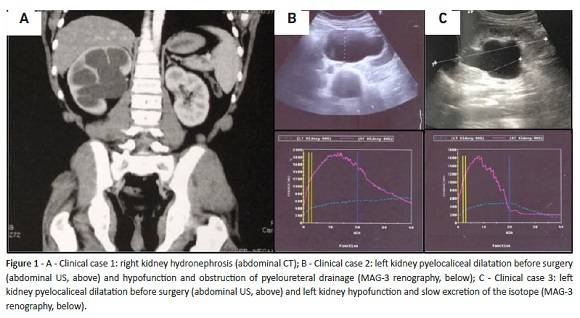
<body><![CDATA[<p>An abdominal computed tomography (CT) scan was performed, showing dilatation    of the renal pelvis and suggesting UPJO (<a href="#f1">Fig. 1A</a>). In renal US, an enlarged    right kidney was observed, with parenchyma confined to an echogenic blade of    5 mm and anteroposterior renal pelvis diameter (APRPD) of 40 mm. MAG-3 renography    revealed pyeloureteral obstruction and slightly decreased (44%) differential    function of the right kidney. The patient was submitted to pyeloplasty. On follow-up,    right kidney APRPD was 35 mm in US, and two years later MAG-3 renography revealed    differential function improvement (48.5%). After five years, the patient remains    well, with no symptoms. </p>     <p>&nbsp;</p>     <p align="center"><a name="f1"></a><img src="/img/revistas/nas/v28n1/28n1a04f1.jpg"/></p>     
<p>&nbsp;</p>     <p><u>Case 2</u></p>     <p>A young, healthy 15-year-old female presented to the Emergency Department with    dysuria and left lumbar pain, with no fever. Physical findings included tenderness    on palpation of the left flank, with the remaining examination unremarkable.    Laboratory findings comprised WBC count of 15.65x10³/&#956;L with 88.6% neutrophils,    CRP of 7.9 mg/dL, blood urea of 17.4 mg/dL, serum creatinine of 0.72 mg/dL,    and electrolytes within the normal range. Urinalysis by microscopy revealed    &gt; 50 white blood cells per HPF, without further abnormalities, and urine    culture presented &gt; 105 colony-forming units (CFU) per milliliter of Escherichia    coli, confirming the diagnosis of febrile UTI. At further evaluation, renal    US showed pyelocaliceal dilation of the left kidney, with 42mm APRPD and reduced    left renal parenchyma. MAG-3 renography showed hypofunction of the left kidney    (24.91%) and pyeloureteral drainage obstruction implying left UPJO. The right    kidney was normal (<a href="#f1">Fig. 1B</a>). The girl underwent pyeloplasty, with good evolution.    Six months later, an abdominal US revealed left kidney renal pelvis with 13    mm and renal function stable in MAG-3 renography. After four years, she remains    asymptomatic.</p>     <p><u>Case 3</u></p>     <p>The third case refers to a 15-year-old female with prenatal diagnosis of left    urinary tract dilatation but normal postnatal scan, with no further follow-up    and no known medical problems. The girl was taken to the Emergency Department    due to intense left lumbar pain, dysuria, and fever (40.7oC). Laboratory findings    showed WBC count of 9.36 x 10³/&#956;L with 77.5% neutrophils and 16.6% lymphocytes;    CRP of 9.8 mg/dL; blood urea of 24.8 mg/dL; creatinine of 0.79 mg/ dL, and electrolytes    within the normal range. Urine culture revealed &gt;105 CFU/mL of Escherichia    coli. The patient was hospitalized with acute pyelonephritis. An enlarged left    kidney with renal pelvis with 40 mm of anteroposterior diameter was detected    on abdominal US. MAG-3 renography showed left kidney hypofunction (22.6%) and    slow excretion of the isotope (<a href="#f1">Fig. 1C</a>). Retrograde cystourethrogram was normal.    The patient was submitted to a laparoscopic pyeloplasty. Sixteen months later,    kidney&rsquo;s APRPD was 23 mm in US and in MAG-3 renography the left kidney function    further decreased but remained stable. Over a two-year follow-up, the girl remained    asymptomatic.</p>     <p><b>Discussion</b></p>     <p>The three patients described presented with flank or lumbar pain, in addition    to other symptoms. All had a late diagnosis of UPJO, with symptoms and deterioration    of renal function, requiring surgical treatment. Pyeloplasty prevented stabilization    of renal function in two patients, improved renal function in one case, and    all patients became asymptomatic. These findings are similar to those described    in the literature.</p>     ]]></body>
<body><![CDATA[<p>A high degree of suspicion is required to include UPJO in differential diagnosis    of abdominal or back pain in older children and adolescents.</p>     <p><b>Abbreviations</b></p>     <p>CFU: Colony-forming units </p>     <p>CRP: C-reactive protein </p>     <p>CT: computed tomography</p>     <p>MAG-3: 99mTc-mercaptoacetyltriglycine-3 </p>     <p>UPJO: ureteropelvic junction obstruction </p>     <p>US: ultrasonography</p>     <p>UTI: urinary tract infection </p>     <p>VUR: vesicoureteral reflux </p>     ]]></body>
<body><![CDATA[<p>WBC: white blood cell</p>     <p>UTD: urinary tract dilatation</p>     <p>APRPD: anteroposterior renal pelvis diameter</p>     <p>&nbsp;</p>     <p><b>REFERENCES</b></p>     <!-- ref --><p>1. Hashim H, Woodhouse CRJ. Ureteropelvic Junction Obstruction. Eur Urol Suppl    2012; 11:25-32. DOI: <a href="https://dx.doi.org/10.1016/j.eursup.2012.01.004" target="_blank">10.1016/j.eursup.2012.01.004</a>.    &nbsp;&nbsp;&nbsp;&nbsp;&nbsp;&nbsp;&nbsp;&nbsp;[&#160;<a href="javascript:void(0);" onclick="javascript: window.open('/scielo.php?script=sci_nlinks&ref=1113505&pid=S0872-0754201900010000400001&lng=','','width=640,height=500,resizable=yes,scrollbars=1,menubar=yes,');">Links</a>&#160;]<!-- end-ref --></p>     <!-- ref --><p>2. Baskin LS, Wilcox D, Kim MS. UpToDate. Congenital ureteropelvic junction    obstruction.    &nbsp;&nbsp;&nbsp;&nbsp;&nbsp;&nbsp;&nbsp;&nbsp;[&#160;<a href="javascript:void(0);" onclick="javascript: window.open('/scielo.php?script=sci_nlinks&ref=1113507&pid=S0872-0754201900010000400002&lng=','','width=640,height=500,resizable=yes,scrollbars=1,menubar=yes,');">Links</a>&#160;]<!-- end-ref --></p>     <!-- ref --><p>3. Chen F. Genetic and developmental basis for urinary tract obstruction. Pediatr    Nephrol 2009;24:1621-32. DOI: <a href="https://dx.doi.org/10.1007/s00467-008-1072-y" target="_blank">10.1007/s00467-008-1072-y</a>.    &nbsp;&nbsp;&nbsp;&nbsp;&nbsp;&nbsp;&nbsp;&nbsp;[&#160;<a href="javascript:void(0);" onclick="javascript: window.open('/scielo.php?script=sci_nlinks&ref=1113509&pid=S0872-0754201900010000400003&lng=','','width=640,height=500,resizable=yes,scrollbars=1,menubar=yes,');">Links</a>&#160;]<!-- end-ref --></p>     <!-- ref --><p>4. Hiep T, Nguyen HT, Benson CB, Bromley B, Campbell JB, Chow J, <i>et al</i>.    Multidisciplinary consensus on the classification of prenatal and postnatal    urinary tract dilation (UTD classification system). J Pediatr Urol 2014; 10:    982-99. DOI: <a href="https://dx.doi.org/10.1016/J.JPUROL.2014.10.001" target="_blank">10.1016/J.JPUROL.2014.10.001</a>.    &nbsp;&nbsp;&nbsp;&nbsp;&nbsp;&nbsp;&nbsp;&nbsp;[&#160;<a href="javascript:void(0);" onclick="javascript: window.open('/scielo.php?script=sci_nlinks&ref=1113511&pid=S0872-0754201900010000400004&lng=','','width=640,height=500,resizable=yes,scrollbars=1,menubar=yes,');">Links</a>&#160;]<!-- end-ref --></p>     <!-- ref --><p>5. Poudel A, Afshan S, Dixit M. Congenital Anomalies of the Kidney and Urinary    Tract. NeoReviews 2016;17:e18-e27. DOI: <a href="https://dx.doi.org/10.1542/neo.17-1-e18" target="_blank">10.1542/neo.17-1-e18</a>.    &nbsp;&nbsp;&nbsp;&nbsp;&nbsp;&nbsp;&nbsp;&nbsp;[&#160;<a href="javascript:void(0);" onclick="javascript: window.open('/scielo.php?script=sci_nlinks&ref=1113513&pid=S0872-0754201900010000400005&lng=','','width=640,height=500,resizable=yes,scrollbars=1,menubar=yes,');">Links</a>&#160;]<!-- end-ref --></p>     <!-- ref --><p>6. Alberti C. Congenital ureteropelvic junction obstruction: physiopathology,    decoupling of tout court pelvic dilatation- obstruction semantic connection,    biomarkers to predict renal damage evolution. Eur Rev Med Pharmacol Sci 2012;    16:213-9.    &nbsp;&nbsp;&nbsp;&nbsp;&nbsp;&nbsp;&nbsp;&nbsp;[&#160;<a href="javascript:void(0);" onclick="javascript: window.open('/scielo.php?script=sci_nlinks&ref=1113515&pid=S0872-0754201900010000400006&lng=','','width=640,height=500,resizable=yes,scrollbars=1,menubar=yes,');">Links</a>&#160;]<!-- end-ref --></p>     <p>7. Lee H, Han SW. Ureteropelvic Junction Obstruction: What We Know and What    We Don&rsquo;t Know. Korean J Urol 2009;50:423-31. DOI: <a href="https://dx.doi.org/10.4111/kju.2009.50.5.423" target="_blank">10.4111/kju.2009.50.5.423</a>.</p>     <!-- ref --><p>8. Rosenblum,ND. UpToDate. Evaluation of congenital anomalies of the kidney    and urinary tract (CAKUT).    &nbsp;&nbsp;&nbsp;&nbsp;&nbsp;&nbsp;&nbsp;&nbsp;[&#160;<a href="javascript:void(0);" onclick="javascript: window.open('/scielo.php?script=sci_nlinks&ref=1113518&pid=S0872-0754201900010000400008&lng=','','width=640,height=500,resizable=yes,scrollbars=1,menubar=yes,');">Links</a>&#160;]<!-- end-ref --></p>     ]]></body>
<body><![CDATA[<!-- ref --><p>9. Trnka P, Hiatt MJ, Tarantal AF, Matsell DG. Congenital urinary tract obstruction:    defining markers of developmental kidney injury. Pediatr Res 2012; 72:446-54.    DOI: <a href="https://dx.doi.org/10.1038/pr.2012.113" target="_blank">10.1038/pr.2012.113</a>.    &nbsp;&nbsp;&nbsp;&nbsp;&nbsp;&nbsp;&nbsp;&nbsp;[&#160;<a href="javascript:void(0);" onclick="javascript: window.open('/scielo.php?script=sci_nlinks&ref=1113520&pid=S0872-0754201900010000400009&lng=','','width=640,height=500,resizable=yes,scrollbars=1,menubar=yes,');">Links</a>&#160;]<!-- end-ref --></p>     <p>10. Piscitelli A, Galiano R, Serrao F, Concolino D, Vitale R, D&rsquo;Ambrosio G,    <i>et al</i>. Which cystography in the diagnosis and grading of vesicoureteral    reflux? Pediatr Nephrol 2008; 23:107-10. DOI: <a href="https://dx.doi.org/10.1007/s00467-007-0651-7" target="_blank">10.1007/s00467-007-0651-7</a>.</p>     <!-- ref --><p>11. Balighian E, Burke M. Urinary tract infections in children. Pediatr Rev    2018; 39:3. DOI: <a href="https://dx.doi.org/10.1542/PIR.2017-0007" target="_blank">10.1542/PIR.2017-0007</a>.    &nbsp;&nbsp;&nbsp;&nbsp;&nbsp;&nbsp;&nbsp;&nbsp;[&#160;<a href="javascript:void(0);" onclick="javascript: window.open('/scielo.php?script=sci_nlinks&ref=1113523&pid=S0872-0754201900010000400011&lng=','','width=640,height=500,resizable=yes,scrollbars=1,menubar=yes,');">Links</a>&#160;]<!-- end-ref --></p>     <p>&nbsp;</p>     <p><a href="#topc0">Endere&ccedil;o para correspond&ecirc;ncia</a> | <a href="#topc0">Direcci&oacute;n    para correspondencia</a> | <a href="#topc0">Correspondence</a><a name="c0"></a></p>     <p>Mariana Abreu    <br>   Pediatrics Department    <br>   Centro Materno Pediátrico    ]]></body>
<body><![CDATA[<br>   Centro Hospitalar Universitário de São João     <br>   Alameda Prof. Hernâni Monteiro    <br>   4200-319 Porto    <br>   Email: <a href="mailto:marianacgabreu@gmail.com">marianacgabreu@gmail.com</a></p>     <p>&nbsp;</p>     <p>Received for publication: 29.11.2017 </p>     <p>Accepted in revised form: 13.11.2018</p>      ]]></body><back>
<ref-list>
<ref id="B1">
<label>1</label><nlm-citation citation-type="journal">
<person-group person-group-type="author">
<name>
<surname><![CDATA[Hashim]]></surname>
<given-names><![CDATA[H]]></given-names>
</name>
<name>
<surname><![CDATA[Woodhouse]]></surname>
<given-names><![CDATA[CRJ]]></given-names>
</name>
</person-group>
<article-title xml:lang="en"><![CDATA[Ureteropelvic Junction Obstruction]]></article-title>
<source><![CDATA[Eur Urol Suppl]]></source>
<year>2012</year>
<volume>11</volume>
<page-range>25-32</page-range></nlm-citation>
</ref>
<ref id="B2">
<label>2</label><nlm-citation citation-type="">
<person-group person-group-type="author">
<name>
<surname><![CDATA[Baskin]]></surname>
<given-names><![CDATA[LS]]></given-names>
</name>
<name>
<surname><![CDATA[Wilcox]]></surname>
<given-names><![CDATA[D]]></given-names>
</name>
<name>
<surname><![CDATA[Kim]]></surname>
<given-names><![CDATA[MS]]></given-names>
</name>
</person-group>
<source><![CDATA[UpToDate: Congenital ureteropelvic junction obstruction]]></source>
<year></year>
</nlm-citation>
</ref>
<ref id="B3">
<label>3</label><nlm-citation citation-type="journal">
<person-group person-group-type="author">
<name>
<surname><![CDATA[Chen]]></surname>
<given-names><![CDATA[F]]></given-names>
</name>
</person-group>
<article-title xml:lang="en"><![CDATA[Genetic and developmental basis for urinary tract obstruction]]></article-title>
<source><![CDATA[Pediatr Nephrol]]></source>
<year>2009</year>
<volume>24</volume>
<page-range>1621-32</page-range></nlm-citation>
</ref>
<ref id="B4">
<label>4</label><nlm-citation citation-type="journal">
<person-group person-group-type="author">
<name>
<surname><![CDATA[Hiep]]></surname>
<given-names><![CDATA[T]]></given-names>
</name>
<name>
<surname><![CDATA[Nguyen]]></surname>
<given-names><![CDATA[HT]]></given-names>
</name>
<name>
<surname><![CDATA[Benson]]></surname>
<given-names><![CDATA[CB]]></given-names>
</name>
<name>
<surname><![CDATA[Bromley]]></surname>
<given-names><![CDATA[B]]></given-names>
</name>
<name>
<surname><![CDATA[Campbell]]></surname>
<given-names><![CDATA[JB]]></given-names>
</name>
<name>
<surname><![CDATA[Chow]]></surname>
<given-names><![CDATA[J]]></given-names>
</name>
</person-group>
<article-title xml:lang="en"><![CDATA[Multidisciplinary consensus on the classification of prenatal and postnatal urinary tract dilation (UTD classification system)]]></article-title>
<source><![CDATA[J Pediatr Urol]]></source>
<year>2014</year>
<volume>10</volume>
<page-range>982-99</page-range></nlm-citation>
</ref>
<ref id="B5">
<label>5</label><nlm-citation citation-type="journal">
<person-group person-group-type="author">
<name>
<surname><![CDATA[Poudel]]></surname>
<given-names><![CDATA[A]]></given-names>
</name>
<name>
<surname><![CDATA[Afshan]]></surname>
<given-names><![CDATA[S]]></given-names>
</name>
<name>
<surname><![CDATA[Dixit]]></surname>
<given-names><![CDATA[M]]></given-names>
</name>
</person-group>
<article-title xml:lang="en"><![CDATA[Congenital Anomalies of the Kidney and Urinary Tract]]></article-title>
<source><![CDATA[NeoReviews]]></source>
<year>2016</year>
<volume>17</volume>
<page-range>e18-e27</page-range></nlm-citation>
</ref>
<ref id="B6">
<label>6</label><nlm-citation citation-type="journal">
<person-group person-group-type="author">
<name>
<surname><![CDATA[Alberti]]></surname>
<given-names><![CDATA[C]]></given-names>
</name>
</person-group>
<article-title xml:lang="en"><![CDATA[Congenital ureteropelvic junction obstruction: physiopathology, decoupling of tout court pelvic dilatation- obstruction semantic connection, biomarkers to predict renal damage evolution]]></article-title>
<source><![CDATA[Eur Rev Med Pharmacol Sci]]></source>
<year>2012</year>
<volume>16</volume>
<page-range>213-9</page-range></nlm-citation>
</ref>
<ref id="B7">
<label>7</label><nlm-citation citation-type="journal">
<person-group person-group-type="author">
<name>
<surname><![CDATA[Lee]]></surname>
<given-names><![CDATA[H]]></given-names>
</name>
<name>
<surname><![CDATA[Han]]></surname>
<given-names><![CDATA[SW]]></given-names>
</name>
</person-group>
<article-title xml:lang="en"><![CDATA[Ureteropelvic Junction Obstruction: What We Know and What We Don’t Know]]></article-title>
<source><![CDATA[Korean J Urol]]></source>
<year>2009</year>
<volume>50</volume>
<page-range>423-31</page-range></nlm-citation>
</ref>
<ref id="B8">
<label>8</label><nlm-citation citation-type="">
<person-group person-group-type="author">
<name>
<surname><![CDATA[Rosenblum]]></surname>
<given-names><![CDATA[ND]]></given-names>
</name>
</person-group>
<article-title xml:lang="en"><![CDATA[UpToDate: Evaluation of congenital anomalies of the kidney and urinary tract (CAKUT)]]></article-title>
<source><![CDATA[]]></source>
<year></year>
</nlm-citation>
</ref>
<ref id="B9">
<label>9</label><nlm-citation citation-type="journal">
<person-group person-group-type="author">
<name>
<surname><![CDATA[Trnka]]></surname>
<given-names><![CDATA[P]]></given-names>
</name>
<name>
<surname><![CDATA[Hiatt]]></surname>
<given-names><![CDATA[MJ]]></given-names>
</name>
<name>
<surname><![CDATA[Tarantal]]></surname>
<given-names><![CDATA[AF]]></given-names>
</name>
<name>
<surname><![CDATA[Matsell]]></surname>
<given-names><![CDATA[DG]]></given-names>
</name>
</person-group>
<article-title xml:lang="en"><![CDATA[Congenital urinary tract obstruction: defining markers of developmental kidney injury]]></article-title>
<source><![CDATA[Pediatr Res]]></source>
<year>2012</year>
<volume>72</volume>
<page-range>446-54</page-range></nlm-citation>
</ref>
<ref id="B10">
<label>10</label><nlm-citation citation-type="journal">
<person-group person-group-type="author">
<name>
<surname><![CDATA[Piscitelli]]></surname>
<given-names><![CDATA[A]]></given-names>
</name>
<name>
<surname><![CDATA[Galiano]]></surname>
<given-names><![CDATA[R]]></given-names>
</name>
<name>
<surname><![CDATA[Serrao]]></surname>
<given-names><![CDATA[F]]></given-names>
</name>
<name>
<surname><![CDATA[Concolino]]></surname>
<given-names><![CDATA[D]]></given-names>
</name>
<name>
<surname><![CDATA[Vitale]]></surname>
<given-names><![CDATA[R]]></given-names>
</name>
<name>
<surname><![CDATA[D’Ambrosio]]></surname>
<given-names><![CDATA[G]]></given-names>
</name>
</person-group>
<article-title xml:lang="en"><![CDATA[Which cystography in the diagnosis and grading of vesicoureteral reflux?]]></article-title>
<source><![CDATA[Pediatr Nephrol]]></source>
<year>2008</year>
<volume>23</volume>
<page-range>107-10</page-range></nlm-citation>
</ref>
<ref id="B11">
<label>11</label><nlm-citation citation-type="journal">
<person-group person-group-type="author">
<name>
<surname><![CDATA[Balighian]]></surname>
<given-names><![CDATA[E]]></given-names>
</name>
<name>
<surname><![CDATA[Burke]]></surname>
<given-names><![CDATA[M]]></given-names>
</name>
</person-group>
<article-title xml:lang="en"><![CDATA[Urinary tract infections in children]]></article-title>
<source><![CDATA[Pediatr Rev]]></source>
<year>2018</year>
<volume>39</volume>
<page-range>3</page-range></nlm-citation>
</ref>
</ref-list>
</back>
</article>
