<?xml version="1.0" encoding="ISO-8859-1"?><article xmlns:mml="http://www.w3.org/1998/Math/MathML" xmlns:xlink="http://www.w3.org/1999/xlink" xmlns:xsi="http://www.w3.org/2001/XMLSchema-instance">
<front>
<journal-meta>
<journal-id>0872-0754</journal-id>
<journal-title><![CDATA[Nascer e Crescer]]></journal-title>
<abbrev-journal-title><![CDATA[Nascer e Crescer]]></abbrev-journal-title>
<issn>0872-0754</issn>
<publisher>
<publisher-name><![CDATA[Centro Hospitalar do Porto]]></publisher-name>
</publisher>
</journal-meta>
<article-meta>
<article-id>S0872-07542019000200007</article-id>
<article-id pub-id-type="doi">10.25753/BirthGrowthMJ.v28.i2.14909</article-id>
<title-group>
<article-title xml:lang="en"><![CDATA[Cutaneous leishmaniasis - two cases, two perspectives]]></article-title>
<article-title xml:lang="pt"><![CDATA[Leishmaníase cutânea - dois casos, duas perspetivas]]></article-title>
</title-group>
<contrib-group>
<contrib contrib-type="author">
<name>
<surname><![CDATA[Maio]]></surname>
<given-names><![CDATA[Inês]]></given-names>
</name>
<xref ref-type="aff" rid="A1"/>
</contrib>
<contrib contrib-type="author">
<name>
<surname><![CDATA[Teixeira]]></surname>
<given-names><![CDATA[Carla]]></given-names>
</name>
<xref ref-type="aff" rid="A1"/>
</contrib>
<contrib contrib-type="author">
<name>
<surname><![CDATA[Prior]]></surname>
<given-names><![CDATA[Catarina]]></given-names>
</name>
<xref ref-type="aff" rid="A1"/>
</contrib>
<contrib contrib-type="author">
<name>
<surname><![CDATA[Machado]]></surname>
<given-names><![CDATA[Susana]]></given-names>
</name>
<xref ref-type="aff" rid="A2"/>
</contrib>
<contrib contrib-type="author">
<name>
<surname><![CDATA[Selores]]></surname>
<given-names><![CDATA[Manuela]]></given-names>
</name>
<xref ref-type="aff" rid="A2"/>
</contrib>
<contrib contrib-type="author">
<name>
<surname><![CDATA[Marques]]></surname>
<given-names><![CDATA[Laura]]></given-names>
</name>
<xref ref-type="aff" rid="A1"/>
</contrib>
</contrib-group>
<aff id="AA1">
<institution><![CDATA[,Centro Hospitalar Universitário do Porto Centro Materno-Infantil do Norte Pediatrics Department]]></institution>
<addr-line><![CDATA[Porto ]]></addr-line>
<country>Portugal</country>
</aff>
<aff id="AA2">
<institution><![CDATA[,Centro Hospitalar Universitário do Porto Dermatology Department ]]></institution>
<addr-line><![CDATA[Porto ]]></addr-line>
<country>Portugal</country>
</aff>
<pub-date pub-type="pub">
<day>00</day>
<month>06</month>
<year>2019</year>
</pub-date>
<pub-date pub-type="epub">
<day>00</day>
<month>06</month>
<year>2019</year>
</pub-date>
<volume>28</volume>
<numero>2</numero>
<fpage>90</fpage>
<lpage>92</lpage>
<copyright-statement/>
<copyright-year/>
<self-uri xlink:href="http://scielo.pt/scielo.php?script=sci_arttext&amp;pid=S0872-07542019000200007&amp;lng=en&amp;nrm=iso"></self-uri><self-uri xlink:href="http://scielo.pt/scielo.php?script=sci_abstract&amp;pid=S0872-07542019000200007&amp;lng=en&amp;nrm=iso"></self-uri><self-uri xlink:href="http://scielo.pt/scielo.php?script=sci_pdf&amp;pid=S0872-07542019000200007&amp;lng=en&amp;nrm=iso"></self-uri><abstract abstract-type="short" xml:lang="en"><p><![CDATA[Although endemic in some regions, as the Douro river valley, cutaneous leishmaniasis is a rare zoonosis in Portugal. Children are the most affected age group. Treatment remains controversial, given the lack of scientific evidence. The goal of cutaneous leishmaniasis treatment is to avoid dissemination and progression to disfiguring lesions. The option between no, systemic, or intralesional treatment should be carefully assessed.]]></p></abstract>
<abstract abstract-type="short" xml:lang="pt"><p><![CDATA[Embora endémica em algumas regiões, como a bacia hidrográfica do rio Douro, a leishmaníase cutânea é uma zoonose rara em Portugal. As crianças são o grupo etário mais afetado. O seu tratamento ainda é controverso, dada a falta de evidência científica. O objetivo do tratamento da leishmaníase cutânea é evitar a sua disseminação e evolução para lesões desfigurantes. A opção entre não tratar ou realizartratamento sistémico ou intralesional deve ser cuidadosamente avaliada.]]></p></abstract>
<kwd-group>
<kwd lng="en"><![CDATA[intralesional treatment]]></kwd>
<kwd lng="en"><![CDATA[leishmaniasis]]></kwd>
<kwd lng="en"><![CDATA[old-world leishmaniasis]]></kwd>
<kwd lng="en"><![CDATA[parasitic infections]]></kwd>
<kwd lng="pt"><![CDATA[tratamento intralesional]]></kwd>
<kwd lng="pt"><![CDATA[leishmaníase]]></kwd>
<kwd lng="pt"><![CDATA[leishmaníase do velho mundo]]></kwd>
<kwd lng="pt"><![CDATA[infeções parasitárias]]></kwd>
</kwd-group>
</article-meta>
</front><body><![CDATA[ <p align="right"><font size="2"><b>CASE REPORTS | CASOS CL&Iacute;NICOS</b></font></p>     <p><font size="4"><b>Cutaneous leishmaniasis - two cases, two perspectives</b></font></p>     <p><font size="3"><b>Leishman&iacute;ase cut&acirc;nea - dois casos, duas perspetivas</b></font></p>     <p><b>In&ecirc;s Maio<sup>I</sup>, Carla Teixeira<sup>I</sup>, Catarina Prior<sup>I</sup>, Susana Machado<sup>II</sup>, Manuela Selores<sup>II</sup>, Laura Marques<sup>I</sup></b></p>     <p><sup>I</sup> Pediatrics Department, Centro Materno-Infantil do Norte, Centro Hospitalar Universit&aacute;rio do Porto. 4099-001 Porto, Portugal. <a href="mailto:inesmaiogoncalves@gmail.com">inesmaiogoncalves@gmail.com</a>; <a href="mailto:carlameitei@gmail.com">carlameitei@gmail.com</a>; <a href="mailto:acprior@hotmail.com">acprior@hotmail.com</a>; <a href="mailto:laurahoramarques@gmail.com">laurahoramarques@gmail.com</a></p>     <p><sup>II</sup> Dermatology Department, Centro Hospitalar Universit&aacute;rio do Porto. 4099-001 Porto, Portugal. <a href="mailto:susanamlmachado@gmail.com">susanamlmachado@gmail.com</a>; <a href="mailto:dermat@sapo.pt">dermat@sapo.pt</a></p>     <p><a href="#c0">Endere&ccedil;o para correspond&ecirc;ncia</a> | <a href="#c0">Direcci&oacute;n para correspondencia</a> | <a href="#c0">Correspondence</a><a name="topc0"></a></p> <hr/>     <p>&nbsp;</p>     <p><b>ABSTRACT</b></p>     <p>Although endemic in some regions, as the Douro river valley, cutaneous leishmaniasis is a rare zoonosis in Portugal. Children are the most affected age group. Treatment remains controversial, given the lack of scientific evidence.</p>     ]]></body>
<body><![CDATA[<p>The goal of cutaneous leishmaniasis treatment is to avoid dissemination and progression to disfiguring lesions. The option between no, systemic, or intralesional treatment should be carefully assessed.</p>     <p><b>Keywords: </b>intralesional treatment; leishmaniasis; old-world leishmaniasis; parasitic infections</p> <hr/>     <p>&nbsp;</p>     <p><b>RESUMO</b></p>     <p>Embora end&eacute;mica em algumas regi&otilde;es, como a bacia hidrogr&aacute;fica do rio Douro, a leishman&iacute;ase cut&acirc;nea &eacute; uma zoonose rara em Portugal. As crian&ccedil;as s&atilde;o o grupo et&aacute;rio mais afetado. O seu tratamento ainda &eacute; controverso, dada a falta de evid&ecirc;ncia cient&iacute;fica. O objetivo do tratamento da leishman&iacute;ase cut&acirc;nea &eacute; evitar a sua dissemina&ccedil;&atilde;o e evolu&ccedil;&atilde;o para les&otilde;es desfigurantes. A op&ccedil;&atilde;o entre n&atilde;o tratar ou realizartratamento sist&eacute;mico ou intralesional deve ser cuidadosamente avaliada.</p>     <p><b>Palavras-chave: </b>tratamento intralesional; leishman&iacute;ase; leishman&iacute;ase do velho mundo; infe&ccedil;&otilde;es parasit&aacute;rias</p> <hr/>     <p>&nbsp;</p>     <p><b>Introduction</b></p>     <p>Leishmaniasis is a protozoan parasitic infection endemic in 98 countries that affects 0.7-1.3 million people per year. Sandflies transmit the infection to humans by inoculating <i>Leishmania </i>promastigotes into exposed skin, resulting in cutaneous, mucocutaneous, or visceral disease syndromes.<sup>1-3</sup> Clinical manifestations depend on the causative <i>Leishmania </i>species and underlying host immunity.<sup>1,2,4,5</sup></p>     <p>Over 20 species cause human infection. Although individual species have unique transmission patterns, local reservoirs, and predominant clinical features, Leishmania are broadly subdivided into old-world and new-world species and, in general, the first cause a more indolent cutaneous disease.<sup>1,3</sup></p>     ]]></body>
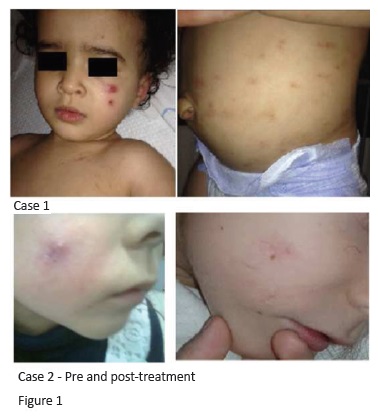
<body><![CDATA[<p>Cutaneous leishmaniasis (CL) is a rare zoonosis in Portugal.<sup>2 </sup>Children are the most affected group. Its treatment remains controversial, given the lack of scientific evidence.<sup>6</sup> Two cases in which different treatment options were adopted are herein presented.</p>     <p><b>Cases description</b></p>     <p>Case 1 - An 18-month-old toddler with no relevant past medical history developed erythematous, non-pruriginous, papulo-nodular lesions two weeks after returning from Morocco. Lesions initially presented in the face and subsequently in the back of the hands, trunk and abdomen (<a href="#f1">Figure 1</a>).</p>     <p>&nbsp;</p>     <p align="center"><a name="f1"></a><img src="/img/revistas/nas/v28n2/28n2a07f1.jpg"/></p>     
<p>&nbsp;</p>     <p>Based on epidemiological history and lesion features, diagnosis of cutaneous leishmaniasis was established and subsequently histologically confirmed. The number of lesions, their potential for disfiguring scars, and the presence of disseminated papulo-nodular lesions in a young child lead us to opt for systemic treatment with intravenous amphotericin B. Treatment outcome was favorable, with complete lesion regression.</p>     <p>Case 2 - A 6-year-old child was observed at the Dermatology outpatient clinic because of a single, gradually increasing papulo- nodular face lesion present for the past eight months, appearing after holidays in the Douro valley region (<a href="#f1">Figure 1</a>). Diagnosis of cutaneous leishmaniasis was suspected and histologically confirmed, but molecular identification was not performed, since the collected specimen was not suitable for analysis. Considering size and location of the single lesion, intralesional treatment with meglumine antimoniate was selected. Treatment outcome was favorable, with complete lesion regression within four weeks and no residual scar.</p>     <p><b>Final comments</b></p>     <p>Treatment goal of cutaneous leishmaniasis is to avoid dissemination, late mucosal involvement, and progression to disfiguring lesions, all of which were achieved in both cases presented. Cases fulfilled criteria for complex CL and required treatment.<sup>1,3,6-8</sup></p>     ]]></body>
<body><![CDATA[<p>A systematic review of new-world cutaneous leishmaniasis treatment efficacy in adults favored treatment with systemic or intralesional drugs over watchful waiting; the most recent literature is debating which treatment should be used.<sup>1,9</sup></p>     <p>Criteria to choose between systemic versus intralesional therapy must be assessed on a case-by-case basis, considering lesion number and location and individual patient characteristics.<sup>3,6</sup> Intralesional treatment is preferred in single lesions, when the risk of dissemination is very low.<sup>1,6</sup></p>     <p>Evaluating the best CL treatment is difficult because several factors may influence drug efficacy, including lesion size, number, and appearance, and disease duration prior to treatment.<sup>9</sup> Treatment efficacy also depends on the causative <i>Leishmania </i>species, so an effective treatment in one geographical area for a given organism may not be effective in a different geographical area or for a different organism in the same location.<sup>9</sup></p>     <p>Differences in immune response, drug clearance, and overall drug exposure in pediatric patients have contributed to a higher proportion of treatment failure in children compared with adults.<sup>7</sup> A large systematic review of cutaneous leishmaniasis treatment in pediatric patients demonstrated high efficacy and tolerability of topical antimonial agents after a median number of five sessions.<sup>7</sup> Although amphotericin was not included in this review, the authors discussed that it can be used as an off-label medicine in children under the age of two, as in the first case here reported.</p>     <p>At present, better and more comprehensive information regarding old-world leishmaniasis treatment and the effectiveness of these drugs in children is lacking, especially in very young children.<sup>7</sup> Increasing availability of molecular diagnostic tools, including PCR- based assays, will enable a shift towards species-directed treatment. When fully available, it will allow individualized treatment choices for patients with cutaneous leishmaniasis.</p>     <p>&nbsp;</p>     <p><b>REFERENCES</b></p>     <!-- ref --><p>1. Cota GF, De Sousa MR, Fereguetti TO, Saleme PS, Alvarisa TK, Rabello A. The cure rate after placebo or no therapy in American cutaneous leishmaniasis: A systematic review and meta- analysis. PLoS One. 2016; 11:1-15.    &nbsp;&nbsp;&nbsp;&nbsp;&nbsp;&nbsp;&nbsp;&nbsp;[&#160;<a href="javascript:void(0);" onclick="javascript: window.open('/scielo.php?script=sci_nlinks&ref=1115410&pid=S0872-0754201900020000700001&lng=','','width=640,height=500,resizable=yes,scrollbars=1,menubar=yes,');">Links</a>&#160;]<!-- end-ref --></p>     <!-- ref --><p>2. World Health Organization. Surveillance of leishmaniasis in the WHO European Region, 2016 Leishmaniasis. WHO Wkly Epidemiol Rec. 2018; 40:521-30.    &nbsp;&nbsp;&nbsp;&nbsp;&nbsp;&nbsp;&nbsp;&nbsp;[&#160;<a href="javascript:void(0);" onclick="javascript: window.open('/scielo.php?script=sci_nlinks&ref=1115412&pid=S0872-0754201900020000700002&lng=','','width=640,height=500,resizable=yes,scrollbars=1,menubar=yes,');">Links</a>&#160;]<!-- end-ref --></p>     <!-- ref --><p>3. Aronson N, Herwaldt BL, Libman M, Pearson R, Lopez-Velez R, Weina P, <i>et al</i>. Diagnosis and treatment of leishmaniasis: Clinical practice guidelines by the infectious diseases society of America (IDSA) and the American Society of tropical medicine and hygiene (ASTMH). Am J Trop Med Hyg. 2017; 96:24-45.    &nbsp;&nbsp;&nbsp;&nbsp;&nbsp;&nbsp;&nbsp;&nbsp;[&#160;<a href="javascript:void(0);" onclick="javascript: window.open('/scielo.php?script=sci_nlinks&ref=1115414&pid=S0872-0754201900020000700003&lng=','','width=640,height=500,resizable=yes,scrollbars=1,menubar=yes,');">Links</a>&#160;]<!-- end-ref --></p>     <!-- ref --><p>4. Showler AJ, Boggild AK. Cutaneous Leishmaniasis in Travellers: a Focus on Epidemiology and Treatment in 2015. Curr Infect Dis Rep. 2015; 17:489.    &nbsp;&nbsp;&nbsp;&nbsp;&nbsp;&nbsp;&nbsp;&nbsp;[&#160;<a href="javascript:void(0);" onclick="javascript: window.open('/scielo.php?script=sci_nlinks&ref=1115416&pid=S0872-0754201900020000700004&lng=','','width=640,height=500,resizable=yes,scrollbars=1,menubar=yes,');">Links</a>&#160;]<!-- end-ref --></p>     <!-- ref --><p>5. Oliveira LF, Schubach AO, Martins MM, Passos SL, Oliveira RV, Marzochi MC, <i>et al</i>. Systematic review of the adverse effects of cutaneous leishmaniasis treatment in the New World. Acta Trop. Elsevier B.V. 2011; 118:87-96.    &nbsp;&nbsp;&nbsp;&nbsp;&nbsp;&nbsp;&nbsp;&nbsp;[&#160;<a href="javascript:void(0);" onclick="javascript: window.open('/scielo.php?script=sci_nlinks&ref=1115418&pid=S0872-0754201900020000700005&lng=','','width=640,height=500,resizable=yes,scrollbars=1,menubar=yes,');">Links</a>&#160;]<!-- end-ref --></p>     <!-- ref --><p>6. Sundar S, Chakravarty J. An update on pharmacotherapy for leishmaniasis. Expert Opin Pharmacother. 2015; 16:237-52.    &nbsp;&nbsp;&nbsp;&nbsp;&nbsp;&nbsp;&nbsp;&nbsp;[&#160;<a href="javascript:void(0);" onclick="javascript: window.open('/scielo.php?script=sci_nlinks&ref=1115420&pid=S0872-0754201900020000700006&lng=','','width=640,height=500,resizable=yes,scrollbars=1,menubar=yes,');">Links</a>&#160;]<!-- end-ref --></p>     <!-- ref --><p>7. Uribe-Restrepo A, Cossio A, Desai MM, D&aacute;valos D, Castro M del M. Interventions to treat cutaneous leishmaniasis in children: A systematic review. PLoS Negl Trop Dis. 2018; 12:e0006986.    &nbsp;&nbsp;&nbsp;&nbsp;&nbsp;&nbsp;&nbsp;&nbsp;[&#160;<a href="javascript:void(0);" onclick="javascript: window.open('/scielo.php?script=sci_nlinks&ref=1115422&pid=S0872-0754201900020000700007&lng=','','width=640,height=500,resizable=yes,scrollbars=1,menubar=yes,');">Links</a>&#160;]<!-- end-ref --></p>     <!-- ref --><p>8. Gradoni L, L&oacute;pez-V&eacute;lez R, Mokni M. Manual on Case Management and Surveillance of the Leishmaniases in the WHO European Region. WHO Reg Off Eur. 2017.    &nbsp;&nbsp;&nbsp;&nbsp;&nbsp;&nbsp;&nbsp;&nbsp;[&#160;<a href="javascript:void(0);" onclick="javascript: window.open('/scielo.php?script=sci_nlinks&ref=1115424&pid=S0872-0754201900020000700008&lng=','','width=640,height=500,resizable=yes,scrollbars=1,menubar=yes,');">Links</a>&#160;]<!-- end-ref --></p>     <!-- ref --><p>9. Heras-Mosteiro J, Monge-Maillo B, Pinart M, Pereira PL, Garcia- Carrasco E, Cuadrado PC, <i>et al</i>. Interventions for Old World cutaneous leishmaniasis (Review). Cochrane Database Syst Rev. 2017. 12: CD005067.    &nbsp;&nbsp;&nbsp;&nbsp;&nbsp;&nbsp;&nbsp;&nbsp;[&#160;<a href="javascript:void(0);" onclick="javascript: window.open('/scielo.php?script=sci_nlinks&ref=1115426&pid=S0872-0754201900020000700009&lng=','','width=640,height=500,resizable=yes,scrollbars=1,menubar=yes,');">Links</a>&#160;]<!-- end-ref --></p>     <p>&nbsp;</p>     <p><a href="#topc0">Endere&ccedil;o para correspond&ecirc;ncia</a> | <a href="#topc0">Direcci&oacute;n para correspondencia</a> | <a href="#topc0">Correspondence</a><a name="c0"></a></p>     <p>In&ecirc;s Maio    <br>   Pediatrics Department    <br>   Centro Materno-Infantil do Norte Centro Hospitalar Universit&aacute;rio do Porto Largo Prof. Abel Salazar    ]]></body>
<body><![CDATA[<br>   4099-001 Porto    <br>   Email:<a href="mailto:inesmaiogoncalves@gmail.com"> inesmaiogoncalves@gmail.com</a></p>     <p>&nbsp;</p>     <p>Received for publication: 10.08.2018 </p>     <p>Accepted in revised form: 05.02.2019</p>      ]]></body><back>
<ref-list>
<ref id="B1">
<label>1</label><nlm-citation citation-type="journal">
<person-group person-group-type="author">
<name>
<surname><![CDATA[Cota]]></surname>
<given-names><![CDATA[GF]]></given-names>
</name>
<name>
<surname><![CDATA[De Sousa]]></surname>
<given-names><![CDATA[MR]]></given-names>
</name>
<name>
<surname><![CDATA[Fereguetti]]></surname>
<given-names><![CDATA[TO]]></given-names>
</name>
<name>
<surname><![CDATA[Saleme]]></surname>
<given-names><![CDATA[PS]]></given-names>
</name>
<name>
<surname><![CDATA[Alvarisa]]></surname>
<given-names><![CDATA[TK]]></given-names>
</name>
<name>
<surname><![CDATA[Rabello]]></surname>
<given-names><![CDATA[A]]></given-names>
</name>
</person-group>
<article-title xml:lang="en"><![CDATA[The cure rate after placebo or no therapy in American cutaneous leishmaniasis: A systematic review and meta- analysis]]></article-title>
<source><![CDATA[PLoS One]]></source>
<year>2016</year>
<volume>11</volume>
<page-range>1-15</page-range></nlm-citation>
</ref>
<ref id="B2">
<label>2</label><nlm-citation citation-type="journal">
<person-group person-group-type="author">
<name>
<surname><![CDATA[Organization]]></surname>
<given-names><![CDATA[World Health]]></given-names>
</name>
</person-group>
<article-title xml:lang="en"><![CDATA[Surveillance of leishmaniasis in the WHO European Region, 2016 Leishmaniasis]]></article-title>
<source><![CDATA[WHO Wkly Epidemiol Rec]]></source>
<year>2018</year>
<volume>40</volume>
<numero>521-30</numero>
<issue>521-30</issue>
</nlm-citation>
</ref>
<ref id="B3">
<label>3</label><nlm-citation citation-type="journal">
<person-group person-group-type="author">
<name>
<surname><![CDATA[Aronson]]></surname>
<given-names><![CDATA[N]]></given-names>
</name>
<name>
<surname><![CDATA[Herwaldt]]></surname>
<given-names><![CDATA[BL]]></given-names>
</name>
<name>
<surname><![CDATA[Libman]]></surname>
<given-names><![CDATA[M]]></given-names>
</name>
<name>
<surname><![CDATA[Pearson]]></surname>
<given-names><![CDATA[R]]></given-names>
</name>
<name>
<surname><![CDATA[Lopez-Velez]]></surname>
<given-names><![CDATA[R]]></given-names>
</name>
<name>
<surname><![CDATA[Weina]]></surname>
<given-names><![CDATA[P]]></given-names>
</name>
</person-group>
<article-title xml:lang="en"><![CDATA[Diagnosis and treatment of leishmaniasis: Clinical practice guidelines by the infectious diseases society of America (IDSA) and the American Society of tropical medicine and hygiene (ASTMH)]]></article-title>
<source><![CDATA[Am J Trop Med Hyg]]></source>
<year>2017</year>
<volume>96</volume>
<page-range>24-45</page-range></nlm-citation>
</ref>
<ref id="B4">
<label>4</label><nlm-citation citation-type="journal">
<person-group person-group-type="author">
<name>
<surname><![CDATA[Showler]]></surname>
<given-names><![CDATA[AJ]]></given-names>
</name>
<name>
<surname><![CDATA[Boggild]]></surname>
<given-names><![CDATA[AK]]></given-names>
</name>
</person-group>
<article-title xml:lang="en"><![CDATA[Cutaneous Leishmaniasis in Travellers: a Focus on Epidemiology and Treatment in 2015]]></article-title>
<source><![CDATA[Curr Infect Dis Rep]]></source>
<year>2015</year>
<volume>17</volume>
<page-range>489</page-range></nlm-citation>
</ref>
<ref id="B5">
<label>5</label><nlm-citation citation-type="journal">
<person-group person-group-type="author">
<name>
<surname><![CDATA[Oliveira]]></surname>
<given-names><![CDATA[LF]]></given-names>
</name>
<name>
<surname><![CDATA[Schubach]]></surname>
<given-names><![CDATA[AO]]></given-names>
</name>
<name>
<surname><![CDATA[Martins]]></surname>
<given-names><![CDATA[MM]]></given-names>
</name>
<name>
<surname><![CDATA[Passos]]></surname>
<given-names><![CDATA[SL]]></given-names>
</name>
<name>
<surname><![CDATA[Oliveira]]></surname>
<given-names><![CDATA[RV]]></given-names>
</name>
<name>
<surname><![CDATA[Marzochi]]></surname>
<given-names><![CDATA[MC]]></given-names>
</name>
</person-group>
<article-title xml:lang="en"><![CDATA[Systematic review of the adverse effects of cutaneous leishmaniasis treatment in the New World]]></article-title>
<source><![CDATA[Acta Trop. Elsevier B.V.]]></source>
<year>2011</year>
<volume>118</volume>
<page-range>87-96</page-range></nlm-citation>
</ref>
<ref id="B6">
<label>6</label><nlm-citation citation-type="journal">
<person-group person-group-type="author">
<name>
<surname><![CDATA[Sundar]]></surname>
<given-names><![CDATA[S]]></given-names>
</name>
<name>
<surname><![CDATA[Chakravarty]]></surname>
<given-names><![CDATA[J]]></given-names>
</name>
</person-group>
<article-title xml:lang="en"><![CDATA[An update on pharmacotherapy for leishmaniasis]]></article-title>
<source><![CDATA[Expert Opin Pharmacother]]></source>
<year>2015</year>
<volume>16</volume>
<page-range>237-52</page-range></nlm-citation>
</ref>
<ref id="B7">
<label>7</label><nlm-citation citation-type="journal">
<person-group person-group-type="author">
<name>
<surname><![CDATA[Uribe-Restrepo]]></surname>
<given-names><![CDATA[A]]></given-names>
</name>
<name>
<surname><![CDATA[Cossio]]></surname>
<given-names><![CDATA[A]]></given-names>
</name>
<name>
<surname><![CDATA[Desai]]></surname>
<given-names><![CDATA[MM]]></given-names>
</name>
<name>
<surname><![CDATA[Dávalos]]></surname>
<given-names><![CDATA[D]]></given-names>
</name>
<name>
<surname><![CDATA[Castro]]></surname>
<given-names><![CDATA[M del M]]></given-names>
</name>
</person-group>
<article-title xml:lang="en"><![CDATA[Interventions to treat cutaneous leishmaniasis in children: A systematic review]]></article-title>
<source><![CDATA[PLoS Negl Trop Dis]]></source>
<year>2018</year>
<volume>12</volume>
<page-range>e0006986</page-range></nlm-citation>
</ref>
<ref id="B8">
<label>8</label><nlm-citation citation-type="book">
<person-group person-group-type="author">
<name>
<surname><![CDATA[Gradoni]]></surname>
<given-names><![CDATA[L]]></given-names>
</name>
<name>
<surname><![CDATA[López-Vélez]]></surname>
<given-names><![CDATA[R]]></given-names>
</name>
<name>
<surname><![CDATA[Mokni]]></surname>
<given-names><![CDATA[M]]></given-names>
</name>
</person-group>
<source><![CDATA[Manual on Case Management and Surveillance of the Leishmaniases in the WHO European Region]]></source>
<year>2017</year>
<publisher-name><![CDATA[WHO Reg Off Eur]]></publisher-name>
</nlm-citation>
</ref>
<ref id="B9">
<label>9</label><nlm-citation citation-type="journal">
<person-group person-group-type="author">
<name>
<surname><![CDATA[Heras-Mosteiro]]></surname>
<given-names><![CDATA[J]]></given-names>
</name>
<name>
<surname><![CDATA[Monge-Maillo]]></surname>
<given-names><![CDATA[B]]></given-names>
</name>
<name>
<surname><![CDATA[Pinart]]></surname>
<given-names><![CDATA[M]]></given-names>
</name>
<name>
<surname><![CDATA[Pereira]]></surname>
<given-names><![CDATA[PL]]></given-names>
</name>
<name>
<surname><![CDATA[Garcia- Carrasco]]></surname>
<given-names><![CDATA[E]]></given-names>
</name>
<name>
<surname><![CDATA[Cuadrado]]></surname>
<given-names><![CDATA[PC]]></given-names>
</name>
</person-group>
<article-title xml:lang="en"><![CDATA[Interventions for Old World cutaneous leishmaniasis (Review)]]></article-title>
<source><![CDATA[Cochrane Database Syst Rev]]></source>
<year>2017</year>
<volume>12</volume>
<page-range>CD005067</page-range></nlm-citation>
</ref>
</ref-list>
</back>
</article>
