S.A. Shama,1,* M.E. Moustafa,1 M.A. Gad2
1 Chemistry Department, Faculty Of Science, Benha University, Egypt
2 Suez Regional Branch, Egyptian Environmental Affairs Agency (EEAA), Egypt
DOI: 10.4152/pea.201002125
Abstract
]]> The adsorption capacity of Eichhornia Crassipes towards metal ions such as Fe3+, Cu2+, Zn2+, Pb2+, Cr3+ and Cd2+, was studied. The adsorption capacity was investigated by batch experiments. The results showed that the removal percentages increased as the weight of sorbent increased, except for Fe3+ and Zn2+. The effect of contact time was also studied and the results showed that the removal percentages increased as the contact time increased for Cr3+, Zn2+ and Pb2+, but for Fe3+, Cu2+ and Cd2+ the removal decreased. The effect of pH of the solution was also studied and the removal percentages increased as pH increased. Also the effect of the initial concentration of metal ions was studied at four different concentrations (5, 10, 30, 50 mg/L); in case of metal ions (Cu2+, Zn2+ and Cd2+) the removal percentages increased by increasing initial concentration. But, for the other metal ions it decreased by increasing initial concentration over 30 mg/L.The order of increasing removal percentages of metal ions at pH=4.86, initial concentration of metal ions 30 mg/L, and after four hours of shaking was: Cu2+< Cr3+ <Cd2+< Zn2+ <Pb2+ <Fe3+.
Keywords: heavy metals, eichhornia crassipes, atomic absorption, spectrophotometer.
Introduction
Activated sludge is used as bioadsorbent for Cu2+, Cd2+ and Ni2+. Pretreatment with NaOH was found to improve the adsorption capacity of the sludge, whereas treatment with HCl reduces it [1]. Anaerobic sludge supplied from a wastewater treatment plant, acts as a novel biosorbent, for Pb2+, Cu2+, Cd2+, and Ni2+ removal from aqueous solutions [2]. Rice husk, a surplus agricultural byproduct, is used for the sorption of Cd2+ from aqueous solution. Some simple and low-cost chemical modifications resulted in increasing the sorption capacity of raw rice husk (RRH) have been studied [3]. Papaya wood was evaluated as a new biosorbent of heavy metal ions such as Cu2+, Cd2+ and Zn2+ [4]. The sorption of lead, copper, cadmium, zinc and nickel by marine algal and characterization of biosorptive capacity were significantly affected by solution pH[5]. Coffee residues binding with clay as adsorbent (hereafter called CC-adsorbent) are utilized for removal of heavy metal ions in solution [6]. Cocoa shells (CS) have been identified as a very efficient natural sorbent to remove Pb2+ and other metal ions from acid soil leachates (ASL) [7]. Fungal biomass immobilized within a loofa sponge (FBILS) is used as a new biosorbent system to remove heavy metal ions such as Pb2+, Cu2+ and Zn2+from aqueous solution [8]. Calcined phosphate is a good adsorbent for the removal of Pb2+, Cu2+, and Zn2+ from solutions. The abundance of natural phosphate, its low price and non-aggressive nature towards the environment are advantages for its utilization in the point of view of wastewater and wastes clean up [9].
This study aims to use cheap and undesirable materials like eichhornia crassipes (which is an aquatic plant causing many problems in fresh water streams) to remove the heavy metal ions from waste water instead of the classical techniques that are difficulty controlled, and requiring mostly expensive equipments.
Experimental
Adsorbent material
]]> The adsorbent material eichhornia crassipes was collected from fresh water streams.The samples were collected from each location and stored in polyethylene bags and then transported to the laboratory in an icebox within the limited time.
The eichhornia crassipes plant was collected from its place within a clean plastic bag and was cut, washed with tap water followed by deionized water, dried at 65 ºC for 48 hours and ground by a mortar. The plant particles were sieved, and a certain size range from (0.25 – 0.75) mm was collected and stored in a plastic bag.
Chemicals
All chemicals used were high-grade chemicals from (Merck, BDH and Fisher) Companies.
1- Buffer solutions of pH equal to 4.01, 6.86 and 9.18 for calibration of the pH-meter.
2- Concentrated nitric acid 63%.
3- Individual standard solution for Fe3+ ion.
4- Individual standard solution for Cu2+ ion.
]]> 5- Individual standard solution for Zn2+ ion.6- Individual standard solution for Pb2+ ion.
7- Individual standard solution for Cr3+ ion.
8- Individual standard solution for Cd2+ ion.
9- Sodium hydroxide pellets.
Chemical analysis
Determination of heavy metals
In flame atomic absorption a sample is aspired into a flame and atomized. A light beam is directed through the flame into a monochromator, and onto a detector that measures the amount of light absorbed by the atomized element in the flame. For some metals, atomic absorption exhibits superior sensitivity over flame emission. Because each element has its own characteristic absorption wavelength, a source lamp composed of that element is used, which is called the Hollow Cathode Lamp. This makes the method relatively free from spectral or radiation interference. The amount of energy at the characteristic wavelength absorbed in the flame is proportional to the concentration of the element in the sample over a limited concentration range.
The instrument used in determination of heavy metals is the Atomic Absorption Spectrophotometer AA-6800 – SHIMADZU.
]]> The method used for the determination of heavy metals was (3111B Direct Air-Acetylene Flame Method) edition 19 – 1995, Standard Method for the Examination of Water and Wastewater.
Effect of weight of eichhornia crassipes on the removal of the heavy metal ions
Multi-element standard solution containing (Fe3+, Cu2+, Zn2+, Pb2+, Cr3+ and Cd2+) metal ions which concentration was equal to 30 mg/L, was prepared. The pH of the standard solution was adjusted to 4.86. To 50 mL of the multi-element standard, 0.1, 0.2, 0.3 and 0.4 g of the eichhornia crassipes were added in an Erlenmeyer flask, and the mixtures were shaken using a rotary shaker at about 100 rpm for 4 hours. After that the mixtures were filtered using a 0.45 µm filter paper. The filtrate and the multi-element standard were analyzed using an atomic absorption spectrophotometer.
Effect of contact time on the removal of the heavy metal ions
A multi-element standard solution was prepared. To 50 mL of each solution, 0.4 g of the eichhornia crassipes were added and the mixtures were shaken for 2, 4 and 8 hours, and analyzed using an atomic absorption spectrophotometer.
Effect of pH on the removal of the heavy metal ions
The prepared standard solutions, which had different pH values (2.06, 3.77and 4.86) were treated as previously and analyzed using atomic absorption spectrophotometer.
]]>Effect of initial concentration of the heavy metal ions on the removal percentage
A series of multi-element standard solutions with concentrations of 5, 10, 30 and 50 mg/L were prepared. The solutions were treated as previously and analyzed using atomic absorption spectrophotometer.
Results and discussion
Effect of weight of eichhornia crassipes on the removal of heavy metal ions
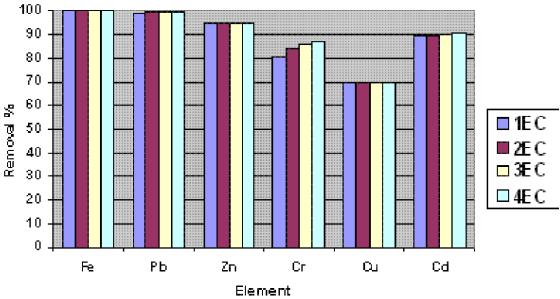
The experiments were carried out with 0.1, 0.2, 0.3 and 0.4 g of the eichhornia crassipes added to a prepared standard solution (synthetic waste water); these four solutions were given the codes 1 EC, 2 EC, 3 EC and 4 EC, respectively. The effect of weight of sorbent eichhornia crassipes plant on the percent removal of Fe3+, Pb2+, Zn2+, Cr3+, Cu2+ and Cd2+ is shown graphically in Fig. 1. Inspection of the data obtained showed that:
1- Maximum percent removal was obtained for Fe3+ ion, which is nearly equal to 99.88%, but it decreased very slightly by increasing the weight of sorbent.
2- Minimum removal was obtained for Cu2+ ion, which is slightly increased by the increase in the weight of sorbent.
3- The removal of Zn2+ is very slightly decreased by the increase in the weight of sorbent.
]]> 4- The variation of maximum percent removal of metal ions with weight of eichhornia crassipes used as sorbent lies in the order Fe3+> Pb2+> Zn2+>Cd2+>Cr3+> Cu2+.
Figure 1. Effect of weight of eichhornia crassipes on the removal of heavy metal ions.
Effect of contact time on the removal of the heavy metal ions
Results of studies on the effect of contact time on the maximum removal of the metal ions under investigation, illustrated in Fig. 2, showed that there are two cases:
1-For Zn2+, Pb2+ and Cr3+ the percent removal increases as the contact time of the metal ions with sorbent increases.
2-For Fe3+, Cu2+ and Cd2+ the percent removal decreases as the contact time increases, being the maximum adsorption attained after 2 hours.
]]>
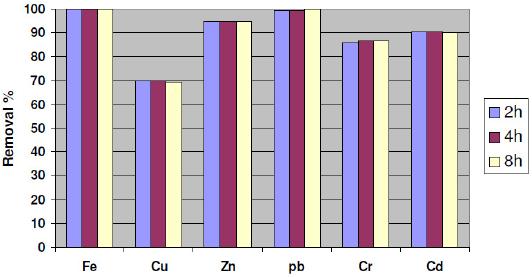
Figure 2. Effect of contact time on the removal of heavy metal ions.
Effect of pH on the removal of the heavy metal ions
Results present in Fig. 3 show that maximum removal takes place at pH 4.86, which indicates that the maximum adsorption affinities take place in moderately and slightly acidic medium.
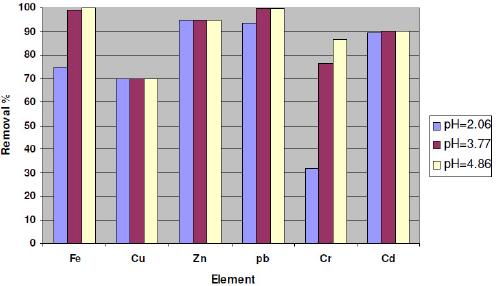
Figure 3. Effect of pH on the removal of heavy metal ions.
Effect of initial concentration of the heavy metal ions on the removal percentage
]]> The variation of percent removal with change in initial concentration of heavy metal ions showed no regular trend. For example, the percent removal of Zn2+, Cu2+ and Cd2+ increases with increasing the initial concentration, and maximum adsorption is attained at the highest initial concentration (50 mg/L). On the other hand, the percent removal for Cr3+, Fe3+ and Pb2+ increases with increasing the initial concentration, till reaching 30 mg/L, then decreases as the initial concentration increases up to 50 mg/L. The results are present in Fig. 4.
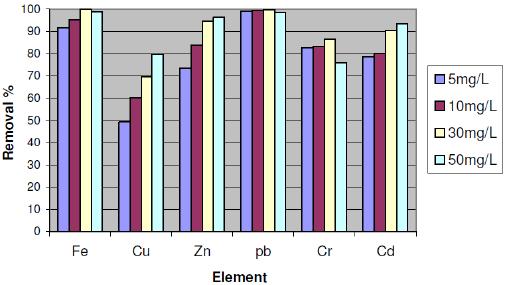
Figure 4. Effect of initial concentration of the heavy metal ions on the removal percentage.
Adsorption isotherms
Adsorption data for adsorbate concentration are most commonly described by adsorption isotherm, such as the Langmuir or Freundlish isotherms.
The Langmuir isotherm is valid for monolayer adsorption onto a surface containing a finite number of identical sites. The model assumes uniform energies of adsorption onto the surface and no transmigration of adsorbate in the plane of the surface. It is represented by the following equation:

where C is the concentration of solute remaining in solution at equilibrium (mg/L), qe is the amount of solute adsorbed per unit weight of solid adsorbent equilibrium time (mg/g) and Q0 and b are Langmuir constants related to the adsorption capacity and energy of adsorption, respectively. These values can be obtained from the plot of 1/qe against (1/C).
]]> The Langmuir linear relation is shown in representative examples in Fig.5 and 6.

Figure 5. Langmuir curve for adsorption of Cu2+ ion on eichhornia crassipes.

Figure 6. Langmuir curves for adsorption of Cr3+ and Pb2+ ions on eichhornia crassipes.
The Freundlich adsorption isotherm was also applied for the adsorption of metal ions on eichhornia crassipes. The Freundlich equation is represented as:


So, by plotting of Log qe vs. Log C, the constant Kf and exponent (n) can be determined.
Freundlich linear relation is shown in representative examples in Figs.7 and 8.
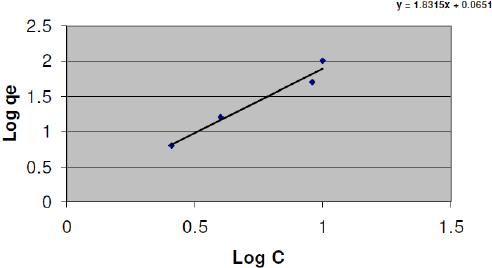
Figure 7. Freundlich curve for adsorption of Cu2+ ion on eichhornia crassipes.
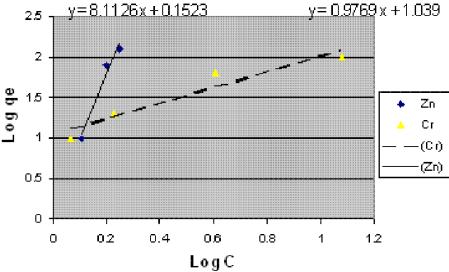
Figure 8. Freundlich curves for adsorption of Zn2+ and Cr3+ ions on eichhornia crassipes.
]]>Conclusion
Based on the present investigation, it could be concluded that some low cost materials like eichhornia crassipes can be used efficiently in the removal of heavy metal ions (Pb2+, Cu2+, Cd2+, Cr3+, Zn2+ and Fe3+ ) from aqueous solutions. The removal of heavy metal ions was pH dependent as the adsorption capacity increases with increasing the pH value of the solution, and at a particular pH the order of increasing the removal percentage was Cu2+< Cr3+ <Cd2+< Zn2+ <Pb2+ <Fe3+.
The metal ions showed different behaviors towards adsorption on eichhornia crassipes by increasing the initial concentration of the metal ions. Adsorption of some metal ions was fitted with Langmuir isotherm, other ones with Freundlich isotherm, and the others were fitted with both the models. The experimental studies showed that eichhornia crassipes could be used as an alternative, inexpensive and effective material to remove high amounts of toxic heavy metal ions from wastewater.
References
1. Z. Al-Qodah, Biosorption of heavy metal ions from aqueous solutions by activated sludge, Desalination 196 (2006) 164-176. [10.1016/j.desal.2005.12.012] [ Links ]
2. H.A. Hawari, N.C. Mulligan, Biosorption of lead (II), cadmium (II), copper (II) and nickel (II) by anaerobic granular biomass, Biores. Tech. 97 (2006) 692-700. [10.1016/j.biortech.2005.03.033]
3. U. Kumar, M. Bandyopadhyay, Sorption of cadmium from aqueous solution using pretreated rice husk, Biores. Tech. 97 (2006) 104-109. [10.1016/j.biortech.2005.02.027]
4. A. Saeed, M.W. Akhter, M. Iqbal, Removal and recovery of heavy metals from aqueous solution using papaya wood as a new biosorbent, Sep. & Purifi. Tech. 45 (2005) 25-31. [10.1016/j.seppur.2005.02.004]
]]> 5. P.X. Sheng, Y.P. Ting, J.P. Chen, L. Hong, Sorption of lead, copper, cadmium, zinc and nickel by marine algal biomass: characterization of biosorptive capacity and investigation of mechanisms, J. Colloid. Interface Science 275 (2004) 131-141. [10.1016/j.jcis.2004.01.036]6. V. Boonamnuayvitaya, C. Chaiya, W. Tanthapanichakoon and S. Jarudilokkul, Removal of heavy metals by adsorbent prepared from pyrolyzed coffee residues and clay, Sep. & Purifi. Tech. 35 (2004) 11-22. [10.1016/S1383-5866(03)00110-2]
7. N. Meunier, J.F. Blais, R.D. Tyagi, Removal of heavy metals from acid soil leachate using cocoa shells in a batch counter-current sorption process, Hydrometallurgy 73 (2004) 225-235. [10.1016/j.hydromet.2003.10.011]
8. M. Iqbal, R.G.J. Edyvean, Biosorption of lead, copper and zinc ions on loofa sponge immobilized biomass of Phanerochaete chrysosporium, Min. Eng. 17 (2004) 217-223. [10.1016/j.mineng.2003.08.014]
9. A. Aklil, M. Mouflih, S. Sebti, Removal of heavy metal ions from water by using calcined phosphate as a new adsorbent, J. Hazard. Materials 112 (2004) 183-190. [10.1016/j.jhazmat.2004.05.018]
Received 30 May 2009; accepted 14 May 2010
* Corresponding author: sashama92@yahoo.com
]]>