<?xml version="1.0" encoding="ISO-8859-1"?><article xmlns:mml="http://www.w3.org/1998/Math/MathML" xmlns:xlink="http://www.w3.org/1999/xlink" xmlns:xsi="http://www.w3.org/2001/XMLSchema-instance">
<front>
<journal-meta>
<journal-id>0872-1904</journal-id>
<journal-title><![CDATA[Portugaliae Electrochimica Acta]]></journal-title>
<abbrev-journal-title><![CDATA[Port. Electrochim. Acta]]></abbrev-journal-title>
<issn>0872-1904</issn>
<publisher>
<publisher-name><![CDATA[Sociedade Portuguesa de Electroquímica]]></publisher-name>
</publisher>
</journal-meta>
<article-meta>
<article-id>S0872-19042011000400004</article-id>
<title-group>
<article-title xml:lang="pt"><![CDATA[Ranitidine Drugs as Non-Toxic Corrosion Inhibitors for Mild Steel in Hydrochloric Acid Medium]]></article-title>
</title-group>
<contrib-group>
<contrib contrib-type="author">
<name>
<surname><![CDATA[Abdel Hameed]]></surname>
<given-names><![CDATA[R.S.]]></given-names>
</name>
<xref ref-type="aff" rid="A01"/>
</contrib>
</contrib-group>
<aff id="A01">
<institution><![CDATA[,Alazhar Univrsty Faculty of Scince Chemistry Department]]></institution>
<addr-line><![CDATA[Cairo ]]></addr-line>
<country>Egypt</country>
</aff>
<pub-date pub-type="pub">
<day>00</day>
<month>00</month>
<year>2011</year>
</pub-date>
<pub-date pub-type="epub">
<day>00</day>
<month>00</month>
<year>2011</year>
</pub-date>
<volume>29</volume>
<numero>4</numero>
<fpage>273</fpage>
<lpage>285</lpage>
<copyright-statement/>
<copyright-year/>
<self-uri xlink:href="http://scielo.pt/scielo.php?script=sci_arttext&amp;pid=S0872-19042011000400004&amp;lng=en&amp;nrm=iso"></self-uri><self-uri xlink:href="http://scielo.pt/scielo.php?script=sci_abstract&amp;pid=S0872-19042011000400004&amp;lng=en&amp;nrm=iso"></self-uri><self-uri xlink:href="http://scielo.pt/scielo.php?script=sci_pdf&amp;pid=S0872-19042011000400004&amp;lng=en&amp;nrm=iso"></self-uri><abstract abstract-type="short" xml:lang="en"><p><![CDATA[Expired ranitidine was tested as a corrosion inhibitor for mild steel in 1 M HCl using different techniques: weight loss, potentiodynamic polarization, open circuit potential and electrochemical impedance spectroscopy. The polarization resistance (Rp) value increased with increase in the concentration of the inhibitor. Results obtained revealed that ranitidine performed excellently as a corrosion inhibitor for mild steel in this medium at 303 K. The protection efficiency increased with increasing inhibitor concentration. The maximum protection efficiency of 90% has been obtained at 400 ppm. On the other hand, the efficiency decreases with increasing temperature. The adsorption of the inhibitor on the mild steel surface followed Langmuir adsorption isotherm model. The activation and thermodynamic parameters of dissolution and adsorption were calculated and discussed. The negative value of &#916;Gads (-40 kJ mol-1) indicates spontaneous chemical adsorption. Results obtained from polarization, EIS and weight loss measurements are in good agreement with each other.]]></p></abstract>
<kwd-group>
<kwd lng="en"><![CDATA[mild steel]]></kwd>
<kwd lng="en"><![CDATA[acid corrosion]]></kwd>
<kwd lng="en"><![CDATA[weight loss]]></kwd>
<kwd lng="en"><![CDATA[drugs]]></kwd>
<kwd lng="en"><![CDATA[polarization]]></kwd>
</kwd-group>
</article-meta>
</front><body><![CDATA[  

    <p><b>Ranitidine Drugs as Non-Toxic Corrosion Inhibitors for Mild Steel in Hydrochloric Acid Medium</b></p>
     <p>&nbsp;</p>
    <p><b>R.S. Abdel Hameed<sup><a href="#0">*</a></sup><a name="top0"></a></b></p>


    <p><i>Chemistry Department, Faculty of Scince, Alazhar Univrsty, Cairo, Egypt</i></p>

    <p>&nbsp;</p>
    <p><b>Abstract</b></p>
    <p>Expired ranitidine was tested as a corrosion inhibitor for mild steel in 1 M HCl using 
different techniques: weight loss, potentiodynamic polarization, open circuit potential 
and electrochemical impedance spectroscopy. The polarization resistance (R<sub>p</sub>) value 
increased with increase in the concentration of the inhibitor. Results obtained revealed 
that ranitidine performed excellently as a corrosion inhibitor for mild steel in this 
medium at 303 K. The protection efficiency increased with increasing inhibitor 
concentration. The maximum protection efficiency of 90% has been obtained at 400 
ppm. On the other hand, the efficiency decreases with increasing temperature. The 
adsorption of the inhibitor on the mild steel surface followed Langmuir adsorption 
isotherm model. The activation and thermodynamic parameters of dissolution and 
adsorption were calculated and discussed. The negative value of &Delta;G<sub>ads</sub> (-40 kJ mol-1) 
indicates spontaneous chemical adsorption. Results obtained from polarization, EIS and 
weight loss measurements are in good agreement with each other.</p>

    <p><b><i>Keywords:</i></b> mild steel, acid corrosion, weight loss, drugs, polarization.</p>

    <p>&nbsp;</p>
    ]]></body>
<body><![CDATA[<p><b>Introduction</b></p>
    <p>Mild steel is widely used as the constructional material in most of the major 
industries, particularly in food, petroleum, power production, chemical and 
electrochemical industries, especially due to its excellent mechanical properties 
and low cost. The major problem of mild steel is its dissolution in acidic 
medium. Corrosion of iron and mild steel in acidic aqueous solutions is one of 
the major areas of concern in many industries where acids are widely used for 
applications such as acid pickling, acid cleaning, acid descaling, and oil well 
acidizing. Because of general aggressiveness of acid solution, materials of 
construction are getting corroded easily.</p>
    <p>Corrosion is a thermodynamically feasible process as it is associated with 
decrease in Gibb's free energy. Corrosion is an afflicting problem associated 
with every use of metals. The damage by corrosion results in high cost for 
maintenance and protection of materials used. Development of methods to 
control corrosion is a challenge to scientists working in this area. Amongst 
various methods developed for corrosion protection, the use of inhibitors is an 
attractive and most practical method for the protection of metals in contact with 
corrosion media. Inhibitors reduce the corrosion of metallic materials by 
controlling the metal dissolution and consumption.</p>
    <p>Majority of the well known inhibitors for the corrosion of steel in acidic medium 
are organic compounds containing nitrogen, sulphur, oxygen atoms, or N-hetero 
cyclic compounds with polar groups. A large number of scientific studies have 
been devoted to the subject of corrosion inhibitors for mild steel in acidic media 
[1-12]. Most of the commercial inhibitors are toxic in nature; therefore, 
replacement by environmentally benign inhibitors is necessary. Few non-toxic 
compounds have been investigated as corrosion inhibitors by some researchers 
[13-16]. Modified plastic waste was used as cheap and safe corrosion inhibitors 
for metals and alloys in different aqueous media [17-20]. The use of 
pharmaceutical compounds offers interesting possibilities for corrosion inhibition 
due to the presence of hetero atoms like nitrogen, sulphur and oxygen in their 
structure, and they are of particular interest because of their safe use, high 
solubility in water and high molecular size. Some of the azosulpha and 
antimalarial drugs have been reported as good corrosion inhibitors [21-23]. Also, 
the use of piperazine derivative drug as a corrosion inhibitor has been reported 
[24].</p>
    <p>In a previous work expired ranitidine was investigated as corrosion inhibitor for 
aluminum alloy in acidic medium [25].</p>
    <p>In the present work, expired ranitidine has been investigated as corrosion 
inhibitor for mild steel in hydrochloric acid using weight loss, potentiodynamic 
polarization and electrochemical impedance spectroscopy techniques. The survey 
of literature reveals that ranitidine is a non-toxic pharmaceutical compound used 
as a histamine H<sub>2</sub>-receptor antagonist. Ranitidine has the commercial name of 
N[2-[[[5-[(dime-thylamino)methyl]-2furanyl]methyl]thio]ethyl]-N'-methyl-2nitro-1,1-ethenediamine, HCl. 
Ranitidine contains N-atoms, O-atoms, S-atoms 
and &pi;-bond in its structure, regarded as important factors for good inhibitor 
performance.    <p>

    <p>&nbsp;</p>
    <p><b>Materials and methods</b></p>
    <p><b><i>Experimental procedure</i></b></p>
    ]]></body>
<body><![CDATA[<p>The test material used was mild steel sample with the following composition 
(wt %): 0.18 C, 0.6 Mn, 0.05 S, 0.04 P, 0.1 Si and balance Fe. Test materials were 
abraded with different emery papers up to 1000 grade, cleaned with acetone, 
washed with double distilled water and properly dried prior to exposure. Analar 
grade HCl and double distilled water were used to prepare all solutions. 
Ranitidine hydrochloride (molecular weight of 350.87) from (SEDICO) 
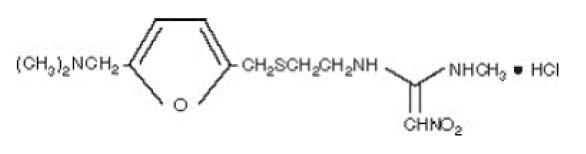
pharmaceutical company was used for the study. Fig. 1 shows the molecular 
structure of 'Ranitidine hydrochloride'.</p> 

    <p>&nbsp;</p>
    <p><img src="/img/revistas/pea/v29n4/29n4a04f1.jpg"></p>
    
<p><b>Figure 1.</b> Molecular structure of ranitidine hydrochloride. {N[2-[[[5-[(dimethylamino)
methyl]-2furanyl]methyl]thio]ethyl]-N'-methyl-2-nitro-1,1-ethenediamine, HCl}.</p>
    <p>&nbsp;</p>


    <p>Weight loss measurements were performed on mild steel coupons having 
2x2x0.2 inch size, in 1 M hydrochloric acid solution with different 
concentrations of the inhibitor. Weight loss of the metal coupons was noted after 
an immersing period of 7 days at the temperature range from 303 K to 333 K. 
The potential of carbon steel electrodes was measured against the saturated 
calomel electrode (SCE) in 1 M HCl solution in the absence and presence of 
various inhibitor concentrations until the open circuit potential is reached. 
Potentiodynamic polarization studies were carried out using Volta lab 40 
(Tacussel-Radiometer PGZ301) potentiostat and controlled by Tacussel 
corrosion analysis software model (Voltamaster 4) at a scan rate of 5 mVs<sup>-1</sup> 
under static condition. A platinum electrode and a saturated calomel electrode 
(SCE) were used as auxiliary and reference electrodes, respectively. The working 
electrode was prepared from a cylindrical mild steel rod insulated with 
polytetrafluroethylene tape (PTFE). The area exposed to the aggressive solution 
was 1 cm2. All the experiments were carried out at constant temperature of 30&plusmn;1 &deg;C.</p>
    <p>AC impedance measurements were performed using Tacussel-Radiometer PGZ 
301 Frequency Response Analyzer in a frequency range from 10<sup>5</sup> to 10<sup>-2</sup> Hz with 
10 points per decade. An AC sinusoid &plusmn;10 mV was applied at the corrosion 
potential (E<sub>corr</sub>). The experiments were measured after 6 h of immersion.</p>

    <p>&nbsp;</p>
    <p><b>Results and discussion</b></p>
    <p><b><i>Weight loss measurements</i></b></p>
    ]]></body>
<body><![CDATA[<p><i>Effect of inhibitor concentration</i></p>
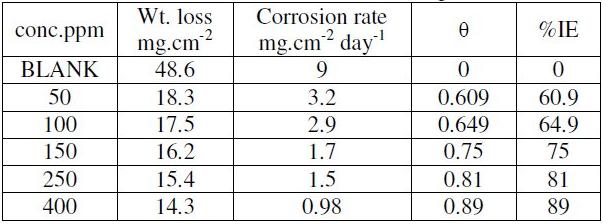
    <p>The weight loss results of mild steel in 1 M HCl in the absence and presence of 
various concentrations of the inhibitor are summarized in Table 1. The I.E. (%) 
was calculated using the following equation:</p>

    <p>&nbsp;</p>
<img src="/img/revistas/pea/v29n4/29n4a04e1.jpg">
    
<p>&nbsp;</p>


    <p>where W1 and W2 are weight loss of mild steel in the presence and absence of 
the inhibitor, respectively. The inhibition efficiency increased with increase in 
the concentration of the inhibitor.</p> 

    <p>&nbsp;</p>    <p>Table 1. Degree of surface coverage (&#952;) and percentage inhibition efficiency (%IE) of
the used inhibitor in 1 M HCl at 303 K, obtained from weight loss measurements.</p>
<img src="/img/revistas/pea/v29n4/29n4a04t1.jpg">
    
<p>&nbsp;</p>


    <p><i>Effect of temperature</i></p>
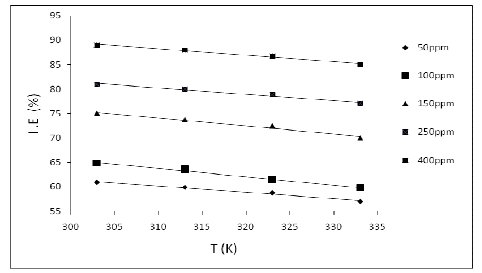
    <p>To elucidate the mechanism of inhibition and to determine the kinetic parameters 
of the corrosion process, weight loss measurements were performed at 303, 313, 
323 and 333 K. The effect of temperature on the corrosion inhibition efficiency 
of mild steel in the presence of the inhibitor is graphically represented in Fig. 2.</p>

    ]]></body>
<body><![CDATA[<p>&nbsp;</p>
    <p><img src="/img/revistas/pea/v29n4/29n4a04f2.jpg"></p>
    
<p><b>Figure 2.</b> Effect of temperature on I.E. for mild steel in 1 M HCl in the presence of
different concentrations of the inhibitor.</p>
    <p>&nbsp;</p>
 

    <p>The inhibition efficiency decreased with increase in temperature, leading to the 
conclusion that the protective film of these compounds formed on the mild steel 
surface is less stable at higher temperatures, which may be due to the desorption 
of some adsorbed molecules from the surface of the mild steel, due to which 
greater area of the metal is exposed to the acidic environment.</p>
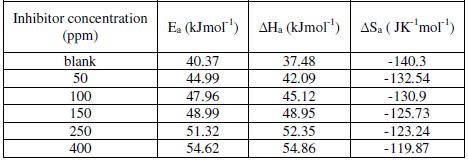
    <p>The apparent activation energy (E<sub>a</sub>) of metal corrosion in acid media can be 
calculated from Arrhenius equation [26].</p>

    <p>&nbsp;</p>
<img src="/img/revistas/pea/v29n4/29n4a04e2.jpg">
    
<p>&nbsp;</p>


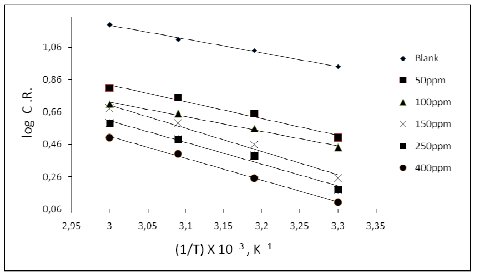
    <p>where E<sub>a</sub> is the apparent activation energy for the corrosion of mild steel, R is the 
universal gas constant, A is Arrhenius pre exponential factor and T is the 
absolute temperature. Fig. 3 depicts the plot of log CR vs. 1/T and the values of 
Ea obtained from the slope of the plot are given in Table 2.</p>


    <p>&nbsp;</p>
    ]]></body>
<body><![CDATA[<p><img src="/img/revistas/pea/v29n4/29n4a04f3.jpg"></p>
    
<p><b>Figure 3.</b> Arrhenius plot for mild steel in 1 M HCl solution in the absence and presence
of different concentrations of the inhibitor.</p>
    <p>&nbsp;</p>


    <p>&nbsp;</p>    <p><a name="t2"></a><a href="#topt2">Table 2</a> . Values of activation parameters for mild steel in 1 M HCl in the absence and
presence of different concentrations of the inhibitor.</p>
<img src="/img/revistas/pea/v29n4/29n4a04t2.jpg">
    
<p>&nbsp;</p>
    <p>The higher value of activation energy (E<sub>a</sub>) in the presence of the inhibitor than in 
its absence is attributed to its physical adsorption; its chemisorption is 
pronounced in the opposite case [21, 27].</p>

    <p>In the present study the higher value of E<sub>a</sub> for mild steel in presence of expired 
ranitidine compared to that in its absence is attributed to its physical adsorption. 
Szauer and Brand [28] explained that the increase in Ea can be attributed to an 
appreciable decrease in the adsorption of the inhibitor on the mild steel surface 
with increase in temperature and a corresponding increase in corrosion rates 
occurs due to the fact that greater area of metal is exposed to acid environment.</p>


    <p>An alternative form of Arrhenius equation is the transition state equation [26].</p>

    <p>&nbsp;</p>
<img src="/img/revistas/pea/v29n4/29n4a04e3.jpg">
    
]]></body>
<body><![CDATA[<p>&nbsp;</p>

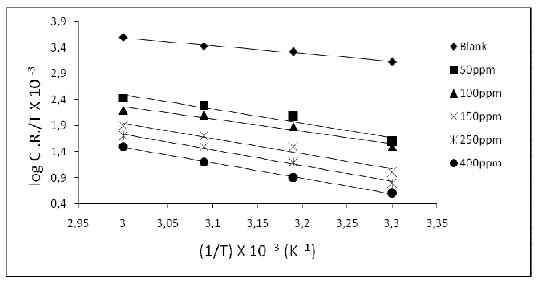
    <p>where h is the Plank's constant, N is the Avogadro's number, &Delta;S<sub>a</sub> is the entropy 
of activation, and &Delta;Ha is the enthalpy of activation. A plot of log (CR/T) vs. 1/T 
gave a straight line, as shown in Fig. 4 with a slope of (-&Delta;H/2.303R) and an 
intercept of [log(R/Nh) + (&Delta;S /R)], from which the values of &Delta;Ha and &Delta;S<sub>a</sub> were 
calculated and listed in <a href="#t2">Table 2</a><a name="topt2"></a>.</p>
    <p>&nbsp;</p>
    <p><img src="/img/revistas/pea/v29n4/29n4a04f4.jpg"></p>
    
<p><b>Figure 4.</b> Transition state plot for mild steel in 1 M HCl solution in the absence and
presence of different concentrations of the inhibitor.</p>
    <p>&nbsp;</p>
    <p>The positive values of &Delta;Ha for corrosion of mild steel in the presence and 
absence of the inhibitor reflect the endothermic nature of the metal dissolution 
process. The increase in &Delta;Ha with increase in the concentration of the inhibitor 
for mild steel corrosion reveals that decrease in mild steel corrosion rate is 
mainly controlled by kinetic parameters of activation [28].</p>
    <p>The entropy of activation values are less negative for inhibited solutions than that 
for the uninhibited solutions. This suggests that an increase in randomness 
occurred while moving from reactants to the activated complex [29].</p>


    <p><i>Adsorption isotherm and thermodynamic parameters</i></p>

    <p>In order to understand the mechanism of corrosion inhibition, the adsorption 
behavior of the organic adsorbate on the metal surface has to be known. The 
degree of surface coverage (&theta;) for different concentrations of the inhibitor (C<sub>inhi</sub>) 
has been evaluated. The data were tested graphically by fitting to various 
isotherms. A straight line with correlation coefficient nearly equal to 1.0 was 
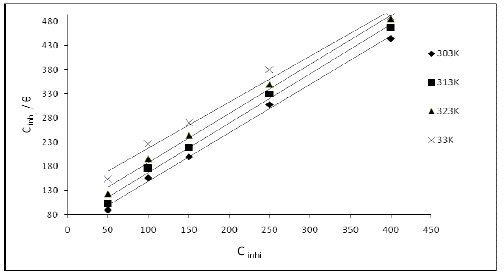
obtained on plotting C<sub>inhi</sub>/&theta; against C<sub>inhi</sub>, as shown in Fig. 5, suggesting 
adsorption of the compound on the mild steel surface following Langmuir 
adsorption isotherm model. It is interpreted from the graph that, adsorption of the 
inhibitor on the mild steel surface followed Langmuir adsorption isotherm at all 
studied temperatures.</p>
    ]]></body>
<body><![CDATA[<p>&nbsp;</p>
    <p><img src="/img/revistas/pea/v29n4/29n4a04f5.jpg"></p>
    
<p><b>Figure 5.</b> Langmuir adsorption isotherm for mild steel in 1 M HCl solution at various
temperatures.</p>
    <p>&nbsp;</p>
    <p>According to this isotherm, the surface coverage (&theta;) is related [30] to inhibitor 
concentration C<sub>inhi</sub> by equation (4) </p>

    <p>&nbsp;</p>
<img src="/img/revistas/pea/v29n4/29n4a04e4.jpg">
    
<p>&nbsp;</p>


    <p>where K<sub>ads</sub> is the equilibrium constant of the equilibrium adsorption process. This 
isotherm assumes that adsorbed molecule occupies only one site and it does not 
interact with other adsorbed species.</p>
    <p>The K<sub>ads</sub> values can be calculated from the intercept lines on the C<sub>inhi</sub>/ &theta; 
axis.</p>
    <p>This is related to the standard free energy of adsorption (&Delta;G<sub>ads</sub>) by equation (5):</p>

    ]]></body>
<body><![CDATA[<p>&nbsp;</p>
<img src="/img/revistas/pea/v29n4/29n4a04e5.jpg">
    
<p>&nbsp;</p>
 

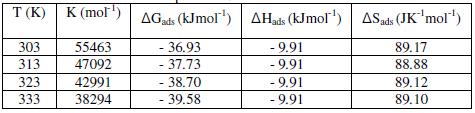
    <p>where R is the gas constant and T is the absolute temperature. The constant value 
of 55.5 is the concentration of water in solution in mol/L. The values of &Delta;G a for 
the inhibitor on the surface of mild steel are given in Table 3.</p> 

    <p>&nbsp;</p>    <p><a name="t3"></a><a href="#topt3">Table 3</a>. Values of thermodynamic parameters for the adsorption of the inhibitor in 1 M
HCl on mild steel at different temperatures.</p>
<img src="/img/revistas/pea/v29n4/29n4a04t3.jpg">
    
<p>&nbsp;</p>


    <p>The negative value of &Delta;G<sub>a</sub> indicated spontaneous adsorption of the inhibitor on 
the mild steel surface. Generally, the magnitude of &Delta;G around -20 kJ/mol or less 
negative indicates electrostatic interactions between the inhibitor and the charged 
metal surface (i.e., physisorption). Those around -40 kJ/mol or more negative are 
indicative of charge sharing or transferring from organic species to the metal 
surface to form a coordinate type of metal bond (i.e., chemisorptions). In the 
present work, the calculated value &Delta;G at 303 K for mild steel is -37 kJ/mol, 
which indicates that adsorption of the inhibitor on the mild steel surface involves 
both physical and chemical process [31-34]. But the inhibition efficiency 
decreased with increasing temperature, indicating that the inhibitor adsorbed 
predominantly physically on the surface of mild steel. The enthalpy of adsorption 
(&Delta;H<sub>ads</sub>) can be calculated from the rearranged Gibbs-Helmholtz equation:</p> 

    <p>&nbsp;</p>
<img src="/img/revistas/pea/v29n4/29n4a04e6.jpg">
    
<p>&nbsp;</p>

 
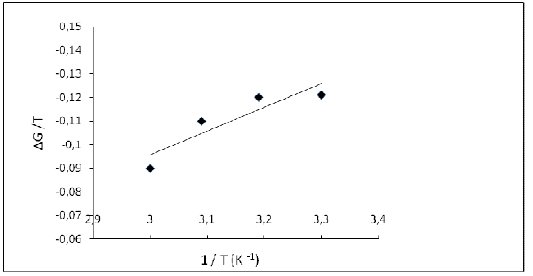
    <p>The variation of &Delta;G<sub>ads</sub>/T with 1/T gave a straight line with a slope of &Delta;H<sub>ads</sub>, as 
shown in Fig. 6. The entropy of adsorption &Delta;S<sub>ads</sub> was calculated using the 
following thermodynamic equation:</p>

    ]]></body>
<body><![CDATA[<p>&nbsp;</p>
<img src="/img/revistas/pea/v29n4/29n4a04e7.jpg">
    
<p>&nbsp;</p>
    <p>&nbsp;</p>
    <p><img src="/img/revistas/pea/v29n4/29n4a04f6.jpg"></p>
    
<p><b>Figure 6.</b> &Delta;G<sub>ads</sub>/T versus 1/T plot for mild steel in 1 M HCl solution.</p>
    <p>&nbsp;</p>  
    <p>The calculated values of heat of adsorption and entropy of adsorption are listed in <a href="#t3">Table 3</a><a name="topt3"></a>.</p>


    <p>It is well known that adsorption is an exothermic phenomenon accompanied by a 
decrease in entropy [35]. In aqueous solutions the adsorption of the organic 
molecule is generally accompanied by desorption of water molecules [42].</p>

    <p>&nbsp;</p>
<img src="/img/revistas/pea/v29n4/29n4a04s1.jpg">
    
<p>&nbsp;</p>

    ]]></body>
<body><![CDATA[<p>The negative sign of &Delta;Hads indicated the exothermic process of adsorption of the 
inhibitor on mild steel surface in HCl. The positive value of &Delta;S<sub>ads</sub> in the presence 
of the inhibitor can be attributed to the increase in the solvent entropy and more 
positive desorption entropy. It is also interpreted that the increase of disorderness 
is due to more water molecules which can be desorbed from the metal surface by 
one inhibitor molecule. Therefore it is revealed that decrease in the enthalpy is 
the driving force for the adsorption of the inhibitor on the surface of mild steel 
[36-39].</p>

 
    <p><b><i>Mechanism of corrosion inhibition</i></b></p>
    <p>In hydrochloric acid medium, the metal surface is negatively charged due to the 
specifically adsorbed chloride ions on the metal surface.</p>

    <p>&nbsp;</p>
<img src="/img/revistas/pea/v29n4/29n4a04s2.jpg">
    
<p>&nbsp;</p>

    <p>In acidic solution, the oxygen, sulfure and nitrogen atoms of ranitidine can be 
protonated easily, due to high electron density on it, leading to positively charged 
inhibitor species. The adsorption can occur via electrostatic interaction between 
positively charged inhibitor molecule and negatively charged metal surface [21, 
28] leading to physisorption of the inhibitor molecules. Further, co-ordinate bond 
may be formed between unshared e-pairs of unprotonated nitrogen atom of the 
inhibitor and vacant d-orbitals of metal surface atoms. Additionally, inhibitor 
molecule may be chemically adsorbed due to the interaction of Ï€ electrons of the 
furan ring of the inhibitor with vacant d-orbitals of the metal [32].</p>


    <p><b><i>Open circuit potential measurements</i></b></p>
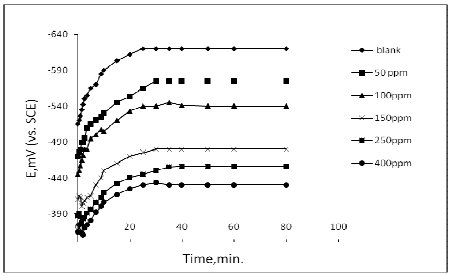
    <p>The potential of mild steel electrodes immersed in 1 M HCl solution was 
measured as a function of immersion time in the absence and presence of 
expired ranitidine, as shown in Fig. 7. It is clear that the potential of mild steel 
electrode immersed in 1 M HCl solution (blank curve) tends towards more 
negative potential firstly, giving rise to short step. This behavior was reported by 
another investigator [40]. It represents the breakdown of the pre-immersion air 
formed oxide film present on the surface, according to the following equation:</p> 

    <p>&nbsp;</p>
<img src="/img/revistas/pea/v29n4/29n4a04s3.jpg">
    
<p>&nbsp;</p>
    ]]></body>
<body><![CDATA[<p>&nbsp;</p>
    <p><img src="/img/revistas/pea/v29n4/29n4a04f7.jpg"></p>
    
<p><b>Figure 7.</b> Potential-time curves for carbon steel immersed in 2 M HCl solution in the
absence and presence of expired ranitidine.</p>
    <p>&nbsp;</p>
    <p>This is followed by the growth of a new oxide film inside the solution, so that the 
potential was shifted again to more noble direction until steady state potential is 
established. Addition of inhibitor molecules to the aggressive medium produces a 
negative shift in the open circuit potential due to the retardation of the cathodic 
reaction.</p>


    <p><b><i>Polarization measurements</i></b></p>
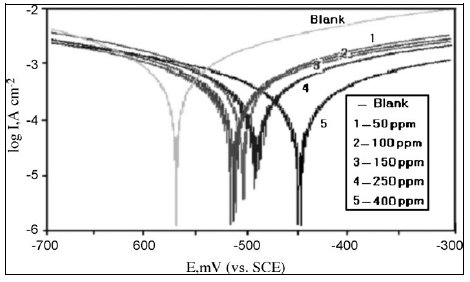
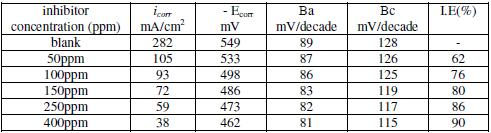
    <p>Polarization curves for mild steel in 1 M hydrochloric acid without and with 
addition of different concentrations of the inhibitor are shown in Fig. 8. The 
values of electrochemical parameters associated with polarization measurements, 
such as corrosion potential (E<sub>corr</sub>), corrosion current density (i<sub>corr</sub>), tafel slopes (&beta;a, &beta;c) and calculated inhibition efficiency (IE%), are listed in Table 4. The 
inhibition efficiency is given by the following equation [41].</p> 

    <p>&nbsp;</p>
<img src="/img/revistas/pea/v29n4/29n4a04e8.jpg">
    
<p>&nbsp;</p>


    <p>where Iuninh and Iinh are the corrosion current densities in the absence and 
presence of the inhibitor, respectively.</p>
    ]]></body>
<body><![CDATA[<p>&nbsp;</p>
    <p><img src="/img/revistas/pea/v29n4/29n4a04f8.jpg"></p>
    
<p><b>Figure 8.</b> Potentiodynamic polarization curves of mild steel in 1 M HCl solution at 30
&deg;C containing various concentrations of the inhibitor.</p>
    <p>&nbsp;</p>

    <p>&nbsp;</p>    <p>Table 4. Electrochemical parameters of mild steel in 1 M hydrochloric acid solution at
303 K.</p>
<img src="/img/revistas/pea/v29n4/29n4a04t4.jpg">
    
<p>&nbsp;</p>

    <p>Corrosion current density decreased noticeably with increase in inhibitor 
concentration, indicating the increased inhibition efficiency with the increase in 
the concentration of the inhibitor. Generally, in acidic solution the anodic process 
of corrosion is the passage of metal ions from the solid metal to the solution, and 
the principal cathodic process is the discharge of hydrogen ions to produce 
hydrogen molecules or reduction of oxygen. In the present study, the corrosion 
potential values slightly shifted to more positive values, indicating that the 
addition of inhibitor molecule reduces both anodic dissolution and cathodic 
reduction; therefore, ranitidine hydrochloride could be classified as a mixed type 
inhibitor, but the anodic effect is more pronounced.</p>
    <p>The anodic and cathodic Tafel constants did not change significantly with 
increase in inhibitor concentration, suggesting that the presence of the inhibitor 
does not alter the reaction mechanism, and that the inhibition effect has occurred 
due to simple blocking of the active sites, thereby reducing available surface area 
of the corroding metal.</p>


    <p><b><i>Electrochemical impedance spectroscopic measurements (EIS)</i></b></p>
    ]]></body>
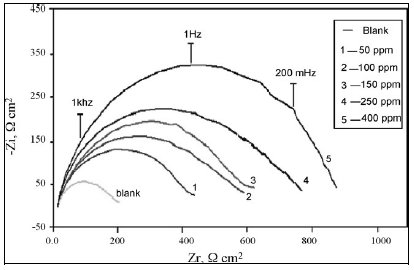
<body><![CDATA[<p>Impedance spectra (Nyquist plots) of mild steel in 1 M HCl containing various 
concentrations of the inhibitor at 30 &deg;C are shown in Fig. 9. Nyquist plots contain 
depressed semicircles with the centre under the real axis. The size of the 
semicircle increases with the inhibitor concentration, indicating the charge 
transfer process as the main controlling factor of the corrosion of mild steel. It is 
apparent from the plots that the impedance of the inhibited solution has increased 
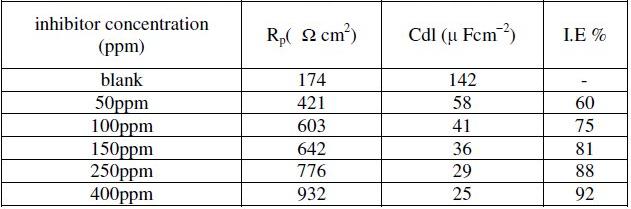
with the increase in the concentration of the inhibitor. The experimental results of 
EIS measurements for the corrosion of mild steel in 1 M HCl in the absence and 
presence of inhibitor are given in Table 5.</p> 

    <p>&nbsp;</p>
    <p><img src="/img/revistas/pea/v29n4/29n4a04f9.jpg"></p>
    
<p><b>Figure 9.</b> Nyquist plots for mild steel in 1 M HCl solution at 30 &deg;C containing various
concentrations of the inhibitor.</p>
    <p>&nbsp;</p>


    <p>&nbsp;</p>    <p>Table 5. AC impedance data of mild steel in 1 M HCl solution at 30 &#176;C.</p>
<img src="/img/revistas/pea/v29n4/29n4a04t5.jpg">
    
<p>&nbsp;</p>


    <p>It can be observed that polarization resistance (R<sub>p</sub>) value increased with increase 
in the concentration of the inhibitor, whereas values of the capacitance of the 
interface (C<sub>dl</sub>) start decreasing, with increase in inhibitor concentration, which is 
most probably due to the decrease in local dielectric constant and/or increase in 
thickness of the electrical double layer. This suggests that the inhibitor acts via 
adsorption at the metal/solution interface [42] and the decrease in the C<sub>dl</sub> values 
is caused by the gradual replacement of water molecules by the adsorption of the 
inhibitor molecules on the electrode surface, which decreases the extent of metal 
dissolution [43].</p>
    <p>The inhibition efficiency [44] is given by equation (9)</p>

    ]]></body>
<body><![CDATA[<p>&nbsp;</p>
<img src="/img/revistas/pea/v29n4/29n4a04e9.jpg">
    
<p>&nbsp;</p>


where R<sub>p</sub> is the polarization resistance without inhibitor, and R<sub>p(inhi)</sub> is the 
polarization resistance with inhibitor.</p>
    <p>C<sub>dl</sub> value is obtained from equation (10):</p>

    <p>&nbsp;</p>
<img src="/img/revistas/pea/v29n4/29n4a04e10.jpg">
    
<p>&nbsp;</p>

    <p>where f<sub>max</sub> is the frequency at the top of the semicircle (where-Z'' is maximum).</p>

    <p>&nbsp;</p>
    <p><b>Conclusions</b></p>
    <p>1) Results obtained from the experimental data show that expired ranitidine 
hydrochloride is a good inhibitor for the corrosion of mild steel in 1M HCl 
and inhibition efficiency was more pronounced with increase in the inhibitor 
concentration.</p>
    <p>2) The inhibition efficiency decreased with increase in temperature, leading to 
the conclusion that the protective film of the compounds formed on the mild 
steel surface is less stable at higher temperature.</p>
    ]]></body>
<body><![CDATA[<p>3) The values of &Delta;G<sub>ads</sub> indicate adsorption of the inhibitor by both physical and 
chemical process.</p>
    <p>4) The potentiodynamic polarization curves imply that expired ranitidine 
hydrochloride acts as a mixed type inhibitor, but under prominent anodic 
control, for corrosion of mild steel in 1 M HCl.</p>
    <p>5) The adsorption of inhibitor on the mild steel surface obeys Langmuir 
adsorption isotherm.</p>
    <p>6) The polarization resistance (R<sub>p</sub>) value increased with increase in the 
concentration of the inhibitor.</p>
    <p>7) Results obtained from polarization, EIS and weight loss measurements are in 
good agreement with each other.</p> 

    <p>&nbsp;</p>
    <p><b>References</b></p>
    <p>1. Tianbao Du, Jiajian Chen, Dianzhen Cao, J. Mater. Sci. 36 (2001) 3903.</p>
    <p>2. P. Morales-Gil, G. Negron-Silva, M. Romero-Romo, C. Angeles-Chavez, M. Palomar-Pardave, Electrochim. Acta. 49 (2004) 4733.</p>
    <!-- ref --><p>3. J.M. Bastidas, J.L. Polo, E. Cano, J. Appl. Electrochem. 30 (2000) 1173.    &nbsp;&nbsp;&nbsp;&nbsp;&nbsp;&nbsp;&nbsp;&nbsp;[&#160;<a href="javascript:void(0);" onclick="javascript: window.open('/scielo.php?script=sci_nlinks&ref=000162&pid=S0872-1904201100040000400003&lng=','','width=640,height=500,resizable=yes,scrollbars=1,menubar=yes,');">Links</a>&#160;]<!-- end-ref --></p>
    <p>4. B. Zerga, A. Attiyibat, M. Sfaira, M. Taleb, B. Hammouti, M. Ebn Touhami, S. Radi, Z. Rais, J. Appl. Electrochem. 40 (2010) 1575.</p>
    <p>5. S. Tamil Selvi, V. Raman, N. Rajendran, J. Appl. Electrochem. 33 (2003) 1175.</p>
    <!-- ref --><p>6. P.Lowmunkhong, D. Ungthararak, P. Sutthivaiyakit, Corros. Sci. 52 (2009) 30.    &nbsp;&nbsp;&nbsp;&nbsp;&nbsp;&nbsp;&nbsp;&nbsp;[&#160;<a href="javascript:void(0);" onclick="javascript: window.open('/scielo.php?script=sci_nlinks&ref=000166&pid=S0872-1904201100040000400006&lng=','','width=640,height=500,resizable=yes,scrollbars=1,menubar=yes,');">Links</a>&#160;]<!-- end-ref --></p>
    <p>7. M. Zerfaoui, H. Oudda, B. Hammouti, S. Kertit, M. Benkaddour, Prog. Org. Coat. 51 (2004) 134.</p>
    <p>8. A. Chetaouani, B. Hammouti, A. Aouniti, N. Benchat, T. Benhadda, Prog. Org. Coat. 45 (2002) 373.</p>
    <p>9. Mohamed K. Awad, J. Electroanal. Chem. 567 (2004) 219.</p>
    <!-- ref --><p>10.D.K. Yadav, B. Maiti, M.A. Quraishi, Corros. Sci. 52 (2010) 3586.    &nbsp;&nbsp;&nbsp;&nbsp;&nbsp;&nbsp;&nbsp;&nbsp;[&#160;<a href="javascript:void(0);" onclick="javascript: window.open('/scielo.php?script=sci_nlinks&ref=000171&pid=S0872-1904201100040000400010&lng=','','width=640,height=500,resizable=yes,scrollbars=1,menubar=yes,');">Links</a>&#160;]<!-- end-ref --></p>
    ]]></body>
<body><![CDATA[<!-- ref --><p>11. K.S. Jacob, G. Parameswaran, Corros. Sci. 52 (2009) 224.    &nbsp;&nbsp;&nbsp;&nbsp;&nbsp;&nbsp;&nbsp;&nbsp;[&#160;<a href="javascript:void(0);" onclick="javascript: window.open('/scielo.php?script=sci_nlinks&ref=000173&pid=S0872-1904201100040000400011&lng=','','width=640,height=500,resizable=yes,scrollbars=1,menubar=yes,');">Links</a>&#160;]<!-- end-ref --></p>
    <p>12. A. Ostovari, S.M. Hoseinieh, M. Peikari, S.R. Shadizadeh, S.J. Hashemi, Corros. Sci. 51(2009) 1935.</p>
    <p>13. F.C. Giacomelli, C. Giacomelli, M.F. Amadori, V. Schmidt, A. Spinelli, Mater. Chem. Phys. 83 (2004) 124.</p>
    <p>14. A.K. Satapathy, G. Gunasekaran, S.C. Sahoo, K. Amit, P.V. Rodrigues, Corros. Sci. 51 (2009) 2848.</p>
    <!-- ref --><p>15. X.H. Li, S.D. Deng, H. Fu, J. Appl. Electrochem. 40 (2010) 1641.    &nbsp;&nbsp;&nbsp;&nbsp;&nbsp;&nbsp;&nbsp;&nbsp;[&#160;<a href="javascript:void(0);" onclick="javascript: window.open('/scielo.php?script=sci_nlinks&ref=000178&pid=S0872-1904201100040000400015&lng=','','width=640,height=500,resizable=yes,scrollbars=1,menubar=yes,');">Links</a>&#160;]<!-- end-ref --></p>
    <p>16. P. Lima-Neto, A.P. Araujo, W.S. Araujo, A.N. Correia, Prog. Org. Coat. 62 (2008) 344.</p>
    <p>17. R.S. Abd El Hameed, H.I. Al Shafey, S.A. Soliman, M.S. Metwally, Al Azhar Bull. Sci. 19 (2008) 283.</p>
    <!-- ref --><p>18. R.S. Abd El Hameed, H.I. Al Shafey, O.A. Farghaly, Research & Reviews in ElectroChemistry, accepted , April (2011).    &nbsp;&nbsp;&nbsp;&nbsp;&nbsp;&nbsp;&nbsp;&nbsp;[&#160;<a href="javascript:void(0);" onclick="javascript: window.open('/scielo.php?script=sci_nlinks&ref=000182&pid=S0872-1904201100040000400018&lng=','','width=640,height=500,resizable=yes,scrollbars=1,menubar=yes,');">Links</a>&#160;]<!-- end-ref --></p>
    <!-- ref --><p>19. R.S. Abd El Hameed, H.I. Al Shafey, E.A. Ismail, Al Azhar Bull. Sci. 20 (2009) 185.    &nbsp;&nbsp;&nbsp;&nbsp;&nbsp;&nbsp;&nbsp;&nbsp;[&#160;<a href="javascript:void(0);" onclick="javascript: window.open('/scielo.php?script=sci_nlinks&ref=000184&pid=S0872-1904201100040000400019&lng=','','width=640,height=500,resizable=yes,scrollbars=1,menubar=yes,');">Links</a>&#160;]<!-- end-ref --></p>
    <p>20. A.M. Atta, H.A. Shehata, H.M. Abd El Bary, Samer Abdel Salam, R.S. Abdel Hameed, Progress in Rubber, Plastics and Recycling Technology 23 (2007) 209.</p>
    <!-- ref --><p>21. I.B. Obot, N.O. Obi-Egbedi, S.A. Umoren, Corros. Sci. 51 (2009) 1868.    &nbsp;&nbsp;&nbsp;&nbsp;&nbsp;&nbsp;&nbsp;&nbsp;[&#160;<a href="javascript:void(0);" onclick="javascript: window.open('/scielo.php?script=sci_nlinks&ref=000187&pid=S0872-1904201100040000400021&lng=','','width=640,height=500,resizable=yes,scrollbars=1,menubar=yes,');">Links</a>&#160;]<!-- end-ref --></p>
    <!-- ref --><p>22. M. Abdallah, Corros. Sci. 46 (2004) 1981.    &nbsp;&nbsp;&nbsp;&nbsp;&nbsp;&nbsp;&nbsp;&nbsp;[&#160;<a href="javascript:void(0);" onclick="javascript: window.open('/scielo.php?script=sci_nlinks&ref=000189&pid=S0872-1904201100040000400022&lng=','','width=640,height=500,resizable=yes,scrollbars=1,menubar=yes,');">Links</a>&#160;]<!-- end-ref --></p>
    <p>23. A.S. Fouda, A.A. Al-Sarawy, F.Sh. Ahmed, H.M. El-Abbasy, Corros. Sci. 51 (2009) 485.</p>
    <!-- ref --><p>24. I.B. Obot, N.O. Obi-Egbedi, E-J. Chem. 7 (2010) 837.    &nbsp;&nbsp;&nbsp;&nbsp;&nbsp;&nbsp;&nbsp;&nbsp;[&#160;<a href="javascript:void(0);" onclick="javascript: window.open('/scielo.php?script=sci_nlinks&ref=000192&pid=S0872-1904201100040000400024&lng=','','width=640,height=500,resizable=yes,scrollbars=1,menubar=yes,');">Links</a>&#160;]<!-- end-ref --></p>
    <!-- ref --><p>25. R.S.A. Hameed, Al Azhar Bull. Sci. 20 (2009) 151.    &nbsp;&nbsp;&nbsp;&nbsp;&nbsp;&nbsp;&nbsp;&nbsp;[&#160;<a href="javascript:void(0);" onclick="javascript: window.open('/scielo.php?script=sci_nlinks&ref=000194&pid=S0872-1904201100040000400025&lng=','','width=640,height=500,resizable=yes,scrollbars=1,menubar=yes,');">Links</a>&#160;]<!-- end-ref --></p>
    <!-- ref --><p>26. Q.B. Zhang, Y.X. Hua, Mater. Chem. Phys. 119 (2010) 57.    &nbsp;&nbsp;&nbsp;&nbsp;&nbsp;&nbsp;&nbsp;&nbsp;[&#160;<a href="javascript:void(0);" onclick="javascript: window.open('/scielo.php?script=sci_nlinks&ref=000196&pid=S0872-1904201100040000400026&lng=','','width=640,height=500,resizable=yes,scrollbars=1,menubar=yes,');">Links</a>&#160;]<!-- end-ref --></p>
    <!-- ref --><p>27. I. Dehri, M. Ozcan, Mater. Chem. Phy. 98 (2006) 316.    &nbsp;&nbsp;&nbsp;&nbsp;&nbsp;&nbsp;&nbsp;&nbsp;[&#160;<a href="javascript:void(0);" onclick="javascript: window.open('/scielo.php?script=sci_nlinks&ref=000198&pid=S0872-1904201100040000400027&lng=','','width=640,height=500,resizable=yes,scrollbars=1,menubar=yes,');">Links</a>&#160;]<!-- end-ref --></p>
    <!-- ref --><p>28. T. Szauer, A. Brandt, Electrochim. Acta 26 (1981) 1253.    &nbsp;&nbsp;&nbsp;&nbsp;&nbsp;&nbsp;&nbsp;&nbsp;[&#160;<a href="javascript:void(0);" onclick="javascript: window.open('/scielo.php?script=sci_nlinks&ref=000200&pid=S0872-1904201100040000400028&lng=','','width=640,height=500,resizable=yes,scrollbars=1,menubar=yes,');">Links</a>&#160;]<!-- end-ref --></p>
    <p>29. M. Bouklah, B. Hammouti, M. Lagrenee, F. Bentiss, Corros. Sci. 48 (2006) 2831.</p>
    ]]></body>
<body><![CDATA[<!-- ref --><p>30. El-Sherbini, E.E. Foad, Mater. Chem. Phy. 60 (1999) 286.    &nbsp;&nbsp;&nbsp;&nbsp;&nbsp;&nbsp;&nbsp;&nbsp;[&#160;<a href="javascript:void(0);" onclick="javascript: window.open('/scielo.php?script=sci_nlinks&ref=000203&pid=S0872-1904201100040000400030&lng=','','width=640,height=500,resizable=yes,scrollbars=1,menubar=yes,');">Links</a>&#160;]<!-- end-ref --></p>
    <p>31. X.H. Li, S.D. Deng, G.N. Mu, H. Fu, F.Z. Yang, Corros. Sci. 50 (2008) 420.</p>
    <!-- ref --><p>32. A.K. Singh, M.A. Quraishi, Corros. Sci. 52 (2010) 152.    &nbsp;&nbsp;&nbsp;&nbsp;&nbsp;&nbsp;&nbsp;&nbsp;[&#160;<a href="javascript:void(0);" onclick="javascript: window.open('/scielo.php?script=sci_nlinks&ref=000206&pid=S0872-1904201100040000400032&lng=','','width=640,height=500,resizable=yes,scrollbars=1,menubar=yes,');">Links</a>&#160;]<!-- end-ref --></p>
    <p>33. M. Bouklah, N. Benchat, B. Hammouti, A. Aouniti, S. Kertit, Mater. Lett. 60 (2006) 1901.</p>
    <!-- ref --><p>34. E. Geler, D.S. Azambuja, Corros. Sci. 42 (2000) 631.    &nbsp;&nbsp;&nbsp;&nbsp;&nbsp;&nbsp;&nbsp;&nbsp;[&#160;<a href="javascript:void(0);" onclick="javascript: window.open('/scielo.php?script=sci_nlinks&ref=000209&pid=S0872-1904201100040000400034&lng=','','width=640,height=500,resizable=yes,scrollbars=1,menubar=yes,');">Links</a>&#160;]<!-- end-ref --></p>
    <p>35. X. Li, S. Deng, H. Fu, G. Mu, Corros. Sci. 51 (2009) 620.</p>
    <!-- ref --><p>36. A.K. Singh, M.A. Quraishi, Corros. Sci. 52 (2010) 1373.    &nbsp;&nbsp;&nbsp;&nbsp;&nbsp;&nbsp;&nbsp;&nbsp;[&#160;<a href="javascript:void(0);" onclick="javascript: window.open('/scielo.php?script=sci_nlinks&ref=000212&pid=S0872-1904201100040000400036&lng=','','width=640,height=500,resizable=yes,scrollbars=1,menubar=yes,');">Links</a>&#160;]<!-- end-ref --></p>
    <!-- ref --><p>37. G. Avci, Colloids Surf. 317 (2008) 730.    &nbsp;&nbsp;&nbsp;&nbsp;&nbsp;&nbsp;&nbsp;&nbsp;[&#160;<a href="javascript:void(0);" onclick="javascript: window.open('/scielo.php?script=sci_nlinks&ref=000214&pid=S0872-1904201100040000400037&lng=','','width=640,height=500,resizable=yes,scrollbars=1,menubar=yes,');">Links</a>&#160;]<!-- end-ref --></p>
    <!-- ref --><p>38. X. Li, S. Deng, H. Fu, G. Mu, Corros. Sci. 51 (2009) 620.    &nbsp;&nbsp;&nbsp;&nbsp;&nbsp;&nbsp;&nbsp;&nbsp;[&#160;<a href="javascript:void(0);" onclick="javascript: window.open('/scielo.php?script=sci_nlinks&ref=000216&pid=S0872-1904201100040000400038&lng=','','width=640,height=500,resizable=yes,scrollbars=1,menubar=yes,');">Links</a>&#160;]<!-- end-ref --></p>
    <p>39. R. Solmaz, G. Kardas, M. Culha, B. Yazici, M. Erbil, Electrochim. Acta 53 (2008) 5941.</p>
    <!-- ref --><p>40. J.M. West, &quot;Electrodeposation and corrosion process&quot;, 2nd ed., Van Nostrand Reinhold, London (1970). p.93.    &nbsp;&nbsp;&nbsp;&nbsp;&nbsp;&nbsp;&nbsp;&nbsp;[&#160;<a href="javascript:void(0);" onclick="javascript: window.open('/scielo.php?script=sci_nlinks&ref=000219&pid=S0872-1904201100040000400040&lng=','','width=640,height=500,resizable=yes,scrollbars=1,menubar=yes,');">Links</a>&#160;]<!-- end-ref --></p>
    <p>41. J. Cruz, R. Martinez, J. Genesca, E. Garcia-Ochoa, J. Electroanal. Chem. 566 (2004) 111.</p>
    <!-- ref --><p>42. K.C. Emregul, A.A. Akay, O. Atakol, Mater. Chem. Phy. 93 (2005) 325.    &nbsp;&nbsp;&nbsp;&nbsp;&nbsp;&nbsp;&nbsp;&nbsp;[&#160;<a href="javascript:void(0);" onclick="javascript: window.open('/scielo.php?script=sci_nlinks&ref=000222&pid=S0872-1904201100040000400042&lng=','','width=640,height=500,resizable=yes,scrollbars=1,menubar=yes,');">Links</a>&#160;]<!-- end-ref --></p>
    <!-- ref --><p>43. K.F. Khaled, Electro. Chim. Acta 48 (2003) 2493.    &nbsp;&nbsp;&nbsp;&nbsp;&nbsp;&nbsp;&nbsp;&nbsp;[&#160;<a href="javascript:void(0);" onclick="javascript: window.open('/scielo.php?script=sci_nlinks&ref=000224&pid=S0872-1904201100040000400043&lng=','','width=640,height=500,resizable=yes,scrollbars=1,menubar=yes,');">Links</a>&#160;]<!-- end-ref --></p>
    <!-- ref --><p>44. J. Aljourani, K. Raeissi, M.A. Golozar, Corros. Sci. 51 (2009) 1836.    &nbsp;&nbsp;&nbsp;&nbsp;&nbsp;&nbsp;&nbsp;&nbsp;[&#160;<a href="javascript:void(0);" onclick="javascript: window.open('/scielo.php?script=sci_nlinks&ref=000226&pid=S0872-1904201100040000400044&lng=','','width=640,height=500,resizable=yes,scrollbars=1,menubar=yes,');">Links</a>&#160;]<!-- end-ref --></p>

    <p>&nbsp;</p>
    <p><Sup><a name="0"></a><a href="#top0">*</a></Sup>Corresponding author. E-mail address <a href="mailto:r.abdelghany@uoh.edu.sa">r.abdelghany@uoh.edu.sa</a></p>
    <p>&nbsp;</p>    <p>Received 12 April 2011; accepted 29 May 2011</p>
     ]]></body><back>
<ref-list>
<ref id="B1">
<label>1</label><nlm-citation citation-type="journal">
<person-group person-group-type="author">
<name>
<surname><![CDATA[Du]]></surname>
<given-names><![CDATA[T.]]></given-names>
</name>
<name>
<surname><![CDATA[Chen]]></surname>
<given-names><![CDATA[J.]]></given-names>
</name>
<name>
<surname><![CDATA[Cao]]></surname>
<given-names><![CDATA[D.]]></given-names>
</name>
</person-group>
<source><![CDATA[J. Mater. Sci.]]></source>
<year>2001</year>
<volume>36</volume>
<page-range>3903</page-range></nlm-citation>
</ref>
<ref id="B2">
<label>2</label><nlm-citation citation-type="journal">
<person-group person-group-type="author">
<name>
<surname><![CDATA[Morales-Gil]]></surname>
<given-names><![CDATA[P.]]></given-names>
</name>
<name>
<surname><![CDATA[Negron-Silva]]></surname>
<given-names><![CDATA[G.]]></given-names>
</name>
<name>
<surname><![CDATA[Romero-Romo]]></surname>
<given-names><![CDATA[M.]]></given-names>
</name>
</person-group>
<source><![CDATA[Electrochim. Acta.]]></source>
<year>2004</year>
<volume>49</volume>
<page-range>4733</page-range></nlm-citation>
</ref>
<ref id="B3">
<label>3</label><nlm-citation citation-type="journal">
<person-group person-group-type="author">
<name>
<surname><![CDATA[Bastidas]]></surname>
<given-names><![CDATA[J.M.]]></given-names>
</name>
<name>
<surname><![CDATA[Polo]]></surname>
<given-names><![CDATA[J.L.]]></given-names>
</name>
<name>
<surname><![CDATA[Cano]]></surname>
<given-names><![CDATA[E.]]></given-names>
</name>
</person-group>
<source><![CDATA[J. Appl. Electrochem.]]></source>
<year>2000</year>
<volume>30</volume>
<page-range>1173</page-range></nlm-citation>
</ref>
<ref id="B4">
<label>4</label><nlm-citation citation-type="journal">
<person-group person-group-type="author">
<name>
<surname><![CDATA[Zerga]]></surname>
<given-names><![CDATA[B.]]></given-names>
</name>
<name>
<surname><![CDATA[Attiyibat]]></surname>
<given-names><![CDATA[A.]]></given-names>
</name>
<name>
<surname><![CDATA[Sfaira]]></surname>
<given-names><![CDATA[M.]]></given-names>
</name>
</person-group>
<source><![CDATA[J. Appl. Electrochem.]]></source>
<year>2010</year>
<volume>40</volume>
<page-range>1575</page-range></nlm-citation>
</ref>
<ref id="B5">
<label>5</label><nlm-citation citation-type="journal">
<person-group person-group-type="author">
<name>
<surname><![CDATA[Selvi]]></surname>
<given-names><![CDATA[S.T.]]></given-names>
</name>
<name>
<surname><![CDATA[Raman]]></surname>
<given-names><![CDATA[V.]]></given-names>
</name>
<name>
<surname><![CDATA[Rajendran]]></surname>
<given-names><![CDATA[N.]]></given-names>
</name>
</person-group>
<source><![CDATA[J. Appl. Electrochem.]]></source>
<year>2003</year>
<volume>33</volume>
<page-range>1175</page-range></nlm-citation>
</ref>
<ref id="B6">
<label>6</label><nlm-citation citation-type="journal">
<person-group person-group-type="author">
<name>
<surname><![CDATA[Lowmunkhong]]></surname>
<given-names><![CDATA[P.]]></given-names>
</name>
<name>
<surname><![CDATA[Ungthararak]]></surname>
<given-names><![CDATA[D.]]></given-names>
</name>
<name>
<surname><![CDATA[Sutthivaiyakit]]></surname>
<given-names><![CDATA[P.]]></given-names>
</name>
</person-group>
<source><![CDATA[Corros. Sci.]]></source>
<year>2009</year>
<volume>52</volume>
<page-range>30</page-range></nlm-citation>
</ref>
<ref id="B7">
<label>7</label><nlm-citation citation-type="journal">
<person-group person-group-type="author">
<name>
<surname><![CDATA[Zerfaoui]]></surname>
<given-names><![CDATA[M.]]></given-names>
</name>
<name>
<surname><![CDATA[Oudda]]></surname>
<given-names><![CDATA[H.]]></given-names>
</name>
<name>
<surname><![CDATA[Hammouti]]></surname>
<given-names><![CDATA[B.]]></given-names>
</name>
</person-group>
<source><![CDATA[Prog. Org. Coat.]]></source>
<year>2004</year>
<volume>51</volume>
<page-range>134</page-range></nlm-citation>
</ref>
<ref id="B8">
<label>8</label><nlm-citation citation-type="journal">
<person-group person-group-type="author">
<name>
<surname><![CDATA[Chetaouani]]></surname>
<given-names><![CDATA[A.]]></given-names>
</name>
<name>
<surname><![CDATA[Hammouti]]></surname>
<given-names><![CDATA[B.]]></given-names>
</name>
<name>
<surname><![CDATA[Aouniti]]></surname>
<given-names><![CDATA[A.]]></given-names>
</name>
</person-group>
<source><![CDATA[Prog. Org. Coat.]]></source>
<year>2002</year>
<volume>45</volume>
<page-range>373</page-range></nlm-citation>
</ref>
<ref id="B9">
<label>9</label><nlm-citation citation-type="journal">
<person-group person-group-type="author">
<name>
<surname><![CDATA[Awad]]></surname>
<given-names><![CDATA[M.K.]]></given-names>
</name>
</person-group>
<source><![CDATA[J. Electroanal. Chem.]]></source>
<year>2004</year>
<volume>567</volume>
<page-range>219</page-range></nlm-citation>
</ref>
<ref id="B10">
<label>10</label><nlm-citation citation-type="journal">
<person-group person-group-type="author">
<name>
<surname><![CDATA[Yadav]]></surname>
<given-names><![CDATA[D.K.]]></given-names>
</name>
<name>
<surname><![CDATA[Maiti]]></surname>
<given-names><![CDATA[B.]]></given-names>
</name>
<name>
<surname><![CDATA[Quraishi]]></surname>
<given-names><![CDATA[M.A.]]></given-names>
</name>
</person-group>
<source><![CDATA[Corros. Sci.]]></source>
<year>2010</year>
<volume>52</volume>
<page-range>3586</page-range></nlm-citation>
</ref>
<ref id="B11">
<label>11</label><nlm-citation citation-type="journal">
<person-group person-group-type="author">
<name>
<surname><![CDATA[Jacob]]></surname>
<given-names><![CDATA[K.S.]]></given-names>
</name>
<name>
<surname><![CDATA[Parameswaran]]></surname>
<given-names><![CDATA[G.]]></given-names>
</name>
</person-group>
<source><![CDATA[Corros. Sci.]]></source>
<year>2009</year>
<volume>52</volume>
<page-range>224</page-range></nlm-citation>
</ref>
<ref id="B12">
<label>12</label><nlm-citation citation-type="journal">
<person-group person-group-type="author">
<name>
<surname><![CDATA[Ostovari]]></surname>
<given-names><![CDATA[A.]]></given-names>
</name>
<name>
<surname><![CDATA[Hoseinieh]]></surname>
<given-names><![CDATA[S.M.]]></given-names>
</name>
<name>
<surname><![CDATA[Peikari]]></surname>
<given-names><![CDATA[M.]]></given-names>
</name>
</person-group>
<source><![CDATA[Corros. Sci.]]></source>
<year>2009</year>
<volume>51</volume>
<page-range>1935</page-range></nlm-citation>
</ref>
<ref id="B13">
<label>13</label><nlm-citation citation-type="journal">
<person-group person-group-type="author">
<name>
<surname><![CDATA[Giacomelli]]></surname>
<given-names><![CDATA[F.C.]]></given-names>
</name>
<name>
<surname><![CDATA[Giacomelli]]></surname>
<given-names><![CDATA[C.]]></given-names>
</name>
<name>
<surname><![CDATA[Amadori]]></surname>
<given-names><![CDATA[M.F.]]></given-names>
</name>
</person-group>
<source><![CDATA[Mater. Chem. Phys.]]></source>
<year>2004</year>
<volume>83</volume>
<page-range>124</page-range></nlm-citation>
</ref>
<ref id="B14">
<label>14</label><nlm-citation citation-type="journal">
<person-group person-group-type="author">
<name>
<surname><![CDATA[Satapathy]]></surname>
<given-names><![CDATA[A.K.]]></given-names>
</name>
<name>
<surname><![CDATA[Gunasekaran]]></surname>
<given-names><![CDATA[G.]]></given-names>
</name>
<name>
<surname><![CDATA[Sahoo]]></surname>
<given-names><![CDATA[S.C.]]></given-names>
</name>
</person-group>
<source><![CDATA[Corros. Sci.]]></source>
<year>2009</year>
<volume>51</volume>
<page-range>2848</page-range></nlm-citation>
</ref>
<ref id="B15">
<label>15</label><nlm-citation citation-type="journal">
<person-group person-group-type="author">
<name>
<surname><![CDATA[Li]]></surname>
<given-names><![CDATA[X.H.]]></given-names>
</name>
<name>
<surname><![CDATA[Deng]]></surname>
<given-names><![CDATA[S.D.]]></given-names>
</name>
<name>
<surname><![CDATA[Fu]]></surname>
<given-names><![CDATA[H.]]></given-names>
</name>
</person-group>
<source><![CDATA[J. Appl. Electrochem.]]></source>
<year>2010</year>
<volume>40</volume>
<page-range>1641</page-range></nlm-citation>
</ref>
<ref id="B16">
<label>16</label><nlm-citation citation-type="journal">
<person-group person-group-type="author">
<name>
<surname><![CDATA[Lima-Neto]]></surname>
<given-names><![CDATA[P.]]></given-names>
</name>
<name>
<surname><![CDATA[Araujo]]></surname>
<given-names><![CDATA[A.P.]]></given-names>
</name>
<name>
<surname><![CDATA[Araujo]]></surname>
<given-names><![CDATA[W.S.]]></given-names>
</name>
</person-group>
<source><![CDATA[Prog. Org. Coat.]]></source>
<year>2008</year>
<volume>62</volume>
<page-range>344</page-range></nlm-citation>
</ref>
<ref id="B17">
<label>17</label><nlm-citation citation-type="journal">
<person-group person-group-type="author">
<name>
<surname><![CDATA[Abd El Hameed]]></surname>
<given-names><![CDATA[R.S.]]></given-names>
</name>
<name>
<surname><![CDATA[Al Shafey]]></surname>
<given-names><![CDATA[H.I.]]></given-names>
</name>
<name>
<surname><![CDATA[Soliman]]></surname>
<given-names><![CDATA[S.A.]]></given-names>
</name>
</person-group>
<source><![CDATA[Al Azhar Bull. Sci.]]></source>
<year>2008</year>
<volume>19</volume>
<page-range>283</page-range></nlm-citation>
</ref>
<ref id="B18">
<label>18</label><nlm-citation citation-type="journal">
<person-group person-group-type="author">
<name>
<surname><![CDATA[Abd El Hameed]]></surname>
<given-names><![CDATA[R.S.]]></given-names>
</name>
<name>
<surname><![CDATA[Al Shafey]]></surname>
<given-names><![CDATA[H.I.]]></given-names>
</name>
<name>
<surname><![CDATA[Farghaly]]></surname>
<given-names><![CDATA[O.A.]]></given-names>
</name>
</person-group>
<source><![CDATA[Research & Reviews in ElectroChemistry]]></source>
<year>2011</year>
</nlm-citation>
</ref>
<ref id="B19">
<label>19</label><nlm-citation citation-type="journal">
<person-group person-group-type="author">
<name>
<surname><![CDATA[Abd El Hameed]]></surname>
<given-names><![CDATA[R.S.]]></given-names>
</name>
<name>
<surname><![CDATA[Al Shafey]]></surname>
<given-names><![CDATA[H.I.]]></given-names>
</name>
<name>
<surname><![CDATA[Ismail]]></surname>
<given-names><![CDATA[E.A.]]></given-names>
</name>
</person-group>
<source><![CDATA[Al Azhar Bull. Sci.]]></source>
<year>2009</year>
<volume>20</volume>
<page-range>185</page-range></nlm-citation>
</ref>
<ref id="B20">
<label>20</label><nlm-citation citation-type="journal">
<person-group person-group-type="author">
<name>
<surname><![CDATA[Atta]]></surname>
<given-names><![CDATA[A.M.]]></given-names>
</name>
<name>
<surname><![CDATA[Shehata]]></surname>
<given-names><![CDATA[H.A.]]></given-names>
</name>
<name>
<surname><![CDATA[Abd El Bary]]></surname>
<given-names><![CDATA[H.M.]]></given-names>
</name>
</person-group>
<source><![CDATA[Progress in Rubber, Plastics and Recycling Technology]]></source>
<year>2007</year>
<volume>23</volume>
<page-range>209</page-range></nlm-citation>
</ref>
<ref id="B21">
<label>21</label><nlm-citation citation-type="journal">
<person-group person-group-type="author">
<name>
<surname><![CDATA[Obot]]></surname>
<given-names><![CDATA[I.B.]]></given-names>
</name>
<name>
<surname><![CDATA[Obi-Egbedi]]></surname>
<given-names><![CDATA[N.O.]]></given-names>
</name>
<name>
<surname><![CDATA[Umoren]]></surname>
<given-names><![CDATA[S.A.]]></given-names>
</name>
</person-group>
<source><![CDATA[Corros. Sci.]]></source>
<year>2009</year>
<volume>51</volume>
<page-range>1868</page-range></nlm-citation>
</ref>
<ref id="B22">
<label>22</label><nlm-citation citation-type="journal">
<person-group person-group-type="author">
<name>
<surname><![CDATA[Abdallah]]></surname>
<given-names><![CDATA[M.]]></given-names>
</name>
</person-group>
<source><![CDATA[Corros. Sci.]]></source>
<year>2004</year>
<volume>46</volume>
<page-range>1981</page-range></nlm-citation>
</ref>
<ref id="B23">
<label>23</label><nlm-citation citation-type="journal">
<person-group person-group-type="author">
<name>
<surname><![CDATA[Fouda]]></surname>
<given-names><![CDATA[A.S.]]></given-names>
</name>
<name>
<surname><![CDATA[Al-Sarawy]]></surname>
<given-names><![CDATA[A.A.]]></given-names>
</name>
<name>
<surname><![CDATA[Ahmed]]></surname>
<given-names><![CDATA[F.Sh.]]></given-names>
</name>
</person-group>
<source><![CDATA[Corros. Sci.]]></source>
<year>2009</year>
<volume>51</volume>
<page-range>485</page-range></nlm-citation>
</ref>
<ref id="B24">
<label>24</label><nlm-citation citation-type="journal">
<person-group person-group-type="author">
<name>
<surname><![CDATA[Obot]]></surname>
<given-names><![CDATA[I.B.]]></given-names>
</name>
<name>
<surname><![CDATA[Obi-Egbedi]]></surname>
<given-names><![CDATA[N.O.]]></given-names>
</name>
</person-group>
<source><![CDATA[E-J. Chem.]]></source>
<year>2010</year>
<volume>7</volume>
<page-range>837</page-range></nlm-citation>
</ref>
<ref id="B25">
<label>25</label><nlm-citation citation-type="journal">
<person-group person-group-type="author">
<name>
<surname><![CDATA[Hameed]]></surname>
<given-names><![CDATA[R.S.A.]]></given-names>
</name>
</person-group>
<source><![CDATA[Al Azhar Bull. Sci.]]></source>
<year>2009</year>
<volume>20</volume>
<page-range>151</page-range></nlm-citation>
</ref>
<ref id="B26">
<label>26</label><nlm-citation citation-type="journal">
<person-group person-group-type="author">
<name>
<surname><![CDATA[Zhang]]></surname>
<given-names><![CDATA[Q.B.]]></given-names>
</name>
<name>
<surname><![CDATA[Hua]]></surname>
<given-names><![CDATA[Y.X.]]></given-names>
</name>
</person-group>
<source><![CDATA[Mater. Chem. Phys.]]></source>
<year>2010</year>
<volume>119</volume>
<page-range>57</page-range></nlm-citation>
</ref>
<ref id="B27">
<label>27</label><nlm-citation citation-type="journal">
<person-group person-group-type="author">
<name>
<surname><![CDATA[Dehri]]></surname>
<given-names><![CDATA[I.]]></given-names>
</name>
<name>
<surname><![CDATA[Ozcan]]></surname>
<given-names><![CDATA[M.]]></given-names>
</name>
</person-group>
<source><![CDATA[Mater. Chem. Phy.]]></source>
<year>2006</year>
<volume>98</volume>
<page-range>316</page-range></nlm-citation>
</ref>
<ref id="B28">
<label>28</label><nlm-citation citation-type="journal">
<person-group person-group-type="author">
<name>
<surname><![CDATA[Szauer]]></surname>
<given-names><![CDATA[T.]]></given-names>
</name>
<name>
<surname><![CDATA[Brandt]]></surname>
<given-names><![CDATA[A.]]></given-names>
</name>
</person-group>
<source><![CDATA[Electrochim. Acta]]></source>
<year>1981</year>
<volume>26</volume>
<page-range>1253</page-range></nlm-citation>
</ref>
<ref id="B29">
<label>29</label><nlm-citation citation-type="journal">
<person-group person-group-type="author">
<name>
<surname><![CDATA[Bouklah]]></surname>
<given-names><![CDATA[M.]]></given-names>
</name>
<name>
<surname><![CDATA[Hammouti]]></surname>
<given-names><![CDATA[B.]]></given-names>
</name>
<name>
<surname><![CDATA[Lagrenee]]></surname>
<given-names><![CDATA[M.]]></given-names>
</name>
</person-group>
<source><![CDATA[Corros. Sci.]]></source>
<year>2006</year>
<volume>48</volume>
<page-range>2831</page-range></nlm-citation>
</ref>
<ref id="B30">
<label>30</label><nlm-citation citation-type="journal">
<person-group person-group-type="author">
<name>
<surname><![CDATA[El-Sherbini]]></surname>
</name>
<name>
<surname><![CDATA[Foad]]></surname>
<given-names><![CDATA[E.E.]]></given-names>
</name>
</person-group>
<source><![CDATA[Mater. Chem. Phy.]]></source>
<year>1999</year>
<volume>60</volume>
<page-range>286</page-range></nlm-citation>
</ref>
<ref id="B31">
<label>31</label><nlm-citation citation-type="journal">
<person-group person-group-type="author">
<name>
<surname><![CDATA[Li]]></surname>
<given-names><![CDATA[X.H.]]></given-names>
</name>
<name>
<surname><![CDATA[Deng]]></surname>
<given-names><![CDATA[S.D.]]></given-names>
</name>
<name>
<surname><![CDATA[Mu]]></surname>
<given-names><![CDATA[G.N.]]></given-names>
</name>
</person-group>
<source><![CDATA[Corros. Sci.]]></source>
<year>2008</year>
<volume>50</volume>
<page-range>420</page-range></nlm-citation>
</ref>
<ref id="B32">
<label>32</label><nlm-citation citation-type="journal">
<person-group person-group-type="author">
<name>
<surname><![CDATA[Singh]]></surname>
<given-names><![CDATA[A.K.]]></given-names>
</name>
<name>
<surname><![CDATA[Quraishi]]></surname>
<given-names><![CDATA[M.A.]]></given-names>
</name>
</person-group>
<source><![CDATA[Corros. Sci.]]></source>
<year>2010</year>
<volume>52</volume>
<page-range>152</page-range></nlm-citation>
</ref>
<ref id="B33">
<label>33</label><nlm-citation citation-type="journal">
<person-group person-group-type="author">
<name>
<surname><![CDATA[Bouklah]]></surname>
<given-names><![CDATA[M.]]></given-names>
</name>
<name>
<surname><![CDATA[Benchat]]></surname>
<given-names><![CDATA[N.]]></given-names>
</name>
<name>
<surname><![CDATA[Hammouti]]></surname>
<given-names><![CDATA[B.]]></given-names>
</name>
</person-group>
<source><![CDATA[Mater. Lett.]]></source>
<year>2006</year>
<volume>60</volume>
<page-range>1901</page-range></nlm-citation>
</ref>
<ref id="B34">
<label>34</label><nlm-citation citation-type="journal">
<person-group person-group-type="author">
<name>
<surname><![CDATA[Geler]]></surname>
<given-names><![CDATA[E.]]></given-names>
</name>
<name>
<surname><![CDATA[Azambuja]]></surname>
<given-names><![CDATA[D.S.]]></given-names>
</name>
</person-group>
<source><![CDATA[Corros. Sci.]]></source>
<year>2000</year>
<volume>42</volume>
<page-range>631</page-range></nlm-citation>
</ref>
<ref id="B35">
<label>35</label><nlm-citation citation-type="journal">
<person-group person-group-type="author">
<name>
<surname><![CDATA[Li]]></surname>
<given-names><![CDATA[X.]]></given-names>
</name>
<name>
<surname><![CDATA[Deng]]></surname>
<given-names><![CDATA[S.]]></given-names>
</name>
<name>
<surname><![CDATA[Fu]]></surname>
<given-names><![CDATA[H.]]></given-names>
</name>
</person-group>
<source><![CDATA[Corros. Sci.]]></source>
<year>2009</year>
<volume>51</volume>
<page-range>620</page-range></nlm-citation>
</ref>
<ref id="B36">
<label>36</label><nlm-citation citation-type="journal">
<person-group person-group-type="author">
<name>
<surname><![CDATA[Singh]]></surname>
<given-names><![CDATA[A.K.]]></given-names>
</name>
<name>
<surname><![CDATA[Quraishi]]></surname>
<given-names><![CDATA[M.A.]]></given-names>
</name>
</person-group>
<source><![CDATA[Corros. Sci.]]></source>
<year>2010</year>
<volume>52</volume>
<page-range>1373</page-range></nlm-citation>
</ref>
<ref id="B37">
<label>37</label><nlm-citation citation-type="journal">
<person-group person-group-type="author">
<name>
<surname><![CDATA[Avci]]></surname>
<given-names><![CDATA[G.]]></given-names>
</name>
</person-group>
<source><![CDATA[Colloids Surf.]]></source>
<year>2008</year>
<volume>317</volume>
<page-range>730</page-range></nlm-citation>
</ref>
<ref id="B38">
<label>38</label><nlm-citation citation-type="journal">
<person-group person-group-type="author">
<name>
<surname><![CDATA[Li]]></surname>
<given-names><![CDATA[X.]]></given-names>
</name>
<name>
<surname><![CDATA[Deng]]></surname>
<given-names><![CDATA[S.]]></given-names>
</name>
<name>
<surname><![CDATA[Fu]]></surname>
<given-names><![CDATA[H.]]></given-names>
</name>
<name>
<surname><![CDATA[Mu]]></surname>
<given-names><![CDATA[G.]]></given-names>
</name>
</person-group>
<source><![CDATA[Corros. Sci.]]></source>
<year>2009</year>
<volume>51</volume>
<page-range>620</page-range></nlm-citation>
</ref>
<ref id="B39">
<label>39</label><nlm-citation citation-type="journal">
<person-group person-group-type="author">
<name>
<surname><![CDATA[Solmaz]]></surname>
<given-names><![CDATA[R.]]></given-names>
</name>
<name>
<surname><![CDATA[Kardas]]></surname>
<given-names><![CDATA[G.]]></given-names>
</name>
<name>
<surname><![CDATA[Culha]]></surname>
<given-names><![CDATA[M.]]></given-names>
</name>
</person-group>
<source><![CDATA[Electrochim. Acta]]></source>
<year>2008</year>
<volume>53</volume>
<page-range>5941</page-range></nlm-citation>
</ref>
<ref id="B40">
<label>40</label><nlm-citation citation-type="book">
<person-group person-group-type="author">
<name>
<surname><![CDATA[West]]></surname>
<given-names><![CDATA[J.M.]]></given-names>
</name>
</person-group>
<source><![CDATA[Electrodeposation and corrosion process]]></source>
<year>1970</year>
<edition>2nd</edition>
<page-range>93</page-range><publisher-loc><![CDATA[London ]]></publisher-loc>
<publisher-name><![CDATA[Van Nostrand Reinhold]]></publisher-name>
</nlm-citation>
</ref>
<ref id="B41">
<label>41</label><nlm-citation citation-type="journal">
<person-group person-group-type="author">
<name>
<surname><![CDATA[Cruz]]></surname>
<given-names><![CDATA[J.]]></given-names>
</name>
<name>
<surname><![CDATA[Martinez]]></surname>
<given-names><![CDATA[R.]]></given-names>
</name>
<name>
<surname><![CDATA[Genesca]]></surname>
<given-names><![CDATA[J.]]></given-names>
</name>
</person-group>
<source><![CDATA[J. Electroanal. Chem.]]></source>
<year>2004</year>
<volume>566</volume>
<page-range>111</page-range></nlm-citation>
</ref>
<ref id="B42">
<label>42</label><nlm-citation citation-type="journal">
<person-group person-group-type="author">
<name>
<surname><![CDATA[Emregul]]></surname>
<given-names><![CDATA[K.C.]]></given-names>
</name>
<name>
<surname><![CDATA[Akay]]></surname>
<given-names><![CDATA[A.A.]]></given-names>
</name>
<name>
<surname><![CDATA[Atakol]]></surname>
<given-names><![CDATA[O.]]></given-names>
</name>
</person-group>
<source><![CDATA[Mater. Chem. Phy.]]></source>
<year>2005</year>
<volume>93</volume>
<page-range>325</page-range></nlm-citation>
</ref>
<ref id="B43">
<label>43</label><nlm-citation citation-type="journal">
<person-group person-group-type="author">
<name>
<surname><![CDATA[Khaled]]></surname>
<given-names><![CDATA[K.F.]]></given-names>
</name>
</person-group>
<source><![CDATA[Electro. Chim. Acta]]></source>
<year>2003</year>
<volume>48</volume>
<page-range>2493</page-range></nlm-citation>
</ref>
<ref id="B44">
<label>44</label><nlm-citation citation-type="journal">
<person-group person-group-type="author">
<name>
<surname><![CDATA[Aljourani]]></surname>
<given-names><![CDATA[J.]]></given-names>
</name>
<name>
<surname><![CDATA[Raeissi]]></surname>
<given-names><![CDATA[K.]]></given-names>
</name>
<name>
<surname><![CDATA[Golozar]]></surname>
<given-names><![CDATA[M.A.]]></given-names>
</name>
</person-group>
<source><![CDATA[Corros. Sci.]]></source>
<year>2009</year>
<volume>51</volume>
<page-range>1836</page-range></nlm-citation>
</ref>
</ref-list>
</back>
</article>