<?xml version="1.0" encoding="ISO-8859-1"?><article xmlns:mml="http://www.w3.org/1998/Math/MathML" xmlns:xlink="http://www.w3.org/1999/xlink" xmlns:xsi="http://www.w3.org/2001/XMLSchema-instance">
<front>
<journal-meta>
<journal-id>0872-1904</journal-id>
<journal-title><![CDATA[Portugaliae Electrochimica Acta]]></journal-title>
<abbrev-journal-title><![CDATA[Port. Electrochim. Acta]]></abbrev-journal-title>
<issn>0872-1904</issn>
<publisher>
<publisher-name><![CDATA[Sociedade Portuguesa de Electroquímica]]></publisher-name>
</publisher>
</journal-meta>
<article-meta>
<article-id>S0872-19042011000400005</article-id>
<title-group>
<article-title xml:lang="en"><![CDATA[Ethoxylated Fatty Esters as Corrosion Inhibitors for Copper in Nitric Acid Solutions]]></article-title>
</title-group>
<contrib-group>
<contrib contrib-type="author">
<name>
<surname><![CDATA[Megahed]]></surname>
<given-names><![CDATA[H.E.]]></given-names>
</name>
<xref ref-type="aff" rid="A01"/>
</contrib>
</contrib-group>
<aff id="A01">
<institution><![CDATA[,Benha University Faculty of Science Dept. of Chemistry]]></institution>
<addr-line><![CDATA[ ]]></addr-line>
</aff>
<pub-date pub-type="pub">
<day>00</day>
<month>00</month>
<year>2011</year>
</pub-date>
<pub-date pub-type="epub">
<day>00</day>
<month>00</month>
<year>2011</year>
</pub-date>
<volume>29</volume>
<numero>4</numero>
<fpage>287</fpage>
<lpage>294</lpage>
<copyright-statement/>
<copyright-year/>
<self-uri xlink:href="http://scielo.pt/scielo.php?script=sci_arttext&amp;pid=S0872-19042011000400005&amp;lng=en&amp;nrm=iso"></self-uri><self-uri xlink:href="http://scielo.pt/scielo.php?script=sci_abstract&amp;pid=S0872-19042011000400005&amp;lng=en&amp;nrm=iso"></self-uri><self-uri xlink:href="http://scielo.pt/scielo.php?script=sci_pdf&amp;pid=S0872-19042011000400005&amp;lng=en&amp;nrm=iso"></self-uri><abstract abstract-type="short" xml:lang="en"><p><![CDATA[The effect of five compounds of ethoxylated fatty esters with different number of ethylene oxide units on the corrosion of copper in 1 M HNO3 solution has been studied using weight loss and galvanostatic polarization techniques. The inhibition efficiency was found to increase with increasing concentration and number of ethylene oxide units per molecule. Inhibition effect was explained on the basis of adsorption of ethoxylated fatty esters on the metal surface through their ethoxy groups. The adsorption process was found to follow Temkin adsorption isotherm. Polarization data suggested that the used additives act as mixed type inhibitors. It was found also that the ethoxylated fatty esters provide a good protection to copper against pitting corrosion in chloride containing solutions.]]></p></abstract>
<kwd-group>
<kwd lng="en"><![CDATA[copper]]></kwd>
<kwd lng="en"><![CDATA[ethoxylated fatty esters]]></kwd>
<kwd lng="en"><![CDATA[corrosion inhibitors]]></kwd>
<kwd lng="en"><![CDATA[pitting corrosion]]></kwd>
<kwd lng="en"><![CDATA[adsorption]]></kwd>
</kwd-group>
</article-meta>
</front><body><![CDATA[  

    <p><b>Ethoxylated Fatty Esters as Corrosion Inhibitors for Copper in Nitric Acid Solutions</b></p>
     <p>&nbsp;</p>
    <p><b>H.E. Megahed<sup><a href="#0">*</a></sup><a name="top0"></a></b></p>


    <p><i>Dept. of Chemistry, Faculty of Science, Benha University, Benha, Egypt</i></p>

    <p>&nbsp;</p>
    <p><b>Abstract</b></p>
    <p>The effect of five compounds of ethoxylated fatty esters with different number of 
ethylene oxide units on the corrosion of copper in 1 M HNO<sub>3</sub> solution has been studied 
using weight loss and galvanostatic polarization techniques. The inhibition efficiency 
was found to increase with increasing concentration and number of ethylene oxide units 
per molecule. Inhibition effect was explained on the basis of adsorption of ethoxylated 
fatty esters on the metal surface through their ethoxy groups. The adsorption process 
was found to follow Temkin adsorption isotherm. Polarization data suggested that the 
used additives act as mixed type inhibitors. It was found also that the ethoxylated fatty 
esters provide a good protection to copper against pitting corrosion in chloride 
containing solutions.</p>

    <p><b><i>Keywords:</i></b> copper, ethoxylated fatty esters, corrosion inhibitors, pitting corrosion, adsorption.</p>

    <p>&nbsp;</p>
    ]]></body>
<body><![CDATA[<p><b>Introduction</b></p>
    <p>Copper is a metal that has a wide range of applications due to its good properties. 
It is used in electronics, for production of wires, sheets, tubes and also to form 
alloys. Copper is resistant toward the influence of atmosphere and many 
chemicals; however, it is known that in aggressive media it is susceptible to 
corrosion. The use of copper corrosion inhibitors in such conditions is necessary 
since no protective passive layer can be expected. The possibility of copper 
corrosion prevention has attracted many researchers, having already been 
investigated numerous possible inhibitors. Amongst them there are inorganic 
ones [1], but in much greater numbers there are organic compounds and their 
derivatives [2-12]. It is noticed that the presence of heteroatoms such as nitrogen, 
sulphur or oxygen, in organic compounds, improves its action as copper 
corrosion inhibitor. This is explained by the presence of vacant d orbital in 
copper ions that from coordinative bonds with atoms able to donate electrons.</p>
    <p>Interaction with rings containing conjugated bonds, p-electron, is also present 
[13].</p>
    <p>Surfactant compounds are widely employed to protect some metals and alloys 
against corrosion [14-18]. The efficiency of the inhibition depends on the 
inhibitor concentration.</p>
    <p>The aim of the present work is to investigate the inhibitive effect of ethoxylated 
fatty esters (non ionic surfactants) on the corrosion of copper in nitric acid 
solution using weight loss and galvanostatic polarization measurements.</p> 

    <p>&nbsp;</p>
    <p><b>Experimental</b></p>
    <p>The copper test sample used has the chemical composition (wt %) 0.001 Sn, 
0.001 Ag, 0.01 Fe, 0.005 Bi, 0.002 Pb and the remainder in Cu. Prior to each 
experiments the specimen was polished with deferent grade emery papers. Then 
the specimen was washed with bidistilled water acetone and finally dried. All 
chemicals were analytical grade quality. A solution of 2 M HNO<sub>3</sub> was prepared 
with bidistilled water.</p>
    <p>For weight loss measurements the tested specimens were used in the form of 
sheets of dimension 1x3x0.2 cm. For galvanostatic studies and potentiodynamic 
anodic polarization a cylindrical rod embedded in araldite with an exposed 
surface area of 0.32 cm2 was used.</p>
    <p>Weight loss measurements were carried out as described elsewhere [19]. 
Galvanostatic polarization study has been performed with an EG & G model 173 
potentiostat /galvanostat equipment. A three compartments cell with a saturated 
calomel electrode and a platinum foil as auxiliary electrode was used. 
Potentiodynamic anodic polarization technique was performed at scanning rate of 
1 mV/s using a Wenking potentioscan type POS73 and the current density-
potential curve was recorded in an X-Y recorder type PL3. The potentials were 
measured relative to saturated calomel electrode (SCE) and the electrolytic cell is 
described elsewhere [20].</p>

    ]]></body>
<body><![CDATA[<p><b><i>Materials</i></b></p>
    <p>Ethoxylated fatty esters were prepared by a previously simple described method 
[21] and having general formula R-COO(CH<sub>2</sub>-CH<sub>2</sub>-O)n-H, where R is C<sub>18</sub>H<sub>37</sub> 
and n is the number of moles of ethylene oxide (E.O) and equal 4, 6, 8, 10 and 12 
for compounds I, II, III, IV and V, respectively. 


    <p>&nbsp;</p>
    <p><b>Results and discussion</b></p>
    <p>The effect of addition of five compounds of ethoxyalted fatty esters on the 
weight loss of copper coupons in 1.0 M HNO<sub>3</sub> as corrosive medium after 3 hours 
was studied.</p>
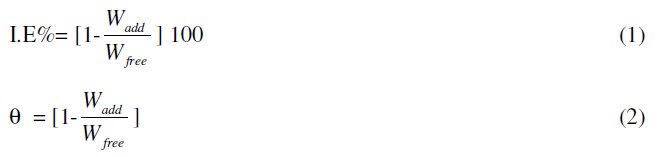
    <p>The percentage inhibition efficiency (I.E%) and the parameter (q) that represents 
the fraction of surface area covered by inhibitor molecules were calculated using 
the following equation</p>

    <p>&nbsp;</p>
<img src="/img/revistas/pea/v29n4/29n4a05e1.jpg">
    
<p>&nbsp;</p>


    <p>where W<sub>add</sub> and W<sub>free</sub> are the weight loss in the presence and the absence of the 
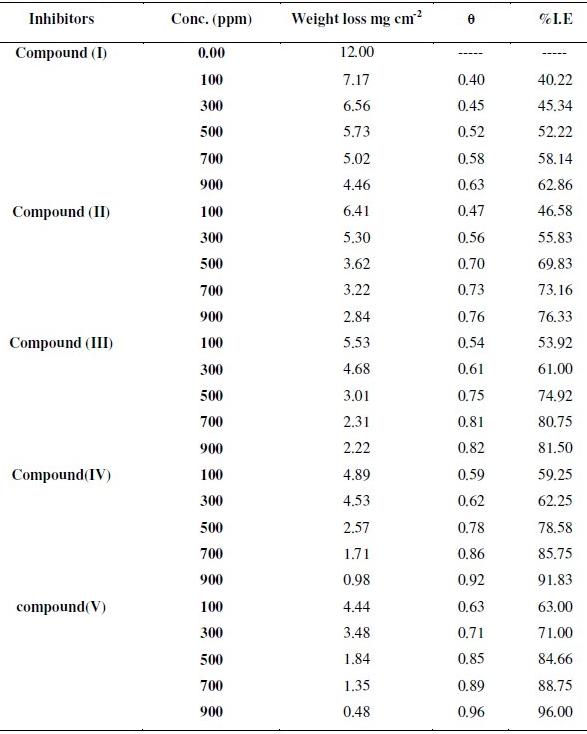
inhibitor. The calculated values of I.E.% and &theta; are listed in Table 1.</p>

    <p>&nbsp;</p>    ]]></body>
<body><![CDATA[<p>Table 1. Effect of ethoxylated fatty ester on the weight loss of copper in 1 M HCl.</p>
<img src="/img/revistas/pea/v29n4/29n4a05t1.jpg">
    
<p>&nbsp;</p>


    <p>It is obvious from Table 1 that the values of I.E. increased with increase of 
inhibitor concentration and the number of ethylene oxide units. The percentage 
inhibition efficiency of these compounds decreases in the following order: 
compound V > IV > III > II > I.</p>
    <p>The results could be explained on the basis of the fact that an increase in the 
concentration of the inhibitor would result in a lowering of the interfacial tension 
at the metal surface. This lowering in the interfacial tension is thought to cause a 
decrease of the bulk concentrations of the inhibitor and an increase in its 
concentration at the metal surface.</p> 

    <p><b><i>Adsorption isotherm</i></b></p>

    <p>The values of surface coverage &theta; 
for different concentrations of the studied 
compounds (I-V) at 25 &deg;C have been used to identify the best isotherm to 
determine the adsorption process. The adsorption of organic adsorbate on the 
surface of copper electrode is regarded as substitutional process between the 
organic compound in the aqueous phase (Org<sub>aq</sub>) and the water molecules 
adsorbed on the copper surface (H<sub>2</sub>O)<sub>ads</sub> [22].</p> 

    <p>&nbsp;</p>
<img src="/img/revistas/pea/v29n4/29n4a05e3.jpg">
    
<p>&nbsp;</p>


    <p>where x is the size ratio, that is the number of water molecules replaced by one 
organic molecule. Attempts were made to fit &theta; values to various isotherms, 
including Langmuir, Freundlich, Temkin and Frumkin isotherms. By far the 
results were best fitted by Temkin adsorption isotherm. The Temkin adsorption 
isotherm is given by the following equation:</p> 

    <p>&nbsp;</p>
<img src="/img/revistas/pea/v29n4/29n4a05e4.jpg">
    
]]></body>
<body><![CDATA[<p>&nbsp;</p>


    <p>where K is the equilibrium constant of the adsorption reaction, C is the inhibitor 
concentration in the bulk of the solution and a is the molecule interaction 
parameters depending upon molecular interactions in the adsorption layer and the 
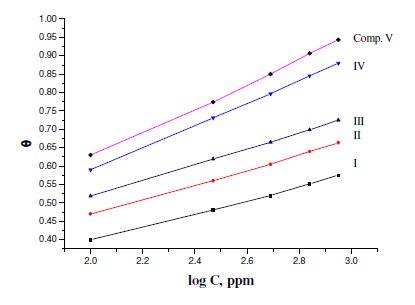
degree of heterogeneity of the metal surface. The plot of &theta; against log C for all 
additives gives straight lines, as shown in Fig. 1. This indicates that these 
compounds are adsorbed on the surface of copper electrode according to Temkin 
adsorption isotherm.</p>

    <p>&nbsp;</p>
    <p><img src="/img/revistas/pea/v29n4/29n4a05f1.jpg"></p>
    
<p><b>Figure 1.</b> Relation between &theta; and the logarithm of the concentration of the inhibitors
(Temkin adsorption isotherm).</p>
    <p>&nbsp;</p>

 
    <p><b><i>Galvanostatic polarization</i></b></p>

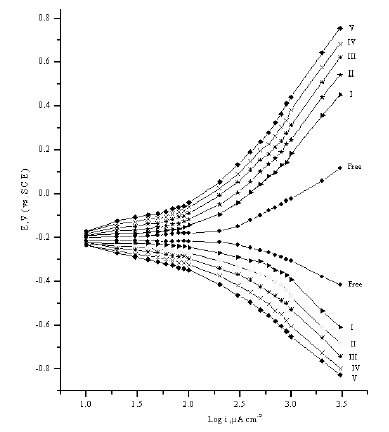
    <p>The effect of addition of ethoxyalted fatty esters on the anodic and cathodic 
polarization curves of copper in 1.0 M HNO<sub>3</sub> solution at 30 &deg;C was studied. The 
effect of increased concentration of compound V is represented in Fig. 2 as an 
example. However, similar curves were obtained for the other compounds (not 
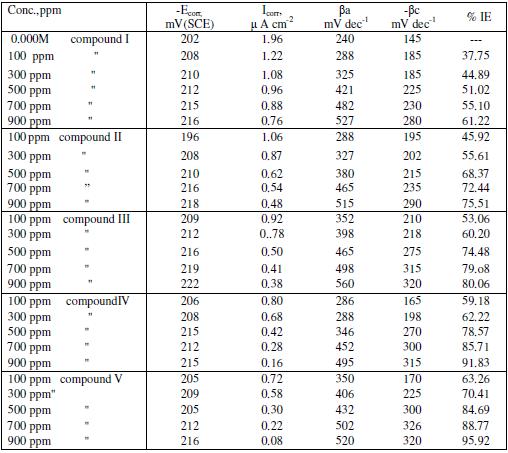
shown). Corrosion parameters such as corrosion potential (E<sub>corr</sub>), corrosion 
current density (I<sub>corr</sub>), cathodic Tafel constant (C), anodic Tafel slope (b<sub>a</sub>) and 
inhibition efficiency (IE), were calculated and given in Table 2.</p>

    <p>&nbsp;</p>
    <p><img src="/img/revistas/pea/v29n4/29n4a05f2.jpg"></p>
    
]]></body>
<body><![CDATA[<p><b>Figure 2.</b> Galvanostatic polarization curves of copper in 1 M HNO<sub>3</sub> alone and
containing different concentrations of compound (V).</p>
    <p>&nbsp;</p>

    <p>&nbsp;</p>    <p><a name="t2"></a><a href="#topt2">Table 2</a>. Electrochemical parameters obtained from galvanostatic polarization curves
of copper electrode in 1 M HNO<sub>3</sub> containing various concentrations of ethoxylated fatty
esters.</p>
<img src="/img/revistas/pea/v29n4/29n4a05t2.jpg">
    
<p>&nbsp;</p>
    <p>The corrosion current density (I<sub>corr</sub>) and corrosion potential (E<sub>corr</sub>) were 
determined by the intersection of the extrapolating anodic and cathodic Tafel 
lines. Inhibition efficiency (IE) was calculated using the following equation:</p> 

    <p>&nbsp;</p>
<img src="/img/revistas/pea/v29n4/29n4a05e5.jpg">
    
<p>&nbsp;</p>


    <p>where I<sub>free</sub> and I<sub>add</sub> are the corrosion current density of copper electrode in the 
absence and in the presence of the inhibitors, respectively.</p>
    <p>Inspection of <a href="#t2">Table 2</a><a name="topt2"></a> shows:</p>
    ]]></body>
<body><![CDATA[<p>An increase in both anodic and cathodic Tafel slopes upon addition of inhibitors 
indicated a mixed anodic and cathodic effect on the corrosion inhibitors 
mechanism [23]. The corrosion potential is almost unaffected, and I<sub>corr</sub> decreased 
when the concentration of ethoxylated fatty esters increased, indicating the 
inhibiting effect of these compounds; the IE increased with increasing of 
additives and number of ethylene oxide units per molecule of the additive. 
The inhibition efficiencies of the five tested compounds measured by the 
polarization method decreased in the following order: compound V > VI > III > II > I.</p>
    <p>This sequence is in accordance with that obtained from weight loss 
measurements.</p>


    <p><b><i>Inhibition of pitting corrosion</i></b></p>

    <p>Potentiodynamic anodic polarization curves of copper electrode were traced in 
solution of 0.1 M HNO<sub>3</sub> + 0.1 M NaCl (as pitting corrosion agent), devoid and 
containing different concentrations of ethoxylated fatty esters, at a scanning rate 
of 1 mV/sec.</p>
    <p>The potential was swept from negative potential towards anodic direction up to 
the pitting potential; no any anodic oxidation peaks are observed in all anodic 
scan. The pitting potential (E<sub>pitt</sub>) was taken as the potential at which the current 
flowing along the passive film increases suddenly to higher values, donating the 
destruction of passive film and initiation of visible pits. The effect of addition of 
increasing concentration of ethoxyalted fatty ester on the values of pitting 
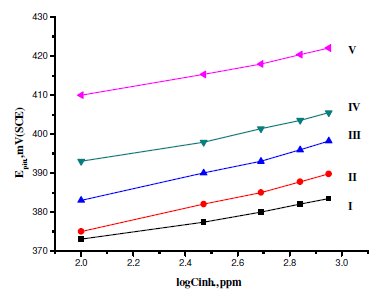
potential is illustrated in Fig. 3. This figure represents the relationship between 
E<sub>pitt</sub> and logarithmic of ppm concentration of additives. It is clear from this figure 
that, as the concentration of additives increases, the pitting potential shifted to 
more positive (noble) direction in according with the following equation:</p>

    <p>&nbsp;</p>
<img src="/img/revistas/pea/v29n4/29n4a05e6.jpg">
    
<p>&nbsp;</p>

  
    <p>where a and b are constants depending on the type of used additives. The 
positive shift of E<sub>pitt</sub> indicates the increased resistance to pitting attack.</p>

    <p>&nbsp;</p>
    <p><img src="/img/revistas/pea/v29n4/29n4a05f3.jpg"></p>
    
]]></body>
<body><![CDATA[<p><b>Figure 3.</b> Relationship between pitting corrosion potential of copper and logarithm of
the concentration of the inhibitors in the presence of 0.001 M NaCl.</p>
    <p>&nbsp;</p>


    <p>At another same inhibitor concentration, the marked shift of pitting potential in 
the noble direction (increased resistance to pitting attack) decreases in the 
following sequence: compound V > VI > III > II > I.</p>
    <p>The different techniques used in this study gave the same order of inhibition 
efficiency but yielded different absolute values, probably due to the different 
experimental details.</p>

    <p>&nbsp;</p>
    <p><b>Conclusions</b></p>
    <p>1-Ethoxylated fatty esters are considered as inhibitors for copper corrosion in 1 
M HNO<sub>3</sub>. The inhibition efficiency was found to increase by increasing the 
inhibitor concentration and number of ethylene oxide units.</p>
    <p>2-The inhibition is due to the adsorption of inhibitor molecules on the copper surface.</p>
    <p>3-The adsorption process follows Temkin adsorption isotherm.</p>
    <p>4-Ethoxylated fatty esters provide protection against pitting corrosion of copper 
in the presence of chloride ions.</p>


    ]]></body>
<body><![CDATA[<p>&nbsp;</p>
    <p><b>References</b></p>
    <!-- ref --><p>1. A. Figual Munoz, J. Garcia Anton, J.L. Guinon, V. Perez Herranz, Electrochim. Acta 50 (2004) 957.    &nbsp;&nbsp;&nbsp;&nbsp;&nbsp;&nbsp;&nbsp;&nbsp;[&#160;<a href="javascript:void(0);" onclick="javascript: window.open('/scielo.php?script=sci_nlinks&ref=000085&pid=S0872-1904201100040000500001&lng=','','width=640,height=500,resizable=yes,scrollbars=1,menubar=yes,');">Links</a>&#160;]<!-- end-ref --></p>
    <!-- ref --><p>2. G.K.Gomma, Mater. Chem. Phys. 56 (1998) 27.    &nbsp;&nbsp;&nbsp;&nbsp;&nbsp;&nbsp;&nbsp;&nbsp;[&#160;<a href="javascript:void(0);" onclick="javascript: window.open('/scielo.php?script=sci_nlinks&ref=000087&pid=S0872-1904201100040000500002&lng=','','width=640,height=500,resizable=yes,scrollbars=1,menubar=yes,');">Links</a>&#160;]<!-- end-ref --></p>
    <!-- ref --><p>3. A.S. Fouda, A. Abd El-Aal, A.B. Kandil, Desalination 201 (2006) 216.    &nbsp;&nbsp;&nbsp;&nbsp;&nbsp;&nbsp;&nbsp;&nbsp;[&#160;<a href="javascript:void(0);" onclick="javascript: window.open('/scielo.php?script=sci_nlinks&ref=000089&pid=S0872-1904201100040000500003&lng=','','width=640,height=500,resizable=yes,scrollbars=1,menubar=yes,');">Links</a>&#160;]<!-- end-ref --></p>
    <!-- ref --><p>4. K.F. Khaled, Appl. Surf. Sci. 255 (2008) 1811.    &nbsp;&nbsp;&nbsp;&nbsp;&nbsp;&nbsp;&nbsp;&nbsp;[&#160;<a href="javascript:void(0);" onclick="javascript: window.open('/scielo.php?script=sci_nlinks&ref=000091&pid=S0872-1904201100040000500004&lng=','','width=640,height=500,resizable=yes,scrollbars=1,menubar=yes,');">Links</a>&#160;]<!-- end-ref --></p>
    ]]></body>
<body><![CDATA[<!-- ref --><p>5. E.M. Sherif, Appl. Surf. Sci. 252 (2006) 8615.    &nbsp;&nbsp;&nbsp;&nbsp;&nbsp;&nbsp;&nbsp;&nbsp;[&#160;<a href="javascript:void(0);" onclick="javascript: window.open('/scielo.php?script=sci_nlinks&ref=000093&pid=S0872-1904201100040000500005&lng=','','width=640,height=500,resizable=yes,scrollbars=1,menubar=yes,');">Links</a>&#160;]<!-- end-ref --></p> 
    <!-- ref --><p>6. E. Galer, D.S. Azambuja, Corros. Sci. 42 (2000) 631.    &nbsp;&nbsp;&nbsp;&nbsp;&nbsp;&nbsp;&nbsp;&nbsp;[&#160;<a href="javascript:void(0);" onclick="javascript: window.open('/scielo.php?script=sci_nlinks&ref=000095&pid=S0872-1904201100040000500006&lng=','','width=640,height=500,resizable=yes,scrollbars=1,menubar=yes,');">Links</a>&#160;]<!-- end-ref --></p>
    <p>7. Y.M. Tang, W.Z. Yang, Y.S. Yin, Y. Liu, R. Wan, J.T. Wang, Mater. Chem. Phys. 116 (2009) 479.</p>
    <!-- ref --><p>8. L.H. Madkour, M.A. Elmorsi, M.M. Ghoneim, Monatshefte Fur Chemie 126 (1995) 1087.    &nbsp;&nbsp;&nbsp;&nbsp;&nbsp;&nbsp;&nbsp;&nbsp;[&#160;<a href="javascript:void(0);" onclick="javascript: window.open('/scielo.php?script=sci_nlinks&ref=000098&pid=S0872-1904201100040000500008&lng=','','width=640,height=500,resizable=yes,scrollbars=1,menubar=yes,');">Links</a>&#160;]<!-- end-ref --></p>
    <!-- ref --><p>9. E. Abelev, D. Staeosvetsky, Y. Ein. Eli, Electrochim Acta 52 (2007) 1975.    &nbsp;&nbsp;&nbsp;&nbsp;&nbsp;&nbsp;&nbsp;&nbsp;[&#160;<a href="javascript:void(0);" onclick="javascript: window.open('/scielo.php?script=sci_nlinks&ref=000100&pid=S0872-1904201100040000500009&lng=','','width=640,height=500,resizable=yes,scrollbars=1,menubar=yes,');">Links</a>&#160;]<!-- end-ref --></p>
    <!-- ref --><p>10. E.M. Sherif, S.M. Park, Corros. Sci. 48 (2006) 4065.    &nbsp;&nbsp;&nbsp;&nbsp;&nbsp;&nbsp;&nbsp;&nbsp;[&#160;<a href="javascript:void(0);" onclick="javascript: window.open('/scielo.php?script=sci_nlinks&ref=000102&pid=S0872-1904201100040000500010&lng=','','width=640,height=500,resizable=yes,scrollbars=1,menubar=yes,');">Links</a>&#160;]<!-- end-ref --></p>
    <!-- ref --><p>11. A.A. El-Warraky, Ant. Corros. Methods and Mater. 50 (2003) 40.    &nbsp;&nbsp;&nbsp;&nbsp;&nbsp;&nbsp;&nbsp;&nbsp;[&#160;<a href="javascript:void(0);" onclick="javascript: window.open('/scielo.php?script=sci_nlinks&ref=000104&pid=S0872-1904201100040000500011&lng=','','width=640,height=500,resizable=yes,scrollbars=1,menubar=yes,');">Links</a>&#160;]<!-- end-ref --></p>
    <!-- ref --><p>12. E. Szocs, Gy Vastag, A. Shaban, E. Kalman, Corros. Sci. 47 (2005) 893.    &nbsp;&nbsp;&nbsp;&nbsp;&nbsp;&nbsp;&nbsp;&nbsp;[&#160;<a href="javascript:void(0);" onclick="javascript: window.open('/scielo.php?script=sci_nlinks&ref=000106&pid=S0872-1904201100040000500012&lng=','','width=640,height=500,resizable=yes,scrollbars=1,menubar=yes,');">Links</a>&#160;]<!-- end-ref --></p>
    <p>13. M.M. Antonijevic, M.B. Petravic, Int. J. Electrochem. Sci. 3 (2008).</p>
    <!-- ref --><p>14. S.T. Keera, M.A. Deyab, Colloids Surf. A.: Physicochem. Eng. Aspects 266 (2005)129.    &nbsp;&nbsp;&nbsp;&nbsp;&nbsp;&nbsp;&nbsp;&nbsp;[&#160;<a href="javascript:void(0);" onclick="javascript: window.open('/scielo.php?script=sci_nlinks&ref=000109&pid=S0872-1904201100040000500014&lng=','','width=640,height=500,resizable=yes,scrollbars=1,menubar=yes,');">Links</a>&#160;]<!-- end-ref --></p>
    <!-- ref --><p>15. I.A. Aiad, N. Negam, J. Surfact. Deterg. 12 (2009) 213.    &nbsp;&nbsp;&nbsp;&nbsp;&nbsp;&nbsp;&nbsp;&nbsp;[&#160;<a href="javascript:void(0);" onclick="javascript: window.open('/scielo.php?script=sci_nlinks&ref=000111&pid=S0872-1904201100040000500015&lng=','','width=640,height=500,resizable=yes,scrollbars=1,menubar=yes,');">Links</a>&#160;]<!-- end-ref --></p>
    ]]></body>
<body><![CDATA[<!-- ref --><p>16. W.Wang, M.L. Free, Corros. Sci. 46 (2004) 2601.    &nbsp;&nbsp;&nbsp;&nbsp;&nbsp;&nbsp;&nbsp;&nbsp;[&#160;<a href="javascript:void(0);" onclick="javascript: window.open('/scielo.php?script=sci_nlinks&ref=000113&pid=S0872-1904201100040000500016&lng=','','width=640,height=500,resizable=yes,scrollbars=1,menubar=yes,');">Links</a>&#160;]<!-- end-ref --></p>
    <!-- ref --><p>17. M. Abdallah, A.Y. El-Etre, M.F. Moustafa, Port. Electrochim. Acta 27 (2009) 615.    &nbsp;&nbsp;&nbsp;&nbsp;&nbsp;&nbsp;&nbsp;&nbsp;[&#160;<a href="javascript:void(0);" onclick="javascript: window.open('/scielo.php?script=sci_nlinks&ref=000115&pid=S0872-1904201100040000500017&lng=','','width=640,height=500,resizable=yes,scrollbars=1,menubar=yes,');">Links</a>&#160;]<!-- end-ref --></p>
    <!-- ref --><p>18. M. Abdallah, Corros. Sci. 45 (2003) 2705.    &nbsp;&nbsp;&nbsp;&nbsp;&nbsp;&nbsp;&nbsp;&nbsp;[&#160;<a href="javascript:void(0);" onclick="javascript: window.open('/scielo.php?script=sci_nlinks&ref=000117&pid=S0872-1904201100040000500018&lng=','','width=640,height=500,resizable=yes,scrollbars=1,menubar=yes,');">Links</a>&#160;]<!-- end-ref --></p>
    <!-- ref --><p>19. P.B. Mathur, T. Vaudencan, Corrosion 38 (1982) 171.    &nbsp;&nbsp;&nbsp;&nbsp;&nbsp;&nbsp;&nbsp;&nbsp;[&#160;<a href="javascript:void(0);" onclick="javascript: window.open('/scielo.php?script=sci_nlinks&ref=000119&pid=S0872-1904201100040000500019&lng=','','width=640,height=500,resizable=yes,scrollbars=1,menubar=yes,');">Links</a>&#160;]<!-- end-ref --></p>
    <!-- ref --><p>20. S.M. Abd El-Haleem, A.A. Abdel Fattah, W. Tayor, Res. Mech. 30 (1985) 333.    &nbsp;&nbsp;&nbsp;&nbsp;&nbsp;&nbsp;&nbsp;&nbsp;[&#160;<a href="javascript:void(0);" onclick="javascript: window.open('/scielo.php?script=sci_nlinks&ref=000121&pid=S0872-1904201100040000500020&lng=','','width=640,height=500,resizable=yes,scrollbars=1,menubar=yes,');">Links</a>&#160;]<!-- end-ref --></p>
    ]]></body>
<body><![CDATA[<p>21. A. Cacia, Y. Barakat, S.R. Scheetes, W.H. Wide, S.Yin, J. Colloid Interface Sci. 89 (1982) 219.</p>
    <!-- ref --><p>22. G. Moretti, G. Quartarone, A. Tassan, A. Zingales, Werkst. Korros. 95 (1994) 641.    &nbsp;&nbsp;&nbsp;&nbsp;&nbsp;&nbsp;&nbsp;&nbsp;[&#160;<a href="javascript:void(0);" onclick="javascript: window.open('/scielo.php?script=sci_nlinks&ref=000124&pid=S0872-1904201100040000500022&lng=','','width=640,height=500,resizable=yes,scrollbars=1,menubar=yes,');">Links</a>&#160;]<!-- end-ref --></p>
    <!-- ref --><p>23. F. Hanna, G.M. Sherbini, Y. Barakat, Br. Corros. J. 24 (1989) 269.    &nbsp;&nbsp;&nbsp;&nbsp;&nbsp;&nbsp;&nbsp;&nbsp;[&#160;<a href="javascript:void(0);" onclick="javascript: window.open('/scielo.php?script=sci_nlinks&ref=000126&pid=S0872-1904201100040000500023&lng=','','width=640,height=500,resizable=yes,scrollbars=1,menubar=yes,');">Links</a>&#160;]<!-- end-ref --></p>
    <p>&nbsp;</p>
    <p><Sup><a name="0"></a><a href="#top0">*</a></Sup>Corresponding author. E-mail address <a href="mailto:helmymegahed@yahoo.com ">helmymegahed@yahoo.com </a></p>
    <p>&nbsp;</p>    <p>Received 17 April 2011; accepted17 May 2011</p>
     ]]></body><back>
<ref-list>
<ref id="B1">
<label>1</label><nlm-citation citation-type="journal">
<person-group person-group-type="author">
<name>
<surname><![CDATA[Figual Munoz]]></surname>
<given-names><![CDATA[A.]]></given-names>
</name>
<name>
<surname><![CDATA[Garcia Anton]]></surname>
<given-names><![CDATA[J.]]></given-names>
</name>
<name>
<surname><![CDATA[Guinon]]></surname>
<given-names><![CDATA[J.L.]]></given-names>
</name>
<name>
<surname><![CDATA[Perez Herranz]]></surname>
<given-names><![CDATA[V.]]></given-names>
</name>
</person-group>
<source><![CDATA[Electrochim. Acta]]></source>
<year>2004</year>
<volume>50</volume>
<page-range>957</page-range></nlm-citation>
</ref>
<ref id="B2">
<label>2</label><nlm-citation citation-type="journal">
<person-group person-group-type="author">
<name>
<surname><![CDATA[Gomma]]></surname>
<given-names><![CDATA[G.K.]]></given-names>
</name>
</person-group>
<source><![CDATA[Mater. Chem. Phys.]]></source>
<year>1998</year>
<volume>56</volume>
<page-range>27</page-range></nlm-citation>
</ref>
<ref id="B3">
<label>3</label><nlm-citation citation-type="journal">
<person-group person-group-type="author">
<name>
<surname><![CDATA[Fouda]]></surname>
<given-names><![CDATA[A.S.]]></given-names>
</name>
<name>
<surname><![CDATA[Abd El-Aal]]></surname>
<given-names><![CDATA[A.]]></given-names>
</name>
<name>
<surname><![CDATA[Kandil]]></surname>
<given-names><![CDATA[A.B.]]></given-names>
</name>
</person-group>
<source><![CDATA[Desalination]]></source>
<year>2006</year>
<volume>201</volume>
<page-range>216</page-range></nlm-citation>
</ref>
<ref id="B4">
<label>4</label><nlm-citation citation-type="journal">
<person-group person-group-type="author">
<name>
<surname><![CDATA[Khaled]]></surname>
<given-names><![CDATA[K.F.]]></given-names>
</name>
</person-group>
<source><![CDATA[Appl. Surf. Sci.]]></source>
<year>2008</year>
<volume>255</volume>
<page-range>1811</page-range></nlm-citation>
</ref>
<ref id="B5">
<label>5</label><nlm-citation citation-type="journal">
<person-group person-group-type="author">
<name>
<surname><![CDATA[Sherif]]></surname>
<given-names><![CDATA[E.M.]]></given-names>
</name>
</person-group>
<source><![CDATA[Appl. Surf. Sci.]]></source>
<year>2006</year>
<volume>252</volume>
<page-range>8615</page-range></nlm-citation>
</ref>
<ref id="B6">
<label>6</label><nlm-citation citation-type="journal">
<person-group person-group-type="author">
<name>
<surname><![CDATA[Galer]]></surname>
<given-names><![CDATA[E.]]></given-names>
</name>
<name>
<surname><![CDATA[Azambuja]]></surname>
<given-names><![CDATA[D.S.]]></given-names>
</name>
</person-group>
<source><![CDATA[Corros. Sci.]]></source>
<year>2000</year>
<volume>42</volume>
<page-range>631</page-range></nlm-citation>
</ref>
<ref id="B7">
<label>7</label><nlm-citation citation-type="journal">
<person-group person-group-type="author">
<name>
<surname><![CDATA[Tang]]></surname>
<given-names><![CDATA[Y.M.]]></given-names>
</name>
<name>
<surname><![CDATA[Yang]]></surname>
<given-names><![CDATA[W.Z.]]></given-names>
</name>
<name>
<surname><![CDATA[Yin]]></surname>
<given-names><![CDATA[Y.S.]]></given-names>
</name>
</person-group>
<source><![CDATA[Mater. Chem. Phys.]]></source>
<year>2009</year>
<volume>116</volume>
<page-range>479</page-range></nlm-citation>
</ref>
<ref id="B8">
<label>8</label><nlm-citation citation-type="journal">
<person-group person-group-type="author">
<name>
<surname><![CDATA[Madkour]]></surname>
<given-names><![CDATA[L.H.]]></given-names>
</name>
<name>
<surname><![CDATA[Elmorsi]]></surname>
<given-names><![CDATA[M.A.]]></given-names>
</name>
<name>
<surname><![CDATA[Ghoneim]]></surname>
<given-names><![CDATA[M.M.]]></given-names>
</name>
</person-group>
<source><![CDATA[Monatshefte Fur Chemie]]></source>
<year>1995</year>
<volume>126</volume>
<page-range>1087</page-range></nlm-citation>
</ref>
<ref id="B9">
<label>9</label><nlm-citation citation-type="journal">
<person-group person-group-type="author">
<name>
<surname><![CDATA[Abelev]]></surname>
<given-names><![CDATA[E.]]></given-names>
</name>
<name>
<surname><![CDATA[Staeosvetsky]]></surname>
<given-names><![CDATA[D.]]></given-names>
</name>
<name>
<surname><![CDATA[Ein. Eli]]></surname>
<given-names><![CDATA[Y.]]></given-names>
</name>
</person-group>
<source><![CDATA[Electrochim Acta]]></source>
<year>2007</year>
<volume>52</volume>
<page-range>1975</page-range></nlm-citation>
</ref>
<ref id="B10">
<label>10</label><nlm-citation citation-type="journal">
<person-group person-group-type="author">
<name>
<surname><![CDATA[Sherif]]></surname>
<given-names><![CDATA[E.M.]]></given-names>
</name>
<name>
<surname><![CDATA[Park]]></surname>
<given-names><![CDATA[S.M.]]></given-names>
</name>
</person-group>
<source><![CDATA[Corros. Sci.]]></source>
<year>2006</year>
<volume>48</volume>
<page-range>4065</page-range></nlm-citation>
</ref>
<ref id="B11">
<label>11</label><nlm-citation citation-type="journal">
<person-group person-group-type="author">
<name>
<surname><![CDATA[El-Warraky]]></surname>
<given-names><![CDATA[A.A.]]></given-names>
</name>
</person-group>
<source><![CDATA[Ant. Corros. Methods and Mater.]]></source>
<year>2003</year>
<volume>50</volume>
<page-range>40</page-range></nlm-citation>
</ref>
<ref id="B12">
<label>12</label><nlm-citation citation-type="journal">
<person-group person-group-type="author">
<name>
<surname><![CDATA[Szocs]]></surname>
<given-names><![CDATA[E.]]></given-names>
</name>
<name>
<surname><![CDATA[Vastag]]></surname>
<given-names><![CDATA[Gy]]></given-names>
</name>
<name>
<surname><![CDATA[Shaban]]></surname>
<given-names><![CDATA[A.]]></given-names>
</name>
<name>
<surname><![CDATA[Kalman]]></surname>
<given-names><![CDATA[E.]]></given-names>
</name>
</person-group>
<source><![CDATA[Corros. Sci.]]></source>
<year>2005</year>
<volume>47</volume>
<page-range>893</page-range></nlm-citation>
</ref>
<ref id="B13">
<label>13</label><nlm-citation citation-type="journal">
<person-group person-group-type="author">
<name>
<surname><![CDATA[Antonijevic]]></surname>
<given-names><![CDATA[M.M.]]></given-names>
</name>
<name>
<surname><![CDATA[Petravic]]></surname>
<given-names><![CDATA[M.B.]]></given-names>
</name>
</person-group>
<source><![CDATA[Int. J. Electrochem. Sci.]]></source>
<year>2008</year>
<volume>3</volume>
<page-range>1</page-range></nlm-citation>
</ref>
<ref id="B14">
<label>14</label><nlm-citation citation-type="journal">
<person-group person-group-type="author">
<name>
<surname><![CDATA[Keera]]></surname>
<given-names><![CDATA[S.T.]]></given-names>
</name>
<name>
<surname><![CDATA[Deyab]]></surname>
<given-names><![CDATA[M.A.]]></given-names>
</name>
</person-group>
<source><![CDATA[Colloids Surf. A.: Physicochem. Eng. Aspects]]></source>
<year>2005</year>
<volume>266</volume>
<page-range>129</page-range></nlm-citation>
</ref>
<ref id="B15">
<label>15</label><nlm-citation citation-type="journal">
<person-group person-group-type="author">
<name>
<surname><![CDATA[Aiad]]></surname>
<given-names><![CDATA[I.A.]]></given-names>
</name>
<name>
<surname><![CDATA[Negam]]></surname>
<given-names><![CDATA[N.]]></given-names>
</name>
</person-group>
<source><![CDATA[J. Surfact. Deterg.]]></source>
<year>2009</year>
<volume>12</volume>
<page-range>213</page-range></nlm-citation>
</ref>
<ref id="B16">
<label>16</label><nlm-citation citation-type="journal">
<person-group person-group-type="author">
<name>
<surname><![CDATA[Wang]]></surname>
<given-names><![CDATA[W.]]></given-names>
</name>
<name>
<surname><![CDATA[Free]]></surname>
<given-names><![CDATA[M.L.]]></given-names>
</name>
</person-group>
<source><![CDATA[Corros. Sci.]]></source>
<year>2004</year>
<volume>46</volume>
<page-range>2601</page-range></nlm-citation>
</ref>
<ref id="B17">
<label>17</label><nlm-citation citation-type="journal">
<person-group person-group-type="author">
<name>
<surname><![CDATA[Abdallah]]></surname>
<given-names><![CDATA[M.]]></given-names>
</name>
<name>
<surname><![CDATA[El-Etre]]></surname>
<given-names><![CDATA[A.Y.]]></given-names>
</name>
<name>
<surname><![CDATA[Moustafa]]></surname>
<given-names><![CDATA[M.F.]]></given-names>
</name>
</person-group>
<source><![CDATA[Port. Electrochim. Acta]]></source>
<year>2009</year>
<volume>27</volume>
<page-range>615</page-range></nlm-citation>
</ref>
<ref id="B18">
<label>18</label><nlm-citation citation-type="journal">
<person-group person-group-type="author">
<name>
<surname><![CDATA[Abdallah]]></surname>
<given-names><![CDATA[M.]]></given-names>
</name>
</person-group>
<source><![CDATA[Corros. Sci.]]></source>
<year>2003</year>
<volume>45</volume>
<page-range>2705</page-range></nlm-citation>
</ref>
<ref id="B19">
<label>19</label><nlm-citation citation-type="journal">
<person-group person-group-type="author">
<name>
<surname><![CDATA[Mathur]]></surname>
<given-names><![CDATA[P.B.]]></given-names>
</name>
<name>
<surname><![CDATA[Vaudencan]]></surname>
<given-names><![CDATA[T.]]></given-names>
</name>
</person-group>
<source><![CDATA[Corrosion]]></source>
<year>1982</year>
<volume>38</volume>
<page-range>171</page-range></nlm-citation>
</ref>
<ref id="B20">
<label>20</label><nlm-citation citation-type="journal">
<person-group person-group-type="author">
<name>
<surname><![CDATA[Abd El-Haleem]]></surname>
<given-names><![CDATA[S.M.]]></given-names>
</name>
<name>
<surname><![CDATA[Abdel Fattah]]></surname>
<given-names><![CDATA[A.A.]]></given-names>
</name>
<name>
<surname><![CDATA[Tayor]]></surname>
<given-names><![CDATA[W.]]></given-names>
</name>
</person-group>
<source><![CDATA[Res. Mech.]]></source>
<year>1985</year>
<volume>30</volume>
<page-range>333</page-range></nlm-citation>
</ref>
<ref id="B21">
<label>21</label><nlm-citation citation-type="journal">
<person-group person-group-type="author">
<name>
<surname><![CDATA[Cacia]]></surname>
<given-names><![CDATA[A.]]></given-names>
</name>
<name>
<surname><![CDATA[Barakat]]></surname>
<given-names><![CDATA[Y.]]></given-names>
</name>
<name>
<surname><![CDATA[Scheetes]]></surname>
<given-names><![CDATA[S.R.]]></given-names>
</name>
</person-group>
<source><![CDATA[J. Colloid Interface Sci.]]></source>
<year>1982</year>
<volume>89</volume>
<page-range>219</page-range></nlm-citation>
</ref>
<ref id="B22">
<label>22</label><nlm-citation citation-type="journal">
<person-group person-group-type="author">
<name>
<surname><![CDATA[Moretti]]></surname>
<given-names><![CDATA[G.]]></given-names>
</name>
<name>
<surname><![CDATA[Quartarone]]></surname>
<given-names><![CDATA[G.]]></given-names>
</name>
<name>
<surname><![CDATA[Tassan]]></surname>
<given-names><![CDATA[A.]]></given-names>
</name>
<name>
<surname><![CDATA[Zingales]]></surname>
<given-names><![CDATA[A.]]></given-names>
</name>
</person-group>
<source><![CDATA[Werkst. Korros.]]></source>
<year>1994</year>
<volume>95</volume>
<page-range>641</page-range></nlm-citation>
</ref>
<ref id="B23">
<label>23</label><nlm-citation citation-type="journal">
<person-group person-group-type="author">
<name>
<surname><![CDATA[Hanna]]></surname>
<given-names><![CDATA[F.]]></given-names>
</name>
<name>
<surname><![CDATA[Sherbini]]></surname>
<given-names><![CDATA[G.M.]]></given-names>
</name>
<name>
<surname><![CDATA[Barakat]]></surname>
<given-names><![CDATA[Y.]]></given-names>
</name>
</person-group>
<source><![CDATA[Br. Corros. J.]]></source>
<year>1989</year>
<volume>24</volume>
<page-range>269</page-range></nlm-citation>
</ref>
</ref-list>
</back>
</article>