<?xml version="1.0" encoding="ISO-8859-1"?><article xmlns:mml="http://www.w3.org/1998/Math/MathML" xmlns:xlink="http://www.w3.org/1999/xlink" xmlns:xsi="http://www.w3.org/2001/XMLSchema-instance">
<front>
<journal-meta>
<journal-id>0872-1904</journal-id>
<journal-title><![CDATA[Portugaliae Electrochimica Acta]]></journal-title>
<abbrev-journal-title><![CDATA[Port. Electrochim. Acta]]></abbrev-journal-title>
<issn>0872-1904</issn>
<publisher>
<publisher-name><![CDATA[Sociedade Portuguesa de Electroquímica]]></publisher-name>
</publisher>
</journal-meta>
<article-meta>
<article-id>S0872-19042011000400006</article-id>
<title-group>
<article-title xml:lang="en"><![CDATA[Corrosion Behaviour of Stainless Steel 304 Electroplated with Zinc Followed by Blue Passivation]]></article-title>
</title-group>
<contrib-group>
<contrib contrib-type="author">
<name>
<surname><![CDATA[Sherine]]></surname>
<given-names><![CDATA[H.B.]]></given-names>
</name>
<xref ref-type="aff" rid="A01"/>
</contrib>
<contrib contrib-type="author">
<name>
<surname><![CDATA[Rajakumari]]></surname>
<given-names><![CDATA[C.C.]]></given-names>
</name>
<xref ref-type="aff" rid="A01"/>
</contrib>
<contrib contrib-type="author">
<name>
<surname><![CDATA[Rajendran]]></surname>
<given-names><![CDATA[S.]]></given-names>
</name>
<xref ref-type="aff" rid="A02"/>
</contrib>
</contrib-group>
<aff id="A01">
<institution><![CDATA[,Holy Cross College Department of Chemistry ]]></institution>
<addr-line><![CDATA[Tamilnadu ]]></addr-line>
<country>India</country>
</aff>
<aff id="A02">
<institution><![CDATA[,GTN Arts College Department of Chemistry ]]></institution>
<addr-line><![CDATA[Tamilnadu ]]></addr-line>
<country>India</country>
</aff>
<pub-date pub-type="pub">
<day>00</day>
<month>00</month>
<year>2011</year>
</pub-date>
<pub-date pub-type="epub">
<day>00</day>
<month>00</month>
<year>2011</year>
</pub-date>
<volume>29</volume>
<numero>4</numero>
<fpage>295</fpage>
<lpage>305</lpage>
<copyright-statement/>
<copyright-year/>
<self-uri xlink:href="http://scielo.pt/scielo.php?script=sci_arttext&amp;pid=S0872-19042011000400006&amp;lng=en&amp;nrm=iso"></self-uri><self-uri xlink:href="http://scielo.pt/scielo.php?script=sci_abstract&amp;pid=S0872-19042011000400006&amp;lng=en&amp;nrm=iso"></self-uri><self-uri xlink:href="http://scielo.pt/scielo.php?script=sci_pdf&amp;pid=S0872-19042011000400006&amp;lng=en&amp;nrm=iso"></self-uri><abstract abstract-type="short" xml:lang="en"><p><![CDATA[The corrosion resistance of three stainless steel materials, namely, stainless steel (SS), stainless steel electroplated with zinc (SS-Zn) and stainless steel electroplated with zinc followed by blue passivation (BP), has been evaluated in an aqueous solution containing 3.5% NaCl. A potentiodynamic polarization study and AC impedance spectra have been used to investigate the corrosion behaviour of these metals. The corrosion resistance of these materials in 3.5% NaCl increased in the following order: SS>SS+Zn+BP>SS+Zn.]]></p></abstract>
<kwd-group>
<kwd lng="en"><![CDATA[decolourisation]]></kwd>
<kwd lng="en"><![CDATA[corrosion prevention]]></kwd>
<kwd lng="en"><![CDATA[electroplating]]></kwd>
<kwd lng="en"><![CDATA[blue passivation]]></kwd>
</kwd-group>
</article-meta>
</front><body><![CDATA[  

    <p><b>Corrosion Behaviour of Stainless Steel 304 Electroplated with Zinc Followed by Blue Passivation</b></p>
     <p>&nbsp;</p>
    <p><b>H.B. Sherine<sup><a href="#0">*</a><a name="top0"></a>,1</sup>, C.C. Rajakumari<sup>1</sup> and S. Rajendran<sup>2</sup></b></p>


    <p><sup>1</sup><i>Department of Chemistry, Holy Cross College, Tiruchirappalli - 620 002, Tamilnadu, India</i></p>
    <p><sup>2</sup><i>Department of Chemistry, GTN Arts College, Dindigul - 624 005, Tamilnadu, India</i></p>

     <p>&nbsp;</p>
    <p><b>Abstract</b></p>
    <p>The corrosion resistance of three stainless steel materials, namely, stainless steel (SS), 
stainless steel electroplated with zinc (SS-Zn) and stainless steel electroplated with zinc 
followed by blue passivation (BP), has been evaluated in an aqueous solution containing 
3.5% NaCl. A potentiodynamic polarization study and AC impedance spectra have been 
used to investigate the corrosion behaviour of these metals. The corrosion resistance of 
these materials in 3.5% NaCl increased in the following order: SS>SS+Zn+BP>SS+Zn.</p>

    <p><b><i>Keywords:</i></b> decolourisation, corrosion prevention, electroplating, blue passivation.</p>

    ]]></body>
<body><![CDATA[<p>&nbsp;</p>
    <p><b>Introduction</b></p>
    <p>The development of the chemical, fertilizer, petrochemical, refining and energy 
industries depends in most cases, on resolving the problems associated with the 
use and maintenance of stainless steel [1]. The most important problem faced 
with the use of stainless steel is intergranular corrosion (IGC). The IGC resistant 
stainless steel was achieved by stabilizing the characteristics of the steel 
decreasing its percentage of carbon to a very low level [2]. Characterization of 
oxide films formed on metals and alloys has been subject of study for many 
years, because the physical and chemical properties of oxide films can alter the 
mechanism and kinetics of the corrosion processes [3-5]. Particularly, the 
characteristics of oxide films formed on type 304 stainless steel and carbon steel 
as nuclear power plant materials have been subject of investigations, to 
understand environment related materials failure problems. Intergranular stress 
corrosion cracking (IGSCC) of Type 304 stainless steel has been a major concern 
in boiling water reactors undergoing normal water containing 100 to 300 ppb of 
oxygen, 200 to 500 ppb of H<sub>2</sub>O<sub>2</sub> and &lt; 10 ppb of hydrogen. Self-organized 
porous structures produced by anodization of metals or semiconductors have 
attracted much attention regarding applications [6-14]. The composite 
electroplating allows to co-deposit fine particles of metallic or non-metallic 
compounds into plated layers to improve the surface properties and compare the 
performance of pure nickel and Ni-SiC nanostructured composite coatings, and 
the results indicated that the co-deposition of nickel and SiC nano particles leads 
to uniform deposits possessing better abrasion, wear and corrosion properties 
[15].</p>
    <p>The present study is undertaken (i) to electroplate zinc on stainless steel surface 
in an electroplating unit, using zinc anode and a bath containing zinc chloride, 
potassium chloride and boric acid; (ii) to do blue passivation on the zinc plated 
carbon steel surface; (iii) to study the corrosion resistance behaviour of the above 
electroplated surface (a) by immersing it in an aqueous solution containing 3.5 % 
of NaCl, (b) by placing a drop of CuSO<sub>4</sub> solution on the metal surface, and (c) by 
polarization study, AC impedance spectroscopy and cyclic voltammetry; and (iv) 
to decolourise methyl orange solution using (a) stainless steel, (b) stainless steel 
electroplated with zinc, and (c) stainless steel electroplated with zinc followed by 
blue passivation.</p>

    <p>&nbsp;</p>
    <p><b>Experimental</b></p>
    <p><b><i>Preparation of the specimen</i></b></p>
    <p>Three metal specimens, namely, stainless steel (SS 304), stainless steel coated 
with zinc, and stainless steel coated with zinc followed by blue passivation, were 
chosen for the present study. Stainless steel and stainless steel coated with zinc 
are compared with stainless steel coated with zinc followed by blue passivation. 
The composition of SS 304 was (wt%) 10 Cr, 8 Ni, 0.80 Mn, 0.044 C, 0.0025 P, 
0.0015 S and the balance iron [16], and specimens with the dimensions of 
1.0&times;4.0&times;0.2 cm were used for electroplating and to measure the corrosion 
resistivity of the metal surface by weight loss method.</p>


    <p><b><i>Method of electrodeposition</i></b></p>
    <p>The process of electroplating the stainless steel specimens involves pickling with 
con. HCl (16 N), washing with distilled water, drying, polishing, degreasing with 
cleaning powder containing soda, chalk and nice emery powder, drying and 
immersing in bath solution. The composition of the bath solution for zinc plating 
was ZnCl<sub>2</sub> (100 g/L), KCl (225 g/L), H<sub>3</sub>BO<sub>3</sub> (40 g/L). For electrodeposition, pure 
zinc plate acts as anode and stainless steel specimen acts as cathode. The process 
was carried out at room temperature (35 ÂºC) and no agitation of the bath solution 
is required. DC current was passed for the required time (5 minutes). After 
electrodeposition the specimen was washed with water and dried [17]. 
The composition of the post treatment bath solution for blue passivation was 200 
g of sodium dichromate and 5 g of KCr(SO<sub>4</sub>)<sub>2</sub>.12H<sub>2</sub>O (chrome alum). 4 g of this 
mixture were dissolved in 10 mL of nitric acid and made upto 1 litre with water. 
The zinc plated stainless steel was immersed in the blue passivation bath for one 
minute. Then the metal specimens were dried.</p> 

    ]]></body>
<body><![CDATA[<p><b><i>Measurement of corrosion resistance of the electroplated metal surface</i></b></p> 
    <p>The following studies were used to measure the corrosion protective nature of the 
film formed on the stainless steel surface after electroplating.</p>


    <p><b><i>Immersion in chloride environment</i></b></p>
    <p>The metal specimens in triplicate were immersed in 100 mL of an aqueous 
solution containing 3.5% of NaCl for a period of one day. The weights of the 
specimens before and after immersion were determined using a digital balance. </p>
    <p>The corrosion rate (CR) was calculated using the equation</p>

    <p>&nbsp;</p>
<img src="/img/revistas/pea/v29n4/29n4a06e1.jpg">
    
<p>&nbsp;</p>


    <p><b><i>Action of 1% copper sulphate solution</i></b></p>
    <p>One drop of 1% copper sulphate solution was placed on the surface of the metal. 
The time taken for the formation of a red solution was measured, because it is an 
indication of the rate of electron transfer (corrosion process) from the iron to the 
Cu<sup>2+</sup> ion on the metal surface.</p>

    <p><b><i>Potentiodynamic polarization study</i></b></p>
    ]]></body>
<body><![CDATA[<p>Polarization study was carried out in H&CH electrochemical workstation 
impedance Analyzer Model CHI 660A provided with iR compensation facility, 
using a three electrode cell assembly. Stainless steel(SS), stainless steel coated 
with zinc (SS+Zn), or stainless steel electroplated with zinc followed by blue 
passivation (SS+Zn+BP), were used as working electrode, platinum as counter 
electrode and saturated calomel electrode (SCE) as reference electrode. The 
corrosion parameters such as linear polarization resistance (LPR), corrosion 
potential (E<sub>corr</sub>)), corrosion current( I<sub>corr</sub>) and Tafel slopes (bc and ba) were 
calculated.</p>


    <p><b><i>Alternating current impedance spectra</i></b></p>
    <p>AC impedance spectra were recorded in the same instrument used for 
polarization study, using the same type of three electrode cells assembly. The 
real part (Z') and the imaginary part (Z'') of the cell impedance were measured in 
ohms for various frequencies. The impedance values [log (z/ohm)] were derived 
from Bode plots. 


    <p><b><i>Cyclic voltammetry</i></b></p>
    <p>Cyclic voltammograms were recorded with the cell set up used for polarization 
study. The scan rate was 0.1 V/s. The graph between potential (V) vs. current (A) 
was plotted. 


    <p><b><i>Decolourisation process</i></b></p>
    <p>Decolourisation of a dye such as methyl orange was attempted using various 
electrodes such as stainless steel, stainless steel electroplated with zinc and 
stainless steel electroplated with zinc followed by blue passivation. The optical 
density of the methyl orange solution before and after decolourisation was 
measured by an instrument photoelectric colorimeter - 112. The electrodes were 
immersed in 100 mL of the solution containing 50 ppm of methyl orange. The 
solution was subjected to electrochemical decolourisation process after addition 
of various concentrations of NaCl. Graphite was used as cathode. Stainless steel, 
electroplated stainless steel, or stainless steel electroplated with zinc followed by 
blue passivation, were used as anode. The electrolysis was carried out in an 
undivided cell with a stirring bar.</p>
    <p>The % of decolourisation efficiency (DE) was calculated using the relation</p>

    <p>&nbsp;</p>
<img src="/img/revistas/pea/v29n4/29n4a06e2.jpg">
    
<p>&nbsp;</p>

    ]]></body>
<body><![CDATA[<p>where OD<sub>1</sub> and OD<sub>2</sub> are optical densities before and after decolourisation, 
respectively.</p>

    <p>&nbsp;</p>
    <p><b>Results and discussion</b></p>
    <p><b><i>Analysis of results of weight loss method</i></b></p>
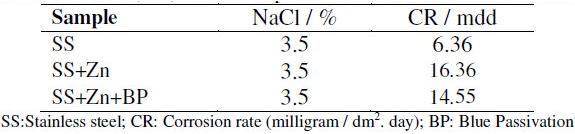
    <p>Corrosion rates obtained by weight loss method of stainless steel (SS) samples, 
before and after electroplating, in an aqueous solution containing 3.5% NaCl, and 
of stainless steel electroplated with zinc followed by blue passivation, are given 
in Table 1. It is observed that when stainless steel is electroplated with zinc, the 
corrosion rate increased from 6.36 mdd to 16.36 mdd. This suggests that the 
corrosion resistance of stainless steel decreases after zinc plating. This is due to 
the fact that the zinc film is broken in presence of 3.5% NaCl. Hence corrosion is 
accelerated. Further, when stainless steel 304 and zinc are in contact, zinc 
becomes anode and hence it undergoes corrosion [18]. But for stainless steel 
electroplated with zinc followed by blue passivation, the corrosion rate decreased 
from 16.36 mdd to 14.55 mdd. The corrosion rates presented in Table 1 reveal 
that the blue passivated stainless steel is more corrosion resistant than zinc coated 
stainless steel, but it is less corrosion resistant than the stainless steel itself.</p>

    <p>&nbsp;</p>    <p>Table 1. Corrosion rates (CR) of metal specimens immersed in 3.5% NaCl solution.</p>
<img src="/img/revistas/pea/v29n4/29n4a06t1.jpg">
    
<p>&nbsp;</p>


    <p><b><i>Action of 1% copper sulphate solution on the metal surface</i></b></p>
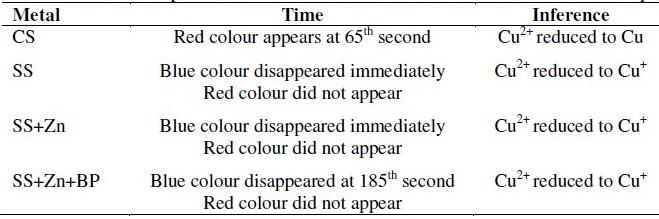
    <p>The time for the appearance of reddish brown solution, when a drop of 1% 
copper sulphate solution was placed on the metal surface, before and after 
electroplating, is given in Table 2.</p>

    ]]></body>
<body><![CDATA[<p>&nbsp;</p>    <p>Table 2. Time required for the appearance of reddish brown deposit when one drop of
1% CuSO<sub>4</sub> solution was placed on the metal surface before and after electroplating.</p>
<img src="/img/revistas/pea/v29n4/29n4a06t2.jpg">
    
<p>&nbsp;</p>

    <p>Usually, when a drop of 1% copper sulphate solution is placed on polished 
carbon steel surface (CS), a red colour appears. The formation of red colour is 
due to the conversion of blue Cu<sup>2+</sup> ion into Cu which is red in colour.</p> 

    <p>&nbsp;</p>
<img src="/img/revistas/pea/v29n4/29n4a06e3.jpg">
    
<p>&nbsp;</p>


    <p>When one drop of 1% copper sulphate was placed on the carbon steel surface, a 
red solution appeared within 65 seconds. This is due to the fact that blue Cu<sup>2+</sup> ion 
is reduced to red Cu because of electron transfer from Fe to Cu<sup>2+</sup>.</p>
    <p>When one drop of 1% copper sulphate solution was placed on stainless steel 
surface, red colour did not appear even after 1200 seconds. But blue colour 
disappeared immediately. A colourless solution was obtained.</p>
    <p>This may be explained by the fact that there is formation of colourless Cu+ ion. 
This Cu+ ion is produced by interaction of blue Cu<sup>2+</sup> ion and the one electron that 
comes from the metal surface. This electron may come from Ni or Cr or Fe 
present in the stainless steel 304. 

    <p>&nbsp;</p>
<img src="/img/revistas/pea/v29n4/29n4a06e4.jpg">
    
]]></body>
<body><![CDATA[<p>&nbsp;</p>


    <p>Similarly, when one drop of 1% copper sulphate was placed on stainless steel 
surface coated with zinc, red colour did not appear even after 1200 seconds. But 
blue colour disappeared immediately. A colourless solution was obtained.</p>
    <p>This may be explained by the fact that there is formation of colourless Cu+ ion. 
This Cu+ ion is produced by interaction of blue Cu<sup>2+</sup> ion and the one electron that 
comes from the metal surface. This electron may come from Ni or Cr or Fe or Zn 
present in the stainless steel 304 or zinc coated stainless steel.</p>
    <p>Similarly, when one drop of 1% copper sulphate was placed on stainless steel 
surface coated with zinc followed by blue passivation, red colour did not appear 
even after 1200 seconds. But blue colour disappeared at 185th second. A 
colourless solution was obtained. This is because when zinc is electroplated on 
stainless steel, zinc becomes less noble and it undergoes corrosion and stainless 
steel is protected [18].</p>

    <p><b><i>Analysis of potentiodynamic polarization study</i></b></p>
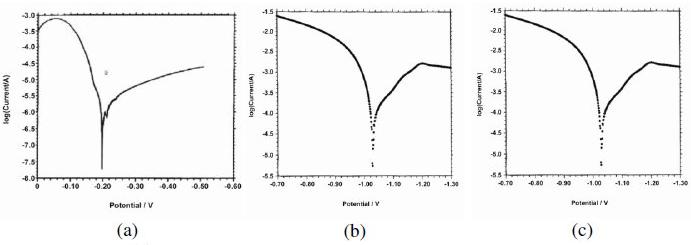
    <p>The polarization curves of stainless steel (SS), stainless steel electroplated with 
zinc, and stainless steel electroplated with zinc followed by blue passivation 
immersed in an aqueous solution containing 3.5% NaCl, are shown in Fig. 1a, 1b 
and 1c. The corrosion parameters such as corrosion potential (E<sub>corr</sub>), Tafel slopes 
(b<sub>c</sub>=cathodic) (b<sub>a</sub>=anodic), linear polarization resistance (LPR) and corrosion 
current (I<sub>corr</sub>), are given in Table 3. When stainless steel was immersed in an 
aqueous solution containing 3.5% NaCl, the corrosion potential was -198 mV vs. 
SCE. When stainless steel was electroplated with zinc, the corrosion potential 
was shifted to cathodic side -1043 mV. This is due to the deposition of Zn on SS 
surface [17] so that metal surface becomes more active and hence undergoes 
corrosion. The LPR value decreases from 503.9&times;10<sup>1</sup> ohm cm<sup>2</sup> 5.128&times;10 ohm 
cm<sup>2</sup> for SS 304 coated with zinc. The corrosion current increases from 
6.827&times;10<sup>-6</sup> to 636.0&times;10<sup>-6</sup> A/cm. Decrease in LPR value and increase in the 
corrosion current suggest that the effective protective film had not been formed 
on stainless steel electroplated with zinc [19-20]. These observations suggest that 
the corrosion protecting efficiency decreases when SS is electroplated with Zn 
and the corrosion rate increases. This suggests that zinc film coated on SS is 
easily broken when in 3.5% NaCl solution. This enhances the corrosion rate of 
iron in SS, as sodium chloride solution enters into the pores created by the 
breaking of zinc film coated on SS surface.</p> 

    <p>&nbsp;</p>
    <p><img src="/img/revistas/pea/v29n4/29n4a06f1.jpg"></p>
    
<p><b>Figure 1.</b> Polarisation curves of stainless steel (a) without further treatment, (b)
electroplated with zinc and (c) electroplated with zinc followed by blue passivation,
immersed in an aqueous solution containing 3.5% NaCl.</p>
    <p>&nbsp;</p>

     ]]></body>
<body><![CDATA[<p>&nbsp;</p>    <p>Table 3. Corrosion parameters of stainless steel (SS) samples immersed in an
aqueous solution containing 3.5% NaCl, before and after electroplating. (Obtained from
potentiodynamic polarization study).</p>
<img src="/img/revistas/pea/v29n4/29n4a06t3.jpg">
    
<p>&nbsp;</p>
    <p>When stainless steel electroplated with zinc followed by blue passivation was 
immersed in an aqueous solution containing 3.5% NaCl, the corrosion potential 
was -1028 mV, which is cathodic when compared to stainless steel, but it is 
slightly anodic when compared with zinc coated stainless steel. The LPR value of 
stainless steel electroplated with zinc followed by blue passivation was 
9.238&times;10<sup>1</sup> ohm cm<sup>2</sup>. The corrosion current value for stainless steel electroplated 
with zinc followed by blue passivation increased to 369.7&times;10<sup>-6</sup> A|cm2. The 
decrease in the LPR value and the increase in the corrosion current suggest that 
the blue passivated stainless steel is more corrosion resistant than the stainless 
steel electroplated with zinc; but it is less corrosion resistant than stainless steel 
itself. The corrosion resistance of SS is better than SS coated with zinc, and than 
SS coated with zinc followed by blue passivation, as revealed by higher LPR 
value and lower current.</p>


    <p>Hence, it is suggested that stainless steel coated with zinc should not be used in 
coastal area, ships and shipyards, and also for storing thiourea in industries [17]. 
Otherwise machines, made of this combination will undergo corrosion because of 
the chloride vapours present in coastal area.</p> 


    <p><b><i>Analysis of AC impedance spectra</i></b></p>
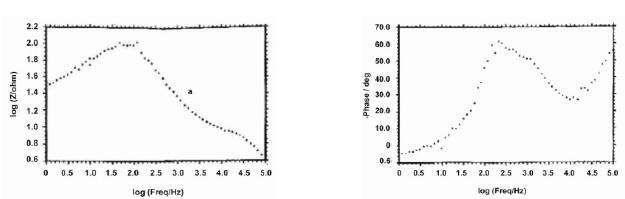
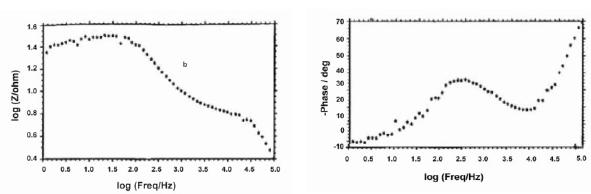
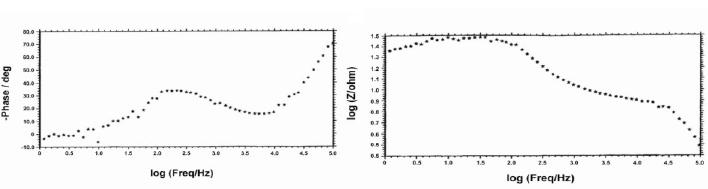
    <p>The AC impedance spectra (Bode plots) of stainless steel electroplated with zinc 
followed by blue passivation immersed in an aqueous solution containing 3.5% 
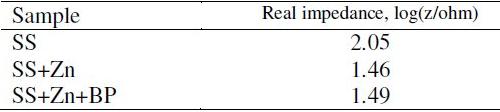
NaCl are shown in Fig. 2a, 2b and 2c. The real impedance [log (z/ohm)] values 
are given Table 4. It was observed that when stainless steel was immersed in 
3.5% NaCl solution the real impedance value was 2.05. After zinc deposition this 
value decreased to 1.46. For blue passivated stainless steel the real impedance 
value was 1.49.</p>

    <p>&nbsp;</p>
    <p><img src="/img/revistas/pea/v29n4/29n4a06f2a.jpg"></p>
    
<p><b>Figure 2a.</b> AC impedance spectra of stainless steel immersed in an aqueous solution
containing 3.5% NaCl (Bode plot).</p>    ]]></body>
<body><![CDATA[<p>&nbsp;</p>
    <p><img src="/img/revistas/pea/v29n4/29n4a06f2b.jpg"></p>
    
<p><b>Figure 2b.</b> AC impedance spectra of stainless steel electroplated with zinc immersed in
an aqueous solution containing 3.5% NaCl (Bode plot).</p>    <p>&nbsp;</p>
    <p><img src="/img/revistas/pea/v29n4/29n4a06f2c.jpg"></p>
    
<p><b>Figure 2c.</b> AC impedance spectra of stainless steel electroplated with zinc followed by
blue passivation immersed in an aqueous solution containing 3.5% NaCl (Bode plot).</p>
    <p>&nbsp;</p>
    <p>&nbsp;</p>    <p>Table 4. AC impedance parameters of stainless steel (SS) samples immersed in an
aqueous solution containing 3.5% NaCl, before and after electroplating (obtained from
Bode plot).</p>
<img src="/img/revistas/pea/v29n4/29n4a06t4.jpg">
    
<p>&nbsp;</p>

    ]]></body>
<body><![CDATA[<p>The decrease in the real impedance value for electroplated (Zn) stainless steel, 
1.46, when compared to stainless steel, 2.05, shows that corrosion is accelerated 
in the case of zinc plated stainless steel; but the value 1.49 for blue pasivated 
stainless steel suggests that the blue passivated stainless steel is more corrosion 
resistant than zinc coated stainless steel, but less corrosion resistant than the 
stainless steel itself.</p>


    <p><b><i>Analysis of cyclic voltammograms</i></b></p>
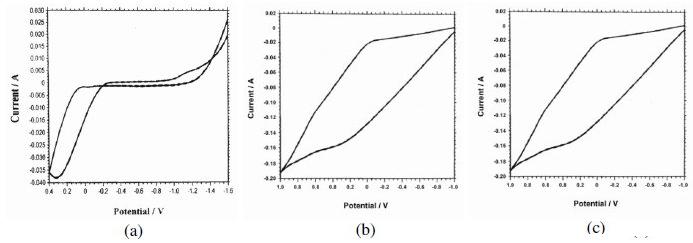
    <p>The cyclic voltammograms of stainless steel, stainless steel electroplated with 
zinc, and stainless steel electroplated with zinc followed by blue passivation, 
immersed in an aqueous solution containing 3.5% NaCl, are shown in Fig. 3a, 3b 
and 3c. It was observed that redox couples were absent in these cyclic 
voltammograms. 
    <p>&nbsp;</p>
    <p><img src="/img/revistas/pea/v29n4/29n4a06f3.jpg"></p>
    
<p><b>Figure 3.</b> Cyclic voltammograms of stainless steel (a) without further treatment, (b)
electroplated with zinc and (c) electroplated with zinc followed by blue passivation,
immersed in an aqueous solution containing 3.5% NaCl.</p>
    <p>&nbsp;</p>


    <p><b><i>Decolourisation process</i></b></p>
    <p><i>Decolourisation using stainless steel</i></p>
    <p>The efficiency of decolourisation of methyl orange (50 ppm) is given in Table 5. 
Uncoated stainless steel anode and graphite cathode were immersed in the 
solution to decolourise 50 ppm of methyl orange solution. The solution was 
electrolysed for 10 minutes without addition of NaCl. There was no 
decolourisation. The experiment was repeated after addition of 7 g of NaCl and 
the solution was electrolysed. The current density was 1.3 A /cm<sup>2</sup> and the 
potential was 3.8 Volts. Methyl orange solution was completely decolourised 
within 157 seconds. The efficiency of decolourisation was 95%.</p>

    ]]></body>
<body><![CDATA[<p>&nbsp;</p>    <p>Table 5. Efficiency of decolourization of methyl orange (50 ppm). Optical density for
methyl orange = 0.42.</p>
<img src="/img/revistas/pea/v29n4/29n4a06t5.jpg">
    
<p>&nbsp;</p>


    <p><i>Decolourisation using stainless steel electroplated with zinc</i></p>
    <p>The experiment was repeated by using stainless steel electroplated with zinc after 
addition of 7 g of NaCl; the solution was electrolysed. The current density was 1 
A/cm2 and the potential was 2.5 Volts. Methyl orange solution was decolourised 
within 249 seconds. The efficiency of decolourisation was 88%. When NaCl 
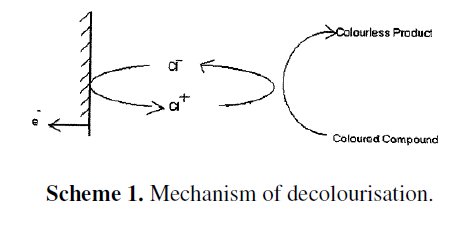
solution was electrolysed, the active species produced is Cl<sup>+</sup> [21-23]. This 
oxidized the coloured material into colourless product. (Scheme1).</p> 

    <p>&nbsp;</p>
<img src="/img/revistas/pea/v29n4/29n4a06s1.jpg">
    
<p>&nbsp;</p>
 

    <p><i>Decolourisation using stainless steel electroplated with zinc followed by blue passivation</i></p>
    <p>The experiment was repeated by using stainless steel electroplated with zinc and 
blue passivation, after addition of 7 g of NaCl. The solution was electrolysed. 
The current density was 0.85 A/cm2 and the potential was 1 Volt. Methyl orange 
solution was decolourised within 241 seconds. The efficiency of decolourisation 
was only 83%.</p>
    <p>The decolourisation efficiency is in the order SS>SS+Zn>SS+Zn+BP. This 
suggests that the ease of electron release from the metal surface is in the order 
SS>SS+Zn>SS+Zn+BP.</p>

    ]]></body>
<body><![CDATA[<p>&nbsp;</p>
    <p><b>Conclusions</b></p>
    <p>Zinc was electro deposited on stainless steel 304 surface using the bath 
containing ZnCl<sub>2</sub>, KCl and boric acid. Then blue passivation was done. The 
corrosion protective efficiency of the film was evaluated by weight loss method, 
copper sulphate test, polarization and AC impedance studies. The zinc deposited 
stainless steel was used to decolourise methyl orange solution.</p>
    <p>When uncoated stainless steel 304 was immersed in an aqueous solution 
containing 3.5% NaCl, the corrosion rate was 6.36 mdd. But when zinc was 
deposited in SS 304, the corrosion rate increased to 16.36 mdd, but for blue 
passivated SS 304 the corrosion rate decreased to 14.55 mdd. This shows that SS 
304 electroplated with zinc followed by blue passivation is more corrosion 
resistant than zinc electroplated SS 304.</p>
    <p>Polarization study and AC impedance spectra lead to conclusion that when 
stainless steel is electroplated with zinc, corrosion is accelerated and corrosion 
protective efficiency was in the order SS>SS+Zn+BP>SS+Zn.</p>
    <p>The metal specimens were used to decolourise 50 ppm of methyl orange solution 
and the decolourising efficiency was in the order SS>SS+Zn>SS+Zn+BP.</p>
    <p>Hence stainless steel coated with zinc should not be used in coastal area, in ships 
and shipyards.</p>


    <p>&nbsp;</p>
    <p><b>References</b></p>
    <!-- ref --><p>1. M.K. Karfoul, ''Industrial Corrosion and Corrosion Control Technology'', H.M. Shalaby, A. Al-Hashem, M. Lowther, J. Al-Besharak (Eds.), Kuwait Inst. Sci. Research, Safat, 1996. p. 431-439.    &nbsp;&nbsp;&nbsp;&nbsp;&nbsp;&nbsp;&nbsp;&nbsp;[&#160;<a href="javascript:void(0);" onclick="javascript: window.open('/scielo.php?script=sci_nlinks&ref=000122&pid=S0872-1904201100040000600001&lng=','','width=640,height=500,resizable=yes,scrollbars=1,menubar=yes,');">Links</a>&#160;]<!-- end-ref --></p>
    <!-- ref --><p>2. E.C. Bain, R.H. Aborn, J.J.B. Rutherford, ''The Nature and Prevention of Intergranular Corrosion in Austenitic Stainless Steel'', Trans. Am. Soc. Steel Treating, 1993. Vol.XXI, No.1, p.481-509.    &nbsp;&nbsp;&nbsp;&nbsp;&nbsp;&nbsp;&nbsp;&nbsp;[&#160;<a href="javascript:void(0);" onclick="javascript: window.open('/scielo.php?script=sci_nlinks&ref=000124&pid=S0872-1904201100040000600002&lng=','','width=640,height=500,resizable=yes,scrollbars=1,menubar=yes,');">Links</a>&#160;]<!-- end-ref --></p>
    <!-- ref --><p>3. E.C. Potter, G.M.W. Mann, ''Oxidation of Mild Steel in High Temperature Aqueous System'', 1st Int. Congress on Metallic Corrosion'', 10-15 April (1961), p. 417.    &nbsp;&nbsp;&nbsp;&nbsp;&nbsp;&nbsp;&nbsp;&nbsp;[&#160;<a href="javascript:void(0);" onclick="javascript: window.open('/scielo.php?script=sci_nlinks&ref=000126&pid=S0872-1904201100040000600003&lng=','','width=640,height=500,resizable=yes,scrollbars=1,menubar=yes,');">Links</a>&#160;]<!-- end-ref --></p>
    <!-- ref --><p>4. G.M.W. Mann, ''High -temperature, High-pressure Electrochemistry in Aqueous Solutions'', Tx: NACE International, Houston, (1976), p.36.    &nbsp;&nbsp;&nbsp;&nbsp;&nbsp;&nbsp;&nbsp;&nbsp;[&#160;<a href="javascript:void(0);" onclick="javascript: window.open('/scielo.php?script=sci_nlinks&ref=000128&pid=S0872-1904201100040000600004&lng=','','width=640,height=500,resizable=yes,scrollbars=1,menubar=yes,');">Links</a>&#160;]<!-- end-ref --></p>
    <!-- ref --><p>5. L. Tomlinson, Corrosion 37 (1981) 591.    &nbsp;&nbsp;&nbsp;&nbsp;&nbsp;&nbsp;&nbsp;&nbsp;[&#160;<a href="javascript:void(0);" onclick="javascript: window.open('/scielo.php?script=sci_nlinks&ref=000130&pid=S0872-1904201100040000600005&lng=','','width=640,height=500,resizable=yes,scrollbars=1,menubar=yes,');">Links</a>&#160;]<!-- end-ref --></p>
    <!-- ref --><p>6. H. Tsuchiya, M. Hueppe, T. Djenizian, P. Schmuki, Appl. Surf. Sci. 547 (2003) 268.    &nbsp;&nbsp;&nbsp;&nbsp;&nbsp;&nbsp;&nbsp;&nbsp;[&#160;<a href="javascript:void(0);" onclick="javascript: window.open('/scielo.php?script=sci_nlinks&ref=000132&pid=S0872-1904201100040000600006&lng=','','width=640,height=500,resizable=yes,scrollbars=1,menubar=yes,');">Links</a>&#160;]<!-- end-ref --></p>
    <p>7. H. Tsuchiya, M. Hueppe, T. Djenizian, P. Schmuki, S. Fujimoto, Sci.Tech. Adv.Mater. 5 (2004) 195.</p>
    <!-- ref --><p>8. H. Tsuchiya, P. Schmuki, J. Electrochem. Comm. 7 (2005) 49-52.    &nbsp;&nbsp;&nbsp;&nbsp;&nbsp;&nbsp;&nbsp;&nbsp;[&#160;<a href="javascript:void(0);" onclick="javascript: window.open('/scielo.php?script=sci_nlinks&ref=000135&pid=S0872-1904201100040000600008&lng=','','width=640,height=500,resizable=yes,scrollbars=1,menubar=yes,');">Links</a>&#160;]<!-- end-ref --></p>
    <p>9. D. Gong, C.A. Grimes, O.K. Varghese, W. Hu, R.S. Singh, Z. Chen, E.C. Dickey, J. Mater. Res.16 (2001) 3331.</p>
    <!-- ref --><p>10. V. Zwilling, E. Darque-Ceretti, A. Boutry-Forveille, Electrochim. Acta 45 (1999) 921.    &nbsp;&nbsp;&nbsp;&nbsp;&nbsp;&nbsp;&nbsp;&nbsp;[&#160;<a href="javascript:void(0);" onclick="javascript: window.open('/scielo.php?script=sci_nlinks&ref=000138&pid=S0872-1904201100040000600010&lng=','','width=640,height=500,resizable=yes,scrollbars=1,menubar=yes,');">Links</a>&#160;]<!-- end-ref --></p>
    <!-- ref --><p>11. S.S. Chang, S. Kurokawa, A. Sakai, Appl. Surf. Sci. 217 (2003) 50.    &nbsp;&nbsp;&nbsp;&nbsp;&nbsp;&nbsp;&nbsp;&nbsp;[&#160;<a href="javascript:void(0);" onclick="javascript: window.open('/scielo.php?script=sci_nlinks&ref=000140&pid=S0872-1904201100040000600011&lng=','','width=640,height=500,resizable=yes,scrollbars=1,menubar=yes,');">Links</a>&#160;]<!-- end-ref --></p>
    <!-- ref --><p>12. S.S. Chang, C.H. Park, S.W. Park, Mater. Chem. Phys. 79 (2003) 9.    &nbsp;&nbsp;&nbsp;&nbsp;&nbsp;&nbsp;&nbsp;&nbsp;[&#160;<a href="javascript:void(0);" onclick="javascript: window.open('/scielo.php?script=sci_nlinks&ref=000142&pid=S0872-1904201100040000600012&lng=','','width=640,height=500,resizable=yes,scrollbars=1,menubar=yes,');">Links</a>&#160;]<!-- end-ref --></p>
    <!-- ref --><p>13. H.C. Shin, J. Dong, M. Liu, Adv. Mater.16 (2004) 237.    &nbsp;&nbsp;&nbsp;&nbsp;&nbsp;&nbsp;&nbsp;&nbsp;[&#160;<a href="javascript:void(0);" onclick="javascript: window.open('/scielo.php?script=sci_nlinks&ref=000144&pid=S0872-1904201100040000600013&lng=','','width=640,height=500,resizable=yes,scrollbars=1,menubar=yes,');">Links</a>&#160;]<!-- end-ref --></p>
    <!-- ref --><p>14. R. Beranek, H. Hildebrand, P. Schmuki, Electrochem. Solid-state Lett. 6 (2003) 312.    &nbsp;&nbsp;&nbsp;&nbsp;&nbsp;&nbsp;&nbsp;&nbsp;[&#160;<a href="javascript:void(0);" onclick="javascript: window.open('/scielo.php?script=sci_nlinks&ref=000146&pid=S0872-1904201100040000600014&lng=','','width=640,height=500,resizable=yes,scrollbars=1,menubar=yes,');">Links</a>&#160;]<!-- end-ref --></p>
    <!-- ref --><p>15. A.M. Lekka, A.N. Koulombi, B.M. Gajo, J.P.L. Bonora, Electrochim. Acta 50 (2005) 4551-4556.    &nbsp;&nbsp;&nbsp;&nbsp;&nbsp;&nbsp;&nbsp;&nbsp;[&#160;<a href="javascript:void(0);" onclick="javascript: window.open('/scielo.php?script=sci_nlinks&ref=000148&pid=S0872-1904201100040000600015&lng=','','width=640,height=500,resizable=yes,scrollbars=1,menubar=yes,');">Links</a>&#160;]<!-- end-ref --></p>
    <!-- ref --><p>16. I. Gurappa, Mater. Charact. 49 (2002) 73-79.    &nbsp;&nbsp;&nbsp;&nbsp;&nbsp;&nbsp;&nbsp;&nbsp;[&#160;<a href="javascript:void(0);" onclick="javascript: window.open('/scielo.php?script=sci_nlinks&ref=000150&pid=S0872-1904201100040000600016&lng=','','width=640,height=500,resizable=yes,scrollbars=1,menubar=yes,');">Links</a>&#160;]<!-- end-ref --></p>
    <!-- ref --><p>17. S. Rajendran, V. Agnes Brigita, J. Manivannan, J. Jeyasundari, Port. Electrochim. Acta 27 (2009) 555-564.    &nbsp;&nbsp;&nbsp;&nbsp;&nbsp;&nbsp;&nbsp;&nbsp;[&#160;<a href="javascript:void(0);" onclick="javascript: window.open('/scielo.php?script=sci_nlinks&ref=000152&pid=S0872-1904201100040000600017&lng=','','width=640,height=500,resizable=yes,scrollbars=1,menubar=yes,');">Links</a>&#160;]<!-- end-ref --></p>
    <!-- ref --><p>18. G.M. Fontana, ''Corrosion Engineering'', Mc Graw-Hill, 3rd Ed., New York, 2006. p.43.    &nbsp;&nbsp;&nbsp;&nbsp;&nbsp;&nbsp;&nbsp;&nbsp;[&#160;<a href="javascript:void(0);" onclick="javascript: window.open('/scielo.php?script=sci_nlinks&ref=000154&pid=S0872-1904201100040000600018&lng=','','width=640,height=500,resizable=yes,scrollbars=1,menubar=yes,');">Links</a>&#160;]<!-- end-ref --></p>
    <p>19. S. Rajendran, J. Paulraj, P. Rengan, J. Jeyasundari, M. Manivannan, J. Dentistry Oral Hygiene 1 (2009) 1-8.</p>
    <p>20. S. Rajendran, V. Uma, A. Krishnaveni, J. Jeyasundari, B. Shymaladevi, M. Manivannan, Arab. J. Sci. Eng. 34 (2009) 147-158.</p>
    <!-- ref --><p>21. J. Sathiyabama, S. Rajendran, J.Arockiaselvi, Bull. Electrochem. 22 (2006) 363-369.    &nbsp;&nbsp;&nbsp;&nbsp;&nbsp;&nbsp;&nbsp;&nbsp;[&#160;<a href="javascript:void(0);" onclick="javascript: window.open('/scielo.php?script=sci_nlinks&ref=000158&pid=S0872-1904201100040000600021&lng=','','width=640,height=500,resizable=yes,scrollbars=1,menubar=yes,');">Links</a>&#160;]<!-- end-ref --></p>
    <!-- ref --><p>22. S. Rajendran, D.C. Trivedi, J. Synth. 2 (1995) 153.    &nbsp;&nbsp;&nbsp;&nbsp;&nbsp;&nbsp;&nbsp;&nbsp;[&#160;<a href="javascript:void(0);" onclick="javascript: window.open('/scielo.php?script=sci_nlinks&ref=000160&pid=S0872-1904201100040000600022&lng=','','width=640,height=500,resizable=yes,scrollbars=1,menubar=yes,');">Links</a>&#160;]<!-- end-ref --></p>
    <!-- ref --><p>23. R.L. Doston, R.W. Lynch, J. Electrochem. Soc. 128 (1981) 798.    &nbsp;&nbsp;&nbsp;&nbsp;&nbsp;&nbsp;&nbsp;&nbsp;[&#160;<a href="javascript:void(0);" onclick="javascript: window.open('/scielo.php?script=sci_nlinks&ref=000162&pid=S0872-1904201100040000600023&lng=','','width=640,height=500,resizable=yes,scrollbars=1,menubar=yes,');">Links</a>&#160;]<!-- end-ref --></p>
    <p>&nbsp;</p>    <p><Sup><a name="0"></a><a href="#top0">*</a></Sup>Corresponding author. E-mail address <a href="mailto:beni2@rediffmail.com">beni2@rediffmail.com</a></p>
    <p>&nbsp;</p>    <p>Received 3 December 2010; accepted 12 March 2011</p>    <p>&nbsp;</p>
    <p><b>Acknowledgement</b></p>
    <p>The authors are thankful to their respective managements, St. Joseph's Research 
and Community Development Trust, Dindigul and University Grants 
commission, India, for their help and encouragement.</p> 
     ]]></body><back>
<ref-list>
<ref id="B1">
<label>1</label><nlm-citation citation-type="">
<person-group person-group-type="author">
<name>
<surname><![CDATA[Karfoul]]></surname>
<given-names><![CDATA[M.K.]]></given-names>
</name>
</person-group>
<article-title xml:lang="en"><![CDATA[Industrial Corrosion and Corrosion Control Technology]]></article-title>
<person-group person-group-type="editor">
<name>
<surname><![CDATA[Shalaby]]></surname>
<given-names><![CDATA[H.M.]]></given-names>
</name>
<name>
<surname><![CDATA[Al-Hashem]]></surname>
<given-names><![CDATA[A.]]></given-names>
</name>
<name>
<surname><![CDATA[Lowther]]></surname>
<given-names><![CDATA[M.]]></given-names>
</name>
<name>
<surname><![CDATA[Al-Besharak]]></surname>
<given-names><![CDATA[J.]]></given-names>
</name>
</person-group>
<source><![CDATA[Kuwait Inst. Sci. Research: Safat]]></source>
<year>1996</year>
<page-range>431-439</page-range></nlm-citation>
</ref>
<ref id="B2">
<label>2</label><nlm-citation citation-type="">
<person-group person-group-type="author">
<name>
<surname><![CDATA[Bain]]></surname>
<given-names><![CDATA[E.C.]]></given-names>
</name>
<name>
<surname><![CDATA[Aborn]]></surname>
<given-names><![CDATA[R.H.]]></given-names>
</name>
<name>
<surname><![CDATA[Rutherford]]></surname>
<given-names><![CDATA[J.J.B.]]></given-names>
</name>
</person-group>
<source><![CDATA[The Nature and Prevention of Intergranular Corrosion in Austenitic Stainless Steel]]></source>
<year>1993</year>
<volume>XXI</volume>
<page-range>481-509</page-range></nlm-citation>
</ref>
<ref id="B3">
<label>3</label><nlm-citation citation-type="confpro">
<person-group person-group-type="author">
<name>
<surname><![CDATA[Potter]]></surname>
<given-names><![CDATA[E.C.]]></given-names>
</name>
<name>
<surname><![CDATA[Mann]]></surname>
<given-names><![CDATA[G.M.W.]]></given-names>
</name>
</person-group>
<source><![CDATA[Oxidation of Mild Steel in High Temperature Aqueous System]]></source>
<year></year>
<conf-name><![CDATA[1 Int. Congress on Metallic Corrosion]]></conf-name>
<conf-date>1961</conf-date>
<conf-loc> </conf-loc>
<page-range>417</page-range></nlm-citation>
</ref>
<ref id="B4">
<label>4</label><nlm-citation citation-type="confpro">
<person-group person-group-type="author">
<name>
<surname><![CDATA[Mann]]></surname>
<given-names><![CDATA[G.M.W.]]></given-names>
</name>
</person-group>
<source><![CDATA[High -temperature, High-pressure Electrochemistry in Aqueous Solutions]]></source>
<year></year>
<conf-name><![CDATA[ Tx: NACE International]]></conf-name>
<conf-date>1976</conf-date>
<conf-loc>Houston </conf-loc>
<page-range>36</page-range></nlm-citation>
</ref>
<ref id="B5">
<label>5</label><nlm-citation citation-type="journal">
<person-group person-group-type="author">
<name>
<surname><![CDATA[Tomlinson]]></surname>
<given-names><![CDATA[L.]]></given-names>
</name>
</person-group>
<source><![CDATA[Corrosion]]></source>
<year>1981</year>
<volume>37</volume>
<page-range>591</page-range></nlm-citation>
</ref>
<ref id="B6">
<label>6</label><nlm-citation citation-type="journal">
<person-group person-group-type="author">
<name>
<surname><![CDATA[Tsuchiya]]></surname>
<given-names><![CDATA[H.]]></given-names>
</name>
<name>
<surname><![CDATA[Hueppe]]></surname>
<given-names><![CDATA[M.]]></given-names>
</name>
<name>
<surname><![CDATA[Djenizian]]></surname>
<given-names><![CDATA[T.]]></given-names>
</name>
<name>
<surname><![CDATA[Schmuki]]></surname>
<given-names><![CDATA[P.]]></given-names>
</name>
</person-group>
<source><![CDATA[Appl. Surf. Sci.]]></source>
<year>2003</year>
<volume>547</volume>
<page-range>268</page-range></nlm-citation>
</ref>
<ref id="B7">
<label>7</label><nlm-citation citation-type="journal">
<person-group person-group-type="author">
<name>
<surname><![CDATA[Tsuchiya]]></surname>
<given-names><![CDATA[H.]]></given-names>
</name>
<name>
<surname><![CDATA[Hueppe]]></surname>
<given-names><![CDATA[M.]]></given-names>
</name>
<name>
<surname><![CDATA[Djenizian]]></surname>
<given-names><![CDATA[T.]]></given-names>
</name>
</person-group>
<source><![CDATA[Sci. Tech. Adv. Mater.]]></source>
<year>2004</year>
<volume>5</volume>
<page-range>195</page-range></nlm-citation>
</ref>
<ref id="B8">
<label>8</label><nlm-citation citation-type="journal">
<person-group person-group-type="author">
<name>
<surname><![CDATA[Tsuchiya]]></surname>
<given-names><![CDATA[H.]]></given-names>
</name>
<name>
<surname><![CDATA[Schmuki]]></surname>
<given-names><![CDATA[P.]]></given-names>
</name>
</person-group>
<source><![CDATA[J. Electrochem. Comm.]]></source>
<year>2005</year>
<volume>7</volume>
<page-range>49</page-range></nlm-citation>
</ref>
<ref id="B9">
<label>9</label><nlm-citation citation-type="journal">
<person-group person-group-type="author">
<name>
<surname><![CDATA[Gong]]></surname>
<given-names><![CDATA[D.]]></given-names>
</name>
<name>
<surname><![CDATA[Grimes]]></surname>
<given-names><![CDATA[C.A.]]></given-names>
</name>
<name>
<surname><![CDATA[Varghese]]></surname>
<given-names><![CDATA[O.K.]]></given-names>
</name>
</person-group>
<source><![CDATA[J. Mater. Res.]]></source>
<year>2001</year>
<volume>16</volume>
<page-range>3331</page-range></nlm-citation>
</ref>
<ref id="B10">
<label>10</label><nlm-citation citation-type="journal">
<person-group person-group-type="author">
<name>
<surname><![CDATA[Zwilling]]></surname>
<given-names><![CDATA[V.]]></given-names>
</name>
<name>
<surname><![CDATA[Darque-Ceretti]]></surname>
<given-names><![CDATA[E.]]></given-names>
</name>
<name>
<surname><![CDATA[Boutry-Forveille]]></surname>
<given-names><![CDATA[A.]]></given-names>
</name>
</person-group>
<source><![CDATA[Electrochim. Acta]]></source>
<year>1999</year>
<volume>45</volume>
<page-range>921</page-range></nlm-citation>
</ref>
<ref id="B11">
<label>11</label><nlm-citation citation-type="journal">
<person-group person-group-type="author">
<name>
<surname><![CDATA[Chang]]></surname>
<given-names><![CDATA[S.S.]]></given-names>
</name>
<name>
<surname><![CDATA[Kurokawa]]></surname>
<given-names><![CDATA[S.]]></given-names>
</name>
<name>
<surname><![CDATA[Sakai]]></surname>
<given-names><![CDATA[A.]]></given-names>
</name>
</person-group>
<source><![CDATA[Appl. Surf. Sci.]]></source>
<year>2003</year>
<volume>217</volume>
<page-range>50</page-range></nlm-citation>
</ref>
<ref id="B12">
<label>12</label><nlm-citation citation-type="journal">
<person-group person-group-type="author">
<name>
<surname><![CDATA[Chang]]></surname>
<given-names><![CDATA[S.S.]]></given-names>
</name>
<name>
<surname><![CDATA[Park]]></surname>
<given-names><![CDATA[C.H.]]></given-names>
</name>
<name>
<surname><![CDATA[Park]]></surname>
<given-names><![CDATA[S.W.]]></given-names>
</name>
</person-group>
<source><![CDATA[Mater. Chem. Phys.]]></source>
<year>2003</year>
<volume>79</volume>
<page-range>9</page-range></nlm-citation>
</ref>
<ref id="B13">
<label>13</label><nlm-citation citation-type="journal">
<person-group person-group-type="author">
<name>
<surname><![CDATA[Shin]]></surname>
<given-names><![CDATA[H.C.]]></given-names>
</name>
<name>
<surname><![CDATA[Dong]]></surname>
<given-names><![CDATA[J.]]></given-names>
</name>
<name>
<surname><![CDATA[Liu]]></surname>
<given-names><![CDATA[M.]]></given-names>
</name>
</person-group>
<source><![CDATA[Adv. Mater.]]></source>
<year>2004</year>
<volume>16</volume>
<page-range>237</page-range></nlm-citation>
</ref>
<ref id="B14">
<label>14</label><nlm-citation citation-type="journal">
<person-group person-group-type="author">
<name>
<surname><![CDATA[Beranek]]></surname>
<given-names><![CDATA[R.]]></given-names>
</name>
<name>
<surname><![CDATA[Hildebrand]]></surname>
<given-names><![CDATA[H.]]></given-names>
</name>
<name>
<surname><![CDATA[Schmuki]]></surname>
<given-names><![CDATA[P.]]></given-names>
</name>
</person-group>
<source><![CDATA[Electrochem. Solid-state Lett.]]></source>
<year>2003</year>
<volume>6</volume>
<page-range>312</page-range></nlm-citation>
</ref>
<ref id="B15">
<label>15</label><nlm-citation citation-type="journal">
<person-group person-group-type="author">
<name>
<surname><![CDATA[Lekka]]></surname>
<given-names><![CDATA[A.M.]]></given-names>
</name>
<name>
<surname><![CDATA[Koulombi]]></surname>
<given-names><![CDATA[A.N.]]></given-names>
</name>
<name>
<surname><![CDATA[Gajo]]></surname>
<given-names><![CDATA[B.M.]]></given-names>
</name>
<name>
<surname><![CDATA[Bonora]]></surname>
<given-names><![CDATA[J.P.L.]]></given-names>
</name>
</person-group>
<source><![CDATA[Electrochim. Acta]]></source>
<year>2005</year>
<volume>50</volume>
<page-range>4551</page-range></nlm-citation>
</ref>
<ref id="B16">
<label>16</label><nlm-citation citation-type="journal">
<person-group person-group-type="author">
<name>
<surname><![CDATA[Gurappa]]></surname>
<given-names><![CDATA[I.]]></given-names>
</name>
</person-group>
<source><![CDATA[Mater. Charact.]]></source>
<year>2002</year>
<volume>49</volume>
<page-range>73</page-range></nlm-citation>
</ref>
<ref id="B17">
<label>17</label><nlm-citation citation-type="journal">
<person-group person-group-type="author">
<name>
<surname><![CDATA[Rajendran]]></surname>
<given-names><![CDATA[S.]]></given-names>
</name>
<name>
<surname><![CDATA[Agnes Brigita]]></surname>
<given-names><![CDATA[V.]]></given-names>
</name>
<name>
<surname><![CDATA[Manivannan]]></surname>
<given-names><![CDATA[J.]]></given-names>
</name>
<name>
<surname><![CDATA[Jeyasundari]]></surname>
<given-names><![CDATA[J.]]></given-names>
</name>
</person-group>
<source><![CDATA[Port. Electrochim. Acta]]></source>
<year>2009</year>
<volume>27</volume>
<page-range>555</page-range></nlm-citation>
</ref>
<ref id="B18">
<label>18</label><nlm-citation citation-type="book">
<person-group person-group-type="author">
<name>
<surname><![CDATA[Fontana]]></surname>
<given-names><![CDATA[G.M.]]></given-names>
</name>
</person-group>
<source><![CDATA[Corrosion Engineering]]></source>
<year>2006</year>
<edition>3</edition>
<page-range>43</page-range><publisher-loc><![CDATA[New York ]]></publisher-loc>
<publisher-name><![CDATA[Mc Graw-Hill]]></publisher-name>
</nlm-citation>
</ref>
<ref id="B19">
<label>19</label><nlm-citation citation-type="journal">
<person-group person-group-type="author">
<name>
<surname><![CDATA[Rajendran]]></surname>
<given-names><![CDATA[S.]]></given-names>
</name>
<name>
<surname><![CDATA[Paulraj]]></surname>
<given-names><![CDATA[J.]]></given-names>
</name>
<name>
<surname><![CDATA[Rengan]]></surname>
<given-names><![CDATA[P.]]></given-names>
</name>
</person-group>
<source><![CDATA[J. Dentistry Oral Hygiene]]></source>
<year>2009</year>
<volume>1</volume>
<page-range>1</page-range></nlm-citation>
</ref>
<ref id="B20">
<label>20</label><nlm-citation citation-type="journal">
<person-group person-group-type="author">
<name>
<surname><![CDATA[Rajendran]]></surname>
<given-names><![CDATA[S.]]></given-names>
</name>
<name>
<surname><![CDATA[Uma]]></surname>
<given-names><![CDATA[V.]]></given-names>
</name>
<name>
<surname><![CDATA[Krishnaveni]]></surname>
<given-names><![CDATA[A.]]></given-names>
</name>
</person-group>
<source><![CDATA[Arab. J. Sci. Eng.]]></source>
<year>2009</year>
<volume>34</volume>
<page-range>147</page-range></nlm-citation>
</ref>
<ref id="B21">
<label>21</label><nlm-citation citation-type="journal">
<person-group person-group-type="author">
<name>
<surname><![CDATA[Sathiyabama]]></surname>
<given-names><![CDATA[J.]]></given-names>
</name>
<name>
<surname><![CDATA[Rajendran]]></surname>
<given-names><![CDATA[S.]]></given-names>
</name>
<name>
<surname><![CDATA[Arockiaselvi]]></surname>
<given-names><![CDATA[J.]]></given-names>
</name>
</person-group>
<source><![CDATA[Bull. Electrochem.]]></source>
<year>2006</year>
<volume>22</volume>
<page-range>363</page-range></nlm-citation>
</ref>
<ref id="B22">
<label>22</label><nlm-citation citation-type="journal">
<person-group person-group-type="author">
<name>
<surname><![CDATA[Rajendran]]></surname>
<given-names><![CDATA[S.]]></given-names>
</name>
<name>
<surname><![CDATA[Trivedi]]></surname>
<given-names><![CDATA[D.C.]]></given-names>
</name>
</person-group>
<source><![CDATA[J. Synth.]]></source>
<year>1995</year>
<volume>2</volume>
<page-range>153</page-range></nlm-citation>
</ref>
<ref id="B23">
<label>23</label><nlm-citation citation-type="journal">
<person-group person-group-type="author">
<name>
<surname><![CDATA[Doston]]></surname>
<given-names><![CDATA[R.L.]]></given-names>
</name>
<name>
<surname><![CDATA[Lynch]]></surname>
<given-names><![CDATA[R.W.]]></given-names>
</name>
</person-group>
<source><![CDATA[J. Electrochem. Soc.]]></source>
<year>1981</year>
<volume>128</volume>
<page-range>798</page-range></nlm-citation>
</ref>
</ref-list>
</back>
</article>