<?xml version="1.0" encoding="ISO-8859-1"?><article xmlns:mml="http://www.w3.org/1998/Math/MathML" xmlns:xlink="http://www.w3.org/1999/xlink" xmlns:xsi="http://www.w3.org/2001/XMLSchema-instance">
<front>
<journal-meta>
<journal-id>0872-1904</journal-id>
<journal-title><![CDATA[Portugaliae Electrochimica Acta]]></journal-title>
<abbrev-journal-title><![CDATA[Port. Electrochim. Acta]]></abbrev-journal-title>
<issn>0872-1904</issn>
<publisher>
<publisher-name><![CDATA[Sociedade Portuguesa de Electroquímica]]></publisher-name>
</publisher>
</journal-meta>
<article-meta>
<article-id>S0872-19042011000500003</article-id>
<article-id pub-id-type="doi">10.4152/pea.201105329</article-id>
<title-group>
<article-title xml:lang="en"><![CDATA[Redox Properties of CU(I) Camphor Hydrazone Complexes]]></article-title>
</title-group>
<contrib-group>
<contrib contrib-type="author">
<name>
<surname><![CDATA[Carvalho]]></surname>
<given-names><![CDATA[M. Fernanda N.N.]]></given-names>
</name>
<xref ref-type="aff" rid="A01"/>
</contrib>
<contrib contrib-type="author">
<name>
<surname><![CDATA[Fernandes]]></surname>
<given-names><![CDATA[Tiago A.]]></given-names>
</name>
<xref ref-type="aff" rid="A01"/>
</contrib>
</contrib-group>
<aff id="A01">
<institution><![CDATA[,Technical University of Lisbon Instituto Superior Técnico Centro de Química Estrutural]]></institution>
<addr-line><![CDATA[Lisboa ]]></addr-line>
<country>Portugal</country>
</aff>
<pub-date pub-type="pub">
<day>00</day>
<month>09</month>
<year>2011</year>
</pub-date>
<pub-date pub-type="epub">
<day>00</day>
<month>09</month>
<year>2011</year>
</pub-date>
<volume>29</volume>
<numero>5</numero>
<fpage>329</fpage>
<lpage>333</lpage>
<copyright-statement/>
<copyright-year/>
<self-uri xlink:href="http://scielo.pt/scielo.php?script=sci_arttext&amp;pid=S0872-19042011000500003&amp;lng=en&amp;nrm=iso"></self-uri><self-uri xlink:href="http://scielo.pt/scielo.php?script=sci_abstract&amp;pid=S0872-19042011000500003&amp;lng=en&amp;nrm=iso"></self-uri><self-uri xlink:href="http://scielo.pt/scielo.php?script=sci_pdf&amp;pid=S0872-19042011000500003&amp;lng=en&amp;nrm=iso"></self-uri><abstract abstract-type="short" xml:lang="en"><p><![CDATA[The electrochemical properties of the one-dimensional coordination polymers [{CuX}2(YNC10H14O)]n (X=Cl: Y=NMe2 1a, Y=NHMe 1b, Y=NH2 1c; X=Br: Y=NH2 2c) and dimers [{Cu(YNC10H14O)}2(&#956;-X)2] (X=Cl: Y=NMe2 3a; Y=NHMe 3b; X=Br: Y=NMe2 4a; Y=NHMe 4b) were studied by cyclic voltammetry (CV) and controlled potential electrolysis (CPE). All complexes display anodic and cathodic processes. The anodic processes involve the oxidation of the metal site (Cu(I)&#8594;Cu(II)), while the cathodic processes are based on the ligand. The substituent (Y) at the camphor hydrazones (YNC10H14O) plays a relevant role in the electrochemical properties and reactivity of Cu(I) coordination polymers and Cu(I) dimmers, as corroborated by CPE.]]></p></abstract>
<kwd-group>
<kwd lng="en"><![CDATA[cyclic voltammetry]]></kwd>
<kwd lng="en"><![CDATA[controlled potential electrolysis]]></kwd>
<kwd lng="en"><![CDATA[redox properties]]></kwd>
<kwd lng="en"><![CDATA[coordination polymers]]></kwd>
<kwd lng="en"><![CDATA[copper dimmers]]></kwd>
<kwd lng="en"><![CDATA[camphor hydrazones]]></kwd>
</kwd-group>
</article-meta>
</front><body><![CDATA[ 

    <p><b>Redox Properties of CU(I) Camphor Hydrazone Complexes</b></p>

    <p><b>M. Fernanda N.N. Carvalho<sup><a href="#0">*<a/></sup></b> and <b>Tiago A. Fernandes</b></p>

    <p><i>CQE, Complexo I, Instituto Superior T&eacute;cnico, Technical University of Lisbon, Av. Rovisco Pais 1049-001 Lisboa, Portugal</i></p>

    <p>&nbsp;</p>
    <p>doi: 10.4152/pea.201105329</p>


    <p>&nbsp;</p>
    <p><b>Abstract</b></p>

    <p>The electrochemical properties of the one-dimensional coordination polymers
[{CuX}<sub>2</sub>(YNC<sub>10</sub>H<sub>14</sub>O)]<sub>n</sub> (X=Cl: Y=NMe2 <b>1a</b>, Y=NHMe <b>1b</b>, Y=NH<sub>2</sub> <b>1c</b>; X=Br: Y=NH<sub>2</sub> <b>2c</b>) and dimers [{Cu(YNC<sub>10</sub>H<sub>14</sub>O)}<sub>2</sub>(&mu;-X)<sub>2</sub>] (X=Cl: Y=NMe2 <b>3a</b>; Y=NHMe <b>3b</b>; X=Br: Y=NMe<sub>2</sub> <b>4a</b>; Y=NHMe <b>4b</b>) were studied by cyclic voltammetry (CV) and controlled
potential electrolysis (CPE). All complexes display anodic and cathodic processes. The
anodic processes involve the oxidation of the metal site (Cu(I)&rarr;Cu(II)), while the
cathodic processes are based on the ligand. The substituent (Y) at the camphor
hydrazones (YNC<sub>10</sub>H<sub>14</sub>O) plays a relevant role in the electrochemical properties and
reactivity of Cu(I) coordination polymers and Cu(I) dimmers, as corroborated by CPE.</p>

    <p><b><i>Keywords:</i></b> cyclic voltammetry, controlled potential electrolysis, redox properties,
coordination polymers, copper dimmers, camphor hydrazones.</p>


    ]]></body>
<body><![CDATA[<p>&nbsp;</p>
    <p><b>Introduction</b></p>

    <p>Palladium and platinum camphor imine (L=YNC<sub>10</sub>H<sub>14</sub>O) complexes trans-
[MX<sub>2</sub>L<sub>2</sub>] are active catalysts for C-C and C-O bond formation [1,2] a fact that
stimulated the study of the ability of camphor hydrazones to coordinate other
transition metals. As a consequence, the camphor hydrazones were found to react
with copper halides (CuX: X=Cl, Br) forming Cu(I) complexes that may have
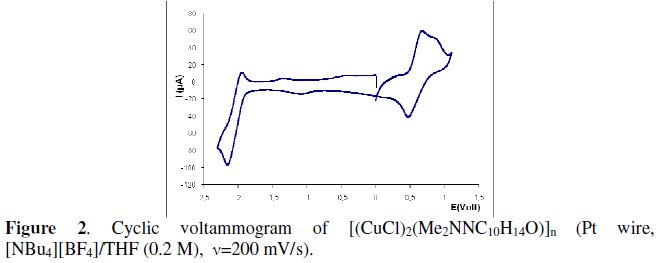
polymer or dimer character [3] (Fig. 1). In particular, coordination polymers have
high interest since they may be included in the category of hybrid nano-materials.
Furthermore, the unusual structural arrangement of the copper units in the
coordination polymers [(CuX)<sub>2</sub>(YNC<sub>10</sub>H<sub>14</sub>O)]<sub>n</sub> challenged the study of the
electrochemical properties of Cu(I) complexes, in order to evaluate if differences
exist in the redox properties of the tetrahedral and linear copper units. The redox
properties of the dimers were also studied because they convert to the related
coordination polymers and the process can be reversed in mild experimental
conditions [4].

    <p>&nbsp;</p>
<img src="/img/revistas/pea/v29n5/29n5a03f1.jpg">
    
<p>&nbsp;</p>


    <p>&nbsp;</p>
    <p><b>Experimental</b></p>

    <p>All electrochemical studies were performed under dinitrogen using [NBu<sub>4</sub>][BF<sub>4</sub>] /
THF (0.2 M) solution as electrolyte. A Pt wire was used as working electrode for
CV and a Pt-gauze as working electrode for CPE. Potentials were measured at
200 mVs<sup>-1</sup> using [Fe(&eta;<sup>5</sup>-C<sub>5</sub>H<sub>5</sub>)<sub>2</sub>]<sup>0/+</sup> (E<sub>1/2</sub>=0.547 V vs. SCE) or alternatively red
Me<sub>2</sub>NNC<sub>10</sub>H<sub>14</sub>O ( E<sub>1/2</sub> )=-2.01 vs. SCE) as internal references. A
potentiostat/galvanostat Radiometer Analytical Voltammetry PST050 VoltaLab&reg;
equipment was used for cyclic voltammetry studies and a potentiostat/galvanostat
Princeton Applied Research Model 273A for controlled potential electrolysis.</p>
    <p>Complexes [2,3] and camphor ligands [4] were prepared by published methods.
THF was purchased from Riedel-de Ha&euml;n and [NBu<sub>4</sub>][BF<sub>4</sub>] / THF from Merck.
THF was purified by published methods and distilled immediately before use.</p>

    <p>&nbsp;</p>
    ]]></body>
<body><![CDATA[<p><b>Results and discussion</b></p>

    <p>The electrochemical properties of complexes [(CuX)<sub>2</sub>(YNC<sub>10</sub>H<sub>14</sub>O)] and
[(CuL)<sub>2</sub>(&mu;-X)<sub>2</sub>] were studied by cyclic voltammetry (CV) in THF. Controlled
potential electrolysis (CPE) was performed at the potential of the anodic
processes to establish the number of electrons transferred in the Cu(I)&rarr;Cu(II)
oxidation processes.</p>

    <p><b><i>CV studies</i></b></p>

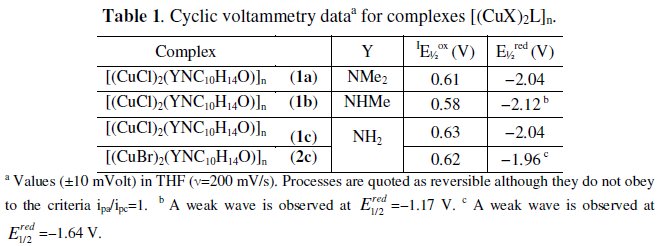
    <p>Complexes [(CuX)<sub>2</sub>(YNC<sub>10</sub>H<sub>14</sub>O)]<sub>n</sub> and [{Cu(YNC<sub>10</sub>H<sub>14</sub>O)}<sub>2</sub>(&mu;-X)<sub>2</sub>] display by cyclic voltammetry one oxidation and one reduction processes with some
reversibility. Coordination polymers [(CuX)<sub>2</sub>(YNC<sub>10</sub>H<sub>14</sub>O)]<sub>n</sub> have two distinct
Cu(I) metal centres per structural unit that oxidize at close potentials, thus the
anodic waves are not fully distinguishable and consequently a broad anodic wave
is observed in the cyclic voltammogram of each complex. Variation of the scan
rate (50 mVs<sup>-1</sup> to 1000 mVs<sup>-1</sup>) could not resolve completely the overlapped anodic
waves, although in the case of <b>1a</b> (v=200 mVs<sup>-1</sup>) two waves are visible (Fig. 2).


    <p>&nbsp;</p>
<img src="/img/revistas/pea/v29n5/29n5a03f2.jpg">
    
<p>&nbsp;</p>


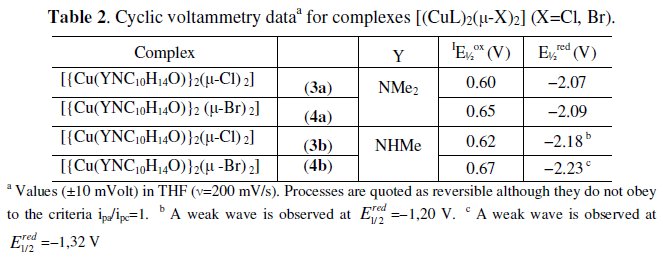
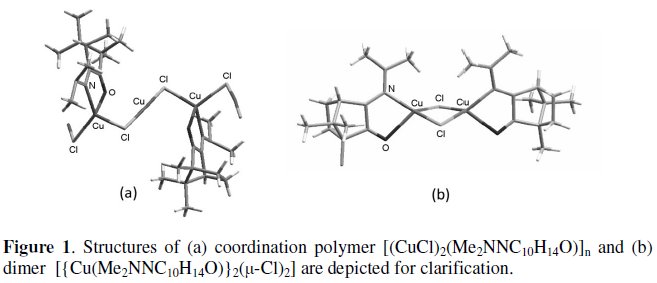
    <p>The potentials of the cathodic processes in complexes (Tables 1 and 2) do not
differ much from those in the corresponding free camphor hydrazones (also
measured in THF) that display irreversible (Y=NHMe: E<sub>1/2</sub><sup>red</sup>=-2.09 V; Y=NH<sub>2</sub>,
E<sub>1/2</sub><sup>red</sup>=-1.99 V) or quasi reversible (Y=NMe2: E<sub>1/2</sub><sup>red</sup>=-2.01V) reduction processes.


    <p>&nbsp;</p><a name="topt1"></a>
<img src="/img/revistas/pea/v29n5/29n5a03t1.jpg">
    
<p>&nbsp;</p><a name="topt2"></a>
<img src="/img/revistas/pea/v29n5/29n5a03t2.jpg">
    
<p>&nbsp;</p>


No big differences also exist between the above values of potential and those
reported before [6] in agreement with the low sensitivity of the reduction
processes to the characteristics of camphor hydrazone substituent (Y). In the
cyclic voltammograms of camphor hydrazones (Y=NHR) a small intensity
irreversible cathodic wave (Y=NHMe, E<sub>1/2</sub><sup>red</sup>=-1.16V; Y=NH<sub>2</sub> E<sub>1/2</sub><sup>red</sup>=-1.20V) was
attributed to the reduction of NH.</p>

    ]]></body>
<body><![CDATA[<p>The potentials of cathodic processes in complexes are consistent with ligand
based processes, while the potentials of the anodic processes (Tables <a href="#topt1">1</a> and <a href="#topt2">2</a>) are
well in the range of the value of the oxidation of CuCl ( E<sub>1/2</sub><sup>ox</sup>= 0.60 V, in THF).
Thus the anodic processes in complexes were attributed to the Cu(I)&rarr;Cu(II)
oxidation.</p>


    <p><b><i>CPE studies</i></b></p>

    <p>The cyclic voltammograms show that the two Cu(I) centres have similar
electronic properties in spite of their linear and tetrahedral geometries.
In order to get further information in the processes, controlled potential
electrolysis was performed at the potentials of the anodic waves.</p>
    <p>A count of two electrons per molecule was obtained as expected for the oxidation
Cu(I)&rarr;Cu(II) of two metal sites in [(CuX)<sub>2</sub>(H<sub>2</sub>NNC<sub>10</sub>H<sub>14</sub>O)]<sub>n</sub> (X=Cl, 1c; Br, 2c).
In contrast, the electron count was one electron per molecule in the case of
complex [(CuCl)<sub>2</sub>(MeHNNC<sub>10</sub>H<sub>14</sub>O)]<sub>n</sub> (1b) or slightly higher than one (1,3)
electron per molecule in the case of compound [(CuCl)<sub>2</sub>(Me<sub>2</sub>NNC<sub>10</sub>H<sub>14</sub>O)]<sub>n</sub> (1a).
The data obtained by CPE indicate that the electrochemical behaviour of the
coordination polymers is driven by the characteristics of the substituent at the
camphor ligand (Y) in contrast to the redox potentials (CV). An electron count
less than two (1a and 1b) suggests that upon one electron oxidation the rupture of
the chain -Cu-Cl-Cu-Cl- occurs, forming CuCl<sub>2</sub> plus a copper species ({CuL}<sup>+</sup>)
that does not oxidize at the potential of CPE (1b) or further reacts (1a). In the last
case nucleophilic attack by fluoride (formed from the electrolyte [Bu<sub>4</sub>N][BF<sub>4</sub>]) at
the cationic species could afford a neutral fluoride species (L-Cu-F) that could
oxidize at the potential of CPE and account for more 0.3 electrons (total, 1+0.3
electrons). The number of electrons (0.3) would be controlled by the kinetics of
formation of the fluoride species. A point in favour of the formation of this
fluoride species from 1a is that an electron count equal to one is obtained when
CPE is made using LiClO<sub>4</sub> as electrolyte in agreement with no fluoride attack
being feasible.</p>
    <p>CPE of dimer complexes [{Cu(YNC<sub>10</sub>H<sub>14</sub>O)}<sub>2</sub>(&mu;-X)<sub>2</sub>] (X=Cl, Br) was also
performed at the potential of the anodic processes. As expected, two electrons
per molecule were transferred in complexes 4a and 4b, although the value is
slightly higher than two in 4b. CPE data from 3a [{Cu(Me<sub>2</sub>NNC<sub>10</sub>H<sub>14</sub>O)}<sub>2</sub>(&mu;-
Cl)<sub>2</sub>] show that 1.3 electrons per molecule are transferred rather than the
expected two for a process involving the oxidation Cu(I)&rarr;Cu(II) of two metal
sites. The electrochemical behavior of compounds 1a and 3a can be related with
their ability to interconvert (1a&rarr;3a and 3a&rarr;1a) [3]. The species {LCuF} may
be considered as an intermediate in polymer to dimer conversion promoted by
oxidation considering the weakening of the L-Cu<sup>+</sup> .... Cl-Cu-Cl bond induced by
electrochemical oxidation followed nucleophilic attack by the halide.</p>

    <p>In a tentative to get further insight into the oxidation process the reaction of
[(CuCl)<sub>2</sub>(Me<sub>2</sub>NNC<sub>10</sub>H<sub>14</sub>O)]<sub>n</sub>
and [{Cu(Me<sub>2</sub>NNC<sub>10</sub>H<sub>14</sub>O)}<sub>2</sub>(&mu;-Br)<sub>2</sub>]
with ferricinium was undertaken. In the reaction formation of the Cu(II) halide (CuX<sub>2</sub>)
was corroborated analytically and following the oxidations of 1a and 4a with
[FcH]<sup>+</sup>[BF<sub>4</sub>]<sup>-</sup> by 19F NMR are observed shifts in the [BF<sub>4</sub>]<sup>-</sup> signal (1a, from
-149.4 ppm to -147.2 ppm and in 4a from -149.4 ppm to -146.6 ppm) that
suggest formation of a different cationic species which we formulated as [CuL]<sup>+</sup>
[BF<sub>4</sub>]<sup>-</sup>. Small shifts in the <sup>19</sup>F NMR spectra are known to accompany transfer of
[BF<sub>4</sub>]<sup>-</sup> from one metal to the other [7,8]. Further evidence for [CuL]<sup>+</sup> comes from
the IR spectra that display a considerable shift to higher values of &nu;<sub>CO</sub> (1762
cm<sup>-1</sup>) and &nu;<sub>CN</sub> (1663 cm<sup>-1</sup>) compared to the corresponding in 1a (&nu;<sub>CO</sub> =1691; &nu;<sub>CN</sub>
=1550 cm<sup>-1</sup>). Such shifts may be attributed to the cationic character of {CuL}<sup>+</sup>.
Although a complete characterization of the species formed by chemical or
electrochemical oxidation could not be done, at least we verified that the
reactivities of the dimethyl hydrazone (Y= NMe<sub>2</sub>) Cu(I) polymer or dimer
complexes follow the same trend by electrochemical or chemical oxidation.</p>
    <p>Calculations to get a better understanding of the processes are in progress.</p>


    <p>&nbsp;</p>
    <p><b>References</b></p>

    <!-- ref --><p>1. M.F.N.N. Carvalho, M.T. Duarte, Rudolf Herrmann, Collect. Czech. Chem. Commun. 71 (2006) 302.    &nbsp;&nbsp;&nbsp;&nbsp;&nbsp;&nbsp;&nbsp;&nbsp;[&#160;<a href="javascript:void(0);" onclick="javascript: window.open('/scielo.php?script=sci_nlinks&ref=000042&pid=S0872-1904201100050000300001&lng=','','width=640,height=500,resizable=yes,scrollbars=1,menubar=yes,');">Links</a>&#160;]<!-- end-ref --></p>
    <!-- ref --><p>2. M.F.N.N. Carvalho, A.S.D. Ferreira, J.L. Ferreira da Silva, L.F. Veiros, Collect. Czech. Chem. Commun. 72 (2007) 649.    &nbsp;&nbsp;&nbsp;&nbsp;&nbsp;&nbsp;&nbsp;&nbsp;[&#160;<a href="javascript:void(0);" onclick="javascript: window.open('/scielo.php?script=sci_nlinks&ref=000044&pid=S0872-1904201100050000300002&lng=','','width=640,height=500,resizable=yes,scrollbars=1,menubar=yes,');">Links</a>&#160;]<!-- end-ref --></p>
    <!-- ref --><p>3. M.F.N.N. Carvalho, T.A. Fernandes, A.M. Galv&atilde;o et all, Inorg. Chim. Acta 363 (2010) 71.    &nbsp;&nbsp;&nbsp;&nbsp;&nbsp;&nbsp;&nbsp;&nbsp;[&#160;<a href="javascript:void(0);" onclick="javascript: window.open('/scielo.php?script=sci_nlinks&ref=000046&pid=S0872-1904201100050000300003&lng=','','width=640,height=500,resizable=yes,scrollbars=1,menubar=yes,');">Links</a>&#160;]<!-- end-ref --></p>
    <!-- ref --><p>4. M.F.N.N. Carvalho, M.T. Duarte, T.A. Fernandes et all, Inorg. Chem. 49 (2010) 10330.    &nbsp;&nbsp;&nbsp;&nbsp;&nbsp;&nbsp;&nbsp;&nbsp;[&#160;<a href="javascript:void(0);" onclick="javascript: window.open('/scielo.php?script=sci_nlinks&ref=000048&pid=S0872-1904201100050000300004&lng=','','width=640,height=500,resizable=yes,scrollbars=1,menubar=yes,');">Links</a>&#160;]<!-- end-ref --></p>
    <!-- ref --><p>5. (a) M.O. Forster, T.J. Thornley, Chem. Soc. 95 (1909) 942; 
(b) V.M. Kolb, A.C. Kuffel, H.0. Spiwek, T.E. Janota, J. Org. Chem. 54 (1989) 2771.    &nbsp;&nbsp;&nbsp;&nbsp;&nbsp;&nbsp;&nbsp;&nbsp;[&#160;<a href="javascript:void(0);" onclick="javascript: window.open('/scielo.php?script=sci_nlinks&ref=000050&pid=S0872-1904201100050000300006&lng=','','width=640,height=500,resizable=yes,scrollbars=1,menubar=yes,');">Links</a>&#160;]<!-- end-ref --></p>
    <!-- ref --><p>6. M.F.N.N. Carvalho, Port. Electrochim. Acta 22 (2004) 3.    &nbsp;&nbsp;&nbsp;&nbsp;&nbsp;&nbsp;&nbsp;&nbsp;[&#160;<a href="javascript:void(0);" onclick="javascript: window.open('/scielo.php?script=sci_nlinks&ref=000052&pid=S0872-1904201100050000300007&lng=','','width=640,height=500,resizable=yes,scrollbars=1,menubar=yes,');">Links</a>&#160;]<!-- end-ref --></p>
    <!-- ref --><p>7. V.N. Plakhotnyka, R. Schmutzlerb, L. Ernstb et all, J. Fluorine Chem. 116 (2002) 41.    &nbsp;&nbsp;&nbsp;&nbsp;&nbsp;&nbsp;&nbsp;&nbsp;[&#160;<a href="javascript:void(0);" onclick="javascript: window.open('/scielo.php?script=sci_nlinks&ref=000054&pid=S0872-1904201100050000300008&lng=','','width=640,height=500,resizable=yes,scrollbars=1,menubar=yes,');">Links</a>&#160;]<!-- end-ref --></p>
    <!-- ref --><p>8. M. Ghiladi, K.B. Jensen, J. Jiang et all, J. Chem. Soc., Dalton Trans. (1999) 2675.    &nbsp;&nbsp;&nbsp;&nbsp;&nbsp;&nbsp;&nbsp;&nbsp;[&#160;<a href="javascript:void(0);" onclick="javascript: window.open('/scielo.php?script=sci_nlinks&ref=000056&pid=S0872-1904201100050000300009&lng=','','width=640,height=500,resizable=yes,scrollbars=1,menubar=yes,');">Links</a>&#160;]<!-- end-ref --></p>


    <p>&nbsp;</p>

    <p><b>Acknowledgement</b></p>

    <p>To Funda&ccedil;&atilde;o para a Ci&ecirc;ncia e Tecnologia (FCT) for financial support through a
PhD grant to T.A. Fernandes (SFRH/BD/48331/2008).</p>

    <p><a name=0></a><sup><a href="#top">*</a></sup> Corresponding author. E-mail address: <a href="mailto:fcarvalho@ist.utl.pt">fcarvalho@ist.utl.pt</a></p>

    <p>Received 7 October 2010; accepted 2 February 2011</p>

    ]]></body>
<body><![CDATA[<p><a href="http://www.peacta.org" target="_blank">www.peacta.org</a> </p>

     ]]></body><back>
<ref-list>
<ref id="B1">
<label>1</label><nlm-citation citation-type="journal">
<person-group person-group-type="author">
<name>
<surname><![CDATA[Carvalho]]></surname>
<given-names><![CDATA[M.F.N.N.]]></given-names>
</name>
<name>
<surname><![CDATA[Duarte]]></surname>
<given-names><![CDATA[M.T.]]></given-names>
</name>
<name>
<surname><![CDATA[Herrmann]]></surname>
<given-names><![CDATA[Rudolf]]></given-names>
</name>
</person-group>
<source><![CDATA[Collect. Czech. Chem. Commun.]]></source>
<year>2006</year>
<volume>71</volume>
<page-range>302</page-range></nlm-citation>
</ref>
<ref id="B2">
<label>2</label><nlm-citation citation-type="journal">
<person-group person-group-type="author">
<name>
<surname><![CDATA[Carvalho]]></surname>
<given-names><![CDATA[M.F.N.N.]]></given-names>
</name>
<name>
<surname><![CDATA[Ferreira]]></surname>
<given-names><![CDATA[A.S.D.]]></given-names>
</name>
<name>
<surname><![CDATA[Ferreira da Silva]]></surname>
<given-names><![CDATA[J.L.]]></given-names>
</name>
<name>
<surname><![CDATA[Veiros]]></surname>
<given-names><![CDATA[L.F.]]></given-names>
</name>
</person-group>
<source><![CDATA[Collect. Czech. Chem. Commun.]]></source>
<year>2007</year>
<volume>72</volume>
<page-range>649</page-range></nlm-citation>
</ref>
<ref id="B3">
<label>3</label><nlm-citation citation-type="journal">
<person-group person-group-type="author">
<name>
<surname><![CDATA[Carvalho]]></surname>
<given-names><![CDATA[M.F.N.N.]]></given-names>
</name>
<name>
<surname><![CDATA[Fernandes]]></surname>
<given-names><![CDATA[T.A.]]></given-names>
</name>
<name>
<surname><![CDATA[Galvão]]></surname>
<given-names><![CDATA[A.M.]]></given-names>
</name>
</person-group>
<source><![CDATA[Inorg. Chim. Acta]]></source>
<year>2010</year>
<volume>363</volume>
<page-range>71</page-range></nlm-citation>
</ref>
<ref id="B4">
<label>4</label><nlm-citation citation-type="journal">
<person-group person-group-type="author">
<name>
<surname><![CDATA[Carvalho]]></surname>
<given-names><![CDATA[M.F.N.N.]]></given-names>
</name>
<name>
<surname><![CDATA[Duarte]]></surname>
<given-names><![CDATA[M.T.]]></given-names>
</name>
<name>
<surname><![CDATA[Fernandes]]></surname>
<given-names><![CDATA[T.A.]]></given-names>
</name>
</person-group>
<source><![CDATA[Inorg. Chem.]]></source>
<year>2010</year>
<volume>49</volume>
<page-range>10330</page-range></nlm-citation>
</ref>
<ref id="B5">
<label>5</label><nlm-citation citation-type="journal">
<person-group person-group-type="author">
<name>
<surname><![CDATA[Forster]]></surname>
<given-names><![CDATA[M.O.]]></given-names>
</name>
<name>
<surname><![CDATA[Thornley]]></surname>
<given-names><![CDATA[T.J.]]></given-names>
</name>
</person-group>
<source><![CDATA[Chem. Soc.]]></source>
<year>1990</year>
<volume>95</volume>
<page-range>942</page-range></nlm-citation>
</ref>
<ref id="B6">
<nlm-citation citation-type="journal">
<person-group person-group-type="author">
<name>
<surname><![CDATA[Kolb]]></surname>
<given-names><![CDATA[V.M.]]></given-names>
</name>
<name>
<surname><![CDATA[Kuffel]]></surname>
<given-names><![CDATA[A.C.]]></given-names>
</name>
<name>
<surname><![CDATA[Spiwek]]></surname>
<given-names><![CDATA[H.0.]]></given-names>
</name>
<name>
<surname><![CDATA[Janota]]></surname>
<given-names><![CDATA[T.E.]]></given-names>
</name>
</person-group>
<source><![CDATA[J. Org. Chem.]]></source>
<year>1989</year>
<volume>54</volume>
<page-range>2771</page-range></nlm-citation>
</ref>
<ref id="B7">
<label>6</label><nlm-citation citation-type="journal">
<person-group person-group-type="author">
<name>
<surname><![CDATA[Carvalho]]></surname>
<given-names><![CDATA[M.F.N.N.]]></given-names>
</name>
</person-group>
<source><![CDATA[Port. Electrochim. Acta]]></source>
<year>2004</year>
<volume>22</volume>
<page-range>3</page-range></nlm-citation>
</ref>
<ref id="B8">
<label>7</label><nlm-citation citation-type="journal">
<person-group person-group-type="author">
<name>
<surname><![CDATA[Plakhotnyka]]></surname>
<given-names><![CDATA[V.N.]]></given-names>
</name>
<name>
<surname><![CDATA[Schmutzlerb]]></surname>
<given-names><![CDATA[R.]]></given-names>
</name>
<name>
<surname><![CDATA[Ernstb]]></surname>
<given-names><![CDATA[L.]]></given-names>
</name>
</person-group>
<source><![CDATA[J. Fluorine Chem.]]></source>
<year>2002</year>
<volume>116</volume>
<page-range>41</page-range></nlm-citation>
</ref>
<ref id="B9">
<label>8</label><nlm-citation citation-type="journal">
<person-group person-group-type="author">
<name>
<surname><![CDATA[Ghiladi]]></surname>
<given-names><![CDATA[M.]]></given-names>
</name>
<name>
<surname><![CDATA[Jensen]]></surname>
<given-names><![CDATA[K.B.]]></given-names>
</name>
<name>
<surname><![CDATA[Jiang]]></surname>
<given-names><![CDATA[J.]]></given-names>
</name>
</person-group>
<source><![CDATA[J. Chem. Soc., Dalton Trans.]]></source>
<year>1999</year>
<page-range>2675</page-range></nlm-citation>
</ref>
</ref-list>
</back>
</article>