<?xml version="1.0" encoding="ISO-8859-1"?><article xmlns:mml="http://www.w3.org/1998/Math/MathML" xmlns:xlink="http://www.w3.org/1999/xlink" xmlns:xsi="http://www.w3.org/2001/XMLSchema-instance">
<front>
<journal-meta>
<journal-id>0872-1904</journal-id>
<journal-title><![CDATA[Portugaliae Electrochimica Acta]]></journal-title>
<abbrev-journal-title><![CDATA[Port. Electrochim. Acta]]></abbrev-journal-title>
<issn>0872-1904</issn>
<publisher>
<publisher-name><![CDATA[Sociedade Portuguesa de Electroquímica]]></publisher-name>
</publisher>
</journal-meta>
<article-meta>
<article-id>S0872-19042011000500004</article-id>
<article-id pub-id-type="doi">10.4152/pea.201105335</article-id>
<title-group>
<article-title xml:lang="en"><![CDATA[Improving Electrocatalytic Activity of LaNiO3 Films by Deposition on Foam Nickel Substrates]]></article-title>
</title-group>
<contrib-group>
<contrib contrib-type="author">
<name>
<surname><![CDATA[Soares]]></surname>
<given-names><![CDATA[C.O.]]></given-names>
</name>
<xref ref-type="aff" rid="A01"/>
</contrib>
<contrib contrib-type="author">
<name>
<surname><![CDATA[Carvalho]]></surname>
<given-names><![CDATA[M.D.]]></given-names>
</name>
<xref ref-type="aff" rid="A01"/>
</contrib>
<contrib contrib-type="author">
<name>
<surname><![CDATA[Jorge]]></surname>
<given-names><![CDATA[M.E. Melo]]></given-names>
</name>
<xref ref-type="aff" rid="A01"/>
</contrib>
<contrib contrib-type="author">
<name>
<surname><![CDATA[Gomes]]></surname>
<given-names><![CDATA[A.]]></given-names>
</name>
<xref ref-type="aff" rid="A01"/>
</contrib>
<contrib contrib-type="author">
<name>
<surname><![CDATA[Silva]]></surname>
<given-names><![CDATA[R.A.]]></given-names>
</name>
<xref ref-type="aff" rid="A02"/>
</contrib>
<contrib contrib-type="author">
<name>
<surname><![CDATA[Rangel]]></surname>
<given-names><![CDATA[C.M.]]></given-names>
</name>
<xref ref-type="aff" rid="A02"/>
</contrib>
<contrib contrib-type="author">
<name>
<surname><![CDATA[Pereira]]></surname>
<given-names><![CDATA[M.I. da Silva]]></given-names>
</name>
<xref ref-type="aff" rid="A01"/>
</contrib>
</contrib-group>
<aff id="A01">
<institution><![CDATA[,Universidade de Lisboa Faculdade de Ciências Departamento de Química e Bioquímica]]></institution>
<addr-line><![CDATA[Lisboa ]]></addr-line>
<country>Portugal</country>
</aff>
<aff id="A02">
<institution><![CDATA[,Laboratório Nacional de Energia e Geologia Fuel Cells and Hydrogen Unit ]]></institution>
<addr-line><![CDATA[Lisboa ]]></addr-line>
<country>Portugal</country>
</aff>
<pub-date pub-type="pub">
<day>00</day>
<month>09</month>
<year>2011</year>
</pub-date>
<pub-date pub-type="epub">
<day>00</day>
<month>09</month>
<year>2011</year>
</pub-date>
<volume>29</volume>
<numero>5</numero>
<fpage>335</fpage>
<lpage>342</lpage>
<copyright-statement/>
<copyright-year/>
<self-uri xlink:href="http://scielo.pt/scielo.php?script=sci_arttext&amp;pid=S0872-19042011000500004&amp;lng=en&amp;nrm=iso"></self-uri><self-uri xlink:href="http://scielo.pt/scielo.php?script=sci_abstract&amp;pid=S0872-19042011000500004&amp;lng=en&amp;nrm=iso"></self-uri><self-uri xlink:href="http://scielo.pt/scielo.php?script=sci_pdf&amp;pid=S0872-19042011000500004&amp;lng=en&amp;nrm=iso"></self-uri><abstract abstract-type="short" xml:lang="en"><p><![CDATA[In this work LaNiO3 oxide was prepared by a self-combustion method using citric acid. The electrodes were obtained by coating a nickel foam support with the oxide suspension. Optical microscopy and cyclic voltammetry were used on the electrodes characterization. The evaluation of the electrodes electrocatalytic activity, towards the oxygen evolution reaction in alkaline medium, was performed by means of steady state measurements. The reaction follows a first order kinetics, with respect to OH- concentration, with Tafel slopes close to 40 mV, for low overpotentials. Based on the apparent and real current densities it was possible to conclude that the increase on the electrode activity, when compared with the published data, is mostly related to geometric factors. This fact has been associated with the high electrode/electrolyte contact area provided by the foam nickel substrate. Synergetic effects between the Ni foam and the perovskite oxide cannot be discarded.]]></p></abstract>
<kwd-group>
<kwd lng="en"><![CDATA[LaNiO3 electrode]]></kwd>
<kwd lng="en"><![CDATA[nickel foam]]></kwd>
<kwd lng="en"><![CDATA[oxygen evolution]]></kwd>
<kwd lng="en"><![CDATA[electrocatalysis]]></kwd>
</kwd-group>
</article-meta>
</front><body><![CDATA[ 

    <p><b>Improving Electrocatalytic Activity of LaNiO<sub>3</sub> Films by Deposition on Foam Nickel Substrates</b></p>

    <p><b>C.O. Soares<sup>1</sup> M.D. Carvalho<sup>1</sup>, M.E. Melo Jorge<sup>1</sup>, A. Gomes<sup>1</sup>, R.A. Silva<sup>2</sup>, C.M. Rangel<sup>2</sup>, M.I. da Silva Pereira<sup>1,<a href="#0">*<a/></sup></b></p>

    <p><sup>1</sup><i>C.C.M.M., Departamento de Qu&iacute;mica e Bioqu&iacute;mica da Faculdade de Ci&ecirc;ncias da Universidade de Lisboa, Campo Grande, 1749-016 Lisboa, Portugal</i></p>

    <p><sup>2</sup><i>Laborat&oacute;rio Nacional de Energia e Geologia, Pa&ccedil;o do Lumiar 22, Fuel Cells and Hydrogen Unit, 1649-038 Lisboa, Portugal</i></p>


    <p>&nbsp;</p>
    <p>doi: 10.4152/pea.201105335</p>


    <p>&nbsp;</p>
    <p><b>Abstract</b></p>
 
    <p>In this work LaNiO<sub>3</sub> oxide was prepared by a self-combustion method using citric acid. 
The electrodes were obtained by coating a nickel foam support with the oxide 
suspension. Optical microscopy and cyclic voltammetry were used on the electrodes 
characterization. The evaluation of the electrodes electrocatalytic activity, towards the 
oxygen evolution reaction in alkaline medium, was performed by means of steady state 
measurements.</p>
    ]]></body>
<body><![CDATA[<p>The reaction follows a first order kinetics, with respect to OH<sup>-</sup> concentration, with Tafel 
slopes close to 40 mV, for low overpotentials. Based on the apparent and real current 
densities it was possible to conclude that the increase on the electrode activity, when 
compared with the published data, is mostly related to geometric factors. This fact has 
been associated with the high electrode/electrolyte contact area provided by the foam 
nickel substrate. Synergetic effects between the Ni foam and the perovskite oxide 
cannot be discarded.</p> 

    <p><b><i>Keywords:</i></b> LaNiO<sub>3</sub> electrode, nickel foam, oxygen evolution, electrocatalysis.</p> 


    <p>&nbsp;</p>
    <p><b>Introduction</b></p>

    <p>Search for new or improved electrode materials is restless in the field of power 
sources, namely, of batteries and fuel cells. One of the challenging problems in 
the area is to find an effective electrode material that operates alternatively as 
anode and cathode and catalyses the oxygen electrochemical reactions 
(bifunctional oxygen electrode) [1, 2]. Perovskite type oxide materials are
considered potential candidates since they can catalyse oxygen evolution and 
reduction, simultaneously. Several studies found in the literature suggest that Ni 
containing perovskites are among the most active [3-10]. Indeed LaNiO<sub>3</sub> is one 
of the best catalysts for the oxygen evolution reaction (OER), in alkaline 
medium, and it is also reported as a good catalyst for the oxygen reduction 
reaction (ORR) [11].</p>

    <p>It is well known that the properties and behaviour of the LaNiO<sub>3</sub> electrode 
depend on the oxide preparation method, the experimental conditions, and in 
particular the support employed in the electrode construction [7,11,12]. 
Consequently, the kinetic parameters for oxygen evolution and reduction might 
vary.</p>
    <p>The main goal of the work presented in this paper is the development of stable 
LaNiO<sub>3</sub> electrodes, with enhanced electrocatalytic activity towards the OER, 
using as support Ni foam.</p>
    <p>To our knowledge this is the first report of construction of a LaNiO<sub>3</sub> electrode 
using Ni foam as support.</p>


    <p>&nbsp;</p>
    <p><b>Experimental</b></p>

    ]]></body>
<body><![CDATA[<p>The perovskite-type oxide LaNiO<sub>3</sub> was prepared by a self-combustion method 
using citric acid. Stoichiometric amounts of La2O<sub>3</sub> (99.95%, Sigma Aldrich), 
previously heated at 1173 K and Ni (99.99%, Sigma Aldrich) were separately 
dissolved in HNO<sub>3</sub> (69%, Sigma Aldrich). Citric acid (99%, Sigma Aldrich) was 
added, in equal amount, to the total metal ions. The solution was heated up, on a 
sand bath, with consequent degradation and combustion of the resulting gel. The 
dry product obtained was heated at 873 K for 6 h in order to remove the 
reminiscent organic matter, and the resulting powder was finally heated at 1173 
K in air for 12 h.</p>
    <p>The formation of the perovskite-type phase was confirmed by X-ray diffraction 
(XRD) using a Philips PW 1730 X-ray powder diffractometer, operating with Cu 
K&alpha; radiation.</p>
    <p>The films were prepared by coating (brush painting) nickel foam supports 
(Goodfellows), typically 1 cm &times; 1 cm, with a suspension of the oxide on 
TritonX-100 Fluke Chemie AG. After each application, the solvent was 
evaporated and the dried layer fired, in an oven, till the temperature reaches 673 
K(&asymp;4 h) followed by 3 h at 673 K. The oxide loading was around 89&pm;5 mg cm<sup>-2</sup>.</p>
    <p>The samples were then mounted in a glass tube with Araldite epoxy resin, so that 
the electrolyte could only make contact with the oxide. Three specimens were 
prepared two for electrochemical experiments and one for morphological 
characterization.</p>
    <p>The global aspect of the electrodes was observed by optical microscopy (Nikon 
SMZ 1500).</p>
    <p>A conventional three-electrode glass cell was used. The measurements were 
carried out at room temperature, using Hg/HgO (+0.098V vs. SHE) and Ni foam 
as reference and counter electrodes, respectively. A Voltalab 10 (PGZ100) 
Radiometer apparatus controlled by a personal computer through the 
VoltaMaster 4 software has been used.</p>
    <p>The potassium hydroxide 1 M solution (>90%, Sigma Aldrich) was prepared 
using Millipore Milli-Q ultrapure water (18 M&Omega;). Prior to each electrochemical 
measurement, the KOH 1 M solution was purged with high-purity N<sub>2</sub>.</p>
    <p>Steady state measurements were performed after stabilising the electrode at 0.720 
V vs. Hg/HgO, for 10 min, in order to obtain a stable surface, prior to the 
measurements. Measurements were recorded from the higher to the lower 
potential value.</p>

    <p>&nbsp;</p>
    <p><b>Results and discussion</b></p>

    ]]></body>
<body><![CDATA[<p><b><i>Optical microscopy</i></b></p>

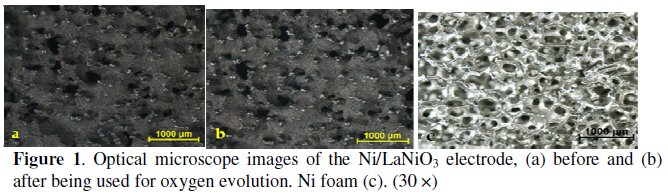
    <p>The morphology of the LaNiO<sub>3</sub> coating was examined by optical microscopy, 
before and after being used as anode for the OER, in order to confirm that the Ni 
foam substrate was suitably covered with the oxide. For comparison, the images 
of the Ni foam were recorded. Fig. 1 shows the representative global aspect of 
the new (a), used (b) electrodes and the uncovered Ni foam support (c). The 
porosity of the nickel foam is evident from the image. Concerning the LaNiO<sub>3</sub> 
coating, the Ni foam support is almost fully covered by the oxide, although some 
uncovered Ni points are observed. The coating is characterized by an irregular 
surface, indicating high roughness. The electrode images, after and before being 
used for oxygen evolution, do not show significant variations.</p> 


    <p>&nbsp;</p>
<img src="/img/revistas/pea/v29n5/29n5a04f1.jpg">
    
<p>&nbsp;</p>


    <p><b><i>Cyclic voltammetry</i></b></p>

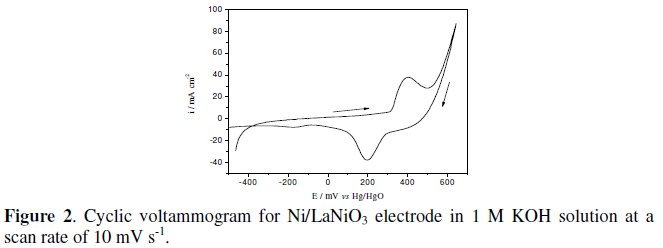
    <p>Fig. 2 shows a representative stabilized cyclic voltammogram recorded for a 
Ni/LaNiO<sub>3</sub> coated electrode in 1 M KOH at a sweep rate of 10 mVs<sup>-1</sup>. For all the 
electrodes, an anodic and the corresponding cathodic peak are observed, prior 
oxygen evolution, usually assigned to the redox pair Ni<sup>3+</sup>/Ni<sup>2+</sup> [7-10]. The 
estimated formal redox potential associated with this pair of peaks is within the 
range of those published, for the same oxide electrodes [7, 8]. In the negative 
potential range a cathodic peak is observed around -0.170 V vs. Hg/HgO 
attributed to the oxygen reduction [10]. The cyclic voltammograms run after and 
before the oxygen evolution showed similar features.</p> 


    <p>&nbsp;</p>
<img src="/img/revistas/pea/v29n5/29n5a04f2.jpg">
    
<p>&nbsp;</p>


    <p><b><i>Oxygen evolution reaction</i></b></p>

    <p>The study of the electrocatalytic activity of the prepared electrodes, towards the 
oxygen evolution reaction was studied in 1 M KOH solutions in the potential 
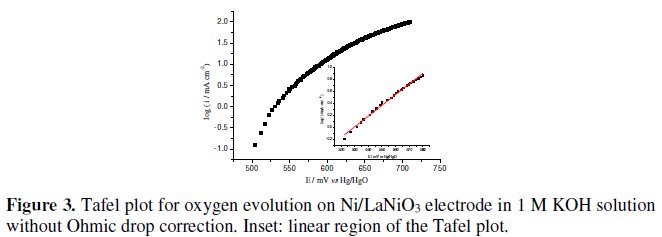
range of 0.500 - 0.720 V vs. Hg/HgO. Fig. 3 shows a representative Tafel plot, 
without Ohmic drop correction, for a freshly prepared Ni/LaNiO<sub>3</sub> coated 
electrode. As Fig, 3 shows, meaningful current intensities could be measured for 
potentials higher than 0.500 V vs. Hg/HgO. Once the standard potential of the 
oxygen electrode in basic solution is +0.300 V vs. Hg/HgO, it can be said that a 
minimum overpotential of &asymp; 0.200 V is needed for oxygen evolution to occur. 
Linear plots for log i vs. E were obtained over less than 1 decade of current, in 
the potential range of 0.520-0.580 V (see Fig. 3 inset). Deviations at more anodic 
potentials can be due either to uncompensated Ohmic drops or to a second Tafel 
line + IR drops. The calculated Tafel slope has the value of 56 &pm; 4 mV. Values 
between 40 and 60 mV can be found in the literature, for this potential region, 
depending on the oxide preparation method, oxide support and electrode type [4, 
7, 9, 13].</p>


    ]]></body>
<body><![CDATA[<p>&nbsp;</p>
<img src="/img/revistas/pea/v29n5/29n5a04f3.jpg">
    
<p>&nbsp;</p>


    <p>The most striking feature on the log i vs. E plots is the extremely narrow Tafel 
region. Similar behaviour has been observed by some of us for spinel type Fe - Co<sub>3</sub>O<sub>4</sub> 
thin film [14] and Li - Co<sub>3</sub>O<sub>4</sub> electrodes [15]. A detailed analysis of the data 
led us to conclude that the observed deviations, from Tafel behaviour, were a 
result of uncompensated Ohmic drops due to the electrode and electrolyte 
resistances as well as oxygen bubbles surface obstruction.</p>
    <p>In order to distinguish between Ohmic drops or a second Tafel line, the Ohmic 
drops were estimated, following the methodology proposed by Boodts and 
Trasatti [16].</p>

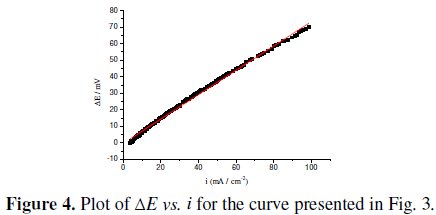
    <p>Fig. 4 shows the relationship of the potential difference &Delta;E, measured at constant 
current, between the experimental points and the extended Tafel line and the 
current density, in the potential range 0.560 - 0.710 V vs. Hg/HgO.

    <p>&nbsp;</p>
<img src="/img/revistas/pea/v29n5/29n5a04f4.jpg">
    
<p>&nbsp;</p>


The linearity indicates that the deviations from the Tafel behaviour are only due to 
uncompensated Ohmic drops and that only one Tafel line exists in this potential 
region. From the slope a value of 0.74&pm;0.1 &Omega; cm<sup>-2</sup> was evaluated for the 
uncompensated resistance between the electrode surface and the tip of the Luggin 
capillary, as well as the resistance of the oxide overlayer.</p> 

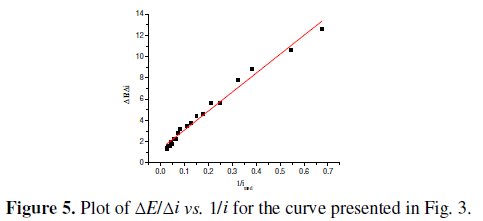
    <p>As in the presence of uncompensated Ohmic drops Tafel equation can be written 
as <i>E = a + b lni + iR</i>, it results <i>dE/di = b/i + R</i> [14, 17]. Fig. 5 shows the plot of 
&Delta;E/&Delta;i vs. 1/i , being &Delta;E and &Delta;i the difference of two consecutive experimental 
points and i the mean value between two consecutive values.</p>


    <p>&nbsp;</p>
<img src="/img/revistas/pea/v29n5/29n5a04f5.jpg">
    
<p>&nbsp;</p>


    ]]></body>
<body><![CDATA[<p>A single straight line is observed whose slope &times;2.303 gives b and whose intercept gives R. 
Considering that a correlation factor of 0.9840 has been achieved, it can be 
concluded that the deviations on the Tafel slope, in the potential region from 
0.540 V to 0.650 V, are due to uncompensated Ohmic drops and oxygen bubbles 
surface obstruction. Moreover the OER mechanism does not change within this 
potential range.</p>

    <p>From the slope of the plot of &Delta;E/&Delta;i vs. 1/i the corrected Tafel slope has been 
calculated and a value of 45&pm;3 mV was obtained. This value is similar to the 
lowest values found in the literature for LaNiO<sub>3</sub> oxide electrodes, in the forms of 
pellets [4] and thin films on platinum [7], at low potentials.</p>

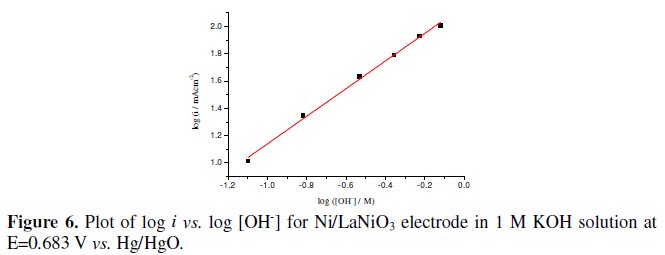
    <p>The reaction order with respect to OH<sup>-</sup>was obtained from E vs. log i curves 
recorded at varying concentrations of KOH at constant ionic strengths, using 
KNO<sub>3</sub> as the inert electrolyte. An order of 1.0 was estimated from the slope of 
the plot, log i vs. log [OH<sup>-</sup>] at 683 mV vs. Hg/HgO (Fig. 6). 


    <p>&nbsp;</p>
<img src="/img/revistas/pea/v29n5/29n5a04f6.jpg">
    
<p>&nbsp;</p>
 

    <p>The reaction order and the Tafel slope observed indicate a mechanism similar to that already given 
by Bockris and Otagawa [18].</p>

    <p>To get a better insight on the OER kinetics, the apparent exchange current 
density (i<sub>0a</sub>) has been evaluated. In order to eliminate geometric effects and 
discriminate the geometric and electronic effects, the value of the true exchange 
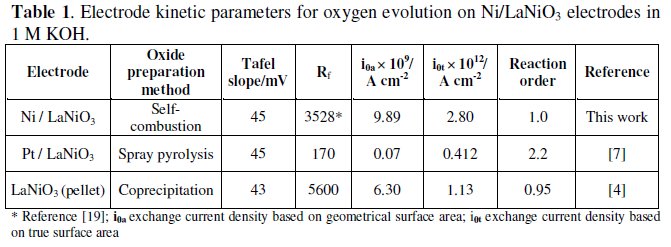
current density i<sub>0t</sub> (= i<sub>0a</sub>/R<sub>f</sub>), has been calculated by normalising i<sub>0a</sub> to unit real 
surface area, taking into account the oxide roughness factor (R<sub>f</sub>) [19], estimated 
from voltammetric curves, recorded in a narrow range of potential, near the open 
circuit potential [20].</p>
    <p>Table 1 presents the estimated kinetic parameters for the OER on Ni/ LaNiO<sub>3</sub> 
electrodes. For the purpose of comparison, data for LaNiO<sub>3</sub> electrodes prepared 
by different methods, and presenting Tafel slopes of the same order, are shown.</p>


    <p>&nbsp;</p>
<img src="/img/revistas/pea/v29n5/29n5a04t1.jpg">
    
<p>&nbsp;</p>


    ]]></body>
<body><![CDATA[<p>This table shows that among all the LaNiO<sub>3</sub> electrodes, the ones prepared in this 
work present the highest apparent exchange current density, what can be ascribed 
to the high roughness factor. Considering that the steady state measurements, for 
all the electrodes, gave similar Tafel slopes, the highest value for the true 
exchange current density, for the coatings on Ni foam, indicates that electronic 
effects are operating besides geometric effects, probably a contribution from the 
Ni foam support.</p>

    <p>The enhanced activity, towards the oxygen evolution reaction, of the electrodes 
prepared in this work, has been confirmed by the comparison between the 
potential values measured at 100 mA  cm<sup>-2</sup> of apparent current density for LaNiO<sub>3</sub> 
films prepared by thermal decomposition and sequential coating, on Ni plates, 
under varying conditions [8]. A value of 0.760 V vs. Hg/HgO is reported for the 
most active electrode, while a lower value of 0.715 V vs. Hg/HgO was obtained 
in this work. Similarly higher values, 0.728 V vs. Hg/HgO, are quoted for 
LaNiO<sub>3</sub> films prepared by oxide-slurry painting, from powders prepared by the 
hydroxide solution precursor method [9].</p>


    <p>&nbsp;</p>
    <p><b>Conclusions</b></p>

    <p>In our exploration of new supports for the LaNiO<sub>3</sub> oxide we have successfully 
made use of Ni foam. It was found that the oxide preparation procedure by the 
self-combustion method, using citric acid, in combination with the use of Ni 
foam as support, enhanced the electrode surface properties. Consequently its 
electrocatalytic activity, towards the OER, is higher when compared with the 
reported in the literature for the same oxide electrode prepared by other methods. 
The better performance exhibited is due to the electrochemical properties of 
foam-oxide films originated from their highly porous morphologies. Synergetic 
effects between the Ni foam and the perovskite oxide cannot be discarded.</p>


    <p>&nbsp;</p>
    <p><b>References</b></p>

    <!-- ref --><p>1. L. Jorissen, J. Power Sources 155 (2006) 23.    &nbsp;&nbsp;&nbsp;&nbsp;&nbsp;&nbsp;&nbsp;&nbsp;[&#160;<a href="javascript:void(0);" onclick="javascript: window.open('/scielo.php?script=sci_nlinks&ref=000070&pid=S0872-1904201100050000400001&lng=','','width=640,height=500,resizable=yes,scrollbars=1,menubar=yes,');">Links</a>&#160;]<!-- end-ref --></p>
    <!-- ref --><p>2. M. Bursell, M. Pirjamali, Y. Kiros, Electrochim. Acta 47 (2002) 1651.    &nbsp;&nbsp;&nbsp;&nbsp;&nbsp;&nbsp;&nbsp;&nbsp;[&#160;<a href="javascript:void(0);" onclick="javascript: window.open('/scielo.php?script=sci_nlinks&ref=000072&pid=S0872-1904201100050000400002&lng=','','width=640,height=500,resizable=yes,scrollbars=1,menubar=yes,');">Links</a>&#160;]<!-- end-ref --></p>
    <!-- ref --><p>3. K. Kinoshita, Electrochemical Oxygen Technology, The Electrochemical Society series, Wiley, New York, 1992.    &nbsp;&nbsp;&nbsp;&nbsp;&nbsp;&nbsp;&nbsp;&nbsp;[&#160;<a href="javascript:void(0);" onclick="javascript: window.open('/scielo.php?script=sci_nlinks&ref=000074&pid=S0872-1904201100050000400003&lng=','','width=640,height=500,resizable=yes,scrollbars=1,menubar=yes,');">Links</a>&#160;]<!-- end-ref --></p>
    <!-- ref --><p>4. T. Otagawa, J. O'M. Bockris, J. Electrochem. Soc. 131 (1984) 290.    &nbsp;&nbsp;&nbsp;&nbsp;&nbsp;&nbsp;&nbsp;&nbsp;[&#160;<a href="javascript:void(0);" onclick="javascript: window.open('/scielo.php?script=sci_nlinks&ref=000076&pid=S0872-1904201100050000400004&lng=','','width=640,height=500,resizable=yes,scrollbars=1,menubar=yes,');">Links</a>&#160;]<!-- end-ref --></p>
    <!-- ref --><p>5. J. O'M. Bockris, T. Otagawa, V. Young, J. Electroanal. Chem. 150 (1983) 633.    &nbsp;&nbsp;&nbsp;&nbsp;&nbsp;&nbsp;&nbsp;&nbsp;[&#160;<a href="javascript:void(0);" onclick="javascript: window.open('/scielo.php?script=sci_nlinks&ref=000078&pid=S0872-1904201100050000400005&lng=','','width=640,height=500,resizable=yes,scrollbars=1,menubar=yes,');">Links</a>&#160;]<!-- end-ref --></p>
    <!-- ref --><p>6. J. O'M. Bockris, T. Otagawa, J. Electrochem. Soc. 129 (1982) 2391.    &nbsp;&nbsp;&nbsp;&nbsp;&nbsp;&nbsp;&nbsp;&nbsp;[&#160;<a href="javascript:void(0);" onclick="javascript: window.open('/scielo.php?script=sci_nlinks&ref=000080&pid=S0872-1904201100050000400006&lng=','','width=640,height=500,resizable=yes,scrollbars=1,menubar=yes,');">Links</a>&#160;]<!-- end-ref --></p>
    <!-- ref --><p>7. R.N. Singh, L. Bahadur, J.P. Pandey et all, J. Appl. Electrochem. 24 (1994) 149.    &nbsp;&nbsp;&nbsp;&nbsp;&nbsp;&nbsp;&nbsp;&nbsp;[&#160;<a href="javascript:void(0);" onclick="javascript: window.open('/scielo.php?script=sci_nlinks&ref=000082&pid=S0872-1904201100050000400007&lng=','','width=640,height=500,resizable=yes,scrollbars=1,menubar=yes,');">Links</a>&#160;]<!-- end-ref --></p>
    <!-- ref --><p>8. S.P. Singh, R.N. Singh, G. Poillerat, P. Chartier, Int. J. Hydrogen Energy 20 (1995) 203.    &nbsp;&nbsp;&nbsp;&nbsp;&nbsp;&nbsp;&nbsp;&nbsp;[&#160;<a href="javascript:void(0);" onclick="javascript: window.open('/scielo.php?script=sci_nlinks&ref=000084&pid=S0872-1904201100050000400008&lng=','','width=640,height=500,resizable=yes,scrollbars=1,menubar=yes,');">Links</a>&#160;]<!-- end-ref --></p>
    <!-- ref --><p>9. R.N. Singh, A.N. Jain, S.K. Tiwari et all, J. Appl. Electrochem. 25 (1995) 1133.    &nbsp;&nbsp;&nbsp;&nbsp;&nbsp;&nbsp;&nbsp;&nbsp;[&#160;<a href="javascript:void(0);" onclick="javascript: window.open('/scielo.php?script=sci_nlinks&ref=000086&pid=S0872-1904201100050000400009&lng=','','width=640,height=500,resizable=yes,scrollbars=1,menubar=yes,');">Links</a>&#160;]<!-- end-ref --></p>
    <!-- ref --><p>10. R.N. Singh, S.K. Tiwari, S.P. Singh et all, Int. J. Hydrogen Energy 22 (1997) 557.    &nbsp;&nbsp;&nbsp;&nbsp;&nbsp;&nbsp;&nbsp;&nbsp;[&#160;<a href="javascript:void(0);" onclick="javascript: window.open('/scielo.php?script=sci_nlinks&ref=000088&pid=S0872-1904201100050000400010&lng=','','width=640,height=500,resizable=yes,scrollbars=1,menubar=yes,');">Links</a>&#160;]<!-- end-ref --></p>
    <!-- ref --><p>11. S.K. Tiwari, J.F. Koenig, G. Poillerat et all, J. Appl. Electrochem. 28 (1998) 114.    &nbsp;&nbsp;&nbsp;&nbsp;&nbsp;&nbsp;&nbsp;&nbsp;[&#160;<a href="javascript:void(0);" onclick="javascript: window.open('/scielo.php?script=sci_nlinks&ref=000090&pid=S0872-1904201100050000400011&lng=','','width=640,height=500,resizable=yes,scrollbars=1,menubar=yes,');">Links</a>&#160;]<!-- end-ref --></p>
    <!-- ref --><p>12. S. Trasatti, in Electrochemistry of Novel Materials, J. Lipkowski, P.N. Ross, Eds, VCH, New York, 1994.    &nbsp;&nbsp;&nbsp;&nbsp;&nbsp;&nbsp;&nbsp;&nbsp;[&#160;<a href="javascript:void(0);" onclick="javascript: window.open('/scielo.php?script=sci_nlinks&ref=000092&pid=S0872-1904201100050000400012&lng=','','width=640,height=500,resizable=yes,scrollbars=1,menubar=yes,');">Links</a>&#160;]<!-- end-ref --></p>
    <!-- ref --><p>13. R.N. Singh, S.K. Tiwari, T. Sharma et all, J. New Mat. Electrochem. Sys. 2 (1999) 65.    &nbsp;&nbsp;&nbsp;&nbsp;&nbsp;&nbsp;&nbsp;&nbsp;[&#160;<a href="javascript:void(0);" onclick="javascript: window.open('/scielo.php?script=sci_nlinks&ref=000094&pid=S0872-1904201100050000400013&lng=','','width=640,height=500,resizable=yes,scrollbars=1,menubar=yes,');">Links</a>&#160;]<!-- end-ref --></p>
    <!-- ref --><p>14. E. Laouini, M. Hamdani, M.I.S. Pereira et all, Int. J. Hydrogen Energy 33 (2008) 4936.    &nbsp;&nbsp;&nbsp;&nbsp;&nbsp;&nbsp;&nbsp;&nbsp;[&#160;<a href="javascript:void(0);" onclick="javascript: window.open('/scielo.php?script=sci_nlinks&ref=000096&pid=S0872-1904201100050000400014&lng=','','width=640,height=500,resizable=yes,scrollbars=1,menubar=yes,');">Links</a>&#160;]<!-- end-ref --></p>
    <!-- ref --><p>15. M. Hamdani, M.I.S. Pereira, J. Douch et all, Electrochim. Acta 49 (2004) 1555.    &nbsp;&nbsp;&nbsp;&nbsp;&nbsp;&nbsp;&nbsp;&nbsp;[&#160;<a href="javascript:void(0);" onclick="javascript: window.open('/scielo.php?script=sci_nlinks&ref=000098&pid=S0872-1904201100050000400015&lng=','','width=640,height=500,resizable=yes,scrollbars=1,menubar=yes,');">Links</a>&#160;]<!-- end-ref --></p>
    <!-- ref --><p>16. J.C.F. Boodts, S. Trasatti, J. Appl. Electrochem. 19 (1989) 255.    &nbsp;&nbsp;&nbsp;&nbsp;&nbsp;&nbsp;&nbsp;&nbsp;[&#160;<a href="javascript:void(0);" onclick="javascript: window.open('/scielo.php?script=sci_nlinks&ref=000100&pid=S0872-1904201100050000400016&lng=','','width=640,height=500,resizable=yes,scrollbars=1,menubar=yes,');">Links</a>&#160;]<!-- end-ref --></p>
    <!-- ref --><p>17. L. Popa, E. Guerrini, S. Trasatti, J. Appl. Electrochem. 35 (2005) 1213.    &nbsp;&nbsp;&nbsp;&nbsp;&nbsp;&nbsp;&nbsp;&nbsp;[&#160;<a href="javascript:void(0);" onclick="javascript: window.open('/scielo.php?script=sci_nlinks&ref=000102&pid=S0872-1904201100050000400017&lng=','','width=640,height=500,resizable=yes,scrollbars=1,menubar=yes,');">Links</a>&#160;]<!-- end-ref --></p>
    <!-- ref --><p>18. J. O'M. Bockris, T. Otagawa, J. Phys. Chem. 87 (1983) 2960.    &nbsp;&nbsp;&nbsp;&nbsp;&nbsp;&nbsp;&nbsp;&nbsp;[&#160;<a href="javascript:void(0);" onclick="javascript: window.open('/scielo.php?script=sci_nlinks&ref=000104&pid=S0872-1904201100050000400018&lng=','','width=640,height=500,resizable=yes,scrollbars=1,menubar=yes,');">Links</a>&#160;]<!-- end-ref --></p>
    <!-- ref --><p>19. C.M. Rangel, C.O. Soares, R.A. Silva et all, ISE NICE S04-P-110, 61st Meeting of ISE, 26 September to 1 October 2010, Nice, France, 2010.    &nbsp;&nbsp;&nbsp;&nbsp;&nbsp;&nbsp;&nbsp;&nbsp;[&#160;<a href="javascript:void(0);" onclick="javascript: window.open('/scielo.php?script=sci_nlinks&ref=000106&pid=S0872-1904201100050000400019&lng=','','width=640,height=500,resizable=yes,scrollbars=1,menubar=yes,');">Links</a>&#160;]<!-- end-ref --></p>
    <!-- ref --><p>20. J. Douch, M. Hamdani, M.I. da Silva Pereira, Port. Electrochim. Acta 20 (2002) 3.    &nbsp;&nbsp;&nbsp;&nbsp;&nbsp;&nbsp;&nbsp;&nbsp;[&#160;<a href="javascript:void(0);" onclick="javascript: window.open('/scielo.php?script=sci_nlinks&ref=000108&pid=S0872-1904201100050000400020&lng=','','width=640,height=500,resizable=yes,scrollbars=1,menubar=yes,');">Links</a>&#160;]<!-- end-ref --></p>


    <p>&nbsp;</p>
    <p><b>Acknowledgement</b></p>

    <p>This work is partially financed by Funda&ccedil;&atilde;o para a Ci&ecirc;ncia e Tecnologia (FCT), 
under contract n&deg; PTDC/CTM/102545/2008. C.O. Soares acknowledges a grant 
from FCT under the same contract.</p>


    ]]></body>
<body><![CDATA[<p><a name=0></a><sup><a href="#top">*</a></sup> Corresponding author. E-mail address: <a href="mailto:mipereira@fc.ul.pt">mipereira@fc.ul.pt</a></p>

    <p>Received 28 December 2010; accepted 23 February 2011</p>

    <p><a href="http://www.peacta.org" target="_blank">www.peacta.org</a> </p>


     ]]></body><back>
<ref-list>
<ref id="B1">
<label>1</label><nlm-citation citation-type="journal">
<person-group person-group-type="author">
<name>
<surname><![CDATA[Jorissen]]></surname>
<given-names><![CDATA[L.]]></given-names>
</name>
</person-group>
<source><![CDATA[J. Power Sources]]></source>
<year>2006</year>
<volume>155</volume>
<page-range>23</page-range></nlm-citation>
</ref>
<ref id="B2">
<label>2</label><nlm-citation citation-type="journal">
<person-group person-group-type="author">
<name>
<surname><![CDATA[Bursell]]></surname>
<given-names><![CDATA[M.]]></given-names>
</name>
<name>
<surname><![CDATA[Pirjamali]]></surname>
<given-names><![CDATA[M.]]></given-names>
</name>
<name>
<surname><![CDATA[Kiros]]></surname>
<given-names><![CDATA[Y.]]></given-names>
</name>
</person-group>
<source><![CDATA[Electrochim. Acta]]></source>
<year>2002</year>
<volume>47</volume>
<page-range>1651</page-range></nlm-citation>
</ref>
<ref id="B3">
<label>3</label><nlm-citation citation-type="book">
<person-group person-group-type="author">
<name>
<surname><![CDATA[Kinoshita]]></surname>
<given-names><![CDATA[K.]]></given-names>
</name>
</person-group>
<source><![CDATA[Electrochemical Oxygen Technology]]></source>
<year>1992</year>
<publisher-loc><![CDATA[New York ]]></publisher-loc>
<publisher-name><![CDATA[Wiley]]></publisher-name>
</nlm-citation>
</ref>
<ref id="B4">
<label>4</label><nlm-citation citation-type="journal">
<person-group person-group-type="author">
<name>
<surname><![CDATA[Otagawa]]></surname>
<given-names><![CDATA[T.]]></given-names>
</name>
<name>
<surname><![CDATA[Bockris]]></surname>
<given-names><![CDATA[J. O'M.]]></given-names>
</name>
</person-group>
<source><![CDATA[J. Electrochem. Soc.]]></source>
<year>1984</year>
<volume>131</volume>
<page-range>290</page-range></nlm-citation>
</ref>
<ref id="B5">
<label>5</label><nlm-citation citation-type="journal">
<person-group person-group-type="author">
<name>
<surname><![CDATA[Bockris]]></surname>
<given-names><![CDATA[J. O'M.]]></given-names>
</name>
<name>
<surname><![CDATA[Otagawa]]></surname>
<given-names><![CDATA[T.]]></given-names>
</name>
<name>
<surname><![CDATA[Young]]></surname>
<given-names><![CDATA[V.]]></given-names>
</name>
</person-group>
<source><![CDATA[J. Electroanal. Chem.]]></source>
<year>1983</year>
<volume>150</volume>
<page-range>633</page-range></nlm-citation>
</ref>
<ref id="B6">
<label>6</label><nlm-citation citation-type="journal">
<person-group person-group-type="author">
<name>
<surname><![CDATA[Bockris]]></surname>
<given-names><![CDATA[J. O'M.]]></given-names>
</name>
<name>
<surname><![CDATA[Otagawa]]></surname>
<given-names><![CDATA[T.]]></given-names>
</name>
</person-group>
<source><![CDATA[J. Electrochem. Soc.]]></source>
<year>1982</year>
<volume>129</volume>
<page-range>2391</page-range></nlm-citation>
</ref>
<ref id="B7">
<label>7</label><nlm-citation citation-type="journal">
<person-group person-group-type="author">
<name>
<surname><![CDATA[Singh]]></surname>
<given-names><![CDATA[R.N.]]></given-names>
</name>
<name>
<surname><![CDATA[Bahadur]]></surname>
<given-names><![CDATA[L.]]></given-names>
</name>
<name>
<surname><![CDATA[Pandey]]></surname>
<given-names><![CDATA[J.P.]]></given-names>
</name>
</person-group>
<source><![CDATA[J. Appl. Electrochem.]]></source>
<year>1994</year>
<volume>24</volume>
<page-range>149</page-range></nlm-citation>
</ref>
<ref id="B8">
<label>8</label><nlm-citation citation-type="journal">
<person-group person-group-type="author">
<name>
<surname><![CDATA[Singh]]></surname>
<given-names><![CDATA[S.P.]]></given-names>
</name>
<name>
<surname><![CDATA[Singh]]></surname>
<given-names><![CDATA[R.N.]]></given-names>
</name>
<name>
<surname><![CDATA[Poillerat]]></surname>
<given-names><![CDATA[G.]]></given-names>
</name>
<name>
<surname><![CDATA[Chartier]]></surname>
<given-names><![CDATA[P.]]></given-names>
</name>
</person-group>
<source><![CDATA[Int. J. Hydrogen Energy]]></source>
<year>1995</year>
<volume>20</volume>
<page-range>203</page-range></nlm-citation>
</ref>
<ref id="B9">
<label>9</label><nlm-citation citation-type="journal">
<person-group person-group-type="author">
<name>
<surname><![CDATA[Singh]]></surname>
<given-names><![CDATA[R.N.]]></given-names>
</name>
<name>
<surname><![CDATA[Jain]]></surname>
<given-names><![CDATA[A.N.]]></given-names>
</name>
<name>
<surname><![CDATA[Tiwari]]></surname>
<given-names><![CDATA[S.K.]]></given-names>
</name>
</person-group>
<source><![CDATA[J. Appl. Electrochem.]]></source>
<year>1995</year>
<volume>25</volume>
<page-range>1133</page-range></nlm-citation>
</ref>
<ref id="B10">
<label>10</label><nlm-citation citation-type="journal">
<person-group person-group-type="author">
<name>
<surname><![CDATA[Singh]]></surname>
<given-names><![CDATA[R.N.]]></given-names>
</name>
<name>
<surname><![CDATA[Tiwari]]></surname>
<given-names><![CDATA[S.K.]]></given-names>
</name>
<name>
<surname><![CDATA[Singh]]></surname>
<given-names><![CDATA[S.P.]]></given-names>
</name>
</person-group>
<source><![CDATA[Int. J. Hydrogen Energy]]></source>
<year>1997</year>
<volume>22</volume>
<page-range>557</page-range></nlm-citation>
</ref>
<ref id="B11">
<label>11</label><nlm-citation citation-type="journal">
<person-group person-group-type="author">
<name>
<surname><![CDATA[Tiwari]]></surname>
<given-names><![CDATA[S.K.]]></given-names>
</name>
<name>
<surname><![CDATA[Koenig]]></surname>
<given-names><![CDATA[J.F.]]></given-names>
</name>
<name>
<surname><![CDATA[Poillerat]]></surname>
<given-names><![CDATA[G.]]></given-names>
</name>
</person-group>
<source><![CDATA[J. Appl. Electrochem.]]></source>
<year>1998</year>
<volume>28</volume>
<page-range>114</page-range></nlm-citation>
</ref>
<ref id="B12">
<label>12</label><nlm-citation citation-type="book">
<person-group person-group-type="author">
<name>
<surname><![CDATA[Trasatti]]></surname>
<given-names><![CDATA[S.]]></given-names>
</name>
</person-group>
<source><![CDATA[Electrochemistry of Novel Materials]]></source>
<year>1994</year>
<publisher-loc><![CDATA[New York ]]></publisher-loc>
<publisher-name><![CDATA[VCH]]></publisher-name>
</nlm-citation>
</ref>
<ref id="B13">
<label>13</label><nlm-citation citation-type="journal">
<person-group person-group-type="author">
<name>
<surname><![CDATA[Singh]]></surname>
<given-names><![CDATA[R.N.]]></given-names>
</name>
<name>
<surname><![CDATA[Tiwari]]></surname>
<given-names><![CDATA[S.K.]]></given-names>
</name>
<name>
<surname><![CDATA[Sharma]]></surname>
<given-names><![CDATA[T.]]></given-names>
</name>
</person-group>
<source><![CDATA[J. New Mat. Electrochem. Sys.]]></source>
<year>1999</year>
<volume>2</volume>
<page-range>65</page-range></nlm-citation>
</ref>
<ref id="B14">
<label>14</label><nlm-citation citation-type="journal">
<person-group person-group-type="author">
<name>
<surname><![CDATA[Laouini]]></surname>
<given-names><![CDATA[E.]]></given-names>
</name>
<name>
<surname><![CDATA[Hamdani]]></surname>
<given-names><![CDATA[M.]]></given-names>
</name>
<name>
<surname><![CDATA[Pereira]]></surname>
<given-names><![CDATA[M.I.S.]]></given-names>
</name>
</person-group>
<source><![CDATA[Int. J. Hydrogen Energy]]></source>
<year>2008</year>
<volume>33</volume>
<page-range>4936</page-range></nlm-citation>
</ref>
<ref id="B15">
<label>15</label><nlm-citation citation-type="journal">
<person-group person-group-type="author">
<name>
<surname><![CDATA[Hamdani]]></surname>
<given-names><![CDATA[M.]]></given-names>
</name>
<name>
<surname><![CDATA[Pereira]]></surname>
<given-names><![CDATA[M.I.S.]]></given-names>
</name>
<name>
<surname><![CDATA[Douch]]></surname>
<given-names><![CDATA[J.]]></given-names>
</name>
</person-group>
<source><![CDATA[Electrochim. Acta]]></source>
<year>2004</year>
<volume>49</volume>
<page-range>1555</page-range></nlm-citation>
</ref>
<ref id="B16">
<label>16</label><nlm-citation citation-type="journal">
<person-group person-group-type="author">
<name>
<surname><![CDATA[Boodts]]></surname>
<given-names><![CDATA[J.C.F.]]></given-names>
</name>
<name>
<surname><![CDATA[Trasatti]]></surname>
<given-names><![CDATA[S.]]></given-names>
</name>
</person-group>
<source><![CDATA[J. Appl. Electrochem.]]></source>
<year>1989</year>
<volume>19</volume>
<page-range>255</page-range></nlm-citation>
</ref>
<ref id="B17">
<label>17</label><nlm-citation citation-type="journal">
<person-group person-group-type="author">
<name>
<surname><![CDATA[Popa]]></surname>
<given-names><![CDATA[L.]]></given-names>
</name>
<name>
<surname><![CDATA[Guerrini]]></surname>
<given-names><![CDATA[E.]]></given-names>
</name>
<name>
<surname><![CDATA[Trasatti]]></surname>
<given-names><![CDATA[S.]]></given-names>
</name>
</person-group>
<source><![CDATA[J. Appl. Electrochem.]]></source>
<year>2005</year>
<volume>35</volume>
<page-range>1213</page-range></nlm-citation>
</ref>
<ref id="B18">
<label>18</label><nlm-citation citation-type="journal">
<person-group person-group-type="author">
<name>
<surname><![CDATA[Bockris]]></surname>
<given-names><![CDATA[J. O'M.]]></given-names>
</name>
<name>
<surname><![CDATA[Otagawa]]></surname>
<given-names><![CDATA[T.]]></given-names>
</name>
</person-group>
<source><![CDATA[J. Phys. Chem.]]></source>
<year>1983</year>
<volume>87</volume>
<page-range>2960</page-range></nlm-citation>
</ref>
<ref id="B19">
<label>19</label><nlm-citation citation-type="">
<person-group person-group-type="author">
<name>
<surname><![CDATA[Rangel]]></surname>
<given-names><![CDATA[C.M.]]></given-names>
</name>
<name>
<surname><![CDATA[Soares]]></surname>
<given-names><![CDATA[C.O.]]></given-names>
</name>
<name>
<surname><![CDATA[Silva]]></surname>
<given-names><![CDATA[R.A.]]></given-names>
</name>
</person-group>
<source><![CDATA[ISE NICE S04-P-110, 61st Meeting of ISE]]></source>
<year>2010</year>
<publisher-loc><![CDATA[Nice^eFrance France]]></publisher-loc>
</nlm-citation>
</ref>
<ref id="B20">
<label>20</label><nlm-citation citation-type="journal">
<person-group person-group-type="author">
<name>
<surname><![CDATA[Douch]]></surname>
<given-names><![CDATA[J.]]></given-names>
</name>
<name>
<surname><![CDATA[Hamdani]]></surname>
<given-names><![CDATA[M.]]></given-names>
</name>
<name>
<surname><![CDATA[da Silva Pereira]]></surname>
<given-names><![CDATA[M.I.]]></given-names>
</name>
</person-group>
<source><![CDATA[Port. Electrochim. Acta]]></source>
<year>2002</year>
<volume>20</volume>
<page-range>3</page-range></nlm-citation>
</ref>
</ref-list>
</back>
</article>