<?xml version="1.0" encoding="ISO-8859-1"?><article xmlns:mml="http://www.w3.org/1998/Math/MathML" xmlns:xlink="http://www.w3.org/1999/xlink" xmlns:xsi="http://www.w3.org/2001/XMLSchema-instance">
<front>
<journal-meta>
<journal-id>0872-1904</journal-id>
<journal-title><![CDATA[Portugaliae Electrochimica Acta]]></journal-title>
<abbrev-journal-title><![CDATA[Port. Electrochim. Acta]]></abbrev-journal-title>
<issn>0872-1904</issn>
<publisher>
<publisher-name><![CDATA[Sociedade Portuguesa de Electroquímica]]></publisher-name>
</publisher>
</journal-meta>
<article-meta>
<article-id>S0872-19042011000500005</article-id>
<article-id pub-id-type="doi">10.4152/pea.201105343</article-id>
<title-group>
<article-title xml:lang="en"><![CDATA[Effect of the Hydrodynamic Conditions on the Electrochemical Degradation of Phenol on a BDD Anode]]></article-title>
</title-group>
<contrib-group>
<contrib contrib-type="author">
<name>
<surname><![CDATA[Sobreira]]></surname>
<given-names><![CDATA[S.]]></given-names>
</name>
<xref ref-type="aff" rid="A01"/>
</contrib>
<contrib contrib-type="author">
<name>
<surname><![CDATA[Pacheco]]></surname>
<given-names><![CDATA[M.J.]]></given-names>
</name>
<xref ref-type="aff" rid="A01"/>
</contrib>
<contrib contrib-type="author">
<name>
<surname><![CDATA[Ciríaco]]></surname>
<given-names><![CDATA[L.]]></given-names>
</name>
<xref ref-type="aff" rid="A01"/>
</contrib>
<contrib contrib-type="author">
<name>
<surname><![CDATA[Lopes]]></surname>
<given-names><![CDATA[A.]]></given-names>
</name>
<xref ref-type="aff" rid="A01"/>
</contrib>
</contrib-group>
<aff id="A01">
<institution><![CDATA[,University of Beira Interior Department of Chemistry ]]></institution>
<addr-line><![CDATA[Covilhã ]]></addr-line>
<country>Portugal</country>
</aff>
<pub-date pub-type="pub">
<day>00</day>
<month>09</month>
<year>2011</year>
</pub-date>
<pub-date pub-type="epub">
<day>00</day>
<month>09</month>
<year>2011</year>
</pub-date>
<volume>29</volume>
<numero>5</numero>
<fpage>343</fpage>
<lpage>348</lpage>
<copyright-statement/>
<copyright-year/>
<self-uri xlink:href="http://scielo.pt/scielo.php?script=sci_arttext&amp;pid=S0872-19042011000500005&amp;lng=en&amp;nrm=iso"></self-uri><self-uri xlink:href="http://scielo.pt/scielo.php?script=sci_abstract&amp;pid=S0872-19042011000500005&amp;lng=en&amp;nrm=iso"></self-uri><self-uri xlink:href="http://scielo.pt/scielo.php?script=sci_pdf&amp;pid=S0872-19042011000500005&amp;lng=en&amp;nrm=iso"></self-uri><abstract abstract-type="short" xml:lang="en"><p><![CDATA[The influence of the hydrodynamics of the system on the extent of the electrochemical degradation of phenol, using a boron doped diamond (BDD) anode was investigated. Two different electrochemical cells were used: a batch stirred cell (A), with a volume of 200 mL and a BDD anode of 17.5 cm², and a batch with recirculation cell (B), with a BDD anode of 70 cm² and connected to a tank of 30 L. Assays were performed at different stirring speeds and applied current density of 300 A m-2 , for cell A, and various flow rates, with an imposed current density of 100 A m-2, for cell B. Chemical oxygen demand (COD) and total organic carbon (TOC) tests were performed to the samples collected throughout the assays, as well as UV-Vis spectrophotometric measurements. For cell A, after 2 h assay, COD removals between 84 and 94% and TOC removals ranging from 54 and 86 % were attained. For the assays run with cell B, during 10 h, COD and TOC removals varied from 27 to 51% and from 23 to 46%, respectively. The influence of the turbulence near the electrode's surface in the combustion efficiency was also analysed.]]></p></abstract>
<kwd-group>
<kwd lng="en"><![CDATA[phenol]]></kwd>
<kwd lng="en"><![CDATA[boron doped diamond electrode]]></kwd>
<kwd lng="en"><![CDATA[electrochemical oxidation]]></kwd>
<kwd lng="en"><![CDATA[hydrodynamic conditions]]></kwd>
</kwd-group>
</article-meta>
</front><body><![CDATA[ 

    <p><b>Effect of the Hydrodynamic Conditions on the Electrochemical Degradation of Phenol on a BDD Anode</b></p>

    <p><b>S. Sobreira, M.J. Pacheco, L. Cir&iacute;aco</b> and <b>A. Lopes</b><sup><a href="#0">*<a/></sup></p>

    <p><i>UMTP and Department of Chemistry, University of Beira Interior, 6201-001 Covilh&atilde;, Portugal</i></p>


    <p>&nbsp;</p>
    <p>doi: 10.4152/pea.201105343</p>


    <p>&nbsp;</p>
    <p><b>Abstract</b></p>

    <p>The influence of the hydrodynamics of the system on the extent of the electrochemical 
degradation of phenol, using a boron doped diamond (BDD) anode was investigated. 
Two different electrochemical cells were used: a batch stirred cell (A), with a volume of 
200 mL and a BDD anode of 17.5 cm<sup>2</sup>, and a batch with recirculation cell (B), with a 
BDD anode of 70 cm<sup>2</sup> and connected to a tank of 30 L. Assays were performed at 
different stirring speeds and applied current density of 300 A m<sup>-2</sup> , for cell A, and 
various flow rates, with an imposed current density of 100 A m<sup>-2</sup>, for cell B. Chemical 
oxygen demand (COD) and total organic carbon (TOC) tests were performed to the 
samples collected throughout the assays, as well as UV-Vis spectrophotometric 
measurements. For cell A, after 2 h assay, COD removals between 84 and 94% and 
TOC removals ranging from 54 and 86 % were attained. For the assays run with cell B, 
during 10 h, COD and TOC removals varied from 27 to 51% and from 23 to 46%, 
respectively. The influence of the turbulence near the electrode's surface in the 
combustion efficiency was also analysed.</p>

    <p><b><i>Keywords:</i></b> phenol; boron doped diamond electrode; electrochemical oxidation; 
hydrodynamic conditions.</p>

    ]]></body>
<body><![CDATA[<p>&nbsp;</p>
    <p><b>Introduction</b></p>

    <p>Phenol is one of the pollutants whose degradation has been under intense study in 
the last decades. In fact, it is often chosen as model pollutant. G. Busca and 
collaborators presented an extensive review over the different ways to promote 
its degradation [1].</p>
    <p>Electrochemical oxidation of effluents containing persistent organic pollutants is 
an alternative or tertiary treatment that has received much attention in the last 
years due to its interesting characteristics, since it is a clean process, can operate 
at low temperature and, in most cases, without adding any chemical and without   
sludge formation. Recently, the use of boron doped diamond (BDD) as anode 
material has proved to be very useful, since, besides its good mechanical and 
electrochemical stability, it has unique electrochemical characteristics, like large 
potential window for water decomposition [2], ability to produce hydroxyl 
radicals [3] poorly adsorbed on the electrode's surface [4] and that can perform 
the oxidation of the pollutants simultaneously in the bulk of the solution. 
Therefore, BDD anodes are an excellent material for the oxidation of all kinds of 
pollutants [5]. In particular, the electrooxidation of phenol and other phenolic 
compounds has already been carried out with BDD anodes, at bench scale, with 
good degradation rate [6,7]. However, to scale-up the process to an industrial 
level, a better understanding of the mass transfer during the electrochemical 
process is needed. The objective of this work is to study the influence of the 
hydrodynamic conditions on the mass transfer process during the anodic 
oxidation of phenol, using BDD as anode material, in two different 
electrochemical cells: a small batch stirred cell and a pilot cell with re-circulating 
flow.</p>


    <p>&nbsp;</p>
    <p><b>Experimental</b></p>

    <p>Two sets of electrochemical assays were run, using different experimental setups. 
The first one (A) consisted of an electrochemical cell, with a BDD anode of 
17.5 cm<sup>2</sup> area, purchased from Adamant Technologies/CSEM, Switzerland, and 
the degradation was carried out in batch mode, for 2 h, at several stirring rates, 
using 200 mL of an aqueous 0.035 M Na<sub>2</sub>SO<sub>2</sub> solution, containing 300 mg L<sup>-1</sup> of 
phenol (purchased from Aldrich). Current was imposed by a laboratory power 
supply GW, model GPS-3O3OD. Cell B was a DiaCel 196PVDF, with two 
monopol BDD electrodes (70 cm<sup>2</sup> area), from Adamant Technologies/CSEM, 
Switzerland, used with a Power supply DiaCell, PC-1500. These assays were 
performed in batch with recirculation mode, for 10 h, and a centrifugal pump, 
Wilo, Serie MHI, enabled the recirculation of the solution at the different flow 
rates tested. The composition of the solution was identical of that in cell A, but a 
volume of 30 L was used here and re-circulation flow rates of 200, 300 and 500 
L h<sup>-1</sup> were tested.</p>
    <p>The electrochemical assays were performed in galvanostatic mode, at imposed 
current densities of 300 and 100 A m<sup>-2</sup> for cells A and B, respectively. Phenol 
degradation tests were followed by UV-Visible spectrophotometry, with 
absorbance being measured from 200 to 600 nm, using a UNICAM -Helios-a 
UV/VIS spectrophotometer, by Chemical Oxygen Demand (COD) tests, using the 
closed reflux dichromate titrimetric method [8], and by Total Organic Carbon 
(TOC) determinations, performed in a Shimadzu TOC-VCPH apparatus.</p>


    <p>&nbsp;</p>
    <p><b>Results and discussion</b></p>

    ]]></body>
<body><![CDATA[<p><b><i>COD analysis</i></b></p>

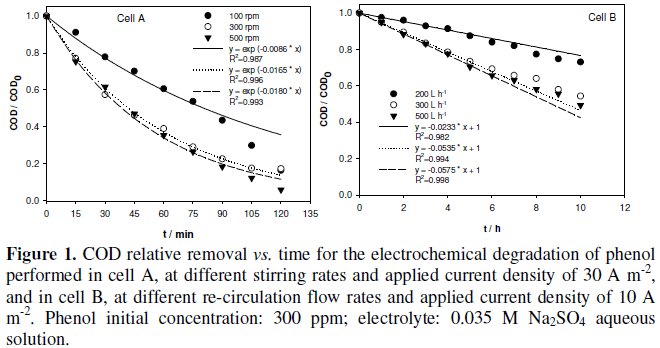
    <p>Fig. 1 presents the experimental COD removal as a function of the assays' 
duration, for the different experimental conditions tested with both 
electrochemical cells.</p>


    <p>&nbsp;</p><a name="top.f1"></a>
<img src="/img/revistas/pea/v29n5/29n5a05f1.jpg">
    
<p>&nbsp;</p>


    <p>In the case of the assays performed with cell A, at the 
applied current density of 30 A m<sup>-2</sup>, the electrodegradation is diffusion controlled 
and COD follows an exponential decay, according to equation [9]:</p>


    <p>&nbsp;</p>
<img src="/img/revistas/pea/v29n5/29n5a05e1.jpg">
    
<p>&nbsp;</p>


where COD<sub>0</sub> refers to the initial COD, A, V and t are the area of the electrode, 
the volume of the solution and the time, respectively, and kd is the medium mass 
transfer coefficient. This exponential equation was fitted to experimental data up 
to 90 min, since after that period of time experimental data differs from fitted 
equation. This fact must be due to an incomplete combustion that leads to the 
formation and accumulation of new metabolites, with a different kd. The kd 
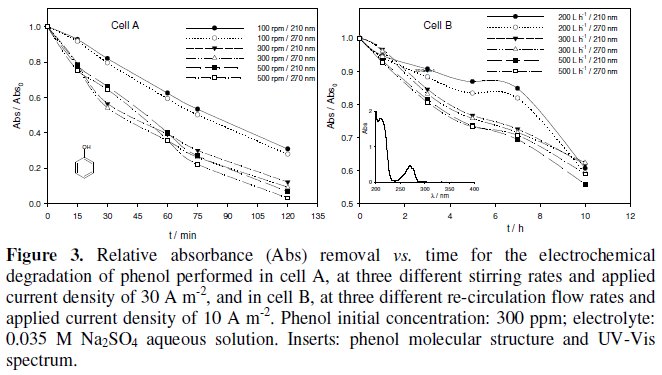
values, determined from the fittings depicted in <a href="#top.f1">Fig. 1</a> (Cell A), are presented in 
Table 1, showing that an increase in the stirring rate leads to an increase in the 
medium mass transfer coefficient, probably due to a decrease in the width of the 
diffusion layer.</p>


    <p>&nbsp; <a name="top.t1"></a> </p>
<img src="/img/revistas/pea/v29n5/29n5a05t1.jpg">
    
<p>&nbsp;</p>


    <p>Regarding the assays performed with cell B, at 100 A m<sup>-2</sup>, the COD decay 
follows a linear fitting, typical from a current controlled process. However, in the 
fitting of linear equations to experimental results different slopes were obtained, 
which was not expected, since current intensity did not vary. The lower COD 
decay observed for the lower flow rate must be related with the formation of 
metabolites that may polarize the surface of the electrode, being removed more 
easily with the increase in flow rate. Also, in these assays, after an initial period, 
there is a change in the trend of COD decay, pointing out to an incomplete 
combustion of phenol, with the consequent formation of metabolites.</p>


    ]]></body>
<body><![CDATA[<p><b><i>TOC analysis</i></b></p>

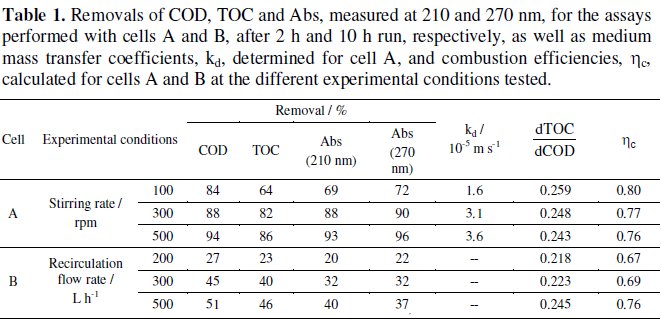
    <p>The samples collected during the assays were analyzed for the total organic 
carbon content. Experimental results and the best equations fitted to the 
experimental points are presented in Fig. 2.</p>


    <p>&nbsp;</p>
<img src="/img/revistas/pea/v29n5/29n5a05f2.jpg">
    
<p>&nbsp;</p>


    <p>TOC removal increases with the stirring speed and with the flow rate, like it was observed for the COD variation. 
However, the removal of TOC is slower than the removal of COD, meaning that 
the electrochemical oxidation does not correspond to a complete mineralization.</p>
    <p>In the case of the highest flow rate tested, there is a clear deviation, after 4 h 
assay, from the initial TOC decay trend, meaning that metabolites formed are 
more resistant to mineralization than phenol.</p>


    <p><b><i>Ultraviolet-Visible spectrophotometry analysis</i></b></p>

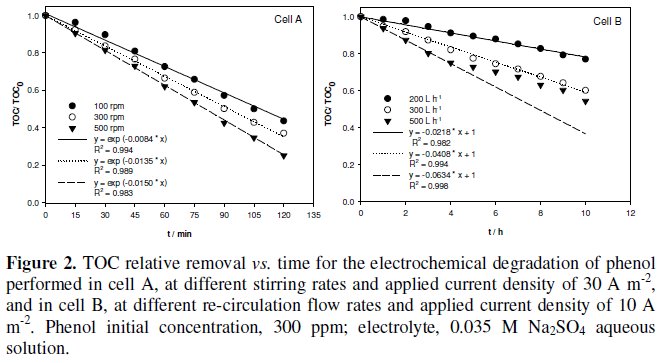
    <p>In Fig. 3 the relative absorbance removal with time is depicted for some of the 
experiments performed in both cells. Two different wavelengths, related to 
maximum of absorbance, were chosen in the ultraviolet region, 210 and 270 nm. 
In the inserts of Fig. 3, it can also be observed the molecular structure of phenol 
and its UV-Vis. spectrum.</p>


    <p>&nbsp;</p>
<img src="/img/revistas/pea/v29n5/29n5a05f3.jpg">
    
<p>&nbsp;</p>


    ]]></body>
<body><![CDATA[<p>For the assays performed in both electrochemical cells, the absorbance removal 
increases with stirring rate and flow rate. However, the decrease in absorbance 
depends on the wavelength, being, in general, the highest decrease observed for 
the band with a maximum at 210 nm.</p>


    <p><b><i>Combustion efficiency</i></b></p>
 
    <p>According to Pacheco and co-workers [7], the efficiency of the combustion, &eta;<sub>c</sub>, 
can be estimated from the ratio between the rate of TOC decrease and the rate of 
COD decrease by:</p>

    <p>&nbsp;</p>
<img src="/img/revistas/pea/v29n5/29n5a05e2.jpg">
    
<p>&nbsp;</p>

    <p>where TOC is in mg<sub>C</sub> / L, COD in mg<sub>O<sub>2</sub></sub> / L, n is the number of electrons 
transferred to the electrode in the process of the complete combustion of the 
organic solute, and x is the number of carbon atoms in the organic molecule. For 
the calculation of n it was assumed that, for phenol, the combustion process is the 
following:    <p>

    <p>&nbsp;</p>
<img src="/img/revistas/pea/v29n5/29n5a05e3.jpg">
    
<p>&nbsp;</p>


    <p>Plots of TOC vs. COD were then drawn to all assays performed in the different 
experimental conditions (data not shown), and the slopes thus obtained are listed 
in <a href="#top.t1">Table 1</a>, as well as the combustion efficiencies calculated with eq. (2). 
Although the values of the combustion efficiencies for the different assays are 
similar, &eta;<sub>c</sub> presents a tendency to decrease with stirring rate, for the assays 
performed in cell A. However, in the case of the assays run in cell B, the 
combustion efficiency increases with the flow rate.</p> 


    ]]></body>
<body><![CDATA[<p>&nbsp;</p>
    <p><b>Conclusions</b></p>

    <p>The electrochemical degradation of phenol was carried out in different 
hydrodynamic conditions, showing that an increase in turbulence near the 
electrode's surface is a very important parameter and its control can be used to 
increase the rate of COD, TOC and absorbance removals. Regarding the 
mineralization index, measured as combustion efficiency, it slightly decreases 
with stirring rate in the assays performed in batch conditions and it increases with 
flow rate in the batch with recirculation experiments.</p>


    <p>&nbsp;</p>
    <p><b>References</b></p>

    <!-- ref --><p>1. G. Busca, S. Berardinelli, C. Resini, L. Arrighi, J. Haz. Mat. 160 (2008) 265.    &nbsp;&nbsp;&nbsp;&nbsp;&nbsp;&nbsp;&nbsp;&nbsp;[&#160;<a href="javascript:void(0);" onclick="javascript: window.open('/scielo.php?script=sci_nlinks&ref=000058&pid=S0872-1904201100050000500001&lng=','','width=640,height=500,resizable=yes,scrollbars=1,menubar=yes,');">Links</a>&#160;]<!-- end-ref --> 
    <!-- ref --><p>2. M. Fryda, D. Herrmann, L. Sch&auml;fer et all, New Diam. Front. Carb. Technol. 9 (1999) 229.    &nbsp;&nbsp;&nbsp;&nbsp;&nbsp;&nbsp;&nbsp;&nbsp;[&#160;<a href="javascript:void(0);" onclick="javascript: window.open('/scielo.php?script=sci_nlinks&ref=000060&pid=S0872-1904201100050000500002&lng=','','width=640,height=500,resizable=yes,scrollbars=1,menubar=yes,');">Links</a>&#160;]<!-- end-ref --> 
    <p>3. C.A. Martinez-Huitle, S. Ferro, Chem. Soc. Rev. 35 (2006) 1324. 
    ]]></body>
<body><![CDATA[<!-- ref --><p>4. B. Marselli, J. Garcia-Gomez, P.A. Michaud, M.A. Rodrigo, Ch. Comninellis, J. Electrochem. Soc. 150 (2003) D79.    &nbsp;&nbsp;&nbsp;&nbsp;&nbsp;&nbsp;&nbsp;&nbsp;[&#160;<a href="javascript:void(0);" onclick="javascript: window.open('/scielo.php?script=sci_nlinks&ref=000063&pid=S0872-1904201100050000500004&lng=','','width=640,height=500,resizable=yes,scrollbars=1,menubar=yes,');">Links</a>&#160;]<!-- end-ref --> 
    <!-- ref --><p>5. M. Panizza, G. Cerisola, Electrochim. Acta 51 (2005) 191.    &nbsp;&nbsp;&nbsp;&nbsp;&nbsp;&nbsp;&nbsp;&nbsp;[&#160;<a href="javascript:void(0);" onclick="javascript: window.open('/scielo.php?script=sci_nlinks&ref=000065&pid=S0872-1904201100050000500005&lng=','','width=640,height=500,resizable=yes,scrollbars=1,menubar=yes,');">Links</a>&#160;]<!-- end-ref --> 
    <p>6. A. Morao, A. Lopes, M.T. Pessoa de Amorim, I.C. Gon&ccedil;alves, Electrochim. Acta 49 (2004) 1587. 
    <p>7. M.J. Pacheco, A. Morao, A. Lopes et all, Electrochim. Acta 53 (2007) 629. 
    <!-- ref --><p>8. A. Eaton, L. Clesceri, A. Greenberg, Standard Methods for Examination of Water and Wastewater, 21st Ed., APHA, AWWA, WEF, Washington, 2005.    &nbsp;&nbsp;&nbsp;&nbsp;&nbsp;&nbsp;&nbsp;&nbsp;[&#160;<a href="javascript:void(0);" onclick="javascript: window.open('/scielo.php?script=sci_nlinks&ref=000069&pid=S0872-1904201100050000500008&lng=','','width=640,height=500,resizable=yes,scrollbars=1,menubar=yes,');">Links</a>&#160;]<!-- end-ref --> 
    <!-- ref --><p>9. M.A. Rodrigo, P.A. Michaud, I. Duo et all, J. Electrochem. Soc. 148 (2001) 60.    &nbsp;&nbsp;&nbsp;&nbsp;&nbsp;&nbsp;&nbsp;&nbsp;[&#160;<a href="javascript:void(0);" onclick="javascript: window.open('/scielo.php?script=sci_nlinks&ref=000071&pid=S0872-1904201100050000500009&lng=','','width=640,height=500,resizable=yes,scrollbars=1,menubar=yes,');">Links</a>&#160;]<!-- end-ref --> 


    ]]></body>
<body><![CDATA[<p>&nbsp;</p>
    <p><b>Acknowledgements</b></p>

    <p>The financial support of Funda&ccedil;&atilde;o para a Ci&ecirc;ncia e a Tecnologia, 
PDCT/AMB/59392/2004, PDCT/AMB/59388/2004 and PTDC/CTM/64856/2006 as well as Adamant Technologies, are gratefully acknowledged.</p>


    <p><a name=0></a><sup><a href="#top">*</a></sup> Corresponding author. E-mail address: <a href="mailto:analopes@ubi.pt">analopes@ubi.pt</a></p>

    <p>Received 3 January 2011; accepted 24 February 2011</p>

    <p><a href="http://www.peacta.org" target="_blank">www.peacta.org</a> </p>


     ]]></body><back>
<ref-list>
<ref id="B1">
<label>1</label><nlm-citation citation-type="journal">
<person-group person-group-type="author">
<name>
<surname><![CDATA[Busca]]></surname>
<given-names><![CDATA[G.]]></given-names>
</name>
<name>
<surname><![CDATA[Berardinelli]]></surname>
<given-names><![CDATA[S.]]></given-names>
</name>
<name>
<surname><![CDATA[Resini]]></surname>
<given-names><![CDATA[C.]]></given-names>
</name>
<name>
<surname><![CDATA[Arrighi]]></surname>
<given-names><![CDATA[L.]]></given-names>
</name>
</person-group>
<source><![CDATA[J. Haz. Mat.]]></source>
<year>2008</year>
<volume>160</volume>
<page-range>265</page-range></nlm-citation>
</ref>
<ref id="B2">
<label>2</label><nlm-citation citation-type="journal">
<person-group person-group-type="author">
<name>
<surname><![CDATA[Fryda]]></surname>
<given-names><![CDATA[M.]]></given-names>
</name>
<name>
<surname><![CDATA[Herrmann]]></surname>
<given-names><![CDATA[D.]]></given-names>
</name>
<name>
<surname><![CDATA[Schäfer]]></surname>
<given-names><![CDATA[L.]]></given-names>
</name>
</person-group>
<source><![CDATA[New Diam. Front. Carb. Technol.]]></source>
<year>1999</year>
<volume>9</volume>
<page-range>229</page-range></nlm-citation>
</ref>
<ref id="B3">
<label>3</label><nlm-citation citation-type="journal">
<person-group person-group-type="author">
<name>
<surname><![CDATA[Mart&iacute;nez-Huitle]]></surname>
<given-names><![CDATA[C.A.]]></given-names>
</name>
<name>
<surname><![CDATA[Ferro]]></surname>
<given-names><![CDATA[S.]]></given-names>
</name>
</person-group>
<source><![CDATA[Chem. Soc. Rev.]]></source>
<year>2006</year>
<volume>35</volume>
<page-range>1324</page-range></nlm-citation>
</ref>
<ref id="B4">
<label>4</label><nlm-citation citation-type="journal">
<person-group person-group-type="author">
<name>
<surname><![CDATA[Marselli]]></surname>
<given-names><![CDATA[B.]]></given-names>
</name>
<name>
<surname><![CDATA[Garcia-Gomez]]></surname>
<given-names><![CDATA[J.]]></given-names>
</name>
<name>
<surname><![CDATA[Michaud]]></surname>
<given-names><![CDATA[P.A.]]></given-names>
</name>
<name>
<surname><![CDATA[Rodrigo]]></surname>
<given-names><![CDATA[M.A.]]></given-names>
</name>
<name>
<surname><![CDATA[Comninellis]]></surname>
<given-names><![CDATA[Ch.]]></given-names>
</name>
</person-group>
<source><![CDATA[J. Electrochem. Soc.]]></source>
<year>2003</year>
<volume>150</volume>
<page-range>D79</page-range></nlm-citation>
</ref>
<ref id="B5">
<label>5</label><nlm-citation citation-type="journal">
<person-group person-group-type="author">
<name>
<surname><![CDATA[Panizza]]></surname>
<given-names><![CDATA[M.]]></given-names>
</name>
<name>
<surname><![CDATA[Cerisola]]></surname>
<given-names><![CDATA[G.]]></given-names>
</name>
</person-group>
<source><![CDATA[Electrochim. Acta]]></source>
<year>2005</year>
<volume>51</volume>
<page-range>191</page-range></nlm-citation>
</ref>
<ref id="B6">
<label>6</label><nlm-citation citation-type="journal">
<person-group person-group-type="author">
<name>
<surname><![CDATA[Morão]]></surname>
<given-names><![CDATA[A.]]></given-names>
</name>
<name>
<surname><![CDATA[Lopes]]></surname>
<given-names><![CDATA[A.]]></given-names>
</name>
<name>
<surname><![CDATA[Pessoa de Amorim]]></surname>
<given-names><![CDATA[M.T.]]></given-names>
</name>
<name>
<surname><![CDATA[Gonçalves]]></surname>
<given-names><![CDATA[I.C.]]></given-names>
</name>
</person-group>
<source><![CDATA[Electrochim. Acta]]></source>
<year>2004</year>
<volume>49</volume>
<page-range>1587</page-range></nlm-citation>
</ref>
<ref id="B7">
<label>7</label><nlm-citation citation-type="journal">
<person-group person-group-type="author">
<name>
<surname><![CDATA[Pacheco]]></surname>
<given-names><![CDATA[M.J.]]></given-names>
</name>
<name>
<surname><![CDATA[Morão]]></surname>
<given-names><![CDATA[A.]]></given-names>
</name>
<name>
<surname><![CDATA[Lopes]]></surname>
<given-names><![CDATA[A.]]></given-names>
</name>
</person-group>
<source><![CDATA[Electrochim. Acta]]></source>
<year>2007</year>
<volume>53</volume>
<page-range>629</page-range></nlm-citation>
</ref>
<ref id="B8">
<label>8</label><nlm-citation citation-type="book">
<person-group person-group-type="author">
<name>
<surname><![CDATA[Eaton]]></surname>
<given-names><![CDATA[A.]]></given-names>
</name>
<name>
<surname><![CDATA[Clesceri]]></surname>
<given-names><![CDATA[L.]]></given-names>
</name>
<name>
<surname><![CDATA[Greenberg]]></surname>
<given-names><![CDATA[A.]]></given-names>
</name>
</person-group>
<source><![CDATA[Standard Methods for Examination of Water and Wastewater]]></source>
<year>2005</year>
<edition>21</edition>
<publisher-loc><![CDATA[Washington ]]></publisher-loc>
<publisher-name><![CDATA[APHA, AWWA, WEF]]></publisher-name>
</nlm-citation>
</ref>
<ref id="B9">
<label>9</label><nlm-citation citation-type="journal">
<person-group person-group-type="author">
<name>
<surname><![CDATA[Rodrigo]]></surname>
<given-names><![CDATA[M.A.]]></given-names>
</name>
<name>
<surname><![CDATA[Michaud]]></surname>
<given-names><![CDATA[P.A.]]></given-names>
</name>
<name>
<surname><![CDATA[Duo]]></surname>
<given-names><![CDATA[I.]]></given-names>
</name>
</person-group>
<source><![CDATA[J. Electrochem. Soc.]]></source>
<year>2001</year>
<volume>148</volume>
<page-range>60</page-range></nlm-citation>
</ref>
</ref-list>
</back>
</article>