<?xml version="1.0" encoding="ISO-8859-1"?><article xmlns:mml="http://www.w3.org/1998/Math/MathML" xmlns:xlink="http://www.w3.org/1999/xlink" xmlns:xsi="http://www.w3.org/2001/XMLSchema-instance">
<front>
<journal-meta>
<journal-id>0872-1904</journal-id>
<journal-title><![CDATA[Portugaliae Electrochimica Acta]]></journal-title>
<abbrev-journal-title><![CDATA[Port. Electrochim. Acta]]></abbrev-journal-title>
<issn>0872-1904</issn>
<publisher>
<publisher-name><![CDATA[Sociedade Portuguesa de Electroquímica]]></publisher-name>
</publisher>
</journal-meta>
<article-meta>
<article-id>S0872-19042011000500006</article-id>
<article-id pub-id-type="doi">10.4152/pea.201105349</article-id>
<title-group>
<article-title xml:lang="en"><![CDATA[Metal Recovery from Aqueous Solutions]]></article-title>
</title-group>
<contrib-group>
<contrib contrib-type="author">
<name>
<surname><![CDATA[Ascensão]]></surname>
<given-names><![CDATA[C.]]></given-names>
</name>
<xref ref-type="aff" rid="A01"/>
</contrib>
<contrib contrib-type="author">
<name>
<surname><![CDATA[Ciríaco]]></surname>
<given-names><![CDATA[L.]]></given-names>
</name>
<xref ref-type="aff" rid="A01"/>
</contrib>
<contrib contrib-type="author">
<name>
<surname><![CDATA[Pacheco]]></surname>
<given-names><![CDATA[M.J.]]></given-names>
</name>
<xref ref-type="aff" rid="A01"/>
</contrib>
<contrib contrib-type="author">
<name>
<surname><![CDATA[Lopes]]></surname>
<given-names><![CDATA[A.]]></given-names>
</name>
<xref ref-type="aff" rid="A01"/>
</contrib>
</contrib-group>
<aff id="A01">
<institution><![CDATA[,University of Beira Interior Department of Chemistry ]]></institution>
<addr-line><![CDATA[ ]]></addr-line>
</aff>
<pub-date pub-type="pub">
<day>00</day>
<month>09</month>
<year>2011</year>
</pub-date>
<pub-date pub-type="epub">
<day>00</day>
<month>09</month>
<year>2011</year>
</pub-date>
<volume>29</volume>
<numero>5</numero>
<fpage>349</fpage>
<lpage>359</lpage>
<copyright-statement/>
<copyright-year/>
<self-uri xlink:href="http://scielo.pt/scielo.php?script=sci_arttext&amp;pid=S0872-19042011000500006&amp;lng=en&amp;nrm=iso"></self-uri><self-uri xlink:href="http://scielo.pt/scielo.php?script=sci_abstract&amp;pid=S0872-19042011000500006&amp;lng=en&amp;nrm=iso"></self-uri><self-uri xlink:href="http://scielo.pt/scielo.php?script=sci_pdf&amp;pid=S0872-19042011000500006&amp;lng=en&amp;nrm=iso"></self-uri><abstract abstract-type="short" xml:lang="en"><p><![CDATA[Metal recovery by reduction of metal ions present in model solutions, containing one or more heavy metals, was performed. To prepare the model solutions, sulfates and/or chlorides of Cu(II), Cd(II), Pb(II) and Zn(II) were used, at pH 3.5. Assays were run in a one or two compartments cell, at different applied potentials, using a steel plate as cathode, a platinum plate as anode and an Ag/AgCl, KClsat as reference electrode. The metal recovery yield was determined by atomic absorption spectroscopy. The phases corresponding to the metallic deposits were identified by X-ray diffraction. For the solutions containing just one metal ion, the best metal recoveries and the corresponding applied potentials, obtained in a one cell compartment, were the following: Cu2+ 99% at E = -100 mV; Pb2+ 99% at E = -800 mV; Cd2+ 93% at E = 900 mV; and Zn2+ 38% at E = -1300 mV. The metal removals from the mixed solution of four heavy metals, after 4 consecutive chronoamperometries, performed in a one compartment cell, at the best applied potentials determined with the solutions containing only one metal ion, were the following: Cu2+ 99%; Pb2+ 68%; Cd2+ 92%; and Zn2+ 10%.]]></p></abstract>
<kwd-group>
<kwd lng="en"><![CDATA[metal recovery]]></kwd>
<kwd lng="en"><![CDATA[copper]]></kwd>
<kwd lng="en"><![CDATA[lead]]></kwd>
<kwd lng="en"><![CDATA[cadmium]]></kwd>
<kwd lng="en"><![CDATA[zinc]]></kwd>
</kwd-group>
</article-meta>
</front><body><![CDATA[ 

    <p><b>Metal Recovery from Aqueous Solutions</b></p>

    <p><b>C. Ascens&atilde;o, L. Cir&iacute;aco<sup><a href="#0">*<a/></sup>, M.J. Pacheco, A. Lopes</b></p>

    <p><i>UMTP Department of Chemistry, University of Beira Interior, 6201-001, Covilh&atilde;, Portugal</i></p>


    <p>&nbsp;</p>
    <p>doi: 10.4152/pea.201105349</p>


    <p>&nbsp;</p>
    <p><b>Abstract</b></p>

    <p>Metal recovery by reduction of metal ions present in model solutions, containing one or 
more heavy metals, was performed. To prepare the model solutions, sulfates and/or 
chlorides of Cu(II), Cd(II), Pb(II) and Zn(II) were used, at pH 3.5. Assays were run in a 
one or two compartments cell, at different applied potentials, using a steel plate as 
cathode, a platinum plate as anode and an Ag/AgCl, KClsat as reference electrode. The 
metal recovery yield was determined by atomic absorption spectroscopy. The phases 
corresponding to the metallic deposits were identified by X-ray diffraction. 
For the solutions containing just one metal ion, the best metal recoveries and the 
corresponding applied potentials, obtained in a one cell compartment, were the 
following: Cu<sup>2+</sup> 99% at E = -100 mV; Pb<sup>2+</sup> 99% at E = -800 mV; Cd<sup>2+</sup> 93% at E = 900 
mV; and Zn<sup>2+</sup> 38% at E = -1300 mV.</p>
    <p>The metal removals from the mixed solution of four heavy metals, after 4 consecutive 
chronoamperometries, performed in a one compartment cell, at the best applied 
potentials determined with the solutions containing only one metal ion, were the 
following: Cu<sup>2+</sup> 99%; Pb<sup>2+</sup> 68%; Cd<sup>2+</sup> 92%; and Zn<sup>2+</sup> 10%.</p>

    ]]></body>
<body><![CDATA[<p><b><i>Keywords:</i></b> metal recovery, copper, lead, cadmium, zinc</p>

    <p>&nbsp;</p>
    <p><b>Introduction</b></p>

    <p>Heavy metals are one of the most dangerous classes of pollutants [1,2]. There are 
several methods for their separation and recovery, some of them using a 
combination of various techniques, such as membrane processes, electrolysis or 
precipitation, to recover metal ions in the metallic state or as oxides or 
hydroxides, with the possibility of being reused later, thereby recovering their 
market value [3,4].</p>
    <p>The application of electrochemical techniques in the environmental remediation 
is increasing because, besides being very versatile, they can be applied in the 
removal of polluting solids, liquids and gases. The recovery of heavy metals 
from aqueous solutions is one of the examples of the use of electrochemical 
methods with environmental purposes [5-9]. In fact, several metal ions in 
solution can be recovered in the metallic form by reduction at a cathode under 
specific conditions. Examples are silver and copper [5,8,10-15], whose economic 
value is significant, and cadmium, lead and nickel [6] used in common and car 
batteries, whose toxicity is high. The recovery of metals from Ni-Cd batteries has 
also been intensively studied in the last decade [7,16-18]. In the case of lead, 
besides the reduction at the cathode, its oxidation can also take place at the 
anode, obtaining lead metallic and lead oxide (IV) [19], respectively, being both 
useful products. During the metal ion recovery from solution, cathodic side 
reactions can take place, like hydrogen evolution or reduction of the dissolved 
oxygen to form water, thus decreasing the current efficiency of the process. 
Besides the recovery of isolated metal ions, several papers were also published in 
what concerns the recovery of metals from mixed solution [9,18,20,21].</p>
    <p>In this paper, the deposition of several metals from aqueous solutions containing 
either a single metal ion or a mixture of metal ions is reported. Metal recoveries 
were performed under potentiostatic conditions from chloride or sulfate solutions 
containing Cu(II), Pb(II), Cd(II), Zn(II) as heavy metals.</p>


    <p>&nbsp;</p>
    <p><b>Experimental</b></p>

    <p>All reagents used in this study were analytical grade, from Sigma Aldrich, having 
purities higher than 99%. The model solutions were aqueous solutions containing 
one or more metal salts and an electrolyte. The heavy metal salts used in the 
preparation of the model solutions were copper sulfate, cadmium sulfate, zinc 
sulfate and lead chloride, with concentrations of 10<sup>-2</sup> mol L<sup>-1</sup> . This value was 
chosen since this is a common value for the concentration of heavy metals in 
some industrial effluents [5,21]. In the case of lead, a chloride salt was used 
instead of the sulphate, since sulfate salt has very low solubility. The electrolytes, 
Na<sub>2</sub>SO<sub>4</sub> or KCl, were chosen since they have a common anion with the metal salt 
and they were used with a concentration of 0.035 mol L<sup>-1</sup>. H<sub>2</sub>SO<sub>4</sub> or HCl 
solutions, 0.1 mol L<sup>-1</sup>, were used to correct the pH value to 3.5 [9].</p>

    <p>In order to choose the potential values to run the assays of metal recovery from 
solution, by chronoamperometry, linear and cyclic voltammetries were run with 
the model solutions. Applied scanning rates ranged between 0.025 and 25 mV s<sup>-1</sup>. 
After the identification of the highest cathodic potential (HCP) that allowed the 
recovery of the metal from solution, chronoamperometries were performed with 
the model solutions containing one or the four metal salts. In the former case, 
chronoamperometry was run for 3 h at several cathodic applied potentials, lower 
than HCP determined for the metal, and the metal ion yield recovery was 
calculated; in the later case, four chronoamperometries were successively run, 
with duration of 3 h each, at the different applied potentials determined in the 
first part of the study as those who allowed best recovery yields for every metal 
ion.</p>

    ]]></body>
<body><![CDATA[<p>Chronoamperometries were performed, at room temperature, with stirring. The 
total volume of solution used in the experimental assays of metal recovery was 
200 mL, for tests run in a one compartment cell. This cell had four electrodes 
connected to the potentiostat/galvanostat: an Ag/AgCl, KClsat electrode as 
reference electrode; a steel plate with 10 cm<sup>2</sup> (both sides) as working electrode; 
two square platinum plates, 12.5 cm<sup>2</sup> each, as auxiliary electrodes, placed on 
each side of the steel plate.</p>

    <p>In the case of lead chloride, an electrochemical cell with two compartments was 
also used. One of the compartments contained 150 mL of metal salt solution in 
the electrolyte, acidified to 3.5, the working electrode and the reference 
electrode. The other compartment had 150 mL of acidified electrolyte solution 
and the auxiliary electrode. The two compartments were separated by a 
membrane, and joined by a salt bridge with a high concentration of electrolyte in 
the cell, 1 mol L<sup>-1</sup>.</p>

    <p>The electrochemical studies were carried out in a potentiostat-galvanostat, 
VoltaLab brand, model PGN 301.</p>

    <p>In order to determine the metal recovery yield, 10 mL samples were collected 
every hour and quantification of the metals in the samples was performed by 
atomic absorption spectroscopy, using a Philips apparatus, model PYE UNICAM 
SP9. The phase identification of the metallic deposits over the cathode and/or 
anode was obtained by X-ray diffraction (XRD), using a Rigaku X-ray 
diffractometer model DMAXIII / C with Cu K radiation (&lambda; = 0.15406 nm) and 
working at 30 kV/40 mA. The diffraction patterns were collected in the range of 
2&theta; = 10-90&deg; with a 0.02&deg; step and an acquisition time of 2 s per step. Scanning 
electron microscopy (SEM) and spectroscopy of energy dispersion X-ray (EDS), 
performed with Hitachi Model S-2700/Oxford (60-74), were used to visualize the 
morphology of the deposits and to have its semi-quantitative chemical analysis, 
respectively.</p>


    <p>&nbsp;</p>
    <p><b>Results and discussion</b></p>

    <p><b><i>Voltammetric study</i></b></p>

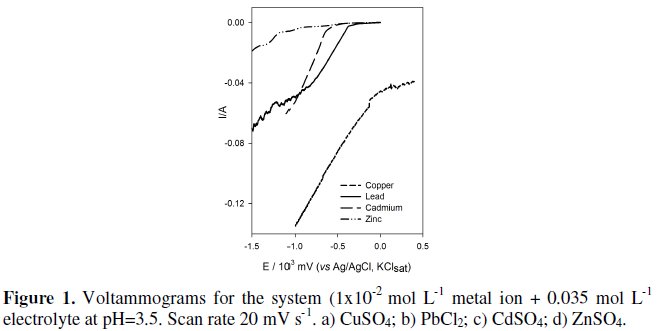
    <p>In order to select the applied potential for the cathodic deposition of the heavy 
metals in solution, linear voltammetries were run for the different solutions 
containing metal salt, at several scan rates. Fig. 1 presents the linear 
voltammetries performed at 20 mV s<sup>-1</sup>, used to determine HCP for the different 
metal ions, which were the following: Cu(II) -100 mV, Pb(II) -400 mV, Cd(II) 600 
mV and Zn(II) -1000 mV.</p>


    <p>&nbsp;</p>
<img src="/img/revistas/pea/v29n5/29n5a06f1.jpg">
    
<p>&nbsp;</p>


    ]]></body>
<body><![CDATA[<p>In the linear voltammogram performed with the zinc solution some shoulders 
were unexpectedly found, since it was predictable that Zn (II) was directly 
reduced to the metallic phase. This observation may be explained by the 
existence of further reductions, related to the reduction of the sulfate to S and 
later to HS-, species that are soluble in aqueous media [22], or a Zn<sup>2+</sup> 
underpotential reduction. This has only been detected with zinc, probably 
because it presents a reduction potential more cathodic than the other studied 
metals.</p>

    <p><b><i>Removal of metals from solution by chronoamperometry</i></b></p>

    <p><u>Copper</u></p>

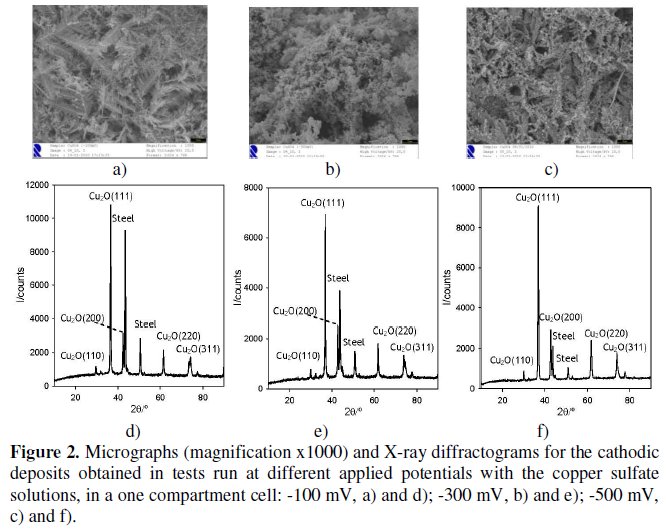
    <p>Fig. 2, a to c, shows the micrographs obtained from deposits on the cathode at 
three different applied potentials, -100, -300 and -500 mV, respectively, equal 
and more cathodic than the HCP determined for copper. Analysis of these 
micrographs shows a more stratified morphology for the applied potential of -100 
mV. 

    <p>&nbsp;</p>
<img src="/img/revistas/pea/v29n5/29n5a06f2.jpg">
    
<p>&nbsp;</p>

 
    <p>The diffractograms of these deposits (Fig. 2, d to f) identified cuprite, Cu<sub>2</sub>O, as 
the main phase, meaning that Cu (II) in solution was mostly reduced to Cu (I). 
The diffractograms are quite clear, with narrow peaks well defined, and when 
compared with XRD files from database of the Joint Committee on Powder 
Diffraction Standards (JCPDS) confirm that the obtained deposit was cuprite, 
since the experimental diffractogram coincides with that of the PDF file # 05-0667 
of the Cu<sub>2</sub>O, cubic structure, with a = 0.42696 nm. Thus, copper (II) 
initially in solution was reduced to copper (I) forming the cuprite. In fact, for the 
applied cathodic potentials the formation of cuprite is only predictable for 
solutions more basic than those used [22]. However, H<sup>+</sup> reduction to H<sub>2</sub> may 
compete with the reduction of Cu<sup>2+</sup>, at the cathode, increasing the local pH and 
favouring the formation of cuprite. At the end of the tests, the copper removal is 
almost total, being higher for the less cathodic applied potential (-100 mV).</p>


    <p><u>Lead</u></p>

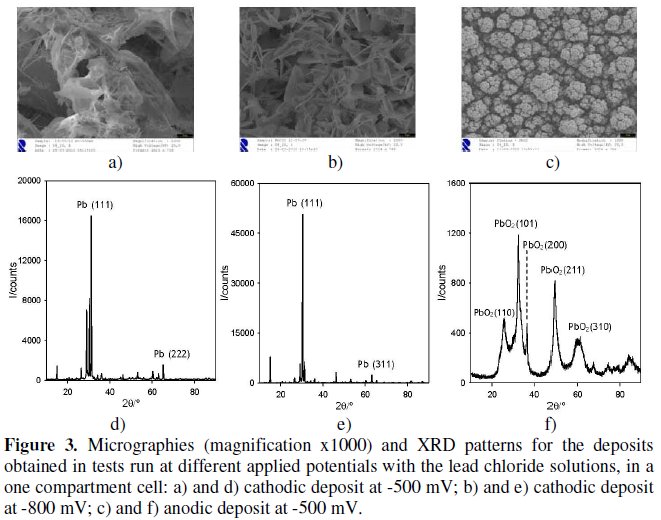
    <p>Fig. 3 presents the SEM (Fig. 3a to c) and XRD (Fig. 3d to f) results for the 
deposits obtained for the chronoamperometries performed with lead chloride 
solutions, carried out in one compartment cell, at applied potentials of -500 and 800 
mV.</p>


    <p>&nbsp;</p>
<img src="/img/revistas/pea/v29n5/29n5a06f3.jpg">
    
]]></body>
<body><![CDATA[<p>&nbsp;</p> 


    <p>During these chronoamperometries the occurrence of a black anodic 
deposit was also observed, whose SEM and XRD results are also presented in 
Fig. 3. By analyzing the experimental diffractograms and comparing them with 
XRD database files, JCPDS, references (PDF # 04-0686 for Pb and PDF # 52-0751 
for PbO2) a similarity between the values of interplanar distances points to 
a lead deposit over the cathode, with cubic structure and a = 0.49506 nm, and a 
deposit of lead oxide over the platinum anode, with an orthorhombic structure 
and a = 0.493 nm, b = 0.4814 nm and c = 0.3363 nm. As the objective of this 
work was the recovery of metal ions in solution by cathodic reduction and in lead 
ion solution assays with one cell compartment, we have obtained simultaneous 
formation of cathodic and anodic deposits, similar tests were run in a two 
compartments electrochemical cell to avoid the anodic deposits. In these tests, 
since the anodic compartment did not contain lead ion (as described in the 
experimental section), only cathodic deposits were obtained, corresponding to the 
same Pb metal phase identified in the tests run in a one compartment 
electrochemical cell (data not shown).</p>


    <p><u>Cadmium</u></p>

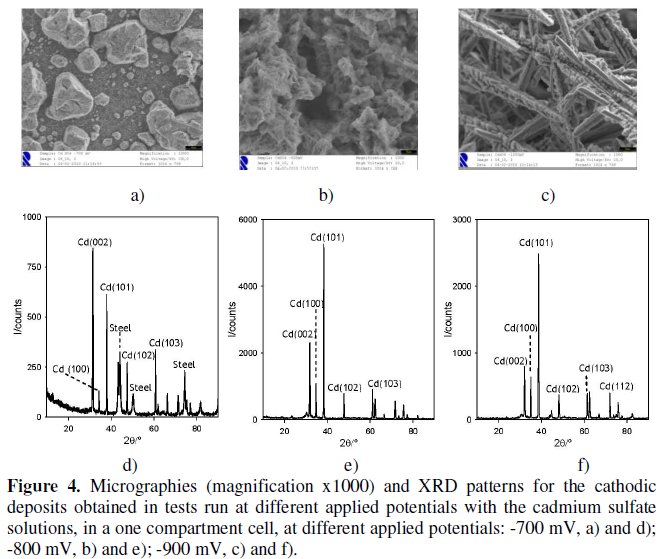
    <p>Fig. 4 shows the micrographs and XRD patterns of the cathodic deposits obtained 
with the chronoamperometries performed with cadmium sulfate solutions at three 
different applied potentials: -700, -800 and -900 mV.</p>


    <p>&nbsp;</p>
<img src="/img/revistas/pea/v29n5/29n5a06f4.jpg">
    
<p>&nbsp;</p> 


    <p>For the applied potential of -900 mV a more stratified morphology can be observed. Regarding the 
diffractograms, when a comparison with the database JCPDS files is made, the 
presence of cadmium metal for the three deposits can be identified, coinciding 
with the PDF file #05-0674, showing a hexagonal structure, with a = 0.2979 nm, 
b = 0.2979 nm, c = 0.5618 nm, a=b=90&deg; and g=120&deg;.</p>


    <p><u>Zinc</u></p>

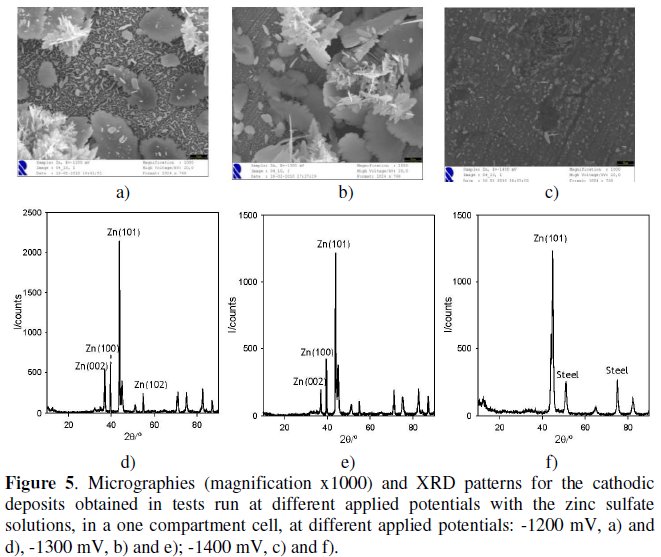
    <p>Fig. 5, a to c, shows the micrographs of the deposits obtained on the steel 
cathodes, for the three different applied potentials (-1200, -1300 and -1400 mV), 
showing a morphology less defined for the more cathodic potential studied (1400 
mV). 

    <p>&nbsp;</p>
<img src="/img/revistas/pea/v29n5/29n5a06f5.jpg">
    
]]></body>
<body><![CDATA[<p>&nbsp;</p> 


    <p>Fig. 5 also presents the diffractogram of the deposits and, when the 
results are compared with those from JCPDS XRD database files, one can come 
to the conclusion that the deposit obtained is metal zinc, since the diffractogram 
match the PDF file # 04-0831, for hexagonal structure, with a = 0.2665 nm, b = 
0.2665 nm, c = 0.4947 nm, a=b=90&deg; and g=120&deg;. For the highest cathodic 
applied potential, -1400 mV, some refraction lines attributed to steel were 
detected. These lines have also been observed in some of the metal recoveries 
performed with copper and cadmium solutions. They were not detected in the 
diffractograms obtained for zinc recovery at higher applied potentials, probably 
due to the increase in zinc deposit obtained at less cathodic potentials that covers 
the substrate in a more regular way.</p>

    <p>Table 1 shows the metal removals from solution obtained after 3 hour assays for 
the various applied potentials, for solutions containing a single heavy metal. 
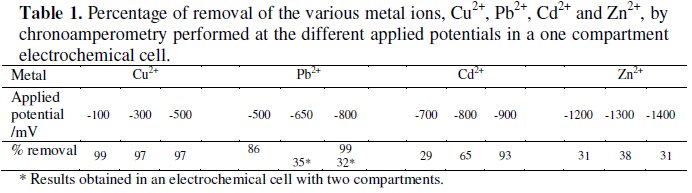

    <p>&nbsp;</p>
<img src="/img/revistas/pea/v29n5/29n5a06t1.jpg">
    
<p>&nbsp;</p>

 
Mixed solution with four heavy metals 
During the preparation of the aqueous solution containing sulfates of copper (II), 
cadmium (II) and zinc (II) and chloride of lead (II), in a concentration of 0.01 
mol L<sup>-1</sup> each, and 0.035 mol L<sup>-1</sup> sodium sulphate, the formation of a precipitate of 
lead sulfate (Solubility of 1.4&times;10<sup>-5</sup> mol L<sup>-1</sup> at 25 &deg;C [23]) occurred. After several 
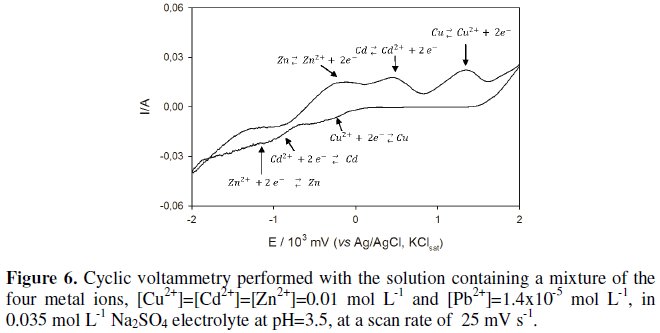
hours stirring, the suspension was filtered and with the resulting solution a cyclic 
voltammetry was performed, at a scan rate of 25 mV s<sup>-1</sup>, starting at 2000 mV 
(Fig. 6). 


    <p>&nbsp;</p>
<img src="/img/revistas/pea/v29n5/29n5a06f6.jpg">
    
<p>&nbsp;</p> 


    <p>Several successive reductions were observed in the cathodic scan, as 
well as several oxidations in a row in the anodic sweep. These peaks were 
assigned to the redox processes related with three of the four heavy metals in 
solution (Fig. 6) according to the sequence of the standard reduction potential. 
Despite the lead ion should also undergo reduction and oxidation, as its 
concentration is much lower than that of the other metals in solution, its redox 
processes are hidden between those of copper and cadmium.</p>

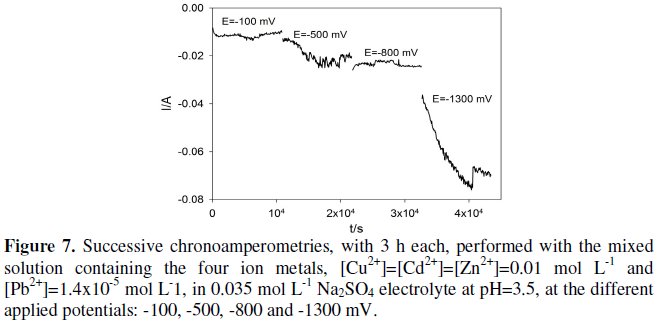
    <p>Fig. 7 shows the successive chronoamperometries for the mixed solution, 
performed at the different chosen applied potentials, in 3 h periods each.</p>


    <p>&nbsp;</p>
<img src="/img/revistas/pea/v29n5/29n5a06f7.jpg">
    
]]></body>
<body><![CDATA[<p>&nbsp;</p> 


    <p>Although this experiment was held in a one compartment cell, there was no black 
deposit of PbO2 on the anode. This may be due to the fact that lead concentration 
in solution was very low. In the analysis by EDX of the cathode deposits it was 
not possible to identify lead, probably due to the same reasons.</p>

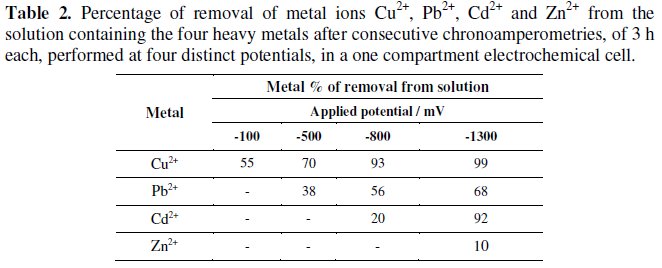
    <p>The metal removals from solution during the successive chronoamperometries 
are presented in Table 2 and, with the exception of zinc, good removals were 
obtained at the end.</p>


    <p>&nbsp;</p>
<img src="/img/revistas/pea/v29n5/29n5a06t2.jpg">
    
<p>&nbsp;</p>


    <p>The XRD analysis of the cathodes allowed the conclusion 
that heavy metals were recovered in metallic form, even for copper, which, when 
isolated in solution, was recovered in the form of cuprite. 
Comparing the values of removals obtained in the individual test, after 3 hours, 
with the values obtained in the mixed solution, it appears that removal is greater 
when the metal is "isolated". The worst removal values have been obtained for 
zinc in both situations, due to the high formation of hydrogen even at its HCP.</p>


    <p>&nbsp;</p>
    <p><b>Conclusions</b></p>

    <p>The recovery of copper from solution presented different behaviors for solutions 
containing just Cu<sup>2+</sup> or a mixture of Cu<sup>2+</sup> with other metal ions, at the same 
applied potential and with the same experimental setup: in the former case, 
copper was recovered by reduction on the cathode in the form of Cu<sub>2</sub>O and, in 
the later case, it was deposited over the cathode has metallic copper.</p>
    <p>Regarding Pb<sup>2+</sup> removal from aqueous solutions, it was recovered in the metallic 
form over the cathode and in the form of PbO2 over the anode, when tests were 
run in a one compartment cell. However, when the assay was performed in a two 
compartments cell, with the metal ion only in the cathodic solution, lead was 
recovered in the metallic form over the cathode, avoiding anodic deposit. The 
removal of lead ion from solution in the cell with two compartments was 
significantly lower than that obtained in a one compartment cell.</p>

    ]]></body>
<body><![CDATA[<p>Metal ions Cd<sup>2+</sup> and Zn<sup>2+</sup> were recovered in the metallic form over the cathode, 
in a one compartment cell, either from the solutions containing just a single metal 
ion or when solutions containing a mixture of metal ions were used.</p>
    <p>The best results obtained in the recovery of the different metals, obtained in a one 
compartment cell, after 3 h under the applied experimental conditions, for 
solutions containing just one metal ion, were: Cu<sup>2+</sup> 99% at E = -100 mV; Pb<sup>2+</sup> 
99% at E = -800 mV; Cd<sup>2+</sup> 93% at E = -800 mV and Zn<sup>2+</sup> 38% at E = -1300 mV. 
The low yield observed for zinc is related to the fact that its reduction is given 
under conditions where the release of hydrogen is quite intense and there is 
competition between the two reduction processes.</p>

    <p>The duration of the experiments containing single metal ion was adequate for the 
almost total removal of metals from solutions, with the exception made to zinc 
ion solutions. In the case of the mixed solutions, with four metal ions, the four 
consecutive runs, with 3 h each, at selected potentials, proved to be enough to 
achieve high removals of the various metals, exception made for zinc: 99% for 
Cu<sup>2+</sup>, 68% for Pb<sup>2+</sup>, 92% for Cd<sup>2+</sup> and 10% for Zn<sup>2+</sup>.</p>


    <p>&nbsp;</p>
    <p><b>References</b></p>

    <!-- ref --><p>1. A. Fuentes, M. Llorens, J. Saez et all, Environ. Pollut. 143 (2006) 355.    &nbsp;&nbsp;&nbsp;&nbsp;&nbsp;&nbsp;&nbsp;&nbsp;[&#160;<a href="javascript:void(0);" onclick="javascript: window.open('/scielo.php?script=sci_nlinks&ref=000078&pid=S0872-1904201100050000600001&lng=','','width=640,height=500,resizable=yes,scrollbars=1,menubar=yes,');">Links</a>&#160;]<!-- end-ref --></p>
    <!-- ref --><p>2. F. Hammy, G. Mercier, J-F. Blais, Hydrometallurgy 80 (2005) 232.    &nbsp;&nbsp;&nbsp;&nbsp;&nbsp;&nbsp;&nbsp;&nbsp;[&#160;<a href="javascript:void(0);" onclick="javascript: window.open('/scielo.php?script=sci_nlinks&ref=000080&pid=S0872-1904201100050000600002&lng=','','width=640,height=500,resizable=yes,scrollbars=1,menubar=yes,');">Links</a>&#160;]<!-- end-ref --></p>
    <!-- ref --><p>3. A. Janin, F. Zaviska, P. Drogui et all, Hydrometallurgy 96 (2009) 318.    &nbsp;&nbsp;&nbsp;&nbsp;&nbsp;&nbsp;&nbsp;&nbsp;[&#160;<a href="javascript:void(0);" onclick="javascript: window.open('/scielo.php?script=sci_nlinks&ref=000082&pid=S0872-1904201100050000600003&lng=','','width=640,height=500,resizable=yes,scrollbars=1,menubar=yes,');">Links</a>&#160;]<!-- end-ref --></p>
    <!-- ref --><p>4. V. Cinanni, I.A. Gough, A.J. Sciuto, Desalination 106 (1996) 145.    &nbsp;&nbsp;&nbsp;&nbsp;&nbsp;&nbsp;&nbsp;&nbsp;[&#160;<a href="javascript:void(0);" onclick="javascript: window.open('/scielo.php?script=sci_nlinks&ref=000084&pid=S0872-1904201100050000600004&lng=','','width=640,height=500,resizable=yes,scrollbars=1,menubar=yes,');">Links</a>&#160;]<!-- end-ref --></p>
    <!-- ref --><p>5. M. Hunsom,_K. Pruksathorn, S. Damronglerd et all, Water Res. 39 (2005) 610.    &nbsp;&nbsp;&nbsp;&nbsp;&nbsp;&nbsp;&nbsp;&nbsp;[&#160;<a href="javascript:void(0);" onclick="javascript: window.open('/scielo.php?script=sci_nlinks&ref=000086&pid=S0872-1904201100050000600005&lng=','','width=640,height=500,resizable=yes,scrollbars=1,menubar=yes,');">Links</a>&#160;]<!-- end-ref --></p>
    <!-- ref --><p>6. N.M.S. Kaminari, D.R. Schultz, M.J.J.S. Ponte at all, Chem. Eng. J. 126 (2007) 139.    &nbsp;&nbsp;&nbsp;&nbsp;&nbsp;&nbsp;&nbsp;&nbsp;[&#160;<a href="javascript:void(0);" onclick="javascript: window.open('/scielo.php?script=sci_nlinks&ref=000088&pid=S0872-1904201100050000600006&lng=','','width=640,height=500,resizable=yes,scrollbars=1,menubar=yes,');">Links</a>&#160;]<!-- end-ref --></p>
    <!-- ref --><p>7. V.G. Lacerda, A.B. Mageste, I.J.B. Santos et all, J. Power Sources 193 (2009) 908.    &nbsp;&nbsp;&nbsp;&nbsp;&nbsp;&nbsp;&nbsp;&nbsp;[&#160;<a href="javascript:void(0);" onclick="javascript: window.open('/scielo.php?script=sci_nlinks&ref=000090&pid=S0872-1904201100050000600007&lng=','','width=640,height=500,resizable=yes,scrollbars=1,menubar=yes,');">Links</a>&#160;]<!-- end-ref --></p>
    <!-- ref --><p>8. C.A. Basha, N.S. Bhadrinarayana, N. Anantharaman, K.M.M.S. Begum, J. Hazard. Mater. 152 (2008) 71.    &nbsp;&nbsp;&nbsp;&nbsp;&nbsp;&nbsp;&nbsp;&nbsp;[&#160;<a href="javascript:void(0);" onclick="javascript: window.open('/scielo.php?script=sci_nlinks&ref=000092&pid=S0872-1904201100050000600008&lng=','','width=640,height=500,resizable=yes,scrollbars=1,menubar=yes,');">Links</a>&#160;]<!-- end-ref --></p>
    <!-- ref --><p>9. L. Doulakas, K. Novy, S. Stucki, Ch. Comninellis, Electrochim. Acta 46 (2000), 349.    &nbsp;&nbsp;&nbsp;&nbsp;&nbsp;&nbsp;&nbsp;&nbsp;[&#160;<a href="javascript:void(0);" onclick="javascript: window.open('/scielo.php?script=sci_nlinks&ref=000094&pid=S0872-1904201100050000600009&lng=','','width=640,height=500,resizable=yes,scrollbars=1,menubar=yes,');">Links</a>&#160;]<!-- end-ref --></p>
    <!-- ref --><p>10. M.C. Santos, S.A.S. Machado, L.A. Avaca, L.H. Mascaro, Qu&iacute;m. Nova 23 (2000) 392.    &nbsp;&nbsp;&nbsp;&nbsp;&nbsp;&nbsp;&nbsp;&nbsp;[&#160;<a href="javascript:void(0);" onclick="javascript: window.open('/scielo.php?script=sci_nlinks&ref=000096&pid=S0872-1904201100050000600010&lng=','','width=640,height=500,resizable=yes,scrollbars=1,menubar=yes,');">Links</a>&#160;]<!-- end-ref --></p>
    <!-- ref --><p>11. R.Y. Bek, V.N. Kiryushov, L.I. Skvortsova et all, J. Anal. Chem. 55 (2000) 1069.    &nbsp;&nbsp;&nbsp;&nbsp;&nbsp;&nbsp;&nbsp;&nbsp;[&#160;<a href="javascript:void(0);" onclick="javascript: window.open('/scielo.php?script=sci_nlinks&ref=000098&pid=S0872-1904201100050000600011&lng=','','width=640,height=500,resizable=yes,scrollbars=1,menubar=yes,');">Links</a>&#160;]<!-- end-ref --></p> 
    <!-- ref --><p>12. J.P. Chen, L.L. Lim, Chemosphere 60 (2005) 1384.    &nbsp;&nbsp;&nbsp;&nbsp;&nbsp;&nbsp;&nbsp;&nbsp;[&#160;<a href="javascript:void(0);" onclick="javascript: window.open('/scielo.php?script=sci_nlinks&ref=000100&pid=S0872-1904201100050000600012&lng=','','width=640,height=500,resizable=yes,scrollbars=1,menubar=yes,');">Links</a>&#160;]<!-- end-ref --></p>
    <p>13. D. Arrington, M. Curry, S. Street, G. Pattanaik, G. Zangary, Electrochim. Acta 53 (2008) 2644.</p>
    ]]></body>
<body><![CDATA[<!-- ref --><p>14. K.I. Popov, T.M. Kostic, N.D. Nikolic et all, J. Electroanal. Chem. 464 (1999) 245.    &nbsp;&nbsp;&nbsp;&nbsp;&nbsp;&nbsp;&nbsp;&nbsp;[&#160;<a href="javascript:void(0);" onclick="javascript: window.open('/scielo.php?script=sci_nlinks&ref=000103&pid=S0872-1904201100050000600014&lng=','','width=640,height=500,resizable=yes,scrollbars=1,menubar=yes,');">Links</a>&#160;]<!-- end-ref --></p>
    <!-- ref --><p>15. K.I. Popov, P.M. Zivkovic, S.B. Krstic, N.D. Nikolic, Electrochim. Acta 54 (2009) 2924.    &nbsp;&nbsp;&nbsp;&nbsp;&nbsp;&nbsp;&nbsp;&nbsp;[&#160;<a href="javascript:void(0);" onclick="javascript: window.open('/scielo.php?script=sci_nlinks&ref=000105&pid=S0872-1904201100050000600015&lng=','','width=640,height=500,resizable=yes,scrollbars=1,menubar=yes,');">Links</a>&#160;]<!-- end-ref --></p>
    <!-- ref --><p>16. C.-C. Yang, J. Power Sources 115 (2003) 352.    &nbsp;&nbsp;&nbsp;&nbsp;&nbsp;&nbsp;&nbsp;&nbsp;[&#160;<a href="javascript:void(0);" onclick="javascript: window.open('/scielo.php?script=sci_nlinks&ref=000107&pid=S0872-1904201100050000600016&lng=','','width=640,height=500,resizable=yes,scrollbars=1,menubar=yes,');">Links</a>&#160;]<!-- end-ref --></p>
    <!-- ref --><p>17. R. Mayen-Mondragon, J.G. Ibanez; R.C. Vasquez et all, Water Air Soil Poll. 194 (2008) 45.    &nbsp;&nbsp;&nbsp;&nbsp;&nbsp;&nbsp;&nbsp;&nbsp;[&#160;<a href="javascript:void(0);" onclick="javascript: window.open('/scielo.php?script=sci_nlinks&ref=000109&pid=S0872-1904201100050000600017&lng=','','width=640,height=500,resizable=yes,scrollbars=1,menubar=yes,');">Links</a>&#160;]<!-- end-ref --></p>
    <!-- ref --><p>18. F-R. Xiu, F-S. Zhang, J. Hazard. Mater. 170 (2009) 191.    &nbsp;&nbsp;&nbsp;&nbsp;&nbsp;&nbsp;&nbsp;&nbsp;[&#160;<a href="javascript:void(0);" onclick="javascript: window.open('/scielo.php?script=sci_nlinks&ref=000111&pid=S0872-1904201100050000600018&lng=','','width=640,height=500,resizable=yes,scrollbars=1,menubar=yes,');">Links</a>&#160;]<!-- end-ref --></p>
    ]]></body>
<body><![CDATA[<!-- ref --><p>19. N.P. Brandon, D. Pilone, G.H. Kelsall, Q. Yin, J. Appl. Electrochem. 33 (2003) 853.    &nbsp;&nbsp;&nbsp;&nbsp;&nbsp;&nbsp;&nbsp;&nbsp;[&#160;<a href="javascript:void(0);" onclick="javascript: window.open('/scielo.php?script=sci_nlinks&ref=000113&pid=S0872-1904201100050000600019&lng=','','width=640,height=500,resizable=yes,scrollbars=1,menubar=yes,');">Links</a>&#160;]<!-- end-ref --></p>
    <!-- ref --><p>20. K. Scott, X. Chen, J.W. Atkinson, M. Todd, Resources, Conserv. Recycling 20 (1997) 43.    &nbsp;&nbsp;&nbsp;&nbsp;&nbsp;&nbsp;&nbsp;&nbsp;[&#160;<a href="javascript:void(0);" onclick="javascript: window.open('/scielo.php?script=sci_nlinks&ref=000115&pid=S0872-1904201100050000600020&lng=','','width=640,height=500,resizable=yes,scrollbars=1,menubar=yes,');">Links</a>&#160;]<!-- end-ref --></p>
    <!-- ref --><p>21. D. Pilone, G.H. Kelsall, Electrochim. Acta 51 (2006) 3802.    &nbsp;&nbsp;&nbsp;&nbsp;&nbsp;&nbsp;&nbsp;&nbsp;[&#160;<a href="javascript:void(0);" onclick="javascript: window.open('/scielo.php?script=sci_nlinks&ref=000117&pid=S0872-1904201100050000600021&lng=','','width=640,height=500,resizable=yes,scrollbars=1,menubar=yes,');">Links</a>&#160;]<!-- end-ref --></p>
    <!-- ref --><p>22. M. Pourbaix, Atlas D'&eacute;quilibres &eacute;lectrochimiques &agrave; 25 &deg;C, Ed., Gauthier-Villars & Cie &eacute;diteur, Paris, 1963.    &nbsp;&nbsp;&nbsp;&nbsp;&nbsp;&nbsp;&nbsp;&nbsp;[&#160;<a href="javascript:void(0);" onclick="javascript: window.open('/scielo.php?script=sci_nlinks&ref=000119&pid=S0872-1904201100050000600022&lng=','','width=640,height=500,resizable=yes,scrollbars=1,menubar=yes,');">Links</a>&#160;]<!-- end-ref --></p>
    <!-- ref --><p>23. Handbook of Chemistry and Physics, CRC Press, Inc, Florida, 63rd Ed., 1982-1983.    &nbsp;&nbsp;&nbsp;&nbsp;&nbsp;&nbsp;&nbsp;&nbsp;[&#160;<a href="javascript:void(0);" onclick="javascript: window.open('/scielo.php?script=sci_nlinks&ref=000121&pid=S0872-1904201100050000600023&lng=','','width=640,height=500,resizable=yes,scrollbars=1,menubar=yes,');">Links</a>&#160;]<!-- end-ref --></p>


    ]]></body>
<body><![CDATA[<p>&nbsp;</p>
    <p><b>Acknowledgements</b></p>

    <p>Funda&ccedil;&atilde;o para a Ci&ecirc;ncia e a Tecnologia, FCT, PTDC/AAC-AMB/103112/2008.</p>

    <p><a name=0></a><sup><a href="#top">*</a></sup> Corresponding author. E-mail address: <a href="mailto:lciriaco@ubi.pt">lciriaco@ubi.pt</a></p>

    <p>Received 5 January 2011; accepted 3 March 2011</p>

    <p><a href="http://www.peacta.org" target="_blank">www.peacta.org</a> </p>


     ]]></body><back>
<ref-list>
<ref id="B1">
<label>1</label><nlm-citation citation-type="journal">
<person-group person-group-type="author">
<name>
<surname><![CDATA[Fuentes]]></surname>
<given-names><![CDATA[A.]]></given-names>
</name>
<name>
<surname><![CDATA[Llorens]]></surname>
<given-names><![CDATA[M.]]></given-names>
</name>
<name>
<surname><![CDATA[Saez]]></surname>
<given-names><![CDATA[J.]]></given-names>
</name>
</person-group>
<source><![CDATA[Environ. Pollut.]]></source>
<year>2006</year>
<volume>143</volume>
<page-range>355</page-range></nlm-citation>
</ref>
<ref id="B2">
<label>2</label><nlm-citation citation-type="journal">
<person-group person-group-type="author">
<name>
<surname><![CDATA[Hammy]]></surname>
<given-names><![CDATA[F.]]></given-names>
</name>
<name>
<surname><![CDATA[Mercier]]></surname>
<given-names><![CDATA[G.]]></given-names>
</name>
<name>
<surname><![CDATA[Blais]]></surname>
<given-names><![CDATA[J-F.]]></given-names>
</name>
</person-group>
<source><![CDATA[Hydrometallurgy]]></source>
<year>2005</year>
<volume>80</volume>
<page-range>232</page-range></nlm-citation>
</ref>
<ref id="B3">
<label>3</label><nlm-citation citation-type="journal">
<person-group person-group-type="author">
<name>
<surname><![CDATA[Janin]]></surname>
<given-names><![CDATA[A.]]></given-names>
</name>
<name>
<surname><![CDATA[Zaviska]]></surname>
<given-names><![CDATA[F.]]></given-names>
</name>
<name>
<surname><![CDATA[Drogui]]></surname>
<given-names><![CDATA[P.]]></given-names>
</name>
</person-group>
<source><![CDATA[Hydrometallurgy]]></source>
<year>2009</year>
<volume>96</volume>
<page-range>318</page-range></nlm-citation>
</ref>
<ref id="B4">
<label>4</label><nlm-citation citation-type="journal">
<person-group person-group-type="author">
<name>
<surname><![CDATA[Cinanni]]></surname>
<given-names><![CDATA[V.]]></given-names>
</name>
<name>
<surname><![CDATA[Gough]]></surname>
<given-names><![CDATA[I.A.]]></given-names>
</name>
<name>
<surname><![CDATA[Sciuto]]></surname>
<given-names><![CDATA[A.J.]]></given-names>
</name>
</person-group>
<source><![CDATA[Desalination]]></source>
<year>1996</year>
<volume>106</volume>
<page-range>145</page-range></nlm-citation>
</ref>
<ref id="B5">
<label>5</label><nlm-citation citation-type="journal">
<person-group person-group-type="author">
<name>
<surname><![CDATA[Hunsom]]></surname>
<given-names><![CDATA[M.]]></given-names>
</name>
<name>
<surname><![CDATA[Pruksathorn]]></surname>
<given-names><![CDATA[K.]]></given-names>
</name>
<name>
<surname><![CDATA[Damronglerd]]></surname>
<given-names><![CDATA[S.]]></given-names>
</name>
</person-group>
<source><![CDATA[Water Res.]]></source>
<year>2005</year>
<volume>39</volume>
<page-range>610</page-range></nlm-citation>
</ref>
<ref id="B6">
<label>6</label><nlm-citation citation-type="journal">
<person-group person-group-type="author">
<name>
<surname><![CDATA[Kaminari]]></surname>
<given-names><![CDATA[N.M.S.]]></given-names>
</name>
<name>
<surname><![CDATA[Schultz]]></surname>
<given-names><![CDATA[D.R.]]></given-names>
</name>
<name>
<surname><![CDATA[Ponte]]></surname>
<given-names><![CDATA[M.J.J.S.]]></given-names>
</name>
</person-group>
<source><![CDATA[Chem. Eng. J.]]></source>
<year>2007</year>
<volume>126</volume>
<page-range>139</page-range></nlm-citation>
</ref>
<ref id="B7">
<label>7</label><nlm-citation citation-type="journal">
<person-group person-group-type="author">
<name>
<surname><![CDATA[Lacerda]]></surname>
<given-names><![CDATA[V.G.]]></given-names>
</name>
<name>
<surname><![CDATA[Mageste]]></surname>
<given-names><![CDATA[A.B.]]></given-names>
</name>
<name>
<surname><![CDATA[Santos]]></surname>
<given-names><![CDATA[I.J.B.]]></given-names>
</name>
</person-group>
<source><![CDATA[J. Power Sources]]></source>
<year>2009</year>
<volume>193</volume>
<page-range>908</page-range></nlm-citation>
</ref>
<ref id="B8">
<label>8</label><nlm-citation citation-type="journal">
<person-group person-group-type="author">
<name>
<surname><![CDATA[Basha]]></surname>
<given-names><![CDATA[C.A.]]></given-names>
</name>
<name>
<surname><![CDATA[Bhadrinarayana]]></surname>
<given-names><![CDATA[N.S.]]></given-names>
</name>
<name>
<surname><![CDATA[Anantharaman]]></surname>
<given-names><![CDATA[N.]]></given-names>
</name>
<name>
<surname><![CDATA[Begum]]></surname>
<given-names><![CDATA[K.M.M.S.]]></given-names>
</name>
</person-group>
<source><![CDATA[J. Hazard. Mater.]]></source>
<year>2008</year>
<volume>152</volume>
<page-range>71</page-range></nlm-citation>
</ref>
<ref id="B9">
<label>9</label><nlm-citation citation-type="journal">
<person-group person-group-type="author">
<name>
<surname><![CDATA[Doulakas]]></surname>
<given-names><![CDATA[L.]]></given-names>
</name>
<name>
<surname><![CDATA[Novy]]></surname>
<given-names><![CDATA[K.]]></given-names>
</name>
<name>
<surname><![CDATA[Stucki]]></surname>
<given-names><![CDATA[S.]]></given-names>
</name>
<name>
<surname><![CDATA[Comninellis]]></surname>
<given-names><![CDATA[Ch.]]></given-names>
</name>
</person-group>
<source><![CDATA[Electrochim. Acta]]></source>
<year>2000</year>
<volume>46</volume>
<page-range>349</page-range></nlm-citation>
</ref>
<ref id="B10">
<label>10</label><nlm-citation citation-type="journal">
<person-group person-group-type="author">
<name>
<surname><![CDATA[Santos]]></surname>
<given-names><![CDATA[M.C.]]></given-names>
</name>
<name>
<surname><![CDATA[Machado]]></surname>
<given-names><![CDATA[S.A.S.]]></given-names>
</name>
<name>
<surname><![CDATA[Avaca]]></surname>
<given-names><![CDATA[L.A.]]></given-names>
</name>
<name>
<surname><![CDATA[Mascaro]]></surname>
<given-names><![CDATA[L.H.]]></given-names>
</name>
</person-group>
<source><![CDATA[Quím. Nova]]></source>
<year>2000</year>
<volume>23</volume>
<page-range>392</page-range></nlm-citation>
</ref>
<ref id="B11">
<label>11</label><nlm-citation citation-type="journal">
<person-group person-group-type="author">
<name>
<surname><![CDATA[Bek]]></surname>
<given-names><![CDATA[R.Y.]]></given-names>
</name>
<name>
<surname><![CDATA[Kiryushov]]></surname>
<given-names><![CDATA[V.N.]]></given-names>
</name>
<name>
<surname><![CDATA[Skvortsova]]></surname>
<given-names><![CDATA[L.I.]]></given-names>
</name>
</person-group>
<source><![CDATA[J. Anal. Chem.]]></source>
<year>2000</year>
<volume>55</volume>
<page-range>1069</page-range></nlm-citation>
</ref>
<ref id="B12">
<label>12</label><nlm-citation citation-type="journal">
<person-group person-group-type="author">
<name>
<surname><![CDATA[Chen]]></surname>
<given-names><![CDATA[J.P.]]></given-names>
</name>
<name>
<surname><![CDATA[Lim]]></surname>
<given-names><![CDATA[L.L.]]></given-names>
</name>
</person-group>
<source><![CDATA[Chemosphere]]></source>
<year>2005</year>
<volume>60</volume>
<page-range>1384</page-range></nlm-citation>
</ref>
<ref id="B13">
<label>13</label><nlm-citation citation-type="journal">
<person-group person-group-type="author">
<name>
<surname><![CDATA[Arrington]]></surname>
<given-names><![CDATA[D.]]></given-names>
</name>
<name>
<surname><![CDATA[Curry]]></surname>
<given-names><![CDATA[M.]]></given-names>
</name>
<name>
<surname><![CDATA[Street]]></surname>
<given-names><![CDATA[S.]]></given-names>
</name>
</person-group>
<source><![CDATA[Electrochim. Acta]]></source>
<year>2008</year>
<volume>53</volume>
<page-range>2644</page-range></nlm-citation>
</ref>
<ref id="B14">
<label>14</label><nlm-citation citation-type="journal">
<person-group person-group-type="author">
<name>
<surname><![CDATA[Popov]]></surname>
<given-names><![CDATA[K.I.]]></given-names>
</name>
<name>
<surname><![CDATA[Kostic]]></surname>
<given-names><![CDATA[T.M.]]></given-names>
</name>
<name>
<surname><![CDATA[Nikolic]]></surname>
<given-names><![CDATA[N.D.]]></given-names>
</name>
</person-group>
<source><![CDATA[J. Electroanal. Chem.]]></source>
<year>1999</year>
<volume>464</volume>
<page-range>245</page-range></nlm-citation>
</ref>
<ref id="B15">
<label>15</label><nlm-citation citation-type="journal">
<person-group person-group-type="author">
<name>
<surname><![CDATA[Popov]]></surname>
<given-names><![CDATA[K.I.]]></given-names>
</name>
<name>
<surname><![CDATA[Zivkovic]]></surname>
<given-names><![CDATA[P.M.]]></given-names>
</name>
<name>
<surname><![CDATA[Krstic]]></surname>
<given-names><![CDATA[S.B.]]></given-names>
</name>
<name>
<surname><![CDATA[Nikolic]]></surname>
<given-names><![CDATA[N.D.]]></given-names>
</name>
</person-group>
<source><![CDATA[Electrochim. Acta]]></source>
<year>2009</year>
<volume>54</volume>
<page-range>2924</page-range></nlm-citation>
</ref>
<ref id="B16">
<label>16</label><nlm-citation citation-type="journal">
<person-group person-group-type="author">
<name>
<surname><![CDATA[Yang]]></surname>
<given-names><![CDATA[C.-C.]]></given-names>
</name>
</person-group>
<source><![CDATA[J. Power Sources]]></source>
<year>2003</year>
<volume>115</volume>
<page-range>352</page-range></nlm-citation>
</ref>
<ref id="B17">
<label>17</label><nlm-citation citation-type="journal">
<person-group person-group-type="author">
<name>
<surname><![CDATA[Mayen-Mondragon]]></surname>
<given-names><![CDATA[R.]]></given-names>
</name>
<name>
<surname><![CDATA[Ibanez]]></surname>
<given-names><![CDATA[J.G.]]></given-names>
</name>
<name>
<surname><![CDATA[Vasquez]]></surname>
<given-names><![CDATA[R.C.]]></given-names>
</name>
</person-group>
<source><![CDATA[Water Air Soil Poll.]]></source>
<year>2008</year>
<volume>194</volume>
<page-range>45</page-range></nlm-citation>
</ref>
<ref id="B18">
<label>18</label><nlm-citation citation-type="journal">
<person-group person-group-type="author">
<name>
<surname><![CDATA[Xiu]]></surname>
<given-names><![CDATA[F-R.]]></given-names>
</name>
<name>
<surname><![CDATA[Zhang]]></surname>
<given-names><![CDATA[F-S.]]></given-names>
</name>
</person-group>
<source><![CDATA[J. Hazard. Mater.]]></source>
<year>2009</year>
<volume>170</volume>
<page-range>191</page-range></nlm-citation>
</ref>
<ref id="B19">
<label>19</label><nlm-citation citation-type="journal">
<person-group person-group-type="author">
<name>
<surname><![CDATA[Brandon]]></surname>
<given-names><![CDATA[N.P.]]></given-names>
</name>
<name>
<surname><![CDATA[Pilone]]></surname>
<given-names><![CDATA[D.]]></given-names>
</name>
<name>
<surname><![CDATA[Kelsall]]></surname>
<given-names><![CDATA[G.H.]]></given-names>
</name>
<name>
<surname><![CDATA[Yin]]></surname>
<given-names><![CDATA[Q.]]></given-names>
</name>
</person-group>
<source><![CDATA[J. Appl. Electrochem.]]></source>
<year>2003</year>
<volume>33</volume>
<page-range>853</page-range></nlm-citation>
</ref>
<ref id="B20">
<label>20</label><nlm-citation citation-type="journal">
<person-group person-group-type="author">
<name>
<surname><![CDATA[Scott]]></surname>
<given-names><![CDATA[K.]]></given-names>
</name>
<name>
<surname><![CDATA[Chen]]></surname>
<given-names><![CDATA[X.]]></given-names>
</name>
<name>
<surname><![CDATA[Atkinson]]></surname>
<given-names><![CDATA[J.W.]]></given-names>
</name>
<name>
<surname><![CDATA[Todd]]></surname>
<given-names><![CDATA[M.]]></given-names>
</name>
</person-group>
<source><![CDATA[Resources, Conserv. Recycling]]></source>
<year>1997</year>
<volume>20</volume>
<page-range>43</page-range></nlm-citation>
</ref>
<ref id="B21">
<label>21</label><nlm-citation citation-type="journal">
<person-group person-group-type="author">
<name>
<surname><![CDATA[Pilone]]></surname>
<given-names><![CDATA[D.]]></given-names>
</name>
<name>
<surname><![CDATA[Kelsall]]></surname>
<given-names><![CDATA[G.H.]]></given-names>
</name>
</person-group>
<source><![CDATA[Electrochim. Acta]]></source>
<year>2006</year>
<volume>51</volume>
<page-range>3802</page-range></nlm-citation>
</ref>
<ref id="B22">
<label>22</label><nlm-citation citation-type="book">
<person-group person-group-type="author">
<name>
<surname><![CDATA[Pourbaix]]></surname>
<given-names><![CDATA[M.]]></given-names>
</name>
</person-group>
<source><![CDATA[Atlas D'équilibres électrochimiques à 25 °C]]></source>
<year>1963</year>
<publisher-loc><![CDATA[Paris ]]></publisher-loc>
<publisher-name><![CDATA[Gauthier-Villars & Cie éditeur]]></publisher-name>
</nlm-citation>
</ref>
<ref id="B23">
<label>23</label><nlm-citation citation-type="book">
<source><![CDATA[Handbook of Chemistry and Physics]]></source>
<year></year>
<edition>63</edition>
<page-range>1982-1983</page-range><publisher-loc><![CDATA[Florida ]]></publisher-loc>
<publisher-name><![CDATA[CRC Press]]></publisher-name>
</nlm-citation>
</ref>
</ref-list>
</back>
</article>