<?xml version="1.0" encoding="ISO-8859-1"?><article xmlns:mml="http://www.w3.org/1998/Math/MathML" xmlns:xlink="http://www.w3.org/1999/xlink" xmlns:xsi="http://www.w3.org/2001/XMLSchema-instance">
<front>
<journal-meta>
<journal-id>0872-1904</journal-id>
<journal-title><![CDATA[Portugaliae Electrochimica Acta]]></journal-title>
<abbrev-journal-title><![CDATA[Port. Electrochim. Acta]]></abbrev-journal-title>
<issn>0872-1904</issn>
<publisher>
<publisher-name><![CDATA[Sociedade Portuguesa de Electroquímica]]></publisher-name>
</publisher>
</journal-meta>
<article-meta>
<article-id>S0872-19042011000500007</article-id>
<article-id pub-id-type="doi">10.4152/pea.201105361</article-id>
<title-group>
<article-title xml:lang="en"><![CDATA[An Electrochemical Biosensor for Acrylamide Determination: Merits and Limitations]]></article-title>
</title-group>
<contrib-group>
<contrib contrib-type="author">
<name>
<surname><![CDATA[Silva]]></surname>
<given-names><![CDATA[Nelson A.F.]]></given-names>
</name>
<xref ref-type="aff" rid="A01"/>
</contrib>
<contrib contrib-type="author">
<name>
<surname><![CDATA[Matos]]></surname>
<given-names><![CDATA[Manuel J.]]></given-names>
</name>
<xref ref-type="aff" rid="A01"/>
</contrib>
<contrib contrib-type="author">
<name>
<surname><![CDATA[Karmali]]></surname>
<given-names><![CDATA[Amin]]></given-names>
</name>
<xref ref-type="aff" rid="A01"/>
</contrib>
<contrib contrib-type="author">
<name>
<surname><![CDATA[Rocha]]></surname>
<given-names><![CDATA[Maria M.]]></given-names>
</name>
<xref ref-type="aff" rid="A02"/>
</contrib>
</contrib-group>
<aff id="A01">
<institution><![CDATA[,Instituto Superior de Engenharia de Lisboa Chemical Engineering and Biotechnology Research Center ]]></institution>
<addr-line><![CDATA[ ]]></addr-line>
<country>Portugal</country>
</aff>
<aff id="A02">
<institution><![CDATA[,Universidade de Lisboa Faculdade de Ciências Chemistry and Biochemistry Department]]></institution>
<addr-line><![CDATA[ ]]></addr-line>
<country>Portugal</country>
</aff>
<pub-date pub-type="pub">
<day>00</day>
<month>09</month>
<year>2011</year>
</pub-date>
<pub-date pub-type="epub">
<day>00</day>
<month>09</month>
<year>2011</year>
</pub-date>
<volume>29</volume>
<numero>5</numero>
<fpage>361</fpage>
<lpage>373</lpage>
<copyright-statement/>
<copyright-year/>
<self-uri xlink:href="http://scielo.pt/scielo.php?script=sci_arttext&amp;pid=S0872-19042011000500007&amp;lng=en&amp;nrm=iso"></self-uri><self-uri xlink:href="http://scielo.pt/scielo.php?script=sci_abstract&amp;pid=S0872-19042011000500007&amp;lng=en&amp;nrm=iso"></self-uri><self-uri xlink:href="http://scielo.pt/scielo.php?script=sci_pdf&amp;pid=S0872-19042011000500007&amp;lng=en&amp;nrm=iso"></self-uri><abstract abstract-type="short" xml:lang="en"><p><![CDATA[The present work reports the results concerning the development and implementation of the first electrochemical biosensor for acrylamide determination, based on a direct biochemical interaction between the analyte and intact bacterial cells, with intracellular enzymatic activity. The biological recognition element consisted of whole cells of Pseudomonas aeruginosa containing intracellular amidase activity, which catalyses the hydrolysis of acrylamide producing ammonium ion (NH4+) and acrylic acid. The transduction process was accomplished by means of an ammonium ion selective electrode. Whole cells were firstly immobilized on single discs of polymeric membranes, such as polyethersulphone, nylon and polycarbonate, which were, then, attached to the surface of the selective electrode. However, it was observed a significant loss of cells each time the biosensor was used, namely at the beginning of the assay, when the membranes were attached to the ammonium electrode, and after the assay, when removed for storage purposes. This evidence determined a premature decrease in the biosensor's stability. Instead of using single membrane discs, a ''sandwich'' design, with two membrane discs was considered. This way the cells remain contained between the membranes, never contacting the electrode's surface, preventing their premature loss. Consequently, the activity of the biosensor could be maintained for longer periods of time. The analytical performance of the biosensor was evaluated. The best results were obtained when polyethersulphone double membranes were used. A typical response of 120 mV (after 6 min reaction time), a Nernstian slope of 48 mV/decade, a limit of detection of 6.31×10⁻⁴ M and a half-life time of 27 days, are examples of some figures of merit observed for this biosensor.]]></p></abstract>
<kwd-group>
<kwd lng="en"><![CDATA[biosensor]]></kwd>
<kwd lng="en"><![CDATA[acrylamide]]></kwd>
<kwd lng="en"><![CDATA[amidase]]></kwd>
<kwd lng="en"><![CDATA[whole cells]]></kwd>
<kwd lng="en"><![CDATA[Pseudomonas aeruginosa]]></kwd>
<kwd lng="en"><![CDATA[polymeric membranes]]></kwd>
</kwd-group>
</article-meta>
</front><body><![CDATA[ 

    <p><b>An Electrochemical Biosensor for Acrylamide Determination: Merits and Limitations</b></p>

    <p><b>Nelson A.F. Silva<sup>1,<a href="#0">*<a/></sup>, Manuel J. Matos<sup>1</sup>, Amin Karmali<sup>1</sup>, Maria M. Rocha<sup>2</sup></b></p>

    <p><sup>1</sup><i> CIEQB-ISEL - Chemical Engineering and Biotechnology Research Center, Portugal</i></p>

    <p><sup>2</sup><i> DQB-FCUL - Chemistry and Biochemistry Department, Portugal</i></p>


    <p>&nbsp;</p>
    <p>doi: 10.4152/pea.201105361</p>


    <p>&nbsp;</p>
    <p><b>Abstract</b></p>

    <p>The present work reports the results concerning the development and implementation of 
the first electrochemical biosensor for acrylamide determination, based on a direct 
biochemical interaction between the analyte and intact bacterial cells, with intracellular 
enzymatic activity. The biological recognition element consisted of whole cells of 
Pseudomonas aeruginosa containing intracellular amidase activity, which catalyses the 
hydrolysis of acrylamide producing ammonium ion (NH<sub>4</sub><sup>+</sup>) and acrylic acid. The 
transduction process was accomplished by means of an ammonium ion selective 
electrode. Whole cells were firstly immobilized on single discs of polymeric 
membranes, such as polyethersulphone, nylon and polycarbonate, which were, then, 
attached to the surface of the selective electrode. However, it was observed a significant 
loss of cells each time the biosensor was used, namely at the beginning of the assay, 
when the membranes were attached to the ammonium electrode, and after the assay, 
when removed for storage purposes. This evidence determined a premature decrease in 
the biosensor's stability. Instead of using single membrane discs, a ''sandwich'' design, 
with two membrane discs was considered. This way the cells remain contained between 
the membranes, never contacting the electrode's surface, preventing their premature 
loss. Consequently, the activity of the biosensor could be maintained for longer periods 
of time. The analytical performance of the biosensor was evaluated. The best results 
were obtained when polyethersulphone double membranes were used. A typical 
response of 120 mV (after 6 min reaction time), a Nernstian slope of 48 mV/decade, a 
limit of detection of 6.31&times;10<sup>-4</sup> M and a half-life time of 27 days, are examples of some 
figures of merit observed for this biosensor.</p>

    ]]></body>
<body><![CDATA[<p><b><i>Keywords:</i></b> biosensor, acrylamide, amidase, whole cells, <i>Pseudomonas aeruginosa</i>, polymeric membranes</p>

    <p>&nbsp;</p>
    <p><b>Introduction</b></p>

    <p>Acrylamide is a chemical compound with potentially hazardous effects on 
environment and human health such as muscular weakness, skin and mucous 
irritation, nausea, numbness and nervous system damage. Long term exposure to 
acrylamide may also result in the development of several types of cancer [1-3]. 
Environmental effects include death of animals and low growing rate in plants. 
Accumulation in groundwater may also occur, as well as persistence in aquatic 
environments [4, 5].</p>

    <p>Acrylamide is also present in some industrial processes, for example in 
wastepaper recycling, synthesis of dyes, as a soil conditioning agents, as a 
copolymer for contact lenses or in textile industry. It is also used as an additive in 
waste and drinking water treatment (where relative high levels of acrylamide can 
be found) [6, 7].</p>

    <p>On the other hand, it was recently discovered that acrylamide is formed when 
certain types of food, namely those with high contents of carbohydrates and low 
in protein, are cooked or processed at high temperatures. Although acrylamide 
formation process in these conditions is poorly understood, it is considered that 
reducing sugars and asparagines are the main responsible for the high levels of 
this carcinogenic amide in such foods [8, 9].</p>

    <p>In this regard it is essential to develop methods in order to determine, reduce and 
control the amount of acrylamide present in the environment, namely waste and 
natural waters, as well as in food, human and animal organisms.</p>

    <p>Traditionally the determination of acrylamide is performed by chromatography, 
namely Liquid Chromatography with Mass Spectrometry detection (LC/MS) 
[10], which is a time consuming and expensive process. Therefore, the 
development of a biosensor for acrylamide may result in a significant alternative 
towards traditional techniques, where several advantages like analyte specificity, 
easy operation and low cost equipment can be stressed out.</p>

    <p>In fact, one of the main advantages of using whole cells of Pseudomonas 
aeruginosa, as the biological recognition element, instead of cell-free extract 
containing enzyme or purified enzymes, is the significant decrease in time 
consuming and costs. Some procedures like cell sonication or enzyme 
purification are overcome.</p>

    <p>This work reports the development of an electrochemical biosensor for 
acrylamide determination, using an ammonium ion selective electrode (ISE) [11, 
12] as an electrochemical transductor. The biological recognition element, or 
biocomponent, consisted of whole cells of Pseudomonas aeruginosa containing 
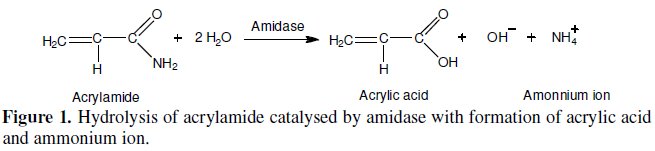
intracellular amidase (EC 3.5.1.4) activity. This enzyme catalyses the hydrolysis 
of aliphatic amides producing the corresponding organic acid (acrylic acid in the 
case of acrylamide) and ammonium ion (NH<sub>4</sub><sup>+</sup>), which is detected by the 
selective electrode [13-15]. The biochemical reaction is shown in Fig. 1.</p>


    ]]></body>
<body><![CDATA[<p>&nbsp;</p>
<img src="/img/revistas/pea/v29n5/29n5a07f1.jpg">
    
<p>&nbsp;</p>


    <p>We strongly believe that this whole cell biosensor can be extremely useful in the 
detection and determination of acrylamide in food and environmental samples.</p>

    <p>This monitorization is essential, regarding the reduction of risks for human health 
and environmental systems.</p>

 
    <p>&nbsp;</p>
    <p><b>Experimental</b></p>

    <p><b><i>Reagents and materials</i></b></p>

    <p>Acrylamide solutions, of several concentrations, were prepared from commercial 
acrylamide, purchased from Merck.</p>

    <p>Lactic acid, Himedia and ammonium sulphate, Merck were used in the 
preparation of bacterial growth media.</p>

    <p>The solvent used in acrylamide solutions was TME (Tris-Mercaptoethanol-
EDTA) 20 mM buffer pH = 7.2. This buffer was prepared with 20 mM Tris-HCl, 
Riedel-de Ha&euml;n, 1 mM &beta;-mercaptoethanol, Merck and 1 mM EDTA, Merck.</p>

    ]]></body>
<body><![CDATA[<p>The solution used for the removal of unbound cells after each immobilization 
procedure was TMEGB (Tris-Mercaptoethanol-EDTA-Glycerol-Benzamidine) 
50 mM buffer pH= 7.2. This buffer was prepared with 50 mM Tris-HCl, Riedelde 
Ha&euml;n, 1 mM &beta;-mercaptoethanol, Merck, 1 mM EDTA, Merck, 10 % (v/v) 
glycerol, Riedel-de Ha&euml;n and 1 mM benzamidine, Merck.</p>

    <p>This buffer was also used in the preparation of whole cells suspension (for 
immobilization purposes) and in the removal of ammonium ions after each 
catalytic reaction.</p>

    <p>The various membranes used for whole cells immobilization were: modified 
polyethersulphone (Ultrabind, 0.45 &mu;m), nylon (Whatman, 0.80 &mu;m), 
polycarbonate (Nuclepore Track-Etch, 0.80 &mu;m), cellulose acetate (Porafil, 0.80 
&mu;m), polyvinylidene fluoride (porablot, 0.20 &mu;m), and nitrocellulose (Trans-Blot, 
0.45 &mu;m).</p>

    <p>All solutions mentioned above were prepared daily with ultra pure (Milli-Q) 
water with a resistivity higher than 18.2 Wm, at 25 &deg;C.</p>


    <p><b><i>Bacterial strain and growth conditions</i></b></p>

    <p>A constitutive mutant strain L10 of Pseudomonas aeruginosa was used as the 
source of amidase. Cells were grown overnight in a minimum salt media 
containing lactic acid (0.5%, v/v), and ammonium sulphate (0.1%, w/v) at pH 7.2 
and at 37 &deg;C, in an orbital shaker set to 250 rpm. The cultures were centrifuged at 
7000 rpm for 10 min and the cells washed twice with saline. The resulting pellets 
were stored at -20 &deg;C. 


    <p><b><i>Instrumentation</i></b></p>

    <p>The apparatus for the potentiometric assays consisted on an AUTOLAB
PGSTAT12 potentiometer from Eco Chemie controlled with GPES v.4.9
software. The acquisition of the resulting data was accomplished by a personal
desktop computer.</p>

    <p>The working and reference electrodes used in all potentiometric measurements
were respectively an ammonium ion selective electrode and the Ag/AgCl
reference system.</p>


    <p><b><i>Potentiometric measurements</i></b></p>

    ]]></body>
<body><![CDATA[<p>All biosensing assays were carried out in a final volume of 5 mL of acrylamide
0.1 M solution, at room temperature, with magnetic stirring.</p>

    <p>After each immobilization procedure of the biological recognition element, the
biosensor was immersed in TMEGB 50 mM buffer for 15 min, with magnetic
stirring, in order to remove any unbound cells of Pseudomonas aeruginosa.</p>

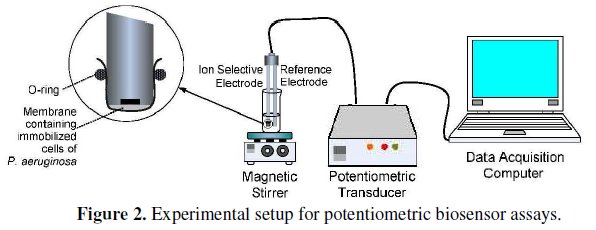
    <p>The experimental setup for the potentiometric biosensor assays is shown in Fig. 2.</p>


    <p>&nbsp;</p>
<img src="/img/revistas/pea/v29n5/29n5a07f2.jpg">
    
<p>&nbsp;</p>


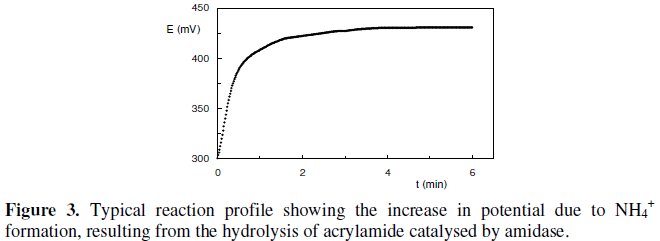
    <p>The biochemical reaction was recorded for a period of 6 min where the formation
of NH<sub>4</sub><sup>+</sup>, given by an increase in the potential values, could be followed. In fact,
the endpoint potential reading of NH<sub>4</sub><sup>+</sup> formation was assumed to be a function
of amidase activity. This parameter was considered as the biosensor's response
and thus taken in consideration for all subsequent assays. All measurements were
carried out in triplicates. A typical reaction profile can be observed in Fig. 3.</p>


    <p>&nbsp; <a name="top.f3"></a> </p>
<img src="/img/revistas/pea/v29n5/29n5a07f3.jpg">
    
<p>&nbsp;</p>


    <p>This reaction profile clearly shows the significant activity of the Pseudomonas
aeruginosa intracellular amidase towards acrylamide by means of the constant
slope established immediately after the beginning of the reaction. Also the
potential difference measured only after 2 min of reaction time, states that there
is not a diffusion resistance imposed by whole cells membrane. Therefore,
substrate transport and assimilation into the cells are not rate-limiting processes
for the whole cell biosensor.</p>


    <p>&nbsp;</p>
    ]]></body>
<body><![CDATA[<p><b>Results and discussion</b></p>

    <p>Immobilization of whole cells on single discs of polyethersulphone membrane
The first approach considered for the immobilization of whole cells of
Pseudomonas aeruginosa, was by using a solid support, namely single
polyethersulphone (PES) membrane discs (&empty; = 20 mm) [16-18]. In fact, a
mixture of 60 &mu;L cell suspension (in TMEGB 50 mM) with 5 &mu;L of
glutaraldehyde 5% (v/v), used as a cross-linking agent [19], was prepared in an
eppendorf tube and immediately transferred to the center of the membrane disc.
The mixture was then incubated at room temperature for 20 min, followed by
membrane attachment to the surface of the ammonium electrode with an o-ring.
Before the first assay, the biosensor was immersed in TMEGB 50 mM buffer for
15 min, with magnetic stirring, in order to remove any unbound cells of
Pseudomonas aeruginosa.</p>


    <p><b><i>Ammonium ion removal</i></b></p>

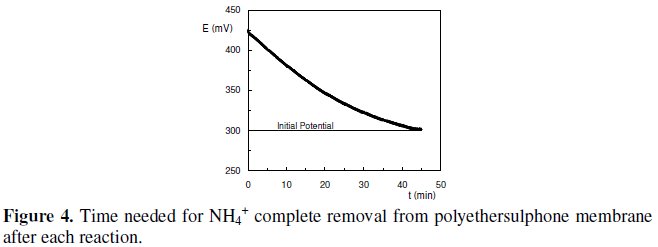
    <p>Despite the fact that a good response was typically obtained with this biosensor
(<a href="#top.f3">Fig. 3</a>), a major drawback emerged from this procedure. In fact, the time needed
for NH<sub>4</sub><sup>+</sup> complete removal from polyethersulphone membrane, after each
catalytic reaction, so that the following assay could be initiated in identical
conditions, was about 45 min. This assay was performed by monitoring the
decrease in potential values, due to the removal of NH<sub>4</sub><sup>+</sup> from the membrane after
each potentiometric assay (Fig. 4).</p>


    <p>&nbsp;</p>
<img src="/img/revistas/pea/v29n5/29n5a07f4.jpg">
    
<p>&nbsp;</p>


    <p>In this procedure, the biosensor was immersed
in 5 mL of TMEGB 50 mM with magnetic stirring. The buffer was refreshed
every 5 min.</p>

    <p>In fact this period is not compatible with real time demanding measurements or
on-line monitorizations, where most of the data collection is performed
continuously [20-23].
 

    <p><b><i>Behaviour of other polymeric membranes</i></b></p>

    <p>In order to overcome this problem, it was decided to extend this procedure to
other polymeric membranes, such as cellulose acetate (CA) [24], nylon (NY)
[25], polyvinylidene fluoride (PVDF) [26], nitrocellulose (NC) [27] and
polycarbonate (PC) [28].</p>

    ]]></body>
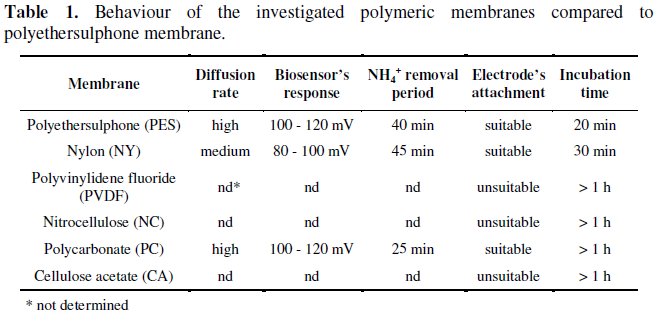
<body><![CDATA[<p>From these membranes, and according to several limitations observed, like low
diffusion rate of the substrate, lack of signal or biosensor's response, extreme
NH<sub>4</sub><sup>+</sup> removal periods, low ability for physical attachment to the electrode's
surface due to unsuitable mechanical properties or high incubation periods, only
nylon and polycarbonate membranes were considered for a comparative study
with polyethersulphone. The results of the tests performed with these polymeric
membranes are summarized in Table 1.</p>

    <p>&nbsp; <a name="top.t1"></a> </p>
<img src="/img/revistas/pea/v29n5/29n5a07t1.jpg">
    
<p>&nbsp;</p>


    <p><b><i>Comparative study between polyethersulphone, nylon and polycarbonate membranes</i></b></p>

    <p>The main goal of this study was to find if nylon or polycarbonate membranes
could be considered as an alternative to polyethersulphone (as immobilization
support for whole cells of Pseudomonas aeruginosa), in what NH<sub>4</sub><sup>+</sup> removal time
it concerns. One of the major concerns at this time was that the biosensor's signal
or response obtained with polyethersulphone membranes wouldn't be
compromised.</p>

    <p>Whole cells immobilization procedure and further experimental conditions
involving these assays are the same described in the sections concerning
immobilization of whole cells on single discs of polyethersulphone membrane
and potentiometric measurement, respectively.</p>

    <p>Preliminary results showed that the biosensor's signal or response obtained with
the new membrane materials were, in all aspects, similar to that verified with
polyethersulphone membrane (<a href="#top.f3">Fig. 3</a>).</p>

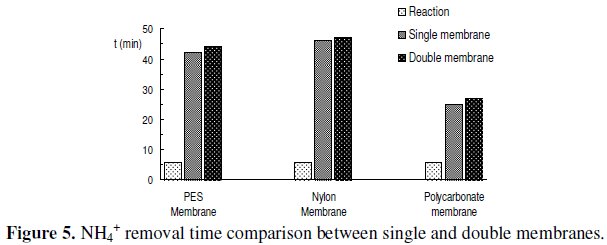
    <p>Regarding the time needed for complete removal of NH<sub>4</sub><sup>+</sup>, the results presented
in Fig. 5 show that polyethersulphone membranes needed about 40 min, whereas
nylon membranes needed about 45 min, leading, from a global perspective, to a
time consuming analysis.</p> 


    <p>&nbsp; <a name="top.f5"></a> </p>
<img src="/img/revistas/pea/v29n5/29n5a07f5.jpg">
    
<p>&nbsp;</p>


    ]]></body>
<body><![CDATA[<p>On the other hand when using polycarbonate 
membranes the time needed for complete removal of NH<sub>4</sub><sup>+</sup> from the membrane
decreased to about 25 min. Despite the fact that this value is about half of that
found for the other two membranes, it is still significantly high, from a point of
view where it is demanding to develop fast methods of analysis.</p>


    <p><b><i>Double membrane biosensors</i></b></p>

    <p>At this stage of the investigation, another limitation was observed, which resulted
from the use of single membrane discs, where the biological element contacts
directly with the electrode's surface. In fact, each time the biosensors were used
and the membranes attached to the ammonium electrode, in order to perform the
assays, and then removed for storage, it was observed that a significant amount
of cells was lost. This observation was responsible for a premature decrease in
the biosensor's overall activity, due to the loss of biological recognition element.
In order to overcome this problem, instead of using single membrane disc, the
hypothesis of using double membrane discs, in a â€œsandwichâ€ design, was
considered. This way the cells would remain contained between the membranes,
never contacting the electrode's surface, and thus prevent their premature loss.
Consequently, the activity of the biosensors could be maintained for longer
periods of time.</p>

    <p>Prior to performing the assays involving the new membrane design, it was
thought that the time needed for NH<sub>4</sub><sup>+</sup> removal from the double membranes could
be twice the time observed for single discs. However, the obtained results, in <a href="#top.f5">Fig. 5</a>, 
showed that no significant increase in this parameter was observed, when
using double membranes.</p>

    <p>In fact, the results obtained for single and double membranes were very similar,
and once again polycarbonate double membrane exhibited the most favourable
result in what NH<sub>4</sub><sup>+</sup> removal time it concerns.</p>

    <p>At this time, since nylon membranes were the less suitable to this purpose, as
well as in what biosensor's response it concerns (<a href="#top.t1">Table 1</a>), only
polyethersulphone and polycarbonate membranes were considered for further
studies.</p>

    <p>On the other hand, bearing in mind the limitations observed in the use of single
membrane discs, as well as the coinciding results obtained for both designs, (<a href="#top.f5">Fig. 5</a>), 
it was decided that only double membranes would be used in future assays.</p>

    <p>Analytical performance of the biosensors for acrylamide detection
The analytical characteristics regarding the performance of the biosensors using
double membranes for acrylamide detection were evaluated and the results
compared.</p>

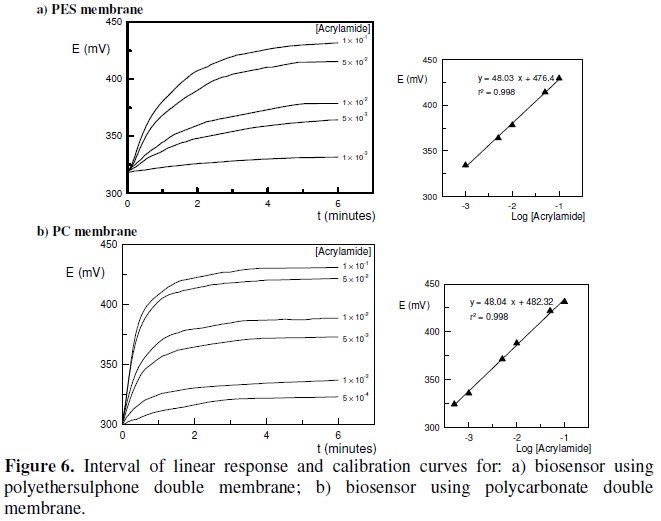
    <p>A calibration assay was carried out for each biosensor in the range of 1&times;10<sup>-5</sup> M to
5&times;10<sup>-1</sup> M of acrylamide concentration. The linear response found for the
biosensor using polyethersulphone double membrane ranged from 1&times;10<sup>-3</sup> M to
1&times;10<sup>-1</sup> M, whereas for the biosensor using polycarbonate double membrane it
was observed in the range of 5&times;10<sup>-4</sup> M to 1&times;10<sup>-1</sup> M. For both biosensors it was
obtained a good correlation between the logarithm of acrylamide concentration
and the variation in potential, E (mV). The Nernst equations obtained were the
following:</p>


    <p>&nbsp;</p>
<img src="/img/revistas/pea/v29n5/29n5a07s1.jpg">
    
]]></body>
<body><![CDATA[<p>&nbsp;</p>


    <p>A set of sensograms for both biosensors, representing the interval of linear
response is shown in Fig. 6.</p>


    <p>&nbsp;</p>
<img src="/img/revistas/pea/v29n5/29n5a07f6.jpg">
    
<p>&nbsp;</p>


    <p>Once the calibration curves were obtained, the limit of detection (LOD) [30, 31]
for acrylamide was determined for each biosensor. The biosensor using
polyethersulphone double membrane exhibited a limit of detection of
6.31&times;10<sup>-4</sup> M, whereas the value obtained for the biosensor using polycarbonate
double membrane was 9.12&times;10<sup>-5</sup> M.</p>

    <p>The biosensors response times, considered as the time needed to achieve 90% of
the endpoint response in a given reaction period [32], were 3.5 min for the
polyethersulphone double membrane biosensor and 2.5 min for the
polycarbonate double membrane sensor.</p>

    <p>In order to compare the biosensors operating and storage stability with time, an
assay involving the reutilization of the same membranes and consequently the
same immobilized Pseudomonas aeruginosa cells, was carried out. These assays
were performed once a week, according to the same experimental conditions
described in the sections concerning immobilization of whole cells on single discs
of polyethersulphone membrane and potentiometric measurements, respectively.</p>

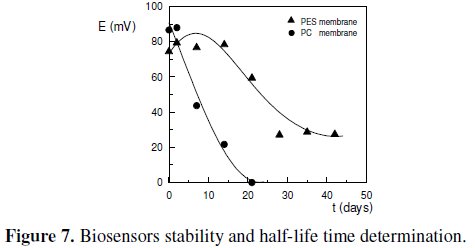
    <p>Between measurements, the membranes were stored at 4 &deg;C in TMEGB buffer,
pH = 7.2. The comparing results, in terms of the half-life time (t<sub>1/2</sub>), are shown in
Fig. 7.</p>


    <p>&nbsp;</p>
<img src="/img/revistas/pea/v29n5/29n5a07f7.jpg">
    
<p>&nbsp;</p>


    ]]></body>
<body><![CDATA[<p>The half-life time of a quantity whose value decreases with time can be defined
as the interval required for the quantity to decay to half of its initial value [16].
According to the results obtained in Fig. 7, the half-life time for the biosensor
using polyethersulphone double membrane was about 27 days, whereas for the
biosensor using polycarbonate double membrane it was only about 7 days. This
poor result obtained with the later biosensor is due to some intrinsic limitations
of the polycarbonate membrane that couldn't be overcome. In fact, a poor
adherence of the cells to the membrane, and a low ability in assuming the
transducer's shape, whenever it was attached to the electrode's surface,
determined that a significant amount of cells was always prematurely lost, even
when using a double membrane design. This observation was the main
responsible for the reduced half-life time observed for the biosensor using
polycarbonate membrane.</p>

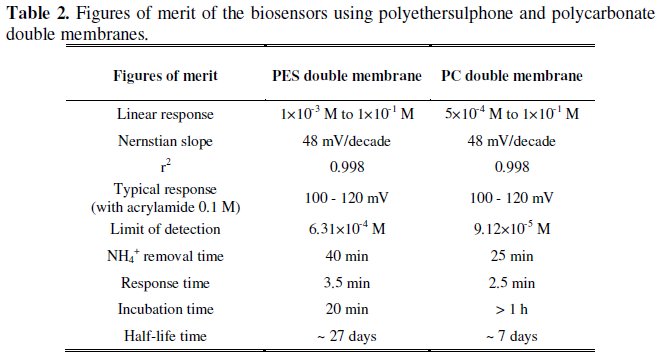
    <p>Table 2 resumes the figures of merit obtained for both biosensors, allowing an
overall comparison between their behaviour and performance when using
polyethersulphone and polycarbonate double membranes.</p>


    <p>&nbsp; <a name="top.t2"></a> </p>
<img src="/img/revistas/pea/v29n5/29n5a07t2.jpg">
    
<p>&nbsp;</p>


    <p>The results presented in Table 2 reveal some advantages of the biosensor with
polycarbonate double membrane towards the biosensor with polyethersulphone
double membrane. These advantages include a wider interval of linear response,
a lower limit of detection and a shorter period for NH<sub>4</sub><sup>+</sup> removal. On the other
hand, the incubation time observed for polycarbonate membrane is significantly
higher than that for polyethersulphone. Also the half-life time obtained with
polycarbonate membranes is only about 1/4 of the value observed for
polyethersulphone.</p>

    <p>At this stage it was taken in consideration that the main goals of the present
investigation were the implementation of a simple and fast bioanalytical method
for toxic amides determination, as well as the development of a device, with
significant time stability, that could be reutilized as many times as possible.
Bearing in mind these objectives, and considering the global results for both
membranes, in particular the biosensors stability and the possibility of their
reutilization, polyethersulphone was considered to be the most adequate
membrane material for Pseudomonas aeruginosa cells immobilization, for the
applications of the herein described electrochemical biosensor.


    <p><b>Conclusions and future developments</b></p>

    <p>The present work involved the development and characterization of the merits
and limitations of an electrochemical biosensor based on ion selective electrode
and immobilized whole cells of <i>Pseudomonas aeruginosa</i>, with intracellular
amidase activity, for the detection and determination of acrylamide.</p>

    <p>The first approach to the biosensor's design involved the use of single discs of
polymeric membranes as support for whole cells immobilization. However, this
procedure determined a significant biomass loss, and a premature decrease in
biosensor's overall activity.</p>

    <p>Bearing in mind this limitation, a new approach was taken in consideration, and
the behaviour of double membranes, in a ''sandwich'' design, was investigated.
In fact, the use of double membranes was responsible for a significant reduction
in biomass loss and thus enhancing biosensor's stability in time. Also, a major
advantage that resulted from this procedure is that when double membranes were
used, the immobilization of the cells, confined between both membranes, was
performed without glutaraldehyde. This aspect is of significantly importance
since the presence of glutaraldehyde increases the toxicity of the immobilization
mixture containing the cells, compromising the biosensor's activity.</p>

    ]]></body>
<body><![CDATA[<p>The biosensors using polyethersulphone and polycarbonate double membranes
exhibited a good analytical performance, according to the figures of merit in
<a href="#top.t2">Table 2</a>. Typical responses of 100-120 mV, Nernstian slopes of 48 mV/decade
and limits of detection in the order of 10<sup>-4</sup> M and 10<sup>-5</sup> M must be enhanced.
However, the major problem encountered when using polymeric membranes in
the immobilization process remained unsolved. In fact, the time needed for NH<sub>4</sub><sup>+</sup>
removal after each biochemical reaction, couldn't ever be reduced below 25 min.
On the other hand, this biosensor presents some advantages towards more classic
methods for acrylamide determination, namely chromatography, since it involves
lower costs, easy operation, simplified experimental design and apparatus, and
enhanced specificity, since it is based on specific enzymatic reaction.</p>

    <p>The referred characteristics allow us to believe that this biosensor may be
significantly useful in the detection and determination of acrylamide in food and
environmental analysis. The assessment of drinking and natural waters quality, in
what acrylamide presence concerns, may be a preference field of application for
this potentiometric biosensor, since accumulation and persistence in drinking
water after treatment, groundwater and aquatic environments may occur.</p>

    <p>Presently, in order to overcome the unique limitation, regarding the present work,
which remains unsolved, we are investigating other immobilization matrices for
whole cells of Pseudomonas aeruginosa as an alternative to the use of polymeric
membranes. Bovine serum albumin (BSA), gelatine, nafion, agarose and sol-gel
(both aqueous route using sodium silicate as a silica precursor and alkoxide
route, using tetraethylorthosilicate), are examples of some materials that are
being used and combined, to prepare different immobilization matrices.</p>

    <p>In future work we will try to adequate the present biosensing system to another
device, with reduced dimensions, with the same or a different transduction
process (in particular condutimetric or piezoelectric). The performance of the
biosensor in flow injection analysis will also be tested, regarding field and online
applications. The development of an acrylamide biosensor using ''screen
printing'' technology is one of the main future objectives. The possibility of using
other microorganisms with intracellular amidase activity, as well as other amides,
such as formamide or acetamide will also be investigated.</p>


    <p>&nbsp;</p>
    <p><b>References</b></p>

    <!-- ref --><p>1. M. Friedman, J. Agr. Food Chem. 51 (2003) 4504.    &nbsp;&nbsp;&nbsp;&nbsp;&nbsp;&nbsp;&nbsp;&nbsp;[&#160;<a href="javascript:void(0);" onclick="javascript: window.open('/scielo.php?script=sci_nlinks&ref=000109&pid=S0872-1904201100050000700001&lng=','','width=640,height=500,resizable=yes,scrollbars=1,menubar=yes,');">Links</a>&#160;]<!-- end-ref --></p>
    <!-- ref --><p>2. Chia-Hsien Feng, Anal. Chim. Acta 684 (2010) 80.    &nbsp;&nbsp;&nbsp;&nbsp;&nbsp;&nbsp;&nbsp;&nbsp;[&#160;<a href="javascript:void(0);" onclick="javascript: window.open('/scielo.php?script=sci_nlinks&ref=000111&pid=S0872-1904201100050000700002&lng=','','width=640,height=500,resizable=yes,scrollbars=1,menubar=yes,');">Links</a>&#160;]<!-- end-ref --></p>
    ]]></body>
<body><![CDATA[<!-- ref --><p>3. J.M. Rice, Mutat. Res. 580 (2005) 3.    &nbsp;&nbsp;&nbsp;&nbsp;&nbsp;&nbsp;&nbsp;&nbsp;[&#160;<a href="javascript:void(0);" onclick="javascript: window.open('/scielo.php?script=sci_nlinks&ref=000113&pid=S0872-1904201100050000700003&lng=','','width=640,height=500,resizable=yes,scrollbars=1,menubar=yes,');">Links</a>&#160;]<!-- end-ref --></p>
    <!-- ref --><p>4. L. Brown, M. M. Rhead, D. Hill, K.C.C. Bancroft, Water Res. 16 (1982) 579.    &nbsp;&nbsp;&nbsp;&nbsp;&nbsp;&nbsp;&nbsp;&nbsp;[&#160;<a href="javascript:void(0);" onclick="javascript: window.open('/scielo.php?script=sci_nlinks&ref=000115&pid=S0872-1904201100050000700004&lng=','','width=640,height=500,resizable=yes,scrollbars=1,menubar=yes,');">Links</a>&#160;]<!-- end-ref --></p>
    <!-- ref --><p>5. M. Weiderborg, T. K&auml;llqvist, K.E. &Oslash;derg&aring;rd et all, Water Res. 35 (2001) 2645.    &nbsp;&nbsp;&nbsp;&nbsp;&nbsp;&nbsp;&nbsp;&nbsp;[&#160;<a href="javascript:void(0);" onclick="javascript: window.open('/scielo.php?script=sci_nlinks&ref=000117&pid=S0872-1904201100050000700005&lng=','','width=640,height=500,resizable=yes,scrollbars=1,menubar=yes,');">Links</a>&#160;]<!-- end-ref --></p>
    <!-- ref --><p>6. C.-C. Wang, &AElig; C.-M. Lee, Curr. Microbiol. 55 (2007) 339.    &nbsp;&nbsp;&nbsp;&nbsp;&nbsp;&nbsp;&nbsp;&nbsp;[&#160;<a href="javascript:void(0);" onclick="javascript: window.open('/scielo.php?script=sci_nlinks&ref=000119&pid=S0872-1904201100050000700006&lng=','','width=640,height=500,resizable=yes,scrollbars=1,menubar=yes,');">Links</a>&#160;]<!-- end-ref --></p>
    <!-- ref --><p>7. S. Cavalli, S. Polesello, G. Saccani, J. Chrom. A 1039 (2004) 155.    &nbsp;&nbsp;&nbsp;&nbsp;&nbsp;&nbsp;&nbsp;&nbsp;[&#160;<a href="javascript:void(0);" onclick="javascript: window.open('/scielo.php?script=sci_nlinks&ref=000121&pid=S0872-1904201100050000700007&lng=','','width=640,height=500,resizable=yes,scrollbars=1,menubar=yes,');">Links</a>&#160;]<!-- end-ref --></p>
    ]]></body>
<body><![CDATA[<!-- ref --><p>8. F. Tateo, Int. J. Food Sci. Tech. 45 (2010) 629.    &nbsp;&nbsp;&nbsp;&nbsp;&nbsp;&nbsp;&nbsp;&nbsp;[&#160;<a href="javascript:void(0);" onclick="javascript: window.open('/scielo.php?script=sci_nlinks&ref=000123&pid=S0872-1904201100050000700008&lng=','','width=640,height=500,resizable=yes,scrollbars=1,menubar=yes,');">Links</a>&#160;]<!-- end-ref --></p>
    <!-- ref --><p>9. M. Anese, B. Quarta, J. Frias, Food Chem. 126 (2011) 435.    &nbsp;&nbsp;&nbsp;&nbsp;&nbsp;&nbsp;&nbsp;&nbsp;[&#160;<a href="javascript:void(0);" onclick="javascript: window.open('/scielo.php?script=sci_nlinks&ref=000125&pid=S0872-1904201100050000700009&lng=','','width=640,height=500,resizable=yes,scrollbars=1,menubar=yes,');">Links</a>&#160;]<!-- end-ref --></p>
    <!-- ref --><p>10. E. Susanna, Molec. Nutr. Food Res. 51 (2007) 239.    &nbsp;&nbsp;&nbsp;&nbsp;&nbsp;&nbsp;&nbsp;&nbsp;[&#160;<a href="javascript:void(0);" onclick="javascript: window.open('/scielo.php?script=sci_nlinks&ref=000127&pid=S0872-1904201100050000700010&lng=','','width=640,height=500,resizable=yes,scrollbars=1,menubar=yes,');">Links</a>&#160;]<!-- end-ref --></p>
    <!-- ref --><p>11. M. Pohankai, P. Skl&aacute;dal, J. Appl. Biomed.6 (2008) 57.    &nbsp;&nbsp;&nbsp;&nbsp;&nbsp;&nbsp;&nbsp;&nbsp;[&#160;<a href="javascript:void(0);" onclick="javascript: window.open('/scielo.php?script=sci_nlinks&ref=000129&pid=S0872-1904201100050000700011&lng=','','width=640,height=500,resizable=yes,scrollbars=1,menubar=yes,');">Links</a>&#160;]<!-- end-ref --></p>
    <!-- ref --><p>12. D. Grieshaber, R. MacKenzie, J. V&ouml;r&ouml;s, E. Reimhult, Sensors 8 (2008) 1400.    &nbsp;&nbsp;&nbsp;&nbsp;&nbsp;&nbsp;&nbsp;&nbsp;[&#160;<a href="javascript:void(0);" onclick="javascript: window.open('/scielo.php?script=sci_nlinks&ref=000131&pid=S0872-1904201100050000700012&lng=','','width=640,height=500,resizable=yes,scrollbars=1,menubar=yes,');">Links</a>&#160;]<!-- end-ref --></p>
    ]]></body>
<body><![CDATA[<!-- ref --><p>13. S. Martins, A. Karmali, M. L. Serralheiro, Anal. Biochem. 355 (2006) 232.    &nbsp;&nbsp;&nbsp;&nbsp;&nbsp;&nbsp;&nbsp;&nbsp;[&#160;<a href="javascript:void(0);" onclick="javascript: window.open('/scielo.php?script=sci_nlinks&ref=000133&pid=S0872-1904201100050000700013&lng=','','width=640,height=500,resizable=yes,scrollbars=1,menubar=yes,');">Links</a>&#160;]<!-- end-ref --></p>
    <!-- ref --><p>14. J. Andrade, A. Karmali, M. A. Carrondo, C. Fraz&atilde;o, J. Biol. Chem. 282 (2007) 19598.    &nbsp;&nbsp;&nbsp;&nbsp;&nbsp;&nbsp;&nbsp;&nbsp;[&#160;<a href="javascript:void(0);" onclick="javascript: window.open('/scielo.php?script=sci_nlinks&ref=000135&pid=S0872-1904201100050000700014&lng=','','width=640,height=500,resizable=yes,scrollbars=1,menubar=yes,');">Links</a>&#160;]<!-- end-ref --></p>
    <!-- ref --><p>15. A.M.O. Brett, C.M.A. Brett, Electroqu&iacute;mica: Princ&iacute;pios, M&eacute;todos e Aplica&ccedil;&otilde;es, Oxford University Press, 1996.    &nbsp;&nbsp;&nbsp;&nbsp;&nbsp;&nbsp;&nbsp;&nbsp;[&#160;<a href="javascript:void(0);" onclick="javascript: window.open('/scielo.php?script=sci_nlinks&ref=000137&pid=S0872-1904201100050000700015&lng=','','width=640,height=500,resizable=yes,scrollbars=1,menubar=yes,');">Links</a>&#160;]<!-- end-ref --></p>
    <!-- ref --><p>16. S.A.S.S. Gomes, M.J.F. Rebelo, Sensors 3 (2003) 166.    &nbsp;&nbsp;&nbsp;&nbsp;&nbsp;&nbsp;&nbsp;&nbsp;[&#160;<a href="javascript:void(0);" onclick="javascript: window.open('/scielo.php?script=sci_nlinks&ref=000139&pid=S0872-1904201100050000700016&lng=','','width=640,height=500,resizable=yes,scrollbars=1,menubar=yes,');">Links</a>&#160;]<!-- end-ref --></p>
    <!-- ref --><p>17. B.J. Ryan, C.O. F&aacute;g&aacute;in, BMC Biotech. 7 (2007) 1472.    &nbsp;&nbsp;&nbsp;&nbsp;&nbsp;&nbsp;&nbsp;&nbsp;[&#160;<a href="javascript:void(0);" onclick="javascript: window.open('/scielo.php?script=sci_nlinks&ref=000141&pid=S0872-1904201100050000700017&lng=','','width=640,height=500,resizable=yes,scrollbars=1,menubar=yes,');">Links</a>&#160;]<!-- end-ref --></p>
    ]]></body>
<body><![CDATA[<!-- ref --><p>18. A.J. Baeumner, N.A. Schlesinger, N. Slutzki et all, Anal. Chem. 74 (2002) 1442.    &nbsp;&nbsp;&nbsp;&nbsp;&nbsp;&nbsp;&nbsp;&nbsp;[&#160;<a href="javascript:void(0);" onclick="javascript: window.open('/scielo.php?script=sci_nlinks&ref=000143&pid=S0872-1904201100050000700018&lng=','','width=640,height=500,resizable=yes,scrollbars=1,menubar=yes,');">Links</a>&#160;]<!-- end-ref --></p>
    <!-- ref --><p>19. E. Akyilmaz, A. Yaoa, E. Din&ccedil;akaya, Anal. Biochem. 354 (2006) 78.    &nbsp;&nbsp;&nbsp;&nbsp;&nbsp;&nbsp;&nbsp;&nbsp;[&#160;<a href="javascript:void(0);" onclick="javascript: window.open('/scielo.php?script=sci_nlinks&ref=000145&pid=S0872-1904201100050000700019&lng=','','width=640,height=500,resizable=yes,scrollbars=1,menubar=yes,');">Links</a>&#160;]<!-- end-ref --></p>
    <!-- ref --><p>20. D.G. Bracewell, A. Gill, M. Hoare, Food Bioprod. Process 80(C2) (2002) 71.    &nbsp;&nbsp;&nbsp;&nbsp;&nbsp;&nbsp;&nbsp;&nbsp;[&#160;<a href="javascript:void(0);" onclick="javascript: window.open('/scielo.php?script=sci_nlinks&ref=000147&pid=S0872-1904201100050000700020&lng=','','width=640,height=500,resizable=yes,scrollbars=1,menubar=yes,');">Links</a>&#160;]<!-- end-ref --></p>
    <!-- ref --><p>21. G. Hanrahan, D.G. Patil, J. Wang, J. Environ. Monit. 6 (2004) 657.    &nbsp;&nbsp;&nbsp;&nbsp;&nbsp;&nbsp;&nbsp;&nbsp;[&#160;<a href="javascript:void(0);" onclick="javascript: window.open('/scielo.php?script=sci_nlinks&ref=000149&pid=S0872-1904201100050000700021&lng=','','width=640,height=500,resizable=yes,scrollbars=1,menubar=yes,');">Links</a>&#160;]<!-- end-ref --></p>
    <!-- ref --><p>22. H. Endo, Y. Yonemori, K. Hibi et all, Biosens. Bioelectron. 24 (2009) 1417.    &nbsp;&nbsp;&nbsp;&nbsp;&nbsp;&nbsp;&nbsp;&nbsp;[&#160;<a href="javascript:void(0);" onclick="javascript: window.open('/scielo.php?script=sci_nlinks&ref=000151&pid=S0872-1904201100050000700022&lng=','','width=640,height=500,resizable=yes,scrollbars=1,menubar=yes,');">Links</a>&#160;]<!-- end-ref --></p>
    ]]></body>
<body><![CDATA[<!-- ref --><p>23. B.C. Okeke, G. Ma, Q. Cheng et all, J. Microbiol. Meth. 68 (2007) 69.    &nbsp;&nbsp;&nbsp;&nbsp;&nbsp;&nbsp;&nbsp;&nbsp;[&#160;<a href="javascript:void(0);" onclick="javascript: window.open('/scielo.php?script=sci_nlinks&ref=000153&pid=S0872-1904201100050000700023&lng=','','width=640,height=500,resizable=yes,scrollbars=1,menubar=yes,');">Links</a>&#160;]<!-- end-ref --></p>
    <!-- ref --><p>24. V. Pundir, C.S. Pundir, J. Sci. Ind. Res. 67 (2008) 299.    &nbsp;&nbsp;&nbsp;&nbsp;&nbsp;&nbsp;&nbsp;&nbsp;[&#160;<a href="javascript:void(0);" onclick="javascript: window.open('/scielo.php?script=sci_nlinks&ref=000155&pid=S0872-1904201100050000700024&lng=','','width=640,height=500,resizable=yes,scrollbars=1,menubar=yes,');">Links</a>&#160;]<!-- end-ref --></p>
    <!-- ref --><p>25. M. Raje, R. Dhiman, S. Majumdar et all, Cytotechnology 51 (2006) 111.    &nbsp;&nbsp;&nbsp;&nbsp;&nbsp;&nbsp;&nbsp;&nbsp;[&#160;<a href="javascript:void(0);" onclick="javascript: window.open('/scielo.php?script=sci_nlinks&ref=000157&pid=S0872-1904201100050000700025&lng=','','width=640,height=500,resizable=yes,scrollbars=1,menubar=yes,');">Links</a>&#160;]<!-- end-ref --></p>
    <!-- ref --><p>26. T.-H. Young, J.-N. Lu, D.-J. Lin et all, Desalination 234 (2008) 134.    &nbsp;&nbsp;&nbsp;&nbsp;&nbsp;&nbsp;&nbsp;&nbsp;[&#160;<a href="javascript:void(0);" onclick="javascript: window.open('/scielo.php?script=sci_nlinks&ref=000159&pid=S0872-1904201100050000700026&lng=','','width=640,height=500,resizable=yes,scrollbars=1,menubar=yes,');">Links</a>&#160;]<!-- end-ref --></p>
    <!-- ref --><p>27. G. Singh, A. Bhalla, N. Capalash, P. Sharma, Indian J. Sci. Technol. 3 (2010) 48.    &nbsp;&nbsp;&nbsp;&nbsp;&nbsp;&nbsp;&nbsp;&nbsp;[&#160;<a href="javascript:void(0);" onclick="javascript: window.open('/scielo.php?script=sci_nlinks&ref=000161&pid=S0872-1904201100050000700027&lng=','','width=640,height=500,resizable=yes,scrollbars=1,menubar=yes,');">Links</a>&#160;]<!-- end-ref --></p>
    ]]></body>
<body><![CDATA[<!-- ref --><p>28. A.K. Basu, P. Chattopadhyay, U. Roychudhuri, R. Chakraborty, Biosens. Bioelectron. 21 (2006) 1968.    &nbsp;&nbsp;&nbsp;&nbsp;&nbsp;&nbsp;&nbsp;&nbsp;[&#160;<a href="javascript:void(0);" onclick="javascript: window.open('/scielo.php?script=sci_nlinks&ref=000163&pid=S0872-1904201100050000700028&lng=','','width=640,height=500,resizable=yes,scrollbars=1,menubar=yes,');">Links</a>&#160;]<!-- end-ref --></p>
    <!-- ref --><p>29. J. Janata, M. Josowicz, Solid State Ionics 94 (1997) 209.    &nbsp;&nbsp;&nbsp;&nbsp;&nbsp;&nbsp;&nbsp;&nbsp;[&#160;<a href="javascript:void(0);" onclick="javascript: window.open('/scielo.php?script=sci_nlinks&ref=000165&pid=S0872-1904201100050000700029&lng=','','width=640,height=500,resizable=yes,scrollbars=1,menubar=yes,');">Links</a>&#160;]<!-- end-ref --></p>
    <!-- ref --><p>30. E. Bakker, E. Pretsch, Trend. Anal. Chem. 24 (2006) 199.    &nbsp;&nbsp;&nbsp;&nbsp;&nbsp;&nbsp;&nbsp;&nbsp;[&#160;<a href="javascript:void(0);" onclick="javascript: window.open('/scielo.php?script=sci_nlinks&ref=000167&pid=S0872-1904201100050000700030&lng=','','width=640,height=500,resizable=yes,scrollbars=1,menubar=yes,');">Links</a>&#160;]<!-- end-ref --></p>
    <!-- ref --><p>31. D.L. Massart, B.G.M. Vandeginste, S.N. Deming et all, Chemometrics: A text book, Ed. B.G.M. Vandeginste, L. Kaufman, Elsevier, Amsterdam, 1988.    &nbsp;&nbsp;&nbsp;&nbsp;&nbsp;&nbsp;&nbsp;&nbsp;[&#160;<a href="javascript:void(0);" onclick="javascript: window.open('/scielo.php?script=sci_nlinks&ref=000169&pid=S0872-1904201100050000700031&lng=','','width=640,height=500,resizable=yes,scrollbars=1,menubar=yes,');">Links</a>&#160;]<!-- end-ref --></p>
    <!-- ref --><p>32. I. Uemasu, Y. Umezawa, Anal. Chem. 54 (1982) 1198.    &nbsp;&nbsp;&nbsp;&nbsp;&nbsp;&nbsp;&nbsp;&nbsp;[&#160;<a href="javascript:void(0);" onclick="javascript: window.open('/scielo.php?script=sci_nlinks&ref=000171&pid=S0872-1904201100050000700032&lng=','','width=640,height=500,resizable=yes,scrollbars=1,menubar=yes,');">Links</a>&#160;]<!-- end-ref --></p>
 

    ]]></body>
<body><![CDATA[<p>&nbsp;</p>
    <p><b>Acknowledgements</b></p>

    <p>The authors would like to acknowledge research grants (CIEQB 702 and
PTDC/AGR-AAM/73460/2006) from Funda&ccedil;&atilde;o para a Ci&ecirc;ncia e Tecnologia,
Portugal. We are also grateful to Sonia Martins, Magda Semedo, Rita Pacheco,
Dulce Gil and Sandra Silva for some technical help.</p>

    <p><a name=0></a><sup><a href="#top">*</a></sup> Corresponding author. E-mail address: <a href="mailto:nsilva@deq.isel.ipl.pt">nsilva@deq.isel.ipl.pt</a></p>

    <p>Received 11 February 2011; accepted 28 March 2011</p>

    <p><a href="http://www.peacta.org" target="_blank">www.peacta.org</a> </p>


     ]]></body><back>
<ref-list>
<ref id="B1">
<label>1</label><nlm-citation citation-type="journal">
<person-group person-group-type="author">
<name>
<surname><![CDATA[Friedman]]></surname>
<given-names><![CDATA[M.]]></given-names>
</name>
</person-group>
<source><![CDATA[J. Agr. Food Chem.]]></source>
<year>2003</year>
<volume>51</volume>
<page-range>4504</page-range></nlm-citation>
</ref>
<ref id="B2">
<label>2</label><nlm-citation citation-type="journal">
<person-group person-group-type="author">
<name>
<surname><![CDATA[Feng]]></surname>
<given-names><![CDATA[Chia-Hsien]]></given-names>
</name>
</person-group>
<source><![CDATA[Anal. Chim. Acta]]></source>
<year>2010</year>
<volume>684</volume>
<page-range>80</page-range></nlm-citation>
</ref>
<ref id="B3">
<label>3</label><nlm-citation citation-type="journal">
<person-group person-group-type="author">
<name>
<surname><![CDATA[Rice]]></surname>
<given-names><![CDATA[J.M.]]></given-names>
</name>
</person-group>
<source><![CDATA[Mutat. Res.]]></source>
<year>2005</year>
<volume>580</volume>
<page-range>3</page-range></nlm-citation>
</ref>
<ref id="B4">
<label>4</label><nlm-citation citation-type="journal">
<person-group person-group-type="author">
<name>
<surname><![CDATA[Brown]]></surname>
<given-names><![CDATA[L.]]></given-names>
</name>
<name>
<surname><![CDATA[Rhead]]></surname>
<given-names><![CDATA[M. M.]]></given-names>
</name>
<name>
<surname><![CDATA[Hill]]></surname>
<given-names><![CDATA[D.]]></given-names>
</name>
<name>
<surname><![CDATA[Bancroft]]></surname>
<given-names><![CDATA[K.C.C.]]></given-names>
</name>
</person-group>
<source><![CDATA[Water Res.]]></source>
<year>1982</year>
<volume>16</volume>
<page-range>579</page-range></nlm-citation>
</ref>
<ref id="B5">
<label>5</label><nlm-citation citation-type="journal">
<person-group person-group-type="author">
<name>
<surname><![CDATA[Weiderborg]]></surname>
<given-names><![CDATA[M.]]></given-names>
</name>
<name>
<surname><![CDATA[Källqvist]]></surname>
<given-names><![CDATA[T.]]></given-names>
</name>
<name>
<surname><![CDATA[Ødergård]]></surname>
<given-names><![CDATA[K.E.]]></given-names>
</name>
</person-group>
<source><![CDATA[Water Res.]]></source>
<year>2001</year>
<volume>35</volume>
<page-range>2645</page-range></nlm-citation>
</ref>
<ref id="B6">
<label>6</label><nlm-citation citation-type="journal">
<person-group person-group-type="author">
<name>
<surname><![CDATA[Wang]]></surname>
<given-names><![CDATA[C.-C.]]></given-names>
</name>
<name>
<surname><![CDATA[Lee]]></surname>
<given-names><![CDATA[Æ C.-M.]]></given-names>
</name>
</person-group>
<source><![CDATA[Curr. Microbiol.]]></source>
<year>2007</year>
<volume>55</volume>
<page-range>339</page-range></nlm-citation>
</ref>
<ref id="B7">
<label>7</label><nlm-citation citation-type="journal">
<person-group person-group-type="author">
<name>
<surname><![CDATA[Cavalli]]></surname>
<given-names><![CDATA[S.]]></given-names>
</name>
<name>
<surname><![CDATA[Polesello]]></surname>
<given-names><![CDATA[S.]]></given-names>
</name>
<name>
<surname><![CDATA[Saccani]]></surname>
<given-names><![CDATA[G.]]></given-names>
</name>
</person-group>
<source><![CDATA[J. Chrom. A]]></source>
<year>2004</year>
<volume>1039</volume>
<page-range>155</page-range></nlm-citation>
</ref>
<ref id="B8">
<label>8</label><nlm-citation citation-type="journal">
<person-group person-group-type="author">
<name>
<surname><![CDATA[Tateo]]></surname>
<given-names><![CDATA[F.]]></given-names>
</name>
</person-group>
<source><![CDATA[Int. J. Food Sci. Tech.]]></source>
<year>2010</year>
<volume>45</volume>
<page-range>629</page-range></nlm-citation>
</ref>
<ref id="B9">
<label>9</label><nlm-citation citation-type="journal">
<person-group person-group-type="author">
<name>
<surname><![CDATA[Anese]]></surname>
<given-names><![CDATA[M.]]></given-names>
</name>
<name>
<surname><![CDATA[Quarta]]></surname>
<given-names><![CDATA[B.]]></given-names>
</name>
<name>
<surname><![CDATA[Frias]]></surname>
<given-names><![CDATA[J.]]></given-names>
</name>
</person-group>
<source><![CDATA[Food Chem.]]></source>
<year>2011</year>
<volume>126</volume>
<page-range>435</page-range></nlm-citation>
</ref>
<ref id="B10">
<label>10</label><nlm-citation citation-type="journal">
<person-group person-group-type="author">
<name>
<surname><![CDATA[Susanna]]></surname>
<given-names><![CDATA[E.]]></given-names>
</name>
</person-group>
<source><![CDATA[Molec. Nutr. Food Res.]]></source>
<year>2007</year>
<volume>51</volume>
<page-range>239</page-range></nlm-citation>
</ref>
<ref id="B11">
<label>11</label><nlm-citation citation-type="journal">
<person-group person-group-type="author">
<name>
<surname><![CDATA[Pohankai]]></surname>
<given-names><![CDATA[M.]]></given-names>
</name>
<name>
<surname><![CDATA[Skládal]]></surname>
<given-names><![CDATA[P.]]></given-names>
</name>
</person-group>
<source><![CDATA[J. Appl. Biomed.]]></source>
<year>2008</year>
<volume>6</volume>
<page-range>57</page-range></nlm-citation>
</ref>
<ref id="B12">
<label>12</label><nlm-citation citation-type="journal">
<person-group person-group-type="author">
<name>
<surname><![CDATA[Grieshaber]]></surname>
<given-names><![CDATA[D.]]></given-names>
</name>
<name>
<surname><![CDATA[MacKenzie]]></surname>
<given-names><![CDATA[R.]]></given-names>
</name>
<name>
<surname><![CDATA[Vörös]]></surname>
<given-names><![CDATA[J.]]></given-names>
</name>
<name>
<surname><![CDATA[Reimhult]]></surname>
<given-names><![CDATA[E.]]></given-names>
</name>
</person-group>
<source><![CDATA[Sensors]]></source>
<year>2008</year>
<volume>8</volume>
<page-range>1400</page-range></nlm-citation>
</ref>
<ref id="B13">
<label>13</label><nlm-citation citation-type="journal">
<person-group person-group-type="author">
<name>
<surname><![CDATA[Martins]]></surname>
<given-names><![CDATA[S.]]></given-names>
</name>
<name>
<surname><![CDATA[Karmali]]></surname>
<given-names><![CDATA[A.]]></given-names>
</name>
<name>
<surname><![CDATA[Serralheiro]]></surname>
<given-names><![CDATA[M. L.]]></given-names>
</name>
</person-group>
<source><![CDATA[Anal. Biochem.]]></source>
<year>2006</year>
<volume>355</volume>
<page-range>232</page-range></nlm-citation>
</ref>
<ref id="B14">
<label>14</label><nlm-citation citation-type="journal">
<person-group person-group-type="author">
<name>
<surname><![CDATA[Andrade]]></surname>
<given-names><![CDATA[J.]]></given-names>
</name>
<name>
<surname><![CDATA[Karmali]]></surname>
<given-names><![CDATA[A.]]></given-names>
</name>
<name>
<surname><![CDATA[Carrondo]]></surname>
<given-names><![CDATA[M. A.]]></given-names>
</name>
<name>
<surname><![CDATA[Frazão]]></surname>
<given-names><![CDATA[C.]]></given-names>
</name>
</person-group>
<source><![CDATA[J. Biol. Chem.]]></source>
<year>2007</year>
<volume>282</volume>
<page-range>19598</page-range></nlm-citation>
</ref>
<ref id="B15">
<label>15</label><nlm-citation citation-type="book">
<person-group person-group-type="author">
<name>
<surname><![CDATA[Brett]]></surname>
<given-names><![CDATA[A.M.O.]]></given-names>
</name>
<name>
<surname><![CDATA[Brett]]></surname>
<given-names><![CDATA[C.M.A.]]></given-names>
</name>
</person-group>
<source><![CDATA[Electroquímica: Princípios, Métodos e Aplicações]]></source>
<year>1996</year>
<publisher-name><![CDATA[Oxford University Press]]></publisher-name>
</nlm-citation>
</ref>
<ref id="B16">
<label>16</label><nlm-citation citation-type="journal">
<person-group person-group-type="author">
<name>
<surname><![CDATA[Gomes]]></surname>
<given-names><![CDATA[S.A.S.S.]]></given-names>
</name>
<name>
<surname><![CDATA[Rebelo]]></surname>
<given-names><![CDATA[M.J.F.]]></given-names>
</name>
</person-group>
<source><![CDATA[Sensors]]></source>
<year>2003</year>
<volume>3</volume>
<page-range>166</page-range></nlm-citation>
</ref>
<ref id="B17">
<label>17</label><nlm-citation citation-type="journal">
<person-group person-group-type="author">
<name>
<surname><![CDATA[Ryan]]></surname>
<given-names><![CDATA[B.J.]]></given-names>
</name>
<name>
<surname><![CDATA[Fágáin]]></surname>
<given-names><![CDATA[C.O.]]></given-names>
</name>
</person-group>
<source><![CDATA[BMC Biotech.]]></source>
<year>2007</year>
<volume>7</volume>
<page-range>1472</page-range></nlm-citation>
</ref>
<ref id="B18">
<label>18</label><nlm-citation citation-type="journal">
<person-group person-group-type="author">
<name>
<surname><![CDATA[Baeumner]]></surname>
<given-names><![CDATA[A.J.]]></given-names>
</name>
<name>
<surname><![CDATA[Schlesinger]]></surname>
<given-names><![CDATA[N.A.]]></given-names>
</name>
<name>
<surname><![CDATA[Slutzki]]></surname>
<given-names><![CDATA[N.]]></given-names>
</name>
</person-group>
<source><![CDATA[Anal. Chem.]]></source>
<year>2002</year>
<volume>74</volume>
<page-range>1442</page-range></nlm-citation>
</ref>
<ref id="B19">
<label>19</label><nlm-citation citation-type="journal">
<person-group person-group-type="author">
<name>
<surname><![CDATA[Akyilmaz]]></surname>
<given-names><![CDATA[E.]]></given-names>
</name>
<name>
<surname><![CDATA[Yaoa]]></surname>
<given-names><![CDATA[A.]]></given-names>
</name>
<name>
<surname><![CDATA[Dinçakaya]]></surname>
<given-names><![CDATA[E.]]></given-names>
</name>
</person-group>
<source><![CDATA[Anal. Biochem.]]></source>
<year>2006</year>
<volume>354</volume>
<page-range>78</page-range></nlm-citation>
</ref>
<ref id="B20">
<label>20</label><nlm-citation citation-type="journal">
<person-group person-group-type="author">
<name>
<surname><![CDATA[Bracewell]]></surname>
<given-names><![CDATA[D.G.]]></given-names>
</name>
<name>
<surname><![CDATA[Gill]]></surname>
<given-names><![CDATA[A.]]></given-names>
</name>
<name>
<surname><![CDATA[Hoare]]></surname>
<given-names><![CDATA[M.]]></given-names>
</name>
</person-group>
<source><![CDATA[Food Bioprod. Process]]></source>
<year>2002</year>
<volume>80(C2)</volume>
<page-range>71</page-range></nlm-citation>
</ref>
<ref id="B21">
<label>21</label><nlm-citation citation-type="journal">
<person-group person-group-type="author">
<name>
<surname><![CDATA[Hanrahan]]></surname>
<given-names><![CDATA[G.]]></given-names>
</name>
<name>
<surname><![CDATA[Patil]]></surname>
<given-names><![CDATA[D.G.]]></given-names>
</name>
<name>
<surname><![CDATA[Wang]]></surname>
<given-names><![CDATA[J.]]></given-names>
</name>
</person-group>
<source><![CDATA[J. Environ. Monit.]]></source>
<year>2004</year>
<volume>6</volume>
<page-range>657</page-range></nlm-citation>
</ref>
<ref id="B22">
<label>22</label><nlm-citation citation-type="journal">
<person-group person-group-type="author">
<name>
<surname><![CDATA[Endo]]></surname>
<given-names><![CDATA[H.]]></given-names>
</name>
<name>
<surname><![CDATA[Yonemori]]></surname>
<given-names><![CDATA[Y.]]></given-names>
</name>
<name>
<surname><![CDATA[Hibi]]></surname>
<given-names><![CDATA[K.]]></given-names>
</name>
</person-group>
<source><![CDATA[Biosens. Bioelectron.]]></source>
<year>2009</year>
<volume>24</volume>
<page-range>1417</page-range></nlm-citation>
</ref>
<ref id="B23">
<label>23</label><nlm-citation citation-type="journal">
<person-group person-group-type="author">
<name>
<surname><![CDATA[Okeke]]></surname>
<given-names><![CDATA[B.C.]]></given-names>
</name>
<name>
<surname><![CDATA[Ma]]></surname>
<given-names><![CDATA[G.]]></given-names>
</name>
<name>
<surname><![CDATA[Cheng]]></surname>
<given-names><![CDATA[Q.]]></given-names>
</name>
</person-group>
<source><![CDATA[J. Microbiol. Meth.]]></source>
<year>2007</year>
<volume>68</volume>
<page-range>69</page-range></nlm-citation>
</ref>
<ref id="B24">
<label>24</label><nlm-citation citation-type="journal">
<person-group person-group-type="author">
<name>
<surname><![CDATA[Pundir]]></surname>
<given-names><![CDATA[V.]]></given-names>
</name>
<name>
<surname><![CDATA[Pundir]]></surname>
<given-names><![CDATA[C.S.]]></given-names>
</name>
</person-group>
<source><![CDATA[J. Sci. Ind. Res.]]></source>
<year>2008</year>
<volume>67</volume>
<page-range>299</page-range></nlm-citation>
</ref>
<ref id="B25">
<label>25</label><nlm-citation citation-type="journal">
<person-group person-group-type="author">
<name>
<surname><![CDATA[Raje]]></surname>
<given-names><![CDATA[M.]]></given-names>
</name>
<name>
<surname><![CDATA[Dhiman]]></surname>
<given-names><![CDATA[R.]]></given-names>
</name>
<name>
<surname><![CDATA[Majumdar]]></surname>
<given-names><![CDATA[S.]]></given-names>
</name>
</person-group>
<source><![CDATA[Cytotechnology]]></source>
<year>2006</year>
<volume>51</volume>
<page-range>111</page-range></nlm-citation>
</ref>
<ref id="B26">
<label>26</label><nlm-citation citation-type="journal">
<person-group person-group-type="author">
<name>
<surname><![CDATA[Young]]></surname>
<given-names><![CDATA[T.-H.]]></given-names>
</name>
<name>
<surname><![CDATA[Lu]]></surname>
<given-names><![CDATA[J.-N.]]></given-names>
</name>
<name>
<surname><![CDATA[Lin]]></surname>
<given-names><![CDATA[D.-J.]]></given-names>
</name>
</person-group>
<source><![CDATA[Desalination]]></source>
<year>2008</year>
<volume>234</volume>
<page-range>134</page-range></nlm-citation>
</ref>
<ref id="B27">
<label>27</label><nlm-citation citation-type="journal">
<person-group person-group-type="author">
<name>
<surname><![CDATA[Singh]]></surname>
<given-names><![CDATA[G.]]></given-names>
</name>
<name>
<surname><![CDATA[Bhalla]]></surname>
<given-names><![CDATA[A.]]></given-names>
</name>
<name>
<surname><![CDATA[Capalash]]></surname>
<given-names><![CDATA[N.]]></given-names>
</name>
<name>
<surname><![CDATA[Sharma]]></surname>
<given-names><![CDATA[P.]]></given-names>
</name>
</person-group>
<source><![CDATA[Indian J. Sci. Technol.]]></source>
<year>2010</year>
<volume>3</volume>
<page-range>48</page-range></nlm-citation>
</ref>
<ref id="B28">
<label>28</label><nlm-citation citation-type="journal">
<person-group person-group-type="author">
<name>
<surname><![CDATA[Basu]]></surname>
<given-names><![CDATA[A.K.]]></given-names>
</name>
<name>
<surname><![CDATA[Chattopadhyay]]></surname>
<given-names><![CDATA[P.]]></given-names>
</name>
<name>
<surname><![CDATA[Roychudhuri]]></surname>
<given-names><![CDATA[U.]]></given-names>
</name>
<name>
<surname><![CDATA[Chakraborty]]></surname>
<given-names><![CDATA[R.]]></given-names>
</name>
</person-group>
<source><![CDATA[Biosens. Bioelectron.]]></source>
<year>2006</year>
<volume>21</volume>
<page-range>1968</page-range></nlm-citation>
</ref>
<ref id="B29">
<label>29</label><nlm-citation citation-type="journal">
<person-group person-group-type="author">
<name>
<surname><![CDATA[Janata]]></surname>
<given-names><![CDATA[J.]]></given-names>
</name>
<name>
<surname><![CDATA[Josowicz]]></surname>
<given-names><![CDATA[M.]]></given-names>
</name>
</person-group>
<source><![CDATA[Solid State Ionics]]></source>
<year>1997</year>
<volume>94</volume>
<page-range>209</page-range></nlm-citation>
</ref>
<ref id="B30">
<label>30</label><nlm-citation citation-type="journal">
<person-group person-group-type="author">
<name>
<surname><![CDATA[Bakker]]></surname>
<given-names><![CDATA[E.]]></given-names>
</name>
<name>
<surname><![CDATA[Pretsch]]></surname>
<given-names><![CDATA[E.]]></given-names>
</name>
</person-group>
<source><![CDATA[Trend. Anal. Chem.]]></source>
<year>2006</year>
<volume>24</volume>
<page-range>199</page-range></nlm-citation>
</ref>
<ref id="B31">
<label>31</label><nlm-citation citation-type="book">
<person-group person-group-type="author">
<name>
<surname><![CDATA[Massart]]></surname>
<given-names><![CDATA[D.L.]]></given-names>
</name>
<name>
<surname><![CDATA[Vandeginste]]></surname>
<given-names><![CDATA[B.G.M.]]></given-names>
</name>
<name>
<surname><![CDATA[Deming]]></surname>
<given-names><![CDATA[S.N.]]></given-names>
</name>
</person-group>
<source><![CDATA[Chemometrics: A text book]]></source>
<year>1988</year>
<publisher-loc><![CDATA[Amsterdam ]]></publisher-loc>
<publisher-name><![CDATA[Elsevier]]></publisher-name>
</nlm-citation>
</ref>
<ref id="B32">
<label>32</label><nlm-citation citation-type="journal">
<person-group person-group-type="author">
<name>
<surname><![CDATA[Uemasu]]></surname>
<given-names><![CDATA[I.]]></given-names>
</name>
<name>
<surname><![CDATA[Umezawa]]></surname>
<given-names><![CDATA[Y.]]></given-names>
</name>
</person-group>
<source><![CDATA[Anal. Chem.]]></source>
<year>1982</year>
<volume>54</volume>
<page-range>1198</page-range></nlm-citation>
</ref>
</ref-list>
</back>
</article>