<?xml version="1.0" encoding="ISO-8859-1"?><article xmlns:mml="http://www.w3.org/1998/Math/MathML" xmlns:xlink="http://www.w3.org/1999/xlink" xmlns:xsi="http://www.w3.org/2001/XMLSchema-instance">
<front>
<journal-meta>
<journal-id>0872-1904</journal-id>
<journal-title><![CDATA[Portugaliae Electrochimica Acta]]></journal-title>
<abbrev-journal-title><![CDATA[Port. Electrochim. Acta]]></abbrev-journal-title>
<issn>0872-1904</issn>
<publisher>
<publisher-name><![CDATA[Sociedade Portuguesa de Electroquímica]]></publisher-name>
</publisher>
</journal-meta>
<article-meta>
<article-id>S0872-19042011000600001</article-id>
<article-id pub-id-type="doi">10.4152/pea.201106375</article-id>
<title-group>
<article-title xml:lang="en"><![CDATA[Corrosion Inhibition of Carbon Steel by Imidazolium and Pyridinium Cations Ionic Liquids in Acidic Environment]]></article-title>
</title-group>
<contrib-group>
<contrib contrib-type="author">
<name>
<surname><![CDATA[Ibrahim]]></surname>
<given-names><![CDATA[Magdy A.M.]]></given-names>
</name>
<xref ref-type="aff" rid="A02"/>
</contrib>
<contrib contrib-type="author">
<name>
<surname><![CDATA[Messali]]></surname>
<given-names><![CDATA[Mouslim]]></given-names>
</name>
<xref ref-type="aff" rid="A01"/>
</contrib>
<contrib contrib-type="author">
<name>
<surname><![CDATA[Moussa]]></surname>
<given-names><![CDATA[Ziad]]></given-names>
</name>
<xref ref-type="aff" rid="A01"/>
</contrib>
<contrib contrib-type="author">
<name>
<surname><![CDATA[Alzahrani]]></surname>
<given-names><![CDATA[Abdullah Y.]]></given-names>
</name>
<xref ref-type="aff" rid="A01"/>
</contrib>
<contrib contrib-type="author">
<name>
<surname><![CDATA[Alamry]]></surname>
<given-names><![CDATA[Saleh N.]]></given-names>
</name>
<xref ref-type="aff" rid="A03"/>
</contrib>
<contrib contrib-type="author">
<name>
<surname><![CDATA[Hammouti]]></surname>
<given-names><![CDATA[Belkheir]]></given-names>
</name>
<xref ref-type="aff" rid="A04"/>
</contrib>
</contrib-group>
<aff id="A01">
<institution><![CDATA[,Taibah University Faculty of Science Chemistry Department]]></institution>
<addr-line><![CDATA[ ]]></addr-line>
<country>Saudi Arabia</country>
</aff>
<aff id="A02">
<institution><![CDATA[,Ain Shams University Faculty of Science Chemistry Department]]></institution>
<addr-line><![CDATA[Cairo ]]></addr-line>
<country>Egypt</country>
</aff>
<aff id="A03">
<institution><![CDATA[,Taibah University Faculty of Science Physics Department]]></institution>
<addr-line><![CDATA[ ]]></addr-line>
<country>Saudi Arabia</country>
</aff>
<aff id="A04">
<institution><![CDATA[,Université Mohamed Premier Faculté des Sciences ]]></institution>
<addr-line><![CDATA[Oujda ]]></addr-line>
<country>Morocco</country>
</aff>
<pub-date pub-type="pub">
<day>00</day>
<month>11</month>
<year>2011</year>
</pub-date>
<pub-date pub-type="epub">
<day>00</day>
<month>11</month>
<year>2011</year>
</pub-date>
<volume>29</volume>
<numero>6</numero>
<fpage>375</fpage>
<lpage>389</lpage>
<copyright-statement/>
<copyright-year/>
<self-uri xlink:href="http://scielo.pt/scielo.php?script=sci_arttext&amp;pid=S0872-19042011000600001&amp;lng=en&amp;nrm=iso"></self-uri><self-uri xlink:href="http://scielo.pt/scielo.php?script=sci_abstract&amp;pid=S0872-19042011000600001&amp;lng=en&amp;nrm=iso"></self-uri><self-uri xlink:href="http://scielo.pt/scielo.php?script=sci_pdf&amp;pid=S0872-19042011000600001&amp;lng=en&amp;nrm=iso"></self-uri><abstract abstract-type="short" xml:lang="en"><p><![CDATA[New imidazolium-based ionic liquids and some pyridinium-based ionic liquids, were tested as corrosion inhibitors of steel in 1.0 M HCl using potentiodynamic polarization, linear polarization and weight loss methods. The obtained results showed that all of the four ILs are good inhibitors for steel in 1.0 M HCl and the inhibition efficiency increased with increasing the inhibitor concentration. All of the ILs act as mixed-type inhibitors. Obtained results from Tafel polarization, linear polarization and weight loss are in good agreement with each other. The adsorption of the four ILs inhibitors, obey the Langmuir adsorption isotherm. From the adsorption isotherm, values of &#916;Gads for the adsorption process were calculated. The effect of temperature on the corrosion behavior of steel in presence of 1 × 10⁻³ M of compound II was studied in the temperature range 298-338 K.]]></p></abstract>
<kwd-group>
<kwd lng="en"><![CDATA[corrosion inhibitor]]></kwd>
<kwd lng="en"><![CDATA[electrochemical techniques]]></kwd>
<kwd lng="en"><![CDATA[ionic inhibitor]]></kwd>
<kwd lng="en"><![CDATA[adsorption]]></kwd>
</kwd-group>
</article-meta>
</front><body><![CDATA[ 

    <p><b>Corrosion Inhibition of Carbon Steel by Imidazolium and Pyridinium Cations Ionic Liquids in Acidic Environment</b></p>

    <p><b>Magdy A.M. Ibrahim<sup>1,2,<a href="#0">*<a/></sup>, Mouslim Messali<sup>1</sup>, Ziad Moussa<sup>1</sup>, Abdullah Y., Alzahrani<sup>1</sup>, 
Saleh N. Alamry<sup>3</sup>, Belkheir Hammouti<sup>4</sup></b></p>

    <p><sup>1</sup><i>Chemistry Department, Faculty of Science, Taibah University, Al Madinah Al Mounawara, 30002 Saudi Arabia</i></p>
    <p><sup>2</sup><i>Chemistry Department, Faculty of Science, Ain Shams University, Abbassia, Cairo, Egypt</i></p>
    <p><sup>3</sup><i>Physics Department, Faculty of Science, Taibah University, Al Madinah Al Mounawara, 30002 Saudi Arabia</i></p>
    <p><sup>4</sup><i>LCAE-URAC18, Facult&eacute; des Sciences, Universit&eacute; Mohamed Premier, B.P. 4808, 60046 Oujda, Morocco</i></p>


    <p>&nbsp;</p>
    <p>doi: 10.4152/pea.201106375</p>


    <p>&nbsp;</p>
    ]]></body>
<body><![CDATA[<p><b>Abstract</b></p>

    <p>New imidazolium-based ionic liquids and some pyridinium-based ionic liquids, were 
tested as corrosion inhibitors of steel in 1.0 M HCl using potentiodynamic polarization, 
linear polarization and weight loss methods. The obtained results showed that all of the 
four ILs are good inhibitors for steel in 1.0 M HCl and the inhibition efficiency 
increased with increasing the inhibitor concentration. All of the ILs act as mixed-type 
inhibitors. Obtained results from Tafel polarization, linear polarization and weight loss 
are in good agreement with each other. The adsorption of the four ILs inhibitors, obey 
the Langmuir adsorption isotherm. From the adsorption isotherm, values of &Delta;G<sub>ads</sub> for 
the adsorption process were calculated. The effect of temperature on the corrosion 
behavior of steel in presence of 1 &times; 10<sup>-3</sup> M of compound II was studied in the 
temperature range 298-338 K.</p>

    <p><b><i>Keywords: </i></b>corrosion inhibitor, electrochemical techniques, ionic inhibitor, adsorption.</p>

    <p>&nbsp;</p>
    <p><b>Introduction</b></p>

    <p>Acid solutions are widely used in industrial acid cleaning, acid descaling, acid 
pickling, and oil well acidizing, requiring the use of corrosion inhibitors in order 
to minimize their corrosion attack on metallic materials. The use of organic 
compounds containing oxygen, sulfur and especially nitrogen, to reduce 
corrosion attack on steel has been studied in some details [1-7]. The development 
of new corrosion inhibitors of non-toxic nature, which do not contain heavy 
metals and organic phosphates, is very important [8]. The inhibitors can decrease 
the dissolution rate of metals in acids, affecting the kinetics of the 
electrochemical reactions which constitute the corrosion process. Adsorption of 
inhibitor on the metal surface will change the structure of the electric double 
layer. The adsorption itself depends to a great extent on the molecular structure. 
Previous investigations showed that the inhibition efficiency is improved 
predominantly by increasing the molecular surface area and influenced by the 
position of the substituents as well [9-11]. For planar molecules with very similar 
molecular surface areas the adsorption properties are also function of the 
electronic structure of the molecule [12].</p>

    <p>Although ILs are expected to be good candidates as corrosion inhibitors because 
of their environmentally friendly characteristics in addition to their unique 
properties [13-15], little investigations have been found in literature [16,17]. 
Zhang et al. [18] have investigated the behavior of alkylimidazolium ionic 
liquids for steel in acidic medium. It was found that ILs exhibited excellent 
inhibition performance for mild steel in acidic solution. Imidazolium compounds 
are reported to show corrosion resistant behavior of copper [19], steel [20, 21] 
and aluminum [22]. It is found that the action of such inhibitors depends on the 
specific interaction between the functional groups and the metal surface, due to 
the presence of the -C=N- group and electronegative nitrogen in the molecule. 
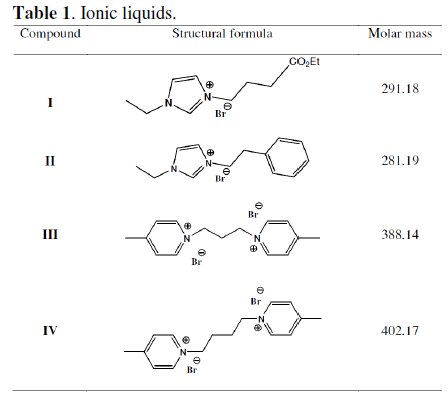
The objective of the present work was to study the applicability of four ILs 
namely: 3-(4-ethoxy-4-oxobutyl)-1-ethylimidazol-3-ium bromide (I) and 1-ethyl3-
phenethylimidazol-3-ium bromide (II), 1,1'-(propane-1,3-diyl)bis(4-methylpyridinium)
dibromide (III), and 1,1'-(butane-1,4-diyl)bis(4-methylpyridinium) 
dibromide (IV), as corrosion inhibitors for carbon steel in 1.0 M HCl (Table 1). It 
is also aimed to predict the thermodynamic feasibility of adsorption of the ILs 
inhibitor molecules on steel surface and to study their adsorption behavior.</p>


    <p>&nbsp;</p>
<img src="/img/revistas/pea/v29n6/29n6a01t1.jpg">
    
<p>&nbsp;</p>


    <p>&nbsp;</p>
    ]]></body>
<body><![CDATA[<p><b>Experimental methods</b></p>

    <p><b><i>Chemical synthesis</i></b></p>

    <p><i>Materials</i></p>

    <p>The reagents: imidazole (99%), ethyl 4-bromo butyrate (96%), (2bromoethyl)
benzene, 4-picoline, 1,3-dibromopropane and 1,4-dibromobutane 
were purchased from Aldrich and used as received. All solvents were of HPLC grade.</p> 

    <p>&nbsp;</p>
    <p><i>Measurements and equipments</i></p>

    <p>All new compounds were synthesized and characterized by <sup>1</sup>H NMR and <sup>13</sup>C 
NMR spectroscopies. <sup>1</sup>H NMR (400 MHz) and <sup>13</sup>C NMR (100 MHz) spectra 
were obtained in DMSO at room temperature. Chemical shifts (d) were reported 
in ppm to a scale calibrated for tetramethylsilane (TMS), which is used as an 
internal standard. The LCMS spectra were measured with a Micromass, LCT 
mass spectrometer. The microwave-assisted reactions were performed using a 
controllable single-mode microwave reactor, CEM Discovery, designed for 
synthetic use. The reactor is equipped with a magnetic stirrer as well as a 
pressure, temperature and power controls. The maximum operating pressure of 
the reactor is 20 bar. The power and temperature range are 15-300 W and 60-250 &deg;C, respectively.</p>

    <p>&nbsp;</p>
    <p><i>Microwave assisted synthesis of imidazolium ionic liquids</i></p> 

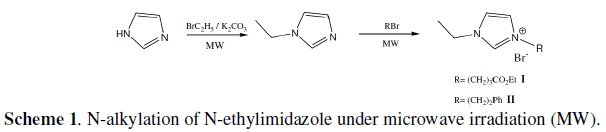
    <p>New environmentally friendly imidazolium-based ionic liquids, I and II, were 
prepared for the first time by using microwave irradiation in short duration of 
time with quantitative yields.</p>


    ]]></body>
<body><![CDATA[<p>&nbsp;</p>
<img src="/img/revistas/pea/v29n6/29n6a01s1.jpg">
    
<p>&nbsp;</p>


    <p><u>3-(4-ethoxy-4-oxobutyl)-1-ethylimidazol-3-ium bromide (I)</u></p>

    <p>N-ethylimidazole (1 g, 0.0104 mol) and ethyl 4-bromobutyrate (2.03 g, 0.0104 
mol) and 10 mL of toluene were placed in a microwave reactor vessel and 
irradiated for 20 minutes at 100 &deg;C. The crude product was washed a few times 
with dry ethyl acetate and dried overnight in a vacuum at 70 &deg;C. The yield of I 
was 92%. The product was analyzed with <sup>1</sup>H NMR, <sup>13</sup>C NMR and LCMS. <sup>1</sup>H 
NMR (400MHz, DMSO) &delta;: 1.13 (t, J = 7.1, 3H), 1.41 (t, J = 7.3, 3H), 2.05 
(quint, J = 7.2, 2H), 2.35 (t, J = 7.5, 2H), 4,00 (q, J = 7.1, 2H), 4.24 (q, J = 7.3, 
2H), 4.28 (t, J = 6.8, 2H), 7.93-7.94 (d, J = 1.2 1H), 7.95-7.96 (d, J = 1.2 1H), 
9.57 (s, 1H); <sup>13</sup>C NMR (100MHz, DMSO) &delta;: 14.0 (CH3), 15.0 (CH3), 24.9 
(CH2), 30.1 (CH2), 44.1 (CH2), 47.9 (CH2), 59.9 (CH2), 122.1 (CH), 122.3 
(CH), 135.9 (CH), 171.8 (C); LCMS: m/z 211 (M+).</p>


    <p>&nbsp;</p>
    <p><u>1-ethyl-3-phenethylimidazol-3-ium bromide (II)</u></p>

    <p>N-ethylimidazole (1 g, 0.0104 mol), (2-bromoethyl) benzene (1.92 g, 0.0104 
mol) and 10 mL of toluene were placed in a microwave reactor vessel and 
irradiated for 20 minutes at 100 &deg;C. The crude product was washed a few times 
with dry ethyl acetate and dried overnight in a vacuum at 70 &deg;C. The yield of II 
was 91%. The product was analyzed with <sup>1</sup>H NMR, <sup>13</sup>C NMR and LCMS.<sup>1</sup>H 
NMR (400MHz, DMSO) &delta;: 1.37 (t, J = 7.3, 3H), 3.17 (t, J = 7.2, 2H), 4.19 (q, J 
= 7.4, 2H), 4.48 (t, J = 7.4, 2H), 7.18-7.34 (m, 5H), 7.85-7.86 (m, 1H), 7.86-7.87 
(m, 1H), 9.33 (s, 1H); <sup>13</sup>C NMR (100MHz, DMSO) &delta;: 15.2 (CH3), 35.6 (CH2), 
44.1 (CH2), 49.8 (CH2), 122.0 (CH), 122.4 (CH), 126.8 (CH), 128.5(CH), 
128.7(CH), 135.7(CH), 136.9 (C); LCMS: m/z 201 (M+).</p>

    <p>&nbsp;</p>
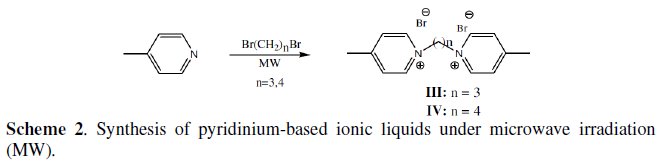
    <p><i>Microwave assisted synthesis of pyridinium ionic liquids</i></p>

    <p>Although compounds III and IV have been previously reported by conventional 
methods [23], their preparation under microwave irradiation has never been disclosed.</p>


    ]]></body>
<body><![CDATA[<p>&nbsp;</p>
<img src="/img/revistas/pea/v29n6/29n6a01s2.jpg">
    
<p>&nbsp;</p>


    <p>&nbsp;</p>
    <p><u>1,1'-(propane-1,3-diyl)bis(4-methylpyridinium)dibromide (III)</u></p>

    <p>4-picoline (2 g, 0.0215 mol), 1,3-dibromopropane (2.1 g, 0.0107 mol) and 10 mL 
of toluene were placed in a microwave reactor vessel and irradiated for 20 
minutes at 100 &deg;C. The crude product was washed a few times with dry ethyl 
acetate and dried overnight in a vacuum at 70 &deg;C. The yield of III was 90%. The 
product was analyzed with <sup>1</sup>H NMR, <sup>13</sup>C NMR and LCMS. <sup>1</sup>H NMR (400MHz, 
DMSO) &delta;: 2.6 (s, 6H), 2.65 (quint, J = 7.3, 2H), 4.73 (t, J = 7.5, 4H), 8.03 (d, J = 
6.6 4H), 9.05 (d, J = 6.6 4H); <sup>13</sup>C NMR (100MHz, DMSO) &delta;: 21.4 (CH3), 31.7 
(CH2), 56.6 (CH2), 128.4 (CH), 143.9 (CH), 159.1 (C).</p>


    <p>&nbsp;</p>
    <p><u>1,1'-(butane-1,3-diyl)bis(4-methylpyridinium)dibromide (IV)</u></p>

    <p>4-picoline (2 g, 0.0215 mol), 1,4-dibromopropane (2.31 g, 0.0107 mol) and 10 
mL of toluene were placed in a microwave reactor vessel and irradiated for 20 
minutes at 100 &deg;C. The crude product was washed a few times with dry ethyl 
acetate and dried overnight in a vacuum at 70 &deg;C. The yield of IV was 92%. The 
product was analyzed with <sup>1</sup>H NMR, <sup>13</sup>C NMR and LCMS. <sup>1</sup>H NMR (400MHz, 
DMSO) &delta;: 1.92 (m, 4H), 2.59 (s, 6H), 4.58 (m, 4H), 7.95 (d, J = 6.8 4H), 8.88 (d, 
J = 6.8 4H); <sup>13</sup>C NMR (100MHz, DMSO) &delta;: 21.6 (CH3), 27.3 (CH2), 59.4 (CH2), 
128.7 (CH), 143.8 (CH), 159.3 (C).</p>


    <p>&nbsp;</p>
    <p><b><i>Electrochemical tests</i></b></p>

    ]]></body>
<body><![CDATA[<p>For the weight loss measurements, carbon steel sheets of 4 cm 2 size, and of 
chemical composition (wt%): C = 0.15%, Mn = 0.45%, Si = 0.10, S= 0.05%, P% 
= 0.03% and the reminder Fe, were used. The samples were abraded with a series 
of emery papers, from a coarse grade 500 and proceeding in steps to fine grade 
1500, washed thoroughly with doubly distilled water. The cleaned samples were 
weighed before and after immersion in 1.0 M HCl for 4 hours in the absence and 
presence of various concentrations of the four ILs inhibitors.</p>

    <p>The potentiodynamic polarization experiments were carried out in a conventional 
three-electrode electrochemical cell. A carbon steel cylinder pressed into a 
Teflon holder acted as a working electrode (WE). Its working area of 0.5 cm<sup>2</sup> 
remained precisely fixed. A saturated calomel electrode (SCE) connected 
through a salt bridge was used as a reference electrode, while a platinum wire 
was used as a counter electrode. The electrode was abraded similar to that mentioned above.</p>

    <p>Electrochemical measurements were performed using a potentiostat/galvanostat 
SI 1287 Solartron, software packages CorrWare 2, and CorrView 2 provided by 
Solartron were used to obtain the polarization curves.</p>

    <p>The polarization curves were recorded by changing the electrode potential 
automatically from ca. -0.95 V to -0.75 V with a scan rate of 20 mVs<sup>-1</sup> . From 
polarization curves measured using only the range &pm; 10 mV before and after E<sub>corr</sub>, 
with scan rate of 1.0 mV s<sup>-1</sup>, the polarization resistance R<sub>p</sub> was evaluated. All of 
the experiments were triplicate to ensure reproducibility.</p>


    <p>&nbsp;</p>
    <p><b>Results and discussion</b></p> 

    <p><b><i>Weight loss studies</i></b></p>

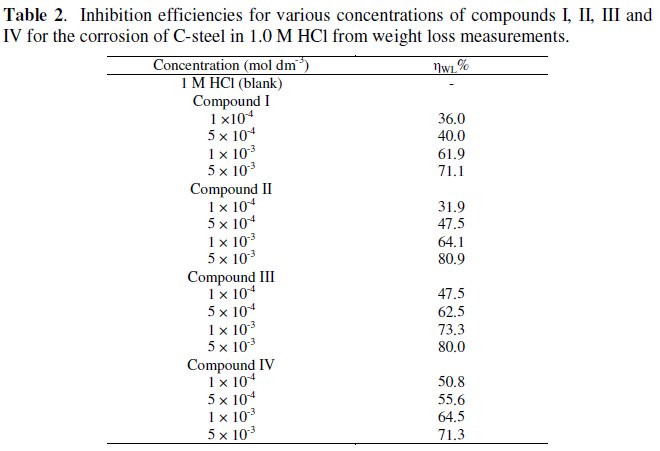
    <p>The weight loss of steel in 1.0 M HCl in the absence and presence of various 
concentrations (1 x 10<sup>-4</sup> - 5 x 10<sup>-3</sup> M) of the four ILs were obtained after 4 h of 
immersion at 25 &deg;C. Eq. (1) determines the inhibition efficiency:</p>

    <p>&nbsp;</p>
<img src="/img/revistas/pea/v29n6/29n6a01e1.jpg">
    
<p>&nbsp;</p>

    ]]></body>
<body><![CDATA[<p>where W and W<sub>inh</sub> are the weight loss of steel in the absence and presence of the 
inhibitors, respectively. The results of the four tested ILs compounds in Table 2 
showed that the &eta;<sub>WL</sub>% increases with increase in the concentration of the 
inhibitors. Based on the maximum inhibition efficiency, the inhibitors can be 
ranked as follows: II > III > I > IV.</p>

    <p>&nbsp;</p>
<img src="/img/revistas/pea/v29n6/29n6a01t2.jpg">
    
<p>&nbsp;</p>


    <p><b><i>Potentiodynamic polarization curves</i></b></p>

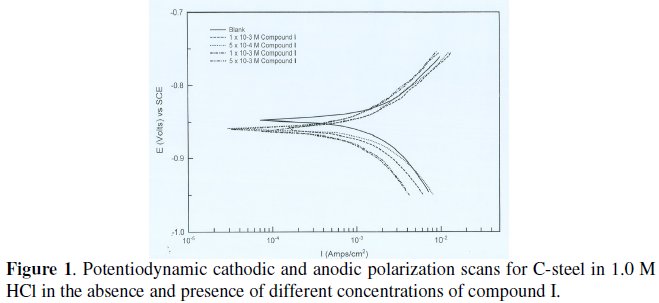
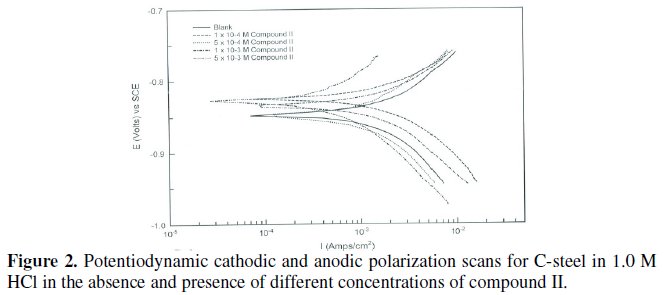
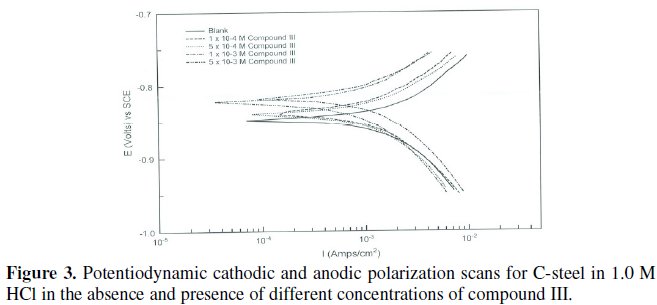
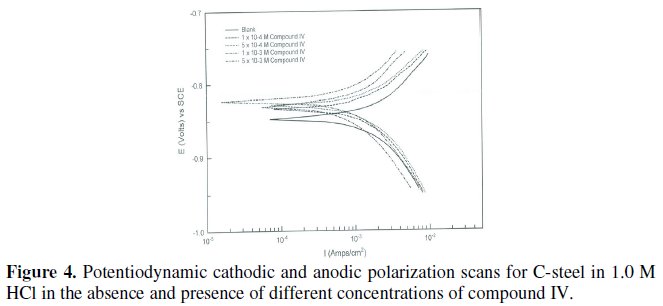
    <p>Tafel plots for steel in 1.0 M HCl solution with and without various 
concentrations of the four ILs are shown in Figs. 1-4.</p>


    <p>&nbsp; <a name="top.f1"></a> </p>
<img src="/img/revistas/pea/v29n6/29n6a01f1.jpg">
    
<p>&nbsp; <a name="top.f2"></a> </p>
<img src="/img/revistas/pea/v29n6/29n6a01f2.jpg">
    
<p>&nbsp; <a name="top.f3"></a> </p>
<img src="/img/revistas/pea/v29n6/29n6a01f3.jpg">
    
<p>&nbsp; <a name="top.f4"></a> </p>
<img src="/img/revistas/pea/v29n6/29n6a01f4.jpg">
    
<p>&nbsp;</p>


    ]]></body>
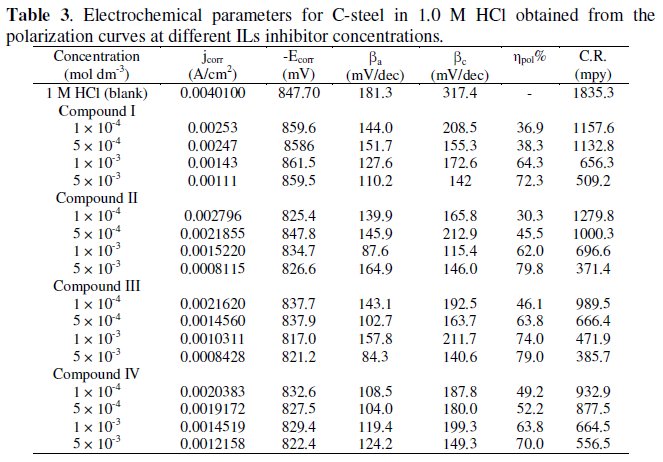
<body><![CDATA[<p>Various kinetic data and 
corrosion parameters such as corrosion potential (E<sub>corr</sub>), corrosion current density 
(j<sub>corr</sub>), cathodic and anodic Tafel slopes (bc, ba), corrosion rate (CR) in mpy and 
the inhibition efficiency (&eta;<sub>pol</sub>%) are listed and summarized in Table 3.</p>

    <p>&nbsp;</p>
<img src="/img/revistas/pea/v29n6/29n6a01t3.jpg">
    
<p>&nbsp;</p>

    <p>Corrosion current densities were obtained by linear extrapolation of the anodic and cathodic 
branches of the Tafel plots to the corrosion potential. The corrosion rate is 
determined in mils per year (mpy) using: CR = 0.129 a j/ n D [24], where CR is 
the corrosion rate in mpy, a is the atomic weight of the metal, n is the number of 
electrons in the reduction of the metal ions, D is the density of the metal in 
g/cm<sup>3</sup>, and j is the corrosion current density in &mu;A/cm<sup>2</sup>.</p> 

    <p><a href="#top.f1">Fig. 1</a> represents the influence of various concentrations of compound I on the 
polarization behavior of steel in 1.0 M HCl. In this case, the cathodic branch of 
the polarization curve is more affected by the addition of the inhibitor than the 
anodic branch. In addition, the corrosion potential in solutions containing 
inhibitor is shifted towards more negative values with increase of the inhibitor 
concentrations. This indicates that this compound acts as a mixed type inhibitor 
with predominant cathodic.</p>

    <p><a href="#top.f2">Fig. 2</a> represents the influence of various concentrations of compound II on the 
polarization behavior of steel in 1.0 M HCl. The anodic current decreased with 
increasing the inhibitor concentration and the corrosion potential is shifted to 
more positive potential indicating a mixed type inhibitor with predominant 
anodic.</p>

    <p>According to some researchers [25,26], an inhibitor behaves as anodic or 
cathodic only if displacement due to inhibitor addition is at least of 85 mV with 
respect to E<sub>corr</sub> of the blank solution (absence of the inhibitor). In the present case, 
(compounds I and II) shift were lower than the referenced value, which suggests 
that experimental compounds can be defined only as mixed type inhibitors with 
predominant anodic.</p>

    <p>The inhibition efficiency &eta;<sub>pol</sub>% at different inhibitor concentrations was 
calculated from the following equation:</p>

    <p>&nbsp;</p>
<img src="/img/revistas/pea/v29n6/29n6a01e2.jpg">
    
<p>&nbsp;</p>

    ]]></body>
<body><![CDATA[<p>where j<sub>corr</sub> and j<sup>0</sup><sub>corr</sub> are the current density in the absence and presence of 
inhibitors, respectively. The &eta;<sub>pol</sub>% increases with increasing the concentration of 
the inhibitors. The results suggest the inhibitor molecules are adsorbed at the 
steel/solution interface where the adsorbed molecules partly hinder the active 
sites of the corrodent. The increase in &eta;<sub>pol</sub>% observed at higher inhibitor 
concentration indicates that the adsorption process enhances with increasing 
inhibitor concentration, which leads more inhibitor molecules to adsorb on the 
metal surface, thus resulting large surface coverage.</p>

    <p>Figs. <a href="#top.f3">3</a> and <a href="#top.f4">4</a> represent the influence of adding various concentrations of 
compound III and compound IV, respectively, on the polarization behavior of 
steel in 1.0 M HCl.</p> 

    <p>It is observed that the presence of ionic liquid affected both 
the anodic dissolution of steel and the cathodic hydrogen evolution reaction in 
1.0 M HCl. These compounds decreased the corrosion current density and shifted 
E<sub>corr</sub> towards more noble potential values, indicating that the inhibitors act as 
mixed type.</p>
 
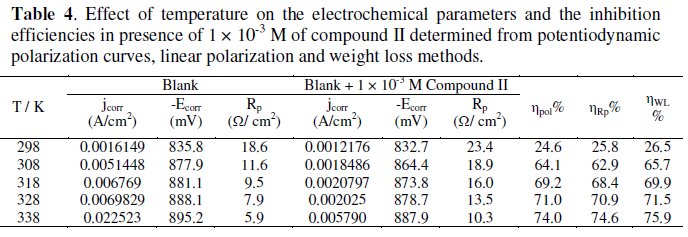
    <p>It is of practical importance to study the inhibitor behavior at higher temperatures 
since the pickling of the steel is run at temperatures up to 60 &deg;C. The effect of 
temperature on the corrosion behavior of steel in presence of 1 &times; 10<sup>-3</sup> M of 
compound II was studied in the temperature range 298-338 K as a representative 
example using the three different techniques. The electrochemical parameters 
again were collected at Table 4.</p>


    <p>&nbsp;</p>
<img src="/img/revistas/pea/v29n6/29n6a01t4.jpg">
    
<p>&nbsp;</p>


    <p>The results showed an increase in the inhibition 
efficiency with raising the solution temperature. This indicates physical 
adsorption of the inhibitors. The inhibition efficiency was found to increase with 
raising the solution temperature. This could be explained by the fact that at high 
temperatures the surface covered by the inhibitor increases and the rate 
determining step of the metal dissolution becomes the diffusion through the film 
of corrosion products and inhibitor. Inspection of the data reveals that an increase 
of temperature shifts the values of E<sub>corr</sub> to more negative potentials. The values of 
j<sub>corr</sub> increase with increasing temperature as a result of the higher dissolution of 
the metal at higher temperatures. The thermodynamic functions for the 
dissolution of steel in 1.0 M HCl in the absence and presence of compound II 
were obtained by applying the Arrhenius equation (3) and transition state 
equation (4), respectively, and the results are given in Table 5:</p>

    <p>&nbsp;</p>
<img src="/img/revistas/pea/v29n6/29n6a01e3.jpg">
    
<p>&nbsp;</p>

    <p>where E<sub>a</sub> is the apparent activation energy, R is the universal gas constant, &lambda; 
is the Arrhenius pre-exponential factor, &Delta;S<sub>a</sub> is the change in entropy of activation, 
&Delta;H<sub>a</sub> is the change in enthalpy of activation, h is Planck's constant and N is the 
Avogadro's number.</p>

    ]]></body>
<body><![CDATA[<p>&nbsp; <a name="top.t5"></a> </p>
<img src="/img/revistas/pea/v29n6/29n6a01t5.jpg">
    
<p>&nbsp;</p>

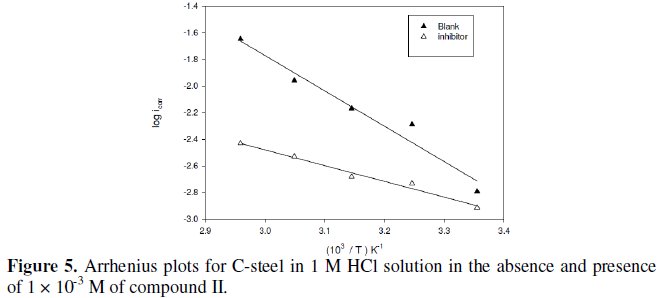
    <p>According to eq. (3), the apparent activation energy E<sub>a</sub> can 
be obtained by plotting log (j<sub>corr</sub>) against 1/T (Fig. 5).


    <p>&nbsp;</p>
<img src="/img/revistas/pea/v29n6/29n6a01f5.jpg">
    
<p>&nbsp;</p>


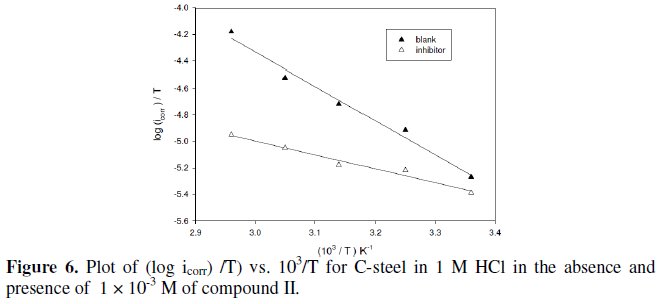
    <p>However, a plot of log (j<sub>corr</sub> /T) against 1/T according to eq. (4) should give straight line with a slope of (-&Delta;H<sub>a</sub> 
/2.303 R) and an intercept of (log R/Nh + &Delta;S<sub>a</sub>/2.303 R), as shown in Fig. 6.


    <p>&nbsp;</p>
<img src="/img/revistas/pea/v29n6/29n6a01f6.jpg">
    
<p>&nbsp;</p>


    <p>The value of the activation energy for the inhibited process is determined at the 
highest concentrations used, in order to assure that the achieved coverage degree 
is close to the maximal value. The activation energy, Ea, in case of steel, was 
found to be 46.9 kJ mol, in absence, and 29.9 kJ mol, in presence, of 
compound II. The value of the activation energy in presence of inhibitor is lower 
than in 1 M HCl. Similar result of decreasing activation energy in presence of 
inhibitors has been previously reported by Popova et al. [27]. The pre-
exponential factor in the Arrhenius equation, l, for heterogeneous reaction, is 
related to the number of active centers [28]. These active centers have different 
energy, if energetic surface heterogeneity is assumed. There are two possibilities: 
in the first case (E<sub>a,inh</sub> is greater than E<sub>a,HCl</sub>) the inhibitor is adsorbed on the most 
active adsorption sites (having the lowest energy) and the corrosion process takes 
place predominantly on the active sites of the higher energy. In the second case 
(E<sub>a,inh</sub> is lower than E<sub>a,HCl</sub>), observed in these experiments, the value of &lambda; 
is lower (&lambda; = 4.46 &times; 10<sup>-3</sup>) than that in pure HCl (&lambda; = 0.0316), i.e., a smaller number of 
more active sites remain uncovered which take part in the corrosion process [29].</p> 

    <p>The entropy of activation &Delta;S<sub>a</sub> in the absence and presence of compound II is 
large and negative (<a href="#top.t5">Table 5</a>). This implies that the activated complex in the rate 
determining step represents an association rather than a dissociation step, 
meaning that a decrease in disordering takes place on going from reactants to the 
activated complex [30]. The value of &Delta;H<sub>a</sub> reflects the strong adsorbabilty of the 
tested compound on the steel surface and indicates the endothermic nature of the 
process.</p>


    ]]></body>
<body><![CDATA[<p>&nbsp;</p>
    <p><b><i>Linear polarization measurements</i></b></p>

    <p>In order to determine the polarization resistance, Rp, the working electrode was 
polarized &pm; 10 mV in the vicinity of the corrosion potential at a scan rate of 1 
mVs<sup>-1</sup>. The polarization resistance values were determined from the slope of the 
current density-potential lines</p>

    <p>&nbsp;</p>
<img src="/img/revistas/pea/v29n6/29n6a01e5.jpg">
    
<p>&nbsp;</p>

    <p>where A is the surface area of the electrode, dE is the change in potential and dj 
is the change in current. The R<sub>p</sub> values were used to calculate the inhibition 
efficiencies, (&eta;Rp %) using the relationship:</p>

    <p>&nbsp;</p>
<img src="/img/revistas/pea/v29n6/29n6a01e6.jpg">
    
<p>&nbsp;</p>

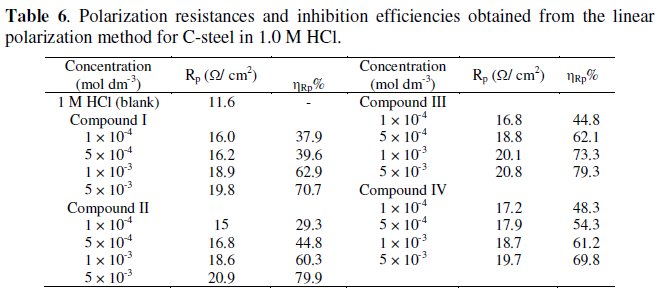
    <p>where R<sub>p</sub> and R<sup>0</sup><sub>p</sub> are the polarization resistance in the absence and presence of 
inhibitors, respectively. From Table 6, it can be seen that by increasing the 
inhibitor concentration, both the polarization resistance and the inhibition 
efficiency increase, indicating adsorption of the inhibitors on the metal surface to 
block the active sites and inhibit corrosion. The inhibition efficiency again is 
seen to decrease in the following order, II > III > I > IV.</p>

    <p>&nbsp;</p>
<img src="/img/revistas/pea/v29n6/29n6a01t6.jpg">
    
]]></body>
<body><![CDATA[<p>&nbsp;</p>

    <p>Obtained results from Tafel polarization, linear polarization and weight loss are 
in good agreement with each other. 


    <p>&nbsp;</p>
    <p><b><i>Adsorption isotherm</i></b></p>

    <p>Basic information dealing with the interaction between the inhibitor molecules 
and the metal surface can be provided by adsorption isotherms [31]. In order to 
get more knowledge about the mode of adsorption of ILs on the surface of the 
steel, the data obtained from the potentiodynamic polarization curves have been 
tested with the well known adsorption isotherms. Data obtained from polarization 
measurements were tested graphically for fitting various isotherms including 
Langmuir, Frumkin and Temkin. Among these isotherms, the best fit was 
obtained with the Langmuir isotherm. According to this isotherm &Theta; 
is related to 
the inhibitor concentration by the following equation: 

    <p>&nbsp;</p>
<img src="/img/revistas/pea/v29n6/29n6a01e7.jpg">
    
<p>&nbsp;</p>

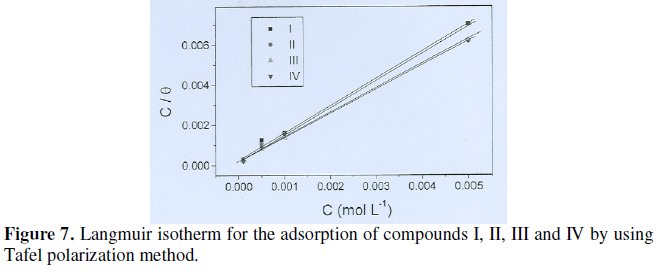
    <p>where c is the inhibitor concentration in mol dm<sup>-3</sup> , &Theta; 
is the degree of surface coverage (&Theta; = &eta; / 100) and Kads is the equilibrium constants of adsorption 
process. It is noted that the straight lines obtained on plotting c /&Theta; 
vs. c, as shown in Fig.7, suggest that the adsorption of the ILs inhibitors on the steel surface in 
HCl solution follows Langmuir's adsorption isotherm. The degree of surface 
coverage was found to increase with increasing the concentration of additive. 
    <p>&nbsp;</p>
<img src="/img/revistas/pea/v29n6/29n6a01f7.jpg">
    
<p>&nbsp;</p>


    ]]></body>
<body><![CDATA[<p>The free energy of adsorption (&Delta;G<sub>ads</sub>) was calculated from the equation [32]:</p>

    <p>&nbsp;</p>
<img src="/img/revistas/pea/v29n6/29n6a01e8.jpg">
    
<p>&nbsp;</p>

    <p>where 55.5 mol dm<sup>-3</sup> is the molar concentration of water in the solution, R is the 
gas constant and T is the absolute temperature. Generally, values of &Delta;G<sub>ads</sub> up to 20 
kJ mol<sup>-1</sup> are consistent with electrostatic interactions between the charged 
molecules and the charged metal (physisorption), while those around -40 kJ mol<sup>-1</sup> 
or higher are associated with chemisorption as a result of sharing or transfer of 
electrons from ILs molecules to the metal surface to form a coordinate type of 
bond (chemisorption) [33]. The absolute values of &Delta;G<sub>ads</sub> calculated in presence of 
the four ILs inhibitors are found to be relatively small (around 30 kJmol<sup>-1</sup>).</p>

    <p>Therefore, the results indicate the inhibitors to be physically adsorbed on the 
surface and their negative sign indicates spontaneous interaction of inhibitor 
molecule with the corroding steel surface [34]. In general, all the inhibitors used 
in this study have two nitrogen atoms in their molecular structure. These two 
nitrogen atoms could be in one ring, e.g., imidazolium compounds (I and II) or in 
two different rings, e.g., pyridinium compounds (compounds III and IV). 
Adsorption can occur through the formation of an iron-nitrogen coordinate bond 
or p-electron interaction between the heterocyclic in their molecules with 
aromatic character and the iron substrate. Adsorption can also occur via 
electrostatic interactions between a negatively charged surface (due to the 
specific adsorption of Br -anion on the steel surface) and the positive charge of 
the cationic molecules. In addition, electrostatic interactions could be achieved 
due to the ionic liquid compounds and the solid surfaces which can play a role in 
the adsorption process. Comparing compounds I and II, the latter is characterized 
by the presence of benzene ring instead of -CH2-COEt group in compound I.</p>

    <p>Therefore, compound II has a higher rate of relaxation of the adsorbed inhibitors 
from the metal surface because of the flat aromatic head groups that can &pi;-back 
bond with Fe<sup>2+</sup>.</p>

    <p>In the case of compounds III and IV, i.e., pyridinium compounds, it was found 
that shorter chain for pyridinium compounds (Compound III) raised values of &Theta; 
and consequently &eta;%. The compound of pyridinium participates in a more 
parallel rather than perpendicular orientation at the surface, due to the presence 
of two flat aromatic head groups that can &pi;-back bond with Fe<sup>2+</sup>. Thus, the 
adsorbed molecule would occupy a larger surface area compared with a 
perpendicular orientation which is the reason for high &eta;% of compound III in 
comparison with compound IV.</p>


    <p>&nbsp;</p>
    <p><b><i>Surface morphology study</i></b></p>

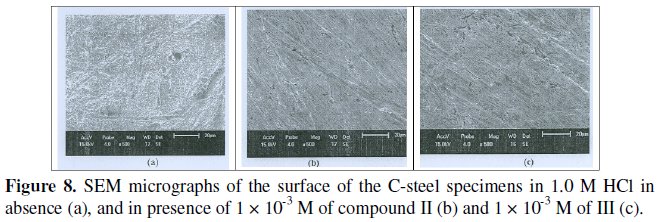
    <p>The surface morphologies of C-steel specimen in 1.0 M HCl solution free or 
containing some of the ILs inhibitors after 4 h immersion were examined using 
scanning electron microscopy (SEM), as displayed in Fig. 8a-c. In the absence of 
inhibitors (Fig. 8a), a very rough surface was observed due to rapid corrosion 
attack of carbon steel by chloride anions. There are a large number of pits 
surrounded by iron oxide layer which almost fully covers the carbon steel 
surface, revealing that pit formation under these conditions occurs continuously 
during the exposure period while iron oxide builds up over the surface. It is 
important to stress out that when ILs inhibitors (II and III) are present in the 
solution (Fg. 8b,c), the morphology of the carbon steel surface is quite different 
from the previous one and the rough surface (amount of the formed iron oxide 
and the number of pits) is visibly reduced, indicating the formation of a 
protective film.</p>

    ]]></body>
<body><![CDATA[<p>&nbsp;</p>
<img src="/img/revistas/pea/v29n6/29n6a01f8.jpg">
    
<p>&nbsp;</p>
    <p></p>


    <p>&nbsp;</p>
    <p><b>Conclusion</b></p>

    <p>From the overall experimental results and discussion the following conclusions 
can be deduced:</p>

    <p>&bull; The four tested ILs behave as inhibitors for the corrosion of the C-steel in 
1 M HCl solution.</p>

    <p>&bull; The inhibition efficiency increased with increasing the inhibitor 
concentration. All of the ILs act as mixed-type inhibitors.</p>

    <p>&bull; The inhibition is due to the adsorption of the inhibitor molecules on the C-
steel surface and the blocking of active sites.</p>

    <p>&bull; Obtained results from Tafel polarization, linear polarization and weight 
loss are in good agreement with each other.</p>

    ]]></body>
<body><![CDATA[<p>&bull; The adsorption of the four ILs inhibitors obeys the Langmuir adsorption isotherm.</p>


    <p>&nbsp;</p>
    <p><b>References</b></p>

    <!-- ref --><p>1. I. Ahamad, C. Gupta, R. Prasad, M.A. Quraishi, J. Appl. Electrochem. 40 (2010) 2171.    &nbsp;&nbsp;&nbsp;&nbsp;&nbsp;&nbsp;&nbsp;&nbsp;[&#160;<a href="javascript:void(0);" onclick="javascript: window.open('/scielo.php?script=sci_nlinks&ref=000146&pid=S0872-1904201100060000100001&lng=','','width=640,height=500,resizable=yes,scrollbars=1,menubar=yes,');">Links</a>&#160;]<!-- end-ref --></p>
    <!-- ref --><p>2. F. El-Taib Heakal, A.S. Fouda and M.S. Radwan, Mater. Chem. Phys. 125 (2011) 26.    &nbsp;&nbsp;&nbsp;&nbsp;&nbsp;&nbsp;&nbsp;&nbsp;[&#160;<a href="javascript:void(0);" onclick="javascript: window.open('/scielo.php?script=sci_nlinks&ref=000148&pid=S0872-1904201100060000100002&lng=','','width=640,height=500,resizable=yes,scrollbars=1,menubar=yes,');">Links</a>&#160;]<!-- end-ref --></p>
    <!-- ref --><p>3. B. Mernari, H. Elattari, M. Traisnel et all, Corrosion 40 (1998) 391.    &nbsp;&nbsp;&nbsp;&nbsp;&nbsp;&nbsp;&nbsp;&nbsp;[&#160;<a href="javascript:void(0);" onclick="javascript: window.open('/scielo.php?script=sci_nlinks&ref=000150&pid=S0872-1904201100060000100003&lng=','','width=640,height=500,resizable=yes,scrollbars=1,menubar=yes,');">Links</a>&#160;]<!-- end-ref --></p>
    <p>4. S.S. Abd El Rehim, Magdy A.M. Ibrahim, K.F. Khaled, Mater. Chem. Phys. 70 (2001) 268.</p>
    ]]></body>
<body><![CDATA[<p>5. M.M. Hamza, S.S. Abd El Rehim and M.A.M. Ibrahim, Arab. J. Chem. (in press).</p>
    <p>6. S.S. Abd El Rehim, Magdy A.M. Ibrahim and K.F. Khaled, J. Appl. Electrochem. 29 (1999) 593.</p>
    <!-- ref --><p>7. K.F. Khaled, A.El-mghraby, O.B. Ibrahim et all, J. Mater. Environ. Sci. 1(3) (2010) 139.    &nbsp;&nbsp;&nbsp;&nbsp;&nbsp;&nbsp;&nbsp;&nbsp;[&#160;<a href="javascript:void(0);" onclick="javascript: window.open('/scielo.php?script=sci_nlinks&ref=000155&pid=S0872-1904201100060000100007&lng=','','width=640,height=500,resizable=yes,scrollbars=1,menubar=yes,');">Links</a>&#160;]<!-- end-ref --></p>
    <!-- ref --><p>8. I. Sekine, Y. Nakata, H. Tanabe, Corros. Sci. 28 (1988) 987.    &nbsp;&nbsp;&nbsp;&nbsp;&nbsp;&nbsp;&nbsp;&nbsp;[&#160;<a href="javascript:void(0);" onclick="javascript: window.open('/scielo.php?script=sci_nlinks&ref=000157&pid=S0872-1904201100060000100008&lng=','','width=640,height=500,resizable=yes,scrollbars=1,menubar=yes,');">Links</a>&#160;]<!-- end-ref --></p>
    <!-- ref --><p>9. A. Popova, M. Christov, S. Raicheva, E. Sokolova, Corros. Sci. 46 (2004) 1333.    &nbsp;&nbsp;&nbsp;&nbsp;&nbsp;&nbsp;&nbsp;&nbsp;[&#160;<a href="javascript:void(0);" onclick="javascript: window.open('/scielo.php?script=sci_nlinks&ref=000159&pid=S0872-1904201100060000100009&lng=','','width=640,height=500,resizable=yes,scrollbars=1,menubar=yes,');">Links</a>&#160;]<!-- end-ref --></p>
    <!-- ref --><p>10. A. Popova, M. Christov, T. Deligeorgiev, Corrosion 59 (2003) 756.    &nbsp;&nbsp;&nbsp;&nbsp;&nbsp;&nbsp;&nbsp;&nbsp;[&#160;<a href="javascript:void(0);" onclick="javascript: window.open('/scielo.php?script=sci_nlinks&ref=000161&pid=S0872-1904201100060000100010&lng=','','width=640,height=500,resizable=yes,scrollbars=1,menubar=yes,');">Links</a>&#160;]<!-- end-ref --> 
    ]]></body>
<body><![CDATA[<!-- ref --><p>11. A. Popova, E. Sokolova, S. Raicheva, M. Christov, Corros. Sci. 45 (2003) 33.    &nbsp;&nbsp;&nbsp;&nbsp;&nbsp;&nbsp;&nbsp;&nbsp;[&#160;<a href="javascript:void(0);" onclick="javascript: window.open('/scielo.php?script=sci_nlinks&ref=000163&pid=S0872-1904201100060000100011&lng=','','width=640,height=500,resizable=yes,scrollbars=1,menubar=yes,');">Links</a>&#160;]<!-- end-ref --></p>
    <!-- ref --><p>12. A. Popova, M. Christov, Corros. Sci. 48 (2006) 3208.    &nbsp;&nbsp;&nbsp;&nbsp;&nbsp;&nbsp;&nbsp;&nbsp;[&#160;<a href="javascript:void(0);" onclick="javascript: window.open('/scielo.php?script=sci_nlinks&ref=000165&pid=S0872-1904201100060000100012&lng=','','width=640,height=500,resizable=yes,scrollbars=1,menubar=yes,');">Links</a>&#160;]<!-- end-ref --></p>
    <!-- ref --><p>13. T. Tsuda, C.L. Hussey, Interface 16 (2007) 42.    &nbsp;&nbsp;&nbsp;&nbsp;&nbsp;&nbsp;&nbsp;&nbsp;[&#160;<a href="javascript:void(0);" onclick="javascript: window.open('/scielo.php?script=sci_nlinks&ref=000167&pid=S0872-1904201100060000100013&lng=','','width=640,height=500,resizable=yes,scrollbars=1,menubar=yes,');">Links</a>&#160;]<!-- end-ref --></p>
    <!-- ref --><p>14. S. Zhang, N. Sun, X. He et all, J. Phys. Chem. Ref. Data 35 (2006) 4.    &nbsp;&nbsp;&nbsp;&nbsp;&nbsp;&nbsp;&nbsp;&nbsp;[&#160;<a href="javascript:void(0);" onclick="javascript: window.open('/scielo.php?script=sci_nlinks&ref=000169&pid=S0872-1904201100060000100014&lng=','','width=640,height=500,resizable=yes,scrollbars=1,menubar=yes,');">Links</a>&#160;]<!-- end-ref --></p>
    <!-- ref --><p>15. H. Zhao, Chem. Eng. Comm. 193 (2006) 1660.    &nbsp;&nbsp;&nbsp;&nbsp;&nbsp;&nbsp;&nbsp;&nbsp;[&#160;<a href="javascript:void(0);" onclick="javascript: window.open('/scielo.php?script=sci_nlinks&ref=000171&pid=S0872-1904201100060000100015&lng=','','width=640,height=500,resizable=yes,scrollbars=1,menubar=yes,');">Links</a>&#160;]<!-- end-ref --></p>
    ]]></body>
<body><![CDATA[<!-- ref --><p>16. H. Ashassi-Sorkhabi, M. Es'haghi, Mater. Chem. Phys. 114 (2009) 267.    &nbsp;&nbsp;&nbsp;&nbsp;&nbsp;&nbsp;&nbsp;&nbsp;[&#160;<a href="javascript:void(0);" onclick="javascript: window.open('/scielo.php?script=sci_nlinks&ref=000173&pid=S0872-1904201100060000100016&lng=','','width=640,height=500,resizable=yes,scrollbars=1,menubar=yes,');">Links</a>&#160;]<!-- end-ref --></p>
    <!-- ref --><p>17. N.V. Likhanova, M.A. Dominguez-Aguilar, O. Olivares-Xometl et all, Corros. Sci. 52 (2010) 2088.    &nbsp;&nbsp;&nbsp;&nbsp;&nbsp;&nbsp;&nbsp;&nbsp;[&#160;<a href="javascript:void(0);" onclick="javascript: window.open('/scielo.php?script=sci_nlinks&ref=000175&pid=S0872-1904201100060000100017&lng=','','width=640,height=500,resizable=yes,scrollbars=1,menubar=yes,');">Links</a>&#160;]<!-- end-ref --></p>
    <!-- ref --><p>18. Q.B. Zhang, Y. X. Hua, Electrochim Acta 54 (2009) 1881.    &nbsp;&nbsp;&nbsp;&nbsp;&nbsp;&nbsp;&nbsp;&nbsp;[&#160;<a href="javascript:void(0);" onclick="javascript: window.open('/scielo.php?script=sci_nlinks&ref=000177&pid=S0872-1904201100060000100018&lng=','','width=640,height=500,resizable=yes,scrollbars=1,menubar=yes,');">Links</a>&#160;]<!-- end-ref --></p>
    <!-- ref --><p>19. R. Gasparac, C.R. Martin, E. Stupnisek-lisek, J. Electrochem. Soc. 147 (2000) 548.    &nbsp;&nbsp;&nbsp;&nbsp;&nbsp;&nbsp;&nbsp;&nbsp;[&#160;<a href="javascript:void(0);" onclick="javascript: window.open('/scielo.php?script=sci_nlinks&ref=000179&pid=S0872-1904201100060000100019&lng=','','width=640,height=500,resizable=yes,scrollbars=1,menubar=yes,');">Links</a>&#160;]<!-- end-ref --></p>
    <!-- ref --><p>20. S. Muralidharan, S.V.K. Lyer, Anti-Corros. Methods Mater. 44 (1997) 100.    &nbsp;&nbsp;&nbsp;&nbsp;&nbsp;&nbsp;&nbsp;&nbsp;[&#160;<a href="javascript:void(0);" onclick="javascript: window.open('/scielo.php?script=sci_nlinks&ref=000181&pid=S0872-1904201100060000100020&lng=','','width=640,height=500,resizable=yes,scrollbars=1,menubar=yes,');">Links</a>&#160;]<!-- end-ref --></p>
    ]]></body>
<body><![CDATA[<!-- ref --><p>21. M.E. Palomar, C.O. Olivares-Xometl, N.V. Likhanova, J.B. Perez-Navarrete, J. Surfact. Deterg. 14 (2011) 211.    &nbsp;&nbsp;&nbsp;&nbsp;&nbsp;&nbsp;&nbsp;&nbsp;[&#160;<a href="javascript:void(0);" onclick="javascript: window.open('/scielo.php?script=sci_nlinks&ref=000183&pid=S0872-1904201100060000100021&lng=','','width=640,height=500,resizable=yes,scrollbars=1,menubar=yes,');">Links</a>&#160;]<!-- end-ref --></p>
    <!-- ref --><p>22. M.A. Quraishi, M.Z.A. Rafique, S. Khan, N. Saxena, J. Appl Electrochem. 37 (2007) 1153.    &nbsp;&nbsp;&nbsp;&nbsp;&nbsp;&nbsp;&nbsp;&nbsp;[&#160;<a href="javascript:void(0);" onclick="javascript: window.open('/scielo.php?script=sci_nlinks&ref=000185&pid=S0872-1904201100060000100022&lng=','','width=640,height=500,resizable=yes,scrollbars=1,menubar=yes,');">Links</a>&#160;]<!-- end-ref --></p>
    <!-- ref --><p>23. J. Beata, K. Janina, P. Jerzy, Dyes and Pigments 73(3) (2006) 361.    &nbsp;&nbsp;&nbsp;&nbsp;&nbsp;&nbsp;&nbsp;&nbsp;[&#160;<a href="javascript:void(0);" onclick="javascript: window.open('/scielo.php?script=sci_nlinks&ref=000187&pid=S0872-1904201100060000100023&lng=','','width=640,height=500,resizable=yes,scrollbars=1,menubar=yes,');">Links</a>&#160;]<!-- end-ref --></p>
    <!-- ref --><p>24. Sk.A. Ali, M.T. Saeed, S.U. Rahman, Corros. Sci. 45 (2003) 253.    &nbsp;&nbsp;&nbsp;&nbsp;&nbsp;&nbsp;&nbsp;&nbsp;[&#160;<a href="javascript:void(0);" onclick="javascript: window.open('/scielo.php?script=sci_nlinks&ref=000189&pid=S0872-1904201100060000100024&lng=','','width=640,height=500,resizable=yes,scrollbars=1,menubar=yes,');">Links</a>&#160;]<!-- end-ref --></p>
    <!-- ref --><p>25. M.M. Saleh, A.A. Atia, J. Appl. Electrochem. 36 (2006) 899.    &nbsp;&nbsp;&nbsp;&nbsp;&nbsp;&nbsp;&nbsp;&nbsp;[&#160;<a href="javascript:void(0);" onclick="javascript: window.open('/scielo.php?script=sci_nlinks&ref=000191&pid=S0872-1904201100060000100025&lng=','','width=640,height=500,resizable=yes,scrollbars=1,menubar=yes,');">Links</a>&#160;]<!-- end-ref --></p>
    ]]></body>
<body><![CDATA[<!-- ref --><p>26. E.S. Ferreira, C. Giacomelli, F.C. Giacomelli, A. Spinelli, Mater. Chem. Phys. 83 (2004) 129.    &nbsp;&nbsp;&nbsp;&nbsp;&nbsp;&nbsp;&nbsp;&nbsp;[&#160;<a href="javascript:void(0);" onclick="javascript: window.open('/scielo.php?script=sci_nlinks&ref=000193&pid=S0872-1904201100060000100026&lng=','','width=640,height=500,resizable=yes,scrollbars=1,menubar=yes,');">Links</a>&#160;]<!-- end-ref --></p>
    <!-- ref --><p>27. A. Popova, M. Christov, Corros. Sci. 48 (2006) 3208.    &nbsp;&nbsp;&nbsp;&nbsp;&nbsp;&nbsp;&nbsp;&nbsp;[&#160;<a href="javascript:void(0);" onclick="javascript: window.open('/scielo.php?script=sci_nlinks&ref=000195&pid=S0872-1904201100060000100027&lng=','','width=640,height=500,resizable=yes,scrollbars=1,menubar=yes,');">Links</a>&#160;]<!-- end-ref --></p>
    <!-- ref --><p>28. P.W. Atkins, Physical Chemistry, Mir, Moscow, 1980.    &nbsp;&nbsp;&nbsp;&nbsp;&nbsp;&nbsp;&nbsp;&nbsp;[&#160;<a href="javascript:void(0);" onclick="javascript: window.open('/scielo.php?script=sci_nlinks&ref=000197&pid=S0872-1904201100060000100028&lng=','','width=640,height=500,resizable=yes,scrollbars=1,menubar=yes,');">Links</a>&#160;]<!-- end-ref --></p>
    <!-- ref --><p>29. A. Popova, M. Christov, A. Vasilev, Corros. Sci. 49 (2007) 3276.    &nbsp;&nbsp;&nbsp;&nbsp;&nbsp;&nbsp;&nbsp;&nbsp;[&#160;<a href="javascript:void(0);" onclick="javascript: window.open('/scielo.php?script=sci_nlinks&ref=000199&pid=S0872-1904201100060000100029&lng=','','width=640,height=500,resizable=yes,scrollbars=1,menubar=yes,');">Links</a>&#160;]<!-- end-ref --></p>
    <!-- ref --><p>30. M.K. Gomma, M.H. Wahdan, Mater. Chem. Phys. 39 (1995) 209.    &nbsp;&nbsp;&nbsp;&nbsp;&nbsp;&nbsp;&nbsp;&nbsp;[&#160;<a href="javascript:void(0);" onclick="javascript: window.open('/scielo.php?script=sci_nlinks&ref=000201&pid=S0872-1904201100060000100030&lng=','','width=640,height=500,resizable=yes,scrollbars=1,menubar=yes,');">Links</a>&#160;]<!-- end-ref --></p>
    ]]></body>
<body><![CDATA[<!-- ref --><p>31. E. McCafferty, in: H. Leidheister Jr. (Ed.), Corrosion Control by Coating, Science Press, Princeton, 1979, p. 279.    &nbsp;&nbsp;&nbsp;&nbsp;&nbsp;&nbsp;&nbsp;&nbsp;[&#160;<a href="javascript:void(0);" onclick="javascript: window.open('/scielo.php?script=sci_nlinks&ref=000203&pid=S0872-1904201100060000100031&lng=','','width=640,height=500,resizable=yes,scrollbars=1,menubar=yes,');">Links</a>&#160;]<!-- end-ref --></p>
    <!-- ref --><p>32. J.M. Cases, F. Villieras, Langmuir 8 (1992) 1251.    &nbsp;&nbsp;&nbsp;&nbsp;&nbsp;&nbsp;&nbsp;&nbsp;[&#160;<a href="javascript:void(0);" onclick="javascript: window.open('/scielo.php?script=sci_nlinks&ref=000205&pid=S0872-1904201100060000100032&lng=','','width=640,height=500,resizable=yes,scrollbars=1,menubar=yes,');">Links</a>&#160;]<!-- end-ref --></p>
    <!-- ref --><p>33. S.A. Umoren, E.E. Ebenso, Mater. Chem. Phys. 106 (2007) 393.    &nbsp;&nbsp;&nbsp;&nbsp;&nbsp;&nbsp;&nbsp;&nbsp;[&#160;<a href="javascript:void(0);" onclick="javascript: window.open('/scielo.php?script=sci_nlinks&ref=000207&pid=S0872-1904201100060000100033&lng=','','width=640,height=500,resizable=yes,scrollbars=1,menubar=yes,');">Links</a>&#160;]<!-- end-ref --></p>
    <!-- ref --><p>34. M. Abdullah, Corros. Sci. 44 (2002) 717.    &nbsp;&nbsp;&nbsp;&nbsp;&nbsp;&nbsp;&nbsp;&nbsp;[&#160;<a href="javascript:void(0);" onclick="javascript: window.open('/scielo.php?script=sci_nlinks&ref=000209&pid=S0872-1904201100060000100034&lng=','','width=640,height=500,resizable=yes,scrollbars=1,menubar=yes,');">Links</a>&#160;]<!-- end-ref --></p>


    <p>&nbsp;</p>
    <p><b>Acknowledgements</b></p>

    ]]></body>
<body><![CDATA[<p>The authors gratefully acknowledge the financial support from Taibah University (Grant 430/417).</p>


    <p><a name=0></a><sup><a href="#top">*</a></sup> Corresponding author. E-mail address: <a href="mailto:imagdy1963@hotmail.com">imagdy1963@hotmail.com</a></p>

    <p>Received 11 April 2011; accepted 25 November 2011</p>

    <p><a href="http://www.peacta.org" target="_blank">www.peacta.org</a> </p>


     ]]></body><back>
<ref-list>
<ref id="B1">
<label>1</label><nlm-citation citation-type="journal">
<person-group person-group-type="author">
<name>
<surname><![CDATA[Ahamad]]></surname>
<given-names><![CDATA[I.]]></given-names>
</name>
<name>
<surname><![CDATA[Gupta]]></surname>
<given-names><![CDATA[C.]]></given-names>
</name>
<name>
<surname><![CDATA[Prasad]]></surname>
<given-names><![CDATA[R.]]></given-names>
</name>
<name>
<surname><![CDATA[Quraishi]]></surname>
<given-names><![CDATA[M.A.]]></given-names>
</name>
</person-group>
<source><![CDATA[J. Appl. Electrochem.]]></source>
<year>2010</year>
<volume>40</volume>
<page-range>2171</page-range></nlm-citation>
</ref>
<ref id="B2">
<label>2</label><nlm-citation citation-type="journal">
<person-group person-group-type="author">
<name>
<surname><![CDATA[El-Taib Heakal]]></surname>
<given-names><![CDATA[F.]]></given-names>
</name>
<name>
<surname><![CDATA[Fouda]]></surname>
<given-names><![CDATA[A.S.]]></given-names>
</name>
<name>
<surname><![CDATA[Radwan]]></surname>
<given-names><![CDATA[M.S.]]></given-names>
</name>
</person-group>
<source><![CDATA[Mater. Chem. Phys.]]></source>
<year>2011</year>
<volume>125</volume>
<page-range>26</page-range></nlm-citation>
</ref>
<ref id="B3">
<label>3</label><nlm-citation citation-type="journal">
<person-group person-group-type="author">
<name>
<surname><![CDATA[Mernari]]></surname>
<given-names><![CDATA[B.]]></given-names>
</name>
<name>
<surname><![CDATA[Elattari]]></surname>
<given-names><![CDATA[H.]]></given-names>
</name>
<name>
<surname><![CDATA[Traisnel]]></surname>
<given-names><![CDATA[M.]]></given-names>
</name>
</person-group>
<source><![CDATA[Corrosion]]></source>
<year>1998</year>
<volume>40</volume>
<page-range>391</page-range></nlm-citation>
</ref>
<ref id="B4">
<label>4</label><nlm-citation citation-type="journal">
<person-group person-group-type="author">
<name>
<surname><![CDATA[Abd El Rehim]]></surname>
<given-names><![CDATA[S.S.]]></given-names>
</name>
<name>
<surname><![CDATA[Ibrahim]]></surname>
<given-names><![CDATA[M.A.M.]]></given-names>
</name>
<name>
<surname><![CDATA[Khaled]]></surname>
<given-names><![CDATA[K.F.]]></given-names>
</name>
</person-group>
<source><![CDATA[Mater. Chem. Phys.]]></source>
<year>2001</year>
<volume>70</volume>
<page-range>268</page-range></nlm-citation>
</ref>
<ref id="B5">
<label>5</label><nlm-citation citation-type="journal">
<person-group person-group-type="author">
<name>
<surname><![CDATA[Hamza]]></surname>
<given-names><![CDATA[M.M.]]></given-names>
</name>
<name>
<surname><![CDATA[Abd El Rehim]]></surname>
<given-names><![CDATA[S.S.]]></given-names>
</name>
<name>
<surname><![CDATA[Ibrahim]]></surname>
<given-names><![CDATA[M.A.M.]]></given-names>
</name>
</person-group>
<source><![CDATA[Arab. J. Chem.]]></source>
<year></year>
</nlm-citation>
</ref>
<ref id="B6">
<label>6</label><nlm-citation citation-type="journal">
<person-group person-group-type="author">
<name>
<surname><![CDATA[Abd El Rehim]]></surname>
<given-names><![CDATA[S.S.]]></given-names>
</name>
<name>
<surname><![CDATA[Ibrahim]]></surname>
<given-names><![CDATA[M.A.M.]]></given-names>
</name>
<name>
<surname><![CDATA[Khaled]]></surname>
<given-names><![CDATA[K.F.]]></given-names>
</name>
</person-group>
<source><![CDATA[J. Appl. Electrochem.]]></source>
<year>1999</year>
<volume>29</volume>
<page-range>593</page-range></nlm-citation>
</ref>
<ref id="B7">
<label>7</label><nlm-citation citation-type="journal">
<person-group person-group-type="author">
<name>
<surname><![CDATA[Khaled]]></surname>
<given-names><![CDATA[K.F.]]></given-names>
</name>
<name>
<surname><![CDATA[El-Mghraby]]></surname>
<given-names><![CDATA[A.]]></given-names>
</name>
<name>
<surname><![CDATA[Ibrahim]]></surname>
<given-names><![CDATA[O.B.]]></given-names>
</name>
</person-group>
<source><![CDATA[J. Mater. Environ. Sci.]]></source>
<year>2010</year>
<volume>1</volume>
<numero>3</numero>
<issue>3</issue>
<page-range>139</page-range></nlm-citation>
</ref>
<ref id="B8">
<label>8</label><nlm-citation citation-type="journal">
<person-group person-group-type="author">
<name>
<surname><![CDATA[Sekine]]></surname>
<given-names><![CDATA[I.]]></given-names>
</name>
<name>
<surname><![CDATA[Nakata]]></surname>
<given-names><![CDATA[Y.]]></given-names>
</name>
<name>
<surname><![CDATA[Tanabe]]></surname>
<given-names><![CDATA[H.]]></given-names>
</name>
</person-group>
<source><![CDATA[Corros. Sci.]]></source>
<year>1988</year>
<volume>28</volume>
<page-range>987</page-range></nlm-citation>
</ref>
<ref id="B9">
<label>9</label><nlm-citation citation-type="journal">
<person-group person-group-type="author">
<name>
<surname><![CDATA[Popova]]></surname>
<given-names><![CDATA[A.]]></given-names>
</name>
<name>
<surname><![CDATA[Christov]]></surname>
<given-names><![CDATA[M.]]></given-names>
</name>
<name>
<surname><![CDATA[Raicheva]]></surname>
<given-names><![CDATA[S.]]></given-names>
</name>
<name>
<surname><![CDATA[Sokolova]]></surname>
<given-names><![CDATA[E.]]></given-names>
</name>
</person-group>
<source><![CDATA[Corros. Sci.]]></source>
<year>2004</year>
<volume>46</volume>
<page-range>1333</page-range></nlm-citation>
</ref>
<ref id="B10">
<label>10</label><nlm-citation citation-type="journal">
<person-group person-group-type="author">
<name>
<surname><![CDATA[Popova]]></surname>
<given-names><![CDATA[A.]]></given-names>
</name>
<name>
<surname><![CDATA[Christov]]></surname>
<given-names><![CDATA[M.]]></given-names>
</name>
<name>
<surname><![CDATA[Deligeorgiev]]></surname>
<given-names><![CDATA[T.]]></given-names>
</name>
</person-group>
<source><![CDATA[Corrosion]]></source>
<year>2003</year>
<volume>59</volume>
<page-range>756</page-range></nlm-citation>
</ref>
<ref id="B11">
<label>11</label><nlm-citation citation-type="journal">
<person-group person-group-type="author">
<name>
<surname><![CDATA[Popova]]></surname>
<given-names><![CDATA[A.]]></given-names>
</name>
<name>
<surname><![CDATA[Sokolova]]></surname>
<given-names><![CDATA[E.]]></given-names>
</name>
<name>
<surname><![CDATA[Raicheva]]></surname>
<given-names><![CDATA[S.]]></given-names>
</name>
<name>
<surname><![CDATA[Christov]]></surname>
<given-names><![CDATA[M.]]></given-names>
</name>
</person-group>
<source><![CDATA[Corros. Sci.]]></source>
<year>2003</year>
<volume>45</volume>
<page-range>33</page-range></nlm-citation>
</ref>
<ref id="B12">
<label>12</label><nlm-citation citation-type="journal">
<person-group person-group-type="author">
<name>
<surname><![CDATA[Popova]]></surname>
<given-names><![CDATA[A.]]></given-names>
</name>
<name>
<surname><![CDATA[Christov]]></surname>
<given-names><![CDATA[M.]]></given-names>
</name>
</person-group>
<source><![CDATA[Corros. Sci.]]></source>
<year>2006</year>
<volume>48</volume>
<page-range>3208</page-range></nlm-citation>
</ref>
<ref id="B13">
<label>13</label><nlm-citation citation-type="journal">
<person-group person-group-type="author">
<name>
<surname><![CDATA[Tsuda]]></surname>
<given-names><![CDATA[T.]]></given-names>
</name>
<name>
<surname><![CDATA[Hussey]]></surname>
<given-names><![CDATA[C.L.]]></given-names>
</name>
</person-group>
<source><![CDATA[Interface]]></source>
<year>2007</year>
<volume>16</volume>
<page-range>42</page-range></nlm-citation>
</ref>
<ref id="B14">
<label>14</label><nlm-citation citation-type="journal">
<person-group person-group-type="author">
<name>
<surname><![CDATA[Zhang]]></surname>
<given-names><![CDATA[S.]]></given-names>
</name>
<name>
<surname><![CDATA[Sun]]></surname>
<given-names><![CDATA[N.]]></given-names>
</name>
<name>
<surname><![CDATA[He]]></surname>
<given-names><![CDATA[X.]]></given-names>
</name>
</person-group>
<source><![CDATA[J. Phys. Chem. Ref. Data]]></source>
<year>2006</year>
<volume>35</volume>
<page-range>4</page-range></nlm-citation>
</ref>
<ref id="B15">
<label>15</label><nlm-citation citation-type="journal">
<person-group person-group-type="author">
<name>
<surname><![CDATA[Zhao]]></surname>
<given-names><![CDATA[H.]]></given-names>
</name>
</person-group>
<source><![CDATA[Chem. Eng. Comm.]]></source>
<year>2006</year>
<volume>193</volume>
<page-range>1660</page-range></nlm-citation>
</ref>
<ref id="B16">
<label>16</label><nlm-citation citation-type="journal">
<person-group person-group-type="author">
<name>
<surname><![CDATA[Ashassi-Sorkhabi]]></surname>
<given-names><![CDATA[H.]]></given-names>
</name>
<name>
<surname><![CDATA[Es'haghi]]></surname>
<given-names><![CDATA[M.]]></given-names>
</name>
</person-group>
<source><![CDATA[Mater. Chem. Phys.]]></source>
<year>2009</year>
<page-range>114</page-range><page-range>267</page-range></nlm-citation>
</ref>
<ref id="B17">
<label>17</label><nlm-citation citation-type="journal">
<person-group person-group-type="author">
<name>
<surname><![CDATA[Likhanova]]></surname>
<given-names><![CDATA[N.V.]]></given-names>
</name>
<name>
<surname><![CDATA[Dominguez-Aguilar]]></surname>
<given-names><![CDATA[M.A.]]></given-names>
</name>
<name>
<surname><![CDATA[Olivares-Xometl]]></surname>
<given-names><![CDATA[O.]]></given-names>
</name>
</person-group>
<source><![CDATA[Corros. Sci.]]></source>
<year>2010</year>
<volume>52</volume>
<page-range>2088</page-range></nlm-citation>
</ref>
<ref id="B18">
<label>18</label><nlm-citation citation-type="journal">
<person-group person-group-type="author">
<name>
<surname><![CDATA[Zhang]]></surname>
<given-names><![CDATA[Q.B.]]></given-names>
</name>
<name>
<surname><![CDATA[Hua]]></surname>
<given-names><![CDATA[Y.X.]]></given-names>
</name>
</person-group>
<source><![CDATA[Electrochim Acta]]></source>
<year>2009</year>
<volume>54</volume>
<page-range>1881</page-range></nlm-citation>
</ref>
<ref id="B19">
<label>19</label><nlm-citation citation-type="journal">
<person-group person-group-type="author">
<name>
<surname><![CDATA[Gasparac]]></surname>
<given-names><![CDATA[R.]]></given-names>
</name>
<name>
<surname><![CDATA[Martin]]></surname>
<given-names><![CDATA[C.R.]]></given-names>
</name>
<name>
<surname><![CDATA[Stupnisek-Lisek]]></surname>
<given-names><![CDATA[E.]]></given-names>
</name>
</person-group>
<source><![CDATA[J. Electrochem. Soc.]]></source>
<year>2000</year>
<volume>147</volume>
<page-range>548</page-range></nlm-citation>
</ref>
<ref id="B20">
<label>20</label><nlm-citation citation-type="journal">
<person-group person-group-type="author">
<name>
<surname><![CDATA[Muralidharan]]></surname>
<given-names><![CDATA[S.]]></given-names>
</name>
<name>
<surname><![CDATA[Lyer]]></surname>
<given-names><![CDATA[S.V.K.]]></given-names>
</name>
</person-group>
<source><![CDATA[Anti-Corros. Methods Mater.]]></source>
<year>1997</year>
<volume>44</volume>
<page-range>100</page-range></nlm-citation>
</ref>
<ref id="B21">
<label>21</label><nlm-citation citation-type="journal">
<person-group person-group-type="author">
<name>
<surname><![CDATA[Palomar]]></surname>
<given-names><![CDATA[M.E.]]></given-names>
</name>
<name>
<surname><![CDATA[Olivares-Xometl]]></surname>
<given-names><![CDATA[C.O.]]></given-names>
</name>
<name>
<surname><![CDATA[Likhanova]]></surname>
<given-names><![CDATA[N.V.]]></given-names>
</name>
<name>
<surname><![CDATA[Perez-Navarrete]]></surname>
<given-names><![CDATA[J.B.]]></given-names>
</name>
</person-group>
<source><![CDATA[J. Surfact. Deterg.]]></source>
<year>2011</year>
<volume>14</volume>
<page-range>211</page-range></nlm-citation>
</ref>
<ref id="B22">
<label>22</label><nlm-citation citation-type="journal">
<person-group person-group-type="author">
<name>
<surname><![CDATA[Quraishi]]></surname>
<given-names><![CDATA[M.A.]]></given-names>
</name>
<name>
<surname><![CDATA[Rafique]]></surname>
<given-names><![CDATA[M.Z.A.]]></given-names>
</name>
<name>
<surname><![CDATA[Khan]]></surname>
<given-names><![CDATA[S.]]></given-names>
</name>
<name>
<surname><![CDATA[Saxena]]></surname>
<given-names><![CDATA[N.]]></given-names>
</name>
</person-group>
<source><![CDATA[J. Appl Electrochem.]]></source>
<year>2007</year>
<page-range>37</page-range><page-range>1153</page-range></nlm-citation>
</ref>
<ref id="B23">
<label>23</label><nlm-citation citation-type="journal">
<person-group person-group-type="author">
<name>
<surname><![CDATA[Beata]]></surname>
<given-names><![CDATA[J.]]></given-names>
</name>
<name>
<surname><![CDATA[Janina]]></surname>
<given-names><![CDATA[K.]]></given-names>
</name>
<name>
<surname><![CDATA[Jerzy]]></surname>
<given-names><![CDATA[P.]]></given-names>
</name>
</person-group>
<source><![CDATA[Dyes and Pigments]]></source>
<year>2006</year>
<volume>73</volume>
<numero>3</numero>
<issue>3</issue>
<page-range>361</page-range></nlm-citation>
</ref>
<ref id="B24">
<label>24</label><nlm-citation citation-type="journal">
<person-group person-group-type="author">
<name>
<surname><![CDATA[Ali]]></surname>
<given-names><![CDATA[Sk.A.]]></given-names>
</name>
<name>
<surname><![CDATA[Saeed]]></surname>
<given-names><![CDATA[M.T.]]></given-names>
</name>
<name>
<surname><![CDATA[Rahman]]></surname>
<given-names><![CDATA[S.U.]]></given-names>
</name>
</person-group>
<source><![CDATA[Corros. Sci.]]></source>
<year>2003</year>
<volume>45</volume>
<page-range>253</page-range></nlm-citation>
</ref>
<ref id="B25">
<label>25</label><nlm-citation citation-type="journal">
<person-group person-group-type="author">
<name>
<surname><![CDATA[Saleh]]></surname>
<given-names><![CDATA[M.M.]]></given-names>
</name>
<name>
<surname><![CDATA[Atia]]></surname>
<given-names><![CDATA[A.A.]]></given-names>
</name>
</person-group>
<source><![CDATA[J. Appl. Electrochem.]]></source>
<year>2006</year>
<volume>36</volume>
<page-range>899</page-range></nlm-citation>
</ref>
<ref id="B26">
<label>26</label><nlm-citation citation-type="journal">
<person-group person-group-type="author">
<name>
<surname><![CDATA[Ferreira]]></surname>
<given-names><![CDATA[E.S.]]></given-names>
</name>
<name>
<surname><![CDATA[Giacomelli]]></surname>
<given-names><![CDATA[C.]]></given-names>
</name>
<name>
<surname><![CDATA[Giacomelli]]></surname>
<given-names><![CDATA[F.C.]]></given-names>
</name>
<name>
<surname><![CDATA[Spinelli]]></surname>
<given-names><![CDATA[A.]]></given-names>
</name>
</person-group>
<source><![CDATA[Mater. Chem. Phys.]]></source>
<year>2004</year>
<volume>83</volume>
<page-range>129</page-range></nlm-citation>
</ref>
<ref id="B27">
<label>27</label><nlm-citation citation-type="journal">
<person-group person-group-type="author">
<name>
<surname><![CDATA[Popova]]></surname>
<given-names><![CDATA[A.]]></given-names>
</name>
<name>
<surname><![CDATA[Christov]]></surname>
<given-names><![CDATA[M.]]></given-names>
</name>
</person-group>
<source><![CDATA[Corros. Sci.]]></source>
<year>2006</year>
<volume>48</volume>
<page-range>3208</page-range></nlm-citation>
</ref>
<ref id="B28">
<label>28</label><nlm-citation citation-type="book">
<person-group person-group-type="author">
<name>
<surname><![CDATA[Atkins]]></surname>
<given-names><![CDATA[P.W.]]></given-names>
</name>
</person-group>
<source><![CDATA[Physical Chemistry]]></source>
<year>1980</year>
<publisher-loc><![CDATA[Moscow ]]></publisher-loc>
<publisher-name><![CDATA[Mir]]></publisher-name>
</nlm-citation>
</ref>
<ref id="B29">
<label>29</label><nlm-citation citation-type="journal">
<person-group person-group-type="author">
<name>
<surname><![CDATA[Popova]]></surname>
<given-names><![CDATA[A.]]></given-names>
</name>
<name>
<surname><![CDATA[Christov]]></surname>
<given-names><![CDATA[M.]]></given-names>
</name>
<name>
<surname><![CDATA[Vasilev]]></surname>
<given-names><![CDATA[A.]]></given-names>
</name>
</person-group>
<source><![CDATA[Corros. Sci.]]></source>
<year>2007</year>
<volume>49</volume>
<page-range>3276</page-range></nlm-citation>
</ref>
<ref id="B30">
<label>30</label><nlm-citation citation-type="journal">
<person-group person-group-type="author">
<name>
<surname><![CDATA[Gomma]]></surname>
<given-names><![CDATA[M.K.]]></given-names>
</name>
<name>
<surname><![CDATA[Wahdan]]></surname>
<given-names><![CDATA[M.H.]]></given-names>
</name>
</person-group>
<source><![CDATA[Mater. Chem. Phys.]]></source>
<year>1995</year>
<volume>39</volume>
<page-range>209</page-range></nlm-citation>
</ref>
<ref id="B31">
<label>31</label><nlm-citation citation-type="book">
<person-group person-group-type="author">
<name>
<surname><![CDATA[McCafferty]]></surname>
<given-names><![CDATA[E.]]></given-names>
</name>
</person-group>
<source><![CDATA[Corrosion Control by Coating]]></source>
<year>1979</year>
<page-range>279</page-range><publisher-name><![CDATA[Science Press, Princeton]]></publisher-name>
</nlm-citation>
</ref>
<ref id="B32">
<label>32</label><nlm-citation citation-type="journal">
<person-group person-group-type="author">
<name>
<surname><![CDATA[Cases]]></surname>
<given-names><![CDATA[J.M.]]></given-names>
</name>
<name>
<surname><![CDATA[Villieras]]></surname>
<given-names><![CDATA[F.]]></given-names>
</name>
</person-group>
<source><![CDATA[Langmuir]]></source>
<year>1992</year>
<volume>8</volume>
<page-range>1251</page-range></nlm-citation>
</ref>
<ref id="B33">
<label>33</label><nlm-citation citation-type="journal">
<person-group person-group-type="author">
<name>
<surname><![CDATA[Umoren]]></surname>
<given-names><![CDATA[S.A.]]></given-names>
</name>
<name>
<surname><![CDATA[Ebenso]]></surname>
<given-names><![CDATA[E.E.]]></given-names>
</name>
</person-group>
<source><![CDATA[Mater. Chem. Phys.]]></source>
<year>2007</year>
<volume>106</volume>
<page-range>393</page-range></nlm-citation>
</ref>
<ref id="B34">
<label>34</label><nlm-citation citation-type="journal">
<person-group person-group-type="author">
<name>
<surname><![CDATA[Abdullah]]></surname>
<given-names><![CDATA[M.]]></given-names>
</name>
</person-group>
<source><![CDATA[Corros. Sci.]]></source>
<year>2002</year>
<volume>44</volume>
<page-range>717</page-range></nlm-citation>
</ref>
</ref-list>
</back>
</article>