<?xml version="1.0" encoding="ISO-8859-1"?><article xmlns:mml="http://www.w3.org/1998/Math/MathML" xmlns:xlink="http://www.w3.org/1999/xlink" xmlns:xsi="http://www.w3.org/2001/XMLSchema-instance">
<front>
<journal-meta>
<journal-id>0872-1904</journal-id>
<journal-title><![CDATA[Portugaliae Electrochimica Acta]]></journal-title>
<abbrev-journal-title><![CDATA[Port. Electrochim. Acta]]></abbrev-journal-title>
<issn>0872-1904</issn>
<publisher>
<publisher-name><![CDATA[Sociedade Portuguesa de Electroquímica]]></publisher-name>
</publisher>
</journal-meta>
<article-meta>
<article-id>S0872-19042011000600002</article-id>
<article-id pub-id-type="doi">10.4152/pea.201106391</article-id>
<title-group>
<article-title xml:lang="en"><![CDATA[Inhibition of Mild Steel Corrosion Using L-tryptophan and Synergistic Surfactant Additives]]></article-title>
</title-group>
<contrib-group>
<contrib contrib-type="author">
<name>
<surname><![CDATA[Mobin]]></surname>
<given-names><![CDATA[M.]]></given-names>
</name>
<xref ref-type="aff" rid="A01"/>
</contrib>
<contrib contrib-type="author">
<name>
<surname><![CDATA[Parveen]]></surname>
<given-names><![CDATA[Mosarrat]]></given-names>
</name>
<xref ref-type="aff" rid="A01"/>
</contrib>
<contrib contrib-type="author">
<name>
<surname><![CDATA[Khan]]></surname>
<given-names><![CDATA[M. Alam]]></given-names>
</name>
<xref ref-type="aff" rid="A01"/>
</contrib>
</contrib-group>
<aff id="A01">
<institution><![CDATA[,Aligarh Muslim University Faculty of Engineering & Technology Department of Applied Chemistry]]></institution>
<addr-line><![CDATA[Aligarh ]]></addr-line>
<country>India</country>
</aff>
<pub-date pub-type="pub">
<day>00</day>
<month>11</month>
<year>2011</year>
</pub-date>
<pub-date pub-type="epub">
<day>00</day>
<month>11</month>
<year>2011</year>
</pub-date>
<volume>29</volume>
<numero>6</numero>
<fpage>391</fpage>
<lpage>403</lpage>
<copyright-statement/>
<copyright-year/>
<self-uri xlink:href="http://scielo.pt/scielo.php?script=sci_arttext&amp;pid=S0872-19042011000600002&amp;lng=en&amp;nrm=iso"></self-uri><self-uri xlink:href="http://scielo.pt/scielo.php?script=sci_abstract&amp;pid=S0872-19042011000600002&amp;lng=en&amp;nrm=iso"></self-uri><self-uri xlink:href="http://scielo.pt/scielo.php?script=sci_pdf&amp;pid=S0872-19042011000600002&amp;lng=en&amp;nrm=iso"></self-uri><abstract abstract-type="short" xml:lang="en"><p><![CDATA[The corrosion inhibition characteristics of nitrogen containing amino acid L-tryptophan on mild steel in 0.1 M HCl solution, in the temperature range of 30-50 °C, was studied by weight loss and potentiodynamic polarization measurements. L-tryptophan significantly reduces the corrosion rates of mild steel; the maximum inhibition efficiency being 83% at 50 °C in presence of inhibitor concentration of 500 ppm. The effect of the addition of very small concentrations of anionic surfactant, sodium dodecyl sulfate (SDS), and of cationic surfactant, cetyl trimethyl ammonium bromide (CTAB), on the corrosion inhibition behavior of L-tryptophan was also studied. The inhibition efficiency (IE) of L-tryptophan significantly improved in presence of both surfactants. The effect of SDS and CTAB on the corrosion inhibition behavior of L-tryptophan appears to be synergistic in nature, the values of synergism parameter being greater than unity. The adsorption of inhibitors on mild steel surface obeyed Langmuir's adsorption isotherm. The calculated thermodynamic parameters for adsorption reveal a strong interaction between the inhibitors and the mild steel surface. The results obtained by electrochemical studies are consistent with the results of the weight loss measurements. L-tryptophan acts more anodic than cathodic inhibitor.]]></p></abstract>
<kwd-group>
<kwd lng="en"><![CDATA[L-tryptophan]]></kwd>
<kwd lng="en"><![CDATA[corrosion inhibitor]]></kwd>
<kwd lng="en"><![CDATA[adsorption]]></kwd>
<kwd lng="en"><![CDATA[surfactants]]></kwd>
<kwd lng="en"><![CDATA[electrochemical technique]]></kwd>
</kwd-group>
</article-meta>
</front><body><![CDATA[ 

    <p><b>Inhibition of Mild Steel Corrosion Using L-tryptophan and Synergistic Surfactant Additives</b></p>

    <p><b>M. Mobin<sup><a href="#0">*<a/></sup>, Mosarrat Parveen, M. Alam Khan </b></p>

    <p><i>Corrosion Research Laboratory, Department of Applied Chemistry, Faculty of Engineering & 
Technology, Aligarh Muslim University, Aligarh, India-202 002 (India)</i></p>


    <p>&nbsp;</p>
    <p>doi: 10.4152/pea.201106391</p>


    <p>&nbsp;</p>
    <p><b>Abstract</b></p>

    <p>The corrosion inhibition characteristics of nitrogen containing amino acid L-tryptophan 
on mild steel in 0.1 M HCl solution, in the temperature range of 30-50 &deg;C, was studied 
by weight loss and potentiodynamic polarization measurements. L-tryptophan 
significantly reduces the corrosion rates of mild steel; the maximum inhibition 
efficiency being 83% at 50 &deg;C in presence of inhibitor concentration of 500 ppm. The 
effect of the addition of very small concentrations of anionic surfactant, sodium dodecyl 
sulfate (SDS), and of cationic surfactant, cetyl trimethyl ammonium bromide (CTAB), 
on the corrosion inhibition behavior of L-tryptophan was also studied. The inhibition 
efficiency (IE) of L-tryptophan significantly improved in presence of both surfactants. 
The effect of SDS and CTAB on the corrosion inhibition behavior of L-tryptophan 
appears to be synergistic in nature, the values of synergism parameter being greater than 
unity. The adsorption of inhibitors on mild steel surface obeyed Langmuir's adsorption 
isotherm. The calculated thermodynamic parameters for adsorption reveal a strong 
interaction between the inhibitors and the mild steel surface. The results obtained by 
electrochemical studies are consistent with the results of the weight loss measurements. 
L-tryptophan acts more anodic than cathodic inhibitor.</p>

    <p><b><i>Keywords:</i></b> L-tryptophan, corrosion inhibitor, adsorption, surfactants, electrochemical technique.</p>

    ]]></body>
<body><![CDATA[<p>&nbsp;</p>
    <p><b>Introduction</b></p>

    <p>Among the several methods to save the metals from corrosion, the use of 
inhibitors has found wide attention both in academia and industries. The 
corrosion inhibitors are generally used to protect metals against the attack of the 
acid solutions, which are widely used in acid pickling, industrial cleaning, acid 
descaling, oil-well acidizing, etc. Organic compounds containing nitrogen, sulfur 
and oxygen have been widely used as potential corrosion inhibitors in acid 
solutions [1-3]. These compounds prevent corrosion either by getting adsorbed, or 
by forming a protective layer or an insoluble complex on the metal surface, thus 
blocking the active corrosion sites. However, most of the organic compounds are 
synthetic chemicals, expensive and very hazardous to both human beings and the 
environments, and need to be replaced by non toxic and environmental friendly 
compounds.</p>

    <p>In recent years, a number of eco-friendly compounds such as extract of common 
plants which contain many organic compounds, e.g., alkaloids, fatty acids, 
carbohydrates, tannins, pigments and amino acids, have been exploited as green 
alternative to toxic and hazardous compounds [4]. The amino acids which 
contain carboxyl and amino functionalities bonded to the same carbon atom are 
non-toxic, relatively cheap and easy to produce in purities greater than 99%. It 
has been shown by various authors that some amino acids can act as corrosion 
inhibitors, which has generated an increasing interest in these compounds as 
substitutes to conventional corrosion inhibitors that are usually toxic [5-9]. The 
inhibition effect of three amino acids, namely, alanine, glycine and leucine, 
against steel corrosion in HCl solutions has been investigated by 
potentiodynamic polarization method. The inhibition effect was found to range 
from 28-91% [10]. The corrosion inhibition of Fe in 1 M HCl using twenty two 
different common amino acids and four related compounds has been investigated 
using potentiodynamic polarization curves [11]. In general, amino acids with 
longer hydrocarbon chains showed greater inhibition. Additional groups or 
groups which increased electron density on alpha amino group also increased the 
inhibition efficiency.</p>

    <p>The nitrogen containing amino acid L-tryptophan is a derivative of indole. The 
molecular structure of the compound suggests that it has strong potential to 
become an effective corrosion inhibitor. Moretti and Guidi [12] reported the 
corrosion inhibition of L-tryptophan on copper in aerated 0.5 M H2SO4 in the 
temperature range of 20-50 &deg;C. The corrosion rate did not rise as temperature 
increased. Recently, corrosion inhibition behavior of low carbon steel by L-
tryptophan was investigated using weight loss experiments and Tafel polarization 
curves [13]. The adsorption behavior of L-tryptophan at Fe surface was also 
investigated by the molecule dynamics simulation method and density functional 
theory. The results indicated that L-tryptophan could adsorb on Fe surface 
through the indole ring with p-electrons and nitrogen/oxygen atom with the lone 
pair electrons in its molecule.</p>

    <p>The majority of the acidic inhibitors have been known for their specificity of 
inhibition action. A combination of inhibitors is likely to provide multiple effects 
required for effective corrosion inhibition. The addition of halide ions to organic 
compounds has shown synergistic effect and resulted in improved inhibition 
efficiency of many organic compounds, and has been reported in the literature 
[14]. However, the influence of surfactants on the corrosion inhibition behavior 
of organic compounds is very scanty [15].</p>

    <p>Surfactants have effectively been used as corrosion inhibitors as their molecules 
possess strong adsorption ability to the metallic surfaces. The adsorbed 
molecules form monolayer or bilayer hemimicelles or admicelles, depending 
upon the surfactant concentration, and prevent the acid to attack the surface, and 
thus reduce the corrosion attack [16-19]. Amino acids interact with the 
surfactants to form a complex structure and help to a&Delta;Here to surface, which 
offers great promise in corrosion inhibition. The binding of surfactants to amino 
acids depends upon the structure, molecular weights, interaction times and 
charge densities. A survey of literature indicates that only limited number of 
references is available dealing with the corrosion inhibition effect of L-
tryptophan on mild steel. Further, the corrosion inhibition effect of amino acids 
in presence of surfactants has not yet been reported to the best of our knowledge. 
However, the influence of some surfactants on the corrosion inhibition of some 
oxidiazoles has recently been reported [15]. The adsorption of oxidiazoles on 
mild steel surface is reported to be significantly enhanced in presence of 
surfactants.</p>

    <p>The present work was undertaken to investigate the corrosion inhibition behavior 
of L-tryptophan on mild steel in 0.1 M HCl solution. The effect of the addition of 
very small concentrations of SDS and CTAB on the corrosion inhibition behavior 
of L-tryptophan, for which no reference is available in the literature, was also 
studied. The techniques used are weight loss and potentiodynamic polarization 
measurements.</p>


    <p>&nbsp;</p>
    <p><b>Experimental</b></p>

    ]]></body>
<body><![CDATA[<p><b><i>Material preparation</i></b></p>

    <p>Mild steel specimens having composition (weight %): 0.20 % C, 0.53 % Mn, 
0.11 % S, 0.036 % Si and 0.098 % P, and balance Fe, were used for corrosion 
inhibition studies. The inhibitor L-tryptophan [(2S)-2-amino-3-(1-H-indol-3-yl) 
propanoic acid; molecular mass 204.23 g mole-1], anionic surfactant, sodium 
dodecyl sulfate (SDS), cationic surfactant, N-cetyl N,N,N-trimethyl ammonium 
bromide (CTAB) (C&Delta;H, India), were used as received. The other chemicals used 
were all reagent grade. The stock solution of HCl and inhibitors were prepared 
using double distilled water.</p>


    <p><b><i>Weight loss measurements</i></b></p>

    <p>Mild steel coupons of dimension 2.5 &times; 2.0 &times; 0.03 cm were used for weight loss 
measurements. The coupons were machined and abraded on different grit SiC 
papers and finally washed and degreased using acetone, and dried up. To hold the 
specimens a hole of 1.5 mm dia was made near the edge. The weight loss studies 
were carried out in the temperature range of 30-50 &deg;C in 0.1 M HCl. The test 
solution was made of AR grade 35% HCl using double distilled water. The 
concentration of L-tryptophan was kept between 1 to 500 ppm in HCl. The 
weight loss experiments were performed for duration of 6 h, as per ASTM 
designation G1-90. The inhibition efficiency (%IE) was calculated by using the 
following equation:</p>

    <p>&nbsp;</p>
<img src="/img/revistas/pea/v29n6/29n6a02e1.jpg">
    
<p>&nbsp;</p>

    <p>where, CR<sub>o</sub> = corrosion rate of mild steel in blank HCl; CR<sub>i</sub> = corrosion rate of 
mild steel in presence of the inhibitor.</p>


    <p><b><i>Potentiodynamic polarization measurements</i></b></p>

    <p>The potentiodynamic polarization measurements were carried out using an EG 
and G potentiostat/galvanostat, model 263A. The experiments were carried out 
using a corrosion cell from EG and G; model K0047 with Ag/AgCl electrode 
(saturated KCl) as reference electrode, Pt wire as counter electrode and steel 
coupons as working electrode. The experiments were performed using a scan rate 
of 0.166 mVs<sup>-1</sup>, commencing at a potential above 250 mV more active than the 
stable open circuit potential. All the measurements were carried out at room 
temperature (30 &pm; 1 &deg;C). Before starting the measurements the specimen was left 
to attain a steady state indicated by a constant potential. The inhibition efficiency 
was calculated using the relationship:</p>

    <p>&nbsp;</p>
<img src="/img/revistas/pea/v29n6/29n6a02e2.jpg">
    
]]></body>
<body><![CDATA[<p>&nbsp;</p>

    <p>where i<sub>corr</sub> = inhibited current density and i<sup>0</sup><sub>corr</sub> = uninhibited current density.</p>

 
    <p><b>Results and discussion</b></p>

    <p><b><i>Weight loss measurements</i></b></p>

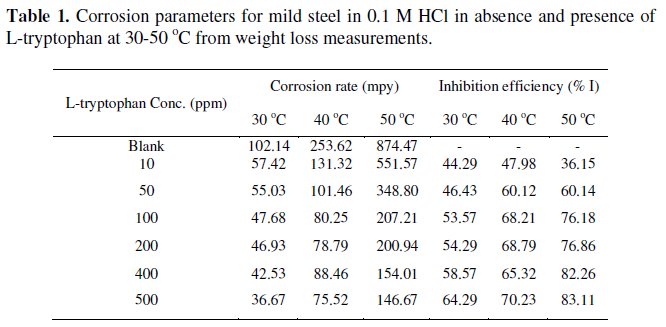
    <p>The corrosion of mild steel in 0.1 M HCl in absence and presence of different 
concentrations of amino acid L-tryptophan was studied in the temperature range 
of 30-50 &deg;C using weight loss technique. Table 1 shows the calculated values of 
weight loss, corrosion rate and IE at different concentrations of L-tryptophan 
under different temperatures.</p>

    <p>&nbsp;</p>
<img src="/img/revistas/pea/v29n6/29n6a02t1.jpg">
    
<p>&nbsp;</p>

    <p>From these data it is clearly seen that the corrosion 
rate of mild steel depends upon two factors, namely inhibitor concentration and 
temperature. The corrosion rates are significantly reduced in presence of L-
tryptophan. The maximum increase in IE of 64% was observed at a concentration 
of 500 ppm at 30 &deg;C, which further increased to 83% on increasing the 
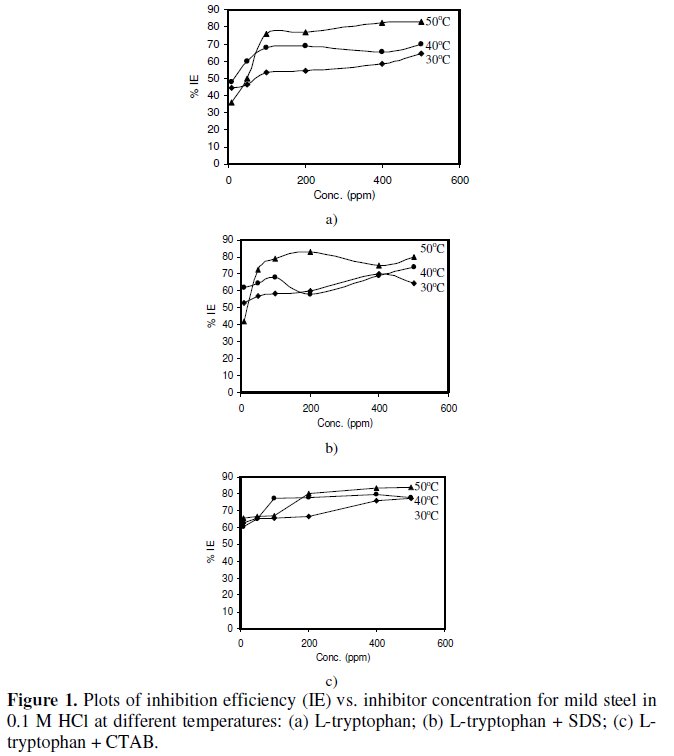
temperature from 30 to 50 &deg;C. The plots of IE as a function of L-tryptophan 
concentration, at 30-50 &deg;C, reveal that IE increases with increase in concentration 
(Fig. 1a).</p>


    <p>&nbsp; <a name="top.f1"></a> </p>
<img src="/img/revistas/pea/v29n6/29n6a02f1.jpg">
    
<p>&nbsp;</p>

 
    ]]></body>
<body><![CDATA[<p>Except at very low concentration of L-tryptophan (up to 10 ppm), IE increases 
with increasing temperature. The inhibition behavior of L-tryptophan on mild 
steel in 0.1 M HCl can be attributed to the adsorption of the molecules on the 
steel surface. The effectiveness of the adsorption of L-tryptophan may be 
attributed to the presence of two nitrogen atoms in the molecule and its large 
volume [20]. The increased IE with increasing the inhibitor concentration 
indicates that more inhibitor molecules are adsorbed on the steel surface, leading 
to the formation of a protective film [21]. The increase in IE with increasing 
temperature suggests that at higher concentrations L-tryptophan is chemically 
adsorbed on to the mild steel surface. At lower concentrations the adsorbed film 
is not so stable and gets damaged at higher temperature, thus showing lower IE. 
The amino acid, L-tryptophan is easily protonated and expected to involve two 
ways of adsorption. Firstly, it may be adsorbed via donor-acceptor interactions 
between the p electrons of the indole rings and the unshared electron pairs of the 
heteroatom, to form a bond with vacant d-orbital of the metal surface [22]. 
Secondly, the -NH2 group of amino acid in acid medium is readily protonated 
and might get adsorbed on the metallic surface via the negatively charged acid 
anions [23].</p>

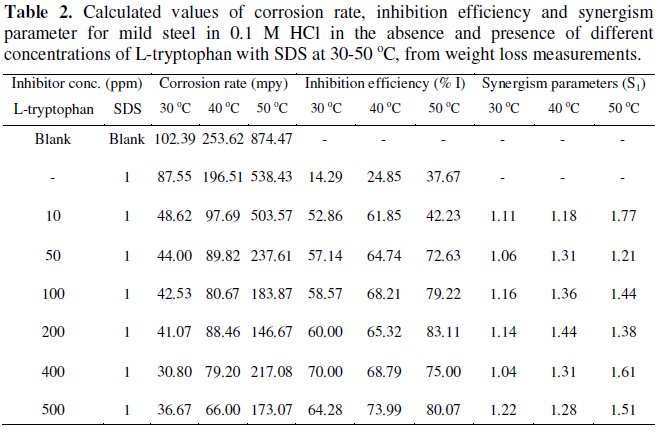
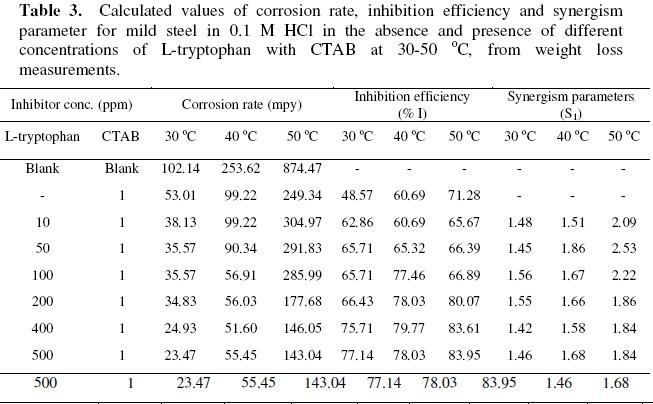
    <p>To observe the effect of SDS and CTAB on the corrosion inhibition behavior of 
L-tryptophan, the corrosion of mild steel in 0.1 M HCl in absence and presence 
of different concentrations of L-tryptophan, in combination with 1 ppm of SDS 
and 1 ppm of CTAB, was separately studied in the temperature range of 30-50 &deg;C 
by weight loss technique. The results are shown in Tables 2 and 3.</p>

    <p>&nbsp; <a name="top.t2"></a> </p>
<img src="/img/revistas/pea/v29n6/29n6a02t2.jpg">
    
<p>&nbsp; <a name="top.t3"></a> </p>
<img src="/img/revistas/pea/v29n6/29n6a02t3.jpg">
    
<p>&nbsp;</p>

    <p>The corrosion rates of mild steel in 0.1 M HCl in presence of L-tryptophan in combination with 
surfactants is further reduced in comparison to L-tryptophan alone. <a href="#top.f1">Fig. 1b</a> and 
<a href="#top.f1">Fig. 1c</a> show the plots of IE as a function of concentration of L-tryptophan in 
combination with 1 ppm of SDS and CTAB, respectively, at 30-50 &deg;C.</p>

    <p>Considering the effect of surfactants on the corrosion inhibition behavior of L-
tryptophan, the anionic SDS binds with L-tryptophan through electrostatic 
interaction, thus helps to adsorb at the metal surface more firmly and displays 
higher IE. The IE of L-tryptophan in presence of 1 ppm of CTAB is also higher, 
but lower in comparison to SDS.</p>

    <p>It may be due to the adsorption of L-tryptophan to metal surface by binding with 
CTAB as co-ions or through hydrophobic interaction. The effect of surfactants 
on the IE of L-tryptophan in 0.1 M HCl appears to be synergistic in nature. The 
values of the synergism parameter S1 for various concentrations of L-tryptophan 
in combination with 1 ppm of surfactants were calculated from the gravimetric 
data at 30 &deg;C using the relationship [14] 

    <p>&nbsp;</p>
<img src="/img/revistas/pea/v29n6/29n6a02e3.jpg">
    
<p>&nbsp;</p>

    ]]></body>
<body><![CDATA[<p>where, I<sub>1+2</sub> = (I1 + I2); I1 is IE of L-tryptophan; I2 is IE of the surfactants; and I<sup>'</sup><sub>1 
+2</sub> being IE of L-tryptophan is in combination with surfactants. The results are 
given in Tables <a href="#top.t2">2</a> and <a href="#top.t3">3</a>. The values are all greater than unity. This is an 
indication that the enhanced IE resulting from the addition of surfactants to L-
tryptophan is synergistic in nature and proved that addition of a very small 
concentration of surfactants can improve the adsorption of L-tryptophan on the 
mild steel.</p>

    <p>The inhibition of mild steel corrosion in presence of various organic compounds 
has been attributed to their adsorption on the steel surface, being generally 
confirmed from the fit of the experimental data to various adsorption isotherms. 
The degree of surface coverage (q) for various concentrations of L-tryptophan, 
and L-tryptophan in combination with 1 ppm of SDS and CTAB, in 0.1 M HCl at 
30-50 &deg;C, for 6 h immersion time, has been evaluated by weight loss 
measurements. The data were tested graphically by fitting to various isotherms 
and the best result was obtained for Langmuir adsorption isotherm.</p>

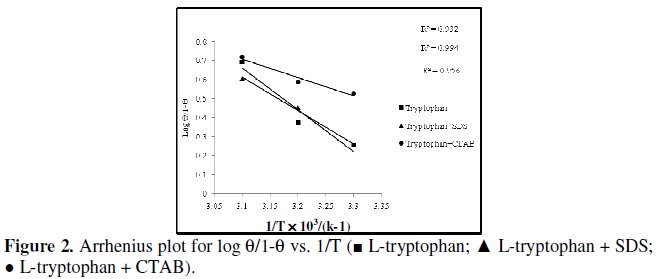
    <p>A plot of log q/1-q vs.1/T, where T is the solution temperature, was also obtained 
for L-tryptophan and for L-tryptophan in combination with 1 ppm of surfactants 
(Fig. 2).</p>


    <p>&nbsp;</p>
<img src="/img/revistas/pea/v29n6/29n6a02f2.jpg">
    
<p>&nbsp;</p>


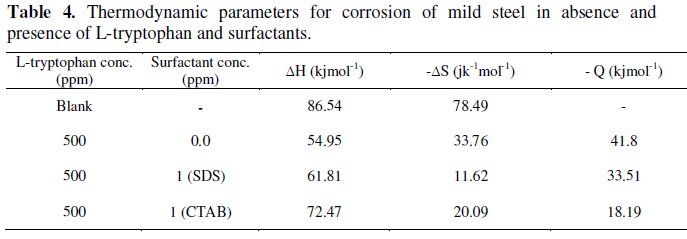
    <p>The heat of adsorption (Qd) was calculated from the slope of the plot 
(-Qd/2.303R) and the values are listed in Table 4.</p>

    <p>&nbsp; <a name="top.t4"></a> </p>
<img src="/img/revistas/pea/v29n6/29n6a02t4.jpg">
    
<p>&nbsp;</p>

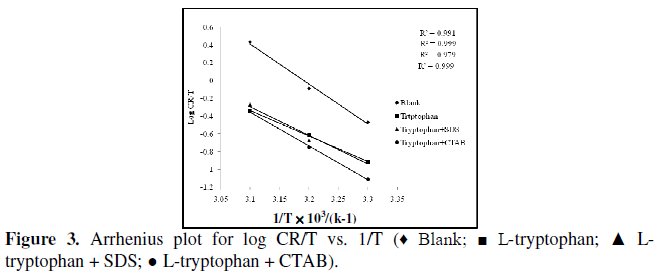
    <p>The plot of log (CR/T) vs. 1/T 
in presence of L-tryptophan and surfactants (Fig. 3) gave a straight line with 
slope of (-&Delta;H/2.303R) and an intercept of [(log(R/Nh) + (&Delta;S/2.303R)].


    <p>&nbsp;</p>
<img src="/img/revistas/pea/v29n6/29n6a02f3.jpg">
    
]]></body>
<body><![CDATA[<p>&nbsp;</p>


    <p>The values of &Delta;H obtained from the slope and of &Delta;S evaluated from the intercept, are 
given in <a href="#top.t4">Table 4</a>.</p>

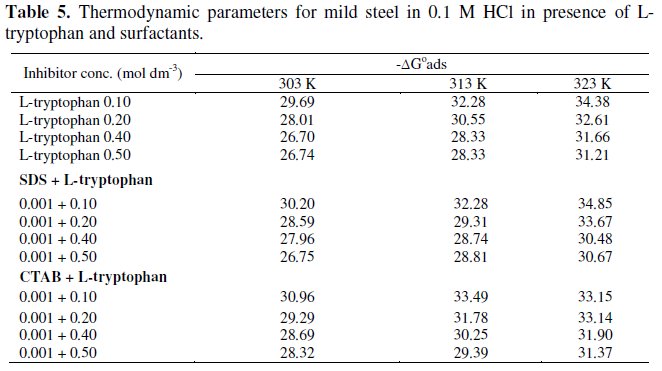
    <p>The values of free energy of adsorption (&Delta;G<sub>ads</sub>) were calculated 
using the following equation [24] and are listed in Table 5.</p>

    <p>&nbsp;</p>
<img src="/img/revistas/pea/v29n6/29n6a02e4.jpg">
    
<p>&nbsp;</p>

    <p>where K is equilibrium constants and is given by</p>

    <p>&nbsp;</p>
<img src="/img/revistas/pea/v29n6/29n6a02e5.jpg">
    
<p>&nbsp;</p>

    <p>where &Theta; is the degree of surface coverage, C the concentration of the inhibitors in 
mol dm<sup>-3</sup>, R is the gas constant and T is the solution temperature.</p>

    <p>&nbsp;</p>
<img src="/img/revistas/pea/v29n6/29n6a02t5.jpg">
    
]]></body>
<body><![CDATA[<p>&nbsp;</p>

    <p>The plots of log &Theta;/1-&Theta; vs. log C showed a linear correlation of slope close to unity, suggesting that 
the adsorption of L-tryptophan on mild steel surface obeys Langmuir adsorption 
isotherm. The values of heat of adsorption are less than -40 kJ mol<sup>-1</sup>, suggesting 
the physical adsorption of the inhibitors [25]. The lower values of &Delta;H for L-
tryptophan in presence of surfactants indicate less energy barrier for the reaction 
[26]. The negative values of &Delta;G<sub>ads</sub> suggest that the adsorption of L-tryptophan on 
mild steel is spontaneous. It is an established fact that values of &Delta;G<sub>ads</sub> around -20 
kJ mol<sup>-1</sup> or less indicate physisorption. The adsorption is attributed to the 
electrostatic attraction between the charged organic molecules and charged metal 
surface. The values of &Delta;G<sub>ads</sub> around -40 kJ mol<sup>-1</sup> or more are considered as 
chemisorptions. However, the values of &Delta;G<sub>ads</sub> between -20 and -40 kJ mol<sup>-1</sup> give 
a disputed judgement about the type of adsorption [27-30]. In the present 
investigation the values of &Delta;G<sub>ads</sub> are in the range of -26.70 to -34.85 kJ mol<sup>-1</sup> , 
suggesting a mixed type of adsorption involving both physisorption and chemisorption.</p> 


    <p><b><i>Potentiodynamic polarization measurements</i></b></p>

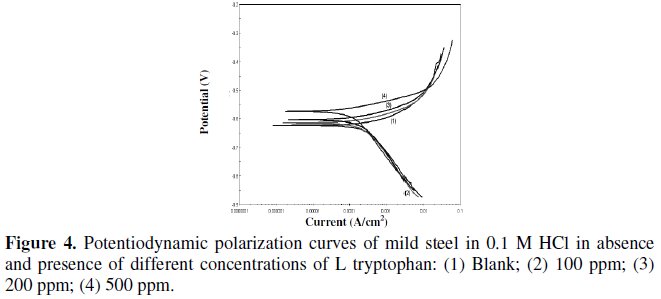
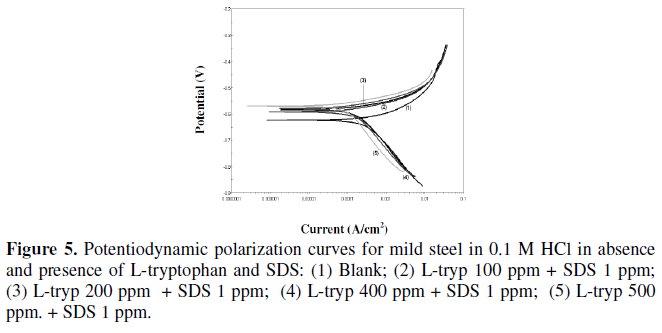
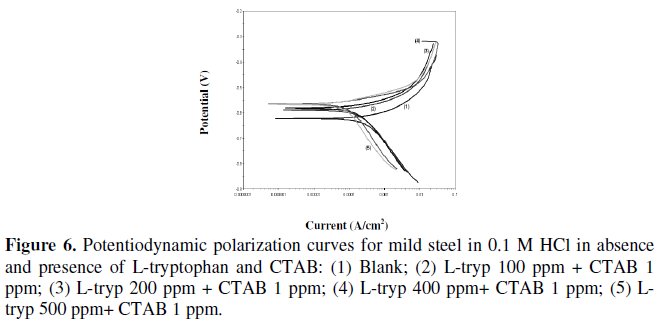
    <p>Potentiodynamic polarization curves for the corrosion of mild steel in 0.1 M HCl 
in absence and presence of different concentrations of L-tryptophan, and of L-
tryptophan in combination with 1 ppm of SDS and CTAB, are shown in Figs. 4-6.</p>

    <p>&nbsp;</p>
<img src="/img/revistas/pea/v29n6/29n6a02f4.jpg">
    
<p>&nbsp;</p>
<img src="/img/revistas/pea/v29n6/29n6a02f5.jpg">
    
<p>&nbsp;</p>
<img src="/img/revistas/pea/v29n6/29n6a02f6.jpg">
    
<p>&nbsp;</p>


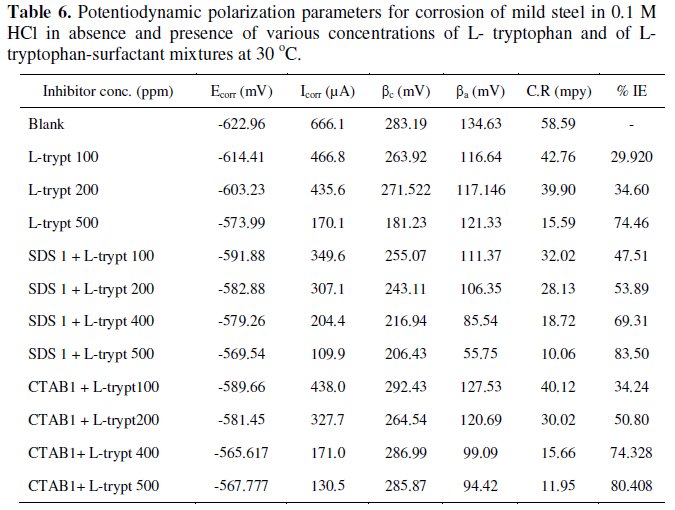
    <p>The values of electrochemical parameters as deduced from these curves, e.g., 
corrosion potential (Ecorr), corrosion current density (i<sub>corr</sub>), cathodic Tafel slope 
(&beta;<sub>c</sub>), anodic Tafel slope (&beta;<sub>a</sub>) and % inhibition efficiency (% IE), are shown in 
Table 6. The IE was calculated using the equation:</p>

    <p>&nbsp;</p>
<img src="/img/revistas/pea/v29n6/29n6a02e6.jpg">
    
]]></body>
<body><![CDATA[<p>&nbsp;</p>

    <p>where i<sup>0</sup><sub>corr</sub> and i<sub>corr</sub> are the corrosion current density in absence and presence of 
the inhibitors, respectively.</p>

    <p>&nbsp;</p>
<img src="/img/revistas/pea/v29n6/29n6a02t6.jpg">
    
<p>&nbsp;</p>

    <p>The study of electrochemical data reveals that the 
value of i<sub>corr</sub> continuously decreases in presence of L-tryptophan. The maximum 
IE of about 75% was observed at a concentration of 500 ppm, indicating that a 
higher coverage of L-tryptophan on steel surface is obtained in the solution with 
highest concentration of the inhibitor. The values of Ecorr shift to more positive 
value compared to the blank, indicating that L-tryptophan acts more as an anodic 
than a cathodic inhibitor. The addition of 1 ppm of SDS and CTAB to different 
concentrations of L-tryptophan improved the IE of L-tryptophan significantly.</p>

    <p>The results as obtained by electrochemical studies are consistent with the results 
of the weight loss measurements.</p>


    <p>&nbsp;</p>
    <p><b>Conclusions</b></p>

    <p>(1) L-tryptophan showed good performance as corrosion inhibitor for mild 
steel in 0.1 M HCl, which is further improved in presence of the 
surfactants SDS and CTAB. The effect of surfactants on corrosion 
inhibition behavior of L-tryptophan appears to be synergistic in nature.</p>

    <p>(2) The data obtained from weight loss measurements suggest corrosion 
inhibition by adsorption mechanism and fit well the Langmuir adsorption 
isotherm. The thermodynamic data suggest mixed type of adsorption 
involving both physisorption and chemisorption.</p>

    ]]></body>
<body><![CDATA[<p>(3) L-tryptophan acts more as an anodic than a cathodic inhibitor. 


    <p>&nbsp;</p>
    <p><b>References</b></p>

    <!-- ref --><p>1. M. Lagrenee, B. Mernari, M. Bouanis et all, Corros. Sci. 44 (2002) 573.    &nbsp;&nbsp;&nbsp;&nbsp;&nbsp;&nbsp;&nbsp;&nbsp;[&#160;<a href="javascript:void(0);" onclick="javascript: window.open('/scielo.php?script=sci_nlinks&ref=000096&pid=S0872-1904201100060000200001&lng=','','width=640,height=500,resizable=yes,scrollbars=1,menubar=yes,');">Links</a>&#160;]<!-- end-ref --></p>
    <!-- ref --><p>2. M.A. Quraishi, R. Sardar, Corrosion 58 (2002) 748.    &nbsp;&nbsp;&nbsp;&nbsp;&nbsp;&nbsp;&nbsp;&nbsp;[&#160;<a href="javascript:void(0);" onclick="javascript: window.open('/scielo.php?script=sci_nlinks&ref=000098&pid=S0872-1904201100060000200002&lng=','','width=640,height=500,resizable=yes,scrollbars=1,menubar=yes,');">Links</a>&#160;]<!-- end-ref --></p>
    <!-- ref --><p>3. M.A. Quraishi, S. Khan, J. Appl. Electrochem. 33 (2003) 233.    &nbsp;&nbsp;&nbsp;&nbsp;&nbsp;&nbsp;&nbsp;&nbsp;[&#160;<a href="javascript:void(0);" onclick="javascript: window.open('/scielo.php?script=sci_nlinks&ref=000100&pid=S0872-1904201100060000200003&lng=','','width=640,height=500,resizable=yes,scrollbars=1,menubar=yes,');">Links</a>&#160;]<!-- end-ref --></p>
    <!-- ref --><p>4. S. Bilgic, Korozyon 13 (2005) 3.    &nbsp;&nbsp;&nbsp;&nbsp;&nbsp;&nbsp;&nbsp;&nbsp;[&#160;<a href="javascript:void(0);" onclick="javascript: window.open('/scielo.php?script=sci_nlinks&ref=000102&pid=S0872-1904201100060000200004&lng=','','width=640,height=500,resizable=yes,scrollbars=1,menubar=yes,');">Links</a>&#160;]<!-- end-ref --></p>
    <!-- ref --><p>5. A.B. Silva, S.M.L. Agostinho, O.E. Barcia et all, Corros. Sci. 48 (2006) 3668.    &nbsp;&nbsp;&nbsp;&nbsp;&nbsp;&nbsp;&nbsp;&nbsp;[&#160;<a href="javascript:void(0);" onclick="javascript: window.open('/scielo.php?script=sci_nlinks&ref=000104&pid=S0872-1904201100060000200005&lng=','','width=640,height=500,resizable=yes,scrollbars=1,menubar=yes,');">Links</a>&#160;]<!-- end-ref --></p>
    <!-- ref --><p>6. L. Toufari, A. Kadri, A. Khalifa et all, J. Eng. Appl. Sci. 3 (a) (2008) 688.    &nbsp;&nbsp;&nbsp;&nbsp;&nbsp;&nbsp;&nbsp;&nbsp;[&#160;<a href="javascript:void(0);" onclick="javascript: window.open('/scielo.php?script=sci_nlinks&ref=000106&pid=S0872-1904201100060000200006&lng=','','width=640,height=500,resizable=yes,scrollbars=1,menubar=yes,');">Links</a>&#160;]<!-- end-ref --></p>
    <!-- ref --><p>7. E.E. Oguzie, Y. Li, F.H. Wang, J. Electrochim. Acta 53 (2007) 909.    &nbsp;&nbsp;&nbsp;&nbsp;&nbsp;&nbsp;&nbsp;&nbsp;[&#160;<a href="javascript:void(0);" onclick="javascript: window.open('/scielo.php?script=sci_nlinks&ref=000108&pid=S0872-1904201100060000200007&lng=','','width=640,height=500,resizable=yes,scrollbars=1,menubar=yes,');">Links</a>&#160;]<!-- end-ref --></p>
    <!-- ref --><p>8. S.A. Umoren, I.B. Obot, N.O. Obi-Egbedi, J. Mater. Sci. 44 (2009) 274.    &nbsp;&nbsp;&nbsp;&nbsp;&nbsp;&nbsp;&nbsp;&nbsp;[&#160;<a href="javascript:void(0);" onclick="javascript: window.open('/scielo.php?script=sci_nlinks&ref=000110&pid=S0872-1904201100060000200008&lng=','','width=640,height=500,resizable=yes,scrollbars=1,menubar=yes,');">Links</a>&#160;]<!-- end-ref --></p>
    <!-- ref --><p>9. M.S. Morad, J. Appl. Electrochem. 38 (2008) 1509.    &nbsp;&nbsp;&nbsp;&nbsp;&nbsp;&nbsp;&nbsp;&nbsp;[&#160;<a href="javascript:void(0);" onclick="javascript: window.open('/scielo.php?script=sci_nlinks&ref=000112&pid=S0872-1904201100060000200009&lng=','','width=640,height=500,resizable=yes,scrollbars=1,menubar=yes,');">Links</a>&#160;]<!-- end-ref --></p>
    <!-- ref --><p>10. H. Ashassi-Sorkhabi, M.R. Majidi, K. Seyyedi, Appl. Surf. Sci. 225 (2004) 176.    &nbsp;&nbsp;&nbsp;&nbsp;&nbsp;&nbsp;&nbsp;&nbsp;[&#160;<a href="javascript:void(0);" onclick="javascript: window.open('/scielo.php?script=sci_nlinks&ref=000114&pid=S0872-1904201100060000200010&lng=','','width=640,height=500,resizable=yes,scrollbars=1,menubar=yes,');">Links</a>&#160;]<!-- end-ref --></p>
    <!-- ref --><p>11. V. Hluchan, B.L. Wheeler, N. Hackerman, Werkst. Korros. 39 (1988) 512.    &nbsp;&nbsp;&nbsp;&nbsp;&nbsp;&nbsp;&nbsp;&nbsp;[&#160;<a href="javascript:void(0);" onclick="javascript: window.open('/scielo.php?script=sci_nlinks&ref=000116&pid=S0872-1904201100060000200011&lng=','','width=640,height=500,resizable=yes,scrollbars=1,menubar=yes,');">Links</a>&#160;]<!-- end-ref --></p>
    <!-- ref --><p>12. G. Moretti, F. Guidi, Corros. Sci. 44(9) (2002) 1995.    &nbsp;&nbsp;&nbsp;&nbsp;&nbsp;&nbsp;&nbsp;&nbsp;[&#160;<a href="javascript:void(0);" onclick="javascript: window.open('/scielo.php?script=sci_nlinks&ref=000118&pid=S0872-1904201100060000200012&lng=','','width=640,height=500,resizable=yes,scrollbars=1,menubar=yes,');">Links</a>&#160;]<!-- end-ref --></p>
    <!-- ref --><p>13. J.J. Fu, S.N. Li, L.H. Cao et all, J. Mater. Sci. 45 (2010) 979.    &nbsp;&nbsp;&nbsp;&nbsp;&nbsp;&nbsp;&nbsp;&nbsp;[&#160;<a href="javascript:void(0);" onclick="javascript: window.open('/scielo.php?script=sci_nlinks&ref=000120&pid=S0872-1904201100060000200013&lng=','','width=640,height=500,resizable=yes,scrollbars=1,menubar=yes,');">Links</a>&#160;]<!-- end-ref --></p>
    <!-- ref --><p>14. S.A. Umoren, U.M. Uduok, E.E. Oguzie, Port. Electrochim. Acta 26(6) (2008) 553.    &nbsp;&nbsp;&nbsp;&nbsp;&nbsp;&nbsp;&nbsp;&nbsp;[&#160;<a href="javascript:void(0);" onclick="javascript: window.open('/scielo.php?script=sci_nlinks&ref=000122&pid=S0872-1904201100060000200014&lng=','','width=640,height=500,resizable=yes,scrollbars=1,menubar=yes,');">Links</a>&#160;]<!-- end-ref --></p>
    <!-- ref --><p>15. M.Z.A. Rafiquee, N. Saxena, S. Khan, M.A. Quraishi, Mater. Chem. Phys. 107 (2008) 528.    &nbsp;&nbsp;&nbsp;&nbsp;&nbsp;&nbsp;&nbsp;&nbsp;[&#160;<a href="javascript:void(0);" onclick="javascript: window.open('/scielo.php?script=sci_nlinks&ref=000124&pid=S0872-1904201100060000200015&lng=','','width=640,height=500,resizable=yes,scrollbars=1,menubar=yes,');">Links</a>&#160;]<!-- end-ref --></p>
    <!-- ref --><p>16. M.A. Migahed, A.M. Al-Sabagh, Chem. Eng. Comm. 196 (2009) 1054.    &nbsp;&nbsp;&nbsp;&nbsp;&nbsp;&nbsp;&nbsp;&nbsp;[&#160;<a href="javascript:void(0);" onclick="javascript: window.open('/scielo.php?script=sci_nlinks&ref=000126&pid=S0872-1904201100060000200016&lng=','','width=640,height=500,resizable=yes,scrollbars=1,menubar=yes,');">Links</a>&#160;]<!-- end-ref --></p>
    <!-- ref --><p>17. M.L. Free, Corrosion 1025 (2002) 58.    &nbsp;&nbsp;&nbsp;&nbsp;&nbsp;&nbsp;&nbsp;&nbsp;[&#160;<a href="javascript:void(0);" onclick="javascript: window.open('/scielo.php?script=sci_nlinks&ref=000128&pid=S0872-1904201100060000200017&lng=','','width=640,height=500,resizable=yes,scrollbars=1,menubar=yes,');">Links</a>&#160;]<!-- end-ref --></p>
    <!-- ref --><p>18. W.L. Wang, M.L. Free, Corros. Sci. 2601 (2004) 46.    &nbsp;&nbsp;&nbsp;&nbsp;&nbsp;&nbsp;&nbsp;&nbsp;[&#160;<a href="javascript:void(0);" onclick="javascript: window.open('/scielo.php?script=sci_nlinks&ref=000130&pid=S0872-1904201100060000200018&lng=','','width=640,height=500,resizable=yes,scrollbars=1,menubar=yes,');">Links</a>&#160;]<!-- end-ref --></p>
    <!-- ref --><p>19. M. Saleh, A.A. Atha, J. Appl. Electrochem. 36 (2006) 899.    &nbsp;&nbsp;&nbsp;&nbsp;&nbsp;&nbsp;&nbsp;&nbsp;[&#160;<a href="javascript:void(0);" onclick="javascript: window.open('/scielo.php?script=sci_nlinks&ref=000132&pid=S0872-1904201100060000200019&lng=','','width=640,height=500,resizable=yes,scrollbars=1,menubar=yes,');">Links</a>&#160;]<!-- end-ref --></p>
    <!-- ref --><p>20. H. Ashassi-Sorkhabi, Z. Ghasimi, D. Seifzadeh, Appl. Surf. Sci. 249 (2005) 408.    &nbsp;&nbsp;&nbsp;&nbsp;&nbsp;&nbsp;&nbsp;&nbsp;[&#160;<a href="javascript:void(0);" onclick="javascript: window.open('/scielo.php?script=sci_nlinks&ref=000134&pid=S0872-1904201100060000200020&lng=','','width=640,height=500,resizable=yes,scrollbars=1,menubar=yes,');">Links</a>&#160;]<!-- end-ref --></p>
    <!-- ref --><p>21. V.S. Rao, L.K. Singhal, J. Mater. Sci. 49 (2009) 2327.    &nbsp;&nbsp;&nbsp;&nbsp;&nbsp;&nbsp;&nbsp;&nbsp;[&#160;<a href="javascript:void(0);" onclick="javascript: window.open('/scielo.php?script=sci_nlinks&ref=000136&pid=S0872-1904201100060000200021&lng=','','width=640,height=500,resizable=yes,scrollbars=1,menubar=yes,');">Links</a>&#160;]<!-- end-ref --></p>
    <!-- ref --><p>22. O. Olivares-Xometl, N.V. Likhanova, R. Martinez-Palou, M.A. Dominguez-Aguilar, Mater. Corros. 60 (2009) 14.    &nbsp;&nbsp;&nbsp;&nbsp;&nbsp;&nbsp;&nbsp;&nbsp;[&#160;<a href="javascript:void(0);" onclick="javascript: window.open('/scielo.php?script=sci_nlinks&ref=000138&pid=S0872-1904201100060000200022&lng=','','width=640,height=500,resizable=yes,scrollbars=1,menubar=yes,');">Links</a>&#160;]<!-- end-ref --></p>
    <!-- ref --><p>23. K. Babic-Samardzija, C. Lupu, N. Hackerman et all, Langmuir 21 (2005) 12187.    &nbsp;&nbsp;&nbsp;&nbsp;&nbsp;&nbsp;&nbsp;&nbsp;[&#160;<a href="javascript:void(0);" onclick="javascript: window.open('/scielo.php?script=sci_nlinks&ref=000140&pid=S0872-1904201100060000200023&lng=','','width=640,height=500,resizable=yes,scrollbars=1,menubar=yes,');">Links</a>&#160;]<!-- end-ref --></p>
    <!-- ref --><p>24. J.M. Cases, F. Villieras, Langmuir 8 (1992) 1251.    &nbsp;&nbsp;&nbsp;&nbsp;&nbsp;&nbsp;&nbsp;&nbsp;[&#160;<a href="javascript:void(0);" onclick="javascript: window.open('/scielo.php?script=sci_nlinks&ref=000142&pid=S0872-1904201100060000200024&lng=','','width=640,height=500,resizable=yes,scrollbars=1,menubar=yes,');">Links</a>&#160;]<!-- end-ref --></p>
    <!-- ref --><p>25. L.J. Jha, Ph.D. Thesis, Faculty of Science, Delhi University, Delhi (1990).    &nbsp;&nbsp;&nbsp;&nbsp;&nbsp;&nbsp;&nbsp;&nbsp;[&#160;<a href="javascript:void(0);" onclick="javascript: window.open('/scielo.php?script=sci_nlinks&ref=000144&pid=S0872-1904201100060000200025&lng=','','width=640,height=500,resizable=yes,scrollbars=1,menubar=yes,');">Links</a>&#160;]<!-- end-ref --></p>
    <!-- ref --><p>26. S.A.R. Sayed, H.H. Hamdy, A.A. Mohammed, Mater. Chem. Phys. 70 (2001) 64.    &nbsp;&nbsp;&nbsp;&nbsp;&nbsp;&nbsp;&nbsp;&nbsp;[&#160;<a href="javascript:void(0);" onclick="javascript: window.open('/scielo.php?script=sci_nlinks&ref=000146&pid=S0872-1904201100060000200026&lng=','','width=640,height=500,resizable=yes,scrollbars=1,menubar=yes,');">Links</a>&#160;]<!-- end-ref --></p>
    <!-- ref --><p>27. F.S. de Souza, A. Spinelli, Corros. Sci. 51 (2009) 642.    &nbsp;&nbsp;&nbsp;&nbsp;&nbsp;&nbsp;&nbsp;&nbsp;[&#160;<a href="javascript:void(0);" onclick="javascript: window.open('/scielo.php?script=sci_nlinks&ref=000148&pid=S0872-1904201100060000200027&lng=','','width=640,height=500,resizable=yes,scrollbars=1,menubar=yes,');">Links</a>&#160;]<!-- end-ref --></p>
    <!-- ref --><p>28. W.H. Li, Q. He, S.T. Zhang et all, J. Appl. Electrochem. 38(3) (2008) 289.    &nbsp;&nbsp;&nbsp;&nbsp;&nbsp;&nbsp;&nbsp;&nbsp;[&#160;<a href="javascript:void(0);" onclick="javascript: window.open('/scielo.php?script=sci_nlinks&ref=000150&pid=S0872-1904201100060000200028&lng=','','width=640,height=500,resizable=yes,scrollbars=1,menubar=yes,');">Links</a>&#160;]<!-- end-ref --></p>
    <!-- ref --><p>29. G. Avci, Mater. Chem. Phys. 112 (2008) 234.    &nbsp;&nbsp;&nbsp;&nbsp;&nbsp;&nbsp;&nbsp;&nbsp;[&#160;<a href="javascript:void(0);" onclick="javascript: window.open('/scielo.php?script=sci_nlinks&ref=000152&pid=S0872-1904201100060000200029&lng=','','width=640,height=500,resizable=yes,scrollbars=1,menubar=yes,');">Links</a>&#160;]<!-- end-ref --></p>
    <!-- ref --><p>30. G.W. Castellan, Physical Chemistry, 2nd edn., Addison-Wesley, Reading MA (1984).    &nbsp;&nbsp;&nbsp;&nbsp;&nbsp;&nbsp;&nbsp;&nbsp;[&#160;<a href="javascript:void(0);" onclick="javascript: window.open('/scielo.php?script=sci_nlinks&ref=000154&pid=S0872-1904201100060000200030&lng=','','width=640,height=500,resizable=yes,scrollbars=1,menubar=yes,');">Links</a>&#160;]<!-- end-ref --></p>


    <p>&nbsp;</p>

    <p><a name=0></a><sup><a href="#top">*</a></sup> Corresponding author. E-mail address: <a href="mailto:drmmobin@hotmail.com">drmmobin@hotmail.com</a></p>

    <p>Received 11 March 2011; accepted 12 November 2011</p> 

    <p><a href="http://www.peacta.org" target="_blank">www.peacta.org</a> </p>


     ]]></body><back>
<ref-list>
<ref id="B1">
<label>1</label><nlm-citation citation-type="journal">
<person-group person-group-type="author">
<name>
<surname><![CDATA[Lagrenee]]></surname>
<given-names><![CDATA[M.]]></given-names>
</name>
<name>
<surname><![CDATA[Mernari]]></surname>
<given-names><![CDATA[B.]]></given-names>
</name>
<name>
<surname><![CDATA[Bouanis]]></surname>
<given-names><![CDATA[M.]]></given-names>
</name>
</person-group>
<source><![CDATA[Corros. Sci.]]></source>
<year>2002</year>
<volume>44</volume>
<page-range>573</page-range></nlm-citation>
</ref>
<ref id="B2">
<label>2</label><nlm-citation citation-type="journal">
<person-group person-group-type="author">
<name>
<surname><![CDATA[Quraishi]]></surname>
<given-names><![CDATA[M.A.]]></given-names>
</name>
<name>
<surname><![CDATA[Sardar]]></surname>
<given-names><![CDATA[R.]]></given-names>
</name>
</person-group>
<source><![CDATA[Corrosion]]></source>
<year>2002</year>
<volume>58</volume>
<page-range>748</page-range></nlm-citation>
</ref>
<ref id="B3">
<label>3</label><nlm-citation citation-type="journal">
<person-group person-group-type="author">
<name>
<surname><![CDATA[Quraishi]]></surname>
<given-names><![CDATA[M.A.]]></given-names>
</name>
<name>
<surname><![CDATA[Khan]]></surname>
<given-names><![CDATA[S.]]></given-names>
</name>
</person-group>
<source><![CDATA[J. Appl. Electrochem.]]></source>
<year>2003</year>
<volume>33</volume>
<page-range>233</page-range></nlm-citation>
</ref>
<ref id="B4">
<label>4</label><nlm-citation citation-type="journal">
<person-group person-group-type="author">
<name>
<surname><![CDATA[Bilgic]]></surname>
<given-names><![CDATA[S.]]></given-names>
</name>
</person-group>
<source><![CDATA[Korozyon]]></source>
<year>2005</year>
<volume>13</volume>
<page-range>3</page-range></nlm-citation>
</ref>
<ref id="B5">
<label>5</label><nlm-citation citation-type="journal">
<person-group person-group-type="author">
<name>
<surname><![CDATA[Silva]]></surname>
<given-names><![CDATA[A.B.]]></given-names>
</name>
<name>
<surname><![CDATA[Agostinho]]></surname>
<given-names><![CDATA[S.M.L.]]></given-names>
</name>
<name>
<surname><![CDATA[Barcia]]></surname>
<given-names><![CDATA[O.E.]]></given-names>
</name>
</person-group>
<source><![CDATA[Corros. Sci.]]></source>
<year>2006</year>
<volume>48</volume>
<page-range>3668</page-range></nlm-citation>
</ref>
<ref id="B6">
<label>6</label><nlm-citation citation-type="journal">
<person-group person-group-type="author">
<name>
<surname><![CDATA[Toufari]]></surname>
<given-names><![CDATA[L.]]></given-names>
</name>
<name>
<surname><![CDATA[Kadri]]></surname>
<given-names><![CDATA[A.]]></given-names>
</name>
<name>
<surname><![CDATA[Khalifa]]></surname>
<given-names><![CDATA[A.]]></given-names>
</name>
</person-group>
<source><![CDATA[J. Eng. Appl. Sci.]]></source>
<year>2008</year>
<volume>3</volume>
<page-range>688</page-range></nlm-citation>
</ref>
<ref id="B7">
<label>7</label><nlm-citation citation-type="journal">
<person-group person-group-type="author">
<name>
<surname><![CDATA[Oguzie]]></surname>
<given-names><![CDATA[E.E.]]></given-names>
</name>
<name>
<surname><![CDATA[Li]]></surname>
<given-names><![CDATA[Y.]]></given-names>
</name>
<name>
<surname><![CDATA[Wang]]></surname>
<given-names><![CDATA[F.H.]]></given-names>
</name>
</person-group>
<source><![CDATA[J. Electrochim. Acta]]></source>
<year>2007</year>
<volume>53</volume>
<page-range>909</page-range></nlm-citation>
</ref>
<ref id="B8">
<label>8</label><nlm-citation citation-type="journal">
<person-group person-group-type="author">
<name>
<surname><![CDATA[Umoren]]></surname>
<given-names><![CDATA[S.A.]]></given-names>
</name>
<name>
<surname><![CDATA[Obot]]></surname>
<given-names><![CDATA[I.B.]]></given-names>
</name>
<name>
<surname><![CDATA[Obi-Egbedi]]></surname>
<given-names><![CDATA[N.O.]]></given-names>
</name>
</person-group>
<source><![CDATA[J. Mater. Sci.]]></source>
<year>2009</year>
<volume>44</volume>
<page-range>274</page-range></nlm-citation>
</ref>
<ref id="B9">
<label>9</label><nlm-citation citation-type="journal">
<person-group person-group-type="author">
<name>
<surname><![CDATA[Morad]]></surname>
<given-names><![CDATA[M.S.]]></given-names>
</name>
</person-group>
<source><![CDATA[J. Appl. Electrochem.]]></source>
<year>2008</year>
<volume>38</volume>
<page-range>1509</page-range></nlm-citation>
</ref>
<ref id="B10">
<label>10</label><nlm-citation citation-type="journal">
<person-group person-group-type="author">
<name>
<surname><![CDATA[Ashassi-Sorkhabi]]></surname>
<given-names><![CDATA[H.]]></given-names>
</name>
<name>
<surname><![CDATA[Majidi]]></surname>
<given-names><![CDATA[M.R.]]></given-names>
</name>
<name>
<surname><![CDATA[Seyyedi]]></surname>
<given-names><![CDATA[K.]]></given-names>
</name>
</person-group>
<source><![CDATA[Appl. Surf. Sci.]]></source>
<year>2004</year>
<volume>225</volume>
<page-range>176</page-range></nlm-citation>
</ref>
<ref id="B11">
<label>11</label><nlm-citation citation-type="journal">
<person-group person-group-type="author">
<name>
<surname><![CDATA[Hluchan]]></surname>
<given-names><![CDATA[V.]]></given-names>
</name>
<name>
<surname><![CDATA[Wheeler]]></surname>
<given-names><![CDATA[B.L.]]></given-names>
</name>
<name>
<surname><![CDATA[Hackerman]]></surname>
<given-names><![CDATA[N.]]></given-names>
</name>
</person-group>
<source><![CDATA[Werkst. Korros.]]></source>
<year>1988</year>
<volume>39</volume>
<page-range>512</page-range></nlm-citation>
</ref>
<ref id="B12">
<label>12</label><nlm-citation citation-type="journal">
<person-group person-group-type="author">
<name>
<surname><![CDATA[Moretti]]></surname>
<given-names><![CDATA[G.]]></given-names>
</name>
<name>
<surname><![CDATA[Guidi]]></surname>
<given-names><![CDATA[F.]]></given-names>
</name>
</person-group>
<source><![CDATA[Corros. Sci.]]></source>
<year>2002</year>
<volume>44</volume>
<numero>9</numero>
<issue>9</issue>
<page-range>1995</page-range></nlm-citation>
</ref>
<ref id="B13">
<label>13</label><nlm-citation citation-type="journal">
<person-group person-group-type="author">
<name>
<surname><![CDATA[Fu]]></surname>
<given-names><![CDATA[J.J.]]></given-names>
</name>
<name>
<surname><![CDATA[Li]]></surname>
<given-names><![CDATA[S.N.]]></given-names>
</name>
<name>
<surname><![CDATA[Cao]]></surname>
<given-names><![CDATA[L.H.]]></given-names>
</name>
</person-group>
<source><![CDATA[J. Mater. Sci.]]></source>
<year>2010</year>
<volume>45</volume>
<page-range>979</page-range></nlm-citation>
</ref>
<ref id="B14">
<label>14</label><nlm-citation citation-type="journal">
<person-group person-group-type="author">
<name>
<surname><![CDATA[Umoren]]></surname>
<given-names><![CDATA[S.A.]]></given-names>
</name>
<name>
<surname><![CDATA[Uduok]]></surname>
<given-names><![CDATA[U.M.]]></given-names>
</name>
<name>
<surname><![CDATA[Oguzie]]></surname>
<given-names><![CDATA[E.E.]]></given-names>
</name>
</person-group>
<source><![CDATA[Port. Electrochim. Acta]]></source>
<year>2008</year>
<volume>26</volume>
<numero>6</numero>
<issue>6</issue>
<page-range>553</page-range></nlm-citation>
</ref>
<ref id="B15">
<label>15</label><nlm-citation citation-type="journal">
<person-group person-group-type="author">
<name>
<surname><![CDATA[Rafiquee]]></surname>
<given-names><![CDATA[M.Z.A.]]></given-names>
</name>
<name>
<surname><![CDATA[Saxena]]></surname>
<given-names><![CDATA[N.]]></given-names>
</name>
<name>
<surname><![CDATA[Khan]]></surname>
<given-names><![CDATA[S.]]></given-names>
</name>
<name>
<surname><![CDATA[Quraishi]]></surname>
<given-names><![CDATA[M.A.]]></given-names>
</name>
</person-group>
<source><![CDATA[Mater. Chem. Phys.]]></source>
<year>2008</year>
<volume>107</volume>
<page-range>528</page-range></nlm-citation>
</ref>
<ref id="B16">
<label>16</label><nlm-citation citation-type="journal">
<person-group person-group-type="author">
<name>
<surname><![CDATA[Migahed]]></surname>
<given-names><![CDATA[M.A.]]></given-names>
</name>
<name>
<surname><![CDATA[Al-Sabagh]]></surname>
<given-names><![CDATA[A.M.]]></given-names>
</name>
</person-group>
<source><![CDATA[Chem. Eng. Comm.]]></source>
<year>2009</year>
<volume>196</volume>
<page-range>1054</page-range></nlm-citation>
</ref>
<ref id="B17">
<label>17</label><nlm-citation citation-type="journal">
<person-group person-group-type="author">
<name>
<surname><![CDATA[Free]]></surname>
<given-names><![CDATA[M.L.]]></given-names>
</name>
</person-group>
<source><![CDATA[Corrosion]]></source>
<year>2002</year>
<volume>1025</volume>
<page-range>58</page-range></nlm-citation>
</ref>
<ref id="B18">
<label>18</label><nlm-citation citation-type="journal">
<person-group person-group-type="author">
<name>
<surname><![CDATA[Wang]]></surname>
<given-names><![CDATA[W.L.]]></given-names>
</name>
<name>
<surname><![CDATA[Free]]></surname>
<given-names><![CDATA[M.L.]]></given-names>
</name>
</person-group>
<source><![CDATA[Corros. Sci.]]></source>
<year>2004</year>
<volume>2601</volume>
<page-range>46</page-range></nlm-citation>
</ref>
<ref id="B19">
<label>19</label><nlm-citation citation-type="journal">
<person-group person-group-type="author">
<name>
<surname><![CDATA[Saleh]]></surname>
<given-names><![CDATA[M.]]></given-names>
</name>
<name>
<surname><![CDATA[Atha]]></surname>
<given-names><![CDATA[A.A.]]></given-names>
</name>
</person-group>
<source><![CDATA[J. Appl. Electrochem.]]></source>
<year>2006</year>
<volume>36</volume>
<page-range>899</page-range></nlm-citation>
</ref>
<ref id="B20">
<label>20</label><nlm-citation citation-type="journal">
<person-group person-group-type="author">
<name>
<surname><![CDATA[Ashassi-Sorkhabi]]></surname>
<given-names><![CDATA[H.]]></given-names>
</name>
<name>
<surname><![CDATA[Ghasimi]]></surname>
<given-names><![CDATA[Z.]]></given-names>
</name>
<name>
<surname><![CDATA[Seifzadeh]]></surname>
<given-names><![CDATA[D.]]></given-names>
</name>
</person-group>
<source><![CDATA[Appl. Surf. Sci.]]></source>
<year>2005</year>
<volume>249</volume>
<page-range>408</page-range></nlm-citation>
</ref>
<ref id="B21">
<label>21</label><nlm-citation citation-type="journal">
<person-group person-group-type="author">
<name>
<surname><![CDATA[Rao]]></surname>
<given-names><![CDATA[V.S.]]></given-names>
</name>
<name>
<surname><![CDATA[Singhal]]></surname>
<given-names><![CDATA[L.K.]]></given-names>
</name>
</person-group>
<source><![CDATA[J. Mater. Sci.]]></source>
<year>2009</year>
<volume>49</volume>
<page-range>2327</page-range></nlm-citation>
</ref>
<ref id="B22">
<label>22</label><nlm-citation citation-type="journal">
<person-group person-group-type="author">
<name>
<surname><![CDATA[Olivares-Xometl]]></surname>
<given-names><![CDATA[O.]]></given-names>
</name>
<name>
<surname><![CDATA[Likhanova]]></surname>
<given-names><![CDATA[N.V.]]></given-names>
</name>
<name>
<surname><![CDATA[Martinez-Palou]]></surname>
<given-names><![CDATA[R.]]></given-names>
</name>
<name>
<surname><![CDATA[Dominguez-Aguilar]]></surname>
<given-names><![CDATA[M.A.]]></given-names>
</name>
</person-group>
<source><![CDATA[Mater. Corros.]]></source>
<year>2009</year>
<volume>60</volume>
<page-range>14</page-range></nlm-citation>
</ref>
<ref id="B23">
<label>23</label><nlm-citation citation-type="journal">
<person-group person-group-type="author">
<name>
<surname><![CDATA[Babic-Samardzija]]></surname>
<given-names><![CDATA[K.]]></given-names>
</name>
<name>
<surname><![CDATA[Lupu]]></surname>
<given-names><![CDATA[C.]]></given-names>
</name>
<name>
<surname><![CDATA[Hackerman]]></surname>
<given-names><![CDATA[N.]]></given-names>
</name>
</person-group>
<source><![CDATA[Langmuir]]></source>
<year>2005</year>
<volume>21</volume>
<page-range>12187</page-range></nlm-citation>
</ref>
<ref id="B24">
<label>24</label><nlm-citation citation-type="journal">
<person-group person-group-type="author">
<name>
<surname><![CDATA[Cases]]></surname>
<given-names><![CDATA[J.M.]]></given-names>
</name>
<name>
<surname><![CDATA[Villieras]]></surname>
<given-names><![CDATA[F.]]></given-names>
</name>
</person-group>
<source><![CDATA[Langmuir]]></source>
<year>1992</year>
<volume>8</volume>
<page-range>1251</page-range></nlm-citation>
</ref>
<ref id="B25">
<label>25</label><nlm-citation citation-type="">
<person-group person-group-type="author">
<name>
<surname><![CDATA[Jha]]></surname>
<given-names><![CDATA[L.J.]]></given-names>
</name>
</person-group>
<source><![CDATA[]]></source>
<year></year>
</nlm-citation>
</ref>
<ref id="B26">
<label>26</label><nlm-citation citation-type="journal">
<person-group person-group-type="author">
<name>
<surname><![CDATA[Sayed]]></surname>
<given-names><![CDATA[S.A.R.]]></given-names>
</name>
<name>
<surname><![CDATA[Hamdy]]></surname>
<given-names><![CDATA[H.H.]]></given-names>
</name>
<name>
<surname><![CDATA[Mohammed]]></surname>
<given-names><![CDATA[A.A.]]></given-names>
</name>
</person-group>
<source><![CDATA[Mater. Chem. Phys.]]></source>
<year>2001</year>
<volume>70</volume>
<page-range>64</page-range></nlm-citation>
</ref>
<ref id="B27">
<label>27</label><nlm-citation citation-type="journal">
<person-group person-group-type="author">
<name>
<surname><![CDATA[de Souza]]></surname>
<given-names><![CDATA[F.S.]]></given-names>
</name>
<name>
<surname><![CDATA[Spinelli]]></surname>
<given-names><![CDATA[A.]]></given-names>
</name>
</person-group>
<source><![CDATA[Corros. Sci.]]></source>
<year>2009</year>
<volume>51</volume>
<page-range>642</page-range></nlm-citation>
</ref>
<ref id="B28">
<label>28</label><nlm-citation citation-type="journal">
<person-group person-group-type="author">
<name>
<surname><![CDATA[Li]]></surname>
<given-names><![CDATA[W.H.]]></given-names>
</name>
<name>
<surname><![CDATA[He]]></surname>
<given-names><![CDATA[Q.]]></given-names>
</name>
<name>
<surname><![CDATA[Zhang]]></surname>
<given-names><![CDATA[S.T.]]></given-names>
</name>
</person-group>
<source><![CDATA[J. Appl. Electrochem.]]></source>
<year>2008</year>
<volume>38</volume>
<numero>3</numero>
<issue>3</issue>
<page-range>289</page-range></nlm-citation>
</ref>
<ref id="B29">
<label>29</label><nlm-citation citation-type="journal">
<person-group person-group-type="author">
<name>
<surname><![CDATA[Avci]]></surname>
<given-names><![CDATA[G.]]></given-names>
</name>
</person-group>
<source><![CDATA[Mater. Chem. Phys.]]></source>
<year>2008</year>
<volume>112</volume>
<page-range>234</page-range></nlm-citation>
</ref>
<ref id="B30">
<label>30</label><nlm-citation citation-type="book">
<person-group person-group-type="author">
<name>
<surname><![CDATA[Castellan]]></surname>
<given-names><![CDATA[G.W.]]></given-names>
</name>
</person-group>
<source><![CDATA[Physical Chemistry]]></source>
<year>1984</year>
<edition>2</edition>
<publisher-loc><![CDATA[Reading^eMA MA]]></publisher-loc>
<publisher-name><![CDATA[Addison-Wesley]]></publisher-name>
</nlm-citation>
</ref>
</ref-list>
</back>
</article>