<?xml version="1.0" encoding="ISO-8859-1"?><article xmlns:mml="http://www.w3.org/1998/Math/MathML" xmlns:xlink="http://www.w3.org/1999/xlink" xmlns:xsi="http://www.w3.org/2001/XMLSchema-instance">
<front>
<journal-meta>
<journal-id>0872-1904</journal-id>
<journal-title><![CDATA[Portugaliae Electrochimica Acta]]></journal-title>
<abbrev-journal-title><![CDATA[Port. Electrochim. Acta]]></abbrev-journal-title>
<issn>0872-1904</issn>
<publisher>
<publisher-name><![CDATA[Sociedade Portuguesa de Electroquímica]]></publisher-name>
</publisher>
</journal-meta>
<article-meta>
<article-id>S0872-19042011000600003</article-id>
<article-id pub-id-type="doi">10.4152/pea.201106405</article-id>
<title-group>
<article-title xml:lang="en"><![CDATA[Musa Paradisiaca Extract as a Green Inhibitor for Corrosion of Mild Steel in 0.5 M Sulphuric Acid Solution]]></article-title>
</title-group>
<contrib-group>
<contrib contrib-type="author">
<name>
<surname><![CDATA[Mayanglambam]]></surname>
<given-names><![CDATA[Ramananda S.]]></given-names>
</name>
<xref ref-type="aff" rid="A01"/>
</contrib>
<contrib contrib-type="author">
<name>
<surname><![CDATA[Sharma]]></surname>
<given-names><![CDATA[Vivek]]></given-names>
</name>
<xref ref-type="aff" rid="A01"/>
</contrib>
<contrib contrib-type="author">
<name>
<surname><![CDATA[Singh]]></surname>
<given-names><![CDATA[Gurmeet]]></given-names>
</name>
<xref ref-type="aff" rid="A02"/>
</contrib>
</contrib-group>
<aff id="A01">
<institution><![CDATA[,University of Delhi Kirorimal College Department of Chemistry]]></institution>
<addr-line><![CDATA[ ]]></addr-line>
<country>India</country>
</aff>
<aff id="A02">
<institution><![CDATA[,University of Delhi Department of Chemistry ]]></institution>
<addr-line><![CDATA[ ]]></addr-line>
<country>India</country>
</aff>
<pub-date pub-type="pub">
<day>00</day>
<month>11</month>
<year>2011</year>
</pub-date>
<pub-date pub-type="epub">
<day>00</day>
<month>11</month>
<year>2011</year>
</pub-date>
<volume>29</volume>
<numero>6</numero>
<fpage>405</fpage>
<lpage>417</lpage>
<copyright-statement/>
<copyright-year/>
<self-uri xlink:href="http://scielo.pt/scielo.php?script=sci_arttext&amp;pid=S0872-19042011000600003&amp;lng=en&amp;nrm=iso"></self-uri><self-uri xlink:href="http://scielo.pt/scielo.php?script=sci_abstract&amp;pid=S0872-19042011000600003&amp;lng=en&amp;nrm=iso"></self-uri><self-uri xlink:href="http://scielo.pt/scielo.php?script=sci_pdf&amp;pid=S0872-19042011000600003&amp;lng=en&amp;nrm=iso"></self-uri><abstract abstract-type="short" xml:lang="en"><p><![CDATA[The effect of extract of Musa paradisiaca on corrosion inhibition of mild steel in aqueous 0.5 M sulphuric acid was investigated by weight loss method, potentiodynamics polarisation technique and electrochemical impedance spectroscopy (EIS). The inhibition efficiency is found to increase with increase in concentration of the extract. Polarization measurement indicates that Musa paradisiaca acts as a mixed- type inhibitor and the inhibition efficiency decreases with rise in temperature. The inhibition is assumed to occur via adsorption of inhibitor molecules on metal surface, which obeys Langmuir adsorption isotherm. The activation energy (Ea) and other thermodynamic parameters for inhibition process were calculated. These thermodynamic parameters indicate a strong interaction between the inhibitor and the mild steel surface. SEM and AFM studies confirmed the adsorption of inhibitor molecules on mild steel surface.]]></p></abstract>
<kwd-group>
<kwd lng="en"><![CDATA[acid corrosion]]></kwd>
<kwd lng="en"><![CDATA[EIS]]></kwd>
<kwd lng="en"><![CDATA[SEM]]></kwd>
<kwd lng="en"><![CDATA[corrosion inhibition]]></kwd>
</kwd-group>
</article-meta>
</front><body><![CDATA[ 

    <p><b>Musa Paradisiaca Extract as a Green Inhibitor for Corrosion of Mild Steel in 0.5 M Sulphuric Acid Solution</b></p>

    <p><b>Ramananda S. Mayanglambam<sup>1,<a href="#0">*<a/></sup>, Vivek Sharma<sup>1</sup>, Gurmeet Singh<sup>2</sup></b></p>

    <p><sup>1</sup><i>Department of Chemistry, Kirorimal College, University of Delhi, India</i></p>
    <p><sup>2</sup><i>Department of Chemistry, University of Delhi, Delhi-110007, India</i></p>


    <p>&nbsp;</p>
    <p>doi: 10.4152/pea.201106405</p>


    <p>&nbsp;</p>
    <p><b>Abstract</b></p>

    <p>The effect of extract of Musa paradisiaca on corrosion inhibition of mild steel in 
aqueous 0.5 M sulphuric acid was investigated by weight loss method, 
potentiodynamics polarisation technique and electrochemical impedance spectroscopy 
(EIS). The inhibition efficiency is found to increase with increase in concentration of 
the extract. Polarization measurement indicates that Musa paradisiaca acts as a mixed-
type inhibitor and the inhibition efficiency decreases with rise in temperature. The 
inhibition is assumed to occur via adsorption of inhibitor molecules on metal surface, 
which obeys Langmuir adsorption isotherm. The activation energy (Ea) and other 
thermodynamic parameters for inhibition process were calculated. These 
thermodynamic parameters indicate a strong interaction between the inhibitor and the 
mild steel surface. SEM and AFM studies confirmed the adsorption of inhibitor 
molecules on mild steel surface.</p>

    ]]></body>
<body><![CDATA[<p><b><i>Keywords:</i></b> acid corrosion; EIS; SEM; corrosion inhibition.</p>

    <p>&nbsp;</p>
    <p><b>Introduction</b></p>

    <p>The study of corrosion inhibition using inhibitor in acidic media is one of the 
most challenging areas in the current research, due to its potential applications in 
industries such as acid pickling, industrial cleaning, acid descaling, oil-well acid 
in oil recovery and petrochemical processes [1-5]. The ability of a compound to 
serve as inhibitor is dependent on its ability to form a compact barrier film and/or 
nature of adsorption on metal surface. The majority of well-known inhibitors are 
organic compounds containing heteroatoms, such as O, N, S and multiple bonds 
[6]. Although many synthetic compounds show good anti<sub>corr</sub>osive properties, 
most of them are highly toxic to both human beings and environments [7]. The  
known hazardous effect of most synthetic organic inhibitors and restrictive 
environmental regulations have now made researchers to focus on the need to 
develop cheap, non-toxic and environmental friendly inhibitors like natural 
products. The natural product extracts are viewed as an incredibly rich source of 
naturally synthesized chemical compounds that can be extracted by simple 
procedures with low cost, and are biodegradable in nature [8]. This area of 
research is of much importance because in addition to being environmentally 
friendly and ecologically acceptable, plant products are inexpensive, readily 
available and renewable source of materials [9]. The use of these natural 
products, such as extracted compounds from the leaves, flowers, seeds and roots, 
as corrosion inhibitors have been widely reported by several authors. M.G. 
Sethuraman et al. [10] studied the corrosion inhibitive effect of the extract of 
black pepper on mild steel in 1 M H2S04 media, P.C. Okafor [11] studied the 
inhibitive action of leaves, seeds and a combination of leaves and seeds extracts 
of phyllanthus amarus on mild steel corrosion in HCl and H2S04 solutions, 
A.M.Abdel-Gaber et al. [12] studied the inhibitive effect of lupine (lupinous 
albus L.) extract on the corrosion of steel in aqueous solution of 1 M H2S04 and 
2 M HCl, K.O. Orubite et al. [13] studied the inhibition of the corrosion of mild 
steel in HCl solutions by extract of the leaves of Nypa fruticans Wurmb, 
N.O.Eddy et al. [14] studied the inhibitive and adsorption properties of ethanol 
extract of verninia amygdalina for the corrosion of mild steel.</p>

    <p>This study aims to gain some insight into the corrosion of mild steel in 0.5 H<sub>2</sub>SO<sub>4</sub> 
in the presence of Musa paradisiaca plant extract as a corrosion inhibitor. The 
aqueous extract of leaves and flowers of Musa paradisiaca plant in 0.5 M 
sulphuric acid was tested by weight loss, potentiodynamic polarization and 
electrochemical impedance techniques. SEM and AFM studies were also used to 
study the surface morphologies. Musa paradisiaca is a perennial tree like herb, 
which is commonly known as banana and is widely found in northern India. The 
stem juices of Musa paradisiaca have been reported to be used in the treatment 
of nervous affections like epilepsy, hysteria and in dysentery and diarrhea [15]. 
Banana is a good source of vitamins A, B and C and it also has a high content of 
carbohydrates like fructose, xylose, galactose, glucose and mannose. However, 
literature search reveals that no study has been done on the inhibitive effects of 
Musa paradisiaca extract on acidic corrosion of mild steel.</p>


    <p>&nbsp;</p>
    <p><b>Material and methods</b></p>

    <p><b><i>Preparation of extract of Musa paradisiaca</i></b></p>

    <p>Double distilled water and analytical reagents-grade H<sub>2</sub>SO<sub>4</sub> (Qualingens, 98.0%) 
were used for preparing solutions. The leaves of Musa paradisiaca were dried for 
6 hours in an oven at 70 oC and ground into powder and 10 grams of the powder 
of Musa paradisiaca were refluxed in 100 mL double distilled water for 1 hour. 
The extract of the plant was prepared by evaporating the filtrate. The required 
concentrations of solution were prepared by using solid paste residue obtained on 
evaporation of the filtrate in aqueous solution of 0.5 M H<sub>2</sub>SO<sub>4</sub>.</p>
  
 
    <p><b><i>Weight loss method</i></b></p>

    ]]></body>
<body><![CDATA[<p>Mild steel specimens having percent composition of C (0.18), Si (0.19), Mn 
(0.51), P (0.044), S (0.057), Cr (0.14), Ni (0.09), Mo (0.02), Cu (0.06), V (less 
than 0.01) and remaining Fe (chemical analysis: % by weight by equipment, 
IS:228 &ICP-OES) were used. Rectangular specimens with dimension 1 &times; 4 &times; 1 
cm were used in weight loss experiments. The specimens were polished 
successively using emery papers of 150, 180, 320, 400, 600 and 1000 grade. The 
polished surface were degreased with acetone and washed with distilled water 
before the experiment. Weight loss of mild steel coupons immersed in 100 mL of 
the electrolyte with and without the extract was determined after 4 hours at 298 
K. The percentage inhibition efficiency (I%) was calculated from the following 
equation [16]:</p>

    <p>&nbsp;</p>
<img src="/img/revistas/pea/v29n6/29n6a03e1.jpg">
    
<p>&nbsp;</p>

    <p>where W0 and Wi are weight losses of mild steel in absence and presence of the 
extract.</p>
  
 
    <p><b><i>Electrochemical measurements</i></b></p>

    <p>An electrochemical cell assembly of three electrodes was used for 
potentiodynamic polarization and electrochemical impedance measurements, in 
which the working electrode was mild steel, a saturated Calomel electrode (SCE) 
was the reference electrode, and a platinum wire was the counter electrode. The 
working electrode was coated thoroughly with epoxy resin keeping surface area 
of 1 cm2 for the study. The surface of the mild steel was abraded into uniform 
surface with 150, 320, 400, 600 grade emery papers and finally polished by 1000 
grade emery papers. The polished surfaces were degreased with acetone and 
washed with distilled water before the experiment. The measurements were done 
by using computer controlled electrochemical workstation of CHI 760c model. 
Before each polarization and EIS measurement, the working electrode was 
introduced into the test solution and kept for 4 hours to attain the open circuit 
potential (OCP). Polarization measurements were made under thermostatic 
conditions at 298 K, 308 K, 318 K and 328 K, and the measurements were 
carried out in the range of potential from -1.2 to 2 V with scan rate of 0.01(V/s) 
and quiet time of 2 seconds. The percentage inhibition efficiency (I%) from the 
polarization measurement was calculated using the following equation [17]</p>

    <p>&nbsp;</p>
<img src="/img/revistas/pea/v29n6/29n6a03e2.jpg">
    
<p>&nbsp;</p>

    <p>where i<sup>0</sup><sub>corr</sub> and i<sub>corr</sub> are the corrosion current density values without and with 
inhibitor, respectively.</p>

    <p>Electrochemical impedance measurements were carried out at 298 K and the 
measurement of the response of the electrochemical system to a.c. excitation, 
with a frequency ranging from 10 0000 to 0.1 Hz and peak to peak a.c. amplitude 
of 0.005 V with quiet time of 2 seconds, was done. The percentage inhibition 
efficiency (I%) from the electrochemical impedance measurement was calculated 
using the following equation [18]:</p>

    ]]></body>
<body><![CDATA[<p>&nbsp;</p>
<img src="/img/revistas/pea/v29n6/29n6a03e3.jpg">
    
<p>&nbsp;</p>

    <p>where Rct(i) and Rct(a) are the values of charge transfer resistance in presence and 
absence of the inhibitor, respectively.</p>
  
 
    <p><b><i>Surface analysis</i></b></p>

    <p>The test coupons of size 1 &times; 1 cm 2 were exposed in 100 mL of 0.5 M H<sub>2</sub>SO<sub>4</sub> 
solutions in absence and presence of 1 and 3 grams of the plant extracts for 5 
hours at 298 K, and then washed with distilled water. After drying the specimens, 
they were examined by scanning electron microscope (SEM) model Leo 435 VP 
with an Oxford Inca energy dispersion spectrometer system and an atomic force 
microscope (AFM) model VEECO CP II.</p>


    <p>&nbsp;</p>
    <p><b>Results and discussions</b></p>

    <p><b><i>Weight loss method</i></b></p>

    <p>The percentage of inhibition efficiency (I%) at different concentrations of Musa 
paradisiaca extract at 298 K are summarized in the Table 1.</p>

    <p>&nbsp;</p>
<img src="/img/revistas/pea/v29n6/29n6a03t1.jpg">
    
]]></body>
<body><![CDATA[<p>&nbsp;</p>


    <p>From the table, it is 
clear that the inhibition efficiency of the extract on corrosion of mild steel 
increases with increase in concentration. It increases up to 82.7% when the 
concentration of the extract increases up to 3 grams per litre.</p>


    <p><b><i>Potentiodynamic polarization measurement</i></b></p>

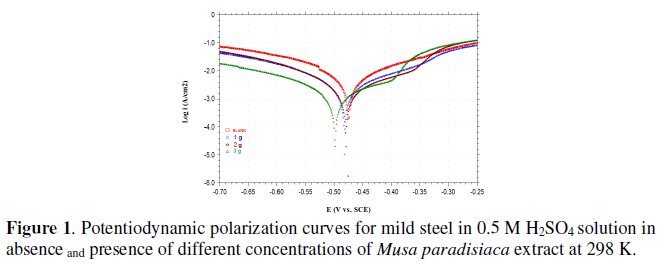
    <p>Potentiodynamic polarization curves for mild steel in 0.5 M H<sub>2</sub>SO<sub>4</sub> solutions in 
absence and presence of various concentrations of Musa paradisiaca extract at 
298 K are shown in Fig. 1.</p>

    <p>&nbsp;</p><a name="top.f1"></a>
<img src="/img/revistas/pea/v29n6/29n6a03f1.jpg">
    
<p>&nbsp;</p>


    <p>The extrapolation of Tafel straight line allows the 
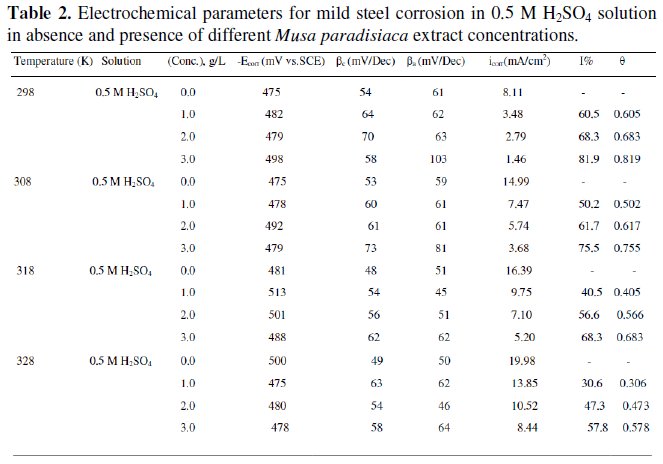
calculation of the corrosion current density (i<sub>corr</sub>). The values of i<sub>corr</sub>, corrosion 
potential (E<sub>corr</sub>), cathodic and anodic Tafel slopes (&beta;<sub>c</sub> and &beta;<sub>a</sub>) and percentage of 
inhibition efficiency (I%), are given in the Table 2.</p>

    <p>&nbsp; <a name="top.t2"></a> </p>
<img src="/img/revistas/pea/v29n6/29n6a03t2.jpg">
    
<p>&nbsp;</p>

    <p>At a given temperature, the addition of the extract of Musa paradisiaca to the 
acid solution increases both the anodic and cathodic overpotentials and decreases 
the corrosion current density (i<sub>corr</sub>). The change in cathodic and anodic Tafel 
slopes (&beta;<sub>c</sub> and &beta;<sub>a</sub>) shown in <a href="#top.t2">Table 2</a> indicates that adsorption of Musa 
paradisiaca extract modifies the mechanism of the anodic dissolution as well as 
cathodic hydrogen evolution. From <a href="#top.f1">Fig. 1</a>, it is clear that both cathodic and 
anodic reactions are inhibited, and the inhibition increases as the inhibitor 
concentration increases in acid media.</p>

    ]]></body>
<body><![CDATA[<p>From <a href="#top.t2">Table 2</a>, it is clear that there is no 
efinite trend in the shift of E<sub>corr</sub> values, in presence of various concentrations of 
Musa paradisiaca extract in 0.5 M H<sub>2</sub>SO<sub>4</sub> solutions. This result indicates that 
Musa paradisiaca extract can be classified as a mixed type of inhibitor in 0.5 M 
H<sub>2</sub>SO<sub>4</sub> solutions [19].</p>

    <p>A detailed study of steady state potentiostatic behavior of the anodic dissolution 
of mild steel in 0.5 M H<sub>2</sub>SO<sub>4</sub> in the absence and presence of various 
concentrations of the extract of Musa paradisiaca plant has been carried out in 
terms of the electrochemical parameters, e.g., critical current density (ic), Flade 
potential (Epp) and passive current density (ip). The critical current density (ic) of 
0.5 M H<sub>2</sub>SO<sub>4</sub> is found to be 363 m A cm<sup>-2</sup>, which is considerably higher than that 
of the solution having the extracts of the plant. The values of critical current 
density (ic) in the presence of the extracts are found to decrease from 308 m A 
cm<sup>-2</sup> to 134 m A cm<sup>-2</sup> on increasing in concentration from 1 g to 3 g of the 
extracts, and the passive current density (ip) values also significantly lower from 
73 m A cm<sup>-2</sup> to 24 m A cm<sup>-2</sup> on increasing in concentration of the extract from 1 
g to 3 g, in comparison to 172 m A cm<sup>-2</sup> for 0.5 M H<sub>2</sub>SO<sub>4</sub>. These results indicate 
that the extract of Musa paradisiaca is a good passivator and it is able to form 
some kind of protective film on mild steel surface which results in inhibition of 
metal dissolution.</p>


    <p><b><i>Effect of temperature</i></b></p>

    <p>The effect of temperature on the inhibition efficiency is summarized in the <a href="#top.t2">Table 2</a>.</p>

    <p>It shows that an increase in temperature decreases the inhibition efficiency. 
This can be explained on the fact that an increase in temperature usually 
accelerates corrosive processes, particularly in media in which H<sub>2</sub> gas evolution 
accompanies corrosion, giving rise to higher dissolution rates of the metal. The 
activation energies (E<sub>a</sub>) for the corrosion process in absence and presence of the 
inhibitor are evaluated from Arrhenius equation [20]:</p>

    <p>&nbsp;</p>
<img src="/img/revistas/pea/v29n6/29n6a03e4.jpg">
    
<p>&nbsp;</p>

    <p>where A is the pre-exponential factor, T is absolute temperature, R is the gas 
constant and k is the rate constant of metal dissolution reaction which is directly 
related to corrosion current density. Therefore, the equation can be rewritten as 
[21]:</p>

    <p>&nbsp;</p>
<img src="/img/revistas/pea/v29n6/29n6a03e5.jpg">
    
<p>&nbsp;</p>

    ]]></body>
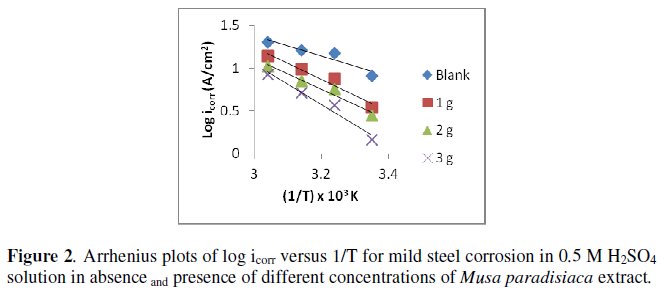
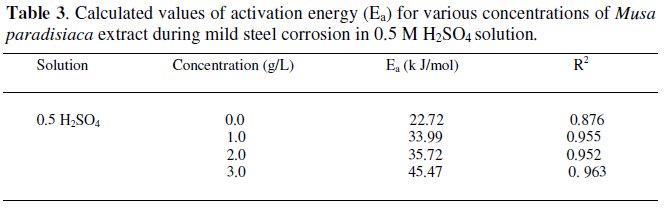
<body><![CDATA[<p>where i<sub>corr</sub> is the corrosion current density. The activation energies of corrosion 
reaction in presence and absence of the inhibitor are determined by plotting log 
i<sub>corr</sub> against 1/T, as shown in Fig. 2. The values of the activation energies are 
given in Table 3.</p>

    <p>&nbsp;</p>
<img src="/img/revistas/pea/v29n6/29n6a03f2.jpg">
    
<p>&nbsp;</p>


    <p>&nbsp;</p>
<img src="/img/revistas/pea/v29n6/29n6a03t3.jpg">
    
<p>&nbsp;</p>


    <p>The values of activation energies (E<sub>a</sub>) increased in presence of the extract at all 
the studied concentrations in 0.5 M H<sub>2</sub>SO<sub>4</sub>, which suggested that the adsorbed 
organic matters create a physical barrier to charge and mass transfer leading to 
reduction in corrosion rate [21].</p>


    <p><b><i>Adsorption isotherms</i></b></p>

    <p>Two main types of the interaction often describe adsorption of organic inhibitors 
on a corroding metal surface viz: chemical adsorption and physical adsorption. It 
has been suggested that physisorbed molecules are attached to the metal at local 
cathodes and essentially retard metal dissolution by stifling the cathodic reaction, 
whereas chemisorbed molecules protect anodic areas and reduce the inherent 
reactivity of the metal at the sites where they are attached. The more efficient 
inhibitors appear to protect anodic areas preferentially by chemisorption. 
Basic information on the interaction between the inhibitor and mild steel surface 
can be provided by the adsorption isotherms. For this purpose, the values of 
surface coverage (q) at different concentrations of Musa paradisiaca extract in 
acid media in the temperature range from 298 K to 328 K have been calculated to 
explain the best isotherm to determine the adsorption process. The value of the 
surface coverage (q) was calculated using the relationship [22]:</p>

    <p>&nbsp;</p>
<img src="/img/revistas/pea/v29n6/29n6a03e6.jpg">
    
<p>&nbsp;</p>

    ]]></body>
<body><![CDATA[<p>Attempts were made to fit these &Theta; values to various isotherms including 
Langmuir, Temkin, Frumkin, El-Awady, Freundlich, and Flory-Huggins, etc.</p>

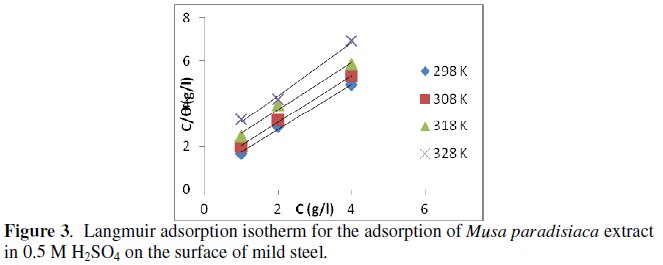
    <p>The best fit was obtained with Langmuir isotherm as suggested by the plot 
between C/&Theta; and C (as shown in Fig. 3) and the linear correlation coefficient of 
the fitted data was close to 1, indicating that the adsorption of the inhibitor 
molecules obeys the Langmuir adsorption isotherm [23-24]:</p>

    <p>&nbsp;</p>
<img src="/img/revistas/pea/v29n6/29n6a03e7.jpg">
    
<p>&nbsp;</p>

    <p>where C is the inhibitor concentration and K<sub>ads</sub> is the equilibrium constant for 
adsorption/desorption process of the inhibitor molecules on the metal surface.</p>


    <p>&nbsp;</p>
<img src="/img/revistas/pea/v29n6/29n6a03f3.jpg">
    
<p>&nbsp;</p>


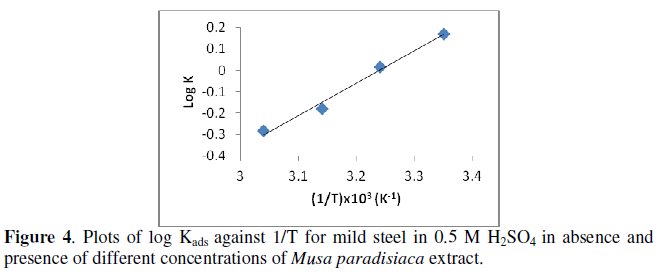
    <p>K<sub>ads</sub> values were calculated from the intercept of the plot for adsorption process. 
The adsorption equilibrium constant, K<sub>ads</sub>, is related to the standard free energy 
(&Delta;G<sup>0</sup><sub>ads</sub>) by the following equation [25]:</p> 

    <p>&nbsp;</p>
<img src="/img/revistas/pea/v29n6/29n6a03e8.jpg">
    
<p>&nbsp;</p>

    ]]></body>
<body><![CDATA[<p>The plotting of log K<sub>ads</sub> against 1/T (as shown in Fig. 4) gives the value of the 
standard free energy (&Delta;G<sup>0</sup><sub>ads</sub>) which is equal to -29.05 kJ mol<sup>-1</sup>.</p>


    <p>&nbsp;</p>
<img src="/img/revistas/pea/v29n6/29n6a03f4.jpg">
    
<p>&nbsp;</p>


    <p>The negative values of &Delta;G<sup>0</sup><sub>ads</sub> ensure 
the spontaneity of the adsorption process and the stability 
of the adsorbed layer on the mild steel surface. It is well known that values of 
&Delta;G<sup>0</sup><sub>ads</sub> of the order of -20 kJ mol<sup>-1</sup> or lower are consistent with the electrostatic 
interaction between organic molecules and metal surface, indicating a 
physisorption, and the values around -40 kJ mol<sup>-1</sup> or higher involve charge 
sharing to transfer from the organic molecules to the metal surface to form a coordinate 
type of bond, indicating a chemisorption [26]. Since calculated value of 
&Delta;G<sup>0</sup><sub>ads</sub> is 29.05 kJ mol<sup>-1</sup> which is between the values of physical adsorption and 
chemical adsorption, it probably meant that both physical and chemical 
adsorption would take place in process of adsorption [26-27].</p> 

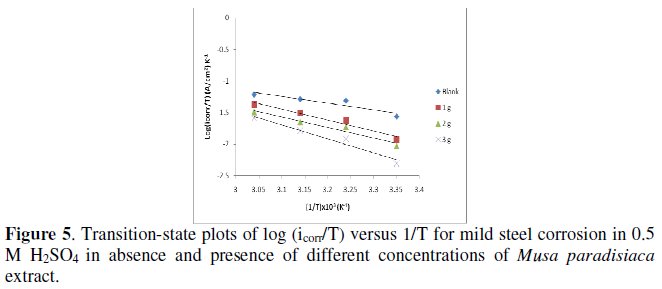
    <p>By using the transition state equation [28]:</p>

    <p>&nbsp;</p>
<img src="/img/revistas/pea/v29n6/29n6a03e9.jpg">
    
<p>&nbsp;</p>
 
    <p>where N is the Avogadro's number and h is the Plank's constant, a plot of log 
(i<sub>corr</sub>/T) against 1/T gives a straight line, as shown in Fig. 5, and the standard 
enthalpy change &Delta;H<sup>0</sup><sub>ads</sub> is evaluated from the slope and the mean value of 
standard enthalpy change (&Delta;H<sup>0</sup><sub>ads</sub>) is found to be -35.99 kJ mol<sup>-1</sup>.</p>

    <p>&nbsp;</p>
<img src="/img/revistas/pea/v29n6/29n6a03f5.jpg">
    
<p>&nbsp;</p>

    ]]></body>
<body><![CDATA[<p>The standard adsorption entropy (&Delta;S<sup>0</sup><sub>ads</sub>) is calculated by using the following equation [29]:</p>

    <p>&nbsp;</p>
<img src="/img/revistas/pea/v29n6/29n6a03e10.jpg">
    
<p>&nbsp;</p>

    <p>The value of &Delta;S<sup>0</sup><sub>ads</sub> is found to be 22.95 J mol<sup>-1</sup> K<sup>-1</sup> in presence of Musa 
paradisiaca in 0.5 M H<sub>2</sub>SO<sub>4</sub> solution, which is large and positive, meaning that 
an increase in disordering takes place in going from reactants to the metal-adsorbed species reaction complex.</p>


    <p><b><i>EIS measurements</i></b></p>

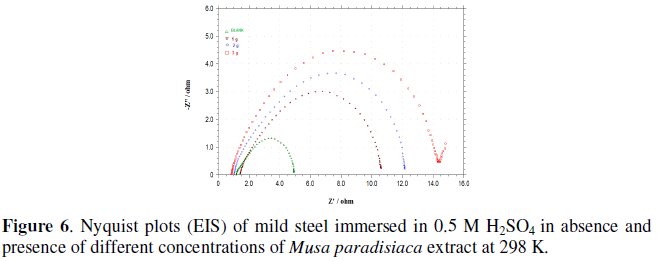
    <p>EIS technique was applied to investigate the electrode/electrolyte interface and 
corrosion processes that occur on mild steel surface in presence and absence of 
Musa paradisiaca extract. To ensure complete characterization of the interface 
and surface processes, EIS measurements were made at OCP in a wide frequency 
range at 298 K. Fig. 6 shows Nyquist plots for mild steel electrode immersed in 
0.5 M H<sub>2</sub>SO<sub>4</sub> solution at 298 K in absence and presence of various concentrations 
of the extract at the respective open circuit potential.</p>


    <p>&nbsp;</p>
<img src="/img/revistas/pea/v29n6/29n6a03f6.jpg">
    
<p>&nbsp;</p>


    <p>It is clear from Fig. 6 that 
the diameter of the semicircle increases with the increase in inhibitor 
concentration in the electrolyte, indicating an increase in corrosion resistance of 
the material.</p>

    <p>The value of electrochemical double layer capacitance (C<sub>dl</sub>) was calculated at the 
frequency, fmax using the following equation [30]:</p>

    ]]></body>
<body><![CDATA[<p>&nbsp;</p>
<img src="/img/revistas/pea/v29n6/29n6a03e11.jpg">
    
<p>&nbsp;</p>

    <p>where fmax is the frequency at which the imaginary component of the impedance 
is maximal.</p>

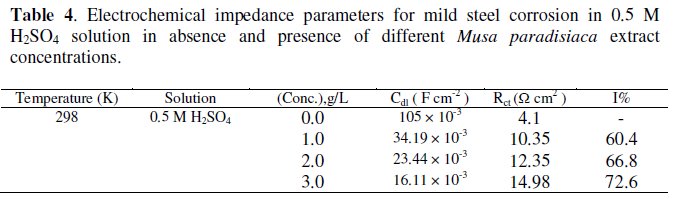
    <p>The impedance data listed in the Table 4 indicate that the values of both R<sub>ct</sub> and 
I% are found to increase by increasing in inhibitor concentration, while the 
values of C<sub>dl</sub> are found to decrease.</p>

    <p>&nbsp;</p>
<img src="/img/revistas/pea/v29n6/29n6a03t4.jpg">
    
<p>&nbsp;</p>

    <p>This behavior can be attributed to a decrease 
in the dielectric constant and/ or an increase in the thickness of the electric 
double layer, suggesting that the inhibitor molecules act by adsorption 
mechanism at mild steel/acid interface [30].</p>


    <p><b><i>Scanning electron microscopy studies</i></b></p>

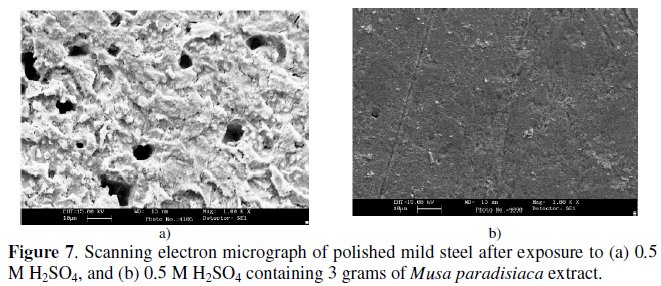
    <p>SEM micrograms of the polished surface of mild steel exposed for 5 hours in 0.5 
M H<sub>2</sub>SO<sub>4</sub> solutions in absence and presence of 3 grams of Musa paradisiaca 
extract are shown in Fig. 7 (a)-(b).</p>


    <p>&nbsp;</p>
<img src="/img/revistas/pea/v29n6/29n6a03f7.jpg">
    
]]></body>
<body><![CDATA[<p>&nbsp;</p>


    <p>In the comparison of the SEM micrograms, 
there were a rough surface on mild steel in absence of the extract and a smooth 
surface with deposited extract in presence of the extract [31]. This confirms that 
the extract inhibited corrosion of mild steel through adsorption of the inhibitor 
molecules on metal surface.</p>


    <p><b><i>Atomic force microscopy (AFM) studies</i></b></p>

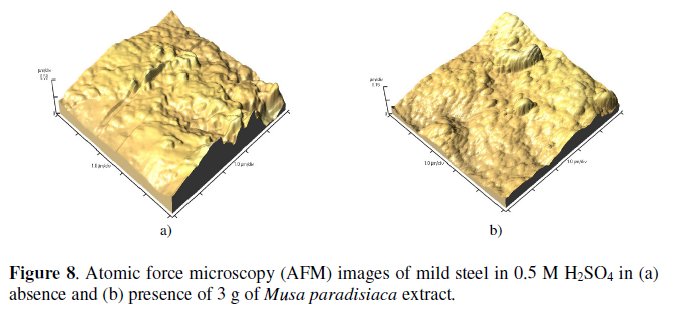
    <p>AFM images of mild steel exposed for 5 hours in 0.5 M H<sub>2</sub>SO<sub>4</sub> solutions in 
absence and presence of 1 gram of extract are shown in Fig. 8 (a)-(b).</p>


    <p>&nbsp;</p>
<img src="/img/revistas/pea/v29n6/29n6a03f8.jpg">
    
<p>&nbsp;</p>

    <p>The roughness of mild steel coupons in 0.5 M H<sub>2</sub>SO<sub>4</sub> solutions in absence and 
presence of the extract are 152.9 nm and 56.99 nm, respectively [32]. This 
indicates that the addition of the extract reduced the surface roughness. AFM 
images and the roughness quantification are also consistent with SEM studies. 
This confirms that the corrosion inhibition on mild steel occurs through 
adsorption of the extract on it.</p>


    <p>&nbsp;</p>
    <p><b>Conclusions</b></p>

    <p>1. The inhibition efficiency of Musa paradisiaca extract on corrosion of mild 
steel in 0.5 M H<sub>2</sub>SO<sub>4</sub> solution increases on increasing of concentration of the 
extract and decreases with rise in temperature. Potentiodynamic polarization 
measurements show that Musa paradisiaca acts as a mixed type inhibitor.</p>

    ]]></body>
<body><![CDATA[<p>2. Adsorption of inhibitor molecules of the extract on mild steel surface is found 
to obey Langmuir adsorption isotherm. The increase in the values of 
activation energies of the corrosion process in presence of the extract 
indicates that Musa paradisiaca extract creates a physical barrier to charge 
and mass transfer, leading to reduction in corrosion rate of mild steel in 0.5 M 
H<sub>2</sub>SO<sub>4</sub> solution. The negative values of &Delta;G<sup>0</sup><sub>ads</sub> 
and &Delta;H<sup>0</sup><sub>ads</sub> highlight that the inhibition of corrosion 
of mild steel through adsorption is spontaneous and 
exothermic. Their values also reveal that both physical adsorption and 
chemisorption are involved in the adsorption process.</p>

    <p>3. EIS measurement reveals that charge transfer resistance increases with 
increase in concentration of the extract, indicating that the inhibition increases 
with increase in concentrations.</p>

    <p>4. SEM and AFM studies confirm that corrosion inhibition of mild steel in 0.5 M 
H<sub>2</sub>SO<sub>4</sub> is due to adsorption of the extract on it.</p>


    <p>&nbsp;</p>
    <p><b>References</b></p>

    <!-- ref --><p>1. M.A. Quraishi, A. Singh, V.K. Singh et all, Mater. Chem. Phys.122 (2010) 114.    &nbsp;&nbsp;&nbsp;&nbsp;&nbsp;&nbsp;&nbsp;&nbsp;[&#160;<a href="javascript:void(0);" onclick="javascript: window.open('/scielo.php?script=sci_nlinks&ref=000128&pid=S0872-1904201100060000300001&lng=','','width=640,height=500,resizable=yes,scrollbars=1,menubar=yes,');">Links</a>&#160;]<!-- end-ref --></p>
    <!-- ref --><p>2. L.R. Chauhan, G. Gunasekaran, Corros. Sci. 49 (2007) 1143.    &nbsp;&nbsp;&nbsp;&nbsp;&nbsp;&nbsp;&nbsp;&nbsp;[&#160;<a href="javascript:void(0);" onclick="javascript: window.open('/scielo.php?script=sci_nlinks&ref=000130&pid=S0872-1904201100060000300002&lng=','','width=640,height=500,resizable=yes,scrollbars=1,menubar=yes,');">Links</a>&#160;]<!-- end-ref --></p>
    <!-- ref --><p>3. J.C. Rocha, J.A.C.P. Gomes, E. D'Elia, Corros. Sci. 52 (2010) 2341.    &nbsp;&nbsp;&nbsp;&nbsp;&nbsp;&nbsp;&nbsp;&nbsp;[&#160;<a href="javascript:void(0);" onclick="javascript: window.open('/scielo.php?script=sci_nlinks&ref=000132&pid=S0872-1904201100060000300003&lng=','','width=640,height=500,resizable=yes,scrollbars=1,menubar=yes,');">Links</a>&#160;]<!-- end-ref --></p>
    <!-- ref --><p>4. A. Ostavari, S.M. Hoseinieh, M. Peikari, S.R. Shadizadeh, S.J. Hashemi, Corros. Sci. 51 (2009) 1935.    &nbsp;&nbsp;&nbsp;&nbsp;&nbsp;&nbsp;&nbsp;&nbsp;[&#160;<a href="javascript:void(0);" onclick="javascript: window.open('/scielo.php?script=sci_nlinks&ref=000134&pid=S0872-1904201100060000300004&lng=','','width=640,height=500,resizable=yes,scrollbars=1,menubar=yes,');">Links</a>&#160;]<!-- end-ref --></p>
    <!-- ref --><p>5. H. Ashassi-Sorkhabi, E. Asghari, Electrochim. Acta 54 (2008) 1578.    &nbsp;&nbsp;&nbsp;&nbsp;&nbsp;&nbsp;&nbsp;&nbsp;[&#160;<a href="javascript:void(0);" onclick="javascript: window.open('/scielo.php?script=sci_nlinks&ref=000136&pid=S0872-1904201100060000300005&lng=','','width=640,height=500,resizable=yes,scrollbars=1,menubar=yes,');">Links</a>&#160;]<!-- end-ref --></p>
    <!-- ref --><p>6. L.G. Trindade, R.S. Goncalves, Corros. Sci. 51 (2009) 1578.    &nbsp;&nbsp;&nbsp;&nbsp;&nbsp;&nbsp;&nbsp;&nbsp;[&#160;<a href="javascript:void(0);" onclick="javascript: window.open('/scielo.php?script=sci_nlinks&ref=000138&pid=S0872-1904201100060000300006&lng=','','width=640,height=500,resizable=yes,scrollbars=1,menubar=yes,');">Links</a>&#160;]<!-- end-ref --></p>
    <!-- ref --><p>7. A.Y. El-Etre, Appl. Surf. Sci. 252 (2006) 8521.    &nbsp;&nbsp;&nbsp;&nbsp;&nbsp;&nbsp;&nbsp;&nbsp;[&#160;<a href="javascript:void(0);" onclick="javascript: window.open('/scielo.php?script=sci_nlinks&ref=000140&pid=S0872-1904201100060000300007&lng=','','width=640,height=500,resizable=yes,scrollbars=1,menubar=yes,');">Links</a>&#160;]<!-- end-ref --></p>
    <!-- ref --><p>8. A.M. Abdel-Gaber, B.A. Abd-El-Nabey, M. Saadawy et all, Corros. Sci. 48 (2006) 2765.    &nbsp;&nbsp;&nbsp;&nbsp;&nbsp;&nbsp;&nbsp;&nbsp;[&#160;<a href="javascript:void(0);" onclick="javascript: window.open('/scielo.php?script=sci_nlinks&ref=000142&pid=S0872-1904201100060000300008&lng=','','width=640,height=500,resizable=yes,scrollbars=1,menubar=yes,');">Links</a>&#160;]<!-- end-ref --></p>
    <!-- ref --><p>9. E.E. Oguzie, Mater. Chem. Phys.99 (2006) 441.    &nbsp;&nbsp;&nbsp;&nbsp;&nbsp;&nbsp;&nbsp;&nbsp;[&#160;<a href="javascript:void(0);" onclick="javascript: window.open('/scielo.php?script=sci_nlinks&ref=000144&pid=S0872-1904201100060000300009&lng=','','width=640,height=500,resizable=yes,scrollbars=1,menubar=yes,');">Links</a>&#160;]<!-- end-ref --></p>
    <!-- ref --><p>10. P.B. Raja, M.G. Sethuraman, Mater. Letter 62 (2008) 2977.    &nbsp;&nbsp;&nbsp;&nbsp;&nbsp;&nbsp;&nbsp;&nbsp;[&#160;<a href="javascript:void(0);" onclick="javascript: window.open('/scielo.php?script=sci_nlinks&ref=000146&pid=S0872-1904201100060000300010&lng=','','width=640,height=500,resizable=yes,scrollbars=1,menubar=yes,');">Links</a>&#160;]<!-- end-ref --></p>
    <!-- ref --><p>11. P.C. Okafor, M.E. Ikpi, I.E. Uwah et all, Corros. Sci. 50 (2008) 2310.    &nbsp;&nbsp;&nbsp;&nbsp;&nbsp;&nbsp;&nbsp;&nbsp;[&#160;<a href="javascript:void(0);" onclick="javascript: window.open('/scielo.php?script=sci_nlinks&ref=000148&pid=S0872-1904201100060000300011&lng=','','width=640,height=500,resizable=yes,scrollbars=1,menubar=yes,');">Links</a>&#160;]<!-- end-ref --></p>
    <!-- ref --><p>12. A.M. Abdel-Gaber, B.A. Abd-El-Nabey, M.Saadawy, Corros. Sci. 51 (2009) 1038.    &nbsp;&nbsp;&nbsp;&nbsp;&nbsp;&nbsp;&nbsp;&nbsp;[&#160;<a href="javascript:void(0);" onclick="javascript: window.open('/scielo.php?script=sci_nlinks&ref=000150&pid=S0872-1904201100060000300012&lng=','','width=640,height=500,resizable=yes,scrollbars=1,menubar=yes,');">Links</a>&#160;]<!-- end-ref --></p>
    <!-- ref --><p>13. K.O. Orubite, N.C. Oforka, Corros. Sci. 58 (2004) 1768.    &nbsp;&nbsp;&nbsp;&nbsp;&nbsp;&nbsp;&nbsp;&nbsp;[&#160;<a href="javascript:void(0);" onclick="javascript: window.open('/scielo.php?script=sci_nlinks&ref=000152&pid=S0872-1904201100060000300013&lng=','','width=640,height=500,resizable=yes,scrollbars=1,menubar=yes,');">Links</a>&#160;]<!-- end-ref --></p>
    <!-- ref --><p>14. A.O. Odiongenyi, S.A. Odoemelam, N.O.Eddy, Port. Electrochim. Acta 27 (2009) 33.    &nbsp;&nbsp;&nbsp;&nbsp;&nbsp;&nbsp;&nbsp;&nbsp;[&#160;<a href="javascript:void(0);" onclick="javascript: window.open('/scielo.php?script=sci_nlinks&ref=000154&pid=S0872-1904201100060000300014&lng=','','width=640,height=500,resizable=yes,scrollbars=1,menubar=yes,');">Links</a>&#160;]<!-- end-ref --></p>
    <!-- ref --><p>15. S.K. Singh, A.N. Kesai, P.K. Rai, G. Watal, Ind. J. Clinical Biochem. 22 (2007) 48.    &nbsp;&nbsp;&nbsp;&nbsp;&nbsp;&nbsp;&nbsp;&nbsp;[&#160;<a href="javascript:void(0);" onclick="javascript: window.open('/scielo.php?script=sci_nlinks&ref=000156&pid=S0872-1904201100060000300015&lng=','','width=640,height=500,resizable=yes,scrollbars=1,menubar=yes,');">Links</a>&#160;]<!-- end-ref --></p>
    <!-- ref --><p>16. S. Ghareba, S. Omanovic, Corros. Sci. 52 (2010) 2104.    &nbsp;&nbsp;&nbsp;&nbsp;&nbsp;&nbsp;&nbsp;&nbsp;[&#160;<a href="javascript:void(0);" onclick="javascript: window.open('/scielo.php?script=sci_nlinks&ref=000158&pid=S0872-1904201100060000300016&lng=','','width=640,height=500,resizable=yes,scrollbars=1,menubar=yes,');">Links</a>&#160;]<!-- end-ref --></p>
    <!-- ref --><p>17. C. Jeyaprabha, S. Sathiyanarayanan, K.L.N. Phani, G. Venkatachari, Appl. Surf. Sci. 252 (2005) 966.    &nbsp;&nbsp;&nbsp;&nbsp;&nbsp;&nbsp;&nbsp;&nbsp;[&#160;<a href="javascript:void(0);" onclick="javascript: window.open('/scielo.php?script=sci_nlinks&ref=000160&pid=S0872-1904201100060000300017&lng=','','width=640,height=500,resizable=yes,scrollbars=1,menubar=yes,');">Links</a>&#160;]<!-- end-ref --></p>
    <!-- ref --><p>18. A. Yurt, V. Butun, B. Duran, Mater. Chem. Phys.105 (2007) 114.    &nbsp;&nbsp;&nbsp;&nbsp;&nbsp;&nbsp;&nbsp;&nbsp;[&#160;<a href="javascript:void(0);" onclick="javascript: window.open('/scielo.php?script=sci_nlinks&ref=000162&pid=S0872-1904201100060000300018&lng=','','width=640,height=500,resizable=yes,scrollbars=1,menubar=yes,');">Links</a>&#160;]<!-- end-ref --></p>
    <!-- ref --><p>19. A.K Satapathy, G. Gunasekaran, S.C. Sahoo et all, Corros. Sci. 51 (2009) 2848.    &nbsp;&nbsp;&nbsp;&nbsp;&nbsp;&nbsp;&nbsp;&nbsp;[&#160;<a href="javascript:void(0);" onclick="javascript: window.open('/scielo.php?script=sci_nlinks&ref=000164&pid=S0872-1904201100060000300019&lng=','','width=640,height=500,resizable=yes,scrollbars=1,menubar=yes,');">Links</a>&#160;]<!-- end-ref --></p>
    <!-- ref --><p>20. A.Y. El-Etre, Corros. Sci. 45 (2003) 2485.    &nbsp;&nbsp;&nbsp;&nbsp;&nbsp;&nbsp;&nbsp;&nbsp;[&#160;<a href="javascript:void(0);" onclick="javascript: window.open('/scielo.php?script=sci_nlinks&ref=000166&pid=S0872-1904201100060000300020&lng=','','width=640,height=500,resizable=yes,scrollbars=1,menubar=yes,');">Links</a>&#160;]<!-- end-ref --></p>
    <p>21. A.M. Fekry, Riham R. Mohamed, Electrochim. Acta 55 (2010) 1933.</p>
    <!-- ref --><p>22. G. Achary, Y.A. Naik, S.V. Kumar, T.V. Venkatesha, B.S. Sherigara, Appl. Surf. Sci. 254 (2008) 5569.    &nbsp;&nbsp;&nbsp;&nbsp;&nbsp;&nbsp;&nbsp;&nbsp;[&#160;<a href="javascript:void(0);" onclick="javascript: window.open('/scielo.php?script=sci_nlinks&ref=000169&pid=S0872-1904201100060000300022&lng=','','width=640,height=500,resizable=yes,scrollbars=1,menubar=yes,');">Links</a>&#160;]<!-- end-ref --></p>
    <!-- ref --><p>23. K. Babic-Samardzija, C. Lupu, N. Hackerman, A.R. Barron, J. Mater. Chem. 15 (2005) 1908.    &nbsp;&nbsp;&nbsp;&nbsp;&nbsp;&nbsp;&nbsp;&nbsp;[&#160;<a href="javascript:void(0);" onclick="javascript: window.open('/scielo.php?script=sci_nlinks&ref=000171&pid=S0872-1904201100060000300023&lng=','','width=640,height=500,resizable=yes,scrollbars=1,menubar=yes,');">Links</a>&#160;]<!-- end-ref --></p>
    ]]></body>
<body><![CDATA[<!-- ref --><p>24. O.K. Abiola, A.O. James, Corros. Sci. 52 (2010) 661.    &nbsp;&nbsp;&nbsp;&nbsp;&nbsp;&nbsp;&nbsp;&nbsp;[&#160;<a href="javascript:void(0);" onclick="javascript: window.open('/scielo.php?script=sci_nlinks&ref=000173&pid=S0872-1904201100060000300024&lng=','','width=640,height=500,resizable=yes,scrollbars=1,menubar=yes,');">Links</a>&#160;]<!-- end-ref --></p>
    <!-- ref --><p>25. G. Moretti, F. Guidi, G. Grion, Corros. Sci. 46 (2004) 387.    &nbsp;&nbsp;&nbsp;&nbsp;&nbsp;&nbsp;&nbsp;&nbsp;[&#160;<a href="javascript:void(0);" onclick="javascript: window.open('/scielo.php?script=sci_nlinks&ref=000175&pid=S0872-1904201100060000300025&lng=','','width=640,height=500,resizable=yes,scrollbars=1,menubar=yes,');">Links</a>&#160;]<!-- end-ref --></p>
    <!-- ref --><p>26. Z. Tao, S. Zhang, W. Li, Ba. Hou, Ind. Eng. Chem. Res. 49 (2010) 2593.    &nbsp;&nbsp;&nbsp;&nbsp;&nbsp;&nbsp;&nbsp;&nbsp;[&#160;<a href="javascript:void(0);" onclick="javascript: window.open('/scielo.php?script=sci_nlinks&ref=000177&pid=S0872-1904201100060000300026&lng=','','width=640,height=500,resizable=yes,scrollbars=1,menubar=yes,');">Links</a>&#160;]<!-- end-ref --></p>
    <p>27. C. Liang, P.Wang, B.Wu an N. Huang, Mater. Corros. 62 (2011) 53.</p>
    <p>28. S.M.A. Hosseini, M. Salari and M. Ghasemi, Mater. Corros. 60 (2009) 963.</p>
    <!-- ref --><p>29. M.A. Deyad, S.S. Abd El-Rehim, S.T. Keera, Colloids Surf. A: Physicochem. Eng. Asp. 348 (2009) 170.    &nbsp;&nbsp;&nbsp;&nbsp;&nbsp;&nbsp;&nbsp;&nbsp;[&#160;<a href="javascript:void(0);" onclick="javascript: window.open('/scielo.php?script=sci_nlinks&ref=000181&pid=S0872-1904201100060000300029&lng=','','width=640,height=500,resizable=yes,scrollbars=1,menubar=yes,');">Links</a>&#160;]<!-- end-ref --></p>
    ]]></body>
<body><![CDATA[<!-- ref --><p>30. M.A. Migahed, A.M. Abdul-Raheim, A.M. Atta, W. Brostow, Mater. Chem. Phys. 121 (2010) 208.    &nbsp;&nbsp;&nbsp;&nbsp;&nbsp;&nbsp;&nbsp;&nbsp;[&#160;<a href="javascript:void(0);" onclick="javascript: window.open('/scielo.php?script=sci_nlinks&ref=000183&pid=S0872-1904201100060000300030&lng=','','width=640,height=500,resizable=yes,scrollbars=1,menubar=yes,');">Links</a>&#160;]<!-- end-ref --></p>
    <!-- ref --><p>31. D. Cetin, M.L. Aksu, Corros. Sci. 51 (2009) 1584.    &nbsp;&nbsp;&nbsp;&nbsp;&nbsp;&nbsp;&nbsp;&nbsp;[&#160;<a href="javascript:void(0);" onclick="javascript: window.open('/scielo.php?script=sci_nlinks&ref=000185&pid=S0872-1904201100060000300031&lng=','','width=640,height=500,resizable=yes,scrollbars=1,menubar=yes,');">Links</a>&#160;]<!-- end-ref --></p>
    <!-- ref --><p>32. X. Sheng, Y.-P. Ting, S.O. Pehkaonen, Ind. Eng. Chem. Res. 46 (2007) 7117.    &nbsp;&nbsp;&nbsp;&nbsp;&nbsp;&nbsp;&nbsp;&nbsp;[&#160;<a href="javascript:void(0);" onclick="javascript: window.open('/scielo.php?script=sci_nlinks&ref=000187&pid=S0872-1904201100060000300032&lng=','','width=640,height=500,resizable=yes,scrollbars=1,menubar=yes,');">Links</a>&#160;]<!-- end-ref --></p>


    <p>&nbsp;</p>
    <p><b>Acknowledgement</b></p>

    <p>Authors are very thankful to University Grants Commission, India, for financial 
support for this research work.</p> 

    <p><a name=0></a><sup><a href="#top">*</a></sup> Corresponding author. E-mail address: <a href="mailto:ramananda2002@yahoo.co.in">ramananda2002@yahoo.co.in</a></p>

    ]]></body>
<body><![CDATA[<p>Received 19 February 2011; accepted 22 December 2011</p>

    <p><a href="http://www.peacta.org" target="_blank">www.peacta.org</a> </p>


     ]]></body><back>
<ref-list>
<ref id="B1">
<label>1</label><nlm-citation citation-type="journal">
<person-group person-group-type="author">
<name>
<surname><![CDATA[Quraishi]]></surname>
<given-names><![CDATA[M.A.]]></given-names>
</name>
<name>
<surname><![CDATA[Singh]]></surname>
<given-names><![CDATA[A.]]></given-names>
</name>
<name>
<surname><![CDATA[Singh]]></surname>
<given-names><![CDATA[V.K.]]></given-names>
</name>
</person-group>
<source><![CDATA[Mater. Chem. Phys.]]></source>
<year>2010</year>
<volume>122</volume>
<page-range>114</page-range></nlm-citation>
</ref>
<ref id="B2">
<label>2</label><nlm-citation citation-type="journal">
<person-group person-group-type="author">
<name>
<surname><![CDATA[Chauhan]]></surname>
<given-names><![CDATA[L.R.]]></given-names>
</name>
<name>
<surname><![CDATA[Gunasekaran]]></surname>
<given-names><![CDATA[G.]]></given-names>
</name>
</person-group>
<source><![CDATA[Corros. Sci.]]></source>
<year>2007</year>
<volume>49</volume>
<page-range>1143</page-range></nlm-citation>
</ref>
<ref id="B3">
<label>3</label><nlm-citation citation-type="journal">
<person-group person-group-type="author">
<name>
<surname><![CDATA[Rocha]]></surname>
<given-names><![CDATA[J.C.]]></given-names>
</name>
<name>
<surname><![CDATA[Gomes]]></surname>
<given-names><![CDATA[J.A.C.P.]]></given-names>
</name>
<name>
<surname><![CDATA[D'Elia]]></surname>
<given-names><![CDATA[E.]]></given-names>
</name>
</person-group>
<source><![CDATA[Corros. Sci.]]></source>
<year>2010</year>
<volume>52</volume>
<page-range>2341</page-range></nlm-citation>
</ref>
<ref id="B4">
<label>4</label><nlm-citation citation-type="journal">
<person-group person-group-type="author">
<name>
<surname><![CDATA[Ostavari]]></surname>
<given-names><![CDATA[A.]]></given-names>
</name>
<name>
<surname><![CDATA[Hoseinieh]]></surname>
<given-names><![CDATA[S.M.]]></given-names>
</name>
<name>
<surname><![CDATA[Peikari]]></surname>
<given-names><![CDATA[M.]]></given-names>
</name>
</person-group>
<source><![CDATA[Corros. Sci.]]></source>
<year>2009</year>
<volume>51</volume>
<page-range>1935</page-range></nlm-citation>
</ref>
<ref id="B5">
<label>5</label><nlm-citation citation-type="journal">
<person-group person-group-type="author">
<name>
<surname><![CDATA[Ashassi-Sorkhabi]]></surname>
<given-names><![CDATA[H.]]></given-names>
</name>
<name>
<surname><![CDATA[Asghari]]></surname>
<given-names><![CDATA[E.]]></given-names>
</name>
</person-group>
<source><![CDATA[Electrochim. Acta]]></source>
<year>2008</year>
<volume>54</volume>
<page-range>1578</page-range></nlm-citation>
</ref>
<ref id="B6">
<label>6</label><nlm-citation citation-type="journal">
<person-group person-group-type="author">
<name>
<surname><![CDATA[Trindade]]></surname>
<given-names><![CDATA[L.G.]]></given-names>
</name>
<name>
<surname><![CDATA[Goncalves]]></surname>
<given-names><![CDATA[R.S.]]></given-names>
</name>
</person-group>
<source><![CDATA[Corros. Sci.]]></source>
<year>2009</year>
<volume>51</volume>
<page-range>1578</page-range></nlm-citation>
</ref>
<ref id="B7">
<label>7</label><nlm-citation citation-type="journal">
<person-group person-group-type="author">
<name>
<surname><![CDATA[El-Etre]]></surname>
<given-names><![CDATA[A.Y.]]></given-names>
</name>
</person-group>
<source><![CDATA[Appl. Surf. Sci.]]></source>
<year>2006</year>
<volume>252</volume>
<page-range>8521</page-range></nlm-citation>
</ref>
<ref id="B8">
<label>8</label><nlm-citation citation-type="journal">
<person-group person-group-type="author">
<name>
<surname><![CDATA[Abdel-Gaber]]></surname>
<given-names><![CDATA[A.M.]]></given-names>
</name>
<name>
<surname><![CDATA[Abd-El-Nabey]]></surname>
<given-names><![CDATA[B.A.]]></given-names>
</name>
<name>
<surname><![CDATA[Saadawy]]></surname>
<given-names><![CDATA[M.]]></given-names>
</name>
</person-group>
<source><![CDATA[Corros. Sci.]]></source>
<year>2006</year>
<volume>48</volume>
<page-range>2765</page-range></nlm-citation>
</ref>
<ref id="B9">
<label>9</label><nlm-citation citation-type="journal">
<person-group person-group-type="author">
<name>
<surname><![CDATA[Oguzie]]></surname>
<given-names><![CDATA[E.E.]]></given-names>
</name>
</person-group>
<source><![CDATA[Mater. Chem. Phys.]]></source>
<year>2006</year>
<volume>99</volume>
<page-range>441</page-range></nlm-citation>
</ref>
<ref id="B10">
<label>10</label><nlm-citation citation-type="journal">
<person-group person-group-type="author">
<name>
<surname><![CDATA[Raja]]></surname>
<given-names><![CDATA[P.B.]]></given-names>
</name>
<name>
<surname><![CDATA[Sethuraman]]></surname>
<given-names><![CDATA[M.G.]]></given-names>
</name>
</person-group>
<source><![CDATA[Mater. Letter]]></source>
<year>2008</year>
<volume>62</volume>
<page-range>2977</page-range></nlm-citation>
</ref>
<ref id="B11">
<label>11</label><nlm-citation citation-type="journal">
<person-group person-group-type="author">
<name>
<surname><![CDATA[Okafor]]></surname>
<given-names><![CDATA[P.C.]]></given-names>
</name>
<name>
<surname><![CDATA[Ikpi]]></surname>
<given-names><![CDATA[M.E.]]></given-names>
</name>
<name>
<surname><![CDATA[Uwah]]></surname>
<given-names><![CDATA[I.E.]]></given-names>
</name>
</person-group>
<source><![CDATA[Corros. Sci.]]></source>
<year>2008</year>
<volume>50</volume>
<page-range>2310</page-range></nlm-citation>
</ref>
<ref id="B12">
<label>12</label><nlm-citation citation-type="journal">
<person-group person-group-type="author">
<name>
<surname><![CDATA[Abdel-Gaber]]></surname>
<given-names><![CDATA[A.M.]]></given-names>
</name>
<name>
<surname><![CDATA[Abd-El-Nabey]]></surname>
<given-names><![CDATA[B.A.]]></given-names>
</name>
<name>
<surname><![CDATA[Saadawy]]></surname>
<given-names><![CDATA[M.]]></given-names>
</name>
</person-group>
<source><![CDATA[Corros. Sci.]]></source>
<year>2009</year>
<volume>51</volume>
<page-range>1038</page-range></nlm-citation>
</ref>
<ref id="B13">
<label>13</label><nlm-citation citation-type="journal">
<person-group person-group-type="author">
<name>
<surname><![CDATA[Orubite]]></surname>
<given-names><![CDATA[K.O.]]></given-names>
</name>
<name>
<surname><![CDATA[Oforka]]></surname>
<given-names><![CDATA[N.C.]]></given-names>
</name>
</person-group>
<source><![CDATA[Corros. Sci.]]></source>
<year>2004</year>
<volume>58</volume>
<page-range>1768</page-range></nlm-citation>
</ref>
<ref id="B14">
<label>14</label><nlm-citation citation-type="journal">
<person-group person-group-type="author">
<name>
<surname><![CDATA[Odiongenyi]]></surname>
<given-names><![CDATA[A.O.]]></given-names>
</name>
<name>
<surname><![CDATA[Odoemelam]]></surname>
<given-names><![CDATA[S.A.]]></given-names>
</name>
<name>
<surname><![CDATA[Eddy]]></surname>
<given-names><![CDATA[N.O.]]></given-names>
</name>
</person-group>
<source><![CDATA[Port. Electrochim. Acta]]></source>
<year>2009</year>
<volume>27</volume>
<page-range>33</page-range></nlm-citation>
</ref>
<ref id="B15">
<label>15</label><nlm-citation citation-type="journal">
<person-group person-group-type="author">
<name>
<surname><![CDATA[Singh]]></surname>
<given-names><![CDATA[S.K.]]></given-names>
</name>
<name>
<surname><![CDATA[Kesai]]></surname>
<given-names><![CDATA[A.N.]]></given-names>
</name>
<name>
<surname><![CDATA[Rai]]></surname>
<given-names><![CDATA[P.K.]]></given-names>
</name>
</person-group>
<source><![CDATA[Ind. J. Clinical Biochem.]]></source>
<year>2007</year>
<volume>22</volume>
<page-range>48</page-range></nlm-citation>
</ref>
<ref id="B16">
<label>16</label><nlm-citation citation-type="journal">
<person-group person-group-type="author">
<name>
<surname><![CDATA[Ghareba]]></surname>
<given-names><![CDATA[S.]]></given-names>
</name>
<name>
<surname><![CDATA[Omanovic]]></surname>
<given-names><![CDATA[S.]]></given-names>
</name>
</person-group>
<source><![CDATA[Corros. Sci.]]></source>
<year>2010</year>
<volume>52</volume>
<page-range>2104</page-range></nlm-citation>
</ref>
<ref id="B17">
<label>17</label><nlm-citation citation-type="journal">
<person-group person-group-type="author">
<name>
<surname><![CDATA[Jeyaprabha]]></surname>
<given-names><![CDATA[C.]]></given-names>
</name>
<name>
<surname><![CDATA[Sathiyanarayanan]]></surname>
<given-names><![CDATA[S.]]></given-names>
</name>
<name>
<surname><![CDATA[Phani]]></surname>
<given-names><![CDATA[K.L.N.]]></given-names>
</name>
</person-group>
<source><![CDATA[Appl. Surf. Sci.]]></source>
<year>2005</year>
<volume>252</volume>
<page-range>966</page-range></nlm-citation>
</ref>
<ref id="B18">
<label>18</label><nlm-citation citation-type="journal">
<person-group person-group-type="author">
<name>
<surname><![CDATA[Yurt]]></surname>
<given-names><![CDATA[A.]]></given-names>
</name>
<name>
<surname><![CDATA[Butun]]></surname>
<given-names><![CDATA[V.]]></given-names>
</name>
<name>
<surname><![CDATA[Duran]]></surname>
<given-names><![CDATA[B.]]></given-names>
</name>
</person-group>
<source><![CDATA[Mater. Chem. Phys.]]></source>
<year>2007</year>
<volume>105</volume>
<page-range>114</page-range></nlm-citation>
</ref>
<ref id="B19">
<label>19</label><nlm-citation citation-type="journal">
<person-group person-group-type="author">
<name>
<surname><![CDATA[Satapathy]]></surname>
<given-names><![CDATA[A.K.]]></given-names>
</name>
<name>
<surname><![CDATA[Gunasekaran]]></surname>
<given-names><![CDATA[G.]]></given-names>
</name>
<name>
<surname><![CDATA[Sahoo]]></surname>
<given-names><![CDATA[S.C.]]></given-names>
</name>
</person-group>
<source><![CDATA[Corros. Sci.]]></source>
<year>2009</year>
<volume>51</volume>
<page-range>2848</page-range></nlm-citation>
</ref>
<ref id="B20">
<label>20</label><nlm-citation citation-type="journal">
<person-group person-group-type="author">
<name>
<surname><![CDATA[El-Etre]]></surname>
<given-names><![CDATA[A.Y.]]></given-names>
</name>
</person-group>
<source><![CDATA[Corros. Sci.]]></source>
<year>2003</year>
<volume>45</volume>
<page-range>2485</page-range></nlm-citation>
</ref>
<ref id="B21">
<label>21</label><nlm-citation citation-type="journal">
<person-group person-group-type="author">
<name>
<surname><![CDATA[Fekry]]></surname>
<given-names><![CDATA[A.M.]]></given-names>
</name>
<name>
<surname><![CDATA[Mohamed]]></surname>
<given-names><![CDATA[R.R.]]></given-names>
</name>
</person-group>
<source><![CDATA[Electrochim. Acta]]></source>
<year>2010</year>
<volume>55</volume>
<page-range>1933</page-range></nlm-citation>
</ref>
<ref id="B22">
<label>22</label><nlm-citation citation-type="journal">
<person-group person-group-type="author">
<name>
<surname><![CDATA[Achary]]></surname>
<given-names><![CDATA[G.]]></given-names>
</name>
<name>
<surname><![CDATA[Naik]]></surname>
<given-names><![CDATA[Y.A.]]></given-names>
</name>
<name>
<surname><![CDATA[Kumar]]></surname>
<given-names><![CDATA[S.V.]]></given-names>
</name>
</person-group>
<source><![CDATA[Appl. Surf. Sci.]]></source>
<year>2008</year>
<volume>254</volume>
<page-range>5569</page-range></nlm-citation>
</ref>
<ref id="B23">
<label>23</label><nlm-citation citation-type="journal">
<person-group person-group-type="author">
<name>
<surname><![CDATA[Babic-Samardzija]]></surname>
<given-names><![CDATA[K.]]></given-names>
</name>
<name>
<surname><![CDATA[Lupu]]></surname>
<given-names><![CDATA[C.]]></given-names>
</name>
<name>
<surname><![CDATA[Hackerman]]></surname>
<given-names><![CDATA[N.]]></given-names>
</name>
</person-group>
<source><![CDATA[J. Mater. Chem.]]></source>
<year>2005</year>
<volume>15</volume>
<page-range>1908</page-range></nlm-citation>
</ref>
<ref id="B24">
<label>24</label><nlm-citation citation-type="journal">
<person-group person-group-type="author">
<name>
<surname><![CDATA[Abiola]]></surname>
<given-names><![CDATA[O.K.]]></given-names>
</name>
<name>
<surname><![CDATA[James]]></surname>
<given-names><![CDATA[A.O.]]></given-names>
</name>
</person-group>
<source><![CDATA[Corros. Sci.]]></source>
<year>2010</year>
<volume>52</volume>
<page-range>661</page-range></nlm-citation>
</ref>
<ref id="B25">
<label>25</label><nlm-citation citation-type="journal">
<person-group person-group-type="author">
<name>
<surname><![CDATA[Moretti]]></surname>
<given-names><![CDATA[G.]]></given-names>
</name>
<name>
<surname><![CDATA[Guidi]]></surname>
<given-names><![CDATA[F.]]></given-names>
</name>
<name>
<surname><![CDATA[Grion]]></surname>
<given-names><![CDATA[G.]]></given-names>
</name>
</person-group>
<source><![CDATA[Corros. Sci.]]></source>
<year>2004</year>
<volume>46</volume>
<page-range>387</page-range></nlm-citation>
</ref>
<ref id="B26">
<label>26</label><nlm-citation citation-type="journal">
<person-group person-group-type="author">
<name>
<surname><![CDATA[Tao]]></surname>
<given-names><![CDATA[Z.]]></given-names>
</name>
<name>
<surname><![CDATA[Zhang]]></surname>
<given-names><![CDATA[S.]]></given-names>
</name>
<name>
<surname><![CDATA[Li]]></surname>
<given-names><![CDATA[W.]]></given-names>
</name>
</person-group>
<source><![CDATA[Ind. Eng. Chem. Res.]]></source>
<year>2010</year>
<volume>49</volume>
<page-range>2593</page-range></nlm-citation>
</ref>
<ref id="B27">
<label>27</label><nlm-citation citation-type="journal">
<person-group person-group-type="author">
<name>
<surname><![CDATA[Liang]]></surname>
<given-names><![CDATA[C.]]></given-names>
</name>
<name>
<surname><![CDATA[Wang]]></surname>
<given-names><![CDATA[P.]]></given-names>
</name>
<name>
<surname><![CDATA[Wu]]></surname>
<given-names><![CDATA[B.]]></given-names>
</name>
</person-group>
<source><![CDATA[Mater. Corros.]]></source>
<year>2011</year>
<volume>62</volume>
<page-range>53</page-range></nlm-citation>
</ref>
<ref id="B28">
<label>28</label><nlm-citation citation-type="journal">
<person-group person-group-type="author">
<name>
<surname><![CDATA[Hosseini]]></surname>
<given-names><![CDATA[S.M.A.]]></given-names>
</name>
<name>
<surname><![CDATA[Salari]]></surname>
<given-names><![CDATA[M.]]></given-names>
</name>
<name>
<surname><![CDATA[Ghasemi]]></surname>
<given-names><![CDATA[M.]]></given-names>
</name>
</person-group>
<source><![CDATA[Mater. Corros.]]></source>
<year>2009</year>
<volume>60</volume>
<page-range>963</page-range></nlm-citation>
</ref>
<ref id="B29">
<label>29</label><nlm-citation citation-type="journal">
<person-group person-group-type="author">
<name>
<surname><![CDATA[Deyad]]></surname>
<given-names><![CDATA[M.A.]]></given-names>
</name>
<name>
<surname><![CDATA[Abd El-Rehim]]></surname>
<given-names><![CDATA[S.S.]]></given-names>
</name>
<name>
<surname><![CDATA[Keera]]></surname>
<given-names><![CDATA[S.T.]]></given-names>
</name>
</person-group>
<source><![CDATA[Colloids Surf. A]]></source>
<year>2009</year>
<volume>348</volume>
<page-range>170</page-range></nlm-citation>
</ref>
<ref id="B30">
<label>30</label><nlm-citation citation-type="journal">
<person-group person-group-type="author">
<name>
<surname><![CDATA[Migahed]]></surname>
<given-names><![CDATA[M.A.]]></given-names>
</name>
<name>
<surname><![CDATA[Abdul-Raheim]]></surname>
<given-names><![CDATA[A.M.]]></given-names>
</name>
<name>
<surname><![CDATA[Atta]]></surname>
<given-names><![CDATA[A.M.]]></given-names>
</name>
</person-group>
<source><![CDATA[Mater. Chem. Phys.]]></source>
<year>2010</year>
<volume>121</volume>
<page-range>208</page-range></nlm-citation>
</ref>
<ref id="B31">
<label>31</label><nlm-citation citation-type="journal">
<person-group person-group-type="author">
<name>
<surname><![CDATA[Cetin]]></surname>
<given-names><![CDATA[D.]]></given-names>
</name>
<name>
<surname><![CDATA[Aksu]]></surname>
<given-names><![CDATA[M.L.]]></given-names>
</name>
</person-group>
<source><![CDATA[Corros. Sci.]]></source>
<year>2009</year>
<volume>51</volume>
<page-range>1584</page-range></nlm-citation>
</ref>
<ref id="B32">
<label>32</label><nlm-citation citation-type="journal">
<person-group person-group-type="author">
<name>
<surname><![CDATA[Sheng]]></surname>
<given-names><![CDATA[X.]]></given-names>
</name>
<name>
<surname><![CDATA[Ting]]></surname>
<given-names><![CDATA[Y.-P.]]></given-names>
</name>
<name>
<surname><![CDATA[Pehkaonen]]></surname>
<given-names><![CDATA[S.O.]]></given-names>
</name>
</person-group>
<source><![CDATA[Ind. Eng. Chem. Res.]]></source>
<year>2007</year>
<volume>46</volume>
<page-range>7117</page-range></nlm-citation>
</ref>
</ref-list>
</back>
</article>