<?xml version="1.0" encoding="ISO-8859-1"?><article xmlns:mml="http://www.w3.org/1998/Math/MathML" xmlns:xlink="http://www.w3.org/1999/xlink" xmlns:xsi="http://www.w3.org/2001/XMLSchema-instance">
<front>
<journal-meta>
<journal-id>0872-1904</journal-id>
<journal-title><![CDATA[Portugaliae Electrochimica Acta]]></journal-title>
<abbrev-journal-title><![CDATA[Port. Electrochim. Acta]]></abbrev-journal-title>
<issn>0872-1904</issn>
<publisher>
<publisher-name><![CDATA[Sociedade Portuguesa de Electroquímica]]></publisher-name>
</publisher>
</journal-meta>
<article-meta>
<article-id>S0872-19042011000600004</article-id>
<article-id pub-id-type="doi">10.4152/pea.201106419</article-id>
<title-group>
<article-title xml:lang="en"><![CDATA[Corrosion Inhibitive Effect of Ocimum Gratissimum Extract on Zinc - Aluminium Alloy in Hydrochloric Acid]]></article-title>
</title-group>
<contrib-group>
<contrib contrib-type="author">
<name>
<surname><![CDATA[Nkiko]]></surname>
<given-names><![CDATA[Mojisola O.]]></given-names>
</name>
<xref ref-type="aff" rid="A01"/>
</contrib>
<contrib contrib-type="author">
<name>
<surname><![CDATA[Bamgbose]]></surname>
<given-names><![CDATA[Janet T.]]></given-names>
</name>
<xref ref-type="aff" rid="A01"/>
</contrib>
</contrib-group>
<aff id="A01">
<institution><![CDATA[,University of Agriculture Department of Chemistry ]]></institution>
<addr-line><![CDATA[Abeokuta ]]></addr-line>
<country>Nigeria</country>
</aff>
<pub-date pub-type="pub">
<day>00</day>
<month>11</month>
<year>2011</year>
</pub-date>
<pub-date pub-type="epub">
<day>00</day>
<month>11</month>
<year>2011</year>
</pub-date>
<volume>29</volume>
<numero>6</numero>
<fpage>419</fpage>
<lpage>427</lpage>
<copyright-statement/>
<copyright-year/>
<self-uri xlink:href="http://scielo.pt/scielo.php?script=sci_arttext&amp;pid=S0872-19042011000600004&amp;lng=en&amp;nrm=iso"></self-uri><self-uri xlink:href="http://scielo.pt/scielo.php?script=sci_abstract&amp;pid=S0872-19042011000600004&amp;lng=en&amp;nrm=iso"></self-uri><self-uri xlink:href="http://scielo.pt/scielo.php?script=sci_pdf&amp;pid=S0872-19042011000600004&amp;lng=en&amp;nrm=iso"></self-uri><abstract abstract-type="short" xml:lang="en"><p><![CDATA[The inhibitive effect of Ocimum gratissimum by seed extract on the corrosion of zinc - aluminium (ZA) alloy in 2 M hydrochloric acid (HCl) solution has been studied using gravimetric methods. Inhibition increases with concentration of extract but decreases with temperature. This observation implies that Ocimum gratissimum seed extract is an effective and non toxic inhibitor of the corrosion of zinc - aluminium alloy. Adsorption of the extract on the surface obeyed the Freundlich adsorption isotherm. The calculated rate constant (k) shows a first order kinetics in the absence and presence of the inhibitor. The kinetic parameter B, measured for the reaction has a high negative value which implies that Ocimum gratissimum becomes more effective as the temperature increases. Synergistic effect of halide additives shows an increase in the efficiency of the extract. However synergism parameter shows that synergism of halide additives decreases with increased concentration of inhibitor.]]></p></abstract>
<kwd-group>
<kwd lng="en"><![CDATA[corrosion inhibitor]]></kwd>
<kwd lng="en"><![CDATA[gravimetric methods]]></kwd>
<kwd lng="en"><![CDATA[inhibitor efficiency]]></kwd>
<kwd lng="en"><![CDATA[Ocimum gratissimum]]></kwd>
<kwd lng="en"><![CDATA[synergism]]></kwd>
</kwd-group>
</article-meta>
</front><body><![CDATA[ 

    <p><b>Corrosion Inhibitive Effect of Ocimum Gratissimum Extract on Zinc - Aluminium Alloy in Hydrochloric Acid</b></p>

    <p><b>Mojisola O. Nkiko<sup><a href="#0">*<a/></sup> and Janet T. Bamgbose</b></p>

    <p><i>Department of Chemistry, University of Agriculture, Pmb 2240, Abeokuta, Nigeria</i></p>


    <p>&nbsp;</p>
    <p>doi: 10.4152/pea.201106419</p>


    <p>&nbsp;</p>
    <p><b>Abstract</b></p>

    <p>The inhibitive effect of Ocimum gratissimum by seed extract on the corrosion of zinc - 
aluminium (ZA) alloy in 2 M hydrochloric acid (HCl) solution has been studied using 
gravimetric methods. Inhibition increases with concentration of extract but decreases 
with temperature. This observation implies that Ocimum gratissimum seed extract is an 
effective and non toxic inhibitor of the corrosion of zinc - aluminium alloy. Adsorption 
of the extract on the surface obeyed the Freundlich adsorption isotherm. The calculated 
rate constant (k) shows a first order kinetics in the absence and presence of the inhibitor. 
The kinetic parameter B, measured for the reaction has a high negative value which 
implies that Ocimum gratissimum becomes more effective as the temperature increases. 
Synergistic effect of halide additives shows an increase in the efficiency of the extract. 
However synergism parameter shows that synergism of halide additives decreases with 
increased concentration of inhibitor.</p>

    <p><b><i>Keywords:</i></b> corrosion inhibitor, gravimetric methods, inhibitor efficiency, Ocimum gratissimum, synergism.</p>

    ]]></body>
<body><![CDATA[<p>&nbsp;</p>
    <p><b>Introduction</b></p>

    <p>The current trend of using zinc - aluminium alloy as an alternative to pure 
aluminium or zinc for fabrication of materials such as roofing sheets has kindled 
interest in the study of the properties of zinc - aluminium alloys. Zinc - 
aluminium alloys consist of varying composition of zinc and aluminium which 
were originally designed for gravity casting. Distinguishing features of the alloys 
has been reported to include high as -cast strength, excellent bearing properties 
and low energy requirements for melting [1,2].</p>

    <p>Pure aluminium is known for its passivity and excellent corrosion resistance, 
which make it a primary metal of commerce [3]. However, pure zinc reacts 
slowly at room temperature with acids. Strong acids such as hydrochloric acid 
are capable of removing the passive layer and subsequently their reaction with 
water releases hydrogen gas [4]. Zinc has its major application in corrosion in the 
plating of steel as a sacrificial metal4.</p>

    <p>Ekuma et al. [5,6] have studied the service performance of aluminium - zinc 
alloys in various concentrations of sulphuric acid and have shown that the 
presence of zinc in aluminium acts as impurity and thus reduces the degree to 
which aluminium resists to corrosion in the stimulated environment. 
The use of naturally occurring substances of plant and animal origin, known as 
green inhibitors, has generated much interest in recent times. These plant/ animal 
extracts are cheap, abundant, less toxic, readily available and environmentally 
friendly [7].</p>

    <p>Recent investigations have shown the corrosion inhibitive effect of extracts from 
local plants such as gum from Dacroydes rdulis [7], opuntia [10], guar gum [11], 
mumosa tannin [12] and hibiscus sabdariffa [13], just to mention a few, 
exhibiting good inhibitor efficiencies on the corrosion of different metals, as 
reported by various authors [7-13]. Eddy et al. [14] has investigated the inhibitive 
properties of Ocimum gratissium on the corrosion of mild steel in sulphuric acid. 
The present study investigates the inhibitive properties of the species Ocimum 
gratissimum known as African basil.</p>

    <p>Ocimum gratissimum belongs to the laminaceae family. Phytochemical screening 
of the plant has shown that it consists of alkaloids, flavonoids and tannins [15].</p>


    <p>&nbsp;</p>
    <p><b>Experimental</b></p>

    <p><b><i>Materials and preparation</i></b></p>

    ]]></body>
<body><![CDATA[<p>Zinc - aluminium alloy was obtained from Midland Galvanizing Products Ltd, 
Abeokuta, Nigeria.</p>

    <p>The weight percentage composition of the zinc - aluminium alloy was 
determined to be 30% aluminium and 70% zinc. Each sheet was mechanically 
pressed and cut into coupons of dimension 3 cm by 1.5 cm. Surface treatment of 
polished coupons involved degreasing with absolute ethanol followed by acetone 
and dried. The coupons were thereafter stored in a moisture-free desiccator to 
avoid contamination prior to use.</p>

    <p>All chemicals and reagents used were BDH grade. Blank corrodent is 2 M HCl 
solution. The inhibitor is an extract of Ocimum gratissimum seeds collected from 
the flora of Ago - Iwoye, Ogun state of Nigeria, and classified at the Forest 
Research Institute of Nigeria. FHI number 108361.</p>

    <p>Stock solution of the plant extract was prepared by placing 0.5 kg of milled seeds 
in 100 mL of 2.0 M hydrochloric acid and refluxed for 2.5 hours. The resulting 
solution was cooled, filtered and stored. Inhibitor test solutions (v/v) of the 
extract were prepared in the concentration range of 4% - 10%. The effect of 
halide additives was studied by combining 5.0 mM of the salts of KCl and KI, 
respectively, with solutions of 10% extract. Previously prepared coupons of zinc
- aluminium alloy were weighed and immersed in 100 mL of different 
concentrations of the test solution. The coupons were retrieved from the solution 
every 30 hours, washed and reweighed. The differences in weight of the coupons 
were taken as the weight loss evaluated in grams.</p>

    <p>The inhibitor efficiency of Ocimum gratissimum in 2 M HCl was calculated using 
the equation</p>

    <p>&nbsp;</p>
<img src="/img/revistas/pea/v29n6/29n6a04e1.jpg">
    
<p>&nbsp;</p>

    <p>where W<sub>i</sub> and Wo are weight losses of the zinc - aluminium coupons in the 
presence and absence of the inhibitors, respectively, at the same temperature. 
The degree of surface coverage (S) was calculated using the equation</p>

    <p>&nbsp;</p>
<img src="/img/revistas/pea/v29n6/29n6a04e2.jpg">
    
<p>&nbsp;</p>


    ]]></body>
<body><![CDATA[<p>&nbsp;</p>
    <p><b>Results and discussion</b></p>

    <p><b><i>Temperature dependence of corrosion of Al-Zn</i></b></p>

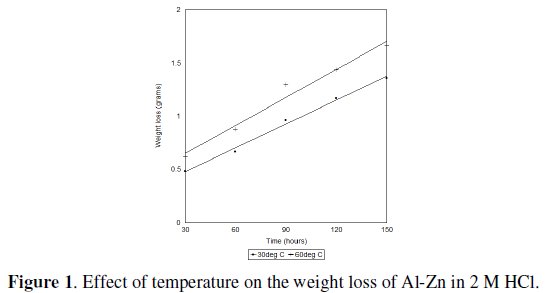
    <p>Figure 1 shows the temperature dependence of corrosion of Al-Zn alloy.</p>


    <p>&nbsp;</p>
<img src="/img/revistas/pea/v29n6/29n6a04f1.jpg">
    
<p>&nbsp;</p>


    <p>An increase in weight loss of the alloy was observed as the temperature increased 
from 30 &deg;C to 60 &deg;C. This implies that the corrosion of this alloy follows the 
general principle of chemical reactions: rate of chemical reaction increases with 
increase in temperature.</p>

    <p><b><i>Weight loss and inhibition efficiency</i></b></p>

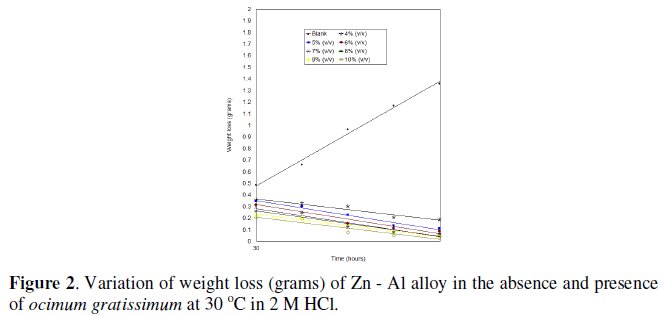
    <p>Weight loss measurement of aluminium - zinc alloy in 2 M HCl in the presence 
and absence of Ocimum gratissimum at various concentrations after immersion 
for 150 hours at 30 &deg;C is shown in Fig. 2; similar plots were obtained at 60 &deg;C.</p>


    <p>&nbsp;</p>
<img src="/img/revistas/pea/v29n6/29n6a04f2.jpg">
    
]]></body>
<body><![CDATA[<p>&nbsp;</p>


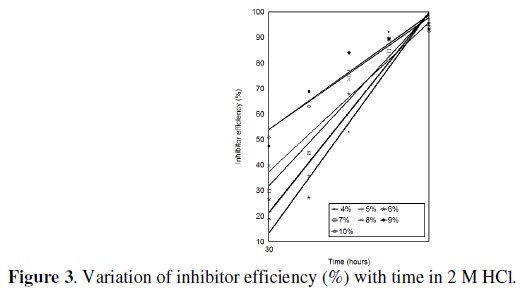
    <p>Weight loss of Al-Zn decreases in the presence of the inhibitor and with 
increasing its concentration as well. Fig. 3 shows the variation of inhibition 
efficiency with time at various concentrations of Ocimum gratissimum at 30 &deg;C.</p>


    <p>&nbsp;</p>
<img src="/img/revistas/pea/v29n6/29n6a04f3.jpg">
    
<p>&nbsp;</p>


    <p>The inhibition efficiency increases with time and with increasing the 
concentration as well. This observation implies that the surface area of the alloy 
covered by the inhibitor increases as the concentration of the inhibitor increases.</p>

    <p><b><i>Temperature dependence of inhibition efficiency</i></b></p>

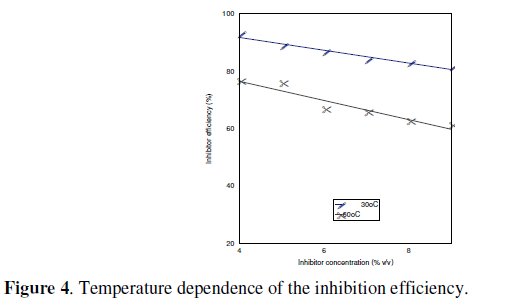
    <p>Fig. 4 is the graphical representation of the temperature dependence of the 
inhibitor efficiency of Ocimum gratissimum on the corrosion of Al-Zn at 30 &deg;C 
and 60 &deg;C in 2 M HCl.</p>


    <p>&nbsp;</p>
<img src="/img/revistas/pea/v29n6/29n6a04f4.jpg">
    
<p>&nbsp;</p>


    <p>Fig. 4 shows that the inhibitor efficiency of Ocimum 
gratissimum decreases with an increase in temperature, which suggests that the 
adsorption mechanism is physical.</p>

    ]]></body>
<body><![CDATA[<p>The inhibitive effect of Ocimum gratissimum may be attributed to the presence of 
phytochemical constituents of the plant seed extract. Previous studies on the 
phytochemical constituents of the plant have shown that it consists of alkaloids, 
tannins, flavonoids, phenols and glycoprotein [15]. These compounds contain 
nitrogen and oxygen atoms which possess lone pairs of electrons that may 
facilitate the formation of dative bonds acting as centres for adsorption, thus, 
creating a barrier between the alloy surface and the corrosive medium.</p>


    <p><b><i>Adsorption isotherm of corrosion of Al-Zn in 2 M HCl</i></b></p>

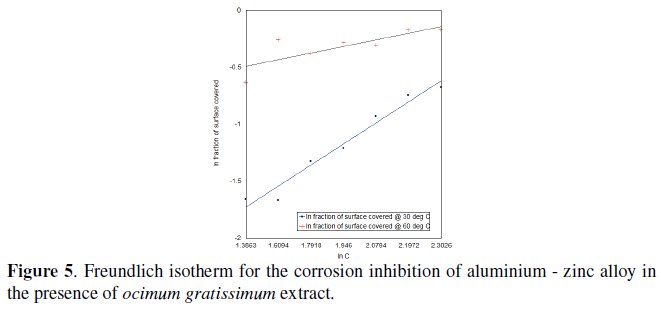
    <p>The adsorption isotherm provides insight into the mechanism of corrosion 
inhibition. This is determined empirically by plotting the surface area of 
coverage (S) as a function of the concentration of the inhibitor (Fig. 5).</p>


    <p>&nbsp;</p>
<img src="/img/revistas/pea/v29n6/29n6a04f5.jpg">
    
<p>&nbsp;</p>


    <p>To ascertain the nature of adsorption, the surface coverage values for Ocimum 
gratissimum extract at 30 &deg;C and 60 &deg;C were fitted into various adsorption 
isotherm models, and correlation coefficients (R<sup>2</sup>) were used to determine the 
best fit which was obtained with Freundlich adsorption isotherm. The linear plots 
obtained (R<sup>2</sup> = 0.97) suggest that the experimental data fit the Freundlich 
adsorption isotherm which is given as equation (3) [16]</p>

    <p>&nbsp;</p>
<img src="/img/revistas/pea/v29n6/29n6a04e3.jpg">
    
<p>&nbsp;</p>

    <p>where</p>

    <p>&nbsp;</p>
<img src="/img/revistas/pea/v29n6/29n6a04e4.jpg">
    
]]></body>
<body><![CDATA[<p>&nbsp;</p>

    <p>where C is the concentration of the Ocimum gratissimum extract and K<sub>ads</sub> is the 
adsorption equilibrium constant; n and K<sub>ads</sub> are temperature dependent.</p>


    <p><b><i>Kinetic / thermodynamic treatment of weight loss results</i></b></p>

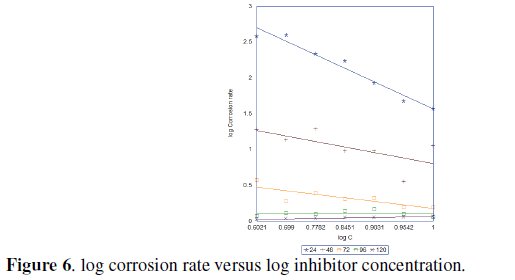
    <p>Assuming that the plot of corrosion rate (CR) of Zn-Al against concentration 
(C) of Ocimum gratissimum (Fig. 6) obeys the kinetic relationship</p>


    <p>&nbsp;</p>
<img src="/img/revistas/pea/v29n6/29n6a04f6.jpg">
    
<p>&nbsp;</p>


    <p>The kinetic parameters K and <b>B</b> can be calculated from eq. 6.</p>

    <p>&nbsp;</p>
<img src="/img/revistas/pea/v29n6/29n6a04e6.jpg">
    
<p>&nbsp;</p>

    <p>where k is rate constant defined by the corrosion rate at inhibitor concentration of 
unity and <b>B</b> is reaction constant, measured for the inhibitor effectiveness [17-20].</p>

    ]]></body>
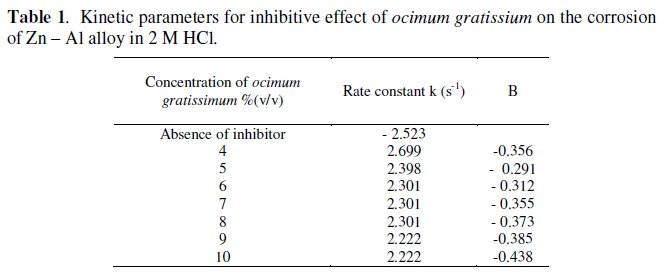
<body><![CDATA[<p>The slope <b>B</b> obtained is negative, (Table 1), depicting that the rate of corrosion is inversely 
proportional to the concentration of Ocimum gratissium.</p>
    <p>&nbsp; <a name="top.t1"></a> </p>
<img src="/img/revistas/pea/v29n6/29n6a04t1.jpg">
    
<p>&nbsp;</p>

    <p>This implies that ocimum gratissimum becomes more effective as the concentration increases. A 
high negative value of <b>B</b> implies good inhibitive properties for Ocimum 
gratissimum. The free energy of the reaction can be calculated using the 
equation:</p>

    <p>&nbsp;</p>
<img src="/img/revistas/pea/v29n6/29n6a04e7.jpg">
    
<p>&nbsp;</p>

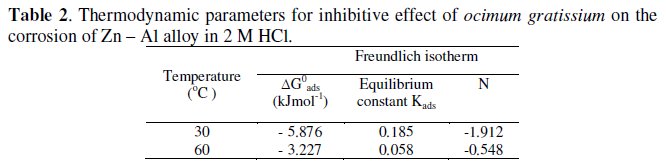
    <p>The calculated values of the equilibrium constant K decrease with increasing 
temperature, which implies that the inhibitor is physically adsorbed by the metal. 
Values of the interaction parameter N obtained from the Freundlich isotherm 
(Table 2) are negative, which implies that there is repulsion on the adsorption 
layer.</p>

    <p>&nbsp;</p>
<img src="/img/revistas/pea/v29n6/29n6a04t2.jpg">
    
<p>&nbsp;</p>

    <p>The values of &Delta;G<sub>ads</sub> (Table 2) for the reaction are negative and small. This 
implies that the adsorption of the inhibitor molecules is spontaneous. The 
magnitude of &Delta;G<sub>ads</sub> is small and less than -20 kJ mol<sup>-1</sup>, which suggests that 
ocimum gratissimum is physically adsorbed on the surface of the metal. 
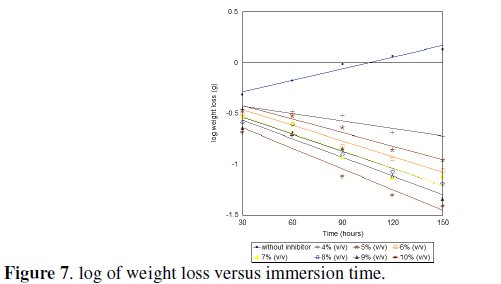
Corrosion reaction is an overall reaction in which both solid and liquid phases are 
consumed. Thus if the following equationis applied to corrosion rate</p>

    ]]></body>
<body><![CDATA[<p>&nbsp;</p>
<img src="/img/revistas/pea/v29n6/29n6a04e8.jpg">
    
<p>&nbsp;</p>

    <p>where k is defined as the rate constant after time (t) of immersion, W<sub>i</sub> and W<sub>0</sub> are 
weight losses in the presence and absence of the inhibitor.</p>

    <p>Fig.(7) shows a linear variation in the absence and presence of the inhibitor. This also confirms a first 
order kinetics. The rate constants, k, obtained for the reaction are shown in <a href="#top.t1">Table 1</a>.</p>

    <p>&nbsp;</p>
<img src="/img/revistas/pea/v29n6/29n6a04f7.jpg">
    
<p>&nbsp;</p>


    <p><b><i>Synergist effect of halide ions on Ocimum gratissimum</i></b></p>

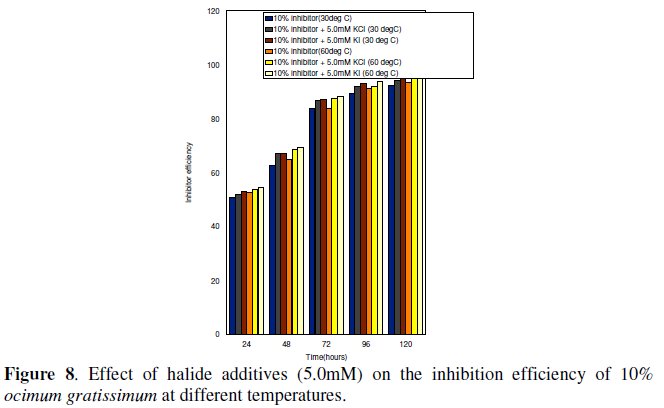
    <p>Fig. 8 shows that halide additive KI and KCl enhanced the inhibition efficiency 
of Ocimum gratissimum at the temperature studied.</p>

    <p>&nbsp;</p>
<img src="/img/revistas/pea/v29n6/29n6a04f8.jpg">
    
<p>&nbsp;</p>

    ]]></body>
<body><![CDATA[<p>This observation has been ascribed to the synergistic effect, which has been attributed to the 
formation of intermediate salt bridges by the halide (anions) between the metal surface and the 
positive end of the organic inhibitor [21-24]. Corrosion inhibition synergism 
from the increased surface coverage area arises from ion - pair interactions 
between the organic cations and the anions.</p>

    <p>The synergistic parameter was calculated using the relationship given by 
Aramaki and Hackerman [25]</p>

    <p>&nbsp;</p>
<img src="/img/revistas/pea/v29n6/29n6a04e9.jpg">
    
<p>&nbsp;</p>

    <p>where I<sub>1+2</sub> = I<sub>1</sub> is the inhibition efficiency of the halide, I<sub>2</sub> is the inhibition 
efficiency of Ocimum gratissium extract and I' is the measured inhibition 
efficiency of the halide combined with Ocimum gratissium extract. Values of S<sub>I</sub> 
less than 1 imply antagonistic interaction existing between halide ions and 
inhibitor. This may be attributed to competitive adsorption. S<sub>I</sub> values greater than 
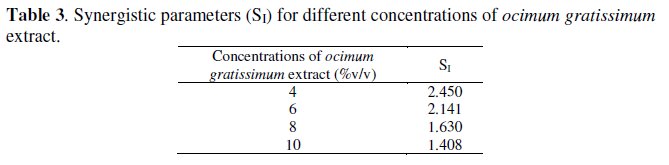
1 imply synergistic effect. The S<sub>I</sub> values calculated at different concentrations of 
the inhibitor for this experiment (Table 3) are greater than 1, which implies that 
inhibition efficiency is enhanced by synergistic effect of iodide ions.</p>

    <p>&nbsp;</p>
<img src="/img/revistas/pea/v29n6/29n6a04t3.jpg">
    
<p>&nbsp;</p>


    <p>&nbsp;</p>
    <p><b>Conclusions</b></p>

    <p>Extract from Ocimum gratissium acts as an efficient inhibitor for Al-Zn 
corrosion in 2 M HCl. Corrosion of Zn-Al decreases with temperature in the 
presence of inhibitor.</p>

    ]]></body>
<body><![CDATA[<p>Inhibitor efficiency of Ocimum gratissimum extracts increases with increase in 
concentration, but decreases with increase in temperature, which implies that the 
adsorption may be physical. Inhibition efficiency was enhanced by the addition 
of KI and KCl while synergism decreases with increased concentration of 
inhibitor.</p>

    <p>Adsorption of the extract on the surface as observed obeys Freundlich adsorption 
isotherm.</p>


    <p>&nbsp;</p>
    <p><b>References</b></p>

    <p>1. J. Randolph Kissel, Robert L. Ferry, Aluminium Studies: a guide to their specification and designs, 2nd Ed: Link. (2002).</p>
    <p>2. E. Paul Degarma, J.T. Black, Ronald A Kosher, Materials Processes in manufacturing, 9th ed, Wiley Press, 133 (2003).</p>
    <!-- ref --><p>3. R.E. Sanders, J. Minerals 53 (2001) 21.    &nbsp;&nbsp;&nbsp;&nbsp;&nbsp;&nbsp;&nbsp;&nbsp;[&#160;<a href="javascript:void(0);" onclick="javascript: window.open('/scielo.php?script=sci_nlinks&ref=000109&pid=S0872-1904201100060000400003&lng=','','width=640,height=500,resizable=yes,scrollbars=1,menubar=yes,');">Links</a>&#160;]<!-- end-ref --></p>
    <p>4. M.N.C. Ijeoma, Elements of corrosion and protection theory. Auto century publishing Co. Ltd, \t\ Enugu, 112 - 128 (1991).</p>
    <!-- ref --><p>5. C.E. Ekuma, N. E. Idenyi, Trends Appl. Sci. Research 2 (2007) 66.    &nbsp;&nbsp;&nbsp;&nbsp;&nbsp;&nbsp;&nbsp;&nbsp;[&#160;<a href="javascript:void(0);" onclick="javascript: window.open('/scielo.php?script=sci_nlinks&ref=000112&pid=S0872-1904201100060000400005&lng=','','width=640,height=500,resizable=yes,scrollbars=1,menubar=yes,');">Links</a>&#160;]<!-- end-ref --></p>
    <!-- ref --><p>6. C.E. Ekuma, N.E. Idenyi, A.E. Umahi, Informat. Tech. J. 7 (2007) 237.    &nbsp;&nbsp;&nbsp;&nbsp;&nbsp;&nbsp;&nbsp;&nbsp;[&#160;<a href="javascript:void(0);" onclick="javascript: window.open('/scielo.php?script=sci_nlinks&ref=000114&pid=S0872-1904201100060000400006&lng=','','width=640,height=500,resizable=yes,scrollbars=1,menubar=yes,');">Links</a>&#160;]<!-- end-ref --></p>
    <!-- ref --><p>7. S.A. Umoren, Port. Electrochim. Acta 26 (2007) 199.    &nbsp;&nbsp;&nbsp;&nbsp;&nbsp;&nbsp;&nbsp;&nbsp;[&#160;<a href="javascript:void(0);" onclick="javascript: window.open('/scielo.php?script=sci_nlinks&ref=000116&pid=S0872-1904201100060000400007&lng=','','width=640,height=500,resizable=yes,scrollbars=1,menubar=yes,');">Links</a>&#160;]<!-- end-ref --></p>
    <!-- ref --><p>8. A.Y. El-Etre, M. Abdallah, E. Tantawwy, Corros. Sci. 47 (2005) 385.    &nbsp;&nbsp;&nbsp;&nbsp;&nbsp;&nbsp;&nbsp;&nbsp;[&#160;<a href="javascript:void(0);" onclick="javascript: window.open('/scielo.php?script=sci_nlinks&ref=000118&pid=S0872-1904201100060000400008&lng=','','width=640,height=500,resizable=yes,scrollbars=1,menubar=yes,');">Links</a>&#160;]<!-- end-ref --></p>
    <!-- ref --><p>9. E.E. Oguzie, G.W. Onuoha, A.I. Onuchukwu, Mater. Chem. Phys. 89 (2004) 305.    &nbsp;&nbsp;&nbsp;&nbsp;&nbsp;&nbsp;&nbsp;&nbsp;[&#160;<a href="javascript:void(0);" onclick="javascript: window.open('/scielo.php?script=sci_nlinks&ref=000120&pid=S0872-1904201100060000400009&lng=','','width=640,height=500,resizable=yes,scrollbars=1,menubar=yes,');">Links</a>&#160;]<!-- end-ref --></p>
    <!-- ref --><p>10. A.Y. El-Etre, Corros. Sci. 45 (2003) 2485.    &nbsp;&nbsp;&nbsp;&nbsp;&nbsp;&nbsp;&nbsp;&nbsp;[&#160;<a href="javascript:void(0);" onclick="javascript: window.open('/scielo.php?script=sci_nlinks&ref=000122&pid=S0872-1904201100060000400010&lng=','','width=640,height=500,resizable=yes,scrollbars=1,menubar=yes,');">Links</a>&#160;]<!-- end-ref --></p>
    <!-- ref --><p>11. M. Abdallah, Port. Electrochim. Acta 22 (2004) 161.    &nbsp;&nbsp;&nbsp;&nbsp;&nbsp;&nbsp;&nbsp;&nbsp;[&#160;<a href="javascript:void(0);" onclick="javascript: window.open('/scielo.php?script=sci_nlinks&ref=000124&pid=S0872-1904201100060000400011&lng=','','width=640,height=500,resizable=yes,scrollbars=1,menubar=yes,');">Links</a>&#160;]<!-- end-ref --></p>
    <!-- ref --><p>12. S. Martinez, I. Stern, J. Appl. Electrochem. 31 (2001) 973.    &nbsp;&nbsp;&nbsp;&nbsp;&nbsp;&nbsp;&nbsp;&nbsp;[&#160;<a href="javascript:void(0);" onclick="javascript: window.open('/scielo.php?script=sci_nlinks&ref=000126&pid=S0872-1904201100060000400012&lng=','','width=640,height=500,resizable=yes,scrollbars=1,menubar=yes,');">Links</a>&#160;]<!-- end-ref --></p>
    <!-- ref --><p>13. E.E. Ebenso, U.J. Ibok, S.A. Umoren, O.K. Abiola, NC. Trans. SAEST 39 (2004) 117.    &nbsp;&nbsp;&nbsp;&nbsp;&nbsp;&nbsp;&nbsp;&nbsp;[&#160;<a href="javascript:void(0);" onclick="javascript: window.open('/scielo.php?script=sci_nlinks&ref=000128&pid=S0872-1904201100060000400013&lng=','','width=640,height=500,resizable=yes,scrollbars=1,menubar=yes,');">Links</a>&#160;]<!-- end-ref --></p>
    <!-- ref --><p>14. N.O. Eddy, S.A. Odoemelan, I.N. Ama, Green Chem. Letts. Rev. 3 (2010) 165.    &nbsp;&nbsp;&nbsp;&nbsp;&nbsp;&nbsp;&nbsp;&nbsp;[&#160;<a href="javascript:void(0);" onclick="javascript: window.open('/scielo.php?script=sci_nlinks&ref=000130&pid=S0872-1904201100060000400014&lng=','','width=640,height=500,resizable=yes,scrollbars=1,menubar=yes,');">Links</a>&#160;]<!-- end-ref --></p>
    <!-- ref --><p>15. H.O. Edeoga, O.O. Eriata, J. Med. Aromatic Plants Sci. 23 (2006) 224.    &nbsp;&nbsp;&nbsp;&nbsp;&nbsp;&nbsp;&nbsp;&nbsp;[&#160;<a href="javascript:void(0);" onclick="javascript: window.open('/scielo.php?script=sci_nlinks&ref=000132&pid=S0872-1904201100060000400015&lng=','','width=640,height=500,resizable=yes,scrollbars=1,menubar=yes,');">Links</a>&#160;]<!-- end-ref --></p>
    <!-- ref --><p>16. E.E. Oguzie, Corros. Sci. 49 (2007) 1527.    &nbsp;&nbsp;&nbsp;&nbsp;&nbsp;&nbsp;&nbsp;&nbsp;[&#160;<a href="javascript:void(0);" onclick="javascript: window.open('/scielo.php?script=sci_nlinks&ref=000134&pid=S0872-1904201100060000400016&lng=','','width=640,height=500,resizable=yes,scrollbars=1,menubar=yes,');">Links</a>&#160;]<!-- end-ref --></p>
    <!-- ref --><p>17. E.A. Noor, Int. J. Electrochem. Sci. 2 (2007) 996.    &nbsp;&nbsp;&nbsp;&nbsp;&nbsp;&nbsp;&nbsp;&nbsp;[&#160;<a href="javascript:void(0);" onclick="javascript: window.open('/scielo.php?script=sci_nlinks&ref=000136&pid=S0872-1904201100060000400017&lng=','','width=640,height=500,resizable=yes,scrollbars=1,menubar=yes,');">Links</a>&#160;]<!-- end-ref --></p>
    <!-- ref --><p>18. P.W. Atkins and J. Paula, Physical Chemistry, Oxford University Press, NY (2002).    &nbsp;&nbsp;&nbsp;&nbsp;&nbsp;&nbsp;&nbsp;&nbsp;[&#160;<a href="javascript:void(0);" onclick="javascript: window.open('/scielo.php?script=sci_nlinks&ref=000138&pid=S0872-1904201100060000400018&lng=','','width=640,height=500,resizable=yes,scrollbars=1,menubar=yes,');">Links</a>&#160;]<!-- end-ref --></p>
    <!-- ref --><p>19. J.M. Thomas, W.J. Thomas, Introduction to the principles of heterogeneous catalysis, 5th ed., Academic Press, London (1981).    &nbsp;&nbsp;&nbsp;&nbsp;&nbsp;&nbsp;&nbsp;&nbsp;[&#160;<a href="javascript:void(0);" onclick="javascript: window.open('/scielo.php?script=sci_nlinks&ref=000140&pid=S0872-1904201100060000400019&lng=','','width=640,height=500,resizable=yes,scrollbars=1,menubar=yes,');">Links</a>&#160;]<!-- end-ref --></p>
    <!-- ref --><p>20. P.W. Atkins, Chemisorbed and physisorbed species, a textbook of Physical Chemistry, University Press, Oxford: NY, 936-938 (1980).    &nbsp;&nbsp;&nbsp;&nbsp;&nbsp;&nbsp;&nbsp;&nbsp;[&#160;<a href="javascript:void(0);" onclick="javascript: window.open('/scielo.php?script=sci_nlinks&ref=000142&pid=S0872-1904201100060000400020&lng=','','width=640,height=500,resizable=yes,scrollbars=1,menubar=yes,');">Links</a>&#160;]<!-- end-ref --></p>
    <!-- ref --><p>21. K.J. Laidler, Reaction kinetics, 1st ed., vol. 1, Pergamon Press, New York (1963).    &nbsp;&nbsp;&nbsp;&nbsp;&nbsp;&nbsp;&nbsp;&nbsp;[&#160;<a href="javascript:void(0);" onclick="javascript: window.open('/scielo.php?script=sci_nlinks&ref=000144&pid=S0872-1904201100060000400021&lng=','','width=640,height=500,resizable=yes,scrollbars=1,menubar=yes,');">Links</a>&#160;]<!-- end-ref --></p>
    <!-- ref --><p>22. G. Mu, X. Li, J. Colloid Interface Sci. 289 (2005) 184.    &nbsp;&nbsp;&nbsp;&nbsp;&nbsp;&nbsp;&nbsp;&nbsp;[&#160;<a href="javascript:void(0);" onclick="javascript: window.open('/scielo.php?script=sci_nlinks&ref=000146&pid=S0872-1904201100060000400022&lng=','','width=640,height=500,resizable=yes,scrollbars=1,menubar=yes,');">Links</a>&#160;]<!-- end-ref --></p>
    <!-- ref --><p>23. D.Q. Zhang, L.X. Gao, G.D. Zhou, J. Appl. Electrochem. 33 (2003) 361.    &nbsp;&nbsp;&nbsp;&nbsp;&nbsp;&nbsp;&nbsp;&nbsp;[&#160;<a href="javascript:void(0);" onclick="javascript: window.open('/scielo.php?script=sci_nlinks&ref=000148&pid=S0872-1904201100060000400023&lng=','','width=640,height=500,resizable=yes,scrollbars=1,menubar=yes,');">Links</a>&#160;]<!-- end-ref --></p>
    <!-- ref --><p>24. E.E. Oguzie, Y. Li, F.H. Wang, J. Colloid Interface Sci. 310 (2007) 90.    &nbsp;&nbsp;&nbsp;&nbsp;&nbsp;&nbsp;&nbsp;&nbsp;[&#160;<a href="javascript:void(0);" onclick="javascript: window.open('/scielo.php?script=sci_nlinks&ref=000150&pid=S0872-1904201100060000400024&lng=','','width=640,height=500,resizable=yes,scrollbars=1,menubar=yes,');">Links</a>&#160;]<!-- end-ref --></p>
    <!-- ref --><p>25. K. Aramaki, N. Hackerman, J. Electrochem. Soc. 116(5) (1969) 568.    &nbsp;&nbsp;&nbsp;&nbsp;&nbsp;&nbsp;&nbsp;&nbsp;[&#160;<a href="javascript:void(0);" onclick="javascript: window.open('/scielo.php?script=sci_nlinks&ref=000152&pid=S0872-1904201100060000400025&lng=','','width=640,height=500,resizable=yes,scrollbars=1,menubar=yes,');">Links</a>&#160;]<!-- end-ref --></p>


    <p>&nbsp;</p>

    <p><a name=0></a><sup><a href="#top">*</a></sup> Corresponding author. E-mail address: <a href="mailto:chrismoj3@yahoo.co.uk">chrismoj3@yahoo.co.uk</a></p>

    <p>Received 6 May 2011; accepted 26 November 2011</p> 

    <p><a href="http://www.peacta.org" target="_blank">www.peacta.org</a> </p>


     ]]></body><back>
<ref-list>
<ref id="B1">
<label>1</label><nlm-citation citation-type="book">
<person-group person-group-type="author">
<name>
<surname><![CDATA[Kissel]]></surname>
<given-names><![CDATA[J.R.]]></given-names>
</name>
<name>
<surname><![CDATA[Ferry]]></surname>
<given-names><![CDATA[R.L.]]></given-names>
</name>
</person-group>
<source><![CDATA[Aluminium Studies: a guide to their specification and designs]]></source>
<year>2002</year>
<edition>2</edition>
<publisher-name><![CDATA[Link]]></publisher-name>
</nlm-citation>
</ref>
<ref id="B2">
<label>2</label><nlm-citation citation-type="book">
<person-group person-group-type="author">
<name>
<surname><![CDATA[Degarma]]></surname>
<given-names><![CDATA[E.P.]]></given-names>
</name>
<name>
<surname><![CDATA[Black]]></surname>
<given-names><![CDATA[J.T.]]></given-names>
</name>
<name>
<surname><![CDATA[Kosher]]></surname>
<given-names><![CDATA[R.A.]]></given-names>
</name>
</person-group>
<source><![CDATA[Materials Processes in manufacturing]]></source>
<year>2003</year>
<edition>9</edition>
<page-range>133</page-range><publisher-name><![CDATA[Wiley Press]]></publisher-name>
</nlm-citation>
</ref>
<ref id="B3">
<label>3</label><nlm-citation citation-type="journal">
<person-group person-group-type="author">
<name>
<surname><![CDATA[Sanders]]></surname>
<given-names><![CDATA[R.E.]]></given-names>
</name>
</person-group>
<source><![CDATA[J. Minerals]]></source>
<year>2001</year>
<volume>53</volume>
<page-range>21</page-range></nlm-citation>
</ref>
<ref id="B4">
<label>4</label><nlm-citation citation-type="book">
<person-group person-group-type="author">
<name>
<surname><![CDATA[Ijeoma]]></surname>
<given-names><![CDATA[M.N.C.]]></given-names>
</name>
</person-group>
<source><![CDATA[Elements of corrosion and protection theory]]></source>
<year>1991</year>
<page-range>112 - 128</page-range><publisher-loc><![CDATA[Enugu ]]></publisher-loc>
<publisher-name><![CDATA[Auto century publishing Co]]></publisher-name>
</nlm-citation>
</ref>
<ref id="B5">
<label>5</label><nlm-citation citation-type="journal">
<person-group person-group-type="author">
<name>
<surname><![CDATA[Ekuma]]></surname>
<given-names><![CDATA[C.E.]]></given-names>
</name>
<name>
<surname><![CDATA[Idenyi]]></surname>
<given-names><![CDATA[N.E.]]></given-names>
</name>
</person-group>
<source><![CDATA[Trends Appl. Sci. Research]]></source>
<year>2007</year>
<volume>2</volume>
<page-range>66</page-range></nlm-citation>
</ref>
<ref id="B6">
<label>6</label><nlm-citation citation-type="journal">
<person-group person-group-type="author">
<name>
<surname><![CDATA[Ekuma]]></surname>
<given-names><![CDATA[C.E.]]></given-names>
</name>
<name>
<surname><![CDATA[Idenyi]]></surname>
<given-names><![CDATA[N.E.]]></given-names>
</name>
<name>
<surname><![CDATA[Umahi]]></surname>
<given-names><![CDATA[A.E.]]></given-names>
</name>
</person-group>
<source><![CDATA[Informat. Tech. J.]]></source>
<year>2007</year>
<volume>7</volume>
<page-range>237</page-range></nlm-citation>
</ref>
<ref id="B7">
<label>7</label><nlm-citation citation-type="journal">
<person-group person-group-type="author">
<name>
<surname><![CDATA[Umoren]]></surname>
<given-names><![CDATA[S.A.]]></given-names>
</name>
</person-group>
<source><![CDATA[Port. Electrochim. Acta]]></source>
<year>2007</year>
<volume>26</volume>
<page-range>199</page-range></nlm-citation>
</ref>
<ref id="B8">
<label>8</label><nlm-citation citation-type="journal">
<person-group person-group-type="author">
<name>
<surname><![CDATA[El-Etre]]></surname>
<given-names><![CDATA[A.Y.]]></given-names>
</name>
<name>
<surname><![CDATA[Abdallah]]></surname>
<given-names><![CDATA[M.]]></given-names>
</name>
<name>
<surname><![CDATA[Tantawwy]]></surname>
<given-names><![CDATA[E.]]></given-names>
</name>
</person-group>
<source><![CDATA[Corros. Sci.]]></source>
<year>2005</year>
<volume>47</volume>
<page-range>385</page-range></nlm-citation>
</ref>
<ref id="B9">
<label>9</label><nlm-citation citation-type="journal">
<person-group person-group-type="author">
<name>
<surname><![CDATA[Oguzie]]></surname>
<given-names><![CDATA[E.E.]]></given-names>
</name>
<name>
<surname><![CDATA[Onuoha]]></surname>
<given-names><![CDATA[G.W.]]></given-names>
</name>
<name>
<surname><![CDATA[Onuchukwu]]></surname>
<given-names><![CDATA[A.I.]]></given-names>
</name>
</person-group>
<source><![CDATA[Mater. Chem. Phys.]]></source>
<year>2004</year>
<volume>89</volume>
<page-range>305</page-range></nlm-citation>
</ref>
<ref id="B10">
<label>10</label><nlm-citation citation-type="journal">
<person-group person-group-type="author">
<name>
<surname><![CDATA[El-Etre]]></surname>
<given-names><![CDATA[A.Y.]]></given-names>
</name>
</person-group>
<source><![CDATA[Corros. Sci.]]></source>
<year>2003</year>
<volume>45</volume>
<page-range>2485</page-range></nlm-citation>
</ref>
<ref id="B11">
<label>11</label><nlm-citation citation-type="journal">
<person-group person-group-type="author">
<name>
<surname><![CDATA[Abdallah]]></surname>
<given-names><![CDATA[M.]]></given-names>
</name>
</person-group>
<source><![CDATA[Port. Electrochim. Acta]]></source>
<year>2004</year>
<volume>22</volume>
<page-range>161</page-range></nlm-citation>
</ref>
<ref id="B12">
<label>12</label><nlm-citation citation-type="journal">
<person-group person-group-type="author">
<name>
<surname><![CDATA[Martinez]]></surname>
<given-names><![CDATA[S.]]></given-names>
</name>
<name>
<surname><![CDATA[Stern]]></surname>
<given-names><![CDATA[I.]]></given-names>
</name>
</person-group>
<source><![CDATA[J. Appl. Electrochem.]]></source>
<year>2001</year>
<volume>31</volume>
<page-range>973</page-range></nlm-citation>
</ref>
<ref id="B13">
<label>13</label><nlm-citation citation-type="journal">
<person-group person-group-type="author">
<name>
<surname><![CDATA[Ebenso]]></surname>
<given-names><![CDATA[E.E.]]></given-names>
</name>
<name>
<surname><![CDATA[Ibok]]></surname>
<given-names><![CDATA[U.J.]]></given-names>
</name>
<name>
<surname><![CDATA[Umoren]]></surname>
<given-names><![CDATA[S.A.]]></given-names>
</name>
</person-group>
<source><![CDATA[NC. Trans. SAEST]]></source>
<year>2004</year>
<volume>39</volume>
<page-range>117</page-range></nlm-citation>
</ref>
<ref id="B14">
<label>14</label><nlm-citation citation-type="journal">
<person-group person-group-type="author">
<name>
<surname><![CDATA[Eddy]]></surname>
<given-names><![CDATA[N.O.]]></given-names>
</name>
<name>
<surname><![CDATA[Odoemelan]]></surname>
<given-names><![CDATA[S.A.]]></given-names>
</name>
<name>
<surname><![CDATA[Ama]]></surname>
<given-names><![CDATA[I.N.]]></given-names>
</name>
</person-group>
<source><![CDATA[Green Chem. Letts. Rev.]]></source>
<year>2010</year>
<volume>3</volume>
<page-range>165</page-range></nlm-citation>
</ref>
<ref id="B15">
<label>15</label><nlm-citation citation-type="journal">
<person-group person-group-type="author">
<name>
<surname><![CDATA[Edeoga]]></surname>
<given-names><![CDATA[H.O.]]></given-names>
</name>
<name>
<surname><![CDATA[Eriata]]></surname>
<given-names><![CDATA[O.O.]]></given-names>
</name>
</person-group>
<source><![CDATA[J. Med. Aromatic Plants Sci.]]></source>
<year>2006</year>
<volume>23</volume>
<page-range>224</page-range></nlm-citation>
</ref>
<ref id="B16">
<label>16</label><nlm-citation citation-type="journal">
<person-group person-group-type="author">
<name>
<surname><![CDATA[Oguzie]]></surname>
<given-names><![CDATA[E.E.]]></given-names>
</name>
</person-group>
<source><![CDATA[Corros. Sci.]]></source>
<year>2007</year>
<volume>49</volume>
<page-range>1527</page-range></nlm-citation>
</ref>
<ref id="B17">
<label>17</label><nlm-citation citation-type="journal">
<person-group person-group-type="author">
<name>
<surname><![CDATA[Noor]]></surname>
<given-names><![CDATA[E.A.]]></given-names>
</name>
</person-group>
<source><![CDATA[Int. J. Electrochem. Sci.]]></source>
<year>2007</year>
<volume>2</volume>
<page-range>996</page-range></nlm-citation>
</ref>
<ref id="B18">
<label>18</label><nlm-citation citation-type="book">
<person-group person-group-type="author">
<name>
<surname><![CDATA[Atkins]]></surname>
<given-names><![CDATA[P.W.]]></given-names>
</name>
<name>
<surname><![CDATA[Paula]]></surname>
<given-names><![CDATA[J.]]></given-names>
</name>
</person-group>
<source><![CDATA[Physical Chemistry]]></source>
<year>2002</year>
<publisher-loc><![CDATA[NY ]]></publisher-loc>
<publisher-name><![CDATA[Oxford University Press]]></publisher-name>
</nlm-citation>
</ref>
<ref id="B19">
<label>19</label><nlm-citation citation-type="book">
<person-group person-group-type="author">
<name>
<surname><![CDATA[Thomas]]></surname>
<given-names><![CDATA[J.M.]]></given-names>
</name>
<name>
<surname><![CDATA[Thomas]]></surname>
<given-names><![CDATA[W.J.]]></given-names>
</name>
</person-group>
<source><![CDATA[Introduction to the principles of heterogeneous catalysis]]></source>
<year>1981</year>
<edition>5</edition>
<publisher-loc><![CDATA[London ]]></publisher-loc>
<publisher-name><![CDATA[Academic Press]]></publisher-name>
</nlm-citation>
</ref>
<ref id="B20">
<label>20</label><nlm-citation citation-type="book">
<person-group person-group-type="author">
<name>
<surname><![CDATA[Atkins]]></surname>
<given-names><![CDATA[P.W.]]></given-names>
</name>
</person-group>
<source><![CDATA[Chemisorbed and physisorbed species, a textbook of Physical Chemistry]]></source>
<year>1980</year>
<page-range>936-938</page-range><publisher-loc><![CDATA[NY ]]></publisher-loc>
<publisher-name><![CDATA[University Press]]></publisher-name>
</nlm-citation>
</ref>
<ref id="B21">
<label>21</label><nlm-citation citation-type="book">
<person-group person-group-type="author">
<name>
<surname><![CDATA[Laidler]]></surname>
<given-names><![CDATA[K.J.]]></given-names>
</name>
</person-group>
<source><![CDATA[Reaction kinetics]]></source>
<year>1963</year>
<edition>1</edition>
<publisher-loc><![CDATA[New York ]]></publisher-loc>
<publisher-name><![CDATA[Pergamon Press]]></publisher-name>
</nlm-citation>
</ref>
<ref id="B22">
<label>22</label><nlm-citation citation-type="journal">
<person-group person-group-type="author">
<name>
<surname><![CDATA[Mu]]></surname>
<given-names><![CDATA[G.]]></given-names>
</name>
<name>
<surname><![CDATA[Li]]></surname>
<given-names><![CDATA[X.]]></given-names>
</name>
</person-group>
<source><![CDATA[J. Colloid Interface Sci.]]></source>
<year>2005</year>
<volume>289</volume>
<page-range>184</page-range></nlm-citation>
</ref>
<ref id="B23">
<label>23</label><nlm-citation citation-type="journal">
<person-group person-group-type="author">
<name>
<surname><![CDATA[Zhang]]></surname>
<given-names><![CDATA[D.Q.]]></given-names>
</name>
<name>
<surname><![CDATA[Gao]]></surname>
<given-names><![CDATA[L.X.]]></given-names>
</name>
<name>
<surname><![CDATA[Zhou]]></surname>
<given-names><![CDATA[G.D.]]></given-names>
</name>
</person-group>
<source><![CDATA[J. Appl. Electrochem.]]></source>
<year>2003</year>
<volume>33</volume>
<page-range>361</page-range></nlm-citation>
</ref>
<ref id="B24">
<label>24</label><nlm-citation citation-type="journal">
<person-group person-group-type="author">
<name>
<surname><![CDATA[Oguzie]]></surname>
<given-names><![CDATA[E.E.]]></given-names>
</name>
<name>
<surname><![CDATA[Li]]></surname>
<given-names><![CDATA[Y.]]></given-names>
</name>
<name>
<surname><![CDATA[Wang]]></surname>
<given-names><![CDATA[F.H.]]></given-names>
</name>
</person-group>
<source><![CDATA[J. Colloid Interface Sci.]]></source>
<year>2007</year>
<volume>310</volume>
<page-range>90</page-range></nlm-citation>
</ref>
<ref id="B25">
<label>25</label><nlm-citation citation-type="journal">
<person-group person-group-type="author">
<name>
<surname><![CDATA[Aramaki]]></surname>
<given-names><![CDATA[K.]]></given-names>
</name>
<name>
<surname><![CDATA[Hackerman]]></surname>
<given-names><![CDATA[N.]]></given-names>
</name>
</person-group>
<source><![CDATA[J. Electrochem. Soc.]]></source>
<year>1969</year>
<volume>116</volume>
<numero>5</numero>
<issue>5</issue>
<page-range>568</page-range></nlm-citation>
</ref>
</ref-list>
</back>
</article>