<?xml version="1.0" encoding="ISO-8859-1"?><article xmlns:mml="http://www.w3.org/1998/Math/MathML" xmlns:xlink="http://www.w3.org/1999/xlink" xmlns:xsi="http://www.w3.org/2001/XMLSchema-instance">
<front>
<journal-meta>
<journal-id>0872-1904</journal-id>
<journal-title><![CDATA[Portugaliae Electrochimica Acta]]></journal-title>
<abbrev-journal-title><![CDATA[Port. Electrochim. Acta]]></abbrev-journal-title>
<issn>0872-1904</issn>
<publisher>
<publisher-name><![CDATA[Sociedade Portuguesa de Electroquímica]]></publisher-name>
</publisher>
</journal-meta>
<article-meta>
<article-id>S0872-19042011000600006</article-id>
<article-id pub-id-type="doi">10.4152/pea.201106445</article-id>
<title-group>
<article-title xml:lang="en"><![CDATA[3-Ethyl-4-amino-5-mercapto-1,2,4-triazole as Corrosion Inhibitor for 6061-Alloy in Sodium Hydroxide Solution]]></article-title>
</title-group>
<contrib-group>
<contrib contrib-type="author">
<name>
<surname><![CDATA[Kumari]]></surname>
<given-names><![CDATA[P.D. Reena]]></given-names>
</name>
<xref ref-type="aff" rid="A01"/>
</contrib>
<contrib contrib-type="author">
<name>
<surname><![CDATA[Nayak]]></surname>
<given-names><![CDATA[Jagannath]]></given-names>
</name>
<xref ref-type="aff" rid="A02"/>
</contrib>
<contrib contrib-type="author">
<name>
<surname><![CDATA[Shetty]]></surname>
<given-names><![CDATA[A. Nityananda]]></given-names>
</name>
<xref ref-type="aff" rid="A01"/>
</contrib>
</contrib-group>
<aff id="A01">
<institution><![CDATA[,National Institute of Technology Karnataka Surathkal Department of Chemistry ]]></institution>
<addr-line><![CDATA[Mangalore ]]></addr-line>
<country>India</country>
</aff>
<aff id="A02">
<institution><![CDATA[,National Institute of Technology Karnataka Surathkal Department of Metallurgical & Materials Engineering ]]></institution>
<addr-line><![CDATA[Mangalore ]]></addr-line>
<country>India</country>
</aff>
<pub-date pub-type="pub">
<day>00</day>
<month>11</month>
<year>2011</year>
</pub-date>
<pub-date pub-type="epub">
<day>00</day>
<month>11</month>
<year>2011</year>
</pub-date>
<volume>29</volume>
<numero>6</numero>
<fpage>445</fpage>
<lpage>462</lpage>
<copyright-statement/>
<copyright-year/>
<self-uri xlink:href="http://scielo.pt/scielo.php?script=sci_arttext&amp;pid=S0872-19042011000600006&amp;lng=en&amp;nrm=iso"></self-uri><self-uri xlink:href="http://scielo.pt/scielo.php?script=sci_abstract&amp;pid=S0872-19042011000600006&amp;lng=en&amp;nrm=iso"></self-uri><self-uri xlink:href="http://scielo.pt/scielo.php?script=sci_pdf&amp;pid=S0872-19042011000600006&amp;lng=en&amp;nrm=iso"></self-uri><abstract abstract-type="short" xml:lang="en"><p><![CDATA[The inhibition action of 3-ethyl-4-amino-5-mercapto-1,2,4-triazole (EAMT) on the corrosion of 6061-Al alloy in different concentrations of aqueous sodium hydroxide solution has been investigated at different temperatures, using potentiodynamic polarization and electrochemical impedance spectroscopic techniques. The surface morphology of the metal surface was investigated by scanning electron microscopy (SEM). The experimental results showed that the presence of EAMT in sodium hydroxide solution decreases the corrosion rates and the corrosion current densities (icorr), and increases the charge transfer resistance (Rp). It was found that the inhibitor efficiency depends on the concentration of the inhibitor, concentration of the corrosive media and temperature. The inhibition was assumed to occur through adsorption of the inhibitor molecule on the metal surface. The adsorption of the inhibitor on the metal surface is found to obey Langmuir adsorption isotherm. EAMT acts as a mixed inhibitor. Thermodynamic parameters for the adsorption processes were determined from the experimental data. The results obtained from both the techniques are in good agreement.]]></p></abstract>
<kwd-group>
<kwd lng="en"><![CDATA[6061/Al alloy]]></kwd>
<kwd lng="en"><![CDATA[corrosion inhibitor]]></kwd>
<kwd lng="en"><![CDATA[triazole derivative]]></kwd>
<kwd lng="en"><![CDATA[electrochemical techniques]]></kwd>
<kwd lng="en"><![CDATA[adsorption isotherm]]></kwd>
</kwd-group>
</article-meta>
</front><body><![CDATA[ 

    <p><b>3-Ethyl-4-amino-5-mercapto-1,2,4-triazole as Corrosion Inhibitor for 6061-Alloy in Sodium Hydroxide Solution</b></p>

    <p><b>P.D. Reena Kumari<sup>1</sup>, Jagannath Nayak<sup>2</sup>, A. Nityananda Shetty<sup>1,<a href="#0">*<a/></sup></b></p>

    <p><sup>1</sup><i> Department of Chemistry, National Institute of Technology Karnataka Surathkal, Mangalore, Karnataka State-575 025, India</i></p>
    <p><sup>2</sup><i> Department of Metallurgical & Materials Engineering, National Institute of Technology Karnataka Surathkal, Mangalore, Karnataka State-575 025, India</i></p>


    <p>&nbsp;</p>
    <p>doi: 10.4152/pea.201106445</p>


    <p>&nbsp;</p>
    <p><b>Abstract</b></p>

    <p>The inhibition action of 3-ethyl-4-amino-5-mercapto-1,2,4-triazole (EAMT) on the 
corrosion of 6061-Al alloy in different concentrations of aqueous sodium hydroxide 
solution has been investigated at different temperatures, using potentiodynamic 
polarization and electrochemical impedance spectroscopic techniques. The surface 
morphology of the metal surface was investigated by scanning electron microscopy 
(SEM). The experimental results showed that the presence of EAMT in sodium 
hydroxide solution decreases the corrosion rates and the corrosion current densities 
(icorr), and increases the charge transfer resistance (Rp). It was found that the inhibitor 
efficiency depends on the concentration of the inhibitor, concentration of the corrosive 
media and temperature. The inhibition was assumed to occur through adsorption of the 
inhibitor molecule on the metal surface. The adsorption of the inhibitor on the metal 
surface is found to obey Langmuir adsorption isotherm. EAMT acts as a mixed 
inhibitor. Thermodynamic parameters for the adsorption processes were determined 
from the experimental data. The results obtained from both the techniques are in good 
agreement.</p>

    ]]></body>
<body><![CDATA[<p><b><i>Keywords:</i></b> 6061/Al alloy, corrosion inhibitor, triazole derivative, electrochemical techniques, adsorption isotherm.</p>

    <p>&nbsp;</p>
    <p><b>Introduction</b></p>

    <p>6061-Al alloy is one of the most extensively used of the 6000 series aluminium 
alloys, widely used for the construction of aircraft structures, yacht, bicycle 
frames, machinery and process-equipment applications. 6061-Al alloy, 
containing magnesium and silicon as its major alloying elements, is a versatile 
heat treatable alloy with medium to high strength capabilities; satisfies the 
requirements of a number of specifications in extruded shape. Owing to its wide 
applicability in industrial and every day life, the electrochemical properties of 
aluminium and its alloys are the subject of many studies [1-7]. However, 
corrosion is indeed one of the major problems affecting the performance and 
safety of the metal. Several methods have been devised for preventing or 
reducing corrosion, which include coating, painting, as well as the use of 
chemical inhibitors. The use of some organic and inorganic compounds as 
effective inhibitors to protect metallic materials in the environment containing 
aggressive ions has been reported. It has been reported that many organic 
compounds containing hetero atoms like N, O, S, and multiple bonds in their 
molecules have been proved to be effective inhibitors for the corrosion of 
aluminium alloys in acid and alkaline media [8-15]. Generally, it has been 
assumed that the action of inhibitors in aggressive media is by the adsorption of 
the inhibitors onto the metal surface. The processes of adsorption of the inhibitor 
are influenced by the nature and surface charge of the metal, the chemical 
structure of organic inhibitors, the type of aggressive electrolyte and the type of 
interaction between the organic molecules and the metallic surface [16]. The 
purpose of the present contribution is to determine the influence of 3-ethyl-4amino-
5-mercapto-1,2,4-triazole (EAMT) towards the corrosion of 6061 Al 
alloy in sodium hydroxide solution, using potentiodynamic polarization and 
electrochemical impedance techniques. It is aimed at obtaining the information 
about surface morphology of the corroded base alloy metal surface by using 
SEM. It was also the purpose of this work to determine the thermodynamic 
parameters for the adsorption process and to gain more information about the 
mode of adsorption of the inhibitor on the metal surface.</p>


    <p>&nbsp;</p>
    <p><b>Experimental</b></p>

    <p><b><i>Materials and chemicals</i></b></p>

    <p>The material employed was 6061-Al alloy in the extruded rod form (extrusion 
ratio 30:1). The chemical composition of the base metal 6061 aluminium alloy is 
given in Table 1.</p>

    <p>&nbsp;</p>
<img src="/img/revistas/pea/v29n6/29n6a06t1.jpg">
    
<p>&nbsp;</p>

    ]]></body>
<body><![CDATA[<p>The sample was metallographically mounted up to 10 mm 
height using cold setting epoxy resin, so that the exposed surface area of the 
metal to the media was 0.785 cm<sup>2</sup>. The sample was mechanically polished using 
different emery papers up to 4/0 grades and finally polished on polishing wheel 
using levigated alumina. Then it was cleaned with acetone, washed with doubly 
distilled water and finally dried. For the electrochemical measurement the 
arrangement used was a conventional three electrode Pyrex glass cell with a 
platinum counter electrode and a saturated calomel electrode (SCE) as reference.</p>

    <p>The test solution used for the investigation was standard solutions of sodium 
hydroxide prepared by using sodium hydroxide pellets of AR grade and double 
distilled water.</p>


    <p>&nbsp;</p>


    <p><b><i>Synthesis of EAMT</i></b></p>

    <p>3-ethyl-4-amino-5-mercapto-1,2,4-triazole was synthesized and recrystallised as 
per the reported procedure [17]. A mixture of thiocarbohydrazide (10 g) and 
propionic acid (60 mL) was heated, under reflux for 4 hours. The product was 
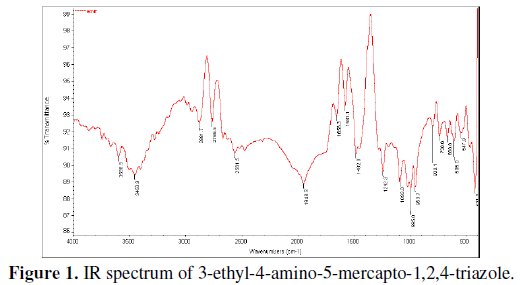
recrystallised from ethanol and characterized by IR (Fig. 1), elemental analysis 
and melting point. Fig. 2 shows the molecular structure of EAMT.</p>
    <p>&nbsp;</p>
<img src="/img/revistas/pea/v29n6/29n6a06f1.jpg">
    
<p>&nbsp;</p>
<img src="/img/revistas/pea/v29n6/29n6a06f2.jpg">
    
<p>&nbsp;</p>


    <p><b><i>Potentiodynamic polarization method</i></b></p>

    <p>Electrochemical measurements were carried out by using an electrochemical 
work station, GillAC and ACM Instruments Version 5 software. Tafel plot 
measurements were carried out using a conventional three electrode Pyrex glass 
cell with a platinum counter electrode and a saturated calomel electrode (SCE) as 
reference electrode. All the potential values are, therefore, referred to the SCE. 
Finely polished alloy specimens were exposed to corrosion medium of different 
concentrations of sodium hydroxide at different temperatures (30 &deg;C to 50 &deg;C) 
and allowed to establish a steady state open circuit potential for 10 minutes. The 
potentiodynamic current-potential curves were recorded by polarizing the 
specimen to -250 mV cathodically and to +250 mV anodically with respect to the 
open circuit potential (OCP) at a scan rate of 1 mV s<sup>-1</sup>.</p>


    ]]></body>
<body><![CDATA[<p><b><i>Electrochemical impedance spectroscopy studies (EIS)</i></b></p>

    <p>The corrosion behavior of the specimens of the base alloy was also obtained from 
EIS technique using the work station, GillAC. In EIS technique a small 
amplitude ac signal of 10 mV and frequency spectrum from 100 kHz to 0.01 Hz 
was impressed at the OCP. A steady state open circuit potential was obtained for 
10 minutes, and the impedance data were analyzed using Nyquist plots. The 
polarization resistance, R<sub>p</sub>, was extracted from the diameter of the semicircle in 
the Nyquist plot.</p>

    <p>In all the above measurements, at least three similar results were considered and 
their average values are reported.</p>


    <p><b><i>Scanning electron microscopy (SEM) analysis</i></b></p>

    <p>The scanning electron microscope images of the samples were recorded using a 
JEOL JSM - 6380 LA analytical scanning electron microscope.</p>


    <p>&nbsp;</p>
    <p><b>Results and discussion</b></p>

    <p><b><i>Potentiodynamic polarization method</i></b></p>

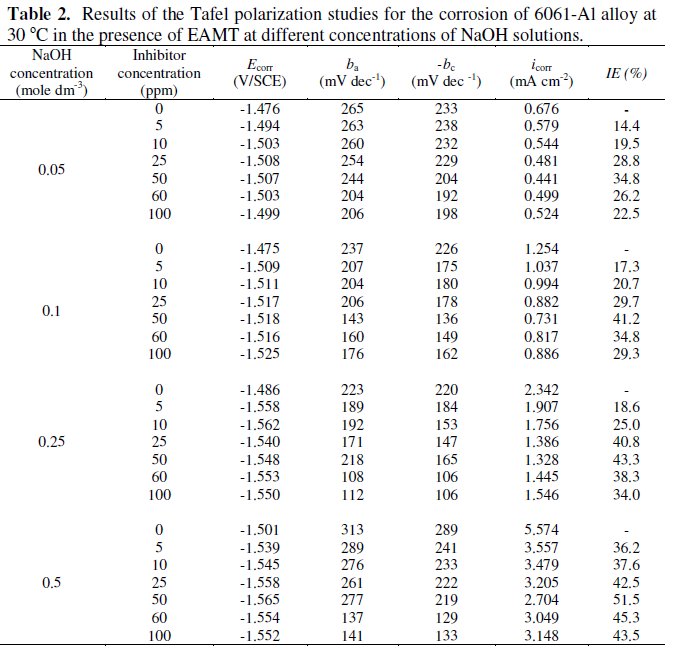
    <p>The polarization studies of the base alloy specimens were carried out in four 
different solutions containing 0.05 M, 0.1 M, 0.25 M and 0.5 M sodium 
hydroxide, in the absence and in the presence of different concentrations of 
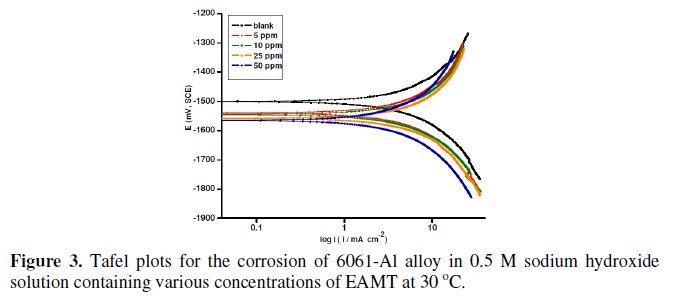
EAMT (5 - 100 ppm). Fig. 3 shows the Tafel polarization curves of the base 
alloy in 0.5 M NaOH solution at 30 &deg;C in the presence of different concentrations 
of EAMT.</p>

    <p>&nbsp;</p>
<img src="/img/revistas/pea/v29n6/29n6a06f3.jpg">
    
]]></body>
<body><![CDATA[<p>&nbsp;</p>

    <p>Similar results were obtained in the same concentration of sodium 
hydroxide at four other temperatures, and also in the other three concentrations of 
sodium hydroxide at the five temperatures studied. The electrochemical 
parameters (E<sub>corr</sub>, icorr, ba, bc, and %IE) associated with the polarization 
measurements at different EAMT concentrations as well as at different 
concentrations of the corrosion media for the base alloy are listed in Table 2.</p>

    <p>&nbsp; <a name="top.t2"></a> </p>
<img src="/img/revistas/pea/v29n6/29n6a06t2.jpg"></p>
    
<p>&nbsp;</p>

    <p>The surface coverage &Theta; is calculated as</p>

    <p>&nbsp;</p>
<img src="/img/revistas/pea/v29n6/29n6a06e1.jpg"></p>
    
<p>&nbsp;</p>

    <p>where i<sub>corr<sub>(uninh)</sub></sub> and i<sub>corr<sub>(inh)</sub></sub> are the corrosion current densities in the absence and 
presence of the inhibitor. The percentage of inhibition efficiency (%IE) is given by</p>

    <p>&nbsp;</p>
<img src="/img/revistas/pea/v29n6/29n6a06e2.jpg"></p>
    
<p>&nbsp;</p>

    ]]></body>
<body><![CDATA[<p>Data from <a href="#top.t2">Table 2</a> reveal that the addition of EAMT decreases the corrosion of 
the alloy by decreasing the current density.</p>

    <p>The results show that the E<sub>corr</sub> values 
shift to more negative potential as the concentration of added EAMT is 
increased, indicating a cathodic type of inhibition. Further inspection reveals that 
there is significant change in both anodic and cathodic Tafel slopes on the 
addition of EMAT. These results indicate that EAMT influences the dissolution 
of aluminium alloy and the hydrogen evolution process, indicating that the 
inhibitor behaved as a mixed -type corrosion inhibitor with predominant control 
of the cathodic reaction [18,19]. The corrosion current density is observed to be 
decreasing with increase in the concentration of the inhibitor, EAMT, up to a 
critical concentration. When the concentration of the inhibitor is increased above 
the critical concentration, the corrosion current density again increases. 
Accordingly, the inhibition efficiency of the inhibitor increases with the increase 
in the concentration of the inhibitor up to critical concentration level and then 
decreases with further increase in the inhibitor concentration. Experimental data 
pertaining to inhibition efficiency of EAMT suggest that the inhibition efficiency 
decreases with increase in temperature in all concentrations of sodium hydroxide 
solution and also at all inhibitor concentration levels (temperature data not shown 
in the paper).</p>


    <p><b><i>Electrochemical impedance spectroscopy (EIS) studies</i></b></p>

    <p>The corrosion behavior of the alloy in all the above conditions was also 
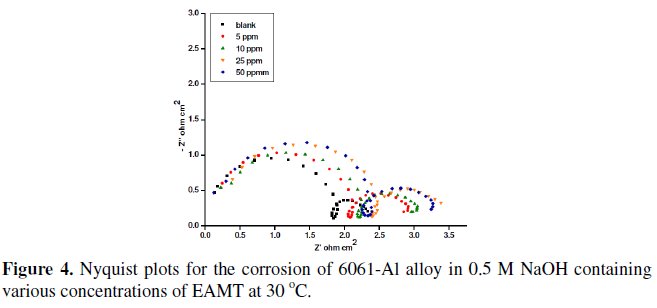
investigated by EIS method. Fig. 4 represents the Nyquist plots of the alloy 
without and with various concentrations of EAMT in 0.5 M NaOH at 30 &deg;C. 
Similar results were obtained in other concentrations of sodium hydroxide and 
also at other temperatures studied.</p>

    <p>&nbsp; <a name="top.f4"></a> </p>
<img src="/img/revistas/pea/v29n6/29n6a06f4.jpg">
    
<p>&nbsp;</p>

    <p>As can be seen from Fig. 4, the impedance diagrams show semicircles, indicating 
that the corrosion process is mainly charge transfer controlled and the additives 
do not change the reaction mechanism of the corrosion of the alloy in sodium 
hydroxide solution. The figure manifests two depressed capacitive semicircles, 
separated by a small inductive loop at intermediate frequencies. The high 
frequency capacitive loop could be assigned to the charge transfer of the 
corrosion process and to the formation of oxide layer [20, 21]. The oxide film is 
considered to be a parallel circuit of a resistor due to the ionic conduction in the 
oxide film and a capacitor due to its dielectric properties. According to Brett [22, 
23], the capacitive loop is corresponding to the interfacial reactions, particularly, 
the reaction of aluminum oxidation at the metal/oxide/electrolyte interface. The 
inductive loop may be related to the relaxation process obtained by adsorption of 
the intermediates [24-26]. The low frequency capacitive loop indicated the 
growth and dissolution of the surface film.</p>

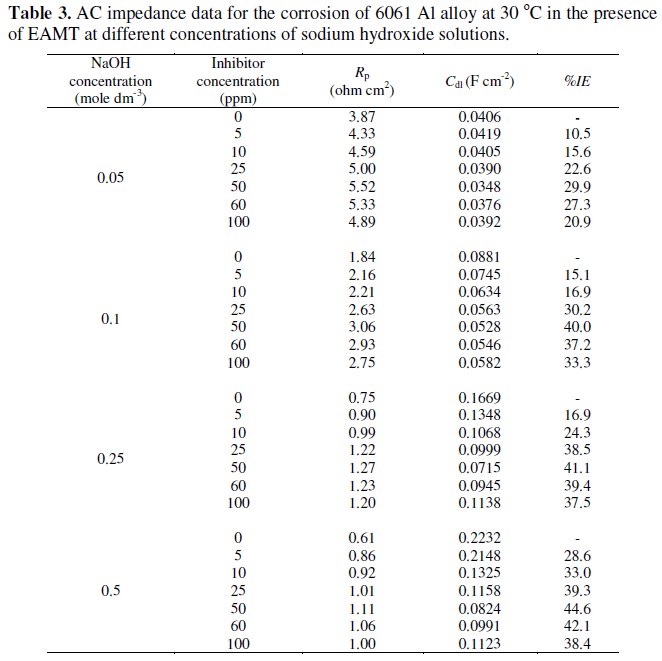
    <p>The impedance parameters derived from Nyquist plots and the inhibition 
efficiency of EAMT in sodium hydroxide solutions of different concentrations in 
the presence of EAMT at various concentrations, at 30 &deg;C, are given in Table 3.</p>

    <p>&nbsp; <a name="top.t3"></a> </p>
<img src="/img/revistas/pea/v29n6/29n6a06t3.jpg"></p>
    
<p>&nbsp;</p>

    ]]></body>
<body><![CDATA[<p>Similar results were also obtained at other temperatures. The measured value of 
polarization resistance (Rp) increases and the double layer capacitance decreases 
with the increasing concentration of EAMT in the solution, indicating decrease in 
the corrosion rate for the alloy with increase in EAMT concentration. This is in 
accordance with the observations obtained from potentiodynamic measurements.</p>

    <p>The semicircles of the impedance spectra for the alloy are depressed. Deviation 
of this kind is referred to as frequency dispersion, and has been attributed to 
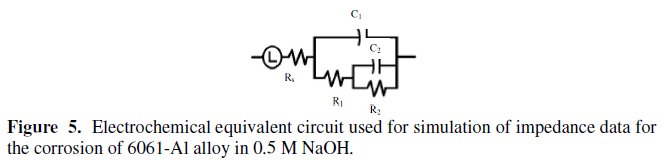
inhomogeneities of solid surfaces [27]. The impedance data were analyzed by 
using an equivalent circuit (EC) model consisting of six elements, as shown in 
Fig. 5.</p>

    <p>&nbsp;</p>
<img src="/img/revistas/pea/v29n6/29n6a06f5.jpg">
    
<p>&nbsp;</p>

    <p>In this equivalent circuit, Rs is the solution resistance, R1 is the charge 
transfer resistance (Rct) and L represents the inductive element. This also consists 
of constant phase element, CPE (C2) in parallel to the parallel resistor R2 and in 
series with R1. There is also a capacitor element, C1 in parallel with R1 and R2.</p>

    <p>In modeling the corrosion process, the capacitor usually behaves as a constant 
phase element (CPE), rather than a pure capacitor [28,29]. The CPE impedance is 
given by [30]</p>

    <p>&nbsp;</p>
<img src="/img/revistas/pea/v29n6/29n6a06e3.jpg"></p>
    
<p>&nbsp;</p>

    <p>where Y<sub>0</sub> is the CPE constant, &omega; is the angular frequency (in rad s<sup>-1</sup>), j<sup>2</sup> = -1 is 
the imaginary number and n is a CPE exponent which can be used as a measure 
of the heterogeneity or roughness of the surface. Depending on the value of n (-1 &le; n &le; 1), 
CPE describes an ideal capacitor for n = 1, an ideal inductor for n = -1, 
and an ideal resistor for n = 0 [31,32]. Y<sub>0</sub> and n can be calculated by the 
equations proved by Mansfeld et al. [33].</p>

    <p>The double layer capacitances Cdl, for a circuit including CPE were calculated 
from the following equation [34]</p>

    ]]></body>
<body><![CDATA[<p>&nbsp;</p>
<img src="/img/revistas/pea/v29n6/29n6a06e4.jpg"></p>
    
<p>&nbsp;</p>


    <p>where fmax is the frequency at which the imaginary component of the impedance 
is maximal. The increase in R<sub>p</sub> values, and consequently of the inhibition 
efficiency, shown in <a href="#top.t3">Table 3</a>, supports the gradual replacement of water 
molecules by the adsorption of inhibitor molecules on the metal surface, and 
consequently leads to decrease in the number of active sites necessary for the 
corrosion process. The replacement of the water molecules by the inhibitor at 
metal/solution interphase within the electrical double layer increases the 
thickness of the barrier layer. According to the expression of the double layer 
capacitance presented in the Helmholtz model [35]</p>

    <p>&nbsp;</p>
<img src="/img/revistas/pea/v29n6/29n6a06e5.jpg"></p>
    
<p>&nbsp;</p>

    <p>where &epsilon;<sub>0</sub> is the vacuum dielectric constant, &epsilon; is the local dielectric constant, d is 
the thickness of the double layer, and S is the surface area of the electrode. It was 
observed that the total surface resistance calculated by fitting the experimental 
impedance data was increased, while the capacitance for the double layer 
decreased after the addition of EAMT, but not significantly, possibly because the 
protective film formed on the metal surface did not completely cover the metal 
surface.</p>

    <p>In accordance with the EC given in  <a href="#top.f4">Fig. 4</a>, the polarization resistance, R<sub>p</sub>, is given 
by:</p>

    <p>&nbsp;</p>
<img src="/img/revistas/pea/v29n6/29n6a06e6.jpg"></p>
    
<p>&nbsp;</p>


    <p>The percentage of inhibition efficiency %IE, was calculated from the following 
equation:</p>

    ]]></body>
<body><![CDATA[<p>&nbsp;</p>
<img src="/img/revistas/pea/v29n6/29n6a06e7.jpg"></p>
    
<p>&nbsp;</p>


    <p>where (Rp)0 and (Rp) are the uninhibited and inhibited polarization resistances, 
respectively.</p>

    <p>From the results of Tafel and EIS studies, it is seen that the inhibition efficiency 
trend in different sodium hydroxide concentrations is 0.5 M > 0.25 M > 0.1 M > 
0.05 M. The higher inhibition efficiency at higher concentrations of NaOH may 
be because the inhibitor ionizes more readily under higher alkaline conditions 
and is more easily adsorbed on the metal surface through active centers.</p>


    <p><b><i>Effect of the immersion time</i></b></p>

    <p>Electrochemical impedance spectroscopy is a rapid and useful technique to 
evaluate the performance of the organic-coated metals because it doesn't 
significantly disturb the system and it is possible to follow it overtime [29]. 
Therefore more reliable results can be obtained from this technique and also it is 
possible to characterize the surface modification, i.e., the formation and growth 
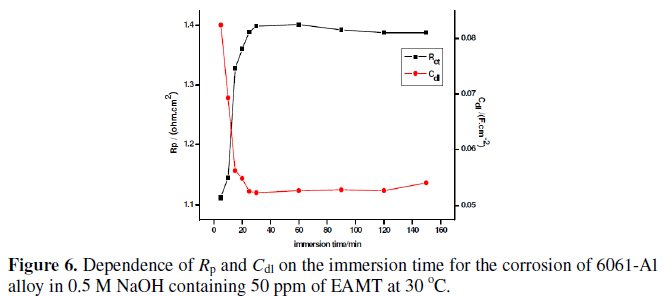
of the inhibitor film [36]. Immersion time experiments were carried out in 0.5 
M NaOH solution containing 50 ppm of EAMT for 150 minutes at 30 &deg;C, and 
Nyquists plots were recorded every 5 min during the initial 30 min, and then 
every 30 min afterward. The obtained results showed that the increase in 
immersion time increased the size of the capacitive loop, reaching a maximum in 
60 min and remaining fairly constant afterward. In Fig. 6, the variation of both 
R<sub>p</sub> and C<sub>dl</sub> with the immersion time recorded for 0.5 M NaOH solution is shown. 
Similar results were obtained for other concentrations of NaOH solutions also.</p>

    <p>&nbsp; <a name="top.f6"></a> </p>
<img src="/img/revistas/pea/v29n6/29n6a06f6.jpg">
    
<p>&nbsp;</p>

    <p>It is obvious from the figure that R<sub>p</sub> value increased from 1.113 ohm cm<sup>2</sup> to 1.4016 
ohm cm<sup>2</sup>, increasing the inhibition efficiency up to 56% during the initial 60 min 
and remaining fairly constant afterward. At the same time, C<sub>dl</sub> values decreased 
up to 60 min and remained fairly constant thereafter. These results suggest that 
the formation of the inhibitive surface film on the electrode surface was almost 
completed within 60 min. These results demonstrate that the inhibition efficiency 
increases with increasing the immersion time. This could be due to the 
progressive coverage of the metal alloy surface by the compact adsorbed film of 
the inhibitor, with time, the EMAT anions being electrostatically adsorbed on the 
metal surface. In order to ascertain the fact that the increase in R<sub>p</sub> value with time 
is due to the increased adsorption of the inhibitor and not due to the accumulation 
of the corrosion product, the immersion time experiment was repeated for the 
alloy in the absence of the inhibitor. The R<sub>p</sub> values did not vary significantly, 
indicating that there is no accumulation of the corrosion product on the alloy 
metal surface. This is expected as aluminium compounds are readily soluble in 
sodium hydroxide medium.</p>


    <p><b><i>Adsorption behavior</i></b></p>

    ]]></body>
<body><![CDATA[<p>In order to understand the mechanism of corrosion inhibition, the adsorption 
behavior of the inhibitor molecules on the alloy surface must be known. It is well 
known the fact that the adsorption isotherms provide useful insights into the 
characteristics of the adsorption process and the mechanism of corrosion 
inhibition [37]. The degree of surface coverage (&Theta;) at different concentrations of 
the inhibitor was evaluated from potentiodynamic polarization measurements. 
The data were tested graphically by fitting to various isotherms.</p>

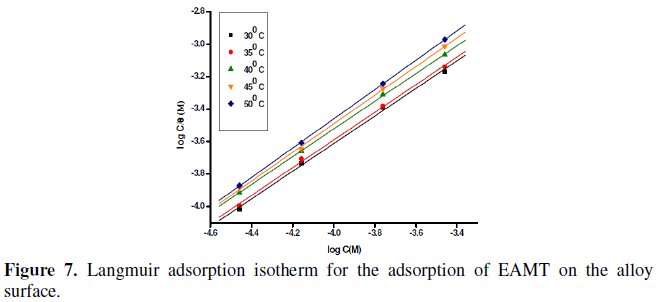
    <p>The Langmuir adsorption isotherm was found to fit well with the experimental data, as shown in 
<a href="#top.f6">Fig. 6</a>, and can be expressed as</p>

    <p>&nbsp;</p>
<img src="/img/revistas/pea/v29n6/29n6a06e8.jpg"></p>
    
<p>&nbsp;</p>

    <p>where K is the adsorption/desorption equilibrium constant, C is the corrosion 
inhibitor concentration in the solution, and &Theta; is the surface coverage. This 
adsorption is based on the assumption that all the adsorption sites are equivalent 
and that the particle binding occurs independently from the nearby sites being 
occupied or unoccupied [19].</p>

    <p>The plots in Fig. 7 are linear, but the slopes are not equal to unity as would be 
expected for the ideal Langmuir adsorption isotherm equation.</p>

    <p>&nbsp;</p>
<img src="/img/revistas/pea/v29n6/29n6a06f7.jpg">
    
<p>&nbsp;</p>

    <p>This deviation 
from unity may be due to the interaction among the adsorbed species on the 
metal surface. The polar groups or atoms present in the case of organic molecules 
are adsorbed at the anodic or cathodic sites of the metal surface. These adsorbed 
species may interact by mutual attraction or repulsion [38]. Thus, the inhibiting 
effect of EAMT molecules on metal surface in NaOH solution slightly deviates 
from ideal Langmuir adsorption isotherm.</p>

    <p>The thermodynamic parameter, free energy adsorption, (&Delta;G<sup>0</sup><sub>ads</sub>) can be calculated 
from the following thermodynamic equation,</p>

    ]]></body>
<body><![CDATA[<p>&nbsp;</p>
<img src="/img/revistas/pea/v29n6/29n6a06e9.jpg">
    
<p>&nbsp;</p>

    <p>where K is the equilibrium constant for the adsorption/desorption process, 55.5 
mol dm<sup>-3</sup> is the molar concentration of water in the solution, T is the temperature 
and R is the gas constant. Standard enthalpy of adsorption (&Delta;H<sup>0</sup><sub>ads</sub>) and standard 
entropy of adsorption (&Delta;S<sup>0</sup><sub>ads</sub>) were obtained from the plot of (&Delta;G<sup>0</sup><sub>ads</sub>) versus T 
according to the thermodynamic basic equation:</p>

    <p>&nbsp;</p>
<img src="/img/revistas/pea/v29n6/29n6a06e10.jpg">
    
<p>&nbsp;</p>

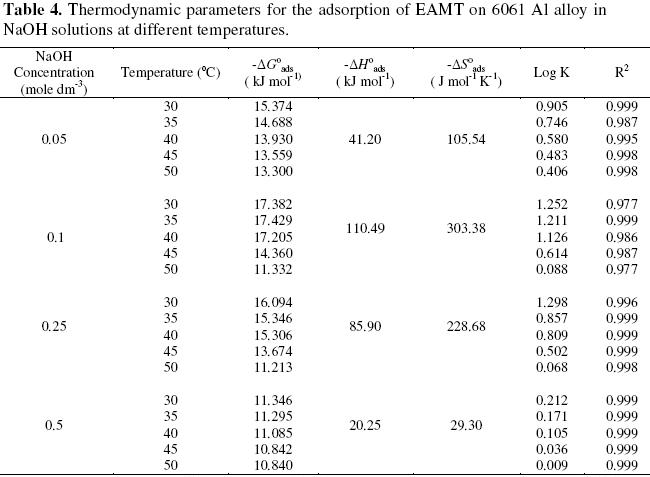
    <p>The values of free energy of adsorption (&Delta;G<sup>0</sup><sub>ads</sub>), enthalpy of adsorption (&Delta;H<sup>0</sup><sub>ads</sub>), 
entropy of adsorption (&Delta;S<sup>0</sup><sub>ads</sub>), equilibrium constant (K) and linear correlation 
coefficient (R2) obtained from the experimental data of potentiodynamic 
polarization method are given in Table 4.</p>

    <p>&nbsp;</p>
<img src="/img/revistas/pea/v29n6/29n6a06t4.jpg">
    
<p>&nbsp;</p>

    <p>The negative values of &Delta;G<sup>0</sup><sub>ads</sub> imply 
the spontaneity of the adsorption process and stability of the adsorbed layer on 
the metal surface. Generally, the values of &Delta;G<sub>ads</sub> lower than -20 kJ mol-1 are 
consistent with physisorption, while those around -40 kJ mol-1 or higher 
correspond to chemisorptions [39,40]. The calculated values of &Delta;G<sup>0</sup><sub>ads</sub> obtained 
in this study, indicate the physical adsorption behavior of EAMT on aluminium 
alloy metal surface. The negative values of &Delta;H<sup>0</sup><sub>ads</sub> indicate that the adsorption of 
the inhibitor is an exothermic process. An exothermic adsorption process may 
involve either physisorption or chemisorption or a mixture of both processes 
[41]. The &Delta;S<sup>0</sup><sub>ads</sub> values in the presence of the inhibitor are negative, indicating 
that an increase in orderliness takes place on going from the free state to the 
adsorbed state of the inhibitors. This might be attributed to the orderly adsorption 
of the inhibitor molecules from a chaotic state of the freely moving molecules in 
the solution [42].</p>

    <p>


    ]]></body>
<body><![CDATA[<p><b><i>Effect of temperature</i></b></p>

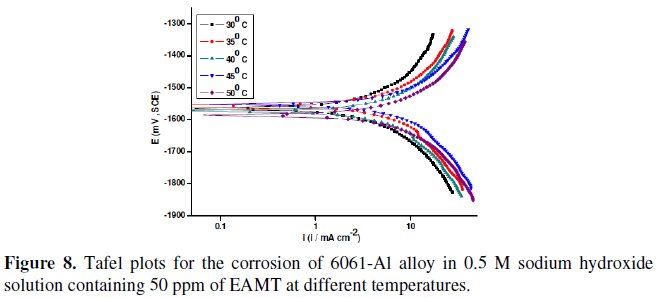
    <p>It was found that the inhibition efficiency of EAMT decreases with the increase 
in temperature. Fig. 8 represents the polarization curves for the corrosion of the 
base alloy in 0.5 M sodium hydroxide solution in the presence of 50 ppm EAMT 
at different temperatures.    <p>
    <p>&nbsp;</p>
<img src="/img/revistas/pea/v29n6/29n6a06f8.jpg">
    
<p>&nbsp;</p>

</p>Similar results were obtained in the presence of other 
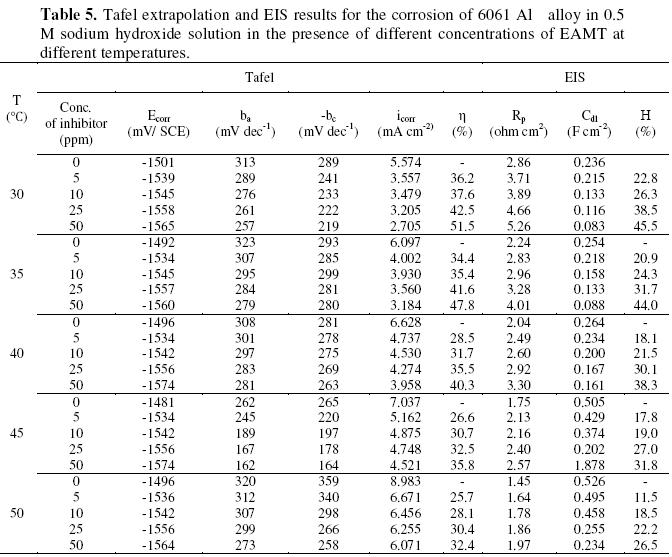
concentrations of the inhibitor and sodium hydroxide. Table 5 summarizes the 
Tafel polarization and impedance data for the corrosion of the alloy in 0.5 M 
sodium hydroxide solution in the presence of different concentrations of EAMT 
at different temperatures.</p>

    <p>&nbsp;</p>
<img src="/img/revistas/pea/v29n6/29n6a06t5.jpg">
    
<p>&nbsp;</p>

    <p>Corrosion reactions are usually regarded as Arrhenius processes and the 
corrosion rate can be expressed by the relation:</p>

    <p>&nbsp;</p>
<img src="/img/revistas/pea/v29n6/29n6a06e11.jpg">
    
<p>&nbsp;</p>

    ]]></body>
<body><![CDATA[<p>where k, the Arrhenius pre-exponential constant, depends on the metal type and 
electrolyte, Ea is the activation energy of the corrosion process, R is the universal 
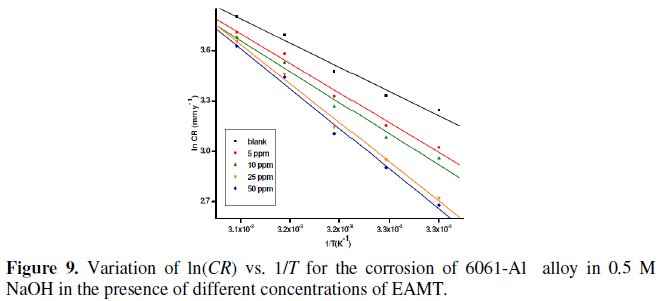
gas constant and T is the absolute temperature. Plot of ln CR vs. 1/T for the 6061 
Al alloy in 0.5 M NaOH solution in the absence and presence of various 
concentrations of EAMT is shown in Fig. 9.</p>

    <p>&nbsp;</p>
<img src="/img/revistas/pea/v29n6/29n6a06f9.jpg">
    
<p>&nbsp;</p>

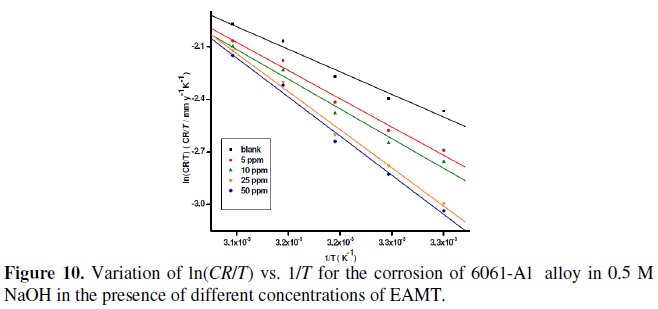
    <p>The values of &Delta;H<sub>a</sub> and &Delta;S<sub>a</sub> were calculated from the plot of ln CR/T vs. 1/T for 
base alloy in 0.5 M NaOH solution (Fig. 10) in the absence and presence of 
various concentrations of EAMT according to transition state equation:</p>

    <p>&nbsp;</p>
<img src="/img/revistas/pea/v29n6/29n6a06e12.jpg">
    
<p>&nbsp;</p>

    <p>where h is Planck's constant, N is Avogadro's number, &Delta;H<sub>a</sub> is the activation 
enthalpy and &Delta;S<sub>a</sub> is the activation entropy.</p>

    <p>&nbsp;</p>
<img src="/img/revistas/pea/v29n6/29n6a06f10.jpg">
    
<p>&nbsp;</p>

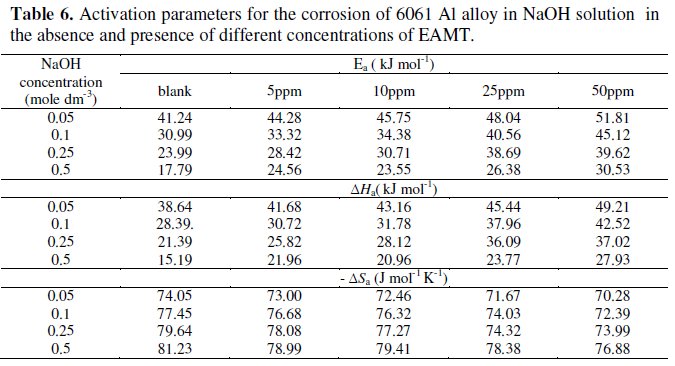
    <p>The calculated values of the apparent 
activation energy Ea, activation enthalpies &Delta;H<sub>a</sub>, and activation entropies &Delta;S<sub>a</sub>, are 
given in Table 6.</p>

    ]]></body>
<body><![CDATA[<p>&nbsp;</p>
<img src="/img/revistas/pea/v29n6/29n6a06t6.jpg">
    
<p>&nbsp;</p>

    <p>The increase in the activation energies with increasing 
concentration of the inhibitor is attributed to physical adsorption of the inhibitor 
molecules on the metal surface [43], with an appreciable increase in the 
adsorption process of the inhibitor on the metal surface with increasing in the 
concentration of inhibitor. The negative values of the entropy of activation, &Delta;S<sub>a</sub>, 
in the blank and inhibited solutions, imply that the activated complex is the rate 
determining step and represents association rather than dissociation. It also 
reveals that an increase in the order takes place in going from reactants to the 
activated complex [43].</p>


    <p><b><i>Scanning Electron Microscopy</i></b></p>

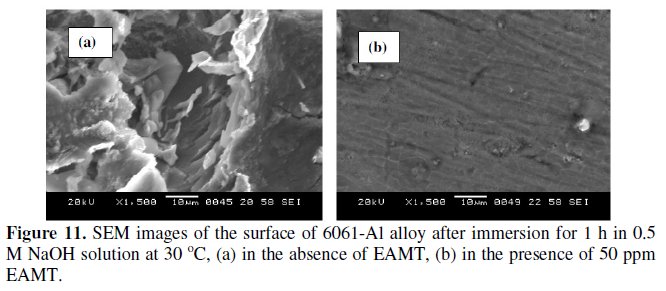
    <p>In order to evaluate the conditions of the 6061 Al alloy surface in contact with 
alkaline solution, a surface analysis was carried out. The SEM micrograph of the 
corroded specimen after 1 hour of immersion in 0.5 M NaOH solution is shown 
in Fig. 11 (a).</p>

    <p>&nbsp;</p>
<img src="/img/revistas/pea/v29n6/29n6a06f11.jpg">
    
<p>&nbsp;</p>

    <p>The faceting seen in the figure is due to the attack of aggressive 
hydroxide ions, the specimen has undergone more or less uniform corrosion. Fig. 
11 (b) depicts the SEM of specimen after 1 hour of immersion in 0.5 M NaOH 
solution with the addition of 50 ppm EAMT. It can be seen that the flakes in the 
surface of the specimen are reduced when compared with the micrograph given 
in Fig. 11 (a). The specimen surface can be observed to be covered with a thin 
layer of the inhibitor molecules, giving protection against corrosion. It is also 
interesting to note the presence of some defective sites due to the break down of 
the film, which permits a free access of aggressive ions to the metal surface.</p>


    <p><b><i>Inhibition mechanism</i></b></p>

    <p>Generally, the adsorption of organic molecules on metallic surfaces involves 
oxygen, nitrogen and sulphur atoms as active centres, forming the linkages with 
the metal surface. The good inhibition efficiency of EAMT is attributed to strong 
adsorption of inhibitor species on the metal surface through the active centers, 
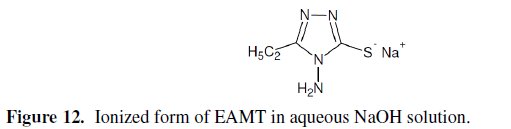
nitrogen and sulphur atoms. In NaOH solution EAMT exits in the ionized form, 
as shown in Fig. 12.</p>

    ]]></body>
<body><![CDATA[<p>&nbsp;</p>
<img src="/img/revistas/pea/v29n6/29n6a06f12.jpg">
    
<p>&nbsp;</p>

    <p>The presence of ethyl group with + R (resonance) and + I (inductive) effects in 
the heterocyclic ring has a marked effect on the inhibition efficiency of the 
triazole molecule. A substituted ethyl group at the position 3 would donate 
charge through hyperconjugation and by the inductive effect, thus concentrating 
the charge density on nitrogen and sulphur atoms, thereby increasing their 
adsorption at the anodic sites of the metal which would normally suffer anodic 
attack. In the presence of aggressive hydroxide ions, it is assumed that the 
inhibitor anions with high charge density compete with anions such as OH -ions 
and preferentially adsorbed at the anodic sites of the metal surface. Adsorption of 
the inhibitor at the metal surface replaces the water molecules within the 
electrical double layer to produce less pronounced dielectric effect [18] and thus 
holds up the reaction of surface water molecules, thus the rate of hydrogen 
evolution is reduced, thereby effecting the cathodic reactions.</p>


    <p>&nbsp;</p>
    <p><b>Conclusions</b></p>

    <p>- The corrosion studies of the 6061 aluminium alloy was carried out at 30 to 50 &deg;C 
temperatures using NaOH solutions, and the results indicate that EAMT 
improved the corrosion resistance of the alloy in alkaline environment.</p>

    <p>- The potentiodynamic polarization curves suggested a mixed-type with a 
predominant control of the cathodic reaction for the inhibition process in NaOH 
solution.</p>

    <p>- The inhibition efficiency increases with the increase in the NaOH 
concentration.</p>

    <p>- The inhibition efficiency decreases with the increase in temperature.</p>

    <p>- The adsorption of EAMT on the metal surface follows Langmuir adsorption 
isotherm.</p>

    ]]></body>
<body><![CDATA[<p>- The inhibition efficiencies obtained from potentiodynamic polarization and EIS 
techniques are in reasonably agreement.</p>


    <p>&nbsp;</p>
    <p><b>References</b></p>

    <p>1. M.L. Doche, J.J. Rameau, R. Durand and F. Novel-Cattin, Corros. Sci. 41 (1999) 805.</p>
    <!-- ref --><p>2. S.-M. Moon, Su-II Pyun, Electrochim. Acta 44 (1999) 2445.    &nbsp;&nbsp;&nbsp;&nbsp;&nbsp;&nbsp;&nbsp;&nbsp;[&#160;<a href="javascript:void(0);" onclick="javascript: window.open('/scielo.php?script=sci_nlinks&ref=000157&pid=S0872-1904201100060000600002&lng=','','width=640,height=500,resizable=yes,scrollbars=1,menubar=yes,');">Links</a>&#160;]<!-- end-ref --></p>
    <!-- ref --><p>3. H. Scholl, M.M.D. Jimenez, Corros. Sci. 33 (1992) 1967.    &nbsp;&nbsp;&nbsp;&nbsp;&nbsp;&nbsp;&nbsp;&nbsp;[&#160;<a href="javascript:void(0);" onclick="javascript: window.open('/scielo.php?script=sci_nlinks&ref=000159&pid=S0872-1904201100060000600003&lng=','','width=640,height=500,resizable=yes,scrollbars=1,menubar=yes,');">Links</a>&#160;]<!-- end-ref --></p>
    <!-- ref --><p>4. A.S. Fouda, A.A. AI-Sarawy, F. Sh. Ahmed, H.M. EI-Abbasy, Corros. Sci. 51 (2009) 485.    &nbsp;&nbsp;&nbsp;&nbsp;&nbsp;&nbsp;&nbsp;&nbsp;[&#160;<a href="javascript:void(0);" onclick="javascript: window.open('/scielo.php?script=sci_nlinks&ref=000161&pid=S0872-1904201100060000600004&lng=','','width=640,height=500,resizable=yes,scrollbars=1,menubar=yes,');">Links</a>&#160;]<!-- end-ref --></p>
    ]]></body>
<body><![CDATA[<p>5. P. Nitin Wasekar, A. Jyothirmayi, L. Ramakrishna and G. Sundararajan, JMEPEG 17 (2008) 708.</p>
    <!-- ref --><p>6. J. Davis, Corrosion Understanding the Basics, ASM International, (2000) USA.    &nbsp;&nbsp;&nbsp;&nbsp;&nbsp;&nbsp;&nbsp;&nbsp;[&#160;<a href="javascript:void(0);" onclick="javascript: window.open('/scielo.php?script=sci_nlinks&ref=000164&pid=S0872-1904201100060000600006&lng=','','width=640,height=500,resizable=yes,scrollbars=1,menubar=yes,');">Links</a>&#160;]<!-- end-ref --></p>
    <!-- ref --><p>7. F.M. AI-Kharafi, W.A. Badawy, Corrosion 5 (1997) 377.    &nbsp;&nbsp;&nbsp;&nbsp;&nbsp;&nbsp;&nbsp;&nbsp;[&#160;<a href="javascript:void(0);" onclick="javascript: window.open('/scielo.php?script=sci_nlinks&ref=000166&pid=S0872-1904201100060000600007&lng=','','width=640,height=500,resizable=yes,scrollbars=1,menubar=yes,');">Links</a>&#160;]<!-- end-ref --></p>
    <!-- ref --><p>8. J.D. Talati, R.M. Modi, Corros. Sci. 19 (1979) 35.    &nbsp;&nbsp;&nbsp;&nbsp;&nbsp;&nbsp;&nbsp;&nbsp;[&#160;<a href="javascript:void(0);" onclick="javascript: window.open('/scielo.php?script=sci_nlinks&ref=000168&pid=S0872-1904201100060000600008&lng=','','width=640,height=500,resizable=yes,scrollbars=1,menubar=yes,');">Links</a>&#160;]<!-- end-ref --></p>
    <!-- ref --><p>9. G. Bereket, A. Pinarbasi, Corros. Eng. Scie. Techn. 39 (2004) 308.    &nbsp;&nbsp;&nbsp;&nbsp;&nbsp;&nbsp;&nbsp;&nbsp;[&#160;<a href="javascript:void(0);" onclick="javascript: window.open('/scielo.php?script=sci_nlinks&ref=000170&pid=S0872-1904201100060000600009&lng=','','width=640,height=500,resizable=yes,scrollbars=1,menubar=yes,');">Links</a>&#160;]<!-- end-ref --></p>
    <!-- ref --><p>10. E.E. Oguzie, B.N. Okolue, C.E. Ogukwe, C. Unaegbu, Materials Letters 60 (2006) 3376.    &nbsp;&nbsp;&nbsp;&nbsp;&nbsp;&nbsp;&nbsp;&nbsp;[&#160;<a href="javascript:void(0);" onclick="javascript: window.open('/scielo.php?script=sci_nlinks&ref=000172&pid=S0872-1904201100060000600010&lng=','','width=640,height=500,resizable=yes,scrollbars=1,menubar=yes,');">Links</a>&#160;]<!-- end-ref --></p>
    <!-- ref --><p>11. A.K. Satpati, P.V. Ravindran, Mater. Chem. Phys. 109 (2008) 352.    &nbsp;&nbsp;&nbsp;&nbsp;&nbsp;&nbsp;&nbsp;&nbsp;[&#160;<a href="javascript:void(0);" onclick="javascript: window.open('/scielo.php?script=sci_nlinks&ref=000174&pid=S0872-1904201100060000600011&lng=','','width=640,height=500,resizable=yes,scrollbars=1,menubar=yes,');">Links</a>&#160;]<!-- end-ref --></p>
    <!-- ref --><p>12. V. Branzoi, F. Golgovici, F. Branzoi, Mater. Chem. Phys. 78 (2002) 122.    &nbsp;&nbsp;&nbsp;&nbsp;&nbsp;&nbsp;&nbsp;&nbsp;[&#160;<a href="javascript:void(0);" onclick="javascript: window.open('/scielo.php?script=sci_nlinks&ref=000176&pid=S0872-1904201100060000600012&lng=','','width=640,height=500,resizable=yes,scrollbars=1,menubar=yes,');">Links</a>&#160;]<!-- end-ref --></p>
    <!-- ref --><p>13. M.N. Moussa, A.S. Fouda, F.I. Taha, A. Elnenaa, Bull. Korean Chem. Soci. 9 (1998) 191.    &nbsp;&nbsp;&nbsp;&nbsp;&nbsp;&nbsp;&nbsp;&nbsp;[&#160;<a href="javascript:void(0);" onclick="javascript: window.open('/scielo.php?script=sci_nlinks&ref=000178&pid=S0872-1904201100060000600013&lng=','','width=640,height=500,resizable=yes,scrollbars=1,menubar=yes,');">Links</a>&#160;]<!-- end-ref --></p>
    <p>14. Z. Grubac, R. Babic, Metikos-Hukovic, J. Appl. Electrochem. 32 (2002) 431.</p>
    <!-- ref --><p>15. S.S. Abd EI Rehim, H.H. Hassan, A.M. Amin, Mater. Chem. Phys. 78 (2002) 337.    &nbsp;&nbsp;&nbsp;&nbsp;&nbsp;&nbsp;&nbsp;&nbsp;[&#160;<a href="javascript:void(0);" onclick="javascript: window.open('/scielo.php?script=sci_nlinks&ref=000181&pid=S0872-1904201100060000600015&lng=','','width=640,height=500,resizable=yes,scrollbars=1,menubar=yes,');">Links</a>&#160;]<!-- end-ref --></p>
    ]]></body>
<body><![CDATA[<!-- ref --><p>16. M. Abdallah, Corros. Sci. 46 (2004) 1981.    &nbsp;&nbsp;&nbsp;&nbsp;&nbsp;&nbsp;&nbsp;&nbsp;[&#160;<a href="javascript:void(0);" onclick="javascript: window.open('/scielo.php?script=sci_nlinks&ref=000183&pid=S0872-1904201100060000600016&lng=','','width=640,height=500,resizable=yes,scrollbars=1,menubar=yes,');">Links</a>&#160;]<!-- end-ref --></p>
    <!-- ref --><p>17. P.T. Shah, T.C. Daniels, Rev. Trav. Chim. 69 (1950) 1545.    &nbsp;&nbsp;&nbsp;&nbsp;&nbsp;&nbsp;&nbsp;&nbsp;[&#160;<a href="javascript:void(0);" onclick="javascript: window.open('/scielo.php?script=sci_nlinks&ref=000185&pid=S0872-1904201100060000600017&lng=','','width=640,height=500,resizable=yes,scrollbars=1,menubar=yes,');">Links</a>&#160;]<!-- end-ref --></p>
    <!-- ref --><p>18. A.R. Yazdad, T. Shahrabi, M.G. Hosseini, Mater. Chem. Phys.109 (2008) 199.    &nbsp;&nbsp;&nbsp;&nbsp;&nbsp;&nbsp;&nbsp;&nbsp;[&#160;<a href="javascript:void(0);" onclick="javascript: window.open('/scielo.php?script=sci_nlinks&ref=000187&pid=S0872-1904201100060000600018&lng=','','width=640,height=500,resizable=yes,scrollbars=1,menubar=yes,');">Links</a>&#160;]<!-- end-ref --></p>
    <!-- ref --><p>19. R. Rosliza, W.B. Wan Nik, Current Applied Phys. 10 (2010) 221.    &nbsp;&nbsp;&nbsp;&nbsp;&nbsp;&nbsp;&nbsp;&nbsp;[&#160;<a href="javascript:void(0);" onclick="javascript: window.open('/scielo.php?script=sci_nlinks&ref=000189&pid=S0872-1904201100060000600019&lng=','','width=640,height=500,resizable=yes,scrollbars=1,menubar=yes,');">Links</a>&#160;]<!-- end-ref --></p>
    <!-- ref --><p>20. F. Mansfeld, S. Lin, S. Kim, H. Shih, Corros. Sci. 27 (1987) 997.    &nbsp;&nbsp;&nbsp;&nbsp;&nbsp;&nbsp;&nbsp;&nbsp;[&#160;<a href="javascript:void(0);" onclick="javascript: window.open('/scielo.php?script=sci_nlinks&ref=000191&pid=S0872-1904201100060000600020&lng=','','width=640,height=500,resizable=yes,scrollbars=1,menubar=yes,');">Links</a>&#160;]<!-- end-ref --></p>
    ]]></body>
<body><![CDATA[<!-- ref --><p>21. F. Mansfeld, S. Lin, S. Kim, H. Shih, U. West, Korros. 39 (1988) 487.    &nbsp;&nbsp;&nbsp;&nbsp;&nbsp;&nbsp;&nbsp;&nbsp;[&#160;<a href="javascript:void(0);" onclick="javascript: window.open('/scielo.php?script=sci_nlinks&ref=000193&pid=S0872-1904201100060000600021&lng=','','width=640,height=500,resizable=yes,scrollbars=1,menubar=yes,');">Links</a>&#160;]<!-- end-ref --></p>
    <!-- ref --><p>22. C.M.A. Brett, J. Appl. Electrochem. 20 (1990) 1000.    &nbsp;&nbsp;&nbsp;&nbsp;&nbsp;&nbsp;&nbsp;&nbsp;[&#160;<a href="javascript:void(0);" onclick="javascript: window.open('/scielo.php?script=sci_nlinks&ref=000195&pid=S0872-1904201100060000600022&lng=','','width=640,height=500,resizable=yes,scrollbars=1,menubar=yes,');">Links</a>&#160;]<!-- end-ref --></p>
    <!-- ref --><p>23. C.M.A. Brett, Corros. Sci. 33 (1992) 203.    &nbsp;&nbsp;&nbsp;&nbsp;&nbsp;&nbsp;&nbsp;&nbsp;[&#160;<a href="javascript:void(0);" onclick="javascript: window.open('/scielo.php?script=sci_nlinks&ref=000197&pid=S0872-1904201100060000600023&lng=','','width=640,height=500,resizable=yes,scrollbars=1,menubar=yes,');">Links</a>&#160;]<!-- end-ref --></p>
    <!-- ref --><p>24. H.J.W. Lenderink, M.V.D. Linden, J.H.W. De Wit, Electrochim. Acta. 38 (1993) 1989.    &nbsp;&nbsp;&nbsp;&nbsp;&nbsp;&nbsp;&nbsp;&nbsp;[&#160;<a href="javascript:void(0);" onclick="javascript: window.open('/scielo.php?script=sci_nlinks&ref=000199&pid=S0872-1904201100060000600024&lng=','','width=640,height=500,resizable=yes,scrollbars=1,menubar=yes,');">Links</a>&#160;]<!-- end-ref --></p>
    <!-- ref --><p>25. D.D. Macdonald, S.S. Real, S.I. Smeldley, M. Urquidi-Macdonald, J. Electrochem. Soc. 135 (1988) 2410.    &nbsp;&nbsp;&nbsp;&nbsp;&nbsp;&nbsp;&nbsp;&nbsp;[&#160;<a href="javascript:void(0);" onclick="javascript: window.open('/scielo.php?script=sci_nlinks&ref=000201&pid=S0872-1904201100060000600025&lng=','','width=640,height=500,resizable=yes,scrollbars=1,menubar=yes,');">Links</a>&#160;]<!-- end-ref --></p>
    ]]></body>
<body><![CDATA[<!-- ref --><p>26. M. Paramasivam, G. Suresh, B. Muthuramalingam et all, Appl. Electrochem. 21 (1990) 452.    &nbsp;&nbsp;&nbsp;&nbsp;&nbsp;&nbsp;&nbsp;&nbsp;[&#160;<a href="javascript:void(0);" onclick="javascript: window.open('/scielo.php?script=sci_nlinks&ref=000203&pid=S0872-1904201100060000600026&lng=','','width=640,height=500,resizable=yes,scrollbars=1,menubar=yes,');">Links</a>&#160;]<!-- end-ref --></p>
    <!-- ref --><p>27. K. Juttner, Electrochim. Acta. 35 (1990) 1501.    &nbsp;&nbsp;&nbsp;&nbsp;&nbsp;&nbsp;&nbsp;&nbsp;[&#160;<a href="javascript:void(0);" onclick="javascript: window.open('/scielo.php?script=sci_nlinks&ref=000205&pid=S0872-1904201100060000600027&lng=','','width=640,height=500,resizable=yes,scrollbars=1,menubar=yes,');">Links</a>&#160;]<!-- end-ref --></p>
    <!-- ref --><p>28. A.A. Mohammed, K.F. Khaled, Q. Mohsen, H.A. Arida, Corros. Sci. 52 (2010) 1684.    &nbsp;&nbsp;&nbsp;&nbsp;&nbsp;&nbsp;&nbsp;&nbsp;[&#160;<a href="javascript:void(0);" onclick="javascript: window.open('/scielo.php?script=sci_nlinks&ref=000207&pid=S0872-1904201100060000600028&lng=','','width=640,height=500,resizable=yes,scrollbars=1,menubar=yes,');">Links</a>&#160;]<!-- end-ref --></p>
    <!-- ref --><p>29. I. Dehri, M. Erbil, Corros. Sci. 42 (2000) 969.    &nbsp;&nbsp;&nbsp;&nbsp;&nbsp;&nbsp;&nbsp;&nbsp;[&#160;<a href="javascript:void(0);" onclick="javascript: window.open('/scielo.php?script=sci_nlinks&ref=000209&pid=S0872-1904201100060000600029&lng=','','width=640,height=500,resizable=yes,scrollbars=1,menubar=yes,');">Links</a>&#160;]<!-- end-ref --></p>
    <!-- ref --><p>30. U. Rammelt, S. Kohler, G. Reinhard, Electrochim. Acta. 53 (2008) 6968.    &nbsp;&nbsp;&nbsp;&nbsp;&nbsp;&nbsp;&nbsp;&nbsp;[&#160;<a href="javascript:void(0);" onclick="javascript: window.open('/scielo.php?script=sci_nlinks&ref=000211&pid=S0872-1904201100060000600030&lng=','','width=640,height=500,resizable=yes,scrollbars=1,menubar=yes,');">Links</a>&#160;]<!-- end-ref --></p>
    ]]></body>
<body><![CDATA[<!-- ref --><p>31. A.K. Mishra, R. Balasubramaniam, Mater. Chem. Phys. 103 (2007) 385.    &nbsp;&nbsp;&nbsp;&nbsp;&nbsp;&nbsp;&nbsp;&nbsp;[&#160;<a href="javascript:void(0);" onclick="javascript: window.open('/scielo.php?script=sci_nlinks&ref=000213&pid=S0872-1904201100060000600031&lng=','','width=640,height=500,resizable=yes,scrollbars=1,menubar=yes,');">Links</a>&#160;]<!-- end-ref --></p>
    <!-- ref --><p>32. A.K. Singh, M.A. Quraishi, Corros. Sci. 52 (2010) 1373.    &nbsp;&nbsp;&nbsp;&nbsp;&nbsp;&nbsp;&nbsp;&nbsp;[&#160;<a href="javascript:void(0);" onclick="javascript: window.open('/scielo.php?script=sci_nlinks&ref=000215&pid=S0872-1904201100060000600032&lng=','','width=640,height=500,resizable=yes,scrollbars=1,menubar=yes,');">Links</a>&#160;]<!-- end-ref --></p>
    <!-- ref --><p>33. F. Mansfeld, C.H. Tsai, H. Shih, In: Munn RS (ed.), Computer modelling in corrosion. ASTM, Philadelphia, 1992.    &nbsp;&nbsp;&nbsp;&nbsp;&nbsp;&nbsp;&nbsp;&nbsp;[&#160;<a href="javascript:void(0);" onclick="javascript: window.open('/scielo.php?script=sci_nlinks&ref=000217&pid=S0872-1904201100060000600033&lng=','','width=640,height=500,resizable=yes,scrollbars=1,menubar=yes,');">Links</a>&#160;]<!-- end-ref --></p>
    <!-- ref --><p>34. C.H. Hsu, F. Mansfeld, Corrosion 57 (2001) 747.    &nbsp;&nbsp;&nbsp;&nbsp;&nbsp;&nbsp;&nbsp;&nbsp;[&#160;<a href="javascript:void(0);" onclick="javascript: window.open('/scielo.php?script=sci_nlinks&ref=000219&pid=S0872-1904201100060000600034&lng=','','width=640,height=500,resizable=yes,scrollbars=1,menubar=yes,');">Links</a>&#160;]<!-- end-ref --></p>
    <!-- ref --><p>35. E. McCafferty, N. Hackerman, J. Electrochem. Soc. 119 (1972) 146.    &nbsp;&nbsp;&nbsp;&nbsp;&nbsp;&nbsp;&nbsp;&nbsp;[&#160;<a href="javascript:void(0);" onclick="javascript: window.open('/scielo.php?script=sci_nlinks&ref=000221&pid=S0872-1904201100060000600035&lng=','','width=640,height=500,resizable=yes,scrollbars=1,menubar=yes,');">Links</a>&#160;]<!-- end-ref --></p>
    ]]></body>
<body><![CDATA[<!-- ref --><p>36. R. Solmaz, G. Kardas, M. Culha et all, Electrochim. Acta 53 (2008) 5941.    &nbsp;&nbsp;&nbsp;&nbsp;&nbsp;&nbsp;&nbsp;&nbsp;[&#160;<a href="javascript:void(0);" onclick="javascript: window.open('/scielo.php?script=sci_nlinks&ref=000223&pid=S0872-1904201100060000600036&lng=','','width=640,height=500,resizable=yes,scrollbars=1,menubar=yes,');">Links</a>&#160;]<!-- end-ref --></p>
    <!-- ref --><p>37. W. Durnie, R. De Marc, R. Jefferson, B. Kinsella, J. Electrochem. Soc. 146 (1990) 1751.    &nbsp;&nbsp;&nbsp;&nbsp;&nbsp;&nbsp;&nbsp;&nbsp;[&#160;<a href="javascript:void(0);" onclick="javascript: window.open('/scielo.php?script=sci_nlinks&ref=000225&pid=S0872-1904201100060000600037&lng=','','width=640,height=500,resizable=yes,scrollbars=1,menubar=yes,');">Links</a>&#160;]<!-- end-ref --></p>
    <!-- ref --><p>38. A.P. Bansiwal, P. Anthony, S.P. Mathur, Br. Corros. J. 4 (2000) 301.    &nbsp;&nbsp;&nbsp;&nbsp;&nbsp;&nbsp;&nbsp;&nbsp;[&#160;<a href="javascript:void(0);" onclick="javascript: window.open('/scielo.php?script=sci_nlinks&ref=000227&pid=S0872-1904201100060000600038&lng=','','width=640,height=500,resizable=yes,scrollbars=1,menubar=yes,');">Links</a>&#160;]<!-- end-ref --></p>
    <!-- ref --><p>39. S.A. Umoren, E.E. Ebenso, P.C. Okafor et all, J. Appl. Polym. Sci. 103 (2007) 2810.    &nbsp;&nbsp;&nbsp;&nbsp;&nbsp;&nbsp;&nbsp;&nbsp;[&#160;<a href="javascript:void(0);" onclick="javascript: window.open('/scielo.php?script=sci_nlinks&ref=000229&pid=S0872-1904201100060000600039&lng=','','width=640,height=500,resizable=yes,scrollbars=1,menubar=yes,');">Links</a>&#160;]<!-- end-ref --></p>
    <!-- ref --><p>40. S.A. Ali, EI-Sherif, R.F. AI-Ghamdi, M.T. Saeed, Corros. Sci. 47 (2005) 2659.    &nbsp;&nbsp;&nbsp;&nbsp;&nbsp;&nbsp;&nbsp;&nbsp;[&#160;<a href="javascript:void(0);" onclick="javascript: window.open('/scielo.php?script=sci_nlinks&ref=000231&pid=S0872-1904201100060000600040&lng=','','width=640,height=500,resizable=yes,scrollbars=1,menubar=yes,');">Links</a>&#160;]<!-- end-ref --></p>
    ]]></body>
<body><![CDATA[<!-- ref --><p>41. A.A. Khadom, A.S. Yaro, A.S. AlTafie, A.A.H. Kadum, Port. Electrochim. Acta 27 (2009) 699.    &nbsp;&nbsp;&nbsp;&nbsp;&nbsp;&nbsp;&nbsp;&nbsp;[&#160;<a href="javascript:void(0);" onclick="javascript: window.open('/scielo.php?script=sci_nlinks&ref=000233&pid=S0872-1904201100060000600041&lng=','','width=640,height=500,resizable=yes,scrollbars=1,menubar=yes,');">Links</a>&#160;]<!-- end-ref --></p>
    <!-- ref --><p>42. L. Tang, G. Mu, G. Liu, Corros. Sci. 45 (2003) 2251.    &nbsp;&nbsp;&nbsp;&nbsp;&nbsp;&nbsp;&nbsp;&nbsp;[&#160;<a href="javascript:void(0);" onclick="javascript: window.open('/scielo.php?script=sci_nlinks&ref=000235&pid=S0872-1904201100060000600042&lng=','','width=640,height=500,resizable=yes,scrollbars=1,menubar=yes,');">Links</a>&#160;]<!-- end-ref --></p>
    <!-- ref --><p>43. H. Ashassi-Sorkhabi, Z. Ghasemi, D. Seifzadeh, Appl. Surf. Sci. 249 (2005) 408.    &nbsp;&nbsp;&nbsp;&nbsp;&nbsp;&nbsp;&nbsp;&nbsp;[&#160;<a href="javascript:void(0);" onclick="javascript: window.open('/scielo.php?script=sci_nlinks&ref=000237&pid=S0872-1904201100060000600043&lng=','','width=640,height=500,resizable=yes,scrollbars=1,menubar=yes,');">Links</a>&#160;]<!-- end-ref --></p>


    <p>&nbsp;</p>

    <p><a name=0></a><sup><a href="#top">*</a></sup> Corresponding author. E-mail address: <a href="mailto:nityashreya@gmail.com">nityashreya@gmail.com</a></p>

    <p>Received 13 October 2010; accepted 27 October 2011</p>

    <p><a href="http://www.peacta.org" target="_blank">www.peacta.org</a> </p>


    ]]></body>
<body><![CDATA[ ]]></body><back>
<ref-list>
<ref id="B1">
<label>1</label><nlm-citation citation-type="journal">
<person-group person-group-type="author">
<name>
<surname><![CDATA[Doche]]></surname>
<given-names><![CDATA[M.L.]]></given-names>
</name>
<name>
<surname><![CDATA[Rameau]]></surname>
<given-names><![CDATA[J.J.]]></given-names>
</name>
</person-group>
<source><![CDATA[Corros. Sci.]]></source>
<year>1999</year>
<volume>41</volume>
<page-range>805</page-range></nlm-citation>
</ref>
<ref id="B2">
<label>2</label><nlm-citation citation-type="journal">
<person-group person-group-type="author">
<name>
<surname><![CDATA[Moon]]></surname>
<given-names><![CDATA[S.-M.]]></given-names>
</name>
<name>
<surname><![CDATA[Pyun]]></surname>
<given-names><![CDATA[Su-II]]></given-names>
</name>
</person-group>
<source><![CDATA[Electrochim. Acta]]></source>
<year>1999</year>
<volume>44</volume>
<page-range>2445</page-range></nlm-citation>
</ref>
<ref id="B3">
<label>3</label><nlm-citation citation-type="journal">
<person-group person-group-type="author">
<name>
<surname><![CDATA[Scholl]]></surname>
<given-names><![CDATA[H.]]></given-names>
</name>
<name>
<surname><![CDATA[Jimenez]]></surname>
<given-names><![CDATA[M.M.D.]]></given-names>
</name>
</person-group>
<source><![CDATA[Corros. Sci.]]></source>
<year>1992</year>
<volume>33</volume>
<page-range>1967</page-range></nlm-citation>
</ref>
<ref id="B4">
<label>4</label><nlm-citation citation-type="journal">
<person-group person-group-type="author">
<name>
<surname><![CDATA[Fouda]]></surname>
<given-names><![CDATA[A.S.]]></given-names>
</name>
<name>
<surname><![CDATA[AI-Sarawy]]></surname>
<given-names><![CDATA[A.A.]]></given-names>
</name>
</person-group>
<source><![CDATA[Corros. Sci.]]></source>
<year>2009</year>
<volume>51</volume>
<page-range>485</page-range></nlm-citation>
</ref>
<ref id="B5">
<label>5</label><nlm-citation citation-type="journal">
<person-group person-group-type="author">
<name>
<surname><![CDATA[Wasekar]]></surname>
<given-names><![CDATA[P.N.]]></given-names>
</name>
<name>
<surname><![CDATA[Jyothirmayi]]></surname>
<given-names><![CDATA[A.]]></given-names>
</name>
</person-group>
<source><![CDATA[JMEPEG]]></source>
<year>2008</year>
<volume>17</volume>
<page-range>708</page-range></nlm-citation>
</ref>
<ref id="B6">
<label>6</label><nlm-citation citation-type="book">
<person-group person-group-type="author">
<name>
<surname><![CDATA[Davis]]></surname>
<given-names><![CDATA[J.]]></given-names>
</name>
</person-group>
<source><![CDATA[Corrosion Understanding the Basics]]></source>
<year>2000</year>
<publisher-name><![CDATA[ASM International]]></publisher-name>
</nlm-citation>
</ref>
<ref id="B7">
<label>7</label><nlm-citation citation-type="journal">
<person-group person-group-type="author">
<name>
<surname><![CDATA[AI-Kharafi]]></surname>
<given-names><![CDATA[F.M.]]></given-names>
</name>
<name>
<surname><![CDATA[Badawy]]></surname>
<given-names><![CDATA[W.A.]]></given-names>
</name>
</person-group>
<source><![CDATA[Corrosion]]></source>
<year>1997</year>
<volume>5</volume>
<page-range>377</page-range></nlm-citation>
</ref>
<ref id="B8">
<label>8</label><nlm-citation citation-type="journal">
<person-group person-group-type="author">
<name>
<surname><![CDATA[Talati]]></surname>
<given-names><![CDATA[J.D.]]></given-names>
</name>
<name>
<surname><![CDATA[Modi]]></surname>
<given-names><![CDATA[R.M.]]></given-names>
</name>
</person-group>
<source><![CDATA[Corros. Sci.]]></source>
<year>1979</year>
<volume>19</volume>
<page-range>35</page-range></nlm-citation>
</ref>
<ref id="B9">
<label>9</label><nlm-citation citation-type="journal">
<person-group person-group-type="author">
<name>
<surname><![CDATA[Bereket]]></surname>
<given-names><![CDATA[G.]]></given-names>
</name>
<name>
<surname><![CDATA[Pinarbasi]]></surname>
<given-names><![CDATA[A.]]></given-names>
</name>
</person-group>
<source><![CDATA[Corros. Eng. Scie. Techn.]]></source>
<year>2004</year>
<volume>39</volume>
<page-range>308</page-range></nlm-citation>
</ref>
<ref id="B10">
<label>10</label><nlm-citation citation-type="journal">
<person-group person-group-type="author">
<name>
<surname><![CDATA[Oguzie]]></surname>
<given-names><![CDATA[E.E.]]></given-names>
</name>
<name>
<surname><![CDATA[Okolue]]></surname>
<given-names><![CDATA[B.N.]]></given-names>
</name>
</person-group>
<source><![CDATA[Materials Letters]]></source>
<year>2006</year>
<volume>60</volume>
<page-range>3376</page-range></nlm-citation>
</ref>
<ref id="B11">
<label>11</label><nlm-citation citation-type="journal">
<person-group person-group-type="author">
<name>
<surname><![CDATA[Satpati]]></surname>
<given-names><![CDATA[A.K.]]></given-names>
</name>
<name>
<surname><![CDATA[Ravindran]]></surname>
<given-names><![CDATA[P.V.]]></given-names>
</name>
</person-group>
<source><![CDATA[Mater. Chem. Phys.]]></source>
<year>2008</year>
<volume>109</volume>
<page-range>352</page-range></nlm-citation>
</ref>
<ref id="B12">
<label>12</label><nlm-citation citation-type="journal">
<person-group person-group-type="author">
<name>
<surname><![CDATA[Branzoi]]></surname>
<given-names><![CDATA[V.]]></given-names>
</name>
<name>
<surname><![CDATA[Golgovici]]></surname>
<given-names><![CDATA[F.]]></given-names>
</name>
<name>
<surname><![CDATA[Branzoi]]></surname>
<given-names><![CDATA[F.]]></given-names>
</name>
</person-group>
<source><![CDATA[Mater. Chem. Phys.]]></source>
<year>2002</year>
<volume>78</volume>
<page-range>122</page-range></nlm-citation>
</ref>
<ref id="B13">
<label>13</label><nlm-citation citation-type="journal">
<person-group person-group-type="author">
<name>
<surname><![CDATA[Moussa]]></surname>
<given-names><![CDATA[M.N.]]></given-names>
</name>
<name>
<surname><![CDATA[Fouda]]></surname>
<given-names><![CDATA[A.S.]]></given-names>
</name>
</person-group>
<source><![CDATA[Bull. Korean Chem. Soci.]]></source>
<year>1998</year>
<volume>9</volume>
<page-range>191</page-range></nlm-citation>
</ref>
<ref id="B14">
<label>14</label><nlm-citation citation-type="journal">
<person-group person-group-type="author">
<name>
<surname><![CDATA[Grubac]]></surname>
<given-names><![CDATA[Z.]]></given-names>
</name>
<name>
<surname><![CDATA[Babic]]></surname>
<given-names><![CDATA[R.]]></given-names>
</name>
<name>
<surname><![CDATA[Hukovic]]></surname>
<given-names><![CDATA[M.]]></given-names>
</name>
</person-group>
<source><![CDATA[J. Appl. Electrochem.]]></source>
<year>2002</year>
<volume>32</volume>
<page-range>431</page-range></nlm-citation>
</ref>
<ref id="B15">
<label>15</label><nlm-citation citation-type="journal">
<person-group person-group-type="author">
<name>
<surname><![CDATA[Abd EI Rehim]]></surname>
<given-names><![CDATA[S.S.]]></given-names>
</name>
<name>
<surname><![CDATA[Hassan]]></surname>
<given-names><![CDATA[H.H.]]></given-names>
</name>
<name>
<surname><![CDATA[Amin]]></surname>
<given-names><![CDATA[A.M.]]></given-names>
</name>
</person-group>
<source><![CDATA[Mater. Chem. Phys.]]></source>
<year>2002</year>
<volume>78</volume>
<page-range>337</page-range></nlm-citation>
</ref>
<ref id="B16">
<label>16</label><nlm-citation citation-type="journal">
<person-group person-group-type="author">
<name>
<surname><![CDATA[Abdallah]]></surname>
<given-names><![CDATA[M.]]></given-names>
</name>
</person-group>
<source><![CDATA[Corros. Sci.]]></source>
<year>2004</year>
<volume>46</volume>
<page-range>1981</page-range></nlm-citation>
</ref>
<ref id="B17">
<label>17</label><nlm-citation citation-type="journal">
<person-group person-group-type="author">
<name>
<surname><![CDATA[Shah]]></surname>
<given-names><![CDATA[P.T.]]></given-names>
</name>
<name>
<surname><![CDATA[Daniels]]></surname>
<given-names><![CDATA[T.C.]]></given-names>
</name>
</person-group>
<source><![CDATA[Rev. Trav. Chim.]]></source>
<year>1950</year>
<volume>69</volume>
<page-range>1545</page-range></nlm-citation>
</ref>
<ref id="B18">
<label>18</label><nlm-citation citation-type="journal">
<person-group person-group-type="author">
<name>
<surname><![CDATA[Yazdad]]></surname>
<given-names><![CDATA[A.R.]]></given-names>
</name>
<name>
<surname><![CDATA[Shahrabi]]></surname>
<given-names><![CDATA[T.]]></given-names>
</name>
<name>
<surname><![CDATA[Hosseini]]></surname>
<given-names><![CDATA[M.G.]]></given-names>
</name>
</person-group>
<source><![CDATA[Mater. Chem. Phys.]]></source>
<year>2008</year>
<volume>109</volume>
<page-range>199</page-range></nlm-citation>
</ref>
<ref id="B19">
<label>19</label><nlm-citation citation-type="journal">
<person-group person-group-type="author">
<name>
<surname><![CDATA[Rosliza]]></surname>
<given-names><![CDATA[R.]]></given-names>
</name>
<name>
<surname><![CDATA[Wan Nik]]></surname>
<given-names><![CDATA[W.B.]]></given-names>
</name>
</person-group>
<source><![CDATA[Current Applied Phys.]]></source>
<year>2010</year>
<volume>10</volume>
<page-range>221</page-range></nlm-citation>
</ref>
<ref id="B20">
<label>20</label><nlm-citation citation-type="journal">
<person-group person-group-type="author">
<name>
<surname><![CDATA[Mansfeld]]></surname>
<given-names><![CDATA[F.]]></given-names>
</name>
<name>
<surname><![CDATA[Lin]]></surname>
<given-names><![CDATA[S.]]></given-names>
</name>
</person-group>
<source><![CDATA[Corros. Sci.]]></source>
<year>1987</year>
<volume>27</volume>
<page-range>997</page-range></nlm-citation>
</ref>
<ref id="B21">
<label>21</label><nlm-citation citation-type="journal">
<person-group person-group-type="author">
<name>
<surname><![CDATA[Mansfeld]]></surname>
<given-names><![CDATA[F.]]></given-names>
</name>
<name>
<surname><![CDATA[Lin]]></surname>
<given-names><![CDATA[S.]]></given-names>
</name>
</person-group>
<source><![CDATA[Korros.]]></source>
<year>1988</year>
<volume>39</volume>
<page-range>487</page-range></nlm-citation>
</ref>
<ref id="B22">
<label>22</label><nlm-citation citation-type="journal">
<person-group person-group-type="author">
<name>
<surname><![CDATA[Brett]]></surname>
<given-names><![CDATA[C.M.A.]]></given-names>
</name>
</person-group>
<source><![CDATA[J. Appl. Electrochem.]]></source>
<year>1990</year>
<volume>20</volume>
<page-range>1000</page-range></nlm-citation>
</ref>
<ref id="B23">
<label>23</label><nlm-citation citation-type="journal">
<person-group person-group-type="author">
<name>
<surname><![CDATA[Brett]]></surname>
<given-names><![CDATA[C.M.A.]]></given-names>
</name>
</person-group>
<source><![CDATA[Corros. Sci.]]></source>
<year>1992</year>
<volume>33</volume>
<page-range>203</page-range></nlm-citation>
</ref>
<ref id="B24">
<label>24</label><nlm-citation citation-type="journal">
<person-group person-group-type="author">
<name>
<surname><![CDATA[Lenderink]]></surname>
<given-names><![CDATA[H.J.W.]]></given-names>
</name>
<name>
<surname><![CDATA[Linden]]></surname>
<given-names><![CDATA[M.V.D.]]></given-names>
</name>
<name>
<surname><![CDATA[De Wit]]></surname>
<given-names><![CDATA[J.H.W.]]></given-names>
</name>
</person-group>
<source><![CDATA[Electrochim. Acta.]]></source>
<year>1993</year>
<volume>38</volume>
<page-range>1989</page-range></nlm-citation>
</ref>
<ref id="B25">
<label>25</label><nlm-citation citation-type="journal">
<person-group person-group-type="author">
<name>
<surname><![CDATA[MacDonald]]></surname>
<given-names><![CDATA[D.D.]]></given-names>
</name>
<name>
<surname><![CDATA[Real]]></surname>
<given-names><![CDATA[S.S.]]></given-names>
</name>
</person-group>
<source><![CDATA[J. Electrochem. Soc.]]></source>
<year>1988</year>
<volume>135</volume>
<page-range>2410</page-range></nlm-citation>
</ref>
<ref id="B26">
<label>26</label><nlm-citation citation-type="journal">
<person-group person-group-type="author">
<name>
<surname><![CDATA[Paramasivam]]></surname>
<given-names><![CDATA[M.]]></given-names>
</name>
<name>
<surname><![CDATA[Suresh]]></surname>
<given-names><![CDATA[G.]]></given-names>
</name>
</person-group>
<source><![CDATA[Appl. Electrochem.]]></source>
<year>1990</year>
<volume>21</volume>
<page-range>452</page-range></nlm-citation>
</ref>
<ref id="B27">
<label>27</label><nlm-citation citation-type="journal">
<person-group person-group-type="author">
<name>
<surname><![CDATA[Juttner]]></surname>
<given-names><![CDATA[K.]]></given-names>
</name>
</person-group>
<source><![CDATA[Electrochim. Acta.]]></source>
<year>1990</year>
<volume>35</volume>
<page-range>1501</page-range></nlm-citation>
</ref>
<ref id="B28">
<label>28</label><nlm-citation citation-type="journal">
<person-group person-group-type="author">
<name>
<surname><![CDATA[Mohammed]]></surname>
<given-names><![CDATA[A.A.]]></given-names>
</name>
<name>
<surname><![CDATA[Khaled]]></surname>
<given-names><![CDATA[K.F.]]></given-names>
</name>
</person-group>
<source><![CDATA[Corros. Sci.]]></source>
<year>2010</year>
<volume>52</volume>
<page-range>1684</page-range></nlm-citation>
</ref>
<ref id="B29">
<label>29</label><nlm-citation citation-type="journal">
<person-group person-group-type="author">
<name>
<surname><![CDATA[Dehri]]></surname>
<given-names><![CDATA[I.]]></given-names>
</name>
<name>
<surname><![CDATA[Erbil]]></surname>
<given-names><![CDATA[M.]]></given-names>
</name>
</person-group>
<source><![CDATA[Corros. Sci.]]></source>
<year>2000</year>
<volume>42</volume>
<page-range>969</page-range></nlm-citation>
</ref>
<ref id="B30">
<label>30</label><nlm-citation citation-type="journal">
<person-group person-group-type="author">
<name>
<surname><![CDATA[Rammelt]]></surname>
<given-names><![CDATA[U.]]></given-names>
</name>
<name>
<surname><![CDATA[Kohler]]></surname>
<given-names><![CDATA[S.]]></given-names>
</name>
<name>
<surname><![CDATA[Reinhard]]></surname>
<given-names><![CDATA[G.]]></given-names>
</name>
</person-group>
<source><![CDATA[Electrochim. Acta]]></source>
<year>2008</year>
<volume>53</volume>
<page-range>6968</page-range></nlm-citation>
</ref>
<ref id="B31">
<label>31</label><nlm-citation citation-type="journal">
<person-group person-group-type="author">
<name>
<surname><![CDATA[Mishra]]></surname>
<given-names><![CDATA[A.K.]]></given-names>
</name>
<name>
<surname><![CDATA[Balasubramaniam]]></surname>
<given-names><![CDATA[R.]]></given-names>
</name>
</person-group>
<source><![CDATA[Mater. Chem. Phys.]]></source>
<year>2007</year>
<volume>103</volume>
<page-range>385</page-range></nlm-citation>
</ref>
<ref id="B32">
<label>32</label><nlm-citation citation-type="journal">
<person-group person-group-type="author">
<name>
<surname><![CDATA[Singh]]></surname>
<given-names><![CDATA[A.K.]]></given-names>
</name>
<name>
<surname><![CDATA[Quraishi]]></surname>
<given-names><![CDATA[M.A.]]></given-names>
</name>
</person-group>
<source><![CDATA[Corros. Sci.]]></source>
<year>2010</year>
<volume>52</volume>
<page-range>1373</page-range></nlm-citation>
</ref>
<ref id="B33">
<label>33</label><nlm-citation citation-type="book">
<person-group person-group-type="author">
<name>
<surname><![CDATA[Mansfeld]]></surname>
<given-names><![CDATA[F.]]></given-names>
</name>
<name>
<surname><![CDATA[Tsai]]></surname>
<given-names><![CDATA[C.H.]]></given-names>
</name>
<name>
<surname><![CDATA[Shih]]></surname>
<given-names><![CDATA[H.]]></given-names>
</name>
</person-group>
<source><![CDATA[Computer modelling in corrosion]]></source>
<year>1992</year>
<publisher-loc><![CDATA[Philadelphia ]]></publisher-loc>
<publisher-name><![CDATA[ASTM]]></publisher-name>
</nlm-citation>
</ref>
<ref id="B34">
<label>34</label><nlm-citation citation-type="journal">
<person-group person-group-type="author">
<name>
<surname><![CDATA[Hsu]]></surname>
<given-names><![CDATA[C.H.]]></given-names>
</name>
<name>
<surname><![CDATA[Mansfeld]]></surname>
<given-names><![CDATA[F.]]></given-names>
</name>
</person-group>
<source><![CDATA[Corrosion]]></source>
<year>2001</year>
<volume>57</volume>
<page-range>747</page-range></nlm-citation>
</ref>
<ref id="B35">
<label>35</label><nlm-citation citation-type="journal">
<person-group person-group-type="author">
<name>
<surname><![CDATA[McCafferty]]></surname>
<given-names><![CDATA[E.]]></given-names>
</name>
<name>
<surname><![CDATA[Hackerman]]></surname>
<given-names><![CDATA[N.]]></given-names>
</name>
</person-group>
<source><![CDATA[J. Electrochem. Soc.]]></source>
<year>1972</year>
<volume>119</volume>
<page-range>146</page-range></nlm-citation>
</ref>
<ref id="B36">
<label>36</label><nlm-citation citation-type="journal">
<person-group person-group-type="author">
<name>
<surname><![CDATA[Solmaz]]></surname>
<given-names><![CDATA[R.]]></given-names>
</name>
<name>
<surname><![CDATA[Kardas]]></surname>
<given-names><![CDATA[G.]]></given-names>
</name>
</person-group>
<source><![CDATA[Electrochim. Acta]]></source>
<year>2008</year>
<volume>53</volume>
<page-range>5941</page-range></nlm-citation>
</ref>
<ref id="B37">
<label>37</label><nlm-citation citation-type="journal">
<person-group person-group-type="author">
<name>
<surname><![CDATA[Durnie]]></surname>
<given-names><![CDATA[W.]]></given-names>
</name>
<name>
<surname><![CDATA[De Marc]]></surname>
<given-names><![CDATA[R.]]></given-names>
</name>
</person-group>
<source><![CDATA[J. Electrochem. Soc.]]></source>
<year>1990</year>
<volume>146</volume>
<page-range>1751</page-range></nlm-citation>
</ref>
<ref id="B38">
<label>38</label><nlm-citation citation-type="journal">
<person-group person-group-type="author">
<name>
<surname><![CDATA[Bansiwal]]></surname>
<given-names><![CDATA[A.P.]]></given-names>
</name>
<name>
<surname><![CDATA[Anthony]]></surname>
<given-names><![CDATA[P.]]></given-names>
</name>
<name>
<surname><![CDATA[Mathur]]></surname>
<given-names><![CDATA[S.P.]]></given-names>
</name>
</person-group>
<source><![CDATA[Br. Corros. J.]]></source>
<year>2000</year>
<volume>4</volume>
<page-range>301</page-range></nlm-citation>
</ref>
<ref id="B39">
<label>39</label><nlm-citation citation-type="journal">
<person-group person-group-type="author">
<name>
<surname><![CDATA[Umoren]]></surname>
<given-names><![CDATA[S.A.]]></given-names>
</name>
<name>
<surname><![CDATA[Ebenso]]></surname>
<given-names><![CDATA[E.E.]]></given-names>
</name>
</person-group>
<source><![CDATA[J. Appl. Polym. Sci.]]></source>
<year>2007</year>
<volume>103</volume>
<page-range>2810</page-range></nlm-citation>
</ref>
<ref id="B40">
<label>40</label><nlm-citation citation-type="journal">
<person-group person-group-type="author">
<name>
<surname><![CDATA[Ali]]></surname>
<given-names><![CDATA[S.A.]]></given-names>
</name>
<name>
<surname><![CDATA[EI-Sherif]]></surname>
</name>
</person-group>
<source><![CDATA[Corros. Sci.]]></source>
<year>2005</year>
<volume>47</volume>
<page-range>2659</page-range></nlm-citation>
</ref>
<ref id="B41">
<label>41</label><nlm-citation citation-type="journal">
<person-group person-group-type="author">
<name>
<surname><![CDATA[Khadom]]></surname>
<given-names><![CDATA[A.A.]]></given-names>
</name>
<name>
<surname><![CDATA[Yaro]]></surname>
<given-names><![CDATA[A.S.]]></given-names>
</name>
</person-group>
<source><![CDATA[Port. Electrochim. Acta]]></source>
<year>2009</year>
<volume>27</volume>
<page-range>699</page-range></nlm-citation>
</ref>
<ref id="B42">
<label>42</label><nlm-citation citation-type="journal">
<person-group person-group-type="author">
<name>
<surname><![CDATA[Tang]]></surname>
<given-names><![CDATA[L.]]></given-names>
</name>
<name>
<surname><![CDATA[Mu]]></surname>
<given-names><![CDATA[G.]]></given-names>
</name>
<name>
<surname><![CDATA[Liu]]></surname>
<given-names><![CDATA[G.]]></given-names>
</name>
</person-group>
<source><![CDATA[Corros. Sci.]]></source>
<year>2003</year>
<volume>45</volume>
<page-range>2251</page-range></nlm-citation>
</ref>
<ref id="B43">
<label>43</label><nlm-citation citation-type="journal">
<person-group person-group-type="author">
<name>
<surname><![CDATA[Ashassi-Sorkhabi]]></surname>
<given-names><![CDATA[H.]]></given-names>
</name>
<name>
<surname><![CDATA[Ghasemi]]></surname>
<given-names><![CDATA[Z.]]></given-names>
</name>
<name>
<surname><![CDATA[Seifzadeh]]></surname>
<given-names><![CDATA[D.]]></given-names>
</name>
</person-group>
<source><![CDATA[Appl. Surf. Sci.]]></source>
<year>2005</year>
<volume>249</volume>
<page-range>408</page-range></nlm-citation>
</ref>
</ref-list>
</back>
</article>