<?xml version="1.0" encoding="ISO-8859-1"?><article xmlns:mml="http://www.w3.org/1998/Math/MathML" xmlns:xlink="http://www.w3.org/1999/xlink" xmlns:xsi="http://www.w3.org/2001/XMLSchema-instance">
<front>
<journal-meta>
<journal-id>0872-1904</journal-id>
<journal-title><![CDATA[Portugaliae Electrochimica Acta]]></journal-title>
<abbrev-journal-title><![CDATA[Port. Electrochim. Acta]]></abbrev-journal-title>
<issn>0872-1904</issn>
<publisher>
<publisher-name><![CDATA[Sociedade Portuguesa de Electroquímica]]></publisher-name>
</publisher>
</journal-meta>
<article-meta>
<article-id>S0872-19042012000100002</article-id>
<article-id pub-id-type="doi">10.4152/pea.201201015</article-id>
<title-group>
<article-title xml:lang="en"><![CDATA[Potentiometric Determination of Amlodipine Besilate and Valsartan Using Microsized and Polymeric Matrix Membrane Sensors]]></article-title>
</title-group>
<contrib-group>
<contrib contrib-type="author">
<name>
<surname><![CDATA[Ramadan]]></surname>
<given-names><![CDATA[Nesrin K.]]></given-names>
</name>
<xref ref-type="aff" rid="A01"/>
</contrib>
<contrib contrib-type="author">
<name>
<surname><![CDATA[Mohamed]]></surname>
<given-names><![CDATA[Heba M.]]></given-names>
</name>
<xref ref-type="aff" rid="A01"/>
</contrib>
<contrib contrib-type="author">
<name>
<surname><![CDATA[Mostafa]]></surname>
<given-names><![CDATA[Azza A.]]></given-names>
</name>
<xref ref-type="aff" rid="A01"/>
</contrib>
</contrib-group>
<aff id="A01">
<institution><![CDATA[,Cairo University Faculty of Pharmacy Analytical Chemistry Department]]></institution>
<addr-line><![CDATA[ ]]></addr-line>
</aff>
<pub-date pub-type="pub">
<day>00</day>
<month>01</month>
<year>2012</year>
</pub-date>
<pub-date pub-type="epub">
<day>00</day>
<month>01</month>
<year>2012</year>
</pub-date>
<volume>30</volume>
<numero>1</numero>
<fpage>15</fpage>
<lpage>29</lpage>
<copyright-statement/>
<copyright-year/>
<self-uri xlink:href="http://scielo.pt/scielo.php?script=sci_arttext&amp;pid=S0872-19042012000100002&amp;lng=en&amp;nrm=iso"></self-uri><self-uri xlink:href="http://scielo.pt/scielo.php?script=sci_abstract&amp;pid=S0872-19042012000100002&amp;lng=en&amp;nrm=iso"></self-uri><self-uri xlink:href="http://scielo.pt/scielo.php?script=sci_pdf&amp;pid=S0872-19042012000100002&amp;lng=en&amp;nrm=iso"></self-uri><abstract abstract-type="short" xml:lang="en"><p><![CDATA[Two poly(vinyl chloride) matrix membrane electrodes responsive to some drugs affecting the cardiovascular system, Amlodipine besilate (AM) and Valsartan (VL), were developed, described and characterized. A microsized graphite selective sensor was investigated with dibutylsebacate (DBS) as a plasticizer in a polymeric matrix of carboxylated polyvinyl chloride (PVC-COOH) in case of (sensor 1). This sensor 1 was prepared using 2-hydroxy propyl &#946;-cyclodextrin (2HP &#946;-CD) as an ionophore. While sensor 2 preparation was based on precipitation technique with bathophenanthroline iron (II) as electroactive materials in poly(vinyl chloride) (PVC) matrix. Fast and stable Nernstian responses near 1×10⁻⁵ - 1×10⁻³ M for the two drugs over the pH range 3-6 and 7-9 for the two sensors, respectively, were obtained. The method was successively applied for the determination of AM and VL in presence of each others, in their pharmaceutical formulations and in human plasma samples. The percentages recoveries for the determination of the drugs by the proposed selective electrodes were 99.78 &pm; 0.38 %, 100.23 &pm; 0.44 %, for sensors 1 and 2, respectively. Statistical comparison between the results obtained by this method and those obtained by the official method and the reported method of the drugs was done and no significant difference was found.]]></p></abstract>
<kwd-group>
<kwd lng="en"><![CDATA[amlodipine besilate]]></kwd>
<kwd lng="en"><![CDATA[valsartan]]></kwd>
<kwd lng="en"><![CDATA[micro sensors]]></kwd>
<kwd lng="en"><![CDATA[human plasma]]></kwd>
</kwd-group>
</article-meta>
</front><body><![CDATA[ 

    <p><b>Potentiometric Determination of Amlodipine Besilate and Valsartan Using Microsized and Polymeric Matrix Membrane Sensors</b></p>

    <p><b>Nesrin K. Ramadan, Heba M. Mohamed<sup><a href="#0">*<a/></sup> and Azza A. Mostafa</b></p>

    <p><i>Cairo University, Faculty of Pharmacy, Analytical Chemistry Department, Kasr-El-Aini 11562, Cairo, Egypt</i></p>


    <p>&nbsp;</p>
    <p>doi: 10.4152/pea.201201015</p>


    <p>&nbsp;</p>
    <p><b>Abstract</b></p>

    <p>Two poly(vinyl chloride) matrix membrane electrodes responsive to some drugs 
affecting the cardiovascular system, Amlodipine besilate (AM) and Valsartan (VL), 
were developed, described and characterized. A microsized graphite selective sensor 
was investigated with dibutylsebacate (DBS) as a plasticizer in a polymeric matrix of 
carboxylated polyvinyl chloride (PVC-COOH) in case of (sensor 1). This sensor 1 was 
prepared using 2-hydroxy propyl &beta;-cyclodextrin (2HP &beta;-CD) as an ionophore. While 
sensor 2 preparation was based on precipitation technique with bathophenanthroline 
iron (II) as electroactive materials in poly(vinyl chloride) (PVC) matrix. 
Fast and stable Nernstian responses near 1&times;10<sup>-5</sup> - 1&times;10<sup>-3</sup> M for the two drugs over the pH 
range 3-6 and 7-9 for the two sensors, respectively, were obtained. The method was 
successively applied for the determination of AM and VL in presence of each others, in 
their pharmaceutical formulations and in human plasma samples. The percentages 
recoveries for the determination of the drugs by the proposed selective electrodes were 
99.78 &pm; 0.38 %, 100.23 &pm; 0.44 %, for sensors 1 and 2, respectively. Statistical 
comparison between the results obtained by this method and those obtained by the 
official method and the reported method of the drugs was done and no significant 
difference was found.</p>

    <p><b><i>Keywords:</i></b> amlodipine besilate, valsartan, micro sensors, human plasma.</p>


    ]]></body>
<body><![CDATA[<p>&nbsp;</p>
    <p><b>Introduction</b></p>

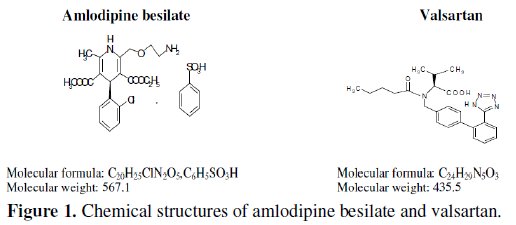
    <p>Amlodipine besilate (AM), Fig. 1, is a long acting dihydropyridine calcium-
channel blocker, that inhibits the trans membrane influx of calcium ions into 
vascular smooth muscle and cardiac muscle.</p>


    <p>&nbsp;</p>
<img src="/img/revistas/pea/v30n1/30n1a02f1.jpg">
    
<p>&nbsp;</p>


    <p>It is used in the management of 
hypertension and angina pectoris [1]. It acts by relaxing the smooth muscle in the 
arterial wall, decreasing total peripheral resistance and hence reducing blood 
pressure; in angina it increases blood flow to the heart muscle [2]. While 
Valsartan (VL), Fig. 1, is an angiotensin II receptor antagonist, used in the 
management of hypertension and may be used in patients with congestive heart 
failure and post myocardial infarction [1].</p>

    <p>It also regulates the cardiovascular 
functions [2]. AM and VL are co-formulated together in commercial tablets as an 
oral anti hypertensive medication.</p>

    <p>Determination of AM was described in British pharmacopoeia [3] by HPLC 
method. It was also determined by several methods involving spectrophotometric 
methods [4-11], HPLC [9, 12-15] and Densitometric TLC method [16]. While 
VL was determined by several methods, involving spectrophotometric [17-19], 
HPLC [20-25] and chemometric methods [26]. AM and VL were previously 
determined in their binary mixture by HPLC methods [27-29], 
Spectroflourimetric method [30] and TLC method [31].</p>

    <p>No electroanalytical methods were reported for the determination of AM and VL, 
so the aim of the present study is to develop and validate a new potentiometric 
method that is simple, rapid, selective and less expensive and less time 
consuming compared with other published TLC and HPLC methods for the 
determination of AM and VL in the presence of each others, in tablets dosage 
form and in plasma samples without prior separation even they were present in 
colored, turbid and viscous solution.</p>

    <p>Microelectrodes have been the subject of much research in recent years [32]. The 
advantages they offer over conventional electrodes are well known [33]. 
Metallic and graphite-based conductors have been suggested [34-36]; these 
electrodes behave as two interface devices, membrane/ electrolyte interface and 
membrane/metal interface [37]. Thus, the membrane potential in the cell has 
been considered as the electric potential difference between the two interfaces. 
Membranes have been suggested to be prepared from polymer, ionophore and 
plasticizer. The role of the polymer is to provide an inert solid support structure 
in which the rest of components are embedded. The ionophore can be viewed as 
a molecular receptor, because its chemical structure provides well defined 
inclusion cavities with a specific receptor function [38]. The plasticizer used to 
plasticize the membrane also affects its lipophilicity.</p>

    ]]></body>
<body><![CDATA[<p>The microsized graphite rod was coated with a thin film of PVC-COOH / 2HP &beta;-CD 
/ DBS in case of sensor 1, and used as a potentiometric sensor for AM. Upon 
soaking this sensor in AM test solution, an acid-base interaction takes place 
between the dissociated COO -groups of the PVC and the amino group of the 
drug, and a homogenous electroactive layer from PVC-COOH / 2HP &beta;-CD / 
DBS / Drug is formed, which induces a potentiometric response for the studied 
drug.</p>

    <p>For sensor 2, VL-BP iron (II) complex was embedded in a PVC matrix 
membrane which acts as a regular support and reproducible trap for ion 
association complexes in ISEs and placticized with DBS as suitable solvent 
mediator.</p>


    <p>&nbsp;</p>
    <p><b>Experimental</b></p>

    <p><b><i>Apparatus</i></b></p>

    <p>&bull; Jenway digital ion analyzer model 3330 (UK) with Ag/AgCl double junction 
reference electrode no. Z113107-1EAPW (Aldrich Chemical Co.).</p>

    <p>&bull; pH glass electrode Jenway (Jenway, UK) no. 924005-BO3-Q11C.</p>

    <p>&bull; Magnetic stirrer, Bandelin Sonorox, Rx510S (Budapest,Hungarian).</p>


    <p><b><i>Reference samples</i></b></p>

    <p>Amlodipine besilate (AM) and Valsartan (VL)-Pure samples were kindly 
supplied by Global Nabi Co., batch numbers 80148 and 4705, respectively, (Giza 
-Egypt). Their percentages purity were 99.75 &pm; 0.36 % and 100.50 &pm; 0.38 %; 
respectively, according to the official method for AM [3] and reported method 
for VL [20].</p>


    ]]></body>
<body><![CDATA[<p><b><i>Pharmaceutical formulations</i></b></p>

    <p>&bull; Exforge 10/160 tablets-Batch number y0001/s0009. Each tablet is claimed to 
contain 10 mg of AM and 160 mg of VL. Manufactured by: Novartis pharma, 
(Cairo, Egypt).</p>

    <p>&bull; Exforge 5/80 tablets-Batch number F0030. Each tablet is claimed to contain 5 
mg of AM and 80 mg of VL. Manufactured by: Novartis pharma, (Cairo, Egypt). 
Reagents</p>

    <p>All chemicals and solvents used were of analytical grade (the used water was 
double distilled). All chemicals and solvents used were handled in the fuming 
cupboard, wearing gloves and masks and the measure of the solvents was done 
using pipettes with the aid of a pipette filler.</p>

    <p>Polyvinyl chloride carboxylated (PVC-COOH); (Fluka chemie GmbH Germany). 
Dibutylsebacate (DBS) - (Sigma/Aldrich, St.Louis, MO).</p>

    <p>2-Hydroxy propyl &beta;-Cyclodextrin (2HP &beta;-CD); (Fluka Chemie GmbH, 
Germany).</p>

    <p>Tetrahydrofuran (THF) - (BDH, limited Poole, England).</p>

    <p>Sodium hydroxide, 1 M aqueous solution; (Prolabo, VWR International, West 
Chester, PA).</p>

    <p>Hydrochloric acid, 1 M aqueous solution; (Prolabo, VWR International, West 
Chester, PA).</p>

    <p>Acetate buffer pH 3.0 and phosphate buffer pH 8.0.</p>

    ]]></body>
<body><![CDATA[<p>Bathophenanthroline (BP); (Merck, Darmstadt, Germany).</p>

    <p>Bathophenanthroline iron (II), (BP iron II) complex, prepared by dissolving 100 
mg of bathophenanthroline in 20 mL of 10<sup>-2</sup> M iron (II) ammonium sulfate, 
followed by drops of ethanol and H2O to keep a clear solution.</p>


    <p><b><i>Standard solutions</i></b></p>

    <p>&bull; AM and VL stock solutions (1 x 10<sup>-2</sup> M)</p>

    <p>They were prepared by transferring 0.567 of AM in 100 mL acetate buffer pH 3 
and 0.435 g VL in 100 mL phosphate buffer pH 8.</p>

    <p>&bull; AM and VL working solutions (1 x 10<sup>-5</sup> to 1 x 10<sup>-3</sup> M)</p>

    <p>They were prepared by proper dilution from their stock solutions using either 
acetate buffer in case of AM or phosphate buffer in case of VL. 

Laboratory prepared mixtures containing different ratios of AM and VL 

Into two series of 25 mL volumetric flasks, different volumes of AM (1 mg/mL) 
and VL (5 mg/mL) were accurately transferred. Then the volume was completed 
with acetate buffer for determination of AM and the other series with phosphate 
buffer for determination of VL to prepare mixtures containing different ratios of 
the two drugs for the proposed sensors.</p>


    <p><b><i>Procedures</i></b></p>

    <p><i>Preparation of electroactive coating membranes: (2-HP &beta;-CD / DBS /PVCCOOH), 
and sensor 1 fabrication</i></p>

    <p>In a glass Petri dish (5 cm diameter), a portion of 0.9 gm PVC-COOH was 
thoroughly mixed with 0.35 gm DBS and 0.3 gm 2-HP &beta;-CD, then dissolved in 
15 mL THF. The Petri dish was covered with a filter paper and left to stand for 1 
h to allow slow solvent evaporation. A thick homogeneous solution was 
produced which was used for preparation of sensor 1.</p>

    ]]></body>
<body><![CDATA[<p>A rod of spectrographic graphite (5 mm in diameter and 15 mm long) was 
inserted in a polyethylene sleeve, and about 3 mm of the other end of the 
protruded rod served as a measuring surface. This end of the rod was washed 
with acetone, dried in air for 3 hours, and dipped rapidly into the previously 
prepared PVC-COOH / 2-HP &beta;-CD / DBS solution. The solvent was allowed to 
evaporate in air after each dipping, and the dipping process was repeated 6-8 
times to produce a uniform membrane on the surface of the graphite rod. Drops 
of mercury were added in the polyethylene sleeve to ensure electrical contact 
with the connection cable. The coated graphite rod was conditioned by soaking in 
a 10<sup>-2</sup> M AM solution for 4 hours, and stored in the same solution when not in 
use.</p>


    <p><i>Precipitation based technique for sensor 2 fabrication</i></p>

    <p>VL-BP iron (II) ion pair complex was prepared by mixing 10 mL of 10<sup>-2</sup> M 
ammoniacal aqueous solution of VL (on which 2 drops of 30 % NH3 solution 
were added to enhance solubility) with 20 mL 10<sup>-2</sup> M BP-iron (II) solution for 
preparation of electrode 2.</p>

    <p>The resulting precipitate formed was filtered using Whatmann No. 42 papers, 
washed with cold water, dried at room temperature (about 20 &deg;C) and grinded to 
fine powder.</p>

    <p>Elemental analysis of the formed complexes confirmed the formation of drug: 
ion exchanger in the ratio of 2:1 in case of sensor 2.</p>

    <p>A portion (10 mg) of VL-ion exchanger was thoroughly mixed with 0.19 g PVC 
and 0.35 mL DBS in a glass Petri dish (5 cm diameter) then dissolved in 5 mL 
THF. The Petri dish was covered with filter paper and left to stand overnight to 
allow solvent evaporation at room temperature. Master membrane with thickness 
of 0.1 mm was obtained and used for the construction of the sensor 2 [39-41].</p>

    <p>Equal volumes of 10<sup>-2</sup> M VL and 10<sup>-2</sup> M KCl were mixed and this solution was 
used as internal reference solution. Ag/AgCl wire (1 mm diameter) was 
immersed in the internal reference solution as internal reference electrode. 
The electrode was conditioned by soaking in 1 x 10<sup>-2</sup> M VL aqueous solution for 
one day and was stored in the same solution when not in use.</p>


    <p><i>Direct potentiometric determination of the drugs in their pure samples</i></p>

    <p>The prepared electrodes in conjunction with the double junction Ag/AgCl 
reference electrode were immersed in aqueous solutions of AM and VL in the 
range of (1 &times; 10<sup>-5</sup> - 1 &times; 10<sup>-3</sup> M) in case of sensor 1 and 2. They were allowed to 
equilibrate while stirring and the emfs were recorded within &pm; 1 mV. The 
membrane sensors were washed with double distilled water between 
measurements. Calibration graphs were plotted relating the recorded potentials 
vs. -log drug concentrations, regression equations were computed and used for 
subsequent measurements of unknown concentrations of AM and VL.</p>


    <p><i>Identification of the slope, response time and operative life of the studied electrodes</i></p>

    ]]></body>
<body><![CDATA[<p>The electrochemical performance of the two proposed sensors was evaluated 
according to the IUPAC recommendations data [42].</p>

    <p>The dynamic response times for the electrodes to reach values of &pm; 1 mV of the 
final equilibrium potential after increasing the drug concentration 10 folds were 
measured.</p>


    <p><i>Effect of pH</i></p>

    <p>The effect of pH on the potential values of the two electrodes was studied over 
pH range from 2 to 11 by adding drops of 1 N HCl and 1 N NaOH on the 
aqueous solutions of both drugs, and the potentials obtained at each value were 
recorded.</p>


    <p><i>Effect of temperature</i></p>

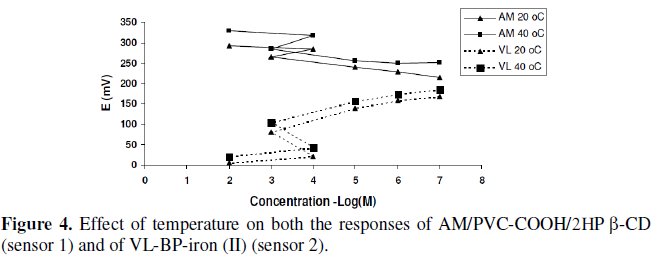
    <p>The effect of temperature was studied, and the potential response displayed by 
the investigated electrodes as a function of temperature in the range of 20 - 40 &deg;C 
was monitored. The potentials obtained at each temperature were recorded.</p>


    <p><i>Effect of interfering compounds on the electrode selectivity</i></p>

    <p>The potential response of the two studied sensors in the presence of the drugs and 
a number of related substances was studied, and the potentiometric selectivity 
coefficient, -log (K<sup>Pot</sup><sub>Primary ion, interferernt</sub>) was used to evaluate the extent to which a 
foreign ion would interfere with the response of the electrodes to its primary ion. 
The selectivity coefficients were calculated by the separate solutions method 
(SSM) [40], where potentials were measured for 10<sup>-3</sup> M drug solution and then 
for 10<sup>-3</sup> M interferent solution, separately, then potentiometric selectivity 
coefficients were calculated using the following equation:</p>


    <p>&nbsp;</p>
<img src="/img/revistas/pea/v30n1/30n1a02e1.jpg">
    
<p>&nbsp;</p>


    ]]></body>
<body><![CDATA[<p>where E<sub>1</sub> is the potential measured in 10<sup>-3</sup> M solution of the 1<sup>ry</sup> ion solution, E<sub>2</sub> 
the potential measured in 10<sup>-3</sup> M solution of interferent and S is the slope of the 
investigated sensor.</p>


    <p><i>Analysis of laboratory prepared mixtures</i></p>

    <p>The potential readings produced by immersing the prepared electrodes in 
conjunction with the double junction Ag/AgCl reference electrode in the 
prepared mixtures [2.6.] were recorded and compared with the calibration graphs.</p>


    <p><i>Application of the proposed method for simultaneous determination of AM and VL in exforge tablets</i></p>

    <p>Ten tablets of the drug formulations were weighed accurately and finely 
powdered in a small dish. An amount of powder equivalent to 56.7 mg of AM 
from the two formulations was accurately transferred to 100 mL volumetric 
flasks and diluted to the mark with acetate buffer pH 3 to prepare 10<sup>-3</sup> M 
solutions of AM. Another amount of powder equivalent to 43.5 mg of VL from 
the two formulations was accurately transferred to 100 mL volumetric flasks and 
diluted to the mark with phosphate buffer pH 8 to prepare 10<sup>-3</sup> M solutions of 
VL. The potential readings produced by immersing the prepared electrodes in 
conjunction with the double junction Ag/AgCl reference electrode in the 
prepared solutions were recorded and compared with the calibration graphs.</p>


    <p><i>Direct potentiometric determination of AM and VL in spiked human plasma sample</i></p>

    <p>Portions equivalent to 4.5 mL of human plasma were placed into four stoppered 
shaking tubes, and then 0.5 mL of 10<sup>-2</sup> and 10<sup>-3</sup> M AM and 0.5 mL of 10<sup>-2</sup> and 
10<sup>-3</sup> M VL were added separately and shacked. The membrane sensors were 
immersed in conjunction with the Ag/AgCl reference electrode in these solutions. 
The membrane sensors were washed with water between measurements. The 
potential readings produced by immersing the prepared electrodes in conjunction 
with the double junction Ag/AgCl reference electrode in the prepared solutions 
were recorded and compared with the calibration plots. No adverse effect on the 
responses of the electrodes was observed when the drugs were spiked with the 
human plasma samples without prior removal of the protein.</p>


    <p>&nbsp;</p>
    <p><b>Results and discussion</b></p>

    <p>The preparation and application of microelectrodes have attracted much interest 
in recent analytical chemistry studies [32]. This is part of a general trend in 
analytical chemistry towards miniaturization. The features of voltammetric 
microelectrodes have been investigated extensively during the last few years with 
the aim of improving the characteristics of electrochemical methods and 
performing studies under conditions not possible with conventional electrodes 
[43, 44]. A variety of electrode materials of different shapes and sizes have been 
reported, but the most commonly used electrode materials are platinum [45] and 
carbon fiber [46].</p>

    ]]></body>
<body><![CDATA[<p>On the other hand, VL behaves as anion, suggesting the use of ion exchangers of 
cationic types and the formation of classic type of membrane electrodes.</p>

    <p><b><i>Sensors fabrication</i></b></p>

    <p>In the present work, the microsized graphite rod was coated with a thin film of 
PVC-COOH / 2-HP &beta;-CD / DBS for sensor 1 and used as a potentiometric sensor 
for AM. Upon soaking this sensor in 1 &times; 10<sup>-2</sup> M AM test solution, a homogenous 
electroactive layer from PVC-COOH / 2-HP &beta;-CD / DBS / AM in case of sensor 
1 was formed which induces a potentiometric response for the studied drug. 
While for sensor 2, a homogenous electroactive layer from ion-pair complex 
(VL-BP ironII) / DBS / VL is embedded in a PVC matrix membrane and 
plasticized with DBS as plasticizer.</p>

    <p><i>DBS (a non polar plasticizer)</i></p>

    <p>DBS was found to be the optimum available mediator for both membrane 
sensors. It plasticizes the membrane and adjusts the membrane permittivity to 
give the highest possible selectivity and sensitivity.</p>

    <p><i>Cyclodextrins</i></p>

    <p>The molecular recognition and inclusion complexation are of current interest in 
host-guest chemistry or supramolecular chemistry [47]. Natural and chemically 
modified cyclodextrins, can be viewed as molecular receptors because their 
chemical structure provides well defined inclusion cavities with a specific 
receptor function. They can accommodate a wide variety of organic, inorganic, 
and biological guest molecules to form stable host-guest inclusion complexes or 
nanostructure supramolecular assemblies in their hydrophobic cavity, showing 
high molecular selectivity and enantioselectivity [48].</p>

    <p>Although the size and geometry of the guest mainly govern the binding strength, 
it is possible to influence the host-guest interactions by modification of the three 
hydroxyl groups on each glucose unit; hence the use of 2-HP &beta;-CD proved to 
enhance the interaction properties between host and guest molecules [49].</p>

    <p>The possibility of using functionalized lipophilic CD derivatives (2-HP &beta;-CD) as 
the sensor ionophore in the preparation of AM selective electrode (sensors 1) 
with PVC-COOH to immobilize the sensor and to attain the formation of highly 
stable complex was evaluated. Also 2-HP &beta;-CD has better aqueous solubility (up 
to 0.7 M) than &beta;-CD which is poorly soluble in water (0.02 M) [50], so it was 
preferred to use 2-HP &beta;-CD as an ionophore, which provides high stability of the 
complex between the molecule and the cationic drug present in solution, in 
addition to enhancing the membrane selectivity and sensitivity.</p>

    <p><i>PVC-COOH</i></p>

    ]]></body>
<body><![CDATA[<p>PVC-COOH was used because of its recommended properties which are the 
partial dissociation and the high adhesion [51]; sensor 1 was simply fabricated 
without the need of ion association complex. It was only preconditioned by 
soaking in the corresponding drug solution for 4 hours where acid-base 
interactions take place between the dissociated COO -group of the PVC and 
tertiary amino group of the drug in the test solution until chemical equilibrium is 
attained.</p>

    <p>PVC-COOH also acts as a regular support matrix, as trap for the ion and as 
polymeric matrix to immobilize the sensor and to attain the formation of highly 
stable complex.</p>

    <p><i>BP-iron II</i></p>

    <p>The present study originates from the fact that VL behaves as anion due to the 
presence of COO -acid group [39]. This fact suggests the use of ion exchanger of 
cationic type. It has been found that bathophenanthroline iron II is the optimum 
cationic exchanger of VL for its low solubility product, high lipophilicity and 
suitable grain size. So (VL-BP ironII) is embedded in PVC matrix membrane and 
plasticized with DBS as plasticizer.</p>

    <p><i>Sensors calibration and response time</i></p>

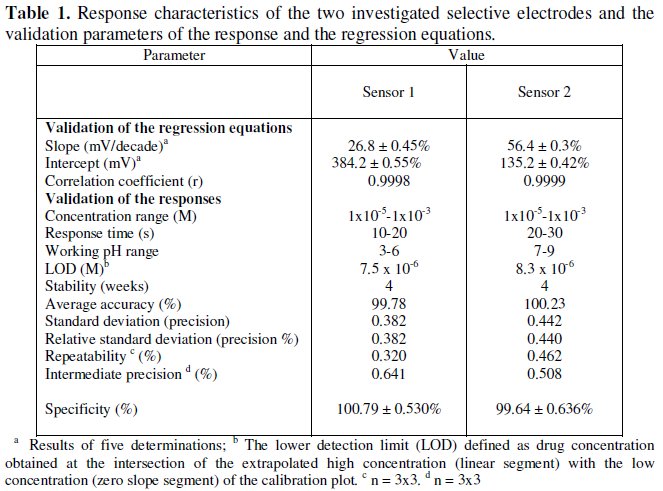
    <p>Electro chemical performance characteristics of the proposed sensors were 
systematically evaluated according to IUPAC standards [42].</p>

    <p>Table 1 shows the results obtained over a period of four weeks for each sensor.</p>

    <p>&nbsp; <a name="top.t1"></a> </p>
<img src="/img/revistas/pea/v30n1/30n1a02t1.jpg">
    
<p>&nbsp;</p>

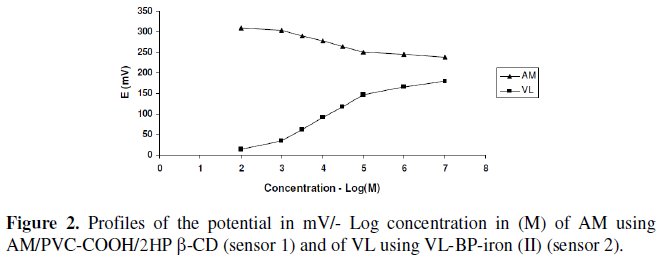
    <p>Typical calibration plots are shown in Fig. 2.</p>


    ]]></body>
<body><![CDATA[<p>&nbsp;</p>
<img src="/img/revistas/pea/v30n1/30n1a02f2.jpg">
    
<p>&nbsp;</p>


    <p>The sensors displayed constant potential readings within &pm; 2 mV from day to day and the calibration slopes did 
not change by more than &pm; 2 mV per decade over a period of 4 weeks for both 
sensors.</p>

    <p>The required time for the sensors to reach values within &pm; 2 mV of the final 
equilibrium potential after increasing drug concentration 10-folds was found to 
be 10-20 and 20-30 seconds, for sensors 1 and 2, respectively. The slopes of the 
calibration plots were 26.8 and 56.4 mV/concentration decades for sensor 1 and 
2, respectively, the typical values of divalent and monovalent substances as AM 
behaves as divalent cation via its amino groups, and VL behaves as a monovalent 
anion via its carboxylic acid group. Deviation from the ideal Nernstian slope (30 
mV/decade and 60 mV/decade) for sensors 1 and 2, is originated from the fact 
that the electrodes respond to the activities of the drug rather than its 
concentrations.</p>


    <p><i>Effect of pH and temperature</i></p>

    <p>In the measurements with the two investigated sensors, the different factors 
affecting the response of the electrodes (emfs) were studied to reach the optimum 
experimental conditions. pH values within the range (3-6) and (7-9) were found 
to be optimum from the point of view of sensor 1 and 2, respectively. AM was in 
the cationic form in acidic media and VL in the anionic form in alkaline media.</p>

    <p>Fig. 3 shows the potential pH profile for 10<sup>-3</sup> and 10<sup>-4</sup> M drug solutions. For 
sensor 1 pH above 6, the potentials displayed by the sensor decreased due to the 
formation of non-protonated amino group of AM drug; below pH 3, the 
potentials displayed by the sensor were noisy and unbalanced.</p>


    <p>&nbsp;</p>
<img src="/img/revistas/pea/v30n1/30n1a02f3.jpg">
    
<p>&nbsp;</p>


    <p>In case of sensor 2, at pH below 7 the potentials displayed by the sensor decreased with the 
increase of solution acidity; at such high acidity the dissociation of the carboxyl 
group is limited and the membrane may extract H<sup>+</sup>, leading to noisy responses; 
above pH 9, the potentials displayed by the sensor were noisy and unbalanced. It 
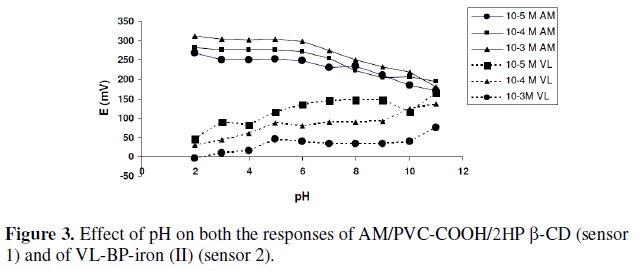
is apparent that the sensors responses are fairly constant in solutions of pH 3-6 
for sensor 1 so AM was dissolved in acetate buffer pH 3, and pH 7-9 for sensor 
2, so VL was dissolved in phosphate buffer pH 8.</p>

    ]]></body>
<body><![CDATA[<p>Upon studying the effect of temperature, the suggested sensors exhibit slight 
gradual increase in their potentials as the temperature increases in the range of 
20-40 &deg;C; however, the calibration graphs obtained at different temperatures 
were parallel, slope and response time did not significantly vary with variation of 
temperature indicating reasonable thermal stability of the suggested sensors up to 
40 &deg;C, Fig. 4.</p>


    <p>&nbsp;</p>
<img src="/img/revistas/pea/v30n1/30n1a02f4.jpg">
    
<p>&nbsp;</p>


    <p><i>Sensors selectivity</i></p>

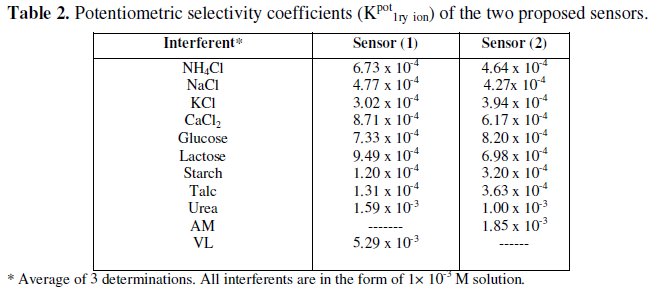
    <p>The effect of interfering substances upon the performance of the sensors was 
studied by separate solutions method [40].</p>

    <p>The performance of the two sensors in the presence of tablets excipients, organic 
and inorganic related substances were assessed by measuring and comparing the 
potentiometric selectivity coefficients. The results revealed that the proposed 
membrane sensors displayed high selectivity compared to the reported HPLC 
methods, which can highly be affected by the excipients and related substances 
of the drugs. No significant interference was observed from interfering species 
(Table 2).</p>


    <p>&nbsp;</p>
<img src="/img/revistas/pea/v30n1/30n1a02t2.jpg">
    
<p>&nbsp;</p>


    <p>To evaluate precision and accuracy, three concentrations within the linear range 
(10<sup>-5</sup>, 10<sup>-4</sup> and 10<sup>-3</sup> M solutions of AM and VL) were chosen. Three solutions of 
each concentration were prepared and analyzed in triplicate (repeatability assay). 
This assay was repeated on three different days (intermediate precision assay), 
(<a href="#top.t1">Table 1</a>).</p>

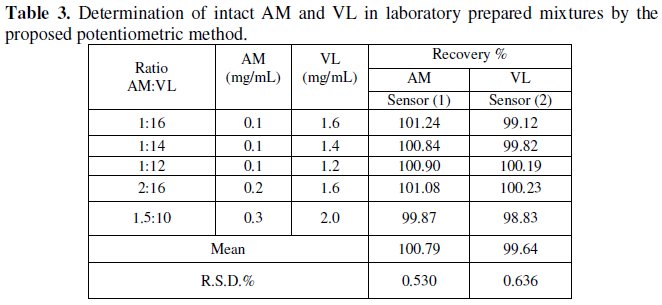
    <p>Table 3 shows the results obtained upon the analysis of synthetic mixtures 
containing different ratios of AM and VL. The results showed that sensor 1 can 
be successfully used for selective determination of AM in presence VL, and 
sensor 2 can be successfully used for selective determination of VL in presence 
of AM.</p>


    ]]></body>
<body><![CDATA[<p>&nbsp;</p>
<img src="/img/revistas/pea/v30n1/30n1a02t3.jpg">
    
<p>&nbsp;</p>

 
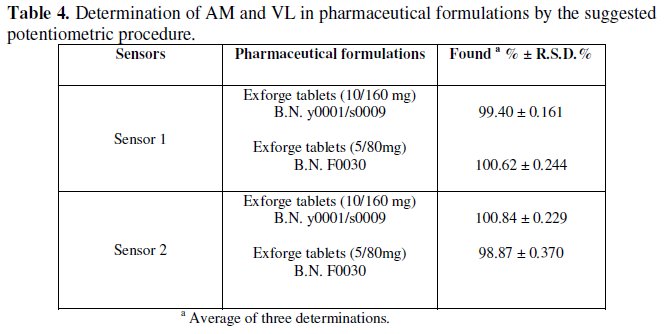
</p>Table 4 shows the results obtained for the determination of AM and VL in 
exforge tablets, proving the applicability of the method without prior treatment or 
separation, like other reported methods, using the two sensors for the 
determination of AM and VL, as demonstrated by the accurate and precise 
percentage recovery.</p>


    <p>&nbsp;</p>
<img src="/img/revistas/pea/v30n1/30n1a02t4.jpg">
    
<p>&nbsp;</p>

 
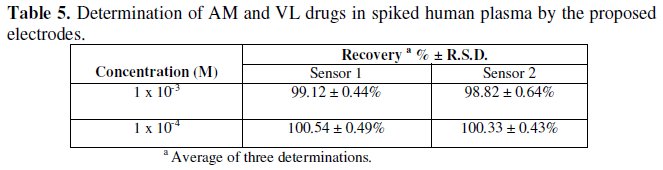
</p>Table 5 shows the results obtained for the determination of AM and VL in spiked 
human plasma. It is seen that high accuracy (recovery) and precision (RSD) were 
given by both sensors without prior treatment to the samples; this shows that the 
efficacy of the sensors has not been affected by the plasma proteins.</p>


    <p>&nbsp;</p>
<img src="/img/revistas/pea/v30n1/30n1a02t5.jpg">
    
<p>&nbsp;</p>

 
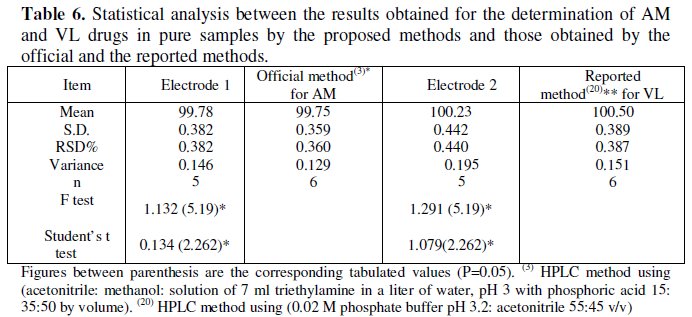
</p>The results obtained were also compared with those obtained by using official 
method for AM [3] and the reported method for VL [20]. No significant 
difference in results was found, (Table 6).</p>


    <p>&nbsp;</p>
<img src="/img/revistas/pea/v30n1/30n1a02t6.jpg">
    
<p>&nbsp;</p>

 
</p><a href="#top.t1">Table 1</a> shows all the validation parameters of the proposed method, including 
linearity, range and LOD, which proves the accuracy, precision and sensitivity of 
the proposed method.</p>

</p>The proposed potentiometric method shows high degree of accuracy, precision, 
sensitivity and selectivity; furthermore, it is less expensive and less time 
consuming compared to other HPLC and TLC methods, being applicable in 
colored, turbid and viscous solutions of the drugs [52].</p>


    <p>&nbsp;</p>
    <p><b>Conclusions</b></p>

    ]]></body>
<body><![CDATA[<p>The described sensors are sufficiently simple and selective for the quantitative 
determination of AM and VL in pure form, in presence of each others, in plasma 
and pharmaceutical formulations. The use of the proposed sensors offers 
advantages of fast response and elimination of drug pretreatment or separation 
steps. They can therefore, be used for routine analysis of AM and VL in quality 
control laboratories.</p>


    <p>&nbsp;</p>
    <p><b>References</b></p>

    <!-- ref --><p>1. S.C. Sweerman, Martindale, The Complete Drug Reference, 32 ED., The Pharmaceutical Press, London, UK, 2004, pp 862.    &nbsp;&nbsp;&nbsp;&nbsp;&nbsp;&nbsp;&nbsp;&nbsp;[&#160;<a href="javascript:void(0);" onclick="javascript: window.open('/scielo.php?script=sci_nlinks&ref=000136&pid=S0872-1904201200010000200001&lng=','','width=640,height=500,resizable=yes,scrollbars=1,menubar=yes,');">Links</a>&#160;]<!-- end-ref --></p>
    <p>2. J.C. Garrisor, Goodman &amp; Gillman's, The Pharmacological Basis of Therapeutics. Hardman, J.G., Limbird, L.E. 10th Ed., McGraw-Hill, Dallas, Taxas, USA, 2001, pp 857.</p>
    <!-- ref --><p>3. British Pharmacopoeia, Her Majesty's Stationary Office, London, 2004, pp 124.    &nbsp;&nbsp;&nbsp;&nbsp;&nbsp;&nbsp;&nbsp;&nbsp;[&#160;<a href="javascript:void(0);" onclick="javascript: window.open('/scielo.php?script=sci_nlinks&ref=000139&pid=S0872-1904201200010000200003&lng=','','width=640,height=500,resizable=yes,scrollbars=1,menubar=yes,');">Links</a>&#160;]<!-- end-ref --></p>
    <!-- ref --><p>4. M.D. Malesuik, S.G. Cardoso, L . Bajerski, A. Lanzanova, J. AOAC 89(2) (2006) 359.    &nbsp;&nbsp;&nbsp;&nbsp;&nbsp;&nbsp;&nbsp;&nbsp;[&#160;<a href="javascript:void(0);" onclick="javascript: window.open('/scielo.php?script=sci_nlinks&ref=000141&pid=S0872-1904201200010000200004&lng=','','width=640,height=500,resizable=yes,scrollbars=1,menubar=yes,');">Links</a>&#160;]<!-- end-ref --></p>
    ]]></body>
<body><![CDATA[<!-- ref --><p>5. S.A. Khopade, N.K.Jain, Indian Drugs 37 (2000) 351.    &nbsp;&nbsp;&nbsp;&nbsp;&nbsp;&nbsp;&nbsp;&nbsp;[&#160;<a href="javascript:void(0);" onclick="javascript: window.open('/scielo.php?script=sci_nlinks&ref=000143&pid=S0872-1904201200010000200005&lng=','','width=640,height=500,resizable=yes,scrollbars=1,menubar=yes,');">Links</a>&#160;]<!-- end-ref --></p>
    <!-- ref --><p>6. H.K. Jain, R.K. Agrawal, Indian Drugs 37 (2000) 196.    &nbsp;&nbsp;&nbsp;&nbsp;&nbsp;&nbsp;&nbsp;&nbsp;[&#160;<a href="javascript:void(0);" onclick="javascript: window.open('/scielo.php?script=sci_nlinks&ref=000145&pid=S0872-1904201200010000200006&lng=','','width=640,height=500,resizable=yes,scrollbars=1,menubar=yes,');">Links</a>&#160;]<!-- end-ref --></p>
    <p>7. R.T. Sane, M. Phadke, P.S. Hijii et all, Indian Drugs 35 (1998) 79.</p>
    <!-- ref --><p>8. S. Singh , R. Jain, Indian Drugs 34 (1997) 678.    &nbsp;&nbsp;&nbsp;&nbsp;&nbsp;&nbsp;&nbsp;&nbsp;[&#160;<a href="javascript:void(0);" onclick="javascript: window.open('/scielo.php?script=sci_nlinks&ref=000148&pid=S0872-1904201200010000200008&lng=','','width=640,height=500,resizable=yes,scrollbars=1,menubar=yes,');">Links</a>&#160;]<!-- end-ref --></p>
    <!-- ref --><p>9. S.B. Wankhede, S.B. Wadkar, K.C. Raka and S.S. Chitlange, Ind. J. Pharm. Sci. 71 (2009) 563.    &nbsp;&nbsp;&nbsp;&nbsp;&nbsp;&nbsp;&nbsp;&nbsp;[&#160;<a href="javascript:void(0);" onclick="javascript: window.open('/scielo.php?script=sci_nlinks&ref=000150&pid=S0872-1904201200010000200009&lng=','','width=640,height=500,resizable=yes,scrollbars=1,menubar=yes,');">Links</a>&#160;]<!-- end-ref --></p>
    <!-- ref --><p>10. P. Rathee, S. Rathee, S. Thakur, V. Kumar, Int. J. Chem. Tech. Res. 2 (2010) 62.    &nbsp;&nbsp;&nbsp;&nbsp;&nbsp;&nbsp;&nbsp;&nbsp;[&#160;<a href="javascript:void(0);" onclick="javascript: window.open('/scielo.php?script=sci_nlinks&ref=000152&pid=S0872-1904201200010000200010&lng=','','width=640,height=500,resizable=yes,scrollbars=1,menubar=yes,');">Links</a>&#160;]<!-- end-ref --></p>
    <!-- ref --><p>11. V.C. Chandnani, K.R. Gupta, C.T. Chopde, H.K. Kunjwani, A.M. Manikrao, S.C. Shivhare, Int. J. Chem. Tech. Res. 2 (2010) 69.    &nbsp;&nbsp;&nbsp;&nbsp;&nbsp;&nbsp;&nbsp;&nbsp;[&#160;<a href="javascript:void(0);" onclick="javascript: window.open('/scielo.php?script=sci_nlinks&ref=000154&pid=S0872-1904201200010000200011&lng=','','width=640,height=500,resizable=yes,scrollbars=1,menubar=yes,');">Links</a>&#160;]<!-- end-ref --></p>
    <p>12. J. Bhatt, S. Singh, B. Shah et all, Biomed. Chromatogr. 21 (2007) 169.</p>
    <!-- ref --><p>13. C.P. Li, X.P. Yan, W.G. Shan, Yaowu Fenxi Zazhi 26 (2006) 1878.    &nbsp;&nbsp;&nbsp;&nbsp;&nbsp;&nbsp;&nbsp;&nbsp;[&#160;<a href="javascript:void(0);" onclick="javascript: window.open('/scielo.php?script=sci_nlinks&ref=000157&pid=S0872-1904201200010000200013&lng=','','width=640,height=500,resizable=yes,scrollbars=1,menubar=yes,');">Links</a>&#160;]<!-- end-ref --></p>
    <!-- ref --><p>14. Y.Y. Ma, F. Qin, X.H. Sun, F.M. Li, J. Pharm. Biomed. Anal. 43 (2007)1540.    &nbsp;&nbsp;&nbsp;&nbsp;&nbsp;&nbsp;&nbsp;&nbsp;[&#160;<a href="javascript:void(0);" onclick="javascript: window.open('/scielo.php?script=sci_nlinks&ref=000159&pid=S0872-1904201200010000200014&lng=','','width=640,height=500,resizable=yes,scrollbars=1,menubar=yes,');">Links</a>&#160;]<!-- end-ref --></p>
    <!-- ref --><p>15. R.P. Priyanka, U.R. Sachin, P.N. Dhabale, K.B. Burade, Int. J. Chem. Tech. Res. 1 (2009) 464.    &nbsp;&nbsp;&nbsp;&nbsp;&nbsp;&nbsp;&nbsp;&nbsp;[&#160;<a href="javascript:void(0);" onclick="javascript: window.open('/scielo.php?script=sci_nlinks&ref=000161&pid=S0872-1904201200010000200015&lng=','','width=640,height=500,resizable=yes,scrollbars=1,menubar=yes,');">Links</a>&#160;]<!-- end-ref --></p>
    ]]></body>
<body><![CDATA[<p>16. N.R. Vekariya, G.F. Patel, H.S. Bhatt et all, Int. J. Chem. Tech. Res. 1 (2009) 1644.</p>
    <!-- ref --><p>17. S. Tatar, S. Saglik, J. Pharm. Biomed. Anal. 30 (2002) 371.    &nbsp;&nbsp;&nbsp;&nbsp;&nbsp;&nbsp;&nbsp;&nbsp;[&#160;<a href="javascript:void(0);" onclick="javascript: window.open('/scielo.php?script=sci_nlinks&ref=000164&pid=S0872-1904201200010000200017&lng=','','width=640,height=500,resizable=yes,scrollbars=1,menubar=yes,');">Links</a>&#160;]<!-- end-ref --></p>
    <!-- ref --><p>18. E. Dinc, B. Uslu, S.A. Ozkan, Anal. Lett. 37 (2004) 679.    &nbsp;&nbsp;&nbsp;&nbsp;&nbsp;&nbsp;&nbsp;&nbsp;[&#160;<a href="javascript:void(0);" onclick="javascript: window.open('/scielo.php?script=sci_nlinks&ref=000166&pid=S0872-1904201200010000200018&lng=','','width=640,height=500,resizable=yes,scrollbars=1,menubar=yes,');">Links</a>&#160;]<!-- end-ref --></p>
    <!-- ref --><p>19. K.R. Gupta, A.R. Wadodkar, S.G. Wadodkar, Int. J. Chem. Tech. Res. 2 (2010) 985.    &nbsp;&nbsp;&nbsp;&nbsp;&nbsp;&nbsp;&nbsp;&nbsp;[&#160;<a href="javascript:void(0);" onclick="javascript: window.open('/scielo.php?script=sci_nlinks&ref=000168&pid=S0872-1904201200010000200019&lng=','','width=640,height=500,resizable=yes,scrollbars=1,menubar=yes,');">Links</a>&#160;]<!-- end-ref --></p>
    <!-- ref --><p>20. E. Santana, S. Altinay, N. Goger, Z. Senturk, J. Pharm. Biomed. Anal. 25 (2001) 1009.    &nbsp;&nbsp;&nbsp;&nbsp;&nbsp;&nbsp;&nbsp;&nbsp;[&#160;<a href="javascript:void(0);" onclick="javascript: window.open('/scielo.php?script=sci_nlinks&ref=000170&pid=S0872-1904201200010000200020&lng=','','width=640,height=500,resizable=yes,scrollbars=1,menubar=yes,');">Links</a>&#160;]<!-- end-ref --></p>
    <!-- ref --><p>21. J. Mac, J. Klima, P. Ptacek, J. Chromatogr. B 832 (2006) 1692.    &nbsp;&nbsp;&nbsp;&nbsp;&nbsp;&nbsp;&nbsp;&nbsp;[&#160;<a href="javascript:void(0);" onclick="javascript: window.open('/scielo.php?script=sci_nlinks&ref=000172&pid=S0872-1904201200010000200021&lng=','','width=640,height=500,resizable=yes,scrollbars=1,menubar=yes,');">Links</a>&#160;]<!-- end-ref --></p>
    <!-- ref --><p>22. B.K.-Kaymakcoglu, S. Unsalan and S. Rollas, Die Pharmazie 61 (2006) 586.    &nbsp;&nbsp;&nbsp;&nbsp;&nbsp;&nbsp;&nbsp;&nbsp;[&#160;<a href="javascript:void(0);" onclick="javascript: window.open('/scielo.php?script=sci_nlinks&ref=000174&pid=S0872-1904201200010000200022&lng=','','width=640,height=500,resizable=yes,scrollbars=1,menubar=yes,');">Links</a>&#160;]<!-- end-ref --></p>
    <!-- ref --><p>23. N. Ferreiros, G. Iriarte, R.M. Alonso, J. Sep. Sci. 31 (2008) 667.    &nbsp;&nbsp;&nbsp;&nbsp;&nbsp;&nbsp;&nbsp;&nbsp;[&#160;<a href="javascript:void(0);" onclick="javascript: window.open('/scielo.php?script=sci_nlinks&ref=000176&pid=S0872-1904201200010000200023&lng=','','width=640,height=500,resizable=yes,scrollbars=1,menubar=yes,');">Links</a>&#160;]<!-- end-ref --></p>
    <!-- ref --><p>24. D. Ivanovic, A. Malenovic, B. Janaic, B. Medenica, J. Liq. Chromatogr. 30 (2007) 2879.    &nbsp;&nbsp;&nbsp;&nbsp;&nbsp;&nbsp;&nbsp;&nbsp;[&#160;<a href="javascript:void(0);" onclick="javascript: window.open('/scielo.php?script=sci_nlinks&ref=000178&pid=S0872-1904201200010000200024&lng=','','width=640,height=500,resizable=yes,scrollbars=1,menubar=yes,');">Links</a>&#160;]<!-- end-ref --></p>
    <!-- ref --><p>25. Ch. Krishnaiah, A.R. Reddy, R. Kumar, K. Mukkanti, J. Pharm. Biomed. Anal. 53 (2010) 483.    &nbsp;&nbsp;&nbsp;&nbsp;&nbsp;&nbsp;&nbsp;&nbsp;[&#160;<a href="javascript:void(0);" onclick="javascript: window.open('/scielo.php?script=sci_nlinks&ref=000180&pid=S0872-1904201200010000200025&lng=','','width=640,height=500,resizable=yes,scrollbars=1,menubar=yes,');">Links</a>&#160;]<!-- end-ref --></p>
    <!-- ref --><p>26. N. Erk, Anal. Lett. 35 (2002) 238.    &nbsp;&nbsp;&nbsp;&nbsp;&nbsp;&nbsp;&nbsp;&nbsp;[&#160;<a href="javascript:void(0);" onclick="javascript: window.open('/scielo.php?script=sci_nlinks&ref=000182&pid=S0872-1904201200010000200026&lng=','','width=640,height=500,resizable=yes,scrollbars=1,menubar=yes,');">Links</a>&#160;]<!-- end-ref --></p>
    <!-- ref --><p>27. S.S. Chitlange, B. Kiran, D.M. Sakarkar, Asian J. Res. Chem. 1 (2008) 1518.    &nbsp;&nbsp;&nbsp;&nbsp;&nbsp;&nbsp;&nbsp;&nbsp;[&#160;<a href="javascript:void(0);" onclick="javascript: window.open('/scielo.php?script=sci_nlinks&ref=000184&pid=S0872-1904201200010000200027&lng=','','width=640,height=500,resizable=yes,scrollbars=1,menubar=yes,');">Links</a>&#160;]<!-- end-ref --></p>
    <p>28. D. Kull, T. Dogan, B.Opal et all, J.AOAC Int. 93 (2010) 882.</p>
    <!-- ref --><p>29. N.K. Ramadan, H.M. Mohamed, A.A. Moustafa, Anal.Lett. 42 (2010) 570.    &nbsp;&nbsp;&nbsp;&nbsp;&nbsp;&nbsp;&nbsp;&nbsp;[&#160;<a href="javascript:void(0);" onclick="javascript: window.open('/scielo.php?script=sci_nlinks&ref=000187&pid=S0872-1904201200010000200029&lng=','','width=640,height=500,resizable=yes,scrollbars=1,menubar=yes,');">Links</a>&#160;]<!-- end-ref --></p>
    <!-- ref --><p>30. R.A. Shaalan, T.S. Belal, Drug Testing and Analysis 2 (2010) 489.    &nbsp;&nbsp;&nbsp;&nbsp;&nbsp;&nbsp;&nbsp;&nbsp;[&#160;<a href="javascript:void(0);" onclick="javascript: window.open('/scielo.php?script=sci_nlinks&ref=000189&pid=S0872-1904201200010000200030&lng=','','width=640,height=500,resizable=yes,scrollbars=1,menubar=yes,');">Links</a>&#160;]<!-- end-ref --></p>
    <!-- ref --><p>31. S.R. Dhaneshwar, N.G. Patre, M.V. Mahadik, Chromatographia 69 (2009) 157.    &nbsp;&nbsp;&nbsp;&nbsp;&nbsp;&nbsp;&nbsp;&nbsp;[&#160;<a href="javascript:void(0);" onclick="javascript: window.open('/scielo.php?script=sci_nlinks&ref=000191&pid=S0872-1904201200010000200031&lng=','','width=640,height=500,resizable=yes,scrollbars=1,menubar=yes,');">Links</a>&#160;]<!-- end-ref --></p>
    ]]></body>
<body><![CDATA[<!-- ref --><p>32. E.E. Sideris, G.N. Valsami, M.A. Koupparis, P.E. Macheras, Eur. J. Pharma. Sci. 7 (1999) 271.    &nbsp;&nbsp;&nbsp;&nbsp;&nbsp;&nbsp;&nbsp;&nbsp;[&#160;<a href="javascript:void(0);" onclick="javascript: window.open('/scielo.php?script=sci_nlinks&ref=000193&pid=S0872-1904201200010000200032&lng=','','width=640,height=500,resizable=yes,scrollbars=1,menubar=yes,');">Links</a>&#160;]<!-- end-ref --></p>
    <!-- ref --><p>33. M.S. Stanley, K.L. Busch, A. Vincze, Planar Chromatogr. Mod. TLC 1 (1988)&nbsp;&nbsp;&nbsp;&nbsp;&nbsp;&nbsp;&nbsp;&nbsp;[&#160;<a href="javascript:void(0);" onclick="javascript: window.open('/scielo.php?script=sci_nlinks&ref=000195&pid=S0872-1904201200010000200033&lng=','','width=640,height=500,resizable=yes,scrollbars=1,menubar=yes,');">Links</a>&#160;]<!-- end-ref --><p>34. M. Shamsipur, F. Mizani, M.F. Mousavi et all, Anal. Chem. Acta 589 (2007) 22.</p>
    <p>35. X. Ji, B. Jin, J. Ren et all, J. Electroanal. Chem. 579 (2005) 25.</p>
    <!-- ref --><p>36. W. Peng, E. Wang, Anal. Chem. Acta 281 (1993) 663.    &nbsp;&nbsp;&nbsp;&nbsp;&nbsp;&nbsp;&nbsp;&nbsp;[&#160;<a href="javascript:void(0);" onclick="javascript: window.open('/scielo.php?script=sci_nlinks&ref=000198&pid=S0872-1904201200010000200036&lng=','','width=640,height=500,resizable=yes,scrollbars=1,menubar=yes,');">Links</a>&#160;]<!-- end-ref --></p>
    <!-- ref --><p>37. H.J. James, G. Carmack, H. Freiser, Anal. Chem. 44 (1972) 856.    &nbsp;&nbsp;&nbsp;&nbsp;&nbsp;&nbsp;&nbsp;&nbsp;[&#160;<a href="javascript:void(0);" onclick="javascript: window.open('/scielo.php?script=sci_nlinks&ref=000200&pid=S0872-1904201200010000200037&lng=','','width=640,height=500,resizable=yes,scrollbars=1,menubar=yes,');">Links</a>&#160;]<!-- end-ref --></p>
    <!-- ref --><p>38. M. Bender, M. Komiyama, In Cyclodextrin Chemistry, Springer: Berlin, Hiedelberg, Germany, 1978.    &nbsp;&nbsp;&nbsp;&nbsp;&nbsp;&nbsp;&nbsp;&nbsp;[&#160;<a href="javascript:void(0);" onclick="javascript: window.open('/scielo.php?script=sci_nlinks&ref=000202&pid=S0872-1904201200010000200038&lng=','','width=640,height=500,resizable=yes,scrollbars=1,menubar=yes,');">Links</a>&#160;]<!-- end-ref --></p>
    <!-- ref --><p>39. S.S.M. Hassan, S.A. Marzouk, Talanta 41 (1994) 891.    &nbsp;&nbsp;&nbsp;&nbsp;&nbsp;&nbsp;&nbsp;&nbsp;[&#160;<a href="javascript:void(0);" onclick="javascript: window.open('/scielo.php?script=sci_nlinks&ref=000204&pid=S0872-1904201200010000200039&lng=','','width=640,height=500,resizable=yes,scrollbars=1,menubar=yes,');">Links</a>&#160;]<!-- end-ref --></p>
    <!-- ref --><p>40. T.S. Ma, S.S.M. Hassan, Organic Analysis Using Ion Selective Electrodes, Academic Press, London, UK 1982 Vols. 1 and 2.    &nbsp;&nbsp;&nbsp;&nbsp;&nbsp;&nbsp;&nbsp;&nbsp;[&#160;<a href="javascript:void(0);" onclick="javascript: window.open('/scielo.php?script=sci_nlinks&ref=000206&pid=S0872-1904201200010000200040&lng=','','width=640,height=500,resizable=yes,scrollbars=1,menubar=yes,');">Links</a>&#160;]<!-- end-ref --></p>
    <!-- ref --><p>41. J.E. Davies, G.J. Moody, W.M. Price, J.D.R. Thomas, Lab. Pract. 22 (1973) 20.    &nbsp;&nbsp;&nbsp;&nbsp;&nbsp;&nbsp;&nbsp;&nbsp;[&#160;<a href="javascript:void(0);" onclick="javascript: window.open('/scielo.php?script=sci_nlinks&ref=000208&pid=S0872-1904201200010000200041&lng=','','width=640,height=500,resizable=yes,scrollbars=1,menubar=yes,');">Links</a>&#160;]<!-- end-ref --></p>
    <!-- ref --><p>42. IUPAC Analytical Chemistry Division, Commission on Analytical Nomenclature, Pure Appl. Chem. 72 (2000) 1851.    &nbsp;&nbsp;&nbsp;&nbsp;&nbsp;&nbsp;&nbsp;&nbsp;[&#160;<a href="javascript:void(0);" onclick="javascript: window.open('/scielo.php?script=sci_nlinks&ref=000210&pid=S0872-1904201200010000200042&lng=','','width=640,height=500,resizable=yes,scrollbars=1,menubar=yes,');">Links</a>&#160;]<!-- end-ref --></p>
    <!-- ref --><p>43. R.M. Wightman, Analytical Chemistry 53 (1981) 1125A.    &nbsp;&nbsp;&nbsp;&nbsp;&nbsp;&nbsp;&nbsp;&nbsp;[&#160;<a href="javascript:void(0);" onclick="javascript: window.open('/scielo.php?script=sci_nlinks&ref=000212&pid=S0872-1904201200010000200043&lng=','','width=640,height=500,resizable=yes,scrollbars=1,menubar=yes,');">Links</a>&#160;]<!-- end-ref --></p>
    <!-- ref --><p>44. A.M. Bond, Analyst 119 (1994) 1R.    &nbsp;&nbsp;&nbsp;&nbsp;&nbsp;&nbsp;&nbsp;&nbsp;[&#160;<a href="javascript:void(0);" onclick="javascript: window.open('/scielo.php?script=sci_nlinks&ref=000214&pid=S0872-1904201200010000200044&lng=','','width=640,height=500,resizable=yes,scrollbars=1,menubar=yes,');">Links</a>&#160;]<!-- end-ref --></p>
    <!-- ref --><p>45. A. El-Kosasy, S. Maissa, El-R. Mohamed, Chem. Pharm. Bull. 56 (2008) 753.    &nbsp;&nbsp;&nbsp;&nbsp;&nbsp;&nbsp;&nbsp;&nbsp;[&#160;<a href="javascript:void(0);" onclick="javascript: window.open('/scielo.php?script=sci_nlinks&ref=000216&pid=S0872-1904201200010000200045&lng=','','width=640,height=500,resizable=yes,scrollbars=1,menubar=yes,');">Links</a>&#160;]<!-- end-ref --></p>
    <!-- ref --><p>46. T.E. Edmonds, Anal. Chim. Acta 175 (1985) 1.    &nbsp;&nbsp;&nbsp;&nbsp;&nbsp;&nbsp;&nbsp;&nbsp;[&#160;<a href="javascript:void(0);" onclick="javascript: window.open('/scielo.php?script=sci_nlinks&ref=000218&pid=S0872-1904201200010000200046&lng=','','width=640,height=500,resizable=yes,scrollbars=1,menubar=yes,');">Links</a>&#160;]<!-- end-ref --></p>
    <p>47. C. Mustafa, V.L. Nicholay, M.S. Fred et all, Sens. Actuators B 92 (2003) 171.</p>
    <p>48. P.K. Samuel, S. Kimio, K. Toshiyuki et all, J. Membr. Sci. 230 (2004) 171.</p>
    <!-- ref --><p>49. S. Fink, F.C.J.M. Veggel and D.N. Reinhoudt, Adv. Mater. 12 (2000) 1315.    &nbsp;&nbsp;&nbsp;&nbsp;&nbsp;&nbsp;&nbsp;&nbsp;[&#160;<a href="javascript:void(0);" onclick="javascript: window.open('/scielo.php?script=sci_nlinks&ref=000222&pid=S0872-1904201200010000200049&lng=','','width=640,height=500,resizable=yes,scrollbars=1,menubar=yes,');">Links</a>&#160;]<!-- end-ref --></p>
    <!-- ref --><p>50. V.S. Vasantha, K.L.N. Phani, J. Electroanal. Chem. 520 (2002) 2283.    &nbsp;&nbsp;&nbsp;&nbsp;&nbsp;&nbsp;&nbsp;&nbsp;[&#160;<a href="javascript:void(0);" onclick="javascript: window.open('/scielo.php?script=sci_nlinks&ref=000224&pid=S0872-1904201200010000200050&lng=','','width=640,height=500,resizable=yes,scrollbars=1,menubar=yes,');">Links</a>&#160;]<!-- end-ref --></p>
    <!-- ref --><p>51. S.S. Hassan, M.M. Amer, S.A. Abd El-Fatah , A.M. El-Kosasy, Talanta 46 (1998) 1395.    &nbsp;&nbsp;&nbsp;&nbsp;&nbsp;&nbsp;&nbsp;&nbsp;[&#160;<a href="javascript:void(0);" onclick="javascript: window.open('/scielo.php?script=sci_nlinks&ref=000226&pid=S0872-1904201200010000200051&lng=','','width=640,height=500,resizable=yes,scrollbars=1,menubar=yes,');">Links</a>&#160;]<!-- end-ref --></p>
    <!-- ref --><p>52. B.A. Conway, Ion Selective Electrodes, Ottawa Press, 3 (1995) 41.    &nbsp;&nbsp;&nbsp;&nbsp;&nbsp;&nbsp;&nbsp;&nbsp;[&#160;<a href="javascript:void(0);" onclick="javascript: window.open('/scielo.php?script=sci_nlinks&ref=000228&pid=S0872-1904201200010000200052&lng=','','width=640,height=500,resizable=yes,scrollbars=1,menubar=yes,');">Links</a>&#160;]<!-- end-ref --></p>


    <p>&nbsp;</p>

    <p><a name=0><sup><a href="#top">*</sup></a>Corresponding author. E-mail address: <a href="mailto:bebo77_7777@yahoo.com">bebo77_7777@yahoo.com</a></p>

    <p>Received 9 March 2011; accepted 28 Fabruary 2012</p>

    ]]></body>
<body><![CDATA[<p><a href="http://www.peacta.org" target="_blank">www.peacta.org</a></p>


     ]]></body><back>
<ref-list>
<ref id="B1">
<label>1</label><nlm-citation citation-type="book">
<person-group person-group-type="author">
<name>
<surname><![CDATA[Sweerman]]></surname>
<given-names><![CDATA[S.C.]]></given-names>
</name>
</person-group>
<source><![CDATA[Martindale, The Complete Drug Reference]]></source>
<year>2004</year>
<edition>32</edition>
<page-range>862</page-range><publisher-loc><![CDATA[London ]]></publisher-loc>
<publisher-name><![CDATA[The Pharmaceutical Press]]></publisher-name>
</nlm-citation>
</ref>
<ref id="B2">
<label>2</label><nlm-citation citation-type="book">
<person-group person-group-type="author">
<name>
<surname><![CDATA[Garrisor]]></surname>
<given-names><![CDATA[J.C.]]></given-names>
</name>
</person-group>
<source><![CDATA[Goodman & Gillman's, The Pharmacological Basis of Therapeutics]]></source>
<year>2001</year>
<edition>10</edition>
<page-range>857</page-range><publisher-loc><![CDATA[Dallas^eTexas Texas]]></publisher-loc>
<publisher-name><![CDATA[McGraw-Hill]]></publisher-name>
</nlm-citation>
</ref>
<ref id="B3">
<label>3</label><nlm-citation citation-type="book">
<source><![CDATA[British Pharmacopoeia]]></source>
<year>2004</year>
<page-range>124</page-range><publisher-loc><![CDATA[London ]]></publisher-loc>
<publisher-name><![CDATA[Her Majesty's Stationary Office]]></publisher-name>
</nlm-citation>
</ref>
<ref id="B4">
<label>4</label><nlm-citation citation-type="journal">
<person-group person-group-type="author">
<name>
<surname><![CDATA[Malesuik]]></surname>
<given-names><![CDATA[M.D.]]></given-names>
</name>
<name>
<surname><![CDATA[Cardoso]]></surname>
<given-names><![CDATA[S.G.]]></given-names>
</name>
</person-group>
<source><![CDATA[J. AOAC]]></source>
<year>2006</year>
<volume>89</volume>
<numero>2</numero>
<issue>2</issue>
<page-range>359</page-range></nlm-citation>
</ref>
<ref id="B5">
<label>5</label><nlm-citation citation-type="journal">
<person-group person-group-type="author">
<name>
<surname><![CDATA[Khopade]]></surname>
<given-names><![CDATA[S.A.]]></given-names>
</name>
<name>
<surname><![CDATA[Jain]]></surname>
<given-names><![CDATA[N.K.]]></given-names>
</name>
</person-group>
<source><![CDATA[Indian Drugs]]></source>
<year>2000</year>
<volume>37</volume>
<page-range>351</page-range></nlm-citation>
</ref>
<ref id="B6">
<label>6</label><nlm-citation citation-type="journal">
<person-group person-group-type="author">
<name>
<surname><![CDATA[Jain]]></surname>
<given-names><![CDATA[H.K.]]></given-names>
</name>
<name>
<surname><![CDATA[Agrawal]]></surname>
<given-names><![CDATA[R.K.]]></given-names>
</name>
</person-group>
<source><![CDATA[Indian Drugs]]></source>
<year>2000</year>
<volume>37</volume>
<page-range>196</page-range></nlm-citation>
</ref>
<ref id="B7">
<label>7</label><nlm-citation citation-type="journal">
<person-group person-group-type="author">
<name>
<surname><![CDATA[Sane]]></surname>
<given-names><![CDATA[R.T.]]></given-names>
</name>
<name>
<surname><![CDATA[Phadke]]></surname>
<given-names><![CDATA[M.]]></given-names>
</name>
</person-group>
<source><![CDATA[Indian Drugs]]></source>
<year>1998</year>
<volume>35</volume>
<page-range>79</page-range></nlm-citation>
</ref>
<ref id="B8">
<label>8</label><nlm-citation citation-type="journal">
<person-group person-group-type="author">
<name>
<surname><![CDATA[Singh]]></surname>
<given-names><![CDATA[S.]]></given-names>
</name>
<name>
<surname><![CDATA[Jain]]></surname>
<given-names><![CDATA[R.]]></given-names>
</name>
</person-group>
<source><![CDATA[Indian Drugs]]></source>
<year>1997</year>
<volume>34</volume>
<page-range>678</page-range></nlm-citation>
</ref>
<ref id="B9">
<label>9</label><nlm-citation citation-type="journal">
<person-group person-group-type="author">
<name>
<surname><![CDATA[Wankhede]]></surname>
<given-names><![CDATA[S.B.]]></given-names>
</name>
<name>
<surname><![CDATA[Wadkar]]></surname>
<given-names><![CDATA[S.B.]]></given-names>
</name>
</person-group>
<source><![CDATA[Ind. J. Pharm. Sci.]]></source>
<year>2009</year>
<volume>71</volume>
<page-range>563</page-range></nlm-citation>
</ref>
<ref id="B10">
<label>10</label><nlm-citation citation-type="journal">
<person-group person-group-type="author">
<name>
<surname><![CDATA[Rathee]]></surname>
<given-names><![CDATA[P.]]></given-names>
</name>
<name>
<surname><![CDATA[Rathee]]></surname>
<given-names><![CDATA[S.]]></given-names>
</name>
</person-group>
<source><![CDATA[Int. J. Chem. Tech. Res.]]></source>
<year>2010</year>
<volume>2</volume>
<page-range>62</page-range></nlm-citation>
</ref>
<ref id="B11">
<label>11</label><nlm-citation citation-type="journal">
<person-group person-group-type="author">
<name>
<surname><![CDATA[Chandnani]]></surname>
<given-names><![CDATA[V.C.]]></given-names>
</name>
<name>
<surname><![CDATA[Gupta]]></surname>
<given-names><![CDATA[K.R.]]></given-names>
</name>
</person-group>
<source><![CDATA[Int. J. Chem. Tech. Res.]]></source>
<year>2010</year>
<volume>2</volume>
<page-range>69</page-range></nlm-citation>
</ref>
<ref id="B12">
<label>12</label><nlm-citation citation-type="journal">
<person-group person-group-type="author">
<name>
<surname><![CDATA[Bhatt]]></surname>
<given-names><![CDATA[J.]]></given-names>
</name>
<name>
<surname><![CDATA[Singh]]></surname>
<given-names><![CDATA[S.]]></given-names>
</name>
</person-group>
<source><![CDATA[Biomed. Chromatogr.]]></source>
<year>2007</year>
<volume>21</volume>
<page-range>169</page-range></nlm-citation>
</ref>
<ref id="B13">
<label>13</label><nlm-citation citation-type="journal">
<person-group person-group-type="author">
<name>
<surname><![CDATA[Li]]></surname>
<given-names><![CDATA[C.P.]]></given-names>
</name>
<name>
<surname><![CDATA[Yan]]></surname>
<given-names><![CDATA[X.P.]]></given-names>
</name>
<name>
<surname><![CDATA[Shan]]></surname>
<given-names><![CDATA[W.G.]]></given-names>
</name>
</person-group>
<source><![CDATA[Yaowu Fenxi Zazhi]]></source>
<year>2006</year>
<volume>26</volume>
<page-range>1878</page-range></nlm-citation>
</ref>
<ref id="B14">
<label>14</label><nlm-citation citation-type="journal">
<person-group person-group-type="author">
<name>
<surname><![CDATA[Ma]]></surname>
<given-names><![CDATA[Y.Y.]]></given-names>
</name>
<name>
<surname><![CDATA[Qin]]></surname>
<given-names><![CDATA[F.]]></given-names>
</name>
</person-group>
<source><![CDATA[J. Pharm. Biomed. Anal.]]></source>
<year>2007</year>
<volume>43</volume>
<page-range>1540</page-range></nlm-citation>
</ref>
<ref id="B15">
<label>15</label><nlm-citation citation-type="journal">
<person-group person-group-type="author">
<name>
<surname><![CDATA[Priyanka]]></surname>
<given-names><![CDATA[R.P.]]></given-names>
</name>
<name>
<surname><![CDATA[Sachin]]></surname>
<given-names><![CDATA[U.R.]]></given-names>
</name>
</person-group>
<source><![CDATA[Int. J. Chem. Tech. Res.]]></source>
<year>2009</year>
<volume>1</volume>
<page-range>464</page-range></nlm-citation>
</ref>
<ref id="B16">
<label>16</label><nlm-citation citation-type="journal">
<person-group person-group-type="author">
<name>
<surname><![CDATA[Vekariya]]></surname>
<given-names><![CDATA[N.R.]]></given-names>
</name>
<name>
<surname><![CDATA[Patel]]></surname>
<given-names><![CDATA[G.F.]]></given-names>
</name>
</person-group>
<source><![CDATA[Int. J. Chem. Tech. Res.]]></source>
<year>2009</year>
<volume>1</volume>
<page-range>1644</page-range></nlm-citation>
</ref>
<ref id="B17">
<label>17</label><nlm-citation citation-type="journal">
<person-group person-group-type="author">
<name>
<surname><![CDATA[Tatar]]></surname>
<given-names><![CDATA[S.]]></given-names>
</name>
<name>
<surname><![CDATA[Saglik]]></surname>
<given-names><![CDATA[S.]]></given-names>
</name>
</person-group>
<source><![CDATA[J. Pharm. Biomed. Anal.]]></source>
<year>2002</year>
<volume>30</volume>
<page-range>371</page-range></nlm-citation>
</ref>
<ref id="B18">
<label>18</label><nlm-citation citation-type="journal">
<person-group person-group-type="author">
<name>
<surname><![CDATA[Dinc]]></surname>
<given-names><![CDATA[E.]]></given-names>
</name>
<name>
<surname><![CDATA[Uslu]]></surname>
<given-names><![CDATA[B.]]></given-names>
</name>
<name>
<surname><![CDATA[Ozkan]]></surname>
<given-names><![CDATA[S.A.]]></given-names>
</name>
</person-group>
<source><![CDATA[Anal. Lett.]]></source>
<year>2004</year>
<volume>37</volume>
<page-range>679</page-range></nlm-citation>
</ref>
<ref id="B19">
<label>19</label><nlm-citation citation-type="journal">
<person-group person-group-type="author">
<name>
<surname><![CDATA[Gupta]]></surname>
<given-names><![CDATA[K.R.]]></given-names>
</name>
<name>
<surname><![CDATA[Wadodkar]]></surname>
<given-names><![CDATA[A.R.]]></given-names>
</name>
<name>
<surname><![CDATA[Wadodkar]]></surname>
<given-names><![CDATA[S.G.]]></given-names>
</name>
</person-group>
<source><![CDATA[Int. J. Chem. Tech. Res.]]></source>
<year>2010</year>
<volume>2</volume>
<page-range>985</page-range></nlm-citation>
</ref>
<ref id="B20">
<label>20</label><nlm-citation citation-type="journal">
<person-group person-group-type="author">
<name>
<surname><![CDATA[Santana]]></surname>
<given-names><![CDATA[E.]]></given-names>
</name>
<name>
<surname><![CDATA[Altinay]]></surname>
<given-names><![CDATA[S.]]></given-names>
</name>
</person-group>
<source><![CDATA[J. Pharm. Biomed. Anal.]]></source>
<year>2001</year>
<volume>25</volume>
<page-range>1009</page-range></nlm-citation>
</ref>
<ref id="B21">
<label>21</label><nlm-citation citation-type="journal">
<person-group person-group-type="author">
<name>
<surname><![CDATA[Mac]]></surname>
<given-names><![CDATA[J.]]></given-names>
</name>
<name>
<surname><![CDATA[Klima]]></surname>
<given-names><![CDATA[J.]]></given-names>
</name>
<name>
<surname><![CDATA[Ptacek]]></surname>
<given-names><![CDATA[P.]]></given-names>
</name>
</person-group>
<source><![CDATA[J. Chromatogr. B]]></source>
<year>2006</year>
<volume>832</volume>
<page-range>1692</page-range></nlm-citation>
</ref>
<ref id="B22">
<label>22</label><nlm-citation citation-type="journal">
<person-group person-group-type="author">
<name>
<surname><![CDATA[Kaymakcoglu]]></surname>
<given-names><![CDATA[B.K.]]></given-names>
</name>
<name>
<surname><![CDATA[Unsalan]]></surname>
<given-names><![CDATA[S.]]></given-names>
</name>
<name>
<surname><![CDATA[Rollas]]></surname>
<given-names><![CDATA[S.]]></given-names>
</name>
</person-group>
<source><![CDATA[Die Pharmazie]]></source>
<year>2006</year>
<volume>61</volume>
<page-range>586</page-range></nlm-citation>
</ref>
<ref id="B23">
<label>23</label><nlm-citation citation-type="journal">
<person-group person-group-type="author">
<name>
<surname><![CDATA[Ferreiros]]></surname>
<given-names><![CDATA[N.]]></given-names>
</name>
<name>
<surname><![CDATA[Iriarte]]></surname>
<given-names><![CDATA[G.]]></given-names>
</name>
<name>
<surname><![CDATA[Alonso]]></surname>
<given-names><![CDATA[R.M.]]></given-names>
</name>
</person-group>
<source><![CDATA[J. Sep. Sci.]]></source>
<year>2008</year>
<volume>31</volume>
<page-range>667</page-range></nlm-citation>
</ref>
<ref id="B24">
<label>24</label><nlm-citation citation-type="journal">
<person-group person-group-type="author">
<name>
<surname><![CDATA[Ivanovic]]></surname>
<given-names><![CDATA[D.]]></given-names>
</name>
<name>
<surname><![CDATA[Malenovic]]></surname>
<given-names><![CDATA[A.]]></given-names>
</name>
</person-group>
<source><![CDATA[J. Liq. Chromatogr.]]></source>
<year>2007</year>
<volume>30</volume>
<page-range>2879</page-range></nlm-citation>
</ref>
<ref id="B25">
<label>25</label><nlm-citation citation-type="journal">
<person-group person-group-type="author">
<name>
<surname><![CDATA[Krishnaiah]]></surname>
<given-names><![CDATA[Ch.]]></given-names>
</name>
<name>
<surname><![CDATA[Reddy]]></surname>
<given-names><![CDATA[A.R.]]></given-names>
</name>
</person-group>
<source><![CDATA[J. Pharm. Biomed. Anal.]]></source>
<year>2010</year>
<volume>53</volume>
<page-range>483</page-range></nlm-citation>
</ref>
<ref id="B26">
<label>26</label><nlm-citation citation-type="journal">
<person-group person-group-type="author">
<name>
<surname><![CDATA[Erk]]></surname>
<given-names><![CDATA[N.]]></given-names>
</name>
</person-group>
<source><![CDATA[Anal. Lett.]]></source>
<year>2002</year>
<volume>35</volume>
<page-range>238</page-range></nlm-citation>
</ref>
<ref id="B27">
<label>27</label><nlm-citation citation-type="journal">
<person-group person-group-type="author">
<name>
<surname><![CDATA[Chitlange]]></surname>
<given-names><![CDATA[S.S.]]></given-names>
</name>
<name>
<surname><![CDATA[Kiran]]></surname>
<given-names><![CDATA[B.]]></given-names>
</name>
<name>
<surname><![CDATA[Sakarkar]]></surname>
<given-names><![CDATA[D.M.]]></given-names>
</name>
</person-group>
<source><![CDATA[Asian J. Res. Chem.]]></source>
<year>2008</year>
<volume>1</volume>
<page-range>1518</page-range></nlm-citation>
</ref>
<ref id="B28">
<label>28</label><nlm-citation citation-type="journal">
<person-group person-group-type="author">
<name>
<surname><![CDATA[Kull]]></surname>
<given-names><![CDATA[D.]]></given-names>
</name>
<name>
<surname><![CDATA[Dogan]]></surname>
<given-names><![CDATA[T.]]></given-names>
</name>
</person-group>
<source><![CDATA[J. AOAC Int.]]></source>
<year>2010</year>
<volume>93</volume>
<page-range>882</page-range></nlm-citation>
</ref>
<ref id="B29">
<label>29</label><nlm-citation citation-type="journal">
<person-group person-group-type="author">
<name>
<surname><![CDATA[Ramadan]]></surname>
<given-names><![CDATA[N.K.]]></given-names>
</name>
<name>
<surname><![CDATA[Mohamed]]></surname>
<given-names><![CDATA[H.M.]]></given-names>
</name>
<name>
<surname><![CDATA[Moustafa]]></surname>
<given-names><![CDATA[A.A.]]></given-names>
</name>
</person-group>
<source><![CDATA[Anal.Lett.]]></source>
<year>2010</year>
<volume>42</volume>
<page-range>570</page-range></nlm-citation>
</ref>
<ref id="B30">
<label>30</label><nlm-citation citation-type="journal">
<person-group person-group-type="author">
<name>
<surname><![CDATA[Shaalan]]></surname>
<given-names><![CDATA[R.A.]]></given-names>
</name>
<name>
<surname><![CDATA[Belal]]></surname>
<given-names><![CDATA[T.S.]]></given-names>
</name>
</person-group>
<source><![CDATA[Drug Testing and Analysis]]></source>
<year>2010</year>
<volume>2</volume>
<page-range>489</page-range></nlm-citation>
</ref>
<ref id="B31">
<label>31</label><nlm-citation citation-type="journal">
<person-group person-group-type="author">
<name>
<surname><![CDATA[Dhaneshwar]]></surname>
<given-names><![CDATA[S.R.]]></given-names>
</name>
<name>
<surname><![CDATA[Patre]]></surname>
<given-names><![CDATA[N.G.]]></given-names>
</name>
<name>
<surname><![CDATA[Mahadik]]></surname>
<given-names><![CDATA[M.V.]]></given-names>
</name>
</person-group>
<source><![CDATA[Chromatographia]]></source>
<year>2009</year>
<volume>69</volume>
<page-range>157</page-range></nlm-citation>
</ref>
<ref id="B32">
<label>32</label><nlm-citation citation-type="journal">
<person-group person-group-type="author">
<name>
<surname><![CDATA[Sideris]]></surname>
<given-names><![CDATA[E.E.]]></given-names>
</name>
<name>
<surname><![CDATA[Valsami]]></surname>
<given-names><![CDATA[G.N.]]></given-names>
</name>
</person-group>
<source><![CDATA[Eur. J. Pharma. Sci.]]></source>
<year>1999</year>
<volume>7</volume>
<page-range>271</page-range></nlm-citation>
</ref>
<ref id="B33">
<label>33</label><nlm-citation citation-type="journal">
<person-group person-group-type="author">
<name>
<surname><![CDATA[Stanley]]></surname>
<given-names><![CDATA[M.S.]]></given-names>
</name>
<name>
<surname><![CDATA[Busch]]></surname>
<given-names><![CDATA[K.L.]]></given-names>
</name>
<name>
<surname><![CDATA[Vincze]]></surname>
<given-names><![CDATA[A.]]></given-names>
</name>
</person-group>
<source><![CDATA[Planar Chromatogr. Mod. TLC]]></source>
<year>1988</year>
<volume>1</volume>
</nlm-citation>
</ref>
<ref id="B34">
<label>34</label><nlm-citation citation-type="journal">
<person-group person-group-type="author">
<name>
<surname><![CDATA[Shamsipur]]></surname>
<given-names><![CDATA[M.]]></given-names>
</name>
<name>
<surname><![CDATA[Mizani]]></surname>
<given-names><![CDATA[F.]]></given-names>
</name>
</person-group>
<source><![CDATA[Anal. Chem. Acta]]></source>
<year>2007</year>
<volume>589</volume>
<page-range>22</page-range></nlm-citation>
</ref>
<ref id="B35">
<label>35</label><nlm-citation citation-type="journal">
<person-group person-group-type="author">
<name>
<surname><![CDATA[Ji]]></surname>
<given-names><![CDATA[X.]]></given-names>
</name>
<name>
<surname><![CDATA[Jin]]></surname>
<given-names><![CDATA[B.]]></given-names>
</name>
</person-group>
<source><![CDATA[J. Electroanal. Chem.]]></source>
<year>2005</year>
<volume>579</volume>
<page-range>25</page-range></nlm-citation>
</ref>
<ref id="B36">
<label>36</label><nlm-citation citation-type="journal">
<person-group person-group-type="author">
<name>
<surname><![CDATA[Peng]]></surname>
<given-names><![CDATA[W.]]></given-names>
</name>
<name>
<surname><![CDATA[Wang]]></surname>
<given-names><![CDATA[E.]]></given-names>
</name>
</person-group>
<source><![CDATA[Anal. Chem. Acta]]></source>
<year>1993</year>
<volume>281</volume>
<page-range>663</page-range></nlm-citation>
</ref>
<ref id="B37">
<label>37</label><nlm-citation citation-type="journal">
<person-group person-group-type="author">
<name>
<surname><![CDATA[James]]></surname>
<given-names><![CDATA[H.J.]]></given-names>
</name>
<name>
<surname><![CDATA[Carmack]]></surname>
<given-names><![CDATA[G.]]></given-names>
</name>
<name>
<surname><![CDATA[Freiser]]></surname>
<given-names><![CDATA[H.]]></given-names>
</name>
</person-group>
<source><![CDATA[Anal. Chem.]]></source>
<year>1972</year>
<volume>44</volume>
<page-range>856</page-range></nlm-citation>
</ref>
<ref id="B38">
<label>38</label><nlm-citation citation-type="book">
<person-group person-group-type="author">
<name>
<surname><![CDATA[Bender]]></surname>
<given-names><![CDATA[M.]]></given-names>
</name>
<name>
<surname><![CDATA[Komiyama]]></surname>
<given-names><![CDATA[M.]]></given-names>
</name>
</person-group>
<source><![CDATA[In Cyclodextrin Chemistry]]></source>
<year>1978</year>
<publisher-loc><![CDATA[Berlin ]]></publisher-loc>
<publisher-name><![CDATA[Springer]]></publisher-name>
</nlm-citation>
</ref>
<ref id="B39">
<label>39</label><nlm-citation citation-type="journal">
<person-group person-group-type="author">
<name>
<surname><![CDATA[Hassan]]></surname>
<given-names><![CDATA[S.S.M.]]></given-names>
</name>
<name>
<surname><![CDATA[Marzouk]]></surname>
<given-names><![CDATA[S.A.]]></given-names>
</name>
</person-group>
<source><![CDATA[Talanta]]></source>
<year>1994</year>
<volume>41</volume>
<page-range>891</page-range></nlm-citation>
</ref>
<ref id="B40">
<label>40</label><nlm-citation citation-type="book">
<person-group person-group-type="author">
<name>
<surname><![CDATA[Ma]]></surname>
<given-names><![CDATA[T.S.]]></given-names>
</name>
<name>
<surname><![CDATA[Hassan]]></surname>
<given-names><![CDATA[S.S.M.]]></given-names>
</name>
</person-group>
<source><![CDATA[Organic Analysis Using Ion Selective Electrodes]]></source>
<year>1982</year>
<publisher-loc><![CDATA[London ]]></publisher-loc>
<publisher-name><![CDATA[Academic Press]]></publisher-name>
</nlm-citation>
</ref>
<ref id="B41">
<label>41</label><nlm-citation citation-type="journal">
<person-group person-group-type="author">
<name>
<surname><![CDATA[Davies]]></surname>
<given-names><![CDATA[J.E.]]></given-names>
</name>
<name>
<surname><![CDATA[Moody]]></surname>
<given-names><![CDATA[G.J.]]></given-names>
</name>
</person-group>
<source><![CDATA[Lab. Pract.]]></source>
<year>1973</year>
<volume>22</volume>
<page-range>20</page-range></nlm-citation>
</ref>
<ref id="B42">
<label>42</label><nlm-citation citation-type="">
<source><![CDATA[]]></source>
<year>2000</year>
<volume>Pure Appl. Chem.</volume><volume>72</volume>
<page-range>1851</page-range></nlm-citation>
</ref>
<ref id="B43">
<label>43</label><nlm-citation citation-type="journal">
<person-group person-group-type="author">
<name>
<surname><![CDATA[Wightman]]></surname>
<given-names><![CDATA[R.M.]]></given-names>
</name>
</person-group>
<source><![CDATA[Analytical Chemistry]]></source>
<year>1981</year>
<volume>53</volume>
<page-range>1125A</page-range></nlm-citation>
</ref>
<ref id="B44">
<label>44</label><nlm-citation citation-type="journal">
<person-group person-group-type="author">
<name>
<surname><![CDATA[Bond]]></surname>
<given-names><![CDATA[A.M.]]></given-names>
</name>
</person-group>
<source><![CDATA[Analyst]]></source>
<year>1994</year>
<volume>119</volume>
<page-range>1R</page-range></nlm-citation>
</ref>
<ref id="B45">
<label>45</label><nlm-citation citation-type="journal">
<person-group person-group-type="author">
<name>
<surname><![CDATA[El-Kosasy]]></surname>
<given-names><![CDATA[A.]]></given-names>
</name>
<name>
<surname><![CDATA[Maissa]]></surname>
<given-names><![CDATA[S.]]></given-names>
</name>
<name>
<surname><![CDATA[Mohamed]]></surname>
<given-names><![CDATA[El-R.]]></given-names>
</name>
</person-group>
<source><![CDATA[Chem. Pharm. Bull.]]></source>
<year>2008</year>
<volume>56</volume>
<page-range>753</page-range></nlm-citation>
</ref>
<ref id="B46">
<label>46</label><nlm-citation citation-type="journal">
<person-group person-group-type="author">
<name>
<surname><![CDATA[Edmonds]]></surname>
<given-names><![CDATA[T.E.]]></given-names>
</name>
</person-group>
<source><![CDATA[Anal. Chim. Acta]]></source>
<year>1985</year>
<volume>175</volume>
<page-range>1</page-range></nlm-citation>
</ref>
<ref id="B47">
<label>47</label><nlm-citation citation-type="journal">
<person-group person-group-type="author">
<name>
<surname><![CDATA[Mustafa]]></surname>
<given-names><![CDATA[C.]]></given-names>
</name>
<name>
<surname><![CDATA[Nicholay]]></surname>
<given-names><![CDATA[V.L.]]></given-names>
</name>
</person-group>
<source><![CDATA[Sens. Actuators B]]></source>
<year>2003</year>
<volume>92</volume>
<page-range>171</page-range></nlm-citation>
</ref>
<ref id="B48">
<label>48</label><nlm-citation citation-type="journal">
<person-group person-group-type="author">
<name>
<surname><![CDATA[Samuel]]></surname>
<given-names><![CDATA[P.K.]]></given-names>
</name>
<name>
<surname><![CDATA[Kimio]]></surname>
<given-names><![CDATA[S.]]></given-names>
</name>
</person-group>
<source><![CDATA[J. Membr. Sci.]]></source>
<year>2004</year>
<volume>230</volume>
<page-range>171</page-range></nlm-citation>
</ref>
<ref id="B49">
<label>49</label><nlm-citation citation-type="journal">
<person-group person-group-type="author">
<name>
<surname><![CDATA[Fink]]></surname>
<given-names><![CDATA[S.]]></given-names>
</name>
<name>
<surname><![CDATA[Veggel]]></surname>
<given-names><![CDATA[F.C.J.M.]]></given-names>
</name>
<name>
<surname><![CDATA[Reinhoudt]]></surname>
<given-names><![CDATA[D.N.]]></given-names>
</name>
</person-group>
<source><![CDATA[Adv. Mater.]]></source>
<year>2000</year>
<volume>12</volume>
<page-range>1315</page-range></nlm-citation>
</ref>
<ref id="B50">
<label>50</label><nlm-citation citation-type="journal">
<person-group person-group-type="author">
<name>
<surname><![CDATA[Vasantha]]></surname>
<given-names><![CDATA[V.S.]]></given-names>
</name>
<name>
<surname><![CDATA[Phani]]></surname>
<given-names><![CDATA[K.L.N.]]></given-names>
</name>
</person-group>
<source><![CDATA[J. Electroanal. Chem.]]></source>
<year>2002</year>
<volume>520</volume>
<page-range>2283</page-range></nlm-citation>
</ref>
<ref id="B51">
<label>51</label><nlm-citation citation-type="journal">
<person-group person-group-type="author">
<name>
<surname><![CDATA[Hassan]]></surname>
<given-names><![CDATA[S.S.]]></given-names>
</name>
<name>
<surname><![CDATA[Amer]]></surname>
<given-names><![CDATA[M.M.]]></given-names>
</name>
</person-group>
<source><![CDATA[Talanta]]></source>
<year>1998</year>
<volume>46</volume>
<page-range>1395</page-range></nlm-citation>
</ref>
<ref id="B52">
<label>52</label><nlm-citation citation-type="book">
<person-group person-group-type="author">
<name>
<surname><![CDATA[Conway]]></surname>
<given-names><![CDATA[B.A.]]></given-names>
</name>
</person-group>
<source><![CDATA[Ion Selective Electrodes]]></source>
<year>1995</year>
<volume>3</volume>
<page-range>41</page-range><publisher-name><![CDATA[Ottawa Press]]></publisher-name>
</nlm-citation>
</ref>
</ref-list>
</back>
</article>