<?xml version="1.0" encoding="ISO-8859-1"?><article xmlns:mml="http://www.w3.org/1998/Math/MathML" xmlns:xlink="http://www.w3.org/1999/xlink" xmlns:xsi="http://www.w3.org/2001/XMLSchema-instance">
<front>
<journal-meta>
<journal-id>0872-1904</journal-id>
<journal-title><![CDATA[Portugaliae Electrochimica Acta]]></journal-title>
<abbrev-journal-title><![CDATA[Port. Electrochim. Acta]]></abbrev-journal-title>
<issn>0872-1904</issn>
<publisher>
<publisher-name><![CDATA[Sociedade Portuguesa de Electroquímica]]></publisher-name>
</publisher>
</journal-meta>
<article-meta>
<article-id>S0872-19042012000100005</article-id>
<article-id pub-id-type="doi">10.4152/pea.201201053</article-id>
<title-group>
<article-title xml:lang="en"><![CDATA[Inhibition of Mild Steel Corrosion by some Phenyltetrazole Substituted Compounds in Hydrochloric Acid]]></article-title>
</title-group>
<contrib-group>
<contrib contrib-type="author">
<name>
<surname><![CDATA[Elkacimi]]></surname>
<given-names><![CDATA[Y.]]></given-names>
</name>
<xref ref-type="aff" rid="A01"/>
</contrib>
<contrib contrib-type="author">
<name>
<surname><![CDATA[Achnin]]></surname>
<given-names><![CDATA[M.]]></given-names>
</name>
<xref ref-type="aff" rid="A03"/>
</contrib>
<contrib contrib-type="author">
<name>
<surname><![CDATA[Aouine]]></surname>
<given-names><![CDATA[Y.]]></given-names>
</name>
<xref ref-type="aff" rid="A02"/>
</contrib>
<contrib contrib-type="author">
<name>
<surname><![CDATA[Touhami]]></surname>
<given-names><![CDATA[M. Ebn]]></given-names>
</name>
<xref ref-type="aff" rid="A01"/>
</contrib>
<contrib contrib-type="author">
<name>
<surname><![CDATA[Alami]]></surname>
<given-names><![CDATA[A.]]></given-names>
</name>
<xref ref-type="aff" rid="A02"/>
</contrib>
<contrib contrib-type="author">
<name>
<surname><![CDATA[Touir]]></surname>
<given-names><![CDATA[R.]]></given-names>
</name>
<xref ref-type="aff" rid="A01"/>
</contrib>
<contrib contrib-type="author">
<name>
<surname><![CDATA[Sfaira]]></surname>
<given-names><![CDATA[M.]]></given-names>
</name>
<xref ref-type="aff" rid="A03"/>
</contrib>
<contrib contrib-type="author">
<name>
<surname><![CDATA[Chebabe]]></surname>
<given-names><![CDATA[D.]]></given-names>
</name>
<xref ref-type="aff" rid="A01"/>
</contrib>
<contrib contrib-type="author">
<name>
<surname><![CDATA[Elachqar]]></surname>
<given-names><![CDATA[A.]]></given-names>
</name>
<xref ref-type="aff" rid="A02"/>
</contrib>
<contrib contrib-type="author">
<name>
<surname><![CDATA[Hammouti]]></surname>
<given-names><![CDATA[B.]]></given-names>
</name>
<xref ref-type="aff" rid="A04"/>
</contrib>
</contrib-group>
<aff id="A01">
<institution><![CDATA[,University Ibn Tofail Faculty of Sciences Electrochemistry and Environment]]></institution>
<addr-line><![CDATA[Kenitra ]]></addr-line>
<country>Morocco</country>
</aff>
<aff id="A02">
<institution><![CDATA[,Sidi Mohammed Ben Abdellah University Faculty of Sciences Dhar El Mahraz Laboratory of Organic Chemistry]]></institution>
<addr-line><![CDATA[Fez ]]></addr-line>
</aff>
<aff id="A03">
<institution><![CDATA[,Sidi Mohammed Ben Abdellah University Faculty of Sciences Dhar El Mahraz Modelling and Environment]]></institution>
<addr-line><![CDATA[Fez ]]></addr-line>
<country>Morocco</country>
</aff>
<aff id="A04">
<institution><![CDATA[,Mohammed the 1st University Faculty of Sciences LCAE-URAC18]]></institution>
<addr-line><![CDATA[Oujda ]]></addr-line>
<country>Morocco</country>
</aff>
<pub-date pub-type="pub">
<day>00</day>
<month>01</month>
<year>2012</year>
</pub-date>
<pub-date pub-type="epub">
<day>00</day>
<month>01</month>
<year>2012</year>
</pub-date>
<volume>30</volume>
<numero>1</numero>
<fpage>53</fpage>
<lpage>65</lpage>
<copyright-statement/>
<copyright-year/>
<self-uri xlink:href="http://scielo.pt/scielo.php?script=sci_arttext&amp;pid=S0872-19042012000100005&amp;lng=en&amp;nrm=iso"></self-uri><self-uri xlink:href="http://scielo.pt/scielo.php?script=sci_abstract&amp;pid=S0872-19042012000100005&amp;lng=en&amp;nrm=iso"></self-uri><self-uri xlink:href="http://scielo.pt/scielo.php?script=sci_pdf&amp;pid=S0872-19042012000100005&amp;lng=en&amp;nrm=iso"></self-uri><abstract abstract-type="short" xml:lang="en"><p><![CDATA[Phenyltetrazole substituted compounds, namely 5-phenyl-1H-tetrazole (PT), 5-(4chlorophenyl)- 1H-tetrazole (Cl-PT), 5-(4-methoxyphenyl)-1H-tetrazole (MO-PT) and 5-p-tolyl-1H-tetrazole (M-PT) were synthesized to study their inhibition behavior on mild steel in 1 M HCl by weight loss measurement, potentiodynamic polarization studies and electrochemical impedance spectroscopy (EIS). It has been observed that corrosion rate decreases and inhibition efficiency increases with increasing in phenyltetrazole substituted concentration and dependence on molecular structure. Polarization data indicate that these compounds act as very good cathodic inhibitors of mild steel in 1 M HCl. The result showed that the inhibition efficiency decreased with temperature and increased with immersion time. EIS has the same trend of inhibitive effect as that of the polarization data, which indicates the formation of a protective layer on mild steel surface by molecules adsorption.]]></p></abstract>
<kwd-group>
<kwd lng="en"><![CDATA[corrosion, inhibition]]></kwd>
<kwd lng="en"><![CDATA[phenyltetrazole]]></kwd>
<kwd lng="en"><![CDATA[mild steel]]></kwd>
<kwd lng="en"><![CDATA[acid medium]]></kwd>
<kwd lng="en"><![CDATA[potentiodynamic polarization]]></kwd>
<kwd lng="en"><![CDATA[EIS]]></kwd>
</kwd-group>
</article-meta>
</front><body><![CDATA[ 

    <p><b>Inhibition of Mild Steel Corrosion by some Phenyltetrazole Substituted Compounds in Hydrochloric Acid</b></p>

    <p><b>Y. Elkacimi<sup>1</sup>, M. Achnin<sup>3</sup>, Y. Aouine<sup>2</sup>, M. Ebn Touhami<sup>1,<a href="#0">*<a/></sup>, A. Alami<sup>2</sup>, R. Touir<sup>1</sup>, M. Sfaira<sup>3</sup>, D. Chebabe<sup>1</sup> A. Elachqar<sup>2</sup>, B. Hammouti<sup>4</sup></b></p>

    <p><sup>1</sup><i>Laboratory of Materials, Electrochemistry and Environment, Faculty of Sciences, University Ibn Tofail, BP. 133 - 14000, Kenitra, Morocco</i></p>

    <p><sup>2</sup><i>Laboratory of Organic Chemistry, Faculty of Sciences Dhar El Mahraz, Sidi Mohammed Ben Abdellah University, BP 1796 - 30000, Atlas - Fez, Morocco</i></p>

    <p><sup>3</sup><i>Laboratory of Materials Engineering, Modelling and Environment, Faculty of Sciences Dhar El Mahraz, Sidi Mohammed Ben Abdellah University, BP 1796 - 30000, Atlas - Fez, Morocco</i></p>

    <p><sup>4</sup><i>LCAE-URAC18, Faculty of Sciences, Mohammed the 1st University, BP 717 - 60000, Oujda, Morocco</i></p>


    <p>&nbsp;</p>
    <p>doi: 10.4152/pea.201201053</p>


    <p>&nbsp;</p>
    ]]></body>
<body><![CDATA[<p><b>Abstract</b></p>

    <p>Phenyltetrazole substituted compounds, namely 5-phenyl-1H-tetrazole (PT), 5-(4chlorophenyl)-
1H-tetrazole (Cl-PT), 5-(4-methoxyphenyl)-1H-tetrazole (MO-PT) and 
5-p-tolyl-1H-tetrazole (M-PT) were synthesized to study their inhibition behavior on 
mild steel in 1 M HCl by weight loss measurement, potentiodynamic polarization 
studies and electrochemical impedance spectroscopy (EIS). It has been observed that 
corrosion rate decreases and inhibition efficiency increases with increasing in 
phenyltetrazole substituted concentration and dependence on molecular structure. 
Polarization data indicate that these compounds act as very good cathodic inhibitors of 
mild steel in 1 M HCl. The result showed that the inhibition efficiency decreased with 
temperature and increased with immersion time. EIS has the same trend of inhibitive 
effect as that of the polarization data, which indicates the formation of a protective layer 
on mild steel surface by molecules adsorption.</p>

    <p><b><i>Keywords:</i></b> corrosion, inhibition, phenyltetrazole, mild steel, acid medium, potentiodynamic polarization, EIS.</p>
 

    <p>&nbsp;</p>
    <p><b>Introduction</b></p>

    <p>Mild steel is one of the major construction materials, which is extensively used in 
chemical and allied industries for the handling of acid, alkali and salt solutions 
[1,2]. Hydrochloric acid is the most difficult of the common acids to handle from 
the standpoints of corrosion and materials of constructions [3]. Inhibitors are 
widely used for protection of metals from corrosion in acid environments. So 
selecting the appropriate inhibitor for a particular metal is very important [4, 5]. 
As acidic media HCl and H2SO4 are generally used in the treatment of steel and 
ferrous alloys, the corrosion inhibition of mild steel in acid media in general and 
in hydrochloric acid in particular has been reviewed [6].</p>

    <p>Most of the well known inhibitors are organic compounds containing nitrogen [713], 
oxygen [9, 11-13] or nitrogen and sulfur [14,16] in their functional groups. 
Some studies have shown that the inhibition of the corrosion process is mainly 
decided by the formation of donor-acceptor surface complexes between free or Ï€ 
electrons of an inhibitor and vacant d orbital of a metal [17-19].</p>

    <p>The aim of this work is to evaluate and to compare the corrosion inhibition 
efficiency of some phenyltetrazole substituted compounds for mild steel in 1 M 
HCl at 25 &deg;C using weight loss measurement, potentiodynamic polarization and 
electrochemical impedance spectroscopy.</p>


    <p>&nbsp;</p>
    <p><b>Experimental</b></p>

    ]]></body>
<body><![CDATA[<p><b><i>Material preparation</i></b></p>

    <p>Mild steel strips composed of: (wt.%) C=0.11, Si=0.24, Mn=0.47, Cr=0.12, 
Mo=0.02, Ni=0.1, Al=0.03, Cu=0.14, W=0.06, Co<0.0012, V<0.003 and rest Fe 
were used. For weight loss measurements, mild steel strips with a surface area of 
4 cm 2 were used. For potentiodynamic polarization and electrochemical 
impedance spectroscopy, mild steel strips with an exposed area of 1 cm2 were 
used.</p>

    <p>Mild steel specimens were polished mechanically with emery papers of 100 to 
1200 grades. They were subsequently degreased with acetone, washed and dried. 
An analytical reagent-grade HCl was used for preparing solutions. Corrosion 
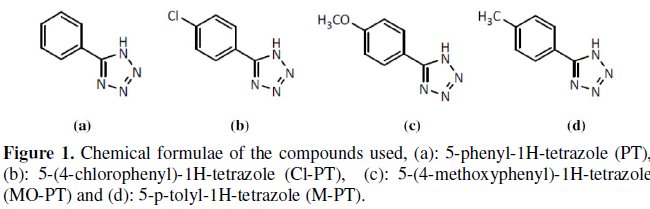
inhibitors used are organic compounds synthesized in the laboratory [20-21]. The 
structural formulae of these inhibitors are shown in Fig. 1.</p>


    <p>&nbsp;</p>
<img src="/img/revistas/pea/v30n1/30n1a05f1.jpg">
    
<p>&nbsp;</p>


    <p><b><i>Weight loss measurement</i></b></p>

    <p>Weight loss experiments were done according to ASTM methods described 
previously [22, 23]. Tests were conducted in 1 M HCl for 6 h at 25 &deg;C. The 
weight loss average of three substrate sheets could be obtained. The inhibition 
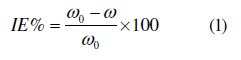
efficiency (IE %) of the inhibitors on the mild steel corrosion was calculated as 
follows:</p>


    <p>&nbsp;</p>
<img src="/img/revistas/pea/v30n1/30n1a05e1.jpg">
    
<p>&nbsp;</p>


    <p>where &omega;<sub>0</sub> and &omega; are the corrosion rates of mild steel without and with the 
inhibitor, respectively.</p>


    ]]></body>
<body><![CDATA[<p><b><i>Electrochemical measurements</i></b></p>

    <p>Electrochemical measurements were conducted in a conventional three-electrode 
cylindrical glass cell at 25 &deg;C with a platinum counter electrode (CE) and a 
saturated calomel electrode (SCE) as the reference electrode. The working 
electrode (WE) was in the form of a square cut from mild steel embedded in 
epoxy resin of polytetrafluoroethylene (PTFE), so that the flat surface was the 
only surface in the electrolyte. The polarization curves were recorded by using a 
potentiostat/galvanostat (PGZ100). The potential increased with a speed of 1 
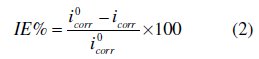
mV/s and started from potential of -750 mV to -100 mV vs. SCE. The IE% was 
defined as:</p>


    <p>&nbsp;</p>
<img src="/img/revistas/pea/v30n1/30n1a05e2.jpg">
    
<p>&nbsp;</p>


    <p>where i<sup>0</sup><sub>corr</sub> and i<sub>corr</sub> are the corrosion current density values without and with 
inhibitor, respectively.</p>


    <p><b><i>EIS measurements</i></b></p>

    <p>The electrochemical impedance spectroscopy measurements were carried out 
using a potentiostat/galvanostat (PGZ100), with a small amplitude ac. signal (10 
mV rms), over a frequency domain from 100 KHz to 10 mHz at 25 &deg;C. The 
results were then analysed in terms of equivalent electrical circuit using 
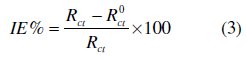
bouckamp program [24]. The inhibition efficiency of the inhibitor has been 
found from the relationship:</p>


    <p>&nbsp;</p>
<img src="/img/revistas/pea/v30n1/30n1a05e3.jpg">
    
<p>&nbsp;</p>


    <p>where R<sup>0</sup><sub>ct</sub> and R<sub>ct</sub> are the charge transfer resistance values in the absence and the 
presence of the inhibitor, respectively.</p>


    ]]></body>
<body><![CDATA[<p>&nbsp;</p>
    <p><b>Results and discussion</b></p>

    <p><b><i>Weight loss studies</i></b></p>

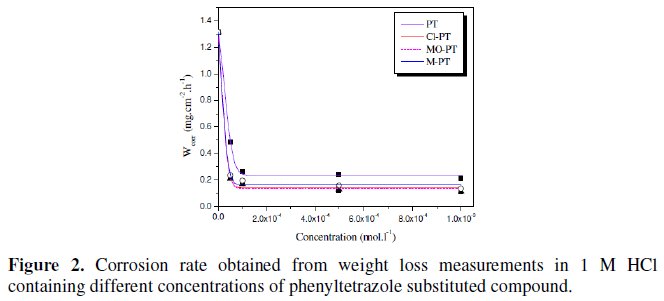
    <p>The weight loss measurements were conducted in 1 M HCl at 25 &deg;C. The values 
of corrosion rate (&omega;<sub>corr</sub>) at different concentrations of the used inhibitors are 
presented in Fig. 2.</p>


    <p>&nbsp;</p>
<img src="/img/revistas/pea/v30n1/30n1a05f2.jpg">
    
<p>&nbsp;</p>


    <p>The results show that all the phenyltetrazole compounds act 
as effective corrosion inhibitors. The corrosion rate decreases with increasing the 
inhibitor concentration and following the order:</p>

    <p>PT > M-PT > MO-PT > Cl-PT</p>

    <p>The difference in their inhibitive action can be explained by increasing of the 
effective electron density of the inhibitors by mesomeric effect in the case of Cl-
PT, and by inductive effect in the case of M-PT [25]. In aromatic or heterocyclic 
ring compounds, the effective electron density at the functional group can be 
varied by introducing different substituent in the ring, leading to variations of the 
molecular structure.</p>

    <p>The corrosion inhibition study indicated that Cl-PT and MO-PT have the highest 
IE% compared to PT and M-PT. This can be attributed to the presence of 
chloride and oxygen atoms on the aromatic rings of Cl-PT and MO-PT, 
respectively.</p>


    ]]></body>
<body><![CDATA[<p><b><i>Potentiodynamic polarization studies</i></b></p>

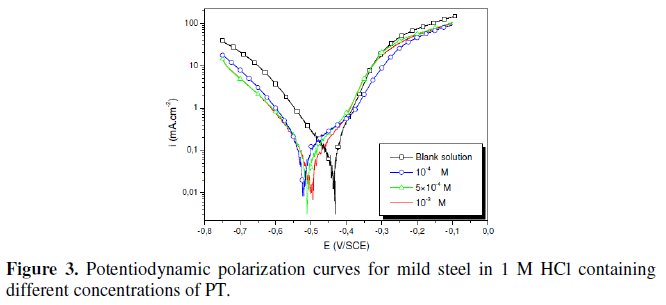
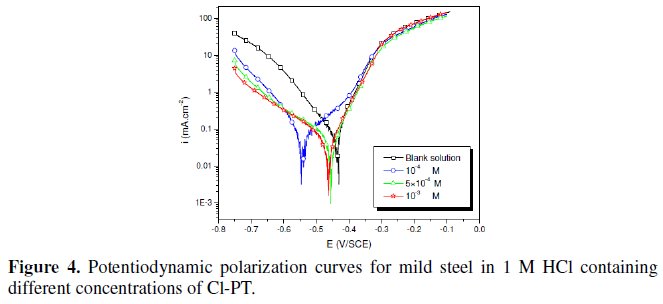
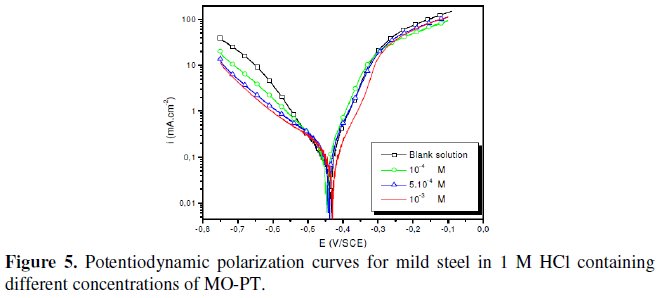
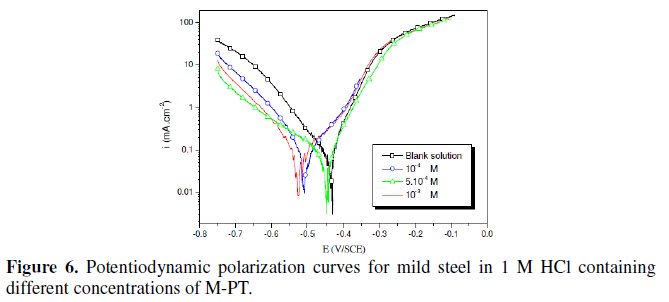
    <p>The polarization behaviour of mild steel in 1 M HCl in the absence and presence 
of different concentrations of all phenyltetrazole is shown in Fig. 3-6.</p>


    <p>&nbsp;</p>
<img src="/img/revistas/pea/v30n1/30n1a05f3.jpg">
    
<p>&nbsp;</p>
<img src="/img/revistas/pea/v30n1/30n1a05f4.jpg">
    
<p>&nbsp;</p>
<img src="/img/revistas/pea/v30n1/30n1a05f5.jpg">
    
<p>&nbsp;</p>
<img src="/img/revistas/pea/v30n1/30n1a05f6.jpg">
    
<p>&nbsp;</p>


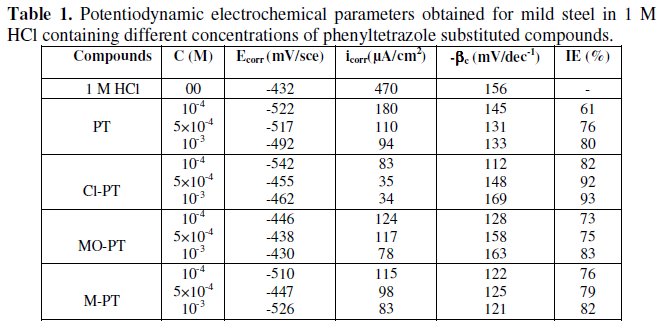
    <p>Electrochemical parameters such as corrosion current density (i<sub>corr</sub>), corrosion 
potential (E<sub>corr</sub>) and Tafel slope constants calculated from Tafel plots (-&beta;<sub>c</sub>) are 
given in Table 1.</p>


    <p>&nbsp;</p>
<img src="/img/revistas/pea/v30n1/30n1a05t1.jpg">
    
<p>&nbsp;</p>


    ]]></body>
<body><![CDATA[<p>These results show that all compounds bring down i<sub>corr</sub> value at 
all concentrations and the maximum decrease is obtained at 10<sup>-3</sup> M, suggesting 
that these compounds are effective corrosion inhibitors. Moreover, we note that 
these compounds cause a significant shift in E<sub>corr</sub> values, indicating that they are 
cathodic type inhibitors in 1 M HCl.</p>

    <p>It is apparent from the results that the IE% of the Cl-PT is highest (93%) among 
the compounds studied.</p>


    <p><b><i>Electrochemical impedance spectroscopy (EIS) measurements</i></b></p>

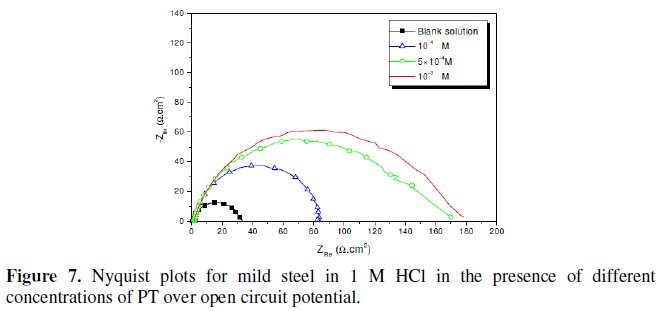
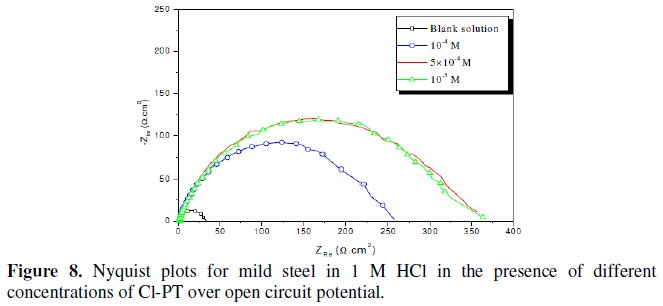
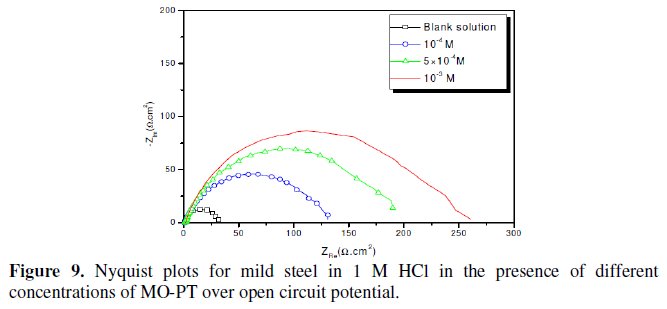
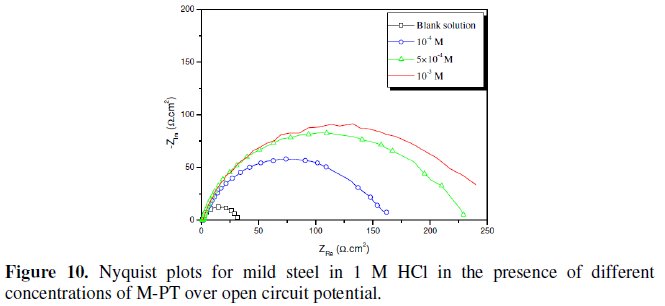
    <p>Fig. 7-10 show Nyquist plots obtained from impedance measurements for mild 
steel in 1 M HCl in the presence of different concentrations of phenyltetrazole 
substituted compounds.</p>


    <p>&nbsp;</p>
<img src="/img/revistas/pea/v30n1/30n1a05f7.jpg">
    
<p>&nbsp;</p>
<img src="/img/revistas/pea/v30n1/30n1a05f8.jpg">
    
<p>&nbsp;</p>
<img src="/img/revistas/pea/v30n1/30n1a05f9.jpg">
    
<p>&nbsp;</p>
<img src="/img/revistas/pea/v30n1/30n1a05f10.jpg">
    
<p>&nbsp;</p>


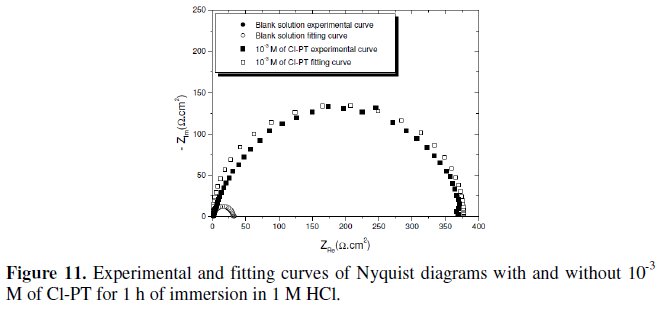
    <p>A comparison between the measured and simulation data 
for the impedance plot of mild steel in 1 M HCl with and without 10<sup>-3</sup> M of Cl-
PT is shown in Fig. 11.</p>


    ]]></body>
<body><![CDATA[<p>&nbsp;</p>
<img src="/img/revistas/pea/v30n1/30n1a05f11.jpg">
    
<p>&nbsp;</p>


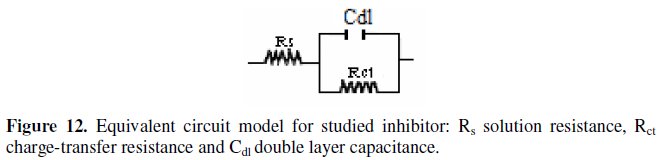
    <p>It constitutes a good indication to prove the accuracy of 
the proposed circuit (Fig. 12) [26].</p>


    <p>&nbsp;</p>
<img src="/img/revistas/pea/v30n1/30n1a05f12.jpg">
    
<p>&nbsp;</p>


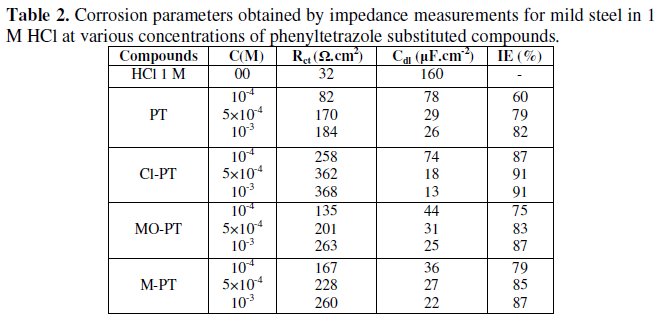
    <p>The various parameters such as charge-
transfer resistance (R<sub>ct</sub>) and double layer capacitance (C<sub>dl</sub>) were obtained from 
impedance measurements and are shown in Table 2.</p>


    <p>&nbsp;</p>
<img src="/img/revistas/pea/v30n1/30n1a05t2.jpg">
    
<p>&nbsp;</p>


    <p>It is apparent from these plots that the impedance response of mild steel in 
uninhibited 1 M HCl solution has significantly changed after the addition of 
phenyltetrazole substituted compounds in the corrosive solution. This indicates 
that the impedance of inhibited substrate increases with increasing inhibitor 
concentrations and consequently the inhibition efficiency increases. The locus of 
the Nyquist plots was regarded as one part of a semicircle. The impedance 
diagrams obtained are not perfect semicircles and this difference has been 
attributed to frequency dispersion [27-28]. The greatest effect was observed at 
10<sup>-3</sup> M of all compounds.</p>

    <p>The addition of phenyltetrazole substituted to HCl is found to enhance R<sub>ct</sub> values 
and bring down C<sub>dl</sub> values. These observations clearly bring out the fact that the 
corrosion of mild steel in 1 M HCl is controlled by a charge transfer process and 
the corrosion inhibition occurs through the adsorption of the phenyltetrazole 
substituted compounds on mild steel surface. The decrease in the C<sub>dl</sub> values can 
be attributed to the adsorption of inhibitors on metal surface [29].</p>

    ]]></body>
<body><![CDATA[<p>Values of corrosion inhibition efficiency obtained for various inhibitors follow 
the order: Cl-PT &gt; MO-PT &gt; M-PT &gt; PT, which is in a good matching with 
results obtained from weight loss and polarization curve tests.</p>

    <p>The effectiveness of a compound as corrosion inhibitor mainly depends on the 
size and the active centers of the compound [30]. The best performance of 
compounds Cl-PT and MO-PT as corrosion inhibitors over compound PT and MPT 
may be attributed to the presence of -Cl and -OCH3 groups in compound Cl-
PT and MO-PT, respectively.</p>


    <p><b><i>Effect of temperature</i></b></p>

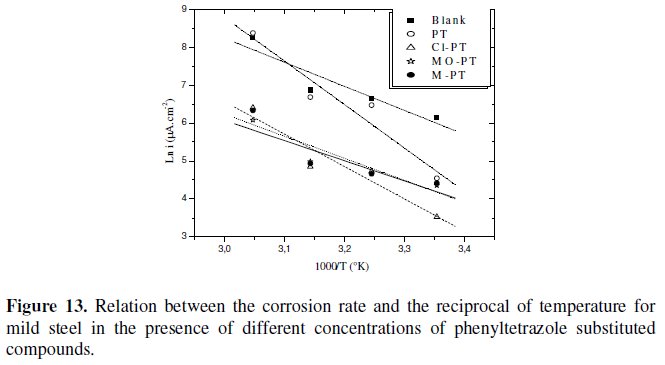
    <p>The effect of temperature on the inhibition efficiency was determined for mild 
steel in 1 M HCl containing 10<sup>-3</sup> M of different phenyltetrazole substituted 
compounds at different temperatures ranging from 25-55 &deg;C. The values of 
activation energy E<sub>a</sub> were calculated from the equation:</p>


    <p>&nbsp;</p>
<img src="/img/revistas/pea/v30n1/30n1a05e4.jpg">
    
<p>&nbsp;</p>


    <p>where i<sub>corr</sub> is the corrosion current density, T is the absolute temperature, R is the 
universal gas constant and K is the Arrhenius pre-exponential factor.</p>

    <p>Plots of the logarithm of the corrosion rate vs. l000/T are given in Fig. 13.</p>


    <p>&nbsp;</p>
<img src="/img/revistas/pea/v30n1/30n1a05f13.jpg">
    
<p>&nbsp;</p>


    ]]></body>
<body><![CDATA[<p>The plots obtained are straight lines and the slope of each straight line gives its 
activation energy E<sub>a</sub>. We note that the increase of the corrosion rate is more 
pronounced with the rise of temperature for blank solution. In the presence of the 
inhibitor, the corrosion rate is highly reduced at the explored temperatures for PT 
and slightly for other phenyltetrazole substituted compounds.</p>

    <p>The E<sub>a</sub> values were found to be equal to 15,71 kJ mol<sup>-1</sup> in the absence of the 
inhibitors and equal to 28,24 kJ mol<sup>-1</sup>, 21,17 kJ mol<sup>-1</sup>, 13,17 kJ mol<sup>-1</sup> and 14,41 
kJ mol<sup>-1</sup> in the presence of PT, Cl-PT, MO-PT and M-PT, respectively.</p>


    <p><b><i>Effect of immersion time</i></b></p>

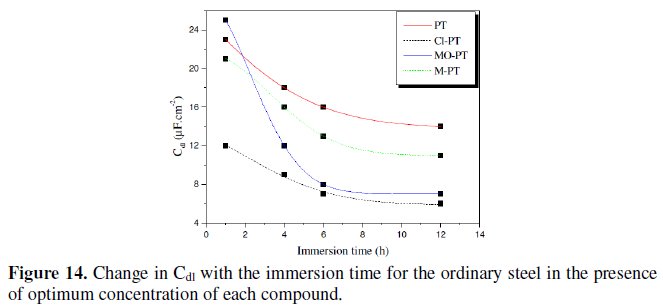
    <p>Fig. 14 represents the variation of C<sub>dl</sub> for mild steel in 1 M HCl in the presence 
10<sup>-3</sup> M of phenyltetrazole substituted compounds at different immersion time.</p>


    <p>&nbsp;</p>
<img src="/img/revistas/pea/v30n1/30n1a05f14.jpg">
    
<p>&nbsp;</p>


    <p>Inspections of this figure reveal that the value of C<sub>dl</sub> decreases with increasing 
immersion time. These results indicate that the immersion time can increase the 
chlorides quantity which will be adsorbed on the surface helping to the formation 
of the inhibitor layer when the entire active sites become saturated with inhibitor. 
Furthermore, the change in the C<sub>dl</sub> values may be caused by the gradual 
replacement of water molecules by the chloride anion and by the adsorption of 
the organic molecules on the metal surface, decreasing the extent of dissolution 
reaction.</p>


    <p><b><i>Adsorption isotherm</i></b></p>

    <p>Basic information dealing with the interaction between the inhibitor molecule 
and metal surface can be provided by adsorption isotherm [31]. Because the 
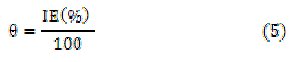
inhibition action is postulated as a result of the adsorption process, (&Theta;) is directly 
related with the inhibition efficiency IE(%) [32], and was calculated using 
Eq.(5):</p>


    <p>&nbsp;</p>
<img src="/img/revistas/pea/v30n1/30n1a05e5.jpg">
    
]]></body>
<body><![CDATA[<p>&nbsp;</p>


    <p>We have tried to fit the coverage-concentration data to different adsorption 
isotherms [33], and we find that the inhibitor behavior can be best fitted to the 
Langmuir adsorption isotherm, which assumes that there is no interaction 
between the adsorbed species eventually leading to a surface saturation. 
The Langmuir adsorption isotherm can be expressed as [34]:</p>


    <p>&nbsp;</p>
<img src="/img/revistas/pea/v30n1/30n1a05e6.jpg">
    
<p>&nbsp;</p>


    <p>where C is the concentration of the inhibitor, &Theta; is the fractional surface coverage, 
and K is the modified adsorption equilibrium constant [35,36] related to the 
energy of adsorption, &Delta;G, as:</p>


    <p>&nbsp;</p>
<img src="/img/revistas/pea/v30n1/30n1a05e7.jpg">
    
<p>&nbsp;</p>


    <p>where C<sub>solvent</sub> is the molar concentration of the solvent, which in the case of water 
is 55.5 mol L<sup>-1</sup>.</p>

    <p>The Langmuir adsorption isotherm can be rearranged to obtain the following 
expression:</p>


    <p>&nbsp;</p>
<img src="/img/revistas/pea/v30n1/30n1a05e8.jpg">
    
]]></body>
<body><![CDATA[<p>&nbsp;</p>


    <p>Hence a plot of C/&Theta; 
versus C should yield a straight line with intercept of K<sup>-1</sup>.</p>

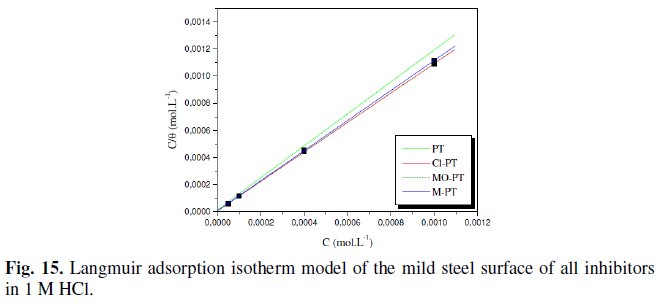
    <p>The adsorption isotherm obtained for phenyltetrazole substituted compounds is 
plotted in Fig. 15.</p>


    <p>&nbsp;</p>
<img src="/img/revistas/pea/v30n1/30n1a05f15.jpg">
    
<p>&nbsp;</p>


    <p>We found that all phenyltetrazole substituted compounds show a good linear fit 
proving that the adsorption of these compounds from 1 M HCl solution on the 
mild steel surface obeys the Langmuir adsorption isotherm. The equilibrium 
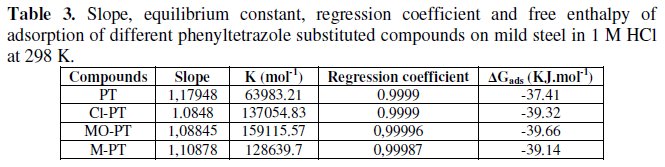
constant K (moL<sup>-1</sup>) is calculated from the intercept from which the free enthalpy 
of adsorption &Delta;G (kJ. moL<sup>-1</sup>) is obtained.</p>

    <p>The calculated values are tabulated in Table 3.</p>


    <p>&nbsp;</p>
<img src="/img/revistas/pea/v30n1/30n1a05t3.jpg">
    
<p>&nbsp;</p>


    <p>The negative sign of free enthalpy 
of dsorption indicates that the adsorption of phenyltetrazole substituted 
compounds at steel surface is a spontaneous process.</p>


    ]]></body>
<body><![CDATA[<p>&nbsp;</p>
    <p><b>Conclusion</b></p>

    <p>All the examined phenyltetrazole substituted compounds are effective corrosion 
inhibitors for mild steel in 1 M HCl solution. These compounds inhibit corrosion 
by adsorption mechanism and their inhibition depends on the type alkyl in their 
structures. In added, the inhibition efficiencies increase with increasing 
immersion time and slightly depend on the temperature. The Cl-PT and MO-PT 
give the highest inhibition efficiency. The order of the inhibition efficiency of 
inhibitors as given by EIS measurements is in good agreement with that obtained 
from weight loss measurements and polarization curves. The adsorption of all 
compounds follows the Langmuir isotherm with negative values of free enthalpy, 
suggesting a spontaneous adsorption process.</p>


    <p>&nbsp;</p>
    <p><b>References</b></p>

    <!-- ref --><p>1. S.D. Shetty, P. Shetty, H.V.S. Nayak, J. Serb. Chem. Soc. 71 (2006) 1073.    &nbsp;&nbsp;&nbsp;&nbsp;&nbsp;&nbsp;&nbsp;&nbsp;[&#160;<a href="javascript:void(0);" onclick="javascript: window.open('/scielo.php?script=sci_nlinks&ref=000128&pid=S0872-1904201200010000500001&lng=','','width=640,height=500,resizable=yes,scrollbars=1,menubar=yes,');">Links</a>&#160;]<!-- end-ref --></p>
    <p>2. R. Touir, N. Dkhireche, M. Ebn Touhami et all, Mater. Chem. Phys. 122 (2010) 1.</p>
    <!-- ref --><p>3. E.A. Noor, A.H. Al-Moubaraki, Int. J. Electrochem. Sci. 3 (2008) 806.    &nbsp;&nbsp;&nbsp;&nbsp;&nbsp;&nbsp;&nbsp;&nbsp;[&#160;<a href="javascript:void(0);" onclick="javascript: window.open('/scielo.php?script=sci_nlinks&ref=000131&pid=S0872-1904201200010000500003&lng=','','width=640,height=500,resizable=yes,scrollbars=1,menubar=yes,');">Links</a>&#160;]<!-- end-ref --></p>
    ]]></body>
<body><![CDATA[<p>4. H.P. Sachin, M.H. Moinuddin Khan, N.S. Bhujangaiah, Int. J. Electrochem. Sci. 4 (2009) 134.</p>
    <p>5. L. Tang, X. Li, Y. Si et all, Mater. Chem. Phys. 95 (2006) 29.</p>
    <!-- ref --><p>6. S.K. Rajappa, Ph.D. Thesis, Kuvempu University, Shankaraghatta, India (2000).    &nbsp;&nbsp;&nbsp;&nbsp;&nbsp;&nbsp;&nbsp;&nbsp;[&#160;<a href="javascript:void(0);" onclick="javascript: window.open('/scielo.php?script=sci_nlinks&ref=000135&pid=S0872-1904201200010000500006&lng=','','width=640,height=500,resizable=yes,scrollbars=1,menubar=yes,');">Links</a>&#160;]<!-- end-ref --></p>
    <!-- ref --><p>7. L.B. Tang, G.N. Mu, G.H. Liu, Corros. Sci. 45 (2003) 2251.    &nbsp;&nbsp;&nbsp;&nbsp;&nbsp;&nbsp;&nbsp;&nbsp;[&#160;<a href="javascript:void(0);" onclick="javascript: window.open('/scielo.php?script=sci_nlinks&ref=000137&pid=S0872-1904201200010000500007&lng=','','width=640,height=500,resizable=yes,scrollbars=1,menubar=yes,');">Links</a>&#160;]<!-- end-ref --></p>
    <!-- ref --><p>8. F. Bentis, M. Traisnel, M. Lagrenee, Br. Corros. J. 35 (2000) 315.    &nbsp;&nbsp;&nbsp;&nbsp;&nbsp;&nbsp;&nbsp;&nbsp;[&#160;<a href="javascript:void(0);" onclick="javascript: window.open('/scielo.php?script=sci_nlinks&ref=000139&pid=S0872-1904201200010000500008&lng=','','width=640,height=500,resizable=yes,scrollbars=1,menubar=yes,');">Links</a>&#160;]<!-- end-ref --></p>
    <!-- ref --><p>9. M.A. Quaraishi, D. Jamal, Corrosion 56 (2000) 156.    &nbsp;&nbsp;&nbsp;&nbsp;&nbsp;&nbsp;&nbsp;&nbsp;[&#160;<a href="javascript:void(0);" onclick="javascript: window.open('/scielo.php?script=sci_nlinks&ref=000141&pid=S0872-1904201200010000500009&lng=','','width=640,height=500,resizable=yes,scrollbars=1,menubar=yes,');">Links</a>&#160;]<!-- end-ref --></p>
    ]]></body>
<body><![CDATA[<p>10. B. Mernari, H.E. Attari, M. Traisnel et all, Corros. Sci. 40 (1998) 391.</p>
    <p>11. M. Lagrenee, B. Mernari, N. Chaibi et all, Corros. Sci. 43 (2001) 951.</p>
    <p>12. M. Elayyachy, B. Hammouti, A. El Idrissi, A. Aouniti, Port. Electrochim. Acta (2011) 57.</p>
    <!-- ref --><p>13. S. Martinez, I. Stern, Appl. Surf. Sci. 199 (2002) 83.    &nbsp;&nbsp;&nbsp;&nbsp;&nbsp;&nbsp;&nbsp;&nbsp;[&#160;<a href="javascript:void(0);" onclick="javascript: window.open('/scielo.php?script=sci_nlinks&ref=000146&pid=S0872-1904201200010000500013&lng=','','width=640,height=500,resizable=yes,scrollbars=1,menubar=yes,');">Links</a>&#160;]<!-- end-ref --></p>
    <p>14. M. Cenoui, N. Dkhireche, O. Kassou et all, J. Mater. Environ. Sci. 1 (2010) 84.</p>
    <p>15. K. Adardour, O. Kassou, R. Touir et all, J. Mater. Environ. Sci. 1 (2010) 129.</p>
    <!-- ref --><p>16. O.R. Khalifa, S.M. Abdallah, Port. Electrochim. Acta 29 (2011) 47.    &nbsp;&nbsp;&nbsp;&nbsp;&nbsp;&nbsp;&nbsp;&nbsp;[&#160;<a href="javascript:void(0);" onclick="javascript: window.open('/scielo.php?script=sci_nlinks&ref=000150&pid=S0872-1904201200010000500016&lng=','','width=640,height=500,resizable=yes,scrollbars=1,menubar=yes,');">Links</a>&#160;]<!-- end-ref --></p>
    <!-- ref --><p>17. E. Khamis, Corrosion 46 (1990) 476.    &nbsp;&nbsp;&nbsp;&nbsp;&nbsp;&nbsp;&nbsp;&nbsp;[&#160;<a href="javascript:void(0);" onclick="javascript: window.open('/scielo.php?script=sci_nlinks&ref=000152&pid=S0872-1904201200010000500017&lng=','','width=640,height=500,resizable=yes,scrollbars=1,menubar=yes,');">Links</a>&#160;]<!-- end-ref --></p>
    <p>18. I. Forsal, M. Ebn Touhami, B. Mernari et all, Port. Electrochim. Acta 28 (2010) 203.</p>
    <!-- ref --><p>19. K. Parameswari, S. Rekha, S. Chitra, E. Kayalvizhy, Port. Electrochim. Acta 28 (2010) 189.    &nbsp;&nbsp;&nbsp;&nbsp;&nbsp;&nbsp;&nbsp;&nbsp;[&#160;<a href="javascript:void(0);" onclick="javascript: window.open('/scielo.php?script=sci_nlinks&ref=000155&pid=S0872-1904201200010000500019&lng=','','width=640,height=500,resizable=yes,scrollbars=1,menubar=yes,');">Links</a>&#160;]<!-- end-ref --></p>
    <p>20. A. Alami, A. El Hallaoui, A. Elachqar et all, Bull. Soc. Chim. Belg. 105, 769 (1996).</p>
    <p>21. S. Achmlale, A. El Achqar, A. El Hallaoui et all, Phosphorus, Sulfur and Silicon 5 (1998) 1.</p>
    <!-- ref --><p>22. Standard practice for laboratory immersion corrosion testing of metals, G 31-72, ASTM, Philadelphia, PA, (1990) 401.    &nbsp;&nbsp;&nbsp;&nbsp;&nbsp;&nbsp;&nbsp;&nbsp;[&#160;<a href="javascript:void(0);" onclick="javascript: window.open('/scielo.php?script=sci_nlinks&ref=000159&pid=S0872-1904201200010000500022&lng=','','width=640,height=500,resizable=yes,scrollbars=1,menubar=yes,');">Links</a>&#160;]<!-- end-ref --></p>
    <p>23. A.D. Mercer, Test methods of corrosion inhibitors, Br. Corros. J. 20 (1985) 61.</p>
    <!-- ref --><p>24. A. Boukamp, Users Manual Equivalent Circuit, ver. 4.51, (1993).    &nbsp;&nbsp;&nbsp;&nbsp;&nbsp;&nbsp;&nbsp;&nbsp;[&#160;<a href="javascript:void(0);" onclick="javascript: window.open('/scielo.php?script=sci_nlinks&ref=000162&pid=S0872-1904201200010000500024&lng=','','width=640,height=500,resizable=yes,scrollbars=1,menubar=yes,');">Links</a>&#160;]<!-- end-ref --></p>
    <!-- ref --><p>25. R.H.L. Wang , R.-B. Liu, J. Xin, Corros. Sci. 46 (2004) 2455.    &nbsp;&nbsp;&nbsp;&nbsp;&nbsp;&nbsp;&nbsp;&nbsp;[&#160;<a href="javascript:void(0);" onclick="javascript: window.open('/scielo.php?script=sci_nlinks&ref=000164&pid=S0872-1904201200010000500025&lng=','','width=640,height=500,resizable=yes,scrollbars=1,menubar=yes,');">Links</a>&#160;]<!-- end-ref --></p>
    <!-- ref --><p>26. F. Mansfeld, Corrosion 36 (1981) 301.    &nbsp;&nbsp;&nbsp;&nbsp;&nbsp;&nbsp;&nbsp;&nbsp;[&#160;<a href="javascript:void(0);" onclick="javascript: window.open('/scielo.php?script=sci_nlinks&ref=000166&pid=S0872-1904201200010000500026&lng=','','width=640,height=500,resizable=yes,scrollbars=1,menubar=yes,');">Links</a>&#160;]<!-- end-ref --></p>
    <!-- ref --><p>27. F. Mansfeld, M.W. Kending, S. Tsai, Corrosion 37 (1981) 301.    &nbsp;&nbsp;&nbsp;&nbsp;&nbsp;&nbsp;&nbsp;&nbsp;[&#160;<a href="javascript:void(0);" onclick="javascript: window.open('/scielo.php?script=sci_nlinks&ref=000168&pid=S0872-1904201200010000500027&lng=','','width=640,height=500,resizable=yes,scrollbars=1,menubar=yes,');">Links</a>&#160;]<!-- end-ref --></p> 
    <!-- ref --><p>28. F. Mansfeld, M.W. Kending, S. Tsai, Corrosion 38 (1982) 570.    &nbsp;&nbsp;&nbsp;&nbsp;&nbsp;&nbsp;&nbsp;&nbsp;[&#160;<a href="javascript:void(0);" onclick="javascript: window.open('/scielo.php?script=sci_nlinks&ref=000170&pid=S0872-1904201200010000500028&lng=','','width=640,height=500,resizable=yes,scrollbars=1,menubar=yes,');">Links</a>&#160;]<!-- end-ref --></p>
    <!-- ref --><p>29. F. Bentiss, M. Traisnel, M. Lagrenee, J. Applied Electrochem. 31 (2001) 41.    &nbsp;&nbsp;&nbsp;&nbsp;&nbsp;&nbsp;&nbsp;&nbsp;[&#160;<a href="javascript:void(0);" onclick="javascript: window.open('/scielo.php?script=sci_nlinks&ref=000172&pid=S0872-1904201200010000500029&lng=','','width=640,height=500,resizable=yes,scrollbars=1,menubar=yes,');">Links</a>&#160;]<!-- end-ref --></p>
    <!-- ref --><p>30. G.Y. Elewady, Int. J. Electrochem. Sci. 3 (2008) 1149.    &nbsp;&nbsp;&nbsp;&nbsp;&nbsp;&nbsp;&nbsp;&nbsp;[&#160;<a href="javascript:void(0);" onclick="javascript: window.open('/scielo.php?script=sci_nlinks&ref=000174&pid=S0872-1904201200010000500030&lng=','','width=640,height=500,resizable=yes,scrollbars=1,menubar=yes,');">Links</a>&#160;]<!-- end-ref --></p>
    <!-- ref --><p>31. M. Bouklah, B. Hammouti, M. Lagrenee, F. Bentiss, Corros. Sci. 48 (2006) 2831.    &nbsp;&nbsp;&nbsp;&nbsp;&nbsp;&nbsp;&nbsp;&nbsp;[&#160;<a href="javascript:void(0);" onclick="javascript: window.open('/scielo.php?script=sci_nlinks&ref=000176&pid=S0872-1904201200010000500031&lng=','','width=640,height=500,resizable=yes,scrollbars=1,menubar=yes,');">Links</a>&#160;]<!-- end-ref --></p>
    <p>32. M. Tariq Saeed, S.K. Ali, Anticorros. Meth. Mater. 50 (2003) 436.</p>
    <!-- ref --><p>33. M. Ehteshamzade, T. Shahrabi, M.G. Hosseini, Appl. Surf. Sci. 252 (2006) 2949.    &nbsp;&nbsp;&nbsp;&nbsp;&nbsp;&nbsp;&nbsp;&nbsp;[&#160;<a href="javascript:void(0);" onclick="javascript: window.open('/scielo.php?script=sci_nlinks&ref=000179&pid=S0872-1904201200010000500033&lng=','','width=640,height=500,resizable=yes,scrollbars=1,menubar=yes,');">Links</a>&#160;]<!-- end-ref --></p>
    <!-- ref --><p>34. K.C. Emregul, A.A. Akay, O. Atakol, Mater. Chem. Phys. 93 (2005) 325.    &nbsp;&nbsp;&nbsp;&nbsp;&nbsp;&nbsp;&nbsp;&nbsp;[&#160;<a href="javascript:void(0);" onclick="javascript: window.open('/scielo.php?script=sci_nlinks&ref=000181&pid=S0872-1904201200010000500034&lng=','','width=640,height=500,resizable=yes,scrollbars=1,menubar=yes,');">Links</a>&#160;]<!-- end-ref --></p>
    ]]></body>
<body><![CDATA[<p>35. L. Tang, X. Li, L. Li et all, Mater. Chem. Phys. 97 (2006) 301.</p> 
    <!-- ref --><p>36. L. Tang, X. Li, G. Mu et all, Appl. Surf. Sci. 252 (2006) 6394.    &nbsp;&nbsp;&nbsp;&nbsp;&nbsp;&nbsp;&nbsp;&nbsp;[&#160;<a href="javascript:void(0);" onclick="javascript: window.open('/scielo.php?script=sci_nlinks&ref=000184&pid=S0872-1904201200010000500036&lng=','','width=640,height=500,resizable=yes,scrollbars=1,menubar=yes,');">Links</a>&#160;]<!-- end-ref --></p>


    <p>&nbsp;</p>

    <p><a name=0><sup><a href="#top">*</sup></a>Corresponding author. E-mail address: <a href="mailto:mebntouhami@yahoo.fr">mebntouhami@yahoo.fr</a></p>

    <p>Received 18 April 2011; accepted 28 February 2012</p>

    <p><a href="http://www.peacta.org" target="_blank">www.peacta.org</a></p>


     ]]></body><back>
<ref-list>
<ref id="B1">
<label>1</label><nlm-citation citation-type="journal">
<person-group person-group-type="author">
<name>
<surname><![CDATA[Shetty]]></surname>
<given-names><![CDATA[S.D.]]></given-names>
</name>
<name>
<surname><![CDATA[Shetty]]></surname>
<given-names><![CDATA[P.]]></given-names>
</name>
<name>
<surname><![CDATA[Nayak]]></surname>
<given-names><![CDATA[H.V.S.]]></given-names>
</name>
</person-group>
<source><![CDATA[J. Serb. Chem. Soc.]]></source>
<year>2006</year>
<volume>71</volume>
<page-range>1073</page-range></nlm-citation>
</ref>
<ref id="B2">
<label>2</label><nlm-citation citation-type="journal">
<person-group person-group-type="author">
<name>
<surname><![CDATA[Touir]]></surname>
<given-names><![CDATA[R.]]></given-names>
</name>
<name>
<surname><![CDATA[Dkhireche]]></surname>
<given-names><![CDATA[N.]]></given-names>
</name>
</person-group>
<source><![CDATA[Mater. Chem. Phys.]]></source>
<year>2010</year>
<volume>122</volume>
<page-range>1</page-range></nlm-citation>
</ref>
<ref id="B3">
<label>3</label><nlm-citation citation-type="journal">
<person-group person-group-type="author">
<name>
<surname><![CDATA[Noor]]></surname>
<given-names><![CDATA[E.A.]]></given-names>
</name>
<name>
<surname><![CDATA[Al-Moubaraki]]></surname>
<given-names><![CDATA[A.H.]]></given-names>
</name>
</person-group>
<source><![CDATA[Int. J. Electrochem. Sci.]]></source>
<year>2008</year>
<volume>3</volume>
<page-range>806</page-range></nlm-citation>
</ref>
<ref id="B4">
<label>4</label><nlm-citation citation-type="journal">
<person-group person-group-type="author">
<name>
<surname><![CDATA[Sachin]]></surname>
<given-names><![CDATA[H.P.]]></given-names>
</name>
<name>
<surname><![CDATA[Khan]]></surname>
<given-names><![CDATA[M.H.M.]]></given-names>
</name>
<name>
<surname><![CDATA[Bhujangaiah]]></surname>
<given-names><![CDATA[N.S.]]></given-names>
</name>
</person-group>
<source><![CDATA[Int. J. Electrochem. Sci.]]></source>
<year>2009</year>
<volume>4</volume>
<page-range>134</page-range></nlm-citation>
</ref>
<ref id="B5">
<label>5</label><nlm-citation citation-type="journal">
<person-group person-group-type="author">
<name>
<surname><![CDATA[Tang]]></surname>
<given-names><![CDATA[L.]]></given-names>
</name>
<name>
<surname><![CDATA[Li]]></surname>
<given-names><![CDATA[X.]]></given-names>
</name>
</person-group>
<source><![CDATA[Mater. Chem. Phys.]]></source>
<year>2006</year>
<volume>95</volume>
<page-range>29</page-range></nlm-citation>
</ref>
<ref id="B6">
<label>6</label><nlm-citation citation-type="">
<person-group person-group-type="author">
<name>
<surname><![CDATA[Rajappa]]></surname>
<given-names><![CDATA[S.K.]]></given-names>
</name>
</person-group>
<source><![CDATA[]]></source>
<year></year>
</nlm-citation>
</ref>
<ref id="B7">
<label>7</label><nlm-citation citation-type="journal">
<person-group person-group-type="author">
<name>
<surname><![CDATA[Tang]]></surname>
<given-names><![CDATA[L.B.]]></given-names>
</name>
<name>
<surname><![CDATA[Mu]]></surname>
<given-names><![CDATA[G.N.]]></given-names>
</name>
<name>
<surname><![CDATA[Liu]]></surname>
<given-names><![CDATA[G.H.]]></given-names>
</name>
</person-group>
<source><![CDATA[Corros. Sci.]]></source>
<year>2003</year>
<volume>45</volume>
<page-range>2251</page-range></nlm-citation>
</ref>
<ref id="B8">
<label>8</label><nlm-citation citation-type="journal">
<person-group person-group-type="author">
<name>
<surname><![CDATA[Bentis]]></surname>
<given-names><![CDATA[F.]]></given-names>
</name>
<name>
<surname><![CDATA[Traisnel]]></surname>
<given-names><![CDATA[M.]]></given-names>
</name>
<name>
<surname><![CDATA[Lagrenee]]></surname>
<given-names><![CDATA[M.]]></given-names>
</name>
</person-group>
<source><![CDATA[Br. Corros. J.]]></source>
<year>2000</year>
<volume>35</volume>
<page-range>315</page-range></nlm-citation>
</ref>
<ref id="B9">
<label>9</label><nlm-citation citation-type="journal">
<person-group person-group-type="author">
<name>
<surname><![CDATA[Quaraishi]]></surname>
<given-names><![CDATA[M.A.]]></given-names>
</name>
<name>
<surname><![CDATA[Jamal]]></surname>
<given-names><![CDATA[D.]]></given-names>
</name>
</person-group>
<source><![CDATA[Corrosion]]></source>
<year>2000</year>
<volume>56</volume>
<page-range>156</page-range></nlm-citation>
</ref>
<ref id="B10">
<label>10</label><nlm-citation citation-type="journal">
<person-group person-group-type="author">
<name>
<surname><![CDATA[Mernari]]></surname>
<given-names><![CDATA[B.]]></given-names>
</name>
<name>
<surname><![CDATA[Attari]]></surname>
<given-names><![CDATA[H.El.]]></given-names>
</name>
</person-group>
<source><![CDATA[Corros. Sci.]]></source>
<year>1998</year>
<volume>40</volume>
<page-range>391</page-range></nlm-citation>
</ref>
<ref id="B11">
<label>11</label><nlm-citation citation-type="journal">
<person-group person-group-type="author">
<name>
<surname><![CDATA[Lagrenee]]></surname>
<given-names><![CDATA[M.]]></given-names>
</name>
<name>
<surname><![CDATA[Mernari]]></surname>
<given-names><![CDATA[B.]]></given-names>
</name>
</person-group>
<source><![CDATA[Corros. Sci.]]></source>
<year>2001</year>
<volume>43</volume>
<page-range>951</page-range></nlm-citation>
</ref>
<ref id="B12">
<label>12</label><nlm-citation citation-type="journal">
<person-group person-group-type="author">
<name>
<surname><![CDATA[Elayyachy]]></surname>
<given-names><![CDATA[M.]]></given-names>
</name>
<name>
<surname><![CDATA[Hammouti]]></surname>
<given-names><![CDATA[B.]]></given-names>
</name>
</person-group>
<source><![CDATA[Port. Electrochim. Acta]]></source>
<year>2011</year>
<volume>29</volume>
<page-range>57</page-range></nlm-citation>
</ref>
<ref id="B13">
<label>13</label><nlm-citation citation-type="journal">
<person-group person-group-type="author">
<name>
<surname><![CDATA[Martinez]]></surname>
<given-names><![CDATA[S.]]></given-names>
</name>
<name>
<surname><![CDATA[Stern]]></surname>
<given-names><![CDATA[I.]]></given-names>
</name>
</person-group>
<source><![CDATA[Appl. Surf. Sci.]]></source>
<year>2002</year>
<volume>199</volume>
<page-range>83</page-range></nlm-citation>
</ref>
<ref id="B14">
<label>14</label><nlm-citation citation-type="journal">
<person-group person-group-type="author">
<name>
<surname><![CDATA[Cenoui]]></surname>
<given-names><![CDATA[M.]]></given-names>
</name>
<name>
<surname><![CDATA[Dkhireche]]></surname>
<given-names><![CDATA[N.]]></given-names>
</name>
</person-group>
<source><![CDATA[J. Mater. Environ. Sci.]]></source>
<year>2010</year>
<volume>1</volume>
<page-range>84</page-range></nlm-citation>
</ref>
<ref id="B15">
<label>15</label><nlm-citation citation-type="journal">
<person-group person-group-type="author">
<name>
<surname><![CDATA[Adardour]]></surname>
<given-names><![CDATA[K.]]></given-names>
</name>
<name>
<surname><![CDATA[Kassou]]></surname>
<given-names><![CDATA[O.]]></given-names>
</name>
</person-group>
<source><![CDATA[J. Mater. Environ. Sci.]]></source>
<year>2010</year>
<volume>1</volume>
<page-range>129</page-range></nlm-citation>
</ref>
<ref id="B16">
<label>16</label><nlm-citation citation-type="journal">
<person-group person-group-type="author">
<name>
<surname><![CDATA[Khalifa]]></surname>
<given-names><![CDATA[O.R.]]></given-names>
</name>
<name>
<surname><![CDATA[Abdallah]]></surname>
<given-names><![CDATA[S.M.]]></given-names>
</name>
</person-group>
<source><![CDATA[Port. Electrochim. Acta]]></source>
<year>2011</year>
<volume>29</volume>
<page-range>47</page-range></nlm-citation>
</ref>
<ref id="B17">
<label>17</label><nlm-citation citation-type="journal">
<person-group person-group-type="author">
<name>
<surname><![CDATA[Khamis]]></surname>
<given-names><![CDATA[E.]]></given-names>
</name>
</person-group>
<source><![CDATA[Corrosion]]></source>
<year>1990</year>
<volume>46</volume>
<page-range>476</page-range></nlm-citation>
</ref>
<ref id="B18">
<label>18</label><nlm-citation citation-type="journal">
<person-group person-group-type="author">
<name>
<surname><![CDATA[Forsal]]></surname>
<given-names><![CDATA[I.]]></given-names>
</name>
<name>
<surname><![CDATA[Touhami]]></surname>
<given-names><![CDATA[M.E.]]></given-names>
</name>
</person-group>
<source><![CDATA[Port. Electrochim. Acta]]></source>
<year>2010</year>
<volume>28</volume>
<page-range>203</page-range></nlm-citation>
</ref>
<ref id="B19">
<label>19</label><nlm-citation citation-type="journal">
<person-group person-group-type="author">
<name>
<surname><![CDATA[Parameswari]]></surname>
<given-names><![CDATA[K.]]></given-names>
</name>
<name>
<surname><![CDATA[Rekha]]></surname>
<given-names><![CDATA[S.]]></given-names>
</name>
</person-group>
<source><![CDATA[Port. Electrochim. Acta]]></source>
<year>2010</year>
<volume>28</volume>
<page-range>189</page-range></nlm-citation>
</ref>
<ref id="B20">
<label>20</label><nlm-citation citation-type="journal">
<person-group person-group-type="author">
<name>
<surname><![CDATA[Alami]]></surname>
<given-names><![CDATA[A.]]></given-names>
</name>
<name>
<surname><![CDATA[El Hallaoui]]></surname>
<given-names><![CDATA[A.]]></given-names>
</name>
</person-group>
<source><![CDATA[Bull. Soc. Chim. Belg.]]></source>
<year>1996</year>
<volume>105</volume>
<page-range>769</page-range></nlm-citation>
</ref>
<ref id="B21">
<label>21</label><nlm-citation citation-type="journal">
<person-group person-group-type="author">
<name>
<surname><![CDATA[Achmlale]]></surname>
<given-names><![CDATA[S.]]></given-names>
</name>
<name>
<surname><![CDATA[El Achqar]]></surname>
<given-names><![CDATA[A.]]></given-names>
</name>
</person-group>
<source><![CDATA[Phosphorus, Sulfur and Silicon]]></source>
<year>1998</year>
<volume>5</volume>
<page-range>1</page-range></nlm-citation>
</ref>
<ref id="B22">
<label>22</label><nlm-citation citation-type="book">
<source><![CDATA[Standard practice for laboratory immersion corrosion testing of metals]]></source>
<year>1990</year>
<page-range>401</page-range><publisher-loc><![CDATA[Philadelphia^ePA PA]]></publisher-loc>
<publisher-name><![CDATA[ASTM]]></publisher-name>
</nlm-citation>
</ref>
<ref id="B23">
<label>23</label><nlm-citation citation-type="journal">
<person-group person-group-type="author">
<name>
<surname><![CDATA[Mercer]]></surname>
<given-names><![CDATA[A.D.]]></given-names>
</name>
</person-group>
<source><![CDATA[Br. Corros. J.]]></source>
<year>1985</year>
<volume>20</volume>
<page-range>61</page-range></nlm-citation>
</ref>
<ref id="B24">
<label>24</label><nlm-citation citation-type="">
<person-group person-group-type="author">
<name>
<surname><![CDATA[Boukamp]]></surname>
<given-names><![CDATA[A.]]></given-names>
</name>
</person-group>
<source><![CDATA[Users Manual Equivalent Circuit]]></source>
<year>1993</year>
</nlm-citation>
</ref>
<ref id="B25">
<label>25</label><nlm-citation citation-type="journal">
<person-group person-group-type="author">
<name>
<surname><![CDATA[Wang]]></surname>
<given-names><![CDATA[R.H.L.]]></given-names>
</name>
<name>
<surname><![CDATA[Liu]]></surname>
<given-names><![CDATA[R.-B.]]></given-names>
</name>
<name>
<surname><![CDATA[Xin]]></surname>
<given-names><![CDATA[J.]]></given-names>
</name>
</person-group>
<source><![CDATA[Corros. Sci.]]></source>
<year>2004</year>
<volume>46</volume>
<page-range>2455</page-range></nlm-citation>
</ref>
<ref id="B26">
<label>26</label><nlm-citation citation-type="journal">
<person-group person-group-type="author">
<name>
<surname><![CDATA[Mansfeld]]></surname>
<given-names><![CDATA[F.]]></given-names>
</name>
</person-group>
<source><![CDATA[Corrosion]]></source>
<year>1981</year>
<volume>36</volume>
<page-range>301</page-range></nlm-citation>
</ref>
<ref id="B27">
<label>27</label><nlm-citation citation-type="journal">
<person-group person-group-type="author">
<name>
<surname><![CDATA[Mansfeld]]></surname>
<given-names><![CDATA[F.]]></given-names>
</name>
<name>
<surname><![CDATA[Kending]]></surname>
<given-names><![CDATA[M.W.]]></given-names>
</name>
<name>
<surname><![CDATA[Tsai]]></surname>
<given-names><![CDATA[S.]]></given-names>
</name>
</person-group>
<source><![CDATA[Corrosion]]></source>
<year>1981</year>
<volume>37</volume>
<page-range>301</page-range></nlm-citation>
</ref>
<ref id="B28">
<label>28</label><nlm-citation citation-type="journal">
<person-group person-group-type="author">
<name>
<surname><![CDATA[Mansfeld]]></surname>
<given-names><![CDATA[F.]]></given-names>
</name>
<name>
<surname><![CDATA[Kending]]></surname>
<given-names><![CDATA[M.W.]]></given-names>
</name>
<name>
<surname><![CDATA[Tsai]]></surname>
<given-names><![CDATA[S.]]></given-names>
</name>
</person-group>
<source><![CDATA[Corrosion]]></source>
<year>1982</year>
<volume>38</volume>
<page-range>570</page-range></nlm-citation>
</ref>
<ref id="B29">
<label>29</label><nlm-citation citation-type="journal">
<person-group person-group-type="author">
<name>
<surname><![CDATA[Bentiss]]></surname>
<given-names><![CDATA[F.]]></given-names>
</name>
<name>
<surname><![CDATA[Traisnel]]></surname>
<given-names><![CDATA[M.]]></given-names>
</name>
<name>
<surname><![CDATA[Lagrenee]]></surname>
<given-names><![CDATA[M.]]></given-names>
</name>
</person-group>
<source><![CDATA[J. Applied Electrochem.]]></source>
<year>2001</year>
<volume>31</volume>
<page-range>41</page-range></nlm-citation>
</ref>
<ref id="B30">
<label>30</label><nlm-citation citation-type="journal">
<person-group person-group-type="author">
<name>
<surname><![CDATA[Elewady]]></surname>
<given-names><![CDATA[G.Y.]]></given-names>
</name>
</person-group>
<source><![CDATA[Int. J. Electrochem. Sci.]]></source>
<year>2008</year>
<volume>3</volume>
<page-range>1149</page-range></nlm-citation>
</ref>
<ref id="B31">
<label>31</label><nlm-citation citation-type="journal">
<person-group person-group-type="author">
<name>
<surname><![CDATA[Bouklah]]></surname>
<given-names><![CDATA[M.]]></given-names>
</name>
<name>
<surname><![CDATA[Hammouti]]></surname>
<given-names><![CDATA[B.]]></given-names>
</name>
</person-group>
<source><![CDATA[Corros. Sci.]]></source>
<year>2006</year>
<volume>48</volume>
<page-range>2831</page-range></nlm-citation>
</ref>
<ref id="B32">
<label>32</label><nlm-citation citation-type="journal">
<person-group person-group-type="author">
<name>
<surname><![CDATA[Saeed]]></surname>
<given-names><![CDATA[M.T.]]></given-names>
</name>
<name>
<surname><![CDATA[Ali]]></surname>
<given-names><![CDATA[S.K.]]></given-names>
</name>
</person-group>
<source><![CDATA[Anticorros. Meth. Mater.]]></source>
<year>2003</year>
<volume>50</volume>
<page-range>436</page-range></nlm-citation>
</ref>
<ref id="B33">
<label>33</label><nlm-citation citation-type="journal">
<person-group person-group-type="author">
<name>
<surname><![CDATA[Ehteshamzade]]></surname>
<given-names><![CDATA[M.]]></given-names>
</name>
<name>
<surname><![CDATA[Shahrabi]]></surname>
<given-names><![CDATA[T.]]></given-names>
</name>
<name>
<surname><![CDATA[Hosseini]]></surname>
<given-names><![CDATA[M.G.]]></given-names>
</name>
</person-group>
<source><![CDATA[Appl. Surf. Sci.]]></source>
<year>2006</year>
<volume>252</volume>
<page-range>2949</page-range></nlm-citation>
</ref>
<ref id="B34">
<label>34</label><nlm-citation citation-type="journal">
<person-group person-group-type="author">
<name>
<surname><![CDATA[Emregul]]></surname>
<given-names><![CDATA[K.C.]]></given-names>
</name>
<name>
<surname><![CDATA[Akay]]></surname>
<given-names><![CDATA[A.A.]]></given-names>
</name>
<name>
<surname><![CDATA[Atakol]]></surname>
<given-names><![CDATA[O.]]></given-names>
</name>
</person-group>
<source><![CDATA[Mater. Chem. Phys.]]></source>
<year>2005</year>
<volume>93</volume>
<page-range>325</page-range></nlm-citation>
</ref>
<ref id="B35">
<label>35</label><nlm-citation citation-type="journal">
<person-group person-group-type="author">
<name>
<surname><![CDATA[Tang]]></surname>
<given-names><![CDATA[L.]]></given-names>
</name>
<name>
<surname><![CDATA[Li]]></surname>
<given-names><![CDATA[X.]]></given-names>
</name>
</person-group>
<source><![CDATA[Mater. Chem. Phys.]]></source>
<year>2006</year>
<volume>97</volume>
<page-range>301</page-range></nlm-citation>
</ref>
<ref id="B36">
<label>36</label><nlm-citation citation-type="journal">
<person-group person-group-type="author">
<name>
<surname><![CDATA[Tang]]></surname>
<given-names><![CDATA[L.]]></given-names>
</name>
<name>
<surname><![CDATA[Li]]></surname>
<given-names><![CDATA[X.]]></given-names>
</name>
<name>
<surname><![CDATA[Mu]]></surname>
<given-names><![CDATA[G.]]></given-names>
</name>
</person-group>
<source><![CDATA[Appl. Surf. Sci.]]></source>
<year>2006</year>
<volume>252</volume>
<page-range>6394</page-range></nlm-citation>
</ref>
</ref-list>
</back>
</article>