<?xml version="1.0" encoding="ISO-8859-1"?><article xmlns:mml="http://www.w3.org/1998/Math/MathML" xmlns:xlink="http://www.w3.org/1999/xlink" xmlns:xsi="http://www.w3.org/2001/XMLSchema-instance">
<front>
<journal-meta>
<journal-id>0872-1904</journal-id>
<journal-title><![CDATA[Portugaliae Electrochimica Acta]]></journal-title>
<abbrev-journal-title><![CDATA[Port. Electrochim. Acta]]></abbrev-journal-title>
<issn>0872-1904</issn>
<publisher>
<publisher-name><![CDATA[Sociedade Portuguesa de Electroquímica]]></publisher-name>
</publisher>
</journal-meta>
<article-meta>
<article-id>S0872-19042012000100006</article-id>
<article-id pub-id-type="doi">10.4152/pea.201201067</article-id>
<title-group>
<article-title xml:lang="en"><![CDATA[Poly(p-Phenylenediamine) as an Inhibitor for Mild Steel in Hydrochloric Acid Medium]]></article-title>
</title-group>
<contrib-group>
<contrib contrib-type="author">
<name>
<surname><![CDATA[Rehim]]></surname>
<given-names><![CDATA[S.S. Abd El]]></given-names>
</name>
<xref ref-type="aff" rid="A01"/>
</contrib>
<contrib contrib-type="author">
<name>
<surname><![CDATA[Sayyahand]]></surname>
<given-names><![CDATA[S.M.]]></given-names>
</name>
<xref ref-type="aff" rid="A02"/>
</contrib>
<contrib contrib-type="author">
<name>
<surname><![CDATA[Azooz]]></surname>
<given-names><![CDATA[R.E.]]></given-names>
</name>
<xref ref-type="aff" rid="A02"/>
</contrib>
</contrib-group>
<aff id="A01">
<institution><![CDATA[,Ain Shams University Faculty of Science Chemistry Department]]></institution>
<addr-line><![CDATA[Cairo ]]></addr-line>
<country>Egypt</country>
</aff>
<aff id="A02">
<institution><![CDATA[,Beni-Suef University Faculty of Science Chemistry Department]]></institution>
<addr-line><![CDATA[ ]]></addr-line>
</aff>
<pub-date pub-type="pub">
<day>00</day>
<month>01</month>
<year>2012</year>
</pub-date>
<pub-date pub-type="epub">
<day>00</day>
<month>01</month>
<year>2012</year>
</pub-date>
<volume>30</volume>
<numero>1</numero>
<fpage>67</fpage>
<lpage>80</lpage>
<copyright-statement/>
<copyright-year/>
<self-uri xlink:href="http://scielo.pt/scielo.php?script=sci_arttext&amp;pid=S0872-19042012000100006&amp;lng=en&amp;nrm=iso"></self-uri><self-uri xlink:href="http://scielo.pt/scielo.php?script=sci_abstract&amp;pid=S0872-19042012000100006&amp;lng=en&amp;nrm=iso"></self-uri><self-uri xlink:href="http://scielo.pt/scielo.php?script=sci_pdf&amp;pid=S0872-19042012000100006&amp;lng=en&amp;nrm=iso"></self-uri><abstract abstract-type="short" xml:lang="en"><p><![CDATA[The corrosion behavior of mild steel (MS) in HCl solution containing various concentrations of electropolymerized P(p-phenylenediamine), P(pPD), has been investigated using weight loss and potentiodynamic polarization techniques. The data obtained from the two techniques are comparable and showed that the presence of P(pPD) in the acid solutions suppresses the corrosion rate of MS indicating that these polymers act as corrosion inhibitors (predominantly as anodic inhibitors). The inhibition efficiency (IE%) of the polymer enhances with increasing their concentrations and decrease with an increase in temperature. The inhibition occurs through adsorption and formation of barrier film on the metal surface which separates the metal from direct contact with the corrosive medium and hence protects the metal against the corrosion. The adsorption followed the Langmuir isotherm. The thermodynamic functions of the adsorption and dissolution processes were evaluated.]]></p></abstract>
<kwd-group>
<kwd lng="en"><![CDATA[corrosion]]></kwd>
<kwd lng="en"><![CDATA[inhibition]]></kwd>
<kwd lng="en"><![CDATA[protection efficiency]]></kwd>
<kwd lng="en"><![CDATA[mild steel]]></kwd>
<kwd lng="en"><![CDATA[Langmuir isotherm]]></kwd>
</kwd-group>
</article-meta>
</front><body><![CDATA[ 

    <p><b>Poly(p-Phenylenediamine) as an Inhibitor for Mild Steel in Hydrochloric Acid Medium</b></p>

    <p><b>S.S Abd El Rehim<sup>1</sup>, S.M. Sayyahand<sup>2</sup> and R.E. Azooz<sup>2,<a href="#0">*<a/></sup></b></p>

    <p><sup>1</sup><i>Chemistry Department, Faculty of Science, Ain Shams University, Abbassia, Cairo,Egypt.</i></p>

    <p><sup>2</sup><i>Polymer Research Laboratory, Chemistry Department, Faculty of Science, Beni-Suef University, 62514 Beni-Suef, Egypt.</i></p>


    <p>&nbsp;</p>
    <p>doi: 10.4152/pea.201201067</p>


    <p>&nbsp;</p>
    <p><b>Abstract</b></p>

    <p>The corrosion behavior of mild steel (MS) in HCl solution containing various 
concentrations of electropolymerized P(p-phenylenediamine), P(pPD), has been 
investigated using weight loss and potentiodynamic polarization techniques. The data 
obtained from the two techniques are comparable and showed that the presence of 
P(pPD) in the acid solutions suppresses the corrosion rate of MS indicating that these 
polymers act as corrosion inhibitors (predominantly as anodic inhibitors). The inhibition 
efficiency (IE%) of the polymer enhances with increasing their concentrations and 
decrease with an increase in temperature. The inhibition occurs through adsorption and 
formation of barrier film on the metal surface which separates the metal from direct 
contact with the corrosive medium and hence protects the metal against the corrosion. 
The adsorption followed the Langmuir isotherm. The thermodynamic functions of the 
adsorption and dissolution processes were evaluated.</p>

    ]]></body>
<body><![CDATA[<p><b><i>Keywords:</i></b> corrosion, inhibition, protection efficiency, mild steel, Langmuir isotherm.</p>


    <p>&nbsp;</p>
    <p><b>Introduction</b></p>

    <p>The uniform corrosion is the main problem in using mild steel (MS) in acidic 
solution. To protect MS from acidic environment corrosion inhibitors or coatings 
are used.</p>

    <p>The most effective factors for the inhibiting effects of organic polymers are: the 
electronegative atoms (such as, N, S, P, O, etc.), the unsaturated bonds (such as, 
double bonds or triple bonds, etc.), the plane conjugated systems including all 
kinds of aromatic cycles, molecular area and molecular weight of the inhibitor 
molecule [2-10].</p>

    <p>According to the type of inhibitor species (anodic or cathodic) and the nature of 
metal or alloy, adsorption may be chemical or physical adsorption. In many 
cases, the efficiency of an organic compound as an inhibitor is due to its 
adsorption on the metal surface forming a barrier layer which separates the metal 
from the corrosive media [10].</p>

    <p>Some phenylenediamines are used as corrosion inhibitors of MS; pphenylenediamine, 
pPD, as a monomer was found to be less effective compared 
with other isomers o-or/and m-phenylenediamine [11]. Also, poly 
phenylenediamines are used; P(oPD) with concentration 15 ppm gives inhibition 
efficiency (IE%) of 95% [12], P(pPD) with concentration 50 ppm gives 
inhibition efficiency (IE%) of 73% [13] and P(mPD) after 168 H give 80% 
efficiency [14].</p>

    <p>In this paper we report the inhibitive action of an electro synthetic p(pPD) on 
corrosion of mild steel in HCl solutions. The inhibition has been evaluated by 
weight loss and potentiodynamic polarization measurements. It is also the 
purpose of this work to test the experimental data obtained from the two 
techniques with Langmuir isotherm at different temperatures, in order to 
determine the thermodynamic functions for the adsorption process.</p>


    <p>&nbsp;</p>
    <p><b>Experimental</b></p>

    ]]></body>
<body><![CDATA[<p><b><i>Chemicals</i></b></p>

    <p>P(pPD) was obtained by the electropolymerized of reagent grade pphenylenediamine 
(Merck-Darmstadt, Germany) in aqueous acidic HCl 
(Riedel-de-Ha&euml;n, Germany) by cyclic voltammetry technique [12]. 
Characterization is done by using FTIR-spectroscopy, UV spectroscopy, TGA 
and element analysis. The proposed structure of this polymer using these tools is 
represented in <a href="#top.s1">scheme (1)</a>. DMF were provided by El-Naser Pharmaceutical 
Chemical Company (Egypt).</p>


    <p><b><i>Methodology</i></b></p>

    <p>For the weight loss measurements, rectangular specimens of mild steel (MS) (wt. 
%: 98.5% Fe, 0.33% C, 0.24% Si, 0.52% Mn, 0.04% Cr and 0.02% S) of size 3 
cm &times; 4 cm &times; 0.2 cm were used. The working electrode was polished 
mechanically with silicon carbide (SiC) belts, 200 to 600 grit (Buehler, Ltd.), and 
1 &mu;m &alpha;-alumina (Buehler, Ltd.), washed with distilled water, then with acetone, 
and finally with double distilled water and dried. The weight loss, expressed in 
mg cm<sup>-2</sup>, was determined by weighing the cleaned samples before and after 
immersion in HCl solution for 1 h. Weight loss was determined in the absence or 
presence of various concentrations of P(pPD), which was prepared previously in 
the same manner as [12].</p>

    <p>The UV-vis.-spectrum for P(pPD) (at room temperature in the range 200-900 nm 
using dimethylformamide as a solvent and reference) consists of the following 
absorption peaks:</p>
    <p>&lambda;<sub>max</sub> = 290 and 263 for &pi;-&pi;* transition;</p>
    <p>&lambda;<sub>max</sub> = 312 nm for polaron-&pi;* transition and;</p>
    <p>&lambda;<sub>max</sub> = 440 nm for &pi;-polaron transition.</p>

    <p>The IR-spectra, show the following bands:</p>
    <p>&mu;<sub>max</sub> = 3415, 3150 cm<sup>-1</sup> for NH2 stretching vibration or OH strong hydrogen bonded group in H2O molecules of hydration in polymer;</p>
    ]]></body>
<body><![CDATA[<p>&mu;<sub>max</sub> = 3015 cm<sup>-1</sup> for CH stretching vibration of aromatic amine:</p>
    <p>&mu;<sub>max</sub> = 1115 cm<sup>-1</sup> for CH bending vibration of quinoid ring;</p>
    <p>&mu;<sub>max</sub> = 1509 cm<sup>-1</sup> for CN stretching vibration of quinod;</p>
    <p>&mu;<sub>max</sub> = 1288 cm<sup>-1</sup> for CN stretching vibration of radical cation;</p>
    <p>&mu;<sub>max</sub> = 1509 cm<sup>-1</sup> for CN stretching vibration benzene ring.</p>

    <p>A weighted 0.01 g of polymer was dissolved in solution (DMF: H2O mix (2:98 
v/v)) to give a stock solution containing 100 ppm of inhibitor.</p>

    <p>For polarization measurements, the electrolytic cell was filled with 100 mL of 
1.0 M HCl solution. The working electrode (MS), auxiliary electrode (Platinum 
wire) and the Luggin-prob were introduced into the cell containing the test 
solution (H2O/DMF (98:2 v/v) and the polymer with different concentrations. 
Potentiodynamic polarization measurements were performed using the 
Potentiostat / Galvanostat Wenking PGS 95 connected with PC computer.</p>

    <p>The working electrode is a MS specimen in the form of rod. The rod was weld 
from one side to a copper wire used for electrical connection. The rod was 
embedded in a glass tube and epoxy resin was used to stick the sample to the 
glass tube. This also ensured that a constant cross-section area of 2 cm2 would be 
exposed to the solution through the experiments. The exposed area was ground 
by different emery papers in the normal way as described above, washed with 
distilled water, then with acetone, and again with distilled water, just before 
insertion in the cell. All the potentials were measured relative to the saturated 
calomel electrode (SCE). The i-E curves were recorded by computer software 
(Model ECT). For each run, a freshly prepared solution as well as a cleaned set 
of electrodes was used. Each run was conducted at constant temperature &pm;1 &deg;C 
with using a circular water thermostat.</p>

    <p>P(pPD) [12] has the structure shown in scheme (1).</p>

    <p>&nbsp; <a name="top.s1"></a> </p>
<img src="/img/revistas/pea/v30n1/30n1a06s1.jpg">
    
]]></body>
<body><![CDATA[<p>&nbsp;</p>


    <p>&nbsp;</p>
    <p><b>Results and discussion</b></p>

    <p><b><i>Weight loss and polarization measurements</i></b></p>

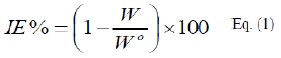
    <p>The inhibition (protection) efficiency, IE%, of P(pPD) was calculated for MS 
sample in the acid solutions in the presence of different concentrations of P(pPD) 
at 303 K using equation [13]:</p>

    <p>&nbsp;</p>
<img src="/img/revistas/pea/v30n1/30n1a06e1.jpg">
    
<p>&nbsp;</p>

    <p>where, Wo and W are the weight loss of MS sample in the absence and presence 
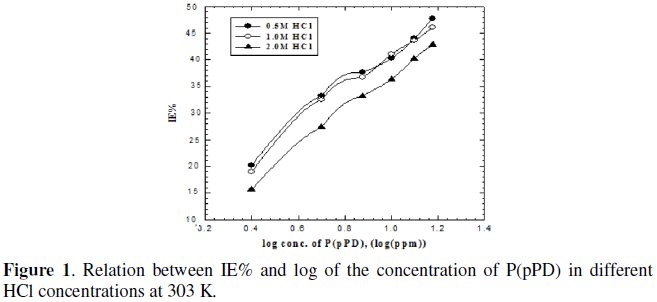
of P(pPD), respectively. The relation between IE% and the logarithm of the 
concentration of the inhibitor in the three acid solutions at 303 K is shown in Fig. (1).</p>


    <p>&nbsp; <a name="top.f1"></a> </p>
<img src="/img/revistas/pea/v30n1/30n1a06f1.jpg">
    
<p>&nbsp;</p>


    ]]></body>
<body><![CDATA[<p>From the figure, The P(pPD) species seems to function as inhibitor by being 
adsorbed on the metal surface from the corroding medium.</p>

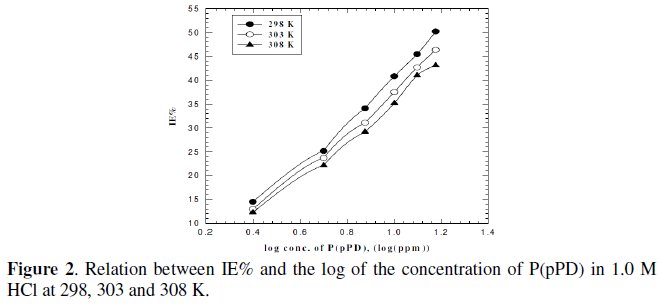
    <p>To verify the nature of adsorption and the effect of temperature on the corrosion 
behaviour of MS sample in 1 M HCl with and without different concentrations of 
P(pPD) inhibitor, weight loss studies were undertaken. The selected temperatures 
tested were 298, 303 and 308 K. The inhibition efficiency, IE%, under the 
prevailing conditions was calculated using equation (1) and the dependence of 
the IE% on the logarithm of the inhibitor concentration of P(pPD) at the three 
tested temperatures was shown in Fig. (2).</p>


    <p>&nbsp;</p>
<img src="/img/revistas/pea/v30n1/30n1a06f2.jpg">
    
<p>&nbsp;</p>


    <p>From Fig. <a href="#top.f1">(1)</a> and (2), one can conclude that the inhibition efficiency decrease 
with increasing the temperature. This can be due to the decrease in the strength of 
adsorption process at higher temperatures, suggesting that physical adsorption 
may be the type of adsorption of P(pPD) compound on MS sample surface. At a 
given temperature and inhibitor concentration, the inhibition efficiency decreases 
with increasing HCl concentration.</p>

    <p>In order to get more information concerning the type of inhibitor, the nature of 
inhibition and the influence of the inhibitor on the kinetics of the partial cathodic 
and anodic reactions, potentiodynamic polarization curves have been conducted.</p>

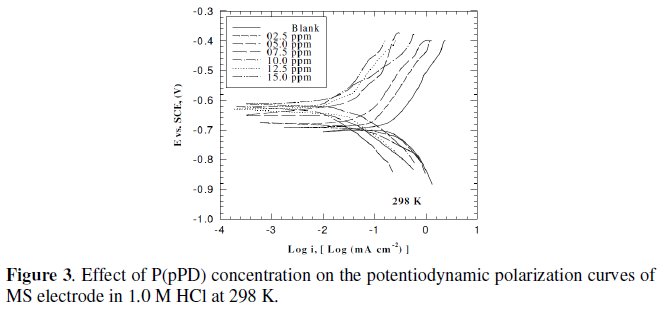
    <p>This was achieved by investigating the inhibitor concentration and solution 
temperature dependences of the corrosion current density (i<sub>corr</sub>) and on the 
corrosion potential (E<sub>corr</sub>), obtained using the Tafel extrapolation method. 
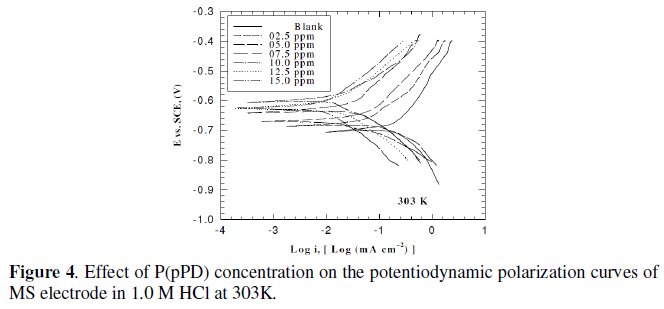
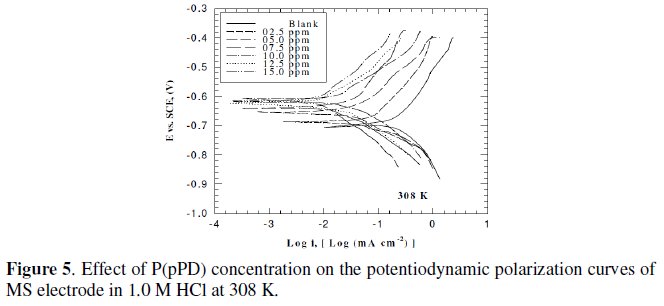
Fig. (3), (4) and (5) represent the influence of P(pPD) concentration on the 
potentiodynamic cathodic and anodic polarization curves for MS electrode in 1.0 
M HCl at scan rate of 10 mVs-1 and at 298, 303 and 308 K, respectively.</p>


    <p>&nbsp;</p>
<img src="/img/revistas/pea/v30n1/30n1a06f3.jpg">
    
<p>&nbsp;</p>
<img src="/img/revistas/pea/v30n1/30n1a06f4.jpg">
    
<p>&nbsp;</p>
<img src="/img/revistas/pea/v30n1/30n1a06f5.jpg">
    
]]></body>
<body><![CDATA[<p>&nbsp;</p>


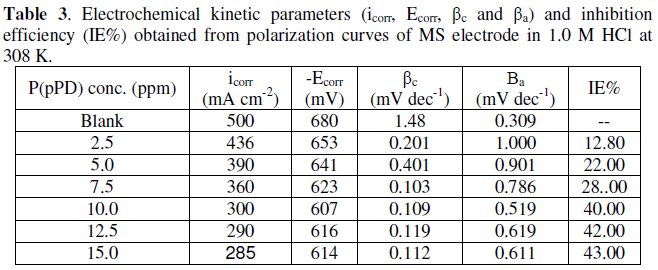
    <p>The data clearly show that the addition of P(pPD) enhances both the anodic and cathodic 
overpotentials (but mainly the anodic) and decreases the corrosion current 
density. These results confirm the suggestion that P(pPD) functions as inhibitor 
for the acid corrosion of MS electrode. This inhibitor is classified mainly as 
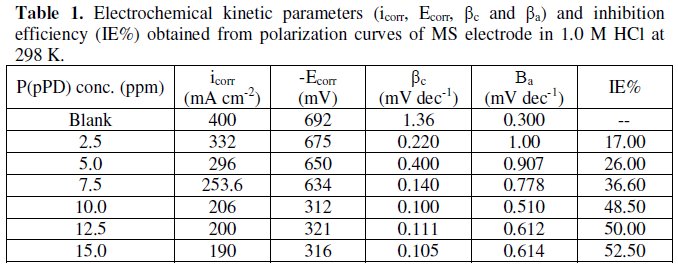
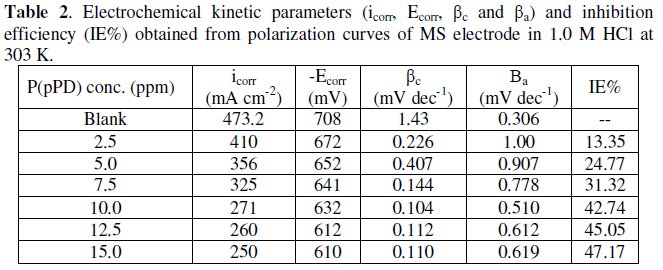
anodic inhibitor. In all cases, the polarization curves exhibited Tafel type 
behavior around the corrosion potential, E<sub>corr</sub>, the electrochemical kinetic 
parameters associated the polarization curves (i<sub>corr</sub>, E<sub>corr</sub>, 
&beta;<sub>c</sub> and &beta;<sub>a</sub>) for MS in 1.0M HCl in the absence and presence of various concentrations of P(pPD) and 
at different temperatures have been simultaneously determined (in the potential 
rang &pm;50 mV from E<sub>corr</sub>) and are given in Tables (1), (2) and (3).</p>


    <p>&nbsp; <a name="top.t1"></a> </p>
<img src="/img/revistas/pea/v30n1/30n1a06t1.jpg">
    
<p>&nbsp; <a name="top.t2"></a> </p>
<img src="/img/revistas/pea/v30n1/30n1a06t2.jpg">
    
<p>&nbsp; <a name="top.t3"></a> </p>
<img src="/img/revistas/pea/v30n1/30n1a06t3.jpg">
    
<p>&nbsp;</p>


    <p>Since the corrosion rate (CR) is directly related to the corrosion current density 
[14], the inhibition efficiency, IE%, at different inhibitor concentrations and 
solution temperatures was calculated from equation [15]:</p>

    <p>&nbsp;</p>
<img src="/img/revistas/pea/v30n1/30n1a06e2.jpg">
    
<p>&nbsp;</p>

    <p>where, i<sup>0</sup><sub>corr</sub> and i<sub>corr</sub> are the corrosion current density for uninhibited and 
inhibited solutions, respectively. The calculated values of IE% are given in 
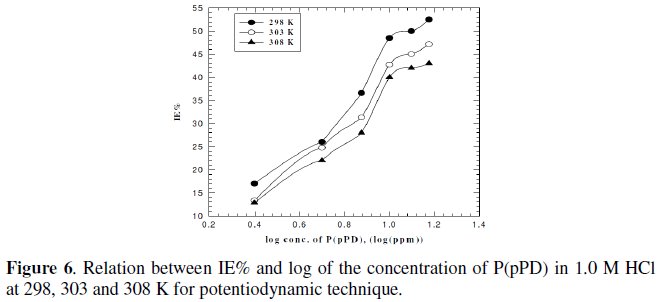
Tables <a href="#top.t1">(1)</a>, <a href="#top.t2">(2)</a> and <a href="#top.t3">(3)</a>. The relation between IE% versus log P(pPD) 
concentration at the three tested temperature is shown in Fig. (6).</p>


    ]]></body>
<body><![CDATA[<p>&nbsp;</p>
<img src="/img/revistas/pea/v30n1/30n1a06f6.jpg">
    
<p>&nbsp;</p>


    <p>According to these data, it is observed that the inhibition efficiency of P(pPD) increases with 
increasing its concentration but decreases with temperature. It is clear that the 
weight loss and potentiodynamic polarization techniques gave the same trends of 
inhibition of P(pPD) and produced nearly the same values of IE%.</p>


    <p><b><i>Thermodynamic Activation Functions of the Corrosion Process</i></b></p>

    <p>More information concerning the adsorption mechanism can be gained by the 
thermodynamic function for the MS corrosion in HCl solution with and without 
different concentrations of P(pPD). These functions were obtained by applying 
the Arrhenius equation [16]:</p>

    <p>&nbsp;</p>
<img src="/img/revistas/pea/v30n1/30n1a06e3.jpg">
    
<p>&nbsp;</p>

    <p>where, E<sup>0</sup><sub>a</sub> is the apparent activation energy, A is the pre-exponential factor, T is 
the temperature and R is the ideal gas constant. An alternative form of Arrhenius 
equation, [16], is the transition state (Eyring) equation [16]:</p>

    <p>&nbsp;</p>
<img src="/img/revistas/pea/v30n1/30n1a06e4.jpg">
    
<p>&nbsp;</p>

    ]]></body>
<body><![CDATA[<p>where, h is the Planck's constant, N is the Avogadro's number, &Delta;S<sup>0</sup> and &Delta;H<sup>0</sup> are 
respectively the entropy and the enthalpy of activation.</p>

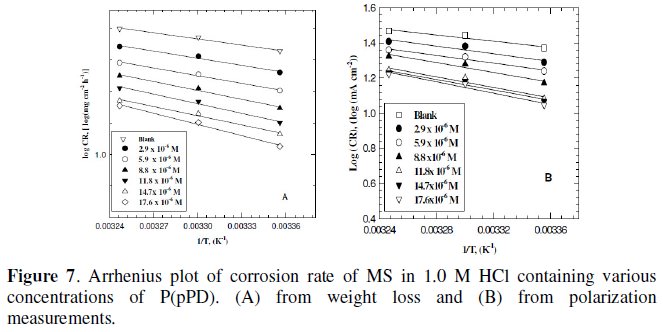
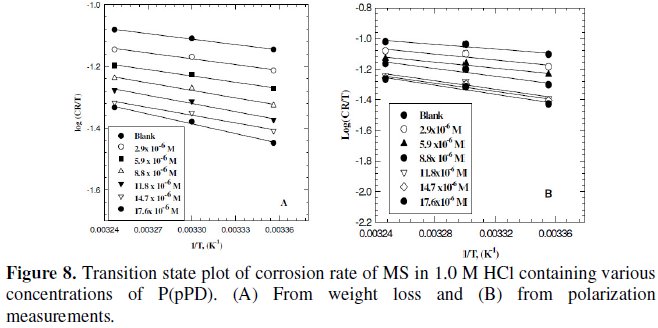
    <p>Plotting the relation between logarithmic of the corrosion rate obtained from 
weight loss and polarization measurements versus 1/T (Arrhenius equation) for 
MS electrode in 1.0 M HCl containing various concentrations of P(pPD) gave 
straight lines, as shown in Fig. 7(A) and (B), respectively.</p>


    <p>&nbsp;</p>
<img src="/img/revistas/pea/v30n1/30n1a06f7.jpg">
    
<p>&nbsp;</p>


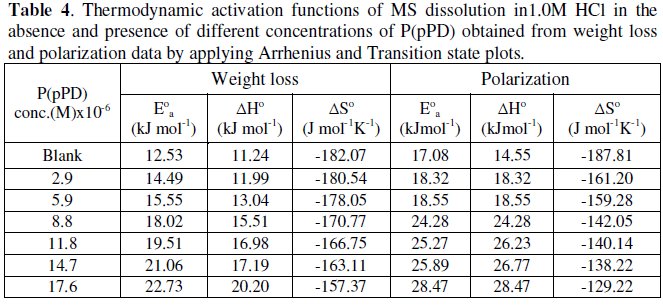
    <p>The values of apparent activation energy, E<sup>0</sup><sub>a</sub>, 
obtained from the slopes of these lines are given in Table (4).</p>

    <p>&nbsp; <a name="top.t4"></a> </p>
<img src="/img/revistas/pea/v30n1/30n1a06t4.jpg">
    
<p>&nbsp;</p>

    <p>Plotting the relation log (CR/T) versus (1/T) for MS in 1.0 M HCl containing 
various concentrations of P(pPD) should give straight lines with slope of (-&Delta;H<sup>0</sup>/ 
2.303R) and an intercept of [(log(R/Nh)) + (&Delta;S<sup>0</sup>/2.303R)] (transition state 
equation).</p>

    <p>Fig. 8 (A) and (B)) display the plots of log (CR/T) versus (1/T) from data 
obtained from weight loss and polarization measurements, respectively. The 
values of the thermodynamic functions &Delta;H<sup>0</sup> and &Delta;S<sup>0</sup> were obtained and are listed 
in <a href="#top.t4">Table (4)</a>.</p>


    <p>&nbsp;</p>
<img src="/img/revistas/pea/v30n1/30n1a06f8.jpg">
    
]]></body>
<body><![CDATA[<p>&nbsp;</p>

    <p>The data infer that the values of E<sup>0</sup><sub>a</sub>, &Delta;H<sup>0</sup> and &Delta;S<sup>0</sup> of the dissolution of MS in 1.0 
M HCl solution in the presence of P(pPD) are higher than those in the blank acid 
solution. The activation thermodynamic parameters of the corrosion process 
enhance with increasing the inhibitor concentration, indicating that more energy 
barrier for the corrosion reaction in the presence of inhibitor is attained [17].</p>


    <p><b><i>Adsorption Isotherms and Thermodynamic Functions of Adsorption Process</i></b></p>

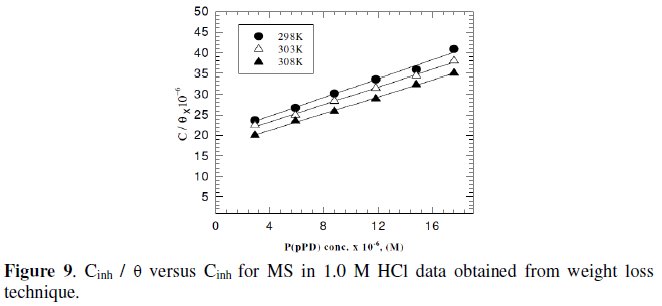
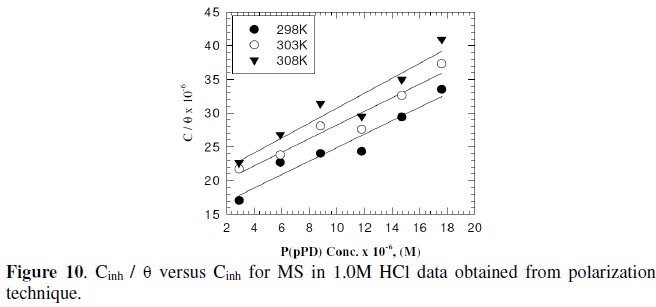
    <p>Langmuir isotherm has been tested with the experimental data obtained from 
both weight loss and polarization measurements for MS electrode in 1.0 M HCl 
in the presence of different concentrations of P(pPD) and temperatures. 
In all cases, it is observed that the linear regression between C<sub>inh</sub> / &Theta; 
and C<sub>inh</sub>, calculated by the computer, and the slope and the linear correlation coefficient 
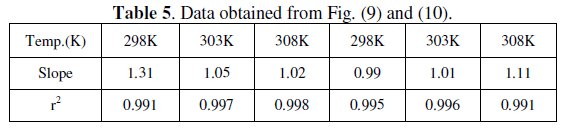
(r<sup>2</sup>) are close to unity, as shown in Fig. (9) and (10), respectively; the correlation 
coefficient r<sup>2</sup> is higher than 0.99 [20], reflecting adsorption of P(pPD) species on 
the electrode surface and applicability of Langmuir isotherm model (c.f. Table (5)).</p>


    <p>&nbsp; <a name="top.f9"></a> </p>
<img src="/img/revistas/pea/v30n1/30n1a06f9.jpg">
    
<p>&nbsp; <a name="top.f10"></a> </p>
<img src="/img/revistas/pea/v30n1/30n1a06f10.jpg">
    
<p>&nbsp;</p>
<img src="/img/revistas/pea/v30n1/30n1a06t5.jpg">
    
<p>&nbsp;</p>


    <p>The adsorption isotherm relationship of Langmuir is represented using the 
following equation [21]:</p>

    <p>&nbsp;</p>
<img src="/img/revistas/pea/v30n1/30n1a06e5.jpg">
    
]]></body>
<body><![CDATA[<p>&nbsp;</p>

    <p>where, K<sub>ads</sub> is the adsorption-desorption equilibrium constant. 

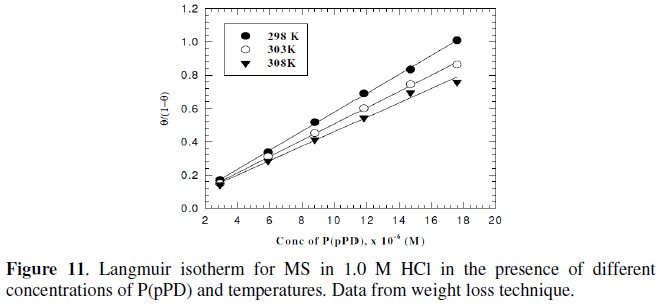
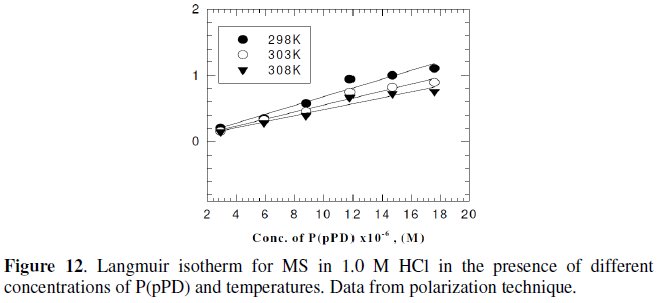
    <p>However, the relation between of (&Theta; / (1-&Theta;) ) against C<sub>inh</sub> gave straight lines, as 
shown in Fig. (11) and (12).</p>


    <p>&nbsp;</p>
<img src="/img/revistas/pea/v30n1/30n1a06f11.jpg">
    
<p>&nbsp;</p>
<img src="/img/revistas/pea/v30n1/30n1a06f12.jpg">
    
<p>&nbsp;</p>


    <p>These results show that the fitting of corrosion data 
is in agreement with Langmuir's isotherm [21] and confirm the assumption that 
the action of the inhibitor is due to its adsorption at the metal/solution interface. 
The equilibrium adsorption constant, K<sub>ads</sub>, for the adsorption of the inhibitor at 
MS electrode surface at T=298, 303 and 308 K were obtained from the slopes of 
these straight lines. The free energies of the inhibitor adsorption, &Delta;G<sup>0</sup><sub>ads</sub>, were 
calculated from the equation [22]:</p>

    <p>&nbsp;</p>
<img src="/img/revistas/pea/v30n1/30n1a06e6.jpg">
    
<p>&nbsp;</p>

    <p>where, 55.5 is the molar concentration of water.</p>

    ]]></body>
<body><![CDATA[<p>The integrated version of the Van Hoff equation [22] is:</p>

    <p>&nbsp;</p>
<img src="/img/revistas/pea/v30n1/30n1a06e7.jpg">
    
<p>&nbsp;</p>

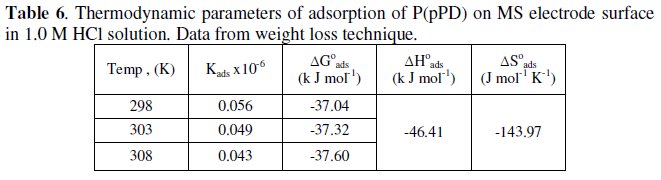
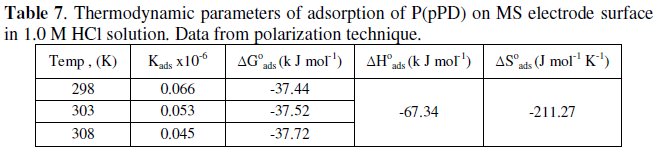
    <p>The calculated values of K<sub>ads</sub> using data obtained from weight loss and 
polarization measurements are given in Tables (6) and (7), respectively.</p>


    <p>&nbsp; <a name="top.t6"></a> </p>
<img src="/img/revistas/pea/v30n1/30n1a06t6.jpg">
    
<p>&nbsp; <a name="top.t7"></a> </p>
<img src="/img/revistas/pea/v30n1/30n1a06t7.jpg">
    
<p>&nbsp;</p>


    <p>It is clear that the values of K<sub>ads</sub> are relatively small and decrease with rise of 
temperature. This behavior indicates that this inhibitor is physically adsorbed on 
the metal surface and the strength of adsorption decreases with temperature. 
Moreover, it is seen that there is a good agreement between the values of K<sub>ads</sub> 
obtained from the two methods used. The average thermodynamic functions 
(&Delta;H<sup>0</sup><sub>ads</sub> and &Delta;S<sup>0</sup><sub>ads</sub>) for P(pPD) adsorption on metal surface were calculated using 
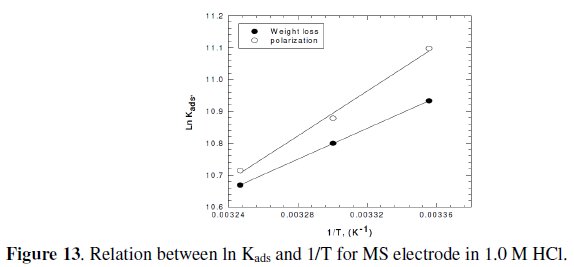
equations (7) and (8), respectively, since plotting lnK<sub>ads</sub> against 1/T gave straight 
lines, as shown in Fig. (13).</p>


    <p>&nbsp;</p>
<img src="/img/revistas/pea/v30n1/30n1a06f13.jpg">
    
<p>&nbsp;</p>


    ]]></body>
<body><![CDATA[<p>The calculated values of &Delta;G<sup>0</sup><sub>ads</sub>, &Delta;H<sup>0</sup><sub>ads</sub> and &Delta;S<sup>0</sup><sub>ads</sub> obtained from weight loss and 
polarization methods are given in Tables <a href="#top.t6">(6)</a> and <a href="#top.t7">(7)</a>, respectively.</p>

    <p>It seems that the thermodynamic functions of the adsorption process obtained from the two 
methods are parallel and in a good agreement. The calculated values of &Delta;G<sup>0</sup><sub>ads</sub> 
are low and negative, suggesting that the nature of this inhibitor adsorption is 
mainly physisorption and spontaneous [22-25]. It is usually accepted that the 
value of &Delta;G<sup>0</sup><sub>ads</sub> around -20 kJ mol<sup>-1</sup> or lower indicates the electrostatic 
interaction between charged metal surface and charged organic inhibitor in the 
bulk of the solution [26], while those around -40 kJ mol<sup>-1</sup> or higher involve 
charge sharing transfer between the metal surface and the organic inhibitor [27]. 
The negative values of &Delta;H<sup>0</sup><sub>ads</sub> indicate that the adsorption is an exothermic 
process [18]. The magnitude of the values of &Delta;H<sup>0</sup><sub>ads</sub> and &Delta;S<sup>0</sup><sub>ads</sub> is characteristic of 
the occurrence of replacement process during adsorption [28, 29].</p>


    <p>&nbsp;</p>
    <p><b>Conclusion</b></p>

    <p>The tested P(p-PD) compound inhibits the corrosion of mild steel in HCl media. 
The addition of P(p-PD) does not change the mechanism of either mild steel 
dissolution or hydrogen evolution reaction. P(p-PD acts as a mixed type 
inhibitor, but predominantly as an anodic one. The inhibition efficiency value 
increases with the inhibitor concentration and decreases by increasing acid 
concentration and temperature. The corrosion inhibition of P(p-PD can be 
interpreted by a simple blocked fraction of the electrode surface related to the 
adsorption of the inhibitor species, according to a Langmuir isotherm on the MS 
and mainly the adsorption process is spontaneous and exothermic physisorption. 
The results obtained from polarization curves and the weight loss data are in 
reasonably good agreement.</p>


    <p>&nbsp;</p>
    <p><b>References</b></p>

    <!-- ref --><p>1. P. Zhao, Q. Liang, Y. Li, Appl. Surf. Sci. 252 (2005) 1596.    &nbsp;&nbsp;&nbsp;&nbsp;&nbsp;&nbsp;&nbsp;&nbsp;[&#160;<a href="javascript:void(0);" onclick="javascript: window.open('/scielo.php?script=sci_nlinks&ref=000130&pid=S0872-1904201200010000600001&lng=','','width=640,height=500,resizable=yes,scrollbars=1,menubar=yes,');">Links</a>&#160;]<!-- end-ref --></p>
    <!-- ref --><p>2. A.M.S. Abdennabi, A.I. Abdulhadi and S. Abu-Orabi, Anti-Corros. Met. Mater. 45 (1998)103.    &nbsp;&nbsp;&nbsp;&nbsp;&nbsp;&nbsp;&nbsp;&nbsp;[&#160;<a href="javascript:void(0);" onclick="javascript: window.open('/scielo.php?script=sci_nlinks&ref=000132&pid=S0872-1904201200010000600002&lng=','','width=640,height=500,resizable=yes,scrollbars=1,menubar=yes,');">Links</a>&#160;]<!-- end-ref --></p>
    <!-- ref --><p>3. K.F. Khaled, Electrochim. Acta 48 (2003) 2493.    &nbsp;&nbsp;&nbsp;&nbsp;&nbsp;&nbsp;&nbsp;&nbsp;[&#160;<a href="javascript:void(0);" onclick="javascript: window.open('/scielo.php?script=sci_nlinks&ref=000134&pid=S0872-1904201200010000600003&lng=','','width=640,height=500,resizable=yes,scrollbars=1,menubar=yes,');">Links</a>&#160;]<!-- end-ref --></p>
    <!-- ref --><p>4. K. Emregul, O. Atakol, Chem. Phys. 82 (2003) 188.    &nbsp;&nbsp;&nbsp;&nbsp;&nbsp;&nbsp;&nbsp;&nbsp;[&#160;<a href="javascript:void(0);" onclick="javascript: window.open('/scielo.php?script=sci_nlinks&ref=000136&pid=S0872-1904201200010000600004&lng=','','width=640,height=500,resizable=yes,scrollbars=1,menubar=yes,');">Links</a>&#160;]<!-- end-ref --></p>
    <!-- ref --><p>5. D.M. Lenz, M. Delamar, C.A. Ferreira, J. Electroanal. Chem. 54 (2003) 35.    &nbsp;&nbsp;&nbsp;&nbsp;&nbsp;&nbsp;&nbsp;&nbsp;[&#160;<a href="javascript:void(0);" onclick="javascript: window.open('/scielo.php?script=sci_nlinks&ref=000138&pid=S0872-1904201200010000600005&lng=','','width=640,height=500,resizable=yes,scrollbars=1,menubar=yes,');">Links</a>&#160;]<!-- end-ref --></p>
    <p>6. M. El Azhar, M. Traisnel, B. Mernari et all, Appl. Surf. Sci. 185 (2002) 197.</p>
    <!-- ref --><p>7. M. Ajmal, A.S. Mideen, M.A. Quraishi, Corros. Sci. 36 (1994) 79.    &nbsp;&nbsp;&nbsp;&nbsp;&nbsp;&nbsp;&nbsp;&nbsp;[&#160;<a href="javascript:void(0);" onclick="javascript: window.open('/scielo.php?script=sci_nlinks&ref=000141&pid=S0872-1904201200010000600007&lng=','','width=640,height=500,resizable=yes,scrollbars=1,menubar=yes,');">Links</a>&#160;]<!-- end-ref --></p>
    ]]></body>
<body><![CDATA[<!-- ref --><p>8. S. Arab, E.E.A. Noor, Corrosion 49 (1993) 122.    &nbsp;&nbsp;&nbsp;&nbsp;&nbsp;&nbsp;&nbsp;&nbsp;[&#160;<a href="javascript:void(0);" onclick="javascript: window.open('/scielo.php?script=sci_nlinks&ref=000143&pid=S0872-1904201200010000600008&lng=','','width=640,height=500,resizable=yes,scrollbars=1,menubar=yes,');">Links</a>&#160;]<!-- end-ref --></p>
    <!-- ref --><p>9. M.A. Quraishi, R. Sardar, Mater. Chem. Phys. 78 (2002) 425.    &nbsp;&nbsp;&nbsp;&nbsp;&nbsp;&nbsp;&nbsp;&nbsp;[&#160;<a href="javascript:void(0);" onclick="javascript: window.open('/scielo.php?script=sci_nlinks&ref=000145&pid=S0872-1904201200010000600009&lng=','','width=640,height=500,resizable=yes,scrollbars=1,menubar=yes,');">Links</a>&#160;]<!-- end-ref --></p>
    <!-- ref --><p>10. S. Arab, E.E.A. Noor, Corrosion 49 (1993) 122.    &nbsp;&nbsp;&nbsp;&nbsp;&nbsp;&nbsp;&nbsp;&nbsp;[&#160;<a href="javascript:void(0);" onclick="javascript: window.open('/scielo.php?script=sci_nlinks&ref=000147&pid=S0872-1904201200010000600010&lng=','','width=640,height=500,resizable=yes,scrollbars=1,menubar=yes,');">Links</a>&#160;]<!-- end-ref --></p>
    <!-- ref --><p>11. Z.D. Stankovic, M. Vukovic, Electrochim. Acta 41 (1996) 2529.    &nbsp;&nbsp;&nbsp;&nbsp;&nbsp;&nbsp;&nbsp;&nbsp;[&#160;<a href="javascript:void(0);" onclick="javascript: window.open('/scielo.php?script=sci_nlinks&ref=000149&pid=S0872-1904201200010000600011&lng=','','width=640,height=500,resizable=yes,scrollbars=1,menubar=yes,');">Links</a>&#160;]<!-- end-ref --></p>
    <!-- ref --><p>12. S.M. Sayyah, M.M. El-Deeb, S.M. Kamal, R.E. Azooz, Appl. Poly. Sci. 117 (2010) 943.    &nbsp;&nbsp;&nbsp;&nbsp;&nbsp;&nbsp;&nbsp;&nbsp;[&#160;<a href="javascript:void(0);" onclick="javascript: window.open('/scielo.php?script=sci_nlinks&ref=000151&pid=S0872-1904201200010000600012&lng=','','width=640,height=500,resizable=yes,scrollbars=1,menubar=yes,');">Links</a>&#160;]<!-- end-ref --></p>
    ]]></body>
<body><![CDATA[<p>13. S.S. Abd El Rehim, H.H Hassan, M.A. Amin, Mat. Chem. Phys. 78 (2002) 337.</p>
    <p>14. M.A. Amin, S.S. Abd El Rehim, E.E.F. El-Sherbini, R.S. Bayoumi, Inter. J. Electrochem. Sci. 3 (2008) 199.</p>
    <!-- ref --><p>15. M.A. Amin, J. Appl. Electrochem. 36 (2006) 215.    &nbsp;&nbsp;&nbsp;&nbsp;&nbsp;&nbsp;&nbsp;&nbsp;[&#160;<a href="javascript:void(0);" onclick="javascript: window.open('/scielo.php?script=sci_nlinks&ref=000155&pid=S0872-1904201200010000600015&lng=','','width=640,height=500,resizable=yes,scrollbars=1,menubar=yes,');">Links</a>&#160;]<!-- end-ref --></p>
    <!-- ref --><p>16. J.O'M. Bockris, A.K.N. Reddy, Modern Electrochemistry, Vol. 2, Platinum Press, N.Y. 1977.    &nbsp;&nbsp;&nbsp;&nbsp;&nbsp;&nbsp;&nbsp;&nbsp;[&#160;<a href="javascript:void(0);" onclick="javascript: window.open('/scielo.php?script=sci_nlinks&ref=000157&pid=S0872-1904201200010000600016&lng=','','width=640,height=500,resizable=yes,scrollbars=1,menubar=yes,');">Links</a>&#160;]<!-- end-ref --></p>
    <!-- ref --><p>17. F. Mansfeld, Corrosion Mechanism, p. 119, Marcel Dakkar, N.Y. 1987.    &nbsp;&nbsp;&nbsp;&nbsp;&nbsp;&nbsp;&nbsp;&nbsp;[&#160;<a href="javascript:void(0);" onclick="javascript: window.open('/scielo.php?script=sci_nlinks&ref=000159&pid=S0872-1904201200010000600017&lng=','','width=640,height=500,resizable=yes,scrollbars=1,menubar=yes,');">Links</a>&#160;]<!-- end-ref --></p>
    <!-- ref --><p>18. J. March: Advanced Organic Chemistry: 3rd. ed., Will Eastern, New Delhi, 1988.    &nbsp;&nbsp;&nbsp;&nbsp;&nbsp;&nbsp;&nbsp;&nbsp;[&#160;<a href="javascript:void(0);" onclick="javascript: window.open('/scielo.php?script=sci_nlinks&ref=000161&pid=S0872-1904201200010000600018&lng=','','width=640,height=500,resizable=yes,scrollbars=1,menubar=yes,');">Links</a>&#160;]<!-- end-ref --></p> 
    ]]></body>
<body><![CDATA[<!-- ref --><p>19. E. McCaaffery, Corrosion Control by Coating, Science Press, Princeton, 1979.    &nbsp;&nbsp;&nbsp;&nbsp;&nbsp;&nbsp;&nbsp;&nbsp;[&#160;<a href="javascript:void(0);" onclick="javascript: window.open('/scielo.php?script=sci_nlinks&ref=000163&pid=S0872-1904201200010000600019&lng=','','width=640,height=500,resizable=yes,scrollbars=1,menubar=yes,');">Links</a>&#160;]<!-- end-ref --></p>
    <!-- ref --><p>20. Y. Yan, W. Li, L. Caiand and B. Hou, Electrochim Acta 53 (2008) 5953.    &nbsp;&nbsp;&nbsp;&nbsp;&nbsp;&nbsp;&nbsp;&nbsp;[&#160;<a href="javascript:void(0);" onclick="javascript: window.open('/scielo.php?script=sci_nlinks&ref=000165&pid=S0872-1904201200010000600020&lng=','','width=640,height=500,resizable=yes,scrollbars=1,menubar=yes,');">Links</a>&#160;]<!-- end-ref --></p>
    <!-- ref --><p>21. I. Langmuir, J. Am. Chem. Soc. 39 (1947) 1848.    &nbsp;&nbsp;&nbsp;&nbsp;&nbsp;&nbsp;&nbsp;&nbsp;[&#160;<a href="javascript:void(0);" onclick="javascript: window.open('/scielo.php?script=sci_nlinks&ref=000167&pid=S0872-1904201200010000600021&lng=','','width=640,height=500,resizable=yes,scrollbars=1,menubar=yes,');">Links</a>&#160;]<!-- end-ref --></p>
    <!-- ref --><p>22. D. Do, Adsorption Analysis: Equilibria and Kinetics, Imperial Collage Press, London, 1998.    &nbsp;&nbsp;&nbsp;&nbsp;&nbsp;&nbsp;&nbsp;&nbsp;[&#160;<a href="javascript:void(0);" onclick="javascript: window.open('/scielo.php?script=sci_nlinks&ref=000169&pid=S0872-1904201200010000600022&lng=','','width=640,height=500,resizable=yes,scrollbars=1,menubar=yes,');">Links</a>&#160;]<!-- end-ref --></p>
    <!-- ref --><p>23. E. Khamis, I. Mellucci, R.M. Lantanision, E.S.H. El-Ashry, Corros. Sci. 47 (1991) 677.    &nbsp;&nbsp;&nbsp;&nbsp;&nbsp;&nbsp;&nbsp;&nbsp;[&#160;<a href="javascript:void(0);" onclick="javascript: window.open('/scielo.php?script=sci_nlinks&ref=000171&pid=S0872-1904201200010000600023&lng=','','width=640,height=500,resizable=yes,scrollbars=1,menubar=yes,');">Links</a>&#160;]<!-- end-ref --></p>
    ]]></body>
<body><![CDATA[<!-- ref --><p>24. F.M. Donahue, k. Noble, J. Electrochem. Soc. 112 (1965) 886.    &nbsp;&nbsp;&nbsp;&nbsp;&nbsp;&nbsp;&nbsp;&nbsp;[&#160;<a href="javascript:void(0);" onclick="javascript: window.open('/scielo.php?script=sci_nlinks&ref=000173&pid=S0872-1904201200010000600024&lng=','','width=640,height=500,resizable=yes,scrollbars=1,menubar=yes,');">Links</a>&#160;]<!-- end-ref --></p>
    <!-- ref --><p>25. P.W. Atkins, Physical Chemistry, 6th. Ed., Oxford Univ. Press 1999, p857.    &nbsp;&nbsp;&nbsp;&nbsp;&nbsp;&nbsp;&nbsp;&nbsp;[&#160;<a href="javascript:void(0);" onclick="javascript: window.open('/scielo.php?script=sci_nlinks&ref=000175&pid=S0872-1904201200010000600025&lng=','','width=640,height=500,resizable=yes,scrollbars=1,menubar=yes,');">Links</a>&#160;]<!-- end-ref --></p>
    <!-- ref --><p>26. H. Keles, M. Keles, I. Dehri, O. Serindag, Colloids surf. A: Physicochem. Eng. Aspects 320 (2008)138.    &nbsp;&nbsp;&nbsp;&nbsp;&nbsp;&nbsp;&nbsp;&nbsp;[&#160;<a href="javascript:void(0);" onclick="javascript: window.open('/scielo.php?script=sci_nlinks&ref=000177&pid=S0872-1904201200010000600026&lng=','','width=640,height=500,resizable=yes,scrollbars=1,menubar=yes,');">Links</a>&#160;]<!-- end-ref --></p>
    <!-- ref --><p>27. A.K. Singh, M.A. Quraishi, Corrosion Sci. 51 (2009) 2752.    &nbsp;&nbsp;&nbsp;&nbsp;&nbsp;&nbsp;&nbsp;&nbsp;[&#160;<a href="javascript:void(0);" onclick="javascript: window.open('/scielo.php?script=sci_nlinks&ref=000179&pid=S0872-1904201200010000600027&lng=','','width=640,height=500,resizable=yes,scrollbars=1,menubar=yes,');">Links</a>&#160;]<!-- end-ref --></p>
    <p>28. B.A.A. Nabey, E. Khamis, M.S. Ramadan, A. El-Gidy, 8th Eur. Symp. Corros. Inhibitors, Ann Univ. Ferrara, NS Sez. 10 (1995) 299.</p>
    <!-- ref --><p>29. M.J. Lampinen and M. Fomino, J. Electrochem. Soc. 140 (1993) 3537.    &nbsp;&nbsp;&nbsp;&nbsp;&nbsp;&nbsp;&nbsp;&nbsp;[&#160;<a href="javascript:void(0);" onclick="javascript: window.open('/scielo.php?script=sci_nlinks&ref=000182&pid=S0872-1904201200010000600029&lng=','','width=640,height=500,resizable=yes,scrollbars=1,menubar=yes,');">Links</a>&#160;]<!-- end-ref --></p>


    <p>&nbsp;</p>

    <p><a name=0><sup><a href="#top">*</sup></a>Corresponding author. E-mail address: <a href="mailto:re_azooz@yahoo.com">re_azooz@yahoo.com</a></p>

    <p>Received 7 March 2011; accepted 28 February 2012</p>

    <p><a href="http://www.peacta.org" target="_blank">www.peacta.org</a></p>


     ]]></body><back>
<ref-list>
<ref id="B1">
<label>1</label><nlm-citation citation-type="journal">
<person-group person-group-type="author">
<name>
<surname><![CDATA[Zhao]]></surname>
<given-names><![CDATA[P.]]></given-names>
</name>
<name>
<surname><![CDATA[Liang]]></surname>
<given-names><![CDATA[Q.]]></given-names>
</name>
<name>
<surname><![CDATA[Li]]></surname>
<given-names><![CDATA[Y.]]></given-names>
</name>
</person-group>
<source><![CDATA[Appl. Surf. Sci.]]></source>
<year>2005</year>
<volume>252</volume>
<page-range>1596</page-range></nlm-citation>
</ref>
<ref id="B2">
<label>2</label><nlm-citation citation-type="journal">
<person-group person-group-type="author">
<name>
<surname><![CDATA[Abdennabi]]></surname>
<given-names><![CDATA[A.M.S.]]></given-names>
</name>
<name>
<surname><![CDATA[Abdulhadi]]></surname>
<given-names><![CDATA[A.I.]]></given-names>
</name>
<name>
<surname><![CDATA[Abu-Orabi]]></surname>
<given-names><![CDATA[S.]]></given-names>
</name>
</person-group>
<source><![CDATA[Anti-Corros. Met. Mater.]]></source>
<year>1998</year>
<volume>45</volume>
<page-range>103</page-range></nlm-citation>
</ref>
<ref id="B3">
<label>3</label><nlm-citation citation-type="journal">
<person-group person-group-type="author">
<name>
<surname><![CDATA[Khaled]]></surname>
<given-names><![CDATA[K.F.]]></given-names>
</name>
</person-group>
<source><![CDATA[Electrochim. Acta]]></source>
<year>2003</year>
<volume>48</volume>
<page-range>2493</page-range></nlm-citation>
</ref>
<ref id="B4">
<label>4</label><nlm-citation citation-type="journal">
<person-group person-group-type="author">
<name>
<surname><![CDATA[Emregul]]></surname>
<given-names><![CDATA[K.]]></given-names>
</name>
<name>
<surname><![CDATA[Atakol]]></surname>
<given-names><![CDATA[O.]]></given-names>
</name>
</person-group>
<source><![CDATA[Chem. Phys.]]></source>
<year>2003</year>
<volume>82</volume>
<page-range>188</page-range></nlm-citation>
</ref>
<ref id="B5">
<label>5</label><nlm-citation citation-type="journal">
<person-group person-group-type="author">
<name>
<surname><![CDATA[Lenz]]></surname>
<given-names><![CDATA[D.M.]]></given-names>
</name>
<name>
<surname><![CDATA[Delamar]]></surname>
<given-names><![CDATA[M.]]></given-names>
</name>
<name>
<surname><![CDATA[Ferreira]]></surname>
<given-names><![CDATA[C.A.]]></given-names>
</name>
</person-group>
<source><![CDATA[J. Electroanal. Chem.]]></source>
<year>2003</year>
<volume>54</volume>
<page-range>35</page-range></nlm-citation>
</ref>
<ref id="B6">
<label>6</label><nlm-citation citation-type="journal">
<person-group person-group-type="author">
<name>
<surname><![CDATA[El Azhar]]></surname>
<given-names><![CDATA[M.]]></given-names>
</name>
<name>
<surname><![CDATA[Traisnel]]></surname>
<given-names><![CDATA[M.]]></given-names>
</name>
</person-group>
<source><![CDATA[Appl. Surf. Sci.]]></source>
<year>2002</year>
<volume>185</volume>
<page-range>197</page-range></nlm-citation>
</ref>
<ref id="B7">
<label>7</label><nlm-citation citation-type="journal">
<person-group person-group-type="author">
<name>
<surname><![CDATA[Ajmal]]></surname>
<given-names><![CDATA[M.]]></given-names>
</name>
<name>
<surname><![CDATA[Mideen]]></surname>
<given-names><![CDATA[A.S.]]></given-names>
</name>
<name>
<surname><![CDATA[Quraishi]]></surname>
<given-names><![CDATA[M.A.]]></given-names>
</name>
</person-group>
<source><![CDATA[Corros. Sci.]]></source>
<year>1994</year>
<volume>36</volume>
<page-range>79</page-range></nlm-citation>
</ref>
<ref id="B8">
<label>8</label><nlm-citation citation-type="journal">
<person-group person-group-type="author">
<name>
<surname><![CDATA[Arab]]></surname>
<given-names><![CDATA[S.]]></given-names>
</name>
<name>
<surname><![CDATA[Noor]]></surname>
<given-names><![CDATA[E.E.A.]]></given-names>
</name>
</person-group>
<source><![CDATA[Corrosion]]></source>
<year>1993</year>
<volume>49</volume>
<page-range>122</page-range></nlm-citation>
</ref>
<ref id="B9">
<label>9</label><nlm-citation citation-type="journal">
<person-group person-group-type="author">
<name>
<surname><![CDATA[Quraishi]]></surname>
<given-names><![CDATA[M.A.]]></given-names>
</name>
<name>
<surname><![CDATA[Sardar]]></surname>
<given-names><![CDATA[R.]]></given-names>
</name>
</person-group>
<source><![CDATA[Mater. Chem. Phys.]]></source>
<year>2002</year>
<volume>78</volume>
<page-range>425</page-range></nlm-citation>
</ref>
<ref id="B10">
<label>10</label><nlm-citation citation-type="journal">
<person-group person-group-type="author">
<name>
<surname><![CDATA[Arab]]></surname>
<given-names><![CDATA[S.]]></given-names>
</name>
<name>
<surname><![CDATA[Noor]]></surname>
<given-names><![CDATA[E.E.A.]]></given-names>
</name>
</person-group>
<source><![CDATA[Corrosion]]></source>
<year>1993</year>
<volume>49</volume>
<page-range>122</page-range></nlm-citation>
</ref>
<ref id="B11">
<label>11</label><nlm-citation citation-type="journal">
<person-group person-group-type="author">
<name>
<surname><![CDATA[Stankovic]]></surname>
<given-names><![CDATA[Z.D.]]></given-names>
</name>
<name>
<surname><![CDATA[Vukovic]]></surname>
<given-names><![CDATA[M.]]></given-names>
</name>
</person-group>
<source><![CDATA[Electrochim. Acta]]></source>
<year>1996</year>
<volume>41</volume>
<page-range>2529</page-range></nlm-citation>
</ref>
<ref id="B12">
<label>12</label><nlm-citation citation-type="journal">
<person-group person-group-type="author">
<name>
<surname><![CDATA[Sayyah]]></surname>
<given-names><![CDATA[S.M.]]></given-names>
</name>
<name>
<surname><![CDATA[El-Deeb]]></surname>
<given-names><![CDATA[M.M.]]></given-names>
</name>
</person-group>
<source><![CDATA[Appl. Poly. Sci.]]></source>
<year>2010</year>
<volume>117</volume>
<page-range>943</page-range></nlm-citation>
</ref>
<ref id="B13">
<label>13</label><nlm-citation citation-type="journal">
<person-group person-group-type="author">
<name>
<surname><![CDATA[El Rehim]]></surname>
<given-names><![CDATA[S.S.A.]]></given-names>
</name>
<name>
<surname><![CDATA[Hassan]]></surname>
<given-names><![CDATA[H.H.]]></given-names>
</name>
<name>
<surname><![CDATA[Amin]]></surname>
<given-names><![CDATA[M.A.]]></given-names>
</name>
</person-group>
<source><![CDATA[Mat. Chem. Phys.]]></source>
<year>2002</year>
<volume>78</volume>
<page-range>337</page-range></nlm-citation>
</ref>
<ref id="B14">
<label>14</label><nlm-citation citation-type="journal">
<person-group person-group-type="author">
<name>
<surname><![CDATA[Amin]]></surname>
<given-names><![CDATA[M.A.]]></given-names>
</name>
<name>
<surname><![CDATA[El Rehim]]></surname>
<given-names><![CDATA[S.S.A.]]></given-names>
</name>
</person-group>
<source><![CDATA[Inter. J. Electrochem. Sci.]]></source>
<year>2008</year>
<volume>3</volume>
<page-range>199</page-range></nlm-citation>
</ref>
<ref id="B15">
<label>15</label><nlm-citation citation-type="journal">
<person-group person-group-type="author">
<name>
<surname><![CDATA[Amin]]></surname>
<given-names><![CDATA[M.A.]]></given-names>
</name>
</person-group>
<source><![CDATA[J. Appl. Electrochem.]]></source>
<year>2006</year>
<volume>36</volume>
<page-range>215</page-range></nlm-citation>
</ref>
<ref id="B16">
<label>16</label><nlm-citation citation-type="book">
<person-group person-group-type="author">
<name>
<surname><![CDATA[Bockris]]></surname>
<given-names><![CDATA[J.O'M.]]></given-names>
</name>
<name>
<surname><![CDATA[Reddy]]></surname>
<given-names><![CDATA[A.K.N.]]></given-names>
</name>
</person-group>
<source><![CDATA[Modern Electrochemistry]]></source>
<year>1977</year>
<volume>2</volume>
<publisher-loc><![CDATA[N.Y. ]]></publisher-loc>
<publisher-name><![CDATA[Platinum Press]]></publisher-name>
</nlm-citation>
</ref>
<ref id="B17">
<label>17</label><nlm-citation citation-type="book">
<person-group person-group-type="author">
<name>
<surname><![CDATA[Mansfeld]]></surname>
<given-names><![CDATA[F.]]></given-names>
</name>
</person-group>
<source><![CDATA[Corrosion Mechanism]]></source>
<year>1987</year>
<page-range>119</page-range><publisher-loc><![CDATA[N.Y. ]]></publisher-loc>
<publisher-name><![CDATA[Marcel Dakkar]]></publisher-name>
</nlm-citation>
</ref>
<ref id="B18">
<label>18</label><nlm-citation citation-type="book">
<person-group person-group-type="author">
<name>
<surname><![CDATA[March]]></surname>
<given-names><![CDATA[J.]]></given-names>
</name>
</person-group>
<source><![CDATA[Advanced Organic Chemistry]]></source>
<year>1988</year>
<edition>3</edition>
<publisher-loc><![CDATA[New Delhi ]]></publisher-loc>
<publisher-name><![CDATA[Will Eastern]]></publisher-name>
</nlm-citation>
</ref>
<ref id="B19">
<label>19</label><nlm-citation citation-type="book">
<person-group person-group-type="author">
<name>
<surname><![CDATA[McCaaffery]]></surname>
<given-names><![CDATA[E.]]></given-names>
</name>
</person-group>
<source><![CDATA[Corrosion Control by Coating]]></source>
<year>1979</year>
<publisher-loc><![CDATA[Princeton ]]></publisher-loc>
<publisher-name><![CDATA[Science Press]]></publisher-name>
</nlm-citation>
</ref>
<ref id="B20">
<label>20</label><nlm-citation citation-type="journal">
<person-group person-group-type="author">
<name>
<surname><![CDATA[Yan]]></surname>
<given-names><![CDATA[Y.]]></given-names>
</name>
<name>
<surname><![CDATA[Li]]></surname>
<given-names><![CDATA[W.]]></given-names>
</name>
</person-group>
<source><![CDATA[Electrochim Acta]]></source>
<year>2008</year>
<volume>53</volume>
<page-range>5953</page-range></nlm-citation>
</ref>
<ref id="B21">
<label>21</label><nlm-citation citation-type="journal">
<person-group person-group-type="author">
<name>
<surname><![CDATA[Langmuir]]></surname>
<given-names><![CDATA[I.]]></given-names>
</name>
</person-group>
<source><![CDATA[J. Am. Chem. Soc.]]></source>
<year>1947</year>
<volume>39</volume>
<page-range>1848</page-range></nlm-citation>
</ref>
<ref id="B22">
<label>22</label><nlm-citation citation-type="book">
<person-group person-group-type="author">
<name>
<surname><![CDATA[Do]]></surname>
<given-names><![CDATA[D.]]></given-names>
</name>
</person-group>
<source><![CDATA[Adsorption Analysis: Equilibria and Kinetics]]></source>
<year>1998</year>
<publisher-loc><![CDATA[London ]]></publisher-loc>
<publisher-name><![CDATA[Imperial Collage Press]]></publisher-name>
</nlm-citation>
</ref>
<ref id="B23">
<label>23</label><nlm-citation citation-type="journal">
<person-group person-group-type="author">
<name>
<surname><![CDATA[Khamis]]></surname>
<given-names><![CDATA[E.]]></given-names>
</name>
<name>
<surname><![CDATA[Mellucci]]></surname>
<given-names><![CDATA[I.]]></given-names>
</name>
</person-group>
<source><![CDATA[Corros. Sci.]]></source>
<year>1991</year>
<volume>47</volume>
<page-range>677</page-range></nlm-citation>
</ref>
<ref id="B24">
<label>24</label><nlm-citation citation-type="journal">
<person-group person-group-type="author">
<name>
<surname><![CDATA[Donahue]]></surname>
<given-names><![CDATA[F.M.]]></given-names>
</name>
<name>
<surname><![CDATA[Noble]]></surname>
<given-names><![CDATA[K.]]></given-names>
</name>
</person-group>
<source><![CDATA[J. Electrochem. Soc.]]></source>
<year>1965</year>
<volume>112</volume>
<page-range>886</page-range></nlm-citation>
</ref>
<ref id="B25">
<label>25</label><nlm-citation citation-type="book">
<person-group person-group-type="author">
<name>
<surname><![CDATA[Atkins]]></surname>
<given-names><![CDATA[P.W.]]></given-names>
</name>
</person-group>
<source><![CDATA[Physical Chemistry]]></source>
<year>1999</year>
<edition>6</edition>
<page-range>857</page-range><publisher-name><![CDATA[Oxford Univ. Press]]></publisher-name>
</nlm-citation>
</ref>
<ref id="B26">
<label>26</label><nlm-citation citation-type="journal">
<person-group person-group-type="author">
<name>
<surname><![CDATA[Keles]]></surname>
<given-names><![CDATA[H.]]></given-names>
</name>
<name>
<surname><![CDATA[Keles]]></surname>
<given-names><![CDATA[M.]]></given-names>
</name>
</person-group>
<source><![CDATA[Colloids surf. A: Physicochem. Eng. Aspects]]></source>
<year>2008</year>
<volume>320</volume>
<page-range>138</page-range></nlm-citation>
</ref>
<ref id="B27">
<label>27</label><nlm-citation citation-type="journal">
<person-group person-group-type="author">
<name>
<surname><![CDATA[Singh]]></surname>
<given-names><![CDATA[A.K.]]></given-names>
</name>
<name>
<surname><![CDATA[Quraishi]]></surname>
<given-names><![CDATA[M.A.]]></given-names>
</name>
</person-group>
<source><![CDATA[Corrosion Sci.]]></source>
<year>2009</year>
<volume>51</volume>
<page-range>2752</page-range></nlm-citation>
</ref>
<ref id="B28">
<label>28</label><nlm-citation citation-type="confpro">
<person-group person-group-type="author">
<name>
<surname><![CDATA[Nabey]]></surname>
<given-names><![CDATA[B.A.A.]]></given-names>
</name>
<name>
<surname><![CDATA[Khamis]]></surname>
<given-names><![CDATA[E.]]></given-names>
</name>
</person-group>
<source><![CDATA[]]></source>
<year></year>
<conf-name><![CDATA[ 8th Eur. Symp. Corros. Inhibitors]]></conf-name>
<conf-date>1995</conf-date>
<conf-loc>Ferrara </conf-loc>
</nlm-citation>
</ref>
<ref id="B29">
<label>29</label><nlm-citation citation-type="journal">
<person-group person-group-type="author">
<name>
<surname><![CDATA[Lampinen]]></surname>
<given-names><![CDATA[M.J.]]></given-names>
</name>
<name>
<surname><![CDATA[Fomino]]></surname>
<given-names><![CDATA[M.]]></given-names>
</name>
</person-group>
<source><![CDATA[J. Electrochem. Soc.]]></source>
<year>1993</year>
<volume>140</volume>
<page-range>3537</page-range></nlm-citation>
</ref>
</ref-list>
</back>
</article>